Mr. Retailer wants to get chummy with you … what’s your 12-digit customer ID?

March 14, 2011

TakeAway: Retailers are trying to recreate images as companies that know its customers and gives them what they want.

Stores are leveraging loyalty programs as a way to use the customer information and customize marketing for each person. 

* * * * *

Excerpted from AdAge, “Retailers on a quest to Rekindle the Personal Touch of a Bygone Era”  by Natalie Zmuda, February 14, 2011

… retailers knew their customers. Sales clerks sent invitations to store events, called when items of interest arrived… Rolodexes crammed with notes about shoppers’ favorite brands and styles. That style of shopping — an intimate experience, not an anonymous one — has long been thought dead… now retailers are hoping to recapture some of the old magic.

… by updating and expanding loyalty programs, …customers are highly educated …more demanding than she’s been in the past, … and wants to go to a retailer that understands her, is really relevant to the lifestyle she’s living, and really does pay attention.

My Macy’s, now in its third year, seeks to be more relevant to consumers by stocking shelves with items popular in local markets — … also extends to marketing. Events celebrating the Kentucky Derby …And big wins for local sports teams are recognized… This month, Macy’s Star Beach Party program will launch in Chicago, targeting college students from 10 area campuses … pairing texting and pop-up events to lure students shopping for spring break fashions and, eventually, interview suits, the retailer hopes.

Food Lion has launched My Food Lion, inspired, in part, by My Macy’s … allows customers to create a profile personalized with relevant specials and recipes.

Worth noting: My Macy’s and My Food Lion are separate from those retailers’ loyalty programs, Macy’s Star Rewards and Food Lion’s MVP Card. The former focuses on understanding the customer and delivering desirable products and information, Ms. Reardon said. The latter is meant to reward customers for frequent shopping.

… savvier use customer information. PetSmart uses its database of email addresses to send out targeted emails with editorial content, as well as coupons. …Likewise, Sears Holdings has overhauled its loyalty program in the past two years, morphing it into Shop Your Way. …The program is cost-effective and gives Kmart and Sears the opportunity to build a robust database of consumers.… ongoing power of a very simple, classic idea: rewarding loyalty based on customer behavior,”…

More robust databases and better targeted communications will go a long way toward helping retailers recapture the magic of retailing days past. But it’s not easy or simple. … “What we tried to do was really customize [catalogs] to what the customer is really looking for and her past behavior shows she might want,” … “It was pretty resource intensive. But we learned a lot, and we are going to do similar things in the future.”

Edit by HH

25 Guys to Avoid on Wall Street …

March 11, 2011

 From CNBC’s NetNet …
25 Guys to Avoid on Wall Street

  1. Avoid the guy who calls you ‘Chief’.  He doesn’t remember your name.
  2. Avoid the guy who went to Hotchkiss and Yale and wears Nantucket reds during the summer. He doesn’t think you belong.
  3. Avoid the dim-witted back-slapping managing director. He’s not as smart as you are—but he’s been throwing guys like you under the bus since you were in grade school.
  4. Avoid the consultant hired by the dumb managing director to do his math for him. Not only will he throw you under the bus, he’s smarter than you are.
  5. Avoid the guy who always wants you to be his alibi when he cheats on his wife. (“Hey man, is it cool if I tell Kathy that we’re going fly fishing in Canada this weekend?”). No, dude: It’s not cool.
  6. Avoid the guy who keeps failing the CFA Level 1. He’s looking for someone to blame.
  7. Avoid the girl who cries at her desk. (You can ignore my advice on this one—but either way, you won’t make that mistake twice.)
  8. Avoid the guy who offers his clients ‘a very special opportunity’ to invest in anything. He has a problem with cocaine.
  9. Avoid any man who has floppy hair after age 30—he’s a complete toolbox.
  10. Avoid the guy who throws his phone across the trading floor whenever his positions go south. He’s an angry dude, and the more time you spend with him the more reasons he’ll find to dislike you.
  11. Avoid anyone who tells you that you should relax and have a couple of drinks—at 9:15 on a Tuesday morning. You’re not cool enough to hang out with this guy.
  12. Avoid anyone who won’t relax and have a couple of drinks—at 9:15 on a Thursday night. They’re not cool enough to hang out with you—and ultimately they’ll resent you for it.
  13. Avoid any broker who tells you his client is going to DTC in 50MM in securities from Europe and he needs to borrow a C-Note. Just for the weekend. And this is the last time.
  14. Avoid the banker who never seems to close a deal but still manages to remain employed. He’s got something ugly on somebody—and you don’t want to be involved.
  15. Avoid anyone who tells you to ‘take one for the team’. He got where he is by convincing dopes like you to jump in front of an oncoming train.
  16. Avoid the guy who tells you, “Seriously, all I do is work and then go home and lift.” He’s telling you the truth—and he’s as dumb as a stone.
  17. Avoid anyone who sits within eye-line of your desk: They know what time you show up and what time you leave—and chances are they think you’re a lazy punk.
  18. Avoid anyone who is ten years older than you are—and is still more junior in the reporting structure. He hates you more than you could ever imagine.
  19. Avoid the guy who posts Facebook pictures of himself getting arrested at the Saint Patrick’s Day parade. The guy is fearless—and he thinks you’re a complete coward.
  20. Avoid the guy who hangs his suit coat on the back of his chair to show off his suspenders. He either still thinks it’s 1985 or he’s trying to compensate for something.
  21. Avoid the guy who can drink all night, take a shower, and come into the office as crisp as a $100 bill. He’s got an oxlike constitution—and it will be fatal to your career to try to emulate his example.
  22. Avoid the guy who keeps telling you: “Without the back office, you overpaid clowns wouldn’t even have a job.” He’s right—but you don’t need to hear it.
  23. Avoid the guy who won’t share his Adderall: It just speaks to his character.
  24. Avoid anyone on Wall Street dumb enough to pick a fight with Bess Levin.
  25. Avoid the guy who gets drunk and loves to brag about never losing in arbitration: He’s going to get indicted. (Trust me on this one.)

Thanks to Dan F. for feeding the lead

New “super cold” Coors cans

March 11, 2011

TakeAway:  Package design is a critical part of a brand’s success.

At the point of sale a catchy package can make the difference between making the sale or not.

MillerCoors continues to evolve its gimmicky “cold cans” to try to boost sales in the ultra-competitive beer market.

* * * * *

Excerpted from brandchannel, “MillerCoors Looks to Boost Marketing in Face of Beer Sales Slump,” by Jennnifer Sokolowsky, February 21, 2011

MillerCoors is hoping that cold cans will warm up beer sales this year.

The veteran brewmeister plans to increase spending on marketing and introduce new packaging for Coors Light.

The new Coors Light packaging will include an indicator to show when the beer has reached a “super cold” temperature …

Introducing new packaging is a strategy that has worked in the past to boost sales for Coors Light, which is expected to overtake Budweiser as the No. 2 selling beer the U.S. this year, behind Bud Light.

However, MillerCoors and other beer makers are also going to need an improved economy and more jobs for 21- to 32-year-old men to get them drinking more mass-market beer. …

Edit by DMG


* * * * *

About those oversized government pensions …. what about Congressmen?

March 10, 2011

The flap over government employees’ pensions resurrected an old question of mine: I’ve always wondered what retired members of the Congress and Senate got to live on when they retired.  Here’s the scoop ..:

* * * * *

Members of Congress are eligible for a pension at age 62 if they have completed at least five years of service.

Members are eligible for a pension at age 50 if they have completed 20 years of service, or at any age after completing 25 years of service.

The amount of the pension depends on years of service, an accrual rate (2.5%), and the average of the highest three years of salary.

For example, after 30 years of Congressional service and a high-3 average salary of $161,800, the initial annual Civil Service Retirement System (CSRS) pension for a Member who retired in December 2006 at the end of the 109th Congress would be: 
                $161,800 x 30 x .025 = $121,350

  • Note: It’s unclear whether the qualifier is Congressional service or civilian government service … both terms are used.
  • Note: Base pay for Representatives and Senators was $165,200 in 2006.

Federal law limits the maximum CSRS pension that may be paid at the start of retirement to 80% of the Member’s final annual salary

As of October 1, 2006, 413 retired Members of Congress were receiving federal pensions based fully or in part on their congressional service. Of this number, 290  had retired under CSRS and were receiving an average annual pension of $60,972.

In 1983, Congress passed a law (P.L. 98-21) that required all federal employees first hired after 1983 to participate in Social Security.

The law also required all members of Congress to participate in Social Security as of January 1, 1984, regardless of when they first entered Congress.

Because the CSRS was not designed to coordinate with Social Security, Congress directed the development of a new retirement plan for federal employees, called the Federal Employees Retirement System (FERS), which does coordinate a federal pension with Social Security.

A total of 123 Members had retired with service under both CSRS and FERS or with service under FERS only. Their average annual pension was $35,952 in 2006.

Since, on average, SS benefits are typically around $24,000 annually,  the total is bumped to about $60,000.

Bottom line: a typical member of Congress get a pension of about $60,000

According to the National Taxpayers Union, the Congressional pension program is about two-to-three times more generous than the average corporate executive pension plan, .

* * * * *

Source:
http://www.senate.gov/reference/common/faq/retirement_for_members.shtml

Full report:
http://www.senate.gov/reference/common/faq/retirement_for_members.shtml

A Subway stop on every corner …

March 10, 2011

The marketing principle: Ubiquitous distribution.  Coke wants to always be within arm’s reach of every person. That’s ubiquity.

Now, Subway wants to be in every nook & cranny – anywhere somebody might yearn for a sandwich.

Punch line:  It’s official: the Subway sandwich chain has surpassed McDonald’s Corp. as the world’s largest restaurant chain, in terms of units.

At the end of last year, Subway had 33,749 restaurants worldwide, compared to McDonald’s 32,737.

Subway just opened its 1,000th location in Asia, including its first in Vietnam.

There are almost 8,000 Subways in unusual locations. “The non-traditional is becoming traditional.”

Subway has achieved its rapid growth, in part, by opening outlets in non-traditional locations such as an automobile showroom in California, an appliance store in Brazil, a ferry terminal in Seattle, a riverboat in Germany, a zoo in Taiwan, a Goodwill store in South Carolina, a high school in Detroit and a church in Buffalo, New York.

“We’re continually looking at just about any opportunity for someone to buy a sandwich, wherever that might be. The closer we can get to the customer, the better.”

McDonald’s is still the leader when it comes to sales. The burger chain reported $24 billion in revenue last year.

Excerpted from WSJ,  Subway Runs Past McDonald’s Chain , March 8, 2011

Battle of the titans: Miracle Whip calls out mayo…

March 10, 2011

TakeAway: Kraft kicked off a new, potentially risky campaign for its sandwich spread brand that embraces both Miracle Whip “lovers” and “haters.” 

The campaign comes at an interesting time for Miracle Whip.

Consumers are still packing lunches after last year’s recession, and sales of sandwich spreads and other “brown bag” ingredients are still holding up in a relatively weak economy.

At the same time, mayo and sandwich dressings have also gotten competition from healthier alternatives such as avocados and hummus, which can also be used as substitutes.

* * * * *

Excerpted from Forbes, “Kraft Shows “Polarizing” Side of Miracle Whip In New Campaign” By Elaine Wong, February 22, 2011

Miracle Whip, which comes in varieties like Light and Free, is targeted towards low-fat consumers and doesn’t think of itself as a mayonnaise. New ads ask bluntly, “We’re not for everyone. Are you Miracle Whip?”  And the lineup of celebrity spokespeople is just as polarizing.

Miracle Whip’s latest campaign is indeed provocative (after all, reaching out to the “haters” of a brand does carry risks), but Kraft sees it as a logical progression from two previous efforts the brand previously ran. One was a campaign that spun mayo, er, sandwich spread advertising on its head with spots that showed punk/rock consumers championing the brand. That effort, which carried the slogan, “We are Miracle Whip and we will not tone it down,” was meant to get younger consumers to take a second look at the brand.

The insight stemmed from the observation that “Miracle Whip has a unique flavor that tends to inspire a polarizing reaction in consumers. So, rather than deny this truth, we’re embracing it and owning up to the fact that we’re not for everyone,” said Miracle Whip’s senior brand manager.

In some households, the debate even went as far as the point where parents had to decide whether to raise the kids as Miracle Whip or mayo consumers, a phenomenon Kraft referred to as the “dual condiment household.”


Brand lovers may certainly help reinforce Miracle Whip’s positive attributes, but “negative” comments affirming the brand’s “poor” side can also easily get out of hand

Edit by AMW

* * * * *

McKinsey says;”Public sector productivity is at least 10 years behind the private sector” … that’s a shocker, isn’t it?

March 9, 2011

Winding through TSA at BWI on Sunday, I could only laugh.  When the supply of shoe-bins reached empty, the world’s slowest  moving human started wheeling a fresh stacks of bins to the front of the line.  I swear, the women was moving at the speed of about 10 feet per minute.  What-she-worry?  She was getting paid by the hour, not based on how many bins she stacked per hour.

With that experience fresh on my mind, a friend emailed the below article to me.

Coincidence?

* * * * *

According to Time mag …

Many Americans think of Washington when they think of government workers.

But the vast majority are state and local employees. The country has 2.2 million federal civilian workers — compared with 19.4 million at the state and local levels.

Almost half of the 19 million work in education, which rivals health care for the most wasteful sector in America.

The rest are mostly police officers, firefighters, social workers, nurses and prison guards.

* * * * *
And though public workers have suffered job losses in the past year (and will suffer more this year), the government remains the most reliable employer in the country.

Compared with before the recession, there are only 1% fewer employees at the state and local levels, according to the U.S. Bureau of Labor Statistics.

The federal civilian workforce is actually 12% larger than it was in November 2007.

Meanwhile, the number of private-sector employees has declined 6.5%

* * * * *.

For now, the efficiency gap between the public and private sectors is holding us all back.

The U.S. ranked 68th (out of 139 countries) in terms of wastefulness of government spending in the 2010-11 World Economic Forum report on global competitiveness.

Experts put our public-sector productivity about 10 years behind that of the rest of our workforce.

If public workers could halve that gap, the annual savings would ring in at $100 billion to $300 billion, according to a new study by the McKinsey Global Institute.

That would mean the equivalent of a recurring stimulus package every three to eight years.

* * * * *

Full article: Time, What Public Employees Really Cost, Mar. 07, 2011 

Thanks to SGC for feeding the lead.

PSA: “Weddings by Costco” … why not?

March 9, 2011

HomaFiles is a non-commercial site that doesn’t accept advertising and doesn’t endorse specific products.

But, if we did, you can bet that “Weddings by Costco” would be in our strike zone.

Costco has sold coffins for years … ‘bout time they fot into weddings.

Be sure to email to a friend who’s getting married …

image

Keds Steps It Up … to Kick It into Gear

March 9, 2011

TakeAway: Keds is repositioning itself and wants to remind people that it is an iconic brand. 

The buildup of artist collaboration and partnerships over 2010 culminates in the 2011 “How Do You Do?” campaign, which will encourage the target audience to create and collaborate, and emphasizes the idea of Keds sneakers being a canvas used to express that creativity.

* * * * *

Excerpted from WSJ, “A Campaign to Introduce Keds to a New Generation” By Tanzina Vega, February 22, 2011

Drivers who see a 32-foot shoebox rolling down the highway over the next few weeks should not be alarmed. The large white box is part of a new national marketing campaign for the sneaker company Keds.  The campaign, called “How Do You Do?,” is intended to reach millennials by taking the shoebox on wheels on a cross-country tour of college campuses. The campaign is also part of an effort to reposition the Keds brand, which has existed since 1916.

Since 2009, the company has been laying the foundation for that awakening by revamping the Keds Web site and participating in partnerships with designers and outlets like Alice and Olivia, Jeffrey New York and Richard Chai. Keds has also joined with the Whitney Museum of American Art on the Keds Whitney Collection, where artists like Jenny Holzer, Laura Owens and Sarah Crowner created limited-edition designs of the canvas sneakers, which were sold in Bloomingdale’s in New York City.

The company also created the online Keds Collective, where artists and designers could create their own versions of Keds to be sold on the company Web site. Users can also design their own Keds sneakers by customizing each of the 15 parts of the shoe, including details like the tongue binding, eyelets and laces.

A print campaign that began in 2010 was the next step in reintroducing the brand to the millennial demographic, defined as optimistic, collaborative, open and diverse. The ads featured groups of people doing things like building a sustainable garden on a rooftop.

Inside the shoebox, visitors will find two touch-screen maps of the tour where they can watch videos about the local artists, retail outlets and charity organizations that Keds is working with in each city. On another wall, users can see a gallery of Keds shoes inspired by each city on the tour schedule.  Outside the shoebox, visitors will see activities that expand on the “How Do You Do?” campaign slogan. For a section called “How Do You Do Keds?” students will be able to customize their own sneakers using a touch-screen kiosk, and can purchase the sneakers from the shoebox. The kiosks will also promote a shoe-design competition called “How Do You Do Your City?” which will run through the month of March.  The winner of the competition will get a $1,000 prize and a $5,000 donation to an arts-based charity. Keds is also sponsoring a segment called “How Do You Do Charity?,” where users will be asked to post messages on Twitter, using the symbol #HDYD, describing what inspires them about their city. The company will donate $1 per post to a local arts-based charity in each city, up to a predetermined maximum.

For each city in the tour, Keds has teamed up with local artists who will use the sneakers as a canvas. The slogans for each of the city stops will reflect the city name, as in “How Do You Do Austin?” and “How Do You Do New York?” For a concurrent promotion — “How Do You Do Art?” — local artists will create a mural on an eight-foot canvas inspired by the postings on Twitter using the tag #HDYD.

Edit by AMW

* * * * *


Uh-oh … the recession hits Wal-Mart as consumers change their buying ways.

March 8, 2011

TakeAway: Wal-Mart, the world’s largest retailer, has had seven consecutive quarters of declining same-store sales. 

A variety of factors contributed to this, including new shopping habits, strong competitors and a loss of some “fill-in” trips.

* * * * *

Excerpted from WSJ, “U.S. Sales At Wal-Mart Show Decline” By Stephanie Clifford, February 22, 2011

As the Christmas season approached, Wal-Mart Stores said it was fixing the problems in its United States division. It hired new executives, added merchandise that it had cut, and fought with Target and other competitors to provide the lowest prices over the holidays.

Company executives and analysts said consumers seemed to have changed their ways during the recession, and that has persisted into the sluggish recovery.

New shopping habits, like using less credit, relying more on month-to-month cash and buying in smaller packages, have hampered Wal-Mart’s ability to climb out of the sales slump. 

In addition, while consumers are still using Wal-Mart for big shopping trips, they are visiting drugstores and dollar stores for in-between purchases.

In the fourth quarter of 2010, the problems stemmed from several areas. Toy sales were down in American stores, though Wal-Mart had aggressively promoted prices and added back toys to its aisles. Apparel continued to be a problem. 

And in consumables — basics like toilet paper and soap — Wal-Mart said its prices and sizes were a problem for shoppers who continued to be on tight budgets.

Edit by AMW

* * * * *

Dr, Pepper says “More taste for only 10 measly calories”

March 8, 2011

TakeAway: Will Dr. Pepper 10 be able to capture the elusive male diet drinker market?

With a strong campaign aimed directly at males they sure hope so. 

Allowing the drink to have 10 calories instead of 0 enables the drink to deliver a flavor closer to the original and they believe will differentiate their product from the crowded diet drink market.  

* * * * *

Excerpted from AdAge, “Can Dr Pepper’s Mid-Cal Soda Score a 10 With Men?”  by Natalie Zmuda, February 21, 2011

Dr Pepper doesn’t want there to be any confusion. Its new 10-calorie soda is simply “Not for Women.”

Dr Pepper Ten, … targeting men, a bold move in a category that has had its fair share of marketing missteps. Coke Zero and Pepsi Max, …had difficulty nailing down the right message for a diet product that’s meant to appeal to men.

Aware of those missteps, Dr Pepper is rolling out an extensive test campaign for the new product, its packaging and marketing. Dave Fleming, director-marketing at Dr Pepper, called the test, which runs from now through June, “elaborate,” saying the strategy is atypical for the company, …

Dr Pepper Ten was created for 25- to 34-year-old men who prefer regular Dr Pepper but want fewer calories. And its inclusion of 10 calories, rather than zero like its competitors, allowed it to deliver a flavor closer to the regular version…

“We have a lot of excitement about this and wanted to give it fair treatment, so it would resemble a national launch in test markets,” he said. “We want to make sure that, if we do take this national, we understand all the variables.”

To that end, Dr Pepper Ten will be trotted out with commercials … A mobile “Man Cave” will also travel to each of six test markets, …The branded trailer will set up in “testosterone zones” such as ball fields or car shows and give men a place to watch TV and play video games. …

The packaging and marketing are both heavy on masculinity, but also clearly state the brand proposition, …

Mr. Fleming said he’s not out to alienate women, … “But we did the research, and it scored well with men and women.”

In theory, so-called mid-calorie sodas will appeal equally to men and women, with a sweet spot among 25- to 34-year-olds, said Bill Pecoriello, CEO of Consumer Edge Research. But he points out that Dr Pepper Ten is clearly intended to appeal to the target market staked out by Coke Zero and Pepsi Max. …

Mid-calorie sodas such as Dr Pepper Ten could be just the boost the struggling soft-drink category needs, as consumers look to trim calories from their diets and health advocates blame the fizzy drinks for obesity and diabetes. …some in the industry believe this in-between category could appeal to consumers, …”The performance we’re seeing from brands like Coke Zero, Diet Mtn Dew and Diet Dr Pepper indicates that diets and perhaps mid-cals may be the future route to growth for the soda category.”


Edit by HH


* * * * *

Jobs: Cause & effect … and spin

March 7, 2011

High fives on Friday when the monthly unemployment numbers were reported.

Jobs up,  Unemployment below 9%.

Even the WSJ is hinting at a turning point (extract below).

Thank god for Obama’s Trillion-dollar Stimulus.

Oh, really ?

First, the unemployment rate is down because the discouraged folks have stopped looking for work and don’t get counted as unemployed.

According to Reuters:

  • The U.S. labor force remains as small as it has been in a generation … 
  • More than 5 million Americans have disappeared from the job rolls …
  • If the labor force was currently at 2007 levels, the unemployment rate would be a whopping 12 percent.

Second, the Stimulus was almost 2 years ago.

Time lag?

I think not.

If, in fact, the economy is turning – and, for the record, I’m not buying that – it’s more likely a rapid-fire response to the extension of those much maligned  Bush Tax Cuts.

At least, companies have 2 years of relative certainty regarding taxes.

Perhaps a little certainty is breeding a little employment.

You think ?

* * * * *

WSJ, The economy shifts into forward, March 5, 2011

Even the WSJ declared:

“With 192,000 new jobs created in February, the U.S. economic engine clearly has shifted into forward recovery.

  • The unemployment rate for the first time in 20 months nudged below 9%, settling at 8.9%.
  • In the private economy, hiring expanded by 222,000.
  • Construction hiring hints that perhaps the worst of the housing depression is over.

Keynesians will have a hard time explaining why the jobs recovery started long after the bulk of the stimulus dollars were spent.

We still have 13.7 million officially unemployed Americans, with 2.7 million more who stopped looking for jobs. Nearly half (43.9%) of those without jobs have been out of work at least six months.

The main reason the unemployment rate has fallen the last several months is that the number of working-age Americans not in the labor force dropped by two million over the past year.

The U.S. economy needs to maintain a pace of 190,000 net new jobs for at least the next 12 months merely to get the jobless rate back to a still awful 8%.

At least the jobs recovery is finally headed in the right direction.”

Georgetown ups rank to #10 …

March 7, 2011

Among undergrad business schools, that is … according to Business Week, up a whopping 13 places to #10.

image

Aunt Jemima wants to friend you … no kidding.

March 7, 2011

TakeAway: One of America’s oldest brands, Aunt Jemima (established in 1889), launched its first ever social media campaign to show consumers exactly how the pancakes and other menu items from its frozen breakfasts division are made. 

The company plans to have the social campaign “in perpetuity.”  In addition to the Facebook page, there will be a Twitter handle to engage with fans and have a two-way conversation.

* * * * *

Excerpted from Brandweek, “Aunt Jemima Deconstructs the Pancake (and More)” By Steve McClellan, February 17, 2011

Aunt Jemima purposefully wants consumers to see that the way the company makes flapjacks and waffles is just like they do at home. 

The core of the campaign is a series of videos appearing on the brand’s new Facebook page, featuring veteran Aunt Jemima employees who describe the “just like homemade process” and the people behind it.

The company held a contest to determine which employees would be featured in the videos and they’ll be appearing at numerous events throughout the coming year.

The campaign will also have an extensive online ad component to drive people to the page, where they can access the videos. Coupons and recipes are also available at the page.

The core target: families with harried weekday mornings, or pretty much everybody.

Edit by AMW

* * * * *

Get your free ObamaPhone and free minutes …

March 4, 2011

That’s the shock email circulating these days. 

OK, to be fair and technically accurate, the program was started under Reagan, but it’s actively promoted by the current administration so we’ll give them some  credit.

Apparently cell phones are a necessity for minimum living standards …

What follows is unbelievable, but true … just follow the links.

The Program

SafeLink Wireless is proud to offer Lifeline Service, which is a program that enables qualifying customers to receive free cellular telephone service.

If you qualify, you will receive free cellular service, a free SafeLink Wireless cell phone and the assurance that you will get no bills and no contracts EVER!

image

* * * * * *

How to Qualify

The process to qualify for Lifeline Service depends on the State you live in.

In general, you may qualify if…

1.You already participate in other State or Federal assistance program such as Federal Public Housing Assistance, Food Stamps and Medicaid, or

2.Your total household income is at or below of the poverty guidelines set by your State and/or the Federal Government, and

3.No one in your household currently receives Lifeline Service through another phone carrier, and

4.You have a valid United States Postal Address.

Note: In order for us to ship you your free phone you must live at a residence that can receive mail from the US Post Office.

In addition to meeting the guidelines above you will also be required to provide proof of your participation in an assistance program, or proof of your income level.

* * * * *

See for yourself:
https://www.safelinkwireless.com/EnrollmentPublic/home.aspx

Kraft goes back to basics: targeted spending, innovation and feet-on-the-street

March 4, 2011

Punch line: Kraft plans to increase marketing to lift lagging sales

Kraft’s U.S. sales are lagging the company plans to boost marketing on targeted brands.

The foodmaker plans to fight rising ingredient costs, the aftereffects of the recession and a stagnant packaged-food market by spending more on its biggest and most profitable brands.

Specifically, Kraft will hike marketing spending by 10% on the 20 brands that make up two-thirds of its revenue and income.

“Under the theme of fewer, bigger and faster, we have 12 big bets in North America this year …  In total, our innovations represent over $2 billion of sales in new products.”

Among the new products is Mio, a “flavor pod” for water that Kraft calls its biggest brand launch in a decade. “Mio is the ultimate way to personalize your beverage.”

Other “big bets” include Trident Vitality and Stride Spark vitamin-enriched chewing gums; Planters NUTrition; Oreo Fudge Creams: Philadelphia Cooking Cream: Oscar Mayer Carving Board and Lunchables with fruit.

The company will ramp up its 7,000-person salesforce.

“We intend to win every account, every store, every household, even yours and mom’s.”

Thanks to Diana M. for feeding the lead

The decline of private unions … precursor to the public ones?

March 3, 2011

Union supporters seem to have a hard time answering the question: which heavily unionized industries have prospered over time?

Steel? Autos? Telecommunications? Education?

Come on, name one.

Sure, members may prosper for awhile, but inevitably, their firms and industries move to non-unionized regions or off-shore.

So, the benefits are transient.

I guess public employee unions think they’re immunized since states can’t move and government services can’t be off-shored.

Or can they ?

Have you noticed how they’re referred to public serants or government employees … but, rarely as government workers.

* * * * *

Here are snippets from an article that stirred my thinking …

To members, unions exist to win higher wages and fringe benefits, and in this, they mainly succeeded.

In 2006, union wages in the private sector were about 19 percent higher than those in comparable nonunion firms.

The union wage premium can endure if higher productivity (aka, efficiency) justifies higher wages, or if companies can pass along costs to customers.

But, the productivity advantages of unionized firms are scant.

The formula worked, because many heavily unionized industries were dominated by a few large firms with similar labor costs that could be recovered in higher prices.

That changed in the 1970s and 1980s.

  • Imports and “transplant” factories created new competition in steel and autos.
  • Airlines, trucking and communications (telephones) were deregulated, allowing new low-cost rivals into the market.
  • Digital technology and the Internet transformed communications and threatened many industries, including traditional phone companies and newspapers.

Both executives and union leaders underestimated the vulnerability of once impregnable market positions. The downfall of the “Big Three” automakers epitomized this disastrous cycle.

Public-sector unions now face a similar predicament.

RCP, Big Labor’s Dilemma, Robert Sameulson, February 28, 2011

Diet Pepsi wants you to “get the skinny” … (and, psst, “get skinny”)

March 3, 2011

TakeAway: Diet Pepsi’s new skinny can is being met with controversy because of the perception that skinny is better and that this will influence the image issues young people face nowadays regarding their body types.

Pepsi on the other hand thinks it’s a new skinny can will provide as a marketing tool for people to “get the skinny” on what is trendy and in.  Who will win the battle?  

* * * * *

Excerpted from AdAge, “Skinny Pepsi Can Launch is Heavy with Controversy”  by Natalie Zmuda, February 21, 2011

It’s hard to imagine that a brand the size of Diet Pepsi spent only $500,000 on measured media in the past three years combined, but that’s exactly what happened.

With the focus on programs such as Refresh Project and brands such as Pepsi Max, Diet Pepsi was pushed to the sidelines. …

“We are going to actually start talking to our consumer again. … We have our loyal followers that are a specific psychographic, and we want to make sure we talk to them on a one-to-one level.”

To that end, the brand is introducing a new package, the Skinny Can, and building a major marketing program around it, slated to run throughout 2011. The can will become part of Diet Pepsi’s permanent lineup. (Pepsi’s Skinny Can is a full 12 oz. serving. )

… Ads promote the can but also convey the idea of “getting the skinny” or the inside scoop on the latest in culture, fashion, style and design. …

A slew of partnerships and retail promotions are also a part of the effort. A promotion that gives consumers $5 off a purchase at Target when they buy a four-pack of Skinny Cans and a People magazine is launching late this month. …

To help conceive the effort, it formed a “Pop Culture Council,” …that was presented with various ideas and advertising concepts and told to “pull them apart and rebuild them.”

“They were saying you need to stop thinking as a staple product and think as we think in the fashion and design industries,” …

The effort is not without controversy. The National Eating Disorders Association put out a press release saying it “takes offense” to the idea. “Pepsi should be ashamed for declaring that skinny is to be celebrated,” …

“It’s the new shape of a product. We’re not talking about the form or shape of a woman,” she said. “And it’s also the marketing platform, getting the skinny, the inside scoop, on fashion, style and design.”

Eric Gustavsen, founding partner at creative firm Graj & Gustavsen who has no connection to the project, said … “This particular idea is simple enough and understandable enough that it may very well have mass appeal. It’s cool and different. That doesn’t mean it’s going to redefine what a soda can shape is, but there’s nothing wrong with breaking away and experimenting.”

Edit by HH

* * * * *

The fall and rise of unions …

March 2, 2011

Great chart in yesterday’s WSJ.

The point of the article was the power of public unions.

My take: the steady decline in private sector unionization.

Why?

Not because company workforces have de-unionized, but because union companies have either (1) moved to non-union regions of the U.S., or (2) have off-shored operations, or (3) have gone out of business – collapsing under the weight of union wage & benefit scales.

Interesting analysis: I’d like to see a mapping of state tax rates against the presence of public employee unions.

My hypothesis: a very high correlation …  in part, indicating a vicious cycle: public unions drive up gov’t expenses – which drive up tax rates –  which drive companies & industries out of the states – which narrows the tax base – which drives up tax rates – which …

Surprised no pundits have jumped on that yet.

image

http://online.wsj.com/article/SB10001424052748704615504576172701898769040.html?mod=djemEditorialPage_h

Deep Thought: “Children begin by …”

March 2, 2011

“Children begin by loving their parents;

as they grow older they judge them;

sometimes they forgive them.”

 
Oscar Wilde, The Picture of Dorian Gray, 1891
http://www.quotationspage.com/quote/27153.html

(OK, so I heard it on Criminal Minds ….)

“Public-employee unions are a mechanism by which every taxpayer is forced to fund the Democratic Party.”

March 2, 2011

Snippets from an interesting article in the Daily Beast

Punch line:  “The primary purpose of public unions today is to work against the financial interests of taxpayers” 

The primary purpose of private-sector unions today is to get workers a larger share of the profits they helped create. But with a power greater than their numbers, these unions have destroyed the manufacturing sector, forcing jobs overseas by driving labor costs above the price consumers here will pay.

Public employees are already protected by statutes that preclude arbitrary hiring and firing decisions.

So,. the primary purpose of public unions today, as ugly as it sounds, is to work against the financial interests of taxpayers: the more public employees are paid in wages and uncapped benefits, the less taxpayers keep of the money they earn.

Public-union bosses collect real money from all taxpayers for the benefit of a few …  public-sector jobs are funded by taxpayer dollars, forcibly collected by the government

A sizable portion of those dues is then donated by the public unions almost exclusively to Democratic candidates.

Of the top 20 biggest givers in federal-level politics over the past 20 years, 10 are unions; just four are corporations. The three biggest public unions gave $171.5 million for the 2010 elections alone.

Big money from public unions, collected through mandatory dues, and funded entirely by the taxpayer, is then redistributed as campaign cash to help elect the politicians who are then supposed to represent taxpayers in negotiations with those same unions.

In effect, the unions sit on both sides of the table and collectively bargain to raise taxes while the voters’ voice is silenced.

Michael Barone sums it up: “public-employee unions are a mechanism by which every taxpayer is forced to fund the Democratic Party.”

Daily Beast, More Politics End the Privileged Class, Feb 28, 2011

“Public-employee unions are a mechanism by which every taxpayer is forced to fund the Democratic Party.”

March 2, 2011

Snippets from an interesting article in the Daily Beast

Punch line:  “The primary purpose of public unions today is to work against the financial interests of taxpayers” 

The primary purpose of private-sector unions today is to get workers a larger share of the profits they helped create. But with a power greater than their numbers, these unions have destroyed the manufacturing sector, forcing jobs overseas by driving labor costs above the price consumers here will pay.

Public employees are already protected by statutes that preclude arbitrary hiring and firing decisions.

So,. the primary purpose of public unions today, as ugly as it sounds, is to work against the financial interests of taxpayers: the more public employees are paid in wages and uncapped benefits, the less taxpayers keep of the money they earn.

Public-union bosses collect real money from all taxpayers for the benefit of a few …  public-sector jobs are funded by taxpayer dollars, forcibly collected by the government

A sizable portion of those dues is then donated by the public unions almost exclusively to Democratic candidates.

Of the top 20 biggest givers in federal-level politics over the past 20 years, 10 are unions; just four are corporations. The three biggest public unions gave $171.5 million for the 2010 elections alone.

Big money from public unions, collected through mandatory dues, and funded entirely by the taxpayer, is then redistributed as campaign cash to help elect the politicians who are then supposed to represent taxpayers in negotiations with those same unions.

In effect, the unions sit on both sides of the table and collectively bargain to raise taxes while the voters’ voice is silenced.

Michael Barone sums it up: “public-employee unions are a mechanism by which every taxpayer is forced to fund the Democratic Party.”

Daily Beast, More Politics End the Privileged Class, Feb 28, 2011

Groupon’s second mistake.. it’s response to its first mistake- offensive Superbowl Ads

March 2, 2011

TakeAway: Just because you were recently offered $6 Billion to be acquired does not mean you can do no wrong.

Groupon’s unclear response to the backlash from its Superbowl Ads was worse than the offense caused by the actual commercials. 

Groupon should take a lesson from Nokia about clear decisive message saving it from its earlier faux pas. 

* * * * *

Excerpted from AdAge, “Groupon vs. Nokia: The Right Way to Respond when Backed into a Corner”  by Rosanna Fiske, February 17, 2011

When CEOs of tech and digital media companies speak, people pay attention. …everyone is listening to the titans of the tech industry.

…recent statements from two well-regarded tech CEOs made international headlines. …Groupon’s botched attempts at explaining its much-hyped and controversial Super Bowl ad. The second was intended to be far more subdued; it was surely not meant for a global audience of several hundred million — the leaked “burning platform” memo from Nokia CEO Stephen Elop.

[In case you missed it, Groupon’s commercial made light of the political and social problems in Tibet – bringing the company more notoriety, than fame.]

The Groupon fallout has many questioning the company’s maturity and ability to handle immense market pressures. …the time for brushing aside their sometimes cavalier approach to communications is long past.

What exactly has allowed Groupon’s Super Bowl ad to continue haunting the company, …concern has far more to do with a general lack of acumen in Groupon’s communications with its customers and stakeholders, rather than the visual offensiveness of its advertising.

… Groupon … can no longer rely on the goodwill of the digerati. Letting slip an errant message in an email blast is one thing; offending a good portion of 111 million U.S. consumers is quite another.

…, Groupon chose the path of least resistance, with multiple attempts at acquiescing to outside interests.

After initially issuing an apology, Groupon CEO Andrew Mason in a blog entry… attempted to explain the ads by rehashing some pre-Groupon history. … a rash decision to pull the ads. This … approach clearly affects the company’s image and reputation.

Contrast … to the skillfully-written Nokia memo. … CEO Elop eloquently expressed his concerns, comparing the company’s faltering sales and prestige to “standing on a ‘burning platform,'” while imploring that “[Nokia] must decide how [it is] going to change [its] behavior.”

Little chance analysts, investors or employees might misconstrue that message.

Mr. Elop’s impassioned plea was decisive and clear; … he delivered a superbly contrasting perspective of how to act … when your company is on the brink of international acclaim …

Also revealed … a long-held secret of successful brands: … executives appear to have their act together and explain the “how” and “why” behind their thinking.


Edit by HH


* * * * *

Gov. Walker: “President Obama simply misunderstands” … ouch!

March 1, 2011

When speaking to the nation’s governors, Pres. Obama jumped back into the Wisconsin fray giving shout-outs to the unionized state employees.

Here’s Gov. Walker’s response …

Excerpted from the Milwaukee Journal Sentinel, Walker responds to Obama, Feb. 28, 2011

Gov. Scott Walker responded to comments President Barack Obama made about the protests in Madison:

Walker’s office issued this statement:

“I’m sure the President knows that most federal employees do not have collective bargaining for wages and benefits while our plan allows it for base pay.

And I’m sure the President knows that the average federal worker pays twice as much for health insurance as what we are asking for in Wisconsin.

At least I would hope he knows these facts.

“Furthermore, I’m sure the President knows that we have repeatedly praised the more than 300,000 government workers who come to work every day in Wisconsin.

“I’m sure that President Obama simply misunderstands the issues in Wisconsi …, and isn’t acting like the union bosses in saying one thing and doing another.”

Blessed are the teachers …

March 1, 2011

Snippets from a guy who was both a college prof  and a farmer.  Whole article is worth reading …

Punch line: So far the angry teachers of Wisconsin have not yet won over the public. They have not convinced the majority that, in an age of staggering budget deficits, they — or, indeed, public employees in general — must as a veritable birthright enjoy salary, benefits, and pensions on average far more generous than those of their private-sector counterparts, who make up the majority of taxpayers.

Why do teachers’ unions oppose merit pay? Why should someone who did not join the union still have to pay its dues? Why should the state have to collect the dues from employee paychecks on behalf of the union? Moreover, when these questions are posed amid a landscape of teachers skipping classes to protest, urging students to join them, and soliciting fraudulent doctors’ notes to cover their cancellations of classes — while their supporters in the legislature hide out to prevent a quorum and thereby subvert the democratic process reaffirmed last November — the public becomes further estranged from their cause.

Contrast teaching to, say, farming.  In farming, almost everyone is constantly hustling — welders, independent truckers, contractors. There is no guaranteed income for the day, let alone for life, no pension other than Social Security, and no health benefits of any kind. There is no sick leave for the self-employed. A day with the flu means the amount of work to do the next day doubled. 

For me, teaching was the antithesis of everything brutal in the private sector.  Yes, there were hours spent in the evenings correcting papers, staying long after class to advise students, endless committee work, class planning well beyond the eight-to-five grind, and research over the summer. But all that said, there were benefits, lots of them: guaranteed retirement with a defined pension; generous medical, dental, and vision coverage; and most importantly time off from the classroom. We taught about 16 weeks a semester, counting finals and introductory orientation, or 32 of 52 weeks a year. The other 20 weeks were ours to spend for “prep.” Some did, some did not, especially those who had been teaching the same classes for five or six years.

So what I remember most was our constant rationalization of our lot. In self-righteous fashion we reminded everyone that we were paid only for nine months’ work and that teaching was an art, a noble profession, not a mere job.

I think that we forget how fortunate teachers are in the 21st century, in terms of compensation, hours spent at work, and the general absence of physical danger, at least in comparison to the lineman, the garbage collector, or the interstate trucker. I have met hundreds of teachers who have had only one steady job: teaching. I have seldom met a land-leveler, company field man, or tractor mechanic who had not worked at a half-dozen jobs over his career — and rarely by choice.

Yes, teaching is a noble profession upon which the future of our youth rests. It is not easy, and it is not as lucrative as the law or medicine. Yet in comparison to most workers in the private sector, teachers are, in terms of working conditions and compensation, blessed.

NRO, On Teachers and Others, February 25, 2011

BHO: “I’ll walk that picket line with you” … oh, just kidding.

February 28, 2011

As a stumping candidate, Obama declared: “And understand this: If American workers are being denied their right to organize and collectively bargain when I’m in the White House, I’ll put on a put on a comfortable pair of shoes myself. I’ll walk on that picket line with you as president of the United States.”

See it with your own eyes

image

http://www.youtube.com/watch?v=SA9KC8SMu3o

So, why hasn’t he kicked off his Motown Gala dancin’ shoes and slipped into some comfy walkers to join his buds in Madison, Wisc. ?

Especially after firing the early shot about “assaulting union rights”?

Well, turns out that Obama has some explaining to do.

As the WSJ reports:

President Obama, the great patron of the working man, also happens to be the great CEO of one of the least union-friendly shop floors in the nation.

Fact: President Obama is the boss of a civil work force that numbers up to two million (excluding postal workers and uniformed military).

Fact: Those federal workers cannot bargain for wages or benefits. Fact: Washington, D.C. is, in the purest sense, a “right to work zone.” Federal employees are not compelled to join a union, nor to pay union dues.

Fact: Neither Mr. Obama, nor the prior Democratic majority, ever acted to give their union chums a better federal deal.

Fact:  Democratic President Jimmy Carter, backed by a Democratic Congress, …  severely proscribed the issues over which employees could bargain, as well as prohibited compulsory union support.

Fact: Federal employee unions . Unions are limited to bargaining over personnel employment practices such as whether employees are allowed to wear beards, or whether the government must pay to clean uniforms.

Perhaps, Pres.. Obama will explain how it is that Wisconsin is wrong to ask for the same budget flexibility that he enjoys as president.

If he’s unable or unwilling) to do that, perhaps he’ll tell the thugs he dispatched to Wisconsin to back off.

In praise of global residencies …

February 28, 2011

Some timely reading for 2nd year Georgetown MBAs as they jump on planes to start their Global residencies. 

According to the dean of the Darden Graduate School of Business at the University of Virginia …

New research has revealed a sizable gap between what the business world needs and what business schools provide to their students.

The bane of most business school deans is the kind of conversation one has with a CEO who wags his finger and tells you that business schools just aren’t delivering the kind of talent business needs.

Lately, it seems that the CEOs have been telling a story like this: “A recent grad we hired got up to give a presentation to our senior management and had simply no appreciation for the challenges of globalization: no feel for the country or region; no anticipation of corruption or socialism in-country; no grasp of the supply chain difficulties; no appreciation for the differences in rule of law and property rights; and the proposed brand name translated into an unmentionable body part. The pitch was an embarrassment.”

A new report issued by the Association for the Advancement of Collegiate Schools of Business, the leading accreditor of business schools in the world reveals a sizable gap between what the world needs and what management educators do.

  • There are about 12,600 institutions in the world award undergraduate or graduate degrees of some kind in business.
  • Only about 10% of these are accredited as meeting widely accepted expectations of quality.
  • Many of the unaccredited institutions are locally focused, and concentrate in the developed economies.

There is a gap in the curricula of business schools, between the aspiration for global content and the reality.

Most schools — even leading schools — aren’t bringing globalization into the classroom in ways that do justice to the subject or the needs of businesses.

We should do better.

Fortune.  B-Schools: It’s time to globalize, February 25, 2011 

E*Trade tells baby: “Just shut-up !”

February 28, 2011

TakeAway:  E*Trade has generated a lot of awareness with its talking baby ads, but is losing ground to its competitors.

Byt, awareness doesn’t lead to customers if the message is wrong.  And, for most people money is not a joking matter..

E*Trade has caught onto this and is reworking its campaigns going forward.

* * * * *

Excerpted from Bloomberg Businessweek, “E*Trade Looks to Outgrow That Talking Baby,” by Ben Steverman, February 16, 2011

E*Trade may boast some of the most popular advertisements on TV, but the company still can’t make a profit. Hobbled by bad loans that blew up in the financial crisis, it’s stuck at fourth place in the highly competitive online brokerage industry.

E*Trade executives are thus trying a new strategy: While not entirely abandoning their talking baby campaign, they’re spending more than half of an increased ad budget on messages without the stock-trading infant. The talking baby ads, which began airing during the 2008 Super Bowl, have been a hit with TV viewers. Nielsen says that an ad featuring the E*Trade baby with a sneezing cat was the third most-liked commercial during the 2011 Super Bowl, watched by a record 111 million people. Because of the baby, “we have much higher brand recognition vs. the competition,” says E*Trade’s chief marketing officer.

Despite the attention, the New York-based company has fallen behind rivals in assets and new customer signups. Since the end of 2007, E*Trade has boosted its number of brokerage accounts by 9.4 percent, to 2.7 million. That’s solid growth, but much of the online brokerage industry has seen a heavier influx of assets. Charles Schwab has increased its active brokerage accounts by 13.5 percent since 2007 and TD Ameritrade has boosted total accounts by 24 percent in that period. …

… What’s holding back E*Trade may not be its offerings but its customer image, something the talking baby ad campaign isn’t improving… It’s an unusual strategy for a financial company. “How many people want to take advice from a baby?” …

Edit by DMG


* * * * *

Stop demonizing Wisconsin teachers !

February 25, 2011

Yesterday’s post “Maybe Wisconsin kids are better off with their teachers protesting” seems to have struck a nerve.

From a reader:

“According to your statistics, Wisconsin teachers are 4% better than the nationwide average.  Which is admittedly pretty poor, but I don’t understand why you are attempting to portray them negatively when they in fact appear to be above average.  Also, can we stop ignoring the fact that the teachers are protesting largely in response to the attempt to take away their collective bargaining rights? Education reform is a hugely complicated issue and I fail to see how demonizing a whole states-worth of individuals who spend more time with kids than many parents do is going to make the situation better.”

Here’s my open reply:

First, the Wisconsin teachers are doing a nice job demonizing themselves — by cutting classes and getting fake excuse notes from doctors.  Would that conduct be tolerated from students?  It certainly wouldn’t be tolerated by private companies – employees would be terminated in a heartbeat.  Which, I guess, is why the teachers need collective bargaining – to protect their irresponsible behavior.

Second, it makes me cringe to see anybody doing victory laps over 32% of eighth graders being proficient in reading …  I don’t think that  4% better than the national average is compelling.  Why?

The bottom line: about two out of three Wisconsin eighth graders don’t read proficiently. Ouch.

Time for teachers in Wisconsin – and every place else –  to step up and take responsibility … or at least get a fake note from a roving doctor.


Location-based Marketing hits it stride … SBUX leads the way

February 25, 2011

TakeAway: Location based marketing is exploding as restaurants and other food venues draw in  more customers.

LBM allows restaurants to reach a pool of consumers who are social media savvy and are “hyper-engaged” with the brand.

* * * * *

Excerpted from MediaPost, “Location-Based Marketing To Diners To ‘Explode’ ” by Karleen Lukovitz, February 15, 2011

Restaurants’ use of location-based marketing to… “explode” in 2011…

As consumers’ uptake of location-based services continues to mushroom, with competitors “not only becoming ubiquitous, but also more sophisticated,” …

Starbucks routinely shows the largest volumes of Foursquare check-ins with McDonald’s generally in second place and Chipotle and Burger King within the top 10, ….

… one in five (21%) consumers who consider going out to restaurants “part of their lifestyles” already uses cell phones or other portable devices to place orders, and nearly four in 10 adult consumers use social media platforms to learn about restaurants, …

…the scale of Facebook interaction …not only enables restaurant brands to imprint themselves on consumers and make relevant, well-timed offers, it is a critical means of building a pool of consumers for purposes of ramping up location-based advertising and promotions.

Starbucks has more than 1,700 Facebook friends per restaurant unit, and Facebook users are over 70% more likely than average to visit Starbucks. …Chipotle Mexican Grill has nearly 1,200 Facebook friends per unit. Engaged Facebook users are nearly 70% more likely than average to patronize this chain, and “hyper-engaged” users are more than 85% more likely.

…Twitter and its geolocation service are offering restaurants a significant opportunity to reach a younger, more urban, multicultural audience, …also proven a critical tool for attracting patrons for urban food trucks and mobile foodservice units — which are increasingly common among big brands, as well as independents.

Mobile devices are also… driving rapid restaurant adoption of in-restaurant, point-of-sale promotions and auto payment systems.

“The restaurant industry is in the midst of being shaped by the convergence of the mobile, always connected, consumer; location-based and context-aware technological innovation; and mobile payments — all of which are already demonstrating the potential to redefine how to cultivate restaurant guest loyalty, incentivize dining occasions and better tailor marketing messages,”

Edit by HH

* * * * *

Maybe Wisconsin kids are better off with their teachers off protesting …

February 24, 2011

I would have thought that Wisconsin’s protesting teachers would have anticipated that the spotlight would eventually be turned onto their performance.

Well, it has … and the picture isn’t much to crow about.

According to CNSnews.com

The National Assessment of Educational Progress rates student learning, and says that “Proficient“ represents solid academic performance.

Applying that standard, two-thirds of the eighth graders in Wisconsin public schools cannot read proficiently.

In the National Assessment of Educational Progress tests administered by the U.S. Department of Education in 2009 — the latest year available — only 32 percent of Wisconsin public-school eighth graders earned a “proficient” rating while another 2 percent earned an “advanced” rating. The other 66 percent of Wisconsin public-school eighth graders earned ratings below “proficient.”

The test also showed that the reading abilities of Wisconsin public-school eighth graders had not improved at all between 1998 and 2009 despite a significant increase in the amount of money Wisconsin public schools spent per pupil each year… from $4,956 per pupil in 1998 to 10,791 per pupil in 2008.

Nationwide, only 30 percent of public school eighth graders earned a rating of “proficient” or better in reading, and the average reading score on the NAEP test was 262 out of 500.

In other words, despite the $10,791 that taxpayers were paying to educate students in Wisconsin public schools, two-thirds of eighth graders in those schools showed at best only a “partial mastery of prerequisite knowledge and skills that are fundamental for proficient work” at that grade level.

Oops

Tell me again why they should get “free” health insurance and pensions …

Auto sales are up, so new home sales should follow … oh, really?

February 24, 2011

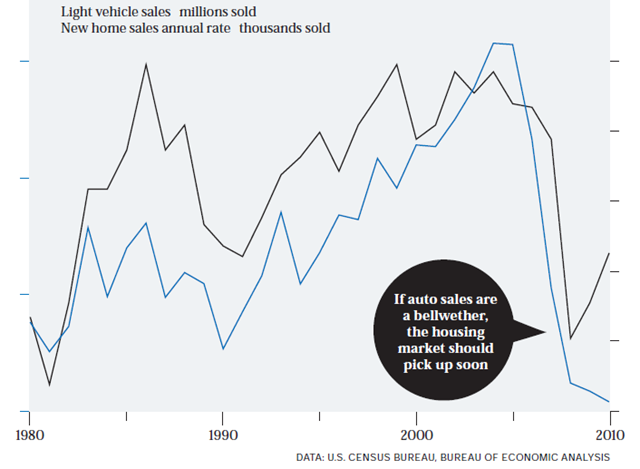
According to Business Week and Bank of America-Merrill Lynch…

Rising demand for cars and trucks signals U.S. new-home sales may jump soon.

Why?

Data from the U.S. Census Bureau and the Bureau of Economic Analysis says that new-home sales have tracked sales of lightweight vehicles in the past 40 years — and lightweight vehicles sales are on the rise.

Hmmm. 

image

Don’t Discount the Men!

February 23, 2011

TakeAway: It seems like no matter where you turn today, there’s a fascination with the idea that women are taking over – their receding unemployment rates, increased number of college degrees, etc.

However, the true growth—even in categories that courted female shoppers for years—lies with the guys.

So, while the buying power might be moving toward women in purely fiscal terms, marketers should not lose sight of the fact that it’s increasingly men who are writing up the shopping lists, hitting the stores and doing the actual spending.

* * * * *

Excerpted from Brandweek, “Women Are Wealthy, but Guys Mean Growth” By Kathy Oneto, December 5, 2010

The “everyday Joe” has been taught that it’s OK to look good, smell nice and dress well. The motivations (while varied) for this new man’s grooming activities are less about vanity than instilling confidence and creating a feeling of success. Then there’s the growth of the full-time dad. Since 2007, 6.3 million American men have lost their jobs, which has among other things served to redefine their household roles.

What’s significant about this from a marketing perspective is that as fathers assume traditional “mom” jobs such as packing lunches and doing laundry, their interest in the brands associated with these activities—from convenience foods to fabric softener—has increased proportionally.

Some brands have been prescient enough to capitalize on this gender-role drift already. Nutrisystem, for example, has defied industry norms in the weight-loss market by directing its messaging toward men. The move not only gave the brand a new base of consumers, but it also furnished Nutrisystem with an alternative to slugging it out with competing weight-loss plans for share of the same female demo.

Similarly—and after years of soft-focus commercials full of soft-skinned women—the Dove soap brand made a play for the masculine market with a new suite of products called Dove Men + Care, which emphasizes deep-cleaning over softness and signed spokesmen like the Yankee’s Joe Girardi to make clear that Dove was no longer your wife’s beauty bar.

A broadened strategic attention is necessary for any company or any brand that hopes to stay competitive and relevant in a marketplace as lean and mutable as this one is. As one target demo (women, in this case) has moved to the economic forefront, the other (men) may have been inversely impacted. But opportunity often arises from disruption. The sooner that the marketing community catches on to men as a market for goods that previously weren’t aimed at them, the sooner they’ll reap the rewards.

Edit by AMW

* * * * *

Are you doing better now ?

February 22, 2011

Key stats from date Obama was inaugurated until today.

Yeah, I know … it’s Bush’s fault.

image

Published on DickMorris.com on February 15, 2011

Honk if you want your money going to pay for gov’t employees’ pay and benefits …

February 22, 2011

Punch line: Gov’t employee unions collect dues from members … then fund political campaigns … and sponsored officials, when elected, increase members pay & benefits … so that the union can collect  more dues, etc. 

Not exactly a virtuous cysle.

Washington Examiner, In Wisconsin, it’s the unions vs. the people, 02/18/11

Liberals and the White House try to blur the issue by lumping together government unions and labor unions in general.

Obama wrongly calls Walker’s bill “an attack on unions.” It is, at its heart, a measure changing the way the state government procures labor — Walker would end single-source contracts with a politically connected special interests.

Government unions in Wisconsin perfectly match the definition of “special interests”.

Four of the top six Wisconsin contributors to the 2010 elections were labor unions … led by the state’s teachers union and  the Wisconsin chapter of the American Federation of State, County, and Municipal Employees.

Almost all of the money went to Democrats.

Government employees, as a group, matched the union contributions with most of their money going to Democrats, too.

In the romantic liberal vision of this union uprising, determined workers are standing up to the powerful.

For much of the Left, though, this about protecting the power of labor. But there’s no fat-cat owner wanting to pocket more profits here. The unions’ target in Wisconsin is the taxpayer.

At bottom, this is the unions versus the people.

Even Franklin Roosevelt said, “The process of collective bargaining, as usually understood, cannot be transplanted into the public service.”

Campaign contributions by government-sector unions, collected through mandatory dues, help elect the public officials who are then supposed to negotiate with them. “The unions sit, in effect, on both sides of the bargaining table.”

When unions overreach in the private sector, they drive their employers out of business, and so unions only flourish under those employers — governments — that can’t go out of business.

While governments won’t go out of business, they are going broke.

So, many taxpayers see the likes of Gov. Walker as a rare grown-up under attack by opportunistic and utterly politicized unions populated by overpaid government workers.

With state budgets in crisis and the Democratic machinery already in all-out campaign mode, war has already been declared — and if the unions win, the people lose.

Checking in to “The Office?”

February 22, 2011

TakeAway: TV check ins give advertisers a new way to get to know their customers even more. Some believe it to be the next big thing in social networking.

* * * * *

Excerpted from Brandchannel, “Check-In, Tune In, Turn On” by Sheila Shayon, February 2, 2011

TV check-ins, aka social TV, is the newest form of online engagement. …it’s steadily growing and predicted to be a break-out trend of 2011.

Brands include GetGlue, Philo and Miso. So far, according to Clickz, GetGlue is the one to beat. Since launching in 2007, GetGlue has amassed 800,000 users, and 30,000 Twitter followers. …partnered with Discovery and HBO, and parlayed $12 million in financing from investors ….

GetGlue partnered with Fox and Fatburger … offering check-ins to the live premiere with printable Fatburger coupons redeemable for a free burger, …

Philo, … claims “tens of thousands” of users. …called it “Twitter + Foursquare For TV Fanatics.”

“[Social TV platforms are] yet another conduit by which brands, networks and sponsors can reach viewers in a contextually relevant time in a hyper-targeted way,” Levy told Clickz. “The context is relevant. They know what they’re watching, they know the demographic and they know each individual user because in general, they’re connecting [to Facebook and Twitter].”

Miso … has 100,000 users and a partnership with Oprah Winfrey’s new network, OWN.

…”People are already tying what they look at on this second screen with what’s happening on the television. The company does not have to create the habit, they merely have to co-opt it.”

Points and badges have proven their worth as social currency across virtually every cranny of the web, and now consumer proclivity for rewards has migrated back to the original screen – television.

… “Social Media and TV fanatics are ahead of the game right now and bending the rules to their will. …

Google’s Kraus acknowledges the imminent sprint for manifest destiny as advertisers are “very experimentally, viewing the second screen as an interesting tie-in opportunity.”

It’s only a matter of time before the click hits the TV screen big time – and the socialization of television becomes standard fare. It’s an evolutionary juggernaut that’s virtually unstoppable.

Edit by HH

Death by Powerpoint …

February 22, 2011

What not to do when you pitch …

Thanks to MM for feeding the lead.

Majority rule or mob rule … I’m confused.

February 21, 2011

I’m getting confused.

When is majority rule good and mob rule bad?

And when is mob rule good and majority rule bad?

In Egypt, mob rule was good because majority rule – in the form of free and open elections – was being suppressed. Plus, Mubarek was a thug – albeit “our” thug for 30 years. 

Pushing aside the fact that the protesters on the square (about 100,000) were an infinitesimal part of the county’s population (about 83 million), I get that one.

In Wisconsin, mob rule is good and majority rule is bad.  Huh?

The clear majority of Wisconsin voters elected a GOP governor and GOP majorities in their state’s Senate and Assembly.  They got to work and prepped legislation to make government workers pay some (versus none) of their health insurance premiums and pension benefits.

So, the Dem Senators – who knew they were going to lose the vote to the majority —  left the state to preclude a quorum for the passing of any legislation.

Democracy at work ?

And, thousands of teachers were suddenly too sick to work, and sick enough to get sight-unseen notes from cause-supportive doctors, but healthy enough  protest in Madison – where they were complemented by bus loads of union and and Dem operatives – some from Wisconsin, some not – all encouraged by no less than President Obama.

So, the multi-state mob is good, the majority of voters is bad.

I’m having trouble with that one.

Now the big question.

If we’re switching from majority rule to mob rule, how many folks have to march on Washington to get ObamaCare repealed?

I figure that since 100,000 out of 83 million was good enough in Egypt … and 50,000 out of 5 million is good enough in Wisconsin … it should take only about 500,000 congregated protesters in the U.S.

I think the Tea Party could muster that number.

Hmmm.  Let’s be consistent, right ?

Anyone care for a Buck Range Light or a Big Flats?

February 21, 2011

TakeAway: New beer brands from retail giants Supervalu and Walgreens are part of a growing effort by chain stores to make a hit of private-label beer, a category that has proved difficult for retailers.

The retailers are trying to tempt shoppers with lower-priced alternatives to domestic mass-market brews such as MillerCoors’ Keystone Light.

The effort comes amid declining sales volumes for the beer industry, which has been hurt by stubbornly high unemployment.  But store-branded beers have struggled to gain traction for years in the U.S., in part because beer is typically consumed in social settings and brand image is important.

* * * * *

Excerpted from WSJ, “Private-Label Beers Take a Shot at Earning Joe Sixpack’s Respect” By David Kesmodel, February 8, 2011

Supervalu, the third-largest U.S. grocery chain by revenue, began selling Buck Range Light, a low-priced domestic brew (12-pack of cans for as little as $5.99), in December. Drugstore chain Walgreens recently began offering Big Flats 1901 for as little as $2.99 a six pack. Costco rolled out craft beers under its Kirkland Signature brand in December 2008.

Part of the attraction for retailers is that sales of other store-branded goods—from soap to pasta—have been robust. Revenue for private-label products rose 2% last year in food, drug and mass-merchandise outlets, according to market-research firm Nielsen Co., compared with a 1% decline for branded items.

Annual sales for the U.S. beer market are about $96 billion, according to market-research firm Beverage Information Group. MillerCoors, which has a 29% share of the U.S. beer market, argues that house brands can pose downsides for the whole beer category. “Retailers should be cautious about over-proliferating their beer shelf with private label, unsupported brands that can commoditize the category”. Dave Peacock, president of Anheuser’s U.S. division, said “the industry is defined by players who invest heavily behind brands.” Anheuser-Busch controls about 48% of the U.S. beer market by volume.

Industry observers said it could be tough for Walgreens and Supervalu to build a following for their new brews. “I think it’s a hard sell, mainly because nobody has succeeded on the low-end with private-label beer,” said Harry Schuhmacher, publisher of the newsletter Beer Business Daily.

Edit by AMW

* * * * *

We’re all “special” … yeah, right.

February 18, 2011

Our parents told us we were special.

But, we all knew they were just doing their jobs.

These days, “awards proliferation” is picking up where mom and dad left off … confirming that we’re all special.

In “Everyone’s a Winner,” sociologist Joel Best concentrates primarily on America’s self- congratulatory culture.

Everywhere the author turns his gaze—from bumper stickers that boast about “my kid the honor-roll student” to boosterish “employee of the month” awards — Mr. Best sees a proliferation of prizes that seems to arise from a desperate desire to exclude fewer and fewer people from the winner’s podium.

Literary prizes are now given for every kind of category, including 12 different kinds of detective fiction recognized by the Mystery Writers of America’s Edgar awards. The nominees for the Best Picture Oscar (nominations themselves are awards) have recently doubled from five to 10, and the number of Grammy awards given out last Sunday night came to more than 100. Valedictorians were once unique; now some high schools have dozens.

The tendency to create social subsets in which we may be recognized for “excellence,” in Mr. Best’s view, is also evident in the explosion of rankings and “best of” lists in recent decades—including everything from colleges and plastic surgeons to car-repair shops and hamburgers.

Such prizes and rankings …  are often self-created and thus abundant.

One question that Mr. Best does not address is whether the many winners among us actually believe our own hype.

Martin Chuzzlewit noted long ago that many of us think we are among “the most remarkable people in America.”

WSJ, Why We’re All Above Average, Feb.16, 2011.

Wisc. gov’t unions to Dem Senators: “We own you !” … Dem Senators: “Let’s get outta here"

February 18, 2011

The rubber seems to have hit the road in Wisconsin.

Scott Walker was elected governor last November.

His platform: get the state budget under control.

So, he and GOPers in the Wisc statehouse drafted a law that would make public workers pay half the costs of their pensions and at least 12.6 percent of their health care coverage – about half of what private sector folks pay.

Currently, the Wisc gov’t workers pay ZERO towards health insurance and pensions.

So, they’re taking the proposed law pretty seriously – shutting down schools (thousands of suddenly sick teachers), marching en masse on the statehouse and the homes of the governor and legislators, carrying signs depicting the governor as Hitler and Mubarek. They’re being praised in lib media as “Midwestern Egyptians”.

In response, all of the Dem state Senators left the state for an Illinois resort — to preclude a quorum.  So, the legislature couldn’t vote the law up or down.

Police were dispatched to round up the escaped Senators, but got stalled at the Wisc state line.

President Obama piped in –- not to praise the fiscal responsibility or condemn the protesters incivility – but to assert that Wisc GOPers are simply trying to break the unions.

I guess that’s why FDR – Obama’s idol – thought that gov’t employee unions shouldn’t be allowed.

Geez.  You can’t make this stuff up.

AP, Wis. lawmakers flee state to block anti-union bill, Feb. 17, 2011

Mobile ads more effective than TV … ring, ring.

February 18, 2011

TakeAway: Data showing effectiveness of mobile advertising, specifically Apple’s iAd platform just released.

Folks seeing ads on their mobile devices via iAds are more likely to remember the brand, like the product and want to buy it more than those who see an ad on TV.

* * * * *

Excerpted from AdAge, “Apple, Campbell’s Say iAds Twice as Effective as TV” by Kunar Patel, February 3, 2011

It’s been seven months since the first iAds — …and now that those campaigns are over, we’re seeing the first effectiveness study, funded by Apple and one of iAd’s early adopters, Campbell’s.

In it, is a fairly big claim: Those exposed to one of Campbell’s iAds were more than twice as likely to recall it than those who had seen a TV ad. …the five-week study showed that iAd consumers remembered the brand “Campbell’s” five times more often than TV ad respondents and the ad messaging three times more often.

IAd respondents intended to purchase Campbell’s four times more than the TV group and that they liked the ad five times more.

… Apple is looking for data that would persuade existing marketers to renew or increase their initial investment as well as win over new advertisers standing on the sidelines. The problem Apple is facing is for their high cost of entry — a reported $1 million minimum for first-run advertisers — many other options exist for mobile advertising, including rich-media competitors like Medialets that look and feel a lot like an iAd.

… Out of 53 million impressions, 1% of users that saw the ad clicked through and spent an average of nearly one minute perusing it. …these results for iAd also beat the marketer’s benchmarks for static banner ads.

… “This does show, in really traditionally brand metric terms, that iAd really outperformed.”… The study was put in place to validate mobile, a relatively new medium for the marketer.

The brand is struggling with preconceptions of the decades-old brand and iAd was a way to frame the brand in a new light.

…the survey could also reflect overall demographic differences of each medium, or the targeting that Campbell’s used in their iAd campaign. The iAd sample was weighted to reflect the iPhone and iPod Touch universe in terms of age, gender and income, while TV survey results were weighted for a general TV audience.

Edit by HH

* * * * *

Cracking down on – you guessed it – those evil, profiteering tanning salons …

February 17, 2011

Here’s the latest from our pro-business, big picture President …

Baked into President Obama’s budget, the Internal Revenue Service will get 1,054 new auditors and staffers and new facilities at a cost to taxpayers of more than $359 million in fiscal 2012 just to watch over the initial implementation of President Obama’s healthcare reforms.

Among the new corps will be 81 workers assigned to make sure tanning salons pay a new 10 percent excise tax.

Their cost: $11.5 million.

US News, Healthcare Reform Law Requires New IRS Army,  February 15, 2011

He may take his eye off Egypt and the US Economy, but he maintains a sharp focus on the tanning salons.

Forget the jugular, just go right for the capillaries.

Thanks to SMH for feeding the lead

I took this to a drugstore and they didn’t even know what it was …

February 17, 2011

In my marketing strategy class, we were chatting about product life cycles, and I commented that being the ‘last guy standing’ in a declining market can be a profitable position since the last guy is by definition a monopolist, and momopolists are positioned to make beaucoup d’argent — that is, lots of money.

A student pointed out that might be true … until the declining market just flat out dies.

Good point …  supported by an interesting story about the end of a photography era and an iconic brand:

A sign on the wall reads: “I took this to a drugstore and they didn’t even know what it was”.

Dwayne’s Photo, a small family business has through luck and persistence become the last processor in the world of Kodachrome, the first successful color film and still the most beloved.

Kodachrome …  is noteworthy in no small part for how long it survived.

Created in 1935, Kodachrome was an instant hit as the first film to effectively render color.

Even when it stopped being the default film for chronicling everyday life — thanks in part to the move to prints from slides — it continued to be the film of choice for many hobbyists.

That celebrated 75-year run from mainstream to niche photography is scheduled to come to an end on Thursday when the last processing machine is shut down at Swayne’s —  to be sold for scrap.

Kodachrome rewarded generations of skilled users with a richness of color and a unique treatment of light that many photographers described as incomparable even as they shifted to digital cameras.

Kodak stopped producing the film last year.

At the peak, there were about 25 labs worldwide that processed Kodachrome. That number got winnowed down to one – Dwayne’s.

Last year, Kodak stopped producing the chemicals needed to develop the film.

The last frame of the last roll to be processed: a picture of all Dwayne’s employees standing in front of the store wearing shirts with the epitaph: “The best slide and movie film in history is now officially retired. Kodachrome: 1935-2010.”

NYT, For Kodachrome Fans, Road Ends at Photo Lab in Kansas, December 29, 2010

Thanks to DM for feeding the lead

If a tree falls in the woods …

February 17, 2011

I always find these numbers interesting …

From the latest ratings book:

  • O’Donnell is holding most of Olberman’s viewers
  • Piers Morgan is beating King’s numbers
  • Nobody is close to O’Reilly

Overall, MSNBC is approaching public access numbers …

image

Source: Drudge

The solution is high-speed rail … what, pray tell, is the problem?

February 16, 2011

Seriously, have you heard anybody (except Reid & Obama) say “man, what this country needs is a $53 billion  “national high-speed rail system” ?

I sure haven’t.

Except for connecting liberal bastions DC, NYC and Boston .., and Disneyland and Las Vegas … I can’t figure out where it would run … and more important, who would ride it ?

Robert Samuelson of Newsweek sees a few other holes in the program …

The rail proposal casts doubt on the administration’s commitment to reducing huge budget deficits.

High-speed rail would definitely be big.

Transportation Secretary Ray LaHood has estimated the administration’s ultimate goal – bringing high-speed rail to 80 percent of the population – could cost $500 billion over 25 years.

For this stupendous sum, there would be scant public benefits. Precisely the opposite. Rail subsidies would threaten funding for more pressing public needs: schools, police, defense.

How can we know this? History, for starters.

In 1970, Congress created Amtrak to preserve intercity passenger trains.  The idea was that the system would become profitable and self-sustaining after an initial infusion of federal money. This never happened. Amtrak has swallowed $35 billion in subsidies, and they’re increasing by more than $1 billion annually.

Despite the subsidies, Amtrak does not provide low-cost transportation. Fares on Amtrak’s high-speed Acela start at $139 one-way; A comparable roundtrip bus fare: $21.50.

Nor does Amtrak do much to relieve congestion, cut oil use, reduce pollution or eliminate greenhouse gases. Its traffic volumes are simply too small to matter.

Measured by passenger-miles traveled, Amtrak represents one-tenth of 1 percent of the national total.

The reasons passenger rail service doesn’t work in America are well-known: Interstate highways shorten many trip times; suburbanization has fragmented destination points; air travel is quicker and more flexible for long distances.

Even if ridership increased fifteenfold over Amtrak levels, the effects on congestion, national fuel consumption and emissions would still be trivial.

What’s disheartening about the Obama administration’s embrace of high-speed rail is that it ignores history, evidence and logic.

The case against it is overwhelming.  High-speed rail is not an “investment in the future”; it’s mostly a waste of money.

High Speed Rail a Fast Track to Waste, February 14, 2011

How high are your property taxes?

February 16, 2011

If you want to know how your county stacks up against others in the US, here’s a very cool interactive tool from the Tax Foundation … reports data for every county in the US

image

http://interactive.taxfoundation.org/propertytax/

Congrats on your new baby … need some Disney duds?

February 16, 2011

TakeAway: The Walt Disney Company wants to clothe newborns with its newest priority, Disney Baby.

Its distribution model starts with 580 maternity hospitals in the United States.

A representative visits a new mother and offers a free Disney Cuddly Bodysuit, a variation of the classic Onesie.

* * * * *

Excerpted from NYTimes, “Disney Looking Into Cradle for Customers ” By Brooks Barnes, February 6, 2011

In bedside demonstrations, the bilingual representatives extol the product’s bells and whistles — extra soft! durable! better sizing! — and ask mothers to sign up for e-mail alerts from DisneyBaby.com.

In this new venture, the company gains access to the maternity hospitals through a company called Our365, a business that sells bedside baby pictures.

Our365 pays hospitals for exclusive access, and companies like Disney pay Our365 to promote their own products.


More than 200,000 bodysuits will be given away by May, when Amazon.com is set to begin selling 85 styles for a starting price of $9.99 for two; Nordstrom and Target will follow with more Disney Baby items, including hats.

The endeavor dances close to a flame. Disney has suffered harsh criticism in recent years over products directed at the very young. The fiercest battle has involved Baby Einstein, the Disney-owned maker of “developmental and entertainment” videos and toys for babies and toddlers. The Campaign for a Commercial-Free Childhood, a nonprofit organization, claimed victory in 2009 when Disney, apparently acknowledging that the products did not turn babies into geniuses after all, offered some Baby Einstein refunds.

Certainly hospitals have given new mothers gift bags for decades. In recent years, however, more have banned the practice, citing criticism that free baby formula, for example, discourages breast-feeding. Privacy also is a concern.

Disney already operates a line of licensed products for infants, but results have been limited because Disney has relied almost entirely on simple licensing deals with companies like Kimberly-Clark, the maker of Huggies diapers. Grouping baby products under one brand that is controlled and heavily marketed by Disney represents a bigger opportunity.

Edit by AMW

* * * * *

Reducing the propensity to work …

February 15, 2011

Parent-to-parent chat line: “I told my son he’d better find a job so he has health insurance”

I’ve heard that refrain dozens of times from parents, so I should have picked up on this earlier …

Last week, CBO Director Elmendorf dropped a bomb at a Congressional hearing when he testified that ObamaCare would reduce the “propensity to work”.

English translation: under ObamaCare, if you don’t work, no problem.  You’ll get free health care from the government.

Well, actually, it’s not free – it’s just paid for by people who do work.  You know, tax payers.

Complement that “benefit” with a couple of years of unemployment compensation and why on earth would anybody take a relatively low paying job.

Kick back.  Relax.  And if you get sick, just send the bills to 1600 Pennsylvania Ave.

Elmendorf says the new ObamaCare entitlement will reduce employment by about 800,000 workers … as the labor force shrinks by about half a percentage point .

Mr. Elmendorf said that the law won’t eliminate jobs, it will reduce “the propensity to work.”

As with any other government subsidy, people receiving “free” health care won’t have as much incentive to search for a job or work full time.

On that score, Chris Van Hollen, the ranking Democrat on the Budget Committee, asked Mr. Elmendorf a leading question about “the freedom to choose to not get a job.”

I guess Van Hollen thinks people shouldn’t be forced to work if the don’t want to.

Hmmm.

Hey, that handbag is a fake !

February 15, 2011

TakeAway: Counterfeit products, especially low quality versions can damage a brand’s reputation.

For pharmaceutical products, counterfeits can also be very dangerous.

There are some promising new solutions to thwart counterfeiters like the one described below.

* * * * *

Excerpted from brandchannel, “New Tag Aims to Impede Chinese Counterfeiting,” by Barry Silverstein, February 2, 2011

Counterfeit branded products continue to plague legitimate marketers both on the street and online. Fueled by wary consumers seeking bargains and a global economy hampered by weak or non-existent intellectual property protection, phony goods skyrocketed last year, and this year will likely be no different.

Counterfeiting is a global problem, but it seems that China has developed a reputation as ground zero for fake brands. In China, counterfeiting is a black market industry that goes far beyond luxury brands, pervading virtually every product category.  …

Now the Leo Burnett ad agency thinks it may have the ultimate solution — the 1-TAG, a proprietary anti-counterfeiting application … which can be applied to a product during manufacturing and serve as “a signature authentication.”

With the 1-TAG, products “can be verified and authenticated at every stage of their manufacture and distribution, right through to the consumer.” The brand manufacturer can associate data to the tag code, including a product description, the manufacturing date, a product expiration date, and the product’s destination.

A salesperson or a consumer uses a standard mobile phone camera to “decode” the information via a free software application loaded on the phone. Burnett says the 1-TAG can be valuable for supply-chain inspections and to authenticate a product every step of the way. So the 1-TAG is both a behind-the-scenes product control mechanism, as well as something the consumer can use to protect herself against brand fakes.

The 1-TAG is currently in development and is likely to be tested in China soon. Burnett intends to market and sell 1-TAG beyond its own clients and potentially roll it out on a global basis. …

Edit by DMG

* * * * *