Archive for July, 2009

Housing prices: might be hitting bottom … and, taking a long-term perspective, not as bad as they sound

July 31, 2009

Ken’s Take: Understandably, the focus on home prices tends to be on the recent month-to-month and year-to-year changes – since that’s what hits people’s net worth.  There appear to be some signs that some markets are bottoming out.

Usually lost in the shuffle is the fact that longer term, say back to 2000, housing prices in many (most?) markets have shown “healthy” annualized increases – even after adjusting for the market crash. For example, current housing prices in the DC market translate to an annualized inflation rate of about 6% since 2000.

Of course, that isn’t much consolation to folks who bought their houses during the boom period.

* * * * *

Annualized since 2000

The Case Shiller indices have a base value of 100 in January 2000. So a current index value of 150 translates to a 50% appreciation rate since January 2000 for a typical home located within the metro market.

image

* * * * *

Monthly and Annual Changes

Source: WSJ, Case-Shiller July 2009 update, July 29,2009

The S&P/Case-Shiller home-price indexes, a closely watched gauge of U.S. home prices, posted their first month-to-month increase in nearly three years in May, but annual weakness continued. (See charts below)

Las Vegas and Phoenix continued to posted the largest monthly and annual declines. Phoenix is down 55% from its peak in June 2006, while Las Vegas is off 53% from its highest level.

* * * * *

image


image

Full article and interactive chart:
http://blogs.wsj.com/economics/2009/07/28/a-look-at-case-shiller-numbers-by-metro-area-july-2009-update/

* * * * *

Looking for ideas in all the right places … different right places

July 31, 2009

Ken’s Take: Lots is written on how to be innovative. This is a nice checklist of frequently used methods …

* * * * *

Extracted from WSJ, “In Search of Innovation”, Bessant, June  23, 2009

When companies try to come up with new ideas, they too often look only where they always look. That won’t get them anywhere.

If you want to understand why some companies lack innovative ideas, think about the man who can’t find his car keys.

His friend asks him why he’s looking for the keys under the lamppost when he dropped them over on the lawn. “Because there’s more light over here,” the man explains.

Innovative ideas, however, don’t really come from nowhere. Instead, they are typically at the edge of a company’s radar screen, and sometimes a bit beyond: trends in peripheral industries, unserved needs in foreign markets, activities that aren’t part of the company’s core business.

In other words, they have to look away from the lamppost.

None of this is easy to do. But companies that succeed may just recognize the next great opportunity, or looming threat, before their competitors do.

Here are nine examples of practices with the potential to produce a company’s eureka moment.

BUILD SCENARIOS
Many companies use teams of writers with diverse perspectives to create complex scenarios of what future markets may look like. The writers try to imagine detailed opportunities and threats for their companies, partners and collaborators. An oil company that wants to explore energy opportunities in cities of the future, for example, might want to work on scenarios with writers from construction, water and utility-management companies.

SPIN THE WEB
A few companies have created Web sites that act as literal marketplaces of ideas. InnoCentive.com is a site where people and companies look for help in solving scientific and business challenges. Posters of challenges sometimes offer cash rewards for solutions: Amounts have ranged from $5,000 to $1 million. Problem solvers can be professionals, retired scientists, students or anyone who can answer a problem that has stumped a company’s own researchers.

ENLIST LEAD USERS
Ideas and insights from so-called lead users can be the starting point for new markets, products and services.

Lead users are innovators themselves. They tend to be people working in or using products in a specific market who are frustrated by the tools, goods or services currently available and yearn for something better. Many medical devices, for example, originate from sketches drawn by surgeons, surgical nurses and other medical staff who feel driven to experiment with new ideas because current products aren’t meeting their needs. They are often supportive, and tend to tolerate product failures as part of a process that helps bring about improvements.

DEEP DIVE
Interest has surged in market research that uses detailed, firsthand observation to learn more about consumers’ needs or wants. Deep diving is one of many terms used to describe the approach, which resembles an anthropological study in the way researchers immerse themselves in the lives of the target consumers.

Such approaches can help uncover underserved or unserved markets and give clues to new directions and new frames in which to search for innovative ideas.

PROBE AND LEARN
Some companies design probe-and-learn strategies that study opportunities in segments of markets the company isn’t active or strong in. This strategy goes further than deep diving by actively experimenting with new ideas in a new context. The experiments might not always work, but they will give valuable insight about future directions of markets.

MOBILIZE THE STAFF
By engaging more of its own workers in the search for innovation, a company can broaden its vision. For example, the duties of procurement, sales or finance groups can be expanded to include learning about trends they encounter that ordinarily might be considered not of primary interest to the company.

CATER TO ENTREPRENEURS
Innovation can bubble up inside a company as well—when the organization follows practices that favor it.

Clear policies that reserve blocks of time for scientists or engineers to explore their own ideas have worked well at some companies. At 3M Co., based in St. Paul, Minn., scientists can spend 15% of their time on projects they dream up themselves, and the company has set procedures to take bright ideas forward, including grants and venture funding. Google Inc. takes a similar approach, allowing researchers to devote 20% of their schedules to play time, pursuing their own ideas and projects.

It helps to have an established pathway to make sure the best new ideas get taken forward. In some cases, informal networking has pushed innovations to the forefront—below the radar screen of formal corporate systems.

START A CONVERSATION
Sometimes innovations arise when different departments talk to each other. But what’s the best way to start the conversation?

Many companies set up so-called communities of practice, which are typically internal Web sites where employees are encouraged to share knowledge and skills important to the company.

BREED DIVERSITY
Close, long-term relationships—depending too much on the same customers, partners or suppliers for innovation ideas—can reinforce old ways of doing things and make changing a frame of reference difficult.

Some companies seek innovation partners with whom they wouldn’t normally work, and who might bring a fresh perspective. Some companies are also recruiting staff with very different perspectives to spice up their knowledge mix e.g.  experienced entrepreneurs. Such characters aren’t afraid to challenge corporate perspectives and to make waves. As one manager put it, they create a little grit to stimulate the oyster to produce pearls.

full article:
http://online.wsj.com/article/SB10001424052970204830304574133562888635626.html

* * * * *

By the numbers: The healthcare tail that’s wagging the dog …

July 30, 2009

According to recent polls

91% of all Americans have insurance …,

84% of Americans who have health insurance are happy with their coverage….

That means that 76% of all Americans will be concerned about anything that threatens their current coverage.

By a 2-1 margin, Americans want coverage from a private provider rather than the government.

* * * * *

Of those who do not have insurance—and who therefore might be better off under OnamaCare

Approximately one-fifth are illegal aliens …

Nearly three-fifths make $50,000 or more a year and can afford insurance (and most have access to plans)

And just under a third are eligible for Medicaid or other government programs already (but haven’t signed up).

The slice of the uninsured that is left is perhaps about 2% of all American citizens

* * * * *

So, spend $1 trillion and put the world’s greatest health-care system at risk ?  Hmmmm.

Excerpted from: WSJ,  Obama’s Great Health Scare, July 29, 2009
http://online.wsj.com/article/SB10001424052970204619004574318334081271414.html

* * * * *

Outback’s $9.99 menu lures budget-strapped boomers …

July 30, 2009

Disclaimer: I’m not unbiased.  Outback is the Homa family restaurant of choice for fancy family meals.

Ken’s Take:  It’s always risky to move away from your traditional value proposition.  Outback is known for a quantity not quality.  Reducing the quantity – even with a commensurate cut in prices – could alienate core customers (like me).

Note that customers get lured in by the lower prices, but end up spending about the same amount as before.  Another marketing triumph, right ?

* * * * *

Business Week, The Leaner Baby Boomer Economy, July 23, 2009

[Hit by the recession], Outback Steakhouse  … reduced menu prices and offered smaller cuts of beef at Outback to maintain margins … and has gone on an ad blitz pushing the more modest portions for $9.99. This is obviously a tricky balancing act at Outback, where a big slab of meat was the chain’s main attraction.

The good news, says Chief Branding Officer Jody Bilney, is that people who order the less expensive entrées typically end up buying dessert or more alcohol, so the average ticket is still about $19 per person.

Full article – includes vignettes on BMW, Starwood Hotels and others:
http://www.businessweek.com/magazine/content/09_31/b4141026524433.htm

* * * * *

“If you’re happy with your healthcare plan, you can keep it” … well. not exactly.

July 29, 2009

Now that the proposed healthcare reform bills are available for public consumption, folks are reading the fine print and some disconcerting details are surfacing are surfacing.

Fortune has a nice summary article with some of the “give-ips” …

* * * * *

Fortune, “5 freedoms you’d lose in health care reform”, June 24,2009

“Read the fine print in the Congressional plans and you’ll find that a lot of cherished aspects of the current system would disappear.

  • If you prize choosing your own cardiologist or urologist under your company’s Preferred Provider Organization plan (PPO) …
  • If your employer rewards your non-smoking, healthy lifestyle with reduced premiums,
  • If you love the bargain Health Savings Account (HSA) that insures you just for the essentials, or
  • if you simply take comfort in the freedom to spend your own money for a policy that covers the newest drugs and diagnostic tests

You will lose all of those good things (and more) under the rules proposed in the two bills that herald a health-care revolution”

Full article:
http://money.cnn.com/2009/07/24/news/economy/health_care_reform_obama.fortune/index.htm?postversion=2009072410

* * * * *

A throttle on healthcare costs: too few doctors …

July 29, 2009

Ken’s Take: Whenever my family talks about how the healthcare system is broken, the conversation usually centers on how hard it is to get an appointment to see a doctor.  Turns out, doctors are in short supply – it’s not just an illusion.  And,  healthcare reform proposals add to demand (more people insured to get more services), but don’t add to the supply of doctors and other medical professionals.

Side note: A friend reminded me that MDs are among the 45 million uninsureds – they often comp services to each other, so don’t need garden variety health insurance.  That’s about 1 million out of the 45 million.

* * * * *
Excerpted from USA TODAY, Medical miscalculation creates doctor shortage, March 21,2005

Many Americans may soon face a shortage of physicians that makes it hard to find convenient, quality health care. The shortage will worsen as 79 million baby boomers reach retirement age and demand more medical care unless the nation starts producing more doctors, according to several new studies.

The country needs to train 3,000 to 10,000 more physicians a year — up from the current 25,000 — to meet the growing medical needs of an aging, wealthy nation, the studies say. Because it takes 10 years to train a doctor, the nation will have a shortage of 85,000 to 200,000 doctors in 2020 unless action is taken soon.

The predictions of a doctor shortage represent an abrupt about-face for the medical profession. For the past quarter-century, the American Medical Association and other industry groups have predicted a glut of doctors and worked to limit the number of new physicians.

The nation now has about 800,000 active physicians, up from 500,000 20 years ago. They’ve been kept busy by a growing population and new procedures ranging from heart stents to liposuction.

But unless more medical students begin training soon, the supply of physicians will begin to shrink in about 10 years when doctors from the baby boom generation retire in large numbers.

“Almost everyone agrees we need more physicians … The debate is over how many.”

The United States dramatically expanded the number of doctors being trained in the 1960s and 1970s, creating two new physicians for every one that retired.

Today, new physicians roughly equal the number of doctors retiring. Within a decade, baby boom doctors licensed in the 1960s, 1970s and 1980s will retire in large numbers that will outstrip the 25,000 new doctors produced every year.

The marketplace doesn’t determine how many doctors the nation has, as it does for engineers, pilots and other professions. The number of doctors is a political decision, heavily influenced by doctors themselves.

Congress controls the supply of physicians by how much federal funding it provides for medical residencies — the graduate training required of all doctors.

To become a physician, students spend four years in medical school. Graduates then spend three to seven years training as residents, usually treating patients under supervision at a hospital.

Medicare, which provides health care to the nation’s seniors, also is the primary federal agency that controls the supply of doctors. It reimburses hospitals for the cost of training medical residents.

The government spends about $11 billion annually on 100,000 medical residents, or roughly $110,000 per resident.

In 1997, to save money and prevent a doctor glut, Congress capped the number of residents that Medicare will pay for at about 80,000 a year. Another 20,000 residents are financed by the Veterans Administration and Medicaid, the state-federal health care program for the poor. Teaching hospitals pay for a small number of residents without government assistance.

Demographic changes in the medical profession also contribute to the need for more physicians. Nearly half of new physicians are women, who work an average of 25% fewer hours than male physicians, Cooper says.

Physicians older than 55 work about 15% less than younger doctors.

Most worrisome, the retirement of baby boom physicians means the number of doctors will start falling just as the first baby boomer turns 70 in 2016.

Because physicians are affluent and in short supply, they tend to locate where they want to live — not necessarily where the most patients are.

Particularly scarce are old-fashioned specialists — general surgeons, radiologists, anesthesiologists — who have a wide range of duties.

Doctors gravitate to high-paying practices — such as sports medicine and total body scans — that serve the wealthy and well-insured at the expense of Medicare patients and others.

“This is a desperate situation. And we need to act now because it takes a long time to train a doctor.”

The U.S. stopped opening medical schools in the 1980s because of the predicted surplus of doctors.

Florida State University’s College of Medicine, the first new medical school since 1982, will graduate its first class this year. Arizona, Nevada, California and Florida are considering opening additional medical schools. Other states are considering expanding theirs.

http://www.usatoday.com/news/health/2005-03-02-doctor-shortage_x.htm

* * * * *

Must Read: 10 Questions re: Healthcare Reform

July 28, 2009

Ken’s Take: Why weren’t any of these questions asked at last week’s press conference?

This guy cuts to the chase …

* * * * *

Exreacted from RCP, “10 Questions for Supporters of ObamaCare”, Dennis Prager,  July 28, 2009

1. If Medicare and Medicaid are fiscally insolvent and gradually bankrupting our society, why is a government takeover of medical care for the rest of society a good idea?  Why not simply see how the Democrats can reform Medicare and Medicaid before nationalizing much of the rest of health care?

2. President Obama reiterated this past week that “no insurance company will be allowed to deny you coverage because of a pre-existing medical condition.”  But if any individual can buy health insurance at any time, why would anyone buy health insurance while healthy? Why would I not simply wait until I got sick or injured to buy the insurance? The whole point of insurance is that the healthy buy it and thereby provide the funds to pay for the sick. And if the answer is that the government will now make it illegal not to buy insurance, how will that be enforced? How will the government check on 300 million people? Will  life insurance companies also be forced to sell life insurance to the terminally ill?  

3. Why do supporters of nationalized medicine so often substitute the word “care” for the word “insurance?” it is patently untrue that millions of Americans do not receive health care. Millions of Americans do not have health insurance but virtually every American (and non-American on American soil) receives health care.

4. No one denies that in order to come close to staying within its budget health care will be rationed. But what is the moral justification of having the state decide what medical care to ration?

5.  Given how many lives — in America and throughout the world – American pharmaceutical companies save, and given how expensive it is to develop any new drug, will the price controls on drugs envisaged improve or impair Americans’ health?  While 20 years ago pharmaceuticals were largely developed in Europe, European price controls made drug development an American enterprise. Fifteen of the 20 top-selling drugs worldwide this year were birthed in the United States.

6. Do anyone really believe that private insurance could survive a “public option” … given that private companies have to show a profit and government agencies do not have to – and given that a private enterprise must raise its own money to be solvent and a government option has access to others’
money — i.e., taxes?

7. Why will hospitals, doctors, and pharmaceutical companies do nearly as superb a job as they now do if their reimbursement from the government will be severely cut? Haven’t the laws of human behavior and common sense been repealed here in arguing that while doctors, hospitals and drug companies will make significantly less money they will continue to provide the same level of uniquely excellent care?

8. Given how many needless procedures are ordered to avoid medical lawsuits and how much money doctors spend on medical malpractice insurance, shouldn’t any meaningful “reform” of health care provide some remedy for frivolous malpractice lawsuits?

9. Given how weak the U.S. economy is, given how weak the U.S. dollar is, and given how much in debt the U.S. is in, why would anyone seek to have the U.S. spend another trillion dollars?

10. Contrary to the assertion of President Obama — “we spend much more on health care than any other nation but aren’t any healthier for it” — we are healthier. Our life expectancy with virtually any major disease is longer. And if you do not count deaths from violent crime and automobile accidents, we also have the longest life expectancy. Do you think a government takeover of American medicine will enable this medical excellence to continue?

Full article:
http://www.realclearpolitics.com/articles/2009/07/28/10_questions_for_supporters_of_obamacare_97651.html

* * * * *

Patient: “I need to see the doctor” … Receptionist: “What are you doing 7 weeks from Tuesday at 1:30 ?” … sound familiar?

July 28, 2009

Real case :   Wife Kathy called to get an appointment with a demotologist to have a suspicious mark checked out.  First open slot – mid October… in 10 weeks.

Ken’s Take: So, will cutting pay rates for docs increase or decrease the supply of doctors – who get trained & certified, and who stay in the doctoring business.  Do any of the bills being circulated provide for more seats at existing med schools or funding new medical schools.  Answer: no.

* * * * *

Knowledge@Wharton,  Another Hurdle to Health Care Reform: Too Few General Practice Doctors,  July 22, 2009 

According to a recent survey by Merritt Hawkins, the average wait time to see a family doctor for a routine physical ranged from seven days in Miami to 63 days in Boston.

In eight of 15 metropolitan areas surveyed by the company, it took at least 14 days to be seen by a family physician.

Why ?

The American Association of Medical Colleges (AAMC) projects that … there will be a be a shortage of 124,000 doctors of all types by 2025, although the number could climb to as high as 159,000.

The supply of primary care physicians is already tight in some parts of the country, and finding a general practice doctor will probably become even harder if the pool of insured Americans expands.

“The biggest chokepoint in the health care system will be the availability of primary care doctors,”  … The physician bodies just aren’t there.”

Experts are particularly worried about a dearth of doctors to focus on primary care services, including routine checkups and sick visits. There are already primary care physician shortages

Full article
http://knowledge.wharton.upenn.edu/article.cfm?articleid=2297

* * * * *

Timely Reprise: About all those uninsured folks …

July 27, 2009

Ken’s Take: The subject of “covering the uninsureds” drives me nuts.  First, the pol-preachers are either sloppy and /or very disingenuous with the numbers.  Second, they talk about the uninsureds as a homogeneous group – they’re not.  Third, the only prescription is to throw money at them.

Below is a reprised post from June that breaks down the numbers. 

Note that over 20% of the uninsureds aren’t even U.S. citizens. I’ve seen estimates that roughly half of rhis group are illegal aliens.  Covering these non-citizens – i.e making tax payers reward them with free health insurance –- will run about $70 billion annually – that’s $700 billion over 10 years.  Count me out on that one.

Over 1/3 are folks are emplyed and make enough to afford health insurance – most of these folks have access to company plans but choose not to participate.  Why should tax payers have to throw a single dime towards their health insurance.  That’s nuts.  OK, pressure insurance companies to offer coverage for those who don’t have access to plans.  But, don’t reward them for spending on big screens instead of health insurance.

That leaves about 20 million folks. Most are between jobs.  Remember that COBRA provides access to coverage for 18 moths.  I’m OK giving these folks some subsidy since COBRA can be pretty expensive – in essence, an employer’s contribution.goes away. So, beef up unemployment benefits a bit.

The remainder of uninsureds are, I guess, poor folks.  Since they should qualify for Medicaid, I don’t understand why they’re a problem. Make them get off the couch and sign up for the existing benefits.

Why is “covering the uninsureds” the paramount issue of our time?  I don’t get it.

* * * * *

Reprised post from June 18, 2009

Re: Healthcare … How many “uninsured” Americans are there? Answer: Not 47 million.

Ken’s Take: This isn’t new news, but it continues to be overlooked in the press and in Presidential speeches.  About 1/3 of “uninsureds” aren’t US citizens; about 1/3 are young and gainfully employed who choose to self-insure.  That leaves about 15 million who need to be taken care of.  Why aren’t “they” more truthful with the numbers?

* * * * *

Excerpted from IBD, “The Phantom Uninsured”, June 16, 2009

Team Obama uses the “46 million uninsured” as a reason to nationalize health care. But the Census Bureau says about a fifth of those aren’t U.S. citizens. In fact, a goodly number are illegal aliens.

According to “Income, Poverty, and Health Insurance Coverage in the United States,” a Census Bureau report published last August, of the 45.6 million persons in the U.S. that did not have health insurance at some point in 2007, 9.7 million, or about 21%, were not U.S. citizens.

Also among the uninsured are 17 million Americans who live in households where the annual income exceeds $50,000; 7 million of those without coverage have incomes of $75,000 a year or more. Many of the uninsured are young and healthy (40% are between ages 18 and 34) and at this point in their lives, particularly in this economy, choose to put their dollars elsewhere

“Why the lack of insurance (among people who own homes and computers)? One clue is that 60% reported being in excellent health or very good health.”

For many, being uninsured is a transitory state, since most uninsured Americans are only without coverage for a short time.” In fact, a Census Bureau’s Survey of Income and Program Participation, found  that only 19 million Americans go without insurance for a full year.

Full article:
http://www.ibdeditorials.com/IBDArticles.aspx?id=330042258549199

* * * * *

Why are Obama’s ratings lower in Rasmussen polls?

July 27, 2009

Ken’s Take: Since Rasmussen was first to report Obama’s approval below 50%, his methodology is being questioned by mainstream media.  Below is a pretty clear explanation. 

Bottom line: Rasmussen samples likely voters instead of all adults and distinguishes between ‘strong’ and ‘somewhat’ approval (and disapproval).

* * * * *
From RCP,Obama Upside Down, July 24th, 2009

Rasmussen officially becomes the first poll to show the President with an upside-down approval rating.  The pollster has him at 49% approve, 51% disapprove today. Rasmussen’s polls are typically spot-on in the end, but he’s been a consistent outlier on the approval rating issue.

Part of this is that Rasmussen samples likely voters, while most pollsters are sampling adults or registered voters right now.  Likely voters typically skew Republican by a few points.  On the one hand, it is difficult to screen for likely voters this early on, but on the other hand, this could be something of a preview of whether things will go when other pollsters begin imposing likely voter screens.

The other thing is that Rasmussen gives for options:  Strongly approve, strongly disapprove, somewhat approve, and somewhat disapprove.  It may well be the case that, given a simple “approve/disapprove” rubric, many people who somewhat disapprove of the job Obama is doing are unwilling to give a complete “disapprove” answer.  By adding the “somewhat” nuance, Rasmussen may be nudging voters into the “disapprove” camp.

One final thought: Rasmussen typically has fewer undecideds than other pollsters.  It may be that people who somewhat approve or somewhat disapprove of the President are more likely to describe themselves as “undecided.”  Pushed away from the “undecided” option, these voters may then choose the “somewhat disapprove” or “somewhat approve” option; it may be that, for now, the undecideds are leaning away from Obama.  This would make sense, given the general sense of approval that has surrounded Obama’s first six months, there may be a large chunk of the populace that simply isn’t willing to voice disapproval of him right now.

At any rate, an unwelcome milestone for the President.

Source article:
http://realclearpolitics.blogs.time.com/2009/07/24/obama-upside-down/

* * * * *

Tough times all over: The days of the $330 Coach purse could be over…

July 27, 2009

Summary: Adapting to a more frugal consumer, Coach has created the less pricey Poppy line, revamping its product mix to lower its average bag price to $290

* * * * *

Excerpted from Business Week, “Coach’s Poppy Line Is Luxury for Recessionary Times”,June 18, 2009

The Coach brand  brand had emerged from its modest origins in the 1940s to become an emblem of the working woman and then, remarkably, a favorite among the fashion-conscious. It had created the very conceit of affordable luxury.

But, even before the recession Coach had become too expensive. “We have a long history of being a very grounded $200 handbag business,” he says. “Beginning around 2001 we started moving up and became a $300 handbag business. Then we reached $330. And the customer came right with us.  Until we reached our natural limits,” .

So began a nearly yearlong quest to design a line of purses and accessories that could be priced to fit the times without cheapening, or otherwise damaging, Coach’s image.

The resulting collection, which will be introduced in late June, is called Poppy. It’s more youthful, eclectic and spontaneous. The average price will be $260, about 20% less than the usual Coach purse.

The main pieces in the Poppy collection were tested in nine Coach stores and 23 department stores in April and May. And for the first time, Coach let people make online purchases through Facebook. Two $198 bags, the Groovy and the Glam, did better than Coach expected. But one didn’t do quite as well: That was the Spotlight, which sells for $298.

* * * *

Factoids

Coach spends about $5 million annually on that customer research.  It frequently surveys customers about their outlook and tastes; it carefully tests new designs; it measures almost everything.   Every three months it surveys some 20,000 women online about the Coach brand as well as about their economic expectations and spending habits.

Coach’s gross margins had been above 75% for the past five years. But during the recession, as the company has lowered prices at its factory stores, its margins have fallen to 72.4%. By comparison, brands such as Polo Ralph Lauren and Tiffany have margins of less than 60%.

Full article:
http://www.businessweek.com/magazine/content/09_26/b4137040272361.htm

* * * * *

Flash Report: Obama’s approval drops below 50%

July 24, 2009

The Rasmussen Reports daily Presidential Tracking Poll for Friday shows that 49% of voters say they at least somewhat approve of the President’s performance. Fifty-one percent (51%) disapprove.

Today marks the first time his overall approval rating has ever fallen below 50% among Likely Voters nationwide. 

30% of the nation’s voters now Strongly Approve of the way that Barack Obama is performing his role as President. Thirty-eight percent (38%) Strongly Disapprove giving Obama a Presidential Approval Index rating of -8 .

Just 25% believe that the economic stimulus package has helped the economy.

Fifty-three percent (53%) now oppose the Congressional health care reform package. That’s up eight points over the past month.

image

http://www.rasmussenreports.com/public_content/politics/obama_administration/daily_presidential_tracking_poll

* * * * *

,

The Cleveland Clinic business model: gouge the foreigners … works for me

July 24, 2009

Ken’s Take: If the U.S. healthcare system is so bad, why do foreigners from the utopian systems come to the U.S. for critical treatment? 

I like the notion of making them pay list prices – very high list prices – to offset citizen healthcare costs.

Idea: why not put a high tax on healthcare services delivered to non-U.S. citizens ?

* * * * *
WSJ, Replicating Cleveland Clinic’s Success Poses Major Challenges, July 23, 2009

The key to the Cleveland Clinic’s success, many policy makers say, is its integrated approach. Like other so-called multispecialty clinics, the Cleveland Clinic employs its own physicians, creating teams of specialists that collaborate in treating each patient. By contrast, at most traditional community hospitals, doctors remain independent, private practitioners.

The Cleveland Clinic stays profitable by offsetting its losses on Medicare patients with payments from private insurers and thousands of foreign patients who often pay its full list prices. Those prices can be two to three times higher than what U.S. insurance plans negotiate with the clinic.

Full article:
http://online.wsj.com/article/SB124831191487074451.html

* * * * *

Obama plays the race card …

July 24, 2009

As usual, I have a different take on Obama’s press conference remark that Cambridge Mass. police acted “stupidly” by arresting a prominent black academic just because he was being disorderly.

Most press reports describe that statement as an “off the cuff” remark.  I doubt it.  Obama’s prior press conference outted the administration’s careful selection of questioners and their likely (or assured) questions.  The mere fact that the question was last in the press conference leads me to conclude that it was orchestrated, and that the President’s answer was deliberate.

Why?

Though Obama campaigned as a grand uniter, he governs as a divider – rewarding folks he deems good guys (i.e. those who agree with him), and punishing those he considers bad guys (i.e. those who disagree with him).

RealClearPolitics observes “Obama maintains the strong support of his base  …  he continues to be the most polarizing modern president.”
http://www.realclearpolitics.com/articles/2009/07/23/obamas_public_support_cracking_at_6_months_97574.html

Cutting to the chase: Obama’s overall approval rating is 94% among blacks.

But 40% of whites and “others” strongly disapprove of his performance as president. 

And, though his total approval among blacks remains  sky high, the approval intensity is dropping.  Shortly after the inauguration, over 80% of blacks strongly approved of his performance as president.  That number has slipped down to 64% – still high, but eroding.

My take: Obama is a win at all costs guy. With his overall approval ratings falling and his chaotic healthcare plan faltering, he is going back to the well – revving up his core constituency – getting their intensity level back up – framing issues as “us” versus “them”.  Watch that theme spill over to the healthcare debate.

Though I think he was trying  to be clever,  it looks like the gambit failed.  Most news shows led with the “stupid white cop”  story – pushing healthcare to the backburner – and stoking even greater polarization.  Not good.

As the expression goes: “Too clever by half.”

* * * * *

Summer Read: Liberty & Tyranny by Mark Levin

July 24, 2009

Liberty & Tyranny, Mark Levin, Threshhold editions, 2009

13 weeks as #1 on the NY Times best seller list  … w/o a NY Times review or author appearances on mainstrean TV

Ken’s Take: A tightly argued case – he’s obviously a (former) lawyer.  Not much new news for card-carrying conservatives.  I recommend the book for liberals – not because it will change your minds, but because it’s an efficient synopsis of conservative thinking. Know thy enemy.

* * * *

Highlights

Levin is constitutional scholar and former lawyer turned conservative radio talk show host.  He’s quite animated on his show, so I was surprised that his book was very thoughtful.  In summary, it lays out the body of conservative logic, tying it back directly to the Constitution.

He basic thesis is that liberal progressives – who he refers to as “statists” —  consider the state (i.e. government – especially the federal government) to be supreme.  Constitutional conservatives – he argues – consider the individual to be supreme.  Preserving the rights of individuals is liberty; subordination of the rights to the is tyranny.

So, Levin argues:

For  rights bestowed from a higher authority (i.e. God)  — because the Constitution says so.

For faith, arguing that the establishment clause doesn’t foreclose mean that religion must be hidden and dismissed.

For states rights, saying that (1) the Constitution was meant to limit federal jurisdiction (2) that the diversity of wants, needs, and means requires it, and (3) that ‘mobility’ among locales let’s citizens situate in places most compatible with their interests (e.g move to Florida if you don’t like income taxes)

For the free market, arguing that it is the economic mechanism that promotes self-worth, self-sufficiency, shared values, and honest dealing.

Against taxes, except those that generate the revenue required to support the government’s constitutional activities (e.g. defence & security).

Against “enviro-statism” (e.g. cap & trade), asserting that the costs are usually far understated – for example, banning DDT eliminated a carcinogen, but also caused the incidence of malaria to re-surge and cause millions of deaths – especially in undeveloped areas.

For legal immigration, but against illegal immigration, including citizenship by birth,  “chain” immigration (i.e. spousal citizenship), and sanctuary cities.

Though Levin offers a list of remedial actions  — his Conservative Manifesto – it’s composed mostly of the usual list of suspects.  Ideas that caught my eye are: term limits for judges (vs. lifetime appointments), sun-setting all Federal agencies (i.e. require that they be reestablished each budget cycle), and replacement of the current income tax system with a “fair” or flat tax.

* * * * *

Those %#@ Health Insurance Companies … cutting to the chase

July 23, 2009

Yesterday, I posted numbers and an analysis of the profitability of health insurance companies.

Conclusion: They don’t make all that much money, so squeezing them will do little to alleviate spiraling healthcare costs.

Blogger  ‘Consultant Ninja’ – reduced my analysis to a straightforward graphic. 

Much better presentation of the data, same conclusion.


http://www.consultantninja.com/2009/07/us-health-care-costs.html

* * * * *

Timely Reprise – Those %#@ Health Insurance Companies !

July 22, 2009

Earlier this week, President Obama turned on a rhetorical dime and rebranded “healthcare reform” as “insurance reform”.  Attacking insurance companies as profiteers and the root cause of spiraling healthcare costs.

Many naive Americans, will likely buy-in to the pitch .  After all, it’s easy to hate insurance companies since they force us to give up our current doctors in favor of less costly ones, deny us the “right” to have certain procedures done, make us co-pay for drugs and services, and raise our premiums to cover the bloated medical expenses of obese smokers.  Those guys are downright evil, right ?

The argument is standard liberal dribble.  As typical, it falls apart when subjected to factual analysis.

Below is an analysis that I posted last fall.

Bottom line: (1) health insurance companies don’t make all that much money, and (2) if you think that insurance companies deny a lot of procedures and claims, just wait until government rationing of healthcare kicks in.

* * * * *

Originally posted 09-09-08
https://kenhoma.wordpress.com/2008/09/09/health-insurance-those-health-insurance-companies/

* * * * *

In the book Crunch, liberal economist Jared Bernstein criticizes health insurance companies, asserts that:

  • “Other countries with advanced economies save a lot by taking the insurers out of the picture. They employ either single-payer or heavily regulated systems, in which either the government is the exclusive insurer or private insurers must provide specified, the subsidized coverage to all … costs are held down by taking advantage of the huge risk pool — the healthy majority subsidizes the sick minority … and, insurer’s profits are weeded out of the system.”
  • “Private insurers have an incentive to prevent people from getting all the care they think they need.  Insurers are in the for-profit sector, so they spend time and resources trying to avoid making payouts. “

These are oft repeated refrains from folks who advocate government administered universal heath insurance.

* * * * *

I think this argument displays a remarkably shallow understanding of what health insurance companies do, how much money they make, and how they make it.  And. it places a remarkably high level of confidence in government administered programs (think, the FDA chasing down salmonella sources).

* * * * *

First, what is the financial upside if all health insurance companies’ profits are eliminated and put in the national bank as economic cost savings.

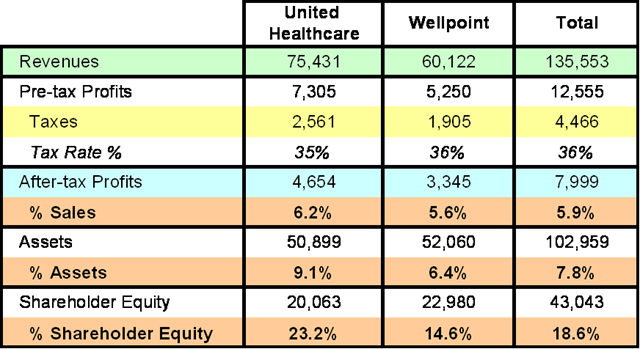
Well, for openers, the health insurance companies — don’t make all that much money.  Consider the 2007 financial results for the two biggest “pure” health insurance companies: United Health Care and Wellpoint.

image

Note that pre-tax profits are about 9% of revenues [12,555 divided by135,553].  About 1/3 of the pre-tax already goes to the government in taxes; about 2/3’s (6% of revenues) drops through to the bottom line.

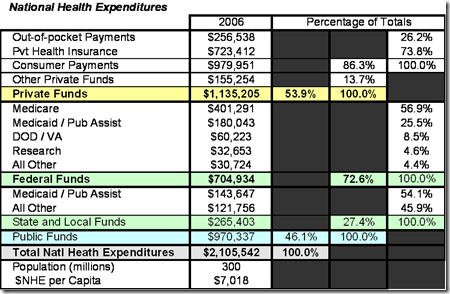
Currently, U.S. health care expenditures are about $2,1 trillion (just over $7,000 per person).  Of that, roughly half is “sourced” from the government via Medicare and Medicaid.  Of the half that is private pay, about 2/3’s ($725 billion ) goes through health insurance companies — the other 1/3 is out of patient’s pockets or “other” (e.g. charitable gifts to medical centers).

image

So, what’s the financial upside if all health care insurers were “disintermediated” and their profits were banked as economic cost savings to the system ?

Well, assuming that the rest of the healthcare insurance companies have profitability profiles comparable to United and Wellpoint — there’s a pre-tax profit of 9% that applies to $725 billion in revenues — or roughly $65 billion dollars.

But wait, the government is already getting about 1/3 of that in taxes.

So, the net gain is at most $40 to $45 billion, or about 2% of the $2.1 trillion in total healthcare spending.  Why “at most” ?

Simple, because it assumes that the government will be able to administer the programs as efficiently as the private companies.  Call me cynical, but I doubt it.

* * * * *

On the second point, that  health insurance companies reject claims and refuse to authorize treatment as a means of boosting their.bottom lines.

Well, that’s at most partially true, and catches the government administration folks in a circular argument.

First, about 1/3 of health  insurance companies’ transactions volume is administrative processing done in support of companies (usually big ones) that choose to self-insure.  That is, the self-insuring companies  take all of the risk, and only pay the insurance companies a fee (that includes profit, of course) for negotiating with health care suppliers and processing transactions  — in conformance with terms, conditions, and rules dictated by the companies.  There are agreed to standards that are enforced.

The other 2/3’s of their transaction volume is strictly premium based.  If more treatments are authorized, costs go up and premiums go up to cover them.   If treatments are denied,  costs go down, and the competitive market pushes premiums down,It’s that simple.

* * * * *

Want more from the Homa Files?
Click link =>
The Homa Files Blog

* * * * *

Why private sector jobs won’t be coming back any time soon … hint: it’s called passive aggressive resistance

July 21, 2009

Team Obama thinks that it has corporate America right where it wants it –- under its thumb.

CEOs and Boards serve at the pleasure of the President, executive compensation is overseen by a Federal czar, product lines are green-dictated by Federal czars and Task Forces, contract law is suspended at will,  bankruptcy laws are changed on the fly — relegating secured creditors behind politically-favored unsecured ones, ineffective government agencies dictate to stumbling companies, unions are given jolts of legislated adrenalin.

The Administration has empowered itself to sort out good guys from bad guys, to pick marketplace winners and  losers, and to destine survivors and failures, Companies (and individuals) that question government policy are ridiculed, harassed, and punished; those that oppose the policies are squashed faster than decades-old GM or Chrysler dealers.

Corporate CEOs are quaking in there boots … or are they ?

Team Obama –- which consistently demonstrates uncanny business naiveté — may be underestimating a staple of organizational behavior: the power of passive aggressive resistance.  Rather than being openly insubordinate when confronted with undesirable tasks — and getting nailed by vindictive superiors —  employees and organizational units will often just procrastinate and work work inefficiently, in effect, pocket vetoing the unpopular orders from above.   In corporate jargon, it’scalled “slow rolling”.

Sure, corporate chieftains will tell President Obama what he wants to hear, and may even stand next to him on a stage in a faux show of support.  Why risk the rath of a Presidential punishment, especially when there are other ways to skin a cat?

Specifically, with respect to continuing job cuts and rising unemployment, here’s a theory of the case.

First, you can’t  let a good crisis go to waste, right?  Businesses always use tough economic times to clean house.   Fat builds in all organizations over time.  In “normal” times, it’s difficult to get rid of dead wood.  Employment laws —  perhaps well-intended originally –- serve to protect slackers by making it cumbersome and difficult to fire anybody.  When the economic tide rolls out, companies have the air cover they need to resize and purge under-performers en masse. The tendency is to cut deep.  If some muscle gets pared too, so be it.  It can be rehabilitated later.

In typical business cycles, employment is a so-called lagging indicator of an economic rebound.  That is, when the economy starts to recover, jobs are usually added back very slowly.  Why?  Because businesses have a renewed zeal for productivity, they recommit to keeping the fat from building up again, and they want to be sure that the signs of better economic times aren’t false positives.

Eventually, open positions are filled and capacity — human and physical —  is added to meet increasing demand.  It may take awhile, but the system eventually gets back in balance.

If the economy is bottoming out now -– as many experts assert —  employment would be expected to start rebounding in 2010.  But, it won’t. Why?

Because the rules of engagement have changed.  It has become far more costly and risky for companies to restore or enlarge their payrolls.

For openers, the minimum wage is scheduled to increase by over 10%, making entry level staffing more costly.  Then, there is the risk that “employer mandate” will force companies to expand health insurance coverage or pay fines – again, making labor most costly.  Then, there is the threat of “card check” legislation turbo-boosting  the mass unionization of U.S. businesses .  And now, there’s the evident risk that government will change rules and regulations on political whims, creating an unprecedented level of uncertainty.

The bottom line: businesses will resist government policies passive aggressively.  Fewer jobs will get added back than history would suggest, and those that get added back will materialize later than past patterns.  Businesses will add jobs as a last resort rather than trying to build capacity ahead of the economic growth curve.  Why should companies  increase their costs and  risks any more than is absolutely necessary ? Companies will continue to off-shore jobs, but will be more clever and clandestine about it, e.g. by vertically disintegrating and simply buying goods and services from 3rd parties.

Given the Administration’s anti-corporate rhetoric, actions, and proposed game-changing rules, I doubt that many CEOs will be taking on added costs and risks to boost the administration. More likely, they will let unemployment continue to creep up, and will slow roll the process of rehiring.  Corporate chieftains will sit back and watch the President squirm and spin his “4 million jobs – saved or created”.  As Rev. Wright would say “the chickens will have come home to roost”.  Passively aggressive  resistance at its very best.

Unfortunately, that means we’ll be seeing double digit unemployment for some time – at least through the 2010 Congressional elections.

* * * * *

Digging deeper on Obama’s sliding performance approval ratings …

July 20, 2009

Top-line Numbers

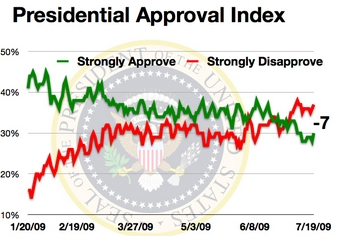
The most recent Rasmussen Poll reports that 30% of likely voters Strongly Approve of Obama’s performance as president, and 37% Strongly Disapprove.   That puts his Presidential Approval Index — the difference between the percentage of likely voters who Strongly Approve and the percentage who Strongly Disapprove — at minus 7.  The PAI has been negative for all of July, and it has been consistently around minus 7 for the past week or so.

image

* * * * *

Top-line Analysis

The generally reported story line: Obama is personally popular, but his policies are causing concern among rock hard GOP opponents and some independents “at the margin”.

But, not to worry – ratings slips are to be expected when a President pushes an aggressive agenda and the Presidential honeymoon period winds down.

But, I’ve been noticing that acquaintances who were strong Obama supporters seem less willing to pitch his case and defend his actions to date.  While “buyer’s remorse” overstates the case, I am seeing some doubts and head-scratching.

So, I did some digging.

I previously posted some FD-Hotline polling results that indicated Obama is slipping among males, independents, and rural voters.  Interesting, but not earth-shaking.

The “internals” from Rasmussen polling – are way more revealing.  They’re under-reported – even by Rasmussen – probably because they tarnish the Obama mystique and reek of political incorrectness.

For example:

  • Obama’s high ratings with females and young people has eroded – his PAI with females and 18-29 year olds are now both dead even – as many strongly disapprove as strongly approve.
  • While his overall approval ratings among blacks is still sky high at 93%, his strong approval has dropped 10 points from 70% to 60%
  • His strong disapproval is over 40% among males, whites, independents, 30-39 year olds, and middle class folks earning between $40,000 and $100,000.

Keep reading for the drill down …

* * * * *

First Level Drill Down

Comparing Rasmussen poll results from the week of July 6-12 to the week of  June 1-7

For the total sample of likely voters: Obama’s PAI (the difference between strong approvers and strong disapprovers)  dropped by 10 points, from plus 3 to minus 7

Highlights from the “internals”

For males: Strong Disapproval increased by 7 points,  from 35% to 42%
For females: Obama’s PAI dropped by 9 points, from plus 9 to even zero

For whites: Strong Disapproval increased by 5 points,  from 36% to 41%
For blacks: Strong Approval dropped 10 points,  from 70% to 60%
For “Other”: Strong Disapproval increased 16 points,  from 27% to 43%

For Democrats: Strong Approval dropped 12 points,  from 62% to 50%
For Republicans: Strong Disapproval increased 7 points,  from 54% to 61%
For “Other”: Strong Disapproval increased 8 points,  from 35% to 43%

For 18-29 olds: Strong Approval dropped 12 points,  from 39% to 27% and Obama’s PAI  dropped by 17 points, from plus 17 to even zero
For 30-39 olds:Strong Disapproval increased by 11 points,  from 31% to 42%

For those earning between $20,000 and $40,000: Obama’s PAI dropped by 12 points, from plus 5 to minus 7
For those earning between $40,000 and $60,000: Strong Disapproval increased by 12 points,  from 35% to 47%
For those earning between $75,000 and $100,000: Strong Disapproval increased by 9 points,  from 35% to 44%

For more still more detail from the internals, keep reading.

* * * * *

Rasmussen June to July Internals

Comparing poll results from the week of July 6-12 to the week of  June 1-7

For the total sample of likely voters:

  • Strong Approval dropped 5 points,  from 34% to 29%
  • Strong Disapproval increased by 5 points,  from 31% to 36%
  • PAI (the difference) dropped by 10 points, from plus 3 to minus 7

* * * * *

Gender

For males:

  • Strong Approval dropped 5 points,  from 32% to 27%
  • Strong Disapproval increased by 7 points,  from 35% to 42%
  • PAI (the difference) dropped by 12 points, from minus 3 to minus 15

For females:

  • Strong Approval dropped 5 points,  from 36% to 31%
  • Strong Disapproval increased by 5 points,  from 27% to 31%
  • PAI (the difference) dropped by 9 points, from plus 9 to even zero

* * * * *

Race

For whites:

  • Strong Approval dropped 5 points,  from 29% to 24%
  • Strong Disapproval increased by 5 points,  from 36% to 41%
  • PAI (the difference) dropped by 10 points, from minus 7 to minus 17

For blacks:

  • Total Approval stayed even at 93%
  • Strong Approval dropped 10 points,  from 70% to 60%
  • Strong Disapproval stayed even at 2 to 3%
  • PAI (the difference) dropped by 9 points, from plus 67 to plus 58

For “Other”:

  • Total Approval dropped 8 points,  from 56% to 48%
  • Strong Approval dropped 2 points,  from 32% to 30%
  • Strong Disapproval increased 16 points,  from 27% to 43%
  • PAI (the difference) dropped by 18 points, from plus 5 to minus 13

* * * * *

Party

For Democrats:

  • Total Approval dropped 6 points,  from 85% to 79%
  • Strong Approval dropped 12 points,  from 62% to 50%
  • Strong Disapproval increased by 4 points,  from 9% to 13%
  • PAI (the difference) dropped by 16 points, from plus 53 to plus 37

For Republicans:

  • Total Approval  and Strong Approval stayed about even even at 23% and 9-10%
  • Strong Disapproval increased 7 points,  from 54% to 61%
  • PAI (the difference) dropped by 6 points, from minus 45 to minus 51

For “Other”:

  • Total Approval dropped 7 points,  from 49% to 42%
  • Strong Approval dropped 5 points,  from 25% to 20%
  • Strong Disapproval increased 8 points,  from 35% to 43%
  • PAI (the difference) dropped by 13 points, from minus 10 to minus 23

* * * * *

Age

For 18-29:

  • Strong Approval dropped 12 points,  from 39% to 27%
  • Strong Disapproval increased by 5 points,  from 22% to 27%
  • PAI (the difference) dropped by 17 points, from plus 17 to even zero

For 30-39:

  • Strong Approval dropped 5 points,  from 30% to 25%
  • Strong Disapproval increased by 11 points,  from 31% to 42%
  • PAI (the difference) dropped by 16 points, from minus 1 to minus17

* * * * *

Income

For those earning less than $20,000

  • Approval and disapproval have remained essentially even
  • PAI (the difference) dropped by 4 points, but remains high at plus 17

For those earning between $20,000 and $40,000

  • Strong Approval dropped 9 points,  from 34% to 25%
  • Strong Disapproval increased by 3 points,  from 29% to 32%
  • PAI (the difference) dropped by 12 points, from plus 5 to minus 7

For those earning between $40,000 and $60,000

  • Strong Approval dropped 9 points,  from 32% to 23%
  • Strong Disapproval increased by 12 points,  from 35% to 47%
  • PAI (the difference) dropped by 21 points, from minus 3 to minus 24

For those earning between $75,000 and $100,000

  • Strong Approval remained about even at 31%
  • Strong Disapproval increased by 9 points,  from 35% to 44%
  • PAI (the difference) dropped by 10 points, from minus 4 to minus 13

* * * * *

Improve healthcare by paying doctors less … huh?

July 20, 2009

“As costs explode, Congress will try to wring out ever more “savings” by underpaying doctors and hospitals.”

Full article: WSJ, What’s Up, Docs?, July 20, 2009
http://online.wsj.com/article/SB124804389935663419.html

* * * * *

Ken’s Take

Cutting to the chase, the crux of ObamaCare is (1) to provide tax-payer funded health insurance to 45 million uninsureds — many of them who don’t deserve it (think non-citizens, and young workers who choose to self-insure) (2) to ration medical services, especially among older folks and (3) squeeze doctors’ earnings. 

Frankly, I think doctors deserve to make a lot of money.  Most are pretty smart, all go through rigorous (and expensive) training, all get paid a pittance in their early years as they work round-the-clock as residents and, most important to me, they are gatekeepers to quality of life for me and my loved ones.

Doctors are already being squeezed.

One doctor friend of mine gave up the fight a couple of years ago, quit his practice, and went to work for a pharma company.

Another – a doc who prided himself on providing highly personal care — is now forced to treat 1/3 more patients to maintain his income level. Dr. Welby is being forced to become Dr. McDonald’s.

Still another doc has ‘vertically integrated’.  As payment rates have dropped on her basic services, she started providing services previously done by specialists.  Think OBY-GYN docs doing ultrasounds — lots of them — on pregnant moms. That boosts their income, but pressures the radiologists — who used to do the procedures — to find fill-in business.  A vicious cycle.

Does anybody really think that’s a formula for higher quality, lower cost healthcare?  Seems penny wise, pound foolish to me.

* * * * *

Dependence on foreign oil … oops I meant foreign bondholders.

July 20, 2009

Ken’s Take: The ballooning deficit and national debt raise two mega-worries: (1) An eventual increase in interest rates as it gets increasingly difficult to find buyers for US bonds, and (2) the increasing dependence on foreign buyers of the debt – especially China.  Neither should be taken lightly …

* * * * *

Excerpted from NY Post,”The Never Ending Pork Parade”, July 4, 2009

Thanks to ongoing trade deficits and relentless borrowing, America’s financial status is deteriorating rapidly.

  • The Commerce Department reported last week that:
  • The value of foreign assets owned by Americans is $19.89 trillion,
  • The value of American assets owned by foreigners is $23.36 trillion.
  • So, we are a “net debtor” to the tune of $3.47 trillion. 
  • Foreigners, most significantly China, own nearly 50 percent of our government’s public debt.

So while the Obama administration frets that we are dangerously dependent on foreign oil (Note: Canada sends us as much oil as the Persian Gulf region, and Mexico not much less), we are increasingly threatened by dependence on foreign bondholders who could wreak havoc on the dollar and our interest rates far more easily than OPEC could cut off our oil.

Full article:
http://www.nypost.com/seven/07042009/postopinion/opedcolumnists/the_never_ending_pork_parade_177485.htm?page=0

* * * * *

Help Wanted: Smart, hard working people willing to work 60 to 80 hours per week for 40 cents on the dollar … pretty motivating, huh?

July 17, 2009

To cover the $1 trillion cost of heath care “reform”,  Team Obama has proposed raising taxes by $544 billion, almost all on the “rich” — those in the top 5% of incomes.

That raises a couple of issues:

1) What if the rich “lay down” – working less as their prospective marginal take home pay gets cut? (see chart below)

2) How to inspire the next generation to bust their butts to grab for the golden ring? Maybe “doing good” will be enough motivation, but I’ll be betting “under” on that one.

3) What happens when the filthy rich are fully taxed and there’s still a big budget gap?  My hunch: they’ll be coming after the rest of us.


Source: IBD, Tax Hike Comin’,July 16, 2009
http://www.ibdeditorials.com/IBDArticles.aspx?id=332637892829537

For details  (local + state + federal)– all states — see Tax Foundation Report
http://www.taxfoundation.org/publications/show/24863.html

* * * * *

According to the Diageo / Hotline poll …

July 16, 2009

The Diageo/Hotline Poll of 800 U.S. registered voters conducted from July 9-13, 2009, finds that the percentage of American voters who approve of the job President Obama is doing has dropped 9points to 56%. The percentage who disapprove jumped by 7 points to 38%.  So, the approve / disapprove “spread” was cut almost in half from 34% to 18%.

According to Hotline, the approval decline was primarily driven by 15 point drops among men from 61% to 46%), independents from 63% to 48%), and rural voters (from 59% to 44%).  Note that a minority of voters in these 3 segments now approve of the job that Obama is doing.

Hotline also reports that 55% of voters now believe that the country is “seriously on the wrong track”; that only 11% are “very confident that Stimulus I will create new jobs”; and 40%strongly oppose a second stimulus package”.

For all of the poll results:
http://www.diageohotlinepoll.com/documents/diageohotlinepoll/FDDiageoHotlineJulyTopline_FORRELEASE_07.15.09.pdf

* * * * *

Some course adjustments for the immutable laws of economics …

July 16, 2009

Homa Note: Mankiw – a Harvard prof – is probably the foremost econ teacher these days.  Evidence: he got an author’s advance of over $1 million for his textbook …

* * * * *

Excerpted from NY Times, “That Freshman Course Won’t Be Quite the Same”, Mankiw, May 24, 2009

Despite the enormity of recent events, the principles of economics are largely unchanged. Students still need to learn about the gains from trade, supply and demand, the efficiency properties of market outcomes, and so on. These topics will remain the bread and butter of introductory economics courses.

Nonetheless, the teaching of basic economics will need to change in some subtle ways in response to recent events. Here are four:

THE ROLE OF FINANCIAL INSTITUTIONS

Students have always learned that the purpose of the financial system is to direct the resources of savers, who have extra funds they are willing to lend, to investors, who have projects that need financing.

The economy’s financial institutions — banks and insurance companies are  part of a system [that is largely taken for granted] and quickly fade into the background

The current crisis, however, has found these financial institutions at the center of the action.

Financial institutions are like the stagehands who work behind the scenes at the theater. If they are there doing their jobs well, the audience can easily forget their presence. But if they fail to show up for work one day, their absence is very apparent, because the show can’t go on.

THE EFFECTS OF LEVERAGE

The economic crisis arose because some financial institutions had, in effect, invested in housing by holding mortgage-backed securities. When housing prices fell by about 20 percent nationwide, these institutions found themselves nearly insolvent.

[The] important question: “If housing prices have fallen only 20 percent, why did the banks lose almost 100 percent of their money?”

The answer was leverage, the use of borrowed money to amplify gains and, in this case, losses.

Economists have yet to figure out what combination of mass delusion and perverse incentives led banks to undertake so much leverage. But there is no doubt that its effects have played a central role in the crisis.

THE LIMITS OF MONETARY POLICY

The textbook answer to recessions is simple: When the economy suffers from high unemployment and reduced capacity utilization, the central bank can cut interest rates and stimulate the demand for goods and services.

When businesses see higher demand, they hire more workers to meet it.

But,  what would happen if the central bank cut interest rates all the way to zero and it still wasn’t enough to get the economy going again?

Now, with the Federal Reserve’s target interest rate at zero to 0.25 percent, that question is  pressing.

The Fed is acting with the conviction that it has other tools to put the economy back on track. These include buying a much broader range of financial assets than it typically includes in its portfolio.

Economists are far from certain how well these tools work.

THE CHALLENGE OF FORECASTING

It is fair to say that this crisis caught most economists flat-footed.

In the eyes of some people, this forecasting failure is an indictment of the profession. But that is the wrong interpretation.

In one way, the current downturn is typical: Most economic slumps take us by surprise. Fluctuations in economic activity are largely unpredictable.

Yet this is no reason for embarrassment.  Some things are just hard to predict. [The vest an economist can do is] assess risks and to be ready for surprises.

Full article:
http://www.economics.harvard.edu/faculty/mankiw/files/That%20Freshman%20Course.pdf

Cash for Clunkers … bet “under” on this one, too

July 15, 2009


Ok, another $1 billion government program .  This one is intended to to jump-start  — or as VP Biden would say “dropkick” –the car industry. 

Let’s start with the basics: if the program were to work, fewer than 300, 000 cars would be sold –- about 1 weeks worth of sales.  And, not all  of those would be be incremental to the ones that might have bought any way.  So call it 250,000.

But, not to worry, not much of this money will make its way out of Treasury’s vault.

Why?

Though there are no income limits on voucher recipients, nor restrictions on where the new cars are made — the program has lots of “small print” qualifiers. 

According to Business Week:

• Vouchers of either $3,500 or $4,500 will only be given to people who trade in an older vehicle to buy a new one.

• The trade-in, or clunker, must be no older than 25 years, have average gas mileage of less than 18 miles per gallon.

• The clunker must have been owned by the seller for at least a year.

• The new car must cost less than $45,000 and get more than 22 mpg. To get the higher voucher, the new vehicle must also average 10 more miles per gallon than the old one.

• To get the higher voucher, the new vehicle must also average 10 more miles per gallon than the old one.

• For trucks—SUVs, pickups, and minivans, a improvement of at least 2 mpg between the old and new vehicles qualifies for $3,500; 5 mpg or more entitles buyers to $4,500.

Ken’s translation of the rules: good luck.

If a clunker qualifies, there are some obvious questions about whether the folks driving those clunkers are willing and able to step up to brand-new wheels.

Think about it. 

The economic impact is less than the face value of the rebates.  Why?  Because the clunkers probably have some market value that is greater than zero  – i.e. the owner can sell it as a step-up model to somebody driving a clunkier (or dead) clunker.  An economist would say that only the difference between the rebate and the clunker’s fair market value counts as an incentive.

More important, people usually drive clunkers because they can’t afford any thing else.  People driving clunkers often buy used cars – not new ones, and even with a $4,500 discount, they probably won’t want to take on new-car payments during a time of economic hardship.

Maybe an arbitrage market will emerge, with upscale people buying a clunker on the open market for less than its clunker program rebate, and trading it in for fancy new wheels (that they were going to buy anyway) – deducting the the clunker rebate’s full “coupon” value. 

What about the rule that somebody has to have owned the car for at least 1 year?  Easy: the current clunker owner uses the rebate to buy a new cay, and then immediately turns around and flips the new car to a pre-arranged “partner”.  Pretty easy.

Congressional reps really should read these bills before they  enact them …

Source article:
Business Week, Cash for Clunkers: What Can $1 Billion Buy?, June 24, 2009 
http://www.businessweek.com/magazine/content/09_28/b4139000349712.htm

* * * * *

Anybody seen Larry Summers or Paul Volcker ?

July 15, 2009

These guys were supposed to be the finance and economics studs in the administration, but have been practically invisible of late.

What’s up?

* * * * *

“Will only raise taxes to the level they were under Clinton” … just kidding

July 14, 2009

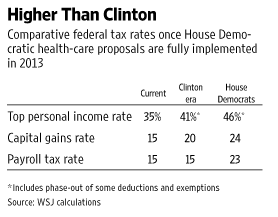
Ken’s Take: During the campaign, Candidate Obama promised repeatedly: “not one dime of new taxes if you make under $250,000” and “for the top brackets, no higher than under President Clinton”.  The latter will fall by the wayside if the Rangel proposal is enacted.  Think the former is far behind ?

* * * *

Excerpted from WSJ, The Small Business Surtax, July 14, 2009

Every detail isn’t known, but late last week Ways and Means Chairman Charlie Rangel disclosed that his draft bill would impose a “surtax” on individuals with adjusted gross income of more than $280,000 a year.

This would hit job creators especially hard because more than six of every 10 who earn that much are small business owners, operators or investors, according to a 2007 Treasury study.

That study also found that almost half of the income taxed at this highest rate is small business income from the more than 500,000 sole proprietorships and subchapter S corporations whose owners pay the individual rate.

In addition, many more smaller business owners with lower profits would be hit by the Rangel plan’s payroll tax surcharge. That surcharge would apply to all firms with 25 or more workers that don’t offer health insurance to their employees, and it would amount to an astonishing eight percentage point fee above the current 15% payroll levy.

image 

Full article:
http://online.wsj.com/article/SB124753106668435899.html

* * * * *

Summer read: Catastrophe by Dick Morris

July 14, 2009

Catastrophe, Dick Morris, HarperCollins, 2009

Morris is a former Clinton adviser turned conservative pundit. For each of the past couple years, Morris has penned a bestseller castigating the direction and tactics of liberals. Catastrophe – a pretty well researched and documented book – continues in that tradition.

Among Morris’s targets in this book are:

  1. The way that team Obama is using the economic crisis to push through a social agenda.
  2. The division of America into a minority (i.e. out voted) taxpaying class, and a majority tax taking class.
  3. The ineffectiveness of the Keynesian-inspired, pork-laden stimulus package.
  4. The prospects for runaway inflation when the economy recovers and the country is left with a bloated national debt.
  5. The reluctance of businesses to invest the time that they are being vilified, that pure craps are changing the rules with no notice, and when the federal government is intervening in private businesses — picking winners and losers, imposing punitive taxes and upending bankruptcy law.
  6. The failure of the bank bailout programs – TARP and TALF – to increase the supply of credit to businesses.
  7. The failure of the various mortgage plans to stem the tide of foreclosures.
  8. The looming fire-aim-ready health care program that is being pushed through Congress — that increases the demand for health services by covering more people with health insurance, but does nothing to increase the supply of services, i.e. the number of doctors and care facilities.
  9. Initiatives to boost Democratic voting rolls, including: amnesty for illegals, expansion of unions (via card check), and “management” of the 2010 census.
  10. A weakened stance on terror, evidenced by a broadening of terror suspects’ rights, the closing of Gitmo, and a general softening of both rhetoric and defense capabilities.
  11. A diminution of support for Israel.
  12. Congressional cronyism, quid pro quo, and pay to play.

At length, Morris documents Pres. Obama’s apparent strategy of political control:

  1. Build on his rock solid support among blacks
  2. Expand the Hispanic population by amnesty and loose immigration laws, and by using expanded health care benefits as a “carrot” to attract even more Hispanic immigrants.
  3. Expand union coverage via card check and UAW-like sweetheart deals including, perhaps, exclusion from any  taxes that may be imposed on employer-provided health care insurance.
  4. “Cook” the 2010 census to overstate his solid constituencies.

For regular news readers and news watchers, there is little new in Morris’s book. But, there are plenty of facts, specific examples, and references.

Catastrophe is a quick read that – fr the most part – is worth the time for conservatives wanting ammunition for the next cocktail party.

* * * * *

Penny Mac … heard of it?

July 14, 2009

This was a new one to me…

In the book Catastrophe, Dick Morris includes a chapter on PennyMac — a joint venture set up by former high-level executives at Countrywide Financial. The name stands for Penny Mortgages After Countrywide.

Here’s the scheme:

Penny Mac buys distressed mortgages from failing banks at the lowest possible prices, works out affordable deals with homeowners, and then re-bundles and re-sells the now “performing”.loans.

For example, according to Morris, Penny Mac recently bought $558 million of home mortgages from the FDIC, which acquired the notes after the collapse of the First National Bank of Nevada. PennyMac paid only $42.2 million, averaging only $.30 to $.50 on the dollar. PennyMac keeps $.20 on every dollar that it initially recovers, with an increase to $.40 down the line.

Think about it. Countrywide executives made bad loans, sold them in packages to investors,  and then, they buy them back as distressed loans at a deep discount, restructure the terms — since they have plenty of spread to play with — and then sell the loans again, at a profit.

Makes you scratch your head, doesn’t it?

* * * * *

Boost employment by raising the minimum wage … has anybody in Washington taken Econ 101 ?

July 13, 2009

The unemployment rate is 9.5%’ including discouraged folks who have stopped looking for work, and it’s approaching 20%; for teenagers, it’s almost 25%, for black teens, it’s almost 40%

 The unemployment rate in June for American teenagers was 24%, for black teens it was 38%

With that as backdrop, Congress has scheduled an increase in the minimum wage later this month, taking the minimum wage up over 10% – from  $6.55 to $7.25 an hour.   The predictable impact: employers are certain to cut back at the low-end – laying off existing workers and not hiring new ones.  It’s simple economics.

“Studies that focus on the least-skilled groups [i.e., teens, and welfare moms] provide relatively overwhelming evidence of stronger disemployment effects.”

Proponents argue that millions of workers will benefit from the bigger paychecks, but those who lose their jobs or who never get a job in the first place get a minimum wage of $0.

Economists estimate that  the 70-cent per-hour minimum wage hike this month will kill about 300,000 jobs for those between the ages of 16-24.

“But the union economic model that now dominates Washington holds that wages only matter for those who already have jobs. The jobs that are (lost or) never created don’t count.”

Source articles:
http://online.wsj.com/article/SB124657739768489217.html
http://online.wsj.com/article/SB124743988386729701.html#mod=djemEditorialPage

* * * * *

I ask again, has anybody in Washington taken Econ 101 ?

* * * * *

Prof tries out a socialistic grading system … with predictable results

July 10, 2009

Ken’s Take:  This story has been making the email rounds.  Even if it’s just an internet legend, it makes common sense.  Project it into current political rhetoric…  

* * * * *

An economics professor at Texas Tech said he had never failed a single student before but had, once, failed an entire class.

That class consensus was that socialism worked —  no one is  poor and no one is rich, a great equalizer.

The professor proposed an experiment on socialism for this class: All grades would be averaged and everyone would receive the same grade.

After the first test the grades were averaged and everyone got a B. The students who studied hard were upset and the students who studied little were happy.

But, as the second test rolled around, the students who studied little for the first test studied even less, and the ones who studied hard on the first test decided they wanted a free ride too; so they studied little.

The second test average was a D! No one was happy.

The average on the 3rd test  was an F. Ouch. To the students great surprise, all failed.

Test scores plummeted as bickering, blame, name calling caused hard feelings.  Finally, no one wanted to study for the benefit of anyone else.

The lesson:  socialism  ultimately fails because when the reward is great, the effort to succeed is great; but, when government takes all the reward away; no one will try or want to succeed.

Not very complicated, at all …

* * * * *

Thanks to Sammie A.  for forwarding …

Microsoft tries again … with Windows 7 @ intro prices

July 10, 2009

Ken’s Take: It’s almost incomprehensible that a company with Microsoft’s tech savvy and  heft could have blown it as badly as they did with Vista.  For their sake, Windows 7 had better be an acclaimed product. You can only shoot and miss so many times.

The intro pricing expense makes sense except the $10 discount is simply leaving money on the table.  Do they really think that it will motivate any incremental purchases?

* * * * *

Excerpted from WSJ, Microsoft Plans Lure for Windows 7, June 26, 2009

The product

Windows 7 is a critical test of whether Microsoft can polish the reputation of its operating system after Windows Vista suffered early technical problems.

While Windows remains by far the most dominant software for running PCs, Vista’s problems were exploited relentlessly by Apple  in marketing campaigns for Macintosh computers. Macs have gained market share steadily over the past few years.

So far, early reviews of test versions of Windows 7 have been favorable.

* * * * *

The pricing

Microsoft announced a plan to encourage pc users to move to a much anticipated new version of its operating system, Windows 7 …  scheduled for release in late October.

Until July 11, consumers can preorder an upgrade copy of Windows 7 Home Premium through retailers for $49.99.

Most new PCs coming out starting in October will have Windows 7 preinstalled.

Any consumers who buy new PCs running its current Windows Vista operating system from now until Jan. 31 will receive free upgrades to Windows 7. 

For consumers who bought PCs prior to the free upgrade program, Microsoft said it will charge $119.99 for Windows 7 Home Premium — expected to be the most popular version for consumers — instead of the $129.99 upgrade price for the comparable version of Windows Vista.

Full article:
http://online.wsj.com/article/SB124593802040653741.html#mod=testMod

* * * * *

Obama’s Presidential Approval Index down to minus 5 points …

July 9, 2009

Rasmussen Reports, Wednesday, July 08, 2009

The Rasmussen Reports daily Presidential Tracking Poll for Wednesday showed that 32% of the nation’s voters now Strongly Approve of the way that Barack Obama is performing his role as President.

The number who strongly disapprove inched up another point to 37%  — the highest level measured to date.

Obama’s Presidential Approval Index rating – the difference between strong approvers and strong disapprovers —  is minus 5 — the lowest level yet for Obama .

Obama’s total approval rating – the sum of strong and “somewhat” approvers – has dropped to 52% among likely voters.


image

http://www.rasmussenreports.com/public_content/politics/obama_administration/daily_presidential_tracking_poll

* * * * *

According to psycho-analysts, what do Obama, Sanford, and Palin have in common?

July 9, 2009

According to some political-psyche pundits and news reports: they’re all narcissists. 

Some have gone a step further and presumptuously diagnose them as having  Narcissistic Personality Disorder (NPD), which is also called pathological narcissism.  (Details below)

* * * * *

When I heard the term the second or third time, I got curious.

Initially, I thought that NPD was a made-up talk show slur.  But, I did some digging and discovered that Narcissistic Personality Disorder really does exist as a documented pathology. 

Below are its diagnostic criteria and the “so whats” of the pathology. 

Worth reading …

* * * * *

Pathological Narcissism: How do you know ?

People may be  clinically diagnosed as having Narcissistic Personality Disorder if they exhibit at least 5 of the following attitudes and behaviors:

1. Have an exaggerated sense of self-importance; obsess over appearance and image

2. Are preoccupied with fantasies of unlimited success, power, brilliance, beauty, or ideal love

3. Believe they are  “special” and can only be understood by other special or high-status people

4. Require excessive admiration; crave the spotlight; expect to be recognized as superior to others.

5. Have a sense of entitlement; expect special treatment and automatic compliance with their wishes

6. Selfishly take advantage of others to achieve their own ends; lie, deceive, and manipulate; believe rules of morality don’t apply to them

7. Lack empathy; fail to recognize or sympathize with other people’s feelings and needs.

8. Are often envious of others and believe that others are envious of them; covet others’ relationships and possessions.

9. “Act out”: present arrogant, patronizing, contemptuous, risky, self-destructive behaviors or attitudes; when caught and confronted, blame bad behavior on other people and burdensome circumstances, show little conscience or true remorse. 

Excerpted from:
http://www.halcyon.com/jmashmun/npd/dsm-iv.html

* * * * *

Pathological Narcissism: So what ? 

Most people are somewhat narcissistic.

A healthy level of narcissism is a mature, balanced love of oneself coupled with a stable sense of self-worth and self-esteem. A healthy narcissist has a proportionate and realistic appraisal of his achievements and traits, and respects interpersonal boundaries.

Pathological narcissism is marked by an immature or impaired sense of one’s “true self” and situational reality that is exaggerated into a fraudulent, compensatory self-image

Down deep, a  pathological narcissist is usually deficient in self-esteem or self-worth.  He draws esteem and worth from the attention and admiration of others  Hence, the pathological narcissist is in constant pursuit of recognition and adoration, relishes the spotlight, and habitually preys his environment for more dependable admirers

Pathological narcissism is often a reaction to abnormal environments and situations (e.g., abuse, trauma, smothering, etc.), the repression of overwhelming memories and experiences, and the suppression of inordinately strong negative feelings (e.g., hurt, envy, anger, or humiliation).

Pathological narcissism is addictive and dysfunctional.  Pathological narcissists are obsessed by delusions of grandeur, superiority, and perfection – in life and love. As a result, they present themselves as image-obsessed (flawlessness) and very competitive (win at all cost).  They want to be at center stage, and when others might be merely motivated, they are strongly compelled. They are driven, relentless, tireless, and ruthless. They strive and fight and learn and climb and create and think and devise and design and conspire. They need to be in control of their relationships and environments.

Pathological narcissists are prone to self-defeating and self-destructive behaviors. They often abandon their commitments, careers, and relationships in mid-stream – losing interest, giving up, moving on.

Sub-consciously, a pathological narcissist may masochistically frustrate his deepest desires and drives; obstruct his own efforts; alienate his friends and sponsors; provoke figures in authority; actively (but unconsciously) seek, submit and relish mistreatment;  incite anger or rejection; engage in risky and improper behavior — all without conscience or true remorse.

Pathological Narcissism: What’s the prognosis?

While Narcissistic Personality Disorder can sometimes be moderated with psycho-therapy. the “prognosis is generally not good”.  That is, the likelihood of recidivism (i.e. repeat behavior) is very high and progressive (i.e.  it gets worse}. 

Excerpted from:
http://www.mayoclinic.com/health/narcissistic-personality-disorder/DS00652/DSECTION=symptoms

* * * * *

Best online medical summary of NPD – from the Mayo Clinic:
http://www.mayoclinic.com/health/narcissistic-personality-disorder/DS00652

* * * * *

Final shots; Obama, Sanford and Palin may be narcissists, but pundits shouldn’t be throwing around the term “Narcissistic Personality Disorder “ lightly.  It’s a real pathology.  Not to be taken lightly.

* * * * *

Cool viewing: Playing for change …

July 9, 2009

These songs and videos have been making the rounds.
(Over 12 million Youtube views)

The theme: street singers around the world.

Worth a view when you need a pick-me-up.

   ==> click to play         

image

* * * * *

Take the loyalty test …

July 8, 2009

From the summer read:
Why Loyalty Matters, Keiningham & Aksoy, Benbella Books, 2009

in prior posts, I highlighted 25 notable nuggets from the book and recounted the 10 Relationship DNA Factors (i.e “styles”)..

Here’s an acid test of loyalty:

Do your friends believe without a doubt that you convincingly demonstrate your loyalty to them? Specifically, do you

  1. Devote enough time to your relationships with them?
  2. Stand up for them when it is uncomfortable to do so?
  3. Celebrate their successes without envy?
  4. Support them during difficult times?
  5. Hold fast to information provided in confidence?
  6. Make every effort to carry out commitments to them, even when it requires considerable self-sacrifice?

Being truly loyal isn’t easy to do. 

Virtually all of us fall short in delivering true and comp,ete loyalty to friends and family.

The good news: there is always room for improvement.  Get started.

* * * * *

When loans exceed posted collateral, borrowers walk away … is that new news ?

July 8, 2009

Takeaway: About half of all foreclosures are attributable to loans going underwater.  That is, the borrower could keep the loan commitment and keep paying, but chooses to simply stop making payments.  For the other half, about half lose their jobs and can’t make payments and almost 40% are simply deadbeats who shouldn’t have been given the loans in the first place.  Relatively few borrowers are forced into foreclosure by rate hikes – e.g expired teaser rates and ARMs.

The good news: looks like almost all of the air has be let out of the bubble, i.e. the bottom may be near.

* * * * *

Stanley Liebowitz — professor of economics at the University of Texas, Dallas – cranked through a database covering more than 30 million mortgages to determine the root causes of foreclosures.


image

His main conclusion:”Although the government is throwing money — almost $2 trillion and counting — at the mortgage markets with the intent of stabilizing house prices, its methods are poorly targeted”.”

Why?  Because “Zero money down, not subprime loans, led to the mortgage meltdown. The important factor is whether or not the homeowner currently has or ever had an important financial stake in the house. Yet merely because an individual has a home with negative equity does not imply that he or she cannot make mortgage payments so much as it implies that the borrower is more willing to walk away from the loan.”

The good news: “Housing prices are likely to stop falling fairly soon  … That’s because current prices are approaching their long-term, inflation-adjusted pre-bubble level. These pre-bubble prices appeared to be a long-term equilibrium, meaning that prices would be expected to return to those levels.”  

WSJ, New Evidence on the Foreclosure Crisis, July 3, 2009
http://online.wsj.com/article/SB124657539489189043.html#mod=djemEditorialPage

* * * * *

Cutting Prof. Leibowitz’s numbers another way: about half of all foreclosures are attributable to loans going underwater.  That is, the borrower could keep the loan commitment and keep paying, but chooses to simply stop making payments.  For the other half, about half lose their jobs and can’t make payments and almost 40% are simply deadbeats who shouldn’t have been given the loans in the first place.  Relatively few borrowers are forced into foreclosure by rate hikes – e.g expired teaser rates and ARMs.


image

* * * * *

Get out your wallet … states move to tax internet sales

July 8, 2009

Ken’s Take: I hate taxes.  Not because I’m not willing to pay my fair share, but because so much of tax revenue is wasted or applied to  questionable political missions. 

That said, if there have to be taxes, I’m a fan of user taxes (think toll bridges) and consumption taxes (think sales taxes).

So, it never made sense to me that internet sales should be sales tax free, except for sites that have a local physical presence (think Best Buy or Barnes & Noble). Of course, I take advantage of the rules and buy stuff over the internet.   But, why should states forego this revenue and why should retailers with a local physical presence be put at a disadvantage.  It just doesn’t make sense.

I expect many states to pit internet sales in the sales tax bullseye.

* * * * *

WSJ, Amazon Cuts North Carolina Affiliates to Avoid Tax,
June 27, 2009

North Carolina is in the process of passing a law that would force companies to collect the tax if they have in-state online-marketing affiliates — people who get a sales commission from links on their Web sites. To avoid getting caught by the law,

Amazon is dropping the affiliates. Amazon.com Inc. said it has ended business relationships with marketing affiliates in North Carolina to avoid collecting sales tax in the state. 

But the decision highlights mounting tensions between online retailers and cash-strapped states across the country. Other states are considering similar laws that would use affiliates as a way to force companies to collect a sales tax for online purchases. 

Consumers are technically supposed to pay a so-called use tax for online purchases on their own, but most don’t. Many e-commerce sites rely on the price advantage they have over traditional retailers because they don’t have to collect taxes. , and forcing them to collect the tax upfront could take away some of that advantage.

Full article:
http://online.wsj.com/article/SB124603593605261787.html#mod=testMod

* * * * *

Senate shifts focus to college football … I say: go get ‘em !

July 7, 2009

 Excerpted from WSJ, “College Football Goes Down the Hatch:,
July 7, 2009

Today the Senate antitrust subcommittee will hold hearings on the Bowl Championship Series (BCS). Like an earlier hearing in the House, this one will ask whether the system by which college football chooses its national champion is “fair.”

Specifically, the congressional look-see into college football has been led by Sen. Orrin Hatch (R., Utah) and Rep. Joe Barton (R., Texas). They have not been shy about the menace they see. Mr. Hatch calls the BCS “un-American.” Mr. Barton likens it to “communism.” The Texas Republican has even introduced legislation that would forbid the BCS from holding a “national championship game” unless that game was the result of playoffs.

Full article:
http://online.wsj.com/article/SB124692993074303505.html

* * * * *

Ken;s Take: Now, some may ask: why is the Senate wasting time on this issue instead of working on the economy, healthcare reform, cap & tax  … ?

I disagree with those people.  This is precisely the kind of issue I want filling Congressional agendas. .I figure that every minute they’re fretting over college football, is a minute that they’re not wastefully spending another $1 trillion of our money.

In fact, isn’t it about time that Congress reopened their baseball steroids investigation?  Or, what about hearings on the Designated Hitter rule? I say, keep ‘em distracted as long as possible.

P.S. Since I prefer controversy over clarity, I like the BCS

* * * * *

What is your relationship style?

July 7, 2009

From the summer read:
Why Loyalty Matters, Keiningham & Aksoy, Benbella Books, 2009

in a prior post, I highlighted 25 notable nuggets from the book.

In my opinion, the most useful part of the book was a relationship framework based on the notion that each of us has our own relationship DNA that serves as the code for how we interact with one another. 

While  no two people are identical in how they connect with others, all are made up of the same 10 basic building blocks:

  1. Leadership
  2. Reliance
  3. Empathy
  4. Security
  5. Calculativeness
  6. Connectedness
  7. Independence
  8. Traditionalism
  9. Problem-focused coping
  10. Emotion-focused coping

Being high or low on a particular factor does not imply good or bad, since each factor has the potential to have both the positive and negative impact on our relationships, regardless of where one falls on the factor.

People have their own idiosyncratic relationship styles. We are able to build strong, loyal relationships with one another precisely because each of us is different. It is our differences that allow us to enrich each other’s lives.

* * * * *

Leadership is the ability to influence others to follow you voluntarily. Leaders have a general sense that they are in control of themselves and their surroundings, are motivated to achieve success, attain a comfort level interacting with others, and are not afraid to take risks. The leaders competitive spirit fuels ambition. Some people see this fortitude as a blessing; it alienates other people who see it as being too competitive and too aggressive.

Reliance describes how well a person trusts and attaches to people around him. Reliant people have a support web that is based on openness and accountability. They are willing to ask for help when it’s needed. Reliant people tend to have “deep” and long-lasting friends. People low in reliance usually try to solve problems autonomously without depending on others. They often have difficulty building long-term relationships.

Empathy is the ability to identify and sympathize with others. Empathetic people tend to have a more flexible outlook and appreciate people for who they are. This brings with it more friendliness and is inviting to others. Empathetic people are compassionate, kindhearted, and understanding. They see problems through the eyes and hearts of others. People with  low empathy create distance between themselves and others.

Security is a general sense of stability and comfort with oneself and one’s environment. It’s a feeling that things are going well and there is no need to worry excessively or be anxious. This leads to life with a lower amount of stress and pressure, and prevents being needlessly encumbered by a sense of the impending. Secure people are able to manage anxiety and stress successfully. Insecure people often feel “on the edge”, and think that things are either wrong, or are going to go wrong. Insecurity leads to worry.

Calculativeness is an attempt to control and promote one’s self image and create an ideal environment for personal benefit. Calculating people place importance on showcasing themselves in the right way.  So, they have an air of formality in their interactions, selectively articulate themselves to others (versus “being themselves”), and tightly control their self-presentation. Calculating people are often viewed as contrived, less sincere, and less worthy of complete trust. They are often perceived by others as unemotional and manipulative.

Connectedness is how one interacts with others on a personal level  Close and tight relationships typify the crux of this dimension. The feeling of connection to others forms the basis in the bedrock of happiness. People low in connectedness may be loners, or may be surrounded with casual friends — lacking deep and intense bonds.

Independence is marked by autonomy, self-discipline, and thoroughness. On the upside, independent people are rarely disappointed by others, since they usually take matters into their own hands. But, they often miss out on valuable opportunities by failing to capitalize on other people’s ideas and strengths.

Traditionalism reflects a desire for consistency, normalcy, and regularity. Traditionalists like to operate within their comfort zone, and are cautious when approaching truly unfamiliar situations. Traditionalists rarely flaunt their successes, instead preferring humility. As a result, they may sometimes be underrated and underappreciated. Of course, traditionalists miss out on new experiences that could potentially provide novel perspectives and excitement.

Problem-focused coping is taking a planned, reasoned and rational approach to solving problems, meeting challenges, overcoming obstacles, making choices, and withstanding the consequences of decisions. Problem-focused people dissect issues and examine them from multiple angles. They are sometimes viewed as coldly analytical and callous in their decision-making.

Emotion-focused coping tries to suppress or manage the emotions surrounding a problem, rather than the problem itself. Often, advice and comfort is sought from others.

* * * * *

Next up: The “Are you loyal? “ checklist.

* * * * *

Spiking the ball on the 3 yard line …

July 7, 2009

Ken’s Take: As a “get it done” aficionado, I’m intrigued by Team Obama’s inability to make anything really happen. Banks are still holding toxic assets and foreclosing, the economy is still unstimulated, etc.  Their recipe: motivating rhetoric, passed legislation, a new web site, and a declaration of victory … followed by ginned up numbers that they don’t even believe. Below is a partial explanation …

* * * * *
NY Times, “Vince Lombardi Politics”, David Brooks, June 30, 2009 

There are two types of political pragmatism. There is legislative pragmatism — writing bills that can pass.

Then there is policy pragmatism — creating programs that work. These two pragmatisms are in tension, and in their current frame of mind, Democrats often put the former before the latter.

On the stimulus bill, the Democratic committee chairmen wrote a sprawling bill that incorporated the diverse wishes of hundreds of members and interest groups. But as they did so, the bill had less and less to do with stimulus. Only about 40 percent of the money in the bill was truly stimulative, and that money was not designed to be spent quickly.

For example, according to the Congressional Budget Office, only 11 percent of the discretionary spending in the stimulus will be disbursed by the end of the fiscal year. The bill passed, but it is not doing much to create jobs this year and it will not do nearly as much as it could to create jobs in 2010.

On cap and trade, the House chairmen took a relatively clean though politically difficult idea — auctioning off pollution permits — and they transformed it into a morass of corporate giveaways that make the stimulus bill look parsimonious. Permits would now be given to well-connected companies.

The bill passed the House, but would it actually reduce emissions? It’s impossible to know.  A few years ago the European Union passed a similar  cap-and-trade system, but because it was so shot through with special interest caveats, emissions actually rose.

The great paradox of the age is that Barack Obama, the most riveting of recent presidents, is leading us into an era of Congressional dominance. And Congressional governance is a haven for special interest pleading and venal logrolling.

When the executive branch is dominant you often get coherent proposals that may not pass. When Congress is dominant, as now, you get politically viable mishmashes that don’t necessarily make sense.

Full article:
http://www.nytimes.com/2009/06/30/opinion/30brooks.html?_r=2&ref=opinion

* * * * *

Summer read: Why Loyalty Matters

July 6, 2009

Why Loyalty Matters, Keiningham & Aksoy, Benbella Books, 2009

This book positions itself as presenting “the groundbreaking approach to rediscovering happiness, meaning, and lasting fulfillment in your life and work.”  While the book falls short of that tall order, it did contain some insightful material,.

The central thesis of the book:

Loyalty binds us together as people, grounds us on principle, and breeds happiness.

Though a lack of loyalty is one of the major causes of failure in every walk of life, our culture seems to have decided that loyalty is an old-fashioned and unimportant virtue.  That’s wrong and needs to be fixed — the sooner, the better.

Below are 25 nuggets that I highlighted in my reading.

* * * * *

Ken’s 25 Nuggets from Why Loyalty Matters

  1. Being loyal is the manifestation of the deliberate choices we make in life.
  2. Loyalties are signs of the type of person we choose to be. They are the foundation of our character. They demonstrate what we value, what we believe, and what we want our world to be.
  3. Historically, loyalty was not optional. Ostracism represented the ultimate disgrace. A disloyal society was considered a selfish society.
  4. The world has shifted from a society of many deep, long-term loyalties to a society of  fleeting transactional relationships and ephemeral contacts.
  5. A Turkish proverb says “show me your friends, and I will show you who you are.”
  6. Loyalty differentiates friends from acquaintances. Loyal friends won’t abandon us when our need is the greatest..
  7. In a world of easily shifting loyalties, we are likely to find ourselves surrounded by a churning group of fair-weather friends.
  8. “It’s easy to get people to come to a party.”
  9. “A passion for the new quickly wears off, and the old shines through.”
  10. Close, supportive, connected relationships make for happiness, and people have fewer of these relationships today.
  11. Oprah says: “lots of people want to ride with you in the limo, but what you want is someone who will take the bus with you when the limo breaks down.”
  12. Loyalty is the hallmark of strong relationships and demands sacrifices. Few people will admit that they are not loyal; fewer believe believe that they are surrounded by loyal friends. Typically, we believe we are far more loyal than the recipients of our loyalty believe us to be.
  13. The dream of being a rebel who rejects the conventions of society will always hold some appeal in our imaginations.
  14. Real  loyalty endures inconvenience, withstands temptation, and does not cringe under assault.
  15. 25% of Americans report having no close friends in which they could confide things that are important to them. On average, a person has only 2 close confidants.
  16. Friendship =  loyalty, honesty, respect, trust, perseverance, intimacy, help, support, shared experiences.
  17. In this electronic age, some people build synthetic identities and environments. Their real lives and real friendships can’t compete with their fantasized virtual worlds. So, basic values and common humanity get diminished.
  18. Challenges to our self-image make us uncomfortable. But, “you cannot see the picture when you are inside the frame.”
  19. “Most of us remain ignorant of ourselves, because self-knowledge is painful and we prefer the pleasure of illusion.”
  20. Society cannot function and relationships cannot last if betrayal is the readily selected, probable outcome to every perceived grievance, disappointment, and inconvenience.
  21. Loyalty should never be unconditional. If your loyalty to a relationship influences you negatively, then the relationship is “toxic.” While it may be repairable, sustaining  in its current form will damage you.
  22. There is a difference between self-worth and self-absorption. Narcissism causes some people to devalue loyalty, by conveniently defining supreme loyalty as being loyal to one’s self. That is not a virtue!
  23. Loyalty requires a commitment to the future. When we fail, we must make every effort to restore what we have damaged.
  24. To forgive is not to condone.  In the end, forgiveness  may be needed to preserve a relationship. 
  25. Never, ever ignore your moral compass! Know the difference between right and wrong and adhere to it.

* * * * * *

Subsequent posts will ask the questions: what is your relationship style? And, are you loyal?

* * * * * *

Re: the economy … let’s take a Mulligan.

July 6, 2009

Note: “”Mulligan” is a golf term.  When a golfer hits a particularly bad shot, he may petition his buddies (usually fruitlessly)  for a 2nd try, a “do over”.  That’s called a Mulligan

* * * * *

Ken’s Take:  Washington has thrown trillions of dollars at this recession, including that famous $787 billion in more spending that was supposed to yield $1.50 in growth for every $1 spent.

The ‘stimulus’ promised a jobless peak of 8%; it’s now 9.5%.

The defense: (1) We guessed wrong (Biden), (2) Less than 20% of the stimulus has hit the economy (wasn’t it an “emergency bill”  intended for this year?), (3) It’s Bush’s fault (remember him, from long ago?)

Since so little of the stimulus has been spent, let’s reclaim the dough and either bank it or do it right.

* * * * *

Extracted from WSJ, “Tilting at Windmill Jobs”, July 3, 2009

As always, a sustained expansion and job creation must come from private investment and risk-taking.

Yet as America’s entrepreneurs look at Washington they see uncertainty and higher costs from:

a $1 trillion health-care bill;

  • higher energy costs from the cap-and-tax bill;
  • new restraints on consumer lending in the financial reform bill;
  • new tariffs and threats of trade protection;
  • limits on compensation and banker baiting;
  • the possibility of easier unionization, among numerous other Congressional brainstorms.

None of this inspires “animal spirits.”

The best thing Mr. Obama could do to create jobs would be to declare he’s dropping all of this and starting over.

http://online.wsj.com/article/SB124657739768489217.html

* * * * *

Is Twitter for serious marketers ? … Get serious.

July 3, 2009

Extracted from “Is Twitter for Serious Marketers?”,Tom Davenport The Next Big Thing, April 9, 2009

Do serious marketers spend a lot of time and energy on Twitter campaigns? I doubt it. Sure, go ahead and play around with it — it doesn’t cost much. But I defy you to do serious brand management in 140-character messages. I defy you to prove that Twitter users are your typical customer — unless you sell bubble tea or something similar — or that their tweets are a true reflection of their relationship with your company.

Let’s face it — Twitter is a fad. It has all the attributes of a fad, including the one that people like me don’t get its appeal. It has risen quickly and it will fall quickly. It’s this year’s Second Life — which, you may have noticed, nobody is talking much about anymore. One Daily Telegraph article that did talk about it noted, “While the site is still beloved by geeks and the socially awkward …  it has been virtually abandoned” by “normal” people and businesses.” Ouch!

I’m not as negative about the business and marketing potential of some other social media. For example, because Facebook offers the promise of monetizing social networks — though it hasn’t done so yet — they are not to be easily dismissed.

One conclusion I’ve come to is that we should unbundle the concept of “social media,” because some of its components are much more useful than others in a business and marketing context:

Facebook? I suspect it faces prosperity, over time. Second Life? On life support. Twitter? In the long run, not worth a tweet.

Full article:
http://blogs.harvardbusiness.org/davenport/2009/04/is_twitter_for_serious_marketer.html

According to Gallup, Obama’s approval ratings are …

July 2, 2009

I usually cite the Rasmussen poll numbers.  For the record, they now show Obama running a negative PAI (Presidential Approval Index).  That is, more people strongly disapprove of the job he’s doung as president than strongly approve.  In prior posts, I’ve argued why that’s a better indicator than the groos approval numbers usually reported in mainstream media, and I’ve highlighted the demographics (e.g. rock solid among blacks; double digit negative among whites).

Gallup is longer established than Rasmussen, more brand-recognized and its methodology is arguably more favorable to Obama since it samples more than “likely voters’. 

Well, there even seem to be some “issues’ cropping up in the Gallip numbers.

Gallup has made available Obama’s approval ratings over time, by demographic groups.  While his support is rockhard among some groups (Liberals, blacks, low income, Northeasterners), it is slipping among some demographic groups with approval majorities in those groups threatened.  More specifically,

Comparing the periods Jam.19 to 25 (the Inauguration) to the latest reporting period June 22 to 28:

Pres. Obama’s overall job approval rating is still high (60%), but that’s down 7 points

Disapproval has increased by 20 points, from 13% to 33%

Approval among folks earning $90,000 or more is down 14 points to 52%;

Among whites approval is down 11 points to 52%; 

in the South approval is down 10 points to 54%;

Among college grads w/o post-grad degrees approval is down 14 points to 55%;

Among marrieds approval is down 9 points to 52%;

Among weekly churchgoers approval is down 9 points to 49%.

Is the bloom coming off the rose ?

Source data:
http://www.gallup.com/poll/121199/Obama-Weekly-Job-Approval-Demographic-Groups.aspx

* * * * *

If you can’t trust Walmart, who can you trust?

July 2, 2009

Ken’s Take: Yesterday,  Walmart jumped on the Obamawagon and threw its support behind employer mandated healthcare insurance – the provision that layers additional taxes on any company that doesn’t offer its employees health insurance.

For sure, Walmart isn’t being altruistic.  This is a straightforward strategic-political gambit. 

Walmart already provides health insurance to the majority of its employees – essentially, all full-timers.  They might have to extend coverage to part-timers – or, they might be hoping that part-timers are outboarded from legislation — or, they just hire fewer part-timers (since their advantage over full-timers gets minimized)..

More important, few smaller retailers provide health benefits today.  All of these guys – Walmart’s competitors – will get slammed with higher taxes. In other words, their costs go up, theor margins go down, and Walmart gets a huge competitive advantage.  The small guys won’t be able to compete.

Also, there may be a quid pro quo for Walmart politically. 

Specifically,  if union “card check” gets passed, Walmart will have to be priority one for unionization.  That would be a way bigger problem than employer mandated healthcare insurance. 

My bet: Team Obama prizes the healthcare plan more than card check and cut a deal with Walmart to back off card check. 

Problem for Walmart: administration has a tendency to change rules and break promises.  Could backfire on Walmart.

* * * * *

Excerpted from WSJ, “ Everyday Low Politics” – Wal-Mart buys protection by selling out its competitors”. July 2, 2009

The employer-mandate endorsement falls into the self-interest department. A boost in the minimum wage helps Wal-Mart because most of its workers already earn well over the wage floor, and it hurts smaller, less-profitable competitors that can’t afford to pay more. On health care, an employer mandate will also reduce the margins of their rivals. This is especially true for businesses of a slightly smaller size that cannot insure on the same scale or currently don’t reach the 55% of the 1.4 million Wal-Mart employees who are insured through the company. (Another 40% or so are covered by spouses or the likes of Medicaid.)

The Wal-Mart-Stern-Podesta troika made sure to specify that “shared responsibility” must be “fair and broad in its coverage,” with an emphasis on the latter. The Mom & Pop stores that liberals accuse Wal-Mart of running out of town may get hit hardest. Democrats say they’ll exempt certain small businesses, size details to be determined. But if the mandate is limited to large employers, it won’t reduce the number of uninsured. According to the Kaiser Family Foundation, 99% of firms with more than 200 workers provide health benefits, only 62% of smaller firms.

Businesses are also largely indifferent whether compensation comes in the form of wages or benefits, so an employer mandate — an indirect tax on employment — may cause wages to rise more slowly. Or it may simply mean fewer jobs.

Full article:
http://online.wsj.com/article/SB124649408574683287.html

* * * * *

If you can’t trust Walmart, who can you trust?

July 2, 2009

Ken’s Take: Yesterday,  Walmart jumped on the Obamawagon and threw its support behind employer mandated healthcare insurance – the provision that layers additional taxes on any company that doesn’t offer its employees health insurance.

For sure, Walmart isn’t being altruistic.  This is a straightforward strategic-political gambit. 

Walmart already provides health insurance to the majority of its employees – essentially, all full-timers.  They might have to extend coverage to part-timers – or, they might be hoping that part-timers are outboarded from legislation — or, they just hire fewer part-timers (since their advantage over full-timers gets minimized)..

More important, few smaller retailers provide health benefits today.  All of these guys – Walmart’s competitors – will get slammed with higher taxes. In other words, their costs go up, theor margins go down, and Walmart gets a huge competitive advantage.  The small guys won’t be able to compete.

Also, there may be a quid pro quo for Walmart politically. 

Specifically,  if union “card check” gets passed, Walmart will have to be priority one for unionization.  That would be a way bigger problem than employer mandated healthcare insurance. 

My bet: Team Obama prizes the healthcare plan more than card check and cut a deal with Walmart to back off card check. 

Problem for Walmart: administration has a tendency to change rules and break promises.  Could backfire on Walmart.

* * * * *

Excerpted from WSJ, “ Everyday Low Politics” – Wal-Mart buys protection by selling out its competitors”. July 2, 2009

The employer-mandate endorsement falls into the self-interest department. A boost in the minimum wage helps Wal-Mart because most of its workers already earn well over the wage floor, and it hurts smaller, less-profitable competitors that can’t afford to pay more. On health care, an employer mandate will also reduce the margins of their rivals. This is especially true for businesses of a slightly smaller size that cannot insure on the same scale or currently don’t reach the 55% of the 1.4 million Wal-Mart employees who are insured through the company. (Another 40% or so are covered by spouses or the likes of Medicaid.)

The Wal-Mart-Stern-Podesta troika made sure to specify that “shared responsibility” must be “fair and broad in its coverage,” with an emphasis on the latter. The Mom & Pop stores that liberals accuse Wal-Mart of running out of town may get hit hardest. Democrats say they’ll exempt certain small businesses, size details to be determined. But if the mandate is limited to large employers, it won’t reduce the number of uninsured. According to the Kaiser Family Foundation, 99% of firms with more than 200 workers provide health benefits, only 62% of smaller firms.

Businesses are also largely indifferent whether compensation comes in the form of wages or benefits, so an employer mandate — an indirect tax on employment — may cause wages to rise more slowly. Or it may simply mean fewer jobs.

Full article:
http://online.wsj.com/article/SB124649408574683287.html

* * * * *

Things are tough all over … Queen of England running out of money (ouch).

July 1, 2009

This one speaks for itself … bailing out the Queen:

From the UK Guardian, “Queen running out of money for palace expenses”, June 29, 2009

The Queen’s reserve of public funds is set to run out by 2012, according to Buckingham Palace accounts published today, raising expectations that the government will be asked to increase the civil list, which pays for the running of the royal household.

The Queen has used up £6m from the cash reserve to boost the civil list. The amount is the largest ever drawn from the reserve of surplus cash from the list.

Palace officials have complained that they lack funds to properly maintain some royal residences. They once claimed that part of the facade of Buckingham Palace was in such bad repair that a chunk fell off, narrowly missing Princess Anne.

The total cost to the taxpayer of keeping the monarchy increased by £1.5m to £41.5m during the 2008-09 financial year – effectively 69p per British person last year and an increase of 3p on the previous year. The civil list was £13.9m last year, 43% of which came from the Queen’s reserve.

If she continues drawing on the reserve at the current rate, she will run out of funds by 2012 – the year of her diamond jubilee.

The fund has gone down from £35m to £21m over the last decade.

The current deal – in which the Queen gets £7.9m a year – was agreed by Sir John Major in 1990. The arrangement expires in 2010.

http://www.guardian.co.uk/uk/2009/jun/29/queen-civil-list-running-out

* * * *

Reward healthy lifestyles? … Dems say: NO WAY !

July 1, 2009

Ken’s Take: The Safeway healthcare program – loaded with insurance discounts for people who don’t smoke, watch their weight and cholesterol, and generally live healthier – has gotten mucho press coverage – since it works !

Nonetheless, proposed healthcare reform packages are either silent on healthy lifestyle incentives or explicitly deter them. I guess the logic is that they would discriminate against people who smoke, eat too much, and refuse to walk around the block. My view: those are choices and behaviors, not genetics.  Go ahead and do them, but don’t expect me to subsidize them.

On a related topic: all the proposed healthcare reforms include – explicitly or implicitly – a rationing of healthcare in an person’s final years.  First, how can regulators know when the game clock is about to expire?  Second, shouldn’t Sen. Kennedy – who, incidentally, is old, fat, and a notorious alcohol abuser – walk the talk and start refusing medical treatments ?

* * * * *

WSJ, “Reform Needs Healthy Life Incentives”, Garrington, June 29, 2009

Sen. Kennedy doesn’t want insurers to reward good behavior.

The House Democrat and Kennedy-Dodd proposals do all they can to prevent health-insurance premium rates and coverage terms from reflecting the health status — and thus health-related behavior — of any insured person. Health status would not be permitted to affect coverage decisions, terms or pricing.

Benefit design and marketing of coverage would be regulated in an attempt to keep insurers from rewarding healthier people. Retrospective “risk adjustment” would be employed to reallocate funds from insurers that experience lower medical costs to those with higher costs. If an insurer were to attract relatively more healthy people — or keep more people healthy — it would run the risk of paying some or all of the gains to competitors.

The proposals’ strong aversion to having insurance rates or coverage terms related to health status reflects the view that either the need for health care is immune from individual control, or that a person should not be financially responsible for behavior that contributes to poor health, or both. These views are difficult to reconcile with the consensus that unhealthy behavior contributes significantly to obesity, diabetes, heart disease and cancer, and thus accounts for a substantial proportion of health-care costs.

Regulation that seeks to divorce insurance rates and coverage terms from health status would deter potential innovation that might provide meaningful financial incentives for healthy behavior and lower costs.

Incentives for healthy behavior have traditionally been weak under employer-sponsored health insurance, in part due to federal and state regulation that constrains the ability to reward healthy behavior. Turnover among employees and policy holders also reduces incentives to make long-term investments to promote healthy behavior.

Health-care reform should seek to encourage rather than discourage private innovation to provide incentives for healthy behavior. Safeway’s program offering employee premium discounts related to tobacco use, weight control, blood pressure and cholesterol levels is a good example.

Financial incentives for healthy behavior have the potential to significantly reduce costs without reducing quality.

An aversion to having health-insurance rates and coverage linked to individual behavior may be on the verge of becoming national policy. If that happens, the unintended consequences could be very costly.

* * * * *
Mr. Harrington is professor of health-care management and insurance and risk management at the Wharton School of the University of Pennsylvania

Full article:
http://online.wsj.com/article/SB124623169143066199.html

* * * * *