Archive for August, 2010

GOP lead “largest in Gallup’s history” …

August 31, 2010

Republicans lead by 51% to 41% among registered voters in Gallup weekly tracking of 2010 congressional voting preferences.

The 10-percentage-point lead is the GOP’s largest so far this year and is its largest in Gallup’s history of tracking the midterm generic ballot for Congress.

image
http://www.gallup.com/poll/142718/GOP-Unprecedented-Lead-Generic-Ballot.aspx

If a tree falls in the woods …

August 31, 2010

… does it make a sound ?

I ask because tonight Pres. Obama will be giving an oval office speech declaring that –- true to his campaign promise —  combat troops are out of Iraq.

My bet: real low TV ratings for the speech.

Why?

I can’t remember the last time I heard anybody mention Iraq in conversation. 

Even Bush-bashers are off the case.

It’s old news.

Besides hard core politicos, the only folks watching will be eager to see if the President:

  1. Uses the word “victory”
  2. Apologizes that US forces went into Iraq
  3. Admits that he opposed Gen Petraeus and the surge
  4. Concedes that it was Bush’s exit time line

I’m betting “no” on all but #2 … I put that one at 60-40.

Best reason to watch: to see live if the President sets off another stink bomb -– think “stupid Cambridge police” or “I support the Mosque”.

* * * * *

In a similar vein: Does anybody pay any attention at all to any of VP Biden’s many speeches ?

The bleak job market for 2010 grads …

August 31, 2010

Some factoids from USA Today …

  • About 2.4 million students graduated with bachelor’s and associates degrees as part of the Class of 2010
  • Fewer than half of employers plan to hire recent college grads in 2010 … 79% in 2007
  • Two-thirds of those graduating with a bachelor’s degree are saddled with an average of $23,186 in federal and private loans
  • Among 2009 U.S. college graduates, 80% moved back home with their parents after graduation up from 67% in 2006.
  • Those with computer-related degrees led their class with an average job offer of $58,746.

Source: USA Today;Toughest test comes after graduation: Getting a job, 5/21/2010
http://www.usatoday.com/money/economy/employment/2010-05-19-jobs19_CV_N.htm?csp=obnetwork

Top priority: stabilize housing …

August 30, 2010

The obvious has become clear to me: there will be no meaningful economic recovery until the housing market is stabilized.

Why?

It’s not so much that some folks are being foreclosed on – some deservedly since they bought houses they couldn’t afford with little or no downpayment; some undeservedly because they got caught in the downdraft and lost their jobs .

It’s more because:

  1. Since homes are most families’ biggest assets, the decline in home values impacts consumption.  It’s called the “wealth effect”.
  2. An inability to sell homes – at a profit, or at all – reduces folks’ mobility, making it impossible or impractical to move from a high unemployment market (think Detroit) to one that may have brighter job prospects (think North Dakota).
  3. Since homes are often used as collateral to stake new small businesses, distressed home values cut entrepreneurs borrowing power. And, it is accepted wisdom that small businesses fuel job growth.

I’ve argued that the Feds approach – modify loans to “keep people in their homes” – is philosophically flawed and strategically misdirected. 

If somebody made no downpayment and few monthly payments, then it’s not “their home”.  It’s the bank’s home.

More important, it doesn’t fix the problem.

My answer: unleash private capital to suck up bargain priced residential real estate and rent it out.

Specifically, eliminate future capital gains taxes on any residential property bought in the next 2 years, allow investors (i.e. landlords) who rent the properties to depreciate the properties on an aggressively accelerated basis (i.e. say, 5 years), and allow any excess tax losses from renting to be applied to ordinary income.

My bet: there would be a massive inflow of private capital to buy residential properties, housing prices would be bid up, folks would have access to affordable rentals, and the economy would be stimulated … REALLY stimulated.

The downsides?

Sure, the higher prices would be somewhat artificial … unless the model becomes a new paradigm – replacing the American Dream of home ownership.

And sure, the tax benefits accrue to fat cats.

So what, let’s get the economy rolling …

At least a thousand showed up …

August 30, 2010

Glenn Beck said he was hoping for more than 100,000.

O’Reilly said that – if he drew over 100,000 – he could have the 8 p.m. primetime slot.

So ?

The Associated Press said tens of thousands of people participated in the rally.
http://www.politico.com/news/stories/0810/41553.html

CBS News says that an estimated 87,000 people attended the rally organized by talk-radio host and Fox News commentator Glenn Beck.
http://www.cbsnews.com/8301-503544_162-20014993-503544.html

Objective sources seem to be pegging the number between 300,000 and 500,000.

If 87,000 is the over-under, I’m betting the over.

Here’s the picture … want to cover my bet ?

Fiddling while Rome burns …

August 27, 2010

How many pundit columns or TV clips have you seen in the past week that have opened with “Nobody begrudges the President with some hard earned R&R”?

OK, I just have to get this off my chest … I begrudge Obama his vacation.

Geez, he’s the POTUS … not Clark Griswald.

Ask any C-level exec if they’ve ever had a vacation cancelled, shortened, or interrupted by urgent company business

I’ll bet 100% say they did. I sure did.  Just ask my family.

There’s no more important job than POTUS … and — except for war or a plague — few matters more urgent than an economic meltdown.

According to the AP …

The government is about to confirm what many people have felt for some time: The economy barely has a pulse.

Today, the Commerce Department will revise its estimate for economic growth in the April-to-June period and Wall Street economists forecast it will be cut almost in half, to a 1.4 percent annual rate from 2.4 percent.

That’s a sharp slowdown from the first quarter, and economists say it’s a taste of the weakness to come.

Such slow growth won’t feel much like an economic recovery and won’t lead to much hiring.

The unemployment rate, now at 9.5 percent, could even rise by the end of the year.

Consumers can’t be sure their jobs are safe, with unemployment so high. Business executives don’t know if sales and profits will grow enough to justify adding jobs.

And potential changes to tax laws at the end of this year and other policy reforms also make it hard to plan ahead, economists say.

People have been overwhelmed by uncertainty.”

High unemployment is making it harder for people to make their mortgage payments and stay in their homes.

About 10% of homeowners have missed at least one mortgage payment this year.

AP, Snapshot of economy about to get a lot bleaker, Aug 27, 2010
http://news.yahoo.com/s/ap/20100827/ap_on_bi_go_ec_fi/us_economy

Rather than strolling around swanky Martha’s Vineyard showing folks what a cool dude he is, I’d like our POTUS at least acting like he’s engaged on the economic problem.

Whatever happened to “”I will not rest until (fill in the blank)”

Oh, I know that he took time for a conference call with his economic advisers.

Big deal.

The outcome: stimulus was a grand success, staying the course with people and programs, not to worry – the home winterizing credits and solar panel tax incentives are still in play.

Give me a break …

If they want it their way, “sauce ‘em” …

August 27, 2010

Takeaway:  Restaurants are increasingly using various sauces and dips to provide customers with the ability to construct their own flavor profiles built around existing menu items. 

This modular approach creates customized options without a large incremental increase in cost or delivery time. 

Particularly for Generation Y – the “customize-me” generation – sauces and dips are a point of entry, whereas older consumers simply see them as increments. 

However, to ensure new flavors don’t fizzle out, research and testing are crucial to avoid excess product on hand.

One constant?  Chicken is the most popular core product for sauces and dips at quick-service and fast-casual restaurants.

* * * * *

Excerpted from QSRMagazine.com, “One Sauce Doesn’t Fit All” By Barney Wolf, August 2010

Using ketchup to dip or slather french fries is a long-established American tradition. The pairing has not only provided consumers with a distinct flavor, but it has given diners the ability to choose how much of the condiment to use, based on their own tastes.

Mass customization allows customers to be involved in making decisions regarding the design of an end product, often by using technology or flexible manufacturing processes.

One early example was Burger King, whose “Have It Your Way” campaign was used to differentiate itself from McDonald’s, the biggest mass burger operator at the time. 

In the late 1970s, McDonald’s was looking for ways to provide consumers with wider choices as a change of pace. He came up with the idea of fried chicken nuggets with dipping sauce.  Mickey D tried more than 100 sauce ideas until barbecue, sweet and sour, and hot mustard sauces were selected. The product, Chicken McNuggets, and its dips in prepackaged cups, went into tests in 1979 and were added to the national menu in 1983.

Sauces have played a valuable role in cuisine for centuries.

In the classical brigade-style kitchen, modernized by noted French chef Auguste Escoffier, the saucier is third in rank behind only the chef de cuisine and sous chef. 

Modern sauces have their roots in the classics,  Even mayonnaise, which we call a dressing, is classically considered a sauce. Mustard goes back to Roman times, and American ketchup was once dubbed a “table sauce.”

The growing interest in international and ethnic cuisine—thanks to media, immigration, and the ease of international travel—combined with bold, ethnic cooking by creative chefs bring many more sauces and dips to the attention of consumers.

Edit by AMW

* * * * *

Full Article:
http://www.qsrmagazine.com/articles/features/144/sauce-4.phtml

* * * * *

Where Are the New Jobs?

August 26, 2010

No “new news” per se … but adds some ‘color’ to the discussion …

According to John Stossel …

“Corporate profits are soaring. Companies are sitting on billions of dollars of cash. And still, they’ve yet to amp up hiring or make major investments.”

Today, businesses replace equipment and inventory, but they are reluctant to hire new workers.

Investment that does occur aims at replacing the use of labor by adopting advanced technology. In a growing economy, that’s a sign of progress. Freed-up workers are then available for new projects. But lately, those new projects aren’t being launched.

When new workers are potential threats because of Labor Department regulations, businesses have little confidence to hire. President Obama’s vaunted legislative record not only left entrepreneurs with the burden of bigger government, it also makes it impossible for them to accurately estimate the new burden.

“As much as I might want to hire new salespeople, engineers and marketing staff in an effort to grow, I would be increasing my company’s vulnerability to government.”

“(A)ll of these unsettling possibilities and others of substantial significance must give pause to anyone considering a long-term investment, because any one of them has the potential to turn what seems to be a profitable investment into a big loser.”

Excerpted from RCP: Where Are the New Jobs?, August 25, 2010
http://www.realclearpolitics.com/articles/2010/08/25/where_are_the_new_jobs_106876.html

GOP ad: Dems “Slatering” off Airforce One

August 26, 2010

From the NY Post …

Steven Slater is now a national political punch line.

Remember Slater?

He’s the JetBlue flight attendant who flipped out on a flight landing at John F. Kennedy International Airport and quit his job out the emergency exit,  carrying a couple of beers.

A new Republican spoof video shows congressional Democrats running from President Obama by bailing out of Air Force One – using the emergency slide.

“I’m coming to your hometowns!” a cartoon Obama says, before the bright yellow chute pops open and Democrats start to flee.

* * * * *

See the ad at:
http://www.nydailynews.com/news/politics/2010/08/18/2010-08-18_gop_ad_shows_dems_sliding_off_bam_plane.html

Why Small Businesses Aren’t Hiring …

August 25, 2010

This is the first time I’ve seen somebody make the direct connection between the decline in housing prices and the high unemployment rate. 

Common knowledge: consumers are spending less because of the “wealth effect” .

Insightful twist: most small businesses serve the real estate market and many of them use their owners’ homes as collateral for their loans.

For my answer to the residential housing mess, see last week’s post:
https://kenhoma.wordpress.com/2010/08/18/instead-of-an-august-surprise-answer-for-getting-housing-on-track/

* * * * *

According to AEI …

In the recoveries from the previous two recessions, small businesses led job creation. This time, however, small businesses aren’t hiring.

Here’s why.

The collapse in home prices is holding back small-business hiring. And unless we fix the residential real estate mess, we won’t see small business hiring anytime soon.

The weak residential real estate market is keeping small businesses from hiring in five ways:

1. Declining house prices have softened demand for small businesses’ products and services.

The 29.5 percent drop in home values from the first quarter of 2006 until the end of the first quarter of 2010 has led to a huge drop in household wealth, which has led to reduced consumer spending.

Studies show that consumption falls by about 8 cents for every dollar of decline in wealth.

2. Small businesses are overrepresented in the real estate-related industries that have been decimated by the residential housing market collapse.

Falling home prices have devastated employment in construction and real estate businesses, virtually all of which are small companies.

Prior to the recession, 10.4% of all people employed in small businesses worked in construction. Add another 2.5% who work in real estate and rental and leasing businesses, and we had more than one in eight U.S. small business workers in construction and real estate.

3. Small business owners use their homes to obtain business credit.

Business borrowing of almost one in four small business owners is tied to the value of their homes.

As home prices have fallen, small-business-owning homes have seen their personal balance sheets weaken.

As home values have fallen, small business owners whose business debt is linked to residential real estate have faced demand for more collateral by lenders.

The weakened balance sheets and demand for additional collateral has meant that fewer small business owners have been able to expand.

4. Banks have tightened lending standards in response to a rising share of non-performing real estate loans.

The banks with real-estate problems are among the biggest small business lenders.

These banks have tightened up their lending standards.

Tighter loan standards mean fewer small businesses can get capital for expansion that leads to hiring.

5. Small business owners were major customers of residential real estate loans during the boom, making them among the consumers hardest hit from the collapse in home prices.

Small business owners took on a lot of mortgage debt during the real estate bubble and are now suffering from the fall in residential real estate prices.

Tighter loan standards mean fewer small businesses can get capital for expansion that leads to hiring.

* * * * *

We should acknowledge why small businesses aren’t leading job creation this time around and come up with solutions to the residential real estate problems that are holding them back.

If the residential real estate mess keeps the small business sector from hiring, it will be awfully difficult to reduce our unemployment rate to a reasonable level.

Excerpted from AEI: Why Small Businesses Aren’t Hiring, August 24, 2010
http://www.american.com/archive/2010/august/why-small-businesses-arent-hiring

Obama’s Economic Remarks in Ohio … say what ???

August 25, 2010

I’d bet the ranch that Obama took no courses in economics, business, or taxes in college. (Of course, we’ll never know since he refused to release his transcripts.)

Here’s one of his frequent refrains that makes me cringe:

“And so a couple of things that we’re focused on right now is, number one, making sure that small businesses are getting help, because small businesses like Joe’s architectural firm are really the key to our economy.

They create two out of every three jobs.

And so we want to make sure that they’re getting financing.

We want to make sure that we are cutting their taxes in certain key areas.

One of the things that we’ve done, for example, is propose that we eliminate capital gains taxes on small businesses so that when they’re starting up and they don’t have a lot of cash flow, that’s exactly the time when they should get a break and they should get some help.”

Obama’s Economic Remarks in Ohio, August 18, 2010
http://www.realclearpolitics.com/articles/2010/08/18/obamas_economic_remarks_in_ohio_106807.html

Perhaps somebody can explain to me what capital gains an upstart small business has?

Sure, there are capital gains when a small business goes public or gets bought.

But – except for small companies that buy and sell assets, e.g. financials, real estate – there are no capital gains from normal operations.

So, cutting the cap gains tax rates does nothing to increase cash flow … save for being an incentive to get others to throw dough into the business.

So, what the heck is he talking about ?

The Thrill is gone … at least in Martha’s Vineyard

August 25, 2010

Gotta love it …

On Martha’s Vineyard, “Miss me yet?” t-shirts are outselling ones touting Obama.

As Martha’s Vineyard braces for the first family’s visit — their second summer stay here since President Obama took office — the excitement that marked last summer’s arrival of the fresh-faced commander in chief seems to have ebbed like the tide.

One barometer of the plunge in excitement has been the sale of Obama-themed T-shirts, which designers had been banking on after the craze of last year. Clothing labeled with the president’s name sold by the thousands, helping to salvage a tough economic year for the island.

But this year’s T-shirt sales are much less brisk, merchants say.

“Last year, Obama gave you goose bumps, but I don’t think you’re going to see that this year,’’ said Alex McCluskey, co-owner of the Locker Room, who sold more than 4,000 “I vacationed with Obama’’ T-shirts last year.

But so far this year, he said, his hot item is T-shirts of former President Bush asking, “Miss me yet? … How’s that Hope & Change Thing Working Out for You?’’

Vineyard buzzes less for Obamas’ second visit
http://www.boston.com/news/local/massachusetts/articles/2010/08/18/vineyard_buzzes_less_for_obamas_second_visit/?page=2


Consumer deleveraging … $6 trillion to go.

August 24, 2010

From the WSJ …

There seems to be a structural change in the American economy.

The relationship of household debt to income has proven unsustainable.

The ratio is normally somewhere below 100%, but in 2007 the debt ratio hit 131% of income.

It has now fallen to 122%, but at this pace it would take another five years to bring it under 100%.

The pre-bubble norm was 70%.

To get to this ratio again, debt would have to be reduced by about $6 trillion.

WSJ, The End of American Optimism, August 16, 2010
http://online.wsj.com/article/SB10001424052748703960004575427332237529948.html

Does college deliver what students (and parents) pay for?

August 24, 2010

Punch line: It is generally true that you get what you pay for, but not necessarily when it comes to higher education.

* * * * *

Excerpted from Washington Post: Colleges come up short on what students need to know, August 15, 2010

A study about the value of a college education has found that in most cases, higher tuitions don’t necessarily don’t deliver a better education –at least when it comes to the basics.

Of the 714 four-year institutions reviewed, only 16 received an A.  Aamong them: Baylor University, City University of New York — Brooklyn College, Texas A&M University, the U.S. Air Force Academy, the U.S. Military Academy, the University of Arkansas and St. Thomas Aquinas.

Public institutions are doing a relatively better job than private schools of ensuring that students receive basic skills and knowledge — and at a considerably lower price.

Both public and private universities are failing to ensure that students cover the important subjects, notably economics and U.S. government or history.

* * * * *

Among the reasons for the void in “the basics” is that many professors prefer research to teaching, and course content often reflects that.

There’s no paucity of subjects to choose from, which is part of the problem.

More courses equals more expense equals higher tuition. The question is whether the offerings are of any value.

Students given so many choices aren’t likely to select what’s good for them.

Given human nature, they’ll choose what’s fun, easy or cool — and not early in the morning or on Fridays.

And, at a time when the cost of higher education is increasingly prohibitive — emphasis tends to focus on status.

Full article:
http://www.washingtonpost.com/wp-dyn/content/article/2010/08/13/AR2010081304468_pf.html

Recovery Summer update: About those 600,000 private sector jobs created …

August 23, 2010

From the WSJ …

The unemployment numbers are even worse than reported.

Last year the Labor Department admitted it over-counted the number of jobs by 1.4 million.

Why?

Because they used a computer program that tries to extrapolate how many new companies are being created during each month and then estimates the number of jobs these firms should be creating.

They were wrong!

Since April, the Labor Department has counted 550,000 nonexistent jobs under this so-called birth/death series.

Without these phantom jobs, the economy this year created virtually no jobs — certainly not the 600,000 the administration has been touting.

WSJ, The End of American Optimism, August 16, 2010
http://online.wsj.com/article/SB10001424052748703960004575427332237529948.html

Recovery Summer update: About those 600,000 private sector jobs created …

August 23, 2010

From the WSJ …

The unemployment numbers are even worse than reported.

Last year the Labor Department admitted it over-counted the number of jobs by 1.4 million.

Why?

Because they used a computer program that tries to extrapolate how many new companies are being created during each month and then estimates the number of jobs these firms should be creating.

They were wrong!

Since April, the Labor Department has counted 550,000 nonexistent jobs under this so-called birth/death series.

Without these phantom jobs, the economy this year created virtually no jobs — certainly not the 600,000 the administration has been touting.

WSJ, The End of American Optimism, August 16, 2010
http://online.wsj.com/article/SB10001424052748703960004575427332237529948.html

Embarrassing pics on Facebook? … No problem – just change your name.

August 23, 2010

From the UK’s Daily Telegraph …

Google’s CEO Eric Schmidt warned that the “young” will have to change their names to escape their ‘cyber past’.

He says that the private lives of young people are now so well documented on the internet that many will have no choice but to change their names on reaching adulthood,

“I don’t believe society understands what happens when everything is available, knowable and recorded by everyone all the time.”

Mr Schmidt said he believed that every young person will one day be allowed to change their name to distance themselves from embarrasssing photographs and material stored on their friends’ social media sites.

Schmidt also predicted that in the future, Google will know so much about its users that the search engine will be able to help them plan their lives.

Using profiles of it customers and tracking their locations through their smart phones, it will be able to provide live updates on their surroundings and inform them of tasks they need to do.

I actually think most people don’t want Google to answer their questions. They want Google to tell them what they should be doing next.”

Full article:
http://www.telegraph.co.uk/technology/google/7951269/Young-will-have-to-change-names-to-escape-cyber-past-warns-Googles-Eric-Schmidt.html

Recovery Summer Tour Update: Approval of O’s handling of the economy takes another hit.

August 20, 2010

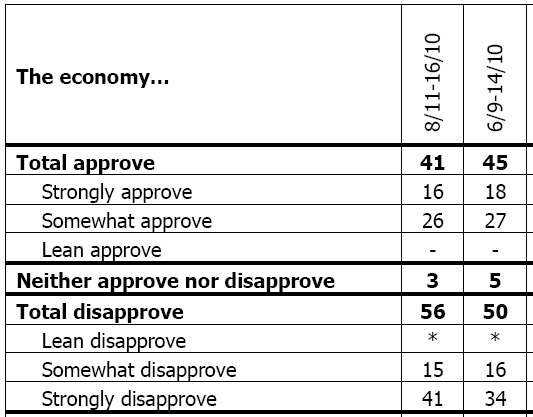
According to the latest left-leaning AP—GTK poll, 16% strongly approve of the way that President Obama is handling the economy; 41% strongly disapprove.

image

http://www.ap-gfkpoll.com/pdf/AP-GfK_Poll_August_Topline_081710.pdf

“What’s this for?” … when freebies are most appreciated

August 20, 2010

Marketers know that giveaways go a long way.

In a paper published in The Journal of Consumer Research, researchers show that reactions vary widely across cultures to this kind of surprise.

Specifically, American-born consumers tended to be more pleased by unexpected freebies than were consumers in Hong Kong and Taiwan.

In one experiment, consumers from each region were equally pleased when presented with a free coffee drink that they had been told to expect.

But when the drink came unexpectedly, the Westerners were more delighted.

In other experiments, Asians tended to react better to gifts that were framed as the product of luck — the lucky ticket, say, fished out of a jar.

Westerners reacted better to gifts that were ostensibly rewards for something they did.

“In Western cultures, marketers should say something like, ‘We want to thank you for your patronage and loyalty, and that is why we are giving you this gift,’ ”

 Excerpted from NYT: Where Giveaways Are Valued Most,  July 26, 2009 
http://www.nytimes.com/2009/07/27/business/27drill.html

Bending the healthcare cost curve (up) … expect 2011 premiums to increase 9% … or more

August 19, 2010

You know the drill: ObamaCare is going to bend the cost curve. Just wait and see…

Well, not so fast.

Why?

First, nothing substantially  “structural” is being done to the system … unless you count bagging Medicare Advantage everyplace but vote-sensitive Florida .. in essence, money is just being shifted around

Second, tens of millions of folks are getting new coverage … with taxpayers and “insureds” picking up the tab … on top of what they’re already paying.

Third, existing plans are forced to adversely select (i.e. add people with known high cost preconditions to their plans), to cover “adult children” under their parents plans, and to eliminate lifetime caps on payouts.

Somebody has to pay for all those adders … and that somebody is you … both through higher taxes and higher insurance premiums.

Employers are forecasting a 9% increase in total healthcare costs in 2011 – up from 7% in 2010.

Much of the increase is attributable to – you guessed it – ObamaCare.

Many employers say that they’ll pass the increases on to employees … 63 percent say they’ll ask workers to pay a higher portion of the premiums … others will be taking money out of the pay increase bucket … some plan to slash prescription and retiree coverage.

Just wait until the full weight of ObamaCare kicks in.

Get out your wallet.

* * * * *

For more, see “Large Companies Faced With Uncertainty Over Effects of New Health Care Law”
http://www.foxnews.com/politics/2010/08/18/large-companies-faced-uncertainty-effects-new-health-care-law/?test=latestnews

What to do if your speech is bombing …

August 19, 2010

When speaking …

Here are the things you don’t want to do if you sense your audience is losing interest:

1. Speak faster to end the ordeal sooner.
2. Speak softer so they can’t hear how boring you are.
3. Ask “May I Have Your Attention Please”
4. Look pissed off, as if it’s the audience’s fault that you are boring.

The easiest way to regain the audience members’ interest is to address them by name, and ask simple questions:

• Shane, has that ever happened to you?
• Roberta, how have you handled these situations in your business?
• Sanjay, are the financial markets affecting the industry as much in your country as they are here in London?

Audience members for business presentations are no different than people in other social interactions. The more you get your date to talk at dinner, the more charming you will be perceived.

So it is with your presentations.

Source: How to Give a Pretty Good Presentation by T. J. Walker

Instead of an August surprise … an answer for getting housing on track …

August 18, 2010

According to Reuters …

Main Street may be about to get its own gigantic bailout.

Rumors are running wild from Washington to Wall Street that the Obama administration is about to order government-controlled lenders Fannie Mae and Freddie Mac to forgive a portion of the mortgage debt of millions of Americans who owe more than what their homes are worth.

Republican leaders believe this is going to happen since it doesn’t require Congressional approval  ….and Wall Street banks are alerting their clients privately to this possibility.

James Pethokoukis, August Surprise from Obama?, Aug 5, 2010
http://blogs.reuters.com/james-pethokoukis/2010/08/05/an-august-surprise-from-obama/

I have a better idea.  Below is a reprised post from November 2008 with my plan for getting housing back on track.

* * * * *

Ken’s Plan Summary: (1) eliminate ALL of the capital gains taxes on residential property that is bought from now until, say, December 31, 2011 and held for at least 18 months, (2) allow these “qualified residential properties”, if they are rented, to be depreciated for tax purposes at an aggressively accelerated rate (say, over 5 or 10 years) to generate high non-cash tax losses, and (3) allow ALL tax losses generated by these “qualified residential rental properties” to offset owners’ taxable ordinary income with no “passive loss’ limitations, thereby reducing their federal income tax liability.

The positive results are practically guaranteed.  Nonetheless, I haven’t even heard the ideas mentioned.  Guess the politically correct folks in DC don’t read the Homa Files.

* * * * *

From HomaFiles archive, “Big Idea: Rallying private capital to stabilize housing prices”, November 23, 2008.

A stark reality of the current mortgage crisis is that there have been — and will continue to be – an unprecedented and destabilizing number of foreclosures that need to be absorbed into the housing market.  Until they are, home prices will continue to slide and the crisis will persist..

To date, most of the government’s programmatic emphasis has focused on mitigating the financial pressures on lending institutions and investors who funded bad loans, by injecting supplementary capital (loans or preferred stock purchases), or by buying toxic securities..  Some political rhetoric has centered on preventing distressed citizens from “losing their homes”, but few substantive steps have been taken.  Why?

First, once a mortgage has been “securitized” – as most have been — there are contractual limitations on possible loan modifications.   In these instances, mortgage “servicers” have their hands tied.  They are only empowered to collect payments and foreclose on non-payers, with very little latitude between the extremes.

Second, there is the proverbial elephant in the middle of the room.  Many so-called home owners are – truth be told — really “occupants” not “owners”.  Some have no equity in the homes.  Some never did – even before housing prices crashed, submerging loan balances under water.   Many wouldn’t qualify today for restructured loans under the most liberal of terms – e.g. lowered interest rates, extended payment periods, reduced principle balances (to the current fair market value of the homes).  Whether the people legitimately qualified for their initial loans is irrelevant.  Whether their initial loan terms were predatory is also largely irrelevant. Objectively, the low bar is whether they can foot the bill for a restructured mortgage.  The emerging evidence seems to suggest that many – maybe most – can’t.

That leads to an inescapable conclusion: regardless of what remedial government bailouts are enacted – the housing market will continue to be flooded with foreclosures.

So, a pivotal economic policy question is how to get the foreclosed properties off the market and into the hands of private owners (i.e. not onto the government’s asset rolls), and how to keep them there until they can be remarketed at an orderly pace and higher prices.

Three straightforward changes to the income tax code – throwbacks to yesteryear — could provide the necessary financial incentives to rally private capital back into the housing market to buy, hold, and rent foreclosed homes: (1) eliminate ALL of the capital gains taxes on residential property that is bought from now until, say, December 31, 2010 and held for at least 18 months, (2) allow these “qualified residential properties”, if they are rented, to be depreciated for tax purposes at an aggressively accelerated rate (say, over 5 or 10 years) to generate high non-cash tax losses, and (3) allow ALL tax losses generated by these “qualified residential rental properties” to offset owners’ taxable ordinary income with no “passive loss’ limitations, thereby reducing their federal income tax liability.

For example, assume that an investor buys a foreclosed home for $200,000 and rents it out at a price that simply breaks even on a cash flow basis.  That is, the rental price just covers interest, taxes, insurance, maintenance, etc.  Assuming a 5-year accelerated depreciation schedule, the rental would generate an annual non-cash tax loss of $40,000 that could be used to offset the investor’s ordinary income.  If the investor were in the Obama-boosted 39.6% marginal tax bracket, that ordinary income offset could save the investor almost $16,000 in federal income taxes each year that the property is held and rented.  If the home were then resold – say, in 3 years for $250,000 –  the investor would book $170,000 in capital gains (the $50,000 home price increase, plus the $120,000 in depreciation claimed against ordinary income when the property was being rented), but the investor would owe no capital gains taxes.

Such a program potentially offers several benefits: (1) it would entice private capital to buy (and hold) foreclosures and other distressed residential property, (2) it would likely provide affordable rental housing to people (maybe the current occupants of the homes) who realistically can’t and shouldn’t shoulder the costs of home ownership , and (3) it might take some of the sting out of President Obama’s proposed tax hikes.

It’s a win-win solution to part of a thorny problem.

Original post:
https://kenhoma.wordpress.com/2008/11/25/big-idea-rallying-private-capital-to-stabilize-housing-prices/
© K.E. Homa 2008

Ten Public Speaking Do’s and Don’ts

August 18, 2010

DO the following:
1. Be interesting.
2. Be passionate.
3. Tell stories.
4. Give examples.
5. Cite case studies.
6. Look at the audience.
7. Let people ask questions anytime.
8. Tell people why they should care.
9. Move your head, hands and body.
10. Finish on time (or early)

DON’T do the following:
1. Read your speech.
2. Do a data dump.
3. Show complex slides with lots of words and small graphics.
4. Stare at your slides and avoid your audience.
5. Be abstract.
6. Use big, complex words.
7. Use Jargon.
8. Be monotone.
9. Be boring.
10. Go over your allotted time.

Source: How to Give a Pretty Good Presentation by T. J. Walker

What do WikiLeaks and Boston dumps have in common?

August 17, 2010

Answer: security vreaches that release VERY sensitive information.

Follow-on question: How would you like your health records made public?

I was surprised that there was hasn’t been an uproar over the ObamaCare provisions that entail the Feds developing Electronic Medical Records databases with all of our health records.

Of course, the representations were that there would be no untoward uses of the data (think IRS) and that all data would be kept strictly private.

Regarding privacy, think WikiLeaks and Boston dumps.

If our high security military information can slip out to hackers, why would anyone believe that health information would be secure?

And, consider the recent incident in Boston where thousands of patient health records, some containing Social Security numbers and sensitive medical diagnoses, ended up in a pile at a public dump. See article highlights below.

If hospitals can’t keep control of old-school paper docs, does anybody really believe that the Feds will be able to control electronic health records?

Caveat citizen

* * * * *

Boston Globe: Patients’ files left at public dump, August 13, 2010

Four Massachusetts community hospitals are investigating how thousands of patient health records, some containing Social Security numbers and sensitive medical diagnoses, ended up in a pile at a public dump.

The unshredded records included pathology reports with patients’ names, addresses, and results of breast, bone, and skin cancer tests, as well as the results of lab work following miscarriages.

By law, medical records and documents containing personal identifying information must be disposed of in a way that protects privacy, and leaving them at a dump is probably illegal, privacy lawyers and hospital officials said. Violators face steep fines.

The episode highlights in dramatic fashion how hard it can be for hospitals to safeguard patient information, given the large number of doctors, insurance companies, medical billing firms, and contractors who have access to personal data in the normal course of business.

“This is a perfect example of how complicated the security of confidential information is … All it takes is one slip in that process for information to be released.’’

Full article:
http://www.boston.com/news/health/articles/2010/08/13/mass_hospitals_investigate_exposure_of_records?mode=PF

* * * * *

Thanks to CH for connecting WikiLeaks and EMR.

LEGO: Rebounding from creativity run amuck …

August 17, 2010

Punch line: In an excerpt from Design Is How It Works, former BusinessWeek staff writer Jay Greene explores Lego’s troubles and its comeback.

* * * * *

Excerpted from: How LEGO Revived Its Brand, July 23, 2010

Not many toy companies in the world have more brand power than LEGO.

Three generations of kids have built cars, cities, and spaceships with LEGO’s iconic bricks. Its logo — the red square with the rounded white letters — is immediately identifiable to most of the developed world and to a bunch of developing nations as well.

Brand power opens doors, getting kids and parents alike to consider LEGO products. But if those products don’t engage them, kids will quickly move to the next toy.

It is sometimes forgotten that LEGO struggled mightily in the early to mid-2000s.

Back then, company executives believing “being LEGO allowed us to do anything” wanted to extend the brand, venturing off on wild forays into new product development.

The prototypical example: Galidor, a legendary bomb that was all about action figures that … were little different than toys offered by scores of other manufacturers. They didn’t require building skills or much in the way of imagination, the hallmark of the more traditional LEGO construction toys.

Worse still, LEGO branched into a whole new business about which it knew little. The company co-produced a kids’ TV show called Galidor: Defenders of the Outer Dimension. The story line was meant to add detail to the action figures, giving kids more reason to buy them. But the shows sparked little interest.

Within its core construction toy business, LEGO was foundering. LEGO managers had given designers free rein to come up with ever more imaginative creations. And they took it. Left to their own devices, designers conjured up increasingly complex models, many of which required the company to make new components — the various bricks, doors, helmets, and heads that come in a rainbow of colors and fill every LEGO box. The number of components exploded, climbing from about 7,000 to 12,400 in just seven years. Of course, supply costs went through the roof, too.

Even more troubling was that the new designs weren’t resonating with kids.

“We almost did innovation suicide. We didn’t do a lot of clever components. We did a lot of stylized pieces.”

LEGO had assumed it would flourish by giving its designers whatever pieces they asked for in order to unleash their creativity. Instead, costs soared as the models veered toward the esoteric.

But, just as design pushed LEGO to the precipice, it helped bring the company back.

But here’s the paradox: Instead of giving designers free rein to conjure up their most brilliant creations to save the company, LEGO tied their hands. Gone were the days when designers could go wherever their imaginations took them.

Instead of rubber-stamping nearly every request for a new component, LEGO put each one through a systematic screening process. And it eliminated rarely used pieces, slashing the total number of components to about 7,000, the same number as in 1997.

LEGO also forced designers to come out of their cocoons and work with noncreative staff. At the earliest stages of product development, marketing managers, who had detailed research on the types of products kids wanted, helped guide development. Manufacturing personnel weighed in on production costs before a prototype ever saw the light of day.

LEGO found that design thrives with some constraints.

That might send chills up the spines of some in the design world. The idea of fencing in designers, forcing them to play in a confined space, runs counter to the notion that design needs to be set free.

“If you put guiding principles in place, you empower people to make the right decision.” 

* * * * *

From Design Is How It Works, to be published in August 2010 by Portfolio/Penguin Group.
http://www.businessweek.com/print/innovate/content/jul2010/id20100722_781838.htm

Flash: Michael Moore may be onto something… well, kinda.

August 16, 2010

An article in The Daily Beast — by super-sized, unconscionably rich, uber-lib Michael Moore – caught my eye.  In it, Moore says:

To understand what’s happening (in the economy), we have to focus on the bottom line, just like CEOs do.

And what the bottom line says is that the entire business world has figured out how to make huge buckets of money without hiring people to work for them.

I’m not sure how in the long run this benefits these companies. Maybe the same robots who make most things now are also programmed to buy them?

But the upshot is this: We have to face the fact that most of America’s CEOs don’t want the economy to get “better.”

Because for them, it couldn’t get better—they’ve got profit coming out their ears, while with 9.5 percent unemployment their entire workforce is too scared to ask for a 25 cent-an-hour raise.

They’d be happy to have things stay just like they are now. Forever.

Profits Up at GM! And You’re Still Unemployed by Michael Moore, Aug 13, 2001
http://www.thedailybeast.com/blogs-and-stories/2010-08-13/gm-profits-michael-moore-on-unemployment-gm-hiring-new-ceo/?cid=hp:mainpromo1

I think Moore’s conclusion that CEOs don’t want the economy to get better is just plain nuts.

But, he’s onto something: the entire business world has figured out how to make huge buckets of money without hiring people.

Well, maybe not the entire business world, but a big chunk of it.

Fact is that businesses always use economic slowdowns to purge themselves of organizational fat that has accumulated in good years.  This slowdown is no exception.

The differences:

(1) more fat had accumulated this time so the cuts appear deeper

(2) companies are rebuilding their cash balances so that – if there is a double dip – they won’t have to grovel for gov’t aid again

(3) few companies  are expecting a quick return to growth —  so hiring freezes are in place

(4) surviving employees are stepping up and delivering productivity increases

(5) ObamaCare, etc., have substantially increased the cost per employee – so there’s less economic advantage to hiring.

How many millionaires are there in the U.S. ? … and some other interesting economic factoids

August 16, 2010

For an update see our later post How many millionaires & billionaires are there in the US ?

* * * * *
From the BusinessInsider.com :

  • In 2009, the number of millionaires in the United States rose 16 percent to 7.8 million.
  • The top 10% of Americans now earn around 50% of our national income.
  • 83 percent of all U.S. stocks are in the hands of 1 percent of the people.
  • The bottom 80 percent of American households held about 7% of the liquid financial assets.
  • The bottom 50 percent of income earners in the United States now collectively own less than 1 percent of the nation’s wealth.
  • 61 percent of Americans “always or usually” live paycheck to paycheck, which isup from 49 percent in 2008 and 43 percent in 2007.
  • More than 40 million Americans are on food stamps.
  • 21 percent of all children in the United States are living below the poverty line
  • 36 percent of Americans say that they don’t contribute anything to retirement savings.
  • 43 percent of Americans have less than $10,000 saved up for retirement.
  • 24% of American workers say that they have postponed their planned retirement age in the past year.
  • The average federal worker now earns 60% MORE than the average worker in the private sector.
  • More than 40% of Americans who are employed are now working in service jobs.
  • In China a garment worker makes approximately 86 cents an hour and in Cambodia a garment worker makes approximately 22 cents an hour.

* * * * *

Source: 22 Statistics That Prove The Middle Class Is Being Systematically Wiped Out Of Existence In America 

>> Current Posts

But people still like him …

August 13, 2010

Thur morning on CNBC, John Harwood – one of NBC’s political hacks – reported on the most recent WSJ/NBC survey.

He rote-repeated the regular lib refrain: yes, the President’s approval ratings have fallen because people don’t like his policies … but people still like him as a person.

Oh, really ?

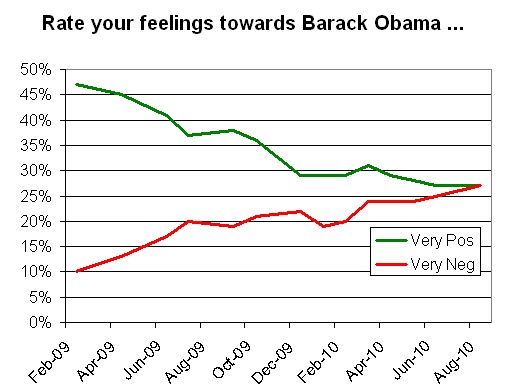
The WSJ/NBC survey asked people to “rate your feelings towards President Obama as very positive, somewhat positive, neutral, somewhat negative, or very
negative
.”

The WSJ/NBC data does say that 46% have “net positive” feelings towards Obama … 41% have “net negative” feelings towards him. 

So, he has a plurality but not a majority.

  • Technical Note: “Net Positive” adds together “Very Positive” and “Somewhat Positive”; “Net Negative” adds together “Very Negative” and “Somewhat Negative”;

In February 2009, Obama’s net positive was 68%; his net negative was 19%.

In other words – from February 2009 to August 2010 – Obama’s net positives dropped by 22 points and his net negatives increased by 22 points.

More significant, Obama’s top & bottom box ratings have converged.

In February 2009, 47% felt “very positive” towards him … only 19% felt “very negative”.

Now, 27% feel “very positive” towards him (a drop of 20 points) … and 27% feel “very negative” (up 8 points). 

Looks to me like folks aren’t liking him as much as they used to …

image

http://msnbcmedia.msn.com/i/MSNBC/Sections/NEWS/A_Politics/___Politics_Today_Stories_Teases/Aug%20NBC-WSJ%20Filled-in%20_for%208-11-10%20release_.pdf

How much does a ‘for sale’ home’s list price matter?

August 13, 2010

Answer: a lot … it’s the psychological effect called anchoring.

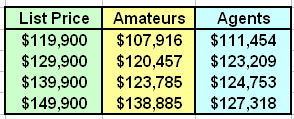
For example, researchers asked both professional real estate agents and man-off-the-street amateurs to predict the final selling price of a house.

They were all told that the current tax appraisal value of the house was $135,000.

Then, each respondent was told that the house was listed in one of four prices — ranging from $119,900 to $149,900.

The researchers found a clear positive correlation between list prices and predicted sale prices.

The amateur is responded more to the differences in list prices and the professionals — but even the pros and a $15,000 spread that can only be attributed to the differences in the list prices.

Bottom line: if you’re selling a home beach for the sky with your list price; if you’re buying a home try to ignore the list price and focus on more fundamental values like tax assessments and comparable sales

image

Source: Priceless, William Poundstone, Hill and Wang Books, 2010

How much does a ‘for sale’ home’s list price matter?

August 13, 2010

Answer: a lot … it’s the psychological effect called anchoring.

For example, researchers asked both professional real estate agents and man-off-the-street amateurs to predict the final selling price of a house.

They were all told that the current tax appraisal value of the house was $135,000.

Then, each respondent was told that the house was listed in one of four prices — ranging from $119,900 to $149,900.

The researchers found a clear positive correlation between list prices and predicted sale prices.

The amateur is responded more to the differences in list prices and the professionals — but even the pros and a $15,000 spread that can only be attributed to the differences in the list prices.

Bottom line: if you’re selling a home beach for the sky with your list price; if you’re buying a home try to ignore the list price and focus on more fundamental values like tax assessments and comparable sales

image

Source: Priceless, William Poundstone, Hill and Wang Books, 2010

The higher education bubble …

August 12, 2010

According to the Washington Examiner … 

Higher education is in a bubble, one soon to burst with considerable consequences for students, faculty, employers, and society at large.

The past decades’ history of tuition growing much faster than the rate of inflation, with students and parents making up the difference via easy credit, is something that can’t go on forever.  It won’t. 

For the past several decades, colleges and universities have built endowments, played moneyball-style faculty hiring games, and constructed grand new buildings, while jacking up tuitions to pay for things (and, in the case of state schools, to make up for gradually diminishing public support).

That has been made possible by an ocean of money borrowed by students — often with the encouragement and assistance of the universities.

Right now, people are still borrowing heavily to pay the steadily increasing tuitions levied by higher education. 

But that borrowing is based on the expectation that students will earn enough to pay off their loans with a portion of the extra income their educations generate. 

Once people doubt that, the bubble will burst. 

Post-bubble, students are likely to be far more concerned about getting actual value for their educational dollars

Faced with straitened circumstances, colleges and universities will have to look at cutting costs.

Excerpted from Washington Examiner: Further thoughts on the higher education bubble, August 8, 2010 
http://www.washingtonexaminer.com/opinion/columns/Sunday_Reflections/Glenn-Harlan-Reynolds-Further-thoughts-on-the-college-tuition-bubble-100216064.html#ixzz0w6axRS7x

Making sense of restaurant wine lists … a first step.

August 12, 2010

From WSJ …

According to a study published in Science magazine 93% of the world’s population is completely predictable.

Spontaneous individuals are largely absent from the population.”

* * * * *

Restaurant wine lists, however, are much less predictable than people — one list may look nothing like another.

Lists of wines are typically organized by:

  • country of origin (sometimes with maps)
  • grape type, e.g. Chardonnay, Cabernet,
  • intensity (light, medium and full-bodied)
  • color (red, white and rosé).
  • texture and aroma (“lush” or “floral”)
  • emotion they presumably embody (“intense and brooding”).
  • prices and scores

There are shortcomings to every kind of wine list and certain compromises must always be made. And yet, there a few changes that could easily improve each type of list.

  • lists that emphasize geography should contain maps
  • grape-oriented lists should come with a brief story—a profile describing  the grape’s characteristics, flavor and history
  • flavor and style notes should be pared back — keep the practical language of weight and texture but  eliminate words like “sexy” and “love.”

A wine list, after all, is ultimately a sales tool.

It can be complemented by a person who talks about wine — or better yet, offers a free taste.

Excerpted from WSJ: Building a Better Wine List, August 7, 2010 :
http://online.wsj.com/article/SB10001424052748703545604575407470969205984.html?mod=djemonwine_t

Auto sales are booming … or are they ?

August 11, 2010

The initial headlines were that US auto sales were up big in July.

Not so fast.

Yeah, they were up versus July 2009, but …

  • Industrywide deliveries dropped to an 11.1 million pace
  •  GM’s sales rose 1.5% … they were expected to rise 10%.
    Ford’s sales fell 0.7 %, trailing analysts’ estimates for a 10% gain.
    Chrysler sales gained 1.1%, versus a 2.2% expectation
    Toyota and Nissan sales dropped, but topped expectations.

The results show GM’s turnaround efforts may be slowing after last year’s bankruptcy.

Bloomberg, GM, Ford and Chrysler Sales All Lag Estimates,  Aug 3, 2010 Aug. 3
http://www.bloomberg.com/news/2010-08-03/gm-s-july-u-s-auto-sales-rise-5-4-falling-short-of-analysts-estimates.html

‘Hawaii Five-O’ is now ‘Hawaii Five-0’ … uh oh !

August 11, 2010

Excerpted from WSJ: Book ‘Em (Again), Danno, August 6, 2010

CBS will launch its updated version of “Hawaii Five-O,” called “Hawaii Five-0,” on Sept. 20.

Note the distinction: the “oh” (five-oh is for the 50th state; it’s now become slang for police) looked like a letter in the old show, but in the new one, it’s a number.

In the original “Hawaii Five-O,” which aired  for 12 years, Jack Lord’s Steve McGarrett is an elite detective — and a bit of a straight arrow. 

He’s too busy solving crimes to have much of a personal life.

For the new version of the cop show, McGarrett is a third-generation military man armed with high-tech weapons to fight international terrorism.

McGarrett owns a Mercury Marquis Brougham, the same model as in the original, but he wears unbuttoned shirts over undershirts.

When “Hawaii Five-O” premiered in 1968, the state still had a mystical allure. Today, after “Magnum, P.I.,” “Lost” and “Survivor,” exotic locales are less exotic.

The new “Hawaii Five-0” will feature the old show’s famous theme music but opens with tanks, a helicopter and high-tech explosions, a decidedly un-analog opening—in South Korea.

The new version will dive deeper into the main characters’ personal lives, while still maintaining closed-end stories rather than run-on serialization.

And, of course, McGarrett  will still give partner Det. Danny “Danno” Williams those iconic instructions: “Book ’em, Danno.”

Full article:
http://online.wsj.com/article/SB10001424052748704017904575409730624410338.html?mod=WSJ_hps_MIDDLESixthNews

Just in case you still think the Stimulus stimulated … a great analysis!

August 10, 2010

The Administration (and mainstream media) have been touting a recent paper by Alan Blinder and Mark Zandi that apparently vindicates the Obama stimulus plan, claiming  that if not for the response of the federal government, the unemployment rate would be 15.7 percent, far higher than the current 9.5 percent …  and understandably way higher than the promised 8%.

Yeah, right.

First, not noted by the press,  most of the positive effects cited in the paper came not from the stimulus but from stabilizing actions of the Federal Reserve, the FDIC, and TARP.

Second, the paper argues that the 8% promise was impaired because Romer & Bernstein didn’t adequately dope out how bad the economy really was.

The below analysis shreds the “starting point” argument and concludes that the stimulus program achieved – in effect – nothing  … except for boosting the national debt by a trillion dollars.

* * * * *

Excerpted from Weekly Standard: Did the Stimulus Stimulate?, Lawrence B. Lindsey, August 16, 2010

In January 2009, Christina Romer, who resigned last Friday as chairman of the president’s Council of Economic Advisers, and Jared Bern-stein, chief economic adviser to Vice President Biden, published a paper projecting what would happen if President Obama’s proposed stimulus package passed, compared with what would happen if it did not.

The Romer-Bernstein paper has often been cited as saying that if the package passed, the unemployment rate would peak below 8 percent in the middle of 2009 and would decline to below 7.5 percent by now.

Obviously this has not happened.

The administration argues that it is not fair to conclude that this proves the package was a failure since Romer and Bernstein underestimated the severity of the recession and that unemployment was already 8.2 percent in the first quarter of 2009, higher than the assumed peak.

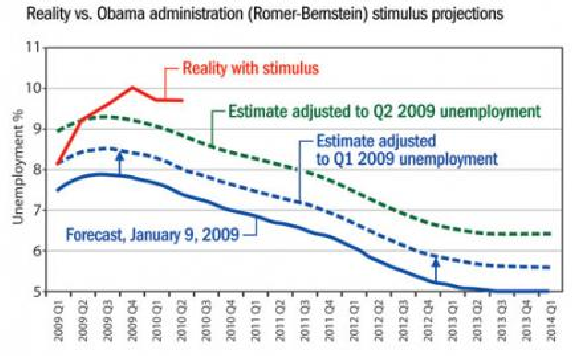
The chart below corrects for their complaint by raising their estimate of where unemployment started in their experiment.

image

The lowest line provides the original estimate of the path of unemployment provided by Romer and Bernstein on January 9, 2009.

The second line replicates the Romer and Bernstein path, but raises the initial unemployment rate from their assumed 7.5 percent to 8.2 percent. This was the actual average of the unemployment rate in the first quarter of 2009, the period in which the stimulus was passed.

The third line provides a more extreme alternative by raising the initial unemployment rate to the 9.3 percent average of the second quarter 2009.

The first modification fully compensates for their objection while the second modification more than compensates for their concern.

But as the chart shows, the problem with the stimulus wasn’t just the starting point — it was that the stimulus itself has been ineffective at lowering it.

The actual unemployment rate, given by the red solid line, is not only above the original Romer-Bernstein projections, but also above projections that take account of the “starting point” problem.

Actual unemployment has been consistently above all of the projections, regardless of starting point, because the stimulus bill has basically brought no relief in terms of lower unemployment.

Full article:
http://www.weeklystandard.com/articles/did-stimulus-stimulate

Feeling deprived? Then sleep late on Saturday (and Sunday) …

August 10, 2010

Simply sleeping late on Saturday doesn’t counter the  ill-effects of a lack of sleep during the week.

In tests, researchers found that a 10-hour “recovery” snooze was not sufficient to make up for a few nights of four hours of sleep.

Participants scored poorly in measures of attention span and reaction times.

The study counters the currently held view that there is “tremendous recovery” in just one night’s sleep.

It means several nights of extra sleep may be needed for those who have been burning the candle at both ends.

“The bottom line is that adequate recovery sleep duration is important for coping with the effects of chronic sleep restriction on the brain”

“Lifestyles that involve chronic sleep restriction during the work week and during days off work may result in continuing build-up of sleep pressure and in an increased likelihood of loss of alertness and increased errors.”

“The bottom line is that adequate recovery sleep duration is important for coping with the effects of chronic sleep restriction on the brain.”

In previous research, it was found that sleeping six hours a night or fewer for two weeks has the same negative effects as two nights of total sleep deprivation.

Source: BBC.com, A weekend lie-in may not help catch up on lost sleep, August 1, 2010 
http://www.bbc.co.uk/news/health-10819746

Wasn’t suing Arizona supposed to help Obama with Hispanics ?

August 9, 2010

Oops … According to Gallup, President Obama’s ratings have slipped among Hispanics … 

click chart to enlarge

image

http://www.gallup.com/poll/141725/Blacks-Whites-Continue-Differ-Sharply-Obama.aspx

As President Obama turns 49 … courtesy of the late shows.

August 9, 2010

Letterman: The president is 49 years old, but it’s never a good sign when your age is higher than your political approval rating.

Leno: They got him a huge cake. He didn’t blow out the candles, he just taxed them until they gave up on their own.

Fallon:  Today was President Obama’s birthday. All the Democrats were like “How old are you now,” while the Republicans were like “And where were you born?”

Why is economics called the dismal science?

August 9, 2010

According to conservative economist Thomas Sowell:

Economics was christened the dismal science because it deals the allocation of scarce resources with inescapable constraints and painful trade-offs, instead of more pleasant, unbounded visions and their accompanying inspiring rhetoric, which many find so attractive in politics and in the media.

Moreover, economics follows the unfolding consequences of decisions over time, not just what happens in the very short run. That is, economics deals as well with second and third-order effects and unintended consequences.

And, economics focuses analytical comparisons against next best alternatives, not idealistic scenarios of perfection.

Source:Applied Economics, Basic Books, 2009

Romer’s Legacy: “Spend a trillion and unemployment will stay under 8%”

August 6, 2010

Which metaphor applies ?

Was she thrown under the bus or did she jump off the ship?

Romer’s history of academic research concluded that Keynesian fiscal stimulus doesn’t work.

Then, she drank the kool-aid and shilled for Obama’s trillion dollar faux-stimulus spending spree.

She seemed smart enough and sincere enough, that one had to think that she was dying of hypocrisy on the inside.

Now, after a short 18 months as Obama’s chief economic spokesperson, Romer woke up and realized that her youngest child was going to start high school, so she needed to move back to California,

Yeah, right.

If she didn’t see that one coming 18 months ago, how could she possibly forecast the economy?

I feel for the lady. 

She’ll end up being remembered for her 8% promise — which will go down in the history books next to “Mission Accomplished”.

If only she had maintained her academic integrity …

* * * * *

Excerpted from WAJ: Romer to Resign as Obama Adviser,  August 6, 2010

Christina Romer said she would resign as chairman of President Barack Obama’s Council of Economic Advisers to return to her teaching post at the University of California at Berkeley, effective Sept. 3.

Ms. Romer is the second member of Mr. Obama’s economic team to leave.

White House budget director Peter Orszag left earlier this summer.

She said she is returning to California so the youngest of her three children can begin high school there.

Among her challenges was explaining why her prediction that the Obama-backed fiscal stimulus would keep the unemployment rate below 8% proved overly optimistic. The unemployment rate is now at 9.5%.

Ms. Romer’s academic work focused, among other things, on the causes of and recovery from the Great Depression and the impact of monetary, spending and tax policy on the economy.

Her 19 months in Washington has confirmed some of her prior beliefs …

Full article:
http://online.wsj.com/article/SB10001424052748704657504575411973910324964.html?mod=WSJ_hps_SECONDTopStories

Geithner declares Mission Accomplished: “Welcome to the Recovery”

August 6, 2010

Well, Treasury Secretary Tim Geithner did it. He declared Mission Accomplished.

In a New York Times op-ed, titled Welcome to the Recovery, he argues that the Administration’s economic plan is working — even better than expected.

“Recent data on the American economy shows that we are on a path back to growth.”

Among his points:

“From the start, President Obama made clear that recovery from a crisis of this magnitude would not come quickly”

Ken’s Note: Well actually, the president said that the almost $1 trillion in stimulus money would be quickly deployed to shovel ready projects that would keep the unemployment rate under 8%. As everybody knows, it has been hovering just shy of double digits.

“The new data show that this recession was even deeper than previously estimated.”

English translation: Our initial analysis was deeply flawed, but you can trust that we’ve got this sucker figured out now. Don’t judge us based on our track record.

“We  expect the unemployment rate to go up before it goes down.”

Ken’s Note: How much recovery can we stand?

“The economic collapse drove tax revenue down, pushing the annual deficit up to $1.3 trillion by last January.”

Ken’s Note: Who could ever have imagined that lower aggregate income would generate less tax revenue

“It would be irresponsible to continue the Bush tax cuts for the wealthy.”

English translation: Let’s defy all empirical evidence and see what happens when you raise taxes during a recession.

Kens Note: I love it when a guy who was caught cheating on his taxes lectures on taxpaying responsibility.

* * * * *

I don’t know about you, but I slept well last night…

NY Times, Welcome to the Recovery, August 2, 2010
http://www.nytimes.com/2010/08/03/opinion/03geithner.html?_r=1&ref=opinion

In this economy, even counterfeiters are trading down …

August 6, 2010

Punch Line: It used to be that flashy names like Rolex were the ones susceptible to counterfeiting. 

Now, there’s more money in downscale brands …

* * * * *

Excerpted from NY Times: Even Cheaper Knockoffs, Jul 31,2010

After years of knocking off luxury products like $2,800 Louis Vuitton handbags, criminals are discovering there is money to be made in faking the more ordinary — like $295 Kooba bags and $140 Ugg boots.

In California, the authorities recently seized a shipment of counterfeit Angel Soft toilet paper.

The shift in the counterfeiting industry plays to recession-weary customers looking for downmarket deals.

Knockoffs of lesser-known brands, which are easy to sell on the Internet, can be priced higher than obvious fakes, and avoid the aggressive programs by the big luxury brands to protect their labels, retail companies and customs enforcement officials say.

“If it’s making money over here in the U.S., it’s going to be reverse-engineered or made overseas.”

The lesson for many counterfeiters has been that they have a better chance of getting away with it if they copy smaller brands and market them on the Internet.

Melting down … despite “The View”.

August 5, 2010

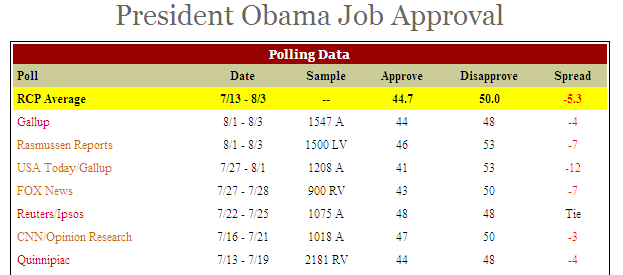
For the first time a majority in the Real Clear Politics poll-of-polls disapprove of the way President Obama is handling his job.

And, for the first time, his averaged approval rating has dipped below 45%.

image

image

More education means more work … so who’s the smart one ?

August 5, 2010

People tend to assume that education opens doors.

That may be true in a lot of cases, but for some American men in the past 20 years, more education has meant less leisure time.

But since 1985, a leisure-time gap has developed among men: Less educated men have devoted more time to leisure, while more educated guys have kept their shoulders to the wheel.

What’s the main explanation?

It could be that as men get more education — and thus more earning power — it becomes more rewarding for them to spend time working.

After all, they’re making more money.

Sourced from US News: Why Relax When You Can Work?, April 9, 2008
http://money.usnews.com/money/business-economy/articles/2008/04/09/why-relax-when-you-can-work.html

History repeats … here’s evidence

August 4, 2010

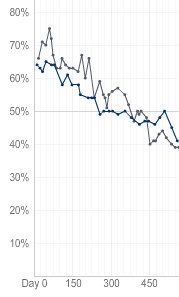
In the most recent Gallup — USA Today presidential tracking poll, Pres. Obama’s approval dropped to 41% — just above the political “Mendoza Line ”.

More interesting (to me), is the remarkable similarity between Obama’s approval decline and that of the President  to which he is most often compared (by conservatives) — Jimmy Carter.

  • Note: Jimmy Carter’s line is the one with the initial spike.

Anybody see a pattern ?

image

http://www.usatoday.com/news/washington/presidential-approval-tracker.htm

Fore: It’s not the first 300 yards of a hole that kill you …

August 4, 2010

Punch Line: It’s something you don’t hear much about, but it’s making a comeback — the par-three golf course.

* * * * *

WSJ: Why We Need More Par-Three Courses, July 24, 2010

The golf industry is struggling, and many people in the game cite the same reasons:

  • a round takes too long; the game is hard;
  • maintenance budgets are through the roof;
  • there are no places for beginners to play while they learn.

One remedy: more short courses.

For the experienced player, they provide a great practice session under game conditions. 

Improving your game around the greens is the best way to cut five strokes from your score; two or three hours at a short course is more valuable than whaling away with your driver on the range.

For the beginner, the shorter holes mean less frustration and more success.

“Most people play short courses for fun … and with a short course, you’re eliminating the longest and most unpredictable shots.”

Full article:
http://online.wsj.com/article/SB10001424052748703467304575382941326891262.html?mod=WSJ_hps_MIDDLEForthNews

Why didn’t they just name it Edsel ?

August 3, 2010

Punch line: The Chevy (oops, I meant to say Chevrolet) Volt will have a  $41,000 sticker price while offering the performance and interior space of a $15,000 economy car.

Maybe nobody will notice …

* * * * *

Excerpted from NYT: G.M.’s Electric Lemon, July 29, 2010

GM introduced America to the Chevrolet Volt at the 2007 Detroit Auto Show as a low-slung concept car that would someday be the future of motorized transportation. It would go 40 miles on battery power alone, after which it would create its own electricity with a gas engine.

Oops.

For starters, G.M.’s vision turned into a car that costs $41,000 before relevant tax breaks (projected to be about $7,500 per car). Tthe Volt’s main competition, the Nissan Leaf ends up costing $8,000 less as a result.

And instead of a sleek coupe , the Volt looks suspiciously similar to a Toyota Prius.

It also requires premium gasoline, seats only four people (the battery runs down the center of the car, preventing a rear bench) and has less head and leg room than the $17,000 Chevrolet Cruze, which is more or less the non-electric version of the Volt.

In short, the Volt appears to be exactly the kind of green-at-all-costs car that some opponents of the bailout feared the government might order G.M. to build.

Though President Obama’s task force reported in 2009 that the Volt “will likely be too expensive to be commercially successful in the short term,” it didn’t cancel the project.

So the future of General Motors (and the $50 billion taxpayer investment in it) now depends on a vehicle that costs $41,000 but offers the performance and interior space of a $15,000 economy car.

If G.M. were honest, it would market the car as a personal donation for, and vote of confidence in, the auto bailout. Unfortunately, that’s not the kind of cross-branding that will make the Volt a runaway success.

Full article:
http://www.nytimes.com/2010/07/30/opinion/30neidermeyer.html?_r=1&ref=opinion

Is that a Mercedes in the Dollar General parking lot?

August 3, 2010

Punch line: Americans are broke and depressed — and also swilling $3 lattes and waiting in line for iPhones.

Go figure.

* * * * *
Highlights from Bloomberg Business Week:The New Abnormal, July 29, 2010

The new abnormal has given rise to a nation of schizophrenic consumers — dollar stores and luxury. They splurge on high-end discretionary items and cut back on brand-name toothpaste and shampoo.

Companies like Apple and Starbucks  are thriving. Mercedes-Benz is having a record sales year.

The irony is that it is often the same people juggling iPhones and venti lattes who are open to switching to off-brand laundry detergents — abandoning Ivory soap and Crest toothpaste for generic brands.

They may also be sneaking into discount retailers for these deals.

The dollar store is the new Target … You go in there to buy shampoo for a buck so you can go to Starbucks and justify spending $3 for a coffee … you buy cheap towels there before hitting a pricey spa.”

What’s going on?

“Some consumers are probably liquidity-constrained … and aren’t buying iPads.

But 90 percent of Americans do have a job, and maybe 70 percent are confident about them. And maybe half of those have liquidity.”

“Consumers’ brains lack a line that separates spending from saving. Instead they practice a certain amount of thrift to justify blowing a large sum frivolously.”

People are saying, ‘There is still risk. I gotta cut back … but life has to have some normalcy. I have to have some luxuries.”

Full article:
http://www.businessweek.com/magazine/content/10_32/b4190050473272_page_4.htm

The economy: Light at the end of the tunnel ?

August 2, 2010

Nope.  Not according to the AP’s survey of leading economists.

That’s confusing (to me) since the President said on the view that he’s got this one under control.

Who to believe ?

* * * * *

Excerpted from: AP survey: A bleaker outlook for economy into 2011, July 29,2010

The U.S. economic recovery will remain slow deep into next year, held back by shoppers reluctant to spend and employers hesitant to hire, according to an Associated Press survey of leading economists.

Economists have turned gloomier in the past three months as “we hit an air pocket in consumer spending,”  They foresee weaker growth – less than 3% — and higher unemployment than they did before.

Growth would have to equal 5 percent for a full year to drive the unemployment rate down by 1 percentage point. Neither the economists in the AP survey nor the Obama administration expects that to happen.

More specifically, economists  forecast:

  • Economic growth the rest of this year and early next year will weaken, to less than 3 percent. From January through May, the economy grew at roughly a 3.5 percent pace.
  • The unemployment rate will be no lower at the end of the year than it is now — 9.5 percent. It will be 2015 or later before the rate falls to a historically normal 5 percent.
  • State budget shortfalls pose a “significant” or “severe” risk to the national economy. The loss of tax revenue has forced state and local governments to cut services and lay off workers. State and local governments cut their spending in the first three months of this year by 3.8%. The drop in state and local government spending shaved about half a percentage point off the U.S. gross domestic product in the first three months of this year.

Full article:
http://www.google.com/hostednews/ap/article/ALeqM5ioRXliVfpQrwlEITOiWDGlofCQfAD9H8FSJ80

“Make no mistake, we’re headed in the right direction” … oh, yeah ?

August 2, 2010

Ken’s Take: Q2 GDP growth was 2.4% … 3% is required to hold the unemployment rate constant … that means that next week’s unemployment rate will tick up … unless more unemployeds get discouraged, stop looking for work and don’t get counted in the denominator.

Doesn’t sound like the right direction to me …

* * * * *

Highlights from WSJ: The 2.4% Recovery, July 31, 2010

Savings by households also increased again, to above 6%, which is back to the range of the early 1990s and is a healthy sign.

The great deleveraging that began with business last year is now continuing with consumers.

While some economists fret that this is bad for consumer “demand,” savings don’t vanish from the economy. They are recycled into lending and investment that can drive future growth if businesses see the right opportunities and have enough confidence.

Ken’s Note: the savings do “vanish” if repaid lenders are also shoring up their balance sheets, i.e. holding the capital in reserve – by law or by desire.

* * * * *

The Obama Administration, in its Keynesian confusion, is simultaneously saying the economy is so weak it needs more spending “stimulus” but also strong enough to absorb a huge tax increase.

The message of 2.4% second quarter growth is closer to the opposite: The epic government stimulus has failed to produce the robust expansion the White House promised, and the prospect of higher taxes and more regulation is inhibiting the private animal spirits needed for growth to accelerate.

Ken’s Note: the fight over the Bush tax cuts will be fun to watch … my bet: it’ll be another GITMO … lots of rhetoric, but Bush had it right.

* * * * *

Full article:
http://online.wsj.com/article/SB10001424052748703999304575399490468359832.html?mod=WSJ_Opinion_LEADTop