Archive for July, 2014
July 31, 2014
A classic “framing” question from Kahneman’s Thinking Fast, Thinking Slow …
Here’s the situation:
A woman has bought two $80 tickets to the theater.
When she arrives at the theater, she opens her wallet and discovers that the tickets are missing.
$80 tickets are still available at the box office.
Will she buy two more tickets to see the play?

Most (but, not all) survey respondents answer that the woman will go home without seeing the show.
Let’s try another situation …
(more…)
SHARE THIS POST WITH FRIENDS & FAMILY
Posted in Cognitive biases, Decision Making, Kahneman, Daniel, Kahneman, Daniel - Thinking Fast, Slow, Problem solving, Thinking Fast, Thinking Slow | Leave a Comment »
July 30, 2014
We’re talking Sandra Fluke today.
You know, the Georgetown law student who couldn’t afford $3,000 for birth control pills while going to law school.

Not to worry, we’re not taking sides on the ObamaCare contraceptives issue … this is all about money — freakonomics.
Still, since it’s critical background, here’s an excerpt of her infamous Congressional testimony:
My name is Sandra Fluke, and I’m a third-year student at Georgetown Law School.
I attend a Jesuit law school that does not provide contraceptive coverage in its student health plan.
We students have faced financial, emotional and medical burdens as a result.
When I look around my campus, I see the faces of the women affected by this lack of contraceptive coverage …
On a daily basis, I hear from yet another woman from Georgetown or from another school … and they tell me that they have suffered financially, emotionally and medically, because of this lack of coverage.
Without insurance coverage, contraception, as you know, can cost a woman over $3,000 during law school.
For a lot of students who, like me, are on public interest scholarships, that’s practically an entire summer’s salary.
Forty percent of the female students at Georgetown Law reported to us that they’ve struggled financially as a result of this policy.
Click for full unedited transcript
OK, I understand.
Sandra is cash-strapped because of the high cost of attending Georgetown and she wants other folks to pay for her contraceptives.
But now, there’s a strange twist to her “poor me” story.
(more…)
SHARE THIS POST WITH FRIENDS & FAMILY
Posted in Laughs, ObamaCare | 2 Comments »
July 29, 2014
Behavioral theorists have long observed that most people are risk adverse and, due in part to an “endowment effect”, they “value” losses greater than gains.
Endowment Effect: People tend to ascribe a higher value to things that they already own than to comparable things that they don’t own. For example, a car-seller might think his sleek machine is “worth” $10,000 even though credible appraisers say it’s worth $7,500. Sometimes the difference is due to information asymmetry (e.g. the owner knows more about the car’s fine points), but usually it’s just a cognitive bias – the Endowment Effect.
The chart below illustrates the gains & losses concept.
- Note that the “value line” is steeper on the losses side of the chart than on the gains side.
- L & G are equivalently sized changes from a current position.
- The gain (G) generates an increase in value equal to X.
- The loss (L) generates a decrease in value that is generally found to be 2 to 3 times an equivalently sized gain

=====
For example, would you take any of these coin flip gambles?
- Heads: win $100; Tails: lose $100
- Heads: win $150; Tails: lose $100
- Heads: win $200; Tails: lose $100
- Heads: win $300; Tails: lose $100
Most people pass on #1 and #2, but would hop on #3 and #4.
OK, now let’s show how all of this relates to ObamaCare.
(more…)
SHARE THIS POST WITH FRIENDS & FAMILY
Posted in Cognitive behavior, Cognitive biases, Endowmwnt Effect, ObamaCare, Polls & Surveys | Leave a Comment »
July 28, 2014
First, a definition lifted from Wiki:
Buyer’s remorse is the sense of regret after having made a purchase. It is frequently associated with the purchase of a big ticket item such as a car or house.
It may stem from fear of making the wrong choice, guilt over extravagance, or a suspicion of having been overly influenced by the seller.
Buyer’s remorse is thought to stem from the post-decision cognitive dissonance that arises when a person makes a difficult decision.
Factors that affect buyer’s remorse include resources invested, the involvement of the purchaser, whether the purchase is compatible with the purchaser’s goals, and what positive or negative evidence the purchaser encounters post-purchase that confirms or denies the purchase as a good idea.

= = = = =
Bet you can guess where this one is going.
Remember the 2012 election when Obama squared off against Romney?
Obama won the election with 51% of the popular vote.
My, how things have changed.
(more…)
SHARE THIS POST WITH FRIENDS & FAMILY
Posted in Buyer behavior, Cognitive behavior, Obama, Polls & Surveys, Romney, Mitt | Leave a Comment »
July 24, 2014
interesting factoid from Quartz.com “ What universities have in common with record labels” …
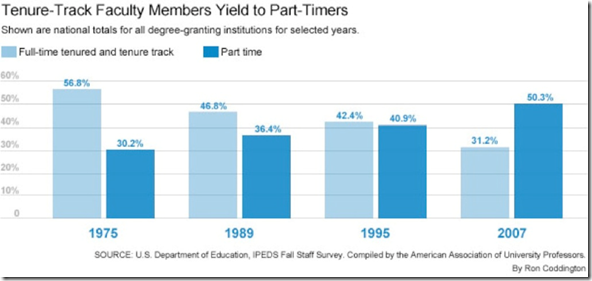
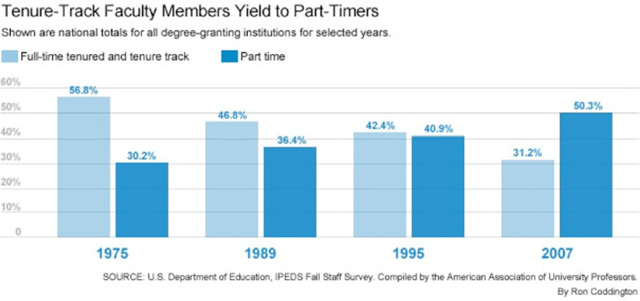
Used to be that the majority of college faculty were on the tenure track … with less than 1 in 3 being non-tenure track “part-timers”.
Source: Quartz.com
With the cost pressures that universities face these days, those numbers have completely reversed.
Now, the majority of university faculty s part-timers … and about 1 in 3 are on the tenure track.
And, Quartz points out that there’s increasing separation between content producing “marquee” profs and “average” profs.
“The ranks of professors will quickly diverge into the 1% and everyone else.”
As the original Grandma Homa used to say; “It’s easy to be good, hard to be great.”
#HomaFiles
Follow on Twitter @KenHoma >> Latest Posts
SHARE THIS POST WITH FRIENDS & FAMILY
Posted in Education - Academics, Employment - Jobs, Higher Education, Tenure | Leave a Comment »
July 23, 2014
Here’s a classic test of intuitive skills excepted from Daniel Kahneman’s Thinking Fast, Thinking Slow…
As you consider this question, please assume that Steve – the subject — was selected at random from a representative sample.
Steve has been described by a neighbor as follows: “Steve is very shy and withdrawn, invariably helpful but with little interest in people or in the world of reality. A meek and tidy soul, he has a need for order and structure, and a passion for detail .”

* * * * *
Is Steve more likely to be a librarian or a farmer?
(more…)
SHARE THIS POST WITH FRIENDS & FAMILY
Posted in Cognitive biases, Decision Making, Kahneman, Daniel - Thinking Fast, Slow, Problem solving, Thinking Fast, Thinking Slow | 1 Comment »
July 22, 2014
Interesting study on cognitive biases from Daniel Kahneman’s Thinking, Fast and Slow …
Patients undergoing a painful medical procedure – think, colonoscopy without anesthesia – recorded their pain levels during the procedure on a range from no pain (zero) to excruciating (10).
Some of the procedures were short in duration … others were longer.
Below is the pain chart for 2 representative patients.
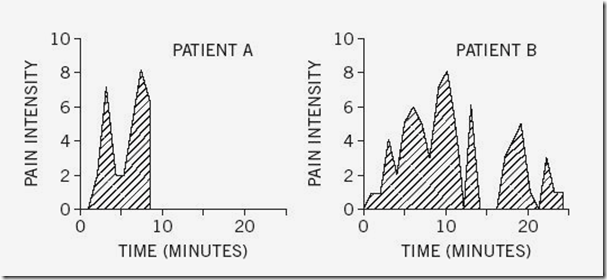
The patients were asked – after the fact—how painful the procedure was.
What’s your bet? Which patient claimed to have undergone the more painful procedure?
(more…)
SHARE THIS POST WITH FRIENDS & FAMILY
Posted in Cognitive biases, Decision Making, Kahneman, Daniel | Leave a Comment »
July 21, 2014
According to Chip & Dan Heath in Rotman Management article “The 4 Villains of Decision Making” …
“Research in Psychology over the last 40 years has identified a broad set of biases in our thinking that doom our decision making. If we aspire to make better choices, we must learn how these biases work and how to fight them.”

According to the Heath Brothers – academics & popular authors – there are 4 decision making villains that have to be confronted
(more…)
SHARE THIS POST WITH FRIENDS & FAMILY
Posted in Cognitive biases, Decision Making, Heath, Chip & Dan | Leave a Comment »
July 18, 2014
Recent Pew Poll …
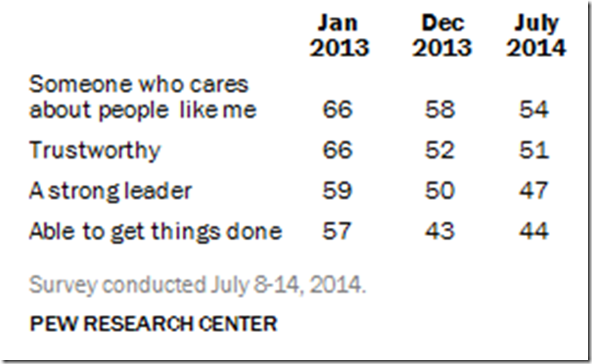
Slim majority of folks agree that President Obama “cares about people like me”.
There are still believes: 51-49 on “trustworthiness”
But, less than half agree that he’s a “strong leader” who is “able to get things done”.
Source: Pew
* * * * *
Poll didn’t ask”faithfully executes laws” or “able to raise big money for political campaigns”
#HomaFiles
Follow on Twitter @KenHoma >> Latest Posts
SHARE THIS POST WITH FRIENDS & FAMILY
Posted in Obama, Polls & Surveys | 1 Comment »
July 18, 2014
Academic and Business Ethics.
Yesterday, the Washington Post reported that an academic journal — had to retract 60 research articles had to be retracted because its peer review process had been compromised.
Apparently, the Journal of Vibration and Control (JVC) — no, I didn’t make that title up — fell victim to a “peer review ring”. A close knit group started cloning their electronic identities as experts.
So, while the journal thought that it was sending candidate articles to a broad sample of experts — they were really sending them to a small handful of cronies.
In fact, because of the law of averages, on at least one occasion, an author got to peer review his own paper.
Oops
When the fraud was discovered, the journal ‘fessed up , retracted the compromised articles and allowed the senior editor to resign.
But, will the Journal of Vibration and Control (JVC) ever be able to restore its good name?
The incident reminded me of my absolute favorite academic journal scandal…

Awhile ago, I got an email from the Executive Director of the Academic and Business Research Institute:
(more…)
SHARE THIS POST WITH FRIENDS & FAMILY
Posted in acad, Academics - Research, Ethics, Plagiarism | Leave a Comment »
July 17, 2014
Probable Answer: “You’re fired!”
Not so in ObamaLand …
There, bossman would be ordering pizza for the victory celebration.
Let’s look at the facts …
Flashback to March 2010, when Obamacare was being steam-rolled though Congress.
At that time, the Congressional Budget Office (CBO) projected that Obamacare would cost $938 billion over a decade, that the Federal deficit would shrink and 19 million uninsured people would be insured as of 2014.
As a frame of reference, those estimates work out to be about $5,000 in annual cost per newly insured person … about par for private market medical insurance.

* * * * *
Unfortunately, but predictably, those estimates were wildly off the mark …
(more…)
SHARE THIS POST WITH FRIENDS & FAMILY
Posted in ObamACA, ObamaCare, ObamaCare - CBO estimates | 1 Comment »
July 16, 2014
According to Business Week…
There was a growth spurt in bowling alleys after World War II. The U.S. added 2,000 bowling alleys between the end of World War II and 1958.
In 1958, the American Society of Planning Officials reported that “the bowling alley is fast becoming one of the most important—if not the most important—local center of participant sport and recreation.”
But, the bowling craze peaked and started to fade as folks found other ways to spend their spare time.
The U.S. had 4,061 bowling centers in 2012, down 25 percent from a high water mark in 1998.

* * * * *
To counter the downward trend, bowling alleys are rebranding themselves as “bowling centers”, spiffing up the facilities, and adding ancillary entertainment (e.g. rock music, gaming arcades).
Following the industry lead, “the exclusive bowling lanes reserved for White House employees and their guests are getting an upgrade.” (more…)
SHARE THIS POST WITH FRIENDS & FAMILY
Posted in Games, Gov't Waste & Inefficiency, Obama, Sports - Games - Recreation | Leave a Comment »
July 15, 2014
Interesting article on Quartz.com tracking how “the internet’s power to unbundle content sparked a rapid transformation of the music industry’ and arguing that”and it’s doing the same thing to higher education today.
Let’s start with the recorded music industry.
It’s no surprise that
The unbundling of albums in favor of individual songs was one of the biggest causes of the music industry’s decline.
It cannibalized the revenue of record labels as 99-cent songs gained popularity over $20 albums.
What did surprise me us that recording industry revenues have dropped by half from the $14 billion in 2000.

The eroding revenues and and internet dynamics have “changed the way music labels had to operate in order to maintain profitability.
The traditional services of labels: identifying artists; investing in them; recording, publishing, and distributing their work; and marketing them—are now increasingly offered a la carte.”
And, talk about the top 1% and distribution of riches …
Being a recording artist these days is a hard gig …
Pressure from labels then had downstream effects on content creators, specifically artists.
The top one 1% of artists now take home 77% of revenue, and the rest is spread across an increasing number of artists.
The pain of the record labels is forced on artists through smaller royalty payments.
Ouch.
Now, what’s the parallel to higher education?
(more…)
SHARE THIS POST WITH FRIENDS & FAMILY
Posted in Digital Media, Disruptive Innovation, Education - Academics, Music | Leave a Comment »
July 14, 2014
Last week, we pointed out that the 288,000 jobs gain in June wasn’t all that it was cracked up to be since full-time employment declined by over 500,000 and part-time employment increased by almost 800,000.
For details see: Last week’s employment report in 4 charts …

I thought the spike in part-time employment was a bad thing … a drift to a part-timer economy.
Silly me.
Liberal economist Dean Baker hset me straight in a HuffPost article:
“The Good News About Obamacare in the June Jobs Report”
Here’s Mr. Baker’s spin …
(more…)
SHARE THIS POST WITH FRIENDS & FAMILY
Posted in Economics, Employment - Jobs, ObamaCare | Leave a Comment »
July 11, 2014
A recent Gallup poll reports that 72% of Muslims approve of the job that President Obama is doing.
78% of Mormons dis-approve …
More generally, the President is under-water with Christians … above water with non-Christians and atheists … and still has Jewish support.
Hmmm.

#HomaFiles
Follow on Twitter @KenHoma >> Latest Posts
SHARE THIS POST WITH FRIENDS & FAMILY
Posted in Obama, Polls & Surveys, Religion | Leave a Comment »
July 10, 2014
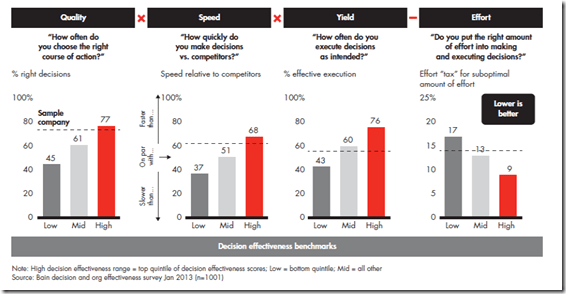
Interesting cut at measuring decision making effectiveness from Bain.
Bain says that:
One thing that sets great companies apart is the ability to make high-quality decisions.
But it isn’t just decision quality—the top performers also make those decisions quickly and execute them effectively. And they don’t spend too much or too little effort in the process.
Source: Bain Decide & Deliver
====
In other words, evaluate decision making along 4 dimensions:
(more…)
SHARE THIS POST WITH FRIENDS & FAMILY
Posted in Bain, Decision Making | Leave a Comment »
July 9, 2014
An article in the WSJ this week is causing a bit of a stir.
Titled “Who Really Gets the Minimum Wage”, the report concluded that Minimum wages are ineffective at helping poor families because such a small share of the benefits flow to them.
Specifically, “Obama’s $10.10 target would steer only 18% of the benefits to poor families; 29% would go to families with incomes three times the poverty level.”
Hmmm.
How does that happen?

The essence of the dynamic: counter-intuitively, low-wage workers and low-income (i.e. “poor”) families are not the same folks.
According to the article, data from the U.S. Census Bureau show that there is only a weak relationship between being a low-wage worker and being poor.
Three reasons for that:.
- Many low-wage workers are in higher-income families—workers who are not the primary breadwinners and often contribute a small share of their family’s income.
- Some workers in poor families earn higher wages but don’t work enough hours (and have hours cut when the minimum wage goes up)
- About half of poor families have no workers, in which case a higher minimum wage does no good. This is simple descriptive evidence and is not disputed by economists.
Bottom line: Not much help to the well-intended anti-poverty movement.
There’s another “non-poor” group that benefits when the minimum wage is raised..
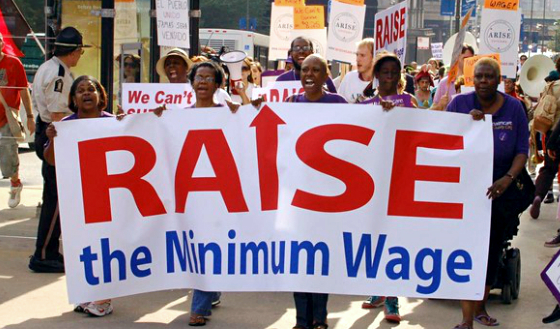
Glance at the picture above and see if you can guess who that is.
(more…)
SHARE THIS POST WITH FRIENDS & FAMILY
Posted in Employment - Jobs, Income & Wealth, Income Inequality, Minimum Wage - Living Wage, Poverty - Income Distribution | Leave a Comment »
July 8, 2014
Interesting piece in the NY Post titled “Federal worker gravy train” …
It’s not new news, but the Post points out that firing a federal worker is almost impossible, and making a termination stick, is even less likely.
Data published in the Federal Times supports the Post’s claim. (and common wisdom)

Source
Think about it: 1 in about 200 get culled each year.
Hardly Jack Welch’s “bottom 10%” program.
More generally, data from the Office of Personnel Management indicate that it is five times as hard to get fired from a federal job as from a private-sector one.
It’s commonly claimed that federal workers settle for lower pay in exchange for job security.
The Post says: Don’t believe it.
(more…)
SHARE THIS POST WITH FRIENDS & FAMILY
Posted in Government benefits, Government Employees, IRS | Leave a Comment »
July 7, 2014
Lots of hoopla last week that the unemployment employment rate dropped to 6.1% as employers added 288,000 jobs
Yep, 288k jobs added … which continues a year-over-year running rate growth in employment of slightly less than 2% … a little less than real GDP year-over-year growth.
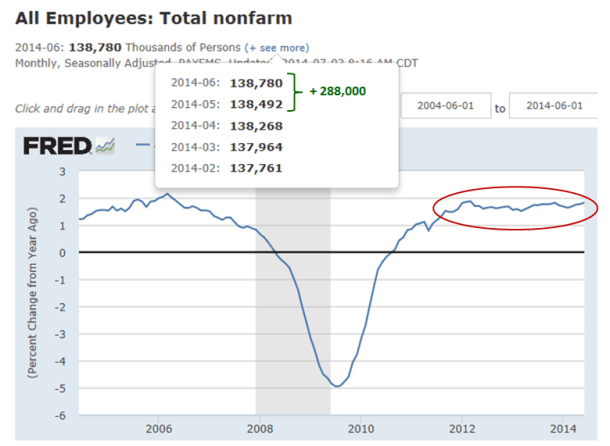
But, there’s more to the story.
Let’s dissect that 288,000 …
(more…)
SHARE THIS POST WITH FRIENDS & FAMILY
Posted in BLS, Employment - Jobs, Part-time workers, Unemployment | Leave a Comment »
July 2, 2014
I often confess to my students that I thought about 51% of the business decisions were correct … and that was despite my analytical pre-disposition and the benefit of a highly proficient team of managers and analysts.
Apparently, my record was about on par.

According to decision scientists Chip & Dan Heath in Decisive: How to Make Better Choices …
(more…)
SHARE THIS POST WITH FRIENDS & FAMILY
Posted in Cognitive biases, Decision-making | Leave a Comment »
July 1, 2014
Last year around this time, I told the said story about how some bad guys tried to steal my identity and open up credit cards and car loans in my name.
Bottom line: An ordeal that burned up a bunch of my time and caused plenty of angst … but, no serious damage (that I know of).
A friend just got had his identity hacked. Somebody filed an IRS 1040 under his name and social security number, hoping to bag a refund check. Fortunately, the IRS flagged the return as suspicious and didn’t pay-off against the fraudulent return.

Now, as a public service, here’s what I learned that may help you …
(more…)
SHARE THIS POST WITH FRIENDS & FAMILY
Posted in Credit Cards, Credit fraud, Cybersecurity - cybercrime, Fraud | 1 Comment »














 The Homa Files