Archive for the ‘Economy’ Category

By one metric, household net worth is running at historical levels …

November 30, 2012

Interesting analysis by the CBO

Punch line:  When you delate the numbers, i.e. take out inflation effects – household net worth is roughly 5 times disposable income … that’s down from the dot-com and housing booms & busts, but roughly at historical levels.

In other words, the market bubbles were more like sugar-rush outliers … than “new normals”.

image

* * * * *
Follow on Twitter @KenHoma

Is the housing market recovering?

November 25, 2012

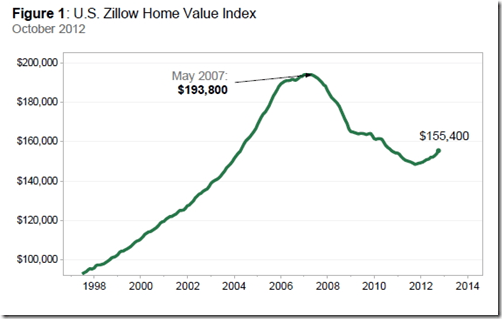
According to Zillow … yes!

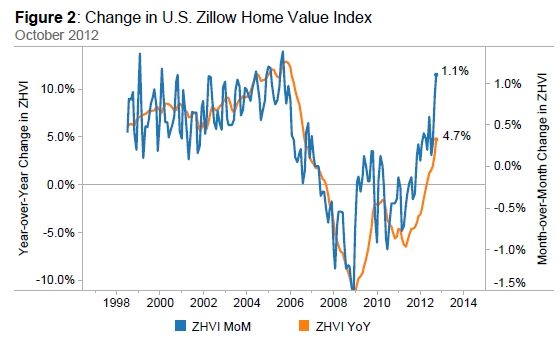
  • National home values rose 1.1% from September to October to $155,400 …  the largest monthly increase since August 2005
  • October is the 12th consecutive month of home value appreciation
  • On a year-over-year basis, home values were up by 4.7% – best since September of 2006
  • Rents across the nation were up by 5.4% from a year ago 

Zillow says: Most markets have already hit a bottom and 40 out of the 256 markets covered are forecasted to experience home value appreciation of 3% or higher.


image


image

image

* * * * *
Follow on Twitter @KenHoma

80 CEO’s call for deficit action … only 80?

October 25, 2012

Lead story in the WSJ today is that 80 CEOs (click for listhave banded together to nudge Congress towards bipartisan deficit reduction … i.e. get the fiscal cliff resolved.

The group – calling themselves Fix the Debt – issued a public statement.

Here are snippets from the Journal’s recap:

Any fiscal plan “that can succeed both financially and politically” has to limit the growth of health-care spending, make Social Security solvent and “include comprehensive and pro-growth tax reform, which broadens the base, lowers rates, raises revenues and reduces the deficit.”

“You can’t tax your way to fix this problem, and you can’t cut entitlements enough to fix this problem.”

The executives didn’t endorse Mr. Obama’s proposal to raise the marginal income-tax rates for the top 2% of taxpayers or any other proposal.

Rather, they called for an overhaul of the tax code that, among things, would eliminate or reduce deductions, credits and loopholes (known as “broadening the base”), and one that also would bring the Treasury more revenue than the existing code does.

Notably absent from the Fix the Debt list are CEOs from big U.S. energy companies, some of whom fear that tax increases will fall more heavily on them.

Hard-line foes of tax increases aren’t likely to be moved by the CEOs.

“When bipartisan deals are struck promising to cut spending and raise taxes, the spending cuts don’t materialize but the tax hikes do,”

Raises a couple of questions:

1. Where have these jabrones been?

2. Only 80 CEOs?  Where are the rest?

3. Is a public statement rehashing the obvious the best they could do?

C’mon guys, mobilize for the good of the country.

>> Latest Posts

“I inherited the deficit” … say, what?

October 25, 2012

Draw your own conclusion, but looks to me like Obama inherited a $500 billion deficit

…. goosed it by a trillion dollars to kinda stimulate the economy

… and has hung well over a trillion dollars, way after the Stimulus.

What’s he talking about?

image
Source: Hot Air.com

* * * * *

While we’re at it, note how the current recovery stacks up against prior recession recoveries …

image
Source: Hot Air.com

>> Latest Posts

Compare the economic recovery plans …

October 25, 2012

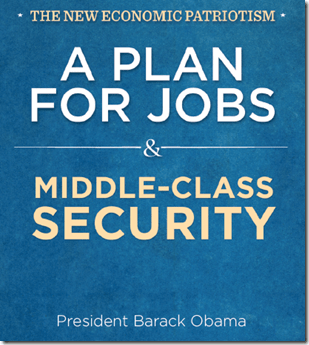
Seriously, before you vote, at least glance at the plans being offered by Obama and Romney.

You decide which is substantial and which is fluff ..

* * * * *

click to view very short video intro

click to view plan

image

click to see Business Insider’s summary of the plan’s highlights:
Obama Has Released A 27-Point Plan For His Second Term, And It’s A Doozy

* * * * *

click to view

image

click to see Business Insider’s summary or Romney’s plan
Here’s Everything We Know Now About Mitt Romney’s Economic Plan

>> Latest Posts

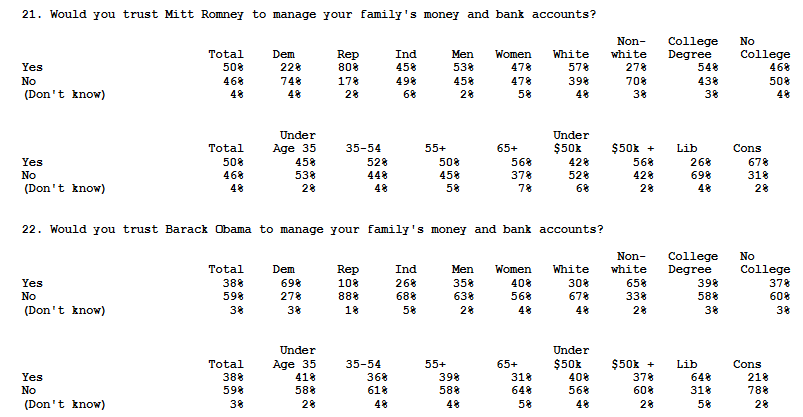
Who would you trust to handle your family’s money & bank accounts – Obama or Romney?

October 10, 2012

Interesting question asked in the latest Fox News poll.

Not surprisingly, Romney gets the nod 50% to 38%

image

Hmmm.

Remember, the Fed gov’t doesn’t have any money of it’s own – it just takes and manages our money.

And, since voter preferences are running about 50-50 … about 12% either don’t think the question is relevant or are satisfied having the inferior money-handler handling their dough.

Go figure.

* * * * *
Update

I was asked about possible sampling bias …. here are the “internals” with party affiliation … and more

click to view

Draw your own conclusions.

>> Latest Posts

Re: job creation … Steve Wynn blasts Obama … again!

October 10, 2012

Holy Smokes!

Steve Wynn, is CEO of Wynn Resorts.

image

He unloaded on President Obama again.

Punch line: “I’m afraid of the president. I have no idea what goofy idea, what crazy, anti-business program this administration will come up. I have no idea. And I have to tell you Jon that every business guy I know in the country is frightened of Barack Obama and the way he thinks.”

click to view
image

Wrap: “I can’t stand the idea of being demagogued, that is put down by a president who has never created any jobs and who doesn’t even understand how the economy works.”

* * * * *
Ken’s Prediction: I heard directly from a Fortune 500 CEO that he – and other CEO’s – were afraid to speak out against Obama because they feared retaliation from the administration. I heard directly from a guy who owned a highly profitable chain of auto dealerships that were closed when he spoke out against the auto bailouts.

Now, since Obama’s on the ropes, I expect a cascade of business execs to start speaking out.

>> Latest Posts

No economist foresaw the severity of the recession … and no president could have done a better job … wrong and WRONG!

October 2, 2012

Obama has been stumping that no economists foresaw the severity of the recession … so don’t blame him the a trillion dollar faux-stimulus didn’t keep unemployment under 8%.

Former President Clinton pitched at the DNC that no president – not even him – could have pulled us out of the dive better than Barack did.

Huh?

Last weekend, the  NY Times debunked the first claim:

President-elect Obama’s economic team spent the final weeks of 2008 trying to assess how bad the economy was.

It was during those weeks ..when they first discussed academic research by the economists Carmen M. Reinhart and Kenneth S. Rogoff that would soon become well known.

Ms. Reinhart and Mr. Rogoff  … were arguing that financial crises led to slumps that were longer and deeper than other recessions.

Almost inevitably … policy makers battling a crisis made the mistake of thinking that their crisis would not be as bad as previous ones.

Obama advisers … knew the history … yet, of course,  they did repeat it.

By late 2008, the full depth of the crisis was not clear, but enough of it was.

A few prominent liberal economists were publicly predicting a long slump.

The Obama team, in private, discussed the Reinhart-Rogoff work.

So why didn’t that work do more to affect the team’s decisions?

Want more proof?

On 12/24/2008, USA Today published a piece titled: Forecasters share predictions for economy’s outlook in 2009

The punch lines:

If the recession continues past the spring, as many economists predict, it will be the most prolonged one since the Great Depression.

Employers are expected to continue to shed jobs at a rapid pace.

Consumers will pull back spending.

Businesses will cancel equipment purchases. Unsold, empty homes will dot city blocks.

I guess what Team Obama means is Goolsbee, Romer, and Bernstein didn’t see the severity.

Clinton’s claim of un-doability is just plain silly.

Reagan inherited a recession as severe as the one Obama inherited, plus 18% inflation.

He pulled the economy out in 1-term … so, there !

Team Obama seems to have a penchant for re-writing history.

>> Latest Posts

Factoids: The state of the economy …

September 21, 2012

The economic analyses done by Mort Zuckerman at US News are always laden with cold facts.

image

Read the article for the prose. Here are the factoids:

  • Annual wage increases have dropped to an average of 1.6 percent, the lowest in the past 30 years.
  • A Census Bureau analysis  indicates that median income in 2011 had fallen to $50,054, the fourth straight year of decline.
  • Layoff announcements have risen from a year ago and hiring plans have dropped dramatically.
  • 5 million people have now been out of work for 27 weeks or more. That’s roughly 40 percent of the unemployed.
  • The average period of unemployment is close to 40 weeks.
  • Fewer Americans are at work today than in April 2000, even though the population has grown by 30 million people since then.
  • Older people are not leaving the workforce at the same rate as in the past … employment in the age group of 55 and older is up 3.9 million, even as total employment is down by five million.
  • The so-called quit rate has sagged to the lowest rate in years.
  • Young workers now face double-digit unemployment and job prospects for young workers aren’t very good.
  • As a result, the birth rate has just hit a 25-year low of 1.87 births per woman. And
  • Of jobs that have been added, more than 40 percent of new private sector jobs are in low-paying categories such as leisure and hospitality, bars, and restaurants
  • Millions of people who had good private sector jobs are now dependent on the government for life support.
  • Roughly 15 percent of the population, a record, representing over 46 million Americans, are in the food stamp program, compared to the 7.9 percent participation from 1970 to 2000.
  • A record 11 million-plus Americans are now collecting federal disability checks. Half of them have come on board since President Barack Obama took office.

Sure doesn’t look like we’ve turned the corner yet.

>> Latest Posts

Some economic statistics that’ll ruin your day … and, maybe your week.

April 23, 2012

Mort Zuckerman — head of U.S. News, not the Mark Zuckerberg, the guy at Facebook — was an Obama supporter in 2008.

Suffice it to say that he’s disappointed with the President’s accomplishments re: the economy.

His article President Obama’s Economic Programs Have Failed is worth reading in its entirety.

Here are a couple of data points from it …

  • The pool of unemployed Americans is 15 million  — that’s roughly equal to the entire population of the states of Connecticut, Delaware, Arkansas, Iowa, and Oklahoma.
  • 25% of households include someone who is unemployed and looking for work.
  • Among the jobless, a staggering 42% of the unemployed are long-term unemployed, without jobs for six months or longer.
  • Since 2008, some 3 million people have dropped out of the job market. If they hadn’t, the unemployment rate would be about 10.8%.
  • So-called structural unemployment has risen from 5 percent before the crisis to close to 7% today …. if so, many lost jobs that cannot be restored by boosting demand.
  • Hiring today is at about 70% of the 2006 level … so, job seekers are only about one third as likely to find work as in 2006.
  • Layoff announcements have risen 18% from a year ago, and hiring plans have dropped 82%.
  • The U.S has lost 6 million blue-collar manufacturing jobs.
  • 70% of job openings have been in mostly low-wage sectors, including healthcare, leisure, hospitality, and retail.
  • Some 7.7 million workers are stuck in part-time jobs, with pay inadequate for entry into the middle class.
  • 67% of the meager employment growth rate has been in the 55 and older age cohort.
  • The jobless rate for workers ages 20 to 24 is over 13%; teenagers, 25%; Hispanic teenagers, 30.5%; and black teenagers, 37.9%.
  • People with a college education face unemployment rates of about 4.2; those with a certificate from a community college or at least some college coursework have a jobless rate of 7.5%.
  • People who did not finish high school have it worst at almost 13%.
  • Two thirds of our employment is concentrated in 6 million small and medium-size businesses.
  • The U.S. needs 1 million new businesses every year to keep us on the right track. Instead we have only about 400,000 firms starting up.
  • Real per capita disposable income — adjusted for inflation — is down to  $32,600 now versus $34,641 back in 2006.
  • The ratio of total household debt to after-tax earnings is 117% — down from last year’s peak peak of 131%, but is still above the pre-bubble rate of 70%.

Zuckerman concludes: We are still in an era of deleveraging, rising savings rates, home price deflation, and squeezed real income, all of which will continue to affect consumer spending.”

Have a nice day …

>> Latest Posts

“Nobody knew the economy was in such bad shape” … oh, yeah?

February 17, 2012

Soon after taking office, President Barack Obama crowed that  he’d cut the deficit in half by the end of his first term.

He made the pledge not as a candidate but as president.

It came in the East Room of the White House at the opening of his Fiscal Responsibility Summit on Feb. 23, 2009.

I want to be very clear: We cannot, and will not, sustain deficits like these without end.

Contrary to the prevailing wisdom in Washington these past few years, we cannot simply spend as we please and defer the consequences to the next budget, the next administration, or the next generation.

We are paying the price for these deficits right now.

In 2008 alone, we paid $250 billion in interest on our debt — one in every 10 taxpayer dollars. That is more than three times what we spent on education that year; more than seven times what we spent on VA health care.

So if we confront this crisis without also confronting the deficits that helped cause it, we risk sinking into another crisis down the road as our interest payments rise, our obligations come due, confidence in our economy erodes, and our children and our grandchildren are unable to pursue their dreams because they’re saddled with our debts.

And that’s why today I’m pledging to cut the deficit we inherited in half by the end of my first term in office.

Now, the President and his shills are hitting the talk shows asking for a pass on the pledge, saying that “nobody knew how deep the economic crisis was”.

Say, what?

Well, except for the Federal Reserve Board … as reported in their annual report … before Obama made the pledge.

click to see the whole report
image

Here’s the essence of the report:

The unemployment rate has risen to its highest level since the early 1990s, and other measures of labor market conditions—for example, the number of persons working part-time because full-time jobs are not available—have worsened noticeably.

The deteriorating job market, along with the sizable losses of equity and housing wealth and the tightening of credit conditions, has depressed consumer sentiment and spending; these factors have also contributed to the continued steep decline in housing activity.

In addition, businesses have instituted widespread cutbacks in capital spending in response to the weakening outlook for sales and production as well as the difficult credit environment.

In all, real gross domestic product (GDP) in the United States dropped at an annual rate of 3-3⁄4 percent in the fourth quarter; real GDP seems headed for another considerable decrease  2009.

Hmmm.  Sounds like the Fed knew.

If you don’t like the Fed, see the Kiplinger Report “They Called It Right (Predictions for 2009)”

Here’s a sampling:

ROBERT SHILLER, professor at Yale University: ” The present situation has many similarities to the Great Depression.”

PETER SCHIFF, president of Euro Pacific Capital: “”We’re going to be in a depressionary environment. Our economy will be a mess for years and years to come. ”

NOURIEL ROUBINI, chairman of RGE Monitor and professor at New York University: ” I expect that the recession will be very severe and that it won’t be over before the end of 2009.”

BOB RODRIGUEZ & TOM ATTEBERRY, chief executive officer and partner, respectively, First Pacific Advisors: “Projections of economic growth have been far too optimistic. This is a multiple-year problem.”

DAVID TICE, chief equity strategist for , Federated Investors: “This will be a longer-term decline — you’ll see fits and starts …   it’s likely going to take four to five to ten years (to recover). 

Maybe Obama’s crack economic team didn’t know, but it looks like way more than “nobody”  knew.

>> Latest Posts

How many hours do you work each month … just to pay your mortgage or rent?

January 4, 2012

On average, the number is now over 100 – almost 3 weeks !

That’s up from 72 hours – about 2 weeks – back at the turn of the century.

Ouch.

* * * * *
“The Toil Index …  portrays the most dramatic element of the middle-class squeeze — the effort required to rent a house served by a school of average quality. ” Robert Frank, New York University

image

Source: Washington Post Chart 12

>> Latest Posts

College grads: low unemployment, but declining earnings …

November 11, 2011

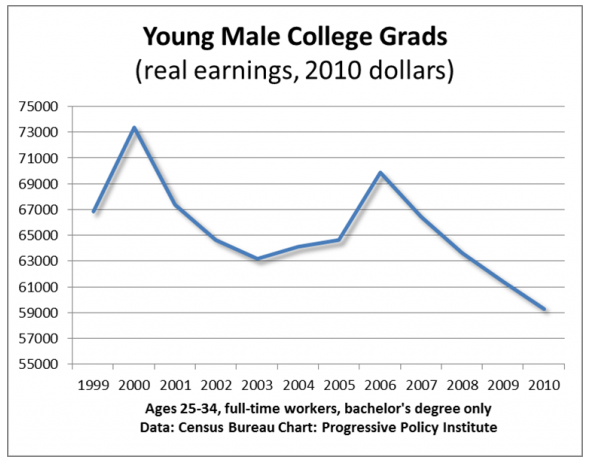
Earlier this week, we posted that only 4.5% of college grads are unemployed … a lot lower percentage than you’d think given the coverage of the Wall Street Occupiers.

There is a flipside, though.

Mean real earnings for college grads have fallen by almost 20% over the past decade … reflecting salary caps at many companies and a re-mixing towards lower paying jobs.

Suggests that the ROI on college is going down, down, down

image

image
Source

>> Latest Posts

For jobs … drill, baby, drill.

October 4, 2011

Punch line: Part of the formula for getting the economy moving is to have a new industry emerge – or have a latent one take-off.

Obama tried with his failed green energy initiatives.

Now, there’s increasing support for for turning the domestic oil, gas and coal industries loose.

Makes sense to me.

And, makes sense to Senators Webb & Warner who have introduced a bill that would expand oil drilling off the shores of Virginia … and split the royalty fees between the Feds and the state.

Their argument: raises revenues without raising individuals’ taxes, reduces dependency on foreign oil, potentially reduces – or at least contains – gas prices, and – oh yeah – adds jobs.

Keep reading …

* * * * *
Excerpted from Forbes: Gassing Up: Why America’s Future Job Growth Lies In Traditional Energy Industries

The  Praxis Strategy Group looked over data for the period after the economy started to weaken in 2006.

Not surprisingly “recession-proof” fields such as health care and education expanded some 11% over the past five years.

But the biggest growth in jobs by far has taken place in the mining, oil and natural gas industries, where jobs expanded by 60%, creating a total of 500,000 new jobs.

The average job in conventional energy pays about $100,000 annually — more than twice as high as those in either health or education.

Overall U.S. oil production has grown by 10% since 2008; the import share of U.S. oil consumption has dropped to 47% from 60% in 2005.

Over the next year, according to one recent industry-funded study, oil and gas could create an additional 1.5 million new jobs.

The relative strength of the energy sector can be seen in changes in income by region over the past decade. For the most part, the largest gains have been heavily concentrated in the energy belt between the Dakotas and the Gulf of Mexico.

Energy-oriented metropolitan economies such as Houston, Dallas, Bismarck and Oklahoma City have also fared relatively well.

In energy-rich North Dakota there’s actually a huge labor shortage, reaching over 17,000 — one likely to get worse if production expands, as now proposed, from 6000 to over 30,000 wells over the next decade.

With the proper environmental controls, these industries could provide a major jolt to the economy while cutting down on energy imports, reducing debts and bringing jobs back home.

As long as Americans consume oil and gas, why not produce close to the market and with reasonable environmental controls?

>> Latest Posts

The Cain effect …

October 3, 2011

Ken’s Take: The article excerpted below got me thinking.

There’s been increasing talk recently about how blacks are provably suffering disproportionately in the current economic environment. The facts are unshakably true.

Even the Congressional Black Caucus has risen to the cause and chastised Pres. Obama for largely ignoring their plight.

Not new news.

The article below observes that  “black interests often have to take a back-seat to the interests of labor, environmentalists, immigration advocates, and so on — even among those elected to represent African Americans!”

Obama’s response: Stop whining, stop complaining … kick off your slippers, put on your shoes … and walk to get me re-elected.

Then, along comes Herman Cain – dishing one-liners that cut to the core … pitching his story of self-reliance, hard work, and earned success … and, arguing that blacks can accrue political power by splitting their votes across parties, rather than voting as a  bloc.

It’ll be interesting to see if his vision resonates among African-Americans.

* * * * *
Excerpted from Weekly Standard: Herman Cain Could Be a Game Changer

If Herman Cain could get some African Americans to give the GOP a look, there would be a real potential not only for the party to do better nationwide, but also for African Americans to leverage their voting strength more effectively.

African Americans do not enjoy robust two party competition for their votes, and accordingly their interests are often poorly served.

  • White conservatives overwhelmingly vote Republican, but black conservatives do not.
  • White moderates usually split their votes between the two parties, according to the study, but black moderates do not.

In many respects this state of affairs is bad for African Americans, because it limits the power of the black vote itself, and so a lot of black interests are just plain overlooked.

For instance, school choice would essentially be a transfer of resources and power directly to poor black families, who would be major beneficiaries of such a program.

However, the National Education Association and the American Federation of Teachers would be losers in the deal, so it is a non-starter on the Democratic side of the aisle.

Additionally, liberal immigration policies do not hurt educated whites, whose skills basically price them out of competition with most immigrants.

If anything, upper income whites are helped because a glut of workers enables companies to keep costs, and therefore prices, down.

Instead, African American workers – who often find themselves in competition with immigrants – would be harmed.

But the Democratic party as a whole would be helped thanks to a flood of new immigrant voters, so it unabashedly advocates loose policies.

Black interests often have to take a back-seat to the interests of labor, environmentalists, immigration advocates, and so on — even among those elected to represent African Americans!

>> Latest Posts

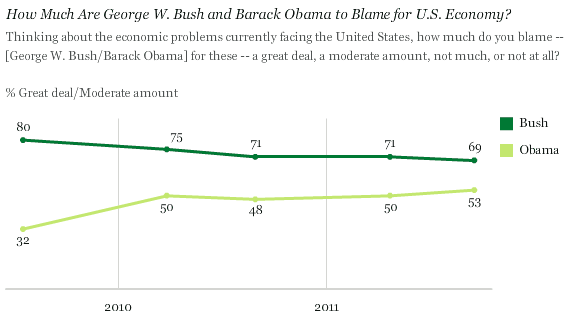
Majority now thinks Obama is blame-worthy for the state of the economy…

September 28, 2011

Based on a new Gallup poll, 69% say that Bush gets at least some of the blame for the bad economy … that’s down 10 points from a couple of years ago … as memories fade.

And, for the first time, a majority of Americans (53%) thinks that President Obama has some culpability for the current condition of the economy.  Only 25% of Dems think so, but 69% of independents give Obama some blame …  apparently, blaming Bush, tsunamis, Arab Springs, etc. is running out of steam.

image

>> Latest Posts

Records set on Obama’s watch …

September 8, 2011

Yeah, yeah, yeah … he inherited a mess from Bush.

But still, here’s the WSJ’s scorecard

boskin

>> Latest Posts

Amateur Hour: No wonder the economy is a mess

August 25, 2011

According to a study by the Employment Policies Institute …

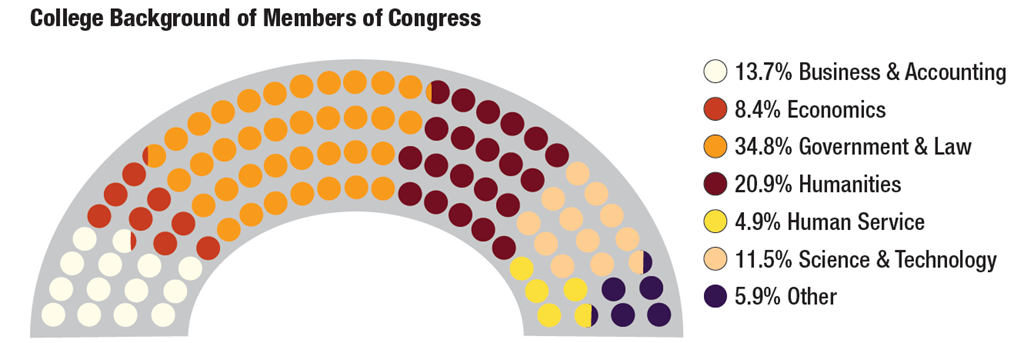
How many members of Congress have an academic background that provided them with a basic understanding how the economy works?

The answer, it turns out, is not many.

Publicly available data  show that nearly 8 out of 10  members of Congress lack an academic background in business or economics.

  • 55.7% majored in either government-related fields or the humanities
  • 13.7% majored in a business or accounting-related field.
  • 8.4% majored in an economics-related field

image

Question: Think the President took a single econ or biz course in college or grad school – except for, maybe, contract law?  I’m betting the under.  I’d still like to see his transcripts to peek at his GPA (UG lower than W’s?) and to see if he took any econ-biz courses.

Couple the above with the low percentage of Obama’s cabinet who had worked in the private business sector prior to their appointment to the cabinet.

Below are the percentages of cabinet members with private sector experience …

Eisenhower………..57%
Reagan……………..56%
GW Bush……………55%
Nixon…………………53%
Wilson ………………52%
GH Bush…………… 51%
F. Roosevelt……….50%
Truman………………50%

Harding………………49%
Coolidge…………… 48%
Johnson……… …….47%
Ford…………………..42%
Hoover ………………42%
Taft……………………40%

Clinton ……….. …..39%
T. Roosevelt……….38%
Carter………………..32%
Kennedy…………….30%

Obama……………… 8%

Hmmm.

Draw your own conclusion.

>> Latest Posts

Locker room sign: “Excuses are for losers”

August 19, 2011

The sign over the door to my high school’s football locker room reminded players that “excuses are for losers”.

Obviously, Pres. Obama didn’t play football for the Maple Heights Mustangs … or, I imagine, any of the thousands of HS or college teams that paste the slogan in their locker rooms.

Why is that a safe bet?

In “Did Bo (Obama’s Dog) Eat The Recovery?”, IBT has a nice recap of the people and events that te President wants to blame for the bad economy

In his inaugural address 2 1/2 years ago, President Obama called for a “new era of responsibility.” Yet lately, his main goal in life seems to be escaping any responsibility for the lousy economy.

It’s getting so you have to keep a list of everyone and everything Obama wants to blame for the anemic economic recovery.

So far, it includes:

• President Bush: Obama continues to blame Bush for the mess he inherited, despite the fact that the recession had pretty much bottomed out by the time Obama took office and was officially over a mere four months after he was sworn in.

• ATMs: In June, Obama blamed automated teller machines and airport check-in kiosks for the lack of jobs, saying that “businesses have learned to become much more efficient, with a lot fewer workers.”

• Republicans: On Monday, Obama said that because “some in Congress would rather see their opponents lose than America win, we ended up creating more uncertainty and more damage to an economy that was already weak” — a thinly veiled attempt to blame the GOP for the economic malaise.

• Gridlock: Obama goes after partisan impasses. What he’s really complaining about is that lawmakers haven’t enacted his latest “stimulus” plan — spending hikes, gimmicky tax breaks and a massive tax hike — that has already been tried and failed.

• The media: In July, Obama said the “splintered” press was in part to blame for Washington’s failure to boost the economy. “If you never even have to hear another argument,” he said, “then over time you start getting more dug in into your positions.”

• Businesses: Obama has often blamed companies needlessly sitting on massive piles of cash. In May, he insisted that firms should “step up” and start hiring.

• Misfortune: “Over the last six months, we’ve had a string of bad luck,” he said at a town hall on Monday, citing the Arab Spring, the Japanese tsunami and Europe’s debt crisis. “So there were a bunch of things taking place over the last six months that were not within our control.”

At a press conference this summer, Obama said: “I’m not interested in finger-pointing.”

But that’s all he’s been doing for months.

Wouldn’t it be nice if Obama instead were to live up to his inaugural credo and start his own “era of responsibility” by admitting his role in the country’s economic slump?

As the sign says “excuses are for losers” …

>> Latest Posts

“The greatest wet blanket to business”

July 20, 2011

Casino mogul Steve Wynn lashed out at Pres. Obama’s anti-business rhetoric and actions.

Wynn’s comments are remarkable for 2 reasons.

First, he’s a Democrat whose family contributed to the Obama campaign and who is a staunch supporter of Harry Reid.

Second, based on my very small sample, he’s speaking for many CEOs who share the sentiments are afraid to speak out for fear of reprisals from an Adminstration that is ready and willing to go directly after industries (think oil companies and tanning salons), companies (think Boeing and Blue Cross of California), and individual CEOs (think Ed Whitacre – who was bounced from GM when he went lukewarm on the Volt).

I doubt Wynn will cause a bandwagon effect of CEO speak-outs … the CEOs will continue to lie low and just keep the lid on jobs …

* * * * *
Here’s the video and transcript of Wynn’s remarks

image


>> Latest Posts

What do Virginia, Texas, & Florida have in common?

June 27, 2011

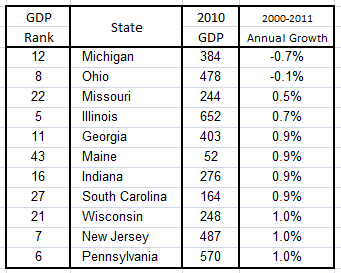
They’re the states whose GDP has grown the most from 2000 to 2010.

Great analysis in USA Today re: state-by-state shifts in the US economy.

A couple of angles from the data:

  • No surprise, income-tax-free Texas is soaring; Midwest rustbelt is struggling
  • 10 states generate over 1/2 of the US GDP
  • “Swing states” have slowest rates of growth (2nd chart)

Hmmm …

  Biggest State GDPs
image


Slowest Growing States 2000-2010
image

* * * * *

By the numbers: Obama’s economic recovery that isn’t.

June 13, 2011

Punch line: Obama inherited a bad situation and made it worse.

* * * * *
Excerpted from Forbes:
President Obama’s Economic Recovery That Isn’t

At the end of this month, President Obama’s economic recovery will be two years old.

In terms of employment the Obama recovery has been catastrophic

  • Total employment (BLS household survey) will be 0.3 million lower than it was at the start of Obama’s “recovery”, two years earlier.
  • The unemployment rate will have fallen from 9.5% to 9.1%, but only because 3.6 million people became discouraged and stopped looking for work.
  • If the rate of labor force participation in June 2011 were the same as it was in June 2009 (65.7%), the reported unemployment rate would be 11.2% rather than 9.1%.

While employment the Obama recovery has been catastrophic,  economic growth  has been merely disastrous.

  • Real annual GDP growth during the first two years of the Obama recovery should average 2.69% … about half of what is normal for the start of an economic recovery. 
  • During the first two years of the Reagan recovery, the dollar rose by 12% against other major currencies and by 34% in terms of gold.

* * * * *

Jobs: Cause & effect … and spin

March 7, 2011

High fives on Friday when the monthly unemployment numbers were reported.

Jobs up,  Unemployment below 9%.

Even the WSJ is hinting at a turning point (extract below).

Thank god for Obama’s Trillion-dollar Stimulus.

Oh, really ?

First, the unemployment rate is down because the discouraged folks have stopped looking for work and don’t get counted as unemployed.

According to Reuters:

  • The U.S. labor force remains as small as it has been in a generation … 
  • More than 5 million Americans have disappeared from the job rolls …
  • If the labor force was currently at 2007 levels, the unemployment rate would be a whopping 12 percent.

Second, the Stimulus was almost 2 years ago.

Time lag?

I think not.

If, in fact, the economy is turning – and, for the record, I’m not buying that – it’s more likely a rapid-fire response to the extension of those much maligned  Bush Tax Cuts.

At least, companies have 2 years of relative certainty regarding taxes.

Perhaps a little certainty is breeding a little employment.

You think ?

* * * * *

WSJ, The economy shifts into forward, March 5, 2011

Even the WSJ declared:

“With 192,000 new jobs created in February, the U.S. economic engine clearly has shifted into forward recovery.

  • The unemployment rate for the first time in 20 months nudged below 9%, settling at 8.9%.
  • In the private economy, hiring expanded by 222,000.
  • Construction hiring hints that perhaps the worst of the housing depression is over.

Keynesians will have a hard time explaining why the jobs recovery started long after the bulk of the stimulus dollars were spent.

We still have 13.7 million officially unemployed Americans, with 2.7 million more who stopped looking for jobs. Nearly half (43.9%) of those without jobs have been out of work at least six months.

The main reason the unemployment rate has fallen the last several months is that the number of working-age Americans not in the labor force dropped by two million over the past year.

The U.S. economy needs to maintain a pace of 190,000 net new jobs for at least the next 12 months merely to get the jobless rate back to a still awful 8%.

At least the jobs recovery is finally headed in the right direction.”

Auto sales are up, so new home sales should follow … oh, really?

February 24, 2011

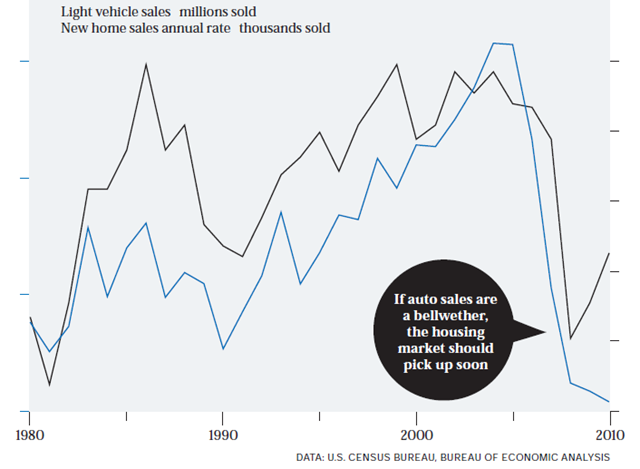
According to Business Week and Bank of America-Merrill Lynch…

Rising demand for cars and trucks signals U.S. new-home sales may jump soon.

Why?

Data from the U.S. Census Bureau and the Bureau of Economic Analysis says that new-home sales have tracked sales of lightweight vehicles in the past 40 years — and lightweight vehicles sales are on the rise.

Hmmm. 

image