Remember this?

Hmmm.
Let’s fast forward to today’s WSJ headline:

The numbers are staggering (and virtually certain):
On Sunday, Business Insider ran a piece called The Most Infuriating Paragraph You Might Ever Read About The Healthcare System
It referenced rants on “Steven Brill’s epic cover story for Time on why healthcare costs so much.”

The paragraph that set them off from the Brill article should – according to Business Insider — “legitimately get anyone’s blood boiling.”
By the time Steven D. died at his home in Northern California the following November, he had lived for an additional 11 months. And Alice had collected bills totaling $902,452. The family’s first bill — for $348,000 — which arrived when Steven got home from the Seton Medical Center in Daly City, Calif., was full of all the usual chargemaster profit grabs: $18 each for 88 diabetes-test strips that Amazon sells in boxes of 50 for $27.85; $24 each for 19 niacin pills that are sold in drugstores for about a nickel apiece.
There were also four boxes of sterile gauze pads for $77 each. None of that was considered part of what was provided in return for Seton’s facility charge for the intensive-care unit for two days at $13,225 a day, 12 days in the critical unit at $7,315 a day and one day in a standard room (all of which totaled $120,116 over 15 days). There was also $20,886 for CT scans and $24,251 for lab work.
As for why we can have a system where diabetes-test strips are sold for $18/each in one place, while Amazon sells a box of 50 for $27.85, see this, great piece by Sarah Kliff on the lack of price controls in the US.
My opinion: Apparently these guys have never heard of “absorption costing” or bothered to really ask “why is healthcare so costly?”
First, what’s the biggest tax loophole?
Answer: The non-taxable payments that companies make towards employees health insurance premiums.
These days, the policy to cover a husband, wife and a couple of kids is about $15,000.
Employers typically pick up about 2/3s of the bill … call it $10,000.
The $10,000 is tax deductible for the company, and isn’t taxed as employee compensation – even though it’s clearly part of an employee’s compensation package.
In total, the health insurance loophole amounts to over $170 billion annually … about twice the mortgage interest deduction … and about twice the “Bush tax cuts for the wealthy”.

Source: Credit Suisse, Neal Soss
= = = = =
So, how might ObamaCare close this loophole?
(more…)
Interesting expose In the NY Times of all places.
Punch line:
When the federal government began providing billions of dollars in incentives to push hospitals and physicians to use electronic medical and billing records, the goal was not only to improve efficiency and patient safety, but also to reduce health care costs.
But, in reality, the move to electronic health records may be contributing to billions of dollars in higher costs for Medicare, private insurers and patients by making it easier for hospitals and physicians to bill more for their services.

How can this be?
Simple, Watson.
First, a system can provide docs with a checklist of separately billable procedures that they might perform … ensuring a complete check-up and making sure that no billing stone is left unturned.
Second, an e-system can make it easier for doctors to “upcode” a procedure in a way to maximize reimbursement rates.
For example, when a doctor enters a billing code, the system can present him with alternative codes for very similar procedures that get higher reimbursement payments … and tell the doctor what addition work needs to be done to qualify for the higher paying code.
So, maybe just asking the patient a couple of more specific questions may upgrade an examination from ‘simple’ to ‘ complex. The doc can then ask the questions (or not) and check the higher paying box.
Third, an e-system makes it easy for docs to “clone” common ‘boiierplate’ findings from one patients chart to another patient’s chart … saving time and, perhaps, implying a more detailed examination.
The Times says:
As software vendors race to sell their systems to physician groups and hospitals, many are straightforward in extolling the benefits of those systems in helping doctors increase their revenue.
In an online demonstration, one vendor promises that it “plays the level-of-service game on your behalf and beats them at their own game using their own rules.”
An expert says “What’s happening is just the problem we feared” … unintended consequences.
For the record, I think that cutting healthcare costs by reducing doctors’ pay is nuts … there is lots of waste, fraud and unnecessary expense in a grossly inefficient system.
Fairly balanced piece in the NY Times last Sunday re: the impacts of ObamaCare
Punch line: In 2015 the country will have 62,900 fewer doctors than needed … that number will more than double by 2025, as the expansion of insurance coverage and the aging of baby boomers drive up demand for care.
The problem, in a nutshell …

While ObamaCare mandates broader insurance coverage, it does little to fundamentally restructure the healthcare delivery … save for government administered rationing.
Part of real answer: more doctors (new and retained), more walk-in clinics (public & private), and more authority to RNs and PAs.
Note: the Times failed to mention that the CBO’s current estimate for ObamaCare’s costs has tripled since the law was passed.
Trick question.
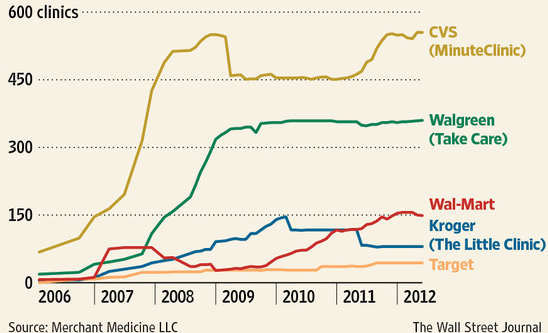
CVS operates about 550 in store clinics under the the Minute Clinic brand umbrella.
More broadly, there are about 1,200 total in-store clinics … run by CVS, Walgreen, Wal-Mart, Kroger and Target.
Ken’s Take: These are great providers of routine health care … I’d like to see them spread like wild fire … and, I’d be all for government run “free clinics” in under-served urban and rural area.
The answer is obvious, right?
They take up more seats, require more server time, and eat more food.
Why do I ask?
Virtually all articles re: ObamaCare are saying “at least save the popular parts like allowing adult children on their parents’ policies until they are 26”.
First, the term “adult-children” gives me the creeps. But, that’s beside the point.
I don’t care if insurance companies have to carry 26 year olds on their parents’ policies, but I don’t understand why you & I have to pay for it … not the adult-children’s parents.
Now, practically all employer-sponsored health insurance plans charge premiums in tiers: employee only, employee plus spouse, employee plus children, and employee plus spouse and children. Note: it doesn’t matter if the employee has 1 child or a dozen children … same premium.
Say what?
For example, the United Healthcare plan through Georgetown — which is probably pretty typical — charges:

Note that it costs $7,346 to tack a spouse (or equivalent) — presumably an adult — onto an employee’s policy.
Then it costs an additional $5,746 to tack one or more children onto the policy.
Said differently, it costs $5,746 to add one child to the policy and nothing to add more kids to the policy.
So, those kids are free, right?
Only in Obama Land.
Each additional kid probably costs about the same as the first one — $5,746.
That unpaid cost simply gets spread across all policy holders in the form of higher premiums.
So, back to the 26 year old adult-children …. I’m ok if they get tacked onto their parents’ policies and pay $5,746 … but, I’m not ok being forced to pay for them.
All of which raises a broader issue: Why are children of any age riding free on health insurance policies? Why not charge $5,746 for all kids, not just the first one?
Recent editorial in the UK’s Telegraph pointed out that the National Health Service (NHS) discriminates against elderly folks … rationing their care by dealying or denying medical services.
According to the Telegraph, the elderly are displaced in the medical queue by overweight folks whose “conditions, though, are the direct result of bad habits, poor diet, and the wrong choices. These conditions range from obesity and diabetes to smoking-related diseases like emphesema.”
If a 20-stone, 30-something woman comes into hospital with a bad diabetic attack, does she deserve to be at the front of the queue or the back?
She has chosen to stuff her face with Mars bars and Coke, and is now suffering the consequences of her choice.
She cannot claim ignorance of the dangers of her diet: the Government has carpet-bombed us with health advice, from schools to GP practices.
Class no longer regulates access to healthy living: everyone who can watch the telly, let alone read the magazines, knows that a high-fat diet will make you look bad and feel worse.
So what?
The Telegraph’s view:
The septuagenarian who develops breast cancer has done nothing wrong – except grow old.
The NHS has to consider that there are deserving cases and undeserving ones.
Age should not be a barrier to optimum care; but bad habits should be.
As my personal odometer races forward, I gotta agree with the Telegraph.
According to a new projection released by the Congressional Budget Office, ObamaCare will cost $1.76 trillion over a decade, rather than the $940 billion forecast when it was signed into law.
The CBO now projects that more people will be obtaining insurance through Medicaid than it estimated a year ago at a greater cost to the government, but fewer people will be getting insurance through their employers or the health care law’s new subsidized insurance exchanges.
According to the Washington Examiner:
Democrats employed many accounting tricks when they were pushing through the national health care legislation.
The most egregious of the accounting tactics was to delay full implementation of the law until 2014, so it would appear cheaper under the CBO’s standard ten-year budget window and, at least on paper, meet Obama’s pledge that the legislation would cost “around $900 billion over 10 years.”
When the final CBO score came out before passage, critics noted that the true 10 year cost would be far higher than advertised once projections accounted for full implementation.
The projection for 2022, the last year available, indicate that the cost is likely to exceed $2 trillion over the first decade, or more than double what Team Obama advertised.
Surprise, surprise, surprise.
That’s a question I often ask.
Everybody knows that some people use ERs in place of a primary care physician or an urgent care clinic.
That’s costly to the healthcare system since an average ER bill is around $1,000 while an average bill at a Minute Clinic or one of Walmart’s ProCare clinics is about around $50.
Currently, Federal law requires ER physicians to look at everyone who comes to the ER and treat those who have life-threatening illnesses or injuries.
So, the “system” has pay a $950 premium and seriously hurt or ill patients get to wait in long queues to get treated.
Bad deal all around..
A hospital in Odessa Texas is trying to attack the problem buy requiring patients to post a $250 deposit if they want to be treated in the ER minor ailments
According to OAOA.com…
When someone comes into the Medical Center Hospital ER, they’re assessed to determine the severity of their ailments.
Based on the examination a doctor decides whether or not the person’s injury or illness requires a stay in the ER.
If the injury or illness is determined to be minor, they’ll be directed to a local clinic rather than be treated in the ER.
People with chest pains, abdominal pains or high risk conditions like tuberculosis are the types of patients who would not be redirected to a clinic.
In addition, children younger than 10 years-old and adults older than 65 years old will not be redirected either.
But if that person chooses to remain in the ER and have their minor ailment treated there, they will have to pay a $250 deposit,
The new measure is part of an effort to redirect those without serious issues to more appropriate places for treatment and streamline the ER.
Sounds like a step in the right direction, but I still gotta ask: Why aren’t there Minute Clinics next to every ER?
Have a stern triage nurse out front directing folks to turn right into the ER or turn left into the clinic.
Everybody gets appropriate treatment and we actually save some healthcare costs … rather than just shuffling around who pays for what.
Interesting tidbit from the WSJ …
On average, people without health insurance consume only about half as much health care as everyone else.
Of the amount of care they consume, they pay for about half.
Thus the “free ride” for the average uninsured person is about one-fourth of what everyone else spends on health care.
Raises an interesting question: do free-riders consume too little health care, or do riders consume too much?
Hmm …
In a recent Advanced Marketing Strategy class, we were talking about “disruptive innovation” … stripped down technologies that attack the low-end of markets (i.e. “low-end encroachment”).
One of the examples in healthcare are ultrasound machines. It used to be that all ultrasound machines were big, sophisticated and costly.
The full-featured ultrasounds got scaled down in functionality and price. Many of the low-cost machines have found their way into ob-gyn offices where non-radiologist docs scan pregnant women for views of their babies.
Now, those machines have been scaled down … to a smartphone app.
Be a hit at the next party … bring your smartphone ultrasound and start scanning.
Here’s a demo …
Punch line: Clayton Christensen – the guru of disruptive innovation – says that the US healthcare system needs some seriously disruption … to improve quality and cut costs.
Here’s a summary of his prescription.
Excerpted from MIT Sloan Review: Good Days for Disruptors – An Interview with Clayton Christensen Spring 2009
Every disruption has three components to it: a technological enabler, a business model innovation and a new commercial ecosystem.
In health care, the enabling technology is the ability to diagnose diseases precisely.
Now, through molecular diagnostics, enabled by our understanding of the genome, and through imaging technology that allows people to look inside the body with remarkable clarity, we are acquiring the ability to precisely diagnose more diseases by their cause, not by their symptoms.
That ability then enables us to develop rules-based treatment and a predictably effective therapy.
Our hospitals are, like mainframe computer companies, hopelessly complicated and very expensive.
To ever expect today’s hospitals to become cheap is a pipe dream.
Instead, we need to bring technology, in the form of precise diagnostics and predictably effective therapy, to outpatient clinics so you can do more and more and more of the things there that in the past required a hospital.
And then we need to bring better diagnostic technology to doctors’ offices, so you can do more and more things there that previously required a clinic.
And to nurse practitioners, so they can take on more and more of the things that in the past required a doctor.
Yes, I’m a big fan of MinuteClinics — walk-in clinics that inexpensively treat common disorders such as strep throat and bladder infections.
The hospital is really not a viable business model because, in general, its costs are driven by overhead, which is driven by complexity.
In a large general hospital, much of the cost is overhead cost that’s not expended in the direct care of a patient.
While cost is driven by complexity, quality is driven by integration. It’s when we don’t integrate things correctly that problems fall through the cracks.
Specialized health care institutions, whether they are focused hospitals or focused diagnostics clinics, can integrate correctly, and because of their focus, they have much lower overhead costs.
You get better quality and lower cost.
Punch line: According to the WSJ, nearly half of all U.S. households now receive some type of government benefit.
Reminder: Some 46.4% of households will pay no federal income tax this year, according to the nonpartisan Tax Policy Center. That’s up from 39.9% in 2007
My bet: All of these households think spending cuts are a bad idea …
and tax hikes on other folks are strokes of brilliance.

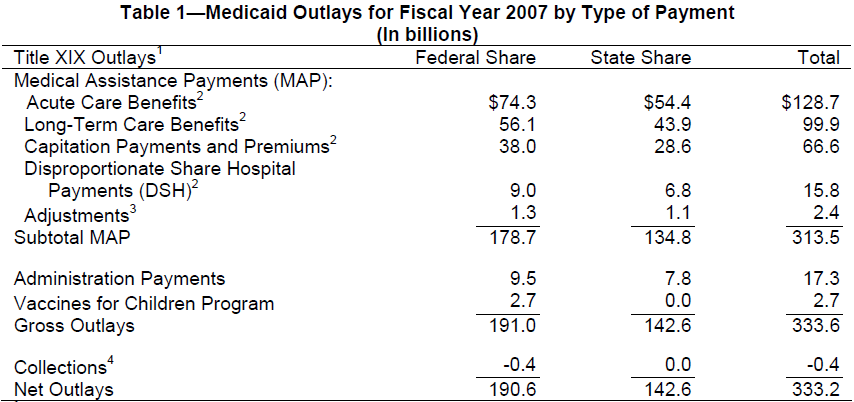
When most people (i.e. me) think of Medicaid, they think of gov’t funded medical care for the poor.
Surprised me to learn that about 1/3 of Medicaid spending supports elderly patients in long-term care facilities (e.g. nursing homes).
* * * * *
According to the Georgetown Health Policy Institute:
“Although most long-term care is provided by family members on an unpaid basis, most of the nation’s long-term care spending (75%) is
concentrated on nursing home care, and Medicaid, the nation’s health care program for poor and low income Americans, is the largest source of payment for that care.”
- Over 1 million total Medicaid nursing facility residents
- Over 400 million Medicaid nursing facility days per year
- Medicaid nursing facility per diem rate ~ $85
“Nearly half of the nation’s nursing home bill was paid by Medicaid in 2003, while just over a quarter was paid out-of-pocket, and less than 10 percent was covered by private insurance.”
According to the WSJ:
Medicare utilization is roughly 50% higher than private health-insurance utilization, even after adjusting for age and medical conditions.
In other words, given two patients with similar health-care needs—one a Medicare beneficiary over age 65, the other an individual under 65 who has private health insurance—the senior will use nearly 50% more care.
Why?
People who have comprehensive health coverage like Medicare tend to use more care, and more expensive care — with no noticeable improvement in health outcomes — than those who have basic coverage or high deductibles.
Prof Mark Perry extends the observation, to partially explain why healthcare costs are so high … in general, folks have a decreasing amount of skin in the game (think deductibles and co-pays) … and when consumers are insulated from costs, they consume more … and more … and more.
The graph below tells the story.

A recent “Investor’s Business Daily” article has been making the email circuit.
Provides statistics from a survey by the United Nations International Health Organization:
* * * * * *
Percentage of men and women who survived a cancer five years after diagnosis:
U.S. 65% Canada 42% England 46%
* * * * *
Percentage of patients diagnosed with diabetes who received treatment within six months:
U.S. 93% Canada 43% England 15%
* * * * *
Percentage of seniors needing hip replacement who received it within six months:
U.S. 90% Canada 43% England 15%
* * * * *
Percentage referred to a medical specialist who see one within one month:
U.S. 77% Canada 43% England 40%
* * * * *
Number of MRI scanners (a prime diagnostic tool) per million people:
U.S. 71 England 14 Canada 18
* * * * *
Dems are adamant: “Don’t touch Medicare & Medicaid”.
And, they were equally adamant that ObamaCare would “bend the cost curve”.
Yep, the cost curve is bending …. unfortunately, in the wrong direction.
According to USA Today … Medicare, Medicaid tab keeps growing
Medicare and Medicaid spending rose 10% in the second quarter from a year earlier to a combined annual rate of almost $992 billion.
The two programs are on track to rise $90 billion in 2011 and crack the $1 trillion milestone for the first time.
The latest spending surge in federal health care is driven by more people getting more treatment, not by price increases.
Health care inflation is at its lowest level in more than a decade — a 1.7% annual rate.
Medicare and Medicaid paid a record 57.5% of patient bills for hospital, doctors, drugs and other care in the last quarter, up from 49.3% in 2005.

Ken’s Take:
(1) Good news for Obama: edging closer to single-payer system
(2) No surprise, costs are rising not falling …. did anybody really believe the “bending the cost curve” riff?
(3) Debt deal says that if the super-committee fails to find cuts, doctors’ reimbursement rates will be cut … good luck to Medicare-Medicaid patients trying to find an MD.
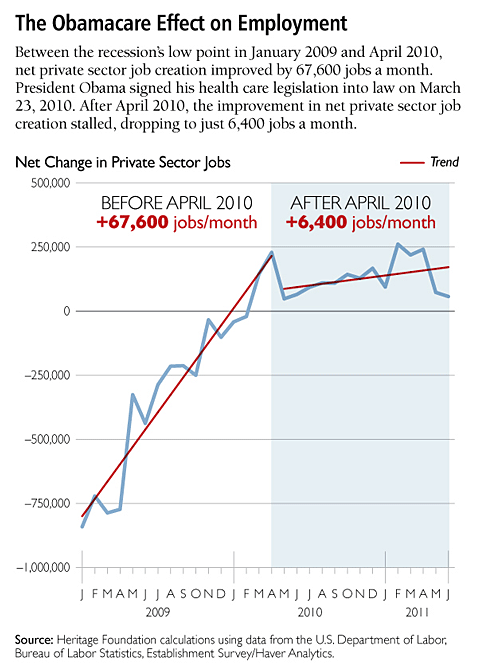
Interesting analysis by the Heritage Foundation …
While correlation doesn’t necessarily imply causation, there are reasons to believe:
Draw your own conclusion.
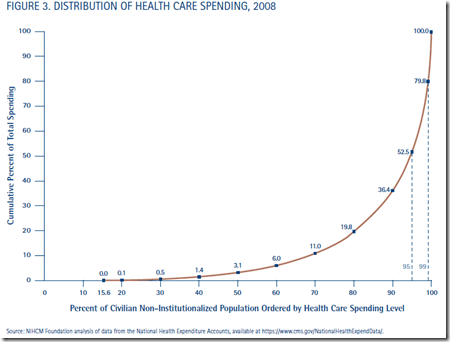
According to the National Health Care Management Association analysis of 2008 healthcare spending:
Of course, I’ve got horses in this race since I’m a McKinsey alum …
When dufass Henry Waxman started attacking McKinsey for lack of credentials and poor methodology, I just had to laugh.
* * * * *
From the WSJ: Shutting Up McKinsey
The White House routinely tries to intimidate its health-care critics, but the campaign against McKinsey & Co. is something else.
The management consultants attempted to find out how U.S. business will respond to ObamaCare,
Democrats don’t like the results, and so McKinsey must pay with its reputation.
The firm’s sin was to canvass some 1,300 companies and report that nearly a third will “definitely” or “probably” stop offering insurance to employees after 2014, dumping them instead into ObamaCare’s subsidized exchanges.
Democrats immediately blasted the results, attacked McKinsey’s integrity and demanded that it release its methodology and full responses.
So this week McKinsey opened its books, and what do you know, the survey was rigorous.
Respondents were a representative cross-section of businesses of many sizes and across industries and regions, and the questions were impartial.
* * * * *
The White House shills declared that the study was not a “predictive economic analysis.”
For truth, they point to the ever-dutiful Congressional Budget Office which – after the CBO got an all expenses paid trip to meet with Obama in the oval office — thinks the law will have little effect on employer coverage.
* * * * *
Viva McKinsey.
Punch line: ObamaCare will lead to a dramatic decline in employer-provided health insurance—with as many as 78 million Americans forced to find other sources of coverage.
* * * * *
Currently, 156 million non-elderly Americans get their coverage at work.
Before ObamaCare passed, the CBO estimated that only 9 million to 10 million people, or about 7% of employees who currently get health insurance at work, would switch to government-subsidized insurance.
A new study by McKinsey – reported in the WSJ — suggests that ObamaCare will lead to a “radical restructuring” of job-based health coverage with as many as 78 million Americans could lose employer health coverage.
The McKinsey study, “How US health care reform will affect employee benefits,” predicts that employers will either drop coverage altogether, offer defined contributions for insurance, or offer coverage only to certain employees.
Up to 50% of employers say they will definitely or probably pursue alternatives to their current health-insurance plan when ObamaCare takes effect in 2014.
And, “something in the range of 80 million to 100 million individuals are going to change coverage categories in the two years” after the insurance mandates take effect in 2014.
* * * * *
The Heritage Foundation points out that:
“Last year at this time Newsweek showed 40 percent of Americans supporting Obamacare and 49 percent opposing it. Today, only 37 percent support it while 56 percent oppose.
According to Quinnipiac, after Obamacare passed last year, 44 percent of Americans approved of President Obama’s handling of health care while 50 percent opposed. Today, only 44 percent approve while opposition has grown to 56 percent.
And according to the Kaiser Family Foundation, after Obamacare passed, 62 percent of Americans thought the law would either have no effect on them or make them worse off. Today that number is up to 69 percent.”
Just in case you think that’s right-wing malarkey, here’s a broad based survey summary from Pollster.com … now, a unit of that right wing bastion — the Huffington Post:


Punch line: Being on Medicaid was associated with the longest length of stay, the most total hospital costs, and the highest risk of death.
According to the WSJ …
Dozens of recent medical studies show that Medicaid patients suffer for it.
Foe example, 2010 study of 893,658 major surgical operations performed between 2003 to 2007, published in the Annals of Surgery, found that being on Medicaid was associated with the longest length of stay, the most total hospital costs, and the highest risk of death.
In all of these studies, the researchers controlled for the socioeconomic and cultural factors that can negatively influence the health of poorer patients on Medicaid.
So why do Medicaid patients fare so badly?
Payment to providers has been reduced to literally pennies on each dollar of customary charges because of sequential rounds of indiscriminate rate cuts, like those now being pursued in states like New York and Illinois.
As a result, doctors often cap how many Medicaid patients they’ll see in their practices.
Meanwhile, patients can’t get timely access to routine and specialized medical care.
Source: WSJ, Medicaid Is Worse Than No Coverage at All, March 10, 2011.
I’m getting confused.
When is majority rule good and mob rule bad?
And when is mob rule good and majority rule bad?
In Egypt, mob rule was good because majority rule – in the form of free and open elections – was being suppressed. Plus, Mubarek was a thug – albeit “our” thug for 30 years.
Pushing aside the fact that the protesters on the square (about 100,000) were an infinitesimal part of the county’s population (about 83 million), I get that one.
In Wisconsin, mob rule is good and majority rule is bad. Huh?
The clear majority of Wisconsin voters elected a GOP governor and GOP majorities in their state’s Senate and Assembly. They got to work and prepped legislation to make government workers pay some (versus none) of their health insurance premiums and pension benefits.
So, the Dem Senators – who knew they were going to lose the vote to the majority — left the state to preclude a quorum for the passing of any legislation.
Democracy at work ?
And, thousands of teachers were suddenly too sick to work, and sick enough to get sight-unseen notes from cause-supportive doctors, but healthy enough protest in Madison – where they were complemented by bus loads of union and and Dem operatives – some from Wisconsin, some not – all encouraged by no less than President Obama.
So, the multi-state mob is good, the majority of voters is bad.
I’m having trouble with that one.
Now the big question.
If we’re switching from majority rule to mob rule, how many folks have to march on Washington to get ObamaCare repealed?
I figure that since 100,000 out of 83 million was good enough in Egypt … and 50,000 out of 5 million is good enough in Wisconsin … it should take only about 500,000 congregated protesters in the U.S.
I think the Tea Party could muster that number.
Hmmm. Let’s be consistent, right ?
Parent-to-parent chat line: “I told my son he’d better find a job so he has health insurance”
I’ve heard that refrain dozens of times from parents, so I should have picked up on this earlier …
Last week, CBO Director Elmendorf dropped a bomb at a Congressional hearing when he testified that ObamaCare would reduce the “propensity to work”.
English translation: under ObamaCare, if you don’t work, no problem. You’ll get free health care from the government.
Well, actually, it’s not free – it’s just paid for by people who do work. You know, tax payers.
Complement that “benefit” with a couple of years of unemployment compensation and why on earth would anybody take a relatively low paying job.
Kick back. Relax. And if you get sick, just send the bills to 1600 Pennsylvania Ave.
Elmendorf says the new ObamaCare entitlement will reduce employment by about 800,000 workers … as the labor force shrinks by about half a percentage point .
Mr. Elmendorf said that the law won’t eliminate jobs, it will reduce “the propensity to work.”
As with any other government subsidy, people receiving “free” health care won’t have as much incentive to search for a job or work full time.
On that score, Chris Van Hollen, the ranking Democrat on the Budget Committee, asked Mr. Elmendorf a leading question about “the freedom to choose to not get a job.”
I guess Van Hollen thinks people shouldn’t be forced to work if the don’t want to.
Hmmm.
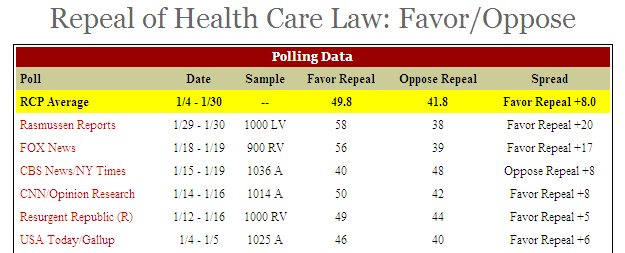
Excluding one poll from the bastions of impartiality: the NY Times and CBS – all major polls are now reporting that a plurality of Americans want ObamaCare repealed … and about 1/2 of the polls report a majority of citizens want it repealed.
Doesn’t faze our Dem senators, though, who voted as a lemming-bloc against an amendment to repeal the law.
Who cares what the majority of citizens want …
http://www.realclearpolitics.com/epolls/other/repeal_of_health_care_law_favoroppose-1947.html
Previously, we posted that a 26-state majority was suing over the constitutionality of ObamaCare mandates.
Make that 27 …
Governor Mary Fallin announced last night that Oklahoma will file a lawsuit against the new healthcare law.
Instead of joining the 25 states in the Florida suit or Virginia in its free-standing lawsuit, Oklahoma will sue on the grounds that the federal healthcare law violates the new constitutional amendment just approved by Oklahoma voters.
Oklahoma State Question 756 changed Oklahoma’s constitution to say Oklahomans can’t be required to participate in any healthcare system – be it Federal or State dictated.
For those keeping score …
But, Reid says “no up or down vote” and Obama says “veto”.
So much for “government by the people, for the people” …
There’s still a lot of chatter about how evil health insurance companies are causing health care costs to continue to soar. The implication is that the increases are largely attributable to their expanding profit margins and astronomical exec bonuses.
Then, a WSJ op-ed got me thinking.
The punch line: Blue Shield of California announced that it was upping premiums by as much as 39% to cover increases in the underlying cost of health care and the added costs of ObamaCare – e.g. coverage for adult children and pre-existing conditions.
Here’s the rub: Blue Shield of CA is a not-for-profit insurer. All they do is collect premiums and pay health providers – and try to breakeven at the end of the year. So, their premium increases can’t be demonized as profiteering. If they have to pay more out, they simply adjust premiums to cover the difference.
Got me wondering: how much of the health insurance business is handled by not-for-profits?
About 275 million Americans have health insurance … roughly 1/3 of them are covered by Medicare or Medicaid.
Since the gov’t doesn’t engage in profiteering, we can dismiss 1/3 of insureds and half of health care expenditures as irrelevant to the profiteering argument.
OK, we’re down to 200 million insureds.
There are plenty of NFP insurance companies, but the biggie is Blue Cross / Blue Shield.
From their web site: Health plan providers affiliated with the Blue Cross and Blue Shield Association (BCBSA) — known as “the Blues” — serve more than 100 million members nationwide.
So, at most, for profit health insurance companies cover about 1/3 of all insureds – and handle less than 1/4 of all health care expenditures.
Looks to me, like premiums are going up because healthcare costs are going up … not because of profiteering.
Maybe I’m missing something …
Six more states – Iowa, Ohio, Kansas, Wyoming, Wisconsin and Maine — are joining Florida’s federal lawsuit challenging ObamaCare’s constitutionality.
That puts the number at 26 – a majority of states.
Hmmm … I guess they’re not swayed by “adult children” free-riding on parents’ policies.
South Florida Business Journal, Six states join health care reform challenge, January 18, 2011
Last week’s disclosure that MediCare will now gladly reimburse doctors for annual chats with patients re: the desirability calling it a day and heading for heaven has revived the death panel uproar.
Why?
First, to put the flap in context: ObamaCare doesn’t fundamentally restructure healthcare delivery … it just rearranges the flow of money and patients.
The current uproar revolves around the latter provisions.
While end of life consultations don’t really represent death paneling, they are a significant step in that direction — they are a form of soft rationing that – in concept — allows patients to voluntarily opt out of end of life medical services.
Some argue that’s a slippery slope.
What if doctors are incentivized by the Feds to skew the conversations towards terminal strategies? Or, what if doctors are incentivized to hush-up available life prolonging options?
Then, the soft rationing begins to harden.
Can you imagine the Feds incentivizing doctors to promote terminal treatment options or the gov’t refusing to reimburse for near end of life procedures for certain ‘unworthy’ patients. Hmmm.
To some people, that starts to sound like death panels.
And, that’s why there’s an uproar.
I don’t expect a lot of sympathy, but I have a story to tell …
We have a house on a river.
FEMA has declared the general area to be a flood zone.
So, I’m being forced to pay over $2,500 annually for FEMA flood insurance.
Here’s the rub.
The house is “sited” on relatively high land.
A couple of years ago we had a “100-year” storm — hurricane Isabel.
The tidal surge flood caused mucho damage to our neighbors — whose houses are sited at low spots.
Fortunately (for us), the water didn’t come within 30 feet of our house. No damage to the house. Period.
So, even though we have empirical evidence that our house is flood safe in a 100-year storm, FEMA makes us buy flood insurance because we’re theoretically in a flood zone.
And, FEMA stands firm behind their flood map — which was drawn up 27 years ago, in 1983.
Nuts!
I can now imagine how young healthy folks are going to feel when ObamaCare kicks in and they’re stuck buying health insurance that they don’t want.
I can feel their pain.
What inference would you draw from the headline: “Americans split on health care repeal”.
Most folks would probably conclude that there’s a 50/50 split between people who want to keep ObamaCare and people who want to trash it.
Not so fast.
The numbers …
37% said they want to repeal it completely.
36% said they want to revise the law so it does more to change the health care system.
10 % wanted modifications to narrow its scope
15% said they would leave the overhaul as it is.
http://news.yahoo.com/s/ap/20101022/ap_on_bi_ge/us_ap_poll_health_care
I guess the “even split” is between folks who want to repeal the bill entirely and those who want to substantially change it.
Strikes me as a releatively narrow difference.
I think the headline should have read “Only 15% favor ObamaCare”.
But — unlike the AP — I’m biased.
Punch line: Boeing is joining the list of companies that say the new health care law has downsides for their workers and is paring its plan.
Ken’s Take:
(1) Last week, McDonald’s and 30 other companies got waivers from ObamaCare … let’s see how long it takes for Boeing to get their waiver.
(2) Boeing has a huge cluster on employees in Washington state … the Senate battle in Washington is close … incumbent Patty Murray voted for ObamaCare … bet this becomes an issue.
* * * * *
According to AP …
“The newly enacted health care reform legislation, while intended to expand access to care for millions of uninsured Americans, is also adding cost pressure as requirements of the new law are phased in over the next several years.”
The Boeing plan is more generous than what its closest competitors offer, and the company was concerned it would get hit with the new “Cadillac” health plans tax under the law.
“We want to manage our costs so this tax doesn’t apply to our plan.”
Boeing said annual deductibles and copayments will increase for all its plans next year.
Deductibles, the share of medical costs that employees pay annually before their plan kicks in, will go up to $300 for individuals, an increase of $100. For families, the new deductible will be $900, an increase of $300.
In addition, Boeing is instituting a copayment of 10 percent after the deductible has been met. The copayment will rise to 20 percent in 2012.
Full article: AP, Citing health care law, Boeing pares employee plan, Oct 18, 2010
http://news.yahoo.com/s/ap/20101018/ap_on_bi_ge/us_health_costs_boeing
Ken’s Take: Pretty well sums up my point of view … nice that coverage got expanded, but no structural change to the system … just moves money (and paper) around … and jams gov’t bureaucrats in the middle of a very personal process.
* * * * *
Excerpted from the National Review …
Tennessee governor Phil Bredesen, a Democrat who was once on the Obama administration’s short list for the job of Health and Human Services secretary, has called the Affordable Care Act “a stunning disappointment.”
“The problem isn’t that we expanded coverage,” Bredesen writes in his new book “Fresh Medicine,” referring to the millions of uninsured and under-insured people who can now either buy insurance with the help of federal vouchers and the creation of state health exchanges.
“The problem was expanding coverage is about all we did.”
It’s “about all we did,” because Bredesen thinks that expanded entitlement saddles an already burdened federal government drowning in red ink with additional – and expensive – obligations.
“Government loves complexity, rules and red tape, but we may have outdone ourselves this time,” Bredesen writes.
“Reform offered a chance to clean up the baroque system we have created over the years, reduce bureaucracy, lower administrative cost and give clarity and focus to a major part of where we spend our taxpayers’ money.
“Instead, we created more complexity, more regulations and the need for more bureaucracy.”
Dem Governor: Obamacare a ‘Stunning Disappointment’, October 12, 2010
http://www.nationalreview.com/corner/249550/dem-governor-obamacare-stunning-disappointment-daniel-foster
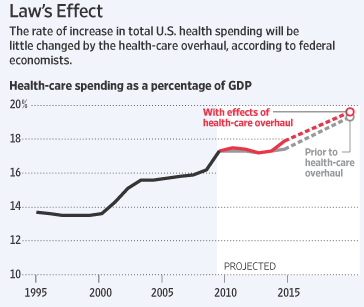
A report by federal number-crunchers casts fresh doubt on Democrats’ argument that the health-care law would curb the sharp increase in costs over the long term,
“The health-care overhaul enacted last spring won’t significantly change national health spending over the next decade compared with projections before the law was passed”.
U.S. health spending is projected to rise 9.2% in 2014, up from the 6.6% projected before the law took effect.
WSJ, Health Outlays Still Seen Rising, Sept. 8, 2010
http://online.wsj.com/article/SB10001424052748704362404575480161749608830.html?mod=djemalertNEWS
Did anybody really think that eliminating life-time payout caps, covering “adult-children”, and covering all pre-conditions would be free … or reduce total healthcare expenditures?
PS There’s no Easter Bunny, either …
* * * * *
Health Insurers Plan Hikes Related to Health-Care Overhaul, Sept. 7, 2010
Health insurers say they plan to raise premiums for some Americans as a direct result of the health overhaul.
Aetna, some BlueCross BlueShield plans and other smaller carriers have asked for premium increases of between 1% and 9% to pay for extra benefits required under the law, according to filings with state regulators.
These and other insurers say Congress’s landmark refashioning of U.S. health coverage is causing them to pass on more costs to consumers than Democrats predicted.
Many carriers also are seeking additional rate increases that they say they need to cover rising medical costs. As a result, some consumers could face total premium increases of more than 20%.
Democrats front-loaded the legislation with early provisions they hoped would boost public support. Those include letting children stay on their parents’ insurance policies until age 26, eliminating co-payments for preventive care and barring insurers from denying policies to children with pre-existing conditions, plus the elimination of the coverage caps.
Insurance companies are telling state regulators it is those very provisions that are forcing them to increase their rates.
The industry contends its increases are justified.
“Anytime you add a benefit, there are increased costs,”
Full article:
http://online.wsj.com/article/SB10001424052748703720004575478200948908976.html?mod=WSJ_hpp_MIDDLETopStories
You know the drill: ObamaCare is going to bend the cost curve. Just wait and see…
Well, not so fast.
Why?
First, nothing substantially “structural” is being done to the system … unless you count bagging Medicare Advantage everyplace but vote-sensitive Florida .. in essence, money is just being shifted around
Second, tens of millions of folks are getting new coverage … with taxpayers and “insureds” picking up the tab … on top of what they’re already paying.
Third, existing plans are forced to adversely select (i.e. add people with known high cost preconditions to their plans), to cover “adult children” under their parents plans, and to eliminate lifetime caps on payouts.
Somebody has to pay for all those adders … and that somebody is you … both through higher taxes and higher insurance premiums.
Employers are forecasting a 9% increase in total healthcare costs in 2011 – up from 7% in 2010.
Much of the increase is attributable to – you guessed it – ObamaCare.
Many employers say that they’ll pass the increases on to employees … 63 percent say they’ll ask workers to pay a higher portion of the premiums … others will be taking money out of the pay increase bucket … some plan to slash prescription and retiree coverage.
Just wait until the full weight of ObamaCare kicks in.
Get out your wallet.
* * * * *
For more, see “Large Companies Faced With Uncertainty Over Effects of New Health Care Law”
http://www.foxnews.com/politics/2010/08/18/large-companies-faced-uncertainty-effects-new-health-care-law/?test=latestnews
Answer: security vreaches that release VERY sensitive information.
Follow-on question: How would you like your health records made public?
I was surprised that there was hasn’t been an uproar over the ObamaCare provisions that entail the Feds developing Electronic Medical Records databases with all of our health records.
Of course, the representations were that there would be no untoward uses of the data (think IRS) and that all data would be kept strictly private.
Regarding privacy, think WikiLeaks and Boston dumps.
If our high security military information can slip out to hackers, why would anyone believe that health information would be secure?
And, consider the recent incident in Boston where thousands of patient health records, some containing Social Security numbers and sensitive medical diagnoses, ended up in a pile at a public dump. See article highlights below.
If hospitals can’t keep control of old-school paper docs, does anybody really believe that the Feds will be able to control electronic health records?
Caveat citizen
* * * * *
Boston Globe: Patients’ files left at public dump, August 13, 2010
Four Massachusetts community hospitals are investigating how thousands of patient health records, some containing Social Security numbers and sensitive medical diagnoses, ended up in a pile at a public dump.
The unshredded records included pathology reports with patients’ names, addresses, and results of breast, bone, and skin cancer tests, as well as the results of lab work following miscarriages.
By law, medical records and documents containing personal identifying information must be disposed of in a way that protects privacy, and leaving them at a dump is probably illegal, privacy lawyers and hospital officials said. Violators face steep fines.
The episode highlights in dramatic fashion how hard it can be for hospitals to safeguard patient information, given the large number of doctors, insurance companies, medical billing firms, and contractors who have access to personal data in the normal course of business.
“This is a perfect example of how complicated the security of confidential information is … All it takes is one slip in that process for information to be released.’’
Full article:
http://www.boston.com/news/health/articles/2010/08/13/mass_hospitals_investigate_exposure_of_records?mode=PF
* * * * *
Thanks to CH for connecting WikiLeaks and EMR.
Excerpted from AOL News: Germany Weighs Tax on the Obese, July 23, 2010
Germany, famed for its beer, pork and chocolates, is one of the fattest countries in Europe. Twenty-one percent of German adults were obese in 2007, and the cost of treating obesity-related illnesses is about $21.7 billion, a year.
Germany’s health system is paid for by a series of mandatory health insurance funds, all of which are reporting serious deficits as the system is overused.
A conservative member of parliament said it is unfair and unsustainable for the taxpayer to carry the entire cost of treating obesity-related illnesses in the public health system.
“I think that it would be sensible if those who deliberately lead unhealthy lives would be held financially accountable for that.”
A health economist called for Germany to tackle the problem of fattening snacks in order to raise money and reduce obesity.
“One should, as with tobacco, tax the purchase of unhealthy consumer goods at a higher rate … that applies to alcohol, chocolate or risky sporting equipment such as hang-gliders.”
The German teachers association recently called for school kids to be weighed each day,
The fat kids could then be reported to social services, who could send them to health clinics.
A professor of nutrition at the Harvard School of Public Health, described the idea of a fat tax as “not humane … since lifestyle is not the only factor in obesity, with both genetics and urban environments playing major roles … Most people who are obese would prefer not to be so.”
Full article:
http://www.aolnews.com/world/article/germany-considers-tax-on-the-obese/19566425
Punch line: The trillion dollar cost of ObamaCare is reportedly funded 1/2 by tax increases and 1/2 by Medicare cuts.
Of the $500 billion in Medicare cuts, 1/2 is cuts in waste & fraud (yeah, right !) and 1/2 by program cuts — the majority of which comes from killing Medicare Advantage – an HMO option to Medicare run by private insurance companies.
The idiocy: Medicare Advantage is a cheaper alternative – about 2% lower cost than traditional Medicare.
Not the way we did it in the companies where I worked …
* * * * *
WSJ: Farewell, Medicare Advantage, June 11, 2010
Medicare Advantage gives almost one of four seniors private insurance options, and Democrats are about to cut its funding by some $136 billion over the next decade.
The Congressional Budget Office says these cuts will cause enrollment to drop by 35%, the Administration’s own Medicare actuaries predict 50%, and both outfits take for granted that benefits will also decline.
Dems loathe Medicare Advantage because it sanctions the private choices that might eventually liberate the U.S. health market from government control . They also want to raid Advantage to finance their new subsidies.
Here’s the rub.
According to the Medicare Payment Advisory Commission, the Advantage HMOs that serve 15% of all seniors in Medicare cost on average two percentage points less for the same benefits than the traditional Medicare program.
Using government data, the insurer trade group AHIP estimates that Advantage beneficiaries in California spend 30% fewer days in the hospital than fee for service, 23% fewer days in Nevada.
These successes and others have come about because Advantage allowed insurers and providers to collaborate, pay for value and coordinate care.
These successes are threatening to politicians because they are a model for true Medicare reform, which would reduce the health-care powers that Congress has exercised for nearly a half-century and let patients decide.
This terror explains why Democrats are so intent on killing Medicare Advantage, and on blaming someone else for destroying a program that millions of seniors prefer.
The President knows this, so he and his fellow Democrats are gearing up to blame these cuts on . . . insurers, rather than on their own policies.
They desperately want to dodge any near-term blame when seniors who use Advantage start to lose its benefits. Ergo, blame insurers first.
Full article:
http://online.wsj.com/article/SB10001424052748703302604575295021352835874.html?mod=WSJ_Opinion_AboveLEFTTop
Thanks to JJP for feeding the lead.
* * * * *
From the Homa Files archive:
Medicare Advantage saves money … so cut it to save money. Huh?
https://kenhoma.wordpress.com/2009/09/25/medicare-advantage-saves-money-so-cut-it-to-save-money-huh/
Pelosi argued that once ObamaCare was passed, folks would see what was in it and rally to support it.
Seems that the opposite is occurring: as reality gets unveiled folks are jumping off the canoe …
The reasons: bad economics and aversion to so-called social democracy’.
* * * * *
Excerpted from RCP: Refusing the Entitlement Lollipop, May 28, 2010
After a brief bump, support for Democratic health reform has declined.
According to a recent Rasmussen poll, 63 percent of voters support repeal of the law, the highest level since passage.
On the theory that the distribution of lollipops usually doesn’t provoke riots of resentment, opposition to the health entitlement requires explanation.
First, the economic case for Democratic health reform has been weak, contrived, even deceptive.
Recent events in Congress make the point. Two months after passing a law that supporters claimed would reduce federal deficits, largely through Medicare cuts, the House is moving toward a temporary “doctor fix” that would add tens of billions in Medicare costs.
The economic arguments for reform — that it would reduce the deficit and health inflation — were questionable from the beginning. Now they have been revealed as absurd.
Second, Americans are troubled with health reform, not because they lack knowledge of its provisions, but because they are uncomfortable with social democracy.
The idea of a middle-class entitlement to health care, achieved through an individual mandate, subsidies and aggressive insurance regulation, seems to change the nature of American society.
Entitlements in the Obama era are no longer a decent provision for the vulnerable; they are intended for citizens at every stage of life.
Americans resist taking this lollipop precisely because America is not Europe
http://www.realclearpolitics.com/articles/2010/05/28/refusing_the_entitlement_lollipop_105762.html
In marketing, there’s a concept called a “perceptual difference”.
The basic notion is that something has to be sufficiently different from a comparative benchmark in order to make a difference in the way people think about it.
For example, throwing an extra 1/2 ounce of Cheerios into a 14 ounce box probably doesn’t pass the perceptual difference test. It adds to the cost of the product, but probably doesn’t motivate buyers to pay more for it.
Increasing the contents by, say 20%, probably does . Folks are likely to notice. Whether they’re willing to pay more for the super-size is another question …
Which brings us to Pres Obama’s push to win seniors over to his health care plan.
Keep in mind that roughly half ObamaCare’s comes from $500 billion in Medicare cuts – half from cutting waste & fraud (yeah, right) and half by eliminating Medicare Advantage – a step-up HMO version of Medicare.
$500 billion passes the perceptual difference test, and seniors are taking the cuts personally.
To partially offset the cuts, ObamaCare is “filling the doughnut hole” in Bush’s prescription drug plan – a program that supplemented Medicare to cover seniors’ prescriptions – but only up to a certain amount – and then kicked back in for extraordinary prescription drug users. The gap between “a certain amount” and “extraordinary – designed to suppress unnecessary prescriptions “at the margin” – is the “doughnut hole”.
To close the doughnut hole, Obama is sending each Medicare senior a check for $250 – the equivalent of 68 cents per day. Hardly a perceptual difference.
Does the administration really think that 68 cents a day will get old folks to think that $500 billion in cuts is good for them ?
* * * * *
Side note: The notion of perceptual differences also provides an explanation for why Obama doesn’t get credit for his “tax cut to 95% of workers”. His “making work pay” program paid out a max of $400 to workers – that’s a little over $1 per day. A significant perceptual difference ?
Draw your own conclusion.
Yesterday, the Feds reported that ObamaCare’s slacker insurance – calling 26 year olds “adult children” and adding them to mommy and daddy’s health insurance policy as “dependents” — wouldn’t actually be free after all.
Surprise, surprise, surprise.
The Feds estimate: cost will be about $4 billion annually – and by law, the cost must be spread across all policy holders.
Translation: you’re paying for you neighbor’s 26 year old “adult-child”.
The source article extract is below, but first, I have to boast that HomaFiles was all over this one back in March:
Slacker insurance: Extending parents coverage to 26 year olds
https://kenhoma.wordpress.com/2010/03/26/slacker-insurance-extending-parents-coverage-to-26-year-olds/
At the time, we said:
OK, everybody knows that under ObamaCare insurance companies will have to allow parents to cover their “adult children” until age 26:
SEC. 2714. EXTENSION OF DEPENDENT COVERAGE FOR YOUNG PEOPLE UP TO 26TH BIRTHDAY THROUGH PARENTS’ INSURANCE .
(a) In general – A group health plan and a health insurance issuer offering group or individual health insurance coverage that provides dependent coverage of children shall continue to make such coverage available for an adult child (who is not married) until the child turns 26 years of age. [Effective 6 months after enactment.]The way the media is covering this aspect of the plan, there seems to be a presumption that this is a free-rider program — just add them to the policy and pay the same premium.
I don’t think so …
Two months later, the Feds discover what we knew then:
Excerpted from AP: Adding 26-year-olds will raise premiums 1%, May 11, 2010
According to HH&S, letting young adults stay on their parents’ health insurance until they turn 26 will nudge premiums nearly 1 percent higher for employer plans.
The new ObamaCare benefit will cost $3,380 for each dependent, raising premiums by 0.7 percent in 2011 for employer plans.
Some 1.2 million young adults are expected to sign up, more than half of whom would have been uninsured.
The regulation also specifies that young adults offered extended coverage through an employer cannot be charged more than other dependents, nor can they be offered a lesser set of benefits. Instead, the cost must be spread broadly.
Family coverage through the workplace now averages about $13,400 a year — counting both the shares paid by the employer and worker.
* * * * *
The situation is different for people buying their family coverage directly from an insurer, as many self-employed parents do. Unlike employers, insurers in the individual market do not have to spread the costs broadly. Parents would face an estimated additional premium of $2,360 in 2011.
http://www.northjersey.com/news/health/93377904_26-year-olds_will_raise_premiums_1_.html
Better health care, lower premiums, cut the deficit … yeah, right.
Dirty Harry would say to Waxman: “You can’t handle the truth”.
Remember when Rep. Waxman ordered a group of CEOs to testify before his subcommittee for writing down earnings to reflect one of the impacts of ObamaCare?
Then, the session was abruptly canceled.
Wonder why?
Well, according to documents obtained by Waxman — and reported on by Fortune: “The Committee’s majority staff issued a memo stating that the write downs were “proper and in accordance with SEC rules.” In other words, the companies were simply following the law.
And, to add fuel to the fire, the company documents indicated that the requirement to allow dependents to remain on their parents’ policies until age 26 will prove costly — very costly. Caterpillar puts the added expense — which is likely to be passed on to the employees — at $20 million a year.
Further, the documents revealed that the companies all were evaluating the possibility of dumping their health care plans, paying the employer mandate penalties, and letting the government handle their employees health care. Why ? To lower their costs — significantly !
For example, Caterpillar estimated in November, when the most likely legislation would have imposed an 8% payroll tax on companies that do not provide coverage, that it could shave $25 million a year, or almost 10% from its bill. Now, because the penalty is $2,000, not 8%, it could reduce its bill by over 70%, by Fortune’s estimate.
Similarly, AT&T revealed that it spends $2.4 billion a year on coverage for its almost 300,000 active employees, a number that would fall to $600 million if AT&T stopped providing health care coverage and paid the penalty option instead.
That raise two issues.
First, Obama says everybody can keep their health care plan if they like it. Not if employers stop offering the programs.
Second, Fortune estimates that if 50% of people covered by company plans get dumped, ObamaCare costs will rise by $160 billion a year in 2016, over and above the ‘gold standard’ CBO projections that propelled passage of the bill.
Oops. Maybe premiums and the deficit won’t come down after all.
That would be a shocker …
Full article:
http://money.cnn.com/2010/05/05/news/companies/dropping_benefits.fortune/
Yes, the AMA supported ObamaCare, but … less than 15% of practicing docs belong to the AMA … and “90% of the AMA’s funding comes via a government sanctioned monopoly whereby the AMA sells the billing codes upon which the entire health care system relies”
Vested interest? You decide …
* * * * *
Excerpted from Forbes: Why Physicians Oppose The Health Care Reform Bill, 04.28.10
The medical establishment is not celebrating ObamaCare. In fact, the mood in exams rooms is downright morose.
A recently released poll of more than 2,000 physicians is alarming:
Many physicians may ultimately be faced with the choice of opting out of government insurance programs or going out of business.
A significant number of physicians are realizing they cannot stay in business — let alone remain independent — if they continue to accept artificially low government reimbursement rates.
The same reform bill that will provide “care for all” may drive away more physician caregivers than attract previously uninsured patients.
What a predicament that would be. Health care without active physician participation is no health care at all.
* * * * *
How can physicians be so pessimistic ?
For one, the bill addresses none of the issues most consistently ranked by physicians as the most critical for lowering costs and improving access.
Tort reform, streamlining billing and payment, and fixing the flawed government formula for calculating physician reimbursement are given little, if any, serious attention.
Instead of fixing these issues, the government will be reducing physician reimbursement, just as the country is counting on even more physicians to be available.
* * * * *
What of the much-touted American Medical Association’s support for the bill?
Less than 15% of practicing physicians are AMA members, so any AMA support is more a reflection of the AMA’s financial interests than what physicians in this country truly want. This is a situation that proved opportunistic to proponents of the bill but could prove painful for America’s health care system.
The AMA, which counts less than 10% of its $300 million dollars in revenue from physician membership dues (the rest comes from a government sanctioned monopoly whereby the AMA sells the billing codes upon which the entire health care system relies) had little choice but to endorse the bill, lest the government retract its exclusive license on billing codes.
* * * * *
Full article:
http://www.forbes.com/2010/04/28/health-care-reform-physicians-opinions-contributors-daniel-palestrant_print.html
The gist of the below article: Primary care physicians are grossly underpaid compared with specialists, so there are fewer are them. (No kidding ?)
So, pay them more and there will be more of them. (It’s called an upward sloping supply curve !)
Yeah, yeah.
But, here’s what caught my eye: “A family physician or general internist averages about $160,000 a year; a specialist averages $267,000.”
BW focused on the $100k difference (which they multiplied by 35 to make it look, well, 35 times bigger).
My focus: the $267,000 level … just enough to target the specialists as rich enough to get hit by Obama’s soak-the-wealthy tax rate increases.
So, under ObamaCare, docs who are arguably the best get hit with reimbursement caps (that cut their earnings) and tax increases (that grabs more of what’s left).
Bend over doc.
* * * * *
Excerpted from Business Week: General Practitioners Need to Make More Money, April 26, 2010
In 1997, The Council on Graduate Medical Education, a little-known federal panel … suggested a cap on the overall number of medical residents as part of federal cost cuts. And so it was done.
Now, the Council is about to recommend an increase in the number of primary-care physicians—and pay them a whole lot more.
Primary-care doctors comprise 32% of the physician workforce. Factor out pediatricians and just over 23% of doctors deal with adults, and that number is shrinking.
A family physician or general internist averages about $160,000 a year; a specialist averages $267,000.
That means the general practitioner will earn about $3.5 million less over a lifetime.
The panel is calling for a 40% hike in the number of primary-care doctors — and a 40% income increase for those entering the field. That should get general practitioners to within 70% of the median income of specialty physicians.
* * * * *
Did you know ?
Medicare determines the baseline for doctors’ pay, and since most medical students elect to train in the non-primary-care jobs generating the majority of charges, procedure-oriented specialists end up the winners.
Medicare finances the system via direct subsidies to pay residents’ salaries and indirect payments to hospitals for tests and other duties fulfilled by residents.
Full article:
http://www.businessweek.com/magazine/content/10_18/b4176043937119.htm
First, the news and a sample of how it’s being covered … below is my take on why it’s important.
In Florida, voters will decide this fall whether to ban health insurance mandates, including those required by the federal health care overhaul.
The Republican-controlled Florida Legislature voted on Thursday to place a constitutional amendment on the Nov. ballot that would ban any laws that compel someone to “participate in any health care system.”
Republican legislators said the amendment was needed to block an attack on freedom and individual rights by Congress.
Democrats said the debate echoed the battle over states’ rights when the federal government ordered school integration and said the amendment could not trump federal law.
Sixty percent of voters must approve the amendment in order for it take effect.
Excerpted from NYT: Florida: Health Overhaul on November Ballot, April 22, 2010
http://www.nytimes.com/2010/04/23/us/23brfs-HEALTHOVERHA_BRF.html
* * * * *
Ken’s Take: I think the pundits are missing the point on this one.
Whether the constitutional amendment passes or not is largely irrelevant.
An important part of the the Bush / Rove election strategy in 2000 was to get wedge issues on ballots — gay marriage bans. The intent: to draw social conservatives to the polls.
Well, ObamaCare is still opposed by a majority of the electorate — and, many in that majority are passionate about the issue.
So, if ObamaCare shows up on the November ballot, it’ll draw right-leaning voters.
Watch for more of these issues to make their way to the Nov. ballots.
Whether the specific proposals win or lose is irrelevant — it’s all about turnout.
I’d cleared my calendar next Wednesday to watch Henry Waxman and his fellow Congressional nitwits grill a blue-ribbon group of uber-CEO’s on FASB rules and how they apply to the increased costs that companies will incur under Obama’s cost-saving healthcare plan. (Yeah, you read that right.)
I wanted to see Waxman order the CEOs to release fraudulent financial statements and “book” some of the pie-in-the-sky cost savings that ObamaCare promises to deliver …
The hearings would have made great theater …
* * * * **
Excerpted from Washington Examiner: Waxman cancels Obamacare CEO hearing, 04/14/10
Chairman Henry Waxman, D-Calif., has cancelled the April 21 subcommittee hearing in which CEOs were to testify about Obamacare.
Waxman had called the hearing in reaction to public statements by several companies — including Verizon, AT&T, and John Deere, among others — that Obamacare would cost them hundreds of millions or even billions of dollars because it laid a new tax on their retiree health benefit payments.
Ever since the passage of the Medicare Prescription Drug benefit, the payments had been subsidized, tax-free, as a way of preventing these companies from dropping enrollees onto the Medicare rolls, where they would cost the government far more.
When Obamacare changed the tax rules, it was quite clear that this would result in huge losses, but President Obama and Democrats had failed to heed warnings to this effect in the run up to Obamacare’s passage last month.
The CEOs, required by law to be honest about earnings projections, re-stated their bottom lines in reaction to Obamacare’s passage, earning the ire of Waxman and other Democrats.
Hearings on this matter would likely have proved an embarrassment to the Democrats and helped drag out discussion of Obamacare’s unexpected ill effects.
Punchline: More proof that Congress is populated by morons …
A report from the Congressional Research Service found that — because of imprecise language and a possible drafting error in the ObamaCare bill — senators, representatives, and their staffers may end up having their ‘Cadillac’ coverage replaced by everyman’s ObamaCare.
A provision in the bill inadvertently bars members of Congress and congressional staff from taking part in the current federal health employee plan.
Watch for a legislative fix … via the 51 vote reconciliation process, of course.
* * * * *
Excerpted from NY Times: Baffled by Health Plan? So Are Some Lawmakers, April 12, 2010
The new health care law will affect almost every American in some way. And, perhaps fittingly if unintentionally, no one may be more affected than members of Congress themselves.
The Congressional Research Service says the law may have significant unintended consequences for the “personal health insurance coverage” of senators, representatives and their staff members.
For example, it says, the law may “remove members of Congress and Congressional staff” from their current coverage, in the Federal Employees Health Benefits Program.
The confusion raises the inevitable question: If they did not know exactly what they were doing to themselves, did lawmakers who wrote and passed the bill fully grasp the details of how it would influence the lives of other Americans?
Representative Jason Chaffetz, Republican of Utah, said lawmakers were in the same boat as many Americans, trying to figure out what the new law meant for them. “If members of Congress cannot explain how it’s going to work for them and their staff, how will they explain it to the rest of America?”
Full article:
http://www.nytimes.com/2010/04/13/us/politics/13health.html?hp




 The Homa Files