Archive for the ‘MARKETING’ Category

Companies turn to product-specific soap operas to engage consumers

January 15, 2010

TakeAway:  I’m not sure if product-specific soap operas or webisodes are aimed at providing work for struggling actors and actresses, creating another way for studios to get advertising revenue, or engaging consumers. 

While I do think there is some benefit offering enhanced versions of commercials online so that consumers that want more info can get it, I think it is farfetched to say that products require actors in order for consumers to engage with the brand. 

And, if that is the case, maybe the brand may need more than a webisode to solve the problem.

* * * * *

Excerpted from NYTimes, “Shows Online, Brought to You by …,” By Stuart Elliott, November 24, 2009

… Actors are finding new ways to stay in the public eye in the form of Web series, also known as webisodes. Almost all such Web series are being created specifically for advertisers, borrowing a strategy from the early days of radio and television when shows like “The Kraft Music Hall,” “The Bell Telephone Hour” … that entertained Americans while selling cheese, phone service …

Webisodes — part of a trend called branded entertainment — are growing because marketers feel compelled to find new methods to reach consumers in an era when the traditional media are losing eyeballs, ears, hearts, minds and perhaps other body parts to the Internet …

Among the major brands proclaiming “brought to you by … ” online are Maybelline cosmetics, which is sponsoring Ms. Bushnell’s Web series, “The Broadroom,” available at maybelline.com/thebroadroom, and ConAgra Foods, which is sponsoring a daily show, “What’s So Funny?,” on yahoo.com, peddling products like Healthy Choice and Marie Callender’s!

The goal is to “extend our reach,” said media director at Clorox, and attain “a higher level of engagement” than is possible through tactics like running 30-second commercials that interrupt episodes of conventional TV series …

When developing branded entertainment, “the entertainment part has to come first” … otherwise consumers will dismiss it as “pushing a product” …

Shows should have an episodic, TV feel but be digestible, in portions sized appropriately for online viewing — typically three to seven minutes each …

Some consider webisodes “the flavor du jour” … but sponsors are signed “before we shoot a frame” of a Web series …

Edit by TJS

* * * * *

Full Article
http://www.nytimes.com/2009/11/24/business/media/24adcol.html?_r=1&ref=media

* * * * *
Who’s to blame for the lack of integrated marketing mixes these days?

January 14, 2010

TakeAway:  It’s unclear whether CPG manufacturers should blame themselves or the retailers, but the CPGs better blame something for their lack of adhering to a key marketing success pillar – integrate your marketing mix.

* * * * *

Excerpted from Marketing Daily, “GMA Study: Shopper Marketing Still Siloed,” By Karlene Lukovitz, November 3, 2009

Shopper marketing continues to grow in importance for CPGs and retailers, but its effectiveness is being limited by insufficient integration with out-of-store marketing and media channels …

Overall investment in shopper marketing ( … in-store advertising, promotion and design initiatives intended to extend brand equity and provide the retailer with differentiation) is estimated to be growing at 21% annually …

Study concludes that CPG manufacturers have yet to align shopper marketing initiatives with the advertising and promotions that reach consumers at home and on the go. That results in disconnected marketing messages, wasted spending and missed opportunities to drive purchases …

Integrating and quantifying results from shopper marketing is becoming even more critical. Retailers increasingly seek to tap into CPGs’ budgets beyond trade promotions, pushing manufacturers to shift spending into ads on retailer Web sites and in-store video networks, as well as participate in retailer database marketing programs …

Study found brand preference to be the most important out-of-store factor influencing which products go on a shopping list …

The study also found that nearly half of food and beverage shoppers and nearly 60% of health/beauty and household goods shoppers purchase their preferred brands even when a less expensive alternative is available. And, 48% of food and beverage shoppers, 58% of household product shoppers and 59% of health and beauty shoppers — use coupons or price promotions to “justify buying the brands they want” rather than as the key factor driving their decision making …

Shoppers choose 59% of the brands they buy in the store, and 41% before they enter the store. This points to opportunities, even in the current down economy, to influence their brand choices before they go shopping.

For the 59% of items for which brands are selected in-store, 85% of shoppers perceive in-store factors as more influential than out-of-store marketing. After price, communicating benefits on packaging is most influential, whether for reinforcing existing brand preferences, driving competitive switching, capturing purchase when there is no strong brand preference, or creating impulse sales.

While confirming that most shoppers (81%) do research before shopping … 77% of shoppers do not take detailed shopping lists into the store. Instead, most shoppers have “mental lists” that include “brand consideration sets,” but evolve as they are exposed to more marketing at home, in transit and in the store.

Edit by TJS

* * * * *

Full Article
http://www.mediapost.com/publications/?fa=Articles.showArticle&art_aid=116719

* * * * *

Looking for a low-cost marketing research tool? Twitter may be your answer.

January 13, 2010

TakeAway:  In need of real-time consumer feedback?  Well, look no further.  Twitter evolved its search capabilities to allow “searchers” to not only track the volume of tweets, but also to assign a sentiment to those tweets.

* * * * *

Excerpted from, WSJ, “Follow the Tweets,” By Huaxia Rui, Andrew Whinston, and Elizabeth Winkler, November 30, 2009

There’s a new tool that can help companies predict sales for the coming weeks, or decide whether to increase inventories or put items on sale in certain stores. It’s Twitter.

Social-media sites such as Twitter have made it increasingly easy to find out what consumers think and want without the limitations and bias associated with older market-research tools … With Twitter, users broadcast what they are doing or thinking via “tweets” … People can “tweet” about anything at any time … which allows for word-of-mouth to spread at astonishing speed. Anyone can follow a user’s messages, and tweets are easily searchable using keywords …

Executives can make accurate predictions about sales trends by analyzing tweets that mention their products or services … essentially companies can monitor their “buzz” …

Imagine a company is releasing a new product into the marketplace and has spent a lot of money on advertising to create “buzz” … the company can track the buzz, determine whether the overall opinion is positive or negative and focus on specific areas of the country. The company could track the progression of tweets during and after the product’s launch to determine whether there are shifts in opinion, giving the company a chance to react quickly if there is a problem …

If executives notice a sudden surge of tweets in New York City, signaling that people will go out and buy their product over the weekend, they may want to make sure stores in the area have enough stock. Inversely, if they notice that the buzz about the product is dying out, they may decide to put the product on sale, eliminate inventory and come up with something new.

There are some challenges inherent in collecting and sorting tweets in “real time,” or as they are being sent. Twitter returns only the most recent 1,500 tweets for each keyword-search query, so if there is a sudden surge of tweets containing your keywords, you could miss some messages …

Twitter’s advanced-search feature is capable of identifying tweets as either positive or negative … Twitter determines whether a tweet has a positive or negative attitude based on “emoticons” …

Here are a few ways companies are successfully using Twitter:  1) Take note of complaints that may help improve the next generation of products and offer customer service. Listen to what Twitter users are saying about the competition and the industry in general … 2) Identify influencers … Reaching out to these Twitterers can be a key strategy for companies when launching a new product, building a new campaign or just collecting opinions … 3) Pay attention to shifts in opinion … or emoticons … 4) Follow trending topics. Twitter has recently added a trending topics section to its home page, showing the 10 most discussed topics at the moment …

Edit by TJS

* * * * *

Full Article
http://online.wsj.com/article/SB10001424052970204731804574391102221959582.html

* * * * *

Arm & Hammer vows to make child-raising a little less stinky

January 12, 2010

Key Takeaway: In what now almost seems routine, Arm & Hammer has once again laughed in the face of the product life cycle.

The company known for continually finding new ways to market its core product of baking soda has found yet another use: odor-eliminating diaper pails. Arm & Hammer has successfully brought the efficacy of baking soda into several new categories, ranging from refrigerator deodorizers to laundry detergent.

Just goes to show that if you continue to search for new consumer insights and find innovative uses for your product, you too may come up smelling like roses (or baking soda).

* * * * *

Excerpted from Brandweek, “Arm & Hammer Diaper Pail Finds Fresh Use for Baking Soda” by Elaine Wong, November 16, 2009

Church & Dwight has found new usage for baking soda: A vented diaper disposal system. The brand tapped baby care maker Munchkin to launch Arm & Hammer Diaper Pail, which hits stores this week.

In launching the Arm & Hammer Diaper Pail, Church & Dwight is hoping to “address the unmet needs of…[more than] four million new moms every year,” said the company’s licensing director, Tammy Talerico. (Munchkin developed the product under a licensing agreement with the packaged goods maker.) The move is Church & Dwight’s first significant foray into the baby products category, but the company sees it more as a way to extend the multiple uses of its baking soda product, Talerico added.

Print ads will also appear in January parenting magazines; online ads are running on mommy sites like Parents.com, Coolmompicks.com and Babyzone.com. “This ties in nicely with our Diaper Pail, which is designed around one of mom’s most tried-and-true nursery solutions—using the natural power of baking soda to eliminate odors,” Ardell added.

Munchkin has also enlisted the help of mommy bloggers—including Lisa Sugar (Lil’ Sugar) and Michelle W. (Mama Plays Mozart)—to share parenting tips with consumers.

Edit by JMZ

* * * * *

Full Article:
http://www.brandweek.com/bw/content_display/news-and-features/packaged-goods/e3i8ccf864b12d44b626fdc10a8c8c7edbd

What bad economy? DelMonte doing peachy …

January 12, 2010

Key Takeaway: Although the marketing department may continue to be the first to get hit with budget cuts during troubling economic times, Del Monte is showing this may not be the right strategy during a recession.

Through increased advertising, a strong focus on an innovative product pipeline, and leveraging the synergies between consumer and trade promotions, Del Monte has been able to build share and profitability in several markets.

Just goes to show that during times where all of your competition begins to cut marketing programs, ample opportunity is left behind for those who continue to maintain a connection with both consumers and distributors. Who needs a finance department anyway?

* * * * *

Excerpted from Brandweek, “Marketing Helps Del Monte Thrive During the Recession” by Elaine Wong, November 14, 2009

When Del Monte Foods appointed Bill Pearce as its first CMO in May 2008, the goal was to deliver category-changing marketing that would drive the organization forward, the company said at the time. Going by top-line results, you could argue that he delivered. The company reported a first-quarter profit of $58.6 million, versus a year-ago loss of $10.1 million. On Pearce’s watch, the company has rolled forth eye-catching campaigns, such as the “nude fruit”-themed “Fruit Undressed” ads—via lead consumer goods agency, Smith Brothers Agency, Pittsburgh. The advertising is part of Pearce’s strategy to reinvigorate Del Monte by more “consumer-centric marketing,” the former Taco Bell marketing chief said. Pearce, a veteran of the Campbell Soup Co. and Procter & Gamble, spoke with Brandweek about Del Monte’s new marketing focus.

BW: Earlier this month, Del Monte Foods consolidated consumer promotions and shopper marketing duties for its consumer goods and pets business under two different agencies—Catapult Action-Biased Marketing and Draftfcb, Chicago, respectively. What brought about this decision?
BP:
It goes to what we’re trying to do. I talked about top-tier growth and top-tier share, [and this is part of our effort to achieve that]. It’s not just what you do on TV, but how you surround the consumer on the integrated marketing [front]. We wanted to [increase] our ability to communicate with the shopper in-store, and that really requires ramping up our shopper marketing capabilities. And frankly, the consumer trend—how people shop—has changed over the last couple of years. So it’s really also about making sure we have shopper/consumer promotion capabilities in line with the [current] shopper marketing [trends].

BW: Del Monte Foods dialed up ad spending by 11 percent in its latest quarter. Which brands are you focused on marketing in a recession?
BP:
On the consumer side, you’ve seen our Del Monte ads [for our canned fruits and vegetables business] on TV for the first time in 10 years, and we will continue to support [that campaign]. We believe that the brand is extremely relevant, and we’ve got a very creative way to reframe it in consumers’ minds. [Spots, also via Smith Brothers, show the value and nutrition of buying Del Monte’s canned foods over fresh or frozen brands.] On the pets side, we see continued upside in the pet snacks business, and we recently launched a new campaign for Milk-Bone [“It’s good to give,” via Draftfcb in Irvine, Calif.]. We will continue to support that as well as our work on Pup-Peroni [ads show dogs communicating with their owners with the help of signs], which has been on air [since January].

BW: Marketers have cut back on new product pipelines in a recession. Do you see much of Del Monte’s innovations coming from line extensions or category-changing new products? Do you have an example of this?
BP:
Fruit Chillers [Freeze & Eat Tubes is a good example]. You can think of them as line extensions, as we do have the Fruit Chillers [fruit cup snacks] product. But it was a totally reworked proposition with an entirely new target audience. So, a focus on kids, a new product form, a handheld, versus a cup, like one you’d eat sorbet or ice cream out of with a spoon. And we view that as more than a line extension. It’s been well received. It opened our brand to a whole new user base and to new occasions that fit in with today’s lifestyles and [busy] moms’ needs.

Edit by JMZ

* * * * *

Full Article:
http://www.brandweek.com/bw/content_display/news-and-features/direct/e3i8f2c0287dc37ec6b833274de1d3ffa85

Attack ads – companies’ ads talk the talk, and competitors demand proof that the products walk the walk

January 11, 2010

TakeAway:  Due to the increasing competition for consumers’ dollars, negative advertising is at an all time high. 

Companies are responding to this wave of aggressive advertising by demanding that competitors cough up the proof behind their claims. 

But, do attack ads actually work? 

In at least some cases, the answer is no: attack ads may lead consumers to abandon not only a competitor’s product, but also the entire product category. 

Has this new focus on negative advertising caused companies to lose their perspective on the consumer market?

* * * * *

Excerpted from NYTimes, “Best Soup Ever? Suits Over Ads Demand Proof,” By Stephanie Clifford, November 22, 2009

… Companies that were once content to fight in grocery-store aisles and on television commercials are now choosing a different route — filing lawsuits and other formal grievances challenging their competitors’ claims. Longtime foes like Pantene and Dove, Science Diet and Iams, AT&T and Verizon, and Campbell Soup and Progresso have all wrestled over ads recently.

The goal is usually not money but market share. Companies file complaints to get competitors’ ads withdrawn or amended.

The cases themselves might seem a little absurd — an argument over hyped-up advertising copy that not many consumers take at face value. Pantene has attacked Dove’s claim that its conditioner “repairs” hair better, and Iams has been challenged on one of its lines, “No other dog food stacks up like Iams.”

Dueling advertisers, however, argue that these claims can mislead consumers and cause a pronounced drop in sales. Since advertisers are required by law to have a reasonable factual basis for their commercials, their competitors are essentially demanding that they show their hand.

The increase in these actions may be a reflection of the dismal economy: in recessions, when overall spending lags, advertisers must fight harder for customers …

The number of complaints over ads from competitors … is on track to set a record this year … 

Defending claims made in ads sometimes requires delving into minutiae. The Pantene-Dove case centered on whether Dove Therapy repaired hair better than a Pantene conditioner. To defend its conditioner ad, Dove supplied a study measuring the combing force required by treated hair, a study on breakage in a 200-strokes-per-tresses test, and had an expert defend its decision to use the “wet combing” method rather than “dry combing” …

How brands will deal with their competitors’ advertisements is an increasingly important component of the overall marketing strategy … must explore lots of permutations, whether it’s offensively or defensively … But, as with all attacks on competitors, these disputes run the risk of persuading consumers to avoid not just a rival’s product, but the product altogether.

Last fall, Campbell Soup started an ad campaign that said its Select Harvest soups were “Made with TLC” while labeling Progresso soups, from its rival General Mills, “Made with MSG.” Progresso responded with its own campaign, and then both companies complained to the advertising review division, which recommended withdrawal of some ads from both sides … The damage was already done …since then, unit sales of wet soups at both companies have declined every quarter. A UBS analyst attributed the drop largely to the advertising battle …

“They’re navel-gazing and they’re not thinking about what consumers want to hear — they’re just talking at conference tables about how to strike back or how their integrity has been affected” …

Edit by TJS

* * * * *

Full Article

http://www.nytimes.com/2009/11/22/business/media/22lawsuits.html

* * * * *

Of the 5 types of Americans … which are you?

January 7, 2010

Dr. Frank Luntz has used dozens of attitudinal, behavioral, and demographic questions to segment Americans into five statistically distinct psychographic categories that explain not just who they are, but also how they are likely to behave and their view of life around them.

* * * * *

Excerpted from: WHAT AMERICANS REALLY WANT by Dr. Frank I. Luntz

* * * * *

According to Dr. Luntz’s surveys, there are five segments of American consumers:

1. Thirty percent of Americans are Relationship People.

The largest segment of the American population, it’s also the youngest.

To them, relationships can mean friends, family, or spouse. Their whole idea of the good life is to be with someone all the time.

They get their satisfaction out of interacting with other people. They don’t care as much about jobs or careers. They are generally satisfied with their life today, but very nervous about tomorrow.

They don’t save; they spend, and they enjoy spending on other people as much, if not more than, on themselves.

2. Twenty-five percent of Americans are Spiritual People.

This is the oldest and most female-oriented of the five segments.

What unites them, in addition to the importance of religion and prayer, are the principles of simplicity and efficiency.

They don’t need or want to spend money to be happy.

They have older cars and TV sets; they don’t have TiVo or satellite radio.

They’re not just late adopters, they’re non-adopters because stuff doesn’t matter to them.

If Relationship People are the loudest group, Spiritual People are the quietest.

They tend to do things in their spare time that don’t require other people, such as reading and listening to music.

They appreciate the outdoors (they are environmentalists) and they have a respect for natural beauty.

3. Eighteen percent of Americans are Health People.

They’re younger than average, more male than female, and they’re the segment most likely to participate than to observe.

You won’t just meet this segment at the gym or on the basketball or tennis court — you’ll find them shopping at Whole Foods and having a snack at Jamba Juice.

They’re similar to the Spiritual segment in their desire to be outdoors, but they’re parallel to the Relationship segment in their desire to be with others.

They are the most physically active of all the groups and put a lesser emphasis on career and financial success.

4. Twelve percent of Americans are Control People.

These people can be very unpleasant to be around.

For them, it’s not about money; it’s about more time and less hassle.

They have everything planned out.

Their intensity is similar to the Health segment, but while the Healthy are engaged in physical activity, Control People are engaged in mental or intellectual activity.

Control People want to be doing something other than what they’re doing; they think today is awful, but tomorrow is going to be great.

This is the flip side, demographically, of the Spiritual segment in that these people are almost exclusively under 50 and more male than female.

They’re the mirror image in another way: Stuff matters. Their stereo is high-end, and their TV screen is huge. In fact, everything is bigger; they want the newest and the best of everything.

They’re willing to spend money, and they work longer hours than the other segments to be able to afford it.

5. Eleven percent of Americans are Financial Security People.

The fastest-growing segment, these people are always unhappy and dissatisfied, and in the current economic mess, they’re downright miserable.

They judge themselves by how other people judge them.

Their reputations mean more to them than they do for any other segment.

They’re the opposite of self-satisfied; they’re almost self-loathing.

They have a ton of material goods, but they buy things to make a status statement rather than to enjoy them.

They tend to be older and wealthier than average, although you’ll find plenty of people in their 30s in this segment.

They own; they don’t rent or lease because they want whatever it is to belong to them — and they’re dissatisfied when they can’t have everything they want when they want it.


* * * * *

From: WHAT AMERICANS REALLY WANT. . . REALLY – The Truth About Our Hopes, Dreams, and Fears
by Dr. Frank I. Luntz

How much to pay for an Apple?

January 7, 2010

Teaching point: It’s always easier to lower a product’s price than to raise it.  That’s called the “ratchet effect”.  So, it often makes sense try launch at a high price to ‘skim’ the market.  If the market resists, cut the price until you hit the sweet spot.

A blizzard of speculation is building over Apple’s as-yet-unconfirmed release of a tablet computer.

Among other things, the tablet is expected to offer e-books and TV programs. Apple has been trying to get TV networks to license their programming for a subscription service planned as part of a revamp of iTunes, presumably with the tablet in mind.

Assuming the talk is correct, it is hard to see the device proving immediately attractive to the mass market given a price expected somewhere between $500 and $900.

The iPhone wasn’t a big seller when it first released at $499 and $599. Apple quickly lowered that to $399.

But it was only when Apple renegotiated its deal with AT&T, cutting the price for the cheapest model to $199, that sales really took off.

The iPhone will remain Apple’s growth engine for the company for a while yet.

WSJ: Apple’s Hard-to-Swallow Tablet, Dec. 30, 2009
http://online.wsj.com/article/SB10001424052748703510304574626213985068436.html?mod=djemMM

How many gallons of soda do YOU drink in a year? How much time in a car each day?

January 6, 2010

Some interesting stats from WHAT AMERICANS REALLY WANT by Dr. Frank I. Luntz

* * * * *

Americans say they average of 87 minutes a day behind the wheel. For car commuters, it’s an average of 100 minutes.

More than one-third of working Americans are awake by 6:00 a.m. and out the door by 7:00 a.m.  … for a commute to work that is an hour or longer.

More than 3 million Americans travel 50 miles or more one-way to work.

Less than 5 percent of the population takes public transportation to work, and only 12 percent carpool.

About 100 million people drive alone to work each day.

* * * * *

Americans drink an average of more than 50 gallons of soda per person per year.

Put another way, people drink more soda than coffee, milk, and
fruit drinks combined.

* * * * *

Three-quarters of Americans are overweight, meaning they weigh more than the recommended weight for their height … 25 years ago, 50% were overweight.

One-third are obese, meaning they weigh at least 20 percent more than their ideal weight … that’s doubled over the past 25 years. 

Bottom line: All-you-can-eat is no longer just an occasional trip to the buffet line — it’s now a way of life.

* * * * *

From: WHAT AMERICANS REALLY WANT. . . REALLY – The Truth About Our Hopes, Dreams, and Fears
by Dr. Frank I. Luntz

The 5 things that Americans really want …

January 5, 2010

Excerpted from: WHAT AMERICANS REALLY WANT by Dr. Frank I. Luntz

* * * * *

According to Dr. Luntz, the five core attributes define what Americans really want.

1. More money.

Financial success has always been the highest priority for American men, but with the economic downturn it has leapt to the top among American women as well.

For millions of Americans approaching retirement, it’s less about more money and more about just getting back to where they once were.

For women, money is all about personal security, about having no fears and no worries of the financial kind.

Women measure success in life based on personal satisfaction and happiness — and the lack of economic anxiety leads to personal happiness.

For men, more money means more freedom, although that does manifest itself in the desire to buy more stuff. Men are much more likely than women to measure their success by their accumulation of material goods: house, car, technology, toys, the whole package.

For both men and women, money is more important today than at any time in a long time.

2. Fewer hassles.

Having fewer hassles is now the number two day-to-day priority of Americans.

Companies that sell products in shrink-wrapped hard plastic shells that are impossible to open don’t understand the importance of a hassle-free life.

Other examples are products that don’t perform like they do on television, services that sound much better in the advertisement than they are in reality, and
technologies that break or never work right in the first place.

3. More time.

Time used to be the highest priority for women — and for good reason.

From getting the kids up in the morning to paying the bills at night, women shoulder the majority of family responsibilities and household chores, even though the vast majority of women now work outside the home.

They have little time for themselves, and they crave it.

4. More choices.

There is an important distinction between choice and the right to choose.

Young people embrace as much choice as possible. Give them 15 choices of exercise equipment or 20 choices of coffee — the more the better.

Conversely, older people want the right to choose but don’t actually want to make the choice.  If you give them a choice of 20 different health-care plans, you’ve created a situation somewhere between confusion and chaos. To them, too many choices is no choice at all.

But for most Americans, limiting their choices is like denying life, liberty, and the pursuit of happiness.

If you sell the right to choose, or seem to expand people’s choices, you will find a lot of buyers.

5. No worries.

This can mean anything from “Yes, it will get done” to “I will take care of you.” It’s an expression of confidence that things will turn out right. 

* * * * *

From: WHAT AMERICANS REALLY WANT. . . REALLY – The Truth About Our Hopes, Dreams, and Fears
by Dr. Frank I. Luntz

Busted. Marketers’ grocery store tactics revealed

January 5, 2010

TakeAway:  As manufacturers and retailers strategize to squeeze pennies out of our now incredibly cost-conscious consumers, it appears the consumers are starting to catch on.

* * * * *

Excerpted from New Jersey Business, “Savvy marketing ploys can cost unwitting grocery shoppers plenty,” The Associated Press, November 06, 2009

If you ever leave the grocery store with a slight sense of bewilderment at what you’ve just bought, you are not alone.

Despite the utilitarian look of most grocers’ shelves, careful science goes into deciding how to display the thousands of items each store carries and how to make them appeal to consumers.

Marketers tug shoppers toward items they did not intend to buy … with package design, shelf placement, tie-ins and temporary price cuts …

Marketers have put more thought into grocery stores than any other type of store because they see an opportunity in the monotony of shopping for necessities …

For a bundle of 30 products that would cost an “impulsive” shopper $288 … research found a “savvy” shopper would pay just $166 at the same grocery store. In addition to guarding against marketing ploys, the savvy consumer tracked down coupons, used a store bonus card and chose the most economical sizes …

Here’s what to watch for next time you head out for groceries.

1. END OF THE AISLE: Marketers pay grocers dearly to put their wares on the end of each aisle shelves because products there can sell 30 percent more …

2. EYE-LEVEL, EYES OPEN: … Shoppers look straight ahead or, at most, from side to side, as they shop. So products on shelves at eye level often cost more than their lower-shelf siblings …

3. MORE CAN BE LESS: … One in four times a smaller version of a product was cheaper per serving …

4. D-I-Y CARROT STICKS: … convenience can be pricey.

5. DON’T PICK THEIR NUMBER: … Be wary of … the buy-five-for-$5 type. You usually don’t have to buy all five to get the promotional price …

6. THAT ONE LAST THING: The items in the display by the cash register are always marked up …

7. REMEMBER THE TRIED AND TRUE: … Buy store brands, which can be even more economical than shopping at warehouse clubs …

Edit by TJS

* * * * *

Full Article
http://www.nj.com/business/index.ssf/2009/11/savvy_marketing_ploys_can_cost.html

* * * * *

What’s an iPhone without AT&T? … a hot-selling iPod Touch.

January 4, 2010

Punch line: While Apple’s iPhone grabs headlines, the cheaper iPod touch keeps gaining devoted fans … thanks to strong functionality and, well, no dependency on AT&T.

Trend to watch: As my students know, I’m very critical of cell phone service — dead spots, crackling reception, dropped calls, slow upload / download speeds.  Wonder if iPod Touch (and Apple’s tablet to follow) will give a super-boost to WiFi coverage and obsolete cell phone technology.  Hmmm.

* * * * *

Business Week: iPod Touch’s Holiday Sales Spike Likely Beat the iPhone’s, December 30, 2009

Ever since Apple introduced the iPhone in the summer of 2007, it has been hailed as one of the most revolutionary products in tech history. By comparison, the iPod touch, which has all the iPhone’s features without the cell phone, has been downright publicity-starved.

But this holiday season, it seems the thinner, cheaper iPod touch may be Apple’s breakout hit …  iPod touch sales soared more than 100%, to 7.2 million, in the final quarter of 2009, while iPhone sales rose 53%, to 11.3 million.

Post-Christmas, the number of apps downloaded onto … iPod touches surpassed the iPhone. “It wasn’t just that the iPod touch barely squeaked by … It blew the doors off the iPhone—and overnight.”

The iPod touch can do pretty much anything an iPhone can do, and for a lot less money. It features the same slick multi-touch interface and can run almost all the 100,000-plus programs in Apple’s App store. The device has taken the portable gaming market by storm

The main difference is that the iPod touch does not work over cellular networks, so owners must be within striking distance of a Wi-Fi hotspot to go online or download apps. But Wi-Fi is available in most homes, offices, airports, and coffee joints, either for free or for a few bucks—but it costs nowhere near the monthly $100 of an AT&T contract.

This year, iPod touch sales may be getting an extra boost from the travails of AT&T, the exclusive carrier of the iPhone in the U.S.

Because of Ma Bell’s network problems, including frequent dropped calls and spotty Net access in cities such as New York and San Francisco, many consumers are opting to carry a new iPod touch along with their old cell phone rather than rely on an iPhone. Many users carry a BlackBerry  for email and making calls, and an  iPod touch for running apps and going online.

Some folks may soon be tempted by Apple’s much-rumored tablet device. Sources expect the tablet device to be roughly three times the size of an iPhone, making it well-suited for playing games, running apps, and reading e-books or online newspapers. The device may also rely on Wi-Fi, allowing Apple to further distance itself from AT&T’s service woes.

Full article:
http://www.businessweek.com/magazine/content/10_02/b4162022078079.htm

Wal-mart and Amazon put a bullseye on Target.

December 22, 2009

TakeAway:  Wal-mart, Amazon, and Target didn’t want to just lose money on books, they decided to lose money on DVDs too. 

The latest price wars to lure consumers during the holidays may cause irreversible long-term damage.

* * * * *

Excerpted from WSJ, “Online Price War Moves to DVDs As Discounters Compete for Sales,” By Miguel Bustillo and Ann Zimmerman, November 6, 2009

Wal-Mart extended its holiday price war into new territory Thursday by slashing online prices on 10 hotly anticipated DVDs … to $10.

Within hours, Amazon and Target matched some of Wal-Mart’s online prices on pre-orders of the DVDs, and Wal-Mart lowered its price by a penny to $9.99, reprising the scuffle that broke out last month when Wal-Mart launched an aggressive $10 book promotion …

Like the book war … the DVD battle resulted in prices that guaranteed the retailers would lose money on the movies. However, promotions to sell new movie releases close to or below cost in order to drive customer traffic are already common in retailing …

Though Wal-Mart, Amazon and Target always compete feverishly with aggressively priced promotions, the latest skirmishes, heading into a holiday season in which recession-scarred consumers are searching for bargains, have been especially cutthroat.

Despite involving just a handful of titles, the book war aroused strong passions in the publishing industry. Some worried that it would set troublesome new customer expectations on bestseller prices and even affect the amount of future advances publishers could afford to pay writers.

The American Booksellers Association last month asked the Department of Justice to determine if it constituted “illegal predatory pricing,” arguing independent book stores wouldn’t be able to compete.

The book prices were so low that the retailers placed limits on the number of copies customers could purchase.

Edit by TJS

* * * * *

Full Article
http://online.wsj.com/article/SB20001424052748704013004574518210171023536.html#mod=todays_us_marketplace

* * * * *

Use virtual currency to buy virtual gifts … that’s the Xmas spirit !

December 18, 2009

Key Takeaway: Looking to find a way to help increase customer interaction with your brand while, at the same time, take advantage of the social media boom?

The secret to answering these crucial questions may be through the use of virtual currency.

The social media crowd, especially women, tend to love the notion of virtual currency that can be used to obtain coupons and promotions, purchase virtual gifts for friends, or simply advance their game progress. Brand managers, if successful, could potentially turn the gift of virtual currency into a real-money transaction.

Take that, Monopoly!

* * * * *

Excerpted from BrandWeek, “Women Clicking to Earn Virtual Dollars” by Stacy Straczynski, November 10, 2009

Women are jumping at the chance to earn online points and virtual dollars, according to a new report from online marketing firm Q Interactive. The survey, released at this week’s Social Media World Forum, found that 78 percent of women who play social media games clicked on an ad or signed up for a promotion to earn virtual currency.

“One of the primary ways marketers can leverage [social media] interaction is through virtual currency,” said Matt Wise, president Q Interactive. “If you take a look at some of the big game platforms, like Zynga, they comment that a third of their revenue is generated by lead generation, which is advertisers and brands interacting with consumers.”

“It talks to the fact that women are interacting with these games,” said Wise. “If you can create a positive brand experience, it’s an excellent way to weave advertisements into a game because you’ve got the attention of the consumers. . . . It’s a positive experience for the consumer and keeps the consumer engaged in the game by getting more virtual points and ideally playing some more.”

Women mainly attributed their virtual currency usage to advance in their games (37.7 percent) or give virtual gifts (17.3 percent), while many (39.7 percent) use it for both. Recipients claimed that using virtual currency was “fun” and “addictive” (33 percent) and they enjoyed being able to give gifts (25 percent), as well as advance in their games (24 percent). Virtual currency also sparked feelings of competitiveness (8 percent) and personal wealth (8 percent).

Top social media games on Facebook for Nov. 10 were Farmville, Causes, Café World, Mafia Wars and Aquarium, according to AppData.com, which tracks daily metrics and trends for Facebook applications.

Edit by JMZ

* * * * *

Full Article:
http://www.brandweek.com/bw/content_display/news-and-features/direct/e3i8d89a411d4e37fb51572ae37de27a3cf

* * * * *

Use virtual currency to buy virtual gifts … that's the Xmas spirit !

December 18, 2009

Key Takeaway: Looking to find a way to help increase customer interaction with your brand while, at the same time, take advantage of the social media boom?

The secret to answering these crucial questions may be through the use of virtual currency.

The social media crowd, especially women, tend to love the notion of virtual currency that can be used to obtain coupons and promotions, purchase virtual gifts for friends, or simply advance their game progress. Brand managers, if successful, could potentially turn the gift of virtual currency into a real-money transaction.

Take that, Monopoly!

* * * * *

Excerpted from BrandWeek, “Women Clicking to Earn Virtual Dollars” by Stacy Straczynski, November 10, 2009

Women are jumping at the chance to earn online points and virtual dollars, according to a new report from online marketing firm Q Interactive. The survey, released at this week’s Social Media World Forum, found that 78 percent of women who play social media games clicked on an ad or signed up for a promotion to earn virtual currency.

“One of the primary ways marketers can leverage [social media] interaction is through virtual currency,” said Matt Wise, president Q Interactive. “If you take a look at some of the big game platforms, like Zynga, they comment that a third of their revenue is generated by lead generation, which is advertisers and brands interacting with consumers.”

“It talks to the fact that women are interacting with these games,” said Wise. “If you can create a positive brand experience, it’s an excellent way to weave advertisements into a game because you’ve got the attention of the consumers. . . . It’s a positive experience for the consumer and keeps the consumer engaged in the game by getting more virtual points and ideally playing some more.”

Women mainly attributed their virtual currency usage to advance in their games (37.7 percent) or give virtual gifts (17.3 percent), while many (39.7 percent) use it for both. Recipients claimed that using virtual currency was “fun” and “addictive” (33 percent) and they enjoyed being able to give gifts (25 percent), as well as advance in their games (24 percent). Virtual currency also sparked feelings of competitiveness (8 percent) and personal wealth (8 percent).

Top social media games on Facebook for Nov. 10 were Farmville, Causes, Café World, Mafia Wars and Aquarium, according to AppData.com, which tracks daily metrics and trends for Facebook applications.

Edit by JMZ

* * * * *

Full Article:
http://www.brandweek.com/bw/content_display/news-and-features/direct/e3i8d89a411d4e37fb51572ae37de27a3cf

* * * * *

There’s nothing like a good fight when it comes to boosting the bottom line

December 16, 2009

Takeaway: A healthy dose of discord may be just what the doctor ordered when it comes to promoting innovation and achieving profitability within an organization.

Companies recruit employees for the diversity of their backgrounds, so why do these recruits so often transform into bobble-head yes-men?

Let’s face it, we all love a good round of Kumbaya, but effective MBAs should aim to be selectively disruptive in order to deliver real value to their employers.

* * * * *

Excerpt from Harvard Business Review, “How to Pick a Good Fight,” by Saj-nicole A. Joni and Damon Beyer, December 1, 2009.

The effort to eliminate discord at the firm had backfired. Lehman’s board of directors and management team became too agreeable—and too loyal, content to follow even when they knew better. In 2007 and 2008, numerous signals indicated that the firm was heading into a crisis, but insiders who paid attention to them were afraid to point out the elephant in the room. Nobody wanted to disrupt the peace.

The problem is that a peaceful, harmonious workplace can be the worst possible thing for a business, according to consultancy eePulse, which conducts in-depth surveys that measure employee engagement. Complacency, in fact, is the single greatest predictor of poor company performance. The second greatest predictor is an environment in which employees are overwhelmed. In the first case, employees are reluctant to rock the boat. In the second, the level of employee satisfaction is low and the amount of dysfunctional fighting is high. In both situations, low energy levels and fear of political fallout curb action that might address any looming crisis. At Lehman, many alums told us, raising difficult questions could kill your career.

Most leadership experts argue that the best way to manage change is to create alignment, but our research indicates that for large-scale change or innovation initiatives, a healthy dose of dissent is usually just as important. Within an acceptable range of competition and tension, science shows, dissent will fire up more of an individual’s brain, stimulating more pathways and engaging more creative centers. In short, more of what makes people unique, innovative, and passionate is available for use.

Many successful companies are known for their stressful work environments. Microsoft, in its early days, had one of the most contentious, high-strung, and fast-paced corporate cultures in the United States. Bill Gates and Steve Ballmer were famous for yelling at people. Food distributor Sysco, an unusually successful company built on roll-ups and acquisitions, dismisses district managers who don’t meet annual productivity targets—a pretty tough standard for an operating company with thin margins. Market leaders Goldman Sachs and McKinsey are notoriously competitive, hard-driving places to work. Not places you’d go if you were looking for polite and equal regard for all voices.

So it’s time to stop candy-coating what’s taught to executives and their direct reports. It’s time to stop pretending that conflict-free teamwork is the be-all and end-all of organizational life. It’s time to own up to the truth that the right balance of alignment and competition is what pushes individuals and groups to do their best. It’s time to push employees into the right fights.

Let’s be clear—alignment is important. But the purpose of alignment is not harmonious agreement. It is to sustain an organization’s ability to fight for what really matters, and to pull everyone together again once the fight is resolved.


Edit by BHC

* * * * *

Full Article
http://hbr.harvardbusiness.org/2009/12/how-to-pick-a-good-fight/ar/1

* * * * *

There’s nothing like a good fight when it comes to boosting the bottom line

December 16, 2009

Takeaway: A healthy dose of discord may be just what the doctor ordered when it comes to promoting innovation and achieving profitability within an organization.

Companies recruit employees for the diversity of their backgrounds, so why do these recruits so often transform into bobble-head yes-men?

Let’s face it, we all love a good round of Kumbaya, but effective MBAs should aim to be selectively disruptive in order to deliver real value to their employers.

* * * * *

Excerpt from Harvard Business Review, “How to Pick a Good Fight,” by Saj-nicole A. Joni and Damon Beyer, December 1, 2009.

The effort to eliminate discord at the firm had backfired. Lehman’s board of directors and management team became too agreeable—and too loyal, content to follow even when they knew better. In 2007 and 2008, numerous signals indicated that the firm was heading into a crisis, but insiders who paid attention to them were afraid to point out the elephant in the room. Nobody wanted to disrupt the peace.

The problem is that a peaceful, harmonious workplace can be the worst possible thing for a business, according to consultancy eePulse, which conducts in-depth surveys that measure employee engagement. Complacency, in fact, is the single greatest predictor of poor company performance. The second greatest predictor is an environment in which employees are overwhelmed. In the first case, employees are reluctant to rock the boat. In the second, the level of employee satisfaction is low and the amount of dysfunctional fighting is high. In both situations, low energy levels and fear of political fallout curb action that might address any looming crisis. At Lehman, many alums told us, raising difficult questions could kill your career.

Most leadership experts argue that the best way to manage change is to create alignment, but our research indicates that for large-scale change or innovation initiatives, a healthy dose of dissent is usually just as important. Within an acceptable range of competition and tension, science shows, dissent will fire up more of an individual’s brain, stimulating more pathways and engaging more creative centers. In short, more of what makes people unique, innovative, and passionate is available for use.

Many successful companies are known for their stressful work environments. Microsoft, in its early days, had one of the most contentious, high-strung, and fast-paced corporate cultures in the United States. Bill Gates and Steve Ballmer were famous for yelling at people. Food distributor Sysco, an unusually successful company built on roll-ups and acquisitions, dismisses district managers who don’t meet annual productivity targets—a pretty tough standard for an operating company with thin margins. Market leaders Goldman Sachs and McKinsey are notoriously competitive, hard-driving places to work. Not places you’d go if you were looking for polite and equal regard for all voices.

So it’s time to stop candy-coating what’s taught to executives and their direct reports. It’s time to stop pretending that conflict-free teamwork is the be-all and end-all of organizational life. It’s time to own up to the truth that the right balance of alignment and competition is what pushes individuals and groups to do their best. It’s time to push employees into the right fights.

Let’s be clear—alignment is important. But the purpose of alignment is not harmonious agreement. It is to sustain an organization’s ability to fight for what really matters, and to pull everyone together again once the fight is resolved.


Edit by BHC

* * * * *

Full Article
http://hbr.harvardbusiness.org/2009/12/how-to-pick-a-good-fight/ar/1

* * * * *

P&G going after the bottom of the pyramid

December 15, 2009

TakeAway:  The bottom of the pyramid represents two-thirds of the world’s population yet only a fraction of the world’s income. 

But don’t be fooled, this market can be very profitable. 

With the right combination of volume and capital efficiency, and a focus on economic profit, companies will be rewarded.

P&G has a bullseye on the BOP

* * * * *

Excerpted from NYTimes, “P.& G. Sees the World as Its Client,” By Leslie Wayne, December 12, 2009

Add close to 548,000 new customers a day. Every day. For the next five years.

That is the goal Procter & Gamble’s new chief executive, has been promoting in recent weeks and that will be an important benchmark for his tenure …

The consumer products giant has to keep expanding its reach beyond its core markets of the United States, Western Europe and Japan, and start winning over new customers in places like Nigeria, India and Somalia, and is taking on steep challenges.

One is that its rivals Unilever and Colgate have long had a presence in many of these far-flung countries, so much so that they are called walled cities within the industry because of the difficulties new competitors face in penetrating these new markets.

“It will be a knife fight, it will be brutal,” said an industry analyst … “It will be fought in shampoo, detergent, deodorant, and Unilever and Colgate won’t roll over.”

The other big challenge is how a company that built itself on selling premium products at premium prices can shift to selling an array of low-priced products for consumers who often live on only a few hundred dollars a month or less.

In some cases, potential customers do not use many of P.& G.’s products and may even have to be taught how to do so …

Sales from developing countries are doubling every four years. Today, sales from developing markets represent 32 percent of P.& G.’s $78 billion in annual revenue, up from 23 percent four years ago.  Unilever and Colgate, though, already get about 45 percent of their sales from emerging markets.

Today, P.& G. has annual sales of $25 billion from developing countries, compared with $8 billion eight years ago. Procter already operates in 80 countries, selling its wares everywhere — large superstores in cities and tiny storefronts in remote villages …

The pitch from P.& G. executives … Americans spend about $110 a year per capita on Procter’s products. The worldwide per-capita figure is $12. In Mexico, the number is $20; it’s less than $3 in China and less than $1 in India.

The goal is to get the per-capita numbers in China and India to look like Mexico’s. If that were to happen … sales at P.& G. would increase by $40 billion …

Of course, customers in developing countries have little money to spend. And getting Procter’s goods to small towns and villages is a difficult logistical challenge …

Products, too, have to be adjusted. P.& G. has had to break down products like shampoos and soaps into smaller and less expensive sizes …

“There may be one billion new customers,” said Deutsche Bank. “But it is a question of the price per customer and what they can buy. How can you maintain profit margins when you are trying to sell small shampoos or little bars of soap in deepest India or sub-Saharan Africa?”

Procter has come up with marketing efforts that are decidedly different than those in the United States and other more developed countries.

Many infants, for instance, simply go without diapers, which means that P.& G. goes to hospitals and mobile clinics to demonstrate the use of diapers. Because the cost of diapers are often an issue and because children and parents often share the same family bed, P.& G. is promoting diaper use only at nighttime …

Edit by TJS

* * * * *

Full Article
http://www.nytimes.com/2009/12/12/business/global/12procter.html?_r=1&scp=3&sq=procter&st=cse

* * * * *

Creating demand … by tapping non-customers.

December 8, 2009

Ken’s Take: “Blue Ocean” Strategists say to stop competing head-on in established markets and refocus on uncontested part of markets — the wide open, blue ocean.  A critical componect of a blue ocean strategy is to “unlock” non-customers …

* * * * *

From the folks at the Blue Ocean Institute …

Traditional strategic thinking looks to capture a greater share of existing demand. But companies can reach beyond existing demand to unlock demand from non-customers, too.

The key is to understand the three tiers of non-customers who buy opportunistically  … or  refuse to buy  …or are unaware of the product offering.

First-tier non-customers are closest to the existing market. They are the buyers who minimally purchase an industry’s offering out of necessity but are mentally
non-customers. They are waiting to jump ship and leave as soon as an alternative is spotted. These are potentially “soon-to-be” non-customers.  But, if they are offered a step-up in value, they can be retained … and may even increase their purchases.

Second-tier non-customers are people who consciously refuse an company’s offerings. These are buyers who have recognized an company’s offerings as an
option to fulfill their needs but have opted against them. These are “refusing” non-customers.

Third-tier non-customers are furthest from the existing market. They are non-customers who have never thought of a company’s offerings as an option. These are “unexplored” non-customers.

* * * * *

The key question to ask: “What are the factors keep non-customers out of the market … and what can be done to pull them into the market?”

Start by by focusing on the key commonalities – not differences – across these non-customers and existing customers to gain insight into how to create demand among these non-customers.

* * * * *

GE’s “Reverse Innovation” … no, it doesn’t mean going retro.

December 7, 2009

TakeAway: For decades, GE has sold modified Western products to emerging markets. Now, to preempt the emerging giants, it’s trying the reverse.

* * * * *

From WSJ:” GE CEO Touts ‘Reverse Innovation’ Model”, Sept 22, 2009 

To better compete in emerging markets and elsewhere, General Electric is is changing its method of innovation and developing products in low-cost countries, such as China and India, then distributing them worldwide.

Two products – a $1,000 handheld electrocardiogram device and a portable, personal-computer-based ultrasound machine that sells for about $15,000 – are examples of GE’s “reverse innovation.”

They were originally developed for markets in emerging countries and are now being sold in the U.S., a contrast from the past when GE and many other industrial companies created products in the U.S., then adapted them for global sales.

The new business model allows the company to expand into emerging countries and keep firms there from creating similar products, then expanding sales to the U.S.

“Success in developing countries is a prerequisite for continued vitality in developed ones.”

For reverse innovation to work, product developers must be based and managed in the local market, and when the products are sold globally, they may need to be sold at lower prices even if they cannibalize higher-margin products in rich countries.

GE now has more than a dozen “local growth teams” in China and India.

Full article:
http://online.wsj.com/article/SB125364544835231531.html?ru=yahoo&mod=yahoo_hs

* * * * *

From the HBS article:

Two myths must be shattered:

Myth #1: Emerging economies will largely evolve in the same way that wealthy economies did.

The reality is, developing countries aren’t following the same path and could actually jump ahead of developed countries because of their greater willingness to adopt breakthrough innovations.

With far smaller per capita incomes, developing countries are more than happy with high-tech solutions that deliver decent performance at an ultralow cost—a 50% solution at a 15% price.

Myth #2: Products that address developing countries’ special needs can’t be sold in developed countries because they’re not good enough to compete there.

The reality here is, these products can create brand new markets in the developed world — by establishing dramatically lower price points or pioneering new applications.  And, technology often can be improved until it satisfies more demanding customers.

* * * * *

Local Growth Team (LGT) model,  is based on five critical principles.

1. Shift power to where the growth is.
Without autonomy, the LGTs will become pawns of the global business and won’t be able to focus on the problems of customers in emerging markets. Specifically, they need the power to develop their own strategies, organizations, and products.

2. Build new offerings from the ground up.
Given the tremendous gulfs between rich countries and poor ones in income, infrastructure, and sustainability needs, reverse innovation must be zero-based. These wide differences cannot be spanned by adapting global products.

3. Build LGTs from the ground up, like new companies.
Zero-based innovation doesn’t happen without zero-based organizational design. GE’s organizational “software”— its hiring practices, reporting structures, titles, job descriptions, norms for working relationships, and power balances between functions—all evolved to support glocalization. LGTs need to rewrite the software.

4. Customize objectives, targets, and metrics.
Innovation endeavors are, by nature, uncertain. It’s more important to learn quickly by efficiently testing assumptions than to hit
the numbers. So the relevant metrics and standards for LGTs—the ones that resolve the critical unknowns—are rarely the same as
those used by the established businesses.  The new business model emphasized training, offered online guides, designed simpler
products, created built-in presets for certain tasks, and tracked customer satisfaction to gauge success.

5. Have the LGT report to someone high in the organization.
LGTs cannot thrive without strong support from the top. The executive overseeing the LGT has three critical roles: mediating conflicts between the team and
the global business, connecting the team to resources such as global R&D centers, and helping take the innovations that the team develops into rich countries. Only a senior executive in the global business unit, or even its leader, can accomplish all of that.

* * * * *

Kraft and Cadbury … a bittersweet mix.

December 4, 2009

Takeaway: On a day where Advanced Marketing Strategy students were asked to come up with the appropriate bid for Dewey the Cat, it is fitting to revisit the seemingly sweet Kraft hostile bid for Cadbury that quickly turned sour.

While this deal makes business sense, as Kraft will be able to more easily penetrate emerging markets and take advantage of scale economies, the inability of both sides to agree on the proper value of Cadbury struck this deal down.

A falling Kraft share price makes the deal even less attractive to Cadbury shareholders today. Who knows, maybe if Kraft had utilized discovery driven planning to determine the value of the acquisition, it could have induced shareholders to bite the cheese…

* * * * *

Excerpted from BusinessWeek, “Kraft: Is Cadbury the Missing Global Ingredient?” by Ben Steverman, November 9, 2009

If you boil down the motivations behind Kraft Foods’ (KFT) hostile bid for Cadbury (CBY), you reach an undeniable fact: People all over the world love candy, gum, and chocolate.

Because confections have little store-brand competition and sales stay steady even during downturns, food companies such as Kraft envy Cadbury’s profit margins. A further factor makes them envy its growth prospects: Candy travels well.

Cadbury: access to emerging economies

Kraft macaroni-and-cheese may be an American favorite, but it won’t necessarily catch on in China or India. Sweets are different. Around the world, “candy seems to attract consumers who want to try new things,” Van Horn says.

Cadbury has built a global business with access to the emerging economies that Kraft wants to penetrate.

The question, however, is how much Kraft is willing to pay for all this. On Nov. 9, Kraft submitted a hostile bid for Cadbury on the same terms as a September offer that was rejected. The offer valued Cadbury at £9.8 billion, or $16.4 billion in cash and stock. But because the value of Kraft’s shares has been falling, the offer of 717 British pence per share was worth about 4% less than it was two months ago.

Shareholder Buffett: Don’t overpay

On the one hand, a Cadbury acquisition would bring benefits to Kraft. But Kraft has said it doesn’t want to pay so much that it risks its credit rating or dividend. On Nov. 9, Standard & Poor’s said that Kraft’s credit rating remains on “creditwatch with negative implications,” due to the bid.

Kraft’s bid has encountered resistance in Britain from those who don’t want to see a U.S. buyer for a treasured company. One Cadbury heir has called Kraft “an American plastic cheese company.”

By combining her company with Cadbury, Kraft Chairman and Chief Executive Irene Rosenfeld would achieve the size and global reach to compete with such rivals as Nestlé (NESN). She says the new company could find $625 million in savings and synergies and would help Kraft better access markets in India, South Africa, and Mexico.

Economies of scale in food businesses

“Purchasing Cadbury would fast-forward Kraft’s bid to build a larger emerging-market presence and would no doubt offer an infrastructure [in key countries] that would take years to build and perfect on its own,” wrote Stifel Nicolaus (SF) analyst Christopher Growe on Nov. 9.

Size is an advantage in the food business, where economies of scale can be significant, says Steven Rogé, portfolio manager at R.W. Rogé & Co. Size also helps a company negotiate with giant retailers and suppliers. “In an age when you’re trying to sell to the Wal-Marts (WMT) of the world, you need size and scale,” Rogé says.

The dealmaking will test the future of Kraft’s growth strategy as it determines the value of Cadbury’s global reach and lucrative confection brands. Meanwhile, Cadbury shareholders must decide if they’re willing to risk a loss in stock price to keep the company independent.

Edit by JMZ

* * * * *

Full Article:
http://www.businessweek.com/investor/content/nov2009/pi2009119_839315.htm

Shopping therapy saves the day … yeah, right.

December 3, 2009

TakeAway:  Shopping therapy is not a new concept but asserting that it will carry the consumer economy through this recession is quite brazen. 

To what degree does our emotional connection with or satisfaction from a product overrule our rationale behavior, especially during a recession?

* * * * *

Excerpted from WSJ, “The Bonhomie of Buying,” By Laura Vanderkam, November 1, 2009

As the economy tanked last year, pundits claimed that we were entering a new age of frugality. We would stop shopping and learn to “use it up, wear it out, make it do or do without” …

There was just one problem with this prediction: Given how much money is riding on the consumer economy, legions of people now spend their lives figuring out how to make the buying experience more alluring … “We probably know as much about the behavior of the human shopper in its natural habitat, the mall, the grocery, or the department store, as we do about the activities of any species of animal in the wild.”

Now former Esquire editor Lee Eisenberg adds his own take, examining why modern Americans find shopping so irresistible … “Shoptimism” aims to offer a novel view on the big idea of buying and selling … Eisenberg approaches consumer culture as an anthropologist … He turns up some interesting tidbits.

Black Friday shoppers … say that they’re battling the crowds on behalf of themselves rather than shopping for loved ones …

The brains of tight-fisted folks react to high prices in the same way they do to physical pain.

We absorb advertising messages so well that—in a world saturated with PC Guy vs. Mac Dude ads—we actually perform better on creativity tests after being cued by references to Apple products …

Brands are losing their vice grip as shoppers figure out that generic items are often made in the same factories as branded ones and retailers manage to turn their private labels into desirable goods …

* * * * *

The overarching argument inherent in this book: Shopping, in modern America, is fundamentally an optimistic activity.

While our shopping habits are easily manipulated, they are not quite as irrational as critics like to believe. For most of us shopping … really does make us feel better.

We buy because it “confers instant membership in a community.” We buy “to express ourselves.” Most important, we buy because “buying is fun, sociable, and diverting …”

If a sweater or an iPod can do that, … then no wonder, recession or not, it’s hard to keep Americans out of the stores.

Edit by TJS

* * * * *

Full Article
http://online.wsj.com/article/SB10001424052748703399204574505382492105704.html

* * * * *

Extra mayo, please: extending the product life cycle

December 1, 2009

Takeaway: As Americans have tightened their budgets throughout the current recession, the relatively mature mayonnaise market has experienced significant growth.

Sensing a large jump in top-of-mind awareness, Unilever has been making a strong push of its Hellman’s brand to take advantage of the rise of brown-baggers.

With the economy hopefully turning around, the brand is now in a classic dilemma of figuring out how to extend the product life cycle.

Their plan: pushing the “real” ingredients that make up mayo and give it the mystique of the secret ingredient you’ve had in your pantry that can enhance all dishes, from appetizer to dessert.

Creating new uses for a product is a tremendous way to extend that product life cycle; just ask Arm & Hammer. And with Thanksgiving just around the corner, maybe Hellman’s can continue to grow…one clogged artery at a time.

* * * * *

Excerpted from BrandWeek, “The Mayo Clinic” by Elaine Wong, November 7, 2009

Thanks to the recessionary rise of eating at home and brown-bagging lunches for the office, mayo is no longer the staid standby in the back of the kitchen cupboard. And so sales growth — any sales growth — is welcome news for the folks who work in Hellmann’s nondescript office park in Englewood Cliffs. But Fish’s efforts raise some hard questions, among them: As the recession lifts, will mayo’s popularity fade once more? Will vigorous marketing be enough to overcome the market’s vicissitudes? And, in these health-conscious times, is it even possible to overcome the fact that mayonnaise is among the fattiest foods on the market?

Nonetheless, Fish is confident he can get fat-conscious, weight-obsessed Americans to eat more of the stuff. He plans to do that through a combination of creating more uses for the condiment and through the nostalgia sell — appealing to consumers who long to recreate the good-old days of meat and potatoes and other so-called “real food.”

“Remember,” Fish says, “Hellmann’s has always been made with eggs, oil and vinegar.” It’s the sort of message that purists would appreciate — and there seem to be a growing number of those. They’re the sort who devour books by culinary journalist Michael Pollan, and who thrust Julia Child’s half-century-old Mastering the Art of French Cooking back into best seller status in the wake of the film Julie & Julia.

Fish’s approach is on full display in this month’s “Hellmann’s real holiday helpings” campaign, which stars chef Bobby Flay. The Food Network personality is appearing in print and online ads touting Hellmann’s as an essential component in family-oriented, Thanksgiving meals. Ads from OgilvyEntertainment show Flay cooking alongside mothers and their kids. (It is Hellmann’s contention that involving children in the cooking process renders them more willing to eat the results. Plus, introducing them to mayo can’t hurt, either.)

“Recipes that require you to go to the grocery store and buy 10 new things that you didn’t happen to have is asking a lot of people,” Fish says. “This isn’t the time to be asking people to go the extra mile.” If mom is cooking and happens to have a jar of Hellmann’s around, she won’t have to go that extra mile at all.

At the same time, much of Fish’s strategy also hinges on getting home cooks to consider Hellmann’s mayo as their “secret sauce — that special something that I’ve done that you don’t know about that makes this dish taste so good,” he said. “We know from research that consumers love recipes with a secret ingredient in them,” Longfield adds. And mayonnaise, in this instance, does the trick.

Unilever has, in fact, been a staunch proponent of the “real food” movement. The basic line of reasoning is that consumers are more likely to buy goods from companies who can readily tell their ingredients’ stories. And Unilever’s not alone. In introducing Select Harvest, for instance, The Campbell Soup Co. touted it as a soup line “made from only ingredients that people can readily recognize.” Haagen-Dazs also has a line called Five named after the ice cream’s total list of ingredients.

Americans might not like the idea of fat, but they’re still willing to accept it. As the resurgence of Julia Child’s landmark French cookbook proved, Americans’ fear of fat seems secondary to their appreciation of honest and wholesome foods — many of which have lots of fat.

But how long would the good news last? With economists having just declared the recession officially over, it’s only a matter of time before brown-bagging it for lunch will lose its retro cool and families will again go out to eat for dinner. In fact, according to senior associate brand manager Jessica Teilborg, “the biggest competitor we deal with every day is out-of-home dining.”

Edit by JMZ

* * * * *

Full Article:
http://www.brandweek.com/bw/content_display/news-and-features/direct/e3i8875589fada415ac765d6617882ef4b3

* * * * *


Re: Brand Image … Is “bulletproof” Tiger out of the woods?

December 1, 2009

Key Takeaway: As more facts become public, will the controversy around Tiger Woods’ recent accident damage his long-term marketability? More likely than not, the answer to that question will be a resounding no.

Woods’ ability to position himself in such a different way than all other golfers (and all other athletes, for that matter) will help keep him atop the appeal list for both fans and sponsors.

Furthermore, the fan that loves Tiger tends to be more forgiving than most. So you better believe the next time Tiger is being given a green jacket, all of Augusta will be cheering him on.

* * * * *

Excerpted from Brandweek, “Tiger Woods’ Image Likely Unharmed by Accident” by Kenneth Hein, November 30, 2009

Smashed up, semi-conscious and bleeding may be how Tiger Woods was discovered three days ago. However, his reputation as a top brand endorser should remain relatively unscathed, according to sports marketing experts.

Allegations of infidelity and other stories that are currently swirling will not greatly affect his abilities as an endorser, said David Schwab, vp, Octagon Sports Marketing’s First Call and managing director of athletes and personalities. “If it’s only a spat and the story is what we’ve seen, then it doesn’t affect him,” Schwab said. “He is unique in terms of his global appeal, size and long-term ability. He’s not like a prime-time actor competing with 30 other competitors. He doesn’t compete with anyone.”

Woods’ target demographic, namely middle- to upper-class males, “tend to be a lot more forgiving,” said Larry McCartney, associate professor of sports marketing at Seton Hall University’s Center for Sport Management. “There are obviously rumors flying around all over the place at the moment, but he’s pretty much bulletproof.”

The only danger for Woods involves any offers that are currently on the table. “Right now if I’m a brand manager negotiating to do a global campaign, do I pull out because maybe it could get worse?” said Sturner. Still, “long term will it hurt? No. Look at Kobe Bryant right now. Look at the other stars that have had worse incidents that have dampened their reputations [and rebounded]. It’s about what happens on the golf course. That will make or break his marketing appeal.”

Edit by JMZ

* * * * *

Full Article:
http://www.brandweek.com/bw/content_display/news-and-features/direct/e3i4c19162f98c24488bb3e623d9707c6ff

Wanna double shareholder returns? … Try "organic" growth through focused innovation.

November 25, 2009

HBR: Focus Intensely on a Few Great Innovation Ideas, by Georg von Krogh and Sebastian Raisch, Oct 2009

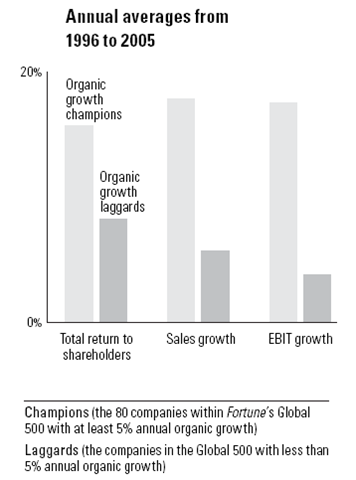
The global companies that are the most successful at achieving growth through innovation (as opposed to acquisitions) tend to devote their energies to a small number of breakthrough ideas. They select the initiatives with the greatest market potential and marshal their resources to develop them.

The organic-growth champions do more than focus on breakthrough ideas. They also put innovation at the top of the agenda, work across functional and divisional boundaries, and empower employees with an entrepreneurial mind-set.

Obviously, pursuing dozens of innovations is less expensive than developing thousands. But it also requires an intense focus on picking winners and commercializing them.

In a study of organic-growth champions— including GE, BMW, Nestlé, and Samsung— researchers at the Center for Organizational Excellence in Switzerland found that the firms’ shareholder returns were almost double those of the other Global 500 companies (which had lower rates of organic growth).

Procter & Gamble focuses its R&D on just eight to 10 core technologies, and Nestlé  … allocates large budgets to the 10 most promising innovations.

image

* * * * *

Repeat after me: time is money, time is money, time is …

November 19, 2009

TakeAway: When it comes to designing products and services, companies would do well to keep in mind the old saying “time is money.”

* * * * *

Excerpted from WSJ: Beat the Clock – How companies can use time to their competitive advantage, October 26, 2009

History suggests that by helping consumers save time or more fully enjoy the time they spend doing something, companies could gain a competitive advantage that could lead to higher sales and profits. Consider the success of innovations such as fast-food restaurants, automated-teller machines and countless labor-saving appliances.

Consumers are continually searching for new offerings that might allow them to do more in less time, and they are growing  less tolerant of organizations that waste their time—say, by keeping them on hold too long or providing poor service.


* * * * *

There are 3 ways that firms can turn time into a source of competitive advantage.

  1. They can help consumers do things faster by, for example, making a product easier to buy, use or throw away.
  2. They can make the time involved in using a product or service more pleasurable.
  3. Or they can design offerings that empower people to choose the mix of time and value that is right for them.

* * * * *

Managing Time as a Price Paid

… and get the price down.

  • Doing It for Them. One simple approach is to help people get more than one thing done at a time. The Roomba vacuum from iRobot Corp., for instance, seeks to get the time-cost associated with the use of a vacuum down to zero by working automatically once it has been turned on. Roomba’s promise is that it “cleans routinely so you don’t have to,” freeing up the customer to do something else.
  • Picking Up the Pace. In many cases, consumers just want to get things done faster. The fast-food industry made it possible to purchase a meal in just a few minutes when it pioneered the drive-through window. Other businesses took note: Today, drive-through services exist at banks, coffee shops, pharmacies, liquor stores, and even at certain wedding chapels in Las Vegas.
  • Shrinking the Commitment. The expression “I’d like to do x, but I just don’t have the time” is uttered with great frequency. A solution is to reduce the “size” of the time needed to complete a task. Examples include speed dating and “lunchtime face-lifts” that takes 30 minutes.
  • Ending the Wait. Getting people out of line also allows companies to reduce the price of time in their offerings. Whole Foods Market Inc. instituted a bank-style checkout system at grocery stores in Manhattan, where customers form two to three big lines and move to one of the more than 30 registers per store as they open up. While this process can make the lines that feed into the registers look frighteningly long, it actually gets large crowds through the store more quickly, the company says.

* * * * *

Managing Time as Product

In our survey of North American consumers,  70% agreed or strongly agreed that they would be “willing to spend more time doing product or service labor” if companies “could figure out how to make the experience more satisfying or engaging.”

The family dinner is an example of something that lends itself well to rethinking time-as-product. Studies have shown that many families wish they could eat more meals together, but they are overwhelmed by the amount of work it takes to get a home-cooked meal on the table.

* * * * *

Giving Customers the Choice

It can be difficult to determine whether a customer is interested in saving time or enjoying it more at any given moment. So some companies are putting the “time dial” in their customers’ hands, allowing them to switch dynamically from fast to slow, depending on their feeling of time pressure at a particular moment.

The evolution of self-service technologies illustrates some of the simplest examples of this approach. 

Online retailer Blue Nile Inc. employs the “choice” strategy when it comes to selling diamond-engagement rings. In many cases, the time cost involved in buying a diamond ring isn’t in favor of the buyer — often a young man making a once-in-a-lifetime purchase. Whether he shops at a diamond warehouse or a high-end retailer, he is likely to find the process of eyeing even a few product samples through a jeweler’s loupe time-consuming and unfulfilling, and to feel pressure to make a difficult and expensive decision in a hurry.

With Blue Nile, the proverbial shopper in his pajamas can spend as much or as little time as he wants researching the diamonds—by cut, size and many other criteria—online. From there, he can shop for particular settings or rings, pricing out the products with a variety of options. Once he has reviewed his choices, his purchase can be quickly executed. Throughout, the purchaser is in control of his time and the pressure is off to hurry a decision.

While critics originally said this business model was doomed to fail, because people wouldn’t go online to buy a product whose sentiment is supposed to “last forever,” the company says diamond engagement rings now account for 70% of its overall sales, and it estimates it has a 4.5% share of the U.S. engagement-ring market.

***
Consumer attitudes about time are a moving target, and companies must constantly reset their sights.

Tasks that were once seen as easy are now often viewed as burdensome, such as renting videos from a brick-and-mortar store when movies are available for purchase digitally at home.

Full article:
http://online.wsj.com/article/SB10001424052970204038304574145390833891688.html?mod=djemMM#printMode

Distinguishing between customers’ nice-to-haves and gotta-haves …

November 19, 2009

Excerpted from: HBR, What Do Customers Really Want?, by Almquist & Lee, April 2009

Most customer-preference rating tools used in product development today are blunt instruments, primarily because consumers have a hard time articulating their real desires.

Asked to rate a long list of product attributes on a scale of 1 (“completely unimportant”) to 10 (“extremely important”), customers are apt to say they want many or even most of them.

To crack that problem, companies need a way to help customers sharpen the distinction between “nice to have” and “gotta have.”

Some companies are beginning to pierce the fog using a research technique called “Maximum Difference Scaling.” which requires customers to make a sequence of explicit trade-offs.

  • Researchers begin by amassing a list of product or brand attributes—typically from 10 to 40— that represent potential benefits.
  • Then they present respondents with sets of four or so attributes at a time, asking them to select which attribute of each set they prefer most and
    least.
  • Subsequent rounds of mixed groupings enable the researchers to identify the standing of each attribute relative to all the others by the number of times customers select it as their most or least important consideration.

A popular restaurant chain recently used MaxDiff to understand why its expansion efforts were misfiring. In a series of focus groups and preference surveys, consumers agreed about what they wanted: more healthful meal options and updated decor.

But, using MaxDiff showed that prompt service of hot meals and a convenient location were far more important to customers than healthful items and modern furnishings, which ended up well down on the list.

The best path forward was to improve kitchen service and select restaurant sites based on where customers worked.

image 
* * * * *

“Adoption velocity” and abandonment: Here today, gone tomorrow …

November 17, 2009

TakeAway: Some research indicates that — counter-intuitively — products which catch on too quickly may end up being less successful overall.

* * * * *

Excerpted from Knowledge@Emory, The Long-term Downside of Overnight Success,  September 16, 2009  

Marketers may dream of coming up with a product that skyrockets in popularity as soon as it is introduced to the public.

Research, however, indicates that products which catch on too quickly may end up being less successful overall.

* * * * *

There are patterns in “cultural adoption and abandonment.” 

“We often see products, ideas and behaviors catch on and spread like wildfire. But we know less about why once-popular things become unpopular.”

“Most managers want their products to catch on faster, but our analysis suggests that this might not always be the best strategy. If something catches on too quickly, it might not only have a shorter lifespan, but may also end up being less successful overall. Faster adoption may hurt product success.”

Fads tend to be viewed negatively: “If people think that sharply increasing [popularity] will be short lived, they may avoid such items to avoid doing something that may later be seen as a flash in the pan.”

The research into the adoption and abandonment challenges some assumptions about the diffusion of a message and its saturation in the population, which is an important concept in marketing.

As a message spreads — or diffuses — through a population, it reaches more potential adopters. However, diffusion models typically assume a set target population size. But, a group may continually renew itself. Other factors, beyond diffusion and saturation, must be involved: “Adoption velocity is one such factor.”

Conventional wisdom would hold that if a message diffused through a population quickly, more potential adopters would be reached, improving the prospects for widespread adoption. “The effect of adoption velocity on the cumulative number adopters … shows that adoption velocity has a negative effect on the cumulative number of adopters.”

For example, in the music industry, new artists who bolt to the top of sales charts, often realize lower overall sales than those whose popularity grows more slowly. “This seemingly counterintuitive finding has important implications. One is that faster adoption is not only linked to faster abandonment, but may also hurt overall success.”

The research fits into the growing literature about “cultural dynamics.” By “more closely examining the psychological processes behind individual choice and cultural transmission, deeper insight can be gained into the relationship between individual (micro) behavior and collective (macro) outcomes such as cultural success.” 

Advertising might lead to fast adoption of a product, but the popularity of the product or service advertised might decline when that support dies off or switches to a substitute. “Importantly, though, results suggest that independently of its cause, a quick rise in popularity may have an accelerating effect on abandonment … as such, we anticipate that there will be an inherent tendency for items that have been adopted quickly to decline faster, even in cases where advertising persists.”

‘This is here today, gone tomorrow.'”

Full article:
http://knowledge.emory.edu/article.cfm?articleid=1266

* * * * *

When does a $1 burger make sense ?

November 17, 2009

Got this provocative email from one one of my son’s friends:

Mr. H – As patriarch of the “First Family” of the $1 menu, I wanted to bring your attention to this article. 

It appears that suspicions may have been correct –   The $1 McDouble cheeseburger is literally a LOSS LEADER. 

Who is right Burger King or their franchisees?  Why charge an unprofitable price?

Below is the article.  Far below is Ken’s Take.

* * * * *

Excerpted from AP: Food fight: Burger King franchisees sue chain, Nov.13, 2009

Restaurants, especially fast-food chains, have been slashing menu prices because of the poor economy. Executives hope the deeply discounted deals will bring in diners who are spending less when they eat out, or opting to stay home altogether.

But, Burger King franchisees sued the hamburger company this week over its $1 double cheeseburger promotion, saying they’re losing money on the deal and the company can’t set maximum menu prices.

A group that represents more than 80 percent of Burger King’s U.S. franchise owners, said the $1 promotion forces restaurant owners to sell the quarter-pound burger with at least a 10-cent loss.

The $1 double cheeseburger typically costs franchisees at least $1.10 — That includes about 55 cents for the cost of the meat, bun, cheese and toppings.

The remainder typically covers expenses such as rent, royalties and worker wages.

“New math, or old math, the math just doesn’t work.”

When the $1 double cheeseburger was announced this fall, an analyst said it could increase restaurant visits by as much as 20 percent, but that as much as half of the gain recorded from increased traffic could be lost because customers were spending less when they ordered food.

Copyright © 2009 The Associated Press. All rights reserved.
http://www.google.com/hostednews/ap/article/ALeqM5hLeKv3ns6qUW8InI9h7yHYvgzHZwD9BUB0181

* * * * *

Ken’s Take:

  1. So, the franchisees just want to cede the “value” position to Mickey D ?  Not a wise move.
  2. Why a loss leader ?  Because it draws traffic — and most customers complement the loss leader with another high margin product — e.g. soda, or fries.
  3. Technical note: the franchisee’s should be thinking about the $1 burger in terms of “incremental profitability” — incrementally, they’re still making 45 cents on each burger — the employees are still going to be there, the rent’s still going to be paid, and the lights are still going to being using electricity whether the burger is sold or not … only way the franchisee loses is through “dilution” — if a dude who would have paid 2 bucks for a burger anyway gets one for $1

Bottom line: Franchisees should fire their lawyers and flip some burgers.

Market segmentation is so yesterday … today, it’s self-selected “tribes”

November 13, 2009

TakeAway:  The power of the Web is undeniable.  It gives companies access to consumers in ways never thought possible.  Companies enjoy the luxury of leveraging online consumer groups for product development feedback, buzz generation, etc. 

Now, companies are flipping their segmentation strategies upside down and using consumer data gathered from the Web to build their segmentation strategies.  And, these companies are realizing cost and accuracy benefits.

* * * * *

Excerpted from Strategy & Business, “The Promise of “Self Segmentation”,” By Nick Wreden, October 5, 2009

… Today, a community-based approach to segmentation — which is both less expensive and more effective than the traditional methodologies based on customer relationship management (CRM) systems — is becoming possible …

Self-segmentation provides a foundation for leveraging customer experience and input … The rise in social networks and online communities, combined with the new era of the Web-empowered consumer … consumers are increasingly segmenting themselves into communities, based on common characteristics, passions, interests, or needs. Such “self-segmentation” is likely to be much more accurate and reflective of consumers’ attributes …

Companies can now bind themselves to consumer communities of interest or “tribes,” … such self-selected communities not only reflect consumers’ true interests but also involve their connection to others with the same passions. This opens the door to fostering brand ambassadors, enabling customer collaboration, and facilitating word-of-mouth cross-fertilization …

Since relevant communities represent self-selected groups who share one or more interests, marketers can substantially reduce the costs, time, and toil required to identify, and segment, qualified prospects … and the communities provide a better guide to potential purchasing behavior …

Interactions within communities represent an ideal listening post, enabling marketers to glean direct insights without the filter of market research …

Engaged participants can provide product development guidance and identify shortcomings in service or other areas to help a company improve its brand …

Companies can utilize three approaches to leverage self-segmented communities — engaging with social networks, tracking online communication behavior, and mass customization …

Segmentation is vital as mass marketing slips into irrelevancy, with information overload causing consumers to block out many corporate communications … But CRM-based market segmentation can be expensive, complex, one-dimensional, and static. It fails to accommodate the multidimensional nature of consumers … It leads to top-down initiatives that view potential customers as targets to be blitzed with campaigns, ambushed with messages, and subjected to guerrilla marketing.

In this new era of branding, companies must focus on ethnic, cultural, religious, sports, or other segments, not markets. This pivot could be achieved through CRM systems, but self-segmented communities of interest provide a more effective alternative. Such communities can provide fast, low-cost market research, generate ideas and feedback about new offerings, help improve corporate and customer-to-customer service, strengthen relationships, provide an early warning system about problems, and promote favorable word-of-mouth. It all starts with finding communities united by a passion or an interest, and talking with them, not at them.

Edit by TJS

* * * * *

Full Article
http://www.strategy-business.com/article/00004?pg=all

* * * * *

If it doesn’t walk like a duck and quack like a duck, what the heck is it?

November 12, 2009

TakeAway: When companies develop innovative products and services that don’t obviously fit into established categories, managers need to help people understand what comparison to make. Without that step, potential customers might just walk away wondering, “What is it?”

* * * * *
Excerpted from NY Times, It’s Brand New, but Make It Sound Familiar, October 4, 2009

GLANCE through a photo album of early automobiles and you’ll find an eclectic assortment of vehicles, including three-wheeled machines and bicycle-like contraptions. You’d be hard-pressed to identify many as cars.

Early consumers were confused, too, until innovators finally converged on a carriage-like design and coined the term “horseless carriage” in the 1890s, giving a clear point of comparison. More than 100 years later, we can learn from their example.

Humans instinctively sort and classify things. It’s how we make sense of a complex world.

So when companies develop innovative products and services that don’t obviously fit into established categories, managers need to help people understand what comparison to make. Without that step, potential customers might just walk away wondering, “What is it?”

* * * * * 

As a starting point, it helps to understand some basic traits of behavior. When people encounter something they don’t recognize, they make sense of it by associating it with something familiar.

“The category signals not only a set of features to expect, but at a more basic level, when and how you should use the novel item.”

Companies can benefit by using comparisons to create expectations that best match an innovation’s strengths.

Problems can arise if consumers can’t place innovations into familiar categories. Consider the introduction of the Segway, the high-tech motorized scooter, “Nobody was quite sure what it was … There was no clear analogy, so people had no idea how to use it.”

* * * * *

Finding the right label is only one of the many ways organizations can influence the way consumers categorize a product. They can also experiment with the product’s shape, packaging, pricing and retail store placement.

* * * * *

As innovative products are introduced, category boundaries are continually shifting and new categories emerging. In some ways, the auto industry is going through a transformation that harks back to the 1800s.

Today’s consumers are confronted with an impressive assortment of new vehicles, including electric models with three wheels and others with designs that just don’t look like what we expect a car to look like.

Will electric vehicles be broadly accepted? And which models will be most popular? The answers may well depend on the associations that automakers try to imprint on consumers.

Full article:
http://www.nytimes.com/2009/10/04/business/04proto.html?sq=segway&st=cse&scp=1&pagewanted=print

PRs more challenging since profit has become a 4-letter word …

November 11, 2009

TakeAway:  In an age where company reputation is playing an increasingly important role in sales generation and growth, the decline of traditional business media could cause big problems for marketers.  Companies must now take the laboring oar and find creative ways to ensure that their preferred message makes it to the consumer.

* * * * *

Excerpted from Strategy & Business, “What a Declining Business Media Means to CEOs” By William Holstein, September 28 2009

The business media is mired in deep economic crisis … the surviving business magazines are much thinner … Newspapers are suspending publication of stand-alone business sections and downgrading their coverage … Even at relatively healthy business news outlets, there is a decline in the quality of business coverage …

One might argue that the weakened state of business media doesn’t matter much … But the consequences for business decision makers are three-fold, and grave.

First, it means that business coverage could become more negative toward profit and enterprise than it is today … Criticism of corporations will be less nuanced, less aware of context, and less insightful. Competent, complacent, and craven companies — or divisions within companies — will all be tarred with the same brush.

Second, the decline in business journalism gives corporate decision makers less of a platform to display and test their own company’s strategy. “It means that there are fewer opportunities for a CEO to get his or her story into the media,” says CNN …

But perhaps the worst effect is the most subtle: Corporate leaders now have fewer opportunities to learn from one another’s experience, or even to know what’s going on in their regions and industries …

What specifically should a corporate leader do differently in this environment? The first priority is to maintain the visible public presence of his or her own company — to build its reputation as a reliable entity, in a time when the integrity of many companies has come under scrutiny …

Meanwhile, it’s more important than ever for CEOs to develop core communications messages that go beyond the issue of profitability and stock price. GE has been very effective with its Ecomagination campaign. Companies must define the way they appear in the world at large …

Edit by TJS

* * * * *

Full Article
http://www.strategy-business.com/article/00003?gko=83b3c

* * * * *

360-degree competition from private-label products

November 11, 2009

TakeAway: Whether it’s due to the economy or consumers’ general frustration with price inflation, private label products are booming.

Accordingly, more and more companies are offering private label products in an attempt to steal sales from their branded counterparts.

Now, this battle has moved from the stores to the Internet. Consumers’ appetite for value is spurring Amazon’s move into the private label business.

* * * * *

Excerpted from WSJ,”Amazon Is Selling Designs Of Its Own,” By Geoffrey Fowler, September 21, 2009

Amazon.com is quietly expanding its private-label business in a bid to diversify away from its online bookstore roots and become more like a general retailer.

After starting with private-label patio furniture in 2004, Amazon has since added its own housewares, including a steamer, frying pan and chopping block … the latest: a wooden chopping block …

Amazon doesn’t say what percentage of its $19 billion in annual sales are from its private-label business, but it already sells more than 1,000 products that are manufactured at its request … this underscores how far the company has moved beyond books, CDs and DVDs …

The company has developed private-label products when it felt customers’ needs weren’t being met by the rest of its catalog … developing private-label products has required new skills for the company, such as managing quality control and meeting product safety regulations. But online feedback from customers who leave product reviews helps the company make improvements…

The company won’t disclose profit margins for its private-label merchandise but it is clear that the effort wouldn’t be feasible if it weren’t for Amazon’s economies of scale …

Private labels are popular with many traditional retailers because they can provide higher profit margins by cutting out the middleman in the supply chain … online-only retailers have been slower to adopt private-label brands because they lack the expertise to design products, and lack a physical store presence to introduce a new brand …

The private-label strategy isn’t without its problems. In particular, Amazon’s own products may conflict with the products and merchants that the company already hosts on its site …

Edit by TJS

* * * * *

Full Article
http://online.wsj.com/article/SB125323090208821381.html?mod=djemMM

* * * * *

Time for a makeover: the future of brand managers

November 10, 2009

Takeaway: If you are pursuing a career as a brand manager, your role may be very different than you imagined.

A report that will soon be released by Forrester will provide a redefinition of what a brand manager should be. Their groundbreaking finding: marketers should get back to marketing. Beyond focusing solely on your product, you should really get into the mind of your consumers and appeal to their needs and desires.

And with the rise of digital media, targeting specific segments can be done with more precision than ever before.

The report also claims that decisions really need to be performance-oriented, with more reliance on research and analytics.

Hmmm, recommending a focus on people and performance? It looks like those extra P’s we learned about in Markstrat were well worth it.

* * * * *

Excerpted from AdAge, “Why It’s Time to Do Away With the Brand Manager” by Jack Neff, October 12, 2009

Managing a brand has always been a slightly odd concept, given that consumers are the real arbiters of brand meaning, and it’s become increasingly outmoded in today’s two-way world. That’s why a new report is going to recommend changing the name “brand manager” to “brand advocate,” and fundamentally changing marketer organizations in response to the onset of the digital age.

The report, due out next week from Forrester, finally puts the onus on marketers to change their structures — a welcome conclusion for media owners and agencies who keep hearing how they should change, but often complain that their clients have done little to shift their organizations to cope with an increasingly complex world of media fragmentation and rising retailer and consumer power.

Among the specific recommendations in its report, “Adaptive Brand Marketing: Rethinking Your Approach to Branding in the Digital Age,” Forrester suggests “brand advocates” be responsible for rapid adaptations of global brand platforms and programs, charging centralized global brand strategists with ensuring what local managers do conforms with the brand equity and strategy.

It also advocates recognizing the brand isn’t the only organizational structure that’s important for multibrand companies, but that structures aimed at marketing to demographic or other segment cohorts are equally important. And it also maintains that marketing executives should think less about anchoring annual plans around one or two big hits and more about doing many smaller things quickly and adapting based on real-time consumer feedback and other data.

He believes marketers in the digital age need to be more “numerate,” with more training in research and analytics even if they still rely on staff for help. Marketers today need to balance art and science, he believes, not unlike architects, musicians or cinematographers.

Key to any change, the former Tide brand manager said, is a return to marketing as the focus of brand management, “rather than one of six things a brand manager does.”

“So much of [brand managers’] time is subsumed by internal management, and so much of the creative process and planning is outsourced to agencies and other parties,” Forrester’s Ms. Bradner said. Brand advocates, she said, “really need to be in charge of the heart and soul of what the brand stands for. It does move you off the generalist track to be more of a pure marketer.”

Edit by JMZ

* * * * *

Full Article:
http://adage.com/cmostrategy/article?article_id=139593

* * * * *

Marketers’ new best friends …

November 9, 2009

TakeAway:  Are apps the next best thing to a Web site?  Some say yes! 

With consumers becoming more and more reliant on their cellphones as an information resource, apps are positioned to be a key tool to drive trial, loyalty, and cross-sales. 

* * * * *

Excerpted from NY Times, “What Do All These Phone Apps Do? Mostly Marketing,” By Roy Furchgott, October 4, 2009

Useful applications are seen as a gold mine for building brands.

Stanley Works, the hand tool maker, iPhone App turns the phone into a level …The company does not know if the iPhone app drove a single sale or fostered any brand loyalty. But based on the 400,000 downloads, Stanley declared the iPhone level a resounding success and is now looking for other tool apps … Other companies are experimenting as well …

Behind the land rush to apps is a belief that they may be some of the cleverest advertising devised. They are advertisements that people voluntarily choose to watch and share with friends. Some apps are even consulted in store aisles when customers decide what to buy. “Apps have a huge advantage,” said a mobile market analyst … “You had to take a step to get it; you are already half sold.”

When people open an app, they give it full attention, which helped drive MasterCard’s decision to follow its A.T.M. locator app with one that would show shoppers nearby stores that offer discounts to MasterCard users.

Apps also give the company a chance to sell cardholders on more services. “It allows consumers to engage with the brand every day,” said SVP for mobile digital marketing at MasterCard …

Novelty apps have had the most downloads, research shows, use of them fades quickly …

Current thinking is that utilities that people use repeatedly are the most effective …

Edit by TJS

* * * * *

Full Article
http://www.nytimes.com/2009/10/05/technology/05apps.html?ref=media

* * * * *

Q&D testing of "killer assumptions" … If you can’t GET the data, then CREATE it.

November 6, 2009

TakeAway: By becoming skilled at experimentation, innovators can gain a competitive edge.

STRATEGY & INNOVATION, Not-So-Risky Business, September 16, 2009

* * * **

By systematically attacking the most critical unknowns with tailored, low-cost experiments, innovators can systematically “de-risk” their strategies and thereby increase their chances of success while lowering the associated investment cost.

Systematically testing “killer assumptions” with quick experiments can create the data otherwise not available in market research reports but necessary to move forward to the next step, whether that step is doubling down, re-vectoring, or folding.

This type of approach is generally most critical when data doesn’t exist in market research or other reports, but rather exists in behavior that hasn’t yet happened or outcomes that can only be learned in market. In other words, if you can’t GET the data, then CREATE it through market experiments.

In other words, the goal is to run early experiments up front to gain critical pieces of information that can enable re-vectoring early and increase odds of success at a lower price tag.

“Test and learn” is the mantra. Invest a little and learn a lot is the approach.

And, the prizes over time come in the shape of lower investment costs, more innovation opportunities, and higher odds of success. Again, just remember “invest a little, learn a lot.”
* * * * *
The first step is detailing “killer assumptions” by assessing risk, confidence, testability:

  • How important is it for this assumption to be true?
  • How confident are we in this assumption?
  • How easy would it be to test this assumption?

Then, start experimenting …

* * * * *
The best experiments:

  • Isolate the variables being tested and keep it to one (or perhaps two) at a time
  • Keep the experimentation quick & dirty (Q&D) … not elaborate or expensive

Get out of the lab and office and into the “real world
* * * * *
Armed with information from experiments, make one of three immediate choices:

  1. Double down and continue to the next assumption,
  2. Re-vector and accordingly re-assess the killer assumptions involved,
  3. Determine that it is time to cut your losses and fold.

* * * * *

Full article
http://www.innosight.com/innovation_resources/article.html?id=842

* * * * *

Brainstorming strategic assumptions …

November 5, 2009

Question: What are the “killer assumptions” that underlie your strategy? 

STRATEGY & INNOVATION, Not-So-Risky Business, September 16, 2009

* * * * *

Start by asking:

Consumer:
Who is the end user?
What are they willing to pay?
Will they have to change their behavior?

Solution:
What constitutes “good enough”?
What are the technical challenges?
Are there logical external partners?
Do we have/need IP protection?

Profit System:
What price makes sense?
What do we expect in terms of trial/repeat purchase?
What capital investment is required?
What marketing support will be needed to launch?

Channel:
Who are the necessary channel partners?
Are they willing to push the solution?
What incentives are required?

Competition:
Who are they?
How do we expect them to respond?
How quickly?
What impact would it have?

Organization:
Do we have the capabilities required?
Are resource allocation processes conducive to success?
Will we gain buy-in from key internal constituents?

Upside:
How scalable is the solution?
What are the stepping stones to the broader opportunity?
How will we achieve longer-term competitive advantage?
 
* * * **
Full article:
http://www.innosight.com/innovation_resources/article.html?id=842

* * * * *

How do you say “Mmm, Mmm, Good” in Russian ?

November 5, 2009

TakeAway:  As the simple meals category grows, soup faces greater competition for a share of your plate.  Campbell’s is making important changes to its products to adapt to consumer needs and win your loyalty (when your budget is not your key decision factor).

* * * * *

Excerpted from BusinessWeek, “Campbell’s: Not About to Let the Soup Cool,” By Matthew Boyle, September 17, 2009

In tough times, comfort sells. And few brands evoke a warm and fuzzy feeling more than Campbell’s … The cost-conscious climate has been a boon for soup sales, which rose 5% in the U.S. in fiscal 2009 … That performance launched Campbell Soup into the ranks of the top 100 brands, where it joined food giants Kellogg, H.J. Heinz, and Nestlé.

But as the recession recedes, Campbell’s will need to prove that its name still resonates with American consumers, many of whom will venture back into restaurants once the economy improves. To stay on top, Campbell’s is launching new products, recasting old favorites, and aggressively pushing into emerging markets …

Consider Campbell’s Chunky line of soups. Last year the company neglected the brand, focusing instead on Select Harvest … Select Harvest became one of the top food launches of 2008. But Chunky suffered as a result … Now Campbell’s is revamping Chunky … the company wants to make the soup more nutritious without sacrificing its perceived heartiness …

China and Russia present a bigger opportunity and challenge for Campbell’s. The two countries account for more than half the world’s consumption of soup. But nearly all of it is homemade. If the company can capture just 3% of the at-home consumption … the size of the business would equal that of the U.S. …

To break into those markets, Campbell’s has been conducting extensive on-the-ground research over the past few years, interviewing thousands of consumers in Russia alone … Their findings led them to develop a broth-like product that Russians can use as a base for their own soups. Next year the company will sell 14 different soups in the country, up from three this year

Edit by TJS

* * * * *

Full Article
http://www.businessweek.com/magazine/content/09_39/b4148060517726.htm

* * * * *

Why is the White House mad at Edmunds … and not at me ? It’s just not fair !

November 2, 2009

Gotta admit, I’m a  bit hacked off.

This week, Team O turned its Chicago guns on Edmunds.com for reporting that “each vehicle sold with a CARS-program assist actually cost taxpayers more than $24,000”.

Source: The New Ledger, The White House Attacks Edmunds for Reaching Politically Uncomfortable Conclusion on Cash for Clunkers, Oct 30, 2009
http://newledger.com/2009/10/the-white-house-attacks-edmunds-for-reaching-politically-uncomfortable-conclusion-on-cash-for-clunkers/

Why am I hacked?  Because we  were all over this one in the Homa Files more than 2 months ago — on August 18.  (The post and the prove-it link are below.)

Shouldn’t somebody be mad at the HomaFiles, too ?

* * * * *

Original post: The Homa Files, C4C … here’s the “incremental analysis”, August 18, 2009
https://kenhoma.wordpress.com/2009/08/18/c4c-heres-the-incremental-analysis/

Most reports tout the Cash for Clunkers programs as a runaway success.

In fact, about 250,000 C4C deals were transacted in a week or two – fully utilizing the budgeted $1 billion – at an average rebate of about $4,000.

But …

Marketing promotions should always be evaluated on an incremental basis.  That is, how many sales were induced over and above what would have happened any way.

Car authority J.D. Power and Associates thinks that most of the cars purchased through the C4C program were simply sales that would have happened this year but were pulled ahead a few months. The company thinks that as few as 20% of the cars bought in the program are really new sales to the market. That means that as many as 80% of the cars would have been sold this year anyway. Edmunds.com, which tracks vehicles pricing and buying data, agrees. They say: “when the public thought that the program would cease after the first billion dollars was spent, they rushed to dealerships.By Aug. 20, we could be back to pre-clunker sales levels.”

So what ?

Well, from a marketing analysis perspective, the full cost of a program should be assigned to the incremental sales.  So, the $1 trillion should be allocated across 50,000 incremental car sales (20% times 250,000).  That’s about $20,000 per incremental sale.

Recast, phase 1 of C4C took 250,000 clunkers off the road by, in effect, giving away 50,000 new, more fuel efficient cars.

Worth it?

You decide.

* * * * *

McKinsey’s “enduring” strategy frameworks … Check this out !

November 2, 2009

McKinsey consultants are in the process of constructing an interactive site with tutorials on core strategic analysis frameworks.

Below is a snapshot of the current “map” of frameworks .. those in green are active; those in blue or black are under development.

To access the site, go to http://tinyurl.com/n75fea

A great resource for current students and alums …


image

 http://tinyurl.com/n75fea

Marketing that goes down the toilet … literally.

October 30, 2009

TakeAway:  Very little is off limits anymore when it comes to marketing. 

Making all marketers proud, the “adults wipes segment”  is getting more graphic and more descriptive.  YIPES.

I’m a proponent of good benefits advertisng, but this one makes me very, very queasy.

* * * * *

Excerpted from NYTimes, “Adult Toilet Training, From Madison Ave.,” By Andrew Adam Newman, October 20, 2009

Toilet tissue advertising traditionally has featured fluffy clouds, cherubic toddlers and Mr. Whipple … But the ads remained steadfastly oblique about what consumers do after they tear along the perforated line.

With the prevalence these days of commercials for erectile dysfunction drugs and risqué network programming, however, tissue brands also are growing more frank … 

Cottonelle just launched a new commercial and a new Web site, CottonelleInstitute.com, to highlight not just the brand’s Aloe & E toilet paper but also its new flushable moist wipes … With both products, the brand is breaking with tradition, trumpeting not softness but rather that it is “dermatologically tested” for sensitive skin.

“Dry toilet paper is generally thought of as being a functional product, and a lot of brands in the category talk about strength and softness,” said a brand manager for Cottonelle wipes. “But we are reframing the Cottonelle brand as a personal care brand, which is a much more emotional space.”

… and the brand is pitching both rolls and wipes in one advertisement, in the hope of increasing the use of wipes, which are purchased by only 25 percent of households, many of which use them only on what she called “select usage occasions” … 

Getting adults to use more wipes in the bathroom … requires marketers to engage in a sort of toilet training with grown-ups, and Cottonelle and other brands apparently think cultural taboos have relaxed enough to do exactly that …

The wipes segment has been fast growing with only modest marketing support … and marketers say the growth of wipes does not cannibalize sales of toilet paper, because consumers tend to use them not as a replacement but an added step …

Charmin also is pitching its wipes … as complementary to rolls, and has launched a new campaign … that includes a video “product demo” …

“It’s a pretty straightforward way of speaking to consumers and letting them know how best to use the products together to get cleaner,” said a Charmin brand manager. “To my knowledge it is the most clearly that we have laid it out so far.”

Edit by TJS

* * * * *

Full Article
http://www.nytimes.com/2009/10/20/business/media/20adco.html?ref=media

* * * * *

Attention K-Mart shoppers … oops, I mean Walmart.

October 29, 2009

TakeAway: Maintaining profitable prices while growing market share requires a delicate balance that many companies struggle to find.

Not HP – through a series of cost savings and operational efficiency initiatives, HP is capturing market share while achieving superior profit margins.

Taking notes, Mr. Dell ?.

* * * * *

Excerpted from WSJ, “H-P Wields Its Clout to Undercut PC Rivals,” By Justin Scheck, September 25, 2009

Hewlett-Packard is using the dismal technology market to bolster its position as the world’s largest personal-computer maker.

For example: a $298 laptop to be sold at Wal-Mart

Since the economy slumped last fall, H-P has gained market share by lowering prices of its consumer PCs to undercut rivals … And while the profit margin in H-P’s PC business has fallen, it hasn’t suffered as much as rivals.

H-P has used its enormous sales volume to demand cheaper prices from suppliers and contract manufacturers. It’s also taken advantage of an improved supply chain to quickly design and deliver new, less expensive PCs …

The price cutting has pushed H-P’s PC division operating-profit margins to 4.6% in late July from 5.7% a year ago. But it’s still better than Dell’s estimated 4.3% margin  …

Dell is ceding market share rather than drastically lowering prices to match H-P. “If we don’t think there is going to be profitable growth, there are some situations where we won’t take part,” said a Dell spokesman. H-P’s market share jumped to nearly 20% of global PC shipments in the second quarter, up from 18.5% a year earlier, according to IDC. In the same period, Dell’s share fell by about two percentage points to 13.7% …

Edit by TJS

* * * * *

Full Article
http://online.wsj.com/article/SB125374794515235743.html

* * * * *

Ring, ring, ring … want a couple of bucks off?

October 28, 2009

TakeAway:  Mobile coupons delivered directly  to  smartphones are catching on, spurring impulse purchases. 

* * * * *

Excerpted from CNBC, “Coupons Via Cellphone: Whipping Up the Impulse Buy,” By Christina Cheddar Bank, October 15, 2009

To date, the concept of receiving coupons on your cell phone has been more theory than practice. This is despite a resurgence in coupon use and an increasing dependence on cell phones.

But with the focus on mobile coupons as a marketing tool on the rise, is the industry heading to an inflection point? A new Harris interactive survey … of more than 2,000 adults … found that 42 percent of those who were between 18 and 34 years old, and 33 percent of those 35 to 44 years old are at least somewhat interested in receiving opt-in alerts on their cell phones for specials at their favorite establishments …

This type of technology is even more impressive when one considers how many purchases consumers make on the fly … 9-in-10 Americans have made an impulse purchase when they were out shopping in a store based on a sale or a special that was going on around where they were … Among adults who own a cell phone, nearly a quarter — some 22 percent — make this type of purchase at least once per week or more often …

1020 Placecast  has designed a system to use digital marketing and mobile devices in an attempt to drive consumers to specific locations.  Using their systems, a restaurant or retailer can send an alert to a customer’s phone whenever the person is nearing its location

Coupons.com … developed applications for the Apple’s iPhone and other devices to help consumers sort through coupons and pair them with their grocery lists … also trying out a system that allows shoppers to browse through coupon offerings on its Web site, then load the offers on to a key tag. Once at the store, shoppers can wave their key tags over the scanner during checkout in order to get the credit.

Both companies caution this is still early days for these technologies.

However, with the number of smartphone users on the rise … penetration is about 15 percent in the U.S. today (about 40 million phones) … most forecasts call for that number to at least double by the end of 2011 … coupled with the yet untapped interest, there may be significant opportunities for a technology that is simple enough for consumers to understand and appreciate …

Still, at this time, the reality is there is still more buzz about mobile coupons than people actually using these offers. But as retailers look to hone in on how they can improve relationships with their customers it seems the demand for this type of service is there.

Edit by TJS

* * * * *

Full Article
http://www.cnbc.com/id/33244923

* * * * *

Customer product reviews: the good, the bad, and the ugly

October 24, 2009

TakeAway: Brands are opening up more dialogues between company and consumer.

Social networking sites, blogs, and online forums have all given consumers an outlet to review anything and everything.

Companies are learning that it is best if these conversations take place on sites where they can use positive and negative feedback to improve their product offerings. Consumers are also seem to appreciate openness and honesty from companies, and hearing both the good and bad helps build that trust.

So maybe bad news isn’t all that bad, as long as there’s some good to balance it out.

* * * * *

Excerpted from MarketingWeek, “Even negative views improve brand image” by Joe Fernandez, September 10, 2009

Brands that open up an honest dialogue with consumers by using online channels to encourage positive and negative feedback are best placed to build trust and ultimately improve sales figures.

Procter & Gamble announced last month that it would start using consumer reviews on its brand sites for the first time. The FMCG company now lets people post their views on its Head & Shoulders and Ariel websites about how the products perform.

Customer endorsements are important tools for any marketer. They can help brands distinguish themselves from competitors, boosting sales and keeping the tills ringing.

Customers, in turn, use other people’s advice and reassurance to help them make purchase decisions. In the past decade, the emergence of online feedback on etail sites, blogs and forums has provided consumers with more resources than ever to base their decision-making on.

The days of spontaneity and blind purchases are long gone. Retailers and etailers are seeing the benefits of talking to customers, and being open has both positives and negatives as part of the overall brand experience.

Producing a dialogue with customers rather than the usual corporate diatribe means that the customer feels valued. Customer loyalty starts with a problem and a voice in the wilderness. If you listen and respond positively, you not only save the sale, you win the customer for life and many of their friends forever too.

Edit by JMZ

* * * * *

Full Article:
http://www.marketingweek.co.uk/even-negative-views-improve-brand-image/3004270.article

* * * * *

Book wars … Walmart tells Amazon "Take that !"

October 23, 2009

TakeAway:  Wal-Mart just took price-leadership to a new level; consumers are enjoying discounts up to 74% on best-selling books.  Many criticize this price war for its negative impact on the book supply chain and publisher pricing power.  At the same time, some see this price war as an opportunity to attract a whole new batch of readers.

* * * * *

Excerpted from WSJ, “Book Price War Escalates,” By Jeffrey Trachtenberg and Brian Blackstone, October 17, 2009

Book publishers are worried they and retail chains could be caught in the cross fire as Amazon.com and Wal-Mart ratchet up their price war over online book sales.

Wal-Mart triggered the online skirmish Thursday when it began selling its 10 most anticipated hardcovers for $10 apiece when pre-ordered on its Web site. Amazon matched the offer hours later and Wal-Mart then chopped its price to $9. Friday morning Amazon had matched the price … Late Friday afternoon, Wal-Mart dropped its price a penny, to $8.99.

The discount applies to popular books such as Mr. King’s “Under the Dome” … which carries a $35 price tag but is available on Amazon and Walmart.com for $9, a discount of 74%.

Walmart.com CEO said that the retailer “will go as low as we need to” to underscore Walmart.com’s intent to be a low-price leader online … Publishers are receiving its customary wholesale price from Wal-Mart and Amazon … “Publishers aren’t subsidizing this in any way,” … 

The nation’s two largest bookstore chains, Barnes & Noble and Borders, each operate their own online retail sites. Neither is matching the prices now being offered by Walmart.com or Amazon …

Publishers said they feared the online pricing could hurt small independent book sellers and big retail chains …

Chief executive of Perseus Books Group … said the price wars will help sales in the short run but create problems if they continue. “When your product is treated as a loss leader, it lowers its perceived value,” he said. “If you are taking margin out of the supply chain, it will eventually put pressure on everyone in that chain.” …

If the industry’s top books continue to be sold for $9 online … it will be increasingly difficult for publishers to launch what he described as “the writers of tomorrow,” because the book market may have narrowed significantly …

Some executives said privately they doubted that the two retailers could afford to maintain the price strategy in the long term, unless they could offset losses on the discounted books with more traffic in other parts of their stores …

But some fear a long-term price degradation. The price war is “eroding the economy of the book,” … what will happen if big retailers try to force publishers to slash their own prices.

Despite the worrying news out of the U.S., the mood isn’t all gloom and doom. The price cuts may lead to a flood of new readers on the market, some executives said. In addition, digital books offer opportunities to include new video and audio content in books.

Edit by TJS

* * * * *

Full Article
http://online.wsj.com/article/SB10001424052748704322004574477050954174722.html?mod=WSJ_hps_LEFTWhatsNews

* * * * *

Staple brands are stealing the show

October 23, 2009

TakeAway:  The “back-to-the-basics” consumer has given new life to many staple brands, e.g. Campbell’s, Kraft.

But, these brands are quickly finding that consumer purchases should not be taken for granted. 

The competition among staple brands has grown very intense, as consumers now more freely substitute products across categories for their “perfect” purchase.  So, product relevance is more important than ever.

* * * * *

Excerpted from NY Times, “More Ads for Basic Brands as Shoppers Spend Less,” By Stuart Elliott, October 7, 2009

Readers of this week’s People magazine could be excused for believing they were leafing through a Look magazine from 1959. Of the 44 full-page ads in the issue, half are for brands like Campbell’s, Jell-O, Kraft cheese, Lipton tea and Post cereal.

Familiar packaged foods that were once dismissed as dowdy or out of date are regaining their puissance as Americans spend less and eat at home more. While marketers in fields like automobiles, financial services and luxury goods are slashing ad budgets … advertising is being maintained, and in some cases increased, for prosaic mealtime products …

The campaigns are another sign that marketers, in this case food companies, are still scrambling to keep up with the profound changes in consumer behavior caused by the recession …

In many instances, suddenly budget-conscious consumers are switching from more expensive foods and “are discovering the difference they’ve been paying for is not worth it,” said the editor of a daily food industry newsletter …

The growing power of middle-brow meal items was apparent in a decision on Monday by Condé Nast to close the more upscale of its two food magazines, Gourmet, and keep publishing the more mainstream Bon Appétit. “Gourmet was a tough sell to packaged goods advertisers” … 

Venerable foodstuffs are not only looming larger in the media in which they typically appear, they are turning up in unexpected places. The episode of “Saturday Night Live” … featured commercials for a Kellogg’s cereal and Tabasco hot sauce …

And, new products are being introduced under mainstay names like French’s, Hormel, Quaker, Ritz and Wheaties …

Marketers of longtime kitchen favorites agree that as nice as it is to capitalize on nostalgic feelings, they must also meet contemporary needs.

“A lot of times, people are talking about a return to the ’50s,” said EVP and CMO at the Pinnacle Foods Group … “But it’s important we’re going forward in this new environment in a way that’s relevant to today,” she added, “instead of just playing on our history.” …

For many of these brands, said Patty Bloomfield, VP at Northlich, “the good news is people have a very strong feeling” about their quality and remember growing up with them …

As for the future, experts say they believe the back-to-basics shift in consumer sentiment could become permanent even after the economy improves …

Edit by TJS

* * * * *

Full Article
http://www.nytimes.com/2009/10/07/business/media/07adco.html?ref=business

* * * * *

Boys will be boys … and that can be very profitable

October 16, 2009

TakeAway: Can anybody keep the attention of young males today? Maybe not, but that won’t stop us from trying.

Disney’s acquisition of Marvel is just the latest case of a company going after this fickle and easily-distracted segment.

You can’t blame Disney, however, as this segment has the potential to contribute greatly to overall profitability.

That is, as long as they finish their chores.

* * * * *

Excerpted from BusinessWeek, “Disney’s Marvel Deal and the Pursuit of Boys” By Tom Lowry and Ronald Grover, September 10, 2009

The U.S. has 30 million males aged 5 to 19, and capturing their attention with a TV show, movie, or magazine article is a boon to advertisers. Boys (or their parental proxies) are ravenous consumers who spend billions each year on apparel, toys, and video games.

Big Media, faced with the loss of auto and financial advertising, is charging hard at this elusive demographic.

Exhibit A: Walt Disney’s $4 billion acquisition of Marvel Entertainment and all its superheroes.

Besides attracting more boys and balancing out Disney’s big following among girls, the Mouse House believes the Marvel acquisition will bolster Disney XD, a channel it is now using to target boys.

Edit by JMZ

* * * * *

Full Article
http://www.businessweek.com/magazine/content/09_38/b4147066139865.htm?chan=innovation_branding_top+stories

* * * * *

Starbucks plays the value card … say, what ?

October 15, 2009

TakeAway:  For a company that has increased the price of its latte exponentially each time the price of milk rose by a penny, it is very intriguing to see Starbucks aggressively offering a coffee value play.  Will a high volume, low margin gain from an extension of its market footprint be able to turn this company around … we’ll see.

* * * * *

Excerpted from WSJ, “Starbucks Takes New Road With Instant Coffee,” By Julie Jargon, September 30, 2009

Starbucks aims to convince Americans and Canadians that its new Via instant coffee is comparable to its brewed product

Via is part of a strategy to provide value for customers who can’t or don’t want to splurge on a regular coffee purchase. One packet of the instant variety produces a cup of coffee for less than $1. Via costs $2.95 for a three-pack and $9.95 for a 12-pack …

Portability will be an important selling point. As such, Via will be available in stores such as REI and Office Depot … Via will be available for purchase on domestic United Airlines flights longer than two hours …

Starbucks doesn’t plan to enter traditional grocery stores until sometime next year … In traditional supermarkets, Starbucks will go up against Nestlé, maker of Nescafe Taster’s Choice, which already is running ads attacking Via.

Starbucks is launching its own ad campaign on television — a rare move for a company that has traditionally stuck to print ads and social-networking sites for its marketing.  The initial commercials will promote a “taste challenge” that will take place at Starbucks stores … “We’re convinced a majority of people won’t be able to tell the difference” …

The idea for developing an instant coffee has been brewing at Starbucks for 20 years … The company, which has struggled amid the recession as customers have either forgone Starbucks visits or purchased less expensive coffee drinks, expects its entry into the $21 billion global instant-coffee market to be a huge opportunity to boost sales …

Edit by TJS

* * * * *

Full Article
http://online.wsj.com/article/SB125418430092348015.html?mod=djemMM

* * * * *

Are you "authentic" … or just a "poser"?

October 14, 2009

TakeAway: “When we say a thing or an event is real, we honor it. But when a thing is made up – regardless of how true it seems – we turn up our noses.”

* * * * *

Excerpted from HBSP : Authenticity – What Consumers Really Want by James H. Gilmore and B. Joseph Pine II

Human beings have always been obsessed with the real and abjured the fake, the phony and the contrived.

In the mid-20th century, Jean-Paul Sartre extended this idea to personality, describing people so confused about their real selves that they lived “inauthentic” lives in self-deceived “bad faith.”

Consumers crave authenticity. If you don’t render authenticity, they will find someone who will, since this need for authenticity is intricately tied to self-image. No one wants to associate with a  “poser.”

* * * * *

Authenticity evolves from experiences and transformations.

Experiences are memorable “inherently personal” events, like when the barista at Starbucks remembers how you like your cappuccino and makes it to order for you.

Transformations help customers change some aspect of themselves. Such offerings – for example, fitness centers or Weight Watchers – let consumers be the sort of people they want to be and feel good about themselves. With each purchase, customers close the gap between reality and aspiration.

* * * * *

The are five “genres” of authenticity:

1. Natural authenticity – An authentic offering must feel natural, raw, of-the-earth, rustic, stripped-down and if possible sustainable, like organic food. For example, coffee beans and natural soaps are commodities, yet Starbucks and the Rocky Mountain Soap Company both render naturally authentic offerings.

2. Original authenticity – An original offering can be new (such as Apple’s iPod), but it can also be old (Coca-Cola) if it stresses its heritage as the first of its kind (“the real thing”).

3. Exceptional authenticity – Any offering can be exceptional, if it is done well, and with feeling. For example, consider the extraordinary services provided by Ritz-Carlton and Southwest Airlines. This doesn’t mean obsequiousness: The salespeople at Apartment Number 9, a Chicago clothing store, will tell you if the puce blazer you’re trying on makes you look fat. They sell not just clothes but also brutal honesty. Make your offering exceptional by stressing uniqueness, adopting a “craft” aesthetic (“good things take time to make”) or being “foreign” relative to the target market.

4. Referential authenticity – A referential offering evokes an “iconic” time, person, group or place. Imagine a Chinese tea ceremony or a visit to a sauna in Finland. If your referential offering is fake, make sure it is a good fake, like the art-filled Bellagio Hotel in Las Vegas, which evokes Bellagio, Italy.

5. Influential authenticity – To have influence, an offering must surpass utility to imply or provoke change. Think of green services, such as “eco-tourism,” or “three-word offerings,” such as “dolphin-safe tuna” or “free-range chickens.”

* * * * *

In Hamlet, Laertes is leaving Elsinore for France when Polonius accosts him. The old man, worried how his son will conduct himself abroad, recites a litany of admonishments that culminates in wisdom both trite and strikingly wise: “This above all,” says Polonius, “to thine own self be true.” In doing that, he continues, “Thou canst not then be false to any man.”

* * * * *

How to seduce women … advice from Pepsi. Huh?

October 14, 2009

Takeaway: PepsiCo’s Amp Energy drink has come out with an iPhone application that gives men tips on how to seduce women.  Huh ?

It’s no surprise that PepsiCos’ brands are moving into the digital space, as most brands nowadays have some sort of Facebook page or iPhone app. But by doing something so gratuitously over-the-top, could Amp’s message harm the image of PepsiCo’s other products? Probably not, since many of their brands have an “edgy, young and fun” positioning.

However, with the information available to consumers, it’s only a matter of time before someone realizes Amp is brought to them by the same company that sells Life cereal. And while Mikey may like the app, we’re not so sure mom will.

* * * * *

Excerpted from BrandWeek, “Pepsi Brand App Comes With NC-17 Rating” by Brian Morrissey, October 9, 2009

PepsiCo’s Amp Energy drink is looking to connect with young men by providing what might be the ultimate utility for the target audience: ways to score with women.

The “Amp Up Before You Score” iPhone application gives dudes various pickup lines and background info through digital flip cards for 24 different types of women, ranging from “rebound girl” to “treehugger” to the now ubiquitous “cougar.”

The app description page on iTunes warns of (promises?) profanity, crude humor and suggestive themes. Amp Energy targets men 18-24.

The Amp app suggests nearby motels, displayed on a Google Map, for rendezvous with married women. For “indie girls,” the app pulls in content from Under the Radar magazine and plots out nearby thrift stores.

Edit by JMZ

* * * * *

Full Article:
http://www.brandweek.com/bw/content_display/news-and-features/digital/e3id3d058ba458918f0aee67a2b41453db2?imw=Y

* * * * *

Follow-up article from WSJ:
http://online.wsj.com/article/SB10001424052748703790404574471522737925470.html?mod=WSJ_hps_MIDDLEForthNews

* * * * *