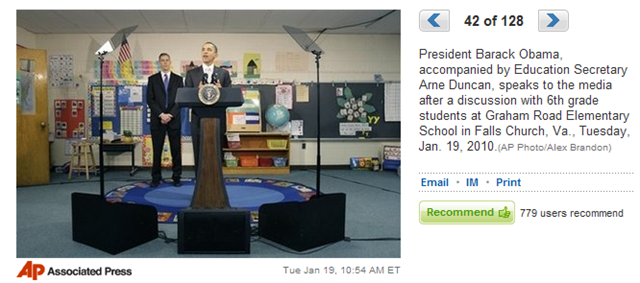
Is Congress dysfunctional … or working the way it’s supposed to?

February 19, 2010

An interesting take that cuts to the chase …

* * * * *

Excerpted from: The Economist:What’s gone wrong in Washington?, Feb 18, 2010

Washington seems incapable of fixing America’s deeper problems.  Certainly the system looks dysfunctional.

This, argue the critics, is what happens when

  • A mere 41 senators (in a 100-strong chamber) can filibuster a bill to death; when states like Wyoming (population: 500,000) have the same clout in the Senate as California (37m), so that senators representing less than 11% of the population can block bills.
  • Thanks to gerrymandering, many congressional seats are immune from competitive elections.
  • A tide of lobbying cash corrupts everything.

A criticism with more weight is that American government is good at solving acute problems (like averting a Depression) but less good at confronting chronic ones (like the burden of entitlements).

America’s political structure was designed to make legislation at the federal level difficult, not easy.

The founders believed that a country the size of America is best governed locally, not nationally.

The basic system works; but that is no excuse for ignoring areas where it could be reformed.

In the House the main outrage is gerrymandering. Tortuously shaped “safe” Republican and Democratic seats mean that the real battles are fought among party activists for their party’s nomination. This leads candidates to pander to extremes, and lessens the chances of bipartisan co-operation.

In the Senate the filibuster is used too often, in part because it is too easy. Senators who want to talk out a bill ought to be obliged to do just that, not rely on a simple procedural vote: voters could then see exactly who was obstructing what.

These defects and others should be corrected. But even if they are not, they do not add up to a system that is as broken as people now claim.

Full article
http://www.economist.com/opinion/displayStory.cfm?story_id=15545983&source=hptextfeature

Bayh goes bye … so do the oil companies

February 18, 2010

Bottom line: Three big companies quit an influential lobbying group that had focused on shaping climate-change legislation, in the latest sign that support for an ambitious bill is melting away.

Besides the obvious — that climate change fever has subsided — companies are starting to stand up to the President.  Many companies had been bending over to the anti-business policies and rhetoric, hoping to at least minimize their hurt with sweetheart dealing and avert the wrath of the White House’s’  vindictive Chicago thugs. The worm seems to be turning.

* * * * *

Excerpted from WSJ: Defections Shake Up Climate Coalition, Feb.   17, 2010

Oil giants BP and ConocoPhillips and heavy-equipment maker Caterpillar said Tuesday they won’t renew their membership in the three-year-old U.S. Climate Action Partnership, a broad business-environmental coalition that had been instrumental in building support in Washington for capping emissions of greenhouse gases.

For companies, the shifting political winds have reduced pressure to find common ground, leading them to pursue their own, sometimes conflicting interests.

More than 20 other large companies, including oil company Royal Dutch Shell PLC and industrial heavyweights General Electric Co. and Honeywell International Inc., remain in the coalition with environmental groups such as the Environmental Defense Fund and Natural Resources Defense Council.

But experts said the companies’ decision to withdraw from USCAP is a sign the politics of climate change is shifting in Washington.

When USCAP was founded in 2007, leaders of big U.S. companies had grown concerned that Democrats in Congress were preparing to put strict limits on industrial emissions of heat-trapping gases linked to climate change. Many executives decided it was better to be part of the debate in a united front.

“The saying in Washington is that if you’re not at the table, you’re on the menu.” 

As long as climate legislation appeared imminent, companies were willing to paper over their differences and continue to work together. But by late last year, momentum had stalled in the Senate as Washington turned its attention to health care, the economy and the midterm elections.

Full article:
http://online.wsj.com/article/SB10001424052748704804204575069440096420212.html

Hey, where’s my favorite deodorant ?

February 18, 2010

Bottom line: As retailers adjust to tight-fisted shoppers, many stores are shrinking the number of name-brand products on their shelves.

Don’t be shocked if you can’t find your favorite salad dressing or mouthwash on your next trip to Wal-Mart.

* * * * *

CNNMoney.com, Dumped! Brand names fight to stay in stores, Feb. 16, 2010 

Large retailers — including Wal-Mart, the world’s biggest — are wrestling with having too many types of brand-name products.

At the same time, shoppers are buying less and looking for bargains.

So unless a particular brand is a top seller in its category, it’s getting knocked off the shelf — and sometimes getting replaced by a cheaper store brand.

For example, Wal-Mart recently removed Glad and Hefty-branded storage bags from shelves, replacing them with its own lower-priced Great Value brand.

Those categories at greatest risk of losing brands are everyday-type purchases such as household products, toiletries and food staples.

These are also categories in which retailers have aggressively pushed their own house brands.

Moves such as this are significant given Wal-Mart’s heavyweight status in the retail industry.

“Any change that Wal-Mart makes with its product assortment has enormous implications for the entire industry.”

Wal-Mart is not the only one doing this,  leading drug store chains, including CVS and Walgreens, grocers such as Kroger, and Wal-Mart’s rival discounter, Target, are also looking to simplify their store shelves.

In good economic times, product variety is a must for retailers. But in down times, when shoppers aren’t buying much, variety can be a burden.

“I think the feeling is that as these companies keep extending their [product] lines, it’s only causing confusion for shoppers and not really driving them to buy more products.”

“If you walk into a Wal-Mart or another large retail chain, there are so many products on shelves that it does make it harder to shop.”

Besides cutting clutter, industry experts say Wal-Mart and other retailers are looking for more lucrative deals from suppliers on both prices and advertising.

“Perhaps one consideration in which product to cut is based on which company gives [Wal-Mart] the best deal.”

“In this recession, consumers have certainly become less discriminating with what they buy. Consumers have rushed to value prices, and they are buying generic brands.”

Retailers’ own brands have grown their market share by between 2% to 6% … and 77% of consumers who traded down to less expensive private label products are happy with their decision.

Full article:
http://money.cnn.com/2010/02/15/news/companies/walmart_dropping_brands/index.htm

Toxic Debt: The Student Loan Spiral

February 17, 2010

TakeAway: As tuitions rise, many students are borrowing heavily to pay their bills. Some no doubt view it as “good debt,” because an education can lead to a higher salary. But in practice, student loans are one of the most toxic debts, requiring extreme consumer caution responsibility.

* * * * *

Excerpted from WSJ: As Default Rates on Borrowing for Higher Education Rise, Some Borrowers See No Way Out, Feb. 13, 2010

There is an estimated $730 billion in outstanding federal and private student-loan debt — and only 40% of that debt is actively being repaid. The rest is in default, or in deferment, which means that payments and interest are halted, or in “forbearance,” which means payments are halted while interest accrues.

When Michelle Bisutti, a 41-year-old family practitioner in Columbus, Ohio, finished medical school in 2003, her student-loan debt amounted to roughly $250,000. Since then, it has ballooned to $555,000.

It is the result of her deferring loan payments while she completed her residency, default charges and relentlessly compounding interest rates. Among the charges: a single $53,870 fee for when her loan was turned over to a collection agency. Now, the entire balance of her federal loans will be paid off in 351 months. Dr. Bisutti will be 70 years old.

Dr. Bisutti says she loves her work, but regrets taking out so many student loans. She admits that she made mistakes in missing payments, deferring her loans and not being completely thorough with some of the paperwork, but was surprised at how quickly the debt spiraled.

As tuitions rise, many people are borrowing heavily to pay their bills. Some no doubt view it as “good debt,” because an education can lead to a higher salary. But in practice, student loans are one of the most toxic debts, requiring extreme consumer caution responsibility.

Unlike other kinds of debt, student loans can be particularly hard to wriggle out of. Homeowners who can’t make their mortgage payments can hand over the keys to their house to their lender. Credit-card and even gambling debts can be discharged in bankruptcy. But ditching a student loan is virtually impossible, especially once a collection agency gets involved.

* * * * *

Lenders say student-loan terms are clear and that they try to work with borrowers who get in trouble.

Loan terms, including interest rates, are disclosed “multiple times and in multiple ways,” says Martha Holler, a spokeswoman for Sallie Mae, who says the company can’t comment on individual accounts. Repayment tools and account information are accessible on Sallie Mae’s Web site as well, she says.

Full article:
http://online.wsj.com/article/SB10001424052748703389004575033063806327030.html?mod=WSJ_hps_MIDDLESixthNews

The elephant(s) in the middle of the room …

February 17, 2010

CNN just released a poll that that their commentators said “shocked them”. 

Bottom line: A majority of “all Americans” say that Pres. Obama does not deserve to be reelected.

Keep reading for some related diagnostics …

image
http://i2.cdn.turner.com/cnn/2010/images/02/16/rel4a.pdf

* * * * *

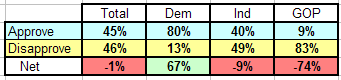
A reputed Quinnipiac University poll released last week concludes that American voters remain deeply divided about President Barack Obama’s job performance with 45% approving of the job he’s doing and 46% disapproving.

Their conclusion seems pretty benign, doesn’t it ? A 50/ 50 country.

Digging deeper into the ‘internals’ reveals some deeper divides …

* * * * *

Obama’s net approval among Dems is plus 67 percentage points; it’s minus 74 percentage points among GOPers.

image

* * * * *

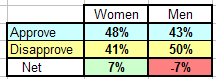
The President is plus 7 among women, and minus 7 among men … a 14 point swing.

image

* * * * *

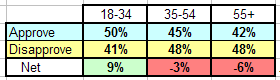
No surprise, younger Americans rate Obama by a plus 9; older folks are a minus 6 … a 15 point swing.

image

* * * * *

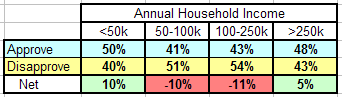
Rich and poor Americans approve of the job the President is doing by 5% and 10% respectively, but middle income Americans are net disapprovers by double digits.

image

* * * * *

A largely ignored divide is more than a bit disturbing .  Draw your own conclusions.

image

* * * * *
Full article:
http://www.quinnipiac.edu/x1295.xml?ReleaseID=1423

Don’t call me ‘professor’ … or I’ll have to smack you.

February 16, 2010

Sarah Palin: ” … we need a commander in chief, not a professor of law”

Harvard professor, Charles J. Ogletree: ” … a thinly veiled attack on Obama’s race”

The teacher formerly known as Professor Ken Homa: “Say what?”

Apparently, there’s a long history of the salutation “Professor” being a slur … so, students have been dissing me, right ?

* * * * *

Excerpted from Inside Higher Ed Professor in Chief, February 10, 2010

Barack Obama has been called a lot of things since he hit the national stage: Celebrity, elitist and even one who “pals around with terrorists.” But as his poll numbers come back down to earth, and an emboldened conservative movement sharpens its attacks, the label that seems to be sticking to Obama as much as any lately is that of “professor.”

Speaking to Tea Party activists in Nashville last week, Sarah Palin did her part to keep the “professor” dig in circulation.

“They know we’re at war, and to win that war we need a commander in chief, not a professor of law standing at the lectern.”

Obama’s supporters accept his higher education experience as evidence of a thoughtful pragmatism.

But, the “professor” label has just as easily been used as a bristly brush, painting the president as an out of touch dreamer who formed theories in the Ivory Tower that can’t be translated into concrete policies from the White House.

The attacks on Obama reveal longstanding stereotypes about the professoriate that continue to speak to a subsection of the electorate for whom higher education is regarded with skepticism.

“The term academic is often used interchangeably with elitist, so there is this notion that if one is well educated that that person is also an elitist and therefore out of touch with the concerns that everyday people have, as if people who are well educated aren’t everyday people.”

The late William F. Buckley Jr., famously opined that he’d “rather entrust the government of the United States to the first 400 people listed in the Boston telephone directory than to the faculty of Harvard University.”

The term professor is seldom used as a compliment, and instead “implies dry, hectoring, unemotional, self important, all of the negative stereotypes of somebody who is vainly certain of his own superior mental capacities but doesn’t have a human connection.”

It’s no surprise that anti-intellectualism has resonance among some Americans today.  Higher education programs are increasingly moving toward the pre-professional variety, and students and parents inclined to press colleges about how their programs will lead to jobs — not to intellectual growth. In that context, the stereotypical liberal arts professor is ever more marginalized.

Charles J. Ogletree, a Harvard professor says he sees the “professor” label as a thinly veiled attack on Obama’s race.

Calling Obama “the professor” walks dangerously close to labeling him “uppity”.

“The idea is that he’s not one of us … as an African American president, he’s out of place.”

Thomas L. Haskell, a professor emeritus of history at Rice University, agrees that racial bias may be implicit in the attack on Obama’s professorial past.

“For me and a lot of other academic types, we identify with Obama precisely because he is an intellectual. But … John Q. Public may be frightened of these people, especially because this particular intellectual is a black.”

Full article:
http://www.insidehighered.com/news/2010/02/10/obama

Yeah, but everybody still likes him …

February 16, 2010

The pundits say repeatedly that a vast majority of Americans like President Obama as a person, though many don’t like his policies.

A recent poll from CBS and the NY Times pegs the President’s job approval at a slim 46% positive to 45% disapproving. 

The same poll indicates that 39% of Americans have a ‘favorable opinion of Barack Obama’ … down from 60% a year ago … and only 5 points more than those with unfavorable opinion.  Hmmm.

CBS NEWS/NEW YORK TIMES POLL
Thursday, February 11th, 2010

image

Click to access poll_Obama_Congress_021110.pdf

Take a bus, Tubby … so says Southwest.

February 16, 2010

Entertainer Kevin Smith was thrown off a Southwest Airlines flight for being too fat to fly.

Flight attendants determined he was too big to lower the armrest comfortably and tossed him from the flight.

The airline said that he was infringing on the “safety and comfort” of other passengers.

According to Southwest Airlines an overweight passenger can block the emergency exits from other passengers trying to quickly exit the plane.

The airline also says that passengers seated next to overweight people will be uncomfortable.

* * * * *

Note that Google embeds a Southwest ad with this article.  Oops.

image

http://www.associatedcontent.com/article/2701833/southwest_airlines_says_kevin_smith.html?cat=51

VA outlaws individual health insurance mandates … and that’s a big deal !

February 15, 2010

Excerpted from NY Times: Virginia Advances Legislation Against Insurance Requirement, February 10, 2010 and TheHill: Virginia moves to block federal insurance mandate, Feb.10, 2010

Virginia may become one of the first states to shield its residents from a proposed federal requirement that they purchase health insurance.

Virginia took another step on Tuesday toward becoming the first state to enact legislation to exempt its residents from a central feature of President Obama’s health care plan: a requirement that everyone buy health insurance or pay a penalty.

The measure is expected to be signed into law shortly by Gov. Bob McDonnell.

About two thirds of the states have some form of this legislation in the works, many of them constitutional amendments.

All seek to foil any attempt by the federal government — and the insurance industry — to make everyone buy insurance, a measure known as the individual mandate.

The mandate has proven exceptionally unpopular to healthcare critics on both the left and right. Liberals feel the mandate functions as a gift to private insurers, who would profit from an insurance requirement not linked to a public healthcare plan. Meanwhile, conservatives stress such a requirement is beyond federal lawmakers’ constitutional powers.

Supporters say the individual mandate is essential to making insurance affordable because it would expand the risk pool to include healthy people who don’t have insurance now.

  • Ken’s Translation: Mandate makes healthy people who consume few healthcare resources (mostly twenty-somethings) to buy expensive insurance in order to subsidize people who consume mucho healthcare resources(mostly old people). 

The law is murky because the United States Constitution establishes the supremacy of national law over state law.

Nonetheless, an individual mandate may be vulnerable in part because there is no precedent for such a requirement. Such a mandate may be impossible to enforce and that these state measures may only encourage citizens in their efforts to resist compliance.

Opponents of an individual mandate argue that is an overreach of federal authority and unconstitutional.

Robert Marshall, the delegate in Virginia who introduced the measure, quoted from the Federalist Papers and denounced the mandate as tyrannical.

“In 220 years, Congress has never tried to compel people to purchase any good or service,” he told his colleagues, according to a report in The Virginian-Pilot. “You are the sentinels of the lives, liberty and property of your constituents. I urge you to protect them against the usurpers in Washington, D.C.”

http://prescriptions.blogs.nytimes.com/2010/02/10/virginia-advances-legislation-prohibiting-insurance-requirement/

http://thehill.com/blogs/blog-briefing-room/news/79207-virginia-moves-to-block-federal-insurance-mandate

Gillette launches new razor … guess how many blades ?

February 15, 2010

Excerpted from AP: Gillette Unveils Razor, and No, It Doesn’t Have 6 Blades, Friday, Feb 12, 2010

A redesign of Gillette’s Fusion razor, the nation’s best seller, is coming and it doesn’t have any extra blades.

The blades war started with Gillette’s introduction of a two-blade razor in 1971, Japan’s Kai went to three in 1998, soon followed by Gillette’s three-bladed Mach3, and then Schick launched Wilkinson-Sword’s four-blade Quattro in 2003.

Not to be outdone, Gillette countered with the five-blade Fusion which has become a $1 billion brand in annual sales and accounts for 45 percent of the men’s razors sold in the U.S. (Below is a revealing internal perspective on Gillette’s 5-blade strategy – it’s well worth reading)

Now. the company’s focus is on making shaving easier and less irritating to the skin.

“Shaving is a very complicated and precise operation. Guys don’t say they want more blades. They want more comfort.”

So there will be no escalation in the decades-long blades race.

New features range from blades that are 15 percent thinner and meant to tug skin less, to a better grip and new mineral-oil lubrication.

The ProGlide will cost 10 percent more than the current Fusion, at a suggested price of $10.99 for a handle and a single shaving head.

Full article:
http://www.cnbc.com/id/35364266

* * * * *

Company Confidential

We’re Doing Five Blades!                                         

By James M. Kilts
CEO and President,
The Gillette Company

February 18, 2004

Would someone tell me how this happened? We were the vanguard of shaving in this country. The Gillette Mach3 was the razor to own. Then the other guy came out with a three-blade razor. Were we scared? Hell, no. Because we hit back with a little thing called the Mach3Turbo. That’s three blades and an aloe strip. For moisture. But you know what happened next? The competition went to four blades. Now we’re standing around selling three blades and a strip. Moisture or no, suddenly we’re the chumps. Well, we’re going to five blades.

Sure, we could go to four blades next, like the competition. That seems like the logical thing to do. After all, three worked out pretty well, and four is the next number after three. So let’s play it safe. Let’s make a thicker aloe strip and call it the Mach3SuperTurbo. Why innovate when we can follow? Oh, I know why: Because we’re a business, that’s why!

You think it’s crazy? It is crazy. But I don’t care. From now on, we’re the ones who have the edge in the multi-blade game. Are they the best a man can get? Hell, no. Gillette is the best a man can get.

What part of this don’t you understand? If two blades is good, and three blades is better, obviously five blades would make us the best razor that ever existed. Comprende? We didn’t claw our way to the top of the razor game by clinging to the two-blade industry standard. We got here by taking chances. Well, five blades is the biggest chance of all.

I’m telling Engineering to stick two more blades in there. I don’t care how. Make the blades so thin they’re invisible. Put some on the handle. I don’t care if they have to cram the fifth blade in perpendicular to the other four, just do it!

You’re taking the “safety” part of “safety razor” too literally, grandma. Cut the strings and soar. Let’s hit it. Let’s roll. This is our chance to make razor history. Let’s dream big. All you have to do is say that five blades can happen, and it will happen. Hey, if I’m the only one who’ll take risks, I’m sure as hell happy to hog all the glory when the five-blade razor becomes the shaving tool for the U.S. of “this is how we shave now” .

People said we couldn’t go to three. It’ll cost a fortune to manufacture, they said. Well, we did it. Now some egghead in a lab is screaming “Five’s crazy?” Well, perhaps he’d be more comfortable in the labs at Norelco, working on electrics.

Maybe I’m wrong. Maybe we should just ride in Bic’s wake and make pens. Ha! Not on your life! The day I shadow a penny-ante outfit like Bic is the day I leave the razor game for good, and that won’t happen until the day I die!

The market? Listen, we make the market. All we have to do is put her out there with a little jingle. It’s as easy as, “Hey, shaving with anything less than five blades is like scraping your beard off with a dull hatchet.” Or “You’ll be so smooth, I could snort lines off of your chin.” Try “Your neck is going to be so soft, someone’s gonna walk up and tie a Cub Scout kerchief under it.”

I know what you’re thinking now: What’ll people say?  When you’re on top, people talk. That’s the price you pay for being on top. Which Gillette is, always has been, and forever shall be, Amen, five blades, sweet Jesus in heaven.

Stop. I just had a stroke of genius. Are you ready?  Put another aloe strip on that thing, too. That’s right. Five blades, two strips, and make the second one lather. You heard me—the second strip lathers. It’s a whole new way to think about shaving. Don’t question it. Don’t say a word. Just key the music, and call the chorus girls, because we’re on the edge—the razor’s edge—and I feel like dancing.

Source: The Onion.com

Shouldn’t a "jobs bill" create jobs ? … hmmm

February 12, 2010

Spend, spend, spend … sky is the limit !

* * * * * *
Excerpted from AP: Jobs bill won’t add many jobs, Feb 10, 2010

It’s a bipartisan jobs bill that would hand President Barack Obama a badly needed political victory and placate Republicans with tax cuts at the same time. But it has a problem: It won’t create many jobs.

Tax experts and business leaders said companies are unlikely to hire workers just to receive a tax break.

Before businesses start hiring, they need increased demand for their products, more work for their employees and more revenue to pay those workers.

“Right now, business owners just don’t have customers. Until you have work for the employee to do, there’s really less of a reason to hire a new worker.”

The bipartisan Senate plan would exempt businesses from paying a 6.2 percent Social Security tax on the wages of new employees, as long as the workers have been unemployed at least 60 days. The tax break would run through the end of the year.

A company could save a maximum of $6,621 if it hired an unemployed worker after the bill is enacted and paid that worker at least $106,800 — the maximum amount of wages subject to Social Security taxes — by the end of the year. The company could get an additional $1,000 on its 2011 tax return if it kept the new worker for at least a full year.

The nonpartisan Congressional Budget Office … estimates that such a tax break would generate only eight to 18 full-time jobs per $1 million in tax breaks.

The Senate proposal … would add 80,000 to 180,000 jobs over the course of a year. The U.S. economy, meanwhile, has lost 8.4 million jobs since the start of the recession.

In addition to a tax break for hiring workers, the Senate package would extend unemployment payments for people without jobs for more than six months as well as subsidies to help the jobless continue paying premiums for health insurance they had been getting through their former employers.

It also would extend through 2010 about $33 billion in popular tax breaks that expired at the end of 2009, including an income tax deduction for sales and property taxes and a business tax credit for research and development.

But,  lawmakers in both parties still could claim tangible accomplishments in addressing high joblessness and the inability of Republicans and Democrats to work together to solve problems, both top issues among voters early in 2010 midterm election season.

Full article:
http://news.yahoo.com/s/ap/20100210/ap_on_bi_ge/us_what_jobs_11

Ford employees deserve a party after the Fiesta’s successful social marketing campaign

February 12, 2010

Key Takeaway: As many brand managers attempt to enter into the social networking space, the one focus tends to be on creating a viral effect.

Many managers believe a catchy video, jingle, or game will lead to both millions of hits and millions of dollars. This sounds like a great idea, but figuring out how to create this viral response has not been easy to crack.

Ford did something novel in its social media strategy for the Fiesta …let the consumer create this content.

Consumers who already had an online following were selected to test the Fiesta, complete different tasks, and create content describing their journey.

By going straight to the source that has the core competency of creating buzz, Ford was able to create a largely successful campaign.

* * * * *

Excerpted from Harvard Business Review via Brandweek, “How Ford Got Social Marketing Right” by Grant McCracken, January 8, 2010

Ford gave 100 consumers a car for six months and asked them to complete a different mission every month. And away they went. At the direction of Ford and their own imagination, “agents” used their Fiestas to deliver Meals On Wheels. They used them to take Harry And David treats to the National Guard. They went looking for adventure, some to wrestle alligators, others actually to elope. All of these stories were then lovingly documented on YouTube, Flickr, Facebook, and Twitter.

The campaign was an important moment for Ford. It wanted in to the small car market, and it hadn’t sold a subcompact car in the United States since it discontinued the Aspire in 1997.

And it was an important moment for marketing. The Fiesta Movement promised to be the most visible, formative social media experiment for the automotive world. Get this right and Detroit marketing would never be the same.

Bud (Caddell) said,

The idea was: let’s go find twenty-something YouTube storytellers who’ve learned how to earn a fan community of their own. [People] who can craft a true narrative inside video, and let’s go talk to them. And let’s put them inside situations that they don’t get to normally experience/document. Let’s add value back to their life. They’re always looking, they’re always hungry, they’re always looking for more content to create. I think this gets things exactly right. Undercurrent grasped the underlying motive (and the real economy) at work in the digital space. People are not just telling stories for the sake of telling stories, though certainly, these stories have their own rewards. They were making narratives that would create economic value.

Undercurrent was reaching out to consumers not just to pitch them, but to ask them to help pitch the product. And the pitch was not merely a matter of “buzz.” Undercurrent wanted consumers to help charge the Fiesta with glamor, excitement, and oddity — to complete the “meaning manufacture” normally conducted only by the agency.

This would be the usual “viral marketing” if all the consumer was called upon to do was to talk up Fiesta. But Undercurrent was proposing a richer bargain, enabling and incenting “agents” to create content for their own sakes, to feed their own networks, to build their own profiles…and in the process to contribute to the project of augmenting Fiesta’s brand.

The effects of the campaign were sensational. Fiesta got 6.5 million YouTube views and 50,000 requests for information about the car—virtually none from people who already had a Ford in the garage. Ford sold 10,000 units in the first six days of sales. The results came at a relatively small cost. The Fiesta Movement is reputed to have cost a small fraction of the typical national TV campaign.

Edit by JMZ

* * * * *

Full Article:
http://www.businessweek.com/managing/content/jan2010/ca2010018_445530.htm

Mad ? … or Mad as Hell?

February 11, 2010

People are a bit testy these days.  Here are the numbers.

* * * * *

Rasmussen Reports: 75% Are Angry At Government’s Current Policies, February 08, 2010 

Voters are madder than ever at the current policies of the federal government.

  • 75% of likely voters now say they are at least somewhat angry at the government’s current policies … 45% are Very Angry
  • 19% now say they’re not very or not at all angry at the government’s policies … 8% say they’re not angry at all 
  • 60% think that neither Republican political leaders nor Democratic political leaders have a good understanding of what is needed today.
  • Male voters are definitely angrier than women.
  • Voters earning $60,000 to $100,000 per year are more frustrated than those in any other income group.
  • 89% of Republicans are angry with the government’s current policies … 61% of Democrats share that anger
  • Older voters and higher-income voters share that believe most strongly that the current political leaders don’t have a good handle on what is needed today. .
  • Most voters oppose the now-seemingly-derailed health care plan  … and they continue to have very mixed feelings about the $787-billion economic stimulus plan.
  • 59% of voters believe cutting taxes is better than increasing government spending as a job-creation tool, but 72% expect the nation’s elected politicians to increase spending instead.
  • Eighty-three percent (83%) of Americans say the size of the federal budget deficit is due more to the unwillingness of politicians to cut government spending than to the reluctance of taxpayers to pay more in taxes.

Voters have consistently said for months that they have more confidence in their own economic judgment than that of either the president or Congress.

Full report:
http://www.rasmussenreports.com/public_content/politics/general_politics/february_2010/75_are_angry_at_government_s_current_policies

Take an Apple to work ?

February 11, 2010

Takeaway: Apple is a favorite at home, and many Mac Heads are now demanding their favorite computers in the workplace.

So far, Apple has turned a blind eye to the corporate customer. Perhaps this is because team Jobs worries that the buttoned-up behemoths would taint its sexy consumer brand.

That said, the recent introduction of the iPad reminds us that the consumer may soon become maxed out with Mac gear and the corporate client may become more critical to boosting Apple’s bottom line. Could a clever multiple target strategy help Apple have its cake and eat it too?
* * * * *

Excerpt from itbusiness.ca, “The enterprise opportunity Apple doesn’t want you to know about” by Jeff Jedras, February 8, 2010.
 
There probably isn’t a week that goes by without an enterprise IT manager hearing one of their users lament “why can’t I have one of those cool iMacs instead of this boring, grey PC?” It’s enough to make even the strongest IT manager run for the hills.

While IT had a list of tried and true answers to bar Apple for many years – cost of support, compatibility with Windows networks, cost of acquisition – those barriers have been coming down, one by one. New management tools make managing mixed networks simple. You can even run Windows on a Mac device, and the increased reliability of an Apple machine can net-out the marginal difference in acquisition cost.

So, increasingly, there is a stronger and stronger case to be made for bringing Apple into the enterprise market. The question is, is the enterprise a market that the fiercely consumer-focused company even wants to go after?

On that question, the jury is out. Apple declined several requests to be interviewed for this feature.

The enterprise is certainly an untapped market for Apple. According to a November, 2009 report from Forrester Research on Enterprise Platform Trends, enterprise Mac OS use was at just four per cent in June 2009, up from one per cent when Forrester first began tracking the statistic in 2006.
Edit by BHC
Full Article:
http://www.itbusiness.ca/it/client/en/home/News.asp?id=56341&cid=6

* * * * *

From the ‘when will they learn ?’ file … another global warming hearing canceled due to DC snow.

February 10, 2010

You just had to know it would happen again …

* * * * * 

EPW HEARINGS POSTPONED DUE TO WEATHER 

EPW UPDATE February 9, 2010:

The following Senate Committee on Environment and Public Works hearings have been postponed due to inclement weather this week:

– The Senate Committee on Environment and Public Works, Subcommittee on Water and Wildlife,  “Collaborative Solutions to Wildlife and Habitat Management.”

– The Senate Committee on Environment and Public Works, “Global Warming Impacts, Including Public Health, in the United States.”

See it for yourself:
http://epw.senate.gov/public/index.cfm?FuseAction=Minority.Blogs&ContentRecord_id=b3e826ad-802a-23ad-45b8-8fa00c661d62

Hold the burger … and just give me with a glass of water, please.

February 10, 2010

Excerpted from CNNMoney.com: The burger and beverage recession, February 9, 2010

People are holding back on buying burgers, soda and beer. So much for fast food, soft drinks and booze being recession-proof.

Sure, the worst of this downturn may in fact be over, but don’t tell that to Coca-Cola, McDonald’s and Molson Coors.

  • Coke’s fourth-quarter profit that was led by robust sales growth in markets such as India, China and Brazil. But North America revenue fell 4%.
  • McDonald’s said that same-store sales, a key measure of growth at restaurants open at least a year, rose more than 4% in Europe as well as in its Asia/Pacific, Middle East and Africa division.  But,  U.S. same-store sales were down 0.7%. 
  • Molson Coors reported that demand for its beers in international markets in the fourth quarter was frothy, with volume rising 14% thanks to healthy sales in Europe, China and Latin America. Yet, sales fell in the U.S. during the quarter.

It appears that U.S. consumers are serious about keeping an eye on their budgets … even for relatively inexpensive creature comforts such as a Big Mac or six-packs of Coke Zero or Coors Light.

“People aren’t as panicked, but they are still hanging on to their wallets pretty tight. The big question hanging out there is whether this recession has been long enough and deep enough to change consumer spending for an extended period of time.”

Full article:
http://money.cnn.com/2010/02/09/markets/thebuzz/index.htm

If the shoe fits, wear it: Zappos’ strategy is for sale

February 10, 2010

Key Takeaway: Behind every great new product, there almost always is an organizational structure in place that acts as a catalyst for success.

Zappos, an online shoe seller, has decided to generate a new source of profitability by selling the secrets of its business model.

While Zappos will surely benefit due to the widespread interest in its unique culture, will each client find success in using this model?

It’s friendly, easy-going atmosphere possibly isn’t transferable to many industries…


* * * * *


Excerpted from BusinessWeek, “Zappos Retails Its Culture” by Christopher Palmeri, December 30, 2009

Zappos already knows how to sell shoes. Now it’s hoping to profit from people’s fascination with its friendly, antics-filled business model. Last summer, the company began holding two-day, $4,000 seminars on how to recreate the essence of its corporate culture.

The goal behind these activities is to build more buzz around the Zappos brand and its extreme customer service. Anthony Hsieh, 36, is an avid consumer of management tomes. He has 1.6 million followers on Twitter—more than either CBS News or the NFL—and he regales these fans with inspirational quotes, riffs on the news, and whatever else is on his mind. In the October seminar, which will be repeated once every quarter, Hsieh, the chief financial officer, and two dozen other staffers shared tips on hiring, compensation, customer care, and creating the right work environment.

There’s certainly much for students of management theory to try on at Zappos. For example, pay for call-center operators starts at a modest $11 an hour, and there are no bonuses or 401(k) matching contributions because Hsieh believes the most productive employees work for the psychic gratification in helping others. Customer service reps are given plenty of freedom. They may chat for hours with customers, write thank-you notes, send flowers, and even direct shoppers to rival Web sites if an item is out of stock. In a tough year for retail, sales are up by double digits.

Edit by JMZ


* * * * *

Full Article
http://www.businessweek.com/magazine/content/10_02/b4162057120453.htm?chan=innovation_branding_brand+profiles

More unionized government employees … here’s the so what.

February 9, 2010

Last week, we posted the increase in the number of government jobs (to over 2 million — not counting contractors) and the increase in unionization of government employees (to over 37% of the government payroll).  Here’s why you should care.

* * * * *
Excerpted from: DC Examiner: Public-Sector Unions Bleed Taxpayers to Help Dems, February 8, 2010

But union membership is growing by leaps & bounds in the public sector. Last year, 37.4 percent of public sector employees were union members.  For the first time in history, a majority of union members are government employees.

In my view, the outlook for both private- and public-sector unionism is problematic.

Public-sector unionism is a very different animal from private-sector unionism. It is not adversarial but collusive.

Public-sector unions strive to elect their management, which in turn can extract money from taxpayers to increase wages and benefits — and can promise pensions that future taxpayers will have to fund.

The results are plain to see. States like New York, New Jersey and California, where public-sector unions are strong, now face enormous budget deficits and pension liabilities. In such states, the public sector has become a parasite sucking the life out of the private-sector economy. Not surprisingly, Americans have been steadily migrating out of such states and into states like Texas, where public-sector unions are weak and taxes are much lower.

President Obama is … doing his best to increase the power — and dues income — of public-sector unions.

Democrats have used the financial crisis to expand the public sector and the public-sector unions. One-third of last year’s $787 billion stimulus package was aid to state and local governments — an obvious attempt to bolster public-sector unions.

And it was a successful one: While the private sector has lost 7 million jobs, the number of public-sector jobs has risen. The number of federal government jobs has been increasing by 10,000 a month, and the percentage of federal employees earning over $100,000 has jumped to 19 percent during the recession.

Unions contributed something like $400,000,000 to Democrats in the 2008 campaign cycle. Public-sector unionism tends to be a self-perpetuating machine that extracts money from taxpayers and then puts it on a conveyor belt to the Democratic Party.

But it may not turn out to be a perpetual-motion machine. Public-sector employees are still heavily outnumbered by those who depend on the private sector for their livelihoods.

The next Congress may not be as willing as this one has been to bail out state governments dominated by public-sector unions.

Voters may bridle at the higher taxes needed to pay for $100,000-plus pensions for public employees who retire in their 50s. Or they may move, as so many have already done, to states like Texas.

Obama’s But voters seem to be saying, “Enough.”

Full article:
http://www.realclearpolitics.com/articles/2010/02/08/public-sector_unions_bleed_taxpayers_to_help_dems_100206.html

Tropicana customers squeeze more out of OJ

February 9, 2010

Takeaway: When consumers think of loyalty programs, airlines and credit card companies are usually top-of-mind. However, Pepsi recently launched a points program on its Tropicana brand.

Perhaps consumer products marketers should reexamine how these programs could reward them. 

* * * * *

Excerpt from BrandWeek, “Tropicana Starts Offering ‘Juicy Rewards’” by Elaine Wong, February 1, 2010. 

Freebies are always appreciated, but even more so in a downturn. That’s why PepsiCo rolled out its Juicy Rewards program for Tropicana last week, a move the company characterizes as the largest marketing investment for its orange juice brand. The program offers incentives through a points-based system for every purchase of qualifying Tropicana juice. Rewards include Adidas shoes, TaylorMade golf balls and a trip to the local zoo, said Tropicana chief marketing officer Andy Horrow. In an interview with Brandweek, Harrow, the former global marketing officer for PepsiCo International, discussed how Tropicana hopes to shake up the OJ category with the new rewards program.

Brandweek: What are you looking to accomplish with Juicy Rewards?
Horrow:
The campaign is a really big marketing platform for Tropicana. Juicy Rewards is a first of its kind opportunity to give consumers something more from their orange juice. We’re not only giving people the best opportunity to get the best-tasting and highest-quality orange juice, but 20,000 different ways they can get more value from their orange juice via healthy rewards. It’s an opportunity for us to really engage with our consumer and get them excited about Tropicana.

BW: Juicy Rewards, at its core, is an incentive-based marketing program. But how penny-pinched are consumers when it comes to buying OJ?
Horrow:
I don’t know that it’s about getting people to buy more orange juice. It’s about giving people more value for the OJ they are buying. We’re already America’s favorite orange juice. We have been and always will be. It’s about giving consumers more value and that is what they want right now. We did a survey that helped inspire the development of this program, and 98 percent of participants said they wanted more value from the products and services that they buy. They expected more from us, and [programs like Juicy Rewards] are one of the ways that Tropicana will continue to go to market in the future. It’s not just about talking with consumers. It’s about engaging with them and building a relationship with them, which is important for any marketer.

BW: How much are you spending on this campaign for Tropicana?
Horrow:
We’re taking a big bet on this. We think it’s the right way for us to go going forward and we’re putting a lot of marketing muscle behind it. We’re being very bold about it and very proud of what this program will stand for. That’s the view going forward. This is the biggest marketing campaign that this brand, I daresay, has ever had—certainly in recent memory—and I don’t like to think of it as a marketing campaign, but as a platform that supports everything we’re doing. It’s a great way for us to get our customers engaged and our retailers excited.

Edit by BHC 

* * * * *

Full Article:

http://www.brandweek.com/bw/content_display/news-and-features/promotion-incentive/e3i757c960f9ac5b913ba87f344ecbb79ac

* * * * *

Your tax dollars at work …

February 8, 2010

In case you missed it last nite, our government spent $2.5 million of our tax dollars (the equivalent of 50 firefighters for a year)on a ridiculous 30 second spot for the 2010 census … part of a $340 million ad campaign.  Ouch.

Click below to view.

For more details: Super Bowl spot kicks off debate over spending on 2010 Census ad campaign
http://thehill.com/homenews/administration/80113-super-bowl-spot-kicks-off-debate-about-census-ad-campaign

image

http://www.youtube.com/user/paytonschlewitt

Mobile loyalty program may destroy the competitive edge of shopper insights

February 8, 2010

Key Takeaway: Motorola is attempting to establish the new decade’s version of a customer loyalty program.

The service will allow the shopper to both receive and use coupons through his or her mobile phone.

The mobile phone will also act as a shopper ID card, eliminating the need for the shopper to carry around club cards for every retail outlet.

In addition to easing the shopping process for the consumer, this innovative system may benefit small retail outlets as well. Smaller chains that do not have the financial ability to lay down the infrastructure for their own loyalty programs will now have access to invaluable consumer information, allowing them to employ more effective product, pricing, and promotional strategies.

Will this upset the big boys, who already have strong shopper insights?

* * * * *
Excerpted from Brandweek, “Motorola’s Loyalty Solution Targets Shoppers” by Noreen O’Leary, January 19, 2010

Recognizing consumers’ need to use mobile phones while shopping, Motorola launched a Mobile Loyalty Solution, which serves as an extension of existing loyalty card programs or as the basis for new digital ones.

The service, unveiled at the National Retail Federation’s annual convention in New York last week, enables retailers to send offers and incentives to customers’ mobile phones, eliminating the need for membership cards and paper coupons. At the same time, those merchants are using it to build a database of shopper product interests, purchase habits and preferences.

“With a growing number of smartphone users and the enhanced capability of their operating platforms, an era–where a constant digital connection via a mobile phone enhances the consumer’s shopping experience–has begun,” said Dana Warszona, global lead for the m-commerce portfolio, Enterprise Mobility Solutions. “From enabling consumers to easily search for product information to completing transactions, the mobile phone has become a business-critical tool that retailers must incorporate into their strategy to meet the needs of customers, now and in the future.”

Edit by JMZ

* * * * *

Full Article:
http://www.brandweek.com/bw/content_display/news-and-features/shopper-marketing/e3id183d5e80b48e57c30e96d6a2b64073a

When political deals backfire … not the Cornhusker Kickback, the Pfizer Fiasco.

February 5, 2010

Bottom line: Rather than fight on principle, Pfizer decided to cut ObamaCare deals … and is now left holding the bag.  Talk about getting what you deserve !

* * * * *
Excerpted from WSJ : Pfizer’s Bad Political Bet, Feb 4, 2010

The sight of ObamaCare on life support has many Democrats disappointed. It could be worse. They could be Pfizer CEO Jeffrey Kindler.

The twin events of an Obama presidency and a financial crisis rattled corporate America.

Public anger put companies on the defensive. A liberal president vowing to punish firms that didn’t aid his agenda got companies scared.Fortune 500 execs could stand up for a free market that benefits consumers and shareholders, or hitch their cart to the new Democratic majority.

Pfizer’s Mr. Kindler is a case study in the hitch-and-hope mentality—a CEO who became the motivating force behind Big Pharma’s $80 billion “deal” on reform, and industry support of ObamaCare.

With that health agenda burning, the choice isn’t looking so grand.

Pfizer was long a company that zealously guarded against government interference.The Pfizer board made Mr. Kindler CEO in 2006—picking a … a Democrat and political junkie.  Mr. Kindler was primed for the Obama ascendancy.

Mr. Kindler heeded congressional threats that companies would do well to have more Democrat-heavy lobby shops. Pfizer also aggressively shifted political giving. According to OpenSecrets.org, in the 2006 campaign cycle it gave 33% of its money to Democrats. In the 2008 cycle, 52%. In the 2010 cycle so far, 61%. In 2009 Pfizer became the fourth largest federal lobbyist, spending nearly $25 million. The year before it hadn’t even made the top 20.

With these gestures, Mr. Kindler surely believed Democrats would treat his industry gently.

The strategy: The industry would pledge $80 billion to reform. In return it would get greater volume and a requirement that people buy brand-name drugs. Democrats would also fight against drug reimportation and forgo price controls.

No one pushed harder than Mr. Kindler. The CEO made no fewer than five trips to the White House last year. He pressed the industry’s $150 million ad campaign promoting ObamaCare, rolled out with liberal activist groups.

Critics warned the legislation would lead to a government takeover and price controls. They warned Democrats would take the money and double-cross them.

None of it phased the industry, right up until ObamaCare imploded.

Having got this far (with Big Pharma’s help), Democrats are more desperate than ever to pass “something.” It won’t include any upside for drug companies. There is talk instead of “popular” stand-alone legislation, including reimportation, Medicare price controls, and slashing the industry’s 12-year patent exclusivity on biologics.

Big Pharma can’t count on former conservative protectors. Republicans were sympathetic to its decision to “sit at the table,” but grew furious when it engaged in active advocacy of the Democratic agenda.

One House Republican staffer predicts the next time drug companies “ask us to stand in front of the train,” the answer will be: “Since you were so happy to work with Democrats, call them. Go on, go: Call Rahm [Emanuel]. Call [Henry] Waxman.”

Public anger over ObamaCare doesn’t help the industry’s reputation. Many Americans now view drug companies in the same light as “crony capitalist” banks or energy firms.

Mr. Kindler might take solace that he’s not alone. Insurers, hospitals, utilities — many chose to accommodate a president whose health-care and climate agendas are now teetering.

There’s a lesson here for corporate America. Try standing up for the free markets and limited government that have always been the foundation of U.S. business. It might work out better.

http://online.wsj.com/article/SB10001424052748704041504575045702997683276.html?mod=djemEditorialPage_h#articleTabs%3Darticle

AdAge reveals seven truths behind successful brand management

February 5, 2010

Takeaway: Even top MBAs need a little help every now and then.

AdAge’s one-pager on the seven universal brand management truths may make for effective cubical flare, though some may want to keep it out of sight in a locked drawer to gain a competitive edge over their peers.
 
* * * * *

Excerpt from AdvertisingAge, “The 7 Universal Brand Management Truths” by Nitish Gupta, January 5, 2010.
 
Coke has a market capitalization in excess of $100 billion because the perceived value of its brand is significantly higher than the sum total of all the assets of the company. By staying true to seven core principles, a marketer can weather economic highs and lows while building an iconic brand for target consumers.

1. Leverage information via hypothesis-led data analysis. This refers to leveraging information and converting it into a forceful rationale to take the right action for the brand. The key to this is understanding the issue at hand by anchoring the hypothesis and then looking at the data or information to prove the hypothesis right or wrong.

The pain-relief medicine brand Aleve had been struggling with single-digit market share. The team anchored two hypotheses: Consumers were not aware of the brand Aleve, and consumers were aware but didn’t want to try the brand. Through data mining, they found that 35% of heavy pain-relief medicine users had tried Aleve in the past year but had been using other brands as well. Thus the issue was clear that the brand had the awareness and trial but needed to drive loyalty. Then, based on the top attributes that drove preference for the brand (control over pain, and freedom to do things you want), they developed the “Dramatic Difference” campaign, resulting in an almost 10% to 20% increase in sales and shares hitting an all-time high.

2. Understand the competition and maintain your point of difference. Having a broader category-competitive understanding is important because that sets the context under which consumers will be viewing your brand. It’s critical to maintain the point of difference for your brand and play to its strengths.

When Coke managed to get sponsorship rights for the 1996 Cricket World Cup in India, Pepsi gauged the competitive threat and stuck to its point of difference (youthful rebellion brand positioning). It launched the “nothing official about it” campaign during the Cricket World Cup, which actually helped Pepsi strengthen its leadership position in India.

3. Be consistent with your positioning over time and across platforms. For any brand, it’s imperative to create a distinctive and meaningful position in the mind of consumers for the offering. So no matter what brand extension or innovation you are planning for your brand, ensure that it builds on and strengthens that distinctive positioning.

The Dove brand has extended across categories from skin care to hair care to others like deodorants by positioning itself on the soft/smooth platform and the fact that it contains moisturizing milk. Dove deodorants are positioned as leaving the underarms feeling soft and smooth. The brand has extended itself only in those categories where these soft/smooth and “contains moisturizing milk” equities are relevant, thus staying true to the positioning over time and across platforms, thus strengthening the brand.

4. Know what your target consumer wants. Evaluating all the marketing choices from the vantage point of the consumer will help you to connect with the consumer and genuinely make a positive difference in his or her life. It’s important to understand both the stated and unstated needs — the insights into your target consumers’ lives.

Louis Vuitton was launched in the late 1800s by supplying LV-branded suitcases to travelers. Travel then was a luxury afforded to only the wealthiest. Thus the brand became a symbol of status — it helped consumers showcase their differences from others. By leveraging this core human insight, LV was able to extend to shoes, apparel and bags. It has became one of the most extended brands but has suffered almost no diminishing returns. The brand was positioned not just on a functional need (like storage), but instead it tapped into deeper insights to connect with consumers.

5. Manage budgets with a “scarcity” mentality. Working with a scarcity mentality will help you maximize returns for every dollar spent by answering the question, “Is this the best way to spend dollars on marketing my brand, or is this money better spent elsewhere to generate greater returns?”

Starbucks, instead of spending money on TV advertising, clusters an area with its stores, increasing total revenue and market share. This was contrary to what established retailing houses did, which was to avoid placing stores near each other so as not to cannibalize sales at existing outlets. For Starbucks, doing so resulted in reduced supply costs and made management of the stores cheaper, which more than made up for sales lost to cannibalization. Thus, funding for expansion from internal cash flow was a judicious use of money. Until recently, Starbucks spent just 1% of its revenues on marketing and advertising (compared to more than 10% for companies of the same size).

6. Get the right pricing that offers value in the eyes of consumers. Pricing determines the value that your consumers get for your offering: Perceived consumer value equals perceived brand benefit/price. Thus it’s critical to decide the pricing strategy for your brand so that there is a net positive value for your consumers.

Gillette’s pricing strategy for its flagship men’s razors and blades brand focuses on regularly upgrading them, and hence pricing up on their newest offerings. The innovations are consumer significant, so that they are ready to pay a premium to upgrade to the latest offering. Right from their twin blade to triple-blade Mach3 to Mach3 Turbo (with vibrating motor) to Gillette Fusion (with an additional trimming blade), their upgrades have been significant, and as a result they’ve been able to charge a more than 10% premium with them.

7. Motivate the team via thought leadership. Building a successful brand requires dedicated support, not just from the leader but from the whole multifunctional team — sales, research, R&D, finance. To do the same, the brand leader needs to have a clear vision for the brand and enlist the team toward the same.

When it launched, Cosmopolitan had been positioned on a broad “for the family” platform. However by the mid-1950s it was suffering from declining readership. In the 1960s Helen Gurley Brown took charge. She sharply defined the target audience (progressive, career-oriented and open-minded women) and then rallied the team to deliver a product that would appeal to the target. They came up with innovations like a glossy format, inspirational articles and writings, and talking frankly and honestly about various issues and needs of women. The first print run of about 350,000 was sold out by the end of publication day, and the Cosmopolitan of today was born.
Edit by BHC
 
* * * * *

Full Article:
http://adage.com/cmostrategy/article?article_id=141298

* * * * *

More government employees … standing united: 37.4% unionized.

February 4, 2010

Bottom line: Two related articles with a combined chilling effect: Once government gets big (bigger ?), there’s no turning back … especially if the government employees are unionized.

* * * * *

Excerpted from Washington Times: Largest-ever federal payroll to hit 2.15 million, Feb. 2, 2009 

The era of big government has returned with a vengeance, in the form of the largest federal work force in modern history.

The Federal government will grow to 2.15 million employees this year, topping 2 million for the first time since President Clinton declared that “the era of big government is over”.

Most of the increases are on the civilian side, which will grow by 153,000 workers, to 1.43 million people, in fiscal 2010. From 1981 through 2008, the civilian work force remained at about 1.1 million to 1.2 million, with a low of 1.07 million in 1986 and a high of more than 1.2 million in 1993 and in 2008. In 2009, the number jumped to 1.28 million.

“When you talk about big government, you’re talking about a big employer.”

Full article:
http://washingtontimes.com/news/2010/feb/02/burgeoning-federal-payroll-signals-return-of-big-g/

* * * * * *

Excerpted from WSJ: The Public-Union Ascendancy, Feb. 3, 2010

Unions once saw their main task as negotiating a bigger share of an individual firm’s profits.

Now the movement’s main goal is securing a larger share of the overall private economy’s wealth, which means pitting government employees against middle-class taxpayers.

It’s now official: In 2009 the number of unionized workers who work for the government surpassed those in the private economy for the first time: 51.4% of America’s 15.4 million union members, or about 7.91 million workers, were employed by the government in 2009.

image

Overall unionism keeps declining, however, with the loss of 771,000 union jobs amid last year’s recession.

In 2009 10.1% of private union jobs were eliminated, which was more than twice the 4.4% rate of overall private job losses.

Only one in eight workers (12.3%) now belongs to a union, with private union employment hitting a record low of 7.2% of all jobs, down from 7.6% in 2008.

In government, by contrast, the union employee share rose to 37.4% from 36.8% the year before.

* * * * *

“The problem for democracy is that this creates a self-reinforcing cycle of higher spending and taxes. The unions help elect politicians, who repay the unions with more pay and benefits and dues-paying members, who in turn help to re-elect those politicians.”

Full article:
http://online.wsj.com/article/SB10001424052748703837004575013424060649464.html?mod=djemEditorialPage_h

Google looks for new ways to keep its lights on

February 4, 2010

Takeaway: In an unexpected move, Google has gone offline in an attempt to diversify its business. The company recently started an energy subsidiary with the goal of making renewable energy more affordable.

Taking such a large step away from its core business to enter a highly capital intensive industry will likely leave analysts wondering what Google’s ROI projections look like for its new division.

* * * * *

Excerpt from FastCompany, “Google Expands Its Empire With Energy Subsidiary” by Ariel Schwartz, January 7, 2010.

It’s no secret that Google is interested in clean energy technology. The company has previously invested in enhanced geothermal technology, smart grid ventures, electric cars, and wind power. Now Google is forming its own energy subsidiary called Google Energy. The Delaware-based company was quietly formed in December, and earlier this week it put in a request to buy and sell electricity on wholesale markets. What, exactly, is Google up to?

The search giant is hoping to use its new venture as an aid in its quest for carbon neutrality. Presumably, that means Google Energy will help Google offset its power use by buying clean energy credits and selling excess power off to the grid. Google already has a 1.6 MW solar array at its Mountain View headquarters.

Knowing Google, however, the new energy subsidiary might be more than meets the eye. Company reps admit that there aren’t any concrete plans for Google Energy yet. That means Google isn’t ruling out the possibility of becoming a utility sometime in the future. It wouldn’t be all that surprising–Google has already stated its plans to make renewable energy cheaper than coal. The company says that its “over-arching vision is that one day a large portion of the world’s vehicles will plug into an electric grid fueled by renewable energy,” so why wouldn’t it also want to be in charge of doling out that energy?

* * * * *

Full Article:

http://www.fastcompany.com/blog/ariel-schwartz/sustainability/google-expands-its-empire-energy-subsidiary

* * * * *

Price hikes cause an avalanche in the U.S. beer market

February 4, 2010

TakeAway:  Despite significant volume declines and loud protest and cries for help from retailers, the biggest U.S. beer brewers continue to increase prices. 

It could be that the big brewers are trying to capitalize on the fact that consumers seem willing to pay higher prices for beer (evidence:  craft beers, typically the more expensive beers, posted great numbers).  However, the value proposition of craft beers is very different from that of mass market beers, and consumers are willing and able to pay a premium for the added benefits that craft beers offer. 

What benefits have mass market brewers added to their value proposition to close this gap and warrant price increases?

* * * * *

Excerpted from WSJ, “Slump Has Beer Makers Over a Barrel,” By David Kesmodel. January 21, 2010

U.S. beer sales volumes fell 2.2% last year, the highest rate since the 1950s, with demand worsening late in the year … The decline, the industry’s first since 2003, raises demands for industry leaders Anheuser-Busch InBev and MillerCoors to come up with better advertising and to rethink recent price increases …

But they must tread carefully, balancing price moves against a need to drive profits in the wake of the mergers that created the two.

The two giants increased prices by about 5% last year, fresh off InBev’s acquisition of Anheuser-Busch and the move by SABMiller and Molson Coors Brewing to combine U.S. operations. Those increases, along with a weak job market and lackluster advertising, contributed to the sales drop …

Some retailers are pushing back against the industry’s price increases and calling for a new approach to marketing. “We need cost decreases or we think there will be declines in domestic beer purchases in total,” said a 7-Eleven spokeswoman. 7-Eleven unsuccessfully has sought lower prices from Anheuser and MillerCoors …

Anheuser and MillerCoors, which control nearly 80% of U.S. beer sales, posted strong profit gains in the first nine months of 2009, buoyed by higher prices and cost cuts that followed the 2008 mergers.

But longer-term, they’ll need to restore sales-volume growth because cost cuts and price hikes will be harder to come by …

“When you raise prices that much, there are going to be consequences,” said an analyst with Deutsche Bank. He said brewers failed to come up with a blockbuster new product akin to Anheuser’s 2008 success with Bud Light Lime.

While the U.S. economy showed signs of improvement in the second half of 2009, beer volumes cooled further. SABMiller said Tuesday that unit sales from distributors to retailers fell 3.6% in the fourth quarter, the weakest result since MillerCoors was formed. SABMiller cited a “challenging industry and economic environment.”

Anheuser, the No. 1 player in the U.S. by sales, and MillerCoors, No. 2, have signaled price increases this year in the range of 2% to 3%, said editor of industry newsletter Beer Marketer’s Insights.  Deutsche Bank analyst’s say they expects large retailers to insist that brewers offer more promotions to spur demand, resulting in pricing not “much better than flat.”

Anheuser posted a 2.1% decline in shipments last year, its biggest drop since 1976 … MillerCoors … had a 1.9% drop. Large suppliers specializing in imported beers fared worse, with Crown Imports showing a 5% drop. The small-batch “craft” beer industry continued to represent an industry bright spot, with the biggest among the craft brewers, Boston Beer, showing a 1.7% increase.

Edit by TJS

* * * * *

Full Article
http://www.mediapost.com/publications/?fa=Articles.showArticle&art_aid=114556

* * * * *


It’s Olbermann’s ratings that are counting down … by 44%

February 3, 2010

Excerpted from Daily Finance: Is America Getting Over Keith Olbermann?, 01/29/10

There are creeping indications that the world may not have quite as much need of  Keith Olbermann and his shtick as it once did.

Ratings for Olbermann’s Countdown have been soft recently. In the important demographic of adults 25 to 54 — the group advertisers are looking to reach — Countdown was down 44% year-over-year in January. It averaged 268,000 viewers in that demo.  Fox News’s O’Reilly Factor dominated the hour with 964,000 viewers age 25 to 54, and was the only cable news show in the time period to increase its audience, by 55%.

But there are also more subjective signs that Olbermann’s stridency and lack of proportion are alienating some of his natural allies. Quite a few eyebrows elevated last week when Jon Stewart, in a parody of one of Olbermann’s “Special Comment” segments, called out the newsman for going way over the top in his denunciations of Republican Senator-elect Scott Brown of Massachusetts. 

MSNBC attributes Olbermann’s January ratings slip to a news cycle in which international news, rather than domestic politics, was the No. 1 story. “On big, breaking international news, CNN tends to do better than us.  “We’re the place for politics, and there are times when politics does great, and there are times when it doesn’t.  We’lI get our momentum back.”

Full article:
http://www.dailyfinance.com/story/media/is-america-getting-over-keith-olbermann/19337944/?icid=main|main|dl3|link1|http%3A%2F%2Fwww.dailyfinance.com%2Fstory%2Fmedia%2Fis-america-getting-over-keith-olbermann%2F19337944%2F

Losing your marketing budget is a losing strategy

February 3, 2010

Key Takeaway: Even in an economic downturn, marketing should be thought of as a necessary business component.

While many companies find it simple to slash marketing budgets during recessions, others use it as an opportunity to increase awareness, improve positioning, or steal share.

Marketers understand the business from all angles, making their input invaluable during a crisis.

GE focuses on a framework of “optimize today, build tomorrow” in which marketing serves a crucial role in the overall strategy and has contributed to the company’s continued success.

* * * * *
Excerpted from BusinessWeek, “A Marketer Is a Terrible Thing To Waste” by Beth Comstock, September 21, 2009

As a result of the economic downturn, marketing budgets are being slashed and the stewards of many of the world’s largest and most prestigious brands have been forced into hibernation mode—waiting for the economy to turn around and the dollars to return to their function area.

But at GE, where I work, we’re trying to increase the volume on marketing, even in the face of these tough times.

In fact, once marketing was recognized and embraced as a potential growth driver at GE, we marketers were only too happy to hang our hats on good fortune—confident we could deliver for the company 8% or 10% growth year over year, more than double our historic rate.

Marketing budgets and resources can be an easy target because they tend to be more flexible—they’re not tied to fixed costs or capital expenditures. Some may even see marketing budgets as a good-times luxury. The reality, though, is that marketing serves as a hedge against economic crises. Good marketing minimizes negative impact and even slingshots the best ideas, innovations, and products forward.

In the current economic environment, those of us in marketing at GE have found that this framework—optimize today, build tomorrow—is incredibly useful to focus our efforts and to remind our colleagues of the vital role marketing plays in good times and bad. For most of GE’s businesses, our ambidextrous strategy unfolds as follows: 60% to 70% of our marketing efforts support today’s initiatives, with the remaining focus on building tomorrow’s initiatives. We think that’s a realistic alignment of energy and resources.

There are three core strategies we have adopted to help us Optimize Today:

• Understand the needs of customers like never before,

• Gain share, and

• Reexamine value and how to measure success.

A wide body of research indicates that companies that spend more time understanding their customers in a downturn are better positioned to do business with them when the economy recovers. On one level, it’s counterintuitive. You know your customers aren’t buying, so why bother? The reality is that there is no better time than now—no matter the environment—to listen for clues, discern insights, and refine value. Customers remember the partners who picked up the phone and called when times were tough and they were not in a position to buy.

In tough economic times, some companies will hunker down until the crisis passes. But winning organizations will take advantage of the opportunity presented to them, capture more share, and achieve lasting success.

We’ve increased our promotions spending at GE, using the current climate as an opportunity to remind customers and investors that we’re an innovative technology company with staying power—and we’ll be here when the recession is over, emerging stronger and smarter from the experience, just like we always have.

At GE, we’ve been particularly focused on understanding customer profitability. Do we understand the true cost of serving our customers? Which ones represent the highest value? Marketing can give you a laser focus on which customers are worth investing in—and which are destroying value for your company.

If your marketing radar is tuned to leading indicators and trends, maybe you were able to see signs of the downturn early enough to be prepared. It’s this ability to see the world in panoramic view that makes marketing so vital to an enterprise’s long-term viability. No other function focuses on and can integrate these key elements:

• Intelligence: What’s going on in the market, and how is the crisis affecting it?

• Customer insights: What do my customers need, and how do I serve them best?

• Value proposition: How do I articulate the value of my product or service and create differentiation?

• Commercial activation: How do I deliver via channel, marketing communications, training, etc.?

Ultimately, marketing is the key to sustainability and vitality—in good markets or economic crises.

Edit by JMZ 

* * * * *

Full Article:
http://www.businessweek.com/innovate/content/sep2009/id20090921_471157.htm

When it comes to social media, Coke shifts direction to swim with the current

February 3, 2010

Takeaway: A recent change in Coke’s online strategy proves that even the largest global consumer brand needs help when it comes to social media.

To that end, the company plans to close its proprietary sites and take its act to Facebook and YouTube. Though these sites offer enormous audiences, the channels are cluttered with a nearly endless host of distractions.

Marketers stay tuned. Will Coke’s decision to forgo a captive few (relatively speaking) for a distracted many bubble Coke’s bottom line? 

* * * * *
Excerpt from HubSpot, “Coke Abandons Plan for Campaign Websites to Invest in Social Media” by Shannon Sweetser, January 13, 2010.

In an attempt to fish where the fish are, Coke has said goodbye to its one-off campaign websites in favor of building a presence on existing social media including YouTube, Facebook, and Twitter.

We would like to place our activities and brands where people are, rather than dragging them to our platform,” said Coke’s interactive marketing manager.

Coke will now either completely forgo building a campaign website or simply create a landing page for that campaign with a call to subscribe to one of their existing social media communities.

What’s interesting is while the major B2C appears to be consolidating their efforts, Pepsi had decided to forego its 23rd year of Super Bowl advertising in order to invest in a proprietary crowd-sourcing community called The Pepsi Refresh Project.

For a B2C company like Coke, this move might be a smart one.  Building a one-off website every single new campaign can be an expensive and slow process when you factor in build time and quality assurance reviews, then there’s the effort and man-power involved in up-keeping the community you have created. 

Right now Coke is charged with managing and maintains more than seven different domains including MyCoke.com and Live Positively, so really they’re just consolidating their resources into one common goal – to build the company’s reach using social media and drive brand enthusiasm through established channels. 

Edit by BHC

* * * * *
Full Article:

http://blog.hubspot.com/blog/tabid/6307/bid/5487/Coke-Abandons-Plans-for-Campaign-Web%20sites-to-Invest-in-Social-Media.aspx

* * * * *

MediCare & Seniors’ Rx Plans … either cut ’em or shut the blank up!

February 2, 2010

Here are my pets from the Team Obama budget and the yak that romanced its announcement …

  1. I’m officially tired of hearing the President whine that Bush created the deficit with his “costly prescription drug plan”.  If Team O doesn’t like it, then show some cahones and cut it.  Otherwise stop strolling down memory lane.  (Note: they don’t have the fortitude to kill it — it’s just a talking point.)
  2. Half of ObamaCare ($50 billion per year) was to be funded with MediCare waste and fraud.  Why don’t they get cracking on the waste and fraud this afternoon?  They said it’s low hanging fruit, so let’s pick it !
  3. Limit the itemized tax deductions high earners can claim for charitable donations.  Let me make sure I understand this: The Feds borrow $100 million from the Chinese to give to the Haitians … and then turn around to starve the Red Cross, Doctors Without Borders and other charitable groups that actually do something.
  4. Repeal a widely ignored law that taxes the personal use of company-issued cell phones like other fringe benefits.  Have you ever looked at your phone bills to see how much is already paid in taxes ?
  5. The budget is silent on the tanning salons’ excise tax. Nuts. That’s at the top of my list.

In the payments war, merchants signal to Visa: don’t discount us

February 2, 2010

Takeaway: A seemingly inconsequential payment decision by consumers may secretly cost them hundreds of dollars per year.

Merchants have become increasingly irritated by debit card fees, set by Visa and MasterCard and enjoyed by the card issuing banks. Retailers have responded by raising their prices in an effort to pass along these costs to their consumers.

The payment industry is dominated by a few major players and this dynamic has provided payment networks such as Visa with price-maker power. However, in a high stakes move, some businesses are now willing to sacrifice some sales in order to refuse certain types of plastic.

With billions of dollars on the line, only one thing is for sure – this battle of who cedes value to whom is unlike to be settled anytime soon.

* * * * *

Excerpt from New York Times, “How Visa, Using Card Fees, Dominates a Market” by Andrew Martin, January 4, 2010.

Every day, millions of Americans stand at store checkout counters and make a seemingly random decision: after swiping their debit card, they choose whether to punch in a code, or to sign their name.

It is a pointless distinction to most consumers, since the price is the same either way. But behind the scenes, billions of dollars are at stake.

When you sign a debit card receipt at a large retailer, the store pays your bank an average of 75 cents for every $100 spent, more than twice as much as when you punch in a four-digit code.

Despite all this, signature debit cards dominate debit use in this country, accounting for 61 percent of all such transactions, even though PIN debit cards are less expensive and less vulnerable to fraud.

Competition, of course, usually forces prices lower. But for payment networks like Visa and MasterCard, competition in the card business is more about winning over banks that actually issue the cards than consumers who use them. Visa and MasterCard set the fees that merchants must pay the cardholder’s bank. And higher fees mean higher profits for banks, even if it means that merchants shift the cost to consumers.

Seizing on this odd twist, Visa enticed banks to embrace signature debit — the higher-priced method of handling debit cards — and turned over the fees to banks as an incentive to issue more Visa cards.

Critics complain that Visa does not fight fair, and that it used its market power to force merchants to accept higher costs for debit cards. Merchants say they cannot refuse Visa cards because it would result in lower sales.

Visa officials say its critics are griping about debit products that have transformed the nation’s payment system, adding convenience for consumers and higher sales for merchants, while cutting the hassle and expense of dealing with cash and checks. In recent years, New York cabbies and McDonald’s are among those reporting higher sales as a result of accepting plastic.

Visa officials said the costs of debit for merchants had not gone down because the cards now provided greater value than they did five or 10 years ago. The costs must not be too onerous, they say, because merchant acceptance has doubled in the last decade.

The fees are “not a cost-based calculation, but a value-based calculation,” said a Visa executive.

Visa provides an electronic network that acts like a tollbooth, processing the transaction between merchants and banks and collecting a fee that averages 5 or 6 cents every time. For the financial year ended in June, Visa handled 40 billion transactions

An executive from retail giant Best Buy said: “Every additional dollar we are forced to pay credit card companies is another dollar we can’t use to hire employees, or pass along to our customers in the form of savings.”

Merchants said they had no choice but to continue taking the debit cards, despite the higher fees, because Visa’s rules required them to honor its debit cards if they chose to accept Visa’s credit cards.

Safeway, 7-Eleven and CVS drugstores automatically prompt consumers to do a less costly PIN debit transaction. The banks, however, still steer consumers toward the more expensive form of signature debit. Wells Fargo and Chase are among those that offer bonus points only on debit purchases completed with a signature.

* * * * *

Full Article:

http://www.nytimes.com/2010/01/05/your-money/credit-and-debit-cards/05visa.html?em

* * * * *

Digging itself out of a hole, can LinkedIn recapture users interest?

February 2, 2010

TakeAway:  Staring obsolescence in the face, LinkedIn is holding nothing back trying to regain/solidify its relevance as a professional networking tool (and make some money in the process).  LinkedIn is even replicating some of Facebook’s strategies in order to achieve its goals.  And, LinkedIn is offering premium services for a price. 

Will these moves reinvigorate LinkedIn’s users and create urgency to use its services or will they simply provide users with a replica of a tool that they already have?

* * * * *

Excerpted from WSJ, LinkedIn Wants Users to Connect More, By Scott Morrison, December 29, 2009

If LinkedIn . wants to avoid being swamped by social-networking giant Facebook it will have to convince users to log in more often they do now.

Users typically log in only a few times a month because they say the site lacks features … By contrast … users log in to Facebook every day to touch base with friends and professional contacts …

For the past year, LinkedIn has be focused on reinvigorating it six-year-old business. While it’s membership has continued to surge, reaching 53.6 million at the end of November from 31.5 million a year ago, it has been dwarfed by Facebook, which has surpassed 350 million members.

More importantly, the amount of time people devote to LinkedIn is a fraction of the time people spend on some other social sites. Visitors spent about 13 minutes on average at LinkedIn during October, while Facebook users logged about 213 minutes and MySpace users spent 87 minutes …

While Facebook doesn’t specifically target the professional market, hundreds of companies … use the site to highlight their firms and recruit new candidates …

LinkedIn recently took a page from Facebook’s playbook and opened LinkedIn’s site to third-party developers so they can create applications that will draw professional users to the site when they aren’t looking for work … [or] … target specific interest groups … Unlike Facebook, all apps must be professionally oriented …

Some analysts downplay the risk LinkedIn faces from sites like Facebook and highlight the recent growth the company has seen outside the U.S. market … the “clear delineation” between social and professional networking affords LinkedIn a fair degree of breathing room …

LinkedIn is also poised to announce a series of subscription “packages,” specially priced memberships that provide not-yet-disclosed products and services designed for job hunters, small-business owners or other groups …

Other partnerships are aimed at making LinkedIn more useful when members are working outside the network. For example, Microsoft’s upcoming version of Outlook will allow users to see people’s LinkedIn profiles when they are sending or receiving. Overlapping users will be able to sync their Outlook and LinkedIn contact lists, as well as use Outlook to expand their LinkedIn networks.

LinkedIn acknowledges that driving membership growth, while at the same time increasing the number of apps they can use to communicate with each other, poses significant challenges …

Edit by TJS

* * * * *

Full Article
http://online.wsj.com/article/SB10001424052748704905704574622191027266548.html?mod=djemMM

* * * * *


Why unemployment will stay high … at least until after the 2010 elections.

February 1, 2010

Quick & to the point. 

Excerpted from WSJ: Bonfire of the Populists , Jan. 28, 2010

The president’s anti-Wall Street rhetoric is not good for the economy, and may hurt his party politically.

FDR was re-elected in 1936 for many reasons, but among them was his fiery denunciations of “economic royalists,” “economic tyranny,” and “economic slavery.”

Business knew it was in the president’s crosshairs and put its capital on strike. The economy didn’t recover until the war.Team Obama is already witnessing a is already witnessing a repeat.

A venture capitalist recently remarked to me that the uncertainty the administration has created is “nothing short of paralyzing.”

Nobody will invest in an industry that might be the next to be overtaxed, overregulated, or publicly disemboweled.

Full article:
http://online.wsj.com/article/SB10001424052748704878904575031640091592622.html?mod=djemEditorialPage

* * * * *
Ken’s Take:

Real business guys tell me that they are, in fact, holding off hiring until “things settle down”. Further, they fear draconian reprisals from Team O if they show any resistance to the anti-business initiatives or rhetoric.

So how can businesses fight back?

Easy.  Just ‘recast’ each potential new hire as a vote for Obama’s policies … and refuse to pull the lever.

It’s called passive aggressive behavior.

Tax dollars at work: DOJ shifts focus from KSM to BCS … again.

February 1, 2010

I may be an outlier, but I like gridlock in Congress and frivolous DOJ investigations … keeps the government from doing serious damage.  So, I’m an advocate of BCS and steroid investigations.

* * * * *

Excerpted from The Hill: Obama administration contemplating probe into college football, 01/29/10

The Department of Justice is contemplating a wide variety of actions intended to reform the current college football championship system and is still determining whether or not to open a formal investigation into the Bowl Championship Series (BCS).

Assistant Attorney General Ronald Weich said “Importantly, and in addition, the administration also is exploring other options that might be available to address concerns with the college football post-season.”

Weich laid out a variety of options the administration and Congress could take to reform or break apart the BCS. He also opened the possibility of commissioning a study of the costs and benefits of the BCS and asking the Federal Trade Commission to examine the legality of the BCS.

Opponents of the BCS, a group that includes several members of Congress, say that the system is unfair to the five smaller BCS conferences that receive less bowl revenue and automatic bids to the four BCS bowls.

They say that because of this, it is almost impossible for “mid-major” colleges to play for the national championship (a group that has included several undefeated teams over the past several years. Thus, opponents contend that the BCS is a oligopoly intended to benefit large athletic conferences.

Supporters of the BCS say that smaller conferences still get sizable portions of the bowl revenue pool. Overall the five mid-major conferences received $24 million in revenue. By comparison, the six larger conferences received at least $17 million each.

BCS proponents also argue that the system matches up the first and second ranked teams in the national championship (though opponents question the complex ranking system to determine the contenders) and say that the system allows historic bowl games to continue to operate and thrive.

Full article:
http://thehill.com/blogs/blog-briefing-room/news/78849-obama-administration-contemplating-action-against-bcs

Lessons from Toyota’s quality snafu

January 29, 2010

Ken’s Take:

(1) Kudos to Toyota for stepping up with a J&J Tylenol-like response in the market … especially since the analogous Audi problem turned out to be bogus.  It’ll hurt Toyota  in the short-run, but pay dividends in the long-run

(2) Press reports have a tinge of “good for them, good for US” … seem to overlook that most of the vehicles are made in the U.S.  Hmmm

(3) GM will regret its direct attack during during Toyota’s sales cessation period.  I’m as competitive as the next guy (ok, more competitive), but what goes around comes around … Just watch and remember.

* * * * *

Consumer Reports, the bible of the car-buying public, now rates Ford’s quality higher than Toyota’s.

Excerpted from WSJ:Toyota: Too Big, Too Fast, Jan. 28, 2010

Three or four years ago senior Honda executives demanded to know from their underlings how arch-rival Toyota could expand its production and sales so quickly and still keep its quality intact.

Now they’re getting the answer: Toyota’s once-vaunted quality actually was eroding.

In fact, Consumer Reports, the bible of the car-buying public, now rates Ford’s quality higher than Toyota’s.

General Motors held the title of “world’s largest car company” for decades before things began to go wrong there. Toyota grabbed the top spot last year, and things started going awry in just a matter of months.

This week the company suspended the sale of eight different models, including the popular Corolla, Camry and Avalon, for potential safety problems. Next week Toyota will halt production at the five North American factories that make those vehicles.

The company also expanded a recall that already was the largest in automotive history. Some 4.8 million Toyota cars and trucks might suffer from sticking accelerator pedals or faulty floor mats that seem to grab the accelerator and can cause the car to accelerate out of control. Several deaths have been attributed to the problem.

How could this possibly happen to the car company that was the undisputed leader in quality, the company that all the others from Germany and America and even Japan wanted to emulate? The answer is almost too simple.

Toyota is suffering from trying to get too big, too fast. It went on a headlong expansion spree around the world.

In doing this Toyota abandoned one of the pillars of its conservative culture: never building a new product in a new factory with a new workforce.

Any new Toyota factory, anywhere in the world, would first build a vehicle that Toyota was making at one of its existing plants. That approach minimized quality-control variables.

But in 2006 Toyota started building its first full-size pickup truck at a new factory with a new workforce in San Antonio, Texas. That truck, the Tundra, was recalled both for the gas-pedal issue and for another problem, potential corrosion of the vehicle’s frame.

In 2005 Toyota recalled 2.38 million vehicles in the U.S., which was slightly more than the number of cars and trucks the company sold in America that year. 

* * * * *

Another question is how quickly Toyota can resolve the unintended acceleration issue. It’s a problem with a curious history.

In the mid-1980s Audi was accused of having a similar problem, and its U.S. sales almost evaporated. But the issue, fed by media hysteria, turned out to be bogus.

Toyota’s acceleration problem appears to be the real thing. The company has pinpointed specific likely causes—linkages in the gas-pedal mechanism and the size of the floor mats.

In an era when cars have more microchips than many desktop computers, these things are amazingly low tech.

Reports yesterday said Toyota was zeroing in on a repair: inserting a “spacer” in the pedal mechanism that would increase the tension in a spring and help prevent sticking.

* * * * *

The company remains the leader in gas-electric hybrid technology. Toyota is reversing its overexpansion and reducing excess capacity by closing a plant in California, and postponing plans to build another plant in Tupelo, Miss.

Because it is Japan’s biggest auto maker by far, Toyota tends to be insular. One pressing need is for Toyota to develop a new generation of talented and trusted local leadership in the many countries where it operates. It’s impossible for a small inner circle in Japan to run a global company effectively in the long run. 

* * * * *

The immediate question is what Toyota’s dramatic moves will do to its reputation.

Consumers might (and should) give the company credit for taking unprecedented and costly action in the interest of protecting their safety. But many Toyota owners are worried, and brand-loyalty ratings have begun to drop.

In last year’s J.D. Power Customer Retention Survey, Toyota lost the top spot to Honda for the first time since the poll began six years ago. Toyota and Lexus still hold the second and third positions in the survey, but the trend has to be discomfiting.

General Motors, meanwhile, has begun offering special discounts to Toyota owners who trade in their cars, a marketing move that might backfire the next time GM has a big recall.

http://online.wsj.com/article/SB10001424052748704878904575031082583154198.html?mod=WSJ_newsreel_opinion

Uh-oh … the President’s lines have crossed.

January 29, 2010

For the first time, Pollster.com’s poll-of-polls has more folks disapproving of President Obama’s job performance than approving.

These numbers are post-Massachusetts, but pre-State of the Union address.

image
http://www.pollster.com/polls/us/jobapproval-obama.php?xml=http://www.pollster.com/flashcharts/content/xml/Obama44JobApproval.xml&choices=Disapprove,Approve&phone=&ivr=&internet=&mail=&smoothing=&from_date=&to_date=&min_pct=&max_pct=&grid=&points=1&lines=1&colors=Disapprove-BF0014,Approve-000000,Undecided-68228B

While Pepsi pushes health, Wall Street is still on a sugar high

January 29, 2010

Key Takeaway: PepsiCo, a company whose only ties to health come through the athletes in its advertisements, is trying to make a push for a more balanced portfolio.

Throughout this period, the company has seen a sharp decline in sales for many of its hero brands. PepsiCo is still staying true to its healthy vision, as the R&D budget has increased by nearly 40% over a three year period.

As delicious as Pepsi Apple Slices may sound to some, Wall Street does not seem to be as favorable to the strategy as it holds PepsiCo’s stock price well below the soft drink giant, Coca-Cola 

* * * * *
Excerpted from BusinessWeek, “Pepsi Brings In the Health Police” by Nanette Byrnes, January 14, 2010

Over the past two years, Pepsi has hired a dozen physicians and PhDs, many of whom built their reputations at the Mayo Clinic, WHO, and like-minded institutions. Some researched diabetes and heart disease, the sort of ailments that can result in part from eating too much of what Pepsi sells.

Last year, technological improvements to an all-natural zero-calorie sweetener derived from a plant called stevia allowed Pepsi to devise several fast-growing brands, including Trop50, a variation on its Tropicana orange juice that has half the calories of the breakfast standby. Introduced in March, Trop50 has become a $100 million brand.

Chief Executive Nooyi says she has no choice but to move in healthier directions. For more than 15 years, consumers have gradually defected from the carbonated soft drinks that once comprised 90% of Pepsi’s beverage business. Many switched to bottled water. Meanwhile, the cloud of criticism shadowing Pepsi’s largest business, oil- and salt-laden Frito Lay snacks, grew steadily.

Coming off a tough 2009, during which once high-flying brands such as Gatorade slipped, Pepsi hasn’t convinced Wall Street that Nooyi’s plans will pay off. The company trades at a significant discount to its rival, Coca-Cola . While securities analysts say that healthier foods look like a good long-term market, for now, the slowdown in the company’s far larger traditional snack-and-soda portfolio cannot be ignored. “The consumer can move to baked chips, or pretzels, or Sun Chips, but they’re not yet giving up their chips for an apple or carrot stick,” says Bill Pecoriello, CEO of Consumer Edge Research, an independent stock-research firm in Stamford, Conn.

Pepsi built its empire on the manufacture and distribution of instantly recognizable products. It could get a bag of Lay’s or a can of Mountain Dew to customers practically anywhere in the world. So far, healthier options have produced only modest hits, including TrueNorth nut snacks and SoBe Lifewater.

Edit by JMZ


* * * * *

Full Article:
http://www.businessweek.com/magazine/content/10_04/b4164050511214.htm?chan=innovation_branding_top+stories

Trust me: Fox is the most trusted name in news … here’s the data

January 28, 2010

Punch line: A poll finds that 49 percent of Americans trust Fox News, 10 percentage points more than any other network.

Note: the polling organization PPP is the one that hit Scott Brown’s election margin on the button.

* * * * *

From Politico: Poll says Fox most trusted name in news, 1/27/10

Fox is the most trusted television news network in the country, according to a new poll out Tuesday.

A Public Policy Polling nationwide survey of 1,151 registered voters found that 49 percent of Americans trusted Fox News, 10 percentage points more than any other network.

Thirty-seven percent said they didn’t trust Fox, also the lowest level of distrust that any of the networks recorded.

CNN was the second-most-trusted network, getting the trust of 39 percent of those polled. Forty-one percent said they didn’t trust CNN.

Each of the three major networks was trusted by 35 percent or less of those surveyed, with NBC ranking highest at 35 percent. Forty-four percent said they did not trust NBC, which was combined with its sister cable station MSNBC.

Thirty-two percent of respondents said they trusted CBS, while 31 percent trusted ABC. Both CBS and ABC were not trusted by 46 percent of those polled.

Full article:
http://www.politico.com/news/stories/0110/32039.html

* * * * *

In a separate WSJ/NBC survey, almost 1 in 4 of all registered voters get most of their political information from Fox

That compares to 37% for the big 3 networks combined, and 18% for CNN.  Only 8% rely on MSNBC (whew !)

I guess the 12% “none of these” track to Jon Stewart & Steven Colbert.  (Yipes.)

image

http://msnbcmedia.msn.com/i/MSNBC/Sections/NEWS/A_Politics/___Politics_Today_Stories_Teases/10049NBCWSJ.pdf

Apple’s tablet to be the savior for lagging industries

January 28, 2010

Key Takeaway: Apple is back to its incredibly innovative ways as it prepares for the launch of the iPad in 2010.

This device will allow consumers to have a more interactive experience with print media, give people the ability to host two-way video discussions anywhere and anytime, and may finally jumpstart telecommuting.

Talk about benefit-overload; this product’s unique attributes show that there are ways to revive and improve stagnant, or even declining, categories.

* * * * *

Excerpted from BusinessWeek, “Five Ways Apple’s Tablet May Change the World” by Ben Kunz, December 30, 2009

Speculation about Apple’s one-device-to-rule-them-all iPad reached fever pitch this month when Yair Reiner, an analyst at Oppenheimer (OPY), dug through Steve Jobs’ production pipeline and found evidence that the tablet was being readied for an April 2010 launch.

…the iPad will change the world in at least five ways.

• Magazine and newspaper publishing will bounce back as consumers rediscover paid subscriptions…Expect to see publishers launch visually stunning versions of their magazines with swooping typography, video insets, CNN iReporter-style news uploads, social media overlays—whatever it takes to make you think you’re seeing a magazine or newspaper like never before, so much so you’ll even want to pay for it.

• Television and radio ratings will continue to fall. Unlike print, TV and radio won’t fit easily into the Apple tablet’s format. Sure, U.S. consumers still watch 5 hours and 9 minutes of live television a day, but the problem is ratings don’t hold when commercials actually air…Rather than being a device to watch television, the Apple tablet is more likely to be an interactive distraction when real TV ads come on your basement set.

• Augmented-reality views of the world will increase. If you missed this trend, it’s simple: Augmented reality puts computer graphics on top of live video feeds, similar to the yellow line you see on the field in NFL games.

• Two-way video on tablets will push communication costs even lower…Add a tablet with built-in Webcam, and suddenly video calls are as easy as holding up a mirror.

• Telecommuting may finally take off…when Apple tablets make portable video truly accessible, plane ticets and poor coffee in cars may become things of the past.

Edit by JMZ

* * * * *

Full Article:
http://www.businessweek.com/technology/content/dec2009/tc20091229_795528.htm

Remember the $787 billion Stimulus … oops, make that $862 billion.

January 27, 2010

Yesterday the CBO released a new budget outlook for 2010 and beyond.  The highlights (or,  lowlights):

  • ” … if current laws and policies remained unchanged, the federal budget would show a deficit of about $1.3 trillion for fiscal year 2010.”
  • The unemployment rate is projected to fall to 9.5% by 2011, 8% by 2012 and about 6% by election day 2012 (hmmm)

    image


  • Somewhat buried in the details is a re-estimation of the cost of the 2009 stimulus bill (officially known as ARRA – American Recovery and Reinvestment Act).

    CBO originally estimated that ARRA would cost $787 billion from 2009 through 2019. Its new estimate is $862 billion, about $75 billion (9.5%) higher than previously forecast.

    Roughly 75% of the overage is attributable to “safety net” programs — food stamps and unemployment benefits.  Logical since the Stimulus program was going to be the silver bullet that kept unemployment below 8%.  Oops.Below is a chart summarizing all of the costs.

    Note that $258 billion hasn’t been spent yet (bank it ?) and that, so far,  a whopping 3% of the budget ($28 billion) has been spent to rebuild our roads and bridges.  Wasn’t that supposed to be the main event?

    Side note: if CBO estimate is off by 10%  in the current year of a budgeted program, how much confidence should we have in a trillion dollar healthcare estimate ?  Yipes.

    Click the chart to enlarge it

image
See Appendix A of the CBO Report:
http://www.cbo.gov/ftpdocs/108xx/doc10871/01-26-Outlook.pdf

Clinically speaking, is Pres. Obama a narcissist ?

January 27, 2010

Anti-Obamanites often characterize the President as a narcissist.  Is he?

Below is one clinician’s criteria for slotting somebody as a narcissist.  All are narcissistic tendencies.

A score of 10 out of 13 slots somebody as an “overt maladaptive narcissist”.  That sounds pretty bad.

If the State of the Union gets boring tonight, pull out the list and score the President along these criteria.
 

image

Source: Disarming the Narcissist: Surviving & Thriving With the Self-Absorbed by Wendy T. Behary

Haitian crisis highlights need to find new ways of gathering data … social networking to the rescue

January 27, 2010

Takeaway: The crisis in Haiti proves that necessity is the mother of innovation as volunteers turn to new platforms to aggregate data from cell phones and social networks in order to decide where to focus their efforts.

As the dust from this tragedy settles, will these new methods for composing tweets into tunes find other applications?

* * * * *

Excerpt from Washington Post, “Crisis mapping brings online tool to Haitian disaster relief effort” by Monica Hesse, January 16, 2010.

The site Ushahidi.com allows users to submit eyewitness accounts or other relevant information for disaster zones via e-mail, text or Twitter — and then visualize the frequency of these events on a map. By Friday, Ushahidi, which means “testimony” in Swahili, had received nearly 33,000 unique visitors, and several hundred personal reports in Haiti that mainstream news organizations might not hear about.

Taken individually, these bits of data might not be terribly useful. The goal is that by aggregating the incidents in a visual format, people and organizations using the site will be able to see patterns of destruction, to determine where services should be concentrated. A red dot on the map, for example, signifies that looting is happening near a town called Pétionville; another shows that Hotel Villa Creole has become a site of medical triage.

The practice is known as crisis mapping, a newer field of disaster analysis using geography-based data sets, employed by organizations like Ushahidi and Arlington-based GeoCommons. Although individuals have used Twitter and Facebook to share anecdotes for a few years — notably, during 2009’s contested Iranian elections — crisis mapping brings many data points together, making meaning out of randomness and spreading information about areas lacking well-developed records. “We’re providing a repository for all kinds of organizations,” says Ushahidi’s director of strategic operations and founded the International Network of Crisis Mappers.

Ushahidi was originally founded in 2008 to map reports of violence in post-election Kenya. A Kenyan blogger had been trying to keep track of these incidents, “but got swamped by how much information was coming in and wanted to have a larger context of what was happening.” She appealed to the blogosphere for help, and soon had a site that allowed the entire Kenyan population to catalogue the injustices and atrocities they were witnessing — a real-time encyclopedia of unrest. Since then, the Ushahidi platform has been employed in many smaller projects, from monitoring elections in India to tracking medicine in various African countries.

In Haiti, it’s too early to tell what impact Ushahidi might have on relief efforts.

Some of the rescue workers for whom Ushahidi was intended are currently too besieged by the chaos of the situation to attempt incorporating it into their work: “Our colleagues are not feeding information into crowd-sourcing platforms for now,” writes one crisis responder. “I don’t think they have the time.”

Crisis mappers hope that their analytics will gain greater use in coming days, as rescue workers attempt to navigate the changed landscape.

“Being one of the poorest countries in the Western Hemisphere, Haiti doesn’t have the infrastructure that a more developed country would have,” such as extensive Global Positioning System equipment that would aid in mapping the terrain, says chief technology officer of GeoCommons, which has also been producing Haiti-related maps. “Now you have all of these people needing to know how to get from here to there. You need to know where the triage centers are, and the food and water. An old map would be irrelevant with road closings.”

The crowd-sourcing represents the future of crisis response. “We’re going to need to collaborate, we’re going to need to share data,” a Ushahidi contributor said. “The best way to provide humanitarian response is to be able to provide platforms and tools that allow people to share on-the-ground information quickly.”

Edit by BHC

* * * * *

Full Article:

http://www.washingtonpost.com/wp-dyn/content/article/2010/01/15/AR2010011502650.html?hpid=topnews

* * * * *

The "Supreme" effect of Brown’s win …

January 26, 2010

Pundits have been so riveted on the impact Scott Brown’s election is having on ObamaCare that they are overlooking a bigger deal: Supreme Court appointments … likely to be a relatively frequent happening since the average age of Supreme Court justices is about 90 years old.

Pre-Brown, Pres Obama could name practically any wingnut he wanted when a Supreme Court vacancy occurred … tilting the Court further left. 

Now, #41 can join his GOP colleagues to block anybody designee who leans too far out of the mainstream.

This could come back to haunt Pres Obama since he voted against Alito, saying that he was “qualified but too conservative”. 

Those words will come back to haunt the President.   

A picture is worth a thousand words on the teleprompter…

January 26, 2010

While speaking to a crowd (?) of 6th graders … cue the teleprompter.

 Here’s Jon Stweart’s take
http://www.realclearpolitics.com/video/2010/01/26/jon_stewart_mocks_obama_for_teleprompter_in_classroom.html

image

http://news.yahoo.com/nphotos/Obama-Cabinet-Picks-Education-Secretary-Arne-Duncan/ss/events/pl/110508obamacabinet/im:/100119/480/9131bc77c7534185bdbf267bb4ab8497/

Slow and steady wins the pricing game

January 26, 2010

Key Takeaway: We all know that a pricing increase, when performed properly, has the potential to exponentially increase profits.

As the economy begins to pick up, it will be important for companies to extract greater value out of their current portfolio, which may be heavily discounted.

The most effective price-increasing strategy may be “Steadily Decreasing Discounting” (SDD), which was found to increase both sales and profitability for the companies using this method. Unlike typical strategies, SDD involves slowly raising prices from the sale price back to the initial level rather than all at once.

This will continually create incentive for a consumer to purchase the product right now, and won’t leave the consumer with a sense of regret if she missed the lowest price.

* * * * *

Excerpted from NACS Online, “Study: Retailers Can Increase Profits by Changing Pricing Strategy” by The University of Miami School of Business Administration, January 7, 2010

The University of Miami School of Business Administration released results of a study this week that shows retailers can substantially increase sales and profits if they increase the price of a sale item to its original cost in gradual steps rather than in one swift move.

Over a 30-week field study, the school reported a 200 percent increase in sales and a 55 percent increase in profits by using this strategy, which it calls “Steadily Decreasing Discounting” or “SDD.”

“SDD starts like Hi-Lo pricing in that you have a big sale, but the main difference comes after the initial sale when you progressively increase the price back to its regular level versus in one shot,” explained Michael Tsiros, an associate professor and chair of the Marketing Department at the University of Miami School of Business and the study’s lead author. “By doing so, SDD avoids a key problem of the Hi-Lo strategy – the big dive in sales at the end of the promotion that results from people stocking up on the item during the promotion or because they perceive the price to be too high because it was recently much lower.”

“SDD could be particularly effective in the current economic downturn,” Tsiros said. “Many retailers have been offering discounts of 60 percent or even 80 percent, and stores can’t offer those prices forever. But if they bring prices back up in increments, consumers will have time to adjust.”


Edit by JMZ

* * * * *

Full Article:
http://www.nacsonline.com/NACS/News/Daily/Pages/ND0107107.aspx

Of course he’s anti-business … so say 77% of investors

January 25, 2010

Ken’s Take: Let’s see, unemployment is over 10% and businesses provide jobs … so, go to war with banks and business.  Hmmm.  Might work.

Bernanke gets the highest approval ratings — by far — so don’t reappoint him.  Hmmm again.

* * * * *

Excerpted from Bloomberg: Obama Seen as Anti-Business by 77% , Jan 21,2010

U.S. investors overwhelmingly see President Barack Obama as anti-business and question his ability to manage a financial crisis, according to a Bloomberg survey.

  • 77 percent of U.S. respondents believe Obama is too anti-business.
  • Four-out-of-five are only somewhat confident or not confident of his ability to handle a financial emergency.
  • Only 27 percent of U.S. investors view the President favorably.

“Investors no longer feel they can take risks,” citing Obama’s efforts to trim bonuses and earnings, make health care his top priority over jobs and plans to tax “the rich or advantaged.”

Investors say Obama has been in a “constant war” with the banking system, using “fat-cat bankers and other misnomers to describe a business model which supports a large portion of America.”

The U.S. investors’ perceptions of Obama stand in contrast to those of their European counterparts, most of whom say the president strikes the right balance when it comes to managing business interests. Europeans, however, are more confident in Obama’s leadership on financial matters than Asians.

U.S. respondents give Geithner a 63 percent unfavorable rating and Summers 67 percent. One financial figure to find favor among U.S. respondents is Federal Reserve Board Chairman Ben S. Bernanke, who garners a 68 percent approval rating.

Unlike other recent presidents, Obama hasn’t selected a leading business executive for his cabinet or a top advisory role.

http://news.yahoo.com/s/bloomberg/20100121/pl_bloomberg/a8uii1bcrdmy

The UAW … California style.

January 25, 2010

Punch line: The pension liability created by lucrative union contracts was no problem … until folks started to retire … and live a lot longer than expected.

* * * * *

Excerpted from WSJ: Public Employee Unions Are Sinking California,  Jan,22, 2010

Months after closing its last budget gap, the Golden State’s $83 billion budget is $20 billion in the red.

“This year alone, $3 billion was diverted to union pension costs from other programs.”

To balance the budget, California needs to take on its public employee unions.

Approximately 85% of the state’s 235,000 employees (not including higher education employees) are unionized.

Over the past decade pension costs for public employees increased 2,000%. State revenues increased only 24% over the same period.

There are now more than 15,000 government retirees statewide who receive pensions that exceed $100,000 a year.

Many of these retirees get a pension that equals 90% of their final year’s pay. The pensions for these (and all other retirees) increase each year with inflation and are guaranteed by taxpayers forever—regardless of what happens in the economy or whether the state’s pensions funds have been fully funded (which they haven’t been).

Note: Many of the retirees are former police officers, firefighters, and prison guards who can retire at age 50 with full benefits.

Full article:
http://online.wsj.com/article/SB10001424052748703699204575017182296077118.html?mod=djemEditorialPage

Loss leader pricing – why do it?

January 25, 2010

TakeAway:  Though it’s facing a lot of resistance from its franchisees, Burger is mandating a profit killing price for the double cheeseburger. 

Why in the world would a global franchisor want to force it’s franchisees to lose money.  The answer is, of course the franchisor doesn’t want the franchisee to lose money.  The franchisor wants to use the item as bait to bring in customers and increase the sales of other, and most likely, higher margin products. 

If Burger King franchisees do not get this logic or have proof that this logic is false, then Burger King may have bigger problems to worry about.

* * * * *

Excerpted from WSJ, “Burger King Franchisees Can’t Have It Their Way,” By Richard Gibson, January 21, 2010

The price of a double cheeseburger is generating a lot of heat among Burger King franchisees.

In an ongoing dispute that could affect how the nation’s hundreds of franchise organizations set prices, the burger chain is insisting that its two beef-patty sandwich be sold for no more than $1—in line with other items on its “Value Menu.”

But the company’s franchisees claim that at that price, they lose money.

Although the loss on each sandwich may only be a few cents, a typical restaurant might sell several hundred of the burgers each week.

Most franchisees are following orders for now, but the National Franchisee Association for Burger King, which represents restaurant operators across the U.S., filed a lawsuit last fall in U.S. District Court in Florida, asserting that the company’s franchise agreements don’t allow it to dictate prices.

Burger King … says it sees the value promotion as key to competing effectively in the current consumer environment …

A court ruling that’s favorable to Burger King could embolden other franchisers to mandate prices. Many franchisees have long regarded their power to set prices as testament to their independence.

Burger King’s arch rival, McDonald’s, faced a similar issue, when its franchisees rebelled against a $1 double cheeseburger. The matter was defused when the fast-food giant removed one of the sandwich’s two slices of cheese and renamed it the McDouble, cutting the cost of ingredients …

Burger King’s franchisees say they usually get the chance to sign off on price changes, and that they’ve twice rejected a $1 double cheeseburger. Burger King confirms that it previously didn’t dictate prices on individual items, though it did require a $1 maximum price on Value Menu items.

The company won a separate case in 2008 requiring franchisees to offer the Value Menu, which is core to its efforts to attract price-conscious consumers.

A company might choose to set prices if it thinks the stores are charging so much that its royalties—and its reputation—are being diminished. But most companies don’t like to rile their franchisees …

Some franchises … say they recommend prices, especially in connection with national marketing campaigns.  For example, Papa John’s is offering a special Super Bowl pizza for $11.99, though it notes in advertisements that the price is valid only at “participating” restaurants.

“Most franchisees follow our recommended national offers,” says Burger King’s SVP … since customers might argue with the store’s workers if they’re charged more.”

Edit by TJS

* * * * *

Full Article
http://online.wsj.com/article/SB20001424052748704320104575014941842011972.html#mod=todays_us_section_b

* * * * *

Conan gets $32 million … where’s the outrage? or the pay czar?

January 22, 2010

Punch line: Conan fails at 11:30 and gets $32 million to go away.  Where’s the pay czar when you need him ? 

* * * * *

FBN: Conan, $40 Million & The TARP Takers by Brian Sullivan, January 19, 2010

Where’s the outrage?

Polls show the public is furious over the expected record bonuses being paid to wall streeters this year.   

Meantime, another large-font headline these days is the very public battle between Jay Leno, Conan O’Brien and NBC.   After trading public barbs (advantage: Conan) for a few weeks, that fight appears over.   Leno gets his show back and Mr. O’Brien reportedly gets $40 million to walk away.

Good for him.   But where’s the bonus bruhaha?

NBC is owned (until the Comcast deal closes) by General Electric.  Like many big banks, GE benefited from taxpayer handouts through backstops of debt for its GE Capital divison.   Not once, but a couple of times.  Imagine the headlines if a stock trader at a TARP-taking bank was paid anywhere close to that to walk away.   The AFL-CIO would issue a press release, Congress would hold another hearing and many TV news types would trip over themselves to out-populist each other.

If we’re going to browbeat the traders for getting their contractually-mandated percentage of business (which is what most of the bonuses are), then we must also be fair and hand out the same criticism for other TARP-takers with large payouts, regardless of the business they’re in.    We don’t have to like the bonuses.   We don’t have to like the banks or the bailouts.   We shouldn’t.   But we should at least follow the money.

Full article:
http://briansullivan.blogs.foxbusiness.com/2010/01/19/conan-40-million-the-tarp-takers/

Nuts and Creeps … both endangered species

January 22, 2010

Punch line: tax payers are no longer going to tolerate lying, cheating, secret-dealing, ineffective government operatives.

Nelson’s Cornhusker Kickback was a defining moment — even the people of Nebraska — the beneficiaries of the special deal — rejected it as just plain wrong.

Imagine … a constituency that can’t be bought off.

* * * * *

WSJ: The New Political Rumbling Massachusetts may signal an end to old ways of fighting , Peggy Noonan, Jan. 21, 2010

In the 2006 and 2008 elections, and at some point during the past decade, the ancestral war between Democrats and the Republicans began to take on a new look.

If you were a normal human sitting at home … chances are pretty good you came to see the two major parties not as the Dems versus the Reps, or the blue versus the bed, but as the Nuts versus the Creeps.

The Nuts were for high spending and taxing and the expansion of government no matter what. The Creeps were hypocrites who talked one thing and did another, who went along on the spending spree while lecturing on fiscal solvency.

In 2008, the voters went for Mr. Obama thinking he was not a Nut but a cool and sober moderate of the center-left sort.

In 2009 and 2010, they looked at Obama’s general governing attitudes as reflected in his preoccupations — health care, cap and trade — and their hidden, potential and obvious costs, and thought, “Uh-oh, he’s a Nut!”

Which meant they were left with the Creeps.

The contest between the Nuts and the Creeps may be ending.

The Nuts just got handed three big losses, and will have to have a meeting in Washington to discuss whether they’ve gotten too nutty.

But the Creeps have kind of had their meetings — in Virginia, New Jersey and Massachusetts. And what seems to be emerging from that is a new and nonsnarling Republicanism.

We’ll see …

Full article:
http://online.wsj.com/article/SB10001424052748703699204575017503811443526.html?mod=djemEditorialPage