“The greatest wet blanket to business”

July 20, 2011

Casino mogul Steve Wynn lashed out at Pres. Obama’s anti-business rhetoric and actions.

Wynn’s comments are remarkable for 2 reasons.

First, he’s a Democrat whose family contributed to the Obama campaign and who is a staunch supporter of Harry Reid.

Second, based on my very small sample, he’s speaking for many CEOs who share the sentiments are afraid to speak out for fear of reprisals from an Adminstration that is ready and willing to go directly after industries (think oil companies and tanning salons), companies (think Boeing and Blue Cross of California), and individual CEOs (think Ed Whitacre – who was bounced from GM when he went lukewarm on the Volt).

I doubt Wynn will cause a bandwagon effect of CEO speak-outs … the CEOs will continue to lie low and just keep the lid on jobs …

* * * * *
Here’s the video and transcript of Wynn’s remarks

image


>> Latest Posts

The last debt ceiling vote …

July 20, 2011

Bush was President.

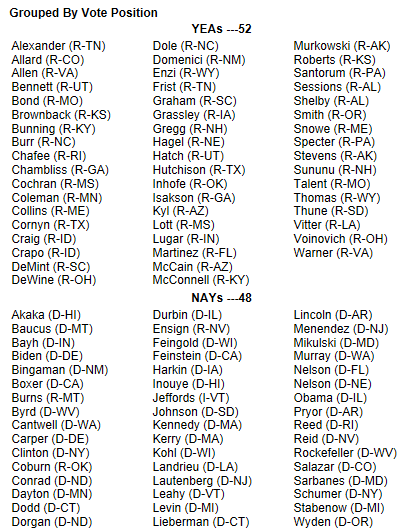
All Dem senators voted against raising the debt ceiling … including Sen. Obama (D-IL)  and Sen. Biden (D-DE).

I guess where you stand depends on where you’re sitting …

image

image
Source: Senate Web Site

>> Latest Posts

Chocolate surges. strawberry slips …

July 20, 2011

I often use the expression: “Vanilla, chocolate & strawberry do the lion’s share of business” … implying that (a) Pareto is alive and well, and (b) variety often builds in complexity without building (much) sales.

Well, I’m going to start saying “vanilla and chocolate” … “vanilla, chocolate & buter pecan” just doesn’t sound right.

* * * * *
Based on a Rasmussen survey of Adults’ flavor preferences in ice cream, the favorite flavors are:

  • 23% vanilla
  • 23% chocolate
  • 9% butter pecan
  • 8% strawberry
  • 8% cookies and cream
  • 6% chocolate chip
  • 4% coffee flavored
  • 17% all other flavors

Other findings:

  • Vanilla is at the top of the men’s list; chocolate is at the top of the women’s list
  • White adults prefer chocolate to vanilla 24% to 19%;  black adults prefer vanilla by a 43% to 14% margin.
  • Most ice cream eaters (78%) usually buy it at the store and eat it at home rather than go to an ice cream parlor; 17% would prefer going to an ice cream parlor for their treat.

>> Latest Posts

Flash: O’s bud Warren takes offense at corp jet slap ….

July 19, 2011

Here’s the video I’ve been waiting for…Warren Buffett – often quoted by Pres. Obama since he’s a fan of higher taxes –  defending his honor as a corporate jet owner.

Guess Buffett doesn’t like being lumped with tanning salons.

image

>> Latest Posts

Grab hold of your wallet … Moody’s says: “Give the President a blank check,

July 19, 2011

CNBC reports that “Moody’s Suggests US Eliminates Debt Ceiling”

Ratings agency Moody’s on Monday suggested the United States should eliminate its statutory limit on government debt to reduce uncertainty among bond holders.

The rationale:

The United States is one of the few countries where Congress sets a ceiling on government debt  , which creates “periodic uncertainty” over the government’s ability to meet its obligation.

And, any way …

In the United States, Moody’s said the debt limit had not effectively curbed the rise in government debt because lawmakers regularly raise it and because that limit is not related to the level of expenditures approved by Congress.

Are you kidding me?

First, giving a drunken sailor an open line of credit at the booze store makes no sense at all.  I have zero confidence that the Feds will show any fiscal restraint ever.  The debt ceiling at least helps to protect them from themselves.

Second, isn’t this the same Moody’s that rated sub-prime mortgage backed securities AAA …  right up to the meltdown?  Does anybody take these jabrones seriously any more?

Third, isn’t Warren Buffett one of Moody’s owners?  Why doesn’t he just turn his personal fortune over to the Treasury if he thinks the spending binge should continue.  It would give Obama some walking around money and shut Buffett up re: his strong desire to pay higher taxes.

Geex.

>> Latest Posts

The rise of the ‘citizen consumer’ … and the rising tide of cause marketing.

July 19, 2011

Punch line: American consumers of all ages are increasingly motivated to buy products that have a connection to a particular charitable or social cause

The key caveat: when price and quality are the same.

* * * * *
Excerpted from USA Today 

Consumers are drawn to products with a charitable connection.

American consumers of all ages are increasingly motivated to buy products that have a connection to a particular charitable or social cause.

Nearly half of survey respondents ranked “social purpose” as the No. 1 factor.

In one recent survey, consumers ranked “purpose” as a significantly more important reason to buy a product than design, innovation or brand loyalty, when quality and price are the same.

“Americans seek deeper involvement in social issues and expect brands and companies to provide various means of engagement,”

“We call this the rise of the ‘citizen consumer.'”

* * * * *

“Cause-related marketing .. is not about slapping a ribbon on a product any longer,”

“Almost half of respondents …  say they feel brands only support good causes for publicity and promotion, and not because they really care.”

But for companies that get it right, the upside of cause marketing is big. Despite the recession, more than half of consumers say that they are willing to pay more for a product that supports a good cause,

Which companies are getting it right? Respondents placed Pepsi, Newman’s Own and Nike, respectively, on top.

>> Latest Posts

“80% of Americans agree that taxes should be raised” … say, what?

July 18, 2011

Seriously, now.

To be technically precise, Pres. Obama said that “80% of Americans favor a ‘balanced’ approach” to attacking the deficit-debt problem.

For Obama, “balanced” means tax hikes.

Problem: data doesn’t seem to support the case.

According to the latest Rasmussen survey “55% Oppose Tax Hike In Debt Ceiling Deal”.

  • Most voters oppose including tax hikes in the deal.

    Just 34% think a tax hike should be included in any legislation to raise the debt ceiling; 55% disagree and say it should not.

  • There is a huge partisan divide on the question. Fifty-eight percent (58%) of Democrats want a tax hike in the deal while 82% of Republicans do not.
  • Among those not affiliated with either major political party, 35% favor a tax hike and 51% are opposed.
  • Even those who earn less than $75,000 a year are opposed to including tax hikes.

Where’s the rub?

“By a 59% to19% margin, Political Class voters favor a tax hike in the debt ceiling deal.

By a 68% to 22% margin, Mainstream voters oppose tax hike in the debt ceiling deal.”

* * * * *

Ken’s Take: I still want to see the survey that asks “Do you favor the gov’t raising YOUR taxes to reduce the national debt?”

If 80% is the over/under, I’ll bet the ranch on the under.

>> Latest Posts

Time for your quarterly performance review …

July 18, 2011

Punch line: Most companies give employees annual performance reviews, usually laced with pablum. Now, more companies are shifting to quarterly performance reviews – with substance.

* * * * *

Excerpted from Thomas Friedman, NYT:

The rising trend in Silicon Valley is to evaluate employees every quarter, not annually.

Why?

Because the merger of globalization and the I.T. revolution means new products are being phased in and out so fast that companies cannot afford to wait until the end of the year to figure out whether a team leader or team member  is doing a good job.

Ken’s Take: Quarterly performance review have been a staple at high-octane consulting firms for years … not surprising that the practice is finally catching on.

>> Latest Posts

Have you noticed ?

July 15, 2011

Have you noticed the Homa Files fresh, new design?

After 3 years of using the stock WordPress design, I was nudged by family and friends to turn it up a notch.

Thanks to daughter-in-law Jess for the awesome new header … with clean lines, contempo colors and  a great image of the Key Bridge leading to Georgetown.

Be sure to notice that there are more information links on the home page … including click thru access to the Homa Notes on the 6 Ps of Marketing.

Onward and upward  …

>> Latest Posts

“Consider the repatriation issue” …

July 15, 2011

Paul Krugman has won a Nobel prize in Economics … and he teaches at Princeton.

So, he should know what he’s talking about, right?

Not so fast …

Here’s an excerpt from his NYT op-ed rant titled “Corporate Cash Con

The subject is taxation of repatriated earnings – money that companies make outside the U.S.

Over the last two years profits have soared while unemployment has remained disastrously high.

Why should anyone believe that handing even more money to corporations, no strings attached, would lead to faster job creation?

Consider the repatriation issue.

U.S. corporations are supposed to pay taxes on the profits of their overseas subsidiaries — but only when those profits are transferred back to the parent company.

Now there’s a move afoot  to offer an amnesty under which companies could move funds back while paying hardly any taxes.

A similar tax holiday was offered in 2004. And it was a total failure.

Companies did indeed take advantage of the amnesty to move a lot of money back to the United States.

But they used that money to pay dividends, pay down debt, buy up other companies, buy back their own stock.

Indeed, there’s no evidence that the 2004 tax holiday did anything at all to stimulate the economy.

What the tax holiday did do, however, was give big corporations a chance to avoid paying taxes, because they would eventually have repatriated, and paid taxes on, much of the money they brought in under the amnesty.

And it also gave these companies an incentive to move even more jobs overseas, since they now know that there’s a good chance that they’ll be able to bring overseas profits home nearly tax-free under future amnesties.

Corporations already have plenty of cash they’re not using, why would giving them a tax break that adds to this pile of cash do anything to accelerate recovery?

Let’s pick some lint off Prof. Krugman’s argument …

First, he overlooks the fact that companies do, in fact, pay taxes to the locales where the income is booked.  It’s not tax-free … but it is usually taxed at rates that are lower than U.S. corporate tax rates … since most countries tax rates are lower.

When  earnings are brought back to the U.S., companies are obligated to pay the difference in the tax rates to the U.S. Treasury.

Second, Prof, Krugman argues that low repatriation tax rates are bad because they “give big corporations a chance to avoid paying taxes, because they would eventually have repatriated.”

Au contraire.

In the old days, the U.S. economy was the growth machine.  These days, international markets are the growth machines.  Think China and India.

The point: in the old days earnings would usually get repatriated for investment in the U.S.

These days, companies have plenty of investment opportunities outside the U.S.  They don’t need to repatriate earnings ever.

So, coaxing companies to bring some cash home via a low repatriation rate means that the U.S. Treasury gets some dough.  Since tax revenues equals the tax rate times the tax base, if the money stays off-shore, the Treasury gets nothing.

Finally, Krugman rants that companies use repatriated “money to pay dividends, pay down debt, buy up other companies, buy back their own stock.”

Is that a bad thing?

What does Krugman think that people do when they get a dividend check?

My hunch: they spend it … creating demand and stimulating the economy.

I learned that at Princeton, Prof. Krugman.

>> Latest Posts

Pareto is alive and well … and haunting the U.S. healthcare system.

July 15, 2011

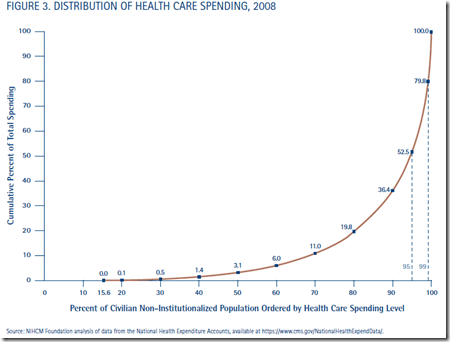
According to the National Health Care Management Association analysis of  2008 healthcare spending:

  • The top 1 percent of the population was responsible for 20.2 percent of spending.
  • The top 5 percent of the population accounted for almost half (47.5 percent) of all health care spending.
  • ABout 60% of the top 5 percent (and top 1 percent) are 55 and older; about 40% is 65 and over
  • The top 10 percent of the population accounted for 63.6 percent of all spending.
  • 15.6 percent of the civilian, non-institutionalized population had no health care spending at all in 2008
  • The half of the population with the lowest spending accounted for only 3.1 percent of all expenditures.

image

>> Latest Posts

“Don’t call my bluff” … say, what?

July 14, 2011

It’s reported that Pres. Obama huffed “Don’t call my bluff, Eric” to Congressman Cantor before walking out of the debt negotiations.

Huh? Freudian slip?

Did he mean; “I’m not bluffing, Eric”?

Or, was he telling Cantor that he was, in fact, bluffing … and didn’t want to be called on it ?

Cue the teleprompter.

I’m confused.

Glum alums … Nearly 20% of recent grads are unemployed

July 14, 2011

According to the National Journal … .

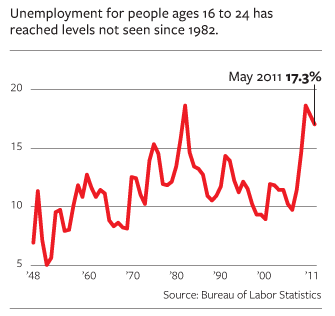
Two years after the Great Recession officially ended, job prospects for young Americans remain historically grim.

More than 17 percent of 16-to-24-year-olds who are looking for work can’t find a job.

  • The percentage of young people who are working—has plunged to 45 percent.

Taken together, the numbers suggest that the U.S. job market is struggling mightily to bring its next generation of workers into the fold.

College graduates who enter the labor force during a recession make significantly less money — in their first year and over the course of their careers — than grads who walk into an economic boom.

Not surprisingly, polls suggest that America’s young people have grown more pessimistic about the economy and their own future fortunes.

image

>> Latest Posts

Friends with benefits …

July 14, 2011

Punch line: The number of unmarried cohabitators has doubled in the past 10 years …

[DIVORCE jump]
Source

>> Latest Posts

The shrinking (black) middle class

July 13, 2011

Some sobering statistics  reported in the Chicago Sun Times …

“History is going to say the black middle class was decimated” over the past few years.

For many in the black community, job loss during this recession has knocked them out of the middle class and back into poverty.

  • In 2004, the median net worth of white households was $134,280, compared with $13,450 for black households.
  • By 2009, the median net worth for white households had fallen 24 percent to $97,860; the median net worth for black households had fallen 83 percent to $2,170.
  • Blacks are overrepresented in state and local government jobs that are being eliminated because of massive budget shortfalls.
  • Since 2009, the overall unemployment rate has fallen slightly, while the black unemployment rate has risen from 14.7 to 16.2 percent — The highest rate since the government began keeping track in 1972.
  • Only 56.9 percent of black men over 20 were working, compared with 68.1 percent of white men.
  • The college-educated unemployment rate is 3.9 percent for whites and 7 percent for blacks.
  • Nearly 8 percent of African Americans who bought homes from 2005 to 2008 have lost them to foreclosure, compared with 4.5 percent of whites.

Some see a bitter irony in soaring black unemployment and the decline of the black middle class on the watch of the first black president.

* * * * *

Ken’s Take: No question, the recession has hit the lower rungs of the economy most severely.  The numbers are striking.

Note: According to Gallup, Over 80% of blacks still approve of job President Obama is doing …

image

>> Latest Posts

Shining sunlight on “vampire brands” …

July 13, 2011

Punch line: Vampire brands live off the blood of their customers … they can be (and should be) defanged by vigilant and vocal consumers.

Extracted from a published letter in the Financial Times by MSB Prof Charles Skuba.

Examples of minor customer exploitation have become too common business practices today and deserve more customer challenge.

It is lamentable that “business practices whose rationale derives from consumer ignorance and producer knowledge” are accepted today by too many executives, particularly in service industries, as convenient opportunities for fattening margins after the primary customer decision has been made.

The best brands and marketing practitioners have greater respect for their customers and work to win their loyalty at what Procter & Gamble calls the first and second “moments of truth”.

  • The first moment of truth is when the customer chooses one brand over another at the point of purchase.
  • The second moment of truth is when the customer chooses whether to repurchase after consideration of the value equation.

We will all benefit when consumers share their frustrating experiences with brands that fail this test.

Vampire brands that live off the blood of their customers are best controlled by exposure to the sunlight of customer criticism.

Ken’s Take: Social media provides a powerful way for dis-satisfied customers to spread their messages broadly and quickly.  Vampire brands beware.

>> Latest Posts

Obama to Boeing: Don’t waste time in court …”

July 12, 2011

Obama’s NLRB filed suit against Boeing to stop it from opening a plant in South Carolina – a right-to-work state.

Boeing has already invested close to $1 billion on the plant, and has already hired over 1,000 workers.

The NLRB action has broad reaching implications, since it tries to restrict where and how a company can operate.

Biz execs say privately that the NLRB is the proverbial straw that broke the camel’s back … demonstrating the lengths that the administration will go to meddle in private businesses to support its union constituency.

If companies are restricted from opening plants in right-to-work states, their only options are operating in high cost union-dominated states … or beyond the U.S.  borders.

Now, after throwing the stink bomb, Obama is trying to play the role of the conciliatory  mediator.

Ken’s Take: To avoid wasting court time, why doesn’t the President just tell his NLRB lackeys to back off?

* * * * *

From KING-TV:

The NLRB alleges that Boeing retaliated against its unionized work force in Washington state by opening a new production line for its 787 airplane in South Carolina, which is a right-to-work state. The case could drag on for years.

President Barack Obama is calling  for Boeing  and its workers to resolve their differences without “wasting a lot of time in court.”

Obama was asked about the National Labor Relations Board’s lawsuit against the aerospace giant in a KING-TV interview.

The president restated an earlier comment that “businesses should be able to locate wherever they want to operate” and have to follow the law.

“We can’t afford to have businesses and their workers arguing instead of coming together to try to produce the best possible products and sell them as aggressively as possible.”

>> Latest Posts

Reprise: Dogbert for President – His Tax Plan

July 12, 2011

This was originally posted July 30, 2008 as the Presidential campaigns were heating up … and has recently been one of the Homa Files most popular posts.

Since it’s particularly relevant during the current deficit debates… here it is again…

* * * * *

A few years ago I stumbled on a Dogbert cartoon. At the time it made me smile.

Today, the cartoon makes me nervous — very nervous.

Of course, the source of my angst is the Obama tax plan. But, my specific concerns aren’t the ones that most pundits dwell on.

* * * * *

Buying Votes

True, Obama did hijack Dogbert’s campaign strategy and plans to raise tax rates on the top 3% of income earners (individuals and couples earning over $250,000 annually) and to redistribute the “savings” via a new tax credit of $500 per person, or $1,000 per working family.

Cynics point out that in the good old days, Mayor Daley’s Chicago political machine could deliver a vote for a the price of a pack of cigarettes. Apparently the price of a vote has gone up more than the price of gasoline. At least votes are now “marked to market”. The Obama plan clearly sets the price at $500 (cash) per vote, with a perpetuity value of about $10,000 @ 5%.

* * * * *

Buying Old Folk’s Votes

And, Obama promises zero Federal taxes for seniors over 65 on income up to $50,000 .

Mark Penn, Hillary Clinton’s former chief strategist says: “The Obama camp hit a bull’s-eye with this proposal, which has little economic justification but is great politics.”
http://www.politico.com/news/stories/0708/12117.html

* * * * *

Upping High Bracket Marginal Rates

In a WSJ op-ed, Stanford economics professor Michael Boskin opines that despite the rhetoric to the contrary, Obama’s increases don’t just hit “rich” individuals. They also impact lot of small businesses and two-earner households in high cost-of-living areas.

Specifically, Obama would raise the top marginal rates from 35% to 39.6%, increase the tax rate on capital gains and dividends, and uncap Social Security taxes (which currently are levied on the first $102,000 of earnings).

When payroll and state income taxes are thrown in, Boskin estimates that the high bracket marginal rate goes to over 60% – with almost $2 of every $3 earned at the margin, going to the government for services and redistribution.

click to make table bigger

click to make table bigger

http://online.wsj.com/article/SB121728762442091427.html?mod=opinion_main_commentaries

* * * * *

Redistributing $131 Billion Annually

An analysis done by the Tax Foundation — a self-proclaimed non-partisan think tank – indicates that Obama’s plan — as proposed — would redistribute about $131 billion each year. Taking money from the undeserving rich, and giving it directly to the financially besieged middle (and lower) class).
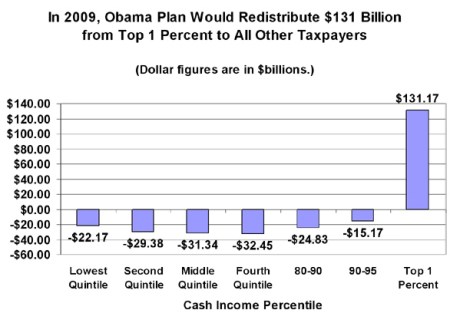
Tax Foundation - Tax Policy Center Estimate
Source: Tax Foundation – Tax Policy Center Estimate

“Hard Numbers on Obama’s Tax Redistribution Plan
http://www.taxfoundation.org/publications/show/23319.html

* * * * *

My POV

1. On a philosophical level, I agree that the grossly uneven distribution of earning power in the US is a serious problem that needs to be fixed.

2. But, I don’t think that the problem of income inequality should be fixed via a tax system — which was originally intended to “tax & spend” efficiently on necessary common services — not to “grab and redistribute”. Direct transfers from one citizen’s pockets to another’s (e.g. refundable tax credits) are certainly the latter.

3. Except for the impact on small businesses, I can’t get too riled over marginal rate increases that start at $350,000; but I do think a “doughnut hole” payroll tax schedule is wacky and I think raising capital gains taxes during an economic slowdown is dangerous.

4 . My real issue: The numbers say that in Obama World, a minority of voting age Americans will be paying income taxes. That scares me. What’s to stop an income tax-free majority from continually voting to raise taxes on the tax-paying minority to fund an ever increasing potpourri of benefits or add to the redistribution pot.

>> Latest Posts

Raising taxes on low- and middle-income families … what?

July 11, 2011

AP is reporting …

Debt reduction proposals under consideration include raising taxes on small business owners and potentially low- and middle-income families.

You won’t hear about that from Obama.

Instead the president focuses on the very rich, and oil companies.

Full article

Ken’s Take Perhaps the President will reveal these considerations in his press conference today … along with his specific plan for cutting the costs of Medicare, Medicaid, and Social Security … he said they’re “on the table” … let’s hear the specifics.

>> Latest Posts

WSJ: A Home Is a Lousy Investment

July 11, 2011

An analysis of home-price and ownership data for the last 30 years in California — the Golden State with notoriously golden property prices — indicates that the average single family house has never been a particularly stellar investment.

If a disciplined investor who might have considered purchasing that median-price California house in 1980 had opted instead to invest the 20% down payment of $19,910 and the normal homeownership expenses (above the cost of renting) over the years in the Dow Jones Industrial Index, the value of his portfolio in 2010 would have been $1,800,016.

The stocks would have been worth more than the house by $1,503,196.

If the analysis is based on 2007, the stock portfolio would have been worth $2,186,120, exceeding the house value by $1,625,850.

Full article < Worth reading

* * * * *

Great Quote: The sanctity of mortgage obligations has become the rough moral equivalent of the 55-mile-per-hour speed limit.

* * * * *

Ken’s Take: But, who put 20% down? Lots of upside potential with little downside risk if you don’t care about your credit rating … living in a house for free a couple years – while the bank tries to foreclose – offsets much of the difference .

>> Latest Posts

How safe is your money market fund?

July 11, 2011

Punch line: Amid the Greek mini-panic this month, did you notice the really shocking news? To wit, U.S. regulators are worried about the “systemic risk” posed by the exposure of American money-market funds to European bank debt.

* * * * *
According to the WSJ:

A 1983 Securities and Exchange Commission rule allows money funds to report a stable net-asset value of $1 per share, even if that’s not precisely true based on changes in the fund’s underlying assets.

The result is that investors have come to expect that money funds never “break the buck,” never decline in value.

But since 2008 U.S. money funds have been allowed to pile into European bank debt.

Half the assets in U.S. prime money market funds were invested in European banks as of the end of May.

>> Latest Posts

Bottom line: If Greece tanks and takes down some Euro banks with it, the impact will be felt by US money market funds … which could possibly break a buck …

A mockery of longstanding bankruptcy law …

July 11, 2011

When the history is written on Pres. Obama’s strained relationship with American business leaders, I think that the GM non-bankruptcy bankruptcy will be tagged as the the first critical shot fired (by the President).

Just in case you forgot, here’s a recap excerpted from Reason:

Many experts suspect that  GM could have obtained private bankruptcy financing if it had presented a credible restructuring plan addressing the cause of its malaise: the uncompetitive costs of its unionized work force.

If it couldn’t, then the government could have offered guarantees to private lenders for the amounts they loaned, which likely would have been smaller than the bailout.

But the administration took matters in its own hands, using taxpayer dollars to commandeer the bankruptcy process to protect key constituencies, while giving short shrift to others.

  • It gave Chrysler’s secured creditors, who would have had priority in a normal bankruptcy, 29 cents on the dollar.
  • Chrysler’s unions, on the other hand, got more than 40 cents, even though they are equivalent to low-priority lenders.

This made a mockery of longstanding bankruptcy law, something that will make credit markets wary of lending to political sacred cows in the future.

I think CEOs could have lived with Obama firing Richard Waggoner as CEO … and then firing his replacement, Fritz Henderson … and then firing his replacement, Ed Whitacre.

But, ignoring the rule of law and subordinating secured creditors to one of Obama’s core constituencies — overpaid union hacks – was over the top.

If there were any hopes of turning around the relationship, the Administration’s moves to keep Boeing from operating a plant in right-to-work South Carolina dashed them

>> Latest Posts

On civility: Do as I say, not as I do.

July 8, 2011

Back in January – seizing the moment after the Gabrielle Gifford’s shooting, “President Obama called for a New Era of Civility in U.S. Politics”.

“At a time when our discourse has become so sharply polarized, at a time when we are far too eager to lay the blame for all that ails the world at the feet of those who think differently than we do,” he said, “it’s important for us to pause for a moment and make sure that we are talking with each other in a way that heals, not a way that wounds.”

Fast forward to this week’s Twitter news conference:

Obama Warns Debt Ceiling Should Not Be ‘Used As A Gun’ To Extract Tax Breaks

In some of his harshest language to date in the fight over the deficit, President Obama warned today that the debt ceiling should not be “used as a gun” against Americans’ heads to extract tax breaks for the wealthy.

Guess the President isn’t a big fan of the Golden Rule …

>> Current Posts

Stores creating “a sense of privacy, even sanctum” … for men!

July 8, 2011

According to research coming out of Australia, and reported in RetailWire:

Male-only supermarket shopping aisles that focus on gender-specific products rather than merchandise by category could encourage men to browse longer, trial new items and spend more.

“Research has shown that there is a group of male shoppers who have a ‘fear of the feminine’ or fear shopping among women’s health products such as tampons, waxing strips, pink razors and body scrubs,”

“Further, research found that men made more purchases … of health products that were not placed in high traffic areas or next to feminine-inspired products.

Apparently, some men are apprehensive of women’s products and are therefore less likely to spend time perusing their own personal needs.”

The answer: Creating retail ‘man caves’… “Gender specific aisles providie a relief to men, inspiring them to explore and discover new products … and create a sense of privacy, even sanctum.”

I can’t wait to go shopping tomorrow … I need some “privacy, even sanctum.”

* * * * *

Random Finding: Men also shop differently, valuing efficiency and independence over customer service and tend not ask for help.

Or, as Grandma Homa used to say: “Women shop, men buy.”

>> Current Posts

Corporate jets … “since John the Baptist”

July 8, 2011

Charles Krauthammer puts the President’s railing against corporate jets into perspective in today’s Washington Post:

What have been Obama’s own debt-reduction ideas?

In last week’s news conference, he railed against the tax break for corporate jet owners — six times.

I did the math.

If you collect that tax for the next 5,000 years — that is not a typo — it would equal the new debt Obama racked up last year alone.

To put it another way, if we had levied this tax at the time of John the Baptist and collected it every year since — first in shekels, then in dollars — we would have 500 years to go before we could offset half of the debt added by Obama last year alone.

* * * * *

>> Current Posts

Flashback: Will the Republicans get hosed again?

July 7, 2011

Today is Pres. Obama’s bipartisan summit to go long ball on debt and deficit reduction.

My bet: history will repeat itself and Republicans will get snookered again.

Remember the budget deal that averted the government shutdown last December?

Headlines said it would cut spending by $38 billion (with an “b”).

Turns out that the real impact was only $352 million (with an “m”).

According to the Washington Post:

Budget deal: CBO analysis shows initial spending cuts less than expected

A federal budget compromise that was hailed as historic for proposing to cut about $38 billion would reduce federal spending by only $352 million this fiscal year, less than 1 percent of the bill’s advertised amount, according to the Congressional Budget Office.

And, a mere 6 months after the agreement – that was supposed to hold until the end of 2012, Obama is walking back the full extension of the Bush tax plan and the tax-based stimulus provisions.

As the original Grandma Homa would say: fool me once, shame on you, fool me twice, shame on me.

* * * * *

Clever planning: The President shrewdly invited the GOP political hacks, but left Ryan, Coburn and Portman —  the only guys who understand the numbers – off the guest list.

I guess that a fact-free summit will go smoother

Also, the President scheduled the summit the day before another likely-to-be-dismal jobs report … hoping that the jobs report will get ignored.

Trust, HomaFiles won’t ignore it.

* * * * *

What to watch: I’m betting that most of the Dems “cuts” will be capping growth in spending (which isn’t a cut !) and the usual phantom attack on waste & fraud (how are we doing on the $500 billion of w&f that was supposed to come out of Medicare?).

>> Current Posts

Still more about corp jets … a bit hypocritical?

July 7, 2011

I vowed to myself that there wouldn’t be another corp-jet post …

But, during Pres Obama’s Twitter Town Hall, he keep harping on those evil, greedy corporate jet owners.

His harping reminded me of 2 stories that highlight the silliness and hypocrisy of the issue.

1) Remember Barack & Michelle’s date night in New York CIty?  Air Force One (kinda like a corp jet) to JFK, Marine One (kinda like a corp helicopter, but nicer), Limo to the theater and dinner … then back to DC.

2) Or, did you hear that the Federal limo fleet increased 73% under Obama administration

Jets, helicopters, limos … does that make Obama an evil, greedy person, too?

I guess those trans-modes are only required for business when you’re the POTUS.

Just looking for a bit of consistency …

>> Current Posts

* * * * *

American people want higher taxes … oh, really?

July 7, 2011

The drivel just won’t stop.

A pundit named Froma Harrop says:

Poll after poll shows that the American people want higher taxes. That’s not the same as liking higher taxes. The people have simply concluded that higher taxes are preferable to the alternative

A Quinnipiac poll found that 69 percent, including nearly half of Republicans, want taxes raised on households making more than $250,000.

Let’s think about that for a moment.

About 2% of Americans are in households making over $250,000.

About 70% of Americans – who presumably earn less than $250,00 – say that taxes should be hiked on the top 2% so that they don’t lose any government handouts.

That doesn’t surprise me.

What does surprise me is that 28% of Americans say – don’t raise taxes on other people just so I can keep my handouts.

Wonder why they don’t poll people on the question: “Do you want YOUR taxes to be jacked up to support out-of-control government spending?”

I bet that fewer than 70% say “sign me up”.

It’s a lot easier to support taxing the other guy …

* * * * *

More re: corp jets … Are they really slipping through a“loophole” ?

July 6, 2011

In an earlier post, we pointed out the irony regarding Pres. Obama’s poli-rants against “corporate jet owners”:

  • HR 4853– the Tax Relief, Unemployment Insurance Reauthorization and Job Creation Act of 2010 – was initiated in the lame duck Pelosi-controlled Democratic House, passed by the Reid-controlled Democratic lame duck Senate, and signed by President Obama – ostensibly to create J-O-B-S.

A HomaFiles reader replied to the post with a relevant clarification:

“A tax break is not a loophole.

HR4853 purposely included this incentive to produce an outcome.

Only unintended tax outcomes that reduce taxes are loopholes.

It is amazing to see the amount of misinformation provided by the press and believed by democrats …”

Good point.

* * * * *

Football, band, honors classes and hot lunches … here we go again.

July 6, 2011

When I was a kid, the local school board would biennially warn that football, the band, the honors program and hot lunches would be cut unless a levy was passed to boost real estate taxes.

I remember that – even as a kid – it sounded like a bunch of bull.

Sometimes the levies passed. Sometimes they didn’t.

Regardless of the vote, the stadium lights still glowed bright on Friday nights, the smart kids still got their honors courses, and the cafeteria kept serving up hot slop.

Today’s equivalent of football, band, honors and lunches was articulated at Pres. Obama’s press conference last week: college scholarships, food safety, medical research, etc.

Nothing else can possibly be cut.

Nope, it’s gotta be football, band, honors and hot lunches.

But, wait a minute.

What about  the $100 to $200 billion in wasteful spending that the GAO reported last last March:

WSJ, Billions in Bloat Uncovered in Beltway, March 1, 2011

A GAO report uncovered billions of dollars in wasteful spending by the U.S. government due to duplicate work done by dozens of overlapping agencies on redundant and ineffective federal programs

For example, the U.S. government has 15 different agencies overseeing food-safety laws, more than 20 separate programs to help the homeless and 80 programs for economic development.

The agency found 82 federal programs to improve teacher quality; 80 to help disadvantaged people with transportation; 47 for job training and employment; and 56 to help people understand finances.

The report took particular aim at government funding for surface transportation, including the building of roads and other projects, which the administration has made a major part of its push to update the country’s infrastructure. The report said five divisions within the Department of Transportation account for 100 different programs that fund things like highways, rail projects and safety programs.

The report chided the government over encouraging federal agencies to purchase plug-in hybrid vehicles while having policies that agencies reduce electricity consumption. It said government agencies have purchased numerous vehicles that run on alternative fuels only to find many gas stations don’t sell alternative fuels. This has led government agencies to turn around and request waivers so they didn’t have to use alternative fuels.

The GAO identified between $100 billion and $200 billion in duplicative spending.

GAO’s prior recommendations have generally been ignored or postponed by federal agencies and lawmakers, particularly when they could require difficult political votes.

Hmmm.

Just not hearing a lot about that report these days …

Nope, it’s gotta be football, band, honors and hot lunches.

* * * * *

Click to see the full report

image

U.S. teachers work longest hours in the world … oh, really?

July 6, 2011

According to the WSJ and the Organization for Economic Cooperation and Development:

    • U.S. primary-school teachers spend only 36 weeks a year in the classroom — among the lowest among the countries tracked
    • But, U.S. primary-school teachers spend 1,097 hours a year teaching – the highest among the countries tracked – and well above the OECD average of 786 hours.

image

And, according to the OECD, that’s just the time teachers spend on instruction. Including hours teachers spend on work at home and outside the classroom, American primary-school educators spend 1,913 working in a year.

According to data from the comparable year in a Labor Department survey, an average full-time employee works 1,932 hours a year spread out over 48 weeks (excluding two weeks vacation and federal holidays).

Despite the amount of time that teachers spend working, student achievement in the U.S. remains average in reading and science and slightly below average in math when compared to other nations in a separate OECD report.

* * * * *
Hmmm.

Teachers work an average of almost 11 hours per day when school is in session,

And, teachers put in about as many hours in 36 weeks as “average full-time employees” do in 48 weeks,

Color me skeptical …

* * * * *

“For Sale, Bring Cash”

July 5, 2011

Punch line: USA Today reports that “cash buyers are kings in weak home-sales market.”

* * * * *

According to the National Association of Realtors, in May 2011, all-cash buyers, who are mostly investors, accounted for 30% of existing home sales, up from 12% two years ago.

The cash buyers are enticed by low prices and potential rental income.

Cash buyers are especially prevalent in markets where prices have fallen the most, often areas hard hit by foreclosures.

  • In Las Vegas, the foreclosure capitol of the U.S. for the past four years, cash buyers accounted for 49% of first-quarter sales
  • In the Miami-Fort Lauderdale area, 63% of first-quarter buyers paid in cash.
  • In Phoenix,  44% are cash buyers.

Cash buyers often get better deals because sellers know their offers won’t fall through for lack of financing. A 5% cash discount is typical.

Source: USA Today

* * * * *

More re: Corp Jets … new nums and a touch of irony

July 5, 2011

Last week, we analyzed Pres Obama’s new target: corporate jet owners.

We said that the “loophole” was that corporate jets get depreciated over 5 years, whereas commercial aircraft (like Southwest’s) get depreciated over 7 years. So, the “loophole” is 2 years of accelerated depreciation … which is monetarily equivalent to about a 1% discount on the purchase price of of the jet. See the original post for the analysis.

But. a loyal HomaFiles reader quickly corrected my tax facts.

Turns out that in December, HR 4853 — the Tax Relief, Unemployment Insurance Reauthorization and Job Creation Act of 2010 – was passed.

HR4853 allows businesses 100 percent accelerated depreciation of investments in capital assets — including new aircraft — through December 31, 2011, retroactive to September 4, 2010.

That changes the numbers …

The difference between depreciating a jet 100% in the first year and depreciating it over 7 years is monetarily equivalent to about a 3.3% discount on the purchase price of of the jet.

Example (table below): Assuming a million dollar capital expenditure, the NPV of the tax benefit of 100% accelerated depreciation is about $250,000 (@ an average corporate  tax rate of 25%) …  the NPV of the tax benefit depreciating the capital asset over 7 years is $214,489 … the difference is $33,011, which is 3.3% of the purchase price.

* * * * *

Here’s the irony …

HR 4853–  the Tax Relief, Unemployment Insurance Reauthorization and Job Creation Act of 2010 – was initiated in the lame duck Pelosi-controlled Democratic House, passed by the Reid-controlled Democratic lame duck Senate, and signed by President Obama – ostensibly to create J-O-B-S.

Six months later, the President turns around and starts attacking a tax law that he and fellow Democrats enacted.

Then, they wonder why corporate America is sitting on $2 trillion in cash.

It goes beyond corporate jets.

They can’t keep changing the rules every couple of months just to score some cheap political points.

* * * * *

image

* * * * *

Gotta be more to the story …

July 5, 2011

If these are true, they’re a sad commentary on the state of the American justice system …

image

Thanks to SMH for feeding the lead

* * * * *

Hey, let’s just split the tab down the middle …

July 2, 2011

Everybody knows one of these jabrones: they order apps, expensive wine (which you don’t touch), a high-priced entre, a fancy dessert (or two)  … and then have the gall to suggest splitting the bill down the middle.

Ouch.

Ratchet the game up a notch, and you get Thomas Sowell’s perspective on the debt limit:

What the national debt-ceiling actually does is enable any administration to get all the political benefits of runaway spending for the benefit of their favorite constituencies — and then invite the opposition party to share the blame, by either raising the national debt ceiling, or by voting for unpopular cutbacks in spending or increases in taxes.

The Obama administration is a classic example.

When all its skyrocketing spending bills were being rushed through Congress without even being read, the Democrats had such overwhelming majorities in both the Senate and the House of Representatives that Republicans had … no chance of stopping, or even slowing down, the spending of trillions of dollars.

Now that the bill is coming due for all that spending and borrowing, Republicans are suddenly being invited in to share the blame for either raising the national debt ceiling or for whatever other unpopular measures will be legislated.

“If you didn’t invite me to the big take-off, don’t invite me to the crash landing.”

This was Obama’s big, partisan spending spree, but “bipartisanship” requires Republicans to either split the bill or be blamed if the government shuts down or defaults.

>> Latest Posts

First, tanning salons … now, corporate jets … here are some nums.

July 1, 2011

Talk about playing small ball …

In Wednesday’s press conference, Pres. Obama turned the spotlight on the “tax loophole for corporate jets”.  He mentioned them 6 times in the press conference.

Must be a big deal, right?

Wrong.

I’m not a big fan of corporate jets, but that’s beside the point.

I’m more intrigued by the numbers … and so far, I haven’t heard any pundits nail them.

First, what’s the “loophole”?

Well, corporate jets get depreciated over 5 years; commercial aircraft (like Southwest’s) get depreciated over 7 years.

The “loophole” is 2 years of accelerated depreciation.

Nobody seems to be disputing that corporate aircraft are deductible as a business expense.

The only question is whether the cost gets booked over 5 years or 7 years.

What’s the difference?

Well, let’s assume – for round numbers —  that a jet costs $1 million.

If it’s a business jet, the company can deduct $200,000 for 5 years ($1 million divided by 5).; if it’s a commercial jet, the airline can deduct $142,857 for 7 years ($1 million divided by 7).

Note that the aggregate nominal deduction doesn’t  change — it is $1 million in both cases.  Just the depreciation period is different.

So, to figure the impact of the different depreciation periods, let’s calculate  the NPV of the 2 depreciation streams  (see table below) …

  • A 5 year stream of $200,000 per year – discounted by 5% per year – has a $909,190 NPV.
  • A 7 year stream of $142,857 per year – discounted by 5% per year – has a $867,956 NPV.
  • The difference is in NPVs is $41,234.

But, $41,234 is the NPV of the tax deduction … not the NPV of the incremental taxes that the gov’t collects.

Assuming a 25% average corporate  tax rate, the deduction has a tax NPV of about $10,000  ($41,234 times 25%) … about 1% of the plane’s purchase price.

Said differently, this Obama game-changer is equivalent to putting a 1% excise tax on new corporate jets.

That’s how Obama’s is going to attack the deficit ???  That’s his big idea ???

Geez.

Only upside I see is that one of Warren Buffett’s dreams will come true since NetJets —  his corporate jet leasing company — will take a direct hit.

Maybe Buffett will stop whining about his taxes being too low.

Maybe.

* * * * *

image

* * * * *

Maryland adds ‘environmental literacy’ to HS graduation requirements … huh?

July 1, 2011

Last week, the Maryland state Board of Education approved an environmental literacy graduation requirement: High school seniors in Maryland will have to demonstrate literacy on environmental matters to graduate from now on.

According to the AP, public schools will be required to infuse core subjects with lessons on conservation, smart growth and other environmental topics.

Maybe that’s a good idea, but consider:

According to the Editorial Projects in Education Research Center, only about 74 percent of all students in Maryland graduate from high school with a regular diploma.

Less than 2/3s of Hispanics and African-Americans get a high school diploma.image

The obvious questions:

1) Will the HS graduation rate go up or down when an additional criteria – any criteria – is added?

I’m betting the down side …

2) Recent statistics indicate that a large proportion of HS graduates get their diploma with an adequate foundation in reading, writing and arithmetic.

Shouldn’t attention be laser-focused on those subjects?

3) Seriously, does it matter if inner city kids are schooled in ‘smart growth’?

* * * * *

Time Mag editor (a reliable O-shill) calls the President a (blank) on MSNBC …

June 30, 2011

Mark Halperin – editor=at=large of thinly read, left-leaning Time magaine said on live TV that President Obama acted like a (blank) during his press conference yesterday.

Watch the clip to fill in the blank … worth watching.

image
http://www.politico.com/news/stories/0611/58098.html

Herman Cain’s bona fides …

June 30, 2011

When pundits speak about Herman Cain – or introduce him for an interview – they usually reference him as  the (black) tea party candidate and former Godfather’s Pizza CEO who once hosted a talk radio show.

As reported by The Atlantic:

It hasn’t gotten much attention that Cain  was chairman of the Kansas City Federal Reserve Bank in the mid-1990s.

The Kansas City Fed is one of twelve regional banks that advise the Federal Reserve Board and initiate changes in the discount rate.

The Kansas City Fed in particular has a reputation for monetary conservatism and distrust of central authority.

From 1992 to 1996, Cain served as a director of the Federal Reserve Bank of Kansas City in the capacities of deputy chairman and then chairman of the Board.

Hmmm …. puts a whole new paint job on the candidate.

* * * * *

Pepsi decides to focus on, well, Pepsi …

June 30, 2011

Ken’s Take: Indra Nooyi — PepsiCo’s CEO — is an Obama fav because she pushes healthier foods (even healthier than sugar-water and corn chips ?) and charity causes.

Bottlers ask “Is she ashamed of selling carbonated sugar water?”

Investors and industry insiders are concerned that her push into healthier brands have distracted the company from some core products.

When flagship Pepsi-Cola dropped to number 3 – behind Coke and Diet Coke – even Ms. Nooyi had to take notice.

Her plan: flashier containers and a summer ad campaign featuring Santa.

Might work …

* * * * *
Excerpted from the WSJ:

Snack-food and beverage giant PepsiCo is launching the first new advertising campaign for its flagship Pepsi-Cola in three years—offering one of the most visible signs PepsiCo is throwing new weight behind its biggest brand after it sank to No. 3 in U.S. soda sales last year, trailing not only Coke but Diet Coke.

Ceding the top two spots to rival Coca-Cola Co. marked a huge embarrassment in a cola war that traces its roots to the 19th century.

PepsiCo is launching its first ad campaign in three years with a spot that focuses on its Pepsi-Cola. “Summer Time Is Pepsi Time” featuring Santa on vacation.

PepsiCo says it plans to spend about 30% more this year on TV advertising for its North American beverages, with soda a big focus.

As recently as 2005, PepsiCo spent $348 million on soda ads in the U.S., almost as much as Coke, which spent $377 million.

But by last year, the company had more than halved its spending to $153 million, while Coca-Cola spent $253 million, according to Nielsen Co., which tracks advertising.

* * * * *

In late 2008, Pepsi implemented a costly overhaul of all brands, that were looking “tired on the shelf.”

PepsiCo launched new graphics for all the big beverage brands and new packaging for more than 1,200 individual products, an unusually ambitious redesign.

* * * * *

Move over, Richard Simmons …

June 30, 2011

Wally the Walrus is latest fitness icon.

Click the pic for for a smile  …

image
xhttp://www.youtube.com/watch?v=KfFjt9EXFgc

Obama’s a genius, Bachman’s a dunce … oh, really?

June 29, 2011

The mainstream media had a field day on Monday when Rep. Michele Bachmann kicked off her presidential campaign on Monday in Waterloo, Iowa, and in one interview surrounding the official event she promised to mimic the spirit of Waterloo’s own John Wayne.

How stupid can she be?

Everybody knows that John Wayne grew up in Winterset, Iowa … not Waterloo.

According to various sources, Waterloo is where his parents met and married, not where The Duke was raised.  He grew up in another Iowa town.

How could anybody with a brain get the facts so wrong?

* * * * *

Now let’s compare that to a gaffe that was largely buried by the mainstream media.

Visiting troops at Fort Drum last week, President Obama confused two of his Medal of Honor recipients, referring to one of the soldiers’ comrades who was killed in combat in Afghanistan as being alive.

Speaking to the 10th Mountain Division Obama reflected on the time he spent with members of the Division.

“First time I saw the 10th Mountain Division, you guys were in southern Iraq. When I went back to visit Afghanistan, you guys were the first ones there. I had the great honor of seeing some of you because a comrade of yours, Jared Monti, was the first person who I was able to award the Medal of Honor to who actually came back and wasn’t receiving it posthumously,”

The mainstream media’s explanation: the President simply misspoke.

To put the gaffe in perspective: the Medal of Honor is the highest award in the country, and Obama has only bestowed 6 Medals of Honor.

I guess even a genius can get confused when he’s trying to remember 6 award winners and trying to keep his place on the teleprompter.

Imagine if Bachman (or Bush) had made that mistake …

* * * * *

Follow-up: Why are there more U.S. troops on South Korea’s border than on our own border?

June 29, 2011

Yesterday, I posed the question:

Why are there more U.S. troops on South Korea’s border than on our own border?

Specifically, there are about 200 US soldiers per border mile between North & South Korea, but only  is about 1 agent or soldier for every 10 miles along the US-Mexican border.

A loyal HomaFiles reader provided an thoughtful answer to my question.

Well this one is pretty easy actually: We are defending against a greater economic threat to the U.S. in South Korea than we currently face in most of the area adjacent to the Mexican border. To wit:

1) North Korea has the world’s largest artillery force, some 13,000 pieces of which are deployed at the DMZ

2) The Korean People’s Army (aka the bad guys) has ~1.1 MM soldiers (plus a reserve of 8 MM) with 70% of that active force within 100km of the DMZ

3) Seoul, South Korea is just 50 from the DMZ and produces ~$210 billion in GDP (Hong Kong is ~$225 billion)

4) Any enduring attack on Seoul would create global supply-chain chaos – much of which would disproportionately impact the U.S. and its allies

5) The most effective deterrent known to the world are U.S. men and women in uniform alert, aware, and armed to the teeth

Draw your own conclusion …

Why are there more U.S. troops on South Korea’s border than on our own border?

June 28, 2011

Excellent question posed by CNN’s Jack Cafferty:

There are 1,200 National Guard troops deployed along the U.S. border with Mexico.

The troops were scheduled to leave June 30th, but an extension is likely.

To be fair, there are about 20,000 border agents also on patrol along the 2,000 mile long U.S.-Mexican border.

That’s about 1 agent or soldier every 10 miles.

In comparison, there are 28,000 U.S.  troops stationed along the South Korean border with North Korea.

The border between North & South Korea is only about 150 miles.

So, there are almost 200 U.S. soldiers per border mile in North Korea.

And, that’s not counting the highly regarded South Korean army.

Does that make sense to you ?

Hmmm …

Get me a beer, Patches.

June 28, 2011

From the HomaFiles human interest files …

Click the pic to see Patches go thru the drive-through, down a burger, and fetch a beer.

Worth a minute … but, only if you want to smile.

image
http://www.youtube.com/watch?v=ZJNHNTs7Gbs

About the 20 to 1 troop ratio in Afghanistan …

June 27, 2011

Here’s a blog reply that I didn’t want to go unnoticed.

Last week – as an add-on to my remarks on Obama’s Afghan speech, I paraphrased Wolf Blitzer on CNN:

“The U.S. has 100,000 troops in Afghanistan, NATO has about 50,000, and there are supposed to be 300,000 in the Afghan security forces. It’s estimated that there are fewer than 25,000 Talban and AlQaeda fighters in the country. With a manpower advantage of almost 20 to 1, shouldn’t we be able to snuff these maggots out?”

A HomaFiles reader provided a very informative answer to the question:

Commenting as an ex-Army officer, you have to be careful with Blitzer’s glib analysis.

First, not all the NATO troops are warfighters – only a small portion are combat effective. The rest are “support” or allied nations providing non-combatants. The tooth-to-tail ratio in modern armies is a lot lower than one might think.

Second, 25,000 enemy fighters is just a “tooth” number- it doesn’t count the undoubtedly numerous locals and Pakistani nationals who provide supply, succor, intelligence, etc. If you want to do a true apples-to-apples comparison of effective numbers, you need to include the “on-demand” support. It is part of fighting an insurgency. The farmer hiding guns or providing water is as an important combat asset as an Army quartermaster.

Third, Blitzer can throw around any overall ratio you want- but in an insurgent fight, a tactical combat, numbers ONLY matter in that specific kill zone. NATO may control the air, communications and supply- but insurgents hold the initiative as to when to give battle. And a shrewd insurgent only gives battle at singular points where he can control the various tactical support ratios. Like crime, insurgency is a tactical problem; war is a strategic one.

There are many more police in Manhattan per violent criminal on any given night. The police have better guns, communication and supplies. But the criminal determines the engagement.

The criminal  finds the place where the police are not. That is why you need more police per active criminal- to achieve parity, provide deterrence, and provide superior back-up forces in case of trouble.

Thanks for the informative reply … very compelling case.

* * * *

What do Virginia, Texas, & Florida have in common?

June 27, 2011

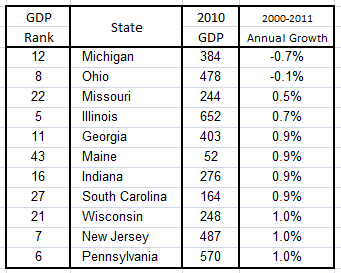
They’re the states whose GDP has grown the most from 2000 to 2010.

Great analysis in USA Today re: state-by-state shifts in the US economy.

A couple of angles from the data:

  • No surprise, income-tax-free Texas is soaring; Midwest rustbelt is struggling
  • 10 states generate over 1/2 of the US GDP
  • “Swing states” have slowest rates of growth (2nd chart)

Hmmm …

  Biggest State GDPs
image


Slowest Growing States 2000-2010
image

* * * * *

Why not use spoons?

June 24, 2011

This is a classic that I had forgotten.

Reprised in the WSJ in response to Obama’s blaming ATMs for taking jobs from gum-chewing tellers:

The story goes that Milton Friedman was once taken to see a massive government project somewhere in Asia.

Thousands of workers using shovels were building a canal.

Friedman was puzzled.

Why weren’t there any excavators or any mechanized earth-moving equipment?

A government official explained that using shovels created more jobs.

Friedman’s response: “Then why not use spoons instead of shovels?”

Now, I guess the President will be looking for spoon-ready public works projects …
* * * * *

“Your rebate check may look like junk mail”

June 24, 2011

Interesting experience, indication of a trend.

Bought a set of new tires … tire guy pointed out that there was an applicable rebate of $20 per tire … even auto-filled out the mail-in form for me.

His parting words:“Your rebate check may look like junk mail … make sure that you don’t accidentally throw it away.”

Nice of the guy.

Have you noticed how more and more rebate and claims checks are, in fact,  looking like junk mail?

Historically, few people go through the hassle of submitting all of the docs for rebates. Historically, less than 15% of earned  rebates are claimed.

It’s just not worth the time and aggravation.

I guess that some companies think the 15% redemption rate is too high.

So, they try to aggravate “breakage” … doing things to keep folks from cashing the checks they receive.

One way to do it —  make the checks look like junk mail.

No way to run a business …

* * * * *

Blah-blah-blah …

June 23, 2011

Obama’s speech last night was well-crafted with tight logic and clever metaphors.

But, Dennis Miller summed it up best: “more smoke than the Vatican announcing a new pope.”

I was afraid it was just me thinking that  Obama’s speeches have taken on a certain ‘tree falling in the woods’  character.

Like, who cares?

It’s not like anything is going to change.

The Middle East will continue to be a mess, we’ll continue to throw lives and money down the rat hole, and AlQaeda will just keep operating out of Pakistan, Yemen and other places.

Only difference: by declaring the withdrawal, Obama owns anything that goes wrong in Afghanistan.

Tell me again why anybody wants to be President ?

* * * * *

Interesting observation …

Paraphrasing Wolf Blitzer on CNN:

“The U.S. has 100,000 troops in Afghanistan, NATO has about 50,000, and there are supposed to be 300,000 in the Afghan security forces.  It’s estimated that there are fewer than 25,000 Talban and AlQaeda fighters in the country.  With a manpower advantage of almost 20 to 1, shouldn’t we be able to snuff these maggots out?”

Good question, Wolf …

* * * * *