Archive for the ‘Taxes’ Category

Per Simpson-Bowles … go ahead and limit the mortgage interest deduction.

November 16, 2012

Since I think Simpson-Bowles will be the template for the fiscal cliff resolution, I’ve been thinking about its provisions … starting with taxes (of course).

image

= = = = =

Mortgage Interest Deduction

Currently, income tax payers who itemize are allowed to deduct mortgage interest subject to some liberal restrictions:

  • Mortgages for both primary and second homes are allowed up to a combined mortgage balance of $1 million
  • Home equity loans— up to $100,000 are allowed with some restrictions on use of the funds

Simpson-Bowles proposed that:

  • The mortgage deduction be eliminated and replaced by a non-refundable tax credit.
  • The non-refundable credit would be equal to the interest on a primary home mortgage up to $500,000
  • No credit would be provided for interest on second home mortgages and home equity loans

Let’s do an example.

Say somebody is holding $1 million in mortgages carrying a 5% interest rate … annual interest paid = $50,000.

  • Under current tax regs, the $50,000 is tax deductible … so, if the taxpayer is in the 35% bracket, the deduction is worth $17,500 in tax savings.
  • Under Simpson-Bowles, only $500,000 of the mortgage qualifies … the imputed  interest on the $500,000 is $25,000 … so, the tax payer – regardless of his tax bracket would get a $3,000 credit against his taxes (12% times $25,000 = $3,000)

On balance, I side with with Simpson-Bowles on this one.

In fact, I’d probably be even more aggressive and phase the mortgage interest tax advantage out entirely over, say, 10 years.

My basic logic: Why should home owners get a tax break that’s not available to the 35% of people who rent the place where they live?

Said differently, why should renters who pay income taxes subsidize my mortgage?

And, it’s hard to say, with a straight face, that vacation homes deserve a tax break.

So, I say: start the process of eliminating the mortgage interest deduction.

What do you say?

* * * * *

Per Simpson-Bowles … go ahead, eliminate the deduction for state & local taxes.

November 15, 2012

Since I think Simpson-Bowles will be the template for the fiscal cliff resolution, I’ve been thinking about its provisions … starting with taxes (of course).

image

= = = = =

State & Local Taxes

Currently, income tax payers who itemize are allowed to deduct state & local taxes.

Primarily, that includes state & local income taxes and local real estate taxes.

I benefit from both.

Still, I side with with Simpson-Bowles on this one.

My basic logic: Why should Federal income tax payers is relatively low tax & spend states (think FL, TX) be forced to subsidize folks in high tax & spend states (think CA, NY, NJ, MD, DC).

If a goal of tax reform is fairness … that’s not fair!

So, I say: eliminate the deduction for state & local taxes.

What do you say?

* * * * *

Told you so: “Tax induced selling”

November 15, 2012

We’ve been on this theme for awhile … now the WSJ is reporting: Tax threat Prompts Selloff

Investors Dumping Winning Stocks Due to Expected Jump in Capital-Gains Rate

The prospect of higher taxes on capital gains is prompting many to unload some of their winning stocks.

Tax-induced selling is one factor some market watchers attribute to the recent declines.

“Tax rates are going up, and if you don’t plan to hold these stocks for a long time, now is the time to take advantage of the lower tax rates”

image

What we’ve said that the WSJ doesn’t say:

  1. Folks with gains may also find it advantageous to sell winners and immediately buy them back … paying the 15% cap gains tax … and re-pricing at a higher cost basis.
  2. This stock selling binge will generate a tax revenue windfall for the Feds in Q4
  3. For details, see Post-election: Government revenues will soar in Q4 … guaranteed.

Advice to GOP: Let Obama have his tax rates on the wealthy with a couple of twists.

November 14, 2012

I really don’t understand why Obama and the Congress are having such a hard time resolving the “revenue” issue, i.e. raising taxes.

Make no mistake, I’m opposed to raising taxes and then wasting the money … both of which are eventually going to happen.

image

That said, here’s what I’d do to break the log jam – a tax plan that protects small businesses (GOP goal) and soaks the rich (Obama’s focus):

1) Separate business income reported on 1040s from all other income … then cap the business income portion at 25% … allow losses to offset ordinary income.

  • Note: The system is already to set-up to handle multiple income streams taxed differently – e.g. ordinary income vs. capital gains.
  • Note: There will be a rash of LPs started to game the system … but, so what? Shouldn’t amount to that much.

2) Then, since Obama is obsessed with raising rates on “millionaires & billionaires” who make more than $250k, I would add some brackets:

  • Bump anything over $250k but less than $500k from 35% to 36%
  • Bump anything over $500k by an additional 2 points to 38%
  • Bump anything over $1 million by still an additional 2 points to 40%
  • Bump anything over $2.5 million by still an additional 2 points to 42%

Bingo … Obama gets his prized punitive rate on millionaires and billionaires making more than $250K without hurting small businesses, and there’s minimal impact on the millionaires (?) making less than $1 million.

It’s as easy as that.

Again, it’s not the way I’d attack the deficit problem, but if Obama’s bound and determined to raise income tax rates, this is how I’d do it.

Note: I must admit that I’m swayed by the inevitability of the GOP losing on this issue … and by an analysis I heard about that said that the vast majority of tax payers would be impacted live in NY, CA, NJ, MD and DC … blue states that overwhelmingly support Obama’s policies … there’s a certain poetic justice to them paying the freight.

Stay tuned for posts re:how I’d really attack the problem.

* * * * *

Taxes: Simpson-Bowles … be careful what you wish for, because you might get it.

November 13, 2012

I often read “Why don’t they just implement Simpson-Bowles?”.

It’s usually stated in a way that it’s a painless gimme.

The convenient compromise.

My hunch: About as many people read the Simpson-Bowles Report as read the  ObamaCare law.

image

I expect that S-B will become a template for any “grand bargain” … so I started refreshing my memory

= = = = =
Taxes

Below is the summary chart from the report.

Most of the buzz centers on the reduction of rates, elimination of the AMT, and capping of some deductions.

Let’s get specific.

Among other things, Simpson-Bowles proposes:

  1. Three brackets with a top tax rate of 28% with no AMT
  2. Capital gains & dividends get taxed at ordinary income tax rates … not 15%, not 20% … 28% at top rates
  3. Muni Bonds: Income on newly issued  municipal bonds gets taxed … i.e. existing bonds are grandfathered as Fed  tax-free.
  4. Employer paid health insurance premiums: Exclusion phased out by 2038 (2038?) via a complicated formula catering to unions … translation: employer paid health insurance premiums would eventually be taxed as ordinary income
  5. Deductions: Eliminate ALL itemized deductions … everybody takes the standard deduction … offset by some capped credits
  6. Mortgage deduction replaced by a 12% non-refundable tax credit … Mortgage capped at $500,000; No credit for interest from second residence and home equity loans
  7. Charitable giving: 12% non-refundable tax credit available above 2% of Adjusted Gross Income (AGI) floor … e.g. if you make $100,000, then no credit for the first $2,000 of charitable giving.
  8. No deduction or exclusion for State & Local Taxes … i.e. state income taxes, state sales taxes, local real estate taxes

Obviously, these changes hit different people in different ways.

Start planning …

= = = = =

Simpson-Bowles Report

image

Pssst: Your taxes are going up on January 1 … even if you’re not a millionaire or billionaire.

November 12, 2012

Just a friendly reminder that the tax man cometh the when the ball drops on Times Square.

There are 2 big ones: elimination of the 2% payroll tax “holiday” … and the ObamaCare tax on “unearned income”

= = = = =
Payroll Tax

For the past 2 years, payroll taxes – you know, the automatic deductions for Social Security and Medicare – were reduced by 2% to stimulate the economy.

The so-called “2% tax holiday” ends on December 31 and there are no apparent moves to renew it.

According to USA Today:

A temporary reduction in Social Security payroll taxes expires at the end of the year and hardly anyone in Washington is pushing to extend it. Obama hasn’t proposed an extension, and it probably wouldn’t get through Congress anyway, with lawmakers in both parties down on the idea.

Even Republicans who have sworn off tax increases have little appetite to prevent this one .

Bottom line: The expiration will cost a typical worker about $1,000 a year, and two-earner family with six-figure incomes as much as $4,500.

= = = = =
ObamaCare Tax

We written about this one before … see The 3.8% solution … here comes the tax pile-on for details.

In essence, one of the tax increases funding ObamaCare is a 3.8% tax on investment income … essentially slapping payroll taxes on so-called “unearned income”.

The “unearned income”  tax applies to:

  • dividends
  • interest, except municipal-bond interest
  • short- and long-term capital gains
  • income from the sale of a principal home (> $500k, not rolled over to another house)
  • a net gain from the sale of a second home
  • passive income from real estate and investments, such as limited partnerships.
  • the taxable portion of annuity payments
  • rents (received by landlords)

Of course, the tax doesn’t apply if you don’t have any of the above income sources.

But, if you do have investment income, the tax applied whether you’re a millionaire or billionaire or not.

“A majority of Americans agree that we should raise taxes on the wealthy” … oh, really?

November 10, 2012

During his presser on Friday, President Obama said:

A tax increase for wealthier Americans “was a central question during the election — it was debated over and over again, and on Tuesday night, we found out that a majority of Americans agree with my approach,” he declared.

Hmmm.

Either a non sequitor or flat out wrong.

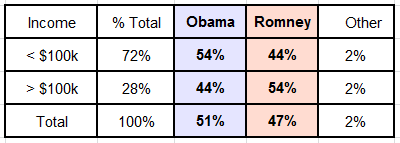
Based on CNN’s exiting polling ….

Overall, 47% said to raise taxes on the wealthy.

Hmmm … that “47%” number sounds familiar, doesn’t it? 

image

Not to get picky, but …

47% doesn’t constitute a majority … 48% said to either raise taxes on everybody (13%) or nobody (35%).

Drilling down a bit …

Yes, 70% of Obama voters say to raise taxes on the wealthy.

Why’s that?

Well, about 75% of Obama supporters have incomes less than $100k … so they are essentially saying: tax the other guy in order to preserve my benefits.

Doesn’t surprise me that they like the idea.

  • Math note: 72% X 54% = 39% / 52% (total % vote) = 75%

The majority of folks who would be impacted aren’t quite as keen on the idea.

image

Bottom line: I don’t see Obama’s “mandate” for jacking up taxes in the numbers …

Post-election: Government revenues will soar in Q4 … guaranteed.

November 8, 2012

Punch line: The planned (and anticipated) increases in capital gains tax rates will motivate stockholders to sell stocks and pay capital gains taxes at the current 15% rate.  As a result government tax revenues should soar between now and the end of the year  … and the market may dive.

= = = = =
Yesterday was day #1 of a highly likely – and predictable stock sell off.

Why a sell-off?

Well, some folks (i.e. me) expect a sharp market drop.

They’ll be selling —  if they haven’t already – to lock in  gains.

Why?

Because, it’s unlikely that President Obama will suddenly do a turnabout and become business-friendly.

So, despite perpetual quantitative easing, stocks are likely to be pressured.

Even if Obama does become pro-business, there’s the impact of the forthcoming capital gains tax bomb(s).

For openers, ObamaCare’s initial $1 trillion cost projections (which have already doubled) … were funded (on paper, that is) roughly half by cuts to Medicare and half by tax increases.

One of the tax increases is a 3.8% tax on investment income … essentially slapping payroll taxes on so-called “unearned income”.

“Unearned income” is defined as:

  • short- and long-term capital gains
  • dividends
  • interest, except municipal-bond interest
  • income from the sale of a principal home
  • rents
  • royalties
  • the taxable portion of annuity payments
  • a net gain from the sale of a second home
  • passive income from real estate and investments, such as limited partnerships

So, at a minimum, capital gains tax rates will go from 15% to 18.8%.

In addition, Obama is on record pushing for a 5 point increase in the base capital gains tax rate to 20%.

  • Note: Simpson-Bowles recommended a hike to the ordinary income tax rate.

Bottom line: the capital gains tax rate is likely to go from 15% to 23.8%.

One implication of increasing marginal tax rates is that investors have an incentive to sell appreciated stocks, bonds, and other assets before the end of the year … and pay the 15% rate instead of the jacked-up 23.8% rate.

As a result, tax revenues increase … when the capital gains taxes are incurred.

That is exactly what happened following the enactment of the Tax Reform Act of 1986, which increased the top capital gains tax rate from 20 percent to 28 percent.

Capital gains realizations almost doubled in 1986 and then fell back in 1987 as investors rushed to take advantage of the soon-to-expire 20 percent rate.

Similar behavior is likely this year unless investors believe that the threatened tax increases are merely head fakes.

= = = = =

Practical implications

Note: I don’t provide investment advice, but I’m willing to share some research I’ve done …

Question: I like my stocks and want to keep holding them … what to do?

You can sell them, pay the 15% rate on capital gains and buy the same stock back … resetting the cost basis at the buy-back price.

Question: Isn’t that a “wash sale”?

Nope.

Wash sale rules only apply to stocks sold at a loss.

When you sell stocks at a loss, you have to wait 30 days to buy them (or comparable stocks) back.

But, if you sell at a gain, you can rebuy immediately … it’s not a wash sale.

Question: I’m only re-investing 85% of the proceeds since I have to pay 15% capital gains taxes, right?

Remember, you only pay capital gains taxes on, well, the capital gains … not all the proceeds.

Question: But, with the laws of compound interest, I lose a lot by reducing my principle even a little, right ?

Based on my back-of-the-envelop calculations, a stock has to go up at least 70% to offset the benefits of taking advantage of the lower capital gains tax rates.

= = = = =
In summary

I’m expecting a stock sell-off in Q4 – partly from investors locking in gains and partly from folks arbitraging the capital gains tax rates – current and anticipated.

The most likely result: lower stock prices … but higher government tax revenues.

We’ll see ….

>> Latest Posts

Some bar stool economics

November 5, 2012

A variant of an old tale that’s making the email rounds…

image

Suppose that every day, ten men go out for a beer and the bill for all ten comes to $100.

If they paid their bill the way we pay our taxes, it would go  something like this:

  • The first four men (the poorest) would pay nothing.
  • The fifth would pay $1.00.
  • The sixth would pay $3.00.
  • The seventh would pay $7.00.
  • The eighth would pay $12.00.
  • The ninth would pay $18.00.
  • The tenth man (the richest) would pay $59.00.

So that’s what they decided to do.

The men drank in the bar every day and seemed quite happy with arrangement, until one day, the owner threw them a curve.

“Since you are all such good customers,” he said, “I’m going to reduce the cost of your daily beer by $20.00.”

Drinks for the ten men now cost just $80.00!

The group still wanted to pay their bill the way we pay our taxes so the first four men were unaffected.  They would still drink for free.

But what about the other six men – the paying customers?

How could they divide the $20 windfall so that everyone would pay their “fair share”?

They calculated that $20.00 divided by six is $3.33.

But if they subtracted that from everybody’s share, then the fifth man and the sixth man would each end up being PAID to drink beer.

That didn’t seem right.

The bar owner suggested that it would be fair to reduce each man’s bill by roughly the same percentage.

Under the bar owners plan:

  • The fifth man, like the first four, now paid nothing (100% savings).
  • The sixth now paid $2 instead of $3 (33% savings).
  • The seventh now paid $5 instead of $7 (28% savings).
  • The eighth now paid $9 instead of $12 (25% savings).
  • The ninth now paid $14 instead of $18 (22% savings).
  • The tenth now paid $49 instead of $59 (16% savings).

Each of the six was better off than before!

And the first four continued to drink for free.

But once outside the restaurant, the men began to compare their savings.

“I only got a dollar back out of the $20 savings,” declared the sixth man.

He pointed to the tenth man, “but he got $10!”

“Yeah, that’s right,” shouted the seventh man.  “Why should he get $10 back when I got only $2?  The wealthy get all the breaks!”

“Wait a minute,” yelled the first four men in unison.  “We didn’t get anything at all.  This system exploits the poor!”

The nine men surrounded the tenth and beat him up.

The next night the tenth man didn’t show up for drinks, so the nine sat down and had beers without him.

But when it came time to pay the bill, they discovered something important.

They didn’t have enough money between all of them for even half of the bill!

And that, boys and girls, journalists and college professors, is how our tax system works.

The people who pay the highest taxes get the most benefit from a tax reduction.

Tax them too much, attack them for being wealthy, and they just may not show up anymore.

In fact, they might start drinking overseas,  somewhere the atmosphere is somewhat friendlier.

For those who understand, no explanation is needed.

For those who do not understand, no explanation is possible.

David R. Kamerschen, PH. D.
Professor of Economics, University of Georgia

* * * * *
BTW: Atlas Shrugged Part 2 opens in theaters October 12th
www.atlasshruggedmovie.com

>> Latest Posts

The election in a nutshell … maybe jobs don’t matter as much any more!

October 18, 2012

There’s a sobering,  must read editorial in the WSJ today … Can Government Benefits Turn an Election?

Here are key points …

The federal government’s 120 means-tested programs today provide $1 trillion of benefits.

  • Unemployment insurance has stretched to 99 weeks
  • Record numbers of unemployed have qualified for disability benefits
  • Food stamps recipients have increase 40% to almost 50 million

The spending for these programs has grown 2½ times faster during the Obama presidency than in any other comparable period in American history.

To what extent might these benefits not just foster dependency but also make the economy’s performance seem less of a deciding factor in voters’ choices?

If you are concerned about your well-being and worried about a failed recovery — but getting new help from the government— do you vote for the candidate who promises more jobs or do you support the candidate who promises more government benefits?

Voters have historically set high standards and voted out incumbents not because they personally disliked them.

Rather, they’ve elected a new president because they understood the importance of a strong economy to their jobs, their income and the future prospects of their children.

Based on the economy, Mr. Obama should lose on Nov. 6. Yet it seems implausible that tens of millions of Americans who have received additional government benefits during his presidency can be completely unaffected by that largess. The election will test the relative power of private-sector aspirations and public-sector dependence.

Based on the economy, Mr. Obama should lose on Nov. 6.

Yet it seems implausible that tens of millions of Americans who have received additional government benefits during his presidency can be completely unaffected by that largess.

The election will test the relative power of private-sector aspirations and public-sector dependence.

Keep in mind that most jobs being created are relatively low paying service sector jobs … an increasing number of which are part-time … in part of duck Fed regulations and taxes (think, ObamaCare).

To get a visceral sense of the electoral “tension”, read Threats to Assassinate Romney Explode After Debate.

And, consider that an increasing number of folks feel that they are paying their fair  share (or more) with the government wasting much or most of the taxes it takes in …   what if those folks decide it’s not worth 60 hour weeks any more any more and shift into neutral?

This year’s election won’t be the end of the process … regardless of the outcome.

>> Latest Posts

HOT: If capital gains tax rates go up 8.8%, how much will after-tax capital gains ROIs go down?

October 16, 2012

Here’s another HOT: Homa Online Tutorial …

Well, Obama says he’ll jack capital gains tax rates from 15% to 20% … and ObamaCare has a 3.8 non-payroll payroll tax on investment income starting in 2013.

So, if Obama is elected and he keeps his promise … the effective capital gains tax rate goes from 15% to 23.8% … a delta of 8.8%.

That 8.8% tax rate increase will cut after-tax capital gains ROIs.

By how much?

Answer: The pre-tax ROI times 8.8%.

In other words, the answer depends on the proportion of a stock’s value that is unrealized capital gains.

The answer isn’t intuitive and the math is a bit hairy, so let’s run thru an example ….

* * * * *
Scenario 1 – CG Tax = 15%

Assume that you bought a stock for $750 and sold it for $1,000 … netting a $250 pre-tax gain.

The pre-tax ROI is 33% … $250 divided by $750.

If the capital gains tax is 15%, you pay $37.50 in taxes … netting you, after taxes, $212.50.

The after-tax ROI is 28.3% … $212.50 divided by $750.

* * * *  *
Scenario 2 – CG Tax = 23.8%

Again assume that you bought a stock for $750 and sold it for $1,000 … netting a $250 pre-tax gain.

The pre-tax ROI is still 33% … $250 divided by $750.

If the capital gains tax is 23.8%, you pay $59.50 in taxes … netting you, after taxes, $190.50.

The after-tax ROI is 25.4% … $190.50 divided by $750.

* * * * *
The Difference

The CG-ROI @15% is 28.3%, where CG-ROI @ 15% is the Capital Gains ROI at a 15% Tax Rate.

The CG-ROI @23.8% is 25.4%, where CG-ROI @ 23.8% is the Capital Gains ROI at a 23.8% Tax Rate

The difference is 2.9% … that is, the CG-ROI dropped by 2.9 percentage points.

Note that 2.9% is equal to the pre-tax ROI (33%) times the difference in the tax rates (8.8%)

* * * * *
The generalizable answer

By math magic, the difference in after tax ROIs  are always equal to the pre-tax ROI (which varies depending on the relationship between a stock’s unrealized capital gains and its cost basis) times the difference in the tax rates (in this case, the 8.8% difference between  15% and 23.8%).

If you’re interested, click to view the math work …  if you’re not, skip to the table below.

Here’s a handy look-up table.

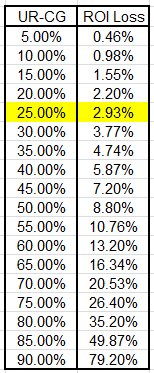
UR-CG are unrealized capital gains as a percentage of current stock market value.

In the above example, UR-CG equals 25% … $250 pre-tax capital gains divided by stock’s current market value $1,000 … and there’s a 2.9 percentage point drop in ROI.

As you’d expected, the greater the percentage of capital gains embedded in a stock, the greater the ROI hit if marginal tax rates go up.

image

* * * * *
So what?

I don’t give investment advice, but the numbers say that if you expect Obama to be re-elected … and if you expect him to keep his promise and jack up capital gains tax rates … and you have stocks with a high proportion of embedded capital gains … you should probably consider selling.

Technical tax note: Wash sales rules don’t apply to stocks sold at a gain … that is, you can sell them pay the capital gains taxes and immediately buy them back at a stepped-up basis (i.e. the current market price).

In a subsequent post I’ll work thru the math re: whether that makes sense.

>> Latest Posts

Limit the home mortgage interest deduction … outrageous!

October 16, 2012

Not really … and, it might come up in tonite’s debate.

First, keep in mind that 2/3’s of tax filers take the standard deduction rather than itemizing deductions … so they’d be unaffected.

And, keep in mind the roughly 1/3 of folks rent the place they live … they don’t get a direct mortgage interest deduction … though, economists argue, they get an indirect deduction since their landlords get to deduct mortgage interest as a business expense. So, the playing field would be leveled for home owners and renters.

So, what about limiting the deduction for those folks who currently own a home and  itemize deductions?

Well, for openers, the home mortgage interest deduction is already limited … there’s already a  $1 million cap on the size of a family’s mortgages that qualify for the deduction … the cap is $500,000 for individuals filing separately.

Interest paid on second homes can be included in the deduction, subject to the caps.

Note that the deduction isn’t a direct cap on the amount of interest that can be deducted … it’s a cap on the size of the mortgage(s) … so, a max’ed out family with a $1,000,000 mortgage @ 6% gets to deduct $60,000 … a family with a $1 MM loan at 4% gets to deduct $40,000.

With that as background …

Tightening the limits on the home interest mortgage deduction would be a fairly simple thing to do …

Specifically, what I’d do if I were Mitt:  Slide the limit down to, say $500,000 – which is about double the median home value in the country … disallow mortgage interest on second homes … and do not raise the cap with inflation… that way, the nominal value of the deduction would stick around forever, but “real” value of the deduction would slowly vanish over time … without jolting the real estate market.

Presto.

BTW: I’d get hammered by this change … but still, I think it would be a right thing to do.

P.S.  As I’ve said before, I’m also in favor of axing the deduction for state & local taxes … if states want to tax high and spend much, that’s their perogative … but, let residents of those states foot the bills … don’t lay off the cost to those of us living in fically responsible staes.  This change would fly politically for Romney since the high tax & spend states are blue ones that won’t vote for him any way … in most red states, Mitt’s proposed rate reductions would offset the loss of the deductions.

>> Latest Posts

HOT: If capital gains tax rates go up 8.8%, how much will after-tax capital gains go down?

October 15, 2012

Another HOT: Homa Online Tutorial

This is a relatively simple financial math question that most people I’ve asked have gotten wrong.

Answers have ranged from less than 8.8% – since only capital gains are being taxed (huh?) … 8.8% – because that’s how much the marginal rate is going up … to more than 8.8% – “otherwise you wouldn’t be asking the question”.

First, what’s magic about 8.8%?

Well, Obama says he’ll jack capital gains tax  rates from 15% to 20% … and ObamaCare has a 3.8 non-payroll payroll tax on investment income starting in 2013.

So, if Obama is elected and he keeps his promise … the effective capital gains tax rate goes from 15% to 23.8% … a delta of 8.8%.

That 8.8% increase will cut after-tax capital gains by 10.35% !

OK, let’s run thru the math.

click for the Homa Online Tutorial
image

* * * * *

Recap

Assume that you bought a stock for $750 and sold it for $1,000 … netting a $250 pre-tax gain.

If the capital gains tax is 15%, you pay $37.50 in taxes … netting you, after taxes, $212.50.

If the capital gains tax is 23.8%, you pay $59.50 in taxes … netting you, after taxes, $190.50.

The difference, is $22 ($212.50 less $190.50 … or simply, 8.8% times $250).

So the percentage drop in after-tax net gains is 10.35% ($22 divided by $212.50)

Note that that percentage stays constant at 10.35% regardless of the size of the gain —  in absolute or relative to proportionate cost basis.

That’s not a coincidence, it’s math.

With a capital gains tax rate of 15%, the after tax gain is simply 1 minus the tax rate times the nominal gain … 1 minus 15% is 85%.

With a capital gains tax rate of 23.8%, the after tax gain is simply 1 minus that tax rate times the nominal gain … 1 minus 23.8% is 76.2%.

The difference is still 8.8%, but the denominator of the change ratio is is 85%, not 100% … and, 8.8% divided by 85% is 10.35%.

Again, that answer is generalizable … not specific to this example.

Q.E.D.

* * * * *
Advanced Financial Math Question

How much will after-tax ROI go down if capital gains tax rates are increased by 8.8%?

Hint: The math is more complicated than the above example, because the answer depends on the cost basis of the stock relative to its current market value.

I’ll give the answer is a later post.

>> Latest Posts

Here comes the taxman … BOOM!

October 5, 2012

Great analysis published this week by the non-partisan Tax Policy Center that details the potential impacts if the Bush (and Obama) tax cuts are allowed to expire at the end of the year.

The entire report is worth reading if you’re in the 53% who do pay Federal income taxes … or if you’re at the top earning end of the 47% – since you’ll get banged, too.

According to the TPC, there will be different effects on households at different income levels:

For most households, the two biggest increases would be the expiration of the temporary cut in Social Security taxes and the expiration of the 2001/2003 tax cuts.

  • Households with low incomes would be particularly affected by the expiration of the credits expanded or created by the 2009 stimulus.
  • Households at the highest income levels would be particularly affected by expiration of the 2001/2003 tax cuts that apply to upper income levels and by the new health reform taxes.
  • Upper middle-income households would be particularly affected by the expiration of the AMT patch.
  • In addition to raising average tax rates, the fiscal cliff would substantially raise marginal tax rates.  The average marginal tax rate would increase by about 5 percentage points on wages and salaries, by about 5 percentage points on interest income, by about 7 percentage points on long-term capital gains, and by more than 20 percentage points on qualified dividends.

image

* * * * *
Potential Stock Sell-off

One implication of increasing marginal tax rates is that some investors would have an incentive to sell appreciated stocks, bonds, and other assets before the end of the year, if they believe the capital gains rate will go up as scheduled and then remain in place for tax year 2013.

That is exactly what happened following the enactment of the Tax Reform Act of 1986, which increased the top capital gains tax rate from 20 percent to 28 percent.

Capital gains realizations almost doubled in 1986 and then fell back in 1987 as investors rushed to take advantage of the soon-to-expire 20 percent rate.

Similar behavior is likely this year unless investors believe that the scheduled tax increases will be averted.

* * * * *

In summary: Ouch.

>> Latest Posts

Romney’s $17,000 tax fix … I like it!

October 3, 2012

According to ABC News, Mitt floated an elegantly simple idea for cleaning up the tax code:

Cut every bracket’s marginal rates and  limit deductions to $17,000.

Specifically, Romney said:

“As an option you could say everybody’s going to get up to a $17,000 deduction; and you could use your charitable deduction, your home mortgage deduction,  your healthcare deduction… to fill that bucket, if you will, that $17,000 bucket that way

And higher income people might have a lower number.”

For the record, the idea would hurt me personally since I carry a couple of jumbo mortgages and make charitable donations.

Still, I think the idea is GREAT.

It simplifies the tax code … and levels the field, say, between renters and home owners.

I’ll continue to give to charities … so will Mitt … so will most current donors.

If charities don’t have powerful enough value propositions to raise money, that’s their problem.

I really like that the change would screw folks in high tax Blue states – e.g. NY, CA – since the deduction for state & local taxes would fall under the cap.

There’s less of an impact on folks in well run states (like VA) … that’ll give tax & spend states more motivation to clean up their own acts.

Sure, there are plenty of details to be worked out (e.g. how to handle child credits) … but, I think this simple plan might be a game-changer.

>> Latest Posts

Back to the Clinton years? … Dems: Be careful what you wish for.

September 27, 2012

Lots of articles have been written about how the the bottom 50% pays no Federal income taxes and the very top tiers pay vast shares.

The usual cry from the Dems: what about payroll taxes?

Then, they holler: go back to the rates in effect during the glorious Clinton years.

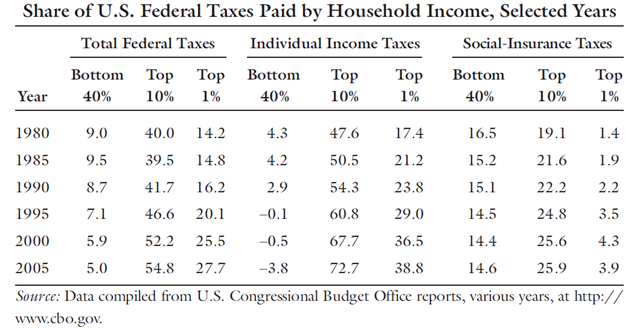
Well, the Independent Review pulled together Federal tax burdens back to 1980 … including payroll taxes

The key findings:

Since 1980, the bottom 40%’s share of total Federal taxes has almost halved … from about 9% to to 5%.

The top 10%’s share has grown about 15% … from 40% to almost 55%.

Most of the top 10%’s share  increase has landed where?

You guessed it … among the evil 1-percenters.

Geez.

If we could only get the wealthy to pay their fair share, we’d be out of this fiscal mess, right?

image

>> Latest Posts

Who pays taxes? Who benefits? … Here are some nums.

September 26, 2012

As loyal readers know, I’ve been trying to get my arms around this question.

In a prior post, we drilled down on taxes … or, as my Dem friends would say government “revenues”.

We posted that in 2012 Americans will pay a tad over $5 trillion in taxes to the Feds, States and Local Governments.

Drilling down, the $5 trillion is split roughly 50%-30%-20% to the Feds, States and Locals, respectively. Note that the Federal portion is just under $2.5 trillion.

image

* * * * *
If these are “revenues” there must be matching services provided, right?

I found a study by the non-partisan Tax Foundation that analyzes taxes paid and benefits received.

The study is old – using 2004 data – but, in my opinion is a good starting point to calibrate the answer.

First, the easy part …

The Federal tax revenues in 2004 were a bit over $2 trillion … compared to our $2.5 trillion projection in 2012.

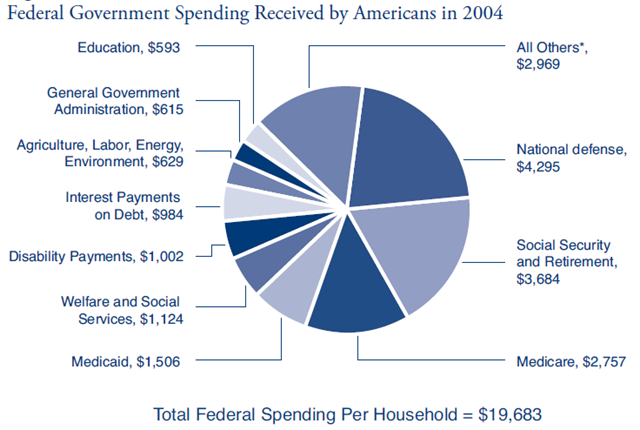
Here’s how the 2004 tax revenues were spent … i.e., the benefits received by citizens.

Note that the Federal spending is just under $20,000 per household.

image

* * * * *

The Tax Foundation analysts also sorted taxes paid by household income pentile against benefits received by the pentiles ….. and things got interesting.

The bottom pentile – households in the bottom 20% of income – pay about 2.5% of Federal taxes (including payroll taxes !) … and receive 1/3 of government benefits.

The top pentile pays over half of the Federal taxes and draws about 15% of government benefits.

The middle pentile comes close to breaking even – paying 14.1% of Federal taxes and getting 16% of government benefits.

image

* * * * *
Here’s another way to cut the data …

On average, households in the bottom pentile get $23,178 more in benefits than they pay in taxes; average households in top 20% run a deficit of almost $40,000 – that is, they pay about $40k in taxes than they receive in benefits; the breakeven point is somewhere around $50,000 in household income – that’s where taxes paid equal benefits received.

image

* * * * *
When state & local taxes and benefits are factored in, the surpluses and deficits grow even  larger.

The bottom 20% gets over $31,000 per household in net government benefits; the top 20% pays almost $50,000 per household more than it gets in government benefits.

The breakeven point is still somewhere around $50,000 in household income – that’s where taxes paid equal benefits received.

image

* * * * *

I’ll be hunting for more recent data.

Until I find it, chew on this!

Note: The Tax Foundation says it doesn’t have funding to update its study.

Nuts !

>> Latest Posts

How much can a family with 2 kids earn and still pay zero Federal income taxes?

September 25, 2012

The  answer is about $45,000

Reminder: Median household income is just a tad over $50,000

* * * * *
Here’s an analytical walk-through from the non-partisan Tax Foundation

Start with the answer: assume  a family of four making $45,000 in adjusted gross income.

Subtract a standard deduction of $11,600 and personal exemptions of $14,800 (four times $3,700) and the family’s taxable income is reduced to $18,600.

The family is taxed at 10 percent on their first $17,000 of income and at 15 percent for their remaining $1,600 of income, giving them a total tax liability of $1,940.

But, they allowed to deduct two tax credits of $1,000 for each of their two children.

And, they’re allowed to deduct an additional $214 due to the Earned Income Tax Credit, which is a credit designed to financially assist low to
moderate income working families.

Subtracting these tax credits from the family’s tax liability brings their $1,940 liability below zero.

However, since the child credits and Earned Income Tax Credit are so-called refundable tax credits, the family ends up receiving a check for $274 from the IRS for the remaining value of their tax credits.

For families who are eligible for other credits such as the child care credit, education credit, or the tax credit for purchasing a hybrid vehicle….. AGI can go higher than $45,000 with no tax liability.

image

* * * * *
Ironic Twist

The same George Bush that the left demonizes is the President who signed the 10% marginal tax bracket, boosted the child credits, and introduced the refunable tax credits.

The irony: liberals should be praising him and conservatives should be dissing him.

If it weren’t for the evil Bush tax cuts, we wouldn’t be at the now famous 47% level of folks not paying Federal income taxes.

image

Tomorrow: Who pays taxes and who gets the benefits?

>> Latest Posts

Flashback: About those 47% who don’t pay income taxes …

September 24, 2012

Romney sure caused a stir with his remark that 47% don’t pay Federal income taxes.

Well, the Homa Files was on this case over 4 years ago !

This analysis was originally posted on July 31, 2008 during the run-up to the election. It proves the point (ahead of its time) that less than half of all voters pay any income taxes now that “Make Work Pay” has been enacted (as part of the stimulus program). Think about it: the majority gets to demand more government programs that they don’t pay a cent towards. I think that’s scary. Very scary..

It’s the HFs post that continues to get the most hits, and the topic is ‘hot’ this week because of Mitt’s smokin’ gun video.

So, here’s a flashback …complete with numbers and sources.

* * * * *

Despite the drumbeat of warnings from various sources, the prospects that a minority of voting age Americans will be paying Federal income taxes under the Obama tax plan doesn’t seem to arouse much visible public anxiety.

Why?

First, for those in the emerging majority that won’t pay any income taxes – or may even be getting government checks for tax credits due – the deal is almost too good to be true. To them, Obama’s plan must make perfect sense. So, why rock the boat?

Second, some people argue that low-earning people who don’t pay income taxes shoulder a regressive payroll tax burden to cover Medicare and Social Security. Yeah, but these programs – which are most akin to insurance or forced savings plans — offer specific individual benefits that are directly linked to each wage earner’s contributions.and the benefits phase down quickly as qualifying income increases. That is, they’re not as regressive as many people argue.

Third, most of the energetic criticism of Obama’s plan has centered on its redistribution intent — taking over $130 billion of “excess” income from undeserving rich people, and giving it directly to those who earn less and need it more.

Fourth, most folks just don’t believe that the numbers will really shift enough to create a voting majority of citizens who don’t pay income taxes. They’re wrong. Very wrong.

Here are the numbers … and why they should bother you.

* * * * *

Today, 41% of voting age adults don’t pay Federal income taxes

Based on the most recent IRS data, slightly more than 200 million out of 225 million voting age Americans filed tax returns. That means that 25 million adults – presumably low income ones – didn’t file returns and, of course, didn’t pay any income taxes. See notes [1] to [4] below

Of the 200 million voting age filers, approximately 68 million (33% of total filers) owed zero income taxes or qualified for refundable tax credits (i.e. paid negative income taxes). [5]

Add those 68 million to the 25 million non-filers, and non-payers already total 93 million – 41% of voting age adults.

* * * * *

Obama’s Estimates – Make that 49%
Not Paying Federal Income Taxes

Obama says (on his web site) that he will give tax credits up of $1,000 per family ($500 per individual) that will “completely eliminate income taxes for 10 million Americans”. And, he says that he will “eliminate income taxes for 7 million seniors making less than $50,000 per year.” [6]

Taking Obama’s estimates at face value, the incremental 17 million that he intends to take off the income tax rolls will push the percentage of non-payers close to 49% of voting age Americans — within rounding distance to a majority. [7]

* * * * *

And, Obama’s estimates are probably low,
so make the number 55% (or higher)

Since Obama’s basic proposal is for tax credits ($500 per person or $1,000 per family) – not simply deductions from Adjusted Gross Income (AGI) — they will have a multiplier impact on the amount of AGI that tax filers can report and still owe no taxes.

For example, a childless married couple that files a joint return can currently report about $17,500 in Adjusted Gross Income (AGI) and owe no income taxes. [8]

Under the Obama Plan, that couple’s zero-tax AGI is bumped up to $27,500 since their new $1,000 tax credit covers the 10% tax liability on an additional $10,000 of AGI. And, married couples filing jointly can keep adding about $10,000 to their zero-tax AGI for each qualifying dependent child that they claim. [9]

click table to make it bigger

click table to make it bigger

Based on the 2006 IRS data, approximately 25 million tax returns were filed that reported AGI less than $27,500 (the post-Obama zero-tax AGI) and required that some income taxes be paid. [10]

Assuming that 45% of those were for couples filing jointly, they represent over 22 million adults. For sure, these 22 million will come off the tax rolls – and they alone will be enough to create a non-taxpayer majority (51% of voting age adults),

click to make table bigger

And, there are more folks being pushed off the tax rolls. About 4.7 million childless individuals earn less than $13,750 (the post-Obama zero-tax AGI for childless individuals), and currently pay some Federal income taxes. This group will shift to non-payer status.

So would several million joint filers who can take advantage of the Child Tax Credit to report more than $27,500 and not pay Federal income taxes.

And, some portion of the 7 million Seniors that Obama says will have their taxes eliminated — that is the Seniors couples earning more than $27,500 (but less than $50,000) — and Senior individuals earning more than $13,750 (but less than $50,000).

So, post-Obama, the percentage of non-taxpayers will easily exceed 55% of voting age adults — a solid majority. It won’t even be close.

* * * * *

The Bottom Line – Why You Should Worry

An income tax paying minority of voting age adults isn’t just a possibility. Under Obama’s plan, it’s a virtual certainty. Based on the hard numbers, Obama’s plan will create a new majority — a powerful voting block: non-tax payers. UH-OH.

Again, for those in the emerging majority that won’t pay any income taxes – or may even be getting government checks for tax credits due – the deal is almost too good to be true. To them, Obama’s plan must make perfect sense. Count on their perpetual support for the plan.

But for those in the new minority, watch out if the new majority decides that more government services are needed, or that $131 billion in income redistribution isn’t enough to balance the scales.

The Tax Foundation — a nonpartisan tax research group – has repeatedly warned that “While some may applaud the fact that millions of low- and middle-income families pay no income taxes, there is a threat to the fabric of our democracy when so many Americans are not only disconnected from the costs of government but are net consumers of government benefits. The conditions are ripe for social conflict if these voters begin to demand more government benefits because they know others will bear the costs.” http://www.taxfoundation.org/research/show/1111.html

* * * * *

Sources & Notes

[1] The Census Bureau reported 217.8 million people age 18 and over; as of July 1, 2003.
http://www.census.gov/Press-Release/www/releases/archives/population/001703.html

http://www.census.gov/popest/national/files/NST-EST2007-alldata.csv

[2] The IRS reported 138.4 million personal tax returns filed in 2006.
http://www.irs.gov/pub/irs-soi/06in11si.xls

[3] The IRS reported that in 2006, approximately 45% of filed returns were by married couples filing jointly (i.e. 2 adults per return); 55% for individual filers (including ‘married filing separately’ and ‘head of household’). http://www.irs.gov/pub/irs-soi/06in36tr.xls

[4] Calculation: 138.4 million returns times 1.45 (adults per return) equals 200.7 million adults represented on filed returns

[5] http://www.irs.gov/pub/irs-soi/06in01fg.xls http://ftp.irs.gov/pub/irs-soi/06inplim.pdf

[6] http://www.barackobama.com/issues/economy/#tax-relief

[7] Analytical note: 93 million plus 17 million equals 110 million divided by 225 million equals 49%.

[8] Analytical note: $17,500 less a $10,700 standard deduction, less 2 exemptions at $3,400 each, equals taxable income of zero – so no federal income taxes are due.

[9] Analytical note: $27,500 less a $10,700 standard deduction, less 2 exemptions at $3,400 each, equals taxable income of $10,000, which at a 10% rate is a $1,000 tax liability that gets offset by the $1,000 Obama credit, reducing the tax liability to zero.

[10] http://www.irs.gov/pub/irs-soi/06in11si.xls

* * * * *

>> Latest Posts

Breaking news: Romney’s tax rate only 14.1% … but his all important GBSR is 43%

September 21, 2012

OK, Romney released his 2011 tax return.

  • In 2011, the Romneys paid $1,935,708 in taxes on $13,696,951 in mostly investment income.
  • The Romneys’ effective tax rate for 2011 was 14.1%.
  • The Romneys donated $4,020,772 to charity in 2011, amounting to nearly 30% of their income.

Holy Buffett, Mitt only paid 14.1% in Federal income taxes … a lower rate than Warren’s secretary.

Scoundrel.

Let’s re-write the tax code.

Not so fast.

Last fall, the Homa Files coined a new metric: the GBSR™ – “Give Back to Society Rate

We defined the GBSR™ as the sum of taxes paid plus charitable contributions – since those are all money that’s supposed to be going to the common good, albeit administered by different organizations – divided by AGI.

In Romney’s case, his release says that he made $13.7 million … paid $1.9 million in taxes … and donated a whopping $4.02 million to charities.

So, his tax rate may sound meager @ 14.1%, but his GBSR™ is about 43% – and that’s not counting state & local income taxes.

My bet: add S&L taxes in and Mitt‘s GBSR™ is way over 45%.

So, it just may be that the tax code is leading fat cats to do the right thing – it’s just that they’re giving much of their dough to private charities instead of the Feds.

Do you blame them?

* * * * *
Romney’s 20 year tax history

According to the Standard ,,,

  • In each year during the entire 20-year period, the Romneys owed both state and federal income taxes.
  • Over the entire 20-year period, the average annual effective federal tax rate was 20.20%.
  • Over the entire 20-year period, the lowest annual effective federal personal tax rate was 13.66%.
  • Over the entire 20-year period, the Romneys gave to charity an average of 13.45% of their adjusted gross income.
  • Over the entire 20-year period, Romney’s GBSR™ the total federal and state taxes owed plus the total charitable donations deducted represented 38.49% of total AGI.

* * * * *
For comparison …

Filers in Obama’s millionaire range ($200,000 to $250,000) donate about 2.5% of their income to charities.

image

>> Latest Posts

Buffett Rule passes the House … now, you’re talking.

September 20, 2012

What gridlock in Washington?

Yesterday, the House of Reps passed a Buffett Rule that should put an end to Warren’s carping about how his taxes are too low.

According to the Washington Times:

The House passed Republicans’ own version of the Buffett Rule, which allows wealthy Americans to voluntarily pony up to reduce the deficit.

The bill, labeled the Buffett Rule Act, passed by voice vote, meaning Democrats and Republicans agreed with it.

Under the legislation, taxpayers can check a box on their taxes and send in a check for more than they owe to the IRS.

“If Warren Buffett and others like him truly feel they’re not paying enough in taxes, they can use the Buffett Rule Act to put their money where their mouth is and voluntarily send in more to pay down the national debt, rather than changing the entire tax code to inflict more job-killing tax hikes on hard-working Americans.”

Current law already allows taxpayers to send money to pay down the debt, but the process is a bit onerous.

Under their new plan, taxpayers would have an easy option on their tax returns allowing them to pay more.

Under the legislation, the money would go directly toward reducing the debt.

So, do you think Buffett will put his money where his mouth is?

I’m betting the under.

>> Latest Posts

Reprise: Who do income tax payers support – Obama or Romney?

September 19, 2012

We posted this last week, ahead of the curve …

Since the bruhaha erupted when Carter’s grandson leaked the pirated tape of Romney speaking to donors, I thought a repost was in order …

Bottom line: It’s not 100% taxpayers for Romey; 100% non-taxpayers for Obama … but there is a statistically significant difference.

* * * * *

Who do tax payers support – Obama or Romney?

That’s an easy one … but, the latest CNN poll was the first I spotted that divides the population along those lines … or, at least, sorta does.

CNN breaks the sample by those earning less than and more than $50,000 .

$50,000 is about the point where folks have to start paying Federal income taxes.*

No surprises in the data.

Romney has the edge among Federal tax payers.

Obama gets those who don’t pay Federal income taxes … by a whopping 57% to 42%.

Uh-oh.

image

* P.S. Yeah, yeah, yeah about payroll taxes … but they are “insurance” payments with directly associated benefits.

>> Latest Posts

Why do so many Americans hate paying income taxes?

September 19, 2012

It’s not simply about the money.

Researchers Jeff Kidder of Northern Illinois University and Isaac Martin from the University of California-San Diego have found that there are moral underpinnings that help explain why many hate paying taxes.

Rather than being associated with a free-market ideology or a person’s own economic interests, tax hostility is more linked with moral principles.

image

“Tax talk is about dollars, but it is also about a moral sense of what is right.”

Generally, respondents saw income taxes as violating the moral principle that hard work should be rewarded.

The respondents “portray taxation as a threat to the moral order because they believe taxes deprive deserving hardworking middle class people of dignity, while rewarding others who are undeserving (both rich and poor)”.

Entrepreneurs are particularly anti-tax.

In fact, a recent survey by payroll service provider Paychex found that tax codes, along with employment regulations and retirement security are the top three election issues for small business owners.

Source: LiveScience extract from the Journal Symbolic Interaction

Which states’ residents are most impacted by Obama’s plan to raise taxes on the rich?

September 12, 2012

This may be common knowledge, but it was a surprise to me …

Based on the 2009 census data (latest available), just under 4% of U.S. households have income greater than $200,000.

Below are the 20 states with the highest proportion of households with incomes greater than $200,000 … led by DC, Connecticut, New Jersey and Maryland (a suburb of DC).

The interesting part:

15 of the states (or 16 depending on how you count Colorado) are Blue- Democratic states

… only 3 are Red-Republican states

… 2 are Purple-Swing states.

Hmmm.

image

>> Latest Posts

In total, how much do Americans pay in taxes? For what? To whom?.

September 11, 2012

Americans pay a tad over $5 trillion in taxes to the Feds, States and Local Governments.

Technical note: In government parlance, the taxes are called “revenue”.

By taxing authority

Drilling down, the $5 trillion is split roughly 50%-30%-20% to the Feds, States and Locals, respectively

image

* * * * *

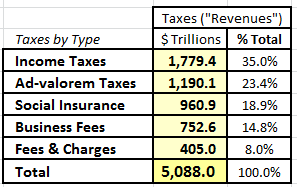
By type of tax

Roughly 1/3 of the $5 trillion is income taxes individual and corporate)

about 1/4 is ad valorem taxes (think sales and property taxes)

just under 1/5 are social insurance (i.e. Social Security, Medicare, Medicaid)

… slightly more than 1/5 are fees and charges (think tolls, business licenses)

image

* * * * *

Income taxes

Roughly 1/3 of the $5 trillion – about $1.8 trillion — is income taxes

…  83.4% are individual income taxes; only 16.6% are corporate income taxes

… about 80% of income taxes go to the Feds; around 20% goes to the States & Locals

image

* * * * *

Ad-valorem taxes

Roughly 1/4 of the $5 trillion in total taxes paid – about $1.2 trillion – is ad-valorem taxes – taxes paid based on the value of something bought or owned.

…  about 40% of ad-valorem taxes are Local property taxes

…  about 1/3 are Sales Taxes …  going mostly to the States

image

* * * * *

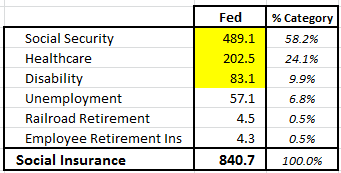
Social Insurance

Roughly 1/5 of the $5 trillion in total taxes paid – about $961 billion – is social insurance – with about 80% going to the Feds

…  roughly 60% of the social insurance payments going to the Feds is for Social Security

…  almost 1/4 of the social insurance payments going to the Feds is for Medicare.

image

* * * * *

Pulling it all together Ken’s Rosetta Stone of Taxes

All the details — now much? to whom? for what?

Click for a PDF: Ken’s Rosetta Stone of Taxes

image

PDF          Data Source

>> Latest Posts

Who do tax payers support – Obama or Romney?

September 7, 2012

That’s an easy one … but, the latest CNN poll was the first I spotted that divides the population along those lines … or, at least, sorta does.

CNN breaks the sample by those earning less than and more than $50,000 .

$50,000 is about the point where folks have to start paying Federal income taxes.*

No surprises in the data.

Romney has the edge among Federal tax payers.

Obama gets those who don’t pay Federal income taxes …  by a whopping 57% to 42%.

Uh-oh.

image

*  P.S. Yeah, yeah, yeah about payroll taxes … but they are “insurance” payments with directly associated benefits.

>> Latest Posts

Is the Federal government a good value?

August 28, 2012

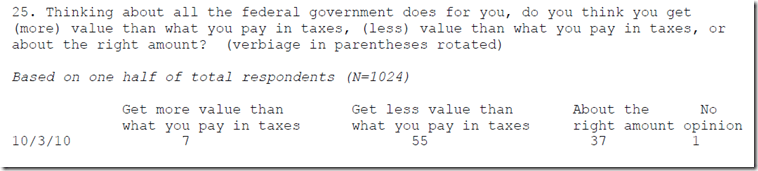
A Kaiser Foundation survey asked folks:

Thinking about all that the Federal government does for you, do you think that you get more or less value than what you pay in taxes?

The results

  • Less than 10% said that they got more value than what they paid in taxes.
  • About 1/3 thought they got about the right value for taxes paid
  • More than half of the respondents said that they got less value than what they paid in taxes.

Of course, the last finding is most interesting since it’s a majority … and since about half of the folks don’t pay any income taxes.

Hmmm

* * * * * *

Source question

image

>> Latest Posts

News flash: Many people strongly dislike paying taxes … here’s proof.

August 28, 2012

Most people dislike paying taxes.

Many  people strongly dislike paying taxes.

No surprise, the tax aversion tendency is most prevalent among people who identify with political parties that generally favor less taxation.

image

Although this distaste could be rational on economic grounds, a recently published study  shows  that this attitude extends beyond simply disliking the costs incurred and affects behavior in “counternormative” ways … a phenomenon coined “ tax aversion”: a desire to avoid taxes per se that exceeds the rational economic motivation to avoid a monetary cost.

The researchers  provide evidence that people have a stronger preference to avoid tax-related costs than to avoid equal-sized (or larger) monetary costs unrelated to taxes.

  • For example, the proportion of Americans who said they’d travel 30 minutes to save 8% on an item by getting it tax-free was 29% bigger than the proportion who said they’d travel the same distance to get an ordinary 9% discount.
  • Similarly,  more than 4 times as many Americans said they’d rather invest in a bond that offered a $120 annual tax-free return than a bond that offered $160 but required a $40 tax.

The researchers say that tax aversion can be mitigated by identifying positive uses of tax payments.

>> Latest Posts

The “fair share” canard …

August 28, 2012

Of course, President Obama is continuing to rant that the rich need to pay their fair share.

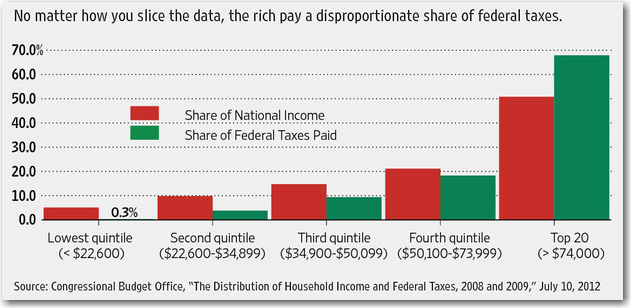
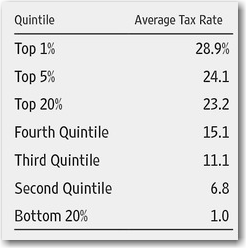
Well, according to a recent report by the Congressional Budget Office (CBO), the rich are paying their fair share.

Based on a WSJ analysis of the CBO data:

  • The average federal tax rate on the top 20% is 23.2%. The 20% of taxpayers earning between $50,100 and $73,999 pay an average 15.1%, and so on down the line.
  • The top 20% of income earners (over $74,000) make 50% of the nation’s income but pay nearly 70% of all federal taxes;  The remaining 30% of the tax burden is borne by 80% of tax filers

Some inconvenient facts, right?

image

image

>> Latest Posts

Interesting twist: Is the U.S. tax system progressive or regressive?

August 23, 2012

A couple of years ago – in the HomaFiles most read post – I tried to answer the question: “Is the U.S. tax system progressive or regressive?

My conclusion: progressive … for sure.

TIME even picked up the post and said I was “fair minded” and “undeniably right”.

Case closed, right?

Well – in the spirit of fair mindedness – I’ve done some analyses that indicate some degree of regressiveness.

Oh my …

* * * * *

Oft-reported are the facts that — except for anomalies — higher income folks pay higher average income tax rates.

image

So, why does Warren Buffett whine that his taxes aren’t high enough and middle income people feel so squeezed.

Well, here’s a partial answer.

A couple of weeks ago the Fed released a report that caught my eye.

The Fed’s Survey of Consumer Finances reported a substantial drop in Americans’ net worth … especially for those in the middle income ranges.

image

Given the net worth numbers, I tried a different twist on income tax rates … rather than the usual income taxes as a percentage of income, I calc’d another ratio: income taxes as a percentage of net worth.

Gets interesting …

image

The lowest half still pays nothing or gets a credit. … that doesn’t change no matter how you cut it.

But, the mid-income ranges pay the highest % of net worth.

While only a point or two, suddenly progressive rates becomes regressive.

Hmmm …

>> Latest Posts

Low blow: Reid accuses Romney of being in the majority … not the 1%.

August 3, 2012

In a Huffington Post article, former boxer and now (punch-drunk) Senate Majority Leader Harry Reid charged that Mitt Romney …

“ …didn’t pay taxes for 10 years!

Now, do I know that that’s true? Well, I’m not certain,” said Reid.

“But obviously he can’t release those tax returns.

How would it look?

Hmmm.

If true, that puts Romney in good company: the roughly 50% of tax filers who pay no income taxes.

Suddenly, Mitt’s a person of the people  … a populist.

OMG.

* * * * *
P.S. Even Jon Stewart called out Reid on this one!

Watch the vid clip

>> Latest Posts

TAX WARNING to DINKs: The marriage penalty is coming back …

July 31, 2012

One of the provisions of the Bush tax plan was to eliminate the so-called marriage penalty … the tax rules and rates that had a husband & wife pay more income taxes if they were married than if they stayed single.

I’ve been bemused that in all of the chatter about Obama’s obsession with jacking rates, I haven’t heard anything about the resurrection of the marriage penalty …  at least for evil rich people.

image

Here’s the rub: Obama’s tax hikes apply to individuals earning more than $200,000 and families earning more than $250,000.

Let’s do a simple example: Sally and Bob – single and living together – each earn $200,000.

So, Obama doesn’t touch their wallets.

But, if Sally & Bob get married … then BAM !

Their income taxes go up about $6,000.

Huh?

Of their $400,000 combined income, the first $250,000 is immunized from Obama’s tax hikes.

But, the $150,000 over the $250,000 ceiling on fair earnings … gets hit with the roughly 4% increase in the upper bracket marginal tax rates (from 35% to 39.6%).

Simple arithmetic: $150,000 times 4% = $6,000.

Back to the key point: tying the knot costs Bob & Sally about $6,000 annually in added taxes.

On average, that accumulates to about $250,000 in added taxes over their expected lifetimes … just because they got married.

Is that fair?

Note: polls consistently say that singles lean more towards Obama than do married folks.

It’s called economic rationality.

>> Latest Posts

Seeds of a revolt: Legal tax avoidance is gaining momentum …

July 12, 2012

A hot topic at BBQs this summer is the impact of Obama’s tax increases … the elimination of the so-called Bush tax rates and, now, the increased likelihood of the ObamaCare hits.

Back in the 70s — before Reagan — tax shelters were the rage … finding ways to transform ordinary income into lesser taxed capital gains and generate paper losses from generous depletion & depreciation allowances.

I’m sensing a return to the 70s mindset.

In the past couple of weeks, I’ve heard of  or seen …

  • A Maryland family plan to relocate to Northern Virginia to dodge Maryland’s increased sales, income and estate taxes.
  • Five Maryland exec-families establishing primary residencies in Florida … to take advantage of Florida’s income and estate tax rates … according to CNBC, they’re a microcosm of rich fleeing MAryland
  • Savvy investors talking about buying municipal bonds as a way of avoiding higher Fed income taxes … especially if dividends start getting whacked at ordinary income tax rates.
  • People going across state lines and ramping up internet purchases …  to minimize sales taxes
  • Merchants and contractors encouraging payment in cash … sometimes with accompanying discounts … to get income “off-the-books”

Most of the tactics are completely legal.

My point: tax avoidance is becoming a popular sport … fed-up tax payers are starting to revolt.

Tax & spend politicos should take heed … their rosy tax hike projections might not materialize as planned.

>> Latest Posts

The 3.8% solution … here comes the tax pile-on.

July 10, 2012

Taxes will be going up … thanks to  ObamaCare and Justice Roberts.

Flashback: ObamaCare’s initial $1 trillion cost projections (which have already doubled) … were funded (on paper, that is) roughly half by cuts to Medicare and half by tax increases.

One of the tax increases is a 3.8% tax on investment income … essentially slapping payroll taxes on so-called “unearned income”.

“Unearned income” is more than dividends and capital gains.

According to the WSJ

The tax applies to:

  • dividends;
  • rents;
  • royalties;
  • interest, except municipal-bond interest;
  • short- and long-term capital gains;
  • the taxable portion of annuity payments;
  • income from the sale of a principal home;
  • a net gain from the sale of a second home;
  • passive income from real estate and investments, such as limited partnerships.

The tax does not apply to:

  • payouts from a regular or Roth IRA, 401(k) plan or pension;
  • Social Security income; or annuities that are part of a retirement plan.
  • life-insurance proceeds;
  • municipal-bond interest;
  • veterans’ benefits; Schedule C income from businesses

Also, the tax does not apply to  non-resident aliens.

Couple of mega-takeaways:

1) Municipal bonds benefit … not subject to the ObamaCare surcharge … and don’t count towards the $250k AGI trigger.

2) Renters lose … landlords are likely to pass along the surcharge to higher rents

3) Housing prices pressured … double-whammy … higher cap gains taxes make houses less attractive as investments … rents tax decreases motivation for investors to buy and rent homes.

4) Seniors lose … if they shifted their retirement portfolios to fixed incomes … since interest and dividends get hit … dividends especially since they’ll also get hit with an increase in income tax rates — from 15% to as high as 39.5%

At least our health insurance premiums are going down … NOT !Could be worse … our health insurance premiums could be going up … oops, they are.

Oh well …

>> Latest Posts

“Prosecutorial Discretion” … the chickens will come home to roost on this one!

July 3, 2012

Long ago … you know, the week before last, King-O ruled by Executive Order that Illegal “dreamers” wouldn’t be deported (though the law says they should be), that illegals ID’ed in Arizona won’t be processed by Feds (though the law says that they should be), etc.

Setting the politics aside, the legal justification is called  “prosecutorial discretion”.

That means that not all laws are to be enforced … only those that the executive branch of government judges to be worthy of enforcement.

While Dems are cheering Obama’s “bold stroke”, I’m betting they’ll rue the day.

Let me give you a couple of examples why …

The Individual Mandate

OK, un-conservative Chief Justice Roberts ruled that the penalty — err, “tax” — is constitutional and has the force of law.

Fast forward to January 2013 … and, imagine a President Romney.

Now, imagine a President Romney issuing an Executive Order to the IRS that they should not enforce ObamaCare’s individual mandate.

Better yet, imagine him reversing the executive action to add 16,000 IRS agents to enforce the individual mandate … or for that matter, any ObamaCare provisions, say the 3.8% surcharge tax on investment income.

Boom.  Gone !

“Prosecutorial discretion” in action.

Think Dems will refer to it as Romney’s bold stroke?

* * * * *
Taxes on Dividend Income

For decades — maybe centuries — economists have argued against the double taxation of dividends … once at the corporate level, once at the individual level.

What if President Romney declares — by Executive Order — that the IRS should stop collecting taxes on dividend income and stop chasing down folks who don’t pay the taxes voluntarily.  So what if the law is on the books?

Boom. Gone.

No Congressional action required.

Just garden variety prosecutorial discretion.

* * * * *
I bet you get the picture …

My instincts tell me that the principle of the executive branch cheery-picking the laws it likes isn’t a long-term winner.

As old Rev. Wright would say: “The chickens will come home to roost on this one.

>> Latest Posts

In the good old days, 88% paid Federal income taxes… not now!

June 6, 2012

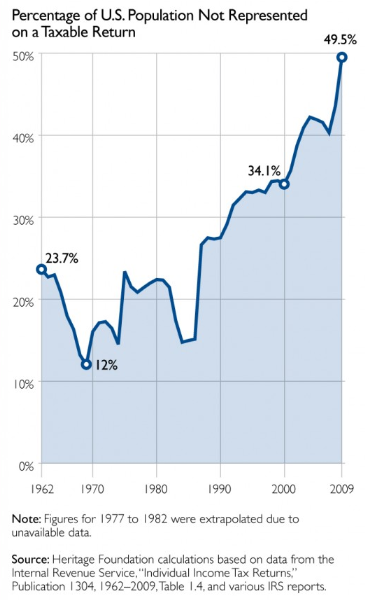
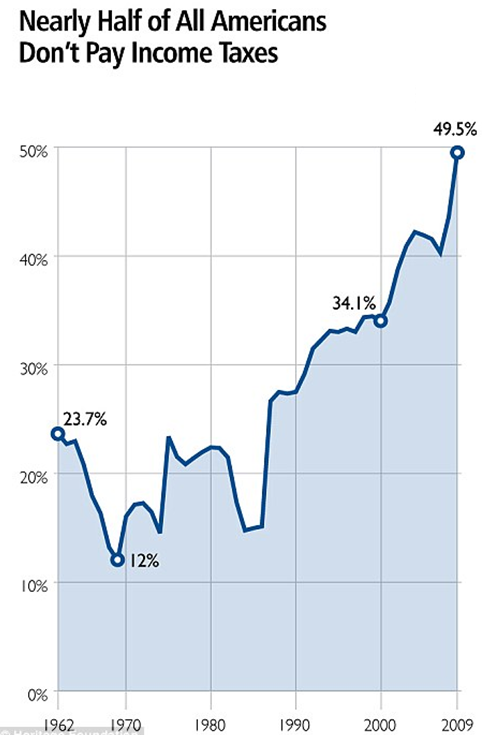
OK, you gotta go way back to  1969, but then, 88% of the U.S. population was represented on a taxable return — either as a taxpayer or a dependent.

Now, according to the Heritage Foundation, that number is down to about 50%.

image

While Obama’s policies (and the recession) have ticked us to a non-taxpaying majority, the blame (or credit, depending on your perspective) belongs to Bush … when he took office in 2001, about 2/3s of the population were represented on taxpaying returns … when he left office in 2009, we were close to the 50 / 50 split.

While the Dems like to harp on the tax breaks to millionaires and billionaires, a whopping 15% of the population benefited by being taken off the tax rolls.

Maybe the economics are sensible, but the political dynamics aren’t …

>> Latest Posts

“Tax morale” … why some folks don’t pay up.

April 26, 2012

Did you know that there’s a field of study devoted to the subject of how individuals make choices about paying taxes; it’s called “tax morale.”

According to BusinessWeek, the IRS studied the factors motivating taxpayers to comply with tax laws and concluded that the” fear of getting caught plays a much smaller role in keeping taxpayers honest than is commonly assumed.” They’re less inclined to dodge when they believe that their cheating creates national problems.

On the flip-side, when taxpayers learn that many people evade taxes, they are more likely to evade them, too. 

And, the IRS hired  social anthropologists to look more closely at the behavior of tax dodgers.

They divided evaders into eight categories of noncompliance.

  • Procedural noncompliants don’t pay taxes because IRS procedures are too complicated.
  • Asocial and habitual noncompliant taxpayers get a rush out of cheating.
  • Symbolic noncompliant taxpayers game the system out of principle.
  • Brokered noncompliants use accountants and lawyers to cheat
  • Some who don’t comply simply can’t afford their tax burden, or are too lazy to file.
  • Generational noncompliers think it’s normal not to pay taxes because people in their families didn’t pay.

The sociologists also found that there are towns in the U.S. inhabited by super-taxpayers who have high compliance rates in numbers and percentage of taxes due that are paid.

Now, the IRS is trying to identify the  super-tax-paying communities’ demographics to pinpoint what makes their residents so honest.

Among the hypotheses: an inspiring pastor, an immigrant community with values from the home country, or really good public schools.

Maybe they should test the locales’ water supply …

>> Latest Posts

John “The Plumber” Lovitz rants on Obamanomics… ouch!

April 25, 2012

Former SNL comedian John Lovitz voted for Obama in 2008.

Now, he’s expressing his disappointment in a very “colorful” way.

The essence of his rant goes to the core of what bothers many besieged taxpayers.

“I voted for the guy and I’m a Democrat.

First they say … ‘You can do anything you want. Go for it.’

So then you go for it, and then you make it, and everyone’s like, ‘F— you’ … give me half … no, that’s not enough, give me more than half.

This whole thing with Obama saying the rich don’t pay their taxes is f—ing bulls—.”

Worth listening to the whole thing … if you don’t mind a few bad words … and want a few yuks

image

>> Latest Posts

The “Buffett Rule” that I want to see …

April 18, 2012

Two events this week got me thinking.

First, the Senate held the campaign-ploy vote on Obama’s Buffett Rule — intended to double capital gains tax rates on millionaires & billionaires”.

Then last nite, Buffett disclosed that he has been diagnosed with prostate cancer.  Consistent with the experience of several of my friends, Buffett says it’s not life-threatening, given the early detection and high success rate of treatments.  I wish him well … in our family, we take cancer very seriously.

That said, the events rekindled my thinking re: tax changes required to advance Buffett’s mission to “pay his fair share”. 

I got it !

 Simply stated:

Ken’s “Buffet Rule”

For purposes of estate taxation, estates shall be limited to a maximum deduction of $1 million for charitable donations. 

Now that Buffett has leveraged the tax laws to amass his $62 billion fortune, he advocates higher taxes for high-earners.

He’s suddenly amped about everybody paying their fair share.

Give me a break.

Let’s walk through Saint Warren’s personal “fair share” plan.

First, to the extent that any of Buffett’s wealth is in stocks with  “unrealized capital gains” … the the dough gets bequeathed at a “stepped-up basis”.

English translation: no capital gains get paid on his “unrealized gains” … ever !

Nice dodge, right? 

Ken’s Buffett Rule doesn’t fix that.

But, the  big daddy tax dodge is that  Buffett is bequeathing his estate to his buddy Bill Gates’ tax exempt foundation … part, I guess, to “give back to society” … but in large part to dodge estate taxes.

If his buddy Barack gets his way, estates will be taxed a minimum of 45%.

That means that Buffett dodges over $25 Billion in Federal estate taxes by channeling the estate to his buddy Gates.

Note: According to the Wash Post, Obama’s Buffett Rule is only projected (by Obama) to raise $46 billion over 10 years …  $4.6 billion annually … and most analysts think that number is a pipe dream.

So, Ken’s Buffett Rule would cop over half of Obama’s 10 year Buffet Rule tax haul, while isolating the tax to the man who won’t shut up about wanting pay his fair share … put YOUR money where your mouth is Warren.

Great idea, right?

P.S. For folks who worry about the collateral damage done to charities, the deduction limit can be raised to $1 billion per estate …. that would exclude practically every estate … except Buffett’s.

>> Latest Posts

What’s the difference between the “Buffett Rule” and the AMT?

April 17, 2012

Finished up my taxes this weekend …. OUCH.

Along with more than 30 million other taxpayers, I got caught by the Alternative Minimum Tax (AMT).

There are about 130 million Fed tax filings each year … about half of them pay no Fed income taxes (or get a refundable credit) … that means that about half of all tax payers get hit with the AMT.  it only takes about $75,000 in income to make somebody a candidate for the AMT.

This year — in part because of the hoopla re: the Buffett Rule — I dug dig into the AMT calculations rather than just take Turbo Tax’s answer and run.

The bottom line — based on my dissection — is that the AMT requires that high earners pay about 28% on their ordinary taxable income — wages, interest, pensions, etc.

So, on ordinary taxable income the Obama-Buffett Rule (OBR) boosts the rate from 28% to 30%.

Big deal, right?

The real impact is what happens to capital gains and “qualified” dividends — which are currently capped at a 15% rate — even under the AMT.

Under the Obama-Buffett Rule, capital gains and qualified dividends would be taxed at 30% — a doubling of the current AMT rate.

Now, that is a big deal.

When you cut to to the chase, the Obama-Buffett Rule is simply a doubling of the capital gains tax rate — selectively applied to those people who earn most of the capital gains.

The OBR simply takes capital out of play from the private sector and transfers it to the government sector.

If you think that the government does a better job allocating capital than the free market, then you gotta love the Obama-Buffett Rule.

If you think the government uses capital less efficiently than the private sector, you gotta hate it.

Put me in the latter camp …

>> Latest Posts

Why the top 1%’s “individual” income has increased so sharply …

April 10, 2012

Interesting op-ed in the WSJ last Friday: “The Real Causes of Income Inequality”

Article’s conclusion: Yeah, the Top 1% have accrued a greater portion of income in the U.S., but not to worry, they still pay proportionately more taxes that in places like, say, France or Sweden.

And, from a strictly taxes-economics perspective, the disproportionate gain is traceable to 3 tax changes which boost economic efficiency:

1) Marginal tax rates for individuals were lowered below corporate tax rates, so new businesses formed as limited partnerships and S-Corps instead of C-Corps.

In 1986, before the top marginal tax rate was reduced to 28% from 50%, half of all businesses in America were organized as C-Corps and taxed as corporations.

By 2007, only 21% of businesses in America were taxed as corporations and 79% were organized as pass-through entities, with four million S-Corps and three million partnerships filing taxes as individuals.

Now,  a significant amount of what is now declared as personal income is actually income from businesses that are now taxed as individuals.

In 1986, just 5.6% of the income of top 1% filers came from business organizations filing as Sub-chapter S-Corps and partnerships.

By 2007, almost 19% of income declared on tax returns filed by the top 1% came from business income.

A significant amount of income that critics claim is going to John Q. Astor actually is being earned by Joe E. Brown & Sons hardware store.

2) Capital gains taxes were lowered, first under President Bill Clinton and then under President George W. Bush.

At a top tax rate of 28%, realized capital gains were 2.5% of GDP and made up 17.7% of the income of top 1% filers.

The percentage of the income of top 1% filers coming from capital gains grew to 26% in the 1997-2002 period and 28.1% during 2003-07.

By reducing the penalty for transferring capital from one investment to another, these lower tax rates increased the mobility of capital.

High-income taxpayers sold more assets, declared more income, and paid more taxes.

3) The tax rate on dividends was lowered,

Similarly, when the tax rate on dividends fell to 15% in 2003, dividend income for the top 1% grew 178% by 2007 to make up 5.6% of the income of these filers.

In 2007, immediately prior to the recession, capital gains and dividend income combined was equal to the amount of salary, bonus and exercised stock options earned by the average top 1% filer.

Lower tax rates made dividend-paying stocks more attractive to high-income investors and made dividend payouts more attractive for companies that would have previously retained those earnings or bought back their stock.

Capital trapped in companies with below-market rates of return was redeployed and the entire economy benefited.

* * * * *

So, if corporate tax rates are pushed own – as they should be to make the U.S. competitive in the global economy – then more businesses will incorporate as C-Corps and income will shift from the top 1% to corporations.

Hmmm.

And, if capital gains and dividend taxes are raised, then capital will become less mobile, and often locked in low return businesses.

Double hmmm.

Hope Team O read the op-ed.

>> Latest Posts

Buffett: Giving to the Gates Foundation because it’s run more efficiently than the gov’t … no (bleep), Warren.

March 8, 2012

Interesting interview with Warren Buffett on CNBC last week.

The dialogue that caught my attention had to do, of course, with Buffett’s whining that his taxes are too low … paired with the hypocrisy that he’s sheltering his estate from taxes by dishing his end-of-life dough to the Gates Foundation.

CNBC’s Joe Kiernan observed to Buffett:

I’ve gotten you to admit in the past that one of the reasons you think the Gates Foundation will do a lot better with your 50 or 60 billion is because charities have a better — a much better reputation for watching how money is spend and for doing more good.

Buffetts retort:

Anytime an organization is as big as the US government or any other government, they are not going to be as efficient, obviously, as smaller organizations.

Kiernan followed up:

So with all that in mind, can you at least see how someone might, on an intellectual basis, be opposed to just giving a blank check to such a profligate entity?

Buffett’s answer:

On the other hand, we have successfully defended the country, we’ve built the greatest industrial machine the world’s ever seen, we’ve built the richest population the world’s ever seen.

The truth is, we can have a country that works wonderfully with 19 percent or so of revenues going to Washington and spending 21 percent.

Say, what?

Kiernan politely went in for the kill:

If the government was a business and Berkshire was looking at it, there’s no way Berkshire would even take a 1 percent stake in the government with their track record of investments. Right?

All Buffett could do was stammer …

Full transcript

>> Latest Posts

Sara Lee splits company … incorporates part in the Netherlands.

March 6, 2012

I bet you missed this one.

It announced on a Friday afternoon, so most folks missed it.  And, it sounds innocuous enough …

According to the WSJ:

Sara Lee Corp. said Friday it will seek a listing for its coffee and tea business on the Amsterdam stock exchange, as part of its plan to split the company in two.

Sara Lee said the business will be incorporated in the Netherlands, where its Douwe Egberts coffee brand is already based.

The new company, which also makes Pickwick Teas, will be headquartered in Amsterdam.

Maybe the move is simply to get company execs closer to the relevant markets.

Call me cynical, but I think we’re going to see quite a few of these offshore splits by U.S. companies.

Why?

Simple.  If Team O continues to push for taxation without repatriation of non-U.S. earnings, you can bet that more American companies will split and plant major parts of their companies in non-U.S. locations.

The economics are compelling …

>> Latest Posts

How does GM’s tax rate compare to Buffett’s secretary’s?

March 2, 2012

Interesting editorial in the WSJ re: the GM bailout.

Everybody knows the GM’s stock holders were wiped out, that secured debt holders were subordinated to the unsecured UAW claims and  haircut to about 50 cents on the dollar, and that “New GM” stock is trading about 25% below its IPO price — leaving taxpayers with a $15 billion book loss on Treasury holdings.

What most folks don’t know is that GM got a special deal that rolls old GM’s $45 billion in accumulated tax losses into new GM.  That’s usually not allowed when restructuring companies — as a means of stopping companies from just acquiring losses from other companies as a tax dodge.

Bottom line:

In a 2011 working paper, J. Mark Ramseyer of Harvard and Eric Rasmusen of Indiana University argue that by manipulating corporate tax rules by fiat, “Treasury gave the firm (and its owners, including the UAW) $18 billion more in assets.”

The WSJ observed:

Mr. Obama crowed yesterday about GM’s “highest profits in its 100-year history.”

We’d be interested to hear how its effective tax rate compares with Warren Buffett’s secretary’s.

Hmmm ….

>> Latest Posts

Tipping point ?

February 24, 2012

As far back as July, 2008 we warned that under Obama: “Tax Payers Will Become a  Dwindling Majority”

To be fair, as the original post outlines, much of the credit (blame?) goes to Bush and the unintended consequences of his tax cuts.   They started the momentum.  Obama just pushed down on the accelerator.

Well, as predicted, we’re approaching the tipping point.

According to the Heritage Foundation, only half of U.S. citizens pay federal income tax, according to the latest available figures.

In 2009, just 50.5 per cent of Americans paid any income tax to the federal government – the lowest proportion in at least half a century

We warned you …

image

>> Latest Posts

The Buffett Rule … a few facts might help.

January 31, 2012

At the risk of stifling the tax rate hysteria with facts, the Congressional Research Service did a great study on the “Buffett Rule”.

One of the key charts – with a couple of Homa Files accentuators – says that

  • “Millionaires & billionaires” tax rate is – on average – 11 points higher than folks making under $100k.
  • About 1 in 4 millionaires & billionaires (less than 100,000 tax payers) – those with the lowest effect tax rates – pay a lower rate than about 10% of the more than 100 million folks making under $100,000
  • Applying the SOTU Buffett Rule – minimum 30% for folks making more than $1 million – would jack up taxes for about 1/2 of millionarires and billionaires.

Is jacking the rate on about 200,000 taxpayers really going to get us out of this fiscal mess we’re in?

I’m betting the under.

image

* * * * *

Supplementary data:

image

>> Latest Posts

Let’s see HER tax returns !

January 26, 2012

Obama seems determined to structure the U.S. income tax code around Warren Buffett and his secretary.

There she was … in Michelle’s box for the SOUTU address.

Well, seems that cameo appearance is sparking some scrutiny.

Is she, in fact,  a tax-abused waif living from paycheck to paycheck?

According to Forbes: Warren Buffett’s Secretary Likely Makes Between $200,000 And $500,000/Year

Warren Buffet’s secretary, Debbie Bosanek, served as a stage prop for President Obama’s State of the Union speech. She was the President’s chief display of the alleged unfairness of our tax system – a little person paying a higher tax rate than her billionaire boss.

Bosanek’s prominent role in Obama’s “fairness” campaign has finally  piqued curiosity.

How much does her boss pay this downtrodden woman?

So far, no one has volunteered this information.

We can get an approximate answer by consulting IRS data on tax rates by adjusted gross income, which would approximate her salary, assuming she does not have significant dividend, interest or capital-gains income (like her boss).

I assume the tax rate Obama refers to is from her own earnings.

Insofar as Buffet (like Mitt Romney) earns income primarily from capital gains, which are taxed at 15 percent (and according to Obama need to be raised for reasons of fairness), we need to determine how much income a taxpayer like Bosanek must earn in order to pay an average tax rate above fifteen percent. This is easy to do.

The IRS publishes detailed tax tables by income level.

The latest results are for 2009. They show that taxpayers earning an adjusted gross income between $100,000 and $200,000 pay an average rate of twelve percent.

12% is below Buffet’s rate; so she must earn more than that.

Taxpayers earning adjusted gross incomes of $200,000 to $500,000, pay an average tax rate of nineteen percent.

Therefore Buffet must pay Debbie Bosanke a salary above two hundred thousand.

At that level of income, she is scarcely the symbol of injustice that Obama wishes her to project.

While we’re at it, how about a peek at Buffett’s returns?

After all, if we’re going to revamp the entire tax code off of 2 data points, let’s at least have all the data that the points have to offer.

Latest Posts

Have I got a deal for you …

January 3, 2012

Hooray.

Big victory for the middle class.

President Obama got his 2-month payroll tax holiday.

So, 150 million folks get $1,000 in 2012 tax savings.

Oops.

The program is only for 2 months, so the committed tax savings are only $167.

Still better than nothing, right?

Not so fast

How is it being paid for?

Well, first, “paid for” is a misnomer … it’s being offset in the governments 10 year hypothetical budget.

Hypothetical because the Senate hasn’t passed a 2012 budget, let alone a 10-year budget.

OK, let’s pretend.

The 2-month payroll tax holiday is being offset (over 10 years) by an increase in mortgage fees,

Every new or refinancing  loan going through Fannie Mae or Freddie Mac – that’s over 90% of all mortgages – get tagged with an added  fee (20 basis points, .2 %)

According to NPR, the added fee works out to about $17 per month for an average mortgage of about $200,000.

So, let’s work the nums.

“Average” folks who don’t have or don’t get or don’t refinance a mortgage walk away with $167 free and clear.

That’s a good deal.

“Average” folks who initiate a loan or refinance through Fannie or Freddie get hit with $17 in added monthly fees as long as they hold a mortgage … assuming that the added fee never goes away – a pretty safe bet.

Let’s pretend the average guy stays mortgaged for 30 years.

What’s the financial impact?

Well, the nominal cost of the mortgage adder is over $6,000.

But, to be fair, let’s discount it back to a present value.

For 30 years, the mortgage cost adder has an PV of over $3,100.

So, for the average guy with a new or refinanced mortgage, the payroll tax holiday will COST him a NPV loss of almost $3,000.

Still wonder why the economy is in trouble?

image

>> Latest Posts

Good riddance: Electric car subsidies expire … at least, some of them.

January 3, 2012

According to the Wash Post

Two of the most wasteful subsidies ever to clutter the Internal Revenue Code went out with the old year when Congress declined to renew either

  • The 45-cent-per-gallon tax credit for corn-based ethanol.
  • A credit that gave electric-car owners up to $1,000 to defray the cost of installing a 220-volt charging device in their homes.  

But, he $7,500 tax credit that the government offers purchasers of electric vehicles did not expire at year’s end.

The Obama administration says that the credit helps build a market for EVs, which helps create jobs.

Sales of electric vehicles were disappointing in 2011, with the Volt coming in below the 10,000 units forecast.

Evidence is mounting that President Obama was overly optimistic to pledge that there would be 1 million EVs on the road by 2015.

More prosaic fuel-economy innovations such as conventional hybrids, clean-diesel cars and advanced gasoline engines all show much more promise than electrics.

>> Latest Posts

The payroll tax holiday … and Homa’s Rule of 3

December 22, 2011

I often remind my students of “Homa’s Rule of 3”.

Simply stated, if you can get somebody to do something – practically any thing – 3 times … then, you got ‘em.  Their behavior becomes – more or less – habitual.

Get hen to eat at your restaurant 3 times.

Get them to use your credit card 3 times.

Bam.  You got ‘em. You’ve got a (loyal) customer with a habitual behavior.

How does that apply to the payroll tax holiday that causing such a fuss in Washington these days?

Easy.

2011 was the first time.

2012 will be the 2nd time … mark my words.

Then what will the 2012 electees do – “raise taxes on 150 Americans”?

I’ll take the under on that bet.

So, the payroll tax holiday will be continued for a 3rd year  … Homa’s Rule of 3 kicks in and it’ll be extended to a 4th … and so on.

So what?

Zero evidence that a payroll tax holiday stimulates the economy.

But, for sure it makes Social Security’s “unfunded obligations” go up and up … year after year.

That’s a problem.

>> Latest Posts