FOX soars … Air America crashes.

January 22, 2010

Punch line: Everything has been coming up roses for Fox since the White House declared war on the network last year.

* * * * *
RCP: Media Wars: FNC Keeps Rising, Air America Crashes, January 21, 2010

On Tuesday, liberal Air America radio declared bankruptcy and will cease live broadcasts immediately.

On the same day Neilsen reported competition-dwarfing numbers for Fox News’s coverage of the special election in Massachusetts on Tuesday night. 

According to Neilsen, Fox News drew an 6.2 million total viewers during primetime Tuesday night, compared to only 1.5 million for CNN and 1.1 million for MSNBC.

Clearly, those numbers are driven in part by the fact that Fox’s right-leaning audience was intensely interested in the outcome of this race. But it also had to do with the fact that Fox simply provided more, and better, coverage of the event. Fox was the only network to cover Coakley and Brown’s speeches in their entirety.

And as  Miami Herald TV critic Glenn Garvin noted “MSNBC’s Keith Olbermann and Rachel Maddow, positively enraged that Massachusetts dared to elect a Republican, delivered two hours of nonstop bilious rage toward the state’s voters, calling them “irrational” and “teabaggers,” engaged in “a total divorce from reality, and hinting that they’re vicious racists to boot.”  Good thing nobody was listening.

Full article:
http://realclearpolitics.blogs.time.com/2010/01/21/media-wars-fnc-keeps-rising-air-america-crashes/

Tanning salons sigh relief as bullseye shifts to big banks

January 21, 2010

Big winner from Mass results are tanning salons since taxing them was going to fund part of ObamaCare.  Maybe, just maybe, they dodged a bullet.

Now, the administration is picking on somebody its own size — the Wall street banks.

Since the announced “fee” on big banks got some populace traction, why not put on a full court press?

* * * * *

WSJ: Proposal Set to Curb Bank Giants, Jan. 21, 2010
 
President Barack Obama is expected to propose new limits on the size and risk taken by the country’s biggest banks, marking the administration’s latest assault on Wall Street in what could mark a return, at least in spirit, to some of the curbs on finance put in place during the Great Depression.

The past decade saw widespread consolidation among large financial institutions to create huge banking titans. If Congress approves the proposal, the White House plan could permanently impose government constraints on the size and nature of banking.

The goal would be to deter banks from becoming so large they put the broader economy at risk and to also prevent banks from becoming so large they distort normal competitive forces.

Mr. Obama is also expected to endorse measures which would place restrictions on the proprietary trading done by commercial banks, essentially limiting the way banks bet with their own capital.

The proposal could have the biggest effect on Bank of America Corp., Wells Fargo & Co., and J.P. Morgan Chase & Co., which control a large amount of U.S. deposits, as well as Goldman Sachs, Morgan Stanley and Citigroup Inc., which have a large presence on Wall Street.

The rules could also keep banks out of the business of running hedge funds, investing in real estate or private equity, all businesses that have become important, profitable parts of these banks.

If investors believe the new rules could take effect, they could sell off the shares of most of the big financial stocks in the belief these companies would be facing years of turmoil and potentially lower profits.

The White House proposal would seek to return the “spirit of Glass Steagall,” meant to limit large banks from becoming too big and complex that create enormous risk.

Full article:
http://online.wsj.com/article/SB10001424052748704320104575015910344117800.html?mod=WSJ_hps_LEFTWhatsNews

Did SNL & the Daily Show start the ball rolling?

January 21, 2010

No pundits are saying it, but I think that video loop of candidate Obama promising to “put the negotiations on C-Span” caused the recent tipping point in voter angst.

And, it’s no secret that many folks get most of their news from the Daily Show and other comedy venues.  So, when they turned their guns on the President, you had to know that trouble was brewing.

Here are the two prime culprits: SNL’s “Jack & Squat” skit … and John Stewart on “Jobs Created or Saved”

* * * * *

Video: SNL goofs on Obama for accomplishing nothing — except jack & squat
http://hotair.com/archives/2009/10/04/video-snl-goofs-on-obama-for-accomplishing-nothing/

* * * * *

Video: Jon Stewart spoofs jobs saved or created.
http://vodpod.com/watch/2655813-the-daily-show-with-jon-stewartamerican-idle?pod=

WARNING: for mature audiences.

click picture or link to view

image

http://vodpod.com/watch/2655813-the-daily-show-with-jon-stewartamerican-idle?pod=

Holding on for dear life, Nokia attempts to re-enter the handset market

January 21, 2010

TakeAway: Like 66% of companies out there, Nokia suffered from the first mover disadvantage.  Then throw some complacency on top of that and you will have the current day Nokia – losing market share by the minute and watching its stock price tumble. 

Now Nokia it is trying to crawl back.  Blaming customer focus, carrier demands, etc. for its dwindling success, Nokia is hoping that a suite of killer apps and new distribution channels will renew its position as a credible competitor in the handset market.

* * * * *

Excerpted from NYTimes, “Can Nokia Recapture Its Glory Days?” By Nelson D. Schwartz, December 13, 2009

If there’s anywhere left in the world where it’s still impolite to flash a BlackBerry or an iPhone, it’s Nokia’s annual analyst meeting.

But earlier this month, as executives talked up the company’s plans for 2010, the optimistic message from the stage was belied by the behavior of the audience. In the back of the room, one money manager after another distractedly toyed with a competing device … one analyst announced to the room, “I don’t think anyone in this room is expecting an improvement in earnings next year” …

Although Nokia still commands 37% of the world’s handset market, it’s facing bruising competition in the lucrative high end of the industry, where the iPhone and BlackBerry have grabbed the cool factor in smartphones that can surf the Web and handle e-mail …

Nokia’s problems are especially acute in North America, where its hold on smartphones equals 3.9%, compared with 51% for Blackberry and 29.5% for iPhone … 

“We made wrong decisions in the American market,” says Nokia’s EVP for devices. For example, Nokia was slow to make the change to so-called clamshell phones, sticking with “monoblock” models even as consumers abandoned them.

And while Nokia first offered touch-screen technology in 2004 — three years before the debut of the iPhone — Apple’s models quickly made Nokia’s competing products look stodgy. Most of Nokia’s touch-screen phones can’t quickly transform their screen with the jab of a finger, which is among the factors that make the iPhone seem so much more slick.

Until recently … the company didn’t want to produce phones specifically tailored for American consumer tastes, and it resisted demands from the major carriers to come up with phones based around their brands and individual specifications …

Nokia has also been hobbled by its traditional weakness in phones employing C.D.M.A., the wireless technology offered by Sprint and Verizon Wireless that’s used by about 50% of American consumers … Nokia focuses instead on G.S.M. phones for AT&T and T-Mobile. However, AT&T’s exclusive deal with Apple has hurt Nokia in the high-end smartphone market …

Nokia is finally responding — its lithe, BlackBerry-like E72 appeared in the United States on Tuesday — but it is facing looming threats in other segments.

Google is offering Android, a rival to Nokia’s own operating system, which has been picked up by competitors like HTC, Motorola and Dell, while Asian manufacturers are turning up the heat with low-priced handsets in emerging economies where Nokia has long enjoyed outsize market share … 

“The market believes this is a management team that can’t and won’t execute,” …

Despite the pessimism outside, Mr. Kallasvuo insists spirits are still high inside the company …

Indeed, for all the new competition in smartphones, Nokia remains the dominant player in conventional handsets, selling roughly 15 phones a second worldwide …

And while market share might be minuscule in North America, the company commands a whopping 62.3% of the market in the Middle East and Africa, as well as 48.5% in Eastern Europe and 41.8% in Asia …

What’s more, Nokia has been written off before.  Citing past crises in 1998 (the advent of smaller phones), 2001 (the bursting of the tech bubble) and 2004 (the sudden popularity of flip phones) … “we’ve always had points where technology hit a plateau and had to be reconfigured.”

So why didn’t Nokia move more quickly to counter Apple and Research in Motion in smartphones? “We didn’t execute; we were aiming at too geeky a community,” he says. “Apple is made for the common man. It’s more for Joe Six-Pack than techno-geeks. But we understand Joe Six-Pack too” …

Nokia executives say new offerings like the N900, which is as much a mobile computer as it is a phone, or the N97 Mini, which combines touch-screen technology with a qwerty keyboard, will win back buzz from Apple and BlackBerry while appealing to the company’s 1.1 billion customers …

Another crucial development in 2010 will be a bigger push for North American market share, as Nokia works more closely with carriers and brings out more smartphones … Nokia executives are promising a smartphone for next year that will update the company’s aging Symbian operating system, combining the touch-screen coolness of the iPhone with a BlackBerry-like e-mail solution …

And though Nokia’s flagship outlets in the United States may be folding, the Finnish giant is still trying to compete directly with Apple online, opening Ovi in May to compete with Apple’s hugely successful Apps Store …

Edit by TJS

* * * * *

Full Article
http://www.nytimes.com/2009/12/13/business/13nokia.html?_r=1&scp=2&sq=nokia&st=cse

* * * * *

Day-after-pills: Dow 11,000 … rats jumping … Hillary smiling

January 20, 2010

OK, couple of morning after the election thoughts …

Dow Soars

I’m on record with friends and on the blog that the Dow would head to 7,500 if ObamaCare passed … and I expected that it would.

Now that the odds have shifted — at least temporarily — the market should get a huge boost.

I’m not a big Jim Cramer fan, but I agree with him on this one:

Former Barack Obama supporter Jim Cramer on Friday said the stock market would have a huge rally if Scott Brown defeats Martha Coakley in Tuesday’s special senatorial election in Massachusetts.
 http://newsbusters.org/blogs/noel-sheppard/2010/01/17/jim-cramer-brown-win-causes-huge-stock-rally-investors-nervous-about-#ixzz0d9GKbCfp

* * * * *

Rats Jumping Ship

Last week I opined that some Dems might be secretly wishing for a Brown victory since it would take them off the hook re: ObamaCare.  They could let it die without casting a no vote.

Well, Democratic Senator Jim Webb of VA stepped up last night, pointing out the obvious:

In many ways the campaign in Massachusetts became a referendum not only on health care reform but also on the openness and integrity of our government process. It is vital that we restore the respect of the American people in our system of government and in our leaders. To that end, I believe it would only be fair and prudent that we suspend further votes on health care legislation until Senator-elect Brown is seated.
http://tpmdc.talkingpointsmemo.com/2010/01/health-care-comes-to-screeching-halt-sen-webb-no-hcr-votes-until-brown-seated.php

If Webb doesn’t get squashed by Reid and the White House today, watch for a flurry of “save my own hide” defections. 

* * * * *

Hillary Smiles

Soon after Obama’s inauguration, a plugged-in politico friend of mine told me that Hillary expected the Obama presidency to implode and was informally keeping part of her organization in place to be prepared to challenge Obama in 2012.  At the time. I dismissed the possibility as wishful thinking.

Well, now an implosion doesn’t appear to be such a wild possibility.

And, no less the the National Enquirer says:

A furious Michelle Obama has declared war on Oprah Winfrey – saying she has proof the talk-show titan is plotting with Hillary Clinton to take the White House from her husband.
http://www.nationalenquirer.com/michelle_obama_war_with_oprah_hillary_clinton/celebrity/67983

Remember, the Enquirer was right on Tiger and John Edwards. 

Hard to bet against them.

Brownisms … that weren’t on CNN or MSNBC

January 20, 2010

I was flipping channels last night to see what the different networks were saying and showing.

Olberman and the MSNBC team were deriding Brown and Mass voters for being stupid, and advocating full steam ahead on ObamaCare 

Blitzer and the CNN team was just sad about the turn of events, and suggesting scaling back ObamaCare.

Both MSNBC and CNN stopped showing Brown’s victory speech when he got into the meat of his campaign points.  Really.

So, if your were watching those networks, you missed his classic line that “It’s not Ted Kennedy’s seat, it’s not the Democrats seat, it’s the people’s seat.”

On ObamaCare: “It will raise taxes, it will hurt Medicare, it will destroy jobs and run our nation deeper into debt.” 

On terrorist rights: “Our tax dollars should go towards weapons that destroy terrorists, not lawyers to defend them.”

For a stupid guy, he seem to make a lot of sense.

* * * * *

P.S. Oh yeah, Hannity and the Fox team were gloating …

From ‘coffee’ to ‘ignoranus’ … some uncommon definitions.

January 20, 2010

The Washington Post has published the winning submissions to its yearly neologism contest, in which readers are asked to supply alternative meanings for common words … and common definitions to not so common words:

The winners are:

1. Coffee (n.), the person upon whom one coughs.

2. Flabbergasted (adj.), appalled over how much weight you have gained.

3. Abdicate (v.), to give up all hope of ever having a flat stomach.

4. Negligent (adj.), describes a condition in which you absentmindedly answer the door in your nightgown.

5. Flatulence (n.) emergency vehicle that picks you up after you are run over by a steamroller.

6. Balderdash (n.), a rapidly receding hairline.

7. Testicle (n.), a humorous question on an exam.

8. Frisbeetarianism (n.), the belief that, when you die, your soul flies up onto the roof and gets stuck there.

9. Bozone (n.): The substance surrounding stupid people that stops bright ideas from penetrating. The bozone layer, unfortunately, shows little sign of breaking down in the near future.

10. Cashtration (n.): The act of buying a house, which renders the subject financially impotent for an indefinite period.

11. Sarchasm (n): The gulf between the author of sarcastic wit and the person who doesn’t get it.

12. Inoculatte (v): To take coffee intravenously when you are running late.

13. Decafalon (n.): The grueling event of getting through the day consuming only things that are good for you.

12. Glibido (v): All talk and no action.

13. Dopeler effect (n): The tendency of stupid ideas to seem smarter when they come at you rapidly.

14. Ignoranus (n): A person who’s both stupid and an #@$!**#@.

PLC regeneration – board games are back and better than before

January 20, 2010

TakeAway:  Board game manufacturers are taking advantage of technology to not only breathe new life into the board game market, but also to enjoy enormous price increases.

* * * * *

Excerpted from WSJ, “New Twists to the Games People Play,” By Ann Zimmerman and Joseph Pereira, December 9, 2009

Mattel and other makers of traditional games these days are increasingly turning to technology to attract a new generation of players. Hasbro has updated the classic Clue with a Secrets and Spies edition … Monopoly became the No. 1 paid application in the iPhone app store … One of the hottest games this holiday season owes its life to medical science.  Part high-tech Ouija board, part Mousetrap, Mattel’s Mindflex purports to allow you to move objects with your mind through the technology in an EEG … 

Toys “R” Us, which chose the Mindflex as a hot Christmas toy, is also selling a similar product, Star Wars The Force Trainer, by toy maker Uncle Milton Industries , which claims that players can levitate a ball inside a clear plastic 10-inch tower with their minds. It sells for $100.

“It is the first time you actually can use the force,” says VP merchandising at Toys “R” Us, adding that the toy is selling well despite its steep price tag.

With titles like these, toy manufacturers are experiencing something of a game renaissance. While sales of toys in the first nine months of the year were down 2%, board-games sales rose 8%, ahead of almost every category …

It’s unclear if high-tech board games will have staying power, but they’ve definitely created a certain buzz. Despite its $80 price tag, Mindflex is almost sold out. Panicked parents have been writing pleading messages on Twitter and other social-media sites, followed by triumphant posts when they secure a game … The mother of a 9-year-old girl says she didn’t mind paying $110, or a 38% premium, for the game online …

The recession has given a big boost to board games in general—even low-tech ones—as families forgo vacations and costly outings in favor of spending more time at home. Hasbro, the largest board-game seller with 53% share of the market, has capitalized on the hunkering-down effect, partnering with food companies and retailers in 120 countries to sell products as part of a “Family Game Night” promotion in the past year.

To entice new sales of traditional games, Hasbro has tried to spice them up with modern features …

The board-game business is also getting a boost from some parents who resent the growing popularity of electronic games …

At $10 to $35 a pop for most traditional games, board games are cheaper alternatives to vacations, ski-trips or even visits to the movies …

“To tell you the truth,” says Mrs. Murphy, a real estate agent, “we had forgotten how much fun games like Clue and Scrabble and Uno can be—not to mention how much money we saved.”

Edit by TJS

* * * * *

Full Article
http://online.wsj.com/article/SB20001424052748703558004574583922534512310.html#mod=todays_us_personal_journal

* * * * *


Obama: "Cambridge Police behave stupidly, again"

January 19, 2010

Well, the President didn’t really say that, but he must be thinking it.

Remember when Obama started a bruhaha over the the arrest of his buddy Harvard Prof. Louis Gates Jr. ? 

Obama said he ‘didn’t know all the facts’  of the case and then declared that the Cambridge police had acted ‘stupidly.’

Well, what goes around comes around, I guess.

At the time, a few Cambridge officers said they would never vote for Obama again.  Who cares, right?

Well, it’s payback time.

The Cambridge Police Patrol Officers union endorsed Republican Scott Brown in the Mass Senate race.

To add salt to the wound, Martha Coakley’s husband is a retired Cambridge cop, and a member of the union.

http://www.wickedlocal.com/cambridge/news/x1409379713/In-dig-at-Coakley-Cambridge-Police-Patrol-Officers-union-endorses-Republican-Brown-in-Senate-race

Adidas plans to extend its product line from the ground up

January 19, 2010

Takeaway: Adidas, a company well-known for shoe production, is going to enter Europe’s growing outdoor apparel market.

Market attractiveness certainly exists in this category, as outdoor gear has been outperforming other sporting goods categories.

The bigger question, however, relates to Adidas’ competitiveness in this market.

With a huge player in North Face and niche competitors, such as Patagonia, does Adidas stand a chance?

Most likely this will come down to Adidas’ brand equity in the eye of the consumer. Does Adidas stand for all outdoor activity? Or is it stuck, like a double-knotted tie, to the shoe industry?

* * * * *

Excerpted from BusinessWeek, “Adidas Leaps from Hot Sneakers to Warm Jackets” by Holger Elfes, December 9, 2009

Adidas has long been one of the world’s premier brands in fashion sport shoes. Now the German sporting-goods company plans to begin selling high-end mountaineering jackets next year, muscling in on North Face’s turf as outdoor gear grows faster than traditional sporting goods.

Sales of outdoor gear will rise about 0.7% in Europe this year, outperforming the declining sporting-goods market, according to industry body European Outdoor Group.

In Europe, Adidas increased its spending on marketing this year by running TV commercials with Alexander and Thomas Huber, brothers who are known for extreme Alpine climbing. The sporting-goods maker also started sponsoring Reinhold Messner, who made the first solo ascent of Mount Everest without bottled oxygen.

Adidas Chief Executive Herbert Hainer has said his company would build its outdoor-sports division using its own brand name and without resorting to acquisitions.

“Adidas is doing a seriously good job as the company tries to take advantage of the increasing interest for outdoor gear,” says Mark Held, secretary general of European Outdoor Group. He expects the industry’s growth to continue into next year. “Even in hard times, people continue buying outdoor gear to escape for a while from the seriousness of life.”

Edit by JMZ

* * * * *

Full Article:
http://www.businessweek.com/innovate/content/dec2009/id2009129_588770.htm?campaign_id=innovation_related

Bumper sticker says it all …

January 18, 2010

image

Viral marketing at a whole new level

January 18, 2010

TakeAway:  The beauty of online ads is that companies can let consumers do most of the work. 

Once a consumer finds an interesting ad, he or she will do the company’s dirty work of spreading that puppy around to hundreds to thousands of their friends. 

Now, companies are upping the game by offering videos. This could be the best viral marketing has ever seen.

* * * * *

Excerpted from NYTimes, “Online Ads Are Booming, if They’re Attached to a Video,” By Brian Stelter, November 11, 2009

News Web sites are starting to look a lot less like newspapers and a lot more like television.  CNN.com and ESPN.com are featuring video much more prominently on their home pages, often prompting visitors to press play before they begin to read … news Web sites are not the only Web sites jumping on this trend …

A major reason is commercial. At a time when other categories of advertising dollars are shrinking, video ads are booming. News sites are adding more video inventory to keep pace with the demands of advertisers, and benefiting from the higher cost-per-thousands, or C.P.M.’s, that ads on those videos command …

Video is now the fastest-growing segment of the Internet advertising market … and video ads will be the “main channel” for major advertisers seeking to increase their online spending in the next 5 years …

Some companies think of online video as an extension of TV, and others think of it as an enhancement — one that allows for interactive messages and instant feedback from viewers.

Companies acknowledge that the medium is still in many ways immature. Sites continue to disagree about the legitimacy of “autoplay,” a setting that starts videos automatically when a Web page loads, increasing the number of streams without necessarily knowing that the Web user is watching.  And, ads next to “serious” news dispatches normally cannot draw the same C.P.M.’s as lighter fare …

“The Web is fulfilling this promise of being a medium where you can enjoy video as much as you can see it on TV,” … “The difference online is, if you want to do something with it — share it, stick it on a blog, post it on a Facebook page, or mark it and save it — you can do all that. And that was never possible before.”

Edit by TJS

* * * * *

Full Article
http://www.nytimes.com/2009/11/11/business/media/11adco.html?_r=1&ref=media

* * * * *

If you're an Amish union member living in Nebraska (with elderly parents living in Florida) … this plan's for you.

January 15, 2010

If you’re keeping track of the special ObamaCare deals:

States have to pay for extended Medicaid — except Nebraska. 

Seniors lose Medicare Advantage — except in Florida. 

Everybody must buy healthcare insurance — unless they’re Amish — since the Amish have a religious objection to insurance.

And, in the latest backroom deal, Cadillac health insurance plans face a 40% excise tax — unless the insured is in a union … at least until 2018.

I figure that by the time all of the special deals are cut and  this junk law is passed,  Lloyd Blankfein (CEO of Goldman Sachs) and Jamie Dimon (CEO of JP Morgan) will only two people in America without a special deal —  and will be paying  for the entirety of the ObamaCare program.

Maybe that’s a good thing.

Here are details …

Source: NY Post: Another Rank Deal, January 15, 2010

What happens when the irresistible force of the Democratic urge to tax runs up against the immovable object of Democratic loyalty to the labor unions?

Another ugly deal in a health-care bill that already was a grotesquerie of pay offs to favored politicians and interests. The levy in question is a 40 percent excise tax on high-end employer-provided insurance plans that – typically – has been sold as a tax on “the rich.” It’s called the “Cadillac tax,” a name redolent of corporate executives cackling in their Escalades over their cushy benefits.

The unions, which make it a point to negotiate generous insurance plans with their employers (to the point of bankrupting them), were chagrined to learn that for purposes of this tax, they’re among the rich. They howled in terms that could have been drawn from Henry Hazlitt’s free-market classic, Economics in One Lesson: The Shortest and Surest Way to Understand Basic Economics.

The excise tax is supposed to be paid by evil insurers and employers. Except in this one case affecting their self-interest directly, the unions see through the fiction and understand that the tax will trickle down onto them. How disorienting to hear unions implicitly recognize that corporations ultimately don’t pay taxes, their customers and employees do.

“While the excise tax is slated to be imposed on the insurers on so-called high cost plans, the tax will be passed on to enrollees in the form of higher premiums, co-pays or reduced benefits,” a coalition of public-employee unions wrote congressional leaders. “Characterizing this tax proposal as a ‘Cadillac tax’ is a misnomer. It hits the average blue collar and white collar employee.”

The unions also bristled at a fairly typical trick of liberal taxation – bracket creep. The Cadillac tax affects few people when it begins in 2013. Since it’s not indexed to account for the ever-rising expense of health care, though, it will catch more and more people over time.

This is why New York Times columnist Bob Herbert called it “a middle-class tax time bomb,” and Nancy Pelosi made an oblique reference to Pres. Barack Obama breaking his promise not to increase taxes for anyone making less than $250,000 a year. Obama’s support for the Cadillac tax not only violates that forlorn pledge, but directly contradicts one of his chief lines of attack against John McCain in the 2008 campaign.

McCain wanted to end the tax exemption for employer-provided insurance coverage and compensate people with a tax credit to buy their own plans, a systematic approach to controlling costs and increasing choice. Obama’s plan will increase costs and reduce choice, but he needs $150 billion in revenue over ten years to try to make it look deficit-neutral, so he’s – as he put it in his unrelenting anti-McCain ads – “taxing health benefits for the first time in history.”

But pressure from the unions has now forced the White House to agree to raise the $23,000-per-household threshold of the tax slightly and – more importantly – exempt insurance plans that are the product of collective-bargaining agreements until 2018. This Labor Loophole stands in the finest tradition of the Louisiana Purchase and the Cornhusker Kickback. With no possible public-policy justification, it puts the awesome power to tax and spend at the service of nakedly political ends.

Oliver Wendell Holmes famously said that taxes are the price of civilization. In this case, taxes are the price of not belonging to a group that pours countless millions of dollars into the Democratic coffers. Under the Cadillac tax, there’s one set of rules for the Service Employees International Union and another for everyone else.

Obama is currently haranguing the banks so he doesn’t get pegged as a “Wall Street Liberal.” The more dangerous rubric for him is a “Washington Liberal,” a politician knee-deep in the special-interest politics of the Beltway as he pushes an unpopular agenda of rapid government expansion. Obama’s style of politics has gone from inspiring to revolting in the space of a year.

http://www.realclearpolitics.com/articles/2010/01/15/another_rank_deal_99912.html

Patois and attitude ? Nope, give us wisdom and competence.

January 15, 2010

Ken’s Note: “Patois” — a great word — is any nonstandard language that draws class distinctions between those who speak it and those who speak the common or dominant language or dialect.  “Patois” could become this year’s “gravitas”.

* * * * * 

The public has turned decisively against the “educated classes”, many of their works, and many of their ideas.

Perhaps, our “educated class” is educated beyond its intelligence, and mistakes mastery of its patois and attitude for wisdom and competence.

It is full of itself, and values too highly its skill sets, which are entertaining, but not on the optimum level of consequence.

On this optimum level are resolution, moral clarity, and an ability to understand and connect with a great many people, things for which the educated class is not known.

This class fooled itself, and much of the country, for which the country will not soon forgive it.

Excerpted from Washington Examiner: Obama’s education of little use to his presidency, January 13, 2010
http://www.washingtonexaminer.com/opinion/columns/Obama_s-education-of-little-use-to-his-presidency-8756295-81272472.html

Mass Senate Race: Will the winner be the winner or the loser ?

January 15, 2010

I’m really intrigued by the Senate race is Mass.

Though I haven’t heard any pundits say it, I’m betting that some current Democratic Senators are silently hoping that Coakley (the Dem) loses.  Think Bayh, Webb, Lincoln, Landrieu. 

Why?

Now, these folks have to vote in lockstep on the bill or get pulverized by the Reid-Pelosi-Obama machine.  If Brown gets elected to break the super-majority, all the pressure is off the lemmings.  They won’t be blamed if the bill flames out.

On the other hand, GOPers are probably better off if Brown loses.  If he wins and ObamaCare goes away, the Repubs lose their major 2010 talking point and get accused of being obstructionists.

Perhaps, the best case for the Republicans would be a Brown victory but a slimey delay to keep him from being sworn in until after ObamaCare passes.  Then the GOP breaks the super-majority and still has the healthcare talking point for the elections.

The only loser in that case: well, all of us.

This is better than the last week of the NFL when play-off spots are still up for grabs.

Companies turn to product-specific soap operas to engage consumers

January 15, 2010

TakeAway:  I’m not sure if product-specific soap operas or webisodes are aimed at providing work for struggling actors and actresses, creating another way for studios to get advertising revenue, or engaging consumers. 

While I do think there is some benefit offering enhanced versions of commercials online so that consumers that want more info can get it, I think it is farfetched to say that products require actors in order for consumers to engage with the brand. 

And, if that is the case, maybe the brand may need more than a webisode to solve the problem.

* * * * *

Excerpted from NYTimes, “Shows Online, Brought to You by …,” By Stuart Elliott, November 24, 2009

… Actors are finding new ways to stay in the public eye in the form of Web series, also known as webisodes. Almost all such Web series are being created specifically for advertisers, borrowing a strategy from the early days of radio and television when shows like “The Kraft Music Hall,” “The Bell Telephone Hour” … that entertained Americans while selling cheese, phone service …

Webisodes — part of a trend called branded entertainment — are growing because marketers feel compelled to find new methods to reach consumers in an era when the traditional media are losing eyeballs, ears, hearts, minds and perhaps other body parts to the Internet …

Among the major brands proclaiming “brought to you by … ” online are Maybelline cosmetics, which is sponsoring Ms. Bushnell’s Web series, “The Broadroom,” available at maybelline.com/thebroadroom, and ConAgra Foods, which is sponsoring a daily show, “What’s So Funny?,” on yahoo.com, peddling products like Healthy Choice and Marie Callender’s!

The goal is to “extend our reach,” said media director at Clorox, and attain “a higher level of engagement” than is possible through tactics like running 30-second commercials that interrupt episodes of conventional TV series …

When developing branded entertainment, “the entertainment part has to come first” … otherwise consumers will dismiss it as “pushing a product” …

Shows should have an episodic, TV feel but be digestible, in portions sized appropriately for online viewing — typically three to seven minutes each …

Some consider webisodes “the flavor du jour” … but sponsors are signed “before we shoot a frame” of a Web series …

Edit by TJS

* * * * *

Full Article
http://www.nytimes.com/2009/11/24/business/media/24adcol.html?_r=1&ref=media

* * * * *

The perils of ‘free’ …

January 14, 2010

Punch line: Economists have shown that if a good’s price is zero or decreasing, then the demand for this good will likely increase. And, that applies to healthcare.

* * * * *

Excerpted from American.com: The High Cost of No Price, January 12, 2010

A simple chart shows why healthcare spending has gone out of control. The graph shows out-of-pocket payments by consumers and spending by Medicaid, Medicare, and private insurers on healthcare from 1965 to 2008.

image 

In 2008, consumers were only directly responsible for 11.9 percent of total national healthcare expenditures, down from 43 percent in 1965.   This means that someone other than consumers pays roughly 88 percent of all healthcare costs, giving consumers little incentive to mind costs and much incentive to over-consume.

Since the passage of Medicare in 1965, consumers’ out-of pocket spending on healthcare has decreased steadily as a percentage of overall U.S. healthcare spending. While real and nominal out-of-pocket healthcare payments increased over the period, growth in these costs was dwarfed by a much more rapid growth in overall spending. On average, consumers’ out-of pocket healthcare costs increased 6.7 percent each year, while national healthcare expenditures increased by an average 9.8 percent each year.

By contrast, increases in expenditures by private insurers, Medicaid, and Medicare accounted for the majority of this excess cost growth — since 1965, private insurers’ spending has increased by an average 10.8 percent annually, Medicaid spending has increased by an average 15.4 percent, and Medicare spending has increased by an average of 15.6 percent each year. The rate of growth in both Medicare and Medicaid spending far outpaces the rate of growth in out-of-pocket and private insurance costs.

When people aren’t exposed to the true cost of their care — even if they pay for it in foregone wages and higher taxes — they consume more.

It’s that simple.

Full article:
http://www.american.com/archive/2010/january/the-high-cost-of-no-price

Mass Senate Race: the real Kennedy factor

January 14, 2010

Scott Brown scored when proclaimed “It’s not teddy Kennedy’s seat, it’s not the Democrats seat, it’s the people’s seat” — nice rhetorical play, for sure.

* * * **

Pundits say that the 3rd party candidate — who happens to be named Kennedy — will sap votes from Brown since their ideology is similar and Kennedy “shows” better than Brown

Pundits are wrong.

Friends know that I often half-joke that I’m not a big fan one man, one vote.  I argue that many voters are completely uninformed on the candidates and issues, so they vote based on precinct boss guidance, candidates’ gender and looks, or name recognition.

My bet: many left leaning Mass voters will pull the voting lever for Kennedy — thinking that they’re voting for a member of the famos clan.  These folks, if they had a clue, would vote for Coakley.

Bottom line: Kennedy factor will help Brown.

Haven’t heard that on TV, have you?

Uh-oh. New Dem idea: Extending the Medicare tax to interest, dividends, and cap gains.

January 14, 2010

I don’t know how I missed this one. 

In the secret WH talks re: reconciling the House and senate bills, another taxing idea slipped out:

Boosting the Medicare payroll tax – either by increasing the rate or extending it to unearned income – is still a live option, according to sources familiar with the talks. 
http://www.politico.com/news/stories/0110/31480.html#ixzz0caQSCeWR

“They” like to call it unearned income.  We  income taxpayers (i.e. the minority) like to call it interest, dividends and capital gains — earnings previously sheltered from FICA and Medicare.

Now, this is getting personal.

Who’s to blame for the lack of integrated marketing mixes these days?

January 14, 2010

TakeAway:  It’s unclear whether CPG manufacturers should blame themselves or the retailers, but the CPGs better blame something for their lack of adhering to a key marketing success pillar – integrate your marketing mix.

* * * * *

Excerpted from Marketing Daily, “GMA Study: Shopper Marketing Still Siloed,” By Karlene Lukovitz, November 3, 2009

Shopper marketing continues to grow in importance for CPGs and retailers, but its effectiveness is being limited by insufficient integration with out-of-store marketing and media channels …

Overall investment in shopper marketing ( … in-store advertising, promotion and design initiatives intended to extend brand equity and provide the retailer with differentiation) is estimated to be growing at 21% annually …

Study concludes that CPG manufacturers have yet to align shopper marketing initiatives with the advertising and promotions that reach consumers at home and on the go. That results in disconnected marketing messages, wasted spending and missed opportunities to drive purchases …

Integrating and quantifying results from shopper marketing is becoming even more critical. Retailers increasingly seek to tap into CPGs’ budgets beyond trade promotions, pushing manufacturers to shift spending into ads on retailer Web sites and in-store video networks, as well as participate in retailer database marketing programs …

Study found brand preference to be the most important out-of-store factor influencing which products go on a shopping list …

The study also found that nearly half of food and beverage shoppers and nearly 60% of health/beauty and household goods shoppers purchase their preferred brands even when a less expensive alternative is available. And, 48% of food and beverage shoppers, 58% of household product shoppers and 59% of health and beauty shoppers — use coupons or price promotions to “justify buying the brands they want” rather than as the key factor driving their decision making …

Shoppers choose 59% of the brands they buy in the store, and 41% before they enter the store. This points to opportunities, even in the current down economy, to influence their brand choices before they go shopping.

For the 59% of items for which brands are selected in-store, 85% of shoppers perceive in-store factors as more influential than out-of-store marketing. After price, communicating benefits on packaging is most influential, whether for reinforcing existing brand preferences, driving competitive switching, capturing purchase when there is no strong brand preference, or creating impulse sales.

While confirming that most shoppers (81%) do research before shopping … 77% of shoppers do not take detailed shopping lists into the store. Instead, most shoppers have “mental lists” that include “brand consideration sets,” but evolve as they are exposed to more marketing at home, in transit and in the store.

Edit by TJS

* * * * *

Full Article
http://www.mediapost.com/publications/?fa=Articles.showArticle&art_aid=116719

* * * * *

Want to opt out of ObamaCare? … Declare yourself Amish.

January 13, 2010

This is getting nuttier by the day. 

States have to pay for extended Medicaid — except Nebraska. 

Seniors lose Medicare Advantage — except in Florida. 

Cadillac health insurance plans face a 40% excise tax — unless the insured is in a union. 

And now, everybody must buy healthcare insurance — unless they’re Amish — since the Amish have a religious objection to insurance. 

Anybody know how to become Amish?

Hmmm.  What if you’re just allergic to insurance?

* * * * *
Sourced from Watertown Daily Times: Amish families exempt from insurance mandate, Jan. 9, 2010

Federal health care reform will require most Americans — but not all — to carry health insurance or risk a fine. People with religious objections can opt out

For example, Amish families  are free from that requirement.

They, as well as some other religious sects, are covered by a “religious conscience” exemption, which allows people with religious objections to insurance to opt out of the mandate.  The provision is in both the House and Senate versions of the bill, making its appearance in the final version routine unless there are last-minute objections.

Amish people generally rely upon a community ethic that disdains government assistance. Families rely upon one another, and communities pitch in to help neighbors pay health care expenses.

Lawmakers reportedly included the provision at the urging of Amish constituents, although the legislation does not specify that community and the provision could apply to other groups as well, including Old Order Mennonites and perhaps Christian Scientists.

Congressional aides said the exemption is based on a carve-out the Amish have had from Social Security and Medicare taxes since the 1960s. Whether Amish businesses, however, would fall under the bill’s mandates is still an open question.

Sen. Charles E. Schumer, D-N.Y., who was a key negotiator on the Senate bill, supports the religious exemption, and called the provision a “no brainer.”

Note: the Amish do buy vehicle insurance. 

Hmmm.  Must be for buggies since they don’t drive cars.

Source article:
http://www.watertowndailytimes.com/article/20100109/NEWS02/301099964

The new GM figures out that trucks are profitable and green cars aren’t … no kidding.

January 13, 2010

Excerpted from WSJ: Back to the Future: GM Bets on Trucks, Jan. 13, 2010

GM now is trying to boost revenue and return to profitability in a bid to repay the $6.7 billion in cash it owes the U.S. government. The Treasury Department also invested roughly $50 billion more in GM that was converted into a 60% stake in the auto maker.

The government has pushed GM, Chrysler — which also restructured in a federally financed bankruptcy — and other auto makers to produce smaller, more fuel-efficient vehicles, including battery-powered cars.

But, GM announced that it is using freed up cash to fund a major update of its full-size pickups, a bet that consumers and businesses will resume buying trucks after a long lull in sales.

GM, which had relied on full-size pickups such as the Chevrolet Silverado for a major portion of its U.S. revenue and operating profit, had put off redesigning the trucks as its finances collapsed and it underwent a government-backed bankruptcy reorganization last year.

Trucks sales sagged in the past two years after gasoline spiked to $4 a gallon in 2008 and home sales — a big driver of truck purchases by contractors and builders — collapsed amid the recession.

Until the past few years, full-size pickups had been a big business for Detroit car companies. They often sell for $30,000 and more and generate thousands of dollars in operating profit each.

“When the housing industry starts to pick up, you will see truck sales increase immediately and companies will need to have fresh products out there,”

Full article:
http://online.wsj.com/article/SB126334663717427135.html?mod=WSJ_hps_LEFTWhatsNews

Looking for a low-cost marketing research tool? Twitter may be your answer.

January 13, 2010

TakeAway:  In need of real-time consumer feedback?  Well, look no further.  Twitter evolved its search capabilities to allow “searchers” to not only track the volume of tweets, but also to assign a sentiment to those tweets.

* * * * *

Excerpted from, WSJ, “Follow the Tweets,” By Huaxia Rui, Andrew Whinston, and Elizabeth Winkler, November 30, 2009

There’s a new tool that can help companies predict sales for the coming weeks, or decide whether to increase inventories or put items on sale in certain stores. It’s Twitter.

Social-media sites such as Twitter have made it increasingly easy to find out what consumers think and want without the limitations and bias associated with older market-research tools … With Twitter, users broadcast what they are doing or thinking via “tweets” … People can “tweet” about anything at any time … which allows for word-of-mouth to spread at astonishing speed. Anyone can follow a user’s messages, and tweets are easily searchable using keywords …

Executives can make accurate predictions about sales trends by analyzing tweets that mention their products or services … essentially companies can monitor their “buzz” …

Imagine a company is releasing a new product into the marketplace and has spent a lot of money on advertising to create “buzz” … the company can track the buzz, determine whether the overall opinion is positive or negative and focus on specific areas of the country. The company could track the progression of tweets during and after the product’s launch to determine whether there are shifts in opinion, giving the company a chance to react quickly if there is a problem …

If executives notice a sudden surge of tweets in New York City, signaling that people will go out and buy their product over the weekend, they may want to make sure stores in the area have enough stock. Inversely, if they notice that the buzz about the product is dying out, they may decide to put the product on sale, eliminate inventory and come up with something new.

There are some challenges inherent in collecting and sorting tweets in “real time,” or as they are being sent. Twitter returns only the most recent 1,500 tweets for each keyword-search query, so if there is a sudden surge of tweets containing your keywords, you could miss some messages …

Twitter’s advanced-search feature is capable of identifying tweets as either positive or negative … Twitter determines whether a tweet has a positive or negative attitude based on “emoticons” …

Here are a few ways companies are successfully using Twitter:  1) Take note of complaints that may help improve the next generation of products and offer customer service. Listen to what Twitter users are saying about the competition and the industry in general … 2) Identify influencers … Reaching out to these Twitterers can be a key strategy for companies when launching a new product, building a new campaign or just collecting opinions … 3) Pay attention to shifts in opinion … or emoticons … 4) Follow trending topics. Twitter has recently added a trending topics section to its home page, showing the 10 most discussed topics at the moment …

Edit by TJS

* * * * *

Full Article
http://online.wsj.com/article/SB10001424052970204731804574391102221959582.html

* * * * *

Fighting off colds, flu … cancer and aging … a miracle drug ? (Nope)

January 12, 2010

Punch line: Medical experts are offering an additional reason to exercise: Regular workouts may help fight off colds and flu, reduce the risk of certain cancers and chronic diseases and slow the process of aging.

* * * * *
Excerpted from WSJ: The Hidden Benefits of Exercise, Jan. 5, 2010

image

Physical activity has long been known to bestow such benefits as helping to maintain a healthy weight and reduce stress, not to mention tightening those abs. Now, a growing body of research is showing that regular exercise—as simple as a brisk 30- to 45-minute walk five times a week—can boost the body’s immune system, increasing the circulation of natural killer cells that fight off viruses and bacteria. And exercise has been shown to improve the body’s response to the influenza vaccine, making it more effective at keeping the virus at bay.

“No pill or nutritional supplement has the power of near-daily moderate activity in lowering the number of sick days people take.”

The Centers for Disease Control and Prevention says 36% of U.S. adults didn’t engage in any leisure-time physical activity in 2008.

“We need to refocus the national message on physical activity, which can have a bigger impact on health than losing weight.”

Regular exercise has been shown to combat the ongoing damage done to cells, tissues and organs that underlies many chronic conditions. Indeed, studies have found that exercise can lower blood pressure, reduce bad cholesterol, and cut the incidence of Type 2 diabetes.

Scientific studies are now suggesting that exercise-induced changes in the body’s immune system may protect against some forms of cancer.

Studies suggest that women who exercise regularly can expect a 20% to 30% reduction in the chance of getting breast cancer compared with women who didn’t exercise. Walking the equivalent of three to five hours per week at an average pace reduced the risk of dying from the disease by 50% compared with more sedentary women.

Researchers are also investigating whether exercise can influence aging in the body. In particular, they are looking at whether exercise lengthens telomeres, the strands of DNA at the tips of chromosomes. When telomeres get too short, cells no longer can divide and they become inactive, a process associated with aging, cancer and a higher risk of death.

Studies have concluded that physical activity has an anti-aging effect at the cellular level, suggesting exercise could prevent aging of the cardiovascular system.

“Exercise can be used like a vaccine to prevent disease and a medication to treat disease … If there were a drug with the same benefits as exercise, it would instantly be the standard of care.”

Starting an exercise program can have benefits at any age, but is particularly important for those over 40, when physical strength, endurance, flexibility and balance begin to decline.

During exercise, two types of immune cells circulate more freely in the blood, neutralizing pathogens. Although the immune system returns to normal within three hours, the effect of the exercise is cumulative, adding up over time to reduce illness rates.

But,  high-intensity exercise over long periods, like running a marathon, can “take a good thing too far.”  Such exertion can induce the release of stress hormones in the body that damp some functions of the immune system temporarily, increasing susceptibility to infection for short periods. In one five-year study,  one out of four ultra-marathoners reported sickness in the two weeks following their races.

Full article (worth reading):
http://online.wsj.com/article/SB10001424052748704350304574638331243027174.html?mod=WSJ_hps_MIDDLEThirdNews

High paying finance jobs getting harder to find …

January 12, 2010


Even when the U.S. labor market finally starts adding more workers than it loses, many of the unemployed will find that the types of jobs they once had simply don’t exist anymore.

The downturn that started in December 2007 delivered a body blow to U.S. workers. In two years, the economy shed 7.2 million jobs, pushing the jobless rate from 5% to 10%, according to the Labor Department. The severity of the recession is reshaping the labor market. Some lost jobs will come back. But some are gone forever, going the way of typewriter repairmen and streetcar operators.

Many of the jobs created by the booms in the housing and credit markets, for example, have likely been permanently erased by the subsequent bust.

For more highly educated workers, finance may no longer offer as many high-paying jobs as it has in the past. Since the start of the recession, the financial sector has lost 548,000 jobs, or 6.6% of its work force. Experts predict that there will be further pressure on financial jobs.

Excerpted from WSJ: Even in a Recovery, Some Jobs Won’t Return, Jan. 12, 2010 
http://online.wsj.com/article/SB126325594634725459.html?mod=WSJ_hps_MIDDLEThirdNews

Why high unemployment is sticky this time …

January 12, 2010

Excerpted from CNBC: How government is routing the recovery, January 11, 2010

Despite all the money spent on stimulus, the economy continues to lose jobs and unemployment remains at a staggering 10 percent.

The number-crunchers have been celebrating what appears to be the end of the Great Recession as told through rising GDP, higher business profits and a buoyant stock market.

But owners of small businesses — the usual engines of economic growth — are still refusing to hire back workers as they normally do when the economy turns up from a sharp decline.

How are companies surviving the recession?

By cutting costs and hoarding cash, not expanding their business and hiring more people, even as the economy now is starting to recover.

During other recoveries, firms would be hiring workers in droves as demand picks up for goods and services. This time around, they’re not — because “they don’t know what their costs are going to be.” And those costs are, of course, higher taxes.<p>

Talk to them, and they’ll gladly tell you why: Having weathered the recession, they now fear the administration will choke off the nascent recovery and increase their costs through higher taxes to pay for the myriad of programs , including the hyperexpensive health-care overhaul.

JP Morgan CEO Jamie Dimon explains that many businesses simply don’t want to borrow to expand their operations and hire more workers. The demand for loans is way down because businesses, particularly those that are making money and can qualify for loans, simply don’t want to borrow … because they don’t know just how high their tax bills will be.”

“Why logically would any businessman use this money to expand if he doesn’t know what all his costs will be because of the expansion of these government programs?”

Why risk expanding operations and hiring workers amid a wild boom in government that will lead to massive tax hikes when you can make money simply by doing nothing or laying people off?        

All of which translates into a jobless recovery — the economy appearing to grow while unemployment remains unnaturally high — unless of course, you work in government

http://www.nypost.com/p/news/opinion/opedcolumnists/how_obama_routing_the_recovery_zneMnksB1VnHzSS7QmuhnL

Arm & Hammer vows to make child-raising a little less stinky

January 12, 2010

Key Takeaway: In what now almost seems routine, Arm & Hammer has once again laughed in the face of the product life cycle.

The company known for continually finding new ways to market its core product of baking soda has found yet another use: odor-eliminating diaper pails. Arm & Hammer has successfully brought the efficacy of baking soda into several new categories, ranging from refrigerator deodorizers to laundry detergent.

Just goes to show that if you continue to search for new consumer insights and find innovative uses for your product, you too may come up smelling like roses (or baking soda).

* * * * *

Excerpted from Brandweek, “Arm & Hammer Diaper Pail Finds Fresh Use for Baking Soda” by Elaine Wong, November 16, 2009

Church & Dwight has found new usage for baking soda: A vented diaper disposal system. The brand tapped baby care maker Munchkin to launch Arm & Hammer Diaper Pail, which hits stores this week.

In launching the Arm & Hammer Diaper Pail, Church & Dwight is hoping to “address the unmet needs of…[more than] four million new moms every year,” said the company’s licensing director, Tammy Talerico. (Munchkin developed the product under a licensing agreement with the packaged goods maker.) The move is Church & Dwight’s first significant foray into the baby products category, but the company sees it more as a way to extend the multiple uses of its baking soda product, Talerico added.

Print ads will also appear in January parenting magazines; online ads are running on mommy sites like Parents.com, Coolmompicks.com and Babyzone.com. “This ties in nicely with our Diaper Pail, which is designed around one of mom’s most tried-and-true nursery solutions—using the natural power of baking soda to eliminate odors,” Ardell added.

Munchkin has also enlisted the help of mommy bloggers—including Lisa Sugar (Lil’ Sugar) and Michelle W. (Mama Plays Mozart)—to share parenting tips with consumers.

Edit by JMZ

* * * * *

Full Article:
http://www.brandweek.com/bw/content_display/news-and-features/packaged-goods/e3i8ccf864b12d44b626fdc10a8c8c7edbd

What bad economy? DelMonte doing peachy …

January 12, 2010

Key Takeaway: Although the marketing department may continue to be the first to get hit with budget cuts during troubling economic times, Del Monte is showing this may not be the right strategy during a recession.

Through increased advertising, a strong focus on an innovative product pipeline, and leveraging the synergies between consumer and trade promotions, Del Monte has been able to build share and profitability in several markets.

Just goes to show that during times where all of your competition begins to cut marketing programs, ample opportunity is left behind for those who continue to maintain a connection with both consumers and distributors. Who needs a finance department anyway?

* * * * *

Excerpted from Brandweek, “Marketing Helps Del Monte Thrive During the Recession” by Elaine Wong, November 14, 2009

When Del Monte Foods appointed Bill Pearce as its first CMO in May 2008, the goal was to deliver category-changing marketing that would drive the organization forward, the company said at the time. Going by top-line results, you could argue that he delivered. The company reported a first-quarter profit of $58.6 million, versus a year-ago loss of $10.1 million. On Pearce’s watch, the company has rolled forth eye-catching campaigns, such as the “nude fruit”-themed “Fruit Undressed” ads—via lead consumer goods agency, Smith Brothers Agency, Pittsburgh. The advertising is part of Pearce’s strategy to reinvigorate Del Monte by more “consumer-centric marketing,” the former Taco Bell marketing chief said. Pearce, a veteran of the Campbell Soup Co. and Procter & Gamble, spoke with Brandweek about Del Monte’s new marketing focus.

BW: Earlier this month, Del Monte Foods consolidated consumer promotions and shopper marketing duties for its consumer goods and pets business under two different agencies—Catapult Action-Biased Marketing and Draftfcb, Chicago, respectively. What brought about this decision?
BP:
It goes to what we’re trying to do. I talked about top-tier growth and top-tier share, [and this is part of our effort to achieve that]. It’s not just what you do on TV, but how you surround the consumer on the integrated marketing [front]. We wanted to [increase] our ability to communicate with the shopper in-store, and that really requires ramping up our shopper marketing capabilities. And frankly, the consumer trend—how people shop—has changed over the last couple of years. So it’s really also about making sure we have shopper/consumer promotion capabilities in line with the [current] shopper marketing [trends].

BW: Del Monte Foods dialed up ad spending by 11 percent in its latest quarter. Which brands are you focused on marketing in a recession?
BP:
On the consumer side, you’ve seen our Del Monte ads [for our canned fruits and vegetables business] on TV for the first time in 10 years, and we will continue to support [that campaign]. We believe that the brand is extremely relevant, and we’ve got a very creative way to reframe it in consumers’ minds. [Spots, also via Smith Brothers, show the value and nutrition of buying Del Monte’s canned foods over fresh or frozen brands.] On the pets side, we see continued upside in the pet snacks business, and we recently launched a new campaign for Milk-Bone [“It’s good to give,” via Draftfcb in Irvine, Calif.]. We will continue to support that as well as our work on Pup-Peroni [ads show dogs communicating with their owners with the help of signs], which has been on air [since January].

BW: Marketers have cut back on new product pipelines in a recession. Do you see much of Del Monte’s innovations coming from line extensions or category-changing new products? Do you have an example of this?
BP:
Fruit Chillers [Freeze & Eat Tubes is a good example]. You can think of them as line extensions, as we do have the Fruit Chillers [fruit cup snacks] product. But it was a totally reworked proposition with an entirely new target audience. So, a focus on kids, a new product form, a handheld, versus a cup, like one you’d eat sorbet or ice cream out of with a spoon. And we view that as more than a line extension. It’s been well received. It opened our brand to a whole new user base and to new occasions that fit in with today’s lifestyles and [busy] moms’ needs.

Edit by JMZ

* * * * *

Full Article:
http://www.brandweek.com/bw/content_display/news-and-features/direct/e3i8f2c0287dc37ec6b833274de1d3ffa85

Did you know …

January 11, 2010

From the Statistical Abstract of the United States:

  • In 2007, the average American spent 1,613 hours watching TV, the equivalent of 67 days.
  • About three-quarters of Americans (76.1 percent in 2007, to be exact) get to work by driving alone. Only 10.4 percent carpool, while 4.9 percent use public transportation and 2.8 percent walk.
  • On average, Americans spend 25.3 minutes commuting each way. The state with the longest average commuting time is New York, at 31.5 minutes.
  • In 2006, about 34 percent of U.S. adults were judged obese, triple France’s rate (10.5 percent) and four times Switzerland’s (7.7 percent).
  • From 1993 to 2007, murders dropped from 25,000 to 17,000 and robberies from 660,000 to 445,000.
  • In 2007, 18 percent of high school students reported carrying a weapon sometime in the previous year.
  • Smoking continues to decline, from 25.3 percent of adults in 1990 to 19.7 percent in 2007.
  • Garbage per person has stabilized; it was 4.5 pounds per day in 1990 and 4.6 pounds in 2007.
  • In 2007, nearly two-fifths of all U.S. births were to unmarried women, double the share in 1980.
  • The share of children under the federal poverty line in 2007 (17.6 percent) was virtually the same as in 1980 (17.9 percent).
  • Since 1970, the student-teacher ratio in schools has declined dramatically, from 22-1 to 15-1 in 2007 … with little effect on test results.
  • Almost one-quarter of elementary and high school students are immigrants or have immigrant parents.

Excerpted from RCP: American Life by the Numbers, January 11, 2010
http://www.realclearpolitics.com/articles/2010/01/11/suicide_sex_and_suvs_99842.html

Don’t interview for jobs on rainy days !

January 11, 2010

Dr. Don Redelmeier examined University of Toronto medical school admission interview reports from 2004-2009.

After correlating the interview scores with each day’s weather archives, he determined that candidates who interviewed on rainy or snowy days received interviewer ratings that were significantly lower than those of candidates who were lucky enough to visit on a sunny day, a difference that could not be explained by demographic factors or by grades and test scores.

In fact, the impact of the bad weather on applicants was the equivalent of a 10% lower score on the MCAT, easily enough to influence acceptance and rejection in many cases.

Some other Redelmeier findings …

* * * * *

The belief that arthritis pain is related to the weather is just another example of perception trumping reality.

After following 18 arthritis patients for a year, Dr. Don found no relationship between weather and pain.

It’s just that people tend to notice the weather more when their joints are aching, and that humans like to find patterns and explanations (particularly for unpleasant phenomena), even when none exist.

* * * * *

Mortality among patients admitted to hospitals on weekends is higher than weekdays.

Dr. Redelmeier found that seriously ill patients admitted to hospitals on weekends were significantly more likely to die.

This study catalyzed important discussions about weekend staffing patterns in hospitals around the world.

* * * * *

Academy award winners live longer than runner-ups.

Dr. Redelmeier, noting that most research examining the correlation between social status and health focused on society’s lower rungs, decided to use the Academy Awards to examine the relationship among the glitterati.

This study found that Academy Award winners live an average of 4 years longer than runner-ups, an astounding survival advantage.

The full mechanism of the apparent survival benefit among successful actors and actresses is not known. Untangling the explanations is complicated because some stars also engage in superstitious and deleterious behaviors.

* * * * *

Medical school class presidents die early

Comparing medical school class presidents to a control group comprised of those who appeared alphabetically before or after the president in the medical school class photo , the class presidents died about 2.5 years earlier.

“The type of medical professional who sacrifices themselves for this type of professional prestige may also be the type who fails to look after their health or is otherwise prone to early mortality.”

* * * * *

Full article:
http://community.the-hospitalist.org/blogs/wachters_world/archive/2009/12/21/rainy-day-interviews-oscar-winners-mortality-and-a-randomized-trial-of-niceness-in-the-er-the-extraordinary-mind-of-don-redelmeier.aspx

Attack ads – companies’ ads talk the talk, and competitors demand proof that the products walk the walk

January 11, 2010

TakeAway:  Due to the increasing competition for consumers’ dollars, negative advertising is at an all time high. 

Companies are responding to this wave of aggressive advertising by demanding that competitors cough up the proof behind their claims. 

But, do attack ads actually work? 

In at least some cases, the answer is no: attack ads may lead consumers to abandon not only a competitor’s product, but also the entire product category. 

Has this new focus on negative advertising caused companies to lose their perspective on the consumer market?

* * * * *

Excerpted from NYTimes, “Best Soup Ever? Suits Over Ads Demand Proof,” By Stephanie Clifford, November 22, 2009

… Companies that were once content to fight in grocery-store aisles and on television commercials are now choosing a different route — filing lawsuits and other formal grievances challenging their competitors’ claims. Longtime foes like Pantene and Dove, Science Diet and Iams, AT&T and Verizon, and Campbell Soup and Progresso have all wrestled over ads recently.

The goal is usually not money but market share. Companies file complaints to get competitors’ ads withdrawn or amended.

The cases themselves might seem a little absurd — an argument over hyped-up advertising copy that not many consumers take at face value. Pantene has attacked Dove’s claim that its conditioner “repairs” hair better, and Iams has been challenged on one of its lines, “No other dog food stacks up like Iams.”

Dueling advertisers, however, argue that these claims can mislead consumers and cause a pronounced drop in sales. Since advertisers are required by law to have a reasonable factual basis for their commercials, their competitors are essentially demanding that they show their hand.

The increase in these actions may be a reflection of the dismal economy: in recessions, when overall spending lags, advertisers must fight harder for customers …

The number of complaints over ads from competitors … is on track to set a record this year … 

Defending claims made in ads sometimes requires delving into minutiae. The Pantene-Dove case centered on whether Dove Therapy repaired hair better than a Pantene conditioner. To defend its conditioner ad, Dove supplied a study measuring the combing force required by treated hair, a study on breakage in a 200-strokes-per-tresses test, and had an expert defend its decision to use the “wet combing” method rather than “dry combing” …

How brands will deal with their competitors’ advertisements is an increasingly important component of the overall marketing strategy … must explore lots of permutations, whether it’s offensively or defensively … But, as with all attacks on competitors, these disputes run the risk of persuading consumers to avoid not just a rival’s product, but the product altogether.

Last fall, Campbell Soup started an ad campaign that said its Select Harvest soups were “Made with TLC” while labeling Progresso soups, from its rival General Mills, “Made with MSG.” Progresso responded with its own campaign, and then both companies complained to the advertising review division, which recommended withdrawal of some ads from both sides … The damage was already done …since then, unit sales of wet soups at both companies have declined every quarter. A UBS analyst attributed the drop largely to the advertising battle …

“They’re navel-gazing and they’re not thinking about what consumers want to hear — they’re just talking at conference tables about how to strike back or how their integrity has been affected” …

Edit by TJS

* * * * *

Full Article

http://www.nytimes.com/2009/11/22/business/media/22lawsuits.html

* * * * *

Press zero if to want to talk to a customer service rep … yeah, right.

January 8, 2010

Excerpted from: WHAT AMERICANS REALLY WANT by Dr. Frank I. Luntz

* * * * *

According to Dr. Luntz’s surveys, 1/3 of Americans say that customer service is worse at major companies than it was five years ago … and people prefer taking out the trash to phoning a customer service call center.

There are two aspects of service that drive consumers crazy:

  • First, getting a live voice on the phone.
  • Second, actually getting help from that person

Telephone automated answering systems were created to organize and streamline consumer interactions, as well as to replace expensive personnel with cheap software and technology. But the cost in consumer irritation is often more than the savings.

It’s no wonder that road rage has given way to phone rage as the number one time-consuming annoyance.

* * * * *

Companies that insist on automated phone systems to answer customer questions and complaints need to follow three procedures if they want to maintain customer credibility.

1. Three rings, max.

People expect the phone to be picked up just after the third ring. That’s the standard set by home answering machines and cell phone voice mail, so people are conditioned to it. Anything longer triggers an immediate negative emotional response and is almost guaranteed to make the call more unpleasant than it otherwise would have been.

2. Two people, max.

Even more irritating than waiting for the initial telephone pickup is being passed from one representative to another.

A company is allowed one transfer. If a generalist transfers you to a specialist, you’ll accept that to get the expert advice implied by the word “specialist.”  But if you’re transferred more than once, people lose confidence in the company and its ability to figure out what’s wrong and fix it.

3. Americans, please.

People are immediately suspicious when they hear a foreign accent. To them, it’s a sign that the help desk has been outsourced, and it immediately destroys customers’ confidence that the problem will be addressed and resolved.

* * * * *

From: WHAT AMERICANS REALLY WANT. . . REALLY – The Truth About Our Hopes, Dreams, and Fears
by Dr. Frank I. Luntz

Memo to C-Span: “Take a hike. I was just kidding” (update)

January 8, 2010

OK, whether you’re for ObamaCare or against it, you gotta feel a bit squimish that the bill is being crafted in secret — literally behind locked doors — with rushed votes that preclude reps from reading it.

Now, President Obama is “hands on” in the process — with some of the meetings taking place at the White House — in secret, of course.

C-Span has offered to televise all of the negotiations.  A logical offer since candidate Obama pledged to hold all of the negotiations in public and ,explicitly promised — on several occasions — to televise them on C-Span

Here are 2 clips  that are worth watching …

Candidate Obama mash-up of the repeated, explicit promise to televise the negotiations:
http://www.breitbart.tv/the-c-span-lie-did-obama-really-promise-televised-healthcare-negotiations/

Commentary by left-leaning Jack Cafferty of CNN:
http://www.realclearpolitics.com/video/2010/01/07/cnns_cafferty_rips_obama_openness_pledge_as_a_lie.html

Gallup: Obama Begins 2nd Year w/Highest Disapproval Rating in Modern Era

January 8, 2010

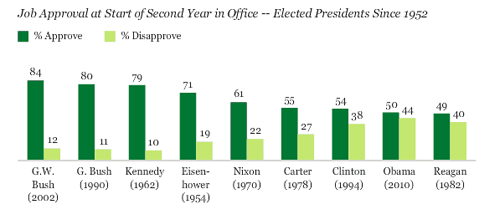
According to Gallup’s first full data set for 2010, Barack Obama starts his second year in office with the highest disapproval rating of any President since Eisenhower.

Obama begins 2010 with 44% of the public disapproving of the job he’s doing as president. That’s four points higher than the next closest president (Reagan), six points worse than Bill Clinton, and 17 points worse than Jimmy Carter.

Obama also begins his second year in office with the second worst job approval rating of any president in the last 56 years:

image

http://realclearpolitics.blogs.time.com/2010/01/06/gallup-obama-begins-2nd-year-whighest-disapproval-rating-in-modern-era/

* * * * *

Of the 5 types of Americans … which are you?

January 7, 2010

Dr. Frank Luntz has used dozens of attitudinal, behavioral, and demographic questions to segment Americans into five statistically distinct psychographic categories that explain not just who they are, but also how they are likely to behave and their view of life around them.

* * * * *

Excerpted from: WHAT AMERICANS REALLY WANT by Dr. Frank I. Luntz

* * * * *

According to Dr. Luntz’s surveys, there are five segments of American consumers:

1. Thirty percent of Americans are Relationship People.

The largest segment of the American population, it’s also the youngest.

To them, relationships can mean friends, family, or spouse. Their whole idea of the good life is to be with someone all the time.

They get their satisfaction out of interacting with other people. They don’t care as much about jobs or careers. They are generally satisfied with their life today, but very nervous about tomorrow.

They don’t save; they spend, and they enjoy spending on other people as much, if not more than, on themselves.

2. Twenty-five percent of Americans are Spiritual People.

This is the oldest and most female-oriented of the five segments.

What unites them, in addition to the importance of religion and prayer, are the principles of simplicity and efficiency.

They don’t need or want to spend money to be happy.

They have older cars and TV sets; they don’t have TiVo or satellite radio.

They’re not just late adopters, they’re non-adopters because stuff doesn’t matter to them.

If Relationship People are the loudest group, Spiritual People are the quietest.

They tend to do things in their spare time that don’t require other people, such as reading and listening to music.

They appreciate the outdoors (they are environmentalists) and they have a respect for natural beauty.

3. Eighteen percent of Americans are Health People.

They’re younger than average, more male than female, and they’re the segment most likely to participate than to observe.

You won’t just meet this segment at the gym or on the basketball or tennis court — you’ll find them shopping at Whole Foods and having a snack at Jamba Juice.

They’re similar to the Spiritual segment in their desire to be outdoors, but they’re parallel to the Relationship segment in their desire to be with others.

They are the most physically active of all the groups and put a lesser emphasis on career and financial success.

4. Twelve percent of Americans are Control People.

These people can be very unpleasant to be around.

For them, it’s not about money; it’s about more time and less hassle.

They have everything planned out.

Their intensity is similar to the Health segment, but while the Healthy are engaged in physical activity, Control People are engaged in mental or intellectual activity.

Control People want to be doing something other than what they’re doing; they think today is awful, but tomorrow is going to be great.

This is the flip side, demographically, of the Spiritual segment in that these people are almost exclusively under 50 and more male than female.

They’re the mirror image in another way: Stuff matters. Their stereo is high-end, and their TV screen is huge. In fact, everything is bigger; they want the newest and the best of everything.

They’re willing to spend money, and they work longer hours than the other segments to be able to afford it.

5. Eleven percent of Americans are Financial Security People.

The fastest-growing segment, these people are always unhappy and dissatisfied, and in the current economic mess, they’re downright miserable.

They judge themselves by how other people judge them.

Their reputations mean more to them than they do for any other segment.

They’re the opposite of self-satisfied; they’re almost self-loathing.

They have a ton of material goods, but they buy things to make a status statement rather than to enjoy them.

They tend to be older and wealthier than average, although you’ll find plenty of people in their 30s in this segment.

They own; they don’t rent or lease because they want whatever it is to belong to them — and they’re dissatisfied when they can’t have everything they want when they want it.


* * * * *

From: WHAT AMERICANS REALLY WANT. . . REALLY – The Truth About Our Hopes, Dreams, and Fears
by Dr. Frank I. Luntz

Fed Economist: A Home is a Lousy Investment

January 7, 2010

Punch line: Before the housing bust, Americans tended to think their homes were their best and most important investments –- a view promoted by Washington policy makers who made home ownership a top priority.

Karen Pence, who runs the Federal Reserve’s household and real estate finance research group, argues that homes are actually a terrible investment.

* * * * *

Excerpted from WSJ: Fed Economist: Housing Is a Lousy Investment, January 5, 2010

Putting aside the fact that home prices have fallen dramatically, Pence says several factors make homes a lousy investments:

  1. An indivisible asset.
    If you own stocks and bonds and suddenly need a little cash, you can sell some of your stocks or bonds but not all. With a home, on the other hand, “you can’t just slice off your bathroom and sell it on the market.”
  2. Undiversified.
    You can buy stocks or bonds in industries or countries all over the world. A home is a bet on one single neighborhood.
  3. High transaction costs
    When you buy or sell a home, you pay real estate agent fees, mortgage fees and moving costs.
  4. Asymmetrically liquid
    That means it’s easy to get money out when home prices are going up. (You just take out a bigger mortgage.) But it’s hard to take money out when prices are going down because refinancing becomes more difficult.Put another way, the leverage that you have in your house with a large mortgage means your investment does well in good times but could be lousy in bad times.
  5. Highly correlated to the job market.
    Home prices in a neighborhood tend to rise when the job market is improving in the area and fall when the job market is worsening. This means that your main financial asset provides the smallest cushion to you when you might need it most.

Ms. Pence has been a Washington renter for many years. Ironically, though, she says she’s considering buying a house herself. The reason: Her husband wants a dog and wants to start gardening. That means moving out of the apartment.

Full article:
http://blogs.wsj.com/economics/2010/01/05/fed-economist-housing-is-a-lousy-investment/

Heath care prescription: more doctors, enabled RNs and PAs, way less paperwork

January 7, 2010

Punch line: According to honchos from Johns Hopkins and Emory Med Schools, health insurance doesn’t guarantee health care — we need initiatives to boost the ranks of physicians and make all physicians more productive.

* * * * *

Excerpted from Baltimore Sun Times: Prescription: more doctors, January 1, 2010

That 30 million Americans may soon be able to obtain health care insurance is at the core of the Senate and House health care bills.

But let’s be clear: “insurance” doesn’t guarantee “care.”Indeed, the legislation is giving “bus tickets” – that is, health insurance – to uninsured Americans. But there are no buses running on those routes.

Without important changes in how many doctors we produce and how we pay to train them, millions of newly insured Americans will simply not have access to a physician.

In fact, we don’t have enough doctors for the 256 million Americans who are insured right now.

The U.S. Department of Health and Human Services notes that the United States has a current shortage, at minimum, of 16,000 primary care physicians.

Some facts:

The U.S. medical schools train about 27,000 new doctors a year.

Today, the overall number of physicians in the U.S. is lower than the average per capita number of doctors in other nations such as Sweden, Denmark, Spain and France, and we now “import” some 25% of our physicians from other countries.

According to HHS, overall demand for physician services will increase an estimated 22% between 2005 and 2020, and the United States will face a shortage of more than 125,000 physicians in the next 15 years.

http://online.wsj.com/article/SB10001424052748703483604574630321885059520.html?mod=djemEditorialPage

* * * * *

The solution is to increase the supply of physicians, especially those in primary care and general surgery … and to increase Medicare-funded residency slots for physicians.

Already, the nation’s medical schools have pledged to increase enrollment by 30 percent by 2015.

Training slots for residents have been capped at present levels for more than a decade.

An increase of 15,000 positions would produce an additional 40,000 physicians over the next 10 years, helping the nation manage the projected shortage by 2025 of 125,000 physicians. And unless we significantly expand training positions, the number of physicians per capita will begin to decrease in the next 10 years.Moreover, there are other steps we can take:

Double the number of National Health Service Corps awards.

Under this program, medical school tuition is paid off by physicians agreeing to practice for several years in underserved areas.

This would not only help with the supply issue, but the more persistent problem of how doctors are distributed around the country. There are plenty of physicians in high-income ZIP codes in the United States. The shortage is most acute in rural areas where access is difficult and where the poverty level is high.

Changing doctors’ traditional practice model.

Nurse practitioners and physician assistants should be more fully integrated into clinical practice, handling the simple, uncomplicated cases. This would allow the physician to spend more time managing patients with chronic and complex conditions.

The new best-practice model should include designing a “medical home” for all patients, utilizing – and paying – all health professionals as part of team that coordinates care, enhances efficiency and increases patient satisfaction.

Cutting through the “hassle factor” of medical administrative costs.

An in-depth survey published in the journal Health Affairs in May showed physicians spend an average of three hours a week on the phone or corresponding with insurance claims adjusters.

Nowhere addressed seriously in House and Senate legislation are the paperwork and multiple insurance claim forms that many physicians name – along with other administrative issues – as their No. 1 complaint.The cumulative cost of the time physicians spend interacting with insurers is $23 billion to $31 billion annually – money and time that could be better spent on direct patient care.

* * * * *

As the House and Senate conferees refine legislation promising new benefits to 30 million Americans, we trust that, unlike the bus tickets to nowhere, attention is focused on funding and training a health care workforce that guarantees access to all.

Dr. Michael M.E. Johns is university chancellor and professor in the schools of Medicine and Public Health at Emory University. Dr. Edward D. Miller is dean and CEO of Johns Hopkins Medicine.

Full article:
http://www.baltimoresun.com/news/opinion/oped/bal-op.doctors01jan01,0,7827816.story

Raise your hand if you want to add some sales taxes onto that Internet order …

January 7, 2010

Ken’s Take: You had to know that this one was coming.

While I’m a beneficiary of the Internet sales tax rules … I agree with the guy that the sales should be taxed — whether bought in local stores or over the net.

In fact, I’d be a fan of upping sales taxes  … concurrent with blowing up the income and estate taxes, of course. 

* * * * *

Excerpted from NY Times: Sorry, Shoppers, but Why Can’t Amazon Collect More Tax?, December 26, 2009

Today, Amazon collects sales tax in only five states, which gives it a continuing advantage over companies who do collect them in all or most states. Competitors aren’t the only ones hurt by Amazon’s stance on sales taxes: it also means the loss of considerable revenue to states and localities that badly need it.

In addition to its home in Washington State, Amazon has facilities in North Dakota, Kentucky and Kansas, and collects sales taxes in these states. The company also collects sales tax in New York, but not cheerfully: Amazon has gone to court to overturn a law passed last year that compels it to collect from New York residents.

Yet these five do not exhaust the roll call of states in which Amazon has additional corporate offices, fulfillment and warehouse operations, customer service and other facilities. Fourteen more (among states with sales taxes) are listed in the company’s last annual report: Arizona, California, Delaware, Florida, Indiana, Michigan, Nevada, New Jersey, Pennsylvania, South Carolina, Texas, Virginia, West Virginia and Wisconsin. But Amazon.com does not collect for any state on that list.

Amazon uses “tax entity isolation” to put large portions of its business into tax-havens … by creating wholly owned subsidiaries for the parts that are treated separately for tax matters, so that Amazon is under no obligation to collect sales tax.

For example, Amazon has offices in four cities in California, for example, including those that are home to the subsidiary that developed the Kindle. Because the subsidiary isn’t selling the Kindle directly to consumers, Amazon is under no obligation to collect sales taxes in those locales. 

Amazon is deliberately maximizing “the significant competitive advantage it gains over its rivals when they must add the typical 5 percent to 10 percent tax to their prices, but Amazon does not.”

Amazon argues that it shouldn’t be compelled to collect sales taxes for purchases made by customers other than those who live in Washington.  “In Washington State, where we have a presence, we get police protection, we get fire protection. We send our kids to local schools … since we get no services from North Carolina and many other states, they shouldn’t be able to force us to collect taxes for them.”

And this may be a good time to point out that states and localities are having a bit of a tough time paying bills.

The Center on Budget and Policy Priorities estimates that state budget gaps for this year and next year combined will be more than $350 billion.

Wider collection of the sales tax is not going to plug a hole of that size, but every billion or two would help.

Some 147 million people, or half the nation’s population, live in sales-tax-levying states where Amazon has facilities but does not collect tax on residents’ purchases.

An Amazon spokesman described today’s sales taxes as “very complex,” but said the company would welcome a “simplified system, fairly applied to all business models.”

Full article:
http://www.nytimes.com/2009/12/27/business/27digi.html?adxnnl=1&ref=business&adxnnlx=1261944246-BDKnjFI47UhFShH1ZYYq1w

Nouveau rides may leave drivers up the creek without a paddle

January 7, 2010

Takeaway: Green enthusiasts applaud electric cars as a breakthrough innovation to control emissions.

However, these cars’ limited range along with an absence of charging stations may leave consumers stranded.

The product’s success is unlikely unless automakers find an effective way to fill these voids by identifying and serving a niche market better than do legacy products.

Only highly satisfied customers will tout the product’s benefits to others and thereby help the manufacturers cross the chasm to broad-based product adoption.

* * * * *

Excerpt from Washington Post, “Where can I juice up my ride?”, by Pete Whoriskey, November 17, 2009.

Electric cars entering U.S. showrooms as early as next year will be engineering marvels: stylish, battery-operated, zero-emission wonders.   While most electric cars are expected to be recharged at home, the predicament of a driver who runs out of battery power on the road has yet to be settled. 

A Nissan chief executive said in an interview that he believes that range anxiety will afflict only a portion of the potential market. For plenty of people, trips of 100 miles or less will be fine.

General Motors, meanwhile, has studied range anxiety and seems to have arrived at a different conclusion.  Accordingly, its forthcoming electric car runs on a battery for the first 40 miles, but when the charge runs low, a gasoline engine kicks in. With or without public charging stations, a Volt driver can motor on as long as there is a gas station nearby.

“For a long time, cars have represented a way to move around — freedom,” a GM executive said. “Some people are unwilling to accept restrictions to that.”

Nissan said that by forgoing the gas engine at the expense of a more limited range, Nissan will be better able to make its electric cars cheaply.

Nissan and other companies exploring the market for electric cars say it would be very difficult to win over consumers without the benefit of the $7,500 tax credit for people who purchase electric cars.

Edit by BHC

* * * * *

Full Article
http://www.washingtonpost.com/wp-dyn/content/article/2009/11/16/AR2009111603706.html?wpisrc=newsletter&wpisrc=newsletter&wpisrc=newsletter

* * * * *

Behavioral Economics: Why companies will drop their health insurance plans …

January 7, 2010

Nice examples that cut to the chase …

click to enlarge

image
From WSJ, Businesses Brace for Health Bill’s Costs, Dec. 23, 2009 
http://online.wsj.com/article/SB126153353820802365.html?mod=WSJ_hpp_LEFTTopStories

How much to pay for an Apple?

January 7, 2010

Teaching point: It’s always easier to lower a product’s price than to raise it.  That’s called the “ratchet effect”.  So, it often makes sense try launch at a high price to ‘skim’ the market.  If the market resists, cut the price until you hit the sweet spot.

A blizzard of speculation is building over Apple’s as-yet-unconfirmed release of a tablet computer.

Among other things, the tablet is expected to offer e-books and TV programs. Apple has been trying to get TV networks to license their programming for a subscription service planned as part of a revamp of iTunes, presumably with the tablet in mind.

Assuming the talk is correct, it is hard to see the device proving immediately attractive to the mass market given a price expected somewhere between $500 and $900.

The iPhone wasn’t a big seller when it first released at $499 and $599. Apple quickly lowered that to $399.

But it was only when Apple renegotiated its deal with AT&T, cutting the price for the cheapest model to $199, that sales really took off.

The iPhone will remain Apple’s growth engine for the company for a while yet.

WSJ: Apple’s Hard-to-Swallow Tablet, Dec. 30, 2009
http://online.wsj.com/article/SB10001424052748703510304574626213985068436.html?mod=djemMM

Best jobs survey: Better to be a teacher or a sewer plant operator?

January 6, 2010

Oh, come on … obviously teacher.  I was just having some fun with you.

According to a newly released study from job site CareerCast.com —  teacher ranked #116 out of 200 of the best and worst jobs in the U.S. —  based on five criteria — environment, income, employment outlook, physical demands and stress.

Sewer plant operator came in a distant #117. 

image

The best and worst are displayed below … with the link to the full survey.

* * * * *

Top Jobs

Ken’s favorite: Philosopher … know any ?

image

* * * * *

Worst Jobs

Where’s toll collector?

image 

Full list:
http://online.wsj.com/public/resources/documents/st_BESTJOBS2010_20100105.html

Thanks to Coop for stringing the lead.

How many gallons of soda do YOU drink in a year? How much time in a car each day?

January 6, 2010

Some interesting stats from WHAT AMERICANS REALLY WANT by Dr. Frank I. Luntz

* * * * *

Americans say they average of 87 minutes a day behind the wheel. For car commuters, it’s an average of 100 minutes.

More than one-third of working Americans are awake by 6:00 a.m. and out the door by 7:00 a.m.  … for a commute to work that is an hour or longer.

More than 3 million Americans travel 50 miles or more one-way to work.

Less than 5 percent of the population takes public transportation to work, and only 12 percent carpool.

About 100 million people drive alone to work each day.

* * * * *

Americans drink an average of more than 50 gallons of soda per person per year.

Put another way, people drink more soda than coffee, milk, and
fruit drinks combined.

* * * * *

Three-quarters of Americans are overweight, meaning they weigh more than the recommended weight for their height … 25 years ago, 50% were overweight.

One-third are obese, meaning they weigh at least 20 percent more than their ideal weight … that’s doubled over the past 25 years. 

Bottom line: All-you-can-eat is no longer just an occasional trip to the buffet line — it’s now a way of life.

* * * * *

From: WHAT AMERICANS REALLY WANT. . . REALLY – The Truth About Our Hopes, Dreams, and Fears
by Dr. Frank I. Luntz

Shaking up the movie industry’s distribution mojo: Sony bypassing intermediaries

January 6, 2010

TakeAway:  Sony is taking the bull by the horns.  The movie industry has been wrestling with its distribution challenges for a few years but no effective solutions have surfaced. 

Now, Sony, with an eye on the future, is leveraging its suite of movie assets to create new channels of distribution for its movies.  Interesting story of product, place, and price optimization.

* * * * *

Excerpted from NYTimes, “Sony to Offer Film on Internet TV, Then DVD,” By Tim Arango, November 10, 2009

The latest experiment in Hollywood’s effort to find a way to compensate for the steep decline in profits from home entertainment … Sony will make its animated hit “Cloudy With a Chance of Meatballs” available to consumers directly through Internet-enabled televisions and Blu-ray players BEFORE the movie is released on DVD.

The move is significant because it represents the latest tinkering with the movie industry’s release windows, something Hollywood has long been reluctant to do out of fear of upsetting the profitability of DVD sales and angering its most important retailer, Wal-Mart. But with the decline in DVD sales, off as much as 25 percent at some studios, finding new ways to distribute movies has become a necessity.

The price of the film, $24.95, is high enough not to alienate retailers, Sony said … “It will make televisions more valuable, and that’s a good thing.”

Sony, the only Hollywood studio tethered to a major hardware manufacturer, is in a unique position to experiment with selling movies directly to consumers through television sets … The experiment is part of a search in Hollywood for ways to capitalize on the Internet’s potential for film distribution.

“The time when a majority of consumers have Internet-enabled TVs is a long way off,” said an analyst at Pali Capital. “But it’s moving the ball in the right direction” …

In addition to the industry ramifications, the experiment is important to Sony’s vision of its two pillars — hardware and content — to work together profitably …

Sony hopes later to entice other studios to make their films available to owners of Sony televisions, bypassing cable and satellite companies that offer their own video-on-demand services …

Mindful of the music industry’s contraction after the collapse of compact disc sales, Hollywood is frantically trying to develop new sources of home entertainment revenue …

Edit by TJS

* * * * *

Full Article
http://www.nytimes.com/2009/11/10/business/media/10sony.html?ref=media

* * * * *

Funding ObamaCare … taxes going up, up, up

January 6, 2010

Based on the CBO scoring (before discovery of double-counting the Medicare savings):

Almost $1 trillion in additional government spending over 10 years … funded roughly half from Medicare cuts and half from tax increases … with the tax increases on a sorry trajectory.

Draw your own conclusions.

image

image

Uh-oh … Mayo Clinic to Medicare Seniors: "Sorry, cash only"

January 5, 2010

Ken’s Take: The Mayo & Cleveland Clinics are frequently cited as ObamaCare’s best practice models. Yesterday, the Mayo Clinic in Arizona stopped taking Medicare patients — unless they’re willing and able to pay CASH out of their own pockets.  Oops.

Why?

The Centers for Medicare and Medicaid Services cautioned that, under the proposed benefit cut, “providers for whom Medicare constitutes a substantive portion of their business could find it difficult to remain profitable and might end their participation in the program (possibly jeopardizing access to care for beneficiaries).”
http://www.investors.com/NewsAndAnalysis/Article.aspx?id=517004

So, Americans who have paid into the Medicare system for their entire working lives end up paying for health care out of their own pockets. Is that fair?

* * * * *

Excerpted from Bloomberg News: Mayo Clinic in Arizona to Stop Treating Some Medicare Patients , Dec. 31, 2009

The Mayo Clinic, praised by President Barack Obama as a national model for efficient health care, will stop accepting Medicare patients at one of its primary-care clinics in Arizona, saying the U.S. government pays too little.

More than 3,000 patients eligible for Medicare … will be forced to pay cash if they want to continue seeing their doctors at a Mayo family clinic in Glendale.

A Medicare patient who chooses to stay at Mayo’s Glendale clinic will pay about $1,500 a year for an annual physical and three other doctor visits, according to an October letter from the facility. Each patient also will be assessed a $250 annual administrative fee.

* * * * *

Obama has frequently cited the nonprofit Rochester, Minnesota-based Mayo Clinic and the Cleveland Clinic in Ohio for offering “the highest quality care at costs well below the national norm.”

Mayo’s move to drop Medicare patients may be copied by family doctors, some of whom have stopped accepting new patients from the program.

“Many physicians have said, ‘I simply cannot afford to keep taking care of Medicare patients … If you truly know your business costs and you are losing money, it doesn’t make sense to do more of it.”

Medicare Loss

The Mayo organization lost $840 million last year on Medicare. The program’s payments cover about 50 percent of the cost of treating elderly primary-care patients at the Glendale clinic where “Medicare payments no longer reflect the increasing cost of providing services for patients.”

* * * * * *

Nationwide, doctors made about 20 percent less for treating Medicare patients than they did caring for privately insured patients in 2007.

Medicare covered an estimated 45 million Americans at the end of 2008.

While 92 percent of U.S. family doctors participate in Medicare, only 73 percent of those are accepting new patients under the program .

There not enough new doctors becoming family doctors, internists and pediatricians who oversee patients’ primary care.

“Some primary care doctors don’t have to see Medicare patients because there is an unlimited demand for their services … When patients with private insurance can be treated at 50 percent to 100 percent higher fees … then Medicare does indeed look like a poor payer.”

Full article:
http://www.bloomberg.com/apps/news?pid=20601070&sid=aHoYSI84VdL0

The 5 things that Americans really want …

January 5, 2010

Excerpted from: WHAT AMERICANS REALLY WANT by Dr. Frank I. Luntz

* * * * *

According to Dr. Luntz, the five core attributes define what Americans really want.

1. More money.

Financial success has always been the highest priority for American men, but with the economic downturn it has leapt to the top among American women as well.

For millions of Americans approaching retirement, it’s less about more money and more about just getting back to where they once were.

For women, money is all about personal security, about having no fears and no worries of the financial kind.

Women measure success in life based on personal satisfaction and happiness — and the lack of economic anxiety leads to personal happiness.

For men, more money means more freedom, although that does manifest itself in the desire to buy more stuff. Men are much more likely than women to measure their success by their accumulation of material goods: house, car, technology, toys, the whole package.

For both men and women, money is more important today than at any time in a long time.

2. Fewer hassles.

Having fewer hassles is now the number two day-to-day priority of Americans.

Companies that sell products in shrink-wrapped hard plastic shells that are impossible to open don’t understand the importance of a hassle-free life.

Other examples are products that don’t perform like they do on television, services that sound much better in the advertisement than they are in reality, and
technologies that break or never work right in the first place.

3. More time.

Time used to be the highest priority for women — and for good reason.

From getting the kids up in the morning to paying the bills at night, women shoulder the majority of family responsibilities and household chores, even though the vast majority of women now work outside the home.

They have little time for themselves, and they crave it.

4. More choices.

There is an important distinction between choice and the right to choose.

Young people embrace as much choice as possible. Give them 15 choices of exercise equipment or 20 choices of coffee — the more the better.

Conversely, older people want the right to choose but don’t actually want to make the choice.  If you give them a choice of 20 different health-care plans, you’ve created a situation somewhere between confusion and chaos. To them, too many choices is no choice at all.

But for most Americans, limiting their choices is like denying life, liberty, and the pursuit of happiness.

If you sell the right to choose, or seem to expand people’s choices, you will find a lot of buyers.

5. No worries.

This can mean anything from “Yes, it will get done” to “I will take care of you.” It’s an expression of confidence that things will turn out right. 

* * * * *

From: WHAT AMERICANS REALLY WANT. . . REALLY – The Truth About Our Hopes, Dreams, and Fears
by Dr. Frank I. Luntz

Shoot the messenger !

January 5, 2010

Ken’s Take: I’m a big fan of Rasmussen Reports’ polls — in part because I like the answers, but more because of its track record for accuracy.

Since Rasmussen was first to report Pres Obama’s approval slide — and continues to be less favorable than the ABC, CBS, NBC, and CNN commissioned polls — the Rasmussen Reports are under attack.

Draw your own conclusion.

* * * * *

Excerpted from Politico: Low Obama favorables: Dems rip Rasmussen Reports, January 2, 2010

Democrats are turning their fire on Scott Rasmussen, the prolific independent pollster whose surveys on elections, President Obama’s popularity and a host of other issues are surfacing in the media with increasing frequency.

The pointed attacks reflect a hardening conventional wisdom among prominent liberal bloggers and many Democrats that Rasmussen Reports polls are, at best, the result of a flawed polling model and, at worst, designed to undermine Democratic politicians and the party’s national agenda. “His data looks like it all comes out of the RNC [Republican National Committee].”

While Scott Rasmussen, the firm’s president, contends that he has no ax to grind — his bio notes that he has been “an independent pollster for more than a decade” and “has never been a campaign pollster or consultant for candidates seeking office” — his opponents on the left insist he is the hand that feeds conservative talkers a daily trove of negative numbers that provides grist for attacks on Obama and the Democratic Party.

Nothing, however, sets off liberal teeth gnashing more than Rasmussen’s daily presidential tracking polls, which throughout the year have consistently placed Obama’s approval numbers around 5 percentage points lower than other polling outfits.

Ken’s Fact Check: The RCP Poll of Polls Data

image
http://www.realclearpolitics.com/epolls/other/president_obama_job_approval-1044.html

Democratic pollster Mark Mellman believes Rasmussen designs its polling questions to elicit negative responses about Obama and Democrats — a sentiment that is widely shared in the liberal blogosphere.

“I think they write their questions in a way that supports a conservative interpretation of the world … In general, they tend to be among the worst polls for Democrats, and they phrase questions in ways that elicit less support for the Democratic point of view.”

Rasmussen is quick to point out the accuracy of his surveys — noting how close his firm was to predicting the final outcome in this fall’s New Jersey governor’s race. (Rasmussen’s final survey in the race showed Republican Chris Christie edging out Gov. Jon Corzine 46 percent to 43 percent. Christie beat Corzine 48 percent to 45 percent on Election Day.)

Last year, the progressive website FiveThirtyEight.com’s pollster ratings, based on the 2008 presidential primaries, awarded Rasmussen the third-highest mark for its accuracy in predicting the outcome of the contests. And Rasmussen’s final poll of the 2008 general election — showing Obama defeating Arizona Sen. John McCain 52 percent to 46 percent — closely mirrored the election’s outcome.

Rasmussen, for his part, explained that his numbers are trending Republican simply because he is screening for only those voters most likely to head to the polls — a pool of respondents, he argues, that just so happens to bend more conservative this election cycle.

Polling all adults — a method used by Gallup, another polling firm that conducts a daily tracking poll of Obama — Rasmussen acknowledged, is “always going to yield a better result for Democrats.” But critics note that the practice of screening for only those voters regarded as most likely to head to the polls potentially weeds out younger and minority voters — who would be more likely to favor Democrats than Republicans.

Rasmussen, of course, is hardly the only pollster to come under fire this election cycle — just the one who attracts the most sustained criticism.

Last month, conservative radio host Rush Limbaugh accused the Gallup polling organization of “doing everything they can — they’re upping the sample to black Americans — to keep” Obama’s approval at 50 percent.

Full article:
http://dyn.politico.com/printstory.cfm?uuid=DCAD6DDB-18FE-70B2-A8986E439331DA11

Busted. Marketers’ grocery store tactics revealed

January 5, 2010

TakeAway:  As manufacturers and retailers strategize to squeeze pennies out of our now incredibly cost-conscious consumers, it appears the consumers are starting to catch on.

* * * * *

Excerpted from New Jersey Business, “Savvy marketing ploys can cost unwitting grocery shoppers plenty,” The Associated Press, November 06, 2009

If you ever leave the grocery store with a slight sense of bewilderment at what you’ve just bought, you are not alone.

Despite the utilitarian look of most grocers’ shelves, careful science goes into deciding how to display the thousands of items each store carries and how to make them appeal to consumers.

Marketers tug shoppers toward items they did not intend to buy … with package design, shelf placement, tie-ins and temporary price cuts …

Marketers have put more thought into grocery stores than any other type of store because they see an opportunity in the monotony of shopping for necessities …

For a bundle of 30 products that would cost an “impulsive” shopper $288 … research found a “savvy” shopper would pay just $166 at the same grocery store. In addition to guarding against marketing ploys, the savvy consumer tracked down coupons, used a store bonus card and chose the most economical sizes …

Here’s what to watch for next time you head out for groceries.

1. END OF THE AISLE: Marketers pay grocers dearly to put their wares on the end of each aisle shelves because products there can sell 30 percent more …

2. EYE-LEVEL, EYES OPEN: … Shoppers look straight ahead or, at most, from side to side, as they shop. So products on shelves at eye level often cost more than their lower-shelf siblings …

3. MORE CAN BE LESS: … One in four times a smaller version of a product was cheaper per serving …

4. D-I-Y CARROT STICKS: … convenience can be pricey.

5. DON’T PICK THEIR NUMBER: … Be wary of … the buy-five-for-$5 type. You usually don’t have to buy all five to get the promotional price …

6. THAT ONE LAST THING: The items in the display by the cash register are always marked up …

7. REMEMBER THE TRIED AND TRUE: … Buy store brands, which can be even more economical than shopping at warehouse clubs …

Edit by TJS

* * * * *

Full Article
http://www.nj.com/business/index.ssf/2009/11/savvy_marketing_ploys_can_cost.html

* * * * *

What’s an iPhone without AT&T? … a hot-selling iPod Touch.

January 4, 2010

Punch line: While Apple’s iPhone grabs headlines, the cheaper iPod touch keeps gaining devoted fans … thanks to strong functionality and, well, no dependency on AT&T.

Trend to watch: As my students know, I’m very critical of cell phone service — dead spots, crackling reception, dropped calls, slow upload / download speeds.  Wonder if iPod Touch (and Apple’s tablet to follow) will give a super-boost to WiFi coverage and obsolete cell phone technology.  Hmmm.

* * * * *

Business Week: iPod Touch’s Holiday Sales Spike Likely Beat the iPhone’s, December 30, 2009

Ever since Apple introduced the iPhone in the summer of 2007, it has been hailed as one of the most revolutionary products in tech history. By comparison, the iPod touch, which has all the iPhone’s features without the cell phone, has been downright publicity-starved.

But this holiday season, it seems the thinner, cheaper iPod touch may be Apple’s breakout hit …  iPod touch sales soared more than 100%, to 7.2 million, in the final quarter of 2009, while iPhone sales rose 53%, to 11.3 million.

Post-Christmas, the number of apps downloaded onto … iPod touches surpassed the iPhone. “It wasn’t just that the iPod touch barely squeaked by … It blew the doors off the iPhone—and overnight.”

The iPod touch can do pretty much anything an iPhone can do, and for a lot less money. It features the same slick multi-touch interface and can run almost all the 100,000-plus programs in Apple’s App store. The device has taken the portable gaming market by storm

The main difference is that the iPod touch does not work over cellular networks, so owners must be within striking distance of a Wi-Fi hotspot to go online or download apps. But Wi-Fi is available in most homes, offices, airports, and coffee joints, either for free or for a few bucks—but it costs nowhere near the monthly $100 of an AT&T contract.

This year, iPod touch sales may be getting an extra boost from the travails of AT&T, the exclusive carrier of the iPhone in the U.S.

Because of Ma Bell’s network problems, including frequent dropped calls and spotty Net access in cities such as New York and San Francisco, many consumers are opting to carry a new iPod touch along with their old cell phone rather than rely on an iPhone. Many users carry a BlackBerry  for email and making calls, and an  iPod touch for running apps and going online.

Some folks may soon be tempted by Apple’s much-rumored tablet device. Sources expect the tablet device to be roughly three times the size of an iPhone, making it well-suited for playing games, running apps, and reading e-books or online newspapers. The device may also rely on Wi-Fi, allowing Apple to further distance itself from AT&T’s service woes.

Full article:
http://www.businessweek.com/magazine/content/10_02/b4162022078079.htm