Archive for November, 2010

The Obama bandwagon … who’s jumping off? who’s staying on?

November 30, 2010

Punch line: Many are jumping off,  in some groups — by droves. 

But, blacks and the intelligentsia remain fiercely loyal.

Unions weren’t a cross-tab category.

* * * * *

From the Washington Examiner ….

The coalition Obama led to victory in 2008 has frayed in just two years.

Start with voters who call themselves independents. Obama won 52 percent of them in 2008; now, according to Gallup, he is at 42 percent. 

Next, women. In 2008, Obama won 56 percent of female voters. Today, he’s at 49 percent.

He is also down with men, from 49 percent in 2008 to 44 percent now.

Even younger voters, a key part of Obama’s coalition, are peeling away. In ’08, Obama won 66 percent of voters 18-29 years of age. Now, he’s at 58 percent.

Then there are white voters. In ’08, Obama won 43 percent of whites. Now, he’s at 37 percent. 

He won 67 percent of Hispanic voters in 2008; now, he’s at 58 percent.

Even support among black voters, a bedrock for Obama, has ticked downward; after winning 95 percent of blacks in ’08, he’s now at 89 percent.

Just one group has stuck with Obama through it all. In ’08, he won 58 percent of people with graduate degrees. Now, he’s at 59 percent. It appears that academic types will be with Obama always.

Excerpted from the Washington Examiner, Obama’s poll numbers point to his defeat in 2012,11/26/10
http://washingtonexaminer.com/politics/2010/11/obamas-poll-numbers-point-his-defeat-2012

Pass the sea salt … now, there’s a gamechanger is the French Fries War.

November 30, 2010

TakeAway:  Wendy’s announced a national marketing plan for its new recipe for French fries, the biggest overhaul of its fries in 41 years. 

Wendy’s CMO admitted fries “are something we hadn’t been a leader in, in the past.” 

The $25 million campaign aims to educate consumers about Wendy’s new fries that it hopes will compete mightily against McDonald’s.

* * * * *

Excerpted from NYTimes, “Wendy’s Rethinks Fries in Nod to More Natural Foods” By Tanzina Vega, November 21, 2010

For the last year, the company has been examining its product line for opportunities to promote food made with more natural ingredients. Wendy’s “new natural-cut fries with sea salt” use Russet Burbank potatoes and are thinner and crisper than the current fries and will be unpeeled.

The idea is to provide an alternative to McDonald’s, which has long been the leader in French fry sales. The Wendy’s campaign includes two television spots that will run on cable and network stations such as TBS, VH1 and Bravo and during shows such as “Conan” and “Lopez Tonight.” The campaign includes two radio commercials that will air nationally, as well as billboards around the country to entice people to select Wendy’s when they get hungry.

The digital campaign includes the use of the Wendy’s Web site, a Twitter account, a Facebook fan page and digital banner ads. The company’s YouTube channel will feature an ad for the fries and the background of the Wendy’s Twitter account page will also feature art for the fries and a “Fry for All” app that lets users select a box of fries that they can post on their Facebook page so they can “share” fries with their friends. The idea of sharing is central to the campaign. “When something is really good, you don’t necessarily want to share it so easily,” said the chief executive and CEO of Wendy’s agency of record.

Edit by AMW

* * * * *

Full Article:

http://www.nytimes.com/2010/11/22/business/media/22wendys.html?ref=media

* * * * *

More whining from Warren Buffett … and I’ve got the remedy.

November 29, 2010

Warren Buffett is back on the talk shows sanctimoniously asserting that the wealthy don’t get taxed enough.

ABC, Warren Buffett: “There’s No Sacrifice Among The Rich”
http://www.realclearpolitics.com/video/2010/11/28/warren_buffett_theres_no_sacrifice_among_the_rich.html

Since he won’t shut up, I suggest that the extension of the Bush tax cuts come with the following modifications:

  • For anyone with wealth (not income) totaling more than $1 billion, all current income – whether ordinary income or capital gains — shall be taxed 95%.  Call it the Gates / Buffet tax.
  • For anyone with wealth totaling more than $1 billion, no deductions shall be allowed against adjusted gross incomes.  Specifically, charitable deductions shall be made after-tax.  Sorry, Bill, but I want to see more of Buffet’s money going to the Feds instead of Gates Foundation … just like mine.
  • For all citizens, an estate can be sheltered by a maximum of $1 million of charitable gifts. Ditto the prior point. Confiscate Buffet’s estate and throw it into the gov’t grinder.

And, while we’re at it:

  • For all members of Congress (House & Senate) and all members of the Administration who report directly to the President, no income tax deductions shall be allowed and all income – regardless of source, type or amount – shall be taxed in its entirety at the highest marginal rate paid by any taxpayer. Let’s make the Congressional tax discussions a bit more personal.
  • For all retired members of Congress and any retired members of any Administration who reported directly to the President, all government pension and retirements benefits (including gov’t paid healthcare premiums) shall be taxed in its entirety – with no allowable deductions —  at the highest current marginal rate paid by any taxpayer. Let them ‘feel our pain’ everyday when they wake up

The above plans kill many birds with relatively few stones:

  1. Raises some dough for deficit reduction
  2. ‘Sensitizes’ our lawmakers.
  3. Potentially, gets Buffett to shut the blank up.

Win, win, win.

Is that a giant Quiznos toaster floating across the outfield grass?

November 29, 2010

TakeAway: Marketers are always looking for ways to increase consumers’ engagement with their brands.

Augmented reality technology offers a new way to do this.

But as Quiznos has learned, there are still some issues to be worked out.

* * * * *

Excerpted from Fortune, “Augmented reality lacks bite for marketers,” by Kristina Grifantini, November 12, 2010

While enjoying a game at Yankee Stadium, you take out your smart phone and point its camera at the field. If the resulting image on your screen shows a giant Quiznos toaster floating above the grass, does that make you more inclined to go get a Quiznos sandwich? …

To users, augmented reality (AR) can seem like magic. When they hold up their phones to their surroundings, the program uses the phone’s camera, GPS, compass, and Web connection to superimpose digital images and information on an on-screen view. …

Though this technology has been around for a while, it has largely been confined to computers with webcams, or to special goggles and headsets. But with the exploding popularity of sensor-equipped smart phones, marketers are trying to use it to sell everything from lunch to concert tickets.

For the Denver-based Quiznos, the idea came about when the number of mobile users visiting its website skyrocketed from 20,000 to a million in a year. Tim Kraus, Quiznos’s interactive-marketing manager, wondered how he could turn those visits into additional real-life trips to one of the chain’s 5,000-plus stores. …

But since Quiznos launched the AR campaign in June, fewer than 2,000 people have user the layer, says Kraus, and he is unable to link the campaign to any increase in sales. Undaunted, he calls it an early-stage experiment to discover what works and what doesn’t. Aside from the fun and novelty factor, “there’s actually some utility in there,” he says. “I definitely think it’s a platform that’s going to grow.” …

This fall, Qualcomm released a software development kit that programmers can use to build vision-based AR applications for Android phones; the company expects commercial campaigns based on the technology to kick off next year. …

Edit by DMG


* * * * *

Full Article
http://tech.fortune.cnn.com/2010/11/12/augmented-reality-lacks-bite-for-marketers/

* * * * *

Obama dives below the Mendoza line …

November 24, 2010

Talk about a bad day.

The President got the 3 a.m. phone call (you do remember Hillary’s campaign ad, don’t you) informing him that North Korea fired on South Korea.  

Besides creating a threat to world peace, the act of aggression sucked all of the oxygen out of the day’s news cycle.

That hurt, because O was heading for Kokomo to cheerlead the recovering economy and do a GM-IPO victory dance.

Oops.

Then the Fed announces that it’s cutting its growth forecast for 2010 and 2011.

To make matters even worse, Gov’t Motors shares tumbled about a buck, heading down below last weeks offering price.

Then the coup de grace: Zogby releases polling results showing the President’s approval rating dipping below the Mendoza Line.

In baseball, a .200 batting average is nicknamed the “Mendoza Line”.

A batting average below the Mendoza Line is considered unqualified for the pros, even if a player has strong fielding skills.

The Presidential equivalent is an approval rating of 40%

Well, according to the latest Zogby poll, Pres Obama has fallen below the Presidential Mendoza line.

Uh-oh.

image

http://zogby.com/news/ReadNews.cfm?ID=1924

Other – more reliable polls – peg Obama’s approval in the mid-40s … so, I take Zogby with a grain of salt. 

But, the Zogby results give me an opportunity to talk about the Mendoza Line … an opportunity that just can’t be passed up.

McCafé Perks Up Sales

November 24, 2010

TakeAway:  The move into premium coffee illustrates McDonald’s ability to reinvent itself and appeal to consumers across the spectrum – and boost sales.

* * * * *

Excerpted from AdAge, “McCafé” By Maureen Morrison, November 15, 2010

McDonald’s has had coffee on its menu since the early 1980s, with as many as 60 different coffee blends being used in the restaurants.

But then McDonald’s starting developing a long-term strategy to integrate coffee and related beverages into its core menu. 

In 2006, it rolled out premium-blend coffee in its restaurants, followed by iced coffee the next year and McCafé in May 2009. In July, McDonald’s expanded McCafé with frozen smoothies and frappes.

“As you look at how customers use our restaurants today, and how eating out and how habits have changed, gone is traditional breakfast, lunch and dinner, even though we sell the majority of our coffee products at breakfast,” said McDonald’s USA spokeswoman. “Some of these other iced beverages really have started to pick up mid-morning and late afternoon.”

An aggressive marketing push helped secure buzz around McCafé . Aside from traditional advertising – general market, TV, radio, and print – McDonald’s  ran a Free Mocha Monday promotion in July 2009.

McDonald’s continues to expand its offering under the McCafé brand. This month it’s introducing a caramel mocha drink, and the company is testing frozen strawberry lemonade in several markets.

Edit by AMW

* * * * *

Full Article:

http://adage.com/article?article_id=147065

* * * * *

GM’s “skimpy” first day bump …

November 23, 2010

First, I’m not a big fan of the GM bailout. 

That view seems contrarian the week after the big IPO.

My reasoning: Remember the Iacocca-led Chrysler bailout.  It was hailed as saving the company.  Well, it saved it from death, but the company never did catch real traction. Even Mercedes couldn’t make it work … and it ended up getting bailed out again.

My take: any company can look good for awhile if you wipe out its shareholders and secured debt holders.

But eventually, the structural factors kick back in (e.g. the UAW albatross) and the rocks start popping through the water again..

Just watch.

Now, about the IPO …

Sean McAlinden of the Center for Automotive Research told NPR that investors may want to ask the new GM: “By the way, the last set of shareholders and bondholders you had, you totally screwed them. So why should I trust you now on nine months’ worth of results?”

Bottom line, the net effect of the bailout and IPO is the transfer of ownership from GM’s old investor base (millions of widows, orphans, and retirees), to a bunch of bailed out banks and sovereign funds…  many of whom whom probably flipped their shares in the first day trading.

The good news is that the new transient owners didn’t make as much flip money as they might have expected.

Here are the facts:

In their first day of trading Thursday, GM shares opened at $35, two dollars above the price investors paid for them in the company’s initial public offering Wednesday.

In trading, they climbed to as high as $35.99 before closing at $34.19.

The first-day price gain of 3.6% over the IPO price was far below the 9.7% average for the previous 10 largest U.S. IPOs, according to Thomson Reuters, which tracks new issues. And the small gain came as the overall stock market rose broadly.

The skimpy price rise appeared to have reflected the U.S. Treasury’s push to boost the IPO price of the shares this week from an initial range of $26 to $29 a share to $32 to $33 a share, and the decision to increase the size of the sale from 365 million shares to 478 million, with an option to sell as many as 550 million.

WSJ, Wall Street Payday for a New GM, Nov.19, 2010. 
http://online.wsj.com/article/SB10001424052748704104104575623061936893220.html?mod=WSJ_hp_LEFTWhatsNewsCollection

If true, I say kudos to the Treasury Dept on this on.

I’ve always scratched my head over big first day IPO pops. 

To me, they always seemed to reflect mis-pricing of issues and a big opportunity loss to the company issuing the stock.  Rather then the companies capturing the full value of the IPO, the flippers get rich.

In this case, the company got pretty much full value.  I think that’s a good thing.

One more rub: I heard that the Treasury’s shares are locked up for 6 months.

My bet: GM will be trading in the high teens, low 20s next May … oops.

Burt Malkiel is still walking randomly …

November 23, 2010

Prof. Burton Malkiel has always been one of my heroes. 

He was the prof in my very first lecture in college.  I’d never heard of him since I’d just fallen off the pumpkin truck, but even I knew the guy was something special.

Four years later he was a “reader” on my college thesis.  He gave me an “A”, then wrote an article debunking my thesis.  That’s OK. If I’m going to get trashed, I want somebody of his stature doing the trashing.

Many people have heard of Prof. Malkiel because of his book “A Random Walk Down Wall Street”.  His central idea: if you try to time the market and beat the pros, you’re nuttier than a fruitcake.

Some consider Prof. Malkiel’s corrollary principles like ‘buy & hold’ and ‘portfolio balancing’ to be passe.

In a WSJ op-ed, he argues that they’re still alive and well, and can make you prosperous.

Here are some highlights …

In the wake of the recent financial crisis, many investors believe that the traditional methods of portfolio management don’t work anymore.

They think that “buying and holding” is outdated, and that success depends on skillful timing.

Diversification no longer works, they argue, because all asset classes move up and down together, especially when stock markets fall. In other words, diversification fails us just when we need it most.

And they suggest that low-cost, passively managed portfolios are no longer useful, that today’s difficult investment environment requires active management.

I don’t agree with any of these arguments. The timeless investment maxims of the past remain valid. Indeed, their benefits may be even greater today than ever before.

While no one can time the market, timeless techniques can help:

  • Dollar-cost averaging,” putting the same amount of money into the market at regular intervals, implies investing some money when stocks are high, but also ensures some buying at market bottoms. More shares are bought when prices are low, thus lowering average costs.
  • The other useful technique is “rebalancing,” keeping the portfolio asset allocation consistent with the investor’s risk tolerance. Rebalancing involves selling some of the asset class whose share is above the desired allocation and putting the money into the other asset class. .
  • Diversification has not lost its effectiveness. Over the past several years, when stocks went down, bonds went up, preserving the value of the portfolio. And while stock markets around the world have tended to rise and fall together, there were huge differences in regional returns.
  • Also, low-cost passive (index-fund) investing remains an excellent strategy . The evidence is clear. Low-cost index funds regularly outperform two-thirds of actively managed funds, and the one-third of actively managed funds that outperform changes from period to period.

If you ignore the pundits who say that old maxims don’t work and you follow the time-tested techniques espoused here, you are likely to do just fine, even during the toughest of times.

WSJ, ‘Buy and Hold’ Is Still a Winner, Nov 18, 2010
http://online.wsj.com/article/SB10001424052748703848204575608623469465624.html?mod=WSJ_newsreel_opinion

Consumers baffled by zero

November 23, 2010

TakeAway: The human brain has difficulty interpreting the number 0 according to new research.

This difficulty can lead to irrational decisions when it comes to choosing a credit cards with 0% interest rates.

Retailers offering credit cards will be happy to take advantage of this.

* * * * *

Excerpted from Wall Street Journal, “When 1% is more appealing than 0%,” by Mary Pilon, November 17, 2010

As retailers ramp up their holiday sales pitches, they may be playing off some surprising and counterintuitive ways our brains interpret numbers.

For example: what’s more confusing: A credit card with a 1% interest rate or a card with a 0% interest rate?

Even though 0% is better, we might be lured toward the 1% card … When it comes to advertising “zero,” consumers get baffled. …

… The “principle of diminishing sensitivity” makes the perceived difference between two quantities decrease as both increase by the same amount. He offers up the example that the difference between 10 and 20 is perceived as larger than the difference between 110 and 120, even though in both cases, the numbers are still only 10 apart.

Enter the number zero.

“Zero is a special value that prevents consumers from using relative comparisons when making decisions.” Because zero makes us lose our reference point when we compare it to other values. …

Let’s say you’re offered a credit card with a 25% interest rate. Then, say you’re offered a credit card with a 1% interest rate. You may think, according to the theory, “Wow, that’s 25 times as high of an interest rate!” The gap seems huge.

But then, let’s say you’re offered a credit card with a 25% interest rate and another interest rate of 0%. The zero makes us lose our bearings when it comes to determining the gap between the two, even though we know that the 0% is less than the 1% and even further away from 25%.

According to research cited in the paper, when no reference point was cited, 49% of survey participants chose a card with a 0% interest rate, while 73% chose a card with a 1% interest rate even though that rate is clearly less advantageous in the long run. …

Edit by DMG


* * * * *

Full Article
http://blogs.wsj.com/economics/2010/11/17/when-1-is-more-appealing-than-0/

* * * * *

About that MediCare waste & fraud …

November 22, 2010

About half of ObamaCare is being funded by cuts in MediCare – and about half of that is supposed to come from eliminating waste & fraud.

Yeah, right.

It’ll be fun watching the the MediCare chief report to GOP interrogators on his progress.

But, I’m still betting under on this one.

From the Christian Science Monitor …

Oversight hearings will begin in the GOP-run House in January.

One of the first oversight hearings will likely probe how the Obama administration intends to attain $500 billion in cuts to Medicare mandated by the health-care reform act.

That will involve a trip to Capitol Hill by Donald Berwick, whom Obama appointed, without Senate confirmation and over GOP objections, to head the government’s Medicare and Medicaid programs.

Republicans will no doubt ask Dr. Berwick to explain how those cuts can be made and what their effect on seniors will be.

http://www.csmonitor.com/USA/Politics/2010/1115/Health-care-reform-in-GOP-cross-hairs/(page)/2

Children’s Tylenol is back, but will Mom buy?

November 22, 2010

TakeAway:  The first children’s Tylenol products are returning to drugstore shelves after a long safety recall, and maker Johnson & Johnson now faces the tricky task of persuading parents to buy the pain reliever again. 

The company has taken a low-key approach and must walk a messaging tightrope, providing reassurance that it has fixed its problems without calling so much attention to them that safety concerns resurface.

* * * * *

Excerpted from WSJ, “Tylenol for Kids Returns to Shelves” By Jonathan Rockoff, November 18, 2010

Bottles of the grape-flavored version of children’s Tylenol have begun reappearing in pharmacies across the country half a year after several J&J over-the-counter children’s medicines were pulled because of manufacturing problems.

The recalls have cost the company hundreds of millions of dollars in lost sales and prompted a shake-up of manufacturing and management.  The quality problems included floating metal particles in the medicines and the potential for excessive concentrations of an active ingredient.

To get parents to return to Tylenol, J&J must combat not just the hit to its reputation but also the encroachment of rival brands, which have been taking over shelf space in drugstores. Cheaper private-label brands are also gaining amid the tough economy as sales of branded medicines drop.  Loyalty to Tylenol’s pain pills, a strong indication that customers will buy the product, dropped 7% in the past year, according to an annual survey in August of 35,000 Americans.  Among over-the-counter pain medicines, Tylenol ranked behind rivals Advil, Aleve and Excedrin in terms of customer loyalty after trailing only Advil in 2009.

“You don’t want to always be apologizing, because that cues the wrong response. You want to be cuing the core emotional benefits that Tylenol delivers,” said the chief executive of a company that consulted for J&J.  There are no signs in stores calling attention to the return, and packaging appears similar to the box before the recall.

Tylenol is a signature brand for J&J, which also sells prescription drugs and medical devices. The company’s swift withdrawal of the medicine during a fatal tampering episode in 1982 endeared J&J and Tylenol to generations of consumers.  Some of that goodwill persists, even after the most recent recalls.

Edit by AMW

* * * * *

Full Article:

http://online.wsj.com/article/SB10001424052748703688704575620851371476806.html


* * * * *

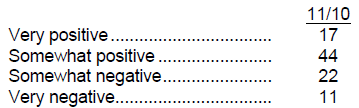
Dancin’ in the streets: 61% think election results are positive for the country …

November 19, 2010

According to a recent WSJ poll …

Question: Overall, how do you feel about the results of this year’s elections — do you feel they are very positive for the country, somewhat positive, somewhat negative, or very negative for the country?

image

http://online.wsj.com/public/resources/documents/WSJpoll111710.pdf

Bad economy? Raise your prices … Beer makers do.

November 19, 2010

TakeAway: Domestic beer makers recently raised prices and narrowed the price gap between premium domestic lagers and subpremium beers.

With less economic incentive for consumers to trade down to domestic subpremium beers, sales of such beers are down 4.1% versus 0.8% for domestic premium beers.

The heavy consolidation of the U.S. beer market has given the two dominant firms considerable power to sustain such price increases.

* * * * *

Excerpted from Wall Street Journal, “Sticky Price Hikes Help Beer Profits,” by David Kesmodel, November 3, 2010

The stubbornly high U.S. jobless rate continues to plague the biggest beer makers, which are expected to report declining third-quarter U.S. unit sales this week, even as they divulge promising signs due to greater pricing power. …

The U.S. divisions of [Anheuser-Busch InBev NV and Molson Coors Brewing Co.] raised prices by between 50 cents and $2 a case in September, … the hikes generally are sticking. Another positive indicator: fewer drinkers appear to be trading down from premium brews such as Anheuser’s Bud Light to less expensive beverages such as Busch Light and Natural Light. …

The weak employment picture hurts mass-market lager makers that depend heavily on sales to 21-to-35-year-old men. But Anheuser and MillerCoors are demonstrating strong pricing power, enabling them to raise their revenue per unit of volume. They also continue to reap the benefits of cost reductions stemming from their 2008 mergers.

Anheuser, which controls about 49% of the U.S. market, and MillerCoors, with about 30%, lifted the prices of their subpremium brands in September, narrowing the price gaps with premium lagers such as Bud Light and Coors Light. That seems to be a factor in recent weaker sales for the inexpensive, low-margin brews. …

Unit sales of domestic premium brews fell just 0.8% in food, drug and mass-merchandise outlets, excluding Wal-Mart Stores Inc., in the 13 weeks through Oct. 3 versus a year-ago … In contrast, domestic subpremium beers fell 4.1%. …

Edit by DMG


* * * * *

Full Article
http://online.wsj.com/article/SB10001424052748703778304575590372679030444.html?mod=djemMM_t

* * * * *

Finally, revenge against the cable guy …

November 18, 2010

Punch line: The number of people subscribing to US cable television services has suffered its biggest decline in 30 years as younger, tech-savvy viewers lead an exodus to web-based operations, such as Hulu and Netflix.

From the Financial Times …

The total number of subscribers to TV services provided by cable operators fell by 741,000 in Q3-2010.

The data suggest that “cord-cutting” – one of the pay-television industry’s biggest fears – is becoming a reality as viewers drift to web-based platforms.

The growth of Hulu and Netflix, the DVD subscription company which began testing a $7.99 per month streaming-only service last month, has become problematic for cable operators.

Hulu’s revenues are increasing sharply: the company is projected to generate more than $240m in 2010, up from $108m in 2009.

Devices such as Apple’s iPad also appear to be accelerating the move away from traditional multichannel television. More than a third of iPad users say they are likely to cancel their pay-TV subscriptions in the next six months.

The cable industry has launched a vigorous defense against cord-cutting: companies such as Comcast are backing “TV Everywhere”, which gives subscribers access to channels and programming online, and via their cable box.

Viewers pull plug on US cable television, November 17 2010
http://www.ft.com/cms/s/0/a3986a1c-f28c-11df-a2f3-00144feab49a.html#axzz15aLGqwx6

Manly Men Drink Coke Zero and Pepsi Max

November 18, 2010

TakeAway: Coke and Pepsi’s rivalry is the stuff of legend in the ad business.

Coke Zero and Pepsi Max are chasing a burgeoning market of men who don’t want “diet” soda. 

Coke Zero launched five years ago and commands a healthy lead in sales. Pepsi, however, launched a new positioning over the summer. 

Below is a comparison of how each managed its media programs.

* * * * *

Excerpted from AdAge, “Coke Zero vs. Pepsi Max: Which Media Plan Had More Fizz?” By Antony Young, November 3, 2010

1.  Creative executions

Coke Zero’s ‘Four S’ Strategy: Coke Zero centered its brand media strategy on four key pillars: sports, social media, schools and Spanish language media. To build brand discussion, Coke Zero also implemented several clever social media and college programs. Lastly, Coke Zero shifted just under a fifth of its budget into Hispanic media in 2010.

Pepsi Max: Zero Calories, Maximum Taste: Pepsi Max went with a more multimedia plan across television, print and online display to launch its new positioning, “Zero Calories, Maximum Taste.” The new creative dropped diet from its messaging and went after Coke Zero with a comparative ad.

2.  Paid media strategy

Coke Zero’s paid media plan this year so far has been essentially 99% broadcast. It also focused almost solely on sports programming.  It also made a very significant shift in targeting among the Hispanic market by placing 18% of its total budget on Univision. Last year it did not buy any Spanish Language television

Pepsi Max employed a broader range of media. It put 72% of its media plan into broadcast television, contrasting Coke Zero’s 51% in broadcast, 28% in cable and 21% in spot. Pepsi Max’s sports buy included auto racing, but its purchase spanned a wider variety of programming to deliver higher reach. Its top two programming genres were reality and comedy.  In print, Pepsi Max ran a series of advertorials in Maxim.

3.  Owned media strategy

Both brands’ owned media strategy smartly leveraged content on Facebook.

4.  Earned media strategy

Coke Zero posted a clever video and developed an excellent college advocate program dubbed Coke Zero Agent. Essentially a recruitment program at major colleges around the country, students pitched to be a Coke Zero Agent, a role that involved promoting the brand in their colleges through marketing and social programs on campus.

The Super Bowl is still some three months away, but Pepsi Max kicked off early buzz for its planned promotion with Doritos. It launched the promotion at an event in Los Angeles with Betty White, the breakout star of the 2010 Super Bowl commercials with her spot for Snickers.

Summary

While Coke Zero had the benefit of a bigger budget, it made clear choices about where it wanted to play in what looked like a more deliberate and distinct strategy. It made a clear decision with its television plan to single-mindedly chase the young male audience through sports programming events. Its substantial investment in Hispanic media gave the brand one edge over Pepsi Max. It also intelligently employed branded content online.

Pepsi Max‘s plan had a more traditional media flavor to it, delivering strong audiences for the advertising and smartly leveraged Doritos’ early buzz for the forthcoming Super Bowl.

Edit by AMW

* * * * *

Full Article:
http://adage.com/mediaworks/article?article_id=146884

* * * * *

Majority of states now opposing ObamaCare’s individual mandate.

November 17, 2010

Right now, 21 states are suing the Feds to stop the ObamaCare mandates that require individuals to buy health insurance whether they want it or not.

Virginia enacted a state law banning individual mandates before  ObamaCare passed.  So, that state – with a law on the books — has a unique standing.

19 states jumped on the bandwagon when Florida filed suit against the individual mandate – claiming it’s unconstitutional

The courts are supposed to rule on both cases before the end of the year.  Regardless of the rulings, they are likely to be appealed to the Supreme Court.

Now – because of GOP gains in governorships —  the plot has thickened.

According to Florida AG-elect Pam Bondi, at least 6 states have newly elected GOP governors or AGs or both: Oklahoma, Ohio, Kansas, Wisconsin, Wyoming, and Maine.  All of these states are likely to jump on the lawsuit bandwagon.

If at least 5 of the 6 do, it’ll mean a majority of states will have expressed their opposition to ObamaCare in one of the strongest possible ways.

While the Supreme Court doesn’t act because a majority of states think something, the lawsuit majority has got to hang in the back of judge’s minds. 

Source story:
http://politifact.com/florida/statements/2010/nov/10/pam-bondi/defending-health-care-suit-new-florida-ag-says-uni/

* * * * *

Reportedly, writers of the 2,700 page ObamaCare bill forgot to include a severability clause – so if the courts rule in the states’ favor, all of ObamaCare goes down with the individual mandate.

Remember when the President dissed the Supreme Court justices at the last State of the Union Address?

I bet he’d like that one back …

What’s in that black bag? Garbage?

November 17, 2010

TakeAway: Hefty wants to cash in on evolving trash-can colors with BlackOut, a new line of black kitchen bags.

Hefty hopes they’ll bring new interest to one of the lowest-involvement categories. 

The target is mainly “kitchen enthusiasts,” the 40% of people who see the kitchen as the heart of their home and enjoy cooking.

* * * * *

Excerpted from AdAge, “What the Stylish Garbage Can Is Wearing: Hefty in Black” By Jack Neff, November 3, 2010

Hefty discovered that consumers were buying more black and stainless-steel trash cans, which consumers say look better with black garbage bags.  Hefty executives are among the first to admit it’s hard to get people thinking about trash bags. Private-label shares in the category stand among the highest in packaged goods at 39% for the year ended Oct. 3. Overall category sales were down 5% for the year, in part because some consumers turned to using bags from the groceries or other “free” alternatives.

But Hefty research found, given the right reasons, people actually do care about where they stash their trash. Color, surprisingly, is one of them.  Today, most kitchen trash bags are white, stemming from a time when most kitchen appliances were white or shades of beige. That time has passed.

Product development started only eight months ago, when Hefty marketers discovered a seismic shift in trash-can and kitchen appliance colors thanks to its partnership with HMS Manufacturing, which licenses the Hefty name for kitchen trash cans. While nearly two-thirds of new kitchen trash cans are still white or tan, unit sales of black trash cans are up 38% from last year. Sales of stainless-steel cans are up 12%, while sales of the white/beige range are down 8%.  This follows trends in kitchen appliances.  While stainless steel is the bigger trend in appliances, black is a bigger deal in trash cans, primarily because black cans are less expensive than stainless steel or chrome. Consumers also find black bags look better with stainless steel than white ones, she said.

Hefty discovered trash also looks better, or at least less messy, in black bags.  The black bag also appeals to consumers’ desire for privacy.

Edit by AMW

* * * * *

Full Article:
http://adage.com/article?article_id=146880

* * * * *

Maybe, just maybe, the answer is $5 million

November 16, 2010

Since the Bush tax cuts are in the news again, I’m taking the opportunity to reprise one of my favorite posts from the archives.  The original was posted on Sept. 11, 2008 …

The punch line: “wealthy” starts at a number higher than $250,000 and higher marginal tax rates for the real high earners might be a good idea.

* *  * * *

Maybe, just maybe, the answer is $5 million

Background: At the Obama-McCain Saddleback debate, the candidates were asked: “What’s rich?” Both gave glib answers.  Obama got a pass, McCain didn’t.  Thinking about it, McCain may have been right.

* * * * *

After Saddleback, Senator McCain was repeatedly hammered for his $5 million dollar answer to Rick Warren’s “what’s rich?” question.

Interestingly, but not surprisingly, Senator Obama got a free pass for his parallel laugh line — even though the annual royalties on 25 million books probably exceed $5 million.  Perhaps. the conversion from books to dollars is sufficiently nuanced that folks didn’t notice.

Even liberal columnist Paul Krugman, acknowledges that McCain was just joking when he flipped the $5 million dollar figure at Pastor Rick.

In a recent  New York Times op-ed titled “Now, that’s rich”,  Krugman concedes the point and puts it into context.  Specifically, he references the book Richistan by Robert Frank of The Wall Street Journal. According to Krugman, Frank “declares … that country is divided into levels, and only the inhabitants of upper Richistan live like aristocrats; the inhabitants of middle Richistan lead ample but not gilded lives; and lower Richistanis live in McMansions, drive around in S.U.V.’s, and are likely to think of themselves as “affluent” rather than rich.”

Perhaps, the stage-pensive Obama should take pause and reflect on Prof. Krugman’s observations.  Senator McCain gave Senator Obama a huge gift.  No, not the new applause line that Obama keeps repeating in his stump speech. It’s bigger than that.  It’s a clue to attracting — or, at least, to avoid alienating — about 5 million voters who, in a close election, may be what the pollsters call “statistically significant”.

* * * * *

Let me explain.

Boiled down to its essence, Senator Obama’s complicated tax plan reduces to taking an average of about $20,000 in additional annual income taxes from about 5 million people, and redistributing the loot to 200 million others — $500 (or more) per person in annual tax credits.

Some of the 5 million targeted “givers” earn as low as $200,000; some are in  Warren Buffett’s category, earning $40 million or $50 million or more.  Obama’s plan doesn’t differentiate among them. The freshly minted MBA working 80 high stress hours in a high cost, high tax locale (think, New York or San Francisco) – paying off a hundred grand or more in student loans — just gets lumped in with Bill Gates.

Now, what if Senator Obama were to adopt Senator McCain’s perspective and define “rich” as starting at $5 million ?  What would it take to raise a redistributable $100 billion from them ?

Well, according to recently released IRS data, there were about 41,000 tax returns filed in 2006 with adjustable gross income greater than $5 million.  Those returns averaged over $15 million in AGI and $13.5 million in taxable income.  As a group, the over $5 million crowd accounted for almost $600 billion in annual taxable income.

So, if he wanted to, Obama could leave the folks earning $200,000 to $5 million alone, and raise the $100 billion by introducing an uber-high income tax bracket for everybody reporting more than $5 million — upping their effective tax rates to about to about 37% (from their current 20% effective income tax rate).  To get there would require a 50% top bracket marginal income tax rate (up from 35%).  And, since about 75% of the uber-high-earners income comes from capital gains and dividends, which are insulated from the Alternative Minimum Tax calculations  — the capital gains and dividends rate would have to upped to about 30%, and rolled into the AMT.

* * * * *

Before dismissing the notion out-of-hand, consider that a $5 million top bracket fits in a historical context, and has some well-aged precedents. 

Since 1913, the top bracket income threshold has averaged about $650,000 (unadjusted for inflation), ranging from $29,750 in 1988 (Reagan’s last year)  to, yes,  $5 million (from 1932 to 1941).  In order to fund WWII, the top bracket income threshold was cut in 1941 to $200,000 — which, coincidentally, inflates to about $5 million in 2008 dollars.

Besides generating a $100 billion redistribution pool, a top bracket with a high rate and high income threshold addresses a few of Senator Obama’s other oft-repeated concerns.  On the campaign trail, Obama often showcases Warren Buffett’s lament that his secretary’s 30% tax rate is higher than his 18%.  That gap only narrows a bit under Senator Obama’s current plan (her’s drops to 29%; his goes to 22%).

Under an uber-income rate bracket structure, the Buffett injustice would remedied, and along with it, private equity and hedge fund loopholes would be closed, and the fattest cats would start paying their fair share despite the holes in the AMT.  Sure, these uber-earners will be tempted to search harder for tax shelters — in the U.S. and offshore — but that’s a risk that Obama says he’s willing to take.

* * * * *

If Senator Obama wanted to moderate the risk somewhat, he could scheme between the extremes by creating multiple new brackets.  Maybe a bracket starting at $500,000 with a 40% marginal rate, a 42.5% bracket starting at $1 million, a 45% bracket starting at $2.5 million, a 47.5% bracket starting at $5 million, and a 50% bracket starting at $10 million.  By my math, this multiple bracket structure would give Senator Obama his $100 billion, too. The point: there are many ways to skin the (fat) cats.

Comedians say that, at their core, many jokes have a ring of truth.  Senator McCain’s $5 million jest may have provided Senator Obama with an out-of-the box idea for rebalancing incomes: deep-drilling the super-rich. The introduction of an uber-income bracket would make Obama’s tax plan more palatable to about 3% of the voting population. And, Mr. Buffett would get his wish come true. In military parlance, I think that’s called friendly-fire. 

* * * * *

Under Armour tries to play in Nike’s sandbox

November 16, 2010

TakeAway: Just a small piece of the $2.5 billion U.S. market for basketball sneakers would meaningfully add to Under Armour’s $856 million annual sales.

Never mind that Nike owns 95% of that market and spends $2.4 billion annually on marketing to defend it.  CEO Kevin Plank has set his sights on being the number one basketball shoe manufacturer.

That’s a quite lofty goal for a company that has already failed in other types of athletic shoes.

* * * * *

Excerpted from Bloomberg Businessweek, “A Half-Court Shot for Under Armour,” by Matt Townsend, October 28, 2010

… Under Armour  launched a basketball shoe line, called Micro G, to take on the longtime ruler of the court, Nike. …

In the $2.5 billion U.S. market for basketball sneakers, Plank confronts more than just Nike’s 95 percent share and the billions it spends on marketing. Sales of basketball shoes in the U.S. have slid for the past three years as fewer people play the sport …. And Under Armour’s earlier disappointments in cross-training and running shoes suggest its hoop dreams may be tough to realize.

If Plank harbors doubts about taking on Nike in its stronghold, he isn’t showing it. “Our goal for getting into basketball is to be No. 1,” he says. …

Despite the trash talk and Baltimore-based Under Armour’s fast growth (sales at its core apparel business have tripled in the past five years), Plank has had difficulty climbing the learning curve in sports footwear. In 2008, Under Armour spent big on a Super Bowl ad for a line of cross-training shoes—months before the shoes actually reached stores. Many shoppers had forgotten the ad by the time of the shoes’ debut. Meanwhile, tepid sales of the line of running shoes it introduced in 2009 have led the company to allow retailers to discount them or simply send them back to clean out inventories. …

As Plank prepared for the Micro G launch, he told employees to start thinking of Under Armour as a footwear brand, not just an apparel maker. “I called our marketing team and said, ‘Go through this building and find anything that says we are only an apparel brand and throw it away,'” Plank says. …

Plank expanded Under Armour by identifying profitable market niches, such as its namesake undergarments that pull moisture away from athletes’ skin …. Getting into basketball shoes, however, is “a whole other level,”…

One reason: Nike spent $2.4 billion on marketing in its last fiscal year, or almost three times Under Armour’s annual sales and 20 times its marketing outlays. Perhaps that’s why the Beaverton (Ore.) sports giant isn’t exactly running scared. “While our main focus is on fulfilling our own potential, which is unlimited, we thrive on competition of any kind,” says Nike spokesman Derek Kent when asked about Under Armour’s foray into basketball. “We expect to further expand our leadership position.”

Edit by DMG


* * * * *

Full Article
http://www.businessweek.com/magazine/content/10_45/b4202024138269.htm

* * * * *

Don’t touch my junk !!!

November 16, 2010

Just in case you’ve been sleeping the past couple of days …

A California man got thrown out of San Diego’s airport when he refused a revealing full-body scan and then an alternative pat-down, telling a Transportation Security Agent, “If you touch my junk, I’ll have you arrested.”

John Tyner, 31, said he was told he could face a civil lawsuit and a $10,000 fine for leaving the screening area before the security check was complete.

It seems like it struck a chord,” said Tyner, a software engineer from Oceanside, California

Article & interesting video:
http://www.aolnews.com/nation/article/airport-security-encounter-dont-touch-my-junk-john-tyner-tells-agent/19716789

Geez, John. 

When did the family jewels get rebranded “junk”?

I say, don’t call my junk “junk”

Wash Post: “Obama’s global influence is intact” … say what?

November 15, 2010

The emperor is wearing a snazzy new suit of clothes isn’t he?

Let’s consider the facts:

  • The election was a shellacking for the President … his words, not mine
  • Most polls indicate that a plurality (sometimes a majority) of citizens take exception to his major policy initiatives: ObamaCare, stimulus, cap & tax
  • No foreign leaders bought into his spend ‘til you drop economic policy

The President’s response?

  • His policies are directionally correct and working … and anybody who doesn’t think so is either ignorant or just plain wrong.
  • The rest of the world leaders are wrong … you’ve got to borrow and spend your way out of the ditch.

“President Obama asserted that the punishment his party took in midterm elections has not damaged his ability to advance U.S. interests.”
 http://www.washingtonpost.com/wp-dyn/content/article/2010/11/12/AR2010111204772.html

I guess a President has to appear confident and sure of himself.

But, isn’t this guy creating a whole new art form.

Or, is there a parallel universe out there?

One that the mainstream media discovered before the rest of us.

My name is Domino’s, and my pizza was bad. Now it’s better.

November 15, 2010

TakeAway: Domino’s admitted its old pizza was lacking (to put it politely) and introduced a new recipe by revealing it to its staunchest critics.

The company continued the transparency theme by encouraging customers to alert Domino’s when the pizzas they ordered were not up to par.

* * * * *

Excerpted from AdAge, “Domino’s Talks Radical Authenticity” By Abbey Klaassen, October 28, 2010

It was arguably one of the riskiest marketing campaigns of all time — so how, exactly, did Domino’s get its “Oh Yes We Did” campaign, which touted a revamp of pizza by admitting the previous version was terrible?

“We had to do something” because sales were so bad, said Domino’s CMO. 

“New and improved” campaigns typically feel cliché and disingenuous.  So Domino’s looked at what was going on in the news and culture and launched it under a new guise: radical transparency.

So far, the company has seen only positive results; most recently, its third-quarter same-store sales were up 11.7%.

Additionally, the “Show Us Your Pizza” campaign, in which Domino’s asked customers to take their own photographs of the food to be used in ad campaigns, has resulted in 13,000 submissions. Domino’s also responded in ads to customers whose photos showed a pizza that didn’t arrive photo-ready.

* * * * *

Full Article:
http://adage.com/ideaconference/article?article_id=146782

* * * * *

Christmas coming early this year?

November 12, 2010

TakeAway: Now that Halloween is over, retailers are embarking on the mad dash to December 25. 

The sluggish economy is raising the stakes for the Christmas shopping season. Some retailers and marketers, worried that uncertainty among shoppers might increase as the weeks go by, hope to pull demand forward by moving up the start of their pitches.

* * * * *

Excerpted from NYTimes, “For Marketers, Christmas Started Last Month” By Stuart Elliott, October 31, 2010

In consumer electronics, “people are getting out there earlier,” said Best Buy’s SVP for U.S. marketing. One reason is increased comparison shopping and another is new products, such as e-readers, tablets and 3-D TV sets.  To “emotionally engage consumers” who will be more deliberate about where they shop, Best Buy will run two holiday campaigns at once.

“The consumer at large is still very cautious about spending and very purposeful about how to plan gift-giving.

The holiday is about celebration and family and giving, but saving is just as much a hallmark.”

Some retailers are playing up the traditional rather than the promotional aspects of Christmas shopping.

For instance, Barneys New York plans to bring to life its theme for 2010, “Have a foodie holiday,” with windows at its flagship store on Madison Avenue that pay tribute to chefs, such as Bobby Flay and Rachael Ray.

However, the profusion of Christmas campaigns runs the risk of wearing out shoppers who may at some point tire of all the Santas and candy canes.

Of course, when it comes to Christmas, one beverage truly stands out: Coca-Cola, which has been running campaigns with holiday themes since the 1930s. The Coca-Cola Company will begin its 2010 campaign this month, varying the introductory date by market. Never mind those concerned about ads that make it seem that the holiday arrives too soon. Coca-Cola worries about it ending too early – it wants to keep Christmas going through the first week of January.

Edit by AMW

* * * * *

Full Article:
http://www.nytimes.com/2010/11/01/business/media/01adco.html?src=busln

* * * * *

Available: One military jet … previously used by Madam Pelosi

November 12, 2010

One of my wife’s hot button the past couple of years has been Speaker Pelosi’s use of a large military passenger jet to cart her and her posse back & forth between DC and San Francisco. 

Ms. Pelosi said she took the military flights on the advice of the House Sergeant-at-Arms office.

Well, score one for GOP frugality.

Rep. John Boehner, the House speaker-to-be, said he plans to continue commuting on commercial flights from his district in Ohio to Washington, D.C.

Guess the House Sergeant-at-Arms changed his mind about security for the person who’s third-in-line for the Presidency.

Hmmm.

http://blogs.wsj.com/washwire/2010/11/10/boehner-flying-commercial/

I’ve been mandated … OUCH !

November 11, 2010

I don’t expect a lot of sympathy, but I have a story to tell …

We have a house on a river.

FEMA has declared the general area to be a flood zone.

So, I’m being forced to pay over $2,500 annually for FEMA flood insurance.

Here’s the rub.

The house is “sited” on relatively high land.

A couple of years ago we had a “100-year” storm — hurricane Isabel.

The tidal surge flood caused mucho damage to our neighbors — whose houses are sited at low spots.

Fortunately (for us), the water didn’t come within 30 feet of our house.  No damage to the house.  Period.

So, even though we have empirical evidence that our house is flood safe in a 100-year storm, FEMA makes us buy flood insurance because we’re theoretically in a flood zone.

And, FEMA stands firm behind their flood map — which was drawn up 27 years ago, in 1983.

Nuts!

I can now imagine how young healthy folks are going to feel when ObamaCare kicks in and they’re stuck buying health insurance that they don’t want.

I can feel their pain.

The deficit committee surfaces … let the games begin

November 11, 2010

Well, the election is done. so it’s “safe” for the deficit committee to reveal its initial ideas.

Here’s the slide deck that Chairmen Bowles and Simpson pitched:

http://online.wsj.com/public/resources/documents/WSJ_CoChair_Draft.pdf

Draw your own conclusions … for now.

Kraft Wants Philly to Flex from Bagels to…Chicken

November 11, 2010

TakeAway: Kraft Foods is repositioning Philadelphia Cream Cheese as a versatile cooking ingredient, spending big to introduce a new product, Philadelphia Cooking Creme. 

The reduced-fat, creamy and spoonable version of the iconic brand will hit stores early next year and be accompanied by one of the largest ad campaigns in company history.

* * * * *

Excerpted from AdAge, “Kraft Puts Big Bucks Behind Philadelphia Cooking Creme Launch” By EJ Schultz, October 26, 2010

The ad budget for this will consume half of all spending in the cheese and dairy division, which also includes Velveeta and Kraft Singles. Those two brands alone accounted for more than $38 million in measured media spending in 2009.

The refrigerated creme will come in four flavors: original, Italian herb, savory garlic and Santa Fe. The campaign will promote the product as a sauce for chicken, vegetables or just about anything else you can put in a pan. Commercials will focus on solving the “dinner dilemma.”

Philadelphia brand cream cheese was first distributed in 1880 by a New York businessman and acquired by Kraft in 1928. The brand was marketed as a versatile cheese in the early years, but Kraft began positioning it as more of a bagel spread in the 1980s. Sales later flattened, as consumers began favoring low-carbohydrate diets, such as the Atkins Diet.

The push to return the cheese to its versatile roots gained steam this year with an online campaign called “Real Women of Philadelphia.” Consumers submitted cream cheese recipes and celebrity chef Paula Deen hosted a cook-off. Kraft hopes to build anticipation for the creme by first sending it to 2,000 consumers who sign up on the Real Women website. Users can submit pitches for an online commercial.

Edit by AMW

* * * * *

Full Article:
http://adage.com/article?article_id=146710

* * * * *

Why there are nitwits and scoundrels in Washington ?

November 10, 2010

I think everybody has wondered at one time or another: with so many talented, solid citizens around, why are our election day ballots littered with losers? 

Why do we have to pick the least of the evils rather than being torn between 2 highly qualified candidates who both deserve to get elected?

Peggy Noonan has a perspective: Negative advertising tears everything down.

It contributes to the cynicism of the populace, especially the young.

It undermines the faith in government Democrats are always asking us to have, by undermining respect for those who govern, or who seek to.

It wears everyone down.

And in the long term, though this can never be quantified, it keeps from electoral politics untold numbers of citizens who could bring their gifts and guts to helping solve our problems.

I will never forget the visionary real-world entrepreneur who sighed, when I once urged him to enter politics, “I’ve lived an imperfect life. They’d kill me.”

WSJ, The Twister of 2010, Oct. 1, 2010
http://online.wsj.com/article/SB10001424052748704483004575524340160716872.html?mod=djemEditorialPage_t

Give It to Me Straight…about Toilet Paper

November 10, 2010

TakeAway: Quilted Northern’s self-identification as “bath tissue” demonstrates the toilet paper segment’s fondness for euphemism, but a new campaign for Soft & Strong aims for straight talk.

It’s a change in messaging for a brand that ran ads for most of this past decade showing cartoon “Quilters” talking about its products. 

However, some people still don’t think it’s candid enough.  Exactly how candid do they want to get!?

* * * * *

Excerpted from Brandweek, “Quilted Northern Ads Try New Approach: Candor” By Elaine Wong, October 3, 2010

Ads for Quilted Northern Soft & Strong show women against a white backdrop speaking their mind. “It’s time to get real about what happens in the bathroom,” says one woman. “Stop all the cutesy stuff,” another adds. A third woman states, “Feeling clean is so important.”

Campaigns for brands in this space often tout that a particular product is “soft” or “strong,” but those happen to be the basic “prices of entry” into the category, said Quilted Northern’s senior marketing director.  He claims that people buy toilet paper to get clean.

In the last year, ads from consumer product companies like Procter & Gamble and Kimberly-Clark have opted for straight talk relating to topics like feminine hygiene and adult incontinence.

Nevertheless, rivals in the category are also moving toward a more frank approach. Ads featuring a family of bears for Charmin show what happens when toilet paper “leaves pieces behind.” Kimberly-Clark is encouraging consumers to spread the word about the “freshness” one can achieve by using its Cottonelle Fresh Flushable Moist Wipes.

Edit by AMW

* * * * *

Full Article:
http://www.brandweek.com/bw/content_display/news-and-features/packaged-goods/e3ifd62d5f2cdeae60e68f7cb7dbafe7bab

* * * * *

Why the auto companies let the UAW drive the bus …

November 9, 2010

Insightful article by Megan McArdle,  business and economics editor for The Atlantic … 

Punch line: Both the auto companies and the UAW took the most obvious course at any given time, while not realizing that their cumulative decisions were entirely toxic.  They created a non-competitive cost structure that lured foreign competition that wasn’t burdened by high labor costs/

* * * * *
The Atlantic, New GM, Same Old Union?, Oct 5 2010

In the mid-1950s the Big Three had settled into a relatively stable relationship with the UAW. 

When contract time came around, the UAW picked off the company it perceived as the least able to survive a strike; used the threat of a strike to get a good contract; and then demanded the same from the other two. 

Management bought union peace with concessions that seemed cheap at the time:  tax-favored pension and health care benefits. 

Those companies were now in a bad position, because if they risked a strike, their competitor, who already had a contract, would take all their customers.

This relationship essentially meant that the Big Three simply didn’t compete on labor cost, work processes, or any of the other labor-side innovations that have enhanced productivity over the last forty years.  

This was good for the UAW and good for the auto manufacturers, because arguably it actually helped cement their cosy oligopoly by removing one of the major competitive pressures. 

In hindsight, this was stupid for many reasons. 

  • Automation made it possible to produce more cars with fewer workers. 
  • Foreign competition cut into market share — the Big Three had about 90% of the US market at the end of World War II, versus about 45% today. 
  • Workers started living a lot longer than they were expected to.  Now, GM has a little over 50,000 hourly employees–and about a half a million retirees. 
  • Soaring health care costs made the health care benefits even more of a problem than the pensions.

Had there been no foreign competition, this wouldn’t have mattered so much.  

Unfortunately for the Big Three, there was competition, from foreign automakers who didn’t have the same legacy cost structure. 

Critics of the union say that the union should have been willing to give back more on labor.  That’s easy to say, but hard to do; unlike many unions, which put their retirees on inactive status, UAW’s bylaws gave retirees considerable power.  Naturally, by the time 90% of your membership is retirees, those bylaws are not going to be altered.

Critics of the company say that the company could have dealt with these problems by making better cars.   How, exactly, were they supposed to make better cars when they were burdened by these huge legacy costs? 

The company was burdened with these costs simply because it had made extraordinarily generous promises in an era when health care was cheaper — and when the firms and the union had a cozy arrangement that allowed them to pass any increase in their labor costs onto consumers

Full article:
http://www.theatlantic.com/business/archive/2010/10/new-gm-same-old-union/64088/

We’re overled & undermanaged, but there’s a role model … or is there?

November 9, 2010

This Business Week article caught my eye over a year ago, and lingered in the back of my mind.

Punch line: The best leadership is good management. Too many so-called leaders fancy themselves above the messy, but crucial, work of managing.  So they don’t know what’s going on.

The article’s poster boy for good management is, you guessed it … Barack Obama.

Oops.

Corporate America has had too much of fancy leadership disconnected from plain old management.

How did this happen? It became fashionable some years ago to separate “leaders” from “managers” — you know, distinguishing those who “do the right things” from those who “do things right.”

I hear stories about this every day: about CEOs who don’t manage so much as deem — pronouncing performance targets, for instance, that are supposed to be met by whoever is doing the real managing.

The truth is, many of the most successful strategies are not conceived in isolation at the “top.”

Unfortunately, detached leaders tend to be more concerned with impressing outsiders than managing within.

The most striking example of engaged leadership now comes — not from the business world — but from the political realm.

Most impressive about President Barack Obama’s energetically led campaign was how capably he managed it.

(Remember all those photos of Obama on his BlackBerry?

BusinessWeek, Overled and Undermanaged, August 6, 2009
http://www.businessweek.com/magazine/content/09_33/b4143068890733.htm

As I often say, the only thing that lets me sleep well at night is knowing that the Administration will bungle the implementation of any wacky programs the Congress legislates …

Nook Kids a Potential Niche

November 9, 2010

TakeAway: Barnes & Noble, intent on winning over a new generation of readers and growing its market, is launching a digital collection of more than 12,000 books under the name Nook Kids. 

Nook Kids represents a crucial effort by the nation’s largest bookstore chain to establish itself with children and their parents (a.k.a gatekeepers) as a digital e-book leader.

* * * * *

Excerpted from the Wall Street Journal, “B&N Aims E-Books at Kids” By Jeffrey A. Trachtenberg, October 25, 2010

The works, aimed at children 3 to 8 years old, include picture books, novels and a selection of enhanced editions of classics.  At the core of those efforts is the Nook, the bookseller’s electronic reader, which competes with such devices as Amazon’s Kindle and the iPad.

One of the unusual features of the Nook Kids venture is that Barnes & Noble has struck publishing deals with more than 15 children’s book publishers to create enhanced digital editions of classic titles.

Publishers say they like that the enhanced titles are engaging but restrained. "When you’re starting with a book that has been a best seller for many years, a beloved book, you need to be subtle," said the president and publisher of HarperCollins Children’s Books.

Edit by AMW

* * * * *

Full Article:
http://online.wsj.com/article/SB10001424052702304354104575568741495194492.html

* * * * *

Most Voters Think House GOP Likely To Disappoint By 2012

November 8, 2010

According to the Rasmussen Reports …

Hold the celebration.

Most voters expected Republicans to win control of the House of Representatives on Election Day, but nearly as many expect to be disappointed with how they perform by the time the 2012 elections roll around.

Voters certainly weren’t surprised by the outcome in the House on Election Day.

78% said it was at least somewhat likely that the GOP would win control of the House in the survey taken Monday and Tuesday night.

59% of Likely U.S. Voters think it is at least somewhat likely that most voters will be disappointed with Republicans in Congress before the next national elections.

Voters overwhelmingly believe the new Republican-controlled House is likely to vote to repeal the unpopular national health care law.

They’re less confident that taxes and government spending will go down with the GOP in charge of the House.

50% view the Pledge as a campaign gimmick rather than a serious policy document.

For most voters, however, the election was a referendum on President Obama’s agenda, and they think he should change course with Republicans now in control of the House.  But most don’t expect him to make that change.

Most Voters Think House GOP Likely To Disappoint By 2012, November 03, 2010 http://www.rasmussenreports.com/public_content/politics/general_politics/november_2010/most_voters_think_house_gop_likely_to_disappoint_by_2012

Gap’s integrated e-commerce sites lead to success

November 8, 2010

TakeAway: Many companies struggle to connect the e-commerce sites of their various brands, preferring a verticalization strategy instead.

Gap Inc. is an exception, having made it easy for customers to move between its various sites.

As a result, traffic for each site has increased, and so has sales.

* * * * *

Excerpted from Advertising Age, “What Media Companies Can Learn From The Gap,” by Zuobin He, September 28, 2010

For the past three years, Gap’s online commerce has been thriving despite a deep worldwide recession. … Gap’s overall net sales fell 10% in this period, but its online store sales grew 33% … How’d they do it? Well, a superb web site that leverages multiple brands

In mid April of 2008, Gap’s e-commerce store changed its small font, simple linking header to an eye-catching, bold tab-shaped design. This change has enabled customers to navigate between brands with ease. … Prior to the change, only 25% of Gap.com’s downstream traffic went to company’s other brands. … That percentage increased to 55% by the end of Aug. 2008.

… Gap.com’s referral traffic from OldNavy.com, its sister brand was only 12% with little or no traffic from the other brands prior to its redesign. The same traffic from OldNavy.com jumped to 26%. … In the meantime, Google.com as a Gap.com referral traffic source was down from 10.1% to 8.6% while its downstream traffic to Google.com was also down from 6% to 3%. Gap.com’s reliance on Google decreased substantially. This means customers no longer use a “vehicle” to get to the Gap’s online store. In short, Gap’s smart design not only increased its sales, it also eased the burden on marketing staff’s acquisition and retention efforts because its number of visitors and the time those visitors spend have substantially increased since then. …

One major challenge … is finding ways to leverage their individual brand power and optimize the entire portfolio at the same time. Many executives and producers believe not every brand is created equal. Each has its own appeal to a specific customer base. For that reason, some have been employing a search engine friendly, SEO/SEM heavy “verticalization” strategy to extent its reach. There is nothing wrong with leveraging the power of search engines, but this strategy will only work if the Gap-like cross linking implementation is in place. Short of that, it can lead to brand isolation.

… from an analytic perspective, it is clear that every click is purpose-driven and consumers only reward those who understand their behavior, whether you are a commerce site, or a media-content site.

Edit by DMG

* * * * *

Full Article
http://adage.com/digitalnext/article?article_id=146146

* * * * *

Uh-oh for California and New York …

November 4, 2010

Here’s an implication of yesterday’s landslide that I haven’t heard any of the pundits pick-up on yet …

Both CA and NY stayed comfortably in the hands of spend and tax Dems.

Both states are rapidly approaching bankruptcy … largely due to the gov’t payrolls — bloated with public union employees … and subject to inefficient work rules, high pay, life-time job security and ridiculous pensions.

None of the elected Dems will pull a Chris Christie and go after the public employee unions — in part because the don’t want to, and part because the they can’t — the unions carried them to victory.

These states were bailed out by Obama’s save-the-states stimulus program.

Well, well, well.

Now, what are the chances that a GOP House will pass bills to bail out CA & NY ?

I think the chances range from slim to none.

So, Brown and Cuomo will be stuck facing up to their state’s problems.

It’ll be interesting to see what they do  …

“Americans split on health care repeal” … gotta love AP’s headline bias.

November 4, 2010

What inference would you draw from the headline: “Americans split on health care repeal”.

Most folks would probably conclude that there’s a 50/50 split between people who want to keep ObamaCare and people who want to trash it.

Not so fast.

The numbers …

37% said they want to repeal it completely.

36% said they want to revise the law so it does more to change the health care system.

10 % wanted modifications to narrow its scope

15% said they would leave the overhaul as it is.

http://news.yahoo.com/s/ap/20101022/ap_on_bi_ge/us_ap_poll_health_care

I guess the  “even split” is between folks who want to repeal the bill entirely and those who want to substantially change it.

Strikes me as a releatively narrow difference.

I think the headline should have read “Only 15% favor ObamaCare”.

But — unlike the AP — I’m biased.

Starbucks: “Hold your pants on, your latte is coming"

November 4, 2010

TakeAway: Starbucks is telling its harried baristas to slow down, which may result in longer lines.

Amid customer complaints that Starbucks has reduced the fine art of coffee making to a mechanized process, Starbucks baristas are being told to stop making multiple drinks at the same time and focus instead on no more than two drinks at a time.

Starbucks says the changes are part of its ongoing effort to make stores operate more efficiently.

But some baristas worry it will create longer lines.

* * * * *

Excerpted from the Wall Street Journal, “At Starbucks, Baristas Told No More Than Two Drinks” By Julie Jargon, October 13, 2010

Starbucks insists the new procedures will eventually hasten the way drinks are made and lead to fresher, hotter drinks. Steaming milk for individual drinks, for example, “ensures the quality of the beverage in taste, temperature and appearance,” Starbucks documents state, while focusing on just two drinks at a time “reduces possibility for errors.”

Customers have indicated that the quality of espresso drinks at Starbucks is “average” and that the beverages are inconsistently prepared from barista to barista and from store to store, the documents say.

Over the last few years, Starbucks has been applying to the coffee counter the kind of “lean” manufacturing techniques car makers have long used as a way to streamline production, eliminate wasteful activity and speed up service. The company has deployed a “lean team” to study every move its baristas make in order to shave seconds off each order.

The company has made numerous changes to its business amid the economic downturn, including closing underperforming stores, trimming its number of bakery suppliers, boosting the perks of its loyalty-card program and introducing new varieties of its Via instant coffee. The cost-cutting and customer-improvement paid off in the company’s last quarter.

Edit by AMW

* * * * *

Full Article:
http://online.wsj.com/article/SB10001424052748704164004575548403514060736.html?mod=WSJ_hps_LEFTWhatsNews

* * * * *

Barack Obama: “Elections have consequences”

November 3, 2010

Let’s see if he’ll man-up and say that in his press conference this afternoon.

Some quick morning after thoughts:

1) The sheer number of GOP wins in the House sent a clear message, for sure.

2) GOP control of the House is key b/c revenue bills originate there and there’s supoena power to call hearings

3) Rep. Issa will kick butt from his chairmanship of the House Oversight Committee … that’ll be fun to watch

4) I really did want Reid to survice as Senate majority leader … I hope he gets a lot of visibility as Obama’s sidekick over the next couple of years … helps GOP in 2012

5) When does Pelosi have to turn over the keys to her mega-Air Force passenger jet?

6) Hooray for John Kasich in Ohio … the only candidate that got $$$ from me …  the sweep of governor seats — especially in the Midwest — is huge !

7) Sorry, but there are 2 Americas … New York & California (& maybe Illinois) … and the rest of the country … that’s a problem.

8) Luckiest gal: Meg Whitman … that state is unmanageable … nobody can get the public employees’ unions under control … the unions showed their muscle in CA and NV

9) Angle, O’Donnell, Raese, Miller stirred things up …  if only they were stronger candidates

10)  My bet: Obama didn’t hear the message and will dig in his heels after some faux conciatory rhetoric.

It’s ok (maybe better) if Dems keep Senate and Reid wins …

November 2, 2010

First, it’s a given that the GOP will retake the House.

That’s good … real good … because:

  • Revenue (i.e. tax) bills originate in the House not the Senate … so, the House can keep passing sensible tax laws and, even if they get stopped in the Senate or vetoed by Obama, members of the House & Senate will have votes on record for 2012
  • The House has subpoena power … so there’ll be a constant string of public hearings on ObamaCare, tax policy, the economy etc. … I doubt that Steven Colbert will get a 2nd bite at the apple
  • While I’d prefer a young gun like Paul Ryan or Kevin McCarthy as the face of the GOP in the House, I think Boehner — with some coaching — can play the role without causing major damage

I also think that a Reid-led Senate would be a good thing … because:

  • If the Dem majority shrinks to, say,  52 … they won’t be able to pass any more mega-destructive legislation … some moderate Dem senators will be running in 2012 … they’ll be less willing to vote like rubber-stamp lemmings
  • I want Reid to be a public face of the Democratic party … it’ll play as “business as usual” and continue to infuriate voters
  • I don’t want Mitch McConnell to be the face of the GOP … he “shows” almost as badly as Reid

In other words, I think a GOP sweep would help Obama’s 2012 re-election run.  He runs against demons, and he’ll have some.

Winning just the House takes some of the wind out of that sail, and lays the groundwork for the GOP in 2012.

"Words matter" … after lecturing us, the orator-in-chief gets another teaching moment.

November 2, 2010

Remember when — during the presidential campaign — candidate Obama was criticized by some folks as being all talk?

His response was a speech — which he plagiarized from Gov. Patrick of Massachusetts — that refrained the phrase “they’re not ‘just’ words, words matter”.

Well, last week he told Latino voters that they should vote “to punish their enemies”.

That has become a battle cry in recent days … for his opponents.

One of Obama’s usual targets — John Boehner — put it succinctly:

We have a president in the White House who referred to Americans who disagree with him as ‘our enemies’.

Think about that. He actually used that word.

When Ronald Reagan, George Bush, Bill Clinton and George W. Bush used the word ‘enemy,’ they reserved it for global terrorists and foreign dictators – enemies of the United States.

Sadly, we have [a] president who used the word ‘enemy’ for fellow Americans … fellow citizens.

He uses it for people who disagree with his agenda for bigger government…people speaking out for a smaller, more accountable government.”

WSJ, Boehner Blasts Obama’s ‘Enemies’ Line*, November 1, 2010
http://blogs.wsj.com/washwire/2010/11/01/boehner-blasts-obamas-enemies-line/

I think Obama’s message resonated … more with his opponents than his supporters.

* * * * *

While I’m on the subject, don’t forget his cocky proclamation “elections have consequences, and I won

I wonder if tomorrow morning he’ll man-up and say “elections have consequences, and I lost”

My, oh my … words do matter, don’t they ?

Management style: Just walk out … huh?

November 2, 2010

Says one Obama aide:

Mr Obama is notoriously impatient, slapping a time limit on all discussion.

“If there is no agreement in 45 minutes, no matter how important the issue may be, he simply stands up and walks out.”

http://www.thesun.co.uk/sol/homepage/news/3201486/Can-Obama-expect-a-hammering-in-the-mid-term-elections-YES-HE-CAN.html

Wouldn’t you like a peek at his calendars to do a work-time analysis?

I wonder: does he ever wakes and say to himself: “Gee, I think I’ll stay in the White House and spend a few minutes on the economy today?”

Naw …

Where, oh where, is My McRib?

November 2, 2010

TakeAway: The McRib – a boneless pork patty molded into the shape of a rib slab and adorned with pickles, onions and barbecue sauce on a bun – is almost never available at all McDonald’s restaurants at the same time.

Instead, the Golden Arches offers them in different cities at different times, rarely for longer than a few weeks.

The elusive nature of McRibs has prompted a “McRib Locator” website and offers cache to a humdrum sandwich.

Sometimes, distribution is slim on purpose.

* * * * *

Excerpted from the Wall Street Journal, “Bona Fide Fans Chase Rib-Free Rib Sandwich” By Julie Jargon and David Kesmodel, October 11, 2010

The sandwich’s elusiveness has created a fan base of people who go to considerable lengths to munch on a McRib.  On Nov. 2, for the first time in 16 years, McDonald’s will offer the McRib at outlets across the U.S., but even then, only for six weeks or so. “It doesn’t sell well all year long because people get tired of it,” says McDonald’s USA President Jan Fields.

Plenty of companies offer limited-time products to coincide with holidays or promotions. Burger King offered actual ribs for a while this year. Mars sells red and green M&M’s at Christmas.

While the chain says it sold more than 60 million McRib sandwiches in the last three years, it sold 1.5 billion Big Macs in the same period. But every sale counts in a business that demands month after month of strong same-store sales.

Edit by AMW

* * * * *

Full Article:
http://online.wsj.com/article/SB10001424052748704696304575538373863627604.html?mod=WSJ_hps_RIGHTTopCarousel_2


* * * * *

How many lawyers are there in the Senate ?

November 1, 2010

Short answer: too many

Or, as Ron Johnson, the Republican businessman currently running ahead of Wisconsin’s incumbent senator Finegold says:

There are 100 members of the U.S. Senate.

Fifty-seven of them, including Russ Feingold, are lawyers.

That’d be fine if we had a lawsuit to settle, but we have an economy to fix.

There are zero manufacturers and one accountant.

It’s no wonder we’re losing jobs and piling up debt. …

http://www.pittsburghlive.com/x/pittsburghtrib/opinion/s_706364.html

Obama heckled in Connecticut … responds with outright lie!

November 1, 2010

Yesterday, at a campaign rally in Bridgeport, Obama was heckled by “young people” chanting “keep the promise” … and responded with a boldface lie that drew cheers from supporters.

Wonder if mainstream media will call him on the lie?

I’m betting ‘no’.

First, here’s the recap of the heckling:

Obama was interrupted by college-age hecklers demanding more funding for the global fight against AIDS.

They chanted, “Keep the promise,” and unfurled banners with the same message. The protesters were booed.

“Excuse me! Excuse me, young people!” Obama said, trying to regain control.

“These folks have been, you’ve been appearing at every rally we’ve been doing. And we’re funding global AIDS, and the other side is not. So I don’t know why you think this is a useful…”

CT Mirror, Obama tries to rekindle hope, October 30, 2010
http://ctmirror.org/story/8229/bridgeport-obama-finds-hope-and-hecklers

Now, from left-leaning CNN no less, the inconvenient truth …

CNN, George W. Bush led on AIDS. Will Obama?, September 21st, 2010

The world needs President Barack Obama to be a global leader on HIV/AIDS.

It was not that long ago faith leaders and millions of activists organized across the globe to press President George W. Bush to respond to the AIDS pandemic and fund solutions to end extreme global poverty.

The result of bold American leadership led to nothing short of a historic wave of success.

Today, nearly four million Africans are on life saving HIV/AIDS medicines, up from 50,000 in 2002. President Bush’s legacy in the fight against global AIDS is strong …

Barack Obama campaigned on a promise to continue that leadership.

But today, his promise has yet to be kept.

Unfortunately, one major source of funding to fight AIDS, The Presidents Emergency Plan for Aids Relief (PEPFAR) has been neglected.

During his campaign, President Obama made a promise to increase the Presidents Emergency Plan for Aids Relief (PEPFAR) funding by $1 billion a year if elected.

He hasn’t done it. That’s a broken promise.

For those of us in this country, it’s a matter of Obama fulfilling a campaign promise. For the world’s poorest, it’s a matter of life and death.

Full article:
http://religion.blogs.cnn.com/2010/09/21/my-take-george-w-bush-led-on-aids-will-obama/

* * * * *
Side note
: “Excuse me, young people” ????

Translation: “You’re dumb, I’m smart”.

How did your Congressman vote?

November 1, 2010

Nice recap from the League of Women’s Voter’s:

http://www.leagueofamericanvoters.com/CongressmenVotes.aspx

The lighter side of Friday’s bomb threats …

November 1, 2010

First, the serious part: we’re all thankful that the bomb packages didn’t do any harm.

Now, the lighter side of a very serious situation:

  • This makes 3 recent incidents in the past few months where terrorist bombs didn’t detonate: the underwear bomber, Times Square, and UPS packages … Wouldn’t you like to be a fly on the wall when Bin Laden calls in the guy running Al-Qaida’s bomb training program? … Let’s hope the moron keeps his job and the string of failures continues.
  • Lots of press praise for the sleuthing done by our intelligence forces … hmmm … the Saudis reportedly sent US officials the UPS tracking numbers … from that point, how hard was it to find the packages?
  • Does anybody think that a Chicago rabbi would carelessly open an anonymous package postmarked from Yemin?  I’m thinking ‘no’.

Again, thankful that nothing bad happened …

Wal-Mart goes right to the source …

November 1, 2010

TakeAway: Wal-Mart has built its reputation on its ability to cut its costs, and then pass the savings on to its customers.

To lower its costs even further, Wal-Mart is now exploring the idea of buying raw materials in conjunction with the manufacturers who sell products in Wal-Mart.

Wal-Mart would presumably know exactly how much the manufacturers are saving, so it’s no surprise they’re staying away.

* * * * *

Excerpted from Bloomberg Businessweek, “Wal-Mart Wants More Buying Clout,” by Matthew Boyle and Carol Wolf, October 7, 2010

Wal-Mart Stores purchasing chief Hernan Muntaner has a dream: teaming the giant retailer with soda and snack maker PepsiCo to buy potatoes jointly for a lower price than either company can get on its own. That would allow both to earn more money on the chips and spuds they sell in Wal-Mart’s supermarkets. So far, Pepsi isn’t playing along. But with sales slowing in the U.S. and the price of sugar, meat, and wheat on the rise, the world’s largest retailer is jointly purchasing a growing share of raw ingredients with manufacturers of food and household products sold in its stores. …

It’s all about the retailing giant doing what it’s become famous for: squeezing costs out of its supply chain. And although Wal-Mart is already feared by many suppliers for its enormous buying clout, it’s convinced it can cut even better deals by consolidating its purchasing with partners. Currently, only makers of private label goods sold under Wal-Mart’s house brands have joined in its so-called collaborative sourcing program. Manufacturers of branded products have taken a pass because they’re loath to share pricing data and product formulas …

Muntaner says that “in most cases” the branded companies “are more sophisticated than we are” in buying raw materials. ” …

Muntaner’s primary job is to circle the globe helping Wal-Mart’s international divisions … find ways to use the company’s massive buying muscle to lower what it spends on everything from copier paper to store-branded bottled water. Increasingly, that means selling the benefits of sourcing collaboratively. Muntaner says a soda maker … has teamed up with Wal-Mart in Britain to buy sugar. The soda company paid 14 percent less, he says. Wal-Mart’s sugar costs also fell, savings it used to lower the price of bags of its own house brand of sugar. …

This is just the company’s latest attempt at slowing expense growth. Wal-Mart … wants savings of over a billion dollars eventually.

Edit by DMG

* * * * *

Full Article
http://www.businessweek.com/magazine/content/10_42/b4199023758279.htm

* * * * *