Archive for January, 2022

WaPo piles on: “Weak, old, wishy-washy, incoherent, lazy, needs a nap”

January 31, 2022

Yipes! When the obvious becomes evident to the Washington Post, you’re in deep yogurt.
==============

The news isn’t so much in the details … it’s  that the obvious has become evident to the Washington Post … and that paper published it … signaling to readers that it’s ok to jump ship.

The fodder for the story was research on “suburban women swing voters” conducted by a Democratic pollster “on behalf of several liberal organizations”.

=============

Here are my Cliff’s notes on WaPo’s article The Long Slide:

> “Almost nobody voted for Biden — they voted against the other guy.”

> Biden presented himself as an antidote to his predecessor, offering the promise of “strong, steady, stable leadership”.

> But a cascade of crises have badly eroded Biden’s image of restoring calm.

> “He’s always hoping for best but failing to plan for the worst.”

> The administration has repeatedly underestimated the magnitude of the nation’s challenges, including failing to anticipate the  coronavirus variants, supply chain disruptions and persistent inflation.

> The president and his team have stumbled in offering a clear and reassuring message, unable to convince many Americans that they understand their travails or that better days are ahead.

> Biden often looks callous, uncaring, incompetent, and failing in a key moments of leadership.

Ouch!

==============

So, what’s team Biden doing about it?

In a word: “Denial”

According to administration operatives:

> The strategy for the year ahead is the same formula we followed for the past year, which is keep working, keep getting things done, keep moving the ball downfield.”

> We’ve got to make people see that “President Biden inherited an epic mess from his predecessor and deserves credit for a range of victories”

> We have to convey that “President Biden is somebody who thinks about what they’re worried about every single day when he wakes up and walks into the Oval Office, and is doing everything in his power to make their lives better.”

In other words, it’s not the product it’s the communication.

At least one White House operative — said Jen O’Malley Dillon, a deputy White House chief of staff — opinds:

It’s important to take stock of where we’ve come and where we are.

This isn’t a time to, you know, spike the football.

Message to Jen: Maybe it is time to quit fumbling the football…
The origins of Covid … smoking guns?

January 26, 2022

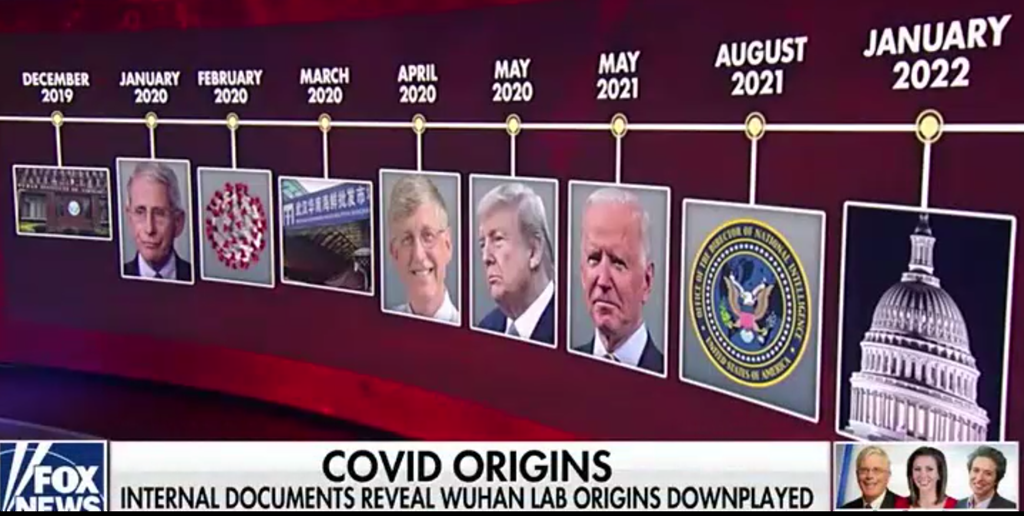
Great piece of reporting by Bret Baer, based on emails and other docs obtained through FOIA requests.

click for 11 min. video<= must see TV … Cliff notes below
image

=============

Here’s my Cliff notes recap (with screenshots from the video report):

> Initially, virologists queried by Fauci, argued (in writing) that the Covid source was a lab leak.

image

image

image

=============

> Fauci immediately tasked a lieutenant to see if if there was evidence that NIH was complicit in the WUHAN lab work.

image

==============

> NIH (and Fauci as the grant awarder) was complicit, having channeled money through the Eco Health Alliance to the Wuhan Lab. 

> Efforts quickly focused on damage control, labeling the lab leak as a conspiracy theory that was a threat to “the science”.

image

image

===============

> NIH awarded almost $9 million in research grants to two of the virologists who were initially adamant that the virus originated in the lab.

image

==============

> The award winning scientists “evolved” their thinking on the subject.

image

image

=============

Bottom line: It’s hard to “follow the science” when the scientists are covering their butts and “following the money”.

Biden: “The unemployment rate is way down to 3.9%”

January 26, 2022

… that is, when you take the 2.3 million who left the work force out of the calculation.
==============

Today, let’s take a 3rd whack at Biden’s economic bravado.

True, the unemployment rate is down to 3.9%.

image

And, that’s a big decline from the 14.7% unemployment rate during the most intense Covid lockdown period.

But, it’s still .4 percentage points higher than the 3.5% pre-Covid unemployment rate.

=============

And, the current unemployment rate is understated since about 2.3 million people have left the labor force … and aren’t counted in the unemployment rate calculation.

image

=============

Combining the current unemployment rate (3.9%) and the number of people who have left the workforce (2.3 million), current employment is only 149 million … about 3.6 million lower than pre-Covid employment.

image

Bottom line: To stay grounded when the statistical shells start moving,  total employment  is the number to focus on …

Biden: “Wages are finally increasing.”

January 25, 2022

Not “real” wages, Joe!
=============

Yesterday, we data-tested Biden’s claim that he “created 6 million new jobs more jobs in one year than any time before.”

The fundamental conclusion: They’re not new jobs.  They’re just old jobs that are being re-filled as lockdowns end and the economy re-opens.

The fun conclusion: By Biden’s measure of job creation, Trump, in his last 6 months,  “created” jobs at a rate 4 times Biden’s rate.

The metric to watch: How many people are employed … and, we’re still 3.7 million jobs below pre-Covid employment levels.

=============

Wage Gains

Today, let’s look at Biden 2nd most touted claim: “Workers are getting raises. Wages are (finally) going up.”

Let’s unpack that claim…

According WaPo, channeling BLS numbers, nominal average hourly wages did rise  4.7% last year.

But, “real” wages — adjusted for inflation, fell 2.4%.

image

Note that:

> During the Obama years, nominal wages (the blue line) were flat … and real wages dipped below the “stay-even” with inflation line

> During the Trump years, nominal wages increased at a slow but steady rate … and real wages stayed above the stay-even line.

> During Biden’s year, nominal wages did increase (by 4.7%), but raging (non-transitory!) inflation more than ate up the gain … so real rages dropped far below the stay-even line (by 2.4%)

So what?

In plain English, according to an NBC poll, over 60% of Americans do not think that their family income is keeping up with the cost of living.

image

Also, according to the NBC poll:

“Overwhelming majorities of Americans believe the country is headed in the wrong direction.”

Coincidence?

Biden: “I added 6 million jobs”

January 24, 2022

By Biden’s measure, Trump added 12 million in his last 6 months!
=============
In last week’s press conference, Biden boasted about his economic record.

Top of the list: Biden touted “record job creation” during his presidency.

He said, “We created 6 million new jobs more jobs in one year than any time before.”

Hmm.

Let’s look at the numbers focusing on “employment”…

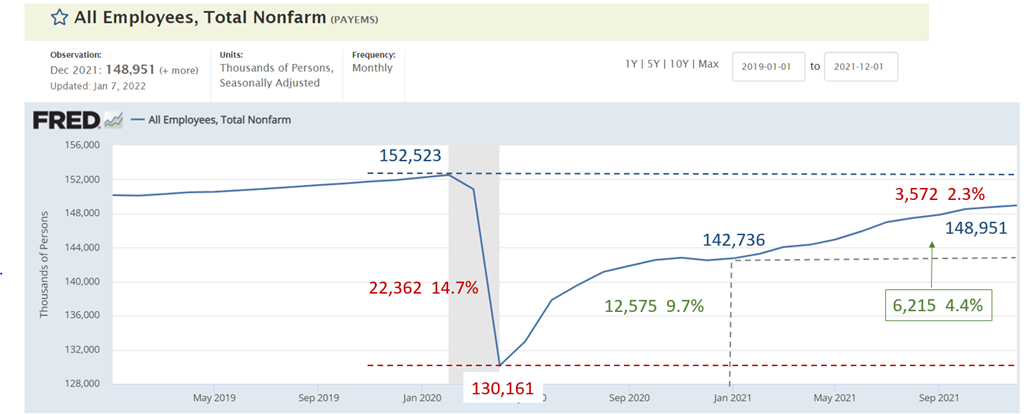
image

> Before Covid hit 152.5 million were employed

> During the intense Covid lockdown period, employment dipped 22.4 million (14.7%) … down to 130.2 million

> Between the lockdown employment trough in May 2020 until Biden’s inauguration in January 2021 (i.e. Trump’s last 6 months in office), employment increased by 12.6 million (9.7%) to 142.7 million.

> From Biden’s inauguration until now,  employment increased by 6.2 million (4.4%) to 149 million.

=============

“Job Creation” or “Ending Lockdowns”?

So, does the 6.2 million employment increase represent the “creation of new jobs” or “refilling old jobs” by removing the Covid lockdowns and re-opening the economy?

To that latter point, note that employment is still 3.7 million (2.3%) lower than the pre-Covid level (152.5 million).

Hmm.

Bottom line: We’re still 3.7 million below the pre-Covid employment level … and relatively few new jobs have been created … we’re just filling the pandemic hole.

=============

Biden vs. Trump

And, note again that in the 6 month period from the Covid trough until Biden’s inauguration, employment increased by 12.6 million.

Using Biden’s bogus logic and semantics, that means that Trump, during that period “added” jobs at an average rate of 2 million per month … 4 times Biden’s rate of 500,000 per month.

Hmm

=============

Takeaway

As even CNN observes:

Biden is free, of course, to boast about how quickly the hole is being filled.

But his claims about setting records should be viewed with contextual caution.

Redefining “invasion”…

January 20, 2022

… and other head-scratchers from Biden’s presser.
==============

Glutton for punishment,  I watched all 2-hours of Biden’s press conference …

Here are a few more of my takeaways…

> Biden redefined “invasion”, coining a new phrase “minor (territorial) incursions” … which many observers interpreted as green-lighting Putin to breach the Ukraine border.

Shades of the domestic version: “mostly peaceful protests” that cause billions of dollars of damage without prosecution.

==============

> Biden praised U.S. technology and science (with no shout-out for Trump’s Op Warp Speed) for fast development of covid vaccines … but added that he (Biden) did the hard part: “getting shots into arms”.

Further, he said that his highest Covid priority for a return to normalcy is to vaccinate the rest of the world 

==============

> He condemned GOP senators for voting as a bloc … because they’re afraid of retribution by Trump.

On the split screen, Dems were threatening to primary Manchin & Sinema for breaking with the Dem bloc on the filibuster and BBB.

==============

> He warned that the 2022 mid-terms might be illegitimate if his voting rights bill isn’t passed.

Moments earlier, he touted the record-setting voter turnout in 2020  … non-sequitur?

Isn’t it wrong to question the legitimacy of elections?

==============

> He asserted that retail shelves are 89% full … only down 1% from a year ago

Generalizing from our past week of shopping: no bread, milk or produce on the shelves, empty sections of  OTC cold and flu medicines and, of course, no covid test kits.

=============

> He conceded that he might have been a month late igniting the push for in-home covid tests … who would have known?

Vanity Fair reported that in January 2021, the incoming Biden Administration was “handed” a national rapid-testing strategy … positioning  rapid testing as the most powerful tool to reduce transmission and case counts.

Then, on October 22, a group of COVID-19 testing experts presented the Biden administration with a detailed strategy for overhauling America’s approach to testing … by putting rapid at-home COVID-19 testing into the hands of average citizens, allowing them to screen themselves in real time and thereby help reduce transmission.

Hmm…

Who would have known?

Biden: “Best 1st year ever … my team is competent … full steam ahead”

January 20, 2022

Begala: “Not bad leaders, bad followers”
=============

Anybody who was hoping for retrospective humility, a course correction, an olive branch or a good old fashioned house cleaning was probably disappointed by Biden’s press conference yesterday.

Instead, he went full Begala, adopting the view that: “Democrats’ Problem ‘Is Not That They Have Bad Leaders. They Have Bad Followers’.

Joe’s view:

  1. He was dealt a bad hand
  2. Not lurching left
  3. No mistakes, no apologies
  4. I didn’t say what I said
  5. Exceeded expectations, great progress
  6. Best presidential first year ever
  7. Entire team doing a good job
  8. Has an agenda, GOP doesn’t
  9. Heading in the right direction
  10. Blame Covid, “Big meat” and Trump
  11. People just need to be informed
  12. The polls are wrong

Oh, my…

For the record:

In the latest RCP poll-of-polls. only 27.6% of Americans think that he country is moving in the right direction…

image

And, in this week’s Morning Consult poll, half of self-identified independents gave Biden either a “D” or an “F” grade for his first year performance.

So much for data-driven…

============

P.S. Best news for GOP…

Biden said: “I’ll be hitting the campaign trail to support Democratic candidates in the mid-term elections.”

COVID Math: So, how accurate are rapid tests?

January 19, 2022

Best guess: If you test negative, the likelihood is very high that you’re not contagious.

If you test positive, the likelihood is high that you are contagious … but there’s about a 1 in 4 chance that you got a false positive, so assume that you are contagious and re-test the next day to be sure.

Keep reading for the math and the underlying assumptions…
============
DISCLAIMER: I’m not a medical professional or scientist — just a curious, self-interested guy.  So, don’t take anything that I say or write as medical advice. Get that from your doctor!
============

In a prior post, we outlined the logic that CDC Director Walensky laid out regarding antigen rapid tests in a 2O2O paper (i.e. before she started walking the political mine field).

Her fundamental conclusion at the time:

“The antigen rapid tests are ideally suited for surveillance testing (i.e. determining if a person is contagious) since they yield positive results precisely when the infected individual is maximally infectious.”

OK, we’ll take that as our qualitative starting point.

=============

What exactly is “accuracy”?

Keying off Walensky’s conclusion (above), we’ll focus on the use of antigen rapid tests for surveillance testing (i.e. determining if a person is contagious).

In that context, antigen rapid test accuracy has two components: sensitivity and specificity:

> Sensitivitysometimes called Positive Percent Agreement (PPA) —is the probability that a contagious person’s test result is positive. When it isn’t, it’s called a false negative.

> Specificitysometimes called Negative Percent Agreement (NPA) —is the probability that a a person who is not contagious gets a negative test result. When it doesn’t, it’s called a false positive.

IMPORTANT: Keep in mind that we’re focusing on surveillance testing … whether or not a person is contagious.

For early-on diagnostic testing (i.e. whether a person may need treatment or quarantine), the above criteria would be “infected”, not “contagious” … and the answers are different.

=============

Now, let’s add some real life parameters and do the math

Johns Hopkins maintains a website that reports sensitivity and specificity for all Emergency Use Approved test kits.

For example, Abbott’s BinaxNOW — one of the most popular — is listed as scoring 84.6% on sensitivity (if contagious, the test result is positive) and  98.5% on specificity (if not contagious, the test result is negative).

That’s testing accuracy, but it’s only part of the story.

What we really care about is the tests’ predictive value.

As JHU puts it…

Positive predictive value (PPV) and negative predictive value (NPV) provide insight into how accurate the positive and negative test results are expected to be in a given population.

Predictive value is based on test accuracy and existing disease prevalence.

OK, so to calibrate predictive value,  let’s assume that Covid prevalence is 5% (i.e. 1 in 20 people that a person runs into is infected) … and plug the Abbott sensitivity and specificity numbers into the below Bayesian table.

For a detailed walk-through of a comparable Bayesian table, see our prior post: If I test positive for COVID, am I infected?     

image

The key numbers — the predictive values — are in the bottom rows of the yellow and orange boxes:

> Less than 1% of the negative test results are false negatives (the orange box)

> But, 25.2% of the positive test results are false positives (the yellow box).

=============

My take:

If a patient gets a negative test result (based on these parameters), it’s virtually certain that they’re not contagious … but they may have small traces of the virus in their system.

If a patient tests positive, there’s high likelihood (74.8%) that they’re contagious … the likelihood is higher if they are symptomatic.

But, if a person is asymptomatic and tests positive, there’s a 1 in 4 chance that they got a false positive and might not be contagious.

Before going out & about, it would make sense to take a second test to validate (or refute) the positive result.

A second positive test (taken a day or 2 later) reduces the chance of a false positive to essentially zero.

=============

IMPORTANT: These Bayesian estimates are dependent the sensitivity and specificity of the test …  and on the assumed prevalence of of the virus.

For example, if the prevalence rate jumps from 5% (1 in 20 people are contagious) to 25% (1 in 4 people are contagious) … then the positive predictive vale soars to 95% and the negative predictive value decreases to 95%.

Conversely, likelihood of a false positive drops to 5% and the likelihood of a false negative increases from near-zero to 5%

==============


RIGHT NOW: Order your “free” at home covid tests

January 18, 2022

The government web site is up and running:

COVIDtests.gov – Free at-home COVID-19 tests

I just ordered our’s … took less than 2 minutes … just enter email address and shipping address … no insurance or ID info required … even get a confirming email — just like the real online guys.

I’m amazed that the site is up & running … and that the process was so simple.

Walenshy on rapid tests … then and now.

January 18, 2022

Last week, we spotlighted a NY Times article “The C.D.C. Is Hoping You’ll Figure Covid Out on Your Own”.

Author Zeynep Tufekci asked:

Why, two years into the pandemic, are people are grasping to know whether they should see a grandparent or an elderly relative or go back to work if they are still testing positive?

Why are we still trying to figure this out on our own?

Of course, the primary root causes are a new, fast-moving, ever-changing virus … and haphazard science, heavily politicized, that can’t seem to converge on a coherent “theory of the case”.

===========

Now that Biden’s test kit program is about to launch, this part of the article has specific relevance….

Deep in the article, Tufekci  channels CDC Director Walensky to provide a clear explanation of covid testing … and an example of the politicization.

According to Tufekci…

Back in 2020, when Walensky was on the faculty of the Harvard Medical School and chief of the division of infectious diseases at Massachusetts General Hospital, she co-authored a scientific paper titled “Saliva-Based Antigen Testing Is Better Than PCR Swabs”.

Some snippets from that paper:

> PCR tests can detect tiny amounts of the virus, so they do a great job of “diagnostic testing” — determining early-on if you are infected and may require isolation or treatment.

> But, PCR tests can “return positives for as many as 6-12 weeks … long after a person has ceased to need medical care or pose any real risk of transmission to others.”

> Said bluntly: PCR tests do a good job of diagnostic testing but a rotten job of “surveillance testing” that zooms in on whether a person is contagious to others.

> “The antigen tests are ideally suited for surveillance testing since they yield positive results precisely when the infected individual is maximally infectious.”

The reason is that antigen tests respond to the viral load in the sample without biologically amplifying the amount of the virus. PCR tests do amplify the virus in the samples and sometimes detect and report inconsequential “left over” viral fragments.

> A rapid test turns positive if a sample contains high levels of the virus, not nonviable bits or minute amounts — and it’s high viral loads that correlate to higher infectiousness.

With respect to viral transmission: “False negatives” on rapid tests are a benefit since “those are true negatives for disease transmission”

Again, a PCR test is positive if any amplified viral content is detected.

An antigen test may be negative if the virus is present but the viral load is very low … consistent with a low likelihood of viral transmission.

> But, antigen tests may be slower (than PCR tests) to detect the early onset of an infection, especially if symptoms haven’t materialized, since the viral load may be low but building.

> So, confirming a suspected early stage infection is best done with a PCR test or with a series of rapid tests, say, every other day for a week.

==============

OK, that’s what Walensky said back in fall of 2020, before her shift from “scientist” to “political scientist”.

Now, she’s saying:

“We actually don’t know how our rapid tests perform and how well they predict whether you’re transmissible during the end of disease”

Has the science changed … or, the scientist?

Hmm

==============

P.S. Walensky’s entire 2020 paper is worth reading.

Here comes the USPS … with 500 million free test kits.

January 17, 2022

Just wondering: What could possibly go wrong?
=============

OK, as the omicron shockwave is showing some signs of peaking, Biden’s mass ordering of in-home rapid test kits is going to launch this week.

A simple plan: Tens of millions of Americans place online orders for free test kits (maximum 4 per “address”) …  7 to 12 days later, the order gets shipped via the USPS … a couple of days later the kits start hitting mailboxes around the country … and over 100 million sharp-as-tack Americans try to figure out when and how to use the kits.

Might work…

Call me cynical, but I think there may be some potential holes in this plan:

> Web site crashes: According to the AP, “Administration officials say they are cognizant that any launch of a website carries some risks”. You don’t say. Envision Obama’s Healthcare.gov web site getting as many as 100 million front-ended hits.

> The Supply Chain: Since purchase orders have just been placed (or are still in process), who knows when the 500 million will actually hit government warehouses?

> Snail mail: Again, successful online orders “will be shipped in 7 to 12 days” … delivery “a couple of days later” — may be optimistic with 500 million test kits floating around an erratic postal system

> Lost in the mail: Any chance some of the kits fall into some USPS dark hole or get misdirected?

> Hijacked mail: The test kits will be the most valuable “bulk rate” mailing since the 2020 mail-in election ballots. Act surprised when people start reporting that they didn’t get their test kits.

> Black market resales: The kits will have value for people who need them but, for whatever reason, can’t score enough for their household. Watch for “free” government supplied test kits showing up on the internet “not for free”.

> Customer service: What if your kits don’t arrive in your mailbox? Who do you call to resolve the problem? Good luck.

> Counterfeits: Once the internet black market starts up (and it will!), the counterfeit and unregulated kits from China are sure to follow.

> Too Late to Matter: Since the kits won’t be arriving until late January – more likely February – omicron will hopefully be past us. What to do with the kits? Will they be able to detect the omega variant?

Note: Omega is the last of the 24  letters in the Greek alphabet, but not necessarily the last covid variant.

==============

Bottom line: High likelihood that this rollout will make the Afghan evacuation look like a Swiss watch.

Hope I’m wrong, I’d like to score a couple of kits … especially if my fellow taxpayers are footing the bill.

=============

P.S. I would have drafted Amazon to do order processing and fulfillment.  They could handle the volume and the 1-per-address rule. Why craft a new government system on-the-fly? Dumb.

NYT: “CDC hoping that we’ll figure Covid out on our own”..

January 13, 2022

Yesterday, we spotlighted a Washington Post  editorial  headlined

image_thumb2

The essence of the editorial:

As Covid-19 swept the world one year ago, the United States under-prioritized the need for data and the tests that produce it.

The data-deficient response to Covid-19 is why this pandemic’s been so deadly, so disruptive and so costly.

=============

Putting it more viscerally, the NY Times says:

image

Some snippets from the Times article:

The government’s haphazard and disorganized Covid response has put the whole country at risk.

We aren’t expecting officials to have crystal balls about everything, but…

The highest-ranking public health officials are making statements that seem more aimed at covering up or making excuses for ongoing failures, rather than leveling with the public.

it’s so disappointing to enter 2022 with 2020 vibes, scouring for supplies, trying to make sense of official declarations that don’t cohere, and wondering what to do.

Why, two years into the pandemic, are people are grasping to know whether they should see a grandparent or an elderly relative or go back to work if they are still testing positive?

Why are we still trying to figure this out on our own?

My question: Why has it taken the WaPo and NY Times so long to notice that “the science” has been letting us down.

WaPo: “Flying blind is no way to survive a pandemic”

January 12, 2022

Finally, I agree with a Washington Post editorial.

image

Amid the omicron spike, the recent uproar about testing and quarantine rules has spotlighted the current unscientific nature of “the science”.

Biden’s scientific team offers up simultaneously contradictory points of view, small scale ad hoc studies that incite reactionary course reversals, and no logical, fact-based “theory of the case”.

In the words of Rajiv J. Shah, president of the Rockefeller Foundation:

“The United States has been flying virally blind.”

More specifically, Shah argues:

Data is the secret weapon that has helped beat every disease outbreak over the last century.

Data is what moves us from a panic-driven response to a science-driven one, telling us how to fight back and which tools are best.

But, as Covid-19 swept the world one year ago, the United States under-prioritized the need for data and the tests that produce it.

The data-deficient response to Covid-19 is why this pandemic’s been so deadly, so disruptive and so costly.

Currently, only a handful of countries (e.g. Israel, South Africa, Britain) are systematically collecting, analyzing and sharing data that is sufficiently comprehensive, precise and timely to help public health authorities and scientists make informed decisions about relaxing precautions or adapting vaccines and treatments.

Unfortunately, from a data perspective, the United States is in no better position to understand and stop a viral variant today than it was before the pandemic started.

The United States has not yet built a real-time system of viral surveillance that would allow comprehensive tracking of variants as they move through the population.

As it is now, the CDC pulls together viral surveillance data from a variety of sources, including its own facilities, state public health labs, and university and private laboratories.

The frustrating complexity and diversity of electronic medical records is an ongoing challenge.

The data sets are minimally standardized, key data is often uncollected, data file formats vary and data reporting is sporadic.

So, it can take weeks to build a complete and reliable picture of how a variant is spreading.

By then, it’s often too late and a newer variant must be battled.

The U.S. must take crucial steps to support a national viral surveillance network to defeat Covid-19 and prepare for the next pandemic.

Bottom line: It’s not surprising that there’s no over-riding theory-of-the-case, confusion re: pivotal factors (e.g. prevalence, transmission, re-infection, mitigation effectiveness) and a seemingly endless pandemic.

Covid: “Now, everybody knows somebody…”

January 11, 2022

Why it feels different this time around…
=============

A couple of months ago – during the last Covid spike – I opined that Covid was an abstract notion for most people since they hadn’t been personally and consequentially touched by it.

As evidence, I cited a broad-scale YouGov survey that found that, despite hundreds of thousands of covid-related death, 2/3’s of Americans didn’t “personally know anyone who had died due to complications from covid-19”.

clip_image002

Sure, people had heard about people getting infected but “they” were either newsworthy celebrities or very distant relationships … distanced by 4 or 5 degrees of separation.

It was like a serious crime epidemic that hadn’t struck “my neighborhood”, let alone “my house”.

For sure that sense has changed …

For openers, we’ve now reached the point where everybody knows somebody who has been infected, and those “somebodies” are closer to home … they’re not a cousin’s neighbor’s son-in-law’s co-worker’s friend … they’re close friends and family … within zero or one degree of separation.

And, there seem to be more “batches” of “theys”, not single isolated cases.

Specifically, entire neighborhoods are getting hit … and once the virus penetrates a household, most family members get sick.

When they get sick, nothing seems to make sense.

Being fully vaccinated is proving to be a porous barrier to infection.

Within households, symptoms vary widely from person to person … seriously symptomatic people are testing negative … asymptomatic people are testing positive (when they can find a test!)

Go figure.

When it hits close to home like this, people seek reliable (and actionable) “what to do” answers … have less tolerance for misdirection, obfuscation and butt-covering bull-bleep.

It becomes evident to all effected that the government’s political-scientists — always assertive, occasionally right – are flying blind … spewing illogical, data-short guidance that confuses rather than clarifies.

As NBC News put it “The rapid spread of the variant has created a level of disruption in many Americans’ lives not seen since the early days of the pandemic. We have gone backwards.”

I think we’ve reached a turning point  … and, that’s a difference time around.

=============

P.S. Your read that right: NBC News … article is worth reading.


Biden: “Lack of competition is exploitation”

January 10, 2022

Does the principle apply to education too, Joe … or just “big meat”?
=============

This week, Biden lashed out at “big meat” … blaming his policy-induced inflation on greedy meat purveyors … and flag-poling a broad theme: “Capitalism without competition is exploitation”.

As an academically-degreed economist, I agree that a condition for “perfectly efficient markets” is the presence of numerous direct and indirect competitors and product substitutes.

But, I think industry concentration is a lame excuse for the current skyrocketing inflation.

Industry consolidation hasn’t changed materially over the past, say, 5 years … and inflation was minimal in the 4 years preceding 2021.

That suggests that there are “root causes” other than industry concentration.

Catch my drift?

=============

My question:

Isn’t Biden’s condition for “market efficiency” generalizable to, say, education?

Even the NY Times concedes that “Many schools have still not returned to normal, worsening learning loss and social isolation.”

Why is it that many schools have not returned to in-person learning?

Simple explanation: Urban teachers’ unions in several cities are continuing to use their collective (and concentrated) clout to stiff-arm in-person classes.

Besides the well-publicized Chicago bruhaha, “closings are taking place in Atlanta, Cleveland, Milwaukee, Newark and several New York City suburbs, among other places.” NYT

The unions collective and concentrated actions are also a violation of economists’ “efficient markets” criteria” … causing havoc.

So, it seems logically consistent in principle to declare:

“Education without competition is exploitation”

President Biden may have inadvertently handed school choice advocates a resonating rallying cry for the 2022 mid-term elections.

============

P.S. For an analysis of the real root causes of meat price increases, see WSJ: Meatpackers Are Biden’s Latest Inflation Scapegoat

Covid death counts are still high!

January 7, 2022

The percentage of infections resulting in hospitalization or death has declined, but…

…. as I used to preach to students: a little number times a very, very large number is a large number.
=============

In prior posts, I’ve encouraged readers to stay focused on the number of Daily New Deaths DNDs).

MUST READ: How will we know when we’ve turned a COVID-19 corner?

=============

It’s not news that the number of covid cases has skyrocketed.

These days, everybody knows somebody who has tested positive for covid … or, has suffered covid-like symptoms without a confirming covid test.

Our personal observations are captured in the reported aggregate numbers.

image

=============

There’s a tendency to characterize the spike in cases as low severity annoyances … minimizing the reality that covid-related deaths are still accumulating at the pandemic’s average rate.

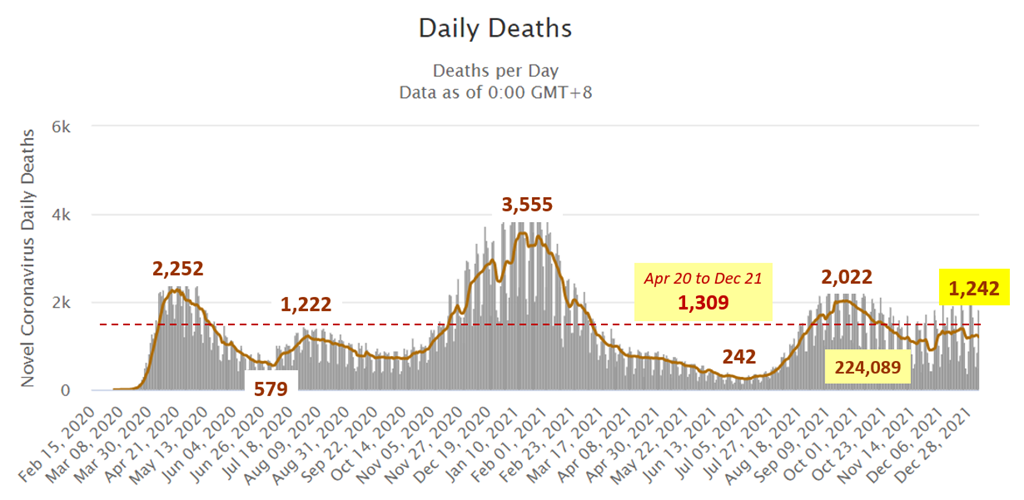
Specifically, we’re currently averaging about 1,250 covid-related deaths per day.

image

Let’s put the 1,250 in perspective …

> Since the start of the pandemic in early 2020, there have been about 850,000 covid-counted deaths … that averages out to 1,300 daily deaths.

> At the 2 prior peaks — April 2020 and January 2021 — the daily death rate reached about 2,250 and 3,500, respectively.

> Historically, the number of flu-related deaths averages about 250 per day during the flu season.

So, while the current daily death count is less than half of the count during the prior peak periods, it’s 5 times the average number of in-season flu deaths.

And, the numbers add up.

Since the prior trough in July 2021, there have been about 225,000 covid-related deaths … that’s about 1/4 of the total covid-related deaths to date.

=============

Bottom line: We’re not out of the woods yet, folks.

Stay focused on the daily death counts.

Postpone any victory celebrations until we get down to the 250 flu-related deaths benchmark … and stay at or below that number.

MUST READ: How will we know when we’ve turned a COVID-19 corner?

January 6, 2022

Stay focused on the number of Daily New Deaths!
==============
This is a relevant excerpt from a long ago prior post (May 2020)
==============

From the begining of the Covid pandemic, I’ve focused on Daily New Deaths (DND) as my key metric.

Why is that?

First, saving lives is our paramount objective, right?  If yes, caused fatalities should be our focus metric.

Second, I think that most other metrics that are being bandied about are quite problematic.

Counting deaths — while a bit macabre — is a more reliable process than counting, say, the number of infected people.

Sure, I’d like to know the number of people infected with COVID-19.

But, unless everybody — or at least a large statistical sample — is tested, the number of confirmed cases is subject to disqualifying statistical issues.

Most notably, who is being tested and who isn’t? What about the asymptomatic “hidden carriers”? What are the criteria for confirming a COVID infection? What about false positives (and false negatives)? How to standardize the reporting processes across states? How to keep governmental units from fudging the numbers?

Importantly, if testing increases, then confirmed cases goes up.

Is that an indication of more virus spread or just a reflection of more testing?

I sure can’t tell … and, I doubt that anybody else can with any degree of reliability.

=============

Again, counting fatalities is probably the most reliable metric.

Fatalities are discrete events – so they’re countable.

Still, even deaths may have some counting imperfections.

For example, many non-hospitalized people die and are buried without autopsies.  Some may be uncounted COVID victims.

On the other hand, some people may die and be diagnosed with COVID infections. That doesn’t necessarily mean that COVID killed them.  That’s especially true with COVID since it’s most deadly for people with other health problems.

And, as we stated above, the definition of COVID deaths has changed over the course of the pandemic:

COVID-related” means “COVID present”, not necessarily “COVID caused” … and , along the way, “present” was redefined from “confirmed” to “presumed”

Further, COVID deaths are a function of two drivers: the incidence of the virus … and, the nature, level and timing of therapeutic healthcare.

Said differently, more effective therapeutic healthcare will dampen the death toll.

==============

Bottom line: “Daily New Deaths” is the number we should be watching.

If it shows a consistent downward trend, then we’ll know we’ve turned the corner.

If it stays stable (at a high level) or turns upward, we’ll know that we’re in deep yogurt.

===============

Next up: So, how are we doing?

Biden’s Christmas rally fizzles…

January 5, 2022

In the run-up to Christmas, as retailers deftly managed through supply chain logjams and Santa fully loaded his sleigh with enough presents to keep kids smiling, Biden’s job approval numbers improved a bit … peaking at 44% approval, 50% disapproval.

Then came omicron and the test kit shortage … and the worm turned again.

According to the RCP poll-of-polls, Biden is now almost 12 percentage points under water …  42.3% approve of his job performance, 53.9% disapprove.

For the record, the 53.9% disapproval is the highest that Biden has earned up to this point in his administration.

image

=============

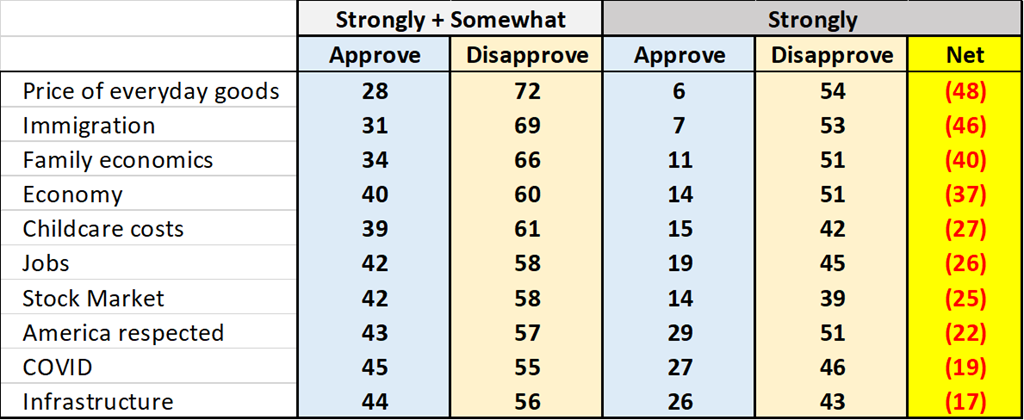
Drilling down, according to a recent CNBC/Change Research poll, Biden is deeply underwater on all queried issue areas.

He scores best (err, make that least bad) on Infrastructure (17 points underwater) and COVID (minus 19 and falling fast).

He scores worst on Price of everyday goods (48 points underwater), Immigration (minus 46) and Family economics (minus 40).

image

==============

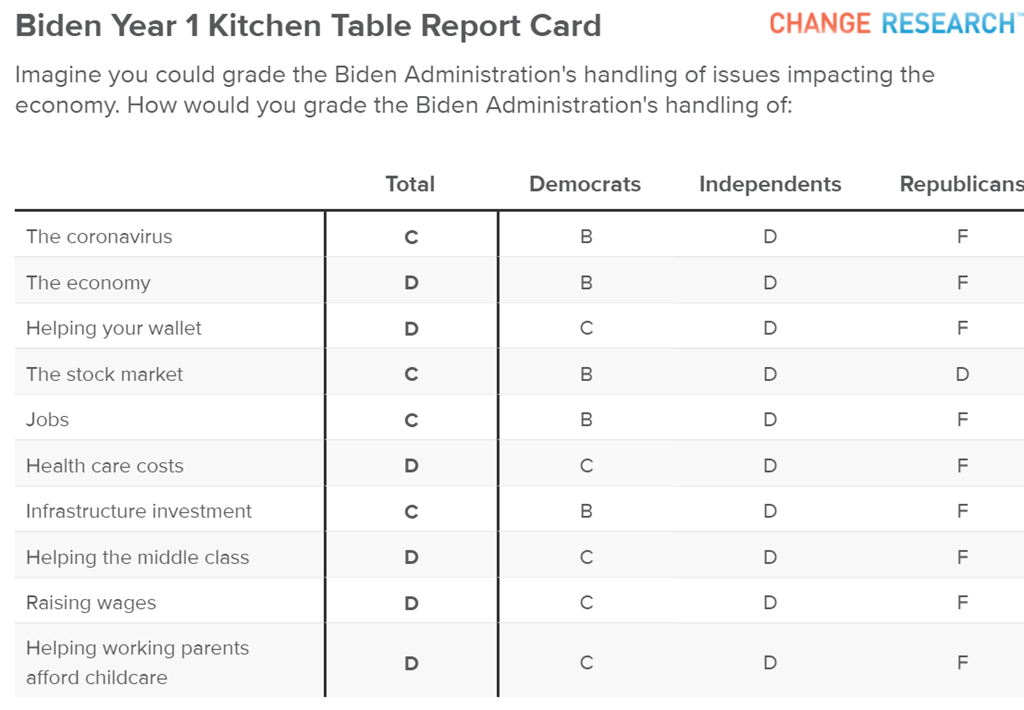
Taking another cut at the data, Change Research (CNBC’s polling partner), scores a “Kitchen Table Report Card” by asking people:

Imagine you could grade the Biden Administration’s handling of issues impacting the economy.

How would you grade the Biden Administration’s handling of each of these issues?

> Republicans given Biden straight Fs

> Dems give him a mix of Bs and Cs … averaging out to B- / C+

> Independents give him straight Ds

image

=============

Just for the record…

On the CNBC poll, Biden scores 38% favorable, 56% unfavorable on personal favorability.

On that same measure, in that same poll, Trump scored 38% favorable, 55% unfavorable.

Hmm.

So, do rapid tests work … or not?

January 4, 2022

With covid prevalence spiking, as usual, CDC guidance muddies the water.
============

A couple of weeks ago, with omicron spreading like wildfire and workforces getting depleted by quarantined workers, Biden finally left his bunker and promised January home-delivery of 500 million hard-to-find antigen rapid tests.

Current reporting is that orders are “in the process” (i..e. they have not yet been officially placed) for 250 million in the last half of January and 250 million in February and March.

That works out to about 1 test per month for every adult.

Biden assured that the testing surge would be another game-changer (akin to getting LA ports to stay open nights & weekends to unclog supply chains) … and that he was, of course, “following the science” …

So, it seems reasonable to conclude that his homeboy scientists advised him that the antigen rapid tests worked.

That is, except for CDC Director Wolensky who told CNN that the CDC doesn’t “actually know how well rapid tests perform and how well they predict transmissible presence of the virus”.

So, do the rapid tests work … or not?

==============

On that question, Epidemiologist Michael Mina published the most informative piece that I’ve found…

Dr. Mina’s overall conclusion:

Antigen tests are extremely sensitive for very contagious people.

When taken at peak viral load, these tests approach 100% sensitivity.

Here’s his visual recap … click it to enlarge it.

image

My takeaways:

> In the first couple of days after getting infected, neither the PCR nor the antigen tests are sensitive enough to detect the infection.

> Around the 5th day after getting infected, the tests are able to detect the virus.

> PCR tests may be able to detect the virus a day or two sooner than the antigen test … but, since the PCR tests require a day or two for processing & reporting, antigen and PCR tests are practically equivalent for early detection.

> Infectees have the highest viral load (and are most contagious) from day 6 to day 12 after getting infected.

> During days 6 to 12, when infectees are most contagious, both PCR and antigen tests are reliably able to detect the virus.

> After day 12, as the level of viral load quickly diminishes, PCR tests are able to detect the residual, non-contagious levels of the virus … but, the less sensitive antigen tests do not.

=============

Again, according to Dr. Mina’s research and analysis:

When taken at peak viral load (when infectees are most contagious), antigen tests approach 100% sensitivity.

Accordingly, Dr. Ashish Jha, the dean of Brown’s school of public health, calls antigen tests “contagiousness tests” … and says that they are very good at detecting people who are still infectious to others.

They won’t detect every speck of virus that their PCR counterparts are attuned to do, but they can detect the important part — if someone is producing enough of the virus that they’re likely to spread it.

=============

Bottom line

If I could get my hands on in-home rapid tests, I would confidently use them…

(1) When I’m exhibiting any symptoms (e.g. fever or sniffles)

(2) After the rare occasions when I’ve attended an indoor gathering with non-family members.

(3) Before visiting my grandkids … for re-assurance that  I’m not contagious.

But, first step is getting my hands on some of the in-home tests!

And, as I like remind readers…

DISCLAIMER: I’m not a medical professional or scientist — just a curious, self-interested guy.  So, don’t take anything that I say or write as medical advice. Get that from your doctor!

Why is the CDC so reactionary, illogical and, uh, unscientific?

January 3, 2022

Their most recent isolation “guidance” is a case in point.
=============

With covid-omicron spreading like wildfire and seeming to close in on all of us (me included) … and with workforces getting depleted by quarantined workers, the CDC stepped in to save the day by issuing revised isolation guidelines, specifically:

Given what we currently know about COVID-19 and the Omicron variant, CDC is shortening the recommended time for isolation for the public.

People with COVID-19 should isolate for 5 days and if they are asymptomatic or their symptoms are resolving (without fever for 24 hours), then…

People should follow that (isolation period) by 5 days of wearing a mask when around others to minimize the risk of infecting people they encounter. CDC

Let’s unpack that guidance…

=============

First, when does the clock start running?

For somebody who who develops symptoms, I guess it’s when “the” symptoms first present themselves.

My questions:

(1) Do cold-like sniffles count as “symptoms”? What’s the best indicator that I may have caught it? How indicative is a fever?

(2) What to do if I am officially symptomatic? Isolate, for sure … but, go see a doctor?

Note: At local walk-in clinics, people are waiting 4 to 6 hours in a room filled with 50 to 100 sick-likely people.  Sounds like a recipe for disaster, right?

=============

What about infectees who are asymptomatic?

For them, I guess that the clock starts for when they test positive.

Let’s pretend that they’re inclined to get tested (say, because other members of their household are symptomatic or have tested positive … or because their employer or airline requires a test).

These folks can’t do-it-themselves now because of the scarcity of in-home rapid tests.

Of course, they have the option of waiting in line for a couple of hours to get a “commercial” PCR test.

Note: Lines are running around the block at local testing sites.  Again, sounds like a recipe for disaster since most of the people in line are symptomatic.

===============

Once the clock starts…

OK, this part of the CDC guidance is pretty clear: isolate for 5 days.

But, things get murky after that isolation period.

The CDC says:

After infectees isolate for 5 days, if they are asymptomatic or their symptoms are resolving (e.g. no fever for 24 hours), then…

They should follow that (isolation period) by 5 days of wearing a mask when around others

The criteria “asymptomatic or symptoms resolving” is most problematic.

=============

What about rapid tests?

In the UK and several other countries, that free-of-isolation criteria is supplemented by the need for a negative covid test … rapid tests qualify.

So, why isn’t the CDC advising a negative covid test?

Cynics observe that the omission of negative tests in the guidance is simply cover for the Biden Administration’s slow-roll on the development and production of antigen rapid tests.

The official CDC announcement says:

The guidance is motivated by science demonstrating that the majority of transmission occurs early in the course of illness, generally in the 1-2 days prior to onset of symptoms and the 2-3 days after infection. CDC

More specifically, CDC Director Rochelle Walensky told CNN that the CDC chose five days because that’s typically the period when individuals are most infectious.

“Those five days account for somewhere between 85 to 90 percent of all transmission that occurs”

So far,so good.

But then she added:

“We opted not to advise the rapid test for isolation because we actually don’t know how our rapid tests perform and how well they predict whether you’re transmissible during the end of disease. Source

Say, what?

So, if I have this right…

Biden has ordered up 500 million in-home rapid tests … but the CDC doesn’t “actually know how well rapid tests perform and how well they predict transmissible presence of the virus”.

If that isn’t dizziness-inducing enough, Dr. Fauci, Biden’s chief political scientist, was his usual ubiquitous self on Sunday TV hinting that the CDC would soon be adding a testing requirement after all. Source

=============

My take: It would be a lot easier to “follow the science” if “the science” weren’t so reactionary, illogical, impractical and, well, unscientific.

The best New Year’s Eve “Ball Drop” … GUARANTEED

January 1, 2022

A couple of weeks ago, one of the teachers at Holy Trinity School (where 2 of my grandkisds go) became an internet star.

Kathleen Fitzpatrick (aka. Ms. Fitz), became a viral internet sensation by sinking a full court shot … on the school’s playground … in front of her cheering students.

ESPN “re-purposed” the video clip for New Year’s Eve.

Totally AWESOME!

image

Subscribe to HomaFiles Email Alerts

January 1, 2022

Click here to subscribe to HomaFiles email alerts.

You’ll get an email summary when
new HomaFiles content is posted.

==============

If the subscription page fails to load:

  1. Copy this link
  2. Open a new browser window
  3. Paste the copied link


Happy New Year!

January 1, 2022

Let’s all say good riddance to 2021, count our blessings and do our part to make 2022 a joyous year.

image