Archive for the ‘Employment – Jobs’ Category

Hard to believe … the BLS streak rolls right on.

October 25, 2012

I though the BLS might find some old time religion – or at least hire a new stats guy – since they got hammered on the incredible 7.8% unemployment number.

Not so.

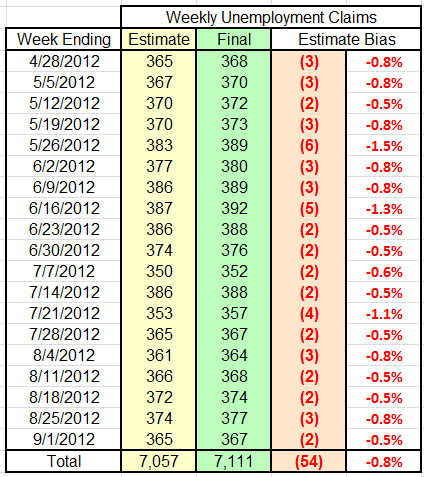
And, the BLS streak — understating initial claims – continued.

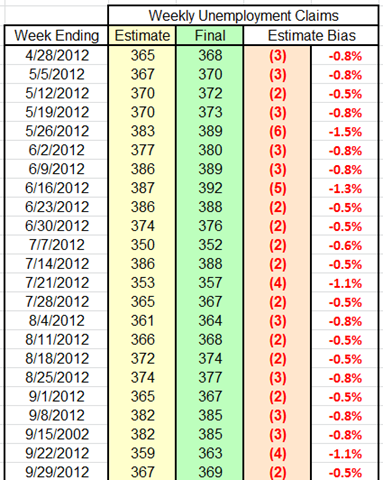
Now we’re up to at least 25 election season weeks in a row that the BLS’s “headline number” has under-reported the number of initial unemployment claims … and cast the jobs situation as brighter than it really is.

Based on today’s BLS report, the number for the week ending October 13 was revised upward from 388,000 to 392,000 … making this week’s headline look 4,000 better.

Glad the election is only 12 days away.

Wanna bet that the BLS makes a post-election change to their methodology?

image

>> Latest Posts

Compare the economic recovery plans …

October 25, 2012

Seriously, before you vote, at least glance at the plans being offered by Obama and Romney.

You decide which is substantial and which is fluff ..

* * * * *

click to view very short video intro

click to view plan

image

click to see Business Insider’s summary of the plan’s highlights:
Obama Has Released A 27-Point Plan For His Second Term, And It’s A Doozy

* * * * *

click to view

image

click to see Business Insider’s summary or Romney’s plan
Here’s Everything We Know Now About Mitt Romney’s Economic Plan

>> Latest Posts

Hoisted by their own pitards … BLS unemployment claims are in.

October 18, 2012

Last week, Team Obama was crowing about the huge drop in initial unemployment claims … proof poitive that the recovery was gaining steam.

They failed to mention the fact that the state of California sat on a pile of claims … making the numbers look better than they really were.

Well, as Rev. Wright would say, the chickens have come home to roost.

According to the BLS: “In the week ending October 13, the advance figure for seasonally adjusted initial claims was 388,000, an increase of 46,000 from the previous week’s revised figure of 342,000.”

Oops.

Headline: “Jobless claims increase 46,000”

Not exactly proof positive of an economy gaining steam.

My bet, Team Obama emphasizes that claims are overstated because of California.

Too bad.

* * * * *
And, yes … the BLS streak — understating initial claims – continued.

Now we’re up to at least 23 election season weeks in a row that the BLS’s “headline number” has under-reported the number of initial unemployment claims … and cast the jobs situation as brighter than it really is.

Based on today’s BLS report, the number for the week ending October 6  was revised upward from 339,000 to 342,000.

C’mon guys … get it right already.

image

>> Latest Posts

Employment stats: Spreading the hours around …

October 16, 2012

Obscured by the headline unemployment numbers is an oft-overlooked stat – average hours worked

In rough numbers, average weekly hours worked has declined by roughly 1/2 hour … to 41.5 hours per week.

Couple of interesting aspects to the number …

First, it’s greater than 40 – a standard 5 days – 8 hours work week … suggesting that firms are still using overtime to meet capacity needs rather than hiring … or, folks are working multiple jobs … maybe, 2 part-time jobs.

Second, while 1/2 hour doesn’t sound like much … it translates to over 600,000 full-time equivalent positions, i.e. has the economic impact of pulling more than a half-million FTE workers out of jobs.

image

>> Latest Posts

Who employs more people – the government or “goods producing” industries?

October 15, 2012

Easy question since you know I wouldn’t ask if the answer wasn’t government.

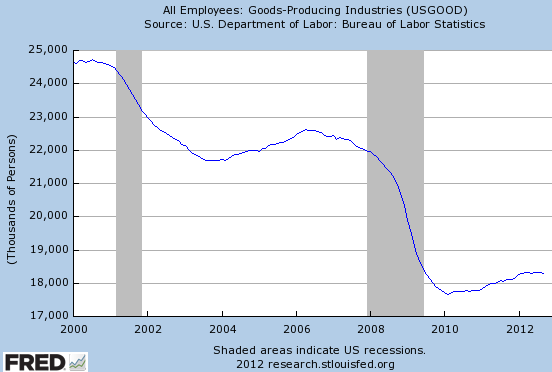
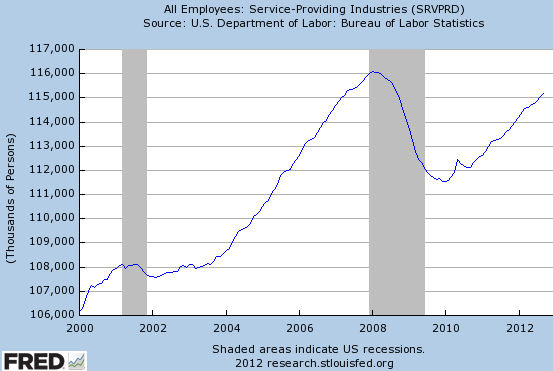
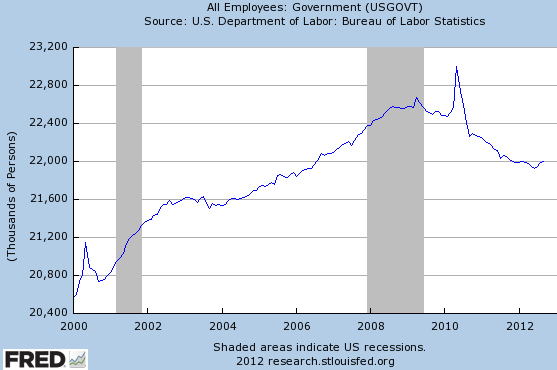
Answer: There are about 22 million government workers … only about 18.5 million in producing goods.

The below charts are quite revealing.

  • Now, almost 75% are employed in service-providing industries … up about 10 million since 2000 … virtually all of the jobs added from the recession’s trough.
  • Goods-producing declined about 7 million from 2000 to the recent recession (i.e. Bush’s watch) … about 500,000 have been restored since the recession’s trough.
  • Gov’t added about 2 million (about 10%) from 2000 to 2010 … about 500,000 – largely temp census workers — have been squeezed out in the past couple of years.

Bottom line: An economy dominated by services and gov’t … not new news, but the severity of the skew surprised me… and, it’s hard to hang all this on Obama – Bush’s fingerprints are all over the trends.

image

image

image

>> Latest Posts

Unemployment claims are down (if you don’t count California) … and, yes, the BLS streak continues.

October 12, 2012

The BLS would morph into a punch line if the stakes weren’t so high.

Let’s do the easy part first.

Now we’re up to at least 22 election season weeks in a row that the BLS’s “headline number” has under-reported the number of initial unemployment claims … and cast the jobs situation as brighter than it really is.

Based on Thursday’s BLS report, the number for the week ending Sept. 29 was revised upward from 367,000 to 369,000.

I’ll complain to the BLS Commish when President Obama appoints one.

see the HFs post: BLS Commissioner’s post vacant since January

image

* * * * *

Bigger Issue this Week

This week, the BLS reported spectacularly good news …  claims down 30,000 (after revising last week’s claims up).

While the BLS report failed to mention the point, somewhere between 15,000 and 25,000 claims from California weren’t processed in time to be included.

Say what?

Business Insider did a nice job decoding the situation:

Some of the jobless claims in one large state–California–were not included in the claims reported to the Department of Labor this week. 

When a state’s jobless claims bureau is short-staffed, sometimes the state does not process all of the claims that came in during the week in time to get them to the DOL.

Our source [at the BLS]  believes that this is what happened this week.

The California claims that were not processed in time to get into this week’s jobless report will appear in future reports, most likely next week’s or the following week’s.

In other words, those reports might be modestly higher than expected.

Our source believes that the number of California claims that were not processed totaled about 15,000-25,000.

Thus, if one were to “normalize” the overall not-seasonally-adjusted jobless claims number, it would increase by about 15,000-25,000.

This week’s “normalized” jobless claims number, therefore, would be about 355,000-365,000, not the 339,000 that was reported.

Are you kidding me?

And, Business Insider missed a key line in the BLS report:

“The largest increases in initial claims for the week ending September 29 were in New York (+2,764) and  California (+2,069)”

So, the missing California claims may be even higher … if the missing regions kept pace with the rest of the state

This is getting silly.

>> Latest Posts

Extinct species list: full-time jobs.

October 10, 2012

Last week’s BLS report has focused attention on the boom in temporary and part-time employees.

Of the jobs “created” since March, about 1 million of them are part-timers.


image

* * * * *
Why part-timers?

Two basic reasons:

(1) companies are trying to stay flexible in the face of uncertain demand, and …

(2) companies are bracing for the certain impact of regulation … especially ObamaCare.

More specifically, according to the Orlando Sentinel

In an experiment apparently aimed at keeping down the cost of health-care reform, Orlando-based Darden Restaurants has stopped offering full-time schedules to many hourly workers in at least a few Olive Gardens, Red Lobsters and LongHorn Steakhouses.

In a statement, Darden said staffing changes are “just one of the many things we are evaluating to help us address the cost implications health care reform will have on our business.”

Analysts say many other companies, including the White Castle hamburger chain, are considering employing fewer full-timers because of key features of the Affordable Care Act scheduled to go into effect in 2014.

Under that law, large companies must provide affordable health insurance to employees working an average of at least 30 hours per week.

If they do not, the companies can face fines of up to $3,000 for each employee.

Under the system Darden is testing, employees are to be scheduled for no more than 28 hours each week.

They can run over that if things get busy, but Darden acknowledged they are not supposed to exceed 30 hours.

“I think a lot of those employers, especially restaurants, are just going to ensure nobody gets scheduled more than 30 hours a week,” said Matthew Snook, partner with human-resources consulting company Mercer.

* * * * *

I guess the part-timer boom is an unintended consequence … but it sure should have been an anticipated consequence, for sure.

Maybe, if you’ve never worked in a business, you don’t know how businesses behave.

>> Latest Posts

Unemployment claims up, unemployment rate down … huh?

October 7, 2012

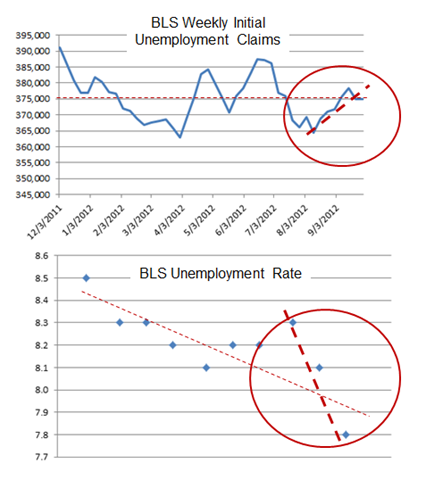
Here’s some more conflicting data for you.

The BLS has been reporting unemployment claims pretty level for the year … but increasing lately.

Defying gravity (and logic), the unemployment rate has going down … an inverse relationship.

Hmmm.

Magic?

image

>> Latest Posts

Encore: “It is important not to read too much into any one monthly report”

October 5, 2012

… unless the data is good, that is.

Team Obama’s victory lap re: last month’s favorable jobs report was unexpected (<= sarcasm), since they have said repeatedly:

“It is important not to read too much into any one monthly report”

Below is an encore post … a stroll down memory lane …

* * * * *

What are you going to believe, the facts or our rhetoric?

Reported by Chris Moody of Yahoo News

When the Bureau of Labor Statistics announced the nation’s latest national employment last week, the Obama administration stressed that people should not “read too much” into the data.

Mitt Romney’s campaign pounced, and flagged the fact that the White House has repeated that same line nearly every month since November 2009.

See below for the roundup of articles from WhiteHouse.gov that Romney’s campaign posted on its site. In many of the posts, the authors for the administration do acknowledge that they repeat themselves:

June 2012: “Therefore, it is important not to read too much into any one monthly report and it is informative to consider each report in the context of other data that are becoming available.”

May 2012: “Therefore, it is important not to read too much into any one monthly report and it is helpful to consider each report in the context of other data that are becoming available.”

April 2012: “Therefore, it is important not to read too much into any one monthly report and it is helpful to consider each report in the context of other data that are becoming available.”

March 2012: “Therefore, it is important not to read too much into any one monthly report, and it is helpful to consider each report in the context of other data that are becoming available.” (LINK:)

February 2012: “Therefore, as the Administration always stresses, it is important not to read too much into any one monthly report; nevertheless, the trend in job market indicators over recent months is an encouraging sign.”

January 2012: “Therefore, as the Administration always stresses, it is important not to read too much into any one monthly report; nevertheless, the trend in job market indicators over recent months is an encouraging sign.”

December 2011: “Therefore, as the Administration always stresses, it is important not to read too much into any one monthly report.”

November 2011: “Therefore, as the Administration always stresses, it is important not to read too much into any one monthly report.”

October 2011: “The monthly employment and unemployment numbers are volatile and employment estimates are subject to substantial revision. There is no better example than August’s jobs figure, which was initially reported at zero and in the latest revision increased to 104,000. This illustrates why the Administration always stresses it is important not to read too much into any one monthly report.”

September 2011: “Therefore, as the Administration always stresses, it is important not to read too much into any one monthly report.”

August 2011: “Therefore, as the Administration always stresses, it is important not to read too much into any one monthly report.”

July 2011: “Therefore, as the Administration always stresses, it is important not to read too much into any one monthly report.”

June 2011: “Therefore, as the Administration always stresses, it is important not to read too much into any one monthly report.”

May 2011: “Therefore, as the Administration always stresses, it is important not to read too much into any one monthly report.”

April 2011: “Therefore, as the Administration always stresses, it is important not to read too much into any one monthly report.”

March 2011: “Therefore, as the Administration always stresses, it is important not to read too much into any one monthly report.”

February 2011: “Therefore, as the Administration always stresses, it is important not to read too much into any one monthly report.”

January 2011: “Therefore, as the Administration always stresses, it is important not to read too much into any one monthly report.”

December 2010: “Therefore, as the Administration always stresses, it is important not to read too much into any one monthly report.”

November 2010: “Therefore, as the Administration always stresses, it is important not to read too much into any one monthly report.”

October 2010: “Given the volatility in monthly employment and unemployment data, it is important not to read too much into any one monthly report.”

September 2010: “Given the volatility in the monthly employment and unemployment data, it is important not to read too much into any one monthly report.”

July 2010: “Therefore, it is important not to read too much into any one monthly report, positive or negative. It is essential that we continue our efforts to move in the right direction and replace job losses with robust job gains.”

August 2010: “Therefore, it is important not to read too much into any one monthly report, positive or negative.”


June 2010: “As always, it is important not to read too much into any one monthly report, positive or negative.”

May 2010: “As always, it is important not to read too much into any one monthly report, positive or negative.”

April 2010: “Therefore, it is important not to read too much into any one monthly report, positive or negative.”

March 2010: “Therefore, it is important not to read too much into any one monthly report, positive or negative.”
January 2010: “Therefore, it is important not to read too much into any one monthly report, positive or negative.”

November 2009: “Therefore, it is important not to read too much into any one monthly report, positive or negative.”
In other words, it’s important not to read too much into the Obama administration’s past 3-1/2 years of performance.

So much for accountability …

Thanks to SMH for feeding the lead

>> Latest Posts

It’s Thursday, so … guess what?

October 4, 2012

Yep, the BLS announced this weeks initial unemployment claims, and you know what?

They revised last week’s headline number up.

Now we’re up to 81 out of 82 weeks — and, at least 22 election season weeks in a row — that the BLS’s “headline number” has under-reported the number of initial unemployment claims … and cast the jobs situation as brighter than it really is.

Based on Thursday’s BLS report, the number for the week ending Sept. 15 was revised upward from 359,000 to 363,000.

In itself, the 4,000 isn’t a big deal.

But, in context it is

Again, I ask: statistical bias or political bias?

I’m now starting to conclude the latter.

The BLS has plenty of statisticians on payroll … and this is an elementary stats problem

* * * * * *

Let’s try a new way of reporting … here’s a picture.

image

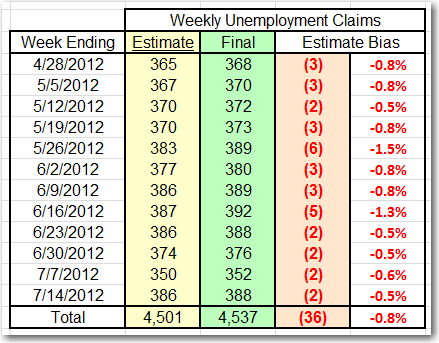
Note that the preliminary estimate (the blue line) is ALWAYS low … by a couple of thousand.

Hint to BLS: just add 2k or 3k … or .8% to your prelim forecast !

>> Latest Posts

NOT HIRING: Job growth not likely according to latest ADP forecast

October 4, 2012

Punch line: Ahead of the government’s official monthly job report, ADP forecasts a slowdown in job growth.

Macroeconomic Advisers went on to predict that the unemployment rate would likely still be above 8% a year from now.

* * * * *
Excerpted from CNN Money’s, “Private sector hiring slowed in September”

Now hiring - image by flickr user Truthout dot org

Private employers added 162,000 jobs in the month … which marks a slowdown from August, when ADP said private employers added 189,000 jobs.

“While this number today is above consensus, it’s hardly a strong number,” said Joel Prakken, chairman of Macroeconomic Advisers. “It’s only barely above the pace that would push the national unemployment rate down.”

The unemployment rate stood at 8.1% in August, and economists surveyed by CNNMoney predict it remained there in September.

Given weak economic forecasts for the foreseeable future, Prakken said he wouldn’t be surprised to see the unemployment rate still above 8% a year from now.

The ADP report is monitored closely since it comes just days before the government’s official monthly job report, due Friday. But the ADP figures are often not a great predictor of what the Labor Department will report.

Edit by JDC

>> Latest Posts

The last time that I talk about BLS reporting bias …

September 28, 2012

… certainly won’t be today

Unbelievable, they did it again this week.

I promise that I’ll stop writing about BLS reporting bias when the streak ends, but …

Now we’re up to 80 out of 81 weeks — and, at least 21 election season weeks in a row — that the BLS’s “headline number” has under-reported the number of initial unemployment claims … and cast the jobs situation as brighter than it really is.

Based on Thursday’s BLS report, the number for the week ending Sept. 22 was revised upward from 382,000 to 385,000.

In itself, the 2,000 isn’t a big deal.

But, in context it is

Again, I ask: statistical bias or political bias?

I’m now starting to conclude the latter.

The BLS has plenty of statisticians on payroll … and this is an elementary stats problem

* * * * * *

Let’s try a new way of reporting … here’s a picture.

Note that the preliminary estimate (the blue line) is ALWAYS low … by a couple of thousand.

Hint to BLS: just add 2k or 3k … or .8% to your prelim forecast !

image

* * * * *

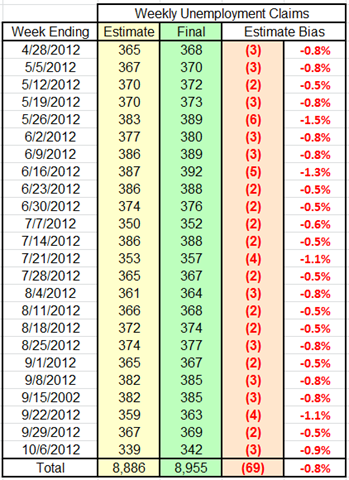
Here are the nums … but the picture says it all.

image 

>> Latest Posts

Unemployment claims drop by 3,000 … well, not really.

September 21, 2012

Yesterday’s headline’s trumpeted a 3,000  drop in initial unemployment claims.

Hooray. Right?

Of course not, the BLS revised last week’s number up by 3.000 so that it could report this week as being down by 3,000.

Huh?

Now we’re up to 79 out of 80 weeks — and, at least 20 election season weeks in a row — that the BLS’s “headline number” has under-reported the number of initial unemployment claims … and cast the jobs situation as brighter than it really is.

Based on Thursday’s BLS report, the number for the week ending Sept. 8 was revised upward from 382,000 to 385,000.

In itself, the 3,000 isn’t a big deal.

But, in context it is

Again, I ask: statistical bias or political bias?

If the former: fix it already, BLS.

Hint to BLS: just add 2k or 3k … or .8% to your prelim forecast !

image

I promise that I’ll stop writing about BLS reporting bias when the streak ends.

>> Latest Posts

Factoids: The state of the economy …

September 21, 2012

The economic analyses done by Mort Zuckerman at US News are always laden with cold facts.

image

Read the article for the prose. Here are the factoids:

  • Annual wage increases have dropped to an average of 1.6 percent, the lowest in the past 30 years.
  • A Census Bureau analysis  indicates that median income in 2011 had fallen to $50,054, the fourth straight year of decline.
  • Layoff announcements have risen from a year ago and hiring plans have dropped dramatically.
  • 5 million people have now been out of work for 27 weeks or more. That’s roughly 40 percent of the unemployed.
  • The average period of unemployment is close to 40 weeks.
  • Fewer Americans are at work today than in April 2000, even though the population has grown by 30 million people since then.
  • Older people are not leaving the workforce at the same rate as in the past … employment in the age group of 55 and older is up 3.9 million, even as total employment is down by five million.
  • The so-called quit rate has sagged to the lowest rate in years.
  • Young workers now face double-digit unemployment and job prospects for young workers aren’t very good.
  • As a result, the birth rate has just hit a 25-year low of 1.87 births per woman. And
  • Of jobs that have been added, more than 40 percent of new private sector jobs are in low-paying categories such as leisure and hospitality, bars, and restaurants
  • Millions of people who had good private sector jobs are now dependent on the government for life support.
  • Roughly 15 percent of the population, a record, representing over 46 million Americans, are in the food stamp program, compared to the 7.9 percent participation from 1970 to 2000.
  • A record 11 million-plus Americans are now collecting federal disability checks. Half of them have come on board since President Barack Obama took office.

Sure doesn’t look like we’ve turned the corner yet.

>> Latest Posts

Sorry, but the BLS streak continues …

September 14, 2012

I promise that I’ll stop writing about BLS reporting bias when the streak ends.

Now we’re up to 78 out of 79 weeks — and, at least 19 election season weeks in a row — that the BLS’s “headline number” has under-reported the number of initial unemployment claims … and cast the jobs situation as brighter than it really is.

Based on Thursday’s BLS report, the number for the week ending Sept. 1 was revised upward from 365,000 to 367,000.

In itself, the 2,000 isn’t a big deal.

But, in context it is

Again, I ask: statistical bias or political bias?

If the former: fix it already, BLS.

Hint to BLS: just add 2k or 3k … or .8% to your prelim forecast !

image

* * * * *

And, oh yeah, the initial jobless claims increased by 15,000 … above the consensus estimates … and consistent with an unemployment rate higher than 8.1%.

image

>> Latest Posts

With dismal job growth, how did the unemployment rate drop to 8.1%?

September 10, 2012

The August employment report was expectedly dismal, but equivocal in that  it gave both parties data points to selectively highlight.

First, the BLS Establishment Survey reported that 96,000 jobs were added … that’s good since it’s a positive number.

But, there was a decline in “goods producing jobs” – i.e. manufacturing … and the 96,000 is below the the 125,000 level that is commonly held as the number required to keep pace with population growth and keep the unemployment rate constant.

image

* * * * *

Nonetheless, the reported unemployment rate went down to 8.1%.

How can that be?

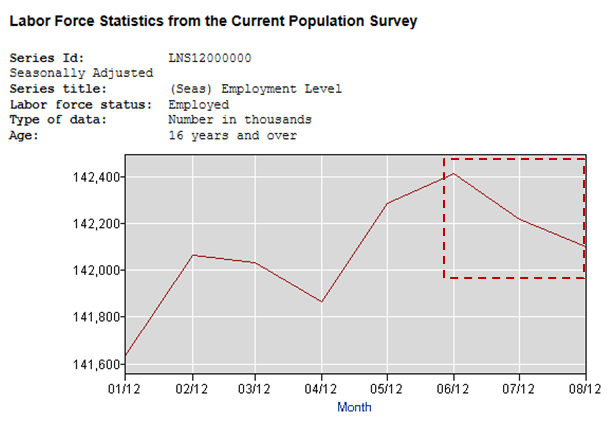
Good question since the Employment reported from the Household Survey – the basis of the 8.1% calculation – declined by 119,000.

image

* * * * *

Now, stop and think about that for a second.

The Establishment Survey said 96,000 jobs were added.

The Household Survey said employment dropped by 119,000.

Yet the unemployment rate went down – from 8.3% to 8.1%.

Hmmm. How can that be?

Well, 368,000 people dropped out of the labor force – stopped looking for work – either retired, became disabled, or simply kicked back on unemployment benefits.

If they hadn’t quit looking for work, they would have been counted as unemployed … and the reported unemployment rate would have been 8.33% – up more than .1% from 8.25% last month

The puts a whole new paint job on things, right?

image

* * * * *

The number of folks dropping out of the labor market is a big deal … since the magnitude is big and the trend is bad – especially this year.


image

* * * * *

The KEY METRIC

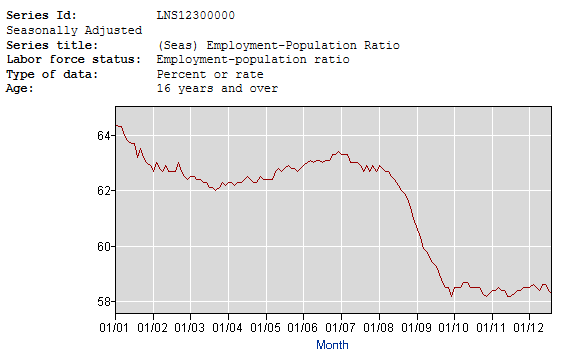
To consolidate all of the above “stuff” into a single metric, I like to look at the employment-to-population ratio … what % of adults who are employed.

The employment-to-population ratio is now at 58.3% … meaning that 41.7% of adults AREN’T employed … that’s a big number !

Note that the employment-to-population ratio hovered around 63% during most of the Bush years … then collapsed during the financial crisis … dropping a 5 points … and then hovering around the lower level.

image

* * * * *

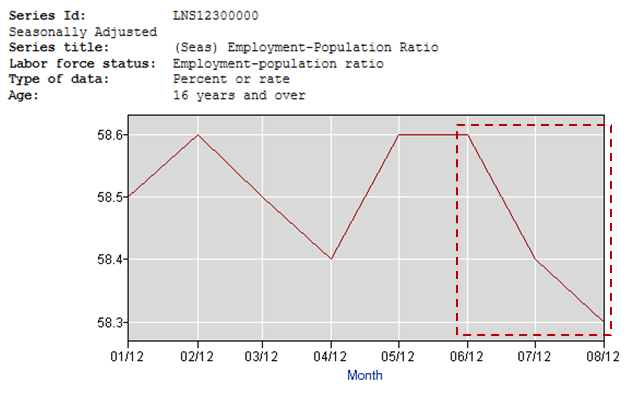
While the employment-to-population ratio looks like it’s “hovering”, look at the past couple of months … it has dropped by .5%.

That may sound like rounding error, but multiply it times the working age population … and you get over 1.2 million fewer people employed.

Ouch.  That’s not rounding error!


image

Bottom line: we’re stalled !

* * * * * * * * * * * * * * * * * * * * * * * * * * * * * * * * * * * * * * * * * * * * * * * * * * * * * * * * * * * * * * * *

Key data source

image

>> Latest Posts

Encore: “It is important not to read too much into any one monthly report” … unless the data is good.

September 10, 2012

Team Obama’s reaction to last week’s dismal jobs report was quite predictable:

“It is important not to read too much into any one monthly report”

Why predictable?

Because it’s EXACTLY the same thing they say whenever the jobs numbers are bad.

Below is an encore post … a stroll down memory lane …

Question: Is it ok to read something into, say, 42 jobs reports?

* * * * *

What are you going to believe, the facts or our rhetoric?

Reported by Chris Moody of Yahoo News

When the Bureau of Labor Statistics announced the nation’s latest national employment last week, the Obama administration stressed that people should not “read too much” into the data.

Mitt Romney’s campaign pounced, and flagged the fact that the White House has repeated that same line nearly every month since November 2009.

See below for the roundup of articles from WhiteHouse.gov that Romney’s campaign posted on its site. In many of the posts, the authors for the administration do acknowledge that they repeat themselves:

June 2012: “Therefore, it is important not to read too much into any one monthly report and it is informative to consider each report in the context of other data that are becoming available.”

May 2012: “Therefore, it is important not to read too much into any one monthly report and it is helpful to consider each report in the context of other data that are becoming available.”

April 2012: “Therefore, it is important not to read too much into any one monthly report and it is helpful to consider each report in the context of other data that are becoming available.”

March 2012: “Therefore, it is important not to read too much into any one monthly report, and it is helpful to consider each report in the context of other data that are becoming available.” (LINK:)

February 2012: “Therefore, as the Administration always stresses, it is important not to read too much into any one monthly report; nevertheless, the trend in job market indicators over recent months is an encouraging sign.”

January 2012: “Therefore, as the Administration always stresses, it is important not to read too much into any one monthly report; nevertheless, the trend in job market indicators over recent months is an encouraging sign.”

December 2011: “Therefore, as the Administration always stresses, it is important not to read too much into any one monthly report.”

November 2011: “Therefore, as the Administration always stresses, it is important not to read too much into any one monthly report.”

October 2011: “The monthly employment and unemployment numbers are volatile and employment estimates are subject to substantial revision. There is no better example than August’s jobs figure, which was initially reported at zero and in the latest revision increased to 104,000. This illustrates why the Administration always stresses it is important not to read too much into any one monthly report.”

September 2011: “Therefore, as the Administration always stresses, it is important not to read too much into any one monthly report.”

August 2011: “Therefore, as the Administration always stresses, it is important not to read too much into any one monthly report.”

July 2011: “Therefore, as the Administration always stresses, it is important not to read too much into any one monthly report.”

June 2011: “Therefore, as the Administration always stresses, it is important not to read too much into any one monthly report.”

May 2011: “Therefore, as the Administration always stresses, it is important not to read too much into any one monthly report.”

April 2011: “Therefore, as the Administration always stresses, it is important not to read too much into any one monthly report.”

March 2011: “Therefore, as the Administration always stresses, it is important not to read too much into any one monthly report.”

February 2011: “Therefore, as the Administration always stresses, it is important not to read too much into any one monthly report.”

January 2011: “Therefore, as the Administration always stresses, it is important not to read too much into any one monthly report.”

December 2010: “Therefore, as the Administration always stresses, it is important not to read too much into any one monthly report.”

November 2010: “Therefore, as the Administration always stresses, it is important not to read too much into any one monthly report.”

October 2010: “Given the volatility in monthly employment and unemployment data, it is important not to read too much into any one monthly report.”

September 2010: “Given the volatility in the monthly employment and unemployment data, it is important not to read too much into any one monthly report.”

July 2010: “Therefore, it is important not to read too much into any one monthly report, positive or negative. It is essential that we continue our efforts to move in the right direction and replace job losses with robust job gains.”

August 2010: “Therefore, it is important not to read too much into any one monthly report, positive or negative.”
June 2010: “As always, it is important not to read too much into any one monthly report, positive or negative.”

May 2010: “As always, it is important not to read too much into any one monthly report, positive or negative.”

April 2010: “Therefore, it is important not to read too much into any one monthly report, positive or negative.”
March 2010: “Therefore, it is important not to read too much into any one monthly report, positive or negative.”
January 2010: “Therefore, it is important not to read too much into any one monthly report, positive or negative.”

November 2009: “Therefore, it is important not to read too much into any one monthly report, positive or negative.”
In other words, it’s important not to read too much into the Obama administration’s past 3-1/2 years of performance.

So much for accountability …

Thanks to SMH for feeding the lead

>> Latest Posts

The key number in BLS report …

September 7, 2012

According to the BLS

The number of employed people dropped by 119,000

… from 142,220,000 to 142,101,000

So, how did the unemployment rate go down?

Simple.

The BLS estimated that 368,00 stopped looking for work

In other words, the denominator changed more than the numerator.

I guess if Team Obama can get more people to stop looking for work, we’ll have unemployment problem licked.

Hmmm.

>> Latest Posts

About the 4.5 million jobs that Obama has (or has not) created …

September 6, 2012

The Dems are touting 4.5 million jobs created by President Obama.

CNN says that the number  is an accurate description of the growth of private-sector jobs since January 2010, when the long, steep slide in employment finally hit bottom.

But – and it’s a BIG but — while a total of 4.5 million jobs sounds great, it’s not the whole picture.

According to CNN:

Nonfarm private payrolls hit a post-recession low of 106.8 million January 2010 … The figure currently stands at 111.3 million as of July.

While that is indeed a gain of 4.5 million, it’s only a net gain of 300,000 over the course of the Obama administration to date since the private jobs figure stood at 111 million in January 2009, the month Obama took office.

And total nonfarm payrolls, including government workers, are down from 133.6 million workers at the beginning of 2009 to 133.2 million in July 2012. There’s been a net loss of nearly 1 million public-sector jobs since Obama took office, despite a surge in temporary hiring for the 2010 census.

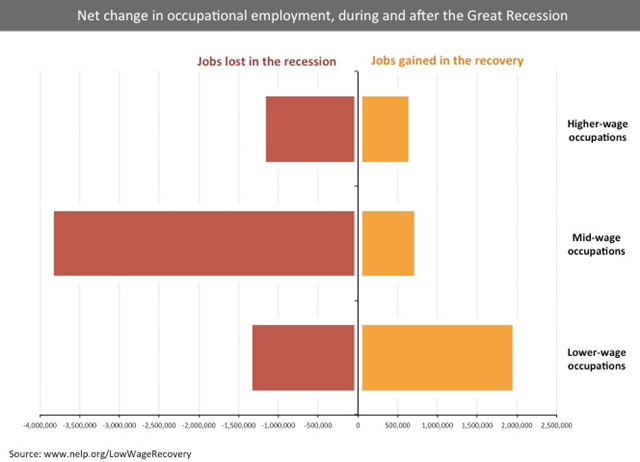
Meanwhile, the jobs that have come back aren’t the same ones that were lost.

According to a study released last week by the liberal-leaning National Employment Law Project, low-wage fields such as retail sales and food service are adding jobs nearly three times as fast as higher-paid occupations.

image

image

>> Latest Posts

Unbelievably, the streak rolls on: BLS under-reports initial unemployment claims … again!

August 31, 2012

Am I the only person in the world to to think this is nuts?

Media sure isn’t reporting it …

Now we’re up to 76 out of 77 weeks — and, at least 17 weeks in a row — that the BLS’s “headline number” has under-reported the number of initial unemployment claims … and cast the jobs situation as brighter than it really is.

Based on yesterday’s BLS report, the number for the week ending August 17 was revised upward from 372,000 to 374,000.

In itself, the 2,000 isn’t a big deal.

But, in context it is

Again, I ask: statistical bias or political bias?

If the former: fix it already, BLS.

Hint to BLS: just add 2k or .8% to your prelim forecast !

image

* * * * *

Almost forgot … the preliminary unemployment claims for the week of Aug. 25 are reported even vs. the Aug. 11 preliminary number and up 2K vs the revised Aug. 18 number.

In other words, no indication that a corner has been turned.

image

>> Latest Posts

The incremental cost of that 51st employee …

August 30, 2012

Of course, I’ve been thinking about entrepreneurs and small businesses recently.

And, the obvious suddenly became evident to me: Under ObamaCare, the incremental cost of a small company’s 51st employee is ENORMOUS.

Think restaurants … paying a bunch of workers minimum wage with few or no benefits.

Today, employee #51 costs the business about $20,000 annually (2,000 hours @ $10 per hour).

Under ObamaCare, that added bus boy costs $122,000 … his $20,000 plus the $2,000 per employee tax penalty on the business for not giving employees health insurance.

That’s a lot money for a bus boy.

Guess employees #1 to #50 are just going to have to work harder.

>> Latest Posts

Millennials: More responsibility, more flexibility … and, oh yeah, more turnover.

August 30, 2012

Punch line: Many companies are beginning to make significant changes for Millennials in order to drive retention and lower turnover rates … uphill battle?.

* * * * *

Excerpted from WSJ, “More Firms Bow to Generation Y’s Demands”

They’re often criticized as spoiled, impatient, and most of all, entitled.

image

But as millennials enter the workforce, more companies are jumping through hoops to accommodate their demands for faster promotions, greater responsibilities and more flexible work schedules—much to the annoyance of older co-workers who feel they have spent years paying their dues to rise through the ranks.

Employers, however, say concessions are necessary to retain the best of millennials, also known as Generation Y, which is broadly defined as those born in the 1980s and 1990s.

They bring fresh skills to the workplace: they’re tech-savvy, racially diverse, socially interconnected and collaborative.

Moreover, companies need to keep their employee pipelines full as baby boomers enter retirement. 

Gen Y will comprise more than 40% of the U.S. workforce by 2020 … far outnumbering any other generation.

Some critics contend that Gen Y is no different from previous generations. 

However, a 2010 Pew Research study found that while baby boomers — generally born between 1946 and 1964 — cited work ethic, respectfulness, and morals as their defining qualities, millennials chose technology, music and pop culture, and liberal leanings — followed by superior intelligence and clothing as their defining qualities.

Millennials are also likely to prioritize lifestyle over salary, and to foresee changing careers.

They want the opportunity to stand out without dealing with routine or hierarchy.

Even if they get what they want, they’re likely to move on.

“I mean, what kind of millennial would work for the same company their whole life?”

Edit by BJP

>> Latest Posts

How does the unemployment rate impact starting salaries?

August 29, 2012

Answer: Starting salaries tend to drop & to 8 percentage points for each percentage point increase in the unemployment rate … and it can take up to 15 years to get back to “normal” levels.

Lisa Kahn, a Yale School of Management economist analyzed government data  during and after the deep 1980s recession.

She  found that for each percentage-point increase in the unemployment rate, those with the misfortune to graduate during the recession earned 7% to 8% less in their first year out than comparable workers who graduated in better times.

image

The effect persisted over many years, with recession-era grads earning 4% to 5% less by their 12th year out of college, and 2% less by their 18th year out.

For example, a man who graduated in December 1982 when unemployment was at 10.8% made, on average, 23% less his first year out of college and 6.6% less 18 years out than one who graduated in May 1981 when the unemployment rate was 7.5%.

For a typical worker, that would mean earning $100,000 less over the 18-year period.

Source

Takeaway: High unemployment rates isn’t just somebody else’s problem …

>> Latest Posts

The streak rolls on: BLS under-reports initial unemployment claims … again!

August 27, 2012

Still again …

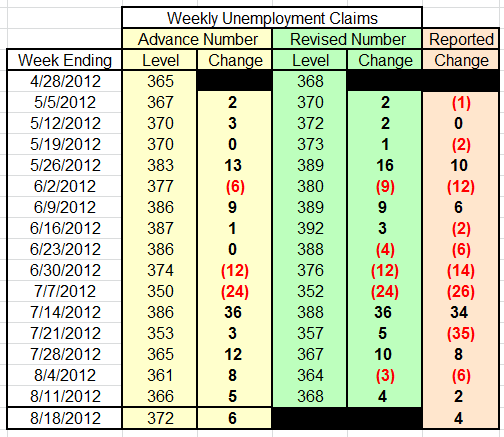
Now we’re up to 75 out of 76 weeks — and, at least 16 weeks in a row — that the BLS’s “headline number” has under-reported the number of initial unemployment claims … and cast the jobs situation as brighter than it really is.

Based on last Thursday’s BLS report, the number for the week ending August 17 was revised upward from 366,000 to 368,000.

In itself, the 2,000 isn’t a big deal.

But, in context it is

Again, I ask: statistical bias or political bias?

If the former: fix it already, BLS.

Hint to BLS: just add 2k or .8% to your prelim forecast !

image

* * * * *

Almost forgot … the preliminary unemployment claims for the week of Aug. 18 are up 6K vs. the Aug. 11 preliminary number and up 4K vs the revised Aug. 11 number.

In other words, no indication that a corner has been turned.

image

>> Latest Posts

“Our plan is working” … except for increasing unemployment rates in 44 states.

August 20, 2012

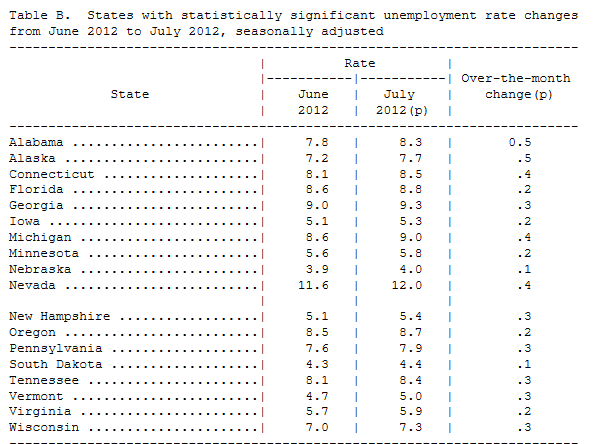
According to BLS data released last week, the unemployment rate ticked up in 44 out of the 50 (or is it 57) states.

Included are some swing states: Florida, Virginia, Wisconsin and New Hampshire.

Imagine if the Administration’s economic plan wasn’t working …

image

* * * * *

And, according to IBD … the 5 5 states with the highest unemployment rates voted for Obama in 2008.

Hmmm.

image

>> Latest Posts

The streak rolls on: BLS under-reports initial unemployment claims … again!

August 17, 2012

One more time …

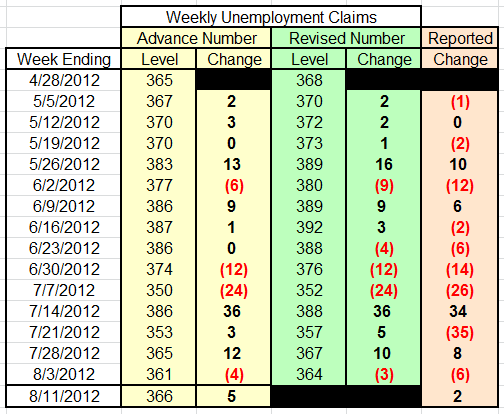
Now we’re up to 74 out of 75 weeks — and, at least 15 weeks in a row — that the BLS’s “headline number” has under-reported the number of initial unemployment claims … and cast the jobs situation as brighter than it really is.

Based on Thursday’s BLS report, the number for the week ending August 3 was revised upward from 361,000 to 364,000.

In itself, the 3,000 isn’t a big deal.

But, in context it is

Again, I ask: statistical bias or political bias?

If the former: fix it already, BLS.

Hint to BLS: just add 2k or .8% to your prelim forecast !

image

* * * * *

Almost forgot … the preliminary unemployment claims for the week of Aug. 11 are up 5K vs. the Aug. 3 preliminary number and up 2K vs the revised Aug.3 number.

In other words, no indication that a corner has been turned.

image

>> Latest Posts

Trick question: Did employment grow faster under Bush or Obama?

August 12, 2012

Team Obama says “Bush’s failed policies of tax cuts to the rich got us into this problem”.

Oh, really?

Team Romney says “The worst recovery ever”.

Oh really?

Let’s cut to the chase.

First, I assert that the housing crash was a bi-partisan effort brewed over several decades … hard to say that it was caused by Bush’s tax policies.

Second, I’ll give Obama that he inherited a mess … and, I’ll start counting from the trough.

Well, well, well.

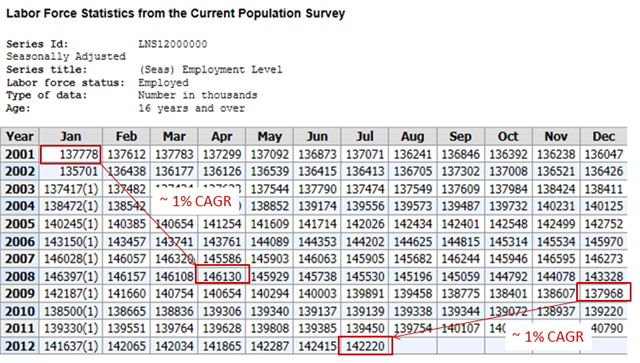
Turns out that – with the above assumptions — the growth in employment under Bush and Obama (to date) is pretty much equal … at about a 1% compound annual rate.

Hmmm.

On one hand, Obama got handled a financial collapse … not just a garden variety business cycle recession.

On the other hand, Obama continued the Bush tax rates … and he (and the Fed) have expended trillions in fiscal and monetary stimulus.

But, Obama continues to run around saying that the Bush tax rates are the cause of all evil … and eliminating them for the wealthy will get us out of this mess.

Oh, really?

image


image

>> Latest Posts

The streak rolls on: BLS under-reports initial unemployment claims … again!

August 10, 2012

I can post this post on auto-generate, I guess …

Now we’re up to 73 out of 74 weeks — and, at least 14 weeks in a row — that the BLS’s “headline number” has under-reported the number of initial unemployment claims … and cast the jobs situation as brighter than it really is.

Based on Thursday’s BLS report, the number for the week ending July 28 was revised upward from 365,000 to 367,000.

In itself, the 2,000 isn’t a big deal.

But, in context it is

Again, I ask: statistical bias or political bias?

If the former: fix it already, BLS.

Hint to BLS: just add 2k or .8% to your prelim forecast !

image

* * * * *

Almost forgot …

The 4-week moving average of initial unemployment claims bumped up 2,250 to 368,250 … suggesting that the corner hasn’t been turned yet.

“Our plan worked” … say, what?

August 7, 2012

A picture is worth a thousand words.

So, here’s a picture.

image

Source: AEI

>> Latest Posts

Were jobs added or lost in July?

August 6, 2012

Basic answer: it depends.

It depends on which BLS survey you look at.

The BLS’ “Establishment Survey” polls businesses and collects data on hiring and firing.

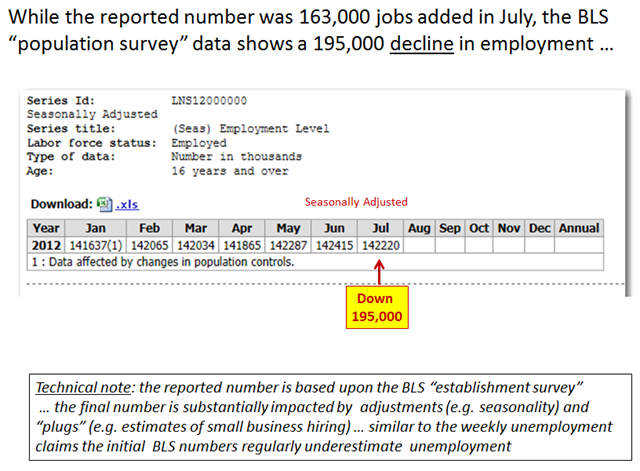
It says that 163,000 jobs were added in July … reversing a recent slide.

The BLS’ “Population Survey” polls people instead of businesses and collects data on whether they’re employed, unemployed, looking for work.

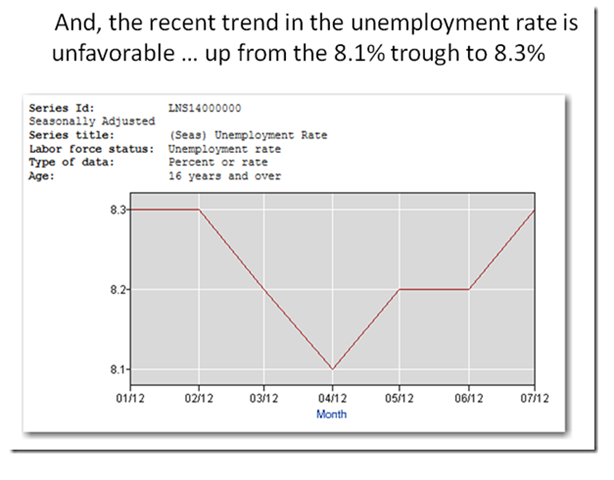
The Population Survey says that 195.000 jobs were lost in July … which is why the unemployment rate increased to 8.3%

Note:

  1. Both surveys are conducted by the BLS
  2. The Establishment Survey – which heavily guesstimates small biz hiring & firing —  is the headline jobs number.
  3. The Population Survey is the basis for the headline unemployment rate
  4. From the lips of the BLS: “Both the payroll and household surveys are needed for a complete picture of the labor market. The payroll survey provides a highly reliable gauge of monthly change in nonfarm payroll employment. The household survey provides a broader picture of employment including agriculture and the self-employed.

* * * * *

image

* * * * *

image

* * * * *

image

>> Latest Posts

The streak rolls on: BLS under-reports initial unemployment claims … again!

August 3, 2012

Now we’re up to 72 out of 73 weeks — and, at least 13 weeks in a row — that the BLS’s “headline number” has under-reported the number of initial unemployment claims … and cast the jobs situation as brighter than it really is.

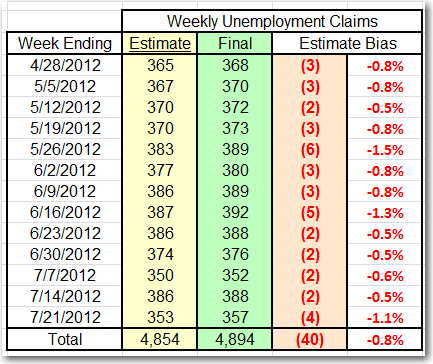
Based on Thursday’s BLS report, the number for the week ending July 21 was revised upward from 353,000 to 357,000.

In itself, the 4,000 isn’t a big deal.

But, in context it is

Again, I ask: statistical bias or political bias?

If the former: fix it already, BLS.

Hint to BLS: just add 2k or .8% to your prelim forecast !

image

* * * * *

Almost forgot …

Ahead of this morning’s BLS unemployment report, Gallup’s unemployment rate bumped up .2% during July and first time unemployment claims increased last week.

My bet BLS will claim we’re steady at 8.2% … and, further nick their credibility.

image

Errata: last line of chart should be dated 7/28/12 … sorry.

>> Latest Posts

Re: Unemployment … this chart says it all

August 2, 2012

There are a lot of of confusing – and sometimes misleading – numbers thrown around to characterize the state of the employment market.

As we’ve been harping the past several weeks, the BLS has been consistently underreporting the weekly unemployment claims numbers that get headlined on the news – only to revise them up quietly the following week.

Similarly, there are lots of questions about the BLS’ seasonal adjustment factors … which sometimes cause more variance than they explain.

Finally, there’s understandable confusion about the reported unemployment rate and the labor force participation rate.  Since the latter has been going down, the former benefits – i.e. there are fewer unemployed people because some (or many) have left the work force.

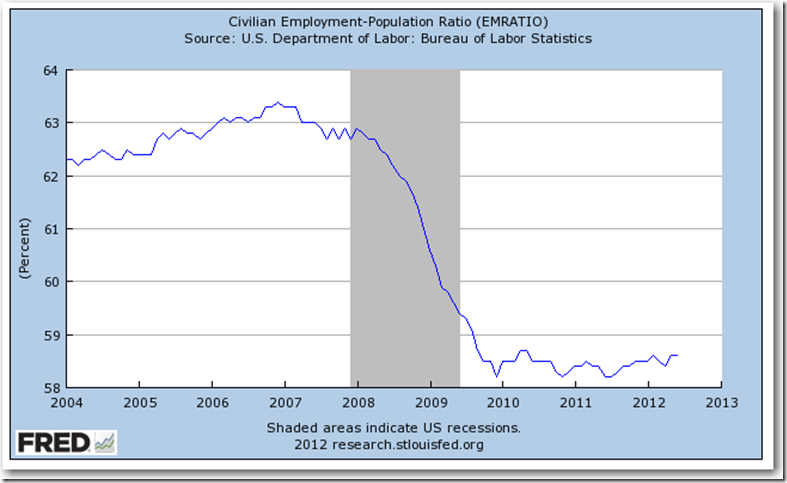
The St. Louis Fed published a chart that puts the factors into perspective.

The chart is brilliant in its simplicity.

It simply plots the percentage of the able-bodied population who are employed.  The difference to 100% is the percentage of able bodies that either choose not to work or can’t find jobs.

What it shows: prior to the financial crisis, about 63% of able bodies had jobs.

The rate fell quickly to about 58.5% and has – save for some statistical noise – hasn’t budged despite the trillions of  fiscal and monetary action.

In other words, about 1 in 20 (the difference between 63% and 58.5%) able bodied folks who used to work, aren’t employed now … and the trend isn’t good.

image

>> Latest Posts

Gallup reports unemployment rate increasing … what’ll the BLS say on Friday?

August 1, 2012

Fully expecting that the BLS will manage this week’s jobs and unemployment rate reports, I thought I’d peek at what Gallup is saying.

Well, the Gallup trend is up sharply since mid-July … up to 8.3%

My bet: BLS will find a way to report that the unemployment rate stayed constant at 8.2% in July.

We’ll see …


image

>> Latest Posts

Amazing: BLS under-reporting streak continues …

July 27, 2012

Now we’re up to 71 out of 72 weeks — and, at least 12 weeks in a row —  that the BLS’s “headline number” has under-reported the number of initial unemployment claims … and cast the jobs situation as brighter than it really is.

Based on Thursday’s BLS report, the number for the week ending July 14 was revised upward from 386,000 to 388,000.

In itself, the 2k isn’t a big deal.

But, in context it is

Again, I ask: statistical bias or political bias?

If the former: fix it already, BLS.

Hint to BLS: just add 2k or .8% to your prelim forecast !

image

>> Latest Posts

BLS streak shamelessly continues …

July 20, 2012

BLS bias continues

Now we’re up to 70 out of 71 weeks that the BLS’s “headline number” has under-reported the number of initial unemployment claims … and cast the jobs situation as brighter than it really is.

Based on Thursday’s BLS report, the number for the week ending July 7 was revised upward from 350,000 to 352,000.

In itself, the 2k isn’t a big deal.

But, in context it is

Again, I ask: statistical bias or political bias?

If the former: fix it already, BLS.

Hint to BLS: just add 2k or  .8% to your prelim forecast !

image

* * * * * *

Increase in Unemployment Claims

And, don’t miss the big point: initial unemployment claims increased by about 10% to 386,000

I expect Team Obama to whine:

“Therefore, it is important not to read too much into any one monthly report and it is informative to consider each report in the context of other data that are becoming available.”

Safe bet since, as we reported before, that’s exactly what they’ve said each month for over 2 years.

image

>> Latest Posts

How productivity creates jobs … and how gov’t stifles productivity.

July 17, 2012

Nice piece in today’s WSJ … here are snippets:

Punch line: Productivity — the ultimate engine of growth and better living standards — always  swims upstream against those that fight it. Unions, regulations and a bizarre tax code  lock in the status quo.

But, doesn’t productivity — getting more output with less inputs — destroy jobs?

Sure, but it creates way more than it destroys by creating technological avenues and lowering the cost of business

So how does productivity result in more employment?

Some new technology comes along that allows something never before possible. Cash from an ATM, stock trading from an airplane’s aisle seat, ads next to Google search results.

Cheaper technology becomes a platform for others to create or expand businesses that never before made economic sense. Think, eBay and Amazon.

Productivity  attracts capital to satisfy new consumer demands. In a competitive economy, productivity—doing more with less—always lowers the cost of products or services:

And, private investment does a better job of allocating capital than any elite economist or politician picking pork-barrel projects and relabeling them as “investments.”

Entire WSJ article is worth reading

>> Latest Posts

The BLS streak continues …

July 16, 2012

No, we didn’t forget … just got busy yesterday.

Now we’re up to 69 out of 70 weeks that the BLS’s  “headline number” has under-reported the number of initial unemployment claims … and cast the jobs situation as brighter than it really is.

Based on Thursday’s BLS report, the number for the week ending June 30 was revised upward from 374,000 to 376,000.

Again, I ask: statistical bias or political bias?

If the former: fix it already, BLS !

image

>> Latest Posts

No job? Maybe you’re just disabled …

July 10, 2012

According to OBD

More workers joined the federal government’s disability program in June than got new jobs..

The economy created just 80,000 jobs in June … also during June, 85,000 workers left the workforce entirely to enroll in the Social Security Disability Insurance program.

While the economy has created 2.6 million jobs since June 2009, 3.1 million workers signed up for disability benefits.

In other words, the number of new disability enrollees has climbed 19% faster than the number of jobs created during the sluggish recovery … even after accounting for people who left the disability program because they died or aged into retirement.

imageIn

Also in June, almost 275,000 put in applications for disability benefits.

Experts say that more people try to get on disability when jobs are scarce.

You think ?

My question: given the ever tightening OHSA regs, how could the workplace have gotten so dangerous?

>> Latest Posts

What are you going to believe, the facts or our rhetoric?

July 9, 2012

Reported by Chris Moody of Yahoo News

When the Bureau of Labor Statistics announced the nation’s latest national employment last week, the Obama administration stressed that people should not “read too much” into the data.

Mitt Romney’s campaign pounced, and flagged the fact that the White House has repeated that same line nearly every month since November 2009.

See below for the roundup of articles from WhiteHouse.gov that Romney’s campaign posted on its site. In many of the posts, the authors for the administration do acknowledge that they repeat themselves:

June 2012: “Therefore, it is important not to read too much into any one monthly report and it is informative to consider each report in the context of other data that are becoming available.”

May 2012: “Therefore, it is important not to read too much into any one monthly report and it is helpful to consider each report in the context of other data that are becoming available.”

April 2012: “Therefore, it is important not to read too much into any one monthly report and it is helpful to consider each report in the context of other data that are becoming available.”

March 2012: “Therefore, it is important not to read too much into any one monthly report, and it is helpful to consider each report in the context of other data that are becoming available.” (LINK:)

February 2012: “Therefore, as the Administration always stresses, it is important not to read too much into any one monthly report; nevertheless, the trend in job market indicators over recent months is an encouraging sign.”

January 2012: “Therefore, as the Administration always stresses, it is important not to read too much into any one monthly report; nevertheless, the trend in job market indicators over recent months is an encouraging sign.”

December 2011: “Therefore, as the Administration always stresses, it is important not to read too much into any one monthly report.”

November 2011: “Therefore, as the Administration always stresses, it is important not to read too much into any one monthly report.”

October 2011: “The monthly employment and unemployment numbers are volatile and employment estimates are subject to substantial revision. There is no better example than August’s jobs figure, which was initially reported at zero and in the latest revision increased to 104,000. This illustrates why the Administration always stresses it is important not to read too much into any one monthly report.”

September 2011: “Therefore, as the Administration always stresses, it is important not to read too much into any one monthly report.”

August 2011: “Therefore, as the Administration always stresses, it is important not to read too much into any one monthly report.”

July 2011: “Therefore, as the Administration always stresses, it is important not to read too much into any one monthly report.”

June 2011: “Therefore, as the Administration always stresses, it is important not to read too much into any one monthly report.”

May 2011: “Therefore, as the Administration always stresses, it is important not to read too much into any one monthly report.”

April 2011: “Therefore, as the Administration always stresses, it is important not to read too much into any one monthly report.”

March 2011: “Therefore, as the Administration always stresses, it is important not to read too much into any one monthly report.”

February 2011: “Therefore, as the Administration always stresses, it is important not to read too much into any one monthly report.”

January 2011: “Therefore, as the Administration always stresses, it is important not to read too much into any one monthly report.”

December 2010: “Therefore, as the Administration always stresses, it is important not to read too much into any one monthly report.”

November 2010: “Therefore, as the Administration always stresses, it is important not to read too much into any one monthly report.”

October 2010: “Given the volatility in monthly employment and unemployment data, it is important not to read too much into any one monthly report.”

September 2010: “Given the volatility in the monthly employment and unemployment data, it is important not to read too much into any one monthly report.”

July 2010: “Therefore, it is important not to read too much into any one monthly report, positive or negative.  It is essential that we continue our efforts to move in the right direction and replace job losses with robust job gains.”

August 2010: “Therefore, it is important not to read too much into any one monthly report, positive or negative.”

June 2010: “As always, it is important not to read too much into any one monthly report, positive or negative.”

May 2010: “As always, it is important not to read too much into any one monthly report, positive or negative.”

April 2010: “Therefore, it is important not to read too much into any one monthly report, positive or negative.”

March 2010: “Therefore, it is important not to read too much into any one monthly report, positive or negative.”

January 2010: “Therefore, it is important not to read too much into any one monthly report, positive or negative.”

November 2009: “Therefore, it is important not to read too much into any one monthly report, positive or negative.”

In other words, it’s important not to read too much into the Obama administration’s past 3-1/2 years of performance.

So much for accountability …

Thanks to SMH for feeeding the lead

>> Latest Posts

The BLS streak continues …

July 6, 2012

We’re up to 68 out of 69 weeks that the BLS has under-reported the number of initial unemployment claims … and cast the jobs situation as brighter than it really is.

Based on yesterday’s BLS report, the number for the week ending June 23 was revised upward from 386,000 to 388,000.

Again, I ask: statistical bias or political bias?

If the former: fix it already, BLS !

image

>> Latest Posts

Cookin’ the books update: 67 of the last 68 weeks.

June 29, 2012

I know it’s getting a bit tedious … but, , here’s this week’s unemployment claims headline:

“Initial claims for state unemployment benefits slipped 1,000 to a seasonally adjusted 386,000.

The prior week’s figure was revised up to 392,000 from the previously reported 387,000.”

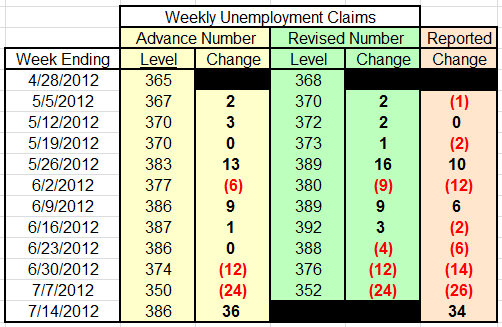
Said differentlt: Unemployment claims (386,000) decreased by 1,000 from last week’s reported number (387,000) … but last week’s reported number (387,000) was revised up by 5,000 to 392,000 … so, this week’s number is not a decrease of 1,000, it’s a decrease of 6,000.

C’mon man.

My bet: this week’s number 386,000 will be revised upward next week.

That’s a safe bet, since the BLS has under-reported initial unemployment claims for 67 out of the last 68 weeks.

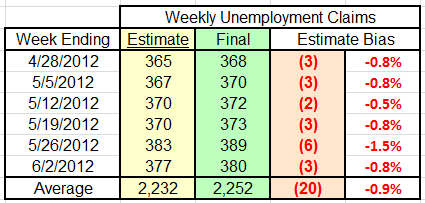
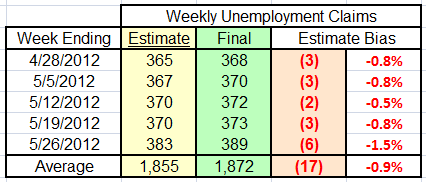
Here’s the recap for the past 7 weeks:

image

Bottom line: a consistent bias – maybe statistical, maybe political – that provides Obama with jobs’ headlines more favorable than reality

image

Either the BLS has the worst statisticians on the face of the earth, or they’ve become political hacks.

>> Latest Posts

Cookin’ the books update: They (shamelessly) did it again …

June 22, 2012

OK, here’s this week’s unemployment claims headline:

“Initial claims for state unemployment benefits slipped 2,000 to a seasonally adjusted 387,000.

The prior week’s figure was revised up to 389,000 from the previously reported 386,000.”

Said differentlt: Unemployment claims (387,000) increased by 1,000 over last week’s reported number (386,000) … but last week’s reported number (386,000) was revised up by 3,000  to 389,000 … so, this week’s number is not an increase of 1,000, it’s a decrease of 2,000.

C’mon man.

My bet: this week’s number 387,000 will be revised upward next week.

That’s a safe bet, since the BLS has under-reported initial unemployment claims for 66 out of the last 67 weeks.

Here’s the recap for the past 7 weeks:

image

Bottom line: a consistent bias – maybe statistical, maybe political – that provides Obama with jobs’ headlines more favorable than reality

image

Either the BLS has the worst statisticians on the face of the earth, or they’ve become political hacks.

You decide …

Obama DECIDES to up the unemployment rate … really!

June 20, 2012

I’m ambivalent about Obama’s decision to, in effect, implement the Dream Act despite it’s rejection by Congress.

I’m ok with parts of it — like legalizing those who serve in the military —  but I’m not that keen on presidents completely ignoring the Constitution.

Immigration politics aside, I’m interested in the statistics … specifically, the impact of Obama’s move on the BLS’ reported unemployment rates.

Most sources are estimating that just short of 1 million illegals fall into Obama’s stick-around policy — over 16 years old, younger than 30.

Those people now — by the stroke of Obama’s pen — qualify as “in the American labor force” … the denominator of the unemployment rate calculation.

Let’s do some simple math …

The BLS says that there are currently 155 million people in the labor force … according to the last BLS report, 142.3 million were employed … 12.7 million unemployed … for an 8.2% unemployment rate.

What happens when the 1 million newly minted legals get thrown into the statistical mix?

Worst case: if all are currently unemployed … then the unemployment rate jumps to 8.8% … 13.7 unemployed divided by 156 million in the labor force.

Best case: if only 11% are unemployed — the current UE rate for Hispanics … then the unemployment rate increases slightly to about 8.25% … 12.81 unemployed divided by 156 million in the labor force.

Most like (statistically): somewhere between the best and worst cases … probably a 25% unemployment rate for the new legals … bumping the UE rate by about .1/10th of a percentage point.

Most likely (politically): the BLS will “forget” to add the new legals to the labor force until, say, January 2013.

That’s the case that I’m betting on … watch the labor force numbers to see if I’m right … they should bump up a million when June numbers get reported … but they won’t!

>> Latest Posts

Here’s a shocker for you ….

June 15, 2012

Yesterday, the BLS reported that it’s revising last week’s estimate of new  unemployment claims up by 3,000 … or about 1%

image

We’ve been pointing out this glaring statistical bias for weeks.

Finally, some other media sources have finally jumped on the bandwagon and researched the issue historically.

Turns out that  the weekly jobless claims number has now been revised up 20 weeks in a row and 65 out of the last 66 weeks.

Hmmm.

Why is it important?

Because it means the Feds are consistently under-reporting weekly unemployment claims’ changes … making things look rosier than they really are.


image


May be an innocent error but, geez, wouldn’t you think the statisticians would have caught on to the bias by now?

>> Latest Posts

Update: Cookin’ the books …

June 11, 2012

Yeah, I’ve been harping on this but it has my attention and I’m dismayed that the mass media hasn’t picked up on it …

Last Thursday’s BLS release on Unemployment Claims did it again … revised upward the prior week’s estimate.

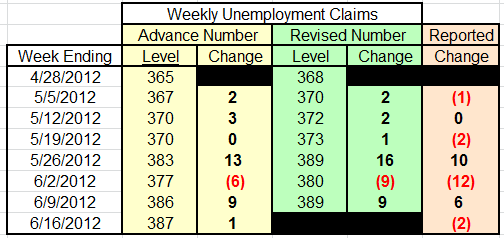
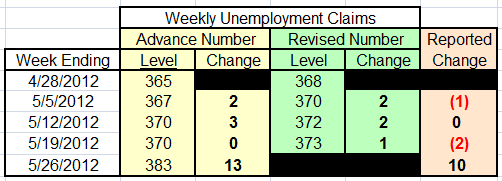
Let’s look at the numbers for the past couple of weeks:

image

In each of the past 5 weeks — maybe longer, I just started tracking then — the so-called “Advance” estimate of weekly unemployment claims eventually got revised upward … by a fairly consistent 1%.

There’s a name for a consistent unidirectional error in forecasts.

It’s called SYSTEMATIC STATISTICAL BIAS.

So, you gotta wonder: why haven’t the crack statisticians at the BLS noticed the bias and started correcting for it?

Either they’re incompetent, or they’re as biased as they’re data.

Why does it matter?

Because the “headline numbers” each week are calculated by subtracting the advance number — which is consistently understated — from the prior week’s final number — which is consistently raised up.

In other words, there is a consistent bias to report bigger drops in unemployment claims than are real … and in 2 of the past 4 weeks, to report drops in weekly unemployment gains when there were actually increases.

Hmmm.

No wonder the President thinks the private economy is doing fine.

image

>> Latest Posts

Flashback: Why private sector jobs won’t be coming back any time soon

June 5, 2012

The chickens came home to roost last Friday when the BLS had to gulp and (1) revise downward March and April jobs data, and (2) boost their count participants to the job market — the statistical aberration that was making the unemployment rate look like it was going down

Last Friday’s dismal jobs report shouldn’t have been much of a surprise to loyal readers.  As we’ve said often,  CEOs are dismayed by Team Obama’s economic, regulatory and pro-union policies and won’t do any serious hiring while Obama is in power. Period.

For the record, the Homa Files pitched this case over 2 years ago in a post titled: “Why private sector jobs won’t be coming back any time soon … Hint: it’s called passive aggressive resistance” … the punch lines:

Given the Administration’s anti-corporate rhetoric, actions, and proposed game-changing rules, I doubt that many CEOs will be taking on added costs and risks to boost the administration.

More likely, they will let unemployment continue to creep along, and will slow roll the process of rehiring.

Corporate chieftains will sit back and watch the President squirm and spin his “4 million jobs – saved or created”. As Rev. Wright would say “the chickens will have come home to roost”. Passively aggressive resistance at its very best.

Unfortunately, that means we’ll be seeing high unemployment for some time – at least through the 2012 Presidential elections.

The full original post is worth another read !

* * * * *

Ken’s current take:

Certainly there won’t be any meaningful hiring until the 2012. elections are in the book.

CEO heels are dug in. I’ve heard cocktail party chatter like “Each job added is a vote for Obama … Fool me once, shame on you … fool me twice, shame on me”

CEOs started to relent a bit when the Congress tilted GOP and Obama extended the Bush tax cuts. (Whatever happened to Immelt’s job creation task force?)

But, recent moves – e.g. stopping Boeing’s move to South Carolina, stumping again for higher taxes, especially on off-shore profits – have more than offset any momentum.

We’ll be stuck with unemployment in the 8s until 2013 … or until there’s a substantial policy roll-back .

And, the latter just ain’t gonna happen …

>> Latest Posts

Do your part: Buy a thingamajig

June 4, 2012

Not to worry about the economy … President Obama has a Plan B.

His response to the bump in the unemployment rate: everybody should “buy a thingamajig for their furnace”  … in June, no less.

                                            click to view

image

You can’t make this stuff up.

I love it when the economist-in-chief talks off-the-cuff without his teleprompter.

Now, about those transcripts …

>> Latest Posts

Book cookin’ alert …

June 1, 2012

The BLS reports May’s unemployment number at 8:30 this morning.

If the headline is “Unemployment rate clicks down to 8%” … I’ll scream.

You may remember that job growth was anemic last month (under 125,000), but the unemployment rate dipped to 8.1% as more than 350,000 quit looking for jobs.

In advance of today’s BLS report …

The Commerce Dept revised down its Q1 GDP estimate to 1.9% … … its original report a month ago was an increase of 2.2%.

ADP reported 133,000 new jobs … after revising its prior month estimate down by 6,000.

Gallup’s mid-May unemployment rate rate hovered around 8.2%.

And, unemployment claims for last week increased by 10,000 … after revising the prior week’s claims up (of course).

image

My bet: miraculously, the unemployment rate will stay constant at 8.1% … though every other piece of data says it it should bump up.

We’ll see.

>> Latest Posts

More cookin’ the books … giving bad news a positive headline.

May 29, 2012

I smelled this one a couple of weeks ago … and, surprisingly, haven’t heard any pundits nail it.

Each Thursday morning, the BLS reports new unemployment claims.

Here are the headline numbers from the past couple of weeks:

In the week ending April 28, the advance figure for seasonally adjusted initial claims was 365,000.

In the week ending May 5, the advance figure for seasonally adjusted initial claims was 367,000, a decrease of 1,000 from the previous week’s revised figure of 368,000.

In the week ending May 12, the advance figure for seasonally adjusted initial claims was 370,000, unchanged from the previous week’s revised figure of 370,000.

In the week ending May 19, the advance figure for seasonally adjusted initial claims was 370,000, a decrease of 2,000 from the previous week’s revised figure of 372,000.

OK, for 3 weeks running, unemployment claims were unchanged 1 week and declining 2 weeks.

Oh really?

Tabulating the reported data (chart below) reveals a very different trend.

Comparing the so-called advance numbers from month-to-month shows a decline in 2 weeks with 1 week unchanged.

Hmmm.

Comparing the revised numbers from month to month shows a decline in 2 weeks.

Double hmmm.

In other words, in each of the past 3 weeks, the advanced number was low-balled and compared to a number that was revised up.

Changes that coincidently provide positive headlines … for what amounts to be negative news.

Cookin’ the books?

Let’s see what happens in this Thursday’s  & Friday’s unemployment reports. …

image

>> Latest Posts

Cookin’ the books … more fishiness in BLS nums.

May 22, 2012

Punch line: The US economy added 130,000 jobs in April … pushing the unemployment rate down to 8.1% since over 350,000 left the labor force.

Hmmm.

* * * * *
First, let’s look at the 130,000:

According to US News & World Report

There is a little-known category of job creation called the birth/death model, a seasonal adjustment in which the Bureau of Labor Statistics (BLS) arbitrarily adds jobs for net new companies it thinks are starting up and creating positions.

Last month, the BLS made the assumption that 206,000 jobs were created in this category based on the companies that it thinks, but really can’t prove, have just started up and essentially are invisible to government labor surveys.

This is an imprecise, controversial guesstimate based on historical extrapolation.

One must be skeptical, since this figure of 206,000 rose from 172,000 in April 2011 despite the obvious decline in economic activity this spring and the general lack of financing for start-up companies.

In other words, 76,000 jobs were lost in “countable” businesses … and 206,000 jobs were added in the “your guess is as good as our/s” category … netting to the reported 130,000 jobs.

Hmmm …

* * * * *
Now, let’s look at the denominator … the 350.000 folks who stopped looking for jobs.

Prior posts have addressed the decline in the labor force participation rate.

One of the reasons offered up for the decline in the labor force participation rate is that that low paying jobs are “under water” compared to unemployment benefits.  Specifically, according to the WSJ, in some high-benefit states women need to earn $30,000 or more to compensate for the benefits they lose if they get a job. Since minimum wage is about $10 per hour and there are about 2,000 hours in a work-year, a minimum wage job pays about $20,000.  So, many folks are making the economically rationale decision to stay home.

Additionally, also according to US News & World Report, the number of people applying for disability benefits has been skyrocketing … apparently,  new stealth welfare program

Last month alone, 225,000 signed up for government=paid disability payments.

That’s up since last year when about 1 million Americans applied for disability.

Since President Obama took office more than three years ago, more than 5 million people have been added to the nation’s disability coverage, costing the government billions upon billions of dollars every year.

“Either the safety standards at work have eroded dramatically or many working people have found a creative way to game the system and turn it into a quasi-welfare state.”

>> Latest Posts