Archive for the ‘Unemployment’ Category

No job? Maybe you’re just disabled …

July 10, 2012

According to OBD

More workers joined the federal government’s disability program in June than got new jobs..

The economy created just 80,000 jobs in June … also during June, 85,000 workers left the workforce entirely to enroll in the Social Security Disability Insurance program.

While the economy has created 2.6 million jobs since June 2009, 3.1 million workers signed up for disability benefits.

In other words, the number of new disability enrollees has climbed 19% faster than the number of jobs created during the sluggish recovery … even after accounting for people who left the disability program because they died or aged into retirement.

imageIn

Also in June, almost 275,000 put in applications for disability benefits.

Experts say that more people try to get on disability when jobs are scarce.

You think ?

My question: given the ever tightening OHSA regs, how could the workplace have gotten so dangerous?

>> Latest Posts

What are you going to believe, the facts or our rhetoric?

July 9, 2012

Reported by Chris Moody of Yahoo News

When the Bureau of Labor Statistics announced the nation’s latest national employment last week, the Obama administration stressed that people should not “read too much” into the data.

Mitt Romney’s campaign pounced, and flagged the fact that the White House has repeated that same line nearly every month since November 2009.

See below for the roundup of articles from WhiteHouse.gov that Romney’s campaign posted on its site. In many of the posts, the authors for the administration do acknowledge that they repeat themselves:

June 2012: “Therefore, it is important not to read too much into any one monthly report and it is informative to consider each report in the context of other data that are becoming available.”

May 2012: “Therefore, it is important not to read too much into any one monthly report and it is helpful to consider each report in the context of other data that are becoming available.”

April 2012: “Therefore, it is important not to read too much into any one monthly report and it is helpful to consider each report in the context of other data that are becoming available.”

March 2012: “Therefore, it is important not to read too much into any one monthly report, and it is helpful to consider each report in the context of other data that are becoming available.” (LINK:)

February 2012: “Therefore, as the Administration always stresses, it is important not to read too much into any one monthly report; nevertheless, the trend in job market indicators over recent months is an encouraging sign.”

January 2012: “Therefore, as the Administration always stresses, it is important not to read too much into any one monthly report; nevertheless, the trend in job market indicators over recent months is an encouraging sign.”

December 2011: “Therefore, as the Administration always stresses, it is important not to read too much into any one monthly report.”

November 2011: “Therefore, as the Administration always stresses, it is important not to read too much into any one monthly report.”

October 2011: “The monthly employment and unemployment numbers are volatile and employment estimates are subject to substantial revision. There is no better example than August’s jobs figure, which was initially reported at zero and in the latest revision increased to 104,000. This illustrates why the Administration always stresses it is important not to read too much into any one monthly report.”

September 2011: “Therefore, as the Administration always stresses, it is important not to read too much into any one monthly report.”

August 2011: “Therefore, as the Administration always stresses, it is important not to read too much into any one monthly report.”

July 2011: “Therefore, as the Administration always stresses, it is important not to read too much into any one monthly report.”

June 2011: “Therefore, as the Administration always stresses, it is important not to read too much into any one monthly report.”

May 2011: “Therefore, as the Administration always stresses, it is important not to read too much into any one monthly report.”

April 2011: “Therefore, as the Administration always stresses, it is important not to read too much into any one monthly report.”

March 2011: “Therefore, as the Administration always stresses, it is important not to read too much into any one monthly report.”

February 2011: “Therefore, as the Administration always stresses, it is important not to read too much into any one monthly report.”

January 2011: “Therefore, as the Administration always stresses, it is important not to read too much into any one monthly report.”

December 2010: “Therefore, as the Administration always stresses, it is important not to read too much into any one monthly report.”

November 2010: “Therefore, as the Administration always stresses, it is important not to read too much into any one monthly report.”

October 2010: “Given the volatility in monthly employment and unemployment data, it is important not to read too much into any one monthly report.”

September 2010: “Given the volatility in the monthly employment and unemployment data, it is important not to read too much into any one monthly report.”

July 2010: “Therefore, it is important not to read too much into any one monthly report, positive or negative.  It is essential that we continue our efforts to move in the right direction and replace job losses with robust job gains.”

August 2010: “Therefore, it is important not to read too much into any one monthly report, positive or negative.”

June 2010: “As always, it is important not to read too much into any one monthly report, positive or negative.”

May 2010: “As always, it is important not to read too much into any one monthly report, positive or negative.”

April 2010: “Therefore, it is important not to read too much into any one monthly report, positive or negative.”

March 2010: “Therefore, it is important not to read too much into any one monthly report, positive or negative.”

January 2010: “Therefore, it is important not to read too much into any one monthly report, positive or negative.”

November 2009: “Therefore, it is important not to read too much into any one monthly report, positive or negative.”

In other words, it’s important not to read too much into the Obama administration’s past 3-1/2 years of performance.

So much for accountability …

Thanks to SMH for feeeding the lead

>> Latest Posts

The BLS streak continues …

July 6, 2012

We’re up to 68 out of 69 weeks that the BLS has under-reported the number of initial unemployment claims … and cast the jobs situation as brighter than it really is.

Based on yesterday’s BLS report, the number for the week ending June 23 was revised upward from 386,000 to 388,000.

Again, I ask: statistical bias or political bias?

If the former: fix it already, BLS !

image

>> Latest Posts

Cookin’ the books update: 67 of the last 68 weeks.

June 29, 2012

I know it’s getting a bit tedious … but, , here’s this week’s unemployment claims headline:

“Initial claims for state unemployment benefits slipped 1,000 to a seasonally adjusted 386,000.

The prior week’s figure was revised up to 392,000 from the previously reported 387,000.”

Said differentlt: Unemployment claims (386,000) decreased by 1,000 from last week’s reported number (387,000) … but last week’s reported number (387,000) was revised up by 5,000 to 392,000 … so, this week’s number is not a decrease of 1,000, it’s a decrease of 6,000.

C’mon man.

My bet: this week’s number 386,000 will be revised upward next week.

That’s a safe bet, since the BLS has under-reported initial unemployment claims for 67 out of the last 68 weeks.

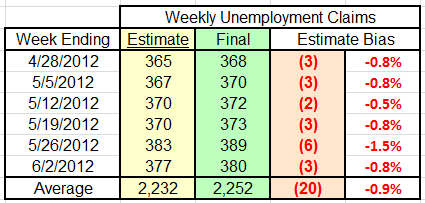
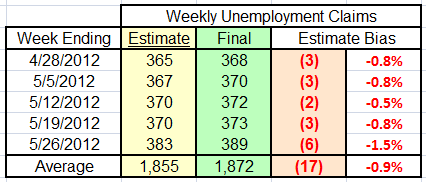
Here’s the recap for the past 7 weeks:

image

Bottom line: a consistent bias – maybe statistical, maybe political – that provides Obama with jobs’ headlines more favorable than reality

image

Either the BLS has the worst statisticians on the face of the earth, or they’ve become political hacks.

>> Latest Posts

Obama DECIDES to up the unemployment rate … really!

June 20, 2012

I’m ambivalent about Obama’s decision to, in effect, implement the Dream Act despite it’s rejection by Congress.

I’m ok with parts of it — like legalizing those who serve in the military —  but I’m not that keen on presidents completely ignoring the Constitution.

Immigration politics aside, I’m interested in the statistics … specifically, the impact of Obama’s move on the BLS’ reported unemployment rates.

Most sources are estimating that just short of 1 million illegals fall into Obama’s stick-around policy — over 16 years old, younger than 30.

Those people now — by the stroke of Obama’s pen — qualify as “in the American labor force” … the denominator of the unemployment rate calculation.

Let’s do some simple math …

The BLS says that there are currently 155 million people in the labor force … according to the last BLS report, 142.3 million were employed … 12.7 million unemployed … for an 8.2% unemployment rate.

What happens when the 1 million newly minted legals get thrown into the statistical mix?

Worst case: if all are currently unemployed … then the unemployment rate jumps to 8.8% … 13.7 unemployed divided by 156 million in the labor force.

Best case: if only 11% are unemployed — the current UE rate for Hispanics … then the unemployment rate increases slightly to about 8.25% … 12.81 unemployed divided by 156 million in the labor force.

Most like (statistically): somewhere between the best and worst cases … probably a 25% unemployment rate for the new legals … bumping the UE rate by about .1/10th of a percentage point.

Most likely (politically): the BLS will “forget” to add the new legals to the labor force until, say, January 2013.

That’s the case that I’m betting on … watch the labor force numbers to see if I’m right … they should bump up a million when June numbers get reported … but they won’t!

>> Latest Posts

Here’s a shocker for you ….

June 15, 2012

Yesterday, the BLS reported that it’s revising last week’s estimate of new  unemployment claims up by 3,000 … or about 1%

image

We’ve been pointing out this glaring statistical bias for weeks.

Finally, some other media sources have finally jumped on the bandwagon and researched the issue historically.

Turns out that  the weekly jobless claims number has now been revised up 20 weeks in a row and 65 out of the last 66 weeks.

Hmmm.

Why is it important?

Because it means the Feds are consistently under-reporting weekly unemployment claims’ changes … making things look rosier than they really are.


image


May be an innocent error but, geez, wouldn’t you think the statisticians would have caught on to the bias by now?

>> Latest Posts

Update: Cookin’ the books …

June 11, 2012

Yeah, I’ve been harping on this but it has my attention and I’m dismayed that the mass media hasn’t picked up on it …

Last Thursday’s BLS release on Unemployment Claims did it again … revised upward the prior week’s estimate.

Let’s look at the numbers for the past couple of weeks:

image

In each of the past 5 weeks — maybe longer, I just started tracking then — the so-called “Advance” estimate of weekly unemployment claims eventually got revised upward … by a fairly consistent 1%.

There’s a name for a consistent unidirectional error in forecasts.

It’s called SYSTEMATIC STATISTICAL BIAS.

So, you gotta wonder: why haven’t the crack statisticians at the BLS noticed the bias and started correcting for it?

Either they’re incompetent, or they’re as biased as they’re data.

Why does it matter?

Because the “headline numbers” each week are calculated by subtracting the advance number — which is consistently understated — from the prior week’s final number — which is consistently raised up.

In other words, there is a consistent bias to report bigger drops in unemployment claims than are real … and in 2 of the past 4 weeks, to report drops in weekly unemployment gains when there were actually increases.

Hmmm.

No wonder the President thinks the private economy is doing fine.

image

>> Latest Posts

Book cookin’ alert …

June 1, 2012

The BLS reports May’s unemployment number at 8:30 this morning.

If the headline is “Unemployment rate clicks down to 8%” … I’ll scream.

You may remember that job growth was anemic last month (under 125,000), but the unemployment rate dipped to 8.1% as more than 350,000 quit looking for jobs.

In advance of today’s BLS report …

The Commerce Dept revised down its Q1 GDP estimate to 1.9% … … its original report a month ago was an increase of 2.2%.

ADP reported 133,000 new jobs … after revising its prior month estimate down by 6,000.

Gallup’s mid-May unemployment rate rate hovered around 8.2%.

And, unemployment claims for last week increased by 10,000 … after revising the prior week’s claims up (of course).

image

My bet: miraculously, the unemployment rate will stay constant at 8.1% … though every other piece of data says it it should bump up.

We’ll see.

>> Latest Posts

More cookin’ the books … giving bad news a positive headline.

May 29, 2012

I smelled this one a couple of weeks ago … and, surprisingly, haven’t heard any pundits nail it.

Each Thursday morning, the BLS reports new unemployment claims.

Here are the headline numbers from the past couple of weeks:

In the week ending April 28, the advance figure for seasonally adjusted initial claims was 365,000.

In the week ending May 5, the advance figure for seasonally adjusted initial claims was 367,000, a decrease of 1,000 from the previous week’s revised figure of 368,000.

In the week ending May 12, the advance figure for seasonally adjusted initial claims was 370,000, unchanged from the previous week’s revised figure of 370,000.

In the week ending May 19, the advance figure for seasonally adjusted initial claims was 370,000, a decrease of 2,000 from the previous week’s revised figure of 372,000.

OK, for 3 weeks running, unemployment claims were unchanged 1 week and declining 2 weeks.

Oh really?

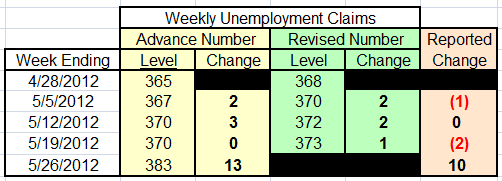
Tabulating the reported data (chart below) reveals a very different trend.

Comparing the so-called advance numbers from month-to-month shows a decline in 2 weeks with 1 week unchanged.

Hmmm.

Comparing the revised numbers from month to month shows a decline in 2 weeks.

Double hmmm.

In other words, in each of the past 3 weeks, the advanced number was low-balled and compared to a number that was revised up.

Changes that coincidently provide positive headlines … for what amounts to be negative news.

Cookin’ the books?

Let’s see what happens in this Thursday’s  & Friday’s unemployment reports. …

image

>> Latest Posts

Tipping point: half of households getting gov’t checks … half paying income taxes.

May 29, 2012

Frequently reported is the stat that only about half of the adults in the U.S. pay any Federal income taxes.

That’s the “revenue” side”.

Now, the WSJ reports that according to recent Census Bureau data, nearly half of the people in the U.S. live in a household that receives at least one government benefit, and many likely received more than one.

The 49.1% of the population in a household that gets benefits is up from 30% in the early 1980s and 44.4% as recently as the third quarter of 2008.

image

First, there are the senior citizens who anted into the pot during their working years:

  • 16% of the population lives in a household where at least one member receives Social Security
  • 15% receive or live with someone who gets Medicare.

Then, there are the poor:

  • 26% had someone enrolled in Medicaid
  • 15% of people lived in a household that received food stamps,
  • 2% had a member receiving unemployment benefits.

Most interesting to me is the low percentage getting unemployment benefits … only about 25% of the unemployed.

>> Latest Posts

Cookin’ the books … more fishiness in BLS nums.

May 22, 2012

Punch line: The US economy added 130,000 jobs in April … pushing the unemployment rate down to 8.1% since over 350,000 left the labor force.

Hmmm.

* * * * *
First, let’s look at the 130,000:

According to US News & World Report

There is a little-known category of job creation called the birth/death model, a seasonal adjustment in which the Bureau of Labor Statistics (BLS) arbitrarily adds jobs for net new companies it thinks are starting up and creating positions.

Last month, the BLS made the assumption that 206,000 jobs were created in this category based on the companies that it thinks, but really can’t prove, have just started up and essentially are invisible to government labor surveys.

This is an imprecise, controversial guesstimate based on historical extrapolation.

One must be skeptical, since this figure of 206,000 rose from 172,000 in April 2011 despite the obvious decline in economic activity this spring and the general lack of financing for start-up companies.

In other words, 76,000 jobs were lost in “countable” businesses … and 206,000 jobs were added in the “your guess is as good as our/s” category … netting to the reported 130,000 jobs.

Hmmm …

* * * * *
Now, let’s look at the denominator … the 350.000 folks who stopped looking for jobs.

Prior posts have addressed the decline in the labor force participation rate.

One of the reasons offered up for the decline in the labor force participation rate is that that low paying jobs are “under water” compared to unemployment benefits.  Specifically, according to the WSJ, in some high-benefit states women need to earn $30,000 or more to compensate for the benefits they lose if they get a job. Since minimum wage is about $10 per hour and there are about 2,000 hours in a work-year, a minimum wage job pays about $20,000.  So, many folks are making the economically rationale decision to stay home.

Additionally, also according to US News & World Report, the number of people applying for disability benefits has been skyrocketing … apparently,  new stealth welfare program

Last month alone, 225,000 signed up for government=paid disability payments.

That’s up since last year when about 1 million Americans applied for disability.

Since President Obama took office more than three years ago, more than 5 million people have been added to the nation’s disability coverage, costing the government billions upon billions of dollars every year.

“Either the safety standards at work have eroded dramatically or many working people have found a creative way to game the system and turn it into a quasi-welfare state.”

>> Latest Posts

What’s up with women leaving the labor force ?

May 14, 2012

Last week, we were fast out of the blocks posting about the drop in the labor force participation rate: How to make 11% unemployment look like 8.1% 

The essential points raised:

  • Since President Obama was inaugurated, the U.S. working age population has increased by roughly 8 million people.
  • During that same period the U.S. labor force – folks either holding or looking for jobs – stayed roughly constant at about 154 million.
  • So, it arithmetically follows that the labor force participation rate declined … from about 66% to 63.5%

Here’s the money chart from last week’s post:

 image

* * * * *
The long view

Some analysts have seized on the fact that  324,000 Women Dropped Out of Labor Force in Last Two Months.

Are women really leaving the labor force in droves? ?

Let’s start with the long view:

Back in 1960, women’s labor force participation rate was below 40%.

Over the next 40 years, it bumped up about a point a year, hitting 60% in 2000.

The demographics are well known.  More women chose to pursue careers and some families needed 2-wage earners in the family in order to make financial ends meet.

image

* * * * *
The Shorter View

But, the long view masks what’s been happening the past couple of years.

Let’s shorten the time frame back to only 1990, and increase the granularity of the charting scale.

During the Clinton Era, women’s labor force participation rates continued to climb at the historical rate and reached a historical peak a bit above 60%

The participation rate fell back slightly during the eight Bush years … from 60% to about 59.5%

During the 3+ years since Obama’s inauguration, the women’s labor force participation rate dropped 2 points from 59.5 to 57.5%

Hmmm.

image

* * * * *

So, what’s going on?

Pundits are serving up a few explanations:

1. The labor market has absorbed the historically pent up supply of women wanting to work and able to find jobs.

2. Some women have discovered what many me have know for centuries – work often isn’t as fulfilling and rewarding as it’s made out to be.

3. Some women have done the math and figured out that compensation levels are sometimes inadequate to fully cover the costs of work clothes, commuting, child care, etc.

4. As government benefits have increased, some women at the lower rungs of the economic ladder have concluded that they’re better off not employed than to take a low paying job. 

Regarding the last pint, according to the WSJ, in some high-benefit states women need to earn $30,000 or more to compensate for the benefits they lose if they get a job.

Considering that a full-time minimum wage job only pays about $20,000  [ 2,000 hours times $10} …  at least part of the explanation for declining labor force participation rates may be purely rational economics …

>> Latest Posts

How to make 11% unemployment look like 8.1%

May 7, 2012

President Obama says “The unemployment rate clicked down again in April”.

Proof positive that his economic plan is working.

Not so fast.

Indeed the unemployment rate dropped to 8.1% despite relatively low job growth.

How can that be?

Easy.

The unemployment rate is a fraction: the numerator is the number of unemployed people who are actively looking for work … the denominator is the number of people employed plus the number of people actively looking for work.

Most people implicitly assume that the denominator is staying relatively constant … maybe edging up a bit.

So, they conclude that a drop in the unemployment rate is driven by unemployed people finding jobs.

Not in the Obama recovery.

These days, the unemployment rate is driven more by what’s called the labor force participation rate … the percentage of able bodied people in the population who are either employed or actively looking for work.

The labor force participation rate has tumbled in the past couple of years.

More specifically …

* * * * *

Labor Force

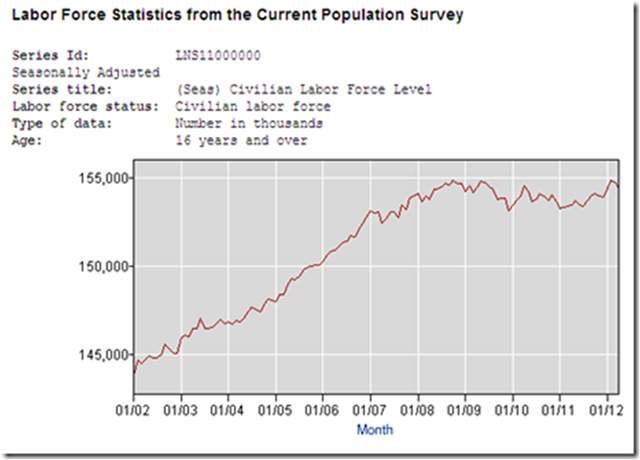
Since January 2009, the U.S. working age population has grown about 8 million, but the labor force has stayed pretty much flat.

image 

* * * * *

Labor Force Participation

While some of the 8 million increase in the working age population since January 2009 may have replaced folks who dropped out of the labor force, the net effect is that the 8 million increase in the working age population didn’t boost the size of the labor force.

Said differently, the labor force participation rate dropped precipitously … from about 66% to 63.5%.

While the labor force participation rate dropped a bit during the Bush years, the decline is – buy and large – a reflection of the “Obama Recovery”.

image

* * * * *

Impact on Unemployment Rate

Let’s put that drop in context:

In January 2009, the labor force participation rate was 65.71%

Since January 2009, the working age population grew by just over 8 million … from 234,738,000 to 242,784,000

If the labor force participation rate had stayed constant from January 2009 until now, there would be 159,522.672 folks in the labor force … not the currently reported 154,365,000

The BLS reported 12.5 million unemployed in April (<= note the “roundness” of the number)

The BLS reported the unemployment rate at 3.1% … 12.5 million divided  by 154.4 million.

If the labor force participation rate was still at the January 2009 level, then the current  unemployment rate would be a whopping 11%. 

Calculation:

159,522.672 minus 154,365,000 equals 5.2 million dropouts from the labor force

12.5 million unemployed plus 5.2 million dropouts = 17.7 million

17.7 million divided by 159,522.672 equals 11%

Those are the top line numbers … in subsequent posts I’ll dive deeper into the numbers and provide some “what’s going on” context

>> Latest Posts

Prepping for the jobs report this Friday …

May 3, 2012

A couple of data points …

The BLS weekly new unemployment claims averaged 363,000 in March … they’ve been just short of 390,000 the past couple of weeks.

* * * * *

Challenger  reported an increase in job cuts — vs. last month and vs. same month last year.

U.S.-based employers announced planned job cuts totaling 40,559 during the month of April.

That is a 7.1 percent increase from  job cuts announced in March.

April job cuts were up 11.2 percent from the same month a year ago.

So far this year, employers have announced 183,653 job cuts, 9.8 percent more than the job cuts by this point in 2011.

* * * * *

Gallup’s daily tracking of unemployment has been running between 8.3% and 8.4% for the past week or so.

* * * * *

Yesterday, ADP reported that the private sector added just 119,000 jobs in April

Private-sector employment increased by just 119,000 in April, according a report from ADP that puts a dent into the notion that the jobs market is on the path to a solid recovery.

The report was well below forecasts of 170,000 and comes after a string of stronger numbers.

ADP said service-sector jobs rose by 123,000, but construction fell by 5,000

* * * * *

Let’s see: unemployment claims are up, Gallup says 8.4%, ADP reports a slowing of job growth (below what’s need to keep pace with typical labor market growth).

So, what’ll be the BLS unemployment number?

My bet: the mysterious seasonal adjustments coupled with more discouraged workers no longer looking for work will keep the unemployment rate at 8.2%

We’ll see.

>> Latest Posts

News Flash:Weekly jobless claims drop … say, what?

April 26, 2012

This is getting downright silly …

The first line of this morning’s BLS report on weekly jobless claims says:

In the week ending April 21, the advance figure for seasonally adjusted initial claims was 388,000, a decrease of 1,000 from the previous week’s revised figure of 389,000.

Note the last couple of words:  “ … from the previous week’s revised figure”.

Hmmm.

Here’s the way CNBC decoded the report:

Initial claims for state unemployment benefits dropped by 1,000 to a seasonally adjusted 388,000, the Labor Department said on Thursday.

The prior week’s figure was revised up to 389,000 from the previously reported 386,000.

The four-week moving average for new claims, a closely followed measure of labor market trends, rose 6,250 to 381,750, its highest since the week that ended January 7.

Get it?

Last week, when claims were reported to have gone up, they were understated by 3,000.

Hmm.

Now, last month gets revised upward … and guess what?

This month is lower than last month.

So, Team O has a talking point: jobless claims are down.

They do think we’re stupid …

>> Latest Posts

Cookin’ the books? … 2 numbers to watch when the BLS reports tomorrow.

April 5, 2012

Loyal readers know that I’m a bit skeptical re: the employment numbers that the BLS has been spitting out in recent months.

Two reasons: (1) Unemployment rates are diverging from the Gallup daily surveys, and (2) Seasonal adjustment factors are boosting the employment numbers.

First, the Gallup relationship …

Historically, Gallup’s mid-month unemployment rate has tracked closely to the BLS end-of-month rate.

Not so in February … Gallup reported 8% … BLS reported 8.2%.

Hmmm.

Gallup’s mid-month rate for March was 8.9%.

Let’s see what the BLS says tomorrow.

image

* * * * *

The 2nd number to watch is the the seasonal adjustment adder.

For the prior10 years, the BLS has seasonally adjusted February employment numbers upward by 1.1423%.

Last month, they upped the raw numbers by 1.1688%.

That’s a big difference when floated into the unemployment rate calculation.

The prior 10 year adjustment factor for March has been .6209 %.

If the seasonal adder is higher than that tomorrow … be suspicious.

image

* * * * *

My bet: the unemployment rate will magically hang at 8.3% … .6% below the Gallup number.

>> Latest Posts

The unemployment numbers … digging deeper.

March 12, 2012

The Feds said last Friday that the economy added over 200,000 jobs and the unemployment rate stayed at 8.3%

I’d predicted 8.5% or higher … hmmm.

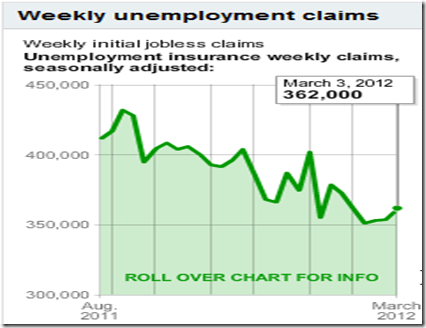
First, unemployment claims increased in each of the 4 weeks in February

image

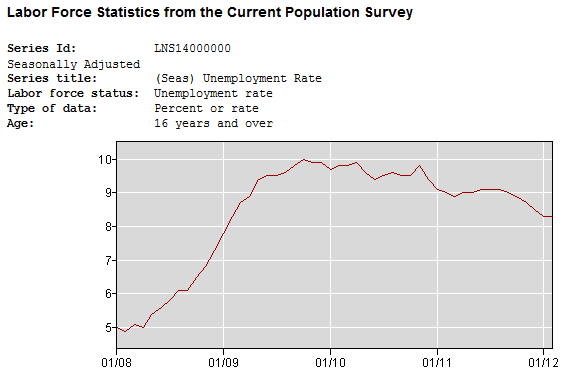
That would make you think that the unemployment rate would go up, right?

Not so, using Fed math … the BLS reported that the  seasonally adjusted unemployment rate stayed at 8.3% …

image

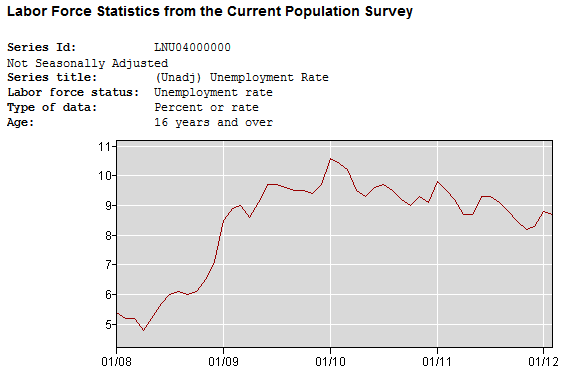
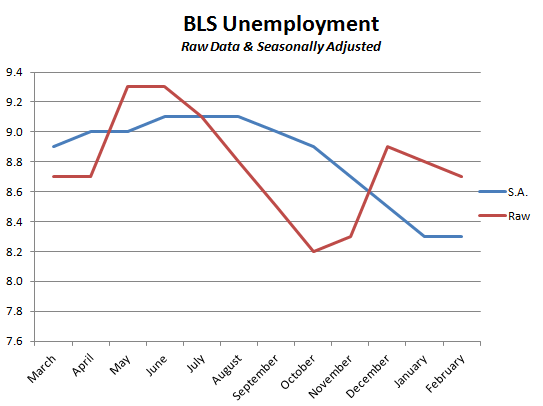
But, take a peek at the raw unemployment rate … the one before the Feds adjust for seasonality.

Hmmm.  Looks like the rate has ticked up in the past couple of months … and is now around 8.7%

image

The secret sauce: the seasonal adjustment factors.

I guess a guy doesn’t feel unemployed if he’s unemployed in February  … seasonal unemployment is different.

Really?

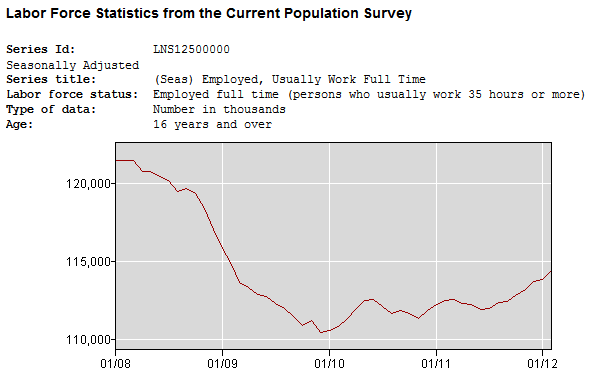
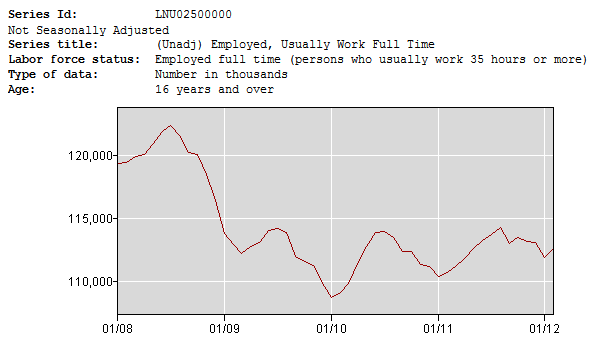
Let’s look at the main data series that goes into the unemployment rate: the number of employed people.

Again, the Feds report steady improvement on a seasonally adjusted basis.

image

But,  when the seasonality factors are backed out, actual employment levels have been going down … consistent with the unemployment claims data.

image

Finally,  for fun, let’s match the seasonally adjusted unemployment rates data (which is reported by the Feds) against the raw numbers (which the Fed calculate but don’t shout out).

image

Pretty interesting … says we’re in a period when seasonally adjusting helps the unemployment rate appear more favorable … but when we head into Aug, Sept, Oct, Nov … seasonally adjusting makes the unemployment rate look less favorable.

My next prediction: about mid-summer, the Feds will come out with some cock-and-bull story explaining why they’re going to start report unemployment data that isn’t seasonally adjusted.

And, they’ll say with a straight face that the change in reporting methods has nothing to do with the election.

Yeah, right.

>> Latest Posts

Unemployment: The final nums before tomorrow’s final nums …

March 8, 2012

Tomorrow’s BLS report will be very interesting.

On the plus side: ADP, released their proprietary private payrolls jobs report earlier this week. Its usually – but not always – a good leading indicator of the the BLS nums.

Form February, ADP reported a gain of 216,000 private sector jobs.

Last month (January) 2012 ADP’s final num was 173,000 jobs. In contrast, the BLS reported 257,000 seasonally adjusted private sector jobs for January.

image

On the minus side:

Today, the BLS reported that the number of U.S. workers filing new applications for unemployment benefits rose for the third consecutive week

Initial jobless claims jumped 8,000 to a seasonally adjusted 362,000 in the week ending March 3.

Most important, Gallup – which nailed the drop to 8.3% last month —  has been consistently reporting an unemployment rate of 9% throughout February.

image

The consensus of economists is that about 200,000 jobs will be reported and that the unemployment rate will hold at  8.3%.

Ken says: seasonally unadjusted jobs will decline, seasonally adjusted jobs will increase less than 200,000 … and the unemployment rate will bump back up to 8.5%

>> Latest Posts

How long does an average unemployed person stay unemployed?

March 5, 2012

Answer : In the old days, it used to be 10 weeks …  then a steady creep up to 20 weeks … then an explosion over the past couple of years to 44 weeks.

But, according to Team Obama, the long duration has nothing to do with the extension of unemployment benefits to 99 weeks.

Yeah, right.

image

>> Latest Posts

Oops … BLS unemployment report not being released until next Friday.

March 1, 2012

OK, I got a bit a head of myself this week …

The December unemployment report was released on January 6 — the first Friday in January,

The January unemployment report was released on February 3 —  the first Friday in February,

image

So, I assumed that the February unemployment report would be released tomorrow March 2 — the first Friday in March,

Wrong.

The BLS says that The Employment Situation for February will be released next Friday, March 9, 2012, at 8:30 a.m. (EST).

My analysis and predictions still hold … a bump up in the rate.

>> Latest Posts

In advance of this week’s unemployment report … Gallup up to 9.2%

February 27, 2012

In case you missed it this weekend, Gallup’s daily tracking report put unemployment at 9.2%up from 8.3% in mid-January.

image

The BLS report this Friday will be vey interesting.  Even with more book-cooking via changed methodologies, sample changes, and seasonal adjustments — it’ll be hard to put lipstick on this pig

My prediction: the BLS rate will go from 8.3% to 8.5% …. with a lot smoke re: seasonal adjustments … but  nothing would surprise me now that the bean counters have been politicized.

>> Latest Posts

Re: the unemployment rate … Gallup still hanging at 9% — up from 8.3%.

February 21, 2012

You may remember that the BLS reported a dramatic drop in the unemployment rate for January — down from 8.5% to 8.3%.

image

At the time, we (and many other folks) pointed out that the apparent improvement was largely drive by people leaving the work force, by seasonal adjustments (which were more liberal than prior years), and by a revision in the way that the BLS compiles the numbers.

In other words, smelled like some book-cooking going on.

At the time, we encouraged loyal readers to start watching the Gallup daily tracking of the unemployment rate.  Historically, it has been a pretty good canary in the unemployment coal mine.

Typically, Gallup’s mid-month number is a good predictor of the BLS’s end-of-month number.

Well, the Gallup number has increased dramatically from mid-January to mid-February … from 8.3% (same as the BLS end of January number) … up to 9%, where it has bee hanging.

The number reported by the BLS for February will be very, very interesting …

Based on Gallup, the unemployment rate should surge back up.

Unless, of course, somebody cooks the books …

image

>> Latest Posts

Unemployment rate down to 8.3% … hmmm.

February 6, 2012

The Feds reported 243,000 new jobs in January … driving the unemployment rate down to 8.3%

Clear evidence that we’re on a roll, right?

Not so fast.

First, numerous sources have pointed out that another 1.2 million people got discouraged and stopped looking for work. They’re no longer counted as unemployed.

Second, as it does every year, the government revised its statistical methodology for the  January report.  The BLS footnotes say “As a result, household survey data for January 2012 will not be directly comparable with that for December 2011 or earlier periods.”

Hmmm.

Morw specifically, even the NY Times asks: Is the number real ?

How many jobs did the American economy add in January?

The Labor Department estimated on Friday that the economy gained 243,000 jobs.

The department also estimated that the economy lost 2,689,000 jobs in the month

The difference in the two numbers is in seasonal adjustment.

The actual survey showed the big loss in jobs.

The seasonal adjustments produced the reported gain of 243,000 jobs.

A reason to doubt the number is that there has been a tendency in this cycle for the seasonal factors to overstate moves, in both directions.

 If the seasonal adjustment was too large, then the gain should be smaller.

Double hmmm.

That’s why  I like to track Gallup’s unemployment estimates.  Over time, they’ve seemed reliable and — call me cynical — but, they’re less likely to be subject to political manipulation.

For openers, here’s what Gallup said prior to the government release:

The U.S. government’s January unemployment rate that it will report Friday morning will be based largely on mid-month conditions.

The mid-month reading normally provides a pretty good estimate of the government’s unadjusted unemployment rate for the month.

At mid-January, Gallup reported that its unemployment rate had declined to 8.3%, based on data collected through the 15th of the month.

OK, that squares with the Feds number.

But, importantly, Gallup also notes:

Gallup’s unemployment and underemployment measures show deterioration since mid-January.

While the unemployment rate of 8.6% for January is up only modestly from December, this overall increase subsumes the more negative trend of the most recent weeks.

In turn, this also seems consistent with Wednesday’s ADP report showing less job growth in January than in the prior month.

English translation: Expect February’s unemployment rate (reported first week of March)  to bounce back up … unless there’s a flurry of new hiring in early February.

Here’s the data …

image

Ken’s Take:

Here’s what I said before, and I stand by it !

Pundits have been saying that Obama will be ok with a high unemployment rate in 2012 as long as the trajectory is in the right direction. That is, that unemployment is coming down.

Here’s my scenario: unemployment will creep back up and Obama will be facing a high unemployment rate that is rising.

That’s not good for the O-team.

Politically, Obama might have been better off if the rate had stayed closer to 9% for a while … he may be in the awkward position of having a high unemployment rate that’s going in the wrong direction.

It’ll be interesting …

>> Latest Posts

How much time do unemployeds spend searching for jobs?

August 24, 2011

Answer: Not much … but, I bet you suspected as much.

According to Freakonomics and The Atlantic:

A new study by economists from Princeton and the University of Chicago breaks it down. The bulk of foregone market work time during the recent recession, they say, is spent on leisure. Only 1% is spent searching for a job.

Hmmm

large[1]

* * * * *

Time distribution of unemployed Americans:

  • 20% to sleeping.
  • 15% to “other leisure,” including listening to music and being on the computer, exercising and recreation, and hobbies such as arts, collecting, writing.
  • 13% to core home production activities (cooking, cleaning, laundry, etc.)
  • 12% to watching TV.
  • 12% to time investments in own health care, own education, and civic activities.
  • 8% to increased shopping.
  • 7% to home maintenance and repair.
  • 6% to child care.
  • 4% to the care of other older adults.
  • 1% of the foregone market work hours are allocated to job search.

Ken’s Take: 99 weeks of unemployment benefits sure can shift a person’s priorities …

>> Latest Posts

So, it the unemployment rate up or down?

March 22, 2011

Answer: Depends who you ask.

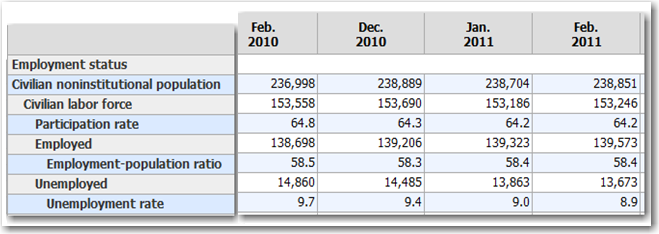
The gov’t Bureau of Labor Statistics reported that unemployment has fallen the past couple of months and is now a bit under 9%.

That would be good news … if true.

image

http://www.bls.gov/news.release/empsit.a.htm

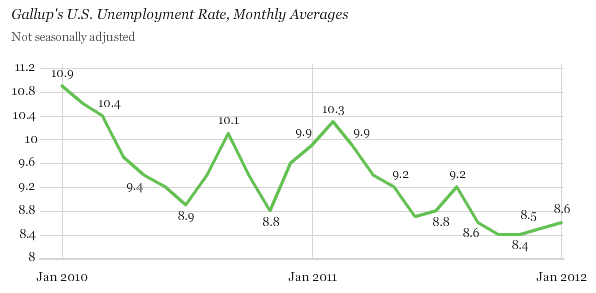
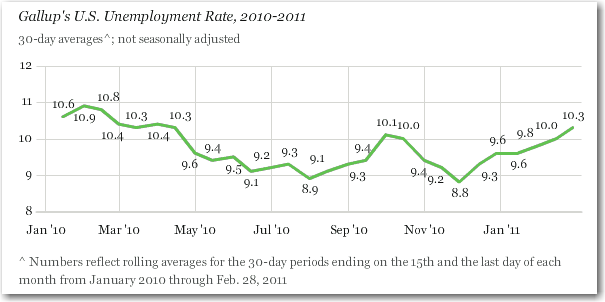
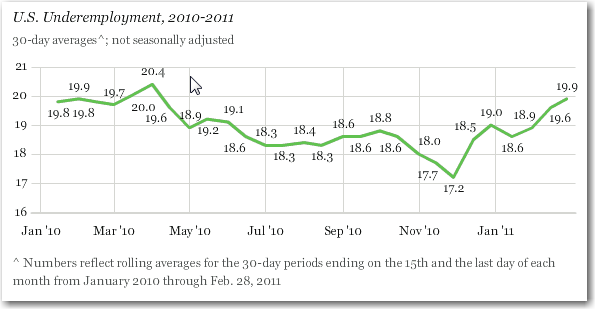
But, it seems that Gallup begs to differ.

According to Gallup, the unemployment rate has been increasing the past couple of months and is now over 10%.  The underemployment rate has also been increasing and is now almost 20%

So, who to believe – the fox guarding the henhouse or a left-leaning, reasonably objective 3rd party.

Hmmm.

image

 image

When it snows … unemployment goes down … huh?

February 8, 2011

Last Friday’s jobs report indicated that virtually no jobs were added (a paltry 36,000 to be precise), yet the unemployment rate dropped from 9.4% to 9.0%

How can that be?

Well first, January is the month when major revisions are made to the factors used to project ‘sample numbers’ to the ‘population numbers’. In other words, the metrics go from apples-to-apples to apples-to-who knows what. 

Most often, when the unemployment rate dips without a surge in jobs, it’s attributed to a LOT of unemployed folks getting discouraged and suspending their efforts to find jobs.  When they throw in the towel, they’re no longer counted as unemployed.

This January’s unemployment report had an extra twist: the snow storms that hit much of the country.

According to some analysts, a million or more people reported that they stopped looking for work in January because the weather was too bad. So, they were no longer counted as unemployed.

So, if the weather warms – or at least the snowfalls stop – these folks are likely to re-start their job searches, will be counted again as unemployeds, and the unemployment rate will go back up.

That is, unless it gets too hot to look for work.

This is a great country …

In the cross hairs: Private-sector union workers aiming at public employee unions …

January 5, 2011

Punch line: Private-sector union workers are beginning to notice that their job prospects are at risk from public-employee union contracts

* * * * *

Excerpts from WSJ: Labor’s Coming Class War, Jan. 4, 2011

Some may be missing the first stirrings of a true American class war: between workers in government unions and their union counterparts in the private sector.

In this recession, for example, construction workers are suffering from unemployment levels roughly double the national rate. They are relearning, the hard way, that without a growing economy, all the labor-friendly laws and regulations in the world won’t keep them working.

What’s more, “blue-collar union workers are beginning to appreciate that the generous pensions and health benefits going to their counterparts in state and local government are coming out of their pockets …  they are beginning to understand the dysfunctional relationship between collective bargaining for government employees and their own job prospects.”

  • In NJ, 40% of  iron workers are out of work—and they know that unless the high-tax state gets its fiscal house in order, the only work they’ll find will be in Texas.
  • In NY, the unemployment rate for members of the  Building and Construction Trades Council of Greater New York is running at 20%.

In some ways, this new appreciation for the private sector is simply back to the future. FDR, for example, warned in 1937 that collective bargaining “cannot be transplanted into the public service.”

These days the two types of worker inhabit two very different worlds.

In the private sector, union workers increasingly pay for more of their own health care, and they have defined contribution pension plans such as 401(k)s. In this they have something fundamental in common even with the fat cats on Wall Street: Both need their companies to succeed.

By contrast, government unions use their political clout to elect those who set their pay: the politicians.

In exchange, these unions are rewarded with contracts whose pension and health-care provisions now threaten many municipalities and states with bankruptcy.

In response to the crisis, government unions demand more and higher taxes. Which of course makes people who have money less inclined to look to those states to make the investments that create jobs for, say, iron workers, electricians and construction workers.

Full article:
http://online.wsj.com/article/SB10001424052748704111504576060092978223976.html?mod=WSJ_Opinion_LEADTop

Gallup say unemployment is 10% … and post-election unemployment report will be ugly

October 21, 2010

Last month, BLS reported unemployment level at 9.6% when Gallup reported an whopping increase to 10.1%.

Hmmm.

Now, Gallup reports that in mid-October, unemployment is at 10.0%  — essentially the same as the 10.1% at the end of September but up sharply from 9.4% in mid-September and 9.3% at the end of August.

Gallup says: This mid-month measurement confirms the late September surge in joblessness that should be reflected in the government’s Nov. 5 unemployment report.

image

http://www.gallup.com/poll/143714/Gallup-Finds-Unemployment-Mid-October.aspx

About the private sector job growth that Obama is touting …

October 11, 2010

The BLS reported that that private sector added 64,000 in September.

Point 1: ADP reported that the private sector cut 39,000 jobs in September … hmmm … one says up, one says down … wonder if the BLS chief got any ‘context’ from the White House ? … remember when the the CBO director got an invitation to the Oval Office when his healthcare numbers weren’t coming out right ?
http://blogs.abcnews.com/politicalpunch/2009/07/republicans-assail-president-obama-meeting-with-congressional-budget-office-director-as-inappropriat.html

Point 2: Accepting the BLS number and putting it into perspective: there are roughly 120 million folks employed in the private sector, so 64,000 represents about  1/20th of 1 percent … better than a negative number, and better than nothing … but not by much …it means that the private sector is adding jobs at the galloping rate of about 1/2% annually … nothing to brag about
(64,000 / 120,000,000 = 0.053% X 12 = .64%)

Point 3: The BLS reports a 9.6% unemployment rate Gallup reports 10.1% … double hmmm

Ken’s Prediction: On the Friday after the election, the meager apparent jobs gain will be revised downward  and the unemployment rate will be revised up.  Just watch …

Gallup pegs unemployment @ 10.1% … says "expect BLS report to understate"

October 8, 2010

There are 3 main sources of unemployment data: ADP, Gallup, and the BLS, with the latter — the gov’t number — comes out today.

This week, ADP report that 39,000 private sector jobs were lost in Sept.

Now, Gallup is reporting a .7% rise in the unemployment rate to 10.1%, and an increase in the underemployment rate to 18.8%. Charts and link below.

So, the Recovery Summer Tour — showcasing the trillion dollar faux stimulus program — started with unemployment at 9.6%, and ends with the rate at 10.1%.

Some recovery …

Gallup says that most of the job losses came in the last 2 weeks of the month and probably won’t be reflected in today’s BLS numbers … they’ll show up in a revision that comes — you guessed it — 3 days after the mid-term elections. 

Hmmm.

image

image

” The government’s final unemployment report before the midterm elections is based on job market conditions around mid-September. Gallup’s modeling of the unemployment rate is consistent with Tuesday’s ADP report of a decline of 39,000 private-sector jobs, and indicates that the government’s national unemployment rate in September will be in the 9.6% to 9.8% range. This is based on Gallup’s mid-September measurements and the continuing decline Gallup is seeing in the U.S. workforce during 2010.

However, Gallup’s monitoring of job market conditions suggests that there was a sharp increase in the unemployment rate during the last couple of weeks of September. It could be that the anticipated slowdown of the overall economy has potential employers even more cautious about hiring.”

http://www.gallup.com/poll/143426/Gallup-Finds-Unemployment-September.aspx

Why high unemployment is sticky this time …

January 12, 2010

Excerpted from CNBC: How government is routing the recovery, January 11, 2010

Despite all the money spent on stimulus, the economy continues to lose jobs and unemployment remains at a staggering 10 percent.

The number-crunchers have been celebrating what appears to be the end of the Great Recession as told through rising GDP, higher business profits and a buoyant stock market.

But owners of small businesses — the usual engines of economic growth — are still refusing to hire back workers as they normally do when the economy turns up from a sharp decline.

How are companies surviving the recession?

By cutting costs and hoarding cash, not expanding their business and hiring more people, even as the economy now is starting to recover.

During other recoveries, firms would be hiring workers in droves as demand picks up for goods and services. This time around, they’re not — because “they don’t know what their costs are going to be.” And those costs are, of course, higher taxes.<p>

Talk to them, and they’ll gladly tell you why: Having weathered the recession, they now fear the administration will choke off the nascent recovery and increase their costs through higher taxes to pay for the myriad of programs , including the hyperexpensive health-care overhaul.

JP Morgan CEO Jamie Dimon explains that many businesses simply don’t want to borrow to expand their operations and hire more workers. The demand for loans is way down because businesses, particularly those that are making money and can qualify for loans, simply don’t want to borrow … because they don’t know just how high their tax bills will be.”

“Why logically would any businessman use this money to expand if he doesn’t know what all his costs will be because of the expansion of these government programs?”

Why risk expanding operations and hiring workers amid a wild boom in government that will lead to massive tax hikes when you can make money simply by doing nothing or laying people off?        

All of which translates into a jobless recovery — the economy appearing to grow while unemployment remains unnaturally high — unless of course, you work in government

http://www.nypost.com/p/news/opinion/opedcolumnists/how_obama_routing_the_recovery_zneMnksB1VnHzSS7QmuhnL