Archive for March, 2011

70% of Americans support Libyan kinetic military action … oh, really?

March 31, 2011

I’ve heard that spin quite a few times in the past week.

70 percent!

Think about it …

Do you think that 70% of the country knows whether Libya is a city, or a state, or a country, or a continent, or a planet?

I’ll take the under on that bet.

Do you think that 70% of the country knows where Libya is and how you spell it?

I’ll take the under on that one, too.

Do you think 70% of the country has the slightest idea what a kinetic military action is – and why we’re doing one in Libya?

Put me down for under on that one.

Yet, 70% are supporting the bombardment campaign.

70 per cent. 

Oh, really?

Facebook; “Pssst, I hear you’re yearning for a pizza …”

March 31, 2011

TakeAway: When you thought Facebook couldn’t get any more stalkerish, it has just rolled out real time ads relating to status updates, posts etc.

In the mood to eat some cupcakes? Immediately cupcake ads should populate the side bar of your Facebook page. 

With real time ad response, Facebook hopes to put advertisers between consumers’ current thoughts and desires and the next step of fulfilling it.

* * * * *

Excerpted from AdAge, “Facebook Test Mines Real-Time Conversations for Ad Targeting” by Irina Slutsky, March 23, 2011

….Facebook started to mine real-time conversations to target ads.

For example: Users who update their status with “Mmm, I could go for some pizza tonight,” could get an ad or a coupon from Domino’s, Papa John’s or Pizza Hut.

A user may not have liked any soccer pages or indicated that soccer is an interest, but by sharing his trip to the pub for the World Cup, that user is now part of the Adidas target audience

With real-time delivery, the mere mention of having a baby, running a marathon, buying a power drill or wearing high-heeled shoes is transformed into an opportunity to serve immediate ads, expanding the target audience exponentially beyond usual targeting methods such as stated preferences through “likes” or user profiles.

The moment between a potential customer expressing a desire and deciding on how to fulfill that desire is an advertiser sweet spot, and the real-time ad model puts advertisers in front of a user at that very delicate, decisive moment.

“The long-held promise of local is to deliver timely, relevant and measurable ads which drive actions such as commerce, so if Facebook is moving in this direction, it’s brilliant.”

This real-time test could make a huge difference in how Facebook ads perform, as well as how they are perceived by users. …some analytics firms claim that the Facebook display ad click-through rate is abysmally low — 0.051% in 2010, or about half the industry average…

Edit by HH

NY Times & O’Reilly come together … rant over GE’s tax loopholes.

March 30, 2011

Disclaimer: I own GE stock and want the share price to go up … a lot.

The NY Time excoriated GE last week because the company paid federal income taxes in 2010.

According to the Times:

“As the company expanded abroad, the portion of its profits booked in low-tax countries such as Ireland and Singapore grew far faster … Since 2002, the company has eliminated a fifth of its work force in the United States while increasing overseas employment.

In that time, G.E.’s accumulated offshore profits have risen to $92 billion from $15 billion.”

Let’s frame the issue: GE paid no federal income taxes for 2 main reasons:

1) The company lost a boatload of money on GE Credit during the financial meltdown, and have carried over the losses.  The ultimate tax dodge: lose money.

2) GE makes a ton of money outside the U.S., pays taxes to local countries and doesn’t “repatriate” the profits back to the US.  That way, the company funds its international developments and keeps the $$$ away from the IRS.

Put succinctly by Seeking Alpha:

Why should GE, or any other company, have to pay U.S. tax on money earned outside the U.S.?

It makes perfect sense, from the perspective of the company and its shareholders, to keep the money outside America until the American politicians wake up and lower American tax rates to the point at which they are competitive with those in Singapore or Ireland.

GE choosing not to pay tax now by choosing to keep the money offshore isn’t really that different from a homeowner deciding not to sell his house now because he doesn’t want to pay the capital gains tax this year.

Up to a point, the decision on when to realize income is up to the taxpayer, not up to the New York Times reporter.

And whatever you might think about how influential GE or its tax department is, it’s not GE that sets the tax rate in Singapore or Ireland.

Seeking Alpha, Why G.E.’s Tax Reducing Strategies Are Legit,  March 27, 2011 

Note: O’Reilly hates GE … mostly because of his feud with Olberman and because he thinks that MSNBC operates as a White House press office.

See Bill and Lou Dobbs rant on GE

Pepsi hypes social media … as share slides

March 30, 2011

There’s a nagging question: how to quantify the ROI of social marketing, and the impact on the bottom line.

Pepsi diverted its Super Bowl ad budget to its “Refresh crowdsourcing initiative” — an ongoing corporate citizenship effort that was cited by Ad Age as a factor in why Pepsi has slipped to third place behind Coke and Diet Coke in the US.

Pepsi’s argument: you’re either on the digital train or you’ll get left behind.

According to PepsiCo’s Director of Digital and Social Media:

  • Technology affecting our lives is nothing new. Once clocks were invented, we began living our lives by the clock.
  • There have been more apps downloaded since apps began than all the music downloaded from iTunes.
  • Kids are “addicted” to the iPad and think all screens are touch screens
  • Grandparents now have relationships with their grandchildren on Skype and Facebook.

Excerpted from: BrandChannel, PepsiCo Pumps Up Digital Fitness, March 24, 2011

Ken gets a makeover … now, a“babe-magnet”

March 30, 2011

 Not me, silly …. Barbie’s “arm candy” in toyland.

I missed that Barbie dumped toy Ken in 2004, ending a 43 year relationship.  For the past 10 years, the jilted Ken toiled in obscurity.

Well, he’s back.

Mattel brokered a reconciliation between Ken and Barbie as part of its brand-marketing, sales-recovery strategy.

Ken’s remake has boosted the brand’s sales to $1.25 billion in 2010

* * * * *

Excerpted from: BW Magazine, “Why Ken Is the New Babe-Magnet in Toyland”  February 10, 2011 BW Magazine

The world’s most famous plastic couple – Ken & Barbie — is getting back together.

Ken’shandlers revamped his image, giving him a Justin Bieberesque makeover complete with floppy locks, skinny jeans, and graphic T-shirt.

That landed Ken a scene-stealing part in Toy Story 3, restoring him to his previous status of pop culture icon.  The filmmakers cast Ken as a vain, leopard-print-wearing metrosexual. In one scene, Ken cries: “I’m not a girl’s toy.”

Ken now has his own Facebook page and Twitter feed (sample tweet: “Weekend Ken-fession: I may have knocked somebody over while walking and playing Madden on my iPhone this morning. My bad.”).

Beaming with confidence after his big-screen debut, Ken won his ex back with professions of love on big-city billboards and ads in Us Weekly. One message: “We may be plastic, but our love is real.”

Despite Ken’s breakout movie role and his growing ranks of Twitter followers, his future depends, as always, on the woman he loves.

He’ll stay in the spotlight “unless he does something to really upset Barbie.”

Raise taxes … unionize gov’t employees … and say bye-bye to your taxpayer base.

March 29, 2011

Some preliminary census results have been released.

Here’s a shocker: folks (and companies) are moving from high tax states to low tax states.

* * * * *

Excerpted from RCP: The Eyes of Texas Are Sparkling in the 2010 Census, March 28, 2011

The fastest growth rates in the 2000-10 decade have been in Texas, the Rocky Mountain states and the South Atlantic states.

Public policy plays an important role that’s especially relevant as state governments seek to cut spending and reduce the power of the public employee unions that seek to raise spending and prevent accountability.

  • The eight states with no state income tax grew 18 percent in the last decade. The other states (including the District of Columbia) grew just 8 percent.
  • The 22 states with right-to-work laws grew 15 percent in the last decade. The other states grew just 6 percent.
  • The 16 states where collective bargaining with public employees is not required grew 15 percent in the last decade. The other states grew 7 percent.

The lesson is that high taxes and strong public employee unions tend to stifle growth and produce a two-tier society.

Wal-mart goes back for the future … more EDLPs

March 29, 2011

TakeAway:  Wal-Mart lost sight of what made it a retail giant: every day low prices.

In an attempt to reverse its US sales slump, the company is abandoning its recent focus on upscale shoppers to instead refocus on low prices.

In a crowded mass retail segment, differentiating with the lowest prices just might get Wal-Mart back on track.

* * * * *

Excerpted from brandchannel, “Wal-Mart Tries to Find Its Way Back,” by Dale Buss, March 22, 2011

It’s one thing for a brand to recognize the error of its ways and attempt to return to what made people love it in the first place. But it’s quite another thing to complete the journey successfully.

Walmart, America’s largest retailer, is finding out that truth about branding these days. It is mired in its worst U.S. sales slump ever, kept there for now by the chain’s inability to return to its roots as a basic purveyor of value-priced merchandise after an ill-considered move upscale.

[According to] Bill Simon, Wal-Mart corporate’s new U.S.-stores chief … Walmart stores are returning to the Every Day Low Prices formula that traditionally powered its sales growth, and also restoring broader selection.

“I think we tried to stretch the brand a little too far,” Simon said.

In short, Walmart realized that its core customers… liked the feel of stores so full of attractively priced merchandise that it could barely be contained on the shelves. A couple of years ago, under Project Impact, Walmart had stripped selection and focused on a clean-store look in an effort to attract upscale shoppers. But that group proved a fickle lot.

Now, in a new advertising campaign breaking next month, Walmart will highlight its decades-old emphasis on low pricing by poking fun at competitors … who use the sort of “high-low” strategy it just abandoned. …

Edit by DMG

For sale: Diamond ring … $1 million … free shipping (I think)

March 28, 2011

From Costco, of course … complementing their strategic thrust into wedding gear and services.

Move fast … only one in stock at this price.

image

In store service goes virtual … and, oh yeah, help yourself.

March 28, 2011

TakeAway: Digital bar code scanning is being utilized in stores to help customers learn more about the product, watch videos, price shop, and even help make an online purchase. 

Home Depot has taken to this strategy to provide another way for customers to get tips and help especially for those in the digital world often unwilling to ask for help but would rather just look it up or do it themselves.  

* * * * *

Excerpted from Internet Retailer, “The Home Depot customers get a Quick Response from mobile bar codes” by Katie Deatsch, March 22, 2011

… Home Depot long emphasized its jovial sales staff that is eager to offer product information and tips in stores. Now the retailer is taking that help to the mobile realm.

… a series of ads incorporating QR, or Quick Response, two-dimensional bar codes that smartphone owners can scan using an app tied to a smartphone’s camera to access product ratings and reviews, how-to guides, product videos and a web page on which they can make a purchase.

… Shoppers …will be able to access information like product demos and instruction videos, relevant accessories, buying guides, project guides, and an option to purchase online. …

… Home Depot … will be able to track the scans via Scanbuy bar code system analytics to better gauge customers’ interests, view locations of scans and more…

“… customers already using mobile devices to assist in the purchasing process, and now Home Depot is embracing this technology to more closely connect our stores and customers to our digital content…”

Bar code scanning may lend itself to products such as home furnishings that can have many complex features and are often installed by do-it-yourselfers.

… enables shoppers to scan…codes on Ralph Morris products for more information about the line as well as to gain access to post-sale help such as information on how to install the Randolph Morris products.

Other retailers using bar code scanning to promote their brands. …Macy’s Inc. last month launched a QR bar code scanning marketing program …that lets in-store shoppers use a mobile device …to access videos about the designers and brands. …provide consumers with tips and information on the latest trends, and advice and inspiration from celebrity style icons via 30-second films delivered to a phone.


Edit by HH


* * * * *

College students meeting schools’ low (and declining) expectations … less studying, less thinking, higher grades … let’s party.

March 25, 2011

Punch line: A provocative new book, “Academically Adrift: Limited Learning on College Campuses,” makes a strong case that for a large portion of the nation’s seemingly successful undergraduates the years in college barely improve their skills in critical thinking, complex reasoning and writing.

* * * * *

Excerpted from NYT,  College the Easy Way

What are America’s kids actually learning in college?

For an awful lot of students, the answer appears to be not much.

Intellectual effort and academic rigor, in the minds of many of the nation’s college students, is becoming increasingly less important.

“Many students come to college not only poorly prepared by prior schooling for highly demanding academic tasks that ideally lie in front of them, but — more troubling still — they enter college with attitudes, norms, values, and behaviors that are often at odds with academic commitment.”

Students are hitting the books less and partying more.

Easier courses and easier majors have become more and more popular.

Perhaps more now than ever, the point of the college experience is to have a good time and walk away with a valuable credential after putting in the least effort possible.

What many of those students are not walking away with is something that has long been recognized as invaluable — higher order thinking and reasoning skills. They can get their degrees without putting in more of an effort because in far too many instances the colleges and universities are not demanding more of them.

The average amount of time spent studying by college students has dropped by more than 50 percent since the early 1960s.

But a lack of academic focus has not had much of an effect on grade point averages or the ability of the undergraduates to obtain their degrees.

Thirty-six percent of the students said they studied alone less than five hours a week. Nevertheless, their transcripts showed a collective grade point average of 3.16.

The colleges and universities have set up a system so that there are ways to navigate through it without taking difficult courses and still get the credential.”

In their first two years of college, 45 percent of the students made no significant improvement in skills related to critical thinking, complex reasoning and communication.

Many of these young men and women are unable to communicate effectively, solve simple intellectual tasks (such as distinguishing fact from opinion), or engage in effective problem-solving.

“It’s important to get the word out about the lack of academic rigor and intellectual engagement that’s occurring at colleges and universities today.”

Whatever happened to: “After we pass it you’ll like it”

March 25, 2011

The Heritage Foundation points out that:

“Last year at this time Newsweek showed 40 percent of Americans supporting Obamacare and 49 percent opposing it. Today, only 37 percent support it while 56 percent oppose.

According to Quinnipiac, after Obamacare passed last year, 44 percent of Americans approved of President Obama’s handling of health care while 50 percent opposed. Today, only 44 percent approve while opposition has grown to 56 percent.

And according to the Kaiser Family Foundation, after Obamacare passed, 62 percent of Americans thought the law would either have no effect on them or make them worse off. Today that number is up to 69 percent.”

Just in case you think that’s right-wing malarkey, here’s a broad based survey summary from  Pollster.com … now, a unit of that right wing bastion — the Huffington Post:

image

image

How much does a ‘for sale’ home’s list price matter?

March 25, 2011

Answer: a lot … it’s the psychological effect called anchoring.

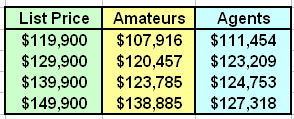
For example, researchers asked both professional real estate agents and man-off-the-street amateurs to predict the final selling price of a house.

They were all told that the current tax appraisal value of the house was $135,000.

Then, each respondent was told that the house was listed in one of four prices — ranging from $119,900 to $149,900.

The researchers found a clear positive correlation between list prices and predicted sale prices.

The amateur is responded more to the differences in list prices and the professionals — but even the pros and a $15,000 spread that can only be attributed to the differences in the list prices.

Bottom line: if you’re selling a home beach for the sky with your list price; if you’re buying a home try to ignore the list price and focus on more fundamental values like tax assessments and comparable sales

image

Source: Priceless, William Poundstone, Hill and Wang Books, 2010

Are B-school profs different?

March 24, 2011

Prof. Greg Mankiw of Harvard made headlines a few years ago when he got a million-dollar advance to write an economics textbook.

I just stumbled on this blog post of his … thought it was interesting.

Punch line: Business students force the faculty to think practically

* * * * *

Excerpted from Mankiew Blog, Are B-school economists different?, June 02, 2009

A journalist … mentioned that he was finding that many of his best sources on the financial crisis teach at B schools, not Econ Departments.

I don’t know of any hard data to establish whether journalists are more likely to cite economists in business schools than those in economics departments, but I can believe it might be the case.

On average, economists in business schools have a more practical and empirical approach to the field than do those in economics departments.

Why? I don’t think the answer is … a difference in training.

I think part of the answer is self-selection.

Economists who are naturally more abstract will have a harder time teaching MBAs and will gravitate toward economics departments. The PhD students there will not mind the higher level of abstraction.

By contrast, economists of a more practical and empirical frame of mind will gravitate toward business schools, where their practicality is valued.

Some business schools encourage more practical research. The case studies written by faculty at Harvard Business School are a particularly extreme example. This experience forces the faculty to come down to earth from the rarefied theory that often characterizes economics research.

Finally, the students themselves influence how the faculty thinks.

Faculty who teach PhD students are used to being asked, “How did you derive that first-order condition? “

Faculty who teach MBA students are used to being asked, “Is that really how it works?”

By contrast, the typical MBA student, like the typical journalist, is older and more self-confident; he or she will more likely balk at what seems to be excessive abstraction.

The business students force the faculty to think practically.

Walk clockwise around grocery stores !

March 24, 2011

Why?

Because you’ll save money.

Researchers have discovered that “shoppers open their wallets wider when moving through a store in a counter-clockwise direction.”

On average, they spend $2 more per visit.

Why??

One theory is that most shoppers are right handed … and like most basketball players, they go to their right better…. so, impulse items stocked to their right along “walls of value” are easier to grab and throw in the cart.

If you are right handed, walk clockwise and the “wall of values” will on your left,  and will be less tempting.

Source: Priceless, William Poundstone, Hill & Wang, 2010, p.149

NYC: Fight a ticket online …

March 24, 2011

From Late Night With Jimmy Fallon:

“New York City has a new service that lets you fight a traffic ticket online. To make it feel like you’re talking to a real clerk, your computer will spend the whole time chewing gum and talking to a friend on the phone.”

… at least the computer won’t be getting fee healthcare and an oversized pension.

Quick: Who to layoff: bad “senior” teachers or good “junior” teachers?

March 23, 2011

Punch line: Teachers’ unions are more interested in protecting their members’ jobs than in the quality of education

According to the WSJ

The steep deficits that states now face mean that teacher layoffs this year are unavoidable. Parents understandably want the best teachers spared. Yet in 14 states it is illegal for schools to consider anything other than a teacher’s length of service when making layoff decisions.

“If layoffs are based only on seniority, that doesn’t help the kids,” said U.S. Education Secretary Arne Duncan in a conference call with reporters. “And particularly doesn’t help the kids who need the most help.”

“Fourteen states have quality-blind layoffs rules but about 40% of all teachers work in those states, and they’re the states with the biggest budget deficits.” In addition to New York, the list includes California, New Jersey, Pennsylvania, Ohio, Illinois and Wisconsin.

The unions that support these laws insist that seniority is the only “fair” way to reduce the teaching work force.

The real problem is the underlying assumption that seniority is a decent proxy for performance.

But, two recent studies on seniority-based layoffs indicate that “only about 20% of the teachers who have the least seniority are also among the least effective teachers in a district. About 80% of the time, there’s a teacher who’s worse that you could have laid off but didn’t because they had more seniority.”

As Secretary Duncan notes, layoffs based on seniority will also remove good teachers from the classrooms where they are most needed.

High-poverty students tend to matriculate at schools where the teachers have less seniority.

While the unions hate school choice for students, they insist on it for teachers.

And senior teachers tend to opt out of high-poverty districts.

The good news is that more and more people now see through the union agenda, even if too many politicians are still on the fence.

In a recent Rasmussen poll, 68% said “teachers’ unions are more interested in protecting their members’ jobs than in the quality of education.”

I spent $1 million on digital advertising … did it work?

March 23, 2011

TakeAway: With the move to digital, companies are unsure how to ensure their digital marketing dollars are being spent effectively.

Companies are spending more and more on copy testing for digital ads even with the criticism that copy testing kills creativity.  

* * * * *

Excerpted from AdAge, Copy Testing Coming to Digital Marketing” by Jack Neff, February 27, 2011

As … marketers are investing more in digital, they’re bringing with them one of their time-honored processes from TV advertising: copy testing.

… despite criticism that copy testing leads to bland ads that avoid risks, and that the storyboards or animatics used in copy tests don’t capture the magic production can create. …

…copy-testing houses have years of research showing copy-test results predict sales impact from ads. But expansion of copy testing to digital adds a new layer of controversy: Some critics believe tests developed for TV won’t work on digital ads.

… people close to P&G say it’s “TV testing” most of its digital ads now — video and other formats alike.

…”A home-page takeover on Yahoo can cost a million dollars a day,… The traditional thing with digital was if it’s not working, we’ll take it down. When you drop a million dollars in a day, you’d better be sure it’s working.” … “even if copy-testing squelches creativity …the world’s largest advertisers see value in doing this.”

…”All of our communications testing is designed to increase the odds of success in market, … We often conduct early learning with prototype production, increasing our ability to produce communication that really resonates with consumers.”…

… believes creative inconsistency has hurt digital ad effectiveness and applauds marketers for seeing they need to test copy. …But…”to try to force fit the old TV pretesting model into digital is kind of idiotic.”

… the context and content of where digital ads run affects how they work, …

Making small digital buys to test creative is no longer tenable for brand marketers because online survey response rates have plunged in recent years. Clicks and conversions in small tests are meaningful for direct-response advertisers, …but not brand marketers, … no links between clicks and offline sales, brand awareness or purchase intent.

…more packaged-goods clients are spending on digital copy testing, though most don’t have specific budgets for it and many are hesitating because of a lack of adequate research options. “Digital is not a single advertising medium, but rather an accumulation of media and should be addressed as such.”

“Once brands and researchers fully understand the digital space digital advertising research will become more actionable.”


Edit by HH

So, it the unemployment rate up or down?

March 22, 2011

Answer: Depends who you ask.

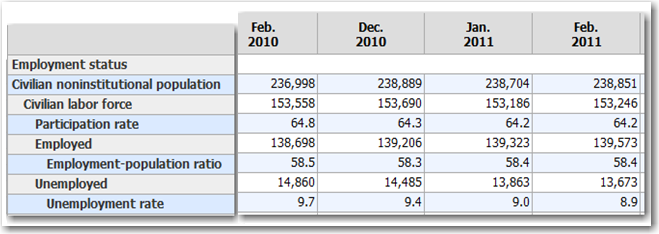
The gov’t Bureau of Labor Statistics reported that unemployment has fallen the past couple of months and is now a bit under 9%.

That would be good news … if true.

image

http://www.bls.gov/news.release/empsit.a.htm

But, it seems that Gallup begs to differ.

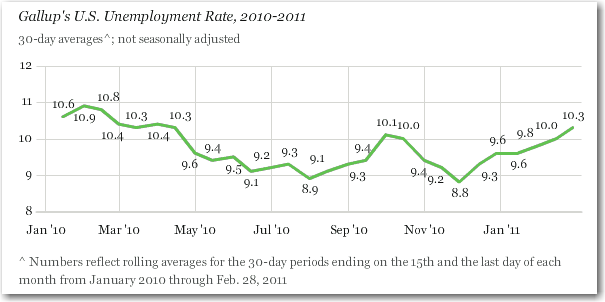
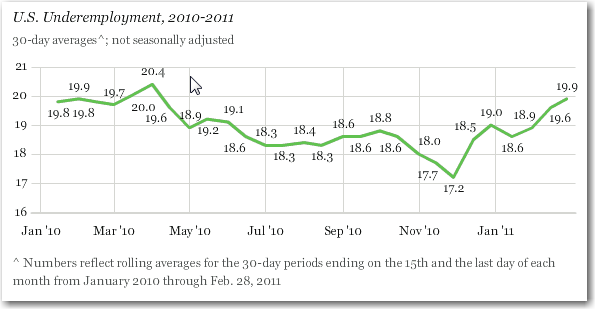
According to Gallup, the unemployment rate has been increasing the past couple of months and is now over 10%.  The underemployment rate has also been increasing and is now almost 20%

So, who to believe – the fox guarding the henhouse or a left-leaning, reasonably objective 3rd party.

Hmmm.

image

 image

Brands and Buddies, the new way to Bing

March 22, 2011

TakeAway: Visual “tiles” that come up with Bing’s search results are part of the Bing’s innovations  to make the search platform more interactive and relevant to its users.

It is also showing the searcher’s Facebook friends’ Likes as another way to for users to validate the results. 

* * * * *

Excerpted from BrandChannel, “Bing Enhances Search with Brands and Buddies”  by Sheila Shayon, February 25, 2011

… search with Microsoft’s Bing lately, noticed the tiles now included with dynamically rendered visual info from brands in the entertainment, local, travel and auto categories. … enhancing Bing to be more relevant to users.

User queries trigger them to appear on the right side of the screen from one of 45 launch partners including IMDb, Yahoo Movies, Rotten Tomatoes, OpenTable, Yelp, CitySearch, Urban Spoon, Cheap Flights, YouTube, MTV, Last.fm, Rhapsody, Pandora, MSN and dozens more.

The tiles are interactive and click-through on a Pandora or Rhapsody tile brings up a song or checks the number of plays via Last.fm.

… the tiles are “going to be pulling in metadata from those sites. …figure out the results they’re looking for if you append some kind of visual cue onto the page.” … And enable users to “ingest third party content more successfully,” …

… “an innovative move to add images to the organic results. But … innovations must come from the ranking results vs. making adjustments to the aesthetics of searches…

… not so much intrusive as a value add to the search and/or social online experience: …feel Bing as a search engine is more user-friendly, smart and reputable. Consumers are intrinsically drawn to visual references and respect and trust this type of added feature when looking for a product…

… Bing tiles are the latest ingredient in a richer mix evocative of Microsoft’s Windows Phone 7 interface with alerts on homescreen tiles updated real-time.

Add to the mix that Bing also now displays your friends’ Facebook likes in your search results, …

Edit by HH

That menu — it’s playing with your mind … is it a profit scheme?

March 22, 2011

You bet it is …

In his book, Priceless: The Myth of Fair Value (and How to Take Advantage of It), author William Poundstone dissects the marketing tricks built into menus—for example, how something as simple as typography can drive you toward or away from that $39 steak.

1. The Upper Right-Hand Corner
That’s the prime spot where diners’ eyes automatically go first.

Restaurants often use it to highlight a tasteful, expensive pile of food.

2. Pictures

Generally, pictures of food are powerful motivators but also menu taboos — mostly because they’re used in downscale chains like Chili’s and Applebee’s.

Red Lobster ditched pics when it started trying to inch upscale

3. The “Anchor”
The highest priced item on the menu may not ever get ordered.  That’s ok.  It’s purpose is to make everything else near it look like a relative bargain.

4. In The Vicinity
The restaurant’s high-profit dishes tend to cluster near the anchor.  They’re items at prices that seem comparatively modest (when compared to the anchor).. They’re the items the restaurant really wants you to buy.

5. Columns Are Killers
It’s a big mistake for restaurants to list prices in a straight column. “Customers will go down and choose from the cheapest items.”

Consultants say to omit “leader dots” that connect the dish to the price; and to drop dollar signs, decimal points, and cents

6. The Benefit Of Boxes
“A box draws attention and, usually, orders.

When you see an item in a box, think “high margin”

7. Menu Siberia
That’s where low-margin dishes that the regulars like end up. They’re there, but relatively easy-to-miss  … or so the restaurant hopes..

8. Bracketing
A regular trick …  it’s when the same dish comes in different sizes.

Because youre never sure of the portion size, you’re tempted to to trade up … especially from small to “regular” size.

* * * * *

Excerpted from Priceless: The Myth of Fair Value (and How to Take Advantage of It), to be published in January by Hill & Wang, an imprint of Farrar, Straus & Giroux. © 2010 by William Poundstone.
http://nymag.com/restaurants/features/62498/

Is social media losing its edge?

March 22, 2011

TakeAway: With all the recent social media flops some say the end of using social media is near. 

While the way people get and consume information is different, the idea behind making a product that people need and selling it them stays the same, and CMOs need to do things that matter like actually selling the product.  

* * * * *

Excerpted from AdAge, “Do Campaign Failures, High-Profile Firings Signal the End of Social Media?” by Jonathan Salem Baskin, March 22, 2011

The latest news involving social-media pioneers isn’t good. Pepsi has fallen to third place behind Diet Coke in spite of its widely heralded switch from Super Bowl ads to a huge social charity program called Refresh Project. Burger King has …fired agency Crispin Porter & Bogusky after producing Facebook campaigns and viral videos that got lots of attention while the business witnessed six consecutive quarters of declining sales. …

Every CMO should use this occasion to pause and reflect …on rolling out a social-media campaign or start giving away content for free. Unfortunately, there are many reasons why you shouldn’t, and may not.

what good are invented metrics for social campaigns if they don’t evidence any influence on sales? There’s no such thing as a successful brand that doesn’t deliver successful marketing, is there? In fact, the latter builds the former. They can’t be disconnected, and if social marketing can’t be made responsible for tangible behaviors that matter to the business, not just to ideas about branding, then no made-up measures of its importance matter much at all.

… Identifying what the social efforts did, if anything, requires the upfront presumption that they were necessary and therefore accomplished anything at all that mattered (like starting out to claim that cereal is “part of a balanced breakfast”). …

…beginning of the end of social media’s infancy. Maybe it’s time to stop talking unseriously and get serious for real. Technology has utterly changed the ways consumers get and use information, and it has completely disrupted how companies create, share and collect it. …People still need and do the same things they always did, and companies still need to sell to them. Pretending that conversation has any value apart from the meaningful, relevant and useful information within it — fad ideas, like “content” is anything more than a silly buzzword, or that anybody wakes up in the morning hoping to have a conversation with a brand of toothpaste or insurance — is no longer credible in light of the latest news.

Instead, CMOs need to discover new ways to do the old things that still matter: Offer products and services that someone truly needs, admitting that you want to sell stuff to them, and then properly serving them after they’ve given you their business. Sounds so easy as I type it but doing so has gotten so incomprehensibly complicated. Maybe the news coming out of Pepsi and Burger King is a wakeup call that we need to make all of this simpler, not harder. …


Edit by HH

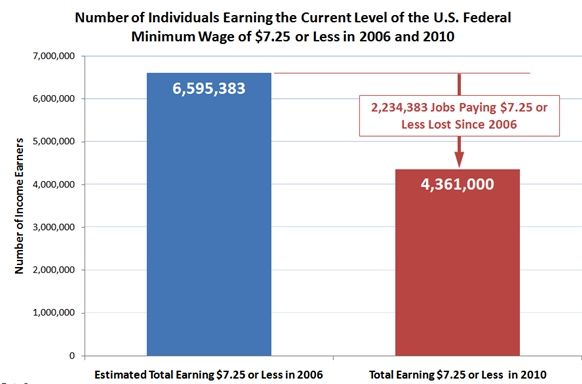
Jobs affected by federal minimum wage hikes account for 41.8% of the total reduction in jobs seen since 2006.

March 21, 2011

Economists warned that raising the minimum wage would result in lost jobs. It always does.

Why?

As labor gets more expensive, companies pare back the employment rolls.

Sure, the folks who hang onto their jobs make more … but folks who lose their jobs make less – zero to be precise.

Here’s a great analysis from the site Political Calculations

* * * * *

In 2006, the last full year in which the U.S. federal minimum wage was a constant value throughout the whole year, at least before 2010, approximately 6,595,383 individuals in the United States earned $7.25 per hour1 or less.

For 2010, the first full year in which the U.S. federal minimum wage was a constant value through the year since 2006, the U.S. Bureau of Labor Statistics estimates that an average of just 4,361,000 individuals in the United States earned the same equivalent of the current prevailing federal minimum wage of $7.25 or less throughout the year.

 image

In terms of jobs lost, that means that 2,234,383 of the jobs lost in the U.S. economy since 2006 have been jobs that were directly impacted by the series of minimum wage increases that were mandated by the federal government in 2007, 2008 and 2009.

Interestingly, the average number of employed members of the civilian labor force in 2006 was 144,427,000. In 2010, the average number of employed members of the civilian labor force in the U.S. was 5,363,000 less, standing at 139,064,000.

So, in percentage terms of the change in total employment level from 2006 to 2010, jobs affected by the federal minimum wage hikes of 2007, 2008 and 2009 account for 41.8% of the total reduction in jobs seen since 2006.

Thanks to Tags for feeding the lead

Panera builds loyalty .. and, oh yeah, keeps prices high.

March 21, 2011

TakeAway: Panera Bread investors are hoping the company’s new loyalty program and additional menu items will lead the way for continued sales and traffic growth.  The loyalty program, MyPanera cards, is a way for the company to build deeper relationships with people who are already engaged with the brand.

* * * * *

Excerpted from WSJ, “Panera Bread Sees Loyalty, Innovation Bringing in the Dough” By Annie Gasparro, February 11, 2011

On the heels of launching its customer-loyalty program, Panera is bringing in steak as new protein for its sandwiches, which, bolstered by extra marketing, are expected to help continue the trend of increasing sales, especially in the dinner and catering businesses.

The move to add steak to the menu comes at a time when beef prices are at all-time highs and rising, putting additional commodity pressure on Panera. But the company remains confident.

Panera’s loyalty program, MyPanera cards, is expected to be a key driver in future traffic growth, as it allows the company to track what its customers are buying, when they buy it and how much they spend. The free program was launched in the fourth quarter and presents members with “soft rewards,” like complimentary items, that match their buying habits.

This kind of insight can be used to make marketing substantially more effective, analysts point out. By giving a free bakery item to a customer who normally buys just coffee, Panera could create a higher-check customer long-term. In the same way, it could bring breakfast frequenters, for instance, in more regularly for lunch or dinner as well.

Panera isn’t afraid of raising prices coming out of the recession. The bakery chain says its overall commodity costs, about 80% of which are locked in for the year, will be up about 3% this year, causing the company to raise prices 2%.  Panera’s bottom line improved through much of the recession, having increased every quarter in nearly three years largely due to customer loyalty. While competitors discounted to lure customers during a slump in dining demand, Panera’s aversion to price cuts succeeded among its base of mostly upper-middle-class customers and revenue growth never reversed.

Edit by AMW

* * * * *

What do the Big East and Richmond, VA have in common?

March 21, 2011

Both have 2 team in the NCAA’s Sweet Sixteen.

Ouch.

All of a sudden, the Big East looks more like the Big Easy.

Charles Barkley on TBS: “When you get to the tourney you’ve got to be physical & talented … not just physical.  Everybody’s physical. Except for Connecticut’s Kemba Walker, who does the Big East have?”

Double ouch.

Think back to brackets’ day.  The pundits (Bilas, Vitale)  praised the Big East and said Virginia Commonwealth didn’t belong in the tournament. That there needs to be more “basketball guys” on the selection committee — who know what they’re talking about. 

Hmmm.  So, who knows what they’re talking about?

Time for baseball.  Go Cubbies.

Marketers Return to “Good Ole Days” Strategy

March 18, 2011

TakeAway: With the economy still a long way from recovering, marketers are turning to an old strategy to reconnect with consumers.

Recent ads from automobile and even bourbon companies aim to reach the average Joe via the theme of shared values 

Advertising that makes an emotional appeal to consumers is by no means a new trick to advertisers or their agency partners, but it’s easier said than done. 

One of the classic, textbook examples of marketers who excel at this is Coca-Cola, which isn’t selling bottles of Coke, per se, but “8- and 12-oz. bottles of happiness.” 

In tough times, the strategy may be even more critical as cash-strapped consumers are more likely to spend money on brands that closely align with their personal values.

* * * * *

Excerpted from WSJ, “Marketers Embrace ‘Values’ Pitch in Tough Times” By Elaine Wong, February 17, 2011

The two-minute Chrysler “Imported from Detroit” commercial is full of values-laden phrases. There are the obvious descriptors like “hard work” and “conviction” as well as adages that inspire awe and determination, such as: “It’s the hottest fires that make the hardest steel.” Or, thought-provoking questions like, “What does a town that’s been to hell and back know about the finer things in life?” All statements that are meant to encourage consumers to take a second look at Chrysler by prompting them to reconsider their values.

Another one of Detroit’s Big Three, General Motors, which also advertised in the Super Bowl, has been running a campaign for the last four months to promote its new lineup of Chevrolet vehicles, including its Volt electric and Cruze compact cars. A 60-second “anthem” or anchor television spot takes viewers through Chevrolet’s historical past, as well as a brief look into its future. “One hundred years ago, Chevrolet sprang bolt by bolt, car by car, out of the very best America had to offer: ingenuity, integrity, optimism,” the voiceover says.  There is also a subtle plug at Chevy’s “deep” history: “This isn’t just any car company. This is Chevrolet. And the strength of our nation can be found in every car and truck we make. That’s why today, tomorrow and on into a bright future, we can proudly say, ‘Chevy runs deep.’”  The strategy is a bit different from the past, when Chevrolet marketed its vehicles via a “hard sell” kind of approach–i.e., “We’re an American brand, you’re an American consumer, therefore, you should buy our products.”

The shift stemmed from this insight: “While consumers want us to succeed, they don’t want to spend their hard earned money on us just because we’re made in the U.S. and are a U.S. company.” A better approach was to focus on the emotional reasons behind why Americans buy Chevrolets.

Edit by AMW

GM Shareholders: The next bailout?

March 18, 2011

If you were one of the insiders who bought GM’s stock on the day of the IPO for $33 and change, and you’re still holding it, guess what?

You’re under water.

More realistically, if you’re one of the first day fat cats, you flipped the IPO stock … maybe for as much as $39 … you made some quick money.

But, those suckers who bought your flip?

Well, they’re way under water.

Last week, the stock was trading at its life time low … under $32. It’s still there.

Some traders are shorting the the stock, looking for a near-complete collapse.

Here’s an analysis from one of the shorts – Jonathon Hoenig of The Capitalist Pig and WSJ’s Smart Money …

GM recently announced a $4.7 billion profit , its biggest in a decade. Some 45,000 union workers will receive profit-sharing payments averaging $4,300 – a record.

And on that very same day, shares of the company slid below their IPO price of $33 for the first time, a vitally important fact overlooked by most of the enthusiastic media reports.

image

If there was ever a stock that makes people emotional , it’s General Motors. Either the company is the backbone of the American working man or the poster child for bad business practices.

That emotion, of course, is only exacerbated by the fact that GM received a $50 billion bailout from the Federal Government, an intervention that left taxpayers the largest shareholders, still owning 26.5% of an extremely weak stock. For the government to break even, shares will have to hit an estimated $53 – up 64% from current prices.

And not all of GM’s headlines have been as rosy as its recent profit announcement. The company sold just 281 Chevy Volt hybrids in February.

Despite its recent rebirth, this is a quintessential ” old soldier ” stock, heavy with the overhang of public ownership and beset with wasteful political influence .

Diet Coke smacks Pepsi …

March 18, 2011

Punch line: Coke #1, Diet Coke #2, Pepsi #3, Diet Pepsi ?

According to the WSJ …

U.S. sales of Diet Coke overtook those of Pepsi-Cola for the first time in 2010, making the diet soda the No. 2 carbonated soft drink in the country behind Coca-Cola, industry data are expected to confirm Thursday.

Occupying the top two rankings marks a historic win for Coca-Cola in its decades-old rivalry with PepsiCo, which has seen its market share slip in recent years and is trying to retool its marketing.

Pepsi-Cola commanded only a slight lead over Diet Coke in 2009, when each brand had slightly less than a 10% market share among carbonated soft drinks.

That year, regular Coke won the cola wars with a 17% market share.

But market-share data is expected to confirm Diet Coke pulled ahead in 2010.

PepsiCo made a big bet in 2010, when it didn’t market its flagship cola on the Super Bowl or in other TV spots.

Instead, it launched the Refresh Project, an online charitable-giving program that disbursed $20 million in donations “for refreshing ideas that change the world.”

Increasing the stakes, Coca-Cola and PepsiCo also spent billions of dollars last year to acquire their largest independent U.S. bottlers in a bid to bring drinks to stores more quickly.

WSJ, Diet Coke Wins Battle in Cola Wars, March 17, 2011

Illinois adopts “Internet Sales Tax Law”

March 17, 2011

Last week, Illinois’ governor signed into law controversial legislation requiring Internet retailers like Amazon.com and Overstock.com to collect Illinois’ 6.25% sales tax if they have affiliate sellers in the state.

Previously,, internet sellers were only compelled to collect sales taxes if they had a physixL presence in the state – e.g. stores or distribution centers.

So, Borders.com would have to collect sales taxes, but Amazon.com didn’t.

Hardly a level playing field.

But, Amazon has over 10,000 “affiliates” based in Illinois – companies that hawk their wares through Amazon. 

Now, these affiliates count like physical outlets.  So, if Amazon has a single affiliate based in the state, it is compelled by law to collect sales taxes

Amazon’s plan: terminate all affiliates located in Illinois.:

My take:

First, the law has nothing to do with level playing fields – it has all to do with tax revenues.

Given that, consider the so-called “second order effects”.  Many Amazon affiliates are likely to move out of Illinois – across the border to Indiana or Illinois – taking with them jobs and, oh yeah, corporate tax revenues.

Hmmm …

Suburban moms — armed with iPads — spur mobile commerce …

March 17, 2011

TakeAway: If your company is utilizing ecommerce, you will want to make sure it is iPad user friendly.

More and more shopping is being done on tablet devices and is stealing its share from pc based purchasing especially as women are becoming heavier users than men because of the inability for the manpurse fad to stick.

* * * * *

Excerpted from AdAge, “How the iPad is Reshaping Ecommerce”  by Patti Ziegler, February 22, 2011

The growing cohort of iPad owners — wealthy, tech savvy, and increasingly female — is emerging as a powerful driver of online retail sales.

iPad has become a must-have mobile device for many suburban moms, who seem especially fond of shopping (and playing Scrabble) …

…counterpoint to common technology stereotypes, women appear to be gaining on men as the fastest growing segment of early iPad adopters. In fact … the female-to-male ratio of iPad users shifted from 1:2 to 2:3… This finding is particularly significant when one considers that women control between 70% and 85% of household spending in the U.S…

…the iPad has emerged as …the poster child for a new class of mobile commerce. Many retailers report that over 50% of their mobile traffic is now coming from the popular tablet device, …

…rather than creating new incremental sales, tablet-commerce will largely grow by …cannibalizing traditional PC-based retail traffic.

… smartphone-based “m-commerce” also remains highly relevant for retailers. Smartphones are less likely to be used to browse products and make actual purchases, yet mobile devices are increasingly supplementing the in-store shopping experience …to find nearby locations, check hours, and obtain price comparisons. …m-commerce activities are not transactional, they do have the potential to drive incremental sales offline.

… E-commerce is growing at a double-digit pace and many retailers are ramping-up their presences on mobile and online platforms to offset a simultaneous decline of physical store sales. … creating opportunities for retailers that create shopper experiences that seamlessly extend across smartphones, laptops, tablets, in-store kiosks and, yes, the iPad.

The iPad’s nearly 10-inch display is comfortable … for web-surfing and product consideration, overcoming the size restraints frustrating shoppers on mobile phones. … the touch-screen functionality provides a more immediately satisfying and tactile shopping experience. …free from the constraints …they can be comfortably schlepped from commuter trains to airport lounges to kitchen counters, facilitating purchases at every venue.

Little wonder then that tablet sales — as a share of total PC sales — are forecast to nearly quadruple from 2010 to 2015…”To that end, retailers need to ensure that all pages, transaction forms, and form fields render as well from tablet devices as from any other browser,”…

In addition to the iPad, new offerings include the Android-based tablets Samsung Galaxy Tab and T-Mobile G-Slate. …The demographics are particularly attractive … typically affluent and more likely to be spending money online in the first place. Nearly 95% of iPad owners have “solid wealth and strong incomes,” …

Meanwhile, among men with means, there’s been speculation that the iPad will finally make “man purses” an acceptable accessory. …Good luck with that, guys! Perhaps an iPad-equipped woman could help you buy one online.


Edit by HH


* * * * *

Husky women play with men …

March 17, 2011

In this case, we’re talking about the top-ranked UConn Huskies women’s basketball team.

Seems that one of their competitive advantages is practicing against men.

According to Business Week:

The top-ranked Connecticut team is among the two-thirds of Division I women’s basketball programs that practice against male players.

Because men who gravitate to competitive round ball are generally built bigger, stronger, and faster than women, teams use them as a form of overload training.

It’s like wearing ankle weights when running.”

If it weren’t for the guys, starters would practice against bench players, who, as a rule, are not as good as the first team.

Plus, from a coach’s point of view, the guys are the managerial dream of expendable labor.

“We don’t have to be worried about whether they are going to be ready to play,”

Business Week, Winning Women Practice Versus Men, March 10, 2011

On Wisconsin: We couldn’t have said it better …

March 16, 2011

Something troubled me watching the protesters camping in the Wisconsin state capitol.

Business Week hit the nail on the head:

Protesters chanted, sang, played drums, deployed yogic oms, and —though few gave the impression of being gainfully employed — they conducted long conversations about the sanctity of workers’ rights.

Business Week,  A Divided Wisconsin, March 9, 2011

And, from the WSJ: 

Whether Wisconsin represents the emergence of a broad-based, national campaign against reform-minded Republican leaders, however, depends on something far less clear: the ability of the protest movement to reach beyond its own echo chamber to the nonunion middle class.

 WSJ, Rules for Wisconsin Radicals, March 15, 2011. 

Funny how folks who don’t pay taxes aren’t fazed by wasted tax dollars …

Want the impact of Facebook? Then, pay up!

March 16, 2011

TakeAway: Brands trying to get in front of their customers by utilizing sponsored stories may be surprised to find out where their stories are ending up. 

This latest attempt for brands to utilize free promotions via Facebook prove that there is still a need to pay for the customers’ attention.

* * * * *

Excerpted from AdAge, “How Brands are Getting Lost on Facebook”  by Brad McCormick, February 22, 2011

… Facebook recently announced the launch of sponsored stories … which allow marketers to insert certain user updates into paid advertisements … another blurring of the line between paid and earned media.

But …brands are stumbling in their quest to be heard on the world’s most popular social network.

… Not all friends are created equal … a principle that social networks have struggled to properly put into practice.

Facebook actually attempted to correct this with…”Top News” featuring the news and updates from your friends that Facebook’s thinks you will be most interested in. … a brand’s presence within a user’s “Top News” is as good as gold because it is the default page.

“Recent News,” is fast becoming the spam folder of Facebook. …with an overflow of updates from “friends” with whom you rarely interact …this is where branded updates are appearing.

… While Facebook’s marketing department may tell Starbucks that another customer’s affinity for a Double Espresso Venti Mocha holds value to its fanbase, Facebook’s Edgerank algorithm may be saying something entirely different. Otherwise, there would be no need to “ensure your fans see the content that your Page publishes” via purchasing sponsor stories ads.

More than anything, Facebook’s announcement shows that is still necessary for brands to pay for a customer’s attention. While that’s not astonishing, for brands to truly leverage the power of Facebook, they need to find better ways to earn it.

Edit by HH

Here’s your new Medicaid card … good luck.

March 15, 2011

Punch line: Being on Medicaid was associated with the longest length of stay, the most total hospital costs, and the highest risk of death.

According to the WSJ

Dozens of recent medical studies show that Medicaid patients suffer for it.

Foe example, 2010 study of 893,658 major surgical operations performed between 2003 to 2007, published in the Annals of Surgery, found that being on Medicaid was associated with the longest length of stay, the most total hospital costs, and the highest risk of death.

In all of these studies, the researchers controlled for the socioeconomic and cultural factors that can negatively influence the health of poorer patients on Medicaid.

So why do Medicaid patients fare so badly?

Payment to providers has been reduced to literally pennies on each dollar of customary charges because of sequential rounds of indiscriminate rate cuts, like those now being pursued in states like New York and Illinois.

As a result, doctors often cap how many Medicaid patients they’ll see in their practices.

Meanwhile, patients can’t get timely access to routine and specialized medical care.

Source: WSJ, Medicaid Is Worse Than No Coverage at All, March 10, 2011. 

But, I just want plain old toothpaste …

March 15, 2011

TakeAway:  An explosion of specialized pastes and gels brag about their powers to whiten teeth, reduce plaque, curb sensitivity and fight gingivitis, sometimes all at the same time.

Add in all the flavors and sizes, plus ever-rising prices, and the simple errand turns into sensory overload. 

Manufacturers acknowledge the problem and are putting the brakes on new-product introductions.  In this case, more product variety isn’t always better.

* * * * *

Excerpted from the WSJ, “Whitens, Brightens, and Confuses By Ellen Byron,February 23, 2010


P&G, maker of Crest, says it has “significantly” reduced the number of oral-care products it makes world-wide in the past two years.  Crest hit the market in 1955 and in 1960 became the first fluoride toothpaste to gain the American Dental Association’s “seal of acceptance.” Toothpaste was elevated from cosmetic to therapeutic status, and sales of Crest nearly tripled within the next two years. The 1980s brought tartar-control formulas, raising consumer expectations of what toothpaste could do. Ever since, companies have brought out benefits and ingredients, in search of the next game-changing upgrade.

Each new benefit is a chance for toothpaste makers to push prices upward and drive sales. With some 93% of U.S. adults using toothpaste, according to Mintel, there’s little room to recruit new users.

Packaging plays its part in toothpaste-aisle clutter. “The toothpaste carton is a certain size and shape and sits on the shelf in a certain way. That makes it hard to communicate effectively when there’s a meaningful difference in a new product,” says Jonathan Asher, senior vice president at Perception Research Services, which specializes in packaging and shopper marketing.

This year, Colgate-Palmolive introduced packages meant to be more easily deciphered. It standardized sizes of the Colgate logo, the “sub-brand” and the flavor or benefit, so shoppers will notice them in that order. It did what it calls “shelf tests,” timing how long it took shoppers to find new packages of Colgate Total Advanced Whitening and other variations, versus older packages. “The new packaging was not only preferred but it was easier to find,” says Nigel Burton, president of Colgate’s global oral care, consumer insight and advertising.

Many dentists think differences between brands aren’t very meaningful. “Just make sure it has fluoride and has the American Dental Association seal,” says Ada Cooper, a New York dentist and consumer adviser for the ADA, which evaluates toothpaste claims. The ADA’s seal “tells you that the product has been tested, that it’s effective in doing what it says it’s going to do, and has the right mix of ingredients.”

Edit by AMW


Unemployment, Budget, Libya, Japan … Fore!

March 15, 2011

Media widely report that Pres Obama took a 4 a.m. phone call from Sec. of Staff Bill Daley last week.

Many inferred that it was the news of the Japan earthquake and tsunami.

Au contraire.

Appears that it was a wake-up call for his 61st round of golf.

As Alfred E. Newman would say, “What me worry?”

President Obama just could not wait for spring weather to arrive.

For the second week in a row, the most powerful man in the world stepped away from the White House to hit the golf course.

Even as his administration and the U.S. military help Japan recover from a devastating earthquake, and as the world worries about Fukushima’s nuclear reactor, the president could not resist taking advantage of the 48-degree weather in the Washington, D.C., area.

The president left the White House Saturday afternoon for a short trip to Joint Andrews Base in Camp Springs, Md.

With cloudy skies, it’s not the best weather for golf, but Obama loves to spend his Saturdays on the greens. Last fall, Obama went golfing darn near every weekend.

These are never quick “work on your swing” trips; usually the president plays 18 holes, as he did last week.

ABC News, Just Warm Enough for Golf, Obama Back on the Course
a. March 12, 2011

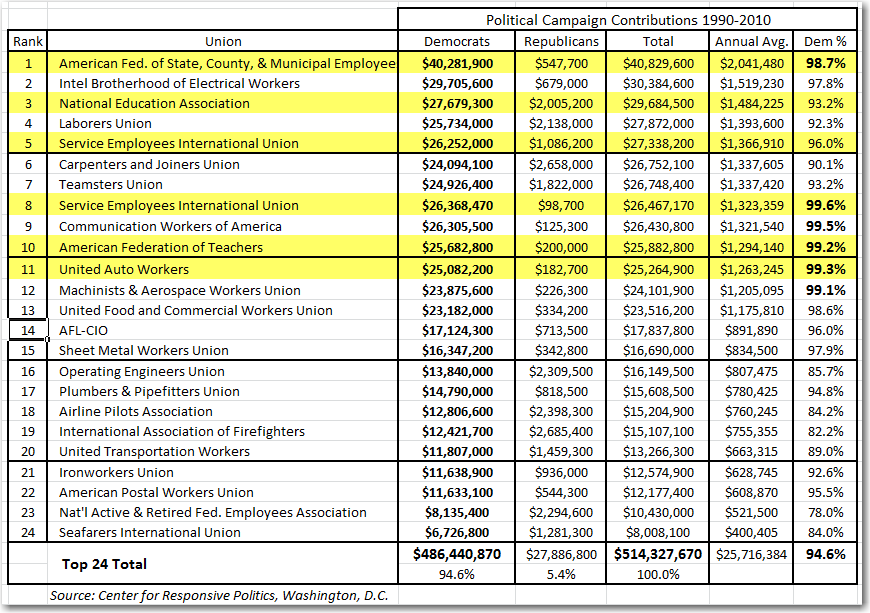
Answer: $514,327,670 … What’s the question?

March 14, 2011

The amount of money that 24 Unions donated to Dem political campaigns over the past 20 years.

Yep – over half-a-BILLION dollars.

That’s why Dems think that automatic payroll deductions for dues is so important.

Maybe if it’s not automatic, then some folks might decide that the union is serving them well .. especially when they simply serve as a financial conduit to Dem politicos.

Hmmm.

Note on the list the prominent position of gov’t employee unions … and quasi gov’t unions like the UAW and the SEIU.

click the chart to enlarge it 

image

Here’s a post from last fall that puts the numbers in context:

According to data from the Center for Responsive Politics …

  • Business PACs gave 52% of their $72.2 million in total donations to Republican candidates from January through July. In the same period of 2009, corporate PACs had sent 59% of their $64 million in campaign contributions to Democratic candidates,
  • Overall, big banks, securities firms and other financial-services companies gave 55% of $18.5 million in campaign donations to Republicans in the January-through-July period. That’s a reversal from the same period last year, when they gave 65% of PAC donations to Democrats.
  • PACs that are run by labor unions give an overwhelming share of their donations to Democrats. Sixteen of the top 20 PAC donors to Democrats so far this election are operated by labor unions.  None of the top 20 PAC donors to Republicans have been labor unions in the current election cycle.

WSJ, Corporate Political Giving Swings Toward the GOP, Sept 21, 2010 

Thanks to JC for feeding the lead.

Mr. Retailer wants to get chummy with you … what’s your 12-digit customer ID?

March 14, 2011

TakeAway: Retailers are trying to recreate images as companies that know its customers and gives them what they want.

Stores are leveraging loyalty programs as a way to use the customer information and customize marketing for each person. 

* * * * *

Excerpted from AdAge, “Retailers on a quest to Rekindle the Personal Touch of a Bygone Era”  by Natalie Zmuda, February 14, 2011

… retailers knew their customers. Sales clerks sent invitations to store events, called when items of interest arrived… Rolodexes crammed with notes about shoppers’ favorite brands and styles. That style of shopping — an intimate experience, not an anonymous one — has long been thought dead… now retailers are hoping to recapture some of the old magic.

… by updating and expanding loyalty programs, …customers are highly educated …more demanding than she’s been in the past, … and wants to go to a retailer that understands her, is really relevant to the lifestyle she’s living, and really does pay attention.

My Macy’s, now in its third year, seeks to be more relevant to consumers by stocking shelves with items popular in local markets — … also extends to marketing. Events celebrating the Kentucky Derby …And big wins for local sports teams are recognized… This month, Macy’s Star Beach Party program will launch in Chicago, targeting college students from 10 area campuses … pairing texting and pop-up events to lure students shopping for spring break fashions and, eventually, interview suits, the retailer hopes.

Food Lion has launched My Food Lion, inspired, in part, by My Macy’s … allows customers to create a profile personalized with relevant specials and recipes.

Worth noting: My Macy’s and My Food Lion are separate from those retailers’ loyalty programs, Macy’s Star Rewards and Food Lion’s MVP Card. The former focuses on understanding the customer and delivering desirable products and information, Ms. Reardon said. The latter is meant to reward customers for frequent shopping.

… savvier use customer information. PetSmart uses its database of email addresses to send out targeted emails with editorial content, as well as coupons. …Likewise, Sears Holdings has overhauled its loyalty program in the past two years, morphing it into Shop Your Way. …The program is cost-effective and gives Kmart and Sears the opportunity to build a robust database of consumers.… ongoing power of a very simple, classic idea: rewarding loyalty based on customer behavior,”…

More robust databases and better targeted communications will go a long way toward helping retailers recapture the magic of retailing days past. But it’s not easy or simple. … “What we tried to do was really customize [catalogs] to what the customer is really looking for and her past behavior shows she might want,” … “It was pretty resource intensive. But we learned a lot, and we are going to do similar things in the future.”

Edit by HH

25 Guys to Avoid on Wall Street …

March 11, 2011

 From CNBC’s NetNet …
25 Guys to Avoid on Wall Street

  1. Avoid the guy who calls you ‘Chief’.  He doesn’t remember your name.
  2. Avoid the guy who went to Hotchkiss and Yale and wears Nantucket reds during the summer. He doesn’t think you belong.
  3. Avoid the dim-witted back-slapping managing director. He’s not as smart as you are—but he’s been throwing guys like you under the bus since you were in grade school.
  4. Avoid the consultant hired by the dumb managing director to do his math for him. Not only will he throw you under the bus, he’s smarter than you are.
  5. Avoid the guy who always wants you to be his alibi when he cheats on his wife. (“Hey man, is it cool if I tell Kathy that we’re going fly fishing in Canada this weekend?”). No, dude: It’s not cool.
  6. Avoid the guy who keeps failing the CFA Level 1. He’s looking for someone to blame.
  7. Avoid the girl who cries at her desk. (You can ignore my advice on this one—but either way, you won’t make that mistake twice.)
  8. Avoid the guy who offers his clients ‘a very special opportunity’ to invest in anything. He has a problem with cocaine.
  9. Avoid any man who has floppy hair after age 30—he’s a complete toolbox.
  10. Avoid the guy who throws his phone across the trading floor whenever his positions go south. He’s an angry dude, and the more time you spend with him the more reasons he’ll find to dislike you.
  11. Avoid anyone who tells you that you should relax and have a couple of drinks—at 9:15 on a Tuesday morning. You’re not cool enough to hang out with this guy.
  12. Avoid anyone who won’t relax and have a couple of drinks—at 9:15 on a Thursday night. They’re not cool enough to hang out with you—and ultimately they’ll resent you for it.
  13. Avoid any broker who tells you his client is going to DTC in 50MM in securities from Europe and he needs to borrow a C-Note. Just for the weekend. And this is the last time.
  14. Avoid the banker who never seems to close a deal but still manages to remain employed. He’s got something ugly on somebody—and you don’t want to be involved.
  15. Avoid anyone who tells you to ‘take one for the team’. He got where he is by convincing dopes like you to jump in front of an oncoming train.
  16. Avoid the guy who tells you, “Seriously, all I do is work and then go home and lift.” He’s telling you the truth—and he’s as dumb as a stone.
  17. Avoid anyone who sits within eye-line of your desk: They know what time you show up and what time you leave—and chances are they think you’re a lazy punk.
  18. Avoid anyone who is ten years older than you are—and is still more junior in the reporting structure. He hates you more than you could ever imagine.
  19. Avoid the guy who posts Facebook pictures of himself getting arrested at the Saint Patrick’s Day parade. The guy is fearless—and he thinks you’re a complete coward.
  20. Avoid the guy who hangs his suit coat on the back of his chair to show off his suspenders. He either still thinks it’s 1985 or he’s trying to compensate for something.
  21. Avoid the guy who can drink all night, take a shower, and come into the office as crisp as a $100 bill. He’s got an oxlike constitution—and it will be fatal to your career to try to emulate his example.
  22. Avoid the guy who keeps telling you: “Without the back office, you overpaid clowns wouldn’t even have a job.” He’s right—but you don’t need to hear it.
  23. Avoid the guy who won’t share his Adderall: It just speaks to his character.
  24. Avoid anyone on Wall Street dumb enough to pick a fight with Bess Levin.
  25. Avoid the guy who gets drunk and loves to brag about never losing in arbitration: He’s going to get indicted. (Trust me on this one.)

Thanks to Dan F. for feeding the lead

New “super cold” Coors cans

March 11, 2011

TakeAway:  Package design is a critical part of a brand’s success.

At the point of sale a catchy package can make the difference between making the sale or not.

MillerCoors continues to evolve its gimmicky “cold cans” to try to boost sales in the ultra-competitive beer market.

* * * * *

Excerpted from brandchannel, “MillerCoors Looks to Boost Marketing in Face of Beer Sales Slump,” by Jennnifer Sokolowsky, February 21, 2011

MillerCoors is hoping that cold cans will warm up beer sales this year.

The veteran brewmeister plans to increase spending on marketing and introduce new packaging for Coors Light.

The new Coors Light packaging will include an indicator to show when the beer has reached a “super cold” temperature …

Introducing new packaging is a strategy that has worked in the past to boost sales for Coors Light, which is expected to overtake Budweiser as the No. 2 selling beer the U.S. this year, behind Bud Light.

However, MillerCoors and other beer makers are also going to need an improved economy and more jobs for 21- to 32-year-old men to get them drinking more mass-market beer. …

Edit by DMG


* * * * *

About those oversized government pensions …. what about Congressmen?

March 10, 2011

The flap over government employees’ pensions resurrected an old question of mine: I’ve always wondered what retired members of the Congress and Senate got to live on when they retired.  Here’s the scoop ..:

* * * * *

Members of Congress are eligible for a pension at age 62 if they have completed at least five years of service.

Members are eligible for a pension at age 50 if they have completed 20 years of service, or at any age after completing 25 years of service.

The amount of the pension depends on years of service, an accrual rate (2.5%), and the average of the highest three years of salary.

For example, after 30 years of Congressional service and a high-3 average salary of $161,800, the initial annual Civil Service Retirement System (CSRS) pension for a Member who retired in December 2006 at the end of the 109th Congress would be: 
                $161,800 x 30 x .025 = $121,350

  • Note: It’s unclear whether the qualifier is Congressional service or civilian government service … both terms are used.
  • Note: Base pay for Representatives and Senators was $165,200 in 2006.

Federal law limits the maximum CSRS pension that may be paid at the start of retirement to 80% of the Member’s final annual salary

As of October 1, 2006, 413 retired Members of Congress were receiving federal pensions based fully or in part on their congressional service. Of this number, 290  had retired under CSRS and were receiving an average annual pension of $60,972.

In 1983, Congress passed a law (P.L. 98-21) that required all federal employees first hired after 1983 to participate in Social Security.

The law also required all members of Congress to participate in Social Security as of January 1, 1984, regardless of when they first entered Congress.

Because the CSRS was not designed to coordinate with Social Security, Congress directed the development of a new retirement plan for federal employees, called the Federal Employees Retirement System (FERS), which does coordinate a federal pension with Social Security.

A total of 123 Members had retired with service under both CSRS and FERS or with service under FERS only. Their average annual pension was $35,952 in 2006.

Since, on average, SS benefits are typically around $24,000 annually,  the total is bumped to about $60,000.

Bottom line: a typical member of Congress get a pension of about $60,000

According to the National Taxpayers Union, the Congressional pension program is about two-to-three times more generous than the average corporate executive pension plan, .

* * * * *

Source:
http://www.senate.gov/reference/common/faq/retirement_for_members.shtml

Full report:
http://www.senate.gov/reference/common/faq/retirement_for_members.shtml

A Subway stop on every corner …

March 10, 2011

The marketing principle: Ubiquitous distribution.  Coke wants to always be within arm’s reach of every person. That’s ubiquity.

Now, Subway wants to be in every nook & cranny – anywhere somebody might yearn for a sandwich.

Punch line:  It’s official: the Subway sandwich chain has surpassed McDonald’s Corp. as the world’s largest restaurant chain, in terms of units.

At the end of last year, Subway had 33,749 restaurants worldwide, compared to McDonald’s 32,737.

Subway just opened its 1,000th location in Asia, including its first in Vietnam.

There are almost 8,000 Subways in unusual locations. “The non-traditional is becoming traditional.”

Subway has achieved its rapid growth, in part, by opening outlets in non-traditional locations such as an automobile showroom in California, an appliance store in Brazil, a ferry terminal in Seattle, a riverboat in Germany, a zoo in Taiwan, a Goodwill store in South Carolina, a high school in Detroit and a church in Buffalo, New York.

“We’re continually looking at just about any opportunity for someone to buy a sandwich, wherever that might be. The closer we can get to the customer, the better.”

McDonald’s is still the leader when it comes to sales. The burger chain reported $24 billion in revenue last year.

Excerpted from WSJ,  Subway Runs Past McDonald’s Chain , March 8, 2011

Battle of the titans: Miracle Whip calls out mayo…

March 10, 2011

TakeAway: Kraft kicked off a new, potentially risky campaign for its sandwich spread brand that embraces both Miracle Whip “lovers” and “haters.” 

The campaign comes at an interesting time for Miracle Whip.

Consumers are still packing lunches after last year’s recession, and sales of sandwich spreads and other “brown bag” ingredients are still holding up in a relatively weak economy.

At the same time, mayo and sandwich dressings have also gotten competition from healthier alternatives such as avocados and hummus, which can also be used as substitutes.

* * * * *

Excerpted from Forbes, “Kraft Shows “Polarizing” Side of Miracle Whip In New Campaign” By Elaine Wong, February 22, 2011

Miracle Whip, which comes in varieties like Light and Free, is targeted towards low-fat consumers and doesn’t think of itself as a mayonnaise. New ads ask bluntly, “We’re not for everyone. Are you Miracle Whip?”  And the lineup of celebrity spokespeople is just as polarizing.

Miracle Whip’s latest campaign is indeed provocative (after all, reaching out to the “haters” of a brand does carry risks), but Kraft sees it as a logical progression from two previous efforts the brand previously ran. One was a campaign that spun mayo, er, sandwich spread advertising on its head with spots that showed punk/rock consumers championing the brand. That effort, which carried the slogan, “We are Miracle Whip and we will not tone it down,” was meant to get younger consumers to take a second look at the brand.

The insight stemmed from the observation that “Miracle Whip has a unique flavor that tends to inspire a polarizing reaction in consumers. So, rather than deny this truth, we’re embracing it and owning up to the fact that we’re not for everyone,” said Miracle Whip’s senior brand manager.

In some households, the debate even went as far as the point where parents had to decide whether to raise the kids as Miracle Whip or mayo consumers, a phenomenon Kraft referred to as the “dual condiment household.”


Brand lovers may certainly help reinforce Miracle Whip’s positive attributes, but “negative” comments affirming the brand’s “poor” side can also easily get out of hand

Edit by AMW

* * * * *

McKinsey says;”Public sector productivity is at least 10 years behind the private sector” … that’s a shocker, isn’t it?

March 9, 2011

Winding through TSA at BWI on Sunday, I could only laugh.  When the supply of shoe-bins reached empty, the world’s slowest  moving human started wheeling a fresh stacks of bins to the front of the line.  I swear, the women was moving at the speed of about 10 feet per minute.  What-she-worry?  She was getting paid by the hour, not based on how many bins she stacked per hour.

With that experience fresh on my mind, a friend emailed the below article to me.

Coincidence?

* * * * *

According to Time mag …

Many Americans think of Washington when they think of government workers.

But the vast majority are state and local employees. The country has 2.2 million federal civilian workers — compared with 19.4 million at the state and local levels.

Almost half of the 19 million work in education, which rivals health care for the most wasteful sector in America.

The rest are mostly police officers, firefighters, social workers, nurses and prison guards.

* * * * *
And though public workers have suffered job losses in the past year (and will suffer more this year), the government remains the most reliable employer in the country.

Compared with before the recession, there are only 1% fewer employees at the state and local levels, according to the U.S. Bureau of Labor Statistics.

The federal civilian workforce is actually 12% larger than it was in November 2007.

Meanwhile, the number of private-sector employees has declined 6.5%

* * * * *.

For now, the efficiency gap between the public and private sectors is holding us all back.

The U.S. ranked 68th (out of 139 countries) in terms of wastefulness of government spending in the 2010-11 World Economic Forum report on global competitiveness.

Experts put our public-sector productivity about 10 years behind that of the rest of our workforce.

If public workers could halve that gap, the annual savings would ring in at $100 billion to $300 billion, according to a new study by the McKinsey Global Institute.

That would mean the equivalent of a recurring stimulus package every three to eight years.

* * * * *

Full article: Time, What Public Employees Really Cost, Mar. 07, 2011 

Thanks to SGC for feeding the lead.

PSA: “Weddings by Costco” … why not?

March 9, 2011

HomaFiles is a non-commercial site that doesn’t accept advertising and doesn’t endorse specific products.

But, if we did, you can bet that “Weddings by Costco” would be in our strike zone.

Costco has sold coffins for years … ‘bout time they fot into weddings.

Be sure to email to a friend who’s getting married …

image

Keds Steps It Up … to Kick It into Gear

March 9, 2011

TakeAway: Keds is repositioning itself and wants to remind people that it is an iconic brand. 

The buildup of artist collaboration and partnerships over 2010 culminates in the 2011 “How Do You Do?” campaign, which will encourage the target audience to create and collaborate, and emphasizes the idea of Keds sneakers being a canvas used to express that creativity.

* * * * *

Excerpted from WSJ, “A Campaign to Introduce Keds to a New Generation” By Tanzina Vega, February 22, 2011

Drivers who see a 32-foot shoebox rolling down the highway over the next few weeks should not be alarmed. The large white box is part of a new national marketing campaign for the sneaker company Keds.  The campaign, called “How Do You Do?,” is intended to reach millennials by taking the shoebox on wheels on a cross-country tour of college campuses. The campaign is also part of an effort to reposition the Keds brand, which has existed since 1916.

Since 2009, the company has been laying the foundation for that awakening by revamping the Keds Web site and participating in partnerships with designers and outlets like Alice and Olivia, Jeffrey New York and Richard Chai. Keds has also joined with the Whitney Museum of American Art on the Keds Whitney Collection, where artists like Jenny Holzer, Laura Owens and Sarah Crowner created limited-edition designs of the canvas sneakers, which were sold in Bloomingdale’s in New York City.

The company also created the online Keds Collective, where artists and designers could create their own versions of Keds to be sold on the company Web site. Users can also design their own Keds sneakers by customizing each of the 15 parts of the shoe, including details like the tongue binding, eyelets and laces.

A print campaign that began in 2010 was the next step in reintroducing the brand to the millennial demographic, defined as optimistic, collaborative, open and diverse. The ads featured groups of people doing things like building a sustainable garden on a rooftop.

Inside the shoebox, visitors will find two touch-screen maps of the tour where they can watch videos about the local artists, retail outlets and charity organizations that Keds is working with in each city. On another wall, users can see a gallery of Keds shoes inspired by each city on the tour schedule.  Outside the shoebox, visitors will see activities that expand on the “How Do You Do?” campaign slogan. For a section called “How Do You Do Keds?” students will be able to customize their own sneakers using a touch-screen kiosk, and can purchase the sneakers from the shoebox. The kiosks will also promote a shoe-design competition called “How Do You Do Your City?” which will run through the month of March.  The winner of the competition will get a $1,000 prize and a $5,000 donation to an arts-based charity. Keds is also sponsoring a segment called “How Do You Do Charity?,” where users will be asked to post messages on Twitter, using the symbol #HDYD, describing what inspires them about their city. The company will donate $1 per post to a local arts-based charity in each city, up to a predetermined maximum.

For each city in the tour, Keds has teamed up with local artists who will use the sneakers as a canvas. The slogans for each of the city stops will reflect the city name, as in “How Do You Do Austin?” and “How Do You Do New York?” For a concurrent promotion — “How Do You Do Art?” — local artists will create a mural on an eight-foot canvas inspired by the postings on Twitter using the tag #HDYD.

Edit by AMW

* * * * *


Uh-oh … the recession hits Wal-Mart as consumers change their buying ways.

March 8, 2011

TakeAway: Wal-Mart, the world’s largest retailer, has had seven consecutive quarters of declining same-store sales. 

A variety of factors contributed to this, including new shopping habits, strong competitors and a loss of some “fill-in” trips.

* * * * *

Excerpted from WSJ, “U.S. Sales At Wal-Mart Show Decline” By Stephanie Clifford, February 22, 2011

As the Christmas season approached, Wal-Mart Stores said it was fixing the problems in its United States division. It hired new executives, added merchandise that it had cut, and fought with Target and other competitors to provide the lowest prices over the holidays.

Company executives and analysts said consumers seemed to have changed their ways during the recession, and that has persisted into the sluggish recovery.

New shopping habits, like using less credit, relying more on month-to-month cash and buying in smaller packages, have hampered Wal-Mart’s ability to climb out of the sales slump. 

In addition, while consumers are still using Wal-Mart for big shopping trips, they are visiting drugstores and dollar stores for in-between purchases.

In the fourth quarter of 2010, the problems stemmed from several areas. Toy sales were down in American stores, though Wal-Mart had aggressively promoted prices and added back toys to its aisles. Apparel continued to be a problem. 

And in consumables — basics like toilet paper and soap — Wal-Mart said its prices and sizes were a problem for shoppers who continued to be on tight budgets.

Edit by AMW

* * * * *

Dr, Pepper says “More taste for only 10 measly calories”

March 8, 2011

TakeAway: Will Dr. Pepper 10 be able to capture the elusive male diet drinker market?

With a strong campaign aimed directly at males they sure hope so. 

Allowing the drink to have 10 calories instead of 0 enables the drink to deliver a flavor closer to the original and they believe will differentiate their product from the crowded diet drink market.  

* * * * *

Excerpted from AdAge, “Can Dr Pepper’s Mid-Cal Soda Score a 10 With Men?”  by Natalie Zmuda, February 21, 2011

Dr Pepper doesn’t want there to be any confusion. Its new 10-calorie soda is simply “Not for Women.”

Dr Pepper Ten, … targeting men, a bold move in a category that has had its fair share of marketing missteps. Coke Zero and Pepsi Max, …had difficulty nailing down the right message for a diet product that’s meant to appeal to men.

Aware of those missteps, Dr Pepper is rolling out an extensive test campaign for the new product, its packaging and marketing. Dave Fleming, director-marketing at Dr Pepper, called the test, which runs from now through June, “elaborate,” saying the strategy is atypical for the company, …

Dr Pepper Ten was created for 25- to 34-year-old men who prefer regular Dr Pepper but want fewer calories. And its inclusion of 10 calories, rather than zero like its competitors, allowed it to deliver a flavor closer to the regular version…

“We have a lot of excitement about this and wanted to give it fair treatment, so it would resemble a national launch in test markets,” he said. “We want to make sure that, if we do take this national, we understand all the variables.”

To that end, Dr Pepper Ten will be trotted out with commercials … A mobile “Man Cave” will also travel to each of six test markets, …The branded trailer will set up in “testosterone zones” such as ball fields or car shows and give men a place to watch TV and play video games. …

The packaging and marketing are both heavy on masculinity, but also clearly state the brand proposition, …

Mr. Fleming said he’s not out to alienate women, … “But we did the research, and it scored well with men and women.”

In theory, so-called mid-calorie sodas will appeal equally to men and women, with a sweet spot among 25- to 34-year-olds, said Bill Pecoriello, CEO of Consumer Edge Research. But he points out that Dr Pepper Ten is clearly intended to appeal to the target market staked out by Coke Zero and Pepsi Max. …

Mid-calorie sodas such as Dr Pepper Ten could be just the boost the struggling soft-drink category needs, as consumers look to trim calories from their diets and health advocates blame the fizzy drinks for obesity and diabetes. …some in the industry believe this in-between category could appeal to consumers, …”The performance we’re seeing from brands like Coke Zero, Diet Mtn Dew and Diet Dr Pepper indicates that diets and perhaps mid-cals may be the future route to growth for the soda category.”


Edit by HH


* * * * *

Jobs: Cause & effect … and spin

March 7, 2011

High fives on Friday when the monthly unemployment numbers were reported.

Jobs up,  Unemployment below 9%.

Even the WSJ is hinting at a turning point (extract below).

Thank god for Obama’s Trillion-dollar Stimulus.

Oh, really ?

First, the unemployment rate is down because the discouraged folks have stopped looking for work and don’t get counted as unemployed.

According to Reuters:

  • The U.S. labor force remains as small as it has been in a generation … 
  • More than 5 million Americans have disappeared from the job rolls …
  • If the labor force was currently at 2007 levels, the unemployment rate would be a whopping 12 percent.

Second, the Stimulus was almost 2 years ago.

Time lag?

I think not.

If, in fact, the economy is turning – and, for the record, I’m not buying that – it’s more likely a rapid-fire response to the extension of those much maligned  Bush Tax Cuts.

At least, companies have 2 years of relative certainty regarding taxes.

Perhaps a little certainty is breeding a little employment.

You think ?

* * * * *

WSJ, The economy shifts into forward, March 5, 2011

Even the WSJ declared:

“With 192,000 new jobs created in February, the U.S. economic engine clearly has shifted into forward recovery.

  • The unemployment rate for the first time in 20 months nudged below 9%, settling at 8.9%.
  • In the private economy, hiring expanded by 222,000.
  • Construction hiring hints that perhaps the worst of the housing depression is over.

Keynesians will have a hard time explaining why the jobs recovery started long after the bulk of the stimulus dollars were spent.

We still have 13.7 million officially unemployed Americans, with 2.7 million more who stopped looking for jobs. Nearly half (43.9%) of those without jobs have been out of work at least six months.

The main reason the unemployment rate has fallen the last several months is that the number of working-age Americans not in the labor force dropped by two million over the past year.

The U.S. economy needs to maintain a pace of 190,000 net new jobs for at least the next 12 months merely to get the jobless rate back to a still awful 8%.

At least the jobs recovery is finally headed in the right direction.”

Georgetown ups rank to #10 …

March 7, 2011

Among undergrad business schools, that is … according to Business Week, up a whopping 13 places to #10.

image

Aunt Jemima wants to friend you … no kidding.

March 7, 2011

TakeAway: One of America’s oldest brands, Aunt Jemima (established in 1889), launched its first ever social media campaign to show consumers exactly how the pancakes and other menu items from its frozen breakfasts division are made. 

The company plans to have the social campaign “in perpetuity.”  In addition to the Facebook page, there will be a Twitter handle to engage with fans and have a two-way conversation.

* * * * *

Excerpted from Brandweek, “Aunt Jemima Deconstructs the Pancake (and More)” By Steve McClellan, February 17, 2011

Aunt Jemima purposefully wants consumers to see that the way the company makes flapjacks and waffles is just like they do at home. 

The core of the campaign is a series of videos appearing on the brand’s new Facebook page, featuring veteran Aunt Jemima employees who describe the “just like homemade process” and the people behind it.

The company held a contest to determine which employees would be featured in the videos and they’ll be appearing at numerous events throughout the coming year.

The campaign will also have an extensive online ad component to drive people to the page, where they can access the videos. Coupons and recipes are also available at the page.

The core target: families with harried weekday mornings, or pretty much everybody.

Edit by AMW

* * * * *