Archive for April, 2018

It takes more than a swig of ‘tussin …

April 30, 2018

In praise of practice and relentless testing …
===========

Chris Rock is a very funny guy.

His routine on the many uses of Robitussin (‘tussin, for short) is a comedy classic.

The ‘tussin skit sets the context for the rest of this post.

If you haven’t seen it – or want a refresher — click to view it now.


I always assumed that Rock was a naturally funny guy who just stoked up and unleashed a stream of top-of-mind consciousness on stage.

I was surprised to learn that Rock takes his craft very seriously and toils long and hard to test and fine-tune his material.

Here’s a glimpse at his recipe for success …

(more…)

Biases: The “halo effect” … rock on, sister!

April 27, 2018

We covered the Halo Effect in a recent class, so I’ve got an excuse to dust off one of my favorite posts …

======

I’ll explain the picture later, but first, the back story.

A couple of interesting dots got connected last week.

image

First, I started watching The Voice.

I liked the talent and the bantering among the coaches, but wondered why they used the turning chairs gimmick.  You know, judges can’t see the the performers, they can just hear them.

Became apparent when Usher turned his chair and was surprised to see that the high-pitched soul singer was a big white guy.

Hmmm.

=====

Second, for the course I’m currently teaching, I’ve been reading a book called The Art of Thinking Clearly — a series of short essays on cognitive biases – those sneaky psychological effects that impair our decision-making.

(more…)

I do my best thinking when I sleep … another scientific rationale.

April 24, 2018

 By default, your brain “defragments” when you sleep.

=========

In a prior post, we reported some scientific evidence that most people really do think when they sleep.

For details, see: I do my best thinking when I’m sleeping … say, what?

Let’s take the science a step further…

image

First, an analogy…

Have you ever defragmented your computer’s hard drive?

Just in case your answer is “no” – or, you’ve never heard of defragmentation – here’s a short course:

When you save a file on your computer (think: Word, Powerpoint, Excel), the file isn’t stored in one piece.

Rather, it’s automatically broken into smaller pieces … and each piece is stashed in the first place that the computer finds an open space on the hard drive.

Since the file is stored in scattered pieces, the computer has to reassemble it when you subsequently re-open the file.

That takes time … and slows the process.

There’s a process called “defragmentation” that sorts through a computer’s hard drive, eliminates “dead links” and reassembles “live” files into contiguous pieces … making the save & open processes more efficient.

Well, it turns out that your brain comes with a process analogous to defragmentation … it’s called “synaptic pruning” … and it happens automatically when you sleep.

Here’s how it works …

(more…)

I do my best thinking when I’m sleeping … say, what?

April 23, 2018

Discussing creativity in class, I casually mentioned that I seem to do my best thinking when I’m asleep.

Specifically, I reported that I like to get to work as soon as I jump out of bed (literally) … and that I often find myself doing a brain dump of thoughts that weren’t top of mind before I’d gone nite-nite.

The revelation initially got some chuckles … then some folks started nodding and chiming in with “me, too” variants on the story.

Of course, some remained unconvinced.

clip_image002

=======

For the skeptics, here some science …

(more…)

Frat boys party more, study less and earn more … say, what?

April 20, 2018

Fraternities get a lot of press.

You know: Heavy drinking, hazing tragedies and pure goofiness.

Why would anybody want their sons to join one?

Well, a couple of economists at Union College did a study that makes joining a fraternity look like a very rational decision.

clip_image002

Here’s the scoop …

(more…)

As if forgetting stuff wasn’t bad enough …

April 19, 2018

Study: Half of people “remember” events that never happened

=====

According to a recent study, once a person hears that a fictional event happened, there’s a 50/50 chance that they will believe that it took place and start to embellish it with details, even if the imaginary event is of a personal nature.

For example, researchers “primed” subjects with fake (but relatively harmless) memories, such as taking a childhood hot-air balloon ride or pulling a prank on a friend.

Researchers intimated that the imaginary events  were real.

clip_image002

And, the result …

(more…)

Taxes: In total, how much do Americans pay in taxes? For what? To whom?.

April 18, 2018

Since yesterday was tax day, I thought you might like to see a recap of how much dough (some) Americans fork over to the government …

Americans pay a tad over $5 trillion in taxes to the Feds, States and Local Governments.

Technical note: In government parlance, the taxes are called “revenue”.

By taxing authority

Drilling down, the $5 trillion is split roughly 50%-30%-20% to the Feds, States and Locals, respectively

Here’s more detail …

(more…)

Uh-oh: Comey’s interview drew less than half of Stormy’s audience.

April 17, 2018

But,  he did have one bombshell revelation …
=========

According to media sources, Stormy’s 60 Minutes interview drew over 20 million viewer’s … Comey drew less than 10.

And, the day-after reviews have been, well, not so good.

I’ve switched across cable stations Monday morning for the commentary re: Comey’s interview.

The anchors on CNN and MSNBC were acting like like they got coal in their Christmas stockings.

They kept trying to bait their panels, but even reliable liberals were using words like “beneath his (former) office” … “self-serving” … “narcissistic” … and most damning of all, “petty”.

===========

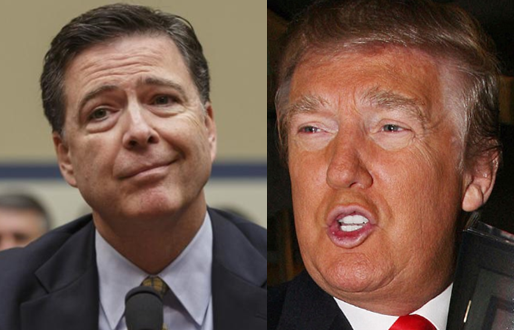
I think the most replayed segment was Comey’s observations about Trump’s appearance:

From the official ABC transcript:

COMEY: He looked slightly orange up close with small white — half moons under his eyes, which I assume are from tanning googles.

Keen, mature insight from the former FBI Director, right?

No commentator mentioned what stuck me as the most ironic aspect of Comey’s dis …

Has Comey looked in a mirror recently?

Geez, don’t throw those stones, Jimmy … until you get some sleep and sun.

image

==============

But, Comey did put one issue to rest, once and for all.

(more…)

More great moments in facial recognition …

April 16, 2018

Chinese snap jaywalkers … then shame or fine them.
===============

Previously, we reported on on how the Chinese gov’t is using facial recognition to control toilet paper usage at tourist spots. See the post for gory details

Building on that success, the Chinese gov’t is now using facial recognition to ID jaywalkers … and then either shame them or fine them.

image

Here are the details …

(more…)

Walking the talk …

April 13, 2018

How about housing a homeless family … in YOUR backyard?
===============

I always grimace when my liberal friends want to raise my taxes, but not their’s.

Evidence : the blue states’ whining about the cap on state & local tax deductions.

Or, when they advocate for mass migration of refugees and immigrants … to other folks zip codes.

And so on …

But, there may now be a counter-case:

LA County is launching an initiative to provide housing the homeless …


KPCC Photo

The idea: LA county will provide loans and grants to homeowners to build HGTV-style mini-homes in their backyards … provided that the new tiny homes get inhabited to currently homeless folks.

Here’s how the plan works …

(more…)

All of the info I’ve collected says I’m right … so there!

April 12, 2018

Dan Lovallo, a professor and decision-making researcher says, “Confirmation bias is probably the single biggest problem in business, because even the most sophisticated people get it wrong. People go out and they’re collecting the data, and they don’t realize they’re cooking the books.”

What’s this “confirmation bias” that Lovello is talking about?

No surprise, people tend to seek out information that supports their existing beliefs.

You know, liberals watch MSNBC, read the NY Times listen to BBC podcasts; conservatives watch FOX, read the WSJ and listen to Rush.

Behavioral psychologists call the he dynamic “confirmation bias”.


clip_image002

=====

In socio-politics, the confirmation bias tends to harden polarized positions. People just gather debate fodder rather than probing both sides of issues.

In the realm of decision making, confirmation bias has a dysfunctional effect: it leads to bad decisions.

(more…)

Nums: What percentage of Americans prepare their own taxes? How many of them like it?

April 11, 2018

Since we’re heading down the homestretch towards the tax filing deadline … …

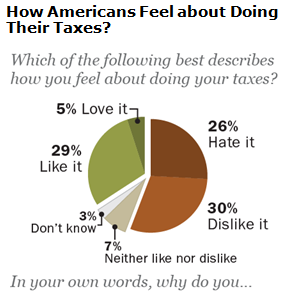
Pew Research says that overall, 33% of Americans say they do their own taxes while 56% say someone else prepares their taxes.

  • Note 1: 11% don’t know who does their taxes or were befuddled by the question
  • Note 2: The folks in the 11% get to vote in Presidential elections (ouch!)

A majority of Americans (56%) have a negative reaction to doing their income taxes 1 in 4  say they hate doing them.

image

Among those who dislike or hate doing their taxes, most cite the hassles of the process or the amount of time it takes:

About a third (34%) say they either like (29%) or love (5%) doing their taxes.

Here are some details re: the “likers” and lovers … 

(more…)

Dilemma: The case of the lost concert tickets …

April 10, 2018

Here’s a classic “framing” question from Kahneman’s Thinking Fast, Thinking Slow

Here’s the situation:

A woman has bought two $80 tickets to the theater.

When she arrives at the theater, she opens her wallet and discovers that the tickets are missing.

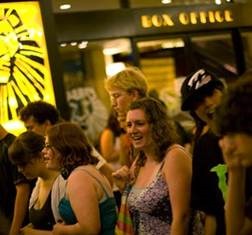
$80 tickets are still available at the box office.

Will she buy two more tickets to see the play?


clip_image002


Most (but, not all) survey respondents answer that the woman will go home without seeing the show.

Let’s try another situation …

(more…)

What’s the fundamental difference between baseball and basketball?

April 9, 2018

The NCAAs are in the books and the NBA is (finally) heading to the playoffs.

Except for some snow challenges, the MLB season is off and running.

Which reminded me of a study re: a common characteristic shared by good baseball players.

Gerald Hall, the director of a youth baseball program in Washington, says:

“Baseball is a game taught by fathers, while basketball and football are more often taught by peers in pickup games.”

So what?

(more…)

Score higher on the SATs … GUARANTEED!

April 6, 2018

Just make sure that your parents went to college.

=======

The College Board has just released it’s “Total Group Profile Report” for recent college-bound seniors …

One set of numbers caught my eye:

SAT scores by the student’s parents level of educational attainment.

image

Note that about 2/3’s of the college-bound seniors taking the SAT came from homes with a degreed parent – either associate, bachelor or graduate.

Only about 1/3 came from homes with parents having only a high school education or less.

And, the performance differentials are substantial between the groups …

(more…)

Some “interesting” SAT results …

April 5, 2018

The College Board has just released it’s “Total Group Profile Report” for  college-bound seniors.

A couple of sets of numbers caught my eye ….

Let’s start with math scores/

Two big takeaways:

(1) The gap between boys and girls narrowed from the 40 point difference in the 1970s to about 25 points … but has remained fairly constant at that level for about the past 20 years

(2) Scores for both boys and girls have been falling for the past dozen years or so.

image

=======

OK, boys outscore girls in math, but girls do better on the verbal part of the SATs, right?

(more…)

One way to alleviate the shortage of doctors…

April 4, 2018

Grant med school grads provisional licenses.

========

Very interesting idea reported by the Heritage Foundation

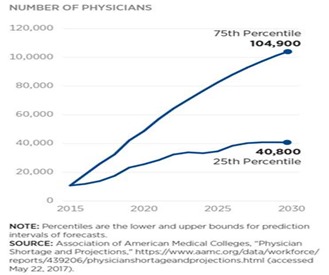
It widely accepted that the U.S. has a current shortage of doctors that is expected to balloon as the demand increases (aging population, expanded Medicaid, etc.).

Current estimates put the 2030 shortage between 40,000 and 105,000.
clip_image002

=========

Each year, US med schools crank out about 18,000 medical degrees. Source

Dictated by the AMA, before getting licensed, these grads need to go through formal residency programs at teaching hospitals.

Here’s the rub.

The residency programs are largely government funded, and there are spending caps.

Spending caps translate to enrollment caps.

So, each year, about 5,000 of the med school grads — more than 25%) — don’t get a residency slot.

No residency, no license.

Reportedly, these non-residentially certified med school grads either land in non-patient treating medical jobs (think “pharma”) or leave healthcare all together.

The usual response: just throw more tax dollars at the problem.

But, there are other options…

Addressing the problem, a few states have implemented a program that Heritage is now touting: provisional licenses.

(more…)

Digital amnesia: Is Google dulling your memory?

April 3, 2018

First, some background …

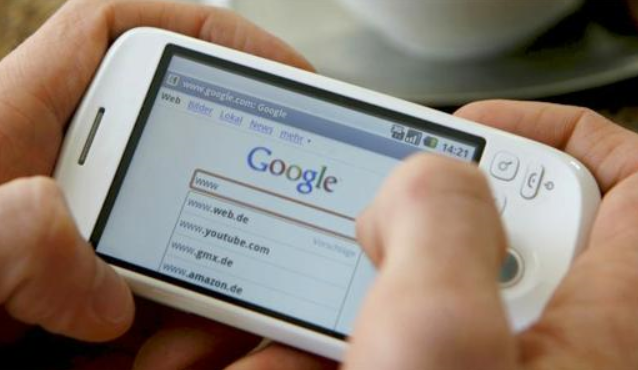
The tests I give my students always include some questions that can reasonably be tagged “memorization”.

Some students are repulsed by them and shout the cultural refrain: “Don’t memorize anything that you can look up.”

The apparent thinking: You’ve only got a limited amount of space in your brain, so don’t clog it with an overload of information … only store the stuff you can’t look-up.

image

What’s wrong with that argument?

(more…)

Students push back on ‘common sense’ safety measures

April 2, 2018

… because they “infringe on our rights”
===========

According to the NY TImes

Since the Florida school shootings, the state and local school district have taken some steps to provide enhanced security:

The state “set aside $8.5 million for the school district to pay for at least one armed police officer at each school starting in the fall” … and, supplemental Florida Highway Patrol troopers will be deployed to “on alert” schools.

In Broward County, “all schools … will have single points of entry by early 2019.”

“Students and staff will be issued identification badges, which they will be required to wear at all times while in school.”

My POV: This is a good first step, which can eventually beefed up with scannable IDs … or, better yet, RFID trackers.

So far, so good.

image

Here’s where the rub comes in …

(more…)