Cases & Deaths

=============
Case Fatality Rate

=============
Hospitalizations
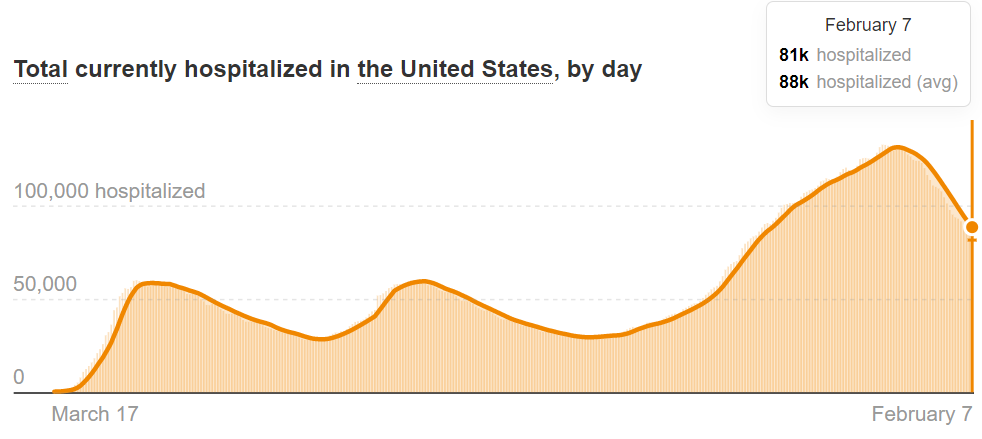
Source: RonaViz.com
Cases & Deaths
=============
Case Fatality Rate
=============
Hospitalizations
Source: RonaViz.com
Vax Rate – Doses Supplied – Supply Utilization
==============
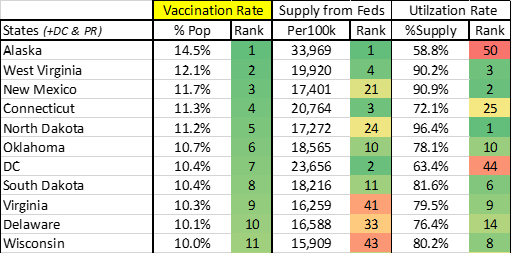
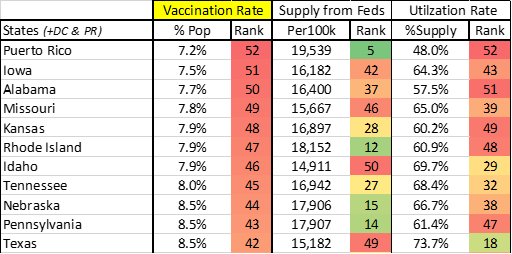
Vaccination Rate – First Dose % Population
States w/ Highest Vaccination Rates
States w/ Lowest Vaccination Rates
=============
More Data Below (including All States data)
We hate to say that we told you so, but…
=============
A couple of weeks ago, we pointed out that there were about 25 million “unused” doses of vaccine … and, they were probably being held in inventory by CVS & Walgreens (leftover from the program to vaccinate nursing homes) and hospitals (a “reserve” for 2nd shots and slow adopting medical staffs).
Our advice: claw back that excess inventory and redeploy it to high velocity vaccinators.
For background and details, see VAX Dx: Where the hell is the vaccine inventory?
Well, it took for “the science” and “the data” awhile to catch up, but according to the weekend Washington Post:
The federal government allocated too much vaccine to CVS & Walgreens to vaccinate patients and staff at nursing homes and long-term care facilities.
The doses — which were counted as part of each state’s allotment – over-counted the number of residents to be vaccinated, over-estimated the percentage of staff that would want the vaccine and didn’t realize that a 6th dose could be squeezed out of many vials.
Finally, many states are starting to “repurpose” and redistribute hundreds of thousands of the unused doses to others outlets,
States can defer or cancel subsequent allocations to long-term-care facilities, transfer doses to the states’ general pool for reallocation to other vaccinators or leave excess vaccine doses with CVS and Walgreens who will soon begin vaccinating the general public in some states.
The CDC didn’t provide an estimate of how much excess CVS & Walgreens were holding.
My hunch: at least couple of million doses… a statistically significant amount at current supply rates … at least a couple of days worth of production … maybe more.
=============
Ok, they’re finally onto one pocket of unused available supply.
Going forward, here’s what to keep your eye on:

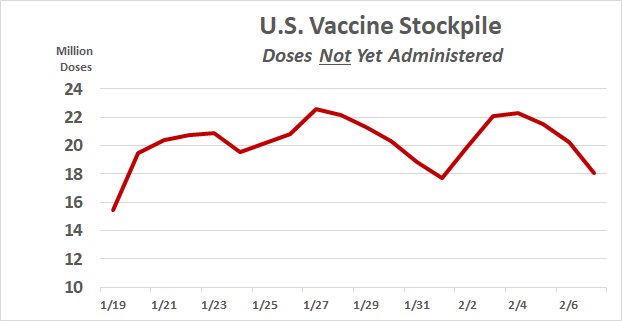
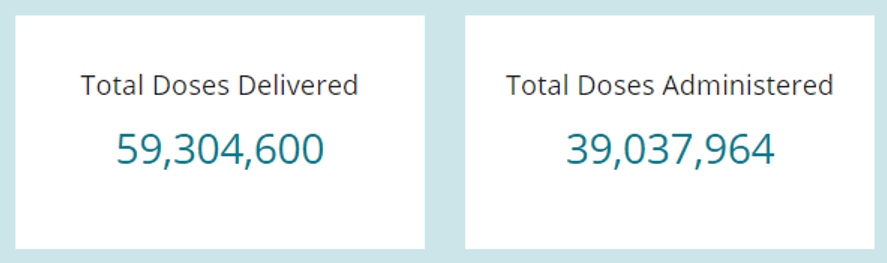
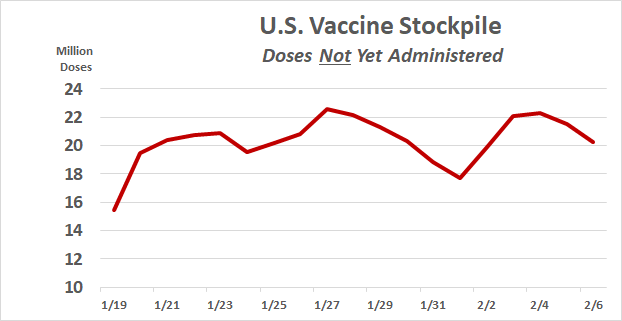
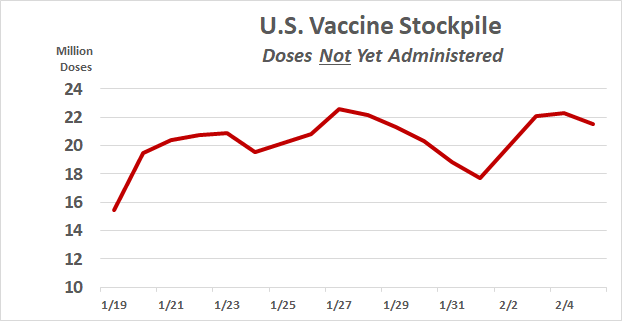
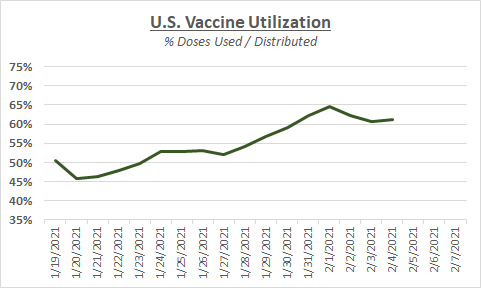
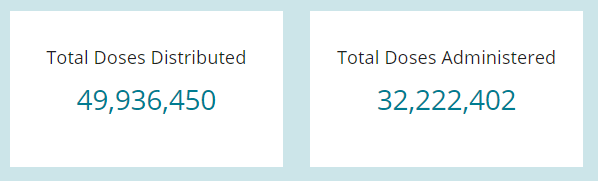
Our morning “VAX stats” post includes a chart showing the U.S. Vaccine Stockpile — the difference between “doses distributed” by the Feds and the “doses administered” by the states and locales.
The number has been hovering around 20 million doses.
Now that the majority of doses are being used as 2nd shots to the folks who got first shots in January, this “reserve” should be deployed and the above curve should quickly start to turn down — steeply as the 2nd dose reserves are being released.
If it doesn’t, you can bet that we’ll be on the case.
============
P.S. West Virginia was the only state that didn’t participate in the Federal government’s partnership with CVS & Walgreens. Rather, WV used a network of local WV pharmacies to service nursing homes and long-term-care facilities. As a result, WV completed vaccinating those high priority facilities about a month before other states … and, the state has had a high vaccine utilization rate since doses were never stuck the CVS – Walgreen’s inventory.
Vaccine Supply & Vaccinations

Vaccine Stockpile Doses NOT Administered
Vaccinations per Day

=============
Link to State by State Data
Cases & Deaths

=============
Case Fatality Rate

=============
Hospitalizations
Source: RonaViz.com
Vaccine Supply & Vaccinations
Vaccine Stockpile Doses NOT Administered
Vaccinations per Day

=============
Link to State by State Data
Cases & Deaths

=============
Case Fatality Rate
=============
Hospitalizations

Source: RonaViz.com
Vaccine Supply & Vaccinations

Vaccine Stockpile Doses NOT Administered
Vaccinations per Day
=============
Link to State by State Data
Cases & Deaths
=============
Case Fatality Rate
=============
Hospitalizations

Source: RonaViz.com
“Basing eligibility on age from now on is the scientific, and least political, method.”
=============
That’s the WSJ’s recommendation for cleaning up the jurisdictionally variable, logistically complicated and politically charged vaccine rationing system(s) that are currently slowing the rate of vaccinations and frustrating eager vax hunters (like me).
The WSJ’s editorial’s guiding premise:
Workers who interact with the public face a higher risk of getting Covid than those who don’t.
But households are bigger spreaders than workplaces.
And age is the most severely consequential risk factor.
=============
More specifically, the WSJ editorial asks:
> Who isn’t “essential”?
The list of “essential” workers has grown to virtual meaninglessness, including those who “work in transportation and logistics, food service, housing construction and finance, information technology, communications, energy, law, media, public safety, and public health.
By that definition, who isn’t essential”
See our prior post: What do lawyers, prisoners and ‘the media” have in common?
=============
> Got political connections?
Initially, it was just COVID-exposed healthcare workers and 1st responders.
But, it didn’t take long for unions and other occupational groups to start flexing their political muscles.
The SEIU pushed for workers such as janitors to be considered “essential”.
Industry groups including hotels, airlines and ride-share companies began lobbying states to have their workers vaccinated first.
Now, predictably, teachers’ unions are trying to cut to the front of the line and are blackmailing politicians by refusing to reopen schools.
=============
> How risky is your medical condition?
No question, some comorbidity factors make a person more vulnerable to severe COVID consequences.
But, like the list of essential occupations, the initial list of meaningful health conditions (e.g. serious heart or pulmonary diseases) quickly expanded.
Now, some of the qualifying criteria are head-scratching (e.g. slightly overweight, habitual smoking) … while others aren’t considered serious enough (e.g. deficient immune systems, oncological history).
See our prior post: VAX: Eat, drink, smoke … and move to the front of the line.
=============
> How to verify eligibility?
Age is easy to verify via driver’s licenses, passports, birth certificates, and the like.
But, how to verify a person’s occupational eligibility?
A person may flash a hospital ID, but how to know if they are an ER or COVID-treating nurse or a hospital IT employee who is working from home during the pandemic?
What about teachers who have been teaching in-person for months, versus those who have no intention of returning to the classroom any time soon? How to determine whether a teacher is really heading back to the classroom?
Similarly, how to verify a person’s legitimate comorbidities? Take their word for it? Require a doctor’s note?
Given the stakes, it’s no surprise that stories abound of people claiming eligibility that may pass bureaucratic muster with the letter of the law … but certainly not the spirit of the law
================
The WSJ’s bottom line:
Basing eligibility in stages from oldest to youngest from now on is simple, scientific and fair.
As supply increases, this will be the fastest way to inoculate the most people, reduce demands on the health-care system, and allow more businesses to reopen.
Interest groups will complain, but so what?
The public will understand and politicians won’t take the inevitable grief for favoritism.
It’s like music to my ears….
=============
P.S. West Virginia has been one of the top states re: vaccination efficiency.
One of the foundation principles that WV adopted was age-based prioritization — starting at age 80, then systematically lowering the age threshold.
And, WV only gives priority to “essential workers” who are over 50.
Pivotal question: Is 66% effectiveness good enough ?
=============
This is an updated and expanded post of my takeaways that draws on several sources, most notably, WSJ analyses and J&J’s press releases.
> Overall, J&J’s vaccine was 66% effective against moderate or severe symptoms … and “appeared to be generally safe and well tolerated”
Note: The Pfizer-BioNTech and Moderna shots were more than 94% effective in late-stage testing.
But, the competitive brands’ results may not be directly comparable.
J&J’s trial occurred as at least one variant (i.e. the South African strain) that appears to have some impact on vaccine efficacy was circulating, while the Moderna and Pfizer-BioNTech trials were completed before variants of concern started transmitting widely. Source
> The vax was 72% effective in the US … lower in Latin America (66%) and South Africa (57%).
Note: The lower effectiveness in South Africa is a red flag re: effectiveness against mutating strains of the virus and probably distorts the comparisons against Pfizer & Moderna
> When considering only severe cases, J&J said its vaccine was 85% effective across all regions studied.
Note: The J&J study tracked moderate and severe cases of Covid-19, defined as testing positive for the virus and having certain symptoms including shortness of breath, cough, fever or respiratory failure.
> The J&J vaccine prevented 100% of hospitalizations and deaths — all hospitalizations and deaths in the study group occurred among people who got the placebo. Bloomberg
============
> Good news: the J&J vaccine is a single dose and only requires refrigeration, not sub-zero freezer storage, making broad-scale distribution more practical.
> More good news: The J&J vax is already in high volume production, awaiting regulatory approval. J&J says that is has “millions of doses available for shipment immediately upon authorization … will deliver 100 million in the U.S. by mid-year … and expects to make more than one billion doses in total this year globally.” Source
> Bad news: If the FDA follows the same timeline as for the Pfizer & Moderna vaccines, regulatory approval won’t come until the end of February or early March. For eager vax chasers (like me), that’s an eternity.
> Open issue: J&J is an adenovirus vaccine that attacks the COVID virus using double-stranded DNA; Pfizer and Moderna vaccines uses single-stranded “messenger” RNA (mRNA). The long-term health effects of these specific vaccines (both types) are uncertain and potentially significant since they “involve” a person’s natural DNA structures. Only time will tell.
More immediate: The J&J vaccine was only marginally effective against the spreading South African COVID strain, suggesting that a 2nd “booster” shot may eventually be required. The Pfizer’s & Moderna’s clinical trials were conducted before the South African strain was evident, so their potency against that strain is uncertain Early early indications are that they may be more effective, but still may eventually also require an additional booster shot.
============
> J&J reminder:
“It’s a pandemic vaccine preventing death and hospitalization and severe disease in an acute situation, now in the middle of a pandemic.”
Said differently, these vaccines are intended to prevent severe consequences (i.e. hospitalization or death), not necessarily to stop infections.
> WSJ conclusion:
Even though it wasn’t as effective as the (Pfizer & Moderna) vaccines, J&J’s vaccine performance would be strong enough to protect many people and help build the community immunity.
> My take:
Disappointed that effectiveness rate isn’t higher. If it were, brand choice would be a no-brainer (save for potential longer-run health consequences — which haven’t been evaluated for any of the vaccines)
Keeping things in perspective, 72% effectiveness in the U.S. is greater than zero … greater than most vaccines that have ever been deployed for other infections… and, roughly the same as the first-dose-only effectiveness of the Moderna vaccine. Source
And, keeping an eye on the goal line, J&J’s vaccine was 100% preventative of hospitalization and deaths.
So, barring any differentiating long-term health consequences that could be significant (and haven’t been studied yet for any of the vaccines), I plan to take the first vax that I can get my hands on.
=============
DISCLAIMER: I’m not a medical professional or scientist — just a curious, self-interested guy. So, don’t take anything that I say or write as medical advice. Get that from your doctor!
According to the Washington Post…

DC has announced that it will offer vaccines to people whose weight (BMI > 25) or medical history (including “habitual smoking”) would not otherwise qualify them for early access to the vaccine in almost any state in the country.
The rationale: Those persons might suffer serious outcomes if they contract the virus.
Again, DC’s obesity criteria: a BMI greater than 25.
By that measure, half of DC’s adult population qualifies as obese.
For example, a person 5’6” weighing more than 155 has a BMI > 25.
So does a person who is 6 feet tall and weighs more than 185 pounds
Click here to calculate your BMI.
The consensus of health experts: DC’s criteria are set too low … that the cut-off should be a BMI of 40 (extreme risk) or 30 (significant risk).
Proponents of the weight criteria argue that it provides wider access for poorer DC residents who tend towards obesity, with 72% having BMIs over 25.
But, opponents point out that DC is already controlling vax distribution by zip code residency — with explicit preference given to poorer neighborhoods.
Teaching point: there’s no need for a proxy measure (like BMI) if there’s a direct control variable (like preferential zip code restrictions).
So, why announce a silly sounding policy?
If everybody is a priority, then nobody is a priority.
=============
To be fair …
DC is also trying to close some loopholes.
For example, vaccination appointments are available for teachers and staff at DC Public Schools but … only those who are already working in person or who will be returning in person for Term 3.
That policy will be tough to enforce, but the intention is good.
===============
Related post:
What do lawyers, prisoners and ‘the media” have in common?
Answer: They’re all ahead of me in line for COVID vax shots
Vaccine Supply & Vaccinations

Supply Utilization
Vaccinations per Day
=============
Link to State by State Data
Cases & Deaths
=============
Case Fatality Rate

=============
Hospitalizations

Source: RonaViz.com
Statistically insignificant, logistically nightmarish.
=============
According to the WSJ …
Team Biden announced a federal program starting Feb. 11 that will deliver vaccines directly to certain pharmacies, including ones operated by Walgreens, CVS, Kroger and Walmart.
Next week, a million doses being allocated to 6,500 stores next week.
If I’ve got the decimal point right, that works out to a whopping 150 doses per store.
Imagine if Apple were to launch a new generation iPhone by allocating 150 per store.
Statistically insignificant … and logistically nightmarish for both stores (that need to staff up for low scale operations) and consumers (who will need to fight for appointments on the hellish scheduling sites).
Though I’m 24 x 7 on all the stores’ appointment scheduling systems, I think I’m more likely to get struck by lightning in the next couple of weeks than to get a shot at one of these places.
But, I’ll keep trying…
=============
P.S. I wonder what the shipping container size is for the vaccines…
Given the deep-freeze storage requirements, I thought a shipping container of vax was much bigger than 30 bottles, each with 5 (or 6) doses.
Anybody know?
Shucks, those are just technical details.
=============
According to the Baltimore Sun …
Here we go again….
Maryland Gov. Hogan announced the opening of two mass vaccination sites at the Baltimore Convention Center and Six Flags America in Prince George’s County.
OK, that makes sense, but …
Details surrounding the mass sites have not been announced:
- How to get an appointment?
- How many vaccines a day the state hopes to administer?
- How fast will the program ramp-up?
I guess those are just technical details.
=============
P.S. The launch is scheduled for tomorrow, so Team Hogan still has today to sort out the details.
What a way to run railway…
Vaccine Supply & Vaccinations

Supply Utilization
Vaccinations per Day

=============
Link to State by State Data
Cases & Deaths
=============
Case Fatality Rate
=============
Hospitalizations

Source: RonaViz.com
Sometimes, it’s easier to just go with the flow…
=============
I think that practically everybody agrees that Blacks have been disproportionately crushed by COVID … and that, for understandable reasons, Blacks are disproportionately reluctant to get COVID vaccinations.
Preliminary data shows white Marylanders account for most of the inoculations, with Black people receiving about 16% of the total despite making up about 31% of the state’s population. Source
To compensate, Maryland Gov. Hogan has launched the GoVax PR campaign to “address a reluctance some people have to getting the vaccine, particularly those who don’t trust the medical system.” Source

No quarreling with the objective … and, the approach is a classic marketing mass communications program.
OK, hold that thought …
… the 2nd dose aftershock effect™ may clog schedules and make you wait until March.
=============
Caution: Keep in mind that we’re frustrated that we haven’t been able to get vaccinated even though we’re officially “vulnerable”.
Earlier this week, the obvious became evident to me.
The chart below displays the number of vax doses administered in our home county.
What pops out at you?
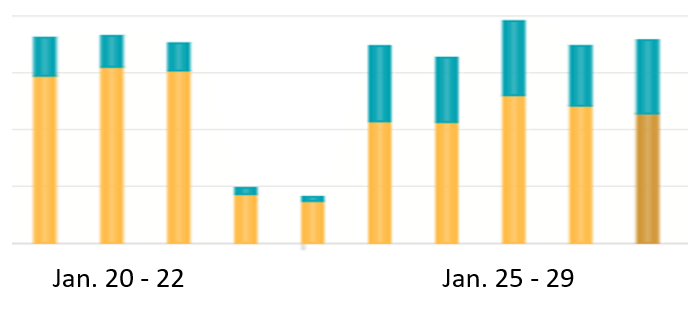
Yep, the blue section of the bars is getting proportionately bigger from week-to-week.
If you answered: “the 2 bars in the middle are pretty small”, you’re right, too.
The obvious explanation: National emergencies are only fought Monday thru Friday (preferably 9 to 5)
So, what’s the blue section?
It’s the number of vax doses given as 2nd shots.
Two weeks ago, 2nd shots accounted for about 15% of the total.
Last week, that proportion jumped to over 1/3 … and, is continuing to increase.
That’s completely understandable.
Since January was essentially the first month of vaccinations … and, both Pfizer and Moderna have 2-shot regiments … all of those January 1st shots are coming due for their follow-up 2nd shots.
What’s the practical implication?
BOOM ! The predictable headline:

While we’re not directly impacted by Baltimore City’s policy, it foreshadows what we can expect to see in my home county (see chart above).
And, the 2nd dose aftershock effect™ is likely to make it to a neighborhood near all folks waiting for first shots.
Case in point: Following Baltimore City’s lead, Maryland’s state health secretary told health care providers that they should” hold in reserve enough COVID-19 vaccine to administer second doses to people who have already received one shot — rather than using their supply to give more people their first inoculation.” Source
The good news: it’s likely to be an alternating month dynamic.
Since there will be proportionately fewer 1st shots in February, there won’t be as many pent-up 2nd shots in March … so, we eager un-vaxed people should a pretty good shot in March (<= pun intended).
And, hopefully, Fauci & Friends won’t drag out the J&J vax approval … which could potentially open the vax floodgates in March.
=============
P.S. There are some health policy changes that could also mitigate the 2nd dose aftershock effect™
We’ll save those for subsequent posts.
=============
Vaccine Supply & Vaccinations

Supply Utilization
Vaccinations per Day

=============
Link to State by State Data
Cases & Deaths

=============
Case Fatality Rate

=============
Hospitalizations
Source: RonaViz.com
Answer: It received disproportionately more vaccine than other states … and it used what it go much more efficiently
=============
When it comes to vaccinating, West Virginia (WV) has been outperforming other states.
For example …
Before the end of December, all WV’s sweep of nursing homes and long-term care facilities was complete.
Currently, over 10% of WV’s residents have gotten at least 1 dose of vaccine
Why has WV been so successful up to now, while other states (e.g. my home state Maryland) are lagging?
In prior posts, we broached the question:
Starting with this post, we’re going to drill down a bit deeper on WV’s performance factors.
===============
Today, let’s take a look from 50,000 feet …
Simply put, WV’s performance (and, more broadly, that of any state) is the joint effect of 2 overall factors: the relative amount of scarce vaccine that the state receives … and, the state’s efficiency in utilizing the supply that it does get.
=============
To get an overview, we sorted states into the consultant’s analytical weapon of choice — 2 dimensional matrix (below):
> On the vertical axis (the rows), the states are sorted by the relative per capita supply of vaccine that they’ve received from the Feds … whether they have received an average amount, at least 5% more than the average or greater than 5% less than the average.
Supply is, by and large, an exogenous variable. That is, other than by whining & complaining to the Feds, it’s not under the states’ control.
> On the horizontal axis (the columns) states are categorized based on the percentage of the vaccine that they’ve been allotted that they’ve utilized (i.e. that has been administered in vaccinations).
The utilization percentage is a summary measure of the state’s utilization efficiency. In later posts, we’ll explore factors that drive the utilization percentage.
Here’s the way states sort out (as of Jan. 30) …
Vaccine Supply & Vaccinations
Supply Utilization

Vaccinations per Day
=============
Link to State by State Data
Cases & Deaths
=============
Case Fatality Rate
=============
Hospitalizations
Source: RonaViz.com
In our prior post re: States’ Performance Rankings, we naively assumed that “all states are getting supplied vaccine roughly proportionate to their populations”.
I decided to test out that assumption and guess what?
Unless one takes a VERY broad interpretation of “roughly”, our going-in assumption is not true.
Let’s go through the numbers…
=============
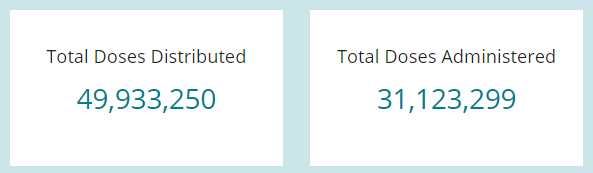
The CDC reports Total Doses Distributed (by the Feds to the States) .. and Doses Administered per 100K (by the states)– a per capita measure standardized based on each state’s population.
On average, states have received 14,769 per capita Doses Distributed (or, in my preferred terminology, “supplied”).
The range runs from a low of 10,879 per 100K in South Carolina to 26,403 in Alaska … that’s a range of 15,000 per capita from high to low.
The Top 10 states average 17,751 — which is 20% higher than the average across all states.

Per capita, Alaska & DC have received 78% and 42% over the average, respectively.
Florida is the only big state of the Top 10 that has received disproportionately high vaccine distributions (7% more than average).
==============
At the other end of the list:
The Bottom 10 states average 12,702 per 100K — which is 16% lower than the all states’ average.

Worst Cases: South Carolina & Nevada have received 26% and 18% under the per capitaaverage, respectively.
There are 3 large states in the Bottom 12 (Illinois, Ohio and Texas) that appear to be getting disproportionately low vaccine distributions.
=============
Is your state getting more or less than its fair share?
Below is a heat map with all states data …
Vaccine Supply & Vaccinations
Supply Utilization

Vaccinations per Day

=============
Link to State by State Data
Cases & Deaths
Case Fatality Rate

Hospitalizations

Source: RonaViz.com


 The Homa Files