Why do so many Americans hate paying income taxes?

September 19, 2012

It’s not simply about the money.

Researchers Jeff Kidder of Northern Illinois University and Isaac Martin from the University of California-San Diego have found that there are moral underpinnings that help explain why many hate paying taxes.

Rather than being associated with a free-market ideology or a person’s own economic interests, tax hostility is more linked with moral principles.

image

“Tax talk is about dollars, but it is also about a moral sense of what is right.”

Generally, respondents saw income taxes as violating the moral principle that hard work should be rewarded.

The respondents “portray taxation as a threat to the moral order because they believe taxes deprive deserving hardworking middle class people of dignity, while rewarding others who are undeserving (both rich and poor)”.

Entrepreneurs are particularly anti-tax.

In fact, a recent survey by payroll service provider Paychex found that tax codes, along with employment regulations and retirement security are the top three election issues for small business owners.

Source: LiveScience extract from the Journal Symbolic Interaction

10 qualities of successful entrepreneurs

September 19, 2012

Punch line: Not enough people understand who entrepreneurs are or how to develop them. Jim Clifton, Gallup Chairman and CEO, uncovers what propels these exceptional businesspeople.

Pensive businessman - Image by flickr user s_falkow

* * * * *

Excerpted fro Gallup Business Journal, “What Drives Entrepreneurs to Win”

In his book The Coming Jobs War, Gallup Chairman and CEO Jim Clifton calls entrepreneurship the “scarcest, rarest, hardest energy and talent in the world to find.”

So how do you rise above the challenges that entrepreneurship poses? Clifton offers some sage advice.

  1. Know your personal brand. Successful entrepreneurs know themselves well and can perceive others accurately.
  2. Take on challenges. Entrepreneurs [should] stretch themselves, raise the bar, face their fears, and [be] willing to experiment.
  3. Think through possibilities and practicalities. Entrepreneurs must be creative and think beyond the boundaries of what exists.
  4. Promote the business. Successful entrepreneurs are their own best spokespeople.
  5. Focus on business outcomes. Highly successful entrepreneurs judge decisions … based on their observed or anticipated effect on profit … [and they] set goals and live by their commitment to them.
  6. Be a perpetual student of the business. Continually gaining input and acquiring the knowledge and skills required to grow the business are essential to an entrepreneur’s success.
  7. Be self-reliant. Successful entrepreneurs are prepared to do whatever must be done to see the business succeed.
  8. Be a self-starter. Successful entrepreneurs are passionate doers who push to make things happen.
  9. Multiply yourself through delegation. Entrepreneurs who are successful … are willing and able to contemplate a shift in style and control.
  10. Build relationships. The ability to build strong relationships is crucial for survival and growth. Successful entrepreneurs are adept at building relationships, have strong social awareness and can attract and maintain a constituency.

Edit by JDC

>> Latest Posts

Marketing is dead … HBR says so !

September 18, 2012

Punch line: According to a Harvard Business Review post, Marketing is dead.

Traditional marketing — including advertising, public relations, branding and corporate communications — is dead.

Many people in traditional marketing roles and organizations may not realize they’re operating within a dead paradigm.

But they are.

The evidence is clear.

image

Here’s the “evidence”:

Several studies have confirmed that in the “buyer’s decision journey,” traditional marketing communications just aren’t relevant. Buyers are checking out product and service information on the Internet, and often from … word-of-mouth or customer reviews.

CEOs have lost all patience with CMOs who lack business credibility, the ability to generate sufficient business growth, and evidence that …  brand equity can be linked to actual firm equity or any other recognized financial metric.

Third, in today’s increasingly social media-infused environment, traditional marketing and sales doesn’t work so well …and  doesn’t make sense.  When you try to extend traditional marketing logic into the world of social media, it simply doesn’t work.

The prescription: build communities, leverage “influencers”, be “authentic”,build social equity, etc.

Blah, blah blah.

Ken’s Take: As I often remind my students, marketing is more than sales and advertising !

Marketing is also about:

  • Identifying high potential (i.e. profitable) target markets
  • Designing products that meet real customer needs
  • Pricing products to deliver value to buyers and profits to shareholders.
  • Distributing through efficient, hassle-free channels
  • Communicating products’ benefits and value-to-customers
  • Measuring performance to efficiently allocate assets and spending.

Reports of marketing’s death are premature … unless you mistakenly think that marketing and advertising are synonymous.

>> Latest Posts

Are you angry with the Federal government?

September 18, 2012

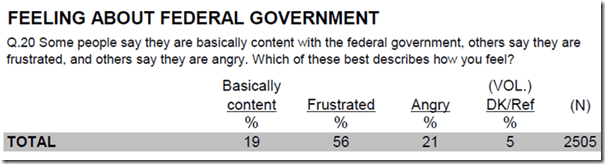
According to a Pew Research poll, 1 in 5 Americans are angry with the Federal government

… another 56% say they’re frustrated with the Federal government

That leaves less than 1 in 5 who are basically content with the Federal government.

How are you feeling these days?

image

>> Latest Posts

Look for Mitt ads on the ‘Price is Right’ … and Dems on Springer.

September 18, 2012

The Washington Times did an analysis of Dem and GOP TV ad placements to reverse engineer their respective targets and strategies.

Here are some of the findings:

  • Republicans are at an extreme disadvantage when it comes to television advertising because Democrats watch more TV.
  • Every single genre of TV programming has a Democratic-leaning audience, with sports coming the closest to a partisan balance.
  • Sports and documentaries, have audiences that are far more inclined to vote.
  • Shark Tank,” a reality program about entrepreneurship, has only 18 percent Democratic ads, and the law-and-order favorite “Cops” is heavily Republican.
  • Venerable game shows, while barely registering as blips in modern pop culture, remain among the top destinations for political ads because of their largely older base of viewers who are likely to go to the polls.

  image

  • The Price Is Right” is second among all TV shows for Romney ads and third for spots for Obama.
  • Democrats are advertising during daytime shows watched by high numbers of unemployed people, including those who rely on welfare and other social services.
  • More generally, the unemployed watch whatever’s on at 3 a.m., or Jerry Springer’ or Maury Povich.
  • All “Jerry Springer” ads have been for Democrats. PAC Priorities USA has made 10 separate buys on Springer.
    image
  • Nearly every political ad during the adult cartoon series “Family Guy” is for a Democrat.
  • More than 80 percent of political spots during “The Young and the Restless,” the long-running soap opera, tout liberal candidates and causes.
  • Relatively inexpensive ads during daytime soap operas watched by stay-at-home moms are abundant, and are used primarily by Democrats.
  • Reality-dating programs have a skewed Democratic audience that’s below average in likelihood to vote.
  • Obama has advertised heavily on courtroom reality shows such as “Judge Judy”  whose viewers include large numbers of black voters.

The implicit Democratic strategy according to the Washington Times:

The more lowbrow the show, the better.

“People who are low in political information can be more persuadable,”

“If you get someone that’s watching ‘[Keeping Up With] the Kardashians,’ and they’re a swing voter, and see one or two ads,” that could make the difference because that ad may be the only political information they digest.

Sometimes I wonder if “1-man, 1-vote” is overrated …

>> Latest Posts

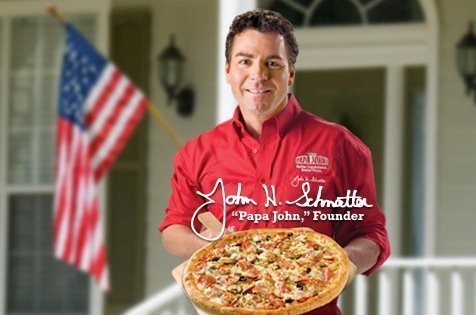
Give me a large pepperoni pizza … with a touch of ObamaCare

September 18, 2012

Punch line: Papa Johns CEO has taken a stand against Obamacare, and announced that the popular pizza delivery chain will pass the increased cost of doing business on to its customers, in order to protect its shareholders.

* * * * *

Excerpted from latimes.com’s, “Papa John’s to raise pizza prices if ‘Obamacare’ survives”

la-fi-mo-papa-johns-pizza-obamacare-20120808-001

Get ready to pay more for your Papa John’s pizza if “Obamacare” goes into full effect …  15 to 20 cents more.

John Schnatter, chief executive of the pizza chain, is bashing President Obama’s healthcare reform law as a policy that will force the company to choose between its customers and its investors.  And if the Patient Protection and Affordable Care Act rolls out as planned in 2014, Schnatter’s strategy is “of course … to pass that cost on the consumer in order to protect our shareholders’ best interest,” he said in a recent conference call.

Schnatter estimates that the legislation will cost Papa John’s about 11 cents to 14 cents per pizza, which equates to 15 cents to 20 cents per order.

“We’re not supportive of Obamacare like most businesses in our industry but our business model and unit economics are about as ideal as you can get for a food company to absorb Obamacare,” Schnatter said. “Ergo, we have a high ticket average with extremely high frequency of order counts, millions of pizzas per year.”

On Twitter, reactions were mostly negative.  “*switches to Pizza Hut*,” wrote one user. “*calls Dominoes*,” wrote another.  “I really wish businesses would stay out of politics,” tweeted user mikedavis824.

The National Restaurant Assn. has criticized the healthcare legislation for having a chilling effect on expansion and hiring in the industry, which tends to be labor-intensive and burdened with thin margins.  Chains such as White Castle and Burger King have predicted surging costs due to the new regulations, which require businesses with 50 or more full-time employees to offer healthcare to such workers and their dependents.

Unsurprisingly, Papa John’s chief is a big fan of Mitt Romney. Schnatter recently even hosted a private fundraiser for the Republican presidential candidate at his mansion in Anchorage, Ky.  Romney was dazzled by the grounds, declaring to guests: “Who would’ve imagined pizza could build this. This is really something. Don’t you love this country? What a home this is, what grounds these are, the pool, the golf course…. This is a real tribute to America, to entrepreneurship.”

Edit by BJP

>> Latest Posts

Re: Woodward’s book … save your $$$ … here’s my synopsis.

September 17, 2012

Given Woodward’s rep,  the pre-release hype, and anticipation of some good dirt on Obama …. I downloaded the Kindle version as soon as it became available.

image

I thought it was tedious with relatively little new news … reminded me of most movies: all the good parts are in the 2-minute trailer … rest of the movie is filler.

The broad theme – wisely reported —  is that Obama is clueless re: how big organizations run, what  a CEO does, how a CEO should act, and generally, how to implement ideas.

That shouldn’t surprise anybody since Obama  hadn’t run anything before becoming President, hadn’t been exposed to any effective big organization leaders and openly despises CEOS (except the late great Steve Jobs and Warren “Please Tax Me More” Buffett).

Verizon CEO Seidenberg “worried that Obama did not appreciate the importance of business. Sure, he understood it intellectually, but did he really admire the guts and instincts that made corporations succeed, hire workers, and grow America?” 

Here’s what caught my eye …

* * * * *

Obama is broadly disrespected by Congressional leaders (both House and Senate, both parities) … and his own staff.

  • Boehner ignored phone calls from Obama …  and hated “ …going down to the White House to listen to what amounted to presidential lectures.”
  • Pelosi hit the mute button and kept working when Obama would call and pontificate
  • Reid allowed a staffer to dress down the President for not having a plan … and confidentially encouraged GOPers
  • Staffers (e.g. Summers, Orzag) observed “no adult in charge” … “It was increasingly clear that no one was running Washington. That was trouble for everyone, but especially for Obama.”
  • Van Hollen: “The administration didn’t seem to have a strategy. It was unbelievable. There didn’t seem to be any core principles.”

Ken’s Take: I was a bit surprised that even Dems  think he’s a tool … they buy in to his ideology, hoped his charisma would make him a good front man – but have been disappointed, and are left trying to cover for his inadequacies.

* * * * *
Woodward presents a comparatively favorable picture of Dems: Biden, Reid, Pelosi, Van Hollen

  • Biden is presented as a savvy legislative pro who builds relationships and tries to work towards solutions … not the bungler he plays in public … McConnell: “ … a man I’ve come to respect as a straight-shooting negotiator.”
  • Reid and Pelosi come across as more thoughtful than their public personas …  effective leaders of their caucuses … cagey working the back channels with GOP leaders … generally trusted by GOP despite policy disagreements.
  • Van Hollen gets points for being a details man re: policy who’s willing to pitch and defend his points

* * * * *
Obama fails at basic CEO stuff … much like a freshly-minted MBA whose first job is running GE … 
 “When you don’t know what you don’t know, it gets you in big trouble.”

  • Disrespects people and their ideas and then expects them to support his ideas … “The polls are pretty good for me right now.”, “Do you think Ronald Reagan sat here like this?”, “I won, you lost”, “This isn’t negotiable” … surprised when folks don’t rally for him when he’s in a bind … “when you need friends, it’s too late to make them.”
  • Unable to separate the important from the incidental … “All we were going to do was nick everybody and irritate everybody and not accomplish anything.”
  • “There was no agility in the White House, no ability to get organized and move fast on critical issues”
  • Absolutely no comprehension of the difficulty of syndicating and implementing decisions … thinks agreements in meeting are the end, not the beginning of the process.
  • “Obama had no chief operating officer, no COO to implement his decisions.” … (you know, a Dick Cheney or Hillary Clinton)
  • Poor staffing choices … goes for comfort level over effectiveness … only yes-men need apply … notice how the entire economic team has turned over?
  • No structure or processes … “Any good manager, any good leader, has a team around him and a structure around him for making things work and making things happen. I never got the slightest clue that there was a structure there.” … ”The place [White House] is dysfunctional.”
  • No contingency planning … no anticipation of 2nd order effects … no Plan Bs
  • Poor negotiation skills … Coburn: “it showed how inexperienced a negotiator Obama was.”
  • No sell-in of ideas … just brute force … expects the power of his idea to carry the the day … Cantor: ”… not on the same page, not in the same book, or even the same library.”
  • Poor communications …“Most extraordinary was the repeated use of the telephone for critical exchanges. Especially baffling was President Obama’s decision to make his critical request for $ 400 billion more in revenue in a spur-of-the-moment phone call. The result was a monumental communications lapse between the key parties”
  • Poor listening skills … “Obama talked, then seemed to listen — but … was really just waiting to talk again, to make his points, to win the argument.”
  • “The president talks a good game, but when it comes time to actually putting these issues on the table, making decisions, he can’t quite pull the trigger.”
  • “How badly the White House had played what should have been a winning hand.”
  • “It was a failure of presidential leadership. He was not Reagan. He was not Clinton.”
  • “Obama really doesn’t have the joy of the game.”

* * * * *
Obama was (and is) is totally obsessed with 2 things …

  • Getting re-elected … e.g. Pushing big decisions past the 2012 election
  • Raising taxes on the top 2% … seems to be his driving mission in life

Ken’s Take:  Does Obama really think the world will change much if and when he gets his white whale?

* * * * *
A few Congressional and business leaders mused: “We were here before him and we’ll be here after him”  … 

  • Implication #1: We’ll have to live with this stuff when he’s gone … “Whatever the Congress decided could be undone by a future Congress anyhow.”
  • Implication #2: All we have to do is drag our feet and outlast him … “Guys like me can hunker down and wait you out.”

* * * * *
Best Teaching Point

Barney Frank’s advice to Paul Ryan:

Ryan sat down at one point with Representative Barney Frank, the Massachusetts Democrat known for his biting wit and powerful intellect.

Though they were ideological opposites, Frank gave him what Ryan considered the best advice he got about how to be an effective congressman.

Be a specialist, Frank told him, not a generalist.

Focus on one set of issues.

Get on the committee that you care about, and then learn more about the topic than anybody else.

Talk to all the experts you can find … and read everything you can.

Know these things inside and out.

* * * * *
Some factoids

  • Internal Revenue Service data shows that the current tax system produces about 85 to 86 percent of what it’s supposed to … i.e. 15% non-compliance
  • 51 percent of all federal employees, including uniformed military, were at the Department of Defense.
  • Pell college grants, a Democratic and Obama favorite aimed at assisting college students, because the annual cost was now more than $ 20 billion.

* * * * *
Some random snippets

  • Golf, a game of recovery. A bad or unlucky shot wasn’t fatal. Follow it up with a good second or third shot, and you could still find yourself on the green with a chance at par, or even better. .
  • Politics meant sitting across the table from people you might not like or who were annoying. Keeping cool was essential.

* * * * *
Final note:  Woodward’s book would have been a big deal last week … Woodward caught a bad break since the Libya assassination and mid-East uprisings pushed his book out of the news coverage … .

>> Latest Posts

Top 5% says: “Thank you, Ben” … bottom 95%, not so much.

September 17, 2012

Punch line: Quantitative easing – pumping money into the economy – helps the top 5% who have most of their net worth in stocks & bonds … but does little to help the average man on the street … especially if he doesn’t have a job.

From the Washington Post:

:It is remarkable, really, that Democrats defend the Obama economy by pointing to the rise in the stock market since the president took office.

The Dow Jones was at 8,279.63 when Barack Obama took office. It’s now over 13,500, boast the Democrats.

Swell, the Wall Street crowd rakes it in and the rest of the country is setting records for unemployment, poverty and food-stamp use.

Imagine if the Republicans made such an argument. If a Republican were in office, the left would holler that this is a jobless recovery.

image

Insightful analysis by Robert Frank of CNBC

Last month, the Bank of England issued a report that must have made Fed chairman Ben Bernanke squirm.

It said that the Bank of England’s policies of quantitative easing – similar to the Fed’s – had benefited mainly the wealthy.

Specifically, it said that its QE program had boosted the value of stocks and bonds by 26 percent … and that about 40 percent of those gains went to the richest 5 percent of British households.

The latest round of QE announced by  Bernanke yesterday has sparked growing controversy about how Fed policy has mainly helped the wealthiest Americans.

One economist says QE “is fundamentally a regressive redistribution program that has been boosting wealth for those already engaged in the financial sector or those who already own homes, but passing little along to the rest of the economy.”

The reason is simple. QE drives up the prices of assets, especially financial assets. And most of the financial assets in America are owed by the wealthiest 5 percent of Americans.

According to Fed data, the top 5 percent own 60 percent of the nation’s individually held financial assets. They own 82 percent of the individually held stocks and more than 90 percent of the individually held bonds.

[Thanks to the first two rounds of quantitative easing] the wealthy quickly recovered much of their wealth as stocks doubled in value.

But the rest of the country, which depends on houses and jobs for their wealth, remained stuck in recession.

Most Americans have most of their wealth tied up in their houses (about 50 percent for most).

For the top 5 percent, homes account for only 10 percent of wealth, while financial assets account for between one third and 40 percent.

By boosting the value of financial assets, Fed has helped the economy of Richistan but not the broader United States.

Despite lowered rates, banks remain strict on lending, restricting access to credit for most Americans. The wealthy and the asset-rich, however, will now enjoy even lower rates on their credit.

Low interest rates also penalize savers, and while the wealthy as a group have the largest savings pool in America, they have only about 13 percent of their investible assets in cash, and the rest (more than 85 percent) in stocks, bonds, alternative investments and mutual funds – all of which have benefited from easing.

The critical  question, though, is whether putting more profits into the hands of the top 5 percent will really generate jobs for the rest of America. So far, the evidence is not promising.

Trust your intuition, ladies …

September 17, 2012

According to a study reported in LiveScience, a bride’s cold feet at the wedding altar is a strong predictor of divorce.

image

When researchers asked the newlyweds, “Were you ever uncertain or hesitant about getting married?”

  • 47% of husbands answered “yes,”
  • 38% of wives said “yes”

While men were more likely to have cold feet, their wives’ reservations better predicted future problems.

Newlywed wives who had doubts about getting married before their wedding were two-and-a-half times more likely to divorce four years later than wives without these doubts.

In 36 percent of couples, both partners said they had no doubts before the wedding, and of those, just 6 percent got divorced by the four-year mark.

Among couples in which the wife or both spouses reported premarital doubts, 20 percent got divorced.

“Do the doubts  go away when you have a mortgage and two kids? Don’t count on that.”

>> Latest Posts

Encore: Why the market goes up when the Fed “quantitatively eases” …

September 14, 2012

Yesterday Bernanke announced another (and apparently infinite) round of quantitative easing … that is, substantially increasing the amount of money in circulation

The stated logic: keep interest rates low so that businesses and prospective homeowners borrow.

The cynical interpretation: 56 days until election … Obama stands by Bernanke … Mitt says he’s fire him

The immediate impact: stock jumped over 200 points.

Why?

There’s a strong link between the supply of money and stock prices.

More money => lower interest rates +> higher comparative returns from stocks => higher stock prices.

That is, until inflation kicks in and borrows face higher rates …

* * * * *

Here’s an archived post that gives more detail:

Back about 40 years ago, an economist-wannabe co-authored a study in the Journal of Finance titled “The Supply of Money and Common Stock Prices”.

image

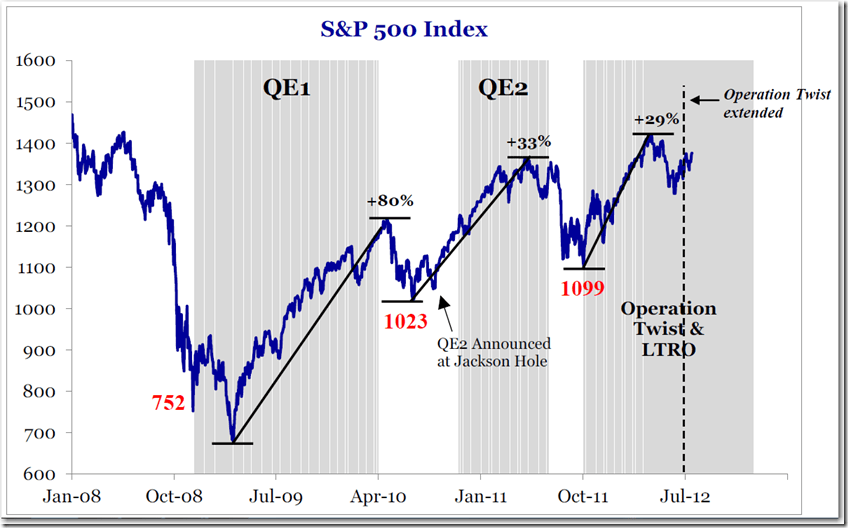
The article summarized an econometric study that demonstrated a tight link between the amount of money floating around and, on a slightly time-delayed basis, the price of stocks.

OK, fast forward to today.

Now, when the Feds expand the money supply, it’s called “Quantitative Easing” … or QE, for short.

Recently, Jason Trennert of Strategas Research Partners published a revealing chart that visually relates stock prices (the S&P 500) to the recent periods of quantitative easing.

Hmmm.

Looks like the supply of money and common stock prices are still related.

Partially explains why the Dow is over 13,000 despite a sluggish and uncertain economy.

image

>> Latest Posts

How many Tea Partiers voted for Obama?

September 14, 2012

According to pollsters Rasmussen & Schoen in their book “Mad as Hell … …

A significant number of self-identified Tea Party supporters —20 to 30 percent, depending on the poll — voted for Obama,

To put hat number in context:

  • A February 20, 2010, Economist/YouGov poll found that one in five Americans identify themselves as being part of the Tea Party movement.
  • Approximately 35 percent of the electorate self-identifies as Tea Party “supporters.

* * * * *

Source: Rasmussen, Scott; Schoen, Doug,
Mad As Hell (pp. 44, 219, 220).
Harper Collins, Kindle Edition.

image

>> Latest Posts

MBA applicants declining … more $$$ for top students and minorities.

September 14, 2012

Punch line: Top US business schools are reporting single and double digit applicant decline, making admission easier for candidates.  After years of applicant increases, admissions offices explain the trend by tough competition – with cheaper and more convenient programs, and ramped up efforts from 2nd tier schools. 

image

* * * * *

Excerpted from businessweek.com’s, “At Top Business Schools, an MBA Application Drought.”

In the last few weeks, a handful of top business schools have reported single-digit, and in some cases double-digit, declines in applications for their full-time MBA classes, including most recently Columbia Business School and New York University’s Stern School of Business.

Full-time MBA applications have sunk at at least a dozen of the top 30 B-schools.

Among the schools that have reported declines are the University of Chicago’s Booth School of Business, the Yale School of Management and Duke University’s Fuqua School of Business (down 3.5 percent, 9.5 percent, and 7 percent, respectively).

A handful of schools reported even steeper drops, including Michigan State University’s Broad College of Business, where applications fell 18 percent, and Indiana University’s Kelley School of Business, with a significant dip of nearly 21 percent.

The decline in applications is attributed to increased competition from rival business schools and a plethora of available choices, including part-time and online programs.

Second-tier schools are working more aggressively to recruit top MBA candidates and entice them with hefty financial aid packages.  “…employer sponsorship for full-time MBA programs is almost nonexistent, and doing an MBA part-time or online can be an attractive offer for some students, especially when there is funding available.

With a smaller pool of MBA applicants, getting an offer to a top business school has become slightly easier … To meet their target enrollment for this year’s incoming MBA class, schools had to work harder to ensure admitted students accepted their offers. For many of those schools, that extra push paid off. Yield was up at nine of the 13 schools on which information was available.

This year, competition was especially stiff for women, underrepresented minorities, and students from nontraditional work backgrounds, says Liz Riley Hargrove at Fuqua. “It was just a really competitive environment, and I think it impacted everybody’s yield this year,” she says.

Edit by BJP

>> Latest Posts

Sorry, but the BLS streak continues …

September 14, 2012

I promise that I’ll stop writing about BLS reporting bias when the streak ends.

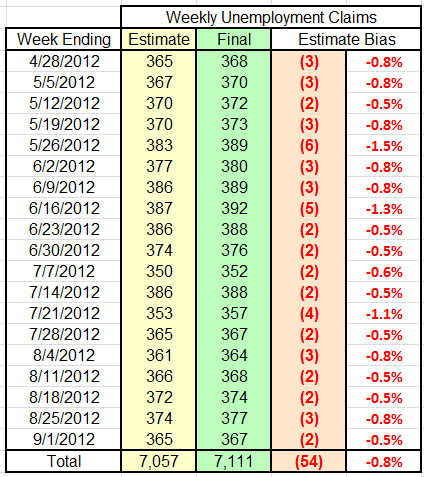
Now we’re up to 78 out of 79 weeks — and, at least 19 election season weeks in a row — that the BLS’s “headline number” has under-reported the number of initial unemployment claims … and cast the jobs situation as brighter than it really is.

Based on Thursday’s BLS report, the number for the week ending Sept. 1 was revised upward from 365,000 to 367,000.

In itself, the 2,000 isn’t a big deal.

But, in context it is

Again, I ask: statistical bias or political bias?

If the former: fix it already, BLS.

Hint to BLS: just add 2k or 3k … or .8% to your prelim forecast !

image

* * * * *

And, oh yeah, the initial jobless claims increased by 15,000 … above the consensus estimates … and consistent with an unemployment rate higher than 8.1%.

image

>> Latest Posts

Some people just shouldn’t vote!

September 13, 2012

Sometimes I scratch my head and wonder whether “one man, one vote” makes sense.

Polls routinely reveal that a majority of Americans have marginal knowledge of government, politics, and political issues.

Try this: ask folks to explain the difference between the Federal deficit and the Federal debt … ask them where the money money that funds, say unemployment benefits, comes from.

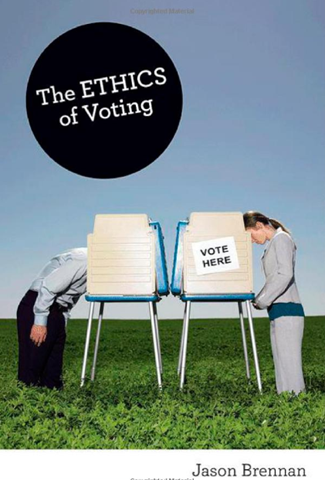
Jason Brennan is a young prof at MSB … his research is at the nexus of ethics and politics.

He has written an insightful book called The Ethics of Voting

image

The essence of Jason’s argument is that all adult citizens have the right to vote … but that they shouldn’t exercise that right unless they are informed, rational, and aiming for the common good.

More specifically, he argues:

“If a citizen has a right to vote, this means at minimum that she ought to be permitted to vote — no one should stop her or deprive her of the vote — and that her vote must be counted.

However, if citizens do vote, they must vote well, on the basis of sound evidence for what is likely to promote the common good.

That is, in general, they must vote for the common good rather than for narrow self-interest.

Citizens who lack the motive, knowledge, rationality, or ability to vote well should abstain from voting.

Some voters are well informed about what candidates are likely to do.

They know what policies candidates endorse and whether the candidates are sincere.

They know the track records and general trends of different political parties.

Other voters are ignorant of such things.

Another way voters vary is in their degree of rationality .

Some voters are scrupulously rational, while others are irrational.

Some have patently stupid beliefs.

[Some citizens] are politically engaged, but they are nonetheless often ignorant of or misinformed about the relevant facts or, worse, are simply irrational.

Though they intend to promote the common good, they all too often lack sufficient evidence to justify the policies they advocate.

When they do vote, I argue, they pollute democracy with their votes and make it more likely that we will have to suffer from bad governance.”

* * * * *

Ken’s Take: An interesting perspective that has been constantly on my mind during this election cycle.

At least read the sample chapter … book is available in paperback at Amazon.

>> Latest Posts

I was struck by a Volt of lightning …

September 13, 2012

What are the odds?

I actually (not virtually, actually) passed a Chevy Volt on the road

Note that “I passed” not “I was passed by”

image

Again I ask, what are the odds?

Well, according to the Detroit News, there have been about 16,000 Volts sold from its birth to date.

Note: about 2,000 have been bought by the gov’t and GE – pandering to the Feds

According to the Dept. of Transportation, There are about 250 million registered vehicles in the U.S.

So, the statistical likelihood of the next car I pass being a Volt is about .0064% … or, less than 1 in 15,000, given the geographic distribution of Volts. 

According to the NOAA, the odds of being struck by lighting in your lifetime are 1 in 10,000.

Hmmm.

* * * * *

Side Note

Reuters reports that nearly two years after the introduction of Volt, GM is still losing as much as $49,000 on each one it builds

It currently costs GM “at least” $75,000 to build the Volt,

According to experts, GM’s basic problem is that “the Volt is over-engineered and over-priced,”

Weak sales are forcing GM to idle the Detroit-Hamtramck assembly plant that makes the Chevrolet Volt for four weeks starting September 17

>> Latest Posts

Which states’ residents are most impacted by Obama’s plan to raise taxes on the rich?

September 12, 2012

This may be common knowledge, but it was a surprise to me …

Based on the 2009 census data (latest available), just under 4% of U.S. households have income greater than $200,000.

Below are the 20 states with the highest proportion of households with incomes greater than $200,000 … led by DC, Connecticut, New Jersey and Maryland (a suburb of DC).

The interesting part:

15 of the states (or 16 depending on how you count Colorado) are Blue- Democratic states

… only 3 are Red-Republican states

… 2 are Purple-Swing states.

Hmmm.

image

>> Latest Posts

Obama’s problem with men …

September 12, 2012

Lots of media coverage re: Romney’s “problem “ with women … less about Obama’s man problem.

According to the latest CNN poll, Romney-Ryan trails Obama-Biden by 12 points among women … 42% to 54%.

But, the numbers flip for men ,,, with Romney-Ryan leading by 12 points … 55% to 43%.

Hmmm.

image

>> Latest Posts

You can slip into these sneaks for about $300 … deal or no deal?

September 12, 2012

Punch line: How do you market a pair of $300-plus sneakers? If you’re Nike, you just do it quietly. And by acting like you’re not marketing them at all.

image

* * * * *

Excerpted from Advertising Age, “Nike’s $300 Shoe Has the Marketing Built Right In”

Nike found itself in another controversy this week when news surfaced that it’s planning its most-expensive sneaker ever: the uber expensive LeBron X …

As the Swoosh is no stranger to controversy it is poised to combat the backlash through:

  1. Counterattack: The athletic giant hasn’t said what the final price will be for the shoe but it ripped the $315 price tag quoted by the WSJ as “inaccurate.”
  2. Word of mouth: Instead of expensive ads, Nike’s relying on word-of-mouth to build anticipation. The result: the buzz from athletes and sneaker blogs has helped score stories in every major media outlet.
  3. Product placement: Nike had the placement of all placements when millions of NBC TV viewers watched LeBron wear the shoes while leading the U.S. men’s basketball team to the gold medal in London.


One of the strongest selling features for shoes like the LeBron X is that they’re not for everybody.

In fact, Nike will only make 25,000 to 50,000 pairs which is expected to drive up prices and demand.

Edited by JDC

>> Latest Posts

In total, how much do Americans pay in taxes? For what? To whom?.

September 11, 2012

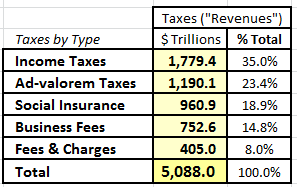
Americans pay a tad over $5 trillion in taxes to the Feds, States and Local Governments.

Technical note: In government parlance, the taxes are called “revenue”.

By taxing authority

Drilling down, the $5 trillion is split roughly 50%-30%-20% to the Feds, States and Locals, respectively

image

* * * * *

By type of tax

Roughly 1/3 of the $5 trillion is income taxes individual and corporate)

about 1/4 is ad valorem taxes (think sales and property taxes)

just under 1/5 are social insurance (i.e. Social Security, Medicare, Medicaid)

… slightly more than 1/5 are fees and charges (think tolls, business licenses)

image

* * * * *

Income taxes

Roughly 1/3 of the $5 trillion – about $1.8 trillion — is income taxes

…  83.4% are individual income taxes; only 16.6% are corporate income taxes

… about 80% of income taxes go to the Feds; around 20% goes to the States & Locals

image

* * * * *

Ad-valorem taxes

Roughly 1/4 of the $5 trillion in total taxes paid – about $1.2 trillion – is ad-valorem taxes – taxes paid based on the value of something bought or owned.

…  about 40% of ad-valorem taxes are Local property taxes

…  about 1/3 are Sales Taxes …  going mostly to the States

image

* * * * *

Social Insurance

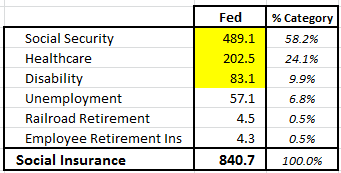
Roughly 1/5 of the $5 trillion in total taxes paid – about $961 billion – is social insurance – with about 80% going to the Feds

…  roughly 60% of the social insurance payments going to the Feds is for Social Security

…  almost 1/4 of the social insurance payments going to the Feds is for Medicare.

image

* * * * *

Pulling it all together Ken’s Rosetta Stone of Taxes

All the details — now much? to whom? for what?

Click for a PDF: Ken’s Rosetta Stone of Taxes

image

PDF          Data Source

>> Latest Posts

How to think like a rich guy …

September 11, 2012

Steve Siebold, author of “How Rich People Think,” spent nearly three decades interviewing millionaires around the world to find out what separates them from everyone else.

“It had little to do with money itself, he told Business Insider. It was about their mentality.”

image

Here are my favorites from his 21 Ways that Rich People Think Differently:

3. Average people have a lottery mentality. Rich people have an action mentality.

“While the masses are waiting to pick the right numbers and praying for prosperity, the great ones are solving problems”

4. Average people think the road to riches is paved with formal education. Rich people believe in acquiring specific knowledge.

“Many world-class performers have little formal education, and have amassed their wealth through the acquisition and subsequent sale of specific knowledge.”

5. Average people long for the good old days. Rich people dream of the future.

“People who believe their best days are behind them rarely get rich, and often struggle with unhappiness and depression.”

7. Average people earn money doing things they don’t love. Rich people follow their passion.

“To the average person, it looks like the rich are working all the time … But one of the smartest strategies of the world class is doing what you love and finding a way to get paid for it.”

8. Average people set low expectations so they’re never disappointed. Rich people are up for the challenge.

“No one would ever strike it rich and live their dreams without huge expectations.”

12. Average people live beyond their means. Rich people live below theirs.

“The rich live below their means, not because they’re so savvy” … but because they can … and they do!

15. Average people would rather be entertained than educated. Rich people would rather be educated than entertained.

“The rich appreciate the power of learning long after college is over … Walk into a wealthy person’s home and one of the first things you’ll see is an extensive library of books they’ve used to educate themselves on how to become more successful … The middle class reads novels, tabloids and entertainment magazines.”

click for the full list

Thanks to CH for feeding the lead

>> Latest Posts

Maybe sex doesn’t sell … yeah, right.

September 11, 2012

Punch line: Sex no longer sells for traditional teen retailer Abercrombie & Fitch. 

Faced with new consumers who want unique, affordable fashion, the clothing giant is seeing sales decline and shutting down US stores. 

* * * * *

Excerpted from Businessweek, “At Abercrombie & Fitch, Sex No Longer Sells

A&F

Abercrombie & Fitch’s skin-filled ads and nightclub vibe once delighted American teenagers and infuriated parents.

Today, many aren’t even paying attention.

The once-edgy retailer has lost a third of its market value in the past year as it grapples with falling sales in Europe and the U.S.

While Abercrombie blames the economy for its woes, brand consultants say it also has failed to change with the times.

Today’s teens are underwhelmed by the half-naked models and blaring, dimly lit stores.

They’re also less inclined to wear Abercrombie’s longtime uniform of pricey denim and graphic T-shirts.

Sales at non-U.S. stores open at least a year plunged 26 percent in the second quarter.

Abercrombie shuttered 71 U.S. stores in its most recent fiscal year, and in February said it will close another 180 through 2015.

Today’s teens are “radically different” from other generations … and have a bevy of options thanks to the boom in fast fashion from Forever 21 and H&M. 

Abercrombie is “positioned well to take advantage of this group’s desire to be rebellious and indie and different, because that’s what the brand is about … but right now the product mix doesn’t communicate that or facilitate it.”

Edit by BJP

With dismal job growth, how did the unemployment rate drop to 8.1%?

September 10, 2012

The August employment report was expectedly dismal, but equivocal in that  it gave both parties data points to selectively highlight.

First, the BLS Establishment Survey reported that 96,000 jobs were added … that’s good since it’s a positive number.

But, there was a decline in “goods producing jobs” – i.e. manufacturing … and the 96,000 is below the the 125,000 level that is commonly held as the number required to keep pace with population growth and keep the unemployment rate constant.

image

* * * * *

Nonetheless, the reported unemployment rate went down to 8.1%.

How can that be?

Good question since the Employment reported from the Household Survey – the basis of the 8.1% calculation – declined by 119,000.

image

* * * * *

Now, stop and think about that for a second.

The Establishment Survey said 96,000 jobs were added.

The Household Survey said employment dropped by 119,000.

Yet the unemployment rate went down – from 8.3% to 8.1%.

Hmmm. How can that be?

Well, 368,000 people dropped out of the labor force – stopped looking for work – either retired, became disabled, or simply kicked back on unemployment benefits.

If they hadn’t quit looking for work, they would have been counted as unemployed … and the reported unemployment rate would have been 8.33% – up more than .1% from 8.25% last month

The puts a whole new paint job on things, right?

image

* * * * *

The number of folks dropping out of the labor market is a big deal … since the magnitude is big and the trend is bad – especially this year.


image

* * * * *

The KEY METRIC

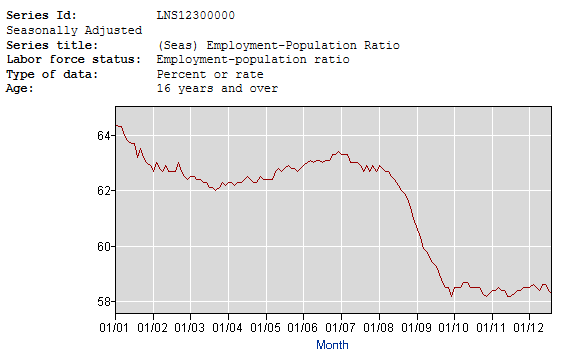
To consolidate all of the above “stuff” into a single metric, I like to look at the employment-to-population ratio … what % of adults who are employed.

The employment-to-population ratio is now at 58.3% … meaning that 41.7% of adults AREN’T employed … that’s a big number !

Note that the employment-to-population ratio hovered around 63% during most of the Bush years … then collapsed during the financial crisis … dropping a 5 points … and then hovering around the lower level.

image

* * * * *

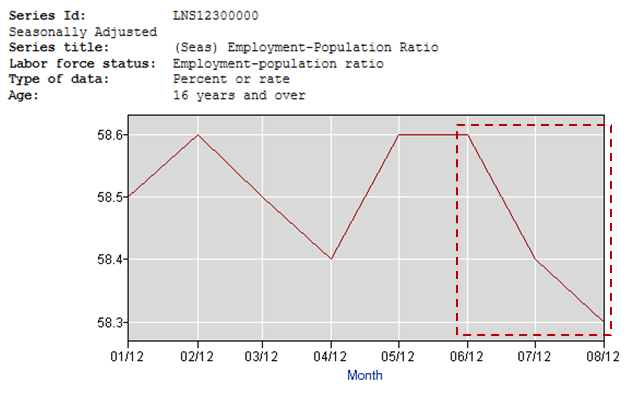
While the employment-to-population ratio looks like it’s “hovering”, look at the past couple of months … it has dropped by .5%.

That may sound like rounding error, but multiply it times the working age population … and you get over 1.2 million fewer people employed.

Ouch.  That’s not rounding error!


image

Bottom line: we’re stalled !

* * * * * * * * * * * * * * * * * * * * * * * * * * * * * * * * * * * * * * * * * * * * * * * * * * * * * * * * * * * * * * * *

Key data source

image

>> Latest Posts

Encore: “It is important not to read too much into any one monthly report” … unless the data is good.

September 10, 2012

Team Obama’s reaction to last week’s dismal jobs report was quite predictable:

“It is important not to read too much into any one monthly report”

Why predictable?

Because it’s EXACTLY the same thing they say whenever the jobs numbers are bad.

Below is an encore post … a stroll down memory lane …

Question: Is it ok to read something into, say, 42 jobs reports?

* * * * *

What are you going to believe, the facts or our rhetoric?

Reported by Chris Moody of Yahoo News

When the Bureau of Labor Statistics announced the nation’s latest national employment last week, the Obama administration stressed that people should not “read too much” into the data.

Mitt Romney’s campaign pounced, and flagged the fact that the White House has repeated that same line nearly every month since November 2009.

See below for the roundup of articles from WhiteHouse.gov that Romney’s campaign posted on its site. In many of the posts, the authors for the administration do acknowledge that they repeat themselves:

June 2012: “Therefore, it is important not to read too much into any one monthly report and it is informative to consider each report in the context of other data that are becoming available.”

May 2012: “Therefore, it is important not to read too much into any one monthly report and it is helpful to consider each report in the context of other data that are becoming available.”

April 2012: “Therefore, it is important not to read too much into any one monthly report and it is helpful to consider each report in the context of other data that are becoming available.”

March 2012: “Therefore, it is important not to read too much into any one monthly report, and it is helpful to consider each report in the context of other data that are becoming available.” (LINK:)

February 2012: “Therefore, as the Administration always stresses, it is important not to read too much into any one monthly report; nevertheless, the trend in job market indicators over recent months is an encouraging sign.”

January 2012: “Therefore, as the Administration always stresses, it is important not to read too much into any one monthly report; nevertheless, the trend in job market indicators over recent months is an encouraging sign.”

December 2011: “Therefore, as the Administration always stresses, it is important not to read too much into any one monthly report.”

November 2011: “Therefore, as the Administration always stresses, it is important not to read too much into any one monthly report.”

October 2011: “The monthly employment and unemployment numbers are volatile and employment estimates are subject to substantial revision. There is no better example than August’s jobs figure, which was initially reported at zero and in the latest revision increased to 104,000. This illustrates why the Administration always stresses it is important not to read too much into any one monthly report.”

September 2011: “Therefore, as the Administration always stresses, it is important not to read too much into any one monthly report.”

August 2011: “Therefore, as the Administration always stresses, it is important not to read too much into any one monthly report.”

July 2011: “Therefore, as the Administration always stresses, it is important not to read too much into any one monthly report.”

June 2011: “Therefore, as the Administration always stresses, it is important not to read too much into any one monthly report.”

May 2011: “Therefore, as the Administration always stresses, it is important not to read too much into any one monthly report.”

April 2011: “Therefore, as the Administration always stresses, it is important not to read too much into any one monthly report.”

March 2011: “Therefore, as the Administration always stresses, it is important not to read too much into any one monthly report.”

February 2011: “Therefore, as the Administration always stresses, it is important not to read too much into any one monthly report.”

January 2011: “Therefore, as the Administration always stresses, it is important not to read too much into any one monthly report.”

December 2010: “Therefore, as the Administration always stresses, it is important not to read too much into any one monthly report.”

November 2010: “Therefore, as the Administration always stresses, it is important not to read too much into any one monthly report.”

October 2010: “Given the volatility in monthly employment and unemployment data, it is important not to read too much into any one monthly report.”

September 2010: “Given the volatility in the monthly employment and unemployment data, it is important not to read too much into any one monthly report.”

July 2010: “Therefore, it is important not to read too much into any one monthly report, positive or negative. It is essential that we continue our efforts to move in the right direction and replace job losses with robust job gains.”

August 2010: “Therefore, it is important not to read too much into any one monthly report, positive or negative.”

June 2010: “As always, it is important not to read too much into any one monthly report, positive or negative.”

May 2010: “As always, it is important not to read too much into any one monthly report, positive or negative.”

April 2010: “Therefore, it is important not to read too much into any one monthly report, positive or negative.”

March 2010: “Therefore, it is important not to read too much into any one monthly report, positive or negative.”
January 2010: “Therefore, it is important not to read too much into any one monthly report, positive or negative.”

November 2009: “Therefore, it is important not to read too much into any one monthly report, positive or negative.”

In other words, it’s important not to read too much into the Obama administration’s past 3-1/2 years of performance.

So much for accountability …

Thanks to SMH for feeding the lead

>> Latest Posts

To spur innovation, hire people who agitate you …

September 10, 2012

Punch line: Nearly 66% of companies on the Fortune 100 list in 1990 are not on the list today.

Why?

It is largely because they didn’t innovate and open themselves up to their next market.

* * * * *

Excerpted from Fast Company, “Why Hiring People Who Annoy You Helps You Innovate”

So are there ways for large, established companies to innovate?

Yes and here are some unconventional guidelines to follow.

1. Hire people who annoy you:

image

A lot of research shows that diverse teams tend to come up with a wider variety of answers, and, thus, are more likely to find the surprising winning idea.

This suggests a hiring strategy–hire people who annoy you.

As long as you’re ensuring they are smart, the people who annoy you represent the diversity you and your company require.

2. Don’t copy, remake:

There is an entire cottage industry devoted to teaching you how to be innovative.

Most answers are glib because they point to some surface feature of a behavior.

3. Don’t create, listen:

The purpose of innovation is not simply to build something new, but to win new customers, new markets, or new products …

If you want to find out what customers want, nix the focus groups and instead watch their behavior.

Edited by JDC
>> Latest Posts

The key number in BLS report …

September 7, 2012

According to the BLS

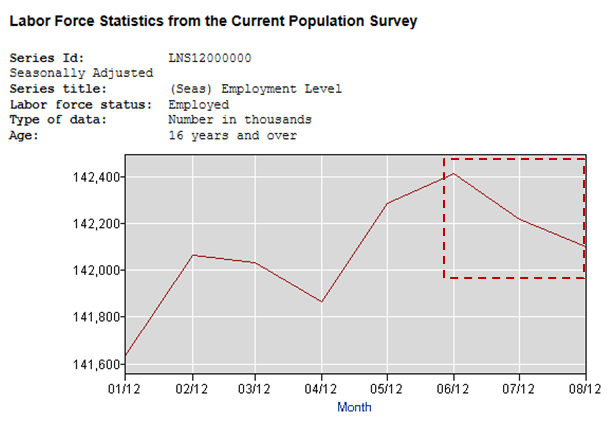
The number of employed people dropped by 119,000

… from 142,220,000 to 142,101,000

So, how did the unemployment rate go down?

Simple.

The BLS estimated that 368,00 stopped looking for work

In other words, the denominator changed more than the numerator.

I guess if Team Obama can get more people to stop looking for work, we’ll have unemployment problem licked.

Hmmm.

>> Latest Posts

Great moments in Dem-ocracy …

September 7, 2012

Earlier this week we posted re: the platform bruhaha at the DNC

On Wednesday, there was a do-over on the controversial parts of the platform: reinserting the words “God” and “Jerusalem“

If you haven’t seen the video, check it out … it’s great theater.

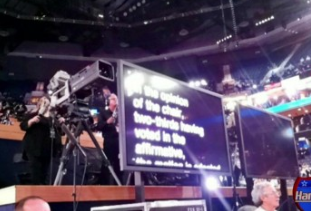
Pay attention to the number of votes taken (3) , how the chairman had to talk very slowly so that the Dem delegates would understand what to do, and draw your own conclusion whether the two-thirds threshold was met.

Here’s the most interesting part of the drama: floor photos taken at the time show that the vote’s results were already loaded to the teleprompter … before the vote was taken.

Apparently, the votes were counted before they were cast.

Having loved in Chicago for many years, I can tell you: that’s the Chicago way.

image

>> Latest Posts

Who do tax payers support – Obama or Romney?

September 7, 2012

That’s an easy one … but, the latest CNN poll was the first I spotted that divides the population along those lines … or, at least, sorta does.

CNN breaks the sample by those earning less than and more than $50,000 .

$50,000 is about the point where folks have to start paying Federal income taxes.*

No surprises in the data.

Romney has the edge among Federal tax payers.

Obama gets those who don’t pay Federal income taxes …  by a whopping 57% to 42%.

Uh-oh.

image

*  P.S. Yeah, yeah, yeah about payroll taxes … but they are “insurance” payments with directly associated benefits.

>> Latest Posts

Sorry to harp … but, the streak continues

September 7, 2012

Some loyal readers have suggested that I get off this case … That I’ve made my point.

I promise that I’ll stop writing about BLS reporting bias when the streak ends.

Now we’re up to 77 out of 78 weeks — and, at least 18 weeks in a row — that the BLS’s “headline number” has under-reported the number of initial unemployment claims … and cast the jobs situation as brighter than it really is.

Based on yesterday’s BLS report, the number for the week ending August 25 was revised upward from 374,000 to 377,000.

In itself, the 3,000 isn’t a big deal.

But, in context it is

Again, I ask: statistical bias or political bias?

If the former: fix it already, BLS.

Hint to BLS: just add 2k or 3k …  or .8% to your prelim forecast !

image

>> Latest Posts

Be bold: chuck PowerPoint … say, what?

September 6, 2012

Punch line: Despite a 95% share of presentation software, many companies are now starting to encourage stepping away from traditional power point slide presentations. 

* * * * *

Excerpted from Businessweek, “Death to Power Point!”

Power point

No matter what your line of work, it’s only getting harder to avoid death by PowerPoint.

Since Microsoft launched the slide show program 22 years ago, it’s been installed on no fewer than 1 billion computers and an estimated 350 PowerPoint presentations are given each second across the globe. 

On June 18, the Iranian government made the case for its highly contested nuclear program to world leaders with a 47-slide deck … Two years back, the New York Knicks tried to woo LeBron James with a PowerPoint pitch, which may explain why James won his first NBA championship in Miami.

As with anything so ubiquitous and relied upon, PowerPoint has bred its share of contempt.

Plug the name into Twitter and you’ll see workers bashing the soporific software in Korean, Arabic, Spanish, and English as each region starts its business day.

Part of this venting may stem from a lack of credible competition:

PowerPoint’s share of the presentation software market remains 95 percent, eclipsing relative newcomers Apple Keynote, Google Presentation, Prezi, and SlideRocket.  

Sometimes … PowerPoint slides …do more harm than good. They bore audiences with amateurish, antiquated animation and typefaces and distract speakers from focusing on the underlying structure of their creators’ speeches.

The best speakers at any corporate level today grip an audience by telling a story … The boldest among them do away with slides entirely 

Even if you’re a middle manager delivering financials to your department in slides, you’re telling a story. 

Many of the top presentation gurus advocate judiciously limiting the role of PowerPoint.

Edit by BJP

>> Latest Posts

About the 4.5 million jobs that Obama has (or has not) created …

September 6, 2012

The Dems are touting 4.5 million jobs created by President Obama.

CNN says that the number  is an accurate description of the growth of private-sector jobs since January 2010, when the long, steep slide in employment finally hit bottom.

But – and it’s a BIG but — while a total of 4.5 million jobs sounds great, it’s not the whole picture.

According to CNN:

Nonfarm private payrolls hit a post-recession low of 106.8 million January 2010 … The figure currently stands at 111.3 million as of July.

While that is indeed a gain of 4.5 million, it’s only a net gain of 300,000 over the course of the Obama administration to date since the private jobs figure stood at 111 million in January 2009, the month Obama took office.

And total nonfarm payrolls, including government workers, are down from 133.6 million workers at the beginning of 2009 to 133.2 million in July 2012. There’s been a net loss of nearly 1 million public-sector jobs since Obama took office, despite a surge in temporary hiring for the 2010 census.

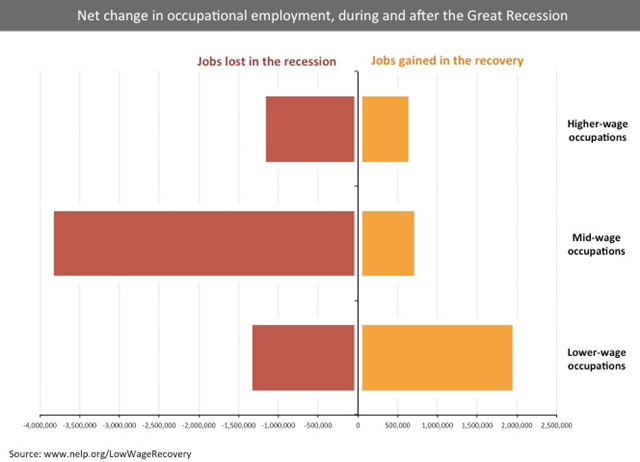
Meanwhile, the jobs that have come back aren’t the same ones that were lost.

According to a study released last week by the liberal-leaning National Employment Law Project, low-wage fields such as retail sales and food service are adding jobs nearly three times as fast as higher-paid occupations.

image

image

>> Latest Posts

Stepping back to see the forest from the trees …

September 6, 2012

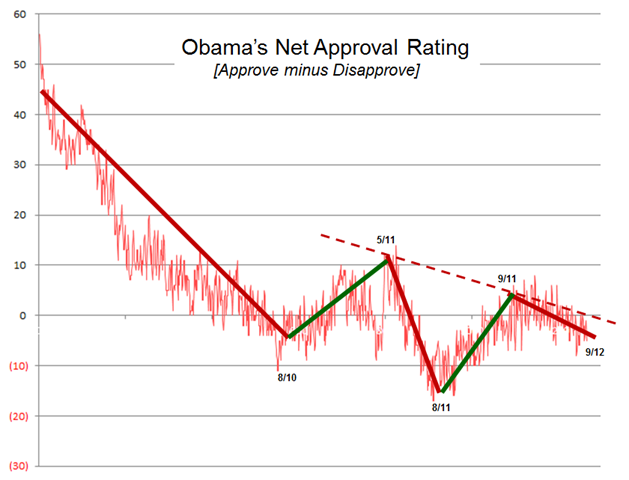
In marketing, there’s a measure called the net promoter’s index … in essence, it’s a company’s percentage of avid supporters minus the percentage of avid disapprovers.

Gallup tracks presidential approval daily … below is Obama’s net approval rating (% approve minus % disapprove) since inauguration.

Note a couple of big picture points:

  1. The overall trend during Obama’s term has been down … even adjusting for the extraordinary hope & change starting point
  2. The most recent bounce back didn’t full recover the 2011 drop
  3. The 2012 trend has been consistently down

The big election question: will Obama continue to slide until election day or stage enough of a bounce back to squeak out a win?

image

>> Latest Posts

People more interested in platforms than speeches … and Dems served up red meat.

September 5, 2012

A couple of related items caught my eye.

First, people polled by Pew Research said that they were more interested in party platforms than convention speeches.
 image

Then, new services started reporting some potentially controversial aspects of the Dem platform:

1. For the first time ever, making no mention  of  God in the platform … much to the delight of the atheist groups and raising the question “How Will Christian Democrats React?”

2. The platform  directly endorsed tax payer funded abortions: “The Democratic Party strongly and unequivocally supports … a woman’s right to …  a safe and legal abortion, regardless of ability to pay.” Pundits are saying that “regardless of ability to pay”  is an endorsement of taxpayer-funded abortions (thru Medicaid and ObamaCare), a policy that President Obama has personally endorsed. According to a 2009 Quinnipiac poll, 72 percent of voters oppose public funding of abortion and 23 percent support it.

3. The  platform doesn’t state that Jerusalem is the capital of IsraelPundits are saying that’s a nuanced but significant a change from prior years that “could provide fuel to critics who say President Barack Obama’s commitment to Israel is weak.”

It will be interesting to see how much play these issues get in the mainstream media.

I’m betting the under …

>> Latest Posts

Who’s viewed more favorably – Obama or Romney? Biden or Ryan?

September 5, 2012

Well, well, well.

According to the most recent CNN poll, more likely voters (53%) view Romney favorably than view Obama favorably (51%).

And, more view Obama unfavorably (48%) than view Romney unfavorably (43%).

BTW: Ryan is viewed way more favorably than Biden

Think the mainstream media will pick up on these poll results?

I’m betting not.

* * * * *

CNN Question #4:

We’d like to get your overall opinion of some people in the news. As I read each name, please say  if you have a favorable or unfavorable opinion of these people.

image

image

>> Latest Posts

Do Olympic sponsors capture the gold?

September 5, 2012

Punch line: Corporate giants spent millions during the Olympic games with the expectation of a return on that investment.  What sales levels can Adidas, P&G, and McDonald’s expect to see after Olympics advertising?

* * * * *

Excerpted from WSJ, “Companies Seek Olympic Legacy

The Olympics has highlighted the boost that companies can get from sports sponsorship in the short term but experts say that the real benefit is brand awareness over the long term, which isn’t so easy to quantify.

Over the past few weeks several companies have trumpeted how sports sponsorship has paid off in terms of sales, with Adidas reporting an 18% jump in second-quarter profit tied to sponsorships.

Olympics

Procter & Gamble expected its sponsorship of the London Olympics to bring in $500 million in incremental sales, with the hope that a bevy of commercials around the events would propel consumers to pick up more Bounty paper towels and Gillette razors.

And U.S. fast food giant McDonald’s Corp. will receive a boost to sales with the exclusive right to sell fries at four sites around the Olympic stadiums.

“There are not that many opportunities for brands to get the massive audiences that sporting events such as the Olympics, soccer World Cup and Euro 2012 attract,” said Graham Hales of Interbrand. “The value of being associated with, say, the Olympics, definitely makes for a stronger brand but working out the financial benefit is a trickier call.”

Adidas, as the sole sportswear partner of the Olympics and with individual deals with athletes including sprinters Tyson Gay and Yohan Blake, sped away from rivals Nike and Puma to post an 18% second-quarter jump in profits thanks to its strong sponsorship deals.  The German company invested $157.1 million in this summer’s Olympics which it has already made back in the past 12 to 18 months in license product sales alone, which have more than tripled since the 2008 games in Beijing.

Procter & Gamble were similarly vague about returns on sponsorship investment. CFO Jon Moeller didn’t disclose how much the world’s largest consumer-products company spent but said that a $600 million figure floating around some circles “is not the number we are spending,” and that the company is pleased with its expected return on this year’s games.

Paying for sponsorship must be weighed up in the context of a company’s overall marketing budget.  Each sponsor pays only to be allowed to be associated with the Olympics—you don’t get much more than that for your money particularly because there is no sponsorship allowed inside Olympic stadiums.  A company must judge whether a $300 million marketing bill with no direct Olympic association is better or worse than paying $100 million for sponsorship and then $200 million to activate it.

The exercise is complicated by “ambush marketing” strategies which enable companies to associate themselves strongly with a sporting event even though they aren’t official sponsors. Nike, for example, which isn’t an official sponsor of the International Olympic Committee or the London 2012 Olympics, but does sponsor the U.S. team, launched a global TV campaign featuring everyday athletes competing in places around the world named London timed to coincide with the Olympics 2012 opening ceremony.

Awareness is not an issue for these large companies and the short-term boost to sales is not significant in their world-wide sell, but being a sponsor is definitely a benefit and justifies the cost of the sponsorship.


Edit by BJP

>> Latest Posts

Eastwooding.

September 4, 2012

Last Thursday nite I was dismayed to watch Clint Eastwood live delivering his now infamous chat with Obama-the-empty-chair.

image

I thought the skit diminished the prime time pitches by wasting valuable time and setting, setting a wrong tone, and potentially monopolizing the next day news cycle.

Maybe I was wrong …

I think the GOP lucked into something.

First, the Eastwood pitch went viral … landing some grand symbolic punches on Obama (emperor has no clothes, empty suit, etc.) …. and coining a new pop culture expression: “Eastwooding” .

Just Google the word and you’ll see what I mean.  It was most-Googled over the weekend.

Here are  my favorite web posts … and the White House’s response.

image

image

image

I guess, sometimes it’s better to be lucky than to be smart.

>> Latest Posts

So much for an informed electorate …

September 4, 2012

According to tvnewser.com, total viewership of Romney’s speech:

image  .

Ken’s Take:

FOX’s share was greater than #2 ABC and #3 NBC combined … before you say “yeah, it was the GOP convention” … I’m betting FOX outdraws the other nets for the DNC

Only about 25 million people watched … down over 31% from 2008.  So much for an informed electorate … I guess if if the vast majority of undecideds watched it’s ok.

I channel switched between FOX and CNN …  felt sorry for CNN … pretty good stable of commentators – arguably better than FOX’s, save for the leftie flame-throwers like Begala …. surprised their ratings free-fell

MSNBC has become a parody of a news network … does anybody take them seriously? It should merge with Comedy Central.

Speaking of which … What if Comedy Central had broadcast the convention – hosted by Stewart & Colbert?  Would be interesting to see the draw since many young voters and older liberals get most of their their news from Comedy Channel.

On balance, I’m disappointed more people didn’t watch …

>> Latest Posts

In praise of classrooms and “live” professors …

September 4, 2012

Interesting op-ed by a Williams College prof in the WSJ last week touted the perils of online education and benefits of faculty-student interaction …

Most of us in higher education take the long view about the value of what we do.

Sure, students graduate with plenty of facts in their heads. But the transmission of information is merely the starting point, a critical tool through which we engage the higher faculties of the mind.

What really matters is the set of deeper abilities — to write effectively, argue persuasively, solve problems creatively, adapt and learn independently — that students develop while in college and use for the rest of their lives.

Which educational inputs best predict progress in these deeper aspects of student learning?

By far, the factor that correlates most highly with gains in these skills is the amount of personal contact a student has with professors.

Not virtual contact, but interaction with real, live human beings, whether in the classroom, or in faculty offices, or in the dining halls.

Nothing else — not the details of the curriculum, not the choice of major, not the student’s GPA — predicts self-reported gains in these critical capacities nearly as well as how much time a student spent with professors.

These rich, human interactions can’t be replaced by any magical application of technology.

Technology has and will continue to improve how we teach.

But what it cannot do is remove human beings from the equation.

Now, there are new purveyors of massive, open online courses.

image

One even proposes to crowd-source the grading of essays, as if averaging letter grades assigned by five random peers were the educational equivalent of a highly trained professor providing thoughtful evaluation and detailed response.

To pretend that this is so is to deny the most significant purposes of education, and to forfeit its true value.

Yet the only way to achieve higher productivity, as the National Academy would define it, is to reduce each student’s time with the faculty.  [To have faculty teach more students and more classes, and to put more material online.]

We know that while such approaches may allow us to deliver some facts to some students more efficiently in the short run, the approaches will undermine the fundamental purpose of education in the long run.

Ken’s Take: Technology doesn’t replace classroom interaction, it liberates and enhances it.

How?

One way is to change the nature of the classroom from “seat time” to “quality time”.

My rule: If I catch myself talking for, say, 10 minutes without a student comment or question, I try to outboard the material to an online tutorial.

That way, I’m able to free up class time for more rigorous interaction that can deepen learning … rather than just running out the clock.

* * * * *

Sidenote: I bet some of the profs who demean online crowd sourced grading use the off-line equivalent: having classmates rate peers’ class participation or having group members rated by their teammates.   Hmmm. What’s the difference?

>> Latest Posts

BOOM: Ryan lands some direct hits…

August 31, 2012

Beyond his scapling of Obama’s record, I thought he made some points that likely to resonate with specific target groups: young voters, women and small businesses.

image

“College graduates should not have to live out their twenties in their childhood bedrooms, staring at fading Obama posters and wondering when they can move out and get going with life.”

image

“I said, I hope it’s not a deal-breaker Mitt, but my playlist starts with AC/DC, and ends with Zeppelin.”
 

image

“My Mom started a small business, and I’ve seen what it takes …   She earned a new degree and learned new skills to start her small business.  It wasn’t just a new livelihood.  It was a new life.  And it transformed my Mom … Her work gave her hope.  It made our family proud.  And to this day, my Mom is my role model.”

image

“Behind every small business, there’s a story worth knowing. 

They didn’t come out of nowhere …

And if small businesspeople say they made it on their own, all they are saying is that nobody else worked seven days a week in their place. 

Nobody showed up in their place to open the door at five in the morning. 

Nobody did their thinking, and worrying, and sweating for them. 

After all that work, and in a bad economy, it sure doesn’t help to hear from their president that government gets the credit.”

  Game on !

>> Latest Posts

You can’t control everything that happens to you but …

August 31, 2012

… you can control the way you respond to everything that happens to you.

Thanks one of the admonitions from my adios lecture to my MBA students.

I was amped when Condi Rice used a version of the line in her speech last night.

Other snippets from her speech that caught my eye are below  …

image

The world is a chaotic and dangerous place. 

The U.S. has since the end of World War II had an answer – we stand for free peoples and free markets, we are willing to support and defend them – we will sustain a balance of power that favors freedom.

Our friends and allies must be able to trust us. From Israel to Poland to the Philippines to Colombia and across the world — they must know that we are reliable and consistent and determined.  And our adversaries must have no reason to doubt our resolve — because peace really does come through strength.

When the world looks at us today they see an American government that cannot live within its means.  They see a government that continues to borrow money, mortgaging the future of generations to come.  The world knows that when a nation loses control of its finances, it eventually loses control of its destiny.  That is not the America that has inspired others to follow our lead.

The essence of America – that which really unites us — is not ethnicity, or nationality or religion – it is an idea — and what an idea it is:  That you can come from humble circumstances and do great things.  That it doesn’t matter where you came from but where you are going.

Ours has never been a narrative of grievance and entitlement.  We have not believed that I am doing poorly because you are doing well.

We have been successful too because Americans have known that one’s status at birth was not a permanent station in life.  You might not be able to control your circumstances but you could control your response to your circumstances

Today, when I can look at your zip code and can tell whether you are going to get a good education – can I really say that it doesn’t matter where you came from – it matters where you are going.  The crisis in K-12 education is a grave threat to who we are.

We need to have high standards for our students – self-esteem comes from achievement not from lax standards and false praise.  And we need to give parents greater choice – particularly poor parents whose kids – most often minorities — are trapped in failing neighborhood schools.

And on a personal note– a little girl grows up in Jim Crow Birmingham – the most segregated big city in America – her parents can’t take her to a movie theater or a restaurant – but they make her believe that even though she can’t have a hamburger at the Woolworth’s lunch counter – she can be President of the United States and she becomes the Secretary of State.

Click to see the video or read the full transcript

>> Latest Posts

Unbelievably, the streak rolls on: BLS under-reports initial unemployment claims … again!

August 31, 2012

Am I the only person in the world to to think this is nuts?

Media sure isn’t reporting it …

Now we’re up to 76 out of 77 weeks — and, at least 17 weeks in a row — that the BLS’s “headline number” has under-reported the number of initial unemployment claims … and cast the jobs situation as brighter than it really is.

Based on yesterday’s BLS report, the number for the week ending August 17 was revised upward from 372,000 to 374,000.

In itself, the 2,000 isn’t a big deal.

But, in context it is

Again, I ask: statistical bias or political bias?

If the former: fix it already, BLS.

Hint to BLS: just add 2k or .8% to your prelim forecast !

image

* * * * *

Almost forgot … the preliminary unemployment claims for the week of Aug. 25 are reported even vs. the Aug. 11 preliminary number and up 2K vs the revised Aug. 18 number.

In other words, no indication that a corner has been turned.

image

>> Latest Posts

The incremental cost of that 51st employee …

August 30, 2012

Of course, I’ve been thinking about entrepreneurs and small businesses recently.

And, the obvious suddenly became evident to me: Under ObamaCare, the incremental cost of a small company’s 51st employee is ENORMOUS.

Think restaurants … paying a bunch of workers minimum wage with few or no benefits.

Today, employee #51 costs the business about $20,000 annually (2,000 hours @ $10 per hour).

Under ObamaCare, that added bus boy costs $122,000 … his $20,000 plus the $2,000 per employee tax penalty on the business for not giving employees health insurance.

That’s a lot money for a bus boy.

Guess employees #1 to #50 are just going to have to work harder.

>> Latest Posts

Millennials: More responsibility, more flexibility … and, oh yeah, more turnover.

August 30, 2012

Punch line: Many companies are beginning to make significant changes for Millennials in order to drive retention and lower turnover rates … uphill battle?.

* * * * *

Excerpted from WSJ, “More Firms Bow to Generation Y’s Demands”

They’re often criticized as spoiled, impatient, and most of all, entitled.

image

But as millennials enter the workforce, more companies are jumping through hoops to accommodate their demands for faster promotions, greater responsibilities and more flexible work schedules—much to the annoyance of older co-workers who feel they have spent years paying their dues to rise through the ranks.

Employers, however, say concessions are necessary to retain the best of millennials, also known as Generation Y, which is broadly defined as those born in the 1980s and 1990s.

They bring fresh skills to the workplace: they’re tech-savvy, racially diverse, socially interconnected and collaborative.

Moreover, companies need to keep their employee pipelines full as baby boomers enter retirement. 

Gen Y will comprise more than 40% of the U.S. workforce by 2020 … far outnumbering any other generation.

Some critics contend that Gen Y is no different from previous generations. 

However, a 2010 Pew Research study found that while baby boomers — generally born between 1946 and 1964 — cited work ethic, respectfulness, and morals as their defining qualities, millennials chose technology, music and pop culture, and liberal leanings — followed by superior intelligence and clothing as their defining qualities.

Millennials are also likely to prioritize lifestyle over salary, and to foresee changing careers.

They want the opportunity to stand out without dealing with routine or hierarchy.

Even if they get what they want, they’re likely to move on.

“I mean, what kind of millennial would work for the same company their whole life?”

Edit by BJP

>> Latest Posts

Does the Federal gov’t have a positive or negative impact on your life?

August 29, 2012

According Pew Research, an increasing plurality (43%) of people think the Federal government negatively impacts their lives.

15 years ago, 50% thought he impact was positive … now,  only 38% think so …..

How do you feel?


image

>> Latest Posts

The alarming increasing in the saving rate … say, what?

August 29, 2012

One of the drags on the economy is that folks have tried to deleverage – i.e. pay down debts – and are saving more.

Recently, I’ve seen several articles talking about the “alarming” spike in the savings rate.

Strikes me as odd since, in the past, saving was considered a good thing (you know, savings is what funds investment which drives the economy) …  and there was hand wring that folks were spending like drunken sailors and weren’t saving enough.

Hmmm.

Here’s a glance at the numbers …

Yes, the savings rate has been increasing since troughing around 2005.But – and it’s a big BUT – the saving rate is still about 5 points lower than it was in the 1970s and 1980s … when there was concern that we weren’t saving enough.

So, if you think the current rate is alarming, expect to be more alarmed as we bounce back to the old normal.

image

>> Latest Posts

How does the unemployment rate impact starting salaries?

August 29, 2012

Answer: Starting salaries tend to drop & to 8 percentage points for each percentage point increase in the unemployment rate … and it can take up to 15 years to get back to “normal” levels.

Lisa Kahn, a Yale School of Management economist analyzed government data  during and after the deep 1980s recession.

She  found that for each percentage-point increase in the unemployment rate, those with the misfortune to graduate during the recession earned 7% to 8% less in their first year out than comparable workers who graduated in better times.

image

The effect persisted over many years, with recession-era grads earning 4% to 5% less by their 12th year out of college, and 2% less by their 18th year out.

For example, a man who graduated in December 1982 when unemployment was at 10.8% made, on average, 23% less his first year out of college and 6.6% less 18 years out than one who graduated in May 1981 when the unemployment rate was 7.5%.

For a typical worker, that would mean earning $100,000 less over the 18-year period.

Source

Takeaway: High unemployment rates isn’t just somebody else’s problem …

>> Latest Posts

Is the Federal government a good value?

August 28, 2012

A Kaiser Foundation survey asked folks:

Thinking about all that the Federal government does for you, do you think that you get more or less value than what you pay in taxes?

The results

  • Less than 10% said that they got more value than what they paid in taxes.
  • About 1/3 thought they got about the right value for taxes paid
  • More than half of the respondents said that they got less value than what they paid in taxes.

Of course, the last finding is most interesting since it’s a majority … and since about half of the folks don’t pay any income taxes.

Hmmm

* * * * * *

Source question

image

>> Latest Posts

News flash: Many people strongly dislike paying taxes … here’s proof.

August 28, 2012

Most people dislike paying taxes.

Many  people strongly dislike paying taxes.

No surprise, the tax aversion tendency is most prevalent among people who identify with political parties that generally favor less taxation.

image

Although this distaste could be rational on economic grounds, a recently published study  shows  that this attitude extends beyond simply disliking the costs incurred and affects behavior in “counternormative” ways … a phenomenon coined “ tax aversion”: a desire to avoid taxes per se that exceeds the rational economic motivation to avoid a monetary cost.

The researchers  provide evidence that people have a stronger preference to avoid tax-related costs than to avoid equal-sized (or larger) monetary costs unrelated to taxes.

  • For example, the proportion of Americans who said they’d travel 30 minutes to save 8% on an item by getting it tax-free was 29% bigger than the proportion who said they’d travel the same distance to get an ordinary 9% discount.
  • Similarly,  more than 4 times as many Americans said they’d rather invest in a bond that offered a $120 annual tax-free return than a bond that offered $160 but required a $40 tax.

The researchers say that tax aversion can be mitigated by identifying positive uses of tax payments.

>> Latest Posts

The “fair share” canard …

August 28, 2012

Of course, President Obama is continuing to rant that the rich need to pay their fair share.

Well, according to a recent report by the Congressional Budget Office (CBO), the rich are paying their fair share.

Based on a WSJ analysis of the CBO data:

  • The average federal tax rate on the top 20% is 23.2%. The 20% of taxpayers earning between $50,100 and $73,999 pay an average 15.1%, and so on down the line.
  • The top 20% of income earners (over $74,000) make 50% of the nation’s income but pay nearly 70% of all federal taxes;  The remaining 30% of the tax burden is borne by 80% of tax filers

Some inconvenient facts, right?

image

image

>> Latest Posts

Picture this: “Food paparazzi”

August 28, 2012

Punch line: A hot dining out trend … the intersection of the foodie culture and social media … call ’em food paparazzi.

* * * * *

Excerpted from brandchannel.com’s “To Cell or Not – While Dining Out”

Interested in wooing business in a challenging economy, and accommodating a younger, wired clientele, many restaurants now cater to diners who have morphed into “food paparazzi.”

image
photo courtesy of JNH

Flickr, the photo-sharing website, has seen the number of pictures tagged as “food” jump from about half a million in 2008 to more than 6 million today… In the group “I Ate This” on Flickr’s site, nearly 20,000 people have uploaded more than 307,000 images of their latest meals.

Of course, this doesn’t begin to count the myriad pictures of food posted to Facebook, Instagram, Twitter, Tumblr, Foursquare, Yelp and foodie niche social networks like Foodspotting.

Camera manufacturers are joining the trend. Nikon, Olympus and Sony sell cameras that offer “cuisine” or “food” settings, which adjust to enhance colors and textures on close-ups.

Sounds harmless enough, but the craze has detractors.

Some maitre d’s regularly face diners demanding to be moved away from camera flashes and the sound of firing shutters.

Some waiters are put off when voice recorders are used to  capture their recitation of each course.

Some chefs have had enough.

Perry’s Deli in Chicago, has gone so far as posting a sign for consumers of their signature overstuffed sandwiches:

“Attention! The use of cellular phones at Perry’s is strictly prohibited. If you are that important that you must use your phone, you should be eating in a much more upscale restaurant.”

Edit by BJP

>> Latest Posts

The streak rolls on: BLS under-reports initial unemployment claims … again!

August 27, 2012

Still again …

Now we’re up to 75 out of 76 weeks — and, at least 16 weeks in a row — that the BLS’s “headline number” has under-reported the number of initial unemployment claims … and cast the jobs situation as brighter than it really is.

Based on last Thursday’s BLS report, the number for the week ending August 17 was revised upward from 366,000 to 368,000.

In itself, the 2,000 isn’t a big deal.

But, in context it is

Again, I ask: statistical bias or political bias?

If the former: fix it already, BLS.

Hint to BLS: just add 2k or .8% to your prelim forecast !

image

* * * * *

Almost forgot … the preliminary unemployment claims for the week of Aug. 18 are up 6K vs. the Aug. 11 preliminary number and up 4K vs the revised Aug. 11 number.

In other words, no indication that a corner has been turned.

image

>> Latest Posts