August 27, 2012
Remember the hysteria around dropping home values, slow real estate sales, and frenetic foreclosure rates? All legit concerns.
May be my selective attention, but I don’t hear much about the housing crisis these days.
Maybe because deeply depressed prices have stopped sliding.
Maybe because all of the government’s silver-bullet programs have failed to move the needle.
Hmmm.
Reality: still a big overhang from the housing bubble needs to be absorbed.
Here’s a rough calibration of the problem, based on the below Fed chart.
Before the bubble. people were putting about $450 billion per quarter into Private Residential Fixed Investment, i.e. houses.
Eyeballing the chart, during the period 2001 and 3009, PRFI averaged about $650 billion per quarter… about $200 billion per quarter over “normal”.
$200 billion times 36 quarters = $7.2 Trillion in excess … or “overhang”.
In the past 3 years, we’ve been running about $100 billion below the pre-bubble “normal” … in effect, absorbing about $1.2 trillion of the overhang (12 quarters times $100 billion).
Bottom line: still have over 80% of the bubble to absorb.
Ouch

When the subject comes up again — and it will — remember to revisit my longstanding idea for unleashing private capital to buoy the housing market. It doesn’t cure the overhang problem, but provides some price relief and liquidity to the market.
>> Latest Posts
SHARE THIS POST WITH FRIENDS & FAMILY
Tags: Housing, private capital, residential real estate
Posted in Housing - Mortgages, Private Residential Fixed Investment - PRFI | Leave a Comment »
August 27, 2012
A Kaiser Foundation survey asked folks to grade the government on a traditional A to F grading scale.
Back in 2000, the government scored a “gentleman’s C” … GPA = 2.07.
In the past decade, the GPA has dropped to 1.63 … a C-minus / D-plus.
Hmmm.
Isn’t that probationary at most b-schools?

Source question

>> Latest Posts
SHARE THIS POST WITH FRIENDS & FAMILY
Tags: government angnst, government GPA, Kaiser Foundation
Posted in Gov't Waste & Inefficiency, Government & Politics, Government Angst, Kaiser Foundation | Leave a Comment »
August 27, 2012
Punch line: An LA restaurant is offering diners a 5% discount to check their technology at the door and actually talk to each other while dining instead.
* * * * *
Excerpted from brandchannel.com’s “To Cell or Not – While Dining Out”

The escalating battle over digital displays in public has reached new heights…or lows…depending on your position on personal freedom versus a modicum of civility.
Between texting, tweeting and Instagram-ing restaurant meal photos, “distracted dining” is the latest scourge on the most basic of manners, the art of face-to-face conversation.
Eva Restaurant … in Los Angeles is offering diners a five percent discount on their bill to check their tech at the door.
“For us, it’s really not about people disrupting other guests. Eva is home, and we want to create that environment of home, and we want people to connect again,” said owner/chef Gold.
About half the customers … take the discount. “I think … they like the idea of actually talking to each other again,” adds Gold.
Edit by BJP
>> Latest Posts
SHARE THIS POST WITH FRIENDS & FAMILY
Tags: cell phones, food & dining
Posted in Cell phones, Food & Drink, Restaurants | Leave a Comment »
August 24, 2012
That’s the question posed in a recent Forbes article that’s worth reading.
Here are some of the underlying facts … read the article for the editorial stuff …
* * * * *
Stock Market
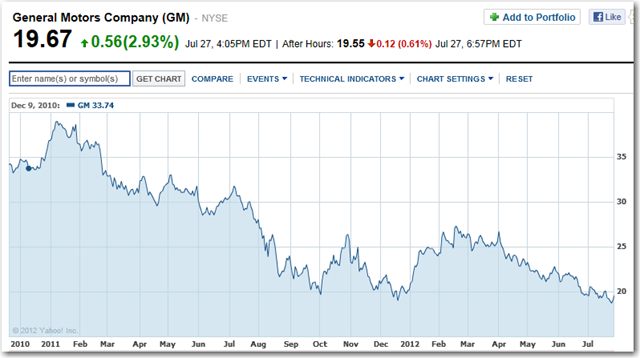
The federal government owns 500,000,000 shares of GM, or about 26% of the company.
The stock is trading at about $20/share, so the government is holding about $10 billion worth of stock
The government’s GM stock is worth about 39% less than it was when the company went public at $33 /share
Since GM’s IPO almost two years ago, the broader S&P 500 has gone up about 30%.
During that period, Ford shares have gone down about 15%, Toyota up about 15%, Honda up about 5%, Nissan up about 35%, Hyundai up about 60% and Volkswagen up about 85%.
Source
It would take about $53.00/share for the gov’t to break even on the bailout.

* * * * *
Car Market
As a company, General Motors peaked in 1965, when it commanded 50.7% of the U.S. market, and made a stunning-for-the-time $2.1 billion dollars in after-tax profits.
In the 1960s, GM averaged a 48.3% share of the U.S. car and truck market.
For the first 7 months of 2012, their market share was 18.0%, down from 20.0% for the same period in 2011.
GM is flailing in the D-car segment (Malibu, Camry) which accountd for about 20% of the U.S. car market.
Recent (and forthcoming) versions of the Malibu score dead last in Car & Driver reviews.
* * * * *
Uh-oh
>> Latest Posts
SHARE THIS POST WITH FRIENDS & FAMILY
Tags: Auto bailout, bankruptcy, GM
Posted in Autos - Travel, GM bailout & IPO | 1 Comment »
August 24, 2012
Stanley Kurtz is a senior fellow at the Ethics and Public Policy Center and author of the new book, “Spreading the Wealth: How Obama Is Robbing the Suburbs to Pay for the Cities”.
His central premise was summarized in Forbes:
In the eyes of the leftist community organizers, suburbs are instruments of bigotry and greed — a way of selfishly refusing to share tax money with the urban poor.
To reverse the trend, some groups advocate systematically redistributing the wealth of America’s suburbs to the cities via “regional tax-base sharing,” a practice by which suburban tax money is directly redistributed to nearby cities and less-well-off “inner-ring” suburbs.

President Obama has lent the full weight of his White House to the efforts.
A federal program called the Sustainable Communities Initiative, for example, has salted planning commissions across the country with “regional equity” and “smart growth” as goals.
These are, of course, code words.
“Regional equity” means that, by their mere existence, suburbs cheat the people who live in cities.
It means, “Let’s spread the suburbs’ wealth around” – i.e., take from the suburbanites to give to the urban poor.
“Smart growth” means, “Quit building sub-divisions and malls, and move back to where mass transit can shuttle you between your 800 square foot apartment in an urban tower and your downtown job.”
Suburbs are for sellouts: That is a large and overlooked theme of Obama’s famous memoir, Dreams from My Father. The city is the moral choice.
He attributed urban decline to taxpayer “flight” to the suburbs.
So, compulsory redistribution of suburban tax money to cities was the only lasting solution to urban decay.
>> Latest Posts
SHARE THIS POST WITH FRIENDS & FAMILY
Tags: cities, suburbs, wealth distribution
Posted in Demograhics, Wealth & Riches, Wealth redistribution | Leave a Comment »
August 23, 2012
A couple of years ago – in the HomaFiles most read post – I tried to answer the question: “Is the U.S. tax system progressive or regressive?”
My conclusion: progressive … for sure.
TIME even picked up the post and said I was “fair minded” and “undeniably right”.
Case closed, right?
Well – in the spirit of fair mindedness – I’ve done some analyses that indicate some degree of regressiveness.
Oh my …
* * * * *
Oft-reported are the facts that — except for anomalies — higher income folks pay higher average income tax rates.

So, why does Warren Buffett whine that his taxes aren’t high enough and middle income people feel so squeezed.
Well, here’s a partial answer.
A couple of weeks ago the Fed released a report that caught my eye.
The Fed’s Survey of Consumer Finances reported a substantial drop in Americans’ net worth … especially for those in the middle income ranges.
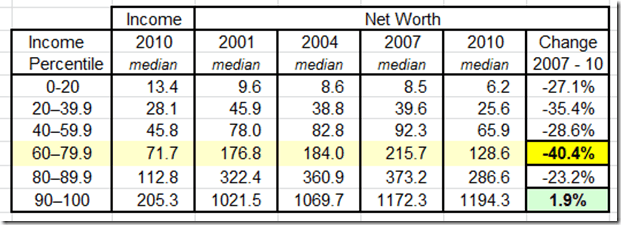
Given the net worth numbers, I tried a different twist on income tax rates … rather than the usual income taxes as a percentage of income, I calc’d another ratio: income taxes as a percentage of net worth.
Gets interesting …
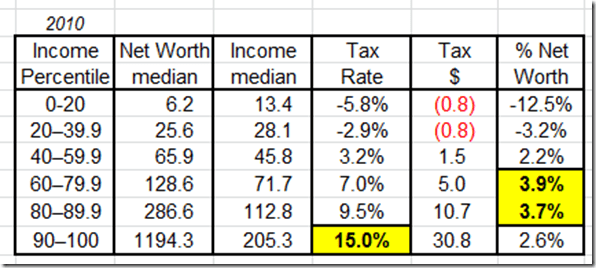
The lowest half still pays nothing or gets a credit. … that doesn’t change no matter how you cut it.
But, the mid-income ranges pay the highest % of net worth.
While only a point or two, suddenly progressive rates becomes regressive.
Hmmm …
>> Latest Posts
SHARE THIS POST WITH FRIENDS & FAMILY
Tags: income tax rates, Income taxes, networth, regressive or progressive taxes
Posted in Taxes | Leave a Comment »
August 23, 2012

According to the Business Insider, these are the 25 companies that throw the toughest interviews …
- McKinsey
- BCG
- Oliver Wyman
- A.T. Kearney
- ZS Associates
- ThoughtWorks
- Bain
- Shell
- Google
- Unisys
- Rackspace Hosting
- Cypress Semiconductor
- Susqueanna Int’l Group
- Bazaarvoice
- P&G
- Teach for America
- LEK Consulting
- Juniper
- Sapient
- Stryker
- General Mills
- Progressive
- Headstrong
- Facebook
- Amazon
Note: the high proportion of consulting and tech companies …
>> Latest Posts
SHARE THIS POST WITH FRIENDS & FAMILY
Tags: Careers, interviews
Posted in Careers & Interviewing | 1 Comment »
August 22, 2012
OK, everybody knows that ObamaCare largely wipes out co-pays and deductibles for preventive medicine.
In other words, patients don’t have to shell out any money … the definition of “free’”, right?
Not so fast.
I always assert to my students that people always, always, always under value their time
See archive post “Time is Money”
Think of the bargain entertainment center you can buy at IKEA for $299.
The purchase price is a steal compared to the fully assembled entertainment center at a furniture store.
But, it takes you two days to assemble it.
At, say $20 per hour, the implicit economic cost of your time is over $200.
Suddenly, it’s no bargain at all.
If you value your time higher than $20 per hour then then economics get even worse.
The principle: “price” is more than the money expended to acquire a product … it also includes the economic cost or searching, acquiring and putting a product into use … and any on-going costs to keep the product maintained and operating.
What does that have to do with preventive medicine?
Simple connection.
According to an article last week in the WSJ: “To meet the promise of free preventive care nationwide, every family doctor in America would have to work full-time delivering it”.
In other words, demand is twice the capacity to supply.
“When demand exceeds supply in a normal market, the price rises until it reaches a market-clearing level.”
That’s Econ 101.
When a price is fixed below the natural “clearing price” then either the product has to be rationed or other economic costs kick in … like the implicit cost of of the time required to acquire the service.
Think about the time involved to get to see a doctor.
First is the scheduling call.
Ever been put on hold or forced to call back?
I have.
Ever been disappointed when told that the first available appointment slot is weeks off?
I have.
Note: For patients in need of services covered by Medicare, the typical wait to see a doctor was two or three weeks
Ever waited for an hour or two or more waiting to see the doctor?
I have.
Note: Studies report that 20% of the patients who come to an emergency room leave without ever seeing a doctor, because they get tired of waiting.
When demand exceeds supply, doctors have a great deal of flexibility about who they see and when they see them.
In marketing economics, it’s called “demand management”.
Demand management has a couple of underlying principles.
One is “Whenever demand exceeds supply take care of loyal customers first, then take care of the other customers willing to pay the most”.
So, if you’re a doctor facing demand that far exceeds your capacity, what do you do?
First, take care of longstanding patients … then service the patients that pay the most – those who pay out-of-pocket or have private insurance.
Who’s last on the list? Government insured patients: MediCare and Medicaid.
How can they possibly do that?
Simple. They can simply act like airlines, restaurants, credit card companies and banks.
For example, once a Medicaid patient’s phone number is in the system, their phone calls can be queued behind any calls from higher paying patients.
Financial service companies have been doing that for years. Whales’ calls get priority routing and faster answers.
Similarly, appointment slots can be capacity constrained by payment type … with relatively few slots per day allocated to low price patients.
Airlines have capacity controlled low priced “leisure” seats for decades.
Once at the office, doctors can keep advancing high pay patients in the waiting queue.
What’s the worse that can happen? A patient that you’re going to lose money serving ups and leaves. Oh well.
The bottom line: free isn’t really free … when you factor in your time … and the possibility of not being served at all.
It’s basic demand management economics.
>> Latest Posts
SHARE THIS POST WITH FRIENDS & FAMILY
Tags: demand management, Free, Healthcare, ObamaCare, prince
Posted in Mktg - Pricing, Mktg- Demand Mangement | 1 Comment »
August 22, 2012
… fool me twice, shame on me.
I’ve oft-noted that I haven’t run into anybody who voted for McCain in ‘08 who’s jumping on the Obama bandwagon this year.
But, I have rum into plenty who voted Obama in ‘08 who aren’t voting for him again in ‘12.
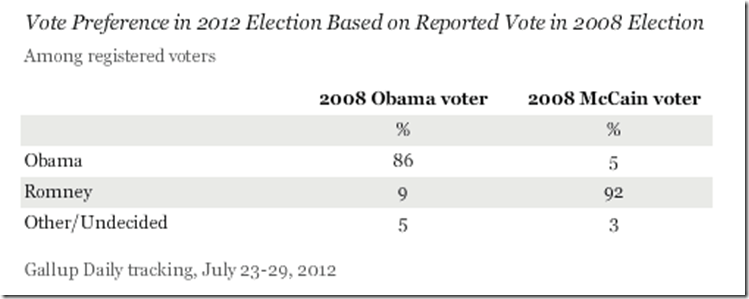
Gallup just released a poll that directionally confirms my anecdotal evidence.
Among registered voters, 0% who voted Obama in ‘08 say they’re voting for Romney; 5% who voted for McCain are hopping on the Obama bandwagon
The 4% difference may not seem like a big deal … except when you’re in a toss-up election.
>> Latest Posts
SHARE THIS POST WITH FRIENDS & FAMILY
Tags: Obama 2012
Posted in 2012 Campaign | Leave a Comment »
August 21, 2012
At the Georgetown student center’s food court, it’s now $5.25.
Ouch.
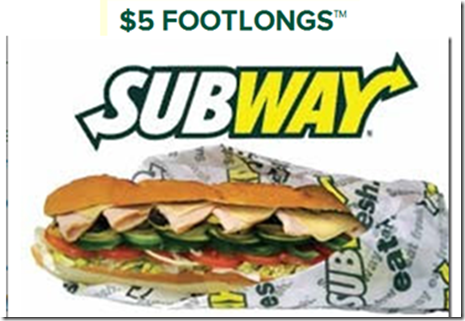
I don’t know if it’s the end of a promotional era or just DC area inflation, but I was sticker shocked when I saw the sign saying the price on my cold cut trio had been jacked up by a quarter.
Trade reports say Subway’s trademarked $5 footlong pricing was a resounding “value pricing” success … driving volume … but, apparently, not enough profits.
Somehow, a $5.25 footlong doesn’t have the same promotional ring, does it?
Oh well.
>> Latest Posts
SHARE THIS POST WITH FRIENDS & FAMILY
Tags: Subway $5 footlong
Posted in Fast food, Food & Drink | Leave a Comment »
August 21, 2012
Background
A colleague and I have been exchanging ideas on this topic.
He’s more liberal than me (no surprise), so it’s an interesting exercise.
We’re starting to find some common ground and develop testable hypotheses.
Here’s one of our initial observations.
Chime in, please … would love your input on this and subsequent reveals.
The big shift in government’s “mission”
Long ago, say 40 or 50 years, the central government mission was to provide essential common services … such as military defense and national infrastructure (aka. “Transportation”).
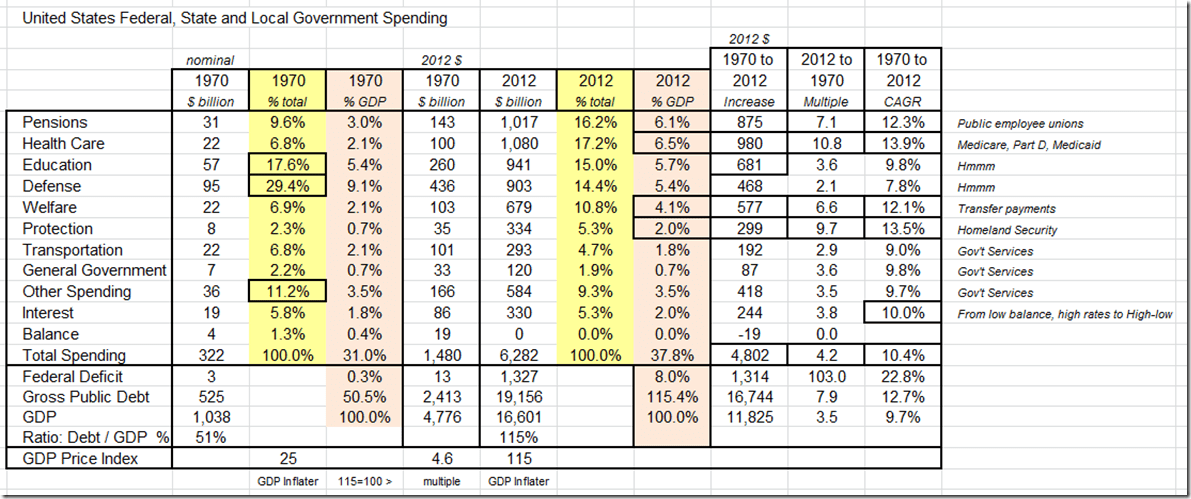
That mission has become more “mixed” over time (see chart below).
Spending on the original essential common services – while still substantial — are proportionately decreased.
For example, military defense was almost 30% of Federal spending in 1970 … it’s less than 15% in 2012.
Some additional layers of spending – consistent with the original mission of essential common services – have been added.
For example, Homeland Security (aka. “Protection”) has been substantially ramped up.
But, the bulk of additional spending over time is attributable to health & welfare entitlements, public employee pensions, education (mostly new Federal programs and administration).
Time bomb warning: Note that “Interest” on the public debt has remained proportionately constant over the 40 year period.
But, of course, the components are very different.
In 1970, there was relatively low debt but high interest rates.
In 2012, we have very high debt with historically low interest rates.
The obvious uh-oh: what happens when interest rates jump up to more “normal” levels?
In other words, spending trends seem to validate the observation that the implicit “government” mission has expanded from a relatively sharp focus on providing essential common services by (1) expanding the scope of declared “essential common services (think DOE and Dept. of Education) and (2) re-missioning to become increasingly a transfer payment hub for “safety net” entitlements.
Ergo the rub.
More to come.
Your views?
>> Latest Posts
SHARE THIS POST WITH FRIENDS & FAMILY
Tags: big government., government mission, government spending
Posted in Gov't Spending, Government & Politics | 2 Comments »
August 20, 2012
They say a picture is worth a thousand words.
Here’s the picture; below are a couple of snippets; click to read the whole article (a must read!).
Couldn’t have said it better myself … send to friends.

Snippets
The question confronting the country … is not who was the better candidate four years ago. It is whether the winner has delivered on his promises. And the sad truth is that he has not.
In his inaugural address, Obama promised “not only to create new jobs, but to lay a new foundation for growth.” He promised to “build the roads and bridges, the electric grids, and digital lines that feed our commerce and bind us together.” He promised to “restore science to its rightful place and wield technology’s wonders to raise health care’s quality and lower its cost.” And he promised to “transform our schools and colleges and universities to meet the demands of a new age.” Unfortunately the president’s scorecard on every single one of those bold pledges is pitiful.
Welcome to Obama’s America: nearly half the population is not represented on a taxable return—almost exactly the same proportion that lives in a household where at least one member receives some type of government benefit. We are becoming the 50–50 nation—half of us paying the taxes, the other half receiving the benefits.
The president has done absolutely nothing to close the long-term gap between spending and revenue.
After all, it’s the president’s job to run the executive branch effectively—to lead the nation. And here is where his failure has been greatest.
Larry Summers told Orszag over dinner in May 2009: “You know, Peter, we’re really home alone … I mean it. We’re home alone. There’s no adult in charge. … You can’t just march in and make that argument and then have him make a decision … because he doesn’t know what he’s deciding.”
The Affordable Care Act (ACA) of 2010 did nothing to address the core defects of the system: the long-run explosion of Medicare costs as the baby boomers retire, the “fee for service” model that drives health-care inflation, the link from employment to insurance that explains why so many Americans lack coverage, and the excessive costs of the liability insurance that our doctors need to protect them from our lawyers.
The president just kept ducking the fiscal issue. Having set up a bipartisan National Commission on Fiscal Responsibility and Reform, headed by retired Wyoming Republican senator Alan Simpson and former Clinton chief of staff Erskine Bowles, Obama effectively sidelined its recommendations of approximately $3 trillion in cuts and $1 trillion in added revenues over the coming decade
For me the president’s greatest failure has been not to think through the implications of these challenges to American power. Far from developing a coherent strategy, he believed—perhaps encouraged by the premature award of the Nobel Peace Prize—that all he needed to do was to make touchy-feely speeches around the world explaining to foreigners that he was not George W. Bush.
America under this president is a superpower in retreat, if not retirement. Small wonder 46 percent of Americans—and 63 percent of Chinese—believe that China already has replaced the U.S. as the world’s leading superpower or eventually will.
It is a sign of just how completely Barack Obama has “lost his narrative” since getting elected that the best case he has yet made for reelection is that Mitt Romney should not be president. In his notorious “you didn’t build that” speech, Obama listed what he considers the greatest achievements of big government: the Internet, the GI Bill, the Golden Gate Bridge, the Hoover Dam, the Apollo moon landing, and even (bizarrely) the creation of the middle class. Sadly, he couldn’t mention anything comparable that his administration has achieved.
Ken’s Take:
There’s not much new news in the article’s content … all of it has been said before somewhere … much has been said here in the HomaFiles.
The news is that a liberal magazine has thrown Obama under the bus.
Newsweek, by breaking from the left-ranks, may have given permission to other media to at least jump off the bus and start reporting squarely.
OMG.
>> Latest Posts
SHARE THIS POST WITH FRIENDS & FAMILY
Tags: Newsweek, Obama, Thrown under the bus
Posted in 2012 Campaign, Obama, Obama - Promises Made & Kept, Obama Administration, ObamaCare | 1 Comment »
August 20, 2012
According to BLS data released last week, the unemployment rate ticked up in 44 out of the 50 (or is it 57) states.
Included are some swing states: Florida, Virginia, Wisconsin and New Hampshire.
Imagine if the Administration’s economic plan wasn’t working …

* * * * *
And, according to IBD … the 5 5 states with the highest unemployment rates voted for Obama in 2008.
Hmmm.

>> Latest Posts
SHARE THIS POST WITH FRIENDS & FAMILY
Tags: Unemployment by state
Posted in Employment - Jobs, Unemployment | Leave a Comment »
August 17, 2012
One more time …
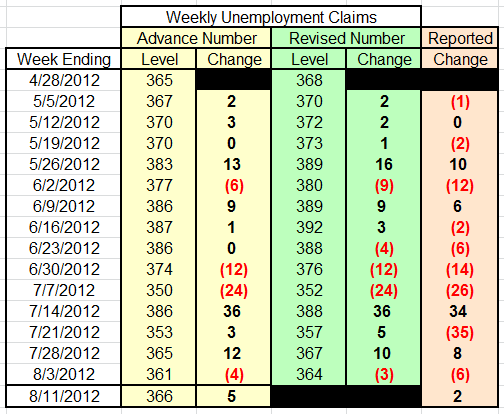
Now we’re up to 74 out of 75 weeks — and, at least 15 weeks in a row — that the BLS’s “headline number” has under-reported the number of initial unemployment claims … and cast the jobs situation as brighter than it really is.
Based on Thursday’s BLS report, the number for the week ending August 3 was revised upward from 361,000 to 364,000.
In itself, the 3,000 isn’t a big deal.
But, in context it is
Again, I ask: statistical bias or political bias?
If the former: fix it already, BLS.
Hint to BLS: just add 2k or .8% to your prelim forecast !

* * * * *
Almost forgot … the preliminary unemployment claims for the week of Aug. 11 are up 5K vs. the Aug. 3 preliminary number and up 2K vs the revised Aug.3 number.
In other words, no indication that a corner has been turned.

>> Latest Posts
SHARE THIS POST WITH FRIENDS & FAMILY
Tags: BLS, statistical bias, unemployment claims
Posted in BLS, Employment - Jobs, Unemployment | Leave a Comment »
August 17, 2012
A new study reported by CBS finds that constantly being online can affect your mental health.
Researchers at the University of Gothenburg found that a majority of them who constantly use a computer and mobile phones can develop stress, sleeping disorders and depression.
“It is easy to spend more time than planned at the computer (e.g., working, gaming, or chatting), and this tends to lead to time pressure, neglect of other activities and personal needs (such as social interaction, sleep, physical activity), as well as bad ergonomics, and mental overload.”
The study also found a correlation between stress and phone use.
“Often using the computer late at 48 night (and consequently losing sleep) was a prospective risk factor for stress and sleep disturbances.”
Takeaway: People need to set limits on computer and cell phone use … to minimize the risk of these types of mental disorders.
>> Latest Posts
SHARE THIS POST WITH FRIENDS & FAMILY
Tags: cell phones, mental disorders, online, stress
Posted in Mental Health, Online Behavior, Stress | Leave a Comment »
August 17, 2012
Pundits – all of whom mis-predicted the Supreme Court decision – were largely split re: whether the decision would boost Obama’s or Romney’s Presidential chances.
Well, based on this week’s NYT-CBS poll, the SCOTUS decision was a boost for Romney:
28% said they were more likely to vote for Romney … only 13% said that they were more likely to vote for Obama … that’s more than 2 to 1.
Fair to say that the SCOTUS decision was a force boosting Romney into a dead heat in the election poll.

* * * * *
SCOTUS & Politics
From the same poll, a majority felt that the SCOTUS decision was based on personal or political views rather than the law.
That can’t be good …

>> Latest Posts
SHARE THIS POST WITH FRIENDS & FAMILY
Tags: Obama, ObamaCare decision, Romney, SCOTUS
Posted in 2012 Campaign, Obama, ObamaCare, Supreme Court | Leave a Comment »
August 16, 2012
According to UK’s Daily Mail …
Recent IQ research indicates that women are brighter than men … more clever … and better at multi-tasking.
Since IQ testing began a century ago, women have been as much as five points behind.
But that gap has been narrowing in recent years and this year women have moved ahead.
‘In the last 100 years the IQ scores of both men and women have risen but women’s have risen faster.’
Women are cleverer than men.
One indication: they’re better at multi-tasking.
I’ve often said that the Lord shouldn’t have taken that 7th day off … she still had some work to do designing us guys.
>> Latest Posts
SHARE THIS POST WITH FRIENDS & FAMILY
Tags: IQ, multi-tasking, women smarter than men
Posted in IQ - IQ Scores | 1 Comment »
August 16, 2012
On Monday, I laid out the Brer Rabbit strategy that I thought Team Romney was implementing.
Note: Pundits are now calling it “Political Jujitsu”
The essence: name Ryan and lure Team Obama into the Medicare trap … get them to repeat their claim that Ryan wants to throw granny off a cliff … and then bang … counter attack and put ObamaCare on the table.
Team Romney probably didn’t expect help from others , it got some.
First, a video of Erskine Bowles – you know, of Simpson-Bowles fame – went viral.
The video shows Bowles (a Democrat) praising Ryan and his budget.
“Have any of you all met Paul Ryan? We should get him to come to the university. I’m telling you this guy is amazing. … He is honest, he is straightforward, he is sincere. And the budget that he came forward with is just like Paul Ryan. It is a sensible, straightforward, serious budget and it cut the budget deficit just like we did, by $4 trillion. … The president as you remember, came out with a budget and I don’t think anybody took that budget very seriously. The Senate voted against it 97 to nothing.”
click to view vid

* * * * *
On cue, the Dem talkers started ripping on Ryan.
As soon as they did, Team Romney launched the counter-attack … reminding folks that Medicare funds were being raided to pay for ObamaCare … taking Medicare funds away from seniors and sprinkling them to others.
click to view vid

* * * * *
On cue, the Dem talkers denied that Obama would ever consider raiding Medicare.
Oops.
Tape on file shows Pres. Obama telling Jake Tapper of ABC that he would, he did, and he’d make it stick.”
TAPPER: One of the concerns about health care and how you pay for it — one third of the funding comes from cuts to Medicare.
PRESIDENT BARACK OBAMA: “Right.”
TAPPER: Are you willing to pledge that whatever cuts in Medicare are being made to fund health insurance, one third of it, that you will veto anything that tries to undo that?
OBAMA: Yes.
click to view vid

* * * * *
That’s called “hoisting yourself by your own petards.”
>> Latest Posts
SHARE THIS POST WITH FRIENDS & FAMILY
Tags: Mecicare, Obama, ObamaCare, Romney, Ryan
Posted in 2012 Campaign, Medicare, ObamaCare, Romney, Mitt | 1 Comment »
August 15, 2012
According to the Business Insider, the answer is a resounding “no”.
Five of the “10 Unhappiest Jobs in America” are in marketing or sales.
Arguably, 6 of the 10 if you count program managers
Ouch.
Security Officers are the least happy folks in their jobs
Here’s the full list:
1. Security Officer
2 Registered Nurse
3 Teacher
4 Sales Engineer
5 Product Manager
6 Program Manager
7 Marketing Manager
8 Director of Sales
9 Marketing Director
10 Maintenance Supervisor
… see the source for details.
* * * * *
Ken’s Take: Geez, and teacher is number 3 on the list.
As a happy teacher and recovering marketer, I don’t buy the survey results
But, it is what folks are reading about the noble marketing profession.
Antidote: Honk if you’re a happy marketer !
>> Latest Posts
SHARE THIS POST WITH FRIENDS & FAMILY
Tags: job happiness, Marketing, marketing careers
Posted in Mktg - Careers | Leave a Comment »
August 15, 2012
Excerpted from a Hoolihan Lokey pitch to the National Association of Corporate Directors …
First the facts …
The amount of cash on U.S. corporate balance sheets is at historical levels and continues to rise
Why?
- Cash is a risk management tool — buffering against economic & regulatory uncertainty
- Cash is a hedge against a disruption in accessing the capital markets … think 2008.
- Cash ensures that a company can maximize its ability to act on opportunistic investment opportunities
Companies have been building cash positions to record levels
* * * * *
How much?
In Q4 2011, total liquid financial assets on US non-financial balance sheets reached $2.3 trillion
Of the $2.3 trillion, it is estimated that approximately 30%, or $695 billion, is excess cash
* * * * *
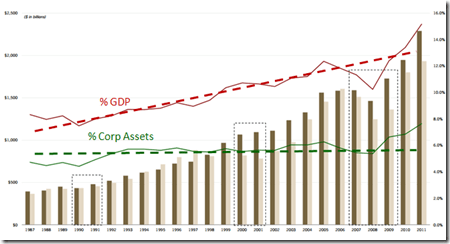
The ratio of cash to total corporate assets has increased from a relatively stable historical level of 6% to 7.6% …
The ratio of cash to GDP has been steadily rising for the past 20 years … dipped from 12.5% to about 10% from 2005 to 2009 … but, increased from 10% to over 15% from 2009 to now.
* * * * *
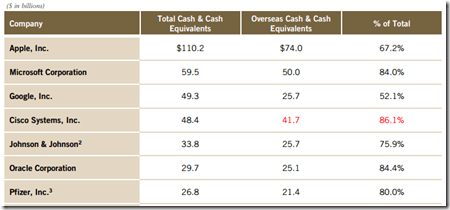
5 of the 10 companies with the highest cash balances are technology-based (Apple, Microsoft, Google, Cisco, Oracle) … 2 are car companies GM and Ford … and 2 are pharma-related (J&J and Pfizer)

* * * * *
For the biggest cash holders, most of the cash is held off-shore.
* * * * *
So what?
While left-leaning pundits think that the cash balances to hire more employees — a seriously flawed economic thought — historically, companies have applied available cash to:
- Pay down debt (deleverage)
- Invest in organic growth (capital expenditures)
- Make acquisitions
- Return Return capital capital to shareholders dividends or share repurchases
Note that hiring unneeded, non-economic employees isn’t on the list …
Stay tuned.
>> Latest Posts
SHARE THIS POST WITH FRIENDS & FAMILY
Tags: corporate cash balances, deleveraging, hoarding cash
Posted in Corporate cash balances, Deleveraging | Leave a Comment »
August 14, 2012
Back about 40 years ago, an economist-wannabe co-authored a study in the Journal of Finance titled “The Supply of Money and Common Stock Prices”.

The article summarized an econometric study that demonstrated a tight link between the amount of money floating around and, on a slightly time-delayed basis, the price of stocks.
OK, fast forward to today.
Now, when the Feds expand the money supply, it’s called “Quantitative Easing” … or QE, for short.
Recently, Jason Trennert of Strategas Research Partners published a revealing chart that visually relates stock prices (the S&P 500) to the recent periods of quantitative easing.
Hmmm.
Looks like the supply of money and common stock prices are still related.
Partially explains why the Dow is over 13,000 despite a sluggish and uncertain economy.

>> Latest Posts
SHARE THIS POST WITH FRIENDS & FAMILY
Tags: Federal Reserve, QE1, QE2, Supply of Money & Common Stock Prices
Posted in Finance & investing, Financial Models, Ken - Misc., Stock Market | 1 Comment »
August 14, 2012
Ac couple of weeks ago we reported a study that consumers almost invariably pick 33% more stuff than a 33% price discount.
Ouch.
Consumers are notoriously bad at spotting real values. Why?
According to the Atlantic ….
- First: Consumers don’t know what the heck anything should cost, so we rely on parts of our brains that aren’t strictly quantitative.
- Second: Although humans spend in numbered dollars, we make decisions based on clues and half-thinking that amount to innumeracy.
More specifically, here are some more ways consumers end up paying too much …
- Anchoring Effect: People are heavily influenced by the first price we see … it’s called “anchoring” … that’s why the appliance salesman shows you the most-featured, highest-priced appliance first … it makes every other appliance seem like deal.
- Aversion to Extremes: People are terrified of extremes … they don’t like buying the cheapest item … or the most costly … they shy away from prices that appear too high or too low.For example, in one famous study, people were offered 2 kinds of beer: premium beer for $2.50 and bargain beer for $1.80.
Around 80% chose the more expensive beer.
When a third beer was introduced, a super bargain beer for $1.60, 80% bought the $1.80 beer and the rest $2.50 beer. Nobody bought the cheapest option.
Then researchers removed the $1.60 beer and replaced with a super premium $3.40 beer.
Most people chose the $2.50 beer, a small number $1.80 beer and around 10% opted for the most expensive $3.40 beer.
- Shining Light Effect: Savvy restaurants, for example, design their menus to draw our eyes to the most profitable items by things as simple as pictures and boxes.Good rule of thumb: If you see a course on the menu that’s highlighted, boxed, illustrated, or paired with a really expensive item, it’s probably a high-margin product that the restaurant hopes you’ll see and consider.
- Dulled senses: Alcohol narrows the range of complicating factors people can hold in their heads at once. People are easily made dumber by alcohol, time, decisions.When we’re drunk, stressed, tired, and otherwise inattentive, we’re more likely to ask and answer simple questions about buying things.
Cheap candy bars and gum are situated near the check-out at grocery stores because that’s where exhausted shoppers are most likely to indulge cravings without paying attention to price.
- Concealed habits: To save some $$$, cancel recurring payments like gym memberships and subscriptions to papers and services you don’t use.Cancelling is a hassle, right?
So what?
Cancel that subscription.
- Peace of mind… allows some companies to make more money on extended warranties and service contracts than they do on their productsExcept for PCs (high prices, risk of crashes), extended warranties don’t pay-off … otherwise, why would retailers push them so aggressively?
>> Latest Posts
SHARE THIS POST WITH FRIENDS & FAMILY
Tags: Behavioral Economics, innumeracy, math, pricing
Posted in Behavioral Economics, Mktg - Consumer Behavior, Mktg - Pricing | Leave a Comment »
August 13, 2012
First, the disclaimers: (1) I’m rooting for Romney and (2) I was hoping for Marco Rubio.
Why Marco.
Simple.
As H.L. Menchken is oft-quoted:
“No one ever went broke or lost office underestimating the intelligence of the American public.”
I think the majority of people who vote are poorly informed – accepting politicians’ focus group tested talking points — and cast their votes based on habit, group association or superficial candidate characteristics.
So, I figured that Rubio – a cool, good looking, young, articulate Latin guy – could deliver Florida, sway some Hispanics and make some single women swoon.
In other words, strictly a vote-getting maneuver.
Morning after, I like the Ryan pick.
Why?
He’s squeaky clean. The Team Obama muckrakers will go crazy trying to find dirt on the guy.
He’s very smart … knows the details, not just the storylines … won’t get Palinized
He’s very articulate … he’ll shred Biden in the VP debate … in fact, I’d love to see him go up against Obama with a neutral moderator (think back to Ryan’s performance in the infamous healthcare summit).
He’s all-Midwest … an area the GOP has to win … puts Wisconsin in play.
He’s Catholic … maybe the bishops will stand behind him on freedom of religion
Fiscal conservatives love him … remember 2010?
What’s the downside?
Yeah, Medicare.
Dust off the “throw Granny over the cliff ad”.
Here’s my take: Medicare is the GOP’s equivalent of Brer Rabbit’s briar patch.
I think they want it on the table.
But, you say, they’ll lose seniors.
Not so fast.
I think that bomb will be easy to diffuse … and as a bonus, it puts ObamaCare back in play:
If you are on Medicare, your benefits will not be cut. Period
In fact, Romney & I will do our best to repeal ObamaCare and restore the $500 billion of Medicare cuts that are in the law.
Think about it.
What good is Medicare if doctors stop accepting Medicare patients?
What good is Medicare if some Washington bureaucrat decides that you’re too old to get your bad hip replaced?
Romney & I won’t let that happen. Period.
I think that this is going to get interesting …
>> Latest Posts
SHARE THIS POST WITH FRIENDS & FAMILY
Tags: Medicare, ObamaCare, Romney, Ryan, Tea Party
Posted in 2012 Campaign | Leave a Comment »
August 13, 2012
According to court testimony in the Apple v. Samsung patent trial …
Apple no longer actually needs to do ANY advertising when it launches new products.
So testified marketing chief Phil Schiller
Instead, the company relies on these two strategies:
- Positive media buzz, e.g. glowing product reviews.
- Product placement in TV shows and movies.
The media is so reliably disposed to favor Apple’s products that when the iPhone was launched in 2007, the company didn’t do any advertising during a brief period after the device was introduced in January 2007 and when it went on sale later in the year.
“We didn’t need to.”
The rave reviews of the iPhone and iPad did a better job than advertising to build buzz.
Apple also relies heavily on product placement: “We love to see our products used by stars in movies and television shows.
* * * * *
Memo to JCP CEO Ron Johnson: JC Penney isn’t Apple !
>> Latest Posts
SHARE THIS POST WITH FRIENDS & FAMILY
Tags: advertising buzz, Apple, JC Penney, product placements
Posted in Mktg - Brands, Mktg - Buzz - Word of Mouth, Mktg - Product Placements | Leave a Comment »
August 12, 2012
Team Obama says “Bush’s failed policies of tax cuts to the rich got us into this problem”.
Oh, really?
Team Romney says “The worst recovery ever”.
Oh really?
Let’s cut to the chase.
First, I assert that the housing crash was a bi-partisan effort brewed over several decades … hard to say that it was caused by Bush’s tax policies.
Second, I’ll give Obama that he inherited a mess … and, I’ll start counting from the trough.
Well, well, well.
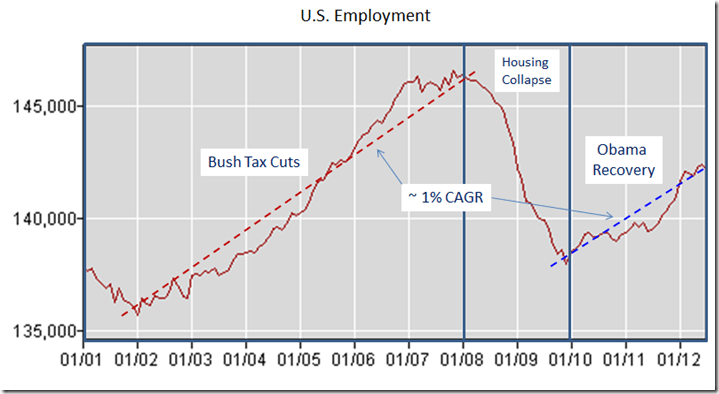
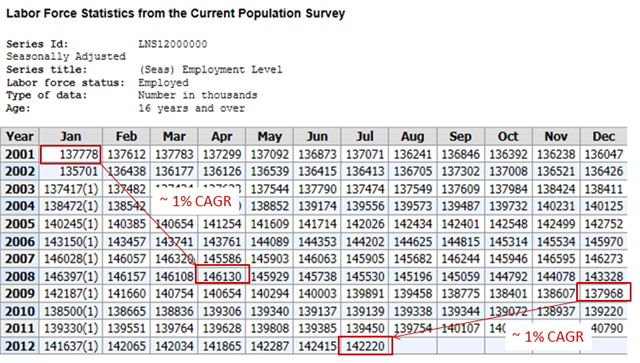
Turns out that – with the above assumptions — the growth in employment under Bush and Obama (to date) is pretty much equal … at about a 1% compound annual rate.
Hmmm.
On one hand, Obama got handled a financial collapse … not just a garden variety business cycle recession.
On the other hand, Obama continued the Bush tax rates … and he (and the Fed) have expended trillions in fiscal and monetary stimulus.
But, Obama continues to run around saying that the Bush tax rates are the cause of all evil … and eliminating them for the wealthy will get us out of this mess.
Oh, really?

>> Latest Posts
SHARE THIS POST WITH FRIENDS & FAMILY
Tags: Bush, employment, Obama
Posted in Bush tax cuts, Employment - Jobs, Obama, Unemployment | Leave a Comment »
August 10, 2012
I can post this post on auto-generate, I guess …
Now we’re up to 73 out of 74 weeks — and, at least 14 weeks in a row — that the BLS’s “headline number” has under-reported the number of initial unemployment claims … and cast the jobs situation as brighter than it really is.
Based on Thursday’s BLS report, the number for the week ending July 28 was revised upward from 365,000 to 367,000.
In itself, the 2,000 isn’t a big deal.
But, in context it is
Again, I ask: statistical bias or political bias?
If the former: fix it already, BLS.
Hint to BLS: just add 2k or .8% to your prelim forecast !

* * * * *
Almost forgot …
The 4-week moving average of initial unemployment claims bumped up 2,250 to 368,250 … suggesting that the corner hasn’t been turned yet.
SHARE THIS POST WITH FRIENDS & FAMILY
Tags: BLS, employment, statistical bias, unemployment
Posted in BLS, Employment - Jobs, Statistical Bias, Unemployment | Leave a Comment »
August 10, 2012
A123 Systems was supposed to be one the U.S. companies to propel the green energy revolution … by designing, making, and supplying batteries to hybrids and electric cars (think Volts).
A123 received more than $200 million from venture investors before raising $378 million in a 2009 initial public offering.
Also in 2009, it was awarded a $249 million green-technology grant under the Obama administration’s $2.4 billion Electric Drive Battery and Component Manufacturing Initiative.
But, things haven’t been going so good for electric cars and A123.
A123 said second-quarter revenue fell 53 percent to $17 million … the company’s second-quarter loss of was $82.9 million … and cash dwindled to the point that the company can only fund its operations for the next four to five months.
So, according Auto News, China’s largest automotive parts supplier is now poised to take control of A123.
China’s Wanxiang Group Corp. plans to invest up to $450 million in A123 Systems, taking an 80 percent stake in A123.
* * * * *
Ken’s Take: So much for energy independence and government venture capitalism.
>> Latest Posts
SHARE THIS POST WITH FRIENDS & FAMILY
Tags: A123, autos. electric batteries, China
Posted in Autos - Travel, Batteries - Lithium Ion | Leave a Comment »
August 10, 2012
A New York Times article reported that the president is encountering more youthful skepticism than in 2008: “The nation’s first-time voters are less enthusiastic about him … and cite a growing lack of faith in government in general.”
from RealClearPolitics …
Give the Obama Youth credit for this: At least — in the last election — they didn’t vote their self-interest.
In the cold light of day, the youthful idealists, believers and activists of 2008 look like the lamentable saps, patsies and suckers of 2012.
In 2008, candidate Obama promised young voters the moon, and all they got was their old childhood bedroom back in their parents’ house. By one count, half are unemployed or underemployed.
He sold a new kind of politics and gave them more debt and more entitlement spending that they will labor to fund all their working lives.
But, hey, did you see Obama “slow jam” the news on “Late Night With Jimmy Fallon”?
But, not all youth are setting themselves up to be duped again.
The below 1-minute video — produced by students at the Univ. of Tennessee — is approaching 1 million Youtube hits.
Maybe there’s hope for change …
click to view video

Thanks to JC for feeding the lead
>> Latest Posts
SHARE THIS POST WITH FRIENDS & FAMILY
Tags: discouraged voters, Obama Youth, University of Tennessee
Posted in Politics | Leave a Comment »
August 9, 2012
From the great moments in marketing file …
If you wan people to buy your product, give ‘em a free sample.

Excerpted from from the NYT …
In a special promotion, Trojan Vibrations is handing out 10,000 vibrators from two Manhattan hot dog carts identified as pleasure carts.
Along with the brand’s logo, the carts will feature sayings like “Getcha vibes here!” and “Relish the moment.”
“We thought that by giving out more vibrators, it would create some buzz, so to speak”
Trojan asserts this is the biggest handout of vibrators ever.
So new are the devices to mainstream retailers that growth in that channel has been phenomenal.
In the past year, revenue for sexual enhancement devices sold in drugstores and mass retailers grew 23.2 percent over the year before, to $16.1 million.
According to studies financed by Trojan and published in The Journal of Sexual Medicine, 52.5 percent of women and 44.8 percent of men have used vibrators.
Contrary to perceptions that they are used nearly exclusively by the unaccompanied, 40.9 percent of women and 40.5 percent of men report having used them with sexual partners.
“What we’re doing is taking something like a hot dog cart that is so everyday and so mainstream … and we’re showing people that vibrators are mainstream.”
Carol Queen, curator of the Antique Vibrator Museum and a staff sexologist for Good Vibrations, a sexual products retailer founded in 1977, credits the new Trojan ads with “pretty seamlessly integrating men into the campaign.”
Rather than seeing the growing availability of the devices at mass retailers as a threat to specialty retailers like Good Vibrations, Ms. Queen said, “what’s fabulous about the way that Trojan has entered the marketplace is that a rising tide lifts all boats.”
Some consumers who buy their first device as an impulse buy at a mass retailer are apt to eventually be drawn to boutiques … with trained people who can answer your questions and help you choose,
You just can’t make this stuff up …
>> Latest Posts
SHARE THIS POST WITH FRIENDS & FAMILY
Tags: free vibrators, hot dog carts, product sampling, promotions
Posted in Great Moments in Marketing, Mktg - Buzz - Word of Mouth, Mktg - Promotion | Leave a Comment »
August 9, 2012
Goes to Romney !
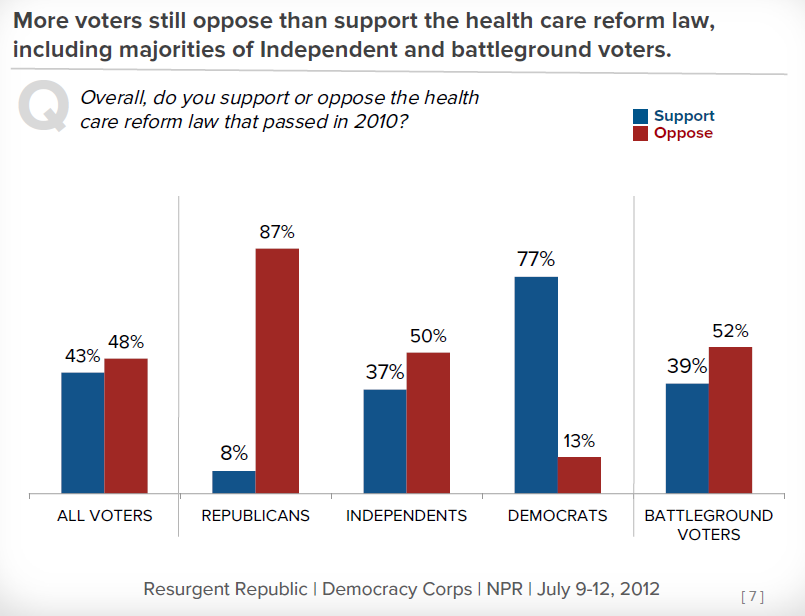
According to last week’s NPR poll , likely voters in the battleground states oppose ObamaCare 52% to 39%.
Hmmm.

>> Latest Posts
SHARE THIS POST WITH FRIENDS & FAMILY
Tags: battleground states, NPR, ObamaCare, swing states
Posted in 2012 Campaign, NPR, ObamaCare | Leave a Comment »
August 8, 2012
One of the America’s Got Talent quarter-finalists this year was a nasty guy named Horse.
His talent: an ability (and willingness) to take repeated shots to the family jewels.
Warning: viewer discretion advised … guys, it may hurt just to view the clip or read the scientific info below..
click for AGT video

Fortunately, Horse didn’t pass through to the semi-finals.
But, he got me wondering …
Why does it hurt so much?
Here’s the scientific explanation.
Excerpted from mentalfloss.com …
More than any other bodily injury, getting hit in the family jewels is probably what every man dreads most … of all the spots on the human body, none register the same kind of incapacitating, end-of-the-world pain .
What causes such inconceivable pain?
Well, for starters, because of nerves, it’s gonna hurt.
Unlike most other parts of your body, though, the scrotum lacks protection in the form of bones, large muscle mass, and fat …. it absorbs the whole force of the blow all on its own.
Second, the groin has a ridiculously high number of sensory nerve endings, and such generous innervation makes good and bad touches alike very “noticeable” sensations.
And the pain doesn’t just stay down there … It radiates throughout the groin and up into the abdomen (and, psychically, out to every other dude standing within a few feet), leading to a weird stomach ache.
This is the work of a phenomenon known as referred pain, which is when a sensation originating at one spot travels along a nerve root to other parts of the body and is perceived as happening there, too.
The pain starts in the groin and travels up the perineal and pudendal nerves and the spermatic plexus … to the abdomen and around the spine.
* * * * *
Design flaw ?
Why is such a sensitive and delicate body part just hanging there in the open?
The placement of the testicles is inconvenient, but absolutely necessary.
The testes’ job is to produce sperm, and sperm are very fragile. They’re extremely sensitive to high and low temperatures, and must be kept away from the rest of the body.
They can handle human body temps for only one to four hours, or the average amount of time it takes them to travel through the female reproductive tract and fertilize an egg.
Internal testes or any type of significant shielding for them would heat them up too much, too early and make them drop out of the race well before reaching the egg, rendering them useless.
Ken’s Take: (1) OUCH ! (2) Compelling proof that god is a woman.
>> Latest Posts
SHARE THIS POST WITH FRIENDS & FAMILY
Tags: Jackass, kicked in the groin, ouch, pain, Science
Posted in Health & Nutrition, Laughs, Physiology | Leave a Comment »
August 8, 2012
My students know that, at heart, I’m a quant guy and encourage market research over gut feel.

So, I should salivate over the Obama campaigns reliance on market research, data mining, and precision messaging.
Excerpted from WSJ
The Obama campaign has elevated poll-testing and focus-grouping to near-clinical heights.
The results from his vaunted focus groups drive the president’s every action: his policies, his campaign venues, his targeted demographics, his messaging.
More specifically, spotted an interesting analysis in The Hill:
Recent campaign spending records of the Obama campaign, disclosed that they’ve spent $15 million on polling since the first of the year.
Based on typical polling rate card, $15 million for polls translate to about 6 million minutes of polling time.
Assuming interview lengths of 10 minutes, that’s like 600,000 interviews.
Of course, “polling” doesn’t necessarily mean one-on-one interviewing.
Perhaps as much as a third of the $15 million may have been spent on focus groups and ad testing with dials.
Again, using normal rate cards, upwards of 4,000 Americans may have been asked to participate in these test sessions.
Yep, from the pollsters lips to the teleprompter’s ears … to the candidate’s lips … to the voters ears.
So, what’s my beef?
First, lack of “authenticity” … a willingness to say anything to anybody if it polls well … even if it’s not true (e.g. the multiple Pinocchios that the Wash Post gave to the Bain outsourcing riff and the incredible “I spend less than any President since Harry Truman)
Second, a willingness to “tailor” the message to different groups or individuals … i.e. to pander shamelessly.
And, the larger point: losing the forest in the trees … whipsawing based on minutiae and missing the big picture,
After all, it’s the economy, stupid.
>> Latest Posts
SHARE THIS POST WITH FRIENDS & FAMILY
Tags: market research, Obama Campaign, political polling
Posted in 2012 Campaign, Mktg - Consumer Behavior, Mktg - Research, Political polling | 1 Comment »
August 7, 2012
The Business Insider says …
He might cavort with video vixens and rap about diamond-encrusted grills, but Houston rapper Slim Thug knows a thing or two about living within his means.
The self-proclaimed Black Suze Orman penned a 47-page e-book (ahem, “financial manifesto”) called “How to Survive the Recession”.

Some of Thug’s wisdom:
- “If you can’t buy it THREE times over, you can’t afford it.”
- “Never buy a house with unnecessary space”
- “Never have a Bentley with a Benz salary.”
- “Why pop a hundred bottles when it only takes a couple to get drunk?“
- “Dude, say you got a million dollar check … You got to pay damn near half of it to taxes.”
Couldn’t have said it better myself, Thugga.
Now, off to pop the minimum number of bottles …
Thanks to SMH for feeding the lead.
>> Latest Posts
SHARE THIS POST WITH FRIENDS & FAMILY
Tags: financial advice, Slim Thugg, Suze Orman, Thugga
Posted in Finance & investing, Laughs, Rappers | Leave a Comment »
August 7, 2012
A picture is worth a thousand words.
So, here’s a picture.

Source: AEI
>> Latest Posts
SHARE THIS POST WITH FRIENDS & FAMILY
Tags: Jobs, Obama, plan worked, unemployment, unemployment rate
Posted in BLS, Employment - Jobs, Obama, Obama - Promises Made & Kept, Unemployment | Leave a Comment »
August 6, 2012
Basic answer: it depends.
It depends on which BLS survey you look at.
The BLS’ “Establishment Survey” polls businesses and collects data on hiring and firing.
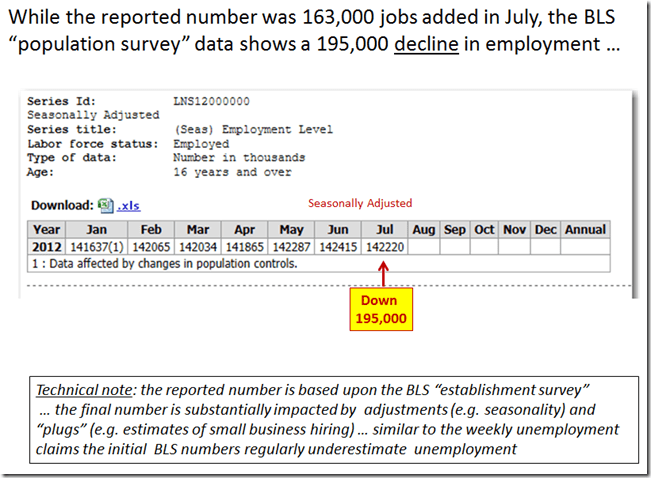
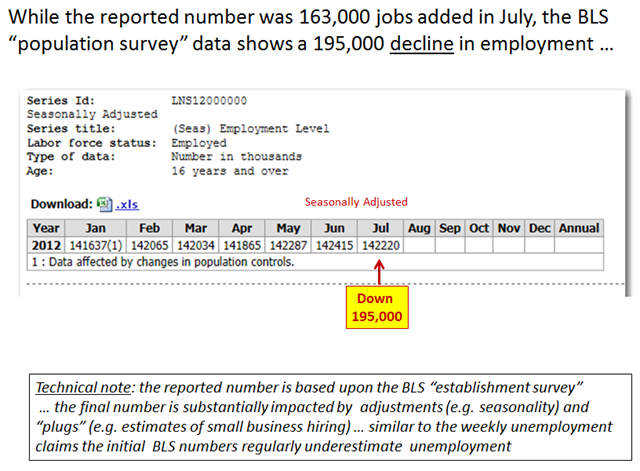
It says that 163,000 jobs were added in July … reversing a recent slide.
The BLS’ “Population Survey” polls people instead of businesses and collects data on whether they’re employed, unemployed, looking for work.
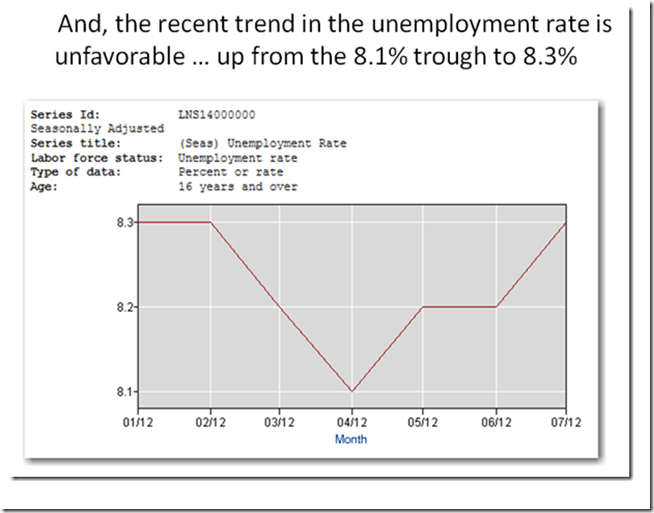
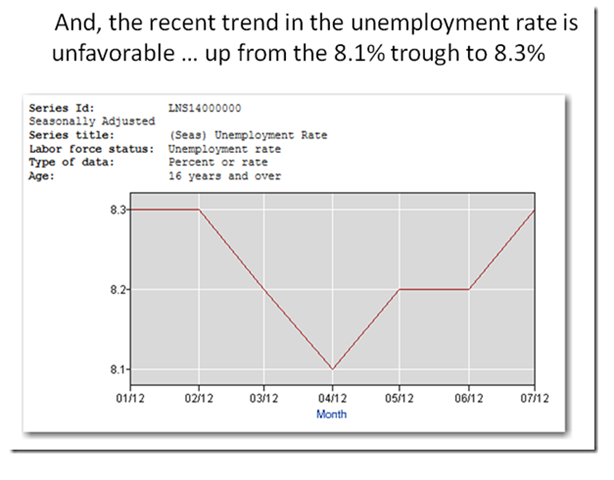
The Population Survey says that 195.000 jobs were lost in July … which is why the unemployment rate increased to 8.3%
Note:
- Both surveys are conducted by the BLS
- The Establishment Survey – which heavily guesstimates small biz hiring & firing — is the headline jobs number.
- The Population Survey is the basis for the headline unemployment rate
- From the lips of the BLS: “Both the payroll and household surveys are needed for a complete picture of the labor market. The payroll survey provides a highly reliable gauge of monthly change in nonfarm payroll employment. The household survey provides a broader picture of employment including agriculture and the self-employed.
* * * * *

* * * * *
* * * * *
>> Latest Posts
SHARE THIS POST WITH FRIENDS & FAMILY
Tags: BLS, Economy, employment, unemployment jobs added
Posted in BLS, Employment - Jobs, Unemployment | Leave a Comment »
August 6, 2012
Last Friday’s Rasmussen Report paints an interesting picture.
Disclaimer: yes, Rasmussen tends to lean right.
I’ve always been a proponent of the “top box effect” … i.e. focusing of folks who either strongly approve or strongly disapprove of a product … or a candidat.
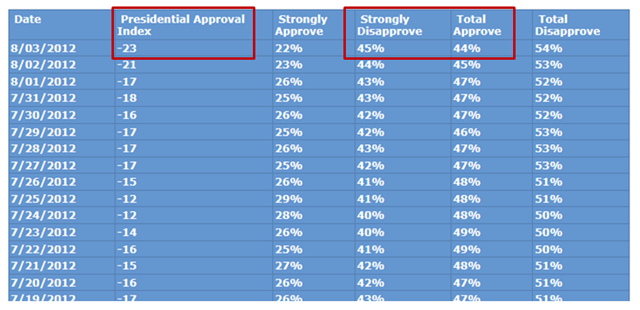
Well, Rasmussen reports that President Obama’s “Presidential Approval Index” – the strongly approves minus the strongly disapproves – is now 23 points underwater.
And, the number of folks who strongly disapprove outnumber the total number who approve (strongly plus somewhat) … 45% to 44%
Those are what’s called statistically significant numbers !

>> Latest Posts
SHARE THIS POST WITH FRIENDS & FAMILY
Tags: Obama, Presidential Approval Index, Rasmussen, top box effect
Posted in 2012 Campaign, Obama, Polls & Surveys, Rasmussen | Leave a Comment »
August 3, 2012
In a Huffington Post article, former boxer and now (punch-drunk) Senate Majority Leader Harry Reid charged that Mitt Romney …
“ …didn’t pay taxes for 10 years!
Now, do I know that that’s true? Well, I’m not certain,” said Reid.
“But obviously he can’t release those tax returns.
How would it look?
Hmmm.
If true, that puts Romney in good company: the roughly 50% of tax filers who pay no income taxes.
Suddenly, Mitt’s a person of the people … a populist.
OMG.
* * * * *
P.S. Even Jon Stewart called out Reid on this one!
Watch the vid clip …
>> Latest Posts
SHARE THIS POST WITH FRIENDS & FAMILY
Tags: 1%, 50% income taxes, Harry Reid, Mitt Romney
Posted in 2012 Campaign, Taxes | Leave a Comment »
August 3, 2012
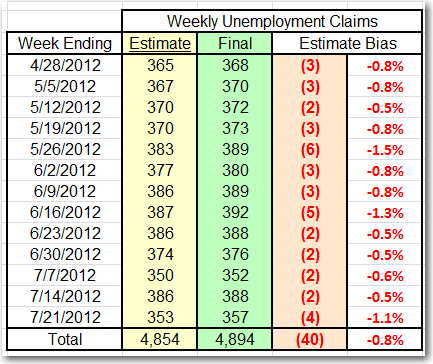
Now we’re up to 72 out of 73 weeks — and, at least 13 weeks in a row — that the BLS’s “headline number” has under-reported the number of initial unemployment claims … and cast the jobs situation as brighter than it really is.
Based on Thursday’s BLS report, the number for the week ending July 21 was revised upward from 353,000 to 357,000.
In itself, the 4,000 isn’t a big deal.
But, in context it is
Again, I ask: statistical bias or political bias?
If the former: fix it already, BLS.
Hint to BLS: just add 2k or .8% to your prelim forecast !

* * * * *
Almost forgot …
Ahead of this morning’s BLS unemployment report, Gallup’s unemployment rate bumped up .2% during July and first time unemployment claims increased last week.
My bet BLS will claim we’re steady at 8.2% … and, further nick their credibility.

Errata: last line of chart should be dated 7/28/12 … sorry.
>> Latest Posts
SHARE THIS POST WITH FRIENDS & FAMILY
Tags: BLS, statistical bias, unemployment claims
Posted in BLS, Employment - Jobs, Unemployment | Leave a Comment »
August 3, 2012
I went to an Orioles game last week and was struck by a grand irony.

To provide context & contrast, remember a couple of years ago when an SEIU mob swarmed the house of a B of A executive?
Happened that Nina Easton – a Fortune reporter – lived next door, was at home to witness the events, and wrote about the incident in Fortune:
Last Sunday, on a peaceful, sun-crisp afternoon, my front yard exploded with 500 screaming, placard-waving strangers on a mission to intimidate my neighbor, Greg Baer.
Baer is deputy general counsel for corporate law at Bank of America.
Waving signs denouncing bank “greed,” hordes of invaders poured out of 14 school buses, up Baer’s steps, and onto his front porch.
Baer’s teenage son Jack — alone in the house — locked himself in the bathroom. “When are they going to leave?” Jack pleaded when I called to check on him.
Police were summoned, but stood by idly … letting the mob rule.
Hmmm.
OK, now fast forward to my trip to Camden Yards.
A couple of times during the game the scoreboard flashed:
“Trespassing on the field is a crime. Violators will be arrested and prosecuted.”
Tell me, why is it a major crime for some drunk jackass to run across the field and slide into one of the bases?
Practically everybody in the park belly laughs watching, nobody gets hurt.
OK, a too-long game gets extended by a couple of more minutes.
So what?
Last year at an O’s game, a wingnut ran around the field eluding a pack of cops and was about to slide into home plate when an umpire tackled him.
Citizen’s arrest, I guess.
Geez.
Now, back to my serious point.
Is running on a baseball field such an threatening act that police need to rush onto the field to corral and cuff the perp?
Apparently, yes.
So then, why don’t cops feel obligated to cuff somebody when their mob threatens a 14 year old kid?
Seems to me like something is badly out of whack.
>> Latest Posts
SHARE THIS POST WITH FRIENDS & FAMILY
Tags: baseball, prosecutions, trespassing
Posted in Laws - Very Strange | 1 Comment »
August 2, 2012
The President continues to tout his prowess as the venture capitalist who engineered GM’s bailout.
Hmmm.
Last week, GM canned its VP – Marketing after less than 1 year on the job.
This week, the company released July sales results.
Bottom line: the pie grew, but GM’s sales fell 6% versus last July … and its market share dropped by a whopping 3 points … down to 17.4%
Any wonder why the share price is about half of the IPO price?

Source

>> Latest Posts
SHARE THIS POST WITH FRIENDS & FAMILY
Tags: General Motors, market share, Obama's bailout
Posted in Autos - Travel, GM | 1 Comment »
August 2, 2012
Fairly balanced piece in the NY Times last Sunday re: the impacts of ObamaCare
Punch line: In 2015 the country will have 62,900 fewer doctors than needed … that number will more than double by 2025, as the expansion of insurance coverage and the aging of baby boomers drive up demand for care.
The problem, in a nutshell …
- There is a shortage of every kind of doctor, except for plastic surgeons and dermatologists
- Primary care doctors make about $200,000 a year. Specialists often make twice as much.
- ObamaCare adds about 30,000 people to insurance rolls … the majority via Medicaid
- Fewer than half of primary care clinicians are accepting new Medicaid patients
- Medicare will surge to 73.2 million in 2025, up 44 percent from 50.7 million this year.
- “Older Americans require significantly more health care,”
- And about a third of the country’s doctors are 55 or older, and nearing retirement.
- Younger doctors are on average working fewer hours than their predecessors.
- It typically takes a decade to train a doctor.
- Medical schools are at capacity and Federal training subsidies have been cut.

While ObamaCare mandates broader insurance coverage, it does little to fundamentally restructure the healthcare delivery … save for government administered rationing.
Part of real answer: more doctors (new and retained), more walk-in clinics (public & private), and more authority to RNs and PAs.
Note: the Times failed to mention that the CBO’s current estimate for ObamaCare’s costs has tripled since the law was passed.
>> Latest Posts
SHARE THIS POST WITH FRIENDS & FAMILY
Tags: doctor shortage, medicaid, ObamaCare
Posted in Doctors & Physicians, Health Care / Medical Insurance, ObamaCare | Leave a Comment »
August 2, 2012
There are a lot of of confusing – and sometimes misleading – numbers thrown around to characterize the state of the employment market.
As we’ve been harping the past several weeks, the BLS has been consistently underreporting the weekly unemployment claims numbers that get headlined on the news – only to revise them up quietly the following week.
Similarly, there are lots of questions about the BLS’ seasonal adjustment factors … which sometimes cause more variance than they explain.
Finally, there’s understandable confusion about the reported unemployment rate and the labor force participation rate. Since the latter has been going down, the former benefits – i.e. there are fewer unemployed people because some (or many) have left the work force.
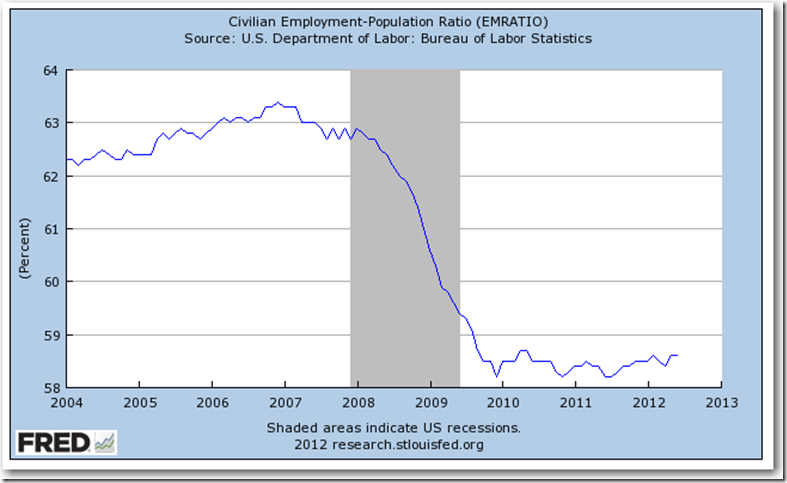
The St. Louis Fed published a chart that puts the factors into perspective.
The chart is brilliant in its simplicity.
It simply plots the percentage of the able-bodied population who are employed. The difference to 100% is the percentage of able bodies that either choose not to work or can’t find jobs.
What it shows: prior to the financial crisis, about 63% of able bodies had jobs.
The rate fell quickly to about 58.5% and has – save for some statistical noise – hasn’t budged despite the trillions of fiscal and monetary action.
In other words, about 1 in 20 (the difference between 63% and 58.5%) able bodied folks who used to work, aren’t employed now … and the trend isn’t good.
>> Latest Posts
SHARE THIS POST WITH FRIENDS & FAMILY
Tags: BLS, employment, unemployment
Posted in BLS, Employment - Jobs, Unemployment | Leave a Comment »
August 1, 2012
Breaking news …
Snoop Dogg wants you to know that he’s tired of hip-hop, is Bob Marley reincarnated and is embracing reggae instead of the culture of guns he once rapped about.

Also, he’s got a new name: Snoop Lion
Snoop says he was was “born again” during a visit to Jamaica and is ready to make music that his “kids and grandparents can listen to.”
Snoop didn’t explain why he was switching from “Dogg” to “Lion,” but it’s likely a reference to a religious symbol popular in the Ethiopian culture.
Lion has new reggae album coming in the fall along a coffee table book about his rebirth.
You just can’t make this stuff up.
>> Latest Posts
SHARE THIS POST WITH FRIENDS & FAMILY
Tags: reborn, Snoop Dogg, Snoop Lion
Posted in Entertainment, Music | Leave a Comment »
August 1, 2012
Fully expecting that the BLS will manage this week’s jobs and unemployment rate reports, I thought I’d peek at what Gallup is saying.
Well, the Gallup trend is up sharply since mid-July … up to 8.3%
My bet: BLS will find a way to report that the unemployment rate stayed constant at 8.2% in July.
We’ll see …

>> Latest Posts
SHARE THIS POST WITH FRIENDS & FAMILY
Tags: BLKS, Gallup, unemployment rate
Posted in BLS, Employment - Jobs, Unemployment | Leave a Comment »
August 1, 2012
A question in the most recent McClatchy poll caught my eye …
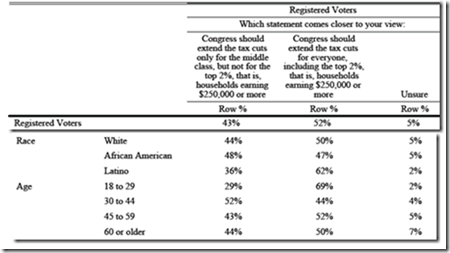
The question: Should Congress extend the Bush tax cuts to everybody or “only to the middle class”?
I always expect this question to come out 98% to 2% in favor of hiking taxes on the “other guy”.
So, I was surprised to see the overall count at 52% to 43% in favor of extending the current tax rates for everybody.
Gets even more interesting …
Latinos are 62% to 36% in favor of extending for everybody.
Young adults 18 to 29 weighed in 69% to 29% in favor of extending to everybody.
So, two of Obama’s key constituencies seem out of line with respect to the President’s line in the sand re: jacking up taxes on the rich.
Hmmm.
>> Latest Posts
SHARE THIS POST WITH FRIENDS & FAMILY
Tags: Bush tax cuts, class warfare, Latinos, young adults
Posted in Bush tax cuts, Obama, Polls & Surveys | Leave a Comment »
July 31, 2012
One of the provisions of the Bush tax plan was to eliminate the so-called marriage penalty … the tax rules and rates that had a husband & wife pay more income taxes if they were married than if they stayed single.
I’ve been bemused that in all of the chatter about Obama’s obsession with jacking rates, I haven’t heard anything about the resurrection of the marriage penalty … at least for evil rich people.

Here’s the rub: Obama’s tax hikes apply to individuals earning more than $200,000 and families earning more than $250,000.
Let’s do a simple example: Sally and Bob – single and living together – each earn $200,000.
So, Obama doesn’t touch their wallets.
But, if Sally & Bob get married … then BAM !
Their income taxes go up about $6,000.
Huh?
Of their $400,000 combined income, the first $250,000 is immunized from Obama’s tax hikes.
But, the $150,000 over the $250,000 ceiling on fair earnings … gets hit with the roughly 4% increase in the upper bracket marginal tax rates (from 35% to 39.6%).
Simple arithmetic: $150,000 times 4% = $6,000.
Back to the key point: tying the knot costs Bob & Sally about $6,000 annually in added taxes.
On average, that accumulates to about $250,000 in added taxes over their expected lifetimes … just because they got married.
Is that fair?
Note: polls consistently say that singles lean more towards Obama than do married folks.
It’s called economic rationality.
>> Latest Posts
SHARE THIS POST WITH FRIENDS & FAMILY
Tags: DINKS, Income taxes, marriage penalty
Posted in Tax Loopholes, Taxes | Leave a Comment »
July 31, 2012
According to IBD …
Near the end of 2010, GM acquired a new captive lending arm, subprime specialist AmeriCredit.
Renamed GM Financial, it has played a significant role in GM’s growth.
Ken’s Note: Approximately 20% of GM revenues go thru GM Financial
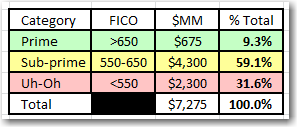
The automaker is relying increasingly on subprime loans.
Potential borrowers of car loans are rated on FICO scores that range from 300 to 850.
Anything under 660 is generally deemed subprime.

So, lots of fleet sales to the Federal & Blue state governments … lots of self-financed sub-prime loans to move the metal
Cue the repo man … for the deadbeats’ cars … and the stock-sliding company.
* * * * *
Note: GM shares are now about half of the IPO price.

>> Latest Posts
SHARE THIS POST WITH FRIENDS & FAMILY
Tags: fleet sales to government, GM, repo man, sub-prime loans
Posted in Autos - Travel, Bailouts, Obama | Leave a Comment »
July 30, 2012
The Orator-in-Chief touched a nerve with his remark “If you’ve got a business, you didn’t build that. Somebody else made that happen.”
Let’s explore another aspect of the Roanoke Reveal.
One of Obama’s points-of-proof: there wouldn’t be an internet (or internet companies) without the government.
“The Internet didn’t get invented on its own. Government research created the Internet so that all the companies could make money off the Internet.”
Source
Great piece in the WSJ debunks that assertion.
It’s an urban legend that the government launched the Internet.
The truth is a more interesting story about how innovation happens—and about how hard it is to build successful technology companies even once the government gets out of the way.
For many technologists, the idea of the Internet traces to Vannevar Bush, the presidential science adviser during World War II who oversaw the development of radar and the Manhattan Project.
By the 1960s technologists were trying to connect separate physical communications networks into one global network—a “world-wide web.”
The federal government was involved, modestly, via the Pentagon’s Advanced Research Projects Agency Network. Its goal was maintaining communications during a nuclear attack, and it didn’t build the Internet.
Robert Taylor, who ran the ARPA program in the 1960s has set the record straight: ” The Arpanet was not an Internet. An Internet is a connection between two or more computer networks.”
If the government didn’t invent the Internet, who did?
Vinton Cerf developed the TCP/IP protocol, the Internet’s backbone, and Tim Berners-Lee gets credit for hyperlinks.
But full credit goes to Xerox.
It was at the Xerox PARC labs in Silicon Valley in the 1970s that the Ethernet was developed to link different computer networks.
Xerox PARC researchers realized they couldn’t wait for the government to connect different networks, so they would have to do it themselves.
It’s important to understand the history of the Internet because it’s too often wrongly cited to justify big government.
It’s also important to recognize that building great technology businesses requires both innovation and the skills to bring innovations to market.
More details in the article.
>> Latest Posts
SHARE THIS POST WITH FRIENDS & FAMILY
Tags: Internet, Obama. You Didn't Build That, Xerox PARC
Posted in Internet - General, Obama, Xerox - PARC | Leave a Comment »
July 30, 2012
Couple of articles caught my eye in the past couple of days that together have me scratching my head …
First, an HBR blast which argued that the best way to reduce stress is to lower your expectations.
Don’t expect much out of life, your friends & family or your co-workers.
If you don’t expect much, you won’t be disappointed and your stress level will be kept in check
Say, what?
Then came a Newsweek article about the economic jam Millennials are in … with student loans, a bad job market, etc.
Started with an interesting point:
Median net worth of people under 35 fell 37 percent between 2005 and 2010; those over 65 took only a 13 percent hit.
The wealth gap today between younger and older Americans now stands as the widest on record.
The median net worth of households headed by someone 65 or older is $170,494, 42 percent higher than in 1984
The median net worth for younger-age households is a paltry $3,662, down 68 percent from a quarter century ago.
OK, reason for the Millennials to despair, for sure.
And, the proposed prescriptions?
There’s a growing notion among economists that the new generation must lower expectations.
For example, the millennial generation shouldn’t set its sights on homeownership … “because it’s going to be out of reach for so many of them.”
They are understandably more amenable to government-mandated income redistribution … since so few young people pay much in the way of taxes.
All I can say is: YIPES.
>> Latest Posts
SHARE THIS POST WITH FRIENDS & FAMILY
Tags: Economy, Millennials, net worth, stress expectations
Posted in Demograhics, Economics, Millennials | Leave a Comment »
July 27, 2012
While it may have gotten lost in the “You didn’t build it” melee, new Federal golf rules will be in effect beginning Jan 2013.
Please share with fellow golfers.
By Executive Order, President Obama appointed a Golf Czar and ordered major rule changes in the game of golf,
The rules will become effective January 1, 2013.
The complete rule book is over 1,000 pages.
Here are a few of the changes.
Golfers with handicaps:
- below 10 will have their green fees increased by 35%.
- between 11 and 18 will see no increase in green fees.
- above 18 will get a $20 check each time they play.
The term “gimmie” will be changed to “entitlement” and will be used as follows:
- handicaps below 10, no entitlements.
- handicaps from 11 to 17, entitlements for putter length putts.
- handicaps above 18, if golfer’s ball is on the green, no need to putt, just pick it up.
These entitlements are intended to bring about fairness and, most importantly, equality in scoring.
In addition, a golfer will be limited to a maximum of one birdie or six pars in any given 18-hole round.
Any excess must be given to those fellow players who have not yet scored a birdie or par.
Only after all players have received a birdie or par from the player actually making the birdie or par, can the par-birdie player begin to count his pars and birdies again.
The current USGA handicap system will be used for the above purposes, but the term “net score” will be available only for scoring those players with handicaps of 18 and above.
These rule changes are intended to “re-distribute” the success of winning by making sure that in every competition; the above 18 handicap players will post only “net score” against every other player’s “gross score”.
These new Rules are intended to positively change the game of golf.
Golf should be about Fairness.
It should not be about ability, hard work, practice, and responsibility.
Importantly, these rules will not apply to President Obama, Congress or Democratic bundlers.
Thanks to JWC for feeding the lead.
>> Latest Posts
SHARE THIS POST WITH FRIENDS & FAMILY
Tags: distributing the wealth, executive orders, golf, Obama, punishing success
Posted in Executive Orders, Obama, Sports & Athletics, Sports - Games - Recreation | 1 Comment »



















 The Homa Files