Things are bad when you’re a liberal and the New Yorker turns on you …
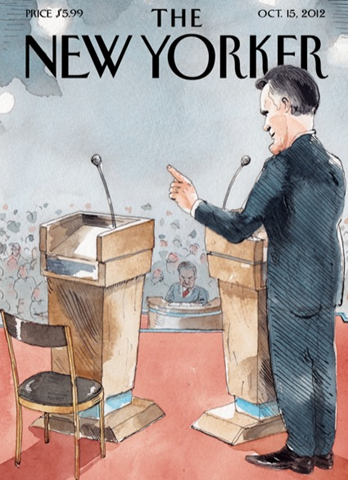
Maybe Clint Eastwood was prophetic …
Things are bad when you’re a liberal and the New Yorker turns on you …
Maybe Clint Eastwood was prophetic …
Architecture and design studio Kawamura-Ganjavian has announced the innovative Ostrich Pillow – essentially a combination pillow & hat that lets would- be nappers kick back or plop down wherever they may be.
The pillow features holes for your head and hands, and “has been designed to allow you to create a little private space within a public one.”

Check out the video …

You just can’t make this stuff up …
Thanks to JNH for feeding the lead
“It is important not to read too much into any one monthly report”
Below is an encore post … a stroll down memory lane …
* * * * *
Reported by Chris Moody of Yahoo News …
When the Bureau of Labor Statistics announced the nation’s latest national employment last week, the Obama administration stressed that people should not “read too much” into the data.
Mitt Romney’s campaign pounced, and flagged the fact that the White House has repeated that same line nearly every month since November 2009.
See below for the roundup of articles from WhiteHouse.gov that Romney’s campaign posted on its site. In many of the posts, the authors for the administration do acknowledge that they repeat themselves:
June 2012: “Therefore, it is important not to read too much into any one monthly report and it is informative to consider each report in the context of other data that are becoming available.”
May 2012: “Therefore, it is important not to read too much into any one monthly report and it is helpful to consider each report in the context of other data that are becoming available.”
April 2012: “Therefore, it is important not to read too much into any one monthly report and it is helpful to consider each report in the context of other data that are becoming available.”
March 2012: “Therefore, it is important not to read too much into any one monthly report, and it is helpful to consider each report in the context of other data that are becoming available.” (LINK:)
February 2012: “Therefore, as the Administration always stresses, it is important not to read too much into any one monthly report; nevertheless, the trend in job market indicators over recent months is an encouraging sign.”
January 2012: “Therefore, as the Administration always stresses, it is important not to read too much into any one monthly report; nevertheless, the trend in job market indicators over recent months is an encouraging sign.”
December 2011: “Therefore, as the Administration always stresses, it is important not to read too much into any one monthly report.”
November 2011: “Therefore, as the Administration always stresses, it is important not to read too much into any one monthly report.”
October 2011: “The monthly employment and unemployment numbers are volatile and employment estimates are subject to substantial revision. There is no better example than August’s jobs figure, which was initially reported at zero and in the latest revision increased to 104,000. This illustrates why the Administration always stresses it is important not to read too much into any one monthly report.”
September 2011: “Therefore, as the Administration always stresses, it is important not to read too much into any one monthly report.”
August 2011: “Therefore, as the Administration always stresses, it is important not to read too much into any one monthly report.”
July 2011: “Therefore, as the Administration always stresses, it is important not to read too much into any one monthly report.”
June 2011: “Therefore, as the Administration always stresses, it is important not to read too much into any one monthly report.”
May 2011: “Therefore, as the Administration always stresses, it is important not to read too much into any one monthly report.”
April 2011: “Therefore, as the Administration always stresses, it is important not to read too much into any one monthly report.”
March 2011: “Therefore, as the Administration always stresses, it is important not to read too much into any one monthly report.”
February 2011: “Therefore, as the Administration always stresses, it is important not to read too much into any one monthly report.”
January 2011: “Therefore, as the Administration always stresses, it is important not to read too much into any one monthly report.”
December 2010: “Therefore, as the Administration always stresses, it is important not to read too much into any one monthly report.”
November 2010: “Therefore, as the Administration always stresses, it is important not to read too much into any one monthly report.”
October 2010: “Given the volatility in monthly employment and unemployment data, it is important not to read too much into any one monthly report.”
September 2010: “Given the volatility in the monthly employment and unemployment data, it is important not to read too much into any one monthly report.”
July 2010: “Therefore, it is important not to read too much into any one monthly report, positive or negative. It is essential that we continue our efforts to move in the right direction and replace job losses with robust job gains.”
August 2010: “Therefore, it is important not to read too much into any one monthly report, positive or negative.”
June 2010: “As always, it is important not to read too much into any one monthly report, positive or negative.”
May 2010: “As always, it is important not to read too much into any one monthly report, positive or negative.”
April 2010: “Therefore, it is important not to read too much into any one monthly report, positive or negative.”
March 2010: “Therefore, it is important not to read too much into any one monthly report, positive or negative.”
January 2010: “Therefore, it is important not to read too much into any one monthly report, positive or negative.”
November 2009: “Therefore, it is important not to read too much into any one monthly report, positive or negative.”
In other words, it’s important not to read too much into the Obama administration’s past 3-1/2 years of performance.
So much for accountability …
Thanks to SMH for feeding the lead
Great analysis published this week by the non-partisan Tax Policy Center that details the potential impacts if the Bush (and Obama) tax cuts are allowed to expire at the end of the year.
The entire report is worth reading if you’re in the 53% who do pay Federal income taxes … or if you’re at the top earning end of the 47% – since you’ll get banged, too.
According to the TPC, there will be different effects on households at different income levels:
For most households, the two biggest increases would be the expiration of the temporary cut in Social Security taxes and the expiration of the 2001/2003 tax cuts.

* * * * *
Potential Stock Sell-off
One implication of increasing marginal tax rates is that some investors would have an incentive to sell appreciated stocks, bonds, and other assets before the end of the year, if they believe the capital gains rate will go up as scheduled and then remain in place for tax year 2013.
That is exactly what happened following the enactment of the Tax Reform Act of 1986, which increased the top capital gains tax rate from 20 percent to 28 percent.
Capital gains realizations almost doubled in 1986 and then fell back in 1987 as investors rushed to take advantage of the soon-to-expire 20 percent rate.
Similar behavior is likely this year unless investors believe that the scheduled tax increases will be averted.
* * * * *
In summary: Ouch.
Punch line: Here’s an angle … An online lesson-plan marketplace allows teachers to make thousands (or millions!) selling lesson plans to other teachers.
Anybody want to buy a PVP syllabus?
* * * * *
Excerpted from businessweek.com’s “How a Teacher Made $1 Million Selling Lesson Plans”

Deanna Jump is not a trust fund baby. She never married into money and she has never won the lottery. But in the past year-and-a-half, the 43-year-old kindergarten teacher has earned more than $1 million. Her unlikely strategy: selling catchy kindergarten lesson plans to other teachers.
Jump is just one of 15,000 teachers currently marketing their original classroom materials through the online marketplace, TeachersPayTeachers (TPT). Since signing on to the site, she has created 93 separate teaching units and sold 161,000 copies for about $8 a pop.
To be fair, no one else on TPT has been as wildly successful as Jump, but at least two other teachers have earned $300,000, and 23 others have earned over $100,000, according to site founder Paul Edelman.
Edelman launched TPT in 2006 after sinking grueling hours into planning his own classes. “To get ahead, Edelman and his colleagues swapped ideas and lesson plans. They also perused online sites for helpful resources, but found only sub-par, outdated materials.
After four years in the classroom, Edelman hit upon the idea for an online lesson-plan marketplace. Soon after the launch, New York-based publisher Scholastic bought the site for a low six-figure sum. Over the next few years, TPT continued growing, though not fast enough to hold Scholastic’s interest. Edelman bought the site back in 2009.
Little by little, TPT began gaining steam. Today the site has 1.1 million active members and over the past year has seen enormous growth. Last month alone, TPT grossed $2.5 million in sales, up from $305,000 in August 2011. It has 10 employees working in customer service. Teachers pay an annual premium membership fee of $59.95 to sell materials on the site, and TPT takes a 15 percent cut of most sales.
Jump admits that her own success is partly due to keeping a popular blog that helps direct readers to her TPT materials. TPT’s “Follow Me” button has also been a boon. “I have over 16,000 followers,” she says. “So every time I post a new product, an e-mail goes out to those people and—literally within an hour—I’m selling, selling, selling.”
In the past three months, Jump, who earns $55,000 per year teaching, has collected $213,000 in TPT sales. The money has not changed how she lives day-to-day. If anything, she’s working harder than ever, putting about 40 hours a week into TPT projects, apart from her regular teaching schedule. So far, she’s used the money to pay off bills, send her daughter to college, and buy a handicapped-accessible van for her quadriplegic brother.
Edit by BJP
Yep, the BLS announced this weeks initial unemployment claims, and you know what?
They revised last week’s headline number up.
Now we’re up to 81 out of 82 weeks — and, at least 22 election season weeks in a row — that the BLS’s “headline number” has under-reported the number of initial unemployment claims … and cast the jobs situation as brighter than it really is.
Based on Thursday’s BLS report, the number for the week ending Sept. 15 was revised upward from 359,000 to 363,000.
In itself, the 4,000 isn’t a big deal.
But, in context it is
Again, I ask: statistical bias or political bias?
I’m now starting to conclude the latter.
The BLS has plenty of statisticians on payroll … and this is an elementary stats problem
* * * * * *
Let’s try a new way of reporting … here’s a picture.

Note that the preliminary estimate (the blue line) is ALWAYS low … by a couple of thousand.
Hint to BLS: just add 2k or 3k … or .8% to your prelim forecast !
Punch line: Ahead of the government’s official monthly job report, ADP forecasts a slowdown in job growth.
Macroeconomic Advisers went on to predict that the unemployment rate would likely still be above 8% a year from now.
* * * * *
Excerpted from CNN Money’s, “Private sector hiring slowed in September”

Private employers added 162,000 jobs in the month … which marks a slowdown from August, when ADP said private employers added 189,000 jobs.
“While this number today is above consensus, it’s hardly a strong number,” said Joel Prakken, chairman of Macroeconomic Advisers. “It’s only barely above the pace that would push the national unemployment rate down.”
The unemployment rate stood at 8.1% in August, and economists surveyed by CNNMoney predict it remained there in September.
Given weak economic forecasts for the foreseeable future, Prakken said he wouldn’t be surprised to see the unemployment rate still above 8% a year from now.
The ADP report is monitored closely since it comes just days before the government’s official monthly job report, due Friday. But the ADP figures are often not a great predictor of what the Labor Department will report.
Edit by JDC
It was was fun watching the MSNBC post-debate show last nite. No tingle up Chris Matthews’ leg.
CNN ran a “scientific poll” of debate watchers … Wolf Blitzer squirmed to rationalize the 67 to 25 Romney win. Their panel’s best excuse: “Must have over-sampled Republicans.”
Hmmm.
Suddenly over-sampling matters.
Both CNN and MSNBC were asking: “Why didn’t Obama bring his “A” game tonite?”
First, I think he did … but, for the sake of argument, I’ll give the benefit of the doubt.
Still, I think pundits are missing the likely “why?”
My take: 3 things took Obama off the game his loyalists expected:
1. Benghazigate … while the topic wasn’t on the docket, I gotta believe that –- behind the scenes – that’s using up a lot of Obama’s energy. Foreign policy in flames, caught lying, forced to play down nailing Bin Laden, CNN broke media ranks and started reporting the cover-up. That’s gotta be taking a toll
2 Hampton speech … the Tuesday release of the factually flawed and racially divisive speech Obama gave in 2007 took “47%” off the table … if he had hit Romney with that, it would have opened the floodgates for a stream of dot points re: how Obama has been dividing the country … I bet Romney regrets that Obama didn’t bring it up.
3. $17,000 deduction cap … great play by Team Romney on Tuesday … sent Team Obama scrambling, diffused the “get specific” line, and left Obama with a weak argument: “Create jobs by taxing the rich”.
Collectively, I think that – behind the scenes – Obama was more focused on these 3 “distractions” than on the debate … and it showed.
* * * * *
For the record, I think Obama did bring his A game … he was holding a bad hand, being forced to defend his record … he wasn’t going head-to-head with the ladies of the View … and he had to go without his crutch …
As Bill Maher tweeted: “Maybe the guy does need a teleprompter”.
Michael Moore tweeted: ““This is what happens when u pick John Kerry as your debate coach.”
Bottom line: The Emperor just wasn’t wearing any threads…
Punch line: Interbrand released its 13th annual Best Global Brands Report, giving Coca-Cola the top bid.
* * * * *
Excerpted from the New York Times, “List of Global Brands Keeps Coke on Top, and Apple Jumps Up.”

Interbrand’s 13th annual Best Global Brands report addresses the value of powerful brands — and the problems of brands whose value is diminishing.
The report ranks what it deems the 100 most valuable brands on criteria that include:
Many of the ranked brands are known for dedicating time and corporate treasure to continually, if not continuously, trying to improve the results of their advertising.
Case in point is the brand that ranked No. 1 on the list for the 13th consecutive year, Coca-Cola. Interbrand estimated its brand value at $77.8 billion, up 8 percent from the 2011 report.
Although nothing lasts forever, the company will strive to keep the Coke brand relevant through innovations in how it engages with consumers.
For instance Facebook Coca-Cola has more likes, 51.98 million, than any other brand.
“A lot of staying relevant is not being afraid to take risks or do different things,” Mr. Tripodi, of Coca-Cola said. “It’s less about what you sell and more about what you stand for as a brand and company.
Eight of the remaining top nine brands changed ranks from last year, including Apple, which rose to No. 2 from No. 8, and Samsung, which rose to No. 9 from No. 17.
Also, two brands dropped out of the top 10: Disney, which fell to No. 13 from No. 9 last year, and Hewlett-Packard, which fell to No. 15 from No. 10.
The list is dominated by technology companies.
Of the top 10 brands, five are in technology: Apple, Google, Microsoft, Intel and Samsung. Another prominent technology company,
Facebook, entered the list for the first time, at No. 69. Facebook was among six new entrants; the others are Pampers (34), Prada (84), Kia (87), Ralph Lauren (91) and MasterCard (94).
Several brands that were ranked lower on the 2012 list compared with last year’s have been suffering setbacks.
Among them are BlackBerry, which tumbled to 93 from 56; Goldman Sachs, which declined to 48 from 38; and Nokia, which dropped to 19 from 14.
Edit by BJP
Punch line: As part of its progressive digital ad unit, Time Inc. has — for the first time — leased the wallpaper of one its twitter properties as ad space.
* * * * *
Excerpted from Ad Age, “Time Inc. Magazine Finds Another Next-Gen Ad Opportunity: Its Twitter Wallpaper”
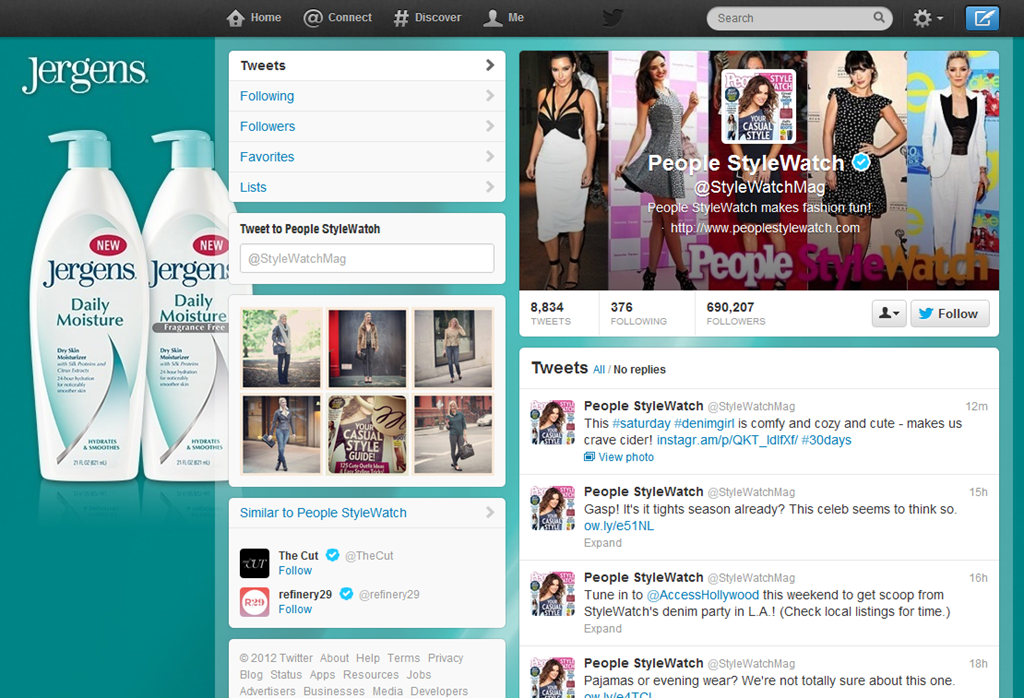
Time Inc. recently built a new digital ad unit as part of its effort to deliver “the next generation of advertising solutions,” but one of the publisher’s titles seems to have found some ad inventory just waiting for the taking: the wallpaper on its Twitter profile page.
People StyleWatch, the fashion and shopping spinoff of People magazine, this week turned the background of its Twitter page into an ad for Jergens Daily Moisture. Media brands on Twitter typically use that area to promote themselves or nothing at all.
Twitter said its users are free to turn their profile pages into ad venues.
“The space is the user’s to customize, and we encourage them to be clear if they are promoting something there, for money or other consideration,” a spokesman said in an email.
Edit by JDC
This is too good to be true: “Obama and Romney to face real lie detector test during debate.”

According to the Daily Caller:
When Barack Obama and Mitt Romney face off for the first time at tonight’s presidential debate in Denver, they’ll also be taking a lie detector test.
A spokesman for the group Americans for Limited Government announced that thee group has contracted with a company to use new truth detecting technology to determine whether either candidate is lying during the debate.
“For the first time, within a few hours of a political debate, the American people will know if the candidates are telling the truth, and better be able to judge what promises are real, and which ones are nothing more than political pandering.”
The group says they hope to release the results from Voice Analysis Technology within three hours of the debate.
Voice Analysis Technology has done work for high-profile criminal cases … and have done interrogations for the Department of Defense, Bureau of Prisons, the Los Angeles County Sheriff’s Department and 60 other law enforcement agencies.
If only the process were in real time with a BS meter on the screen …
According to ABC News, Mitt floated an elegantly simple idea for cleaning up the tax code:
Cut every bracket’s marginal rates and limit deductions to $17,000.
Specifically, Romney said:
“As an option you could say everybody’s going to get up to a $17,000 deduction; and you could use your charitable deduction, your home mortgage deduction, your healthcare deduction… to fill that bucket, if you will, that $17,000 bucket that way
And higher income people might have a lower number.”
For the record, the idea would hurt me personally since I carry a couple of jumbo mortgages and make charitable donations.
Still, I think the idea is GREAT.
It simplifies the tax code … and levels the field, say, between renters and home owners.
I’ll continue to give to charities … so will Mitt … so will most current donors.
If charities don’t have powerful enough value propositions to raise money, that’s their problem.
I really like that the change would screw folks in high tax Blue states – e.g. NY, CA – since the deduction for state & local taxes would fall under the cap.
There’s less of an impact on folks in well run states (like VA) … that’ll give tax & spend states more motivation to clean up their own acts.
Sure, there are plenty of details to be worked out (e.g. how to handle child credits) … but, I think this simple plan might be a game-changer.
The WSJ carried an editorial by Alan Blinder, a Princeton prof, tiltled “The Case Against a CEO in the Oval Office”.
It should have been titled “How we in the ivory tower – who have guaranteed life-time employment and have never set foot in a business – think that business works.”
Blinder’s central thesis: Business people fail in government because there’s no bottom line — and compromise is obligatory.
”Presidential history teaches us that the abilities, character traits and attitudes it takes to succeed in business have little in common with what it takes to succeed in government. In some respects, they are antithetical.”
Say, what?
I don’t know where to start …
First, he obviously is a non-quant economist … he thinks that the law of large numbers and statistically significant samples also applies to small numbers and insufficiently small samples. He concludes that some of our 44 presidents were good ones … and that some of them were politicos and not biz people … and, “the two truly successful businessmen to win the presidency were Herbert Hoover and George H.W. Bush” … and, we know how that turned out.
Case closed..
Huh?
Then, he lowers the boom, quoting from Nolan Bushnell, “the highly successful entrepreneur who founded Chuck E. Cheese” who said “Business is a good game — lots of competition and a minimum of rules. You keep score with money.” Blinder concludes “that’s virtually the opposite of being president of the United States”.
Note: Not Jack Welch, not the CEO of a successful Fortune 500 company … nope, he centers his argument around Chuck E. Cheese’s daddy.
Good enough for me.
More specifically, Blinder asserts that companies are dictatorships, not democracies … they ignore all stakeholders other than shareholders.
Gee, I wouldn’t have picked up on that one from my many managerial and board meetings.
My absolute favorite: “Sound companies dote on efficiency …. and, while there are niches in the federal government where efficiency matters … the big decisions aren’t about efficiency at all. It may even be critical to cut people a little slack here and there.”
He forgot to add: “And, cover for the inefficiency by taxing people who make more than I do their fair share.”
Unbelievable.
He also opines: “A good president communicates well with people and inspires them … Barack Obama may never have met a payroll, but he’s a gifted orator, and empathy and fairness are in his bones … traits … not prized in CEOs.”
To be honest, his appearance on the View during the Libyan crisis didn’t exactly inspire me.
To that point, check out the ad “Leadership” … just sroll down to the video
Gimme a break, man.
Simple answer: more folks are reading the Homa Files.
A more complex answer is offered by James Flynn is his book “Are We Getting Smarter? Rising IQ in the 21st Century”.
Here’s an excerpt from the WSJ review …

* * * * *
From the early 1900s to today, Americans have gained three IQ points per decade.
In 1910, scored against today’s norms, our ancestors would have had an average IQ of 50 to 70.
Our mean IQ today is 130 to 150, depending on the test.
Our ancestors weren’t dumb compared with us, of course. They had the same practical intelligence and ability to deal with the everyday world that we do.
Our lives are utterly different from those led by most Americans before 1910.
The average American went to school for less than six years and then worked long hours in factories, shops or agriculture.
The only artificial images they saw were drawings or photographs.
Aside from basic arithmetic, nonverbal symbols were restricted to musical notation (for an elite) and playing cards.
Their minds were focused on ownership, the useful, the beneficial and the harmful.
Rising IQ scores show how the modern world, particularly education, has changed the human mind itself and set us apart from our ancestors.
Our ancestors lived in a much simpler world, and most had no formal schooling beyond the sixth grade.
Modern people do so well on these tests because … we are the first of our species to live in a world dominated by categories, hypotheticals, nonverbal symbols and visual images that paint alternative realities.
A century ago, people mostly used their minds to manipulate the concrete world for utilitarian advantage.
Our minds now tend toward logical analysis of abstract symbols.
Today we tend to classify things … take the hypothetical seriously …and easily discern symbolic relationships.
Since 1950, there have been large gains on vocabulary and information.
More words mean that more concepts are conveyed.
More information means that more connections are perceived.
Better analysis of hypothetical situations means more innovation.
A greater pool of those capable of understanding abstractions, more contact with people who enjoy playing with ideas, the enhancement of leisure— all of these developments have benefited society.
Our mental abilities have grown, simply enough, through a wider acquaintance with the world’s possibilities.
Thanks to AR for feeding the lead.
Last night, the Daily Caller released an “explosive” new tape of Obama speaking to a group of black ministers at Hampton college in 2007.
I didn’t think the tape’s revelations were all that explosive.
But, one part of the report did catch my attention:
Obama said: “We don’t need to build more highways out in the suburbs,” where, the implication is, the rich white people live.
Instead, Obama says, federal money should flow to “our neighborhoods”.
No problem with the last part … I’m all for urban development … transportation, schools, businesses.
The rub is that Obama positioned a zero sum game between the cities and the suburbs … with redistribution from the suburbs to the cities.
First, I don’t recollect his being so direct on that point in his campaign speeches … hmmm.
Second, brought to mind a recent book on the subject that I largely dismissed at first glance.
Stanley Kurtz is a senior fellow at the Ethics and Public Policy Center and author of “Spreading the Wealth: How Obama Is Robbing the Suburbs to Pay for the Cities”.
His central premise was summarized in Forbes:
In the eyes of the leftist community organizers, suburbs are instruments of bigotry and greed — a way of selfishly refusing to share tax money with the urban poor.
To reverse the trend, some groups advocate systematically redistributing the wealth of America’s suburbs to the cities via “regional tax-base sharing,” a practice by which suburban tax money is directly redistributed to nearby cities and less-well-off “inner-ring” suburbs.
President Obama has lent the full weight of his White House to the efforts.
A federal program called the Sustainable Communities Initiative, for example, has salted planning commissions across the country with “regional equity” and “smart growth” as goals.
These are, of course, code words.
“Regional equity” means that, by their mere existence, suburbs cheat the people who live in cities.
It means, “Let’s spread the suburbs’ wealth around” – i.e., take from the suburbanites to give to the urban poor.
“Smart growth” means, “Quit building sub-divisions and malls, and move back to where mass transit can shuttle you between your 800 square foot apartment in an urban tower and your downtown job.”
Suburbs are for sellouts: That is a large and overlooked theme of Obama’s famous memoir, Dreams from My Father. The city is the moral choice.
He attributed urban decline to taxpayer “flight” to the suburbs.
So, compulsory redistribution of suburban tax money to cities was the only lasting solution to urban decay.
Obama’s uncovered Hampton speech may boost Kurtz’ book sales and unsettle some suburbanites … especially those sitting in bumper-to-bumper commuting traffic.
Yep – the O-Team has literally dragged the campaign into the gutter.
American Federation of State, County and Municipal Employees (AFSCME) – a union supporting Obama – tracked down the garbage man on Romney’s route and got him to testify against Mitt.
The charge: not once has Romney given the dude Gatorade … proof positive that Romney doesn’t get it … that he’s only for rich folks.
You just can’t make this stuff up.
The economy is stalled, the Middle East is ablaze, and these clowns are pitching Mitt Romney’s garbage man.
Geez.
Obama has been stumping that no economists foresaw the severity of the recession … so don’t blame him the a trillion dollar faux-stimulus didn’t keep unemployment under 8%.
Former President Clinton pitched at the DNC that no president – not even him – could have pulled us out of the dive better than Barack did.
Huh?
Last weekend, the NY Times debunked the first claim:
President-elect Obama’s economic team spent the final weeks of 2008 trying to assess how bad the economy was.
It was during those weeks ..when they first discussed academic research by the economists Carmen M. Reinhart and Kenneth S. Rogoff that would soon become well known.
Ms. Reinhart and Mr. Rogoff … were arguing that financial crises led to slumps that were longer and deeper than other recessions.
Almost inevitably … policy makers battling a crisis made the mistake of thinking that their crisis would not be as bad as previous ones.
Obama advisers … knew the history … yet, of course, they did repeat it.
By late 2008, the full depth of the crisis was not clear, but enough of it was.
A few prominent liberal economists were publicly predicting a long slump.
The Obama team, in private, discussed the Reinhart-Rogoff work.
So why didn’t that work do more to affect the team’s decisions?
Want more proof?
On 12/24/2008, USA Today published a piece titled: Forecasters share predictions for economy’s outlook in 2009
The punch lines:
If the recession continues past the spring, as many economists predict, it will be the most prolonged one since the Great Depression.
Employers are expected to continue to shed jobs at a rapid pace.
Consumers will pull back spending.
Businesses will cancel equipment purchases. Unsold, empty homes will dot city blocks.
I guess what Team Obama means is Goolsbee, Romer, and Bernstein didn’t see the severity.
Clinton’s claim of un-doability is just plain silly.
Reagan inherited a recession as severe as the one Obama inherited, plus 18% inflation.
He pulled the economy out in 1-term … so, there !
Team Obama seems to have a penchant for re-writing history.
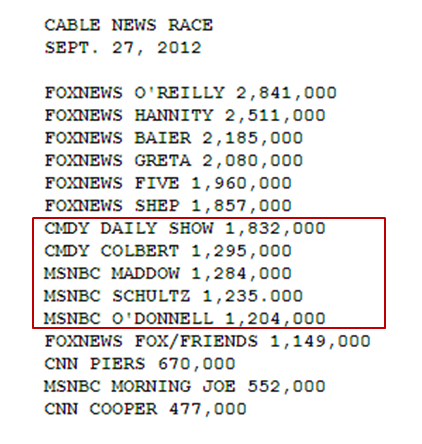
The below chart — jacked from Drudge – caught my for a couple of reasons:
A couple of things trouble me …
Though I’m a Fox fan, it’s sad to see CNN tank. I think they tend to have the best analyst panels and the most mature discussions. It’s too bad that they surrendered their neutrality. Veering left of center has, in my opinion, cost them.
Drudge probably has the networks properly categorized. The fact that a big swath of folks get their news from Comedy Central can’t be good.
All of the numbers – even O’Reilly – are miniscule as a percentage of total adult population. That suggests that the vast majority people who get news – get it from the major networks via their local channels. Since, for example, the networks haven’t been covering the Libyan terrorist attack cover-up, that’s problematic.
Oh well ..
And the company doing it is probably Acxiom … recently profiled in the NY Times.
I had some weird happenings recently.
A friend who works internet marketing for a “plus sized” women’s clothes company used my computer to show me her site’s cool redesign.
For the next couple of weeks I was getting pop-up ads for big women’s clothes … even when I was on common sites like ESPN or WSJ.
Huh?
Another time, I checked the spelling of a Spanish word via Google.
Next couple of times that I went to You Tube, the lead in ads were in Spanish.
Double huh?
I was wondering how the web “knew” … now I know, courtesy of the NY Times.
Here are some highlights …
Acxiom
IT knows who you are. It knows where you live. It knows what you do.
It peers deeper into American life than the F.B.I. or the I.R.S., or those prying digital eyes at Facebook and Google.
If you are an American adult, the odds are that it knows things like your age, race, sex, weight, height, marital status, education level, politics, buying habits, household health worries, vacation dreams — and on and on.
Right now, more than 23,000 computer servers are collecting, collating and analyzing consumer data for a company … called the Acxiom Corporation, the quiet giant of a multibillion-dollar industry known as database marketing.
Acxiom has amassed the world’s largest commercial database on consumers — Its servers process more than 50 trillion data “transactions” a year.
Acxiom maintains its own database on about 190 million individuals and 126 million households in the United States
Its database contains information about 500 million active consumers worldwide, with about 1,500 data points per person.
Acxiom’s Consumer Data Products Catalog offers hundreds of details — called “elements” — that corporate clients can buy about individuals or households, to augment their own marketing databases. Companies can buy data to pinpoint households that are concerned, say, about allergies, diabetes or “senior needs.”
In a fast-changing digital economy, Acxiom is developing the most advanced techniques to mine and refine data.
Digital marketers already customize pitches to users, based on their past activities … think “cookies”.
Acxiom is pursuing far more comprehensive techniques in an effort to influence consumer decisions.
It is integrating what it knows about our offline, online and even mobile selves, creating in-depth behavior portraits in pixilated detail … Its a “360-degree view” on consumers.
How it works
Scott Hughes, an up-and-coming small-business owner and Facebook denizen, is Acxiom’s ideal consumer.
In fact, Acxiom created him. Mr. Hughes is a fictional character who appeared in an Acxiom investor presentation in 2010.
A frequent shopper, he was designed to show the power of Acxiom’s multichannel approach.
In the presentation, he logs on to Facebook and sees that his friend Ella has just become a fan of Bryce Computers, an imaginary electronics retailer and Acxiom client.
Ella’s update prompts Mr. Hughes to check out Bryce’s fan page and do some digital window-shopping for a fast inkjet printer.
Such browsing seems innocuous — hardly data mining. But it cues an Acxiom system designed to recognize consumers, remember their actions, classify their behaviors and influence them with tailored marketing.
When Mr. Hughes follows a link to Bryce’s retail site, for example, the system recognizes him from his Facebook activity and shows him a printer to match his interest.
He registers on the site, but doesn’t buy the printer right away, so the system tracks him online.
Lo and behold, the next morning, while he scans baseball news on ESPN.com, an ad for the printer pops up again.
That evening, he returns to the Bryce site where, the presentation says, “he is instantly recognized” as having registered.
It then offers a sweeter deal: a $10 rebate and free shipping.
It’s not a random offer.
Acxiom has its own classification system, PersonicX, which assigns consumers to one of 70 detailed socioeconomic clusters and markets to them accordingly.
In this situation, it pegs Mr. Hughes as a “savvy single” — meaning he’s in a cluster of mobile, upper-middle-class people who do their banking online, attend pro sports events, are sensitive to prices — and respond to free-shipping offers.
Correctly typecast, Mr. Hughes buys the printer.
But the multichannel system of Acxiom and its online partners is just revving up.
Later, it sends him coupons for ink and paper, to be redeemed via his cellphone, and a personalized snail-mail postcard suggesting that he donate his old printer to a nearby school.
“Waste”
There is a fine line between customization and stalking.
While many people welcome the convenience of personalized offers, others may see the surveillance engines behind them as intrusive or even manipulative.
Privacy advocates say they are more troubled by data brokers’ ranking systems, which classify some people as high-value prospects, to be offered marketing deals and discounts regularly, while dismissing others as low-value — known in industry slang as “waste.”
Exclusion from a vacation offer may not matter much … but if marketing algorithms judge certain people as not worthy of receiving promotions for higher education or health services, they could have a serious impact.
“Over time, that can really turn into a mountain of pathways not offered, not seen and not known about.”
A bit creepy, right?
Punch line: Google, KPMG, P&G, Microsoft and Deloitte top the list of MBA’s most sought after jobs.
* * * * *
Excerpted from businessweek.com’s “Hot Jobs, Google, KPMG, P&G, Top 2012 Rankings”
The world’s college business students have spoken: The single, most coveted job in the world isn’t with some big-name consulting firm or high-flying investment bank.
For the fourth consecutive year, it’s with Google, whose incomparable perks and startup-like culture have catapulted the search giant to a seemingly permanent place atop Universum‘s annual list of the most highly desired employers.

Top 10 Desired Employers for MBA Students:
What separates the winners from the losers is innovative products and services, a relaxed and creative work environment, global opportunities, benefits and perks, and the ability to advance one’s career and personal brand by working for a company.
Millennials are interested in the ‘me brand,’ and they are more concerned about their employ-ability. They want a company with a good reputation. They want to say they work for a ‘cool’ company. Each of the companies at the top of the list has different characteristics that make it cool.
Whole industries can benefit from the perception that that they can serve to advance careers, which is what seems to have happened with management consulting. Consulting as a career is really interesting for people leaving college to develop a set of skills that are transferable to different industries.
Nowadays, the hunt for talent revolves around understanding the unique needs of millennials. At P&G, the company tries to give new college graduates a chance to try on different hats. To increase brand awareness among young people, P&G has undertaken targeted marketing efforts such as the “Thanks, Mom” ad campaign, which aired during the 2012 Summer Olympics. Microsoft, the other company on the rise with job hunters, hires several thousand undergraduates from around the world each year. Mostly discovered through the internship pipeline and on-campus recruiting, these young people are drawn to the company’s willingness to give them real responsibility from the start.
Edit by BJP
Answer: About $17 trillion … but, there’s much more to the story.
There has been so much talk about welfare recently that I did some digging … not to judge good or bad, simply to to get some facts.
You can draw your own conclusions …
* * * * *
Overview
According to Congressional testimony given by the Heritage Foundation, “welfare” refers means-tested federal programs providing cash, food, housing, medical care, social services, training, and targeted education aid to poor and low income Americans.
Means-tested programs are anti-poverty programs: they are intended to increase the living standards of improve the capacity for self-support among the poor and near-poor.
Means-tested welfare spending or aid to the poor consists of government programs that provide assistance deliberately and exclusively to poor and lower-income people.
For example, food stamps, public housing, Medicaid, and Temporary Assistance to Needy Families are means-tested aid programs that provide benefits only to poor and lower-income persons.
Non-welfare programs provide government benefits and services for the general population — all income levels.
For example, Social Security, Medicare, police protection, and public education are not means-tested per se.
But, Social Security benefit pay-out rates are lower for higher income people and Medicare premiums are higher for higher income people
There are 69 means-tested welfare programs operated by the federal government:
* * * * *
Spending
Since the beginning of the War on Poverty, government has spent $15.9 trillion (in inflation-adjusted 2008 dollars) on means-tested welfare.
In FY2011, federal spending on means-tested welfare, plus state contributions to federal programs, were about $940 billion.
Combined federal and state means-tested welfare is now the second largest category of overall government spending in the nation.
Means-tested welfare is exceeded only by the combined cost of Social Security and Medicare.
Welfare spending is greater than the cost of public education and is greater than spending on national defense.
Total means-tested spending in 2008 was $708 billion … about $7,700 to $17,100 in means-tested spending for each poor American (depending on the estimating method) … on average, around $30,000 to $33,000 for a family of four … with about 1/3 of the amount going to medical care.
In FY 2011, total means-tested spending going to families with children … was around $33,000 per low income family with children.
In recent years …
Roughly half of means-tested spending goes to disabled or elderly persons.
The other half goes to lower-income families with children, most of which are headed by single parents.
Most of these lower-income families have some earned income. Average earnings within the whole group are typically about $16,000 per year per family.
If average welfare aid and average earnings are combined, the total resources available come to between $40,000 and $46,000 for each lower-income family with children in the U.S. … about 15% below the total population’s median household income.
Like most Romney supporters, I’m grabbing at straws to find hope in the recent polls.
Gallup has some recent numbers that have me scratching my head.
Last week, according to Gallup, Obama’s approval rating skyrocketed.
According to my analysis, Gallup had Obama’s approval jumping by an unprecedented 12 points in a single day.
Technical note: To isolate daily movements, I “unpacked” the 3 -day averages to see what the newest day’s score would have had to be to move the 3-day average.
Really?
The economy’s tanking and the Middle East is afire … and Obama’s approval jumps.

Just doesn’t pass the smell test.
So, I did a little digging.
Here’s an article I picked up from earlier in the month.
Senior Obama Campaign adviser David Axelrod reportedly contacted The Gallup Organization to discuss the company’s research methodology after their poll’s findings were unfavorable to the President.
After declining to adjust their methodology, Gallup was named in an unrelated lawsuit by the DOJ.
Probably unrelated to the numbers, but sure looks funny.




 The Homa Files