Gone viral on the net …

Thanks to KZ for feeding the lead
* * * * *
Follow on Twitter @KenHoma >> Latest Posts
Gone viral on the net …
Thanks to KZ for feeding the lead
* * * * *
Follow on Twitter @KenHoma >> Latest Posts

* * * * *
Follow on Twitter @KenHoma
Man, even I want to stop dwelling on ObamaCare (or as I like to call it, ObamACA™ )
But , it’s a gift to bloggers that keeps on giving … and, this is BIG !
Last Saturday, the NY Times published an argument defining article titled; Don’t Dare Call the Health Law ‘Redistribution’
I assumed that it would be a typical NYT pro-Obama pitch about how ObamaCare wasn’t a redistribution of wealth … that it was simply a well-intended effort to improve the wasn’t a redistribution of wealth … that it was simply a well-intended effort to improve the health care system by providing universal insurance coverage.
To the contrary.
The article put in black & white the “truth” that, at it’s core, ObamaCare is a wealth distribution scheme with both winners and losers.
OMG, they said it.
Not “like it, keep it with lower premiums” but “winners & losers”
Here are the killer quotes ….
After a couple of years of his saying that he liked the name ObamaCare … since he’s Obama and he cares … the President has indicated that he thinks that ObamaCare –– which is now being lumped with brands like Edsel and New Coke – needs to be rebranded and remarketed.
As a recovering marketer who is always willing to lend a hand, here’s my re-branding nomination:

Pronounced “Obama – ka.”
A clever twist, right?
=====
P.S. Note the trademark TM above my nominated brand name … I’m hereby establishing what the IP attorneys call a “first use” to claim the rights to the name.
Maybe I can make some dough off this mess … to help defray my new, higher health insurance premiums.
* * * * *
Follow on Twitter @KenHoma >> Latest Posts
Seriously, here’s the link to a Senate prepared graphic of the ObamaCare organization structure and processes … and a summary listing of the bill’s key provisions.

=====
Take a quick glance at the flowchart and ask yourself: ”Think this will work?”
The bill’s laundry list special interest provisions caught my eye …
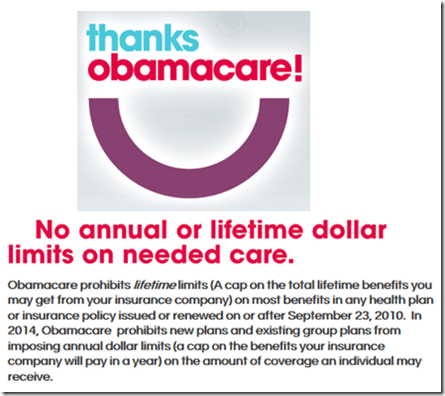
One of the ballyhooed ObamaCare features is the end of lifetime caps on payouts.
=====
While the provision has obvious benefits for folks who encounter humongous medical bills, it strikes me as having a scary semblance to the “insurance” that AIG and others were selling against mortgage-backed securities and their derivatives.
Let me explain …
Well, nothing much since Match.com reportedly works. … at least for some people.
But, below is a clever analogy.

Everybody knows that the Administration reported that slightly over 100,000 people signed up for ObamaCare via the infamous exchanges in October.
But, not everybody is aware that those numbers may be a bit inflated.
Megan McArdle, writing in Bloomberg, nailed it:
“Does your health plan give you access to INOVA’s 4,000 physicians and 5 of the best hospitals in the region?”
That’s the question posed in the mailing I got yesterday …. with a specific reference to the “health plan exchanges” and a strong recommendation to “check your plans” to keep your doctors since “You deserve choices, You deserve the best”.
English translation: “You might be be able to keep your doctor either. Period.”

I expected “narrow networks” to be the next wave of ObamaCare angst, … but, I expected it to build slowly as folks discovered that their doctors aren’t participating in the new & improved ObamaCare-compliant plans.
Apparently, some docs are taking the cut in reimbursement rates personally.
Surprise, surprise, surprise.
* * * * *
Follow on Twitter @KenHoma >> Latest Posts
Yesterday’s post recapped articles from the NYT and WSJ that made a common, largely unrecognized point:
The expansion of “free” and near-free healthcare to approximately 15 million currently uninsureds (out of about 45 million uninsured citizens) is – to a large extent – being funded by the working middle class.
Case in point: the net insurance premiums paid after subsidies on the Obama Exchanges.
Using the Kaiser Foundation subsidy calculator , I picked off the net premiums for single, non-smoking 25 year olds across a range of incomes … and calculated the net premium as a percentage of income.

Here are the fundamental takeaways …
I don’t often cite the NYT … here’s an exception.
One of the best recaps of the ObamaCare issues with some emphasis on the redistributive effect … not from rich to poor … but from the working middle class to the poor.
My opinion: The web site was the detonating device … the crush of the middle class – in the labor & insurance markets — is the bomb that’s about to go off as folks realize the implications of the law.
As the WSJ puts it today:
Americans are beginning to understand that the essence of the Affordable Care Act is that millions of people are being conscripted to buy overpriced insurance they would never choose for themselves in order to afford Mr. Obama monies to spend on the poor and those who are medically uninsurable due to pre-existing conditions.
The ObamaCare exchanges (will likely) devolve into refuges for those who are medically uninsurable.
Having assumed the job of subsidizing these people, the federal government should do so honestly and openly and efficiently.
Redistribution is a popular idea as long as you’re filthy rich … or when it’s somebody else’s money being redistributed.
When it’s your money, it loses some of its sheen … especially if you’re living paycheck-to-paycheck with little money to redistribute.
* * * * *
Follow on Twitter @KenHoma >> Latest Posts
According to the Washington Post, the Obama administration brought in McKinsey to independently assess how the federal online health insurance enrollment system was developing.
And, McKinsey nailed it, “issuing a clear warning that the Oct. 1 launch was fraught with risks.”
This risk assessment was delivered to senior White House and Department of Health and Human Services officials in four briefings between March 28 and April 8.
“But with many of the project’s shortcomings now glaringly obvious, the report appears prescient in many respects”
A couple of numbers have gotten a lot of press coverage in the past couple of days …
The 2014 target enrollment for the Exchanges … 7 million.
The number of cancelled individual policies … 5 million.
The latter (5 million) is referred to by administration spokespeople as a “small sliver”.
The former (7 million) is generally positioned as a big, potentially unreachable number.
Gee, are 5 million and 7 million really that different?
Got me thinking and drove me to the official CBO estimates to do some digging re: ObamaCare numbers.

A couple of interesting points from the chart …
A couple of numbers have gotten a lot of press coverage in the past couple of days …
The 2014 target enrollment for the Exchanges … 7 million.
The number of cancelled individual policies … 5 million.
The latter (5 million) is referred to by administration spokespeople as a “small sliver”.
The former (7 million) is generally positioned by pundits as a big, potentially unreachable number that could sink ObamACare
Gee, are 5 million and 7 million really that different?
Got me thinking and drove me to the official CBO estimates to do some digging re: ObamaCare numbers.

Let’s highlight a couple of the numbers …
A couple of killer quotes from today’s WSJ editorial …
More and more it seems obvious that the vast majority of the politicians who pushed the bill in the House and Senate never read it.
They didn’t know what was in it.
They had no idea.
They don’t understand insurance.
They’re in politics, a branch of showbiz.
=====
Some of them would have tried to read it, but it was 2,000 pages of impenetrable paragraphs — real word-clots, word-slabs — accompanied by long lines of swimming numbers.
Comprehensive bills are never comprehensible ones — they are meant to lack clarity.
======
You can sort of think you know what you’re saying when you say things like, “When each local exchange module launches it will reflect a national weighting of ‘invincibles’ and ‘ancients’ that will stabilize prevailing market realities while providing broader access not only to the poor but to those who currently have non-grandfathered or insufficient plans. So in the end it’s win-win for everyone.”
Say, what?
=====
Most of them had no idea what they were voting for.
They’re as surprised as anybody at what’s happened.
And it’s not only because so many of them are idiots.
They believed what they were told
* * * * *
Follow on Twitter @KenHoma >> Latest Posts
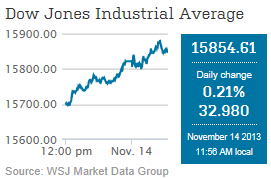
Yesterday, the stock market soared to a new high, again.
====
Why, given a sluggish economy and DC disarray, is the stock market still moving higher??
Easy.
Let’s start by taking a stroll down memory lane ….
Conventional wisdom, summarized by the WSJ, is that”ObamaCare’s financing won’t work unless “young healthies” … pay through the nose for coverage … via the individual mandate.”
The Obama administration estimates that 2.7 million people between the ages of 18 and 30 need to buy health insurance through the federal and state marketplaces to offset the health care needs of older, less healthy Americans.
The 18-26 age group is the lowest user of care.
For example, the average male sees a physician only six times between the ages of 21 and 35.
But, ObamaCare now limits insurers to charging the sickest seniors no more than three times the amount they charge their youngest customers.
Since an average 64-year-old uses six times as much health care as 19-year-olds, young healthy enrollees have to pay considerably more than the cost of their own care.
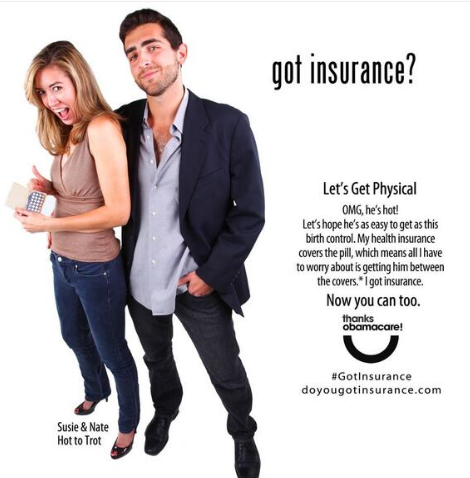
So, the Administration is pulling out all stops to get young healthies enrolled.
But, there are some flies in the ObamaCare ointment …
Here in the U.S., we just whine about high prices.
Not so in Venezuela.
According to USA Today, the Venezuelan government cracked down on soaring inflation by sending troops into appliance stores to slash prices.
Venezuelan bargain-hunters rushed Daka — an electronics chain similar to BestBuy –after the socialist government ordered a military “occupation” of the company’s five stores to force the company to charge customers “fair” prices.

Things got pretty ugly …
Last week, President Obama said that he is “sorry that some Americans are losing their current health insurance plans as a result of the Affordable Care Act”, despite his promise that no one would have to give up a health plan they liked.

His supporters say: “See, he’s stepping up to his false assurances”.
His detractors say: “He’s saying he’s sorry to see people in that situation, but doesn’t fess up to his oft-repeated mis-direction that everybody can keep their doctors and health insurance plans if they like them.”
Pick your side on that one.
I just want to use Obama’s declaration as a philosophical launching point for what makes a good apology.
======
A couple of months ago, I posted some research that proved it’s good business for companies to apologize to customers they’ve wronged — that an apology goes way further than, say, a discount on the next purchase.
I also made a passing reference to how important apologies are in personal life, too.
Following the links in the original article, I stumbled on these “8 simple principles” for making a meaningful apology …
No, that’s not me in the picture … at least not the top one.
I was interviewed by Adweek … asked to comment on 2 ads for Craftsman tools … one ad from the 1970s, another from current day.

=====
A clip from the current ad is above … below is a snap from the old ad.

=====
Among my classic Homa-isms nailed in the article were…
Loyal readers know that I’m no fan of ObamaCare.
That said, here’s a field report that even I find laughably far-fetched.

My wife went shopping at Costco and decided to price check our dogs’ meds.
Here’s what she discovered …
The common wisdom is that the ObamaCare insurance exchange needs healthy young people to subsidize the older, less healthy enrollees … otherwise, policies offered on the exchanges will go into a premiums’ death spiral.
I’m not so sure.

Here’s my thinking …
Something caught my eye, buried deep in the weeds of the chatter re: the ObamaCare web site fiasco.
Forbes had an early-on article theorizing that a major cause of the web site problems was the Feds insistance that folks shouldn’t see potentially shocking list prices, but rather should input a lot of their private data so that they can be flashed a net price – after government subsidies.
That’s old news … and, you can believe it or not.
Here’s the passage that got me thinking:
The core problem stems from “the slate of registration systems [that] intersect with Oracle Identity Manager, a software component embedded in a government identity-checking system.”
The main Healthcare.gov web page collects information using CGI Group technology.
Then that data is transferred to a system built by Quailty Software Services.
QSS then sends data to Experian, the credit-history firm.
Hmmm
Experian – one the 3 major credit bureaus.
Why get a private sector credit bureau involved?

At first, I thought the Feds might have stumbled on a borderline brilliant idea …
Have you ever really looked at the EOB (“Explanation of Benefits”) that you’ve gotten from your health insurance company after getting medical care?
I hadn’t … just threw the letters into the file … or wastebasket.
But, the ObamaCare launch has heightened my interest … and recently, unfortunately, I’ve been able to gather some personal empirical data points.
Here’s the first part of my story …
If you thought you had a bad week … scroll down.

======
=====

======

======

=====
* * * * *
Follow on Twitter @KenHoma >> Latest Posts
Feds say that “economy continues to recover … as indicated in the drop in the unemployment rate to 7.2%”.
Hmmm.
Great chart from Wall Street Daily:
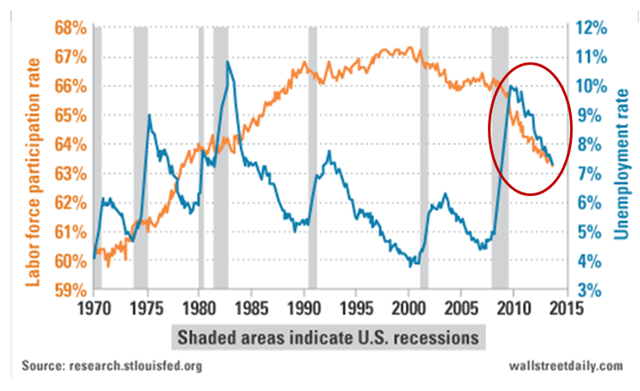
Conclusion: Apparent improvements in the unemployment rate continue to be mostly a reflection of a declining labor force participation rate … more and more folks dropping out of the labor force and staying home.
Frustrated by dim jobs’ prospects or satisfied with the government safety net programs .. or both?
Draw you own conclusion.
* * * * *
Follow on Twitter @KenHoma >> Latest Posts
Even Jon Stewart was flabbergasted when HHS Sebelius said she didn’t know how many people had enrolled on the ObamaCare exchanges.
Zillions of site hits, but no idea how many orders were placed.
Sounded fishy to just about everybody, right?
Any online marketing program – and, no doubt about it, this is a marketing program — tracks orders by the minute, hour, day, week, month, campaign duration.
Now, CBS reports that HHS has been getting real-time reporting … and a daily dashboard that includes, well, enrollments.

=====
So, why would Sebelius and the CMS head lie about not knowing the numbers?


 The Homa Files