Archive for the ‘Education – Academics’ Category
July 2, 2013
Not the cheap wine … we’re talking higher education.
An article in the Economist caught my eye: “The higher-education business – Honours without profits?”
The thrust of the article was that not-for-profit schools are starting to hook-up with for-profit schools … ostensibly to frame a more sustainable business model … merging the intellectual capacity of universities with the content delivery efficiency of the for-profits.
. .
.
Interesting, but that’s not what caught my eye … here’s what did.
(more…)
SHARE THIS POST WITH FRIENDS & FAMILY
Posted in Academics - Research, Education - Academics, MBA Degree | Leave a Comment »
May 21, 2013
I haven’t been a big Michelle Obama fan.
Never recovered from her “first time I’m proud to be an American” snit … and totally turned off by her hypocritical lifestyle of the rich & famous routine.
Biggest deal: I’ve oft said that she and her husband have squandered an opportunity to talk frankly to black kids in a way that only they can.
They’ve got the cred to push family values, individual responsibility and the importance of education.
Except for a few lines in a few speeches, they’ve come up prtetty empty.
That is, until last week when the First Lady gave a great commencement address at Bowie State University.
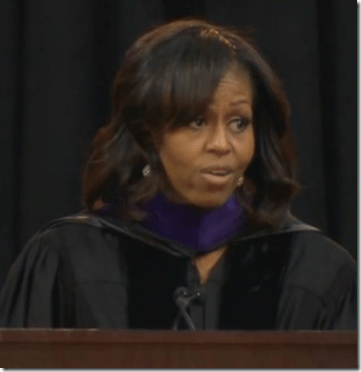
She encouraged the graduates to promote the importance of education in the black community.
According to the Washington Post, she layered a tough-love cultural commentary with statistics … one in three African American students drop out of high school … only one in five African Americans between the ages of 25 and 29 have a college degree.
Here are a couple of the high impact sound bites from her speech:
(more…)
SHARE THIS POST WITH FRIENDS & FAMILY
Posted in Education - Academics, Individual responsibility, Obama, Michelle | Leave a Comment »
March 14, 2013
According to the WSJ …
Tuition at public colleges jumped last year by a record amount.
The average amount that students at public colleges paid in tuition climbed 8.3% last year, the biggest jump on record.
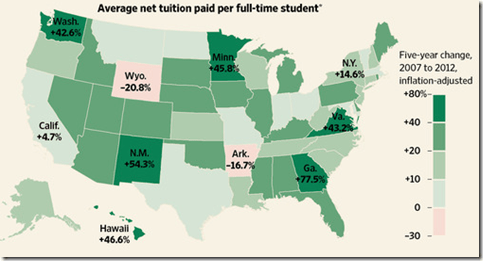
In some cases, state tuition has risen so much that costs approach what students might pay at a private college.
Tuition revenue accounted for a record 47% of educational funding at public colleges last year.
Rising tuition costs are “another example of the bind that public institutions are in,” said Sandy Baum, an economist at Skidmore College.
“Unless we make public funding a higher priority, the funds are going to have to come from parents and students.”
* * * * *
Ken’s Take:
(more…)
SHARE THIS POST WITH FRIENDS & FAMILY
Posted in Education - Academics, Schools, Tuition & fees | 1 Comment »
March 13, 2013
Remember Education Secretary Arne Duncan pitching the party line on Sequester, saying that 70,000 teachers would lose their jobs.
Implied: no place else to look for the savings.
Well, the Milton Friedman Foundation crunched some nums, and guess what?
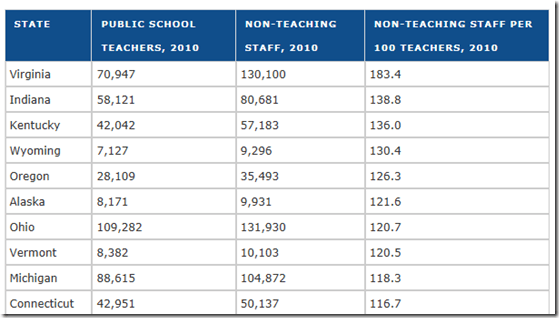
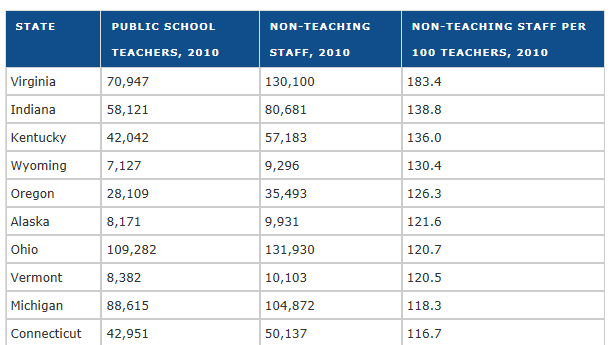
In 25 states, the number of bureaucrats and administrators now outnumber teachers in public schools.
Whoa, Nellie.
Here are the 10 states will the worst staff to teacher ratios.
Start looking there, Arne.
Source: Carpe Diem
Grieves me to see my home state of VA at the top of the list … almost 2 to 1 admin to teachers.
Ouch.
* * * * *
For state-by-state details, check out the cool interactive chart the the Friedman folks put together … everything you need to know about public schools,
* * * * *
Follow on Twitter @KenHoma >> Latest Posts
SHARE THIS POST WITH FRIENDS & FAMILY
Tags:Sequester
Posted in Education - Academics | Leave a Comment »
March 5, 2013
Last week, Secretary of Education Arne Duncan was racking up Pinocchios, trying to whip up some Sequester hysteria.
He said that the world will end if the Fed’s Ed budget is cut by 2% … 40,000 will lose their jobs.
Hmmm.
His analysis was quickly debunked but, for me, it prompted a fundamental question: how is the Dept. of Education doing?
Today, let’s look at perceptions.
Bottom line: folks – you know, taxpayers – the Ed Dept’s “customers” — rate the Dept. of Education the lowest among Federal Agencies … and the agency with the sharpest decline.
A Pew Research poll reports that …
Despite spending hundreds of billions of dollars over the past couple of decades, the Department of Education gets the fewest favorability nods for Americans … only 40% give it a favorable rating … and its favorability rating is falling faster than any other agency.
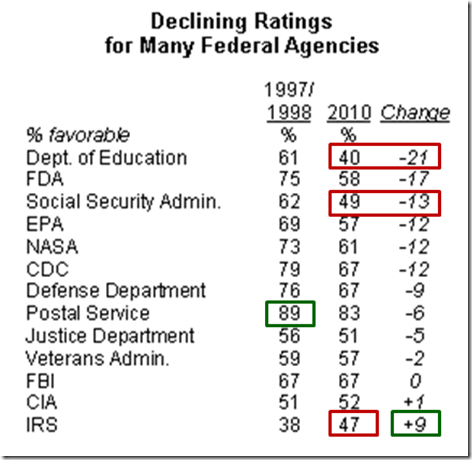
The Education Dept’s low ratings aren’t that surprising since the U.S. is constantly reported to be trailing other developed nations in math, science and other basic skills … and since every politician lasers in on our need to fix public education (while protecting the sanctity of the teachers’ unions).
Want more analysis?
(more…)
SHARE THIS POST WITH FRIENDS & FAMILY
Posted in Education - Academics, Gov't Waste & Inefficiency, Gov't Spending, Government & Politics | Leave a Comment »
February 15, 2013
I once worked for a CEO who wouldn’t stand for lemon in his water or red ink.
That is, both the red ink on a financial statement and red ink on a document.
Apparently, he was onto something with the latter.

In the UK, hundreds of schools have banned their teachers from marking in red ink.
Here’s why …
(more…)
SHARE THIS POST WITH FRIENDS & FAMILY
Tags:red pens
Posted in Education - Academics, Schools | 1 Comment »
February 8, 2013
According to LiveScience.com …
Since psychological studies first began, people have given themselves top marks for most positive traits.
While most people do well at assessing others, they are wildly positive about their own abilities.
The phenomenon is known as illusory superiority.

Illusory superiority is everywhere
- In studies, most people overestimate their IQ. For instance, in a classic 1977 study, 94 percent of professors rated themselves above their peer group average.
- In another study, 32 percent of the employees of a software company said they performed in the top 5%.
- Drivers consistently rate themselves as better than average — even when a test of their hazard perception reveals them to be below par.
Ironically, the most incompetent are also the most likely to overestimate their skills, while the ace performers are more likely to underrate themselves.
Psychologists say the illusory superiority happens for several reasons:
(more…)
SHARE THIS POST WITH FRIENDS & FAMILY
Posted in Academics - Research, Behavioral Economics, Education - Academics, Psychology | 1 Comment »
February 7, 2013
Boys score as well as or better than girls on most standardized tests, yet they are far less likely to get good grades, take advanced classes or attend college.
That’s not fair.
Why does it happen?

Here’s a shocking research finding for you …
(more…)
SHARE THIS POST WITH FRIENDS & FAMILY
Posted in Education - Academics, Psychology | 1 Comment »
January 28, 2013
Answer: It depends on a person’s “major” (i.e. finance folks tend to make more), their background before MBA school, and the b-school they attend.
According to NerdWallet, the average MBA student will earn $113,730 straight out of graduation, which includes a signing bonus of $18,764.

Stanford University leads with an average total compensation of $146,677.
Check out Nerdwallet’s Top 20 List … and rejoice, MSB is on it !
(more…)
SHARE THIS POST WITH FRIENDS & FAMILY
Posted in Compensation - Pay, Education - Academics, MBA Degree, MBAs | Leave a Comment »
January 21, 2013
Interesting article in Slate: The Early Education Racket … poses the question does preschool really matter
Research suggests that if you have the time and money to argue over the merits of different preschools and their philosophies, your kid isn’t going to suffer either way since upper-middle-class parents “tend to be choosing between all very good options
In fact, he/she probably doesn’t need to go to preschool at all.
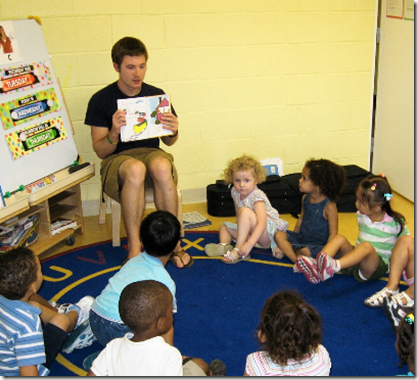
Here’s what the research says …
(more…)
SHARE THIS POST WITH FRIENDS & FAMILY
Posted in Education - Academics | 1 Comment »
January 8, 2013
Just read an interesting McKinsey study: Education to Employment – Designing a System that Works.

The focus of the study:
Worldwide, young people are three times more likely than their parents to be out of work.
Paradoxically, there is a critical skills shortage at the same time.
In other words, there are two related global crises: high levels of youth unemployment and a shortage of people with critical job skills.
This report focuses on skill development, with special attention to the mechanisms that connect education to employment.
More specifically:
- Seventy-five million youth are unemployed
- Half of youth are not sure that their postsecondary education has improved their chances of finding a job
- Almost 40 percent of employers say a lack of skills is the main reason for entry-level vacancies
An obvious conclusion: employers need to work with education providers so that students learn the skills they need to succeed at work
The pivotal finding: Employers, education providers, and youth live in parallel universes.
(more…)
SHARE THIS POST WITH FRIENDS & FAMILY
Posted in Academics - Research, Education - Academics, Jobs - Unemployment | 1 Comment »
January 7, 2013
Don’t fret, MSBers.
Today’s WSJ article — which quotes MSB prof Brooks Holtom (below) — portrays a dismal ROI picture for the typical MBA … but points out that the economic crunch is not as severe for prestigious school grads (think, MSB).
* * * * *
Debt-to-compensation ratio
First the numbers.
The WSJ tracked the average comp levels of young MBAs and matched it against their school debt loads.
The conclusion: an average young MBA has carries a school debt roughly equal to 1-years gross compensation … call it about 2 years of after-tax comp.
Note that the gross comp to student debt ratio was about 4-to-1 in 2001 … during the dotcom land rush.

* * * * *
So, what’s going on?
(more…)
SHARE THIS POST WITH FRIENDS & FAMILY
Posted in Compensation - Pay, Education - Academics, MBA Degree, MBAs | 2 Comments »
January 3, 2013
I was chatting with a friend of mine who is a middle school teacher is suburban Baltimore.
He was telling me about his schools online grading system that regularly emails parents with detailed tracking of their kids’ performance – grades on tests, whether or not homework was turned in, etc.
I asked: What percent of parents are on the system – getting the emails.
He said about 75%.
The other 25% either don’t have internet access (a few) … or either don’t care or are single-parents stretched thin (a lot).
That got me wondering about the number of kids who are structurally disadvantaged by having only one parent present to raise them
Well, it turns out that the Washington Times just did an analysis of Census data to answer the question.
Since the answer may be a bit controversial, I’ll just stick to the facts …

* * * * *
Drilling down, here are some details from the analysis …
(more…)
SHARE THIS POST WITH FRIENDS & FAMILY
Posted in Demograhics, Education - Academics | 2 Comments »
December 11, 2012
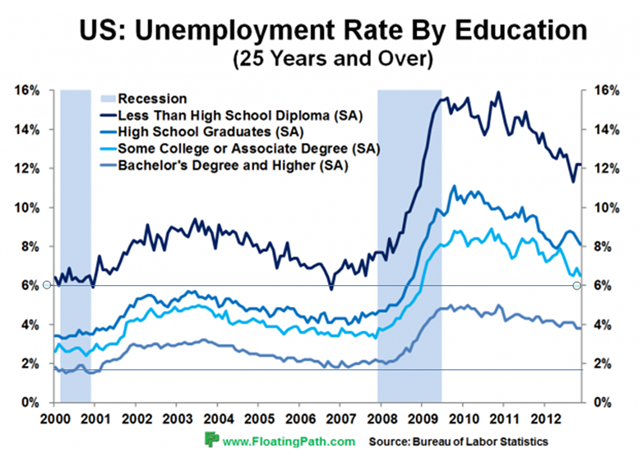
It isn’t exactly new news that more education makes you more employable.
For folks without a HS diploma:
- The current unemployment rate is 12%
- That’s down 4 percentage points from the 16% recession peak.
- But, it’s still 6 percentage points higher than the 6% low point back to 2000.
- And, 6% isn’t very low.
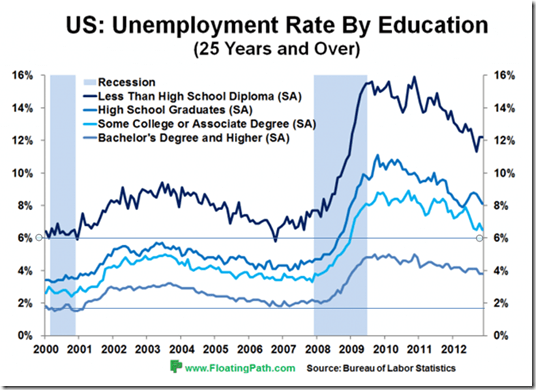
For folks with a college degree or higher:
- The current unemployment rate is 4%
- That’s down 1 percentage points from the 5% recession peak.
- But, it’s still 2 percentage points higher than the 2% low point back to 2000.
Hard to argue against the importance of education.
* * * * *
Follow on Twitter @KenHoma >> Latest Posts
SHARE THIS POST WITH FRIENDS & FAMILY
Posted in Education - Academics, Employment - Jobs, Unemployment | 1 Comment »
November 26, 2012
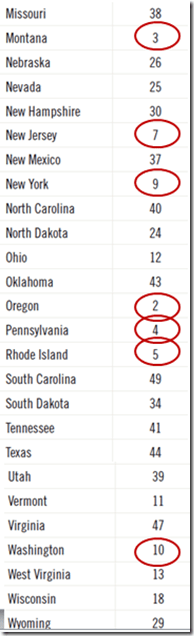
The Fordham Institute evaluated the power of state teacher unions along thirty-seven different variables grouped into five broad areas:
Area 1: Resources and Membership
Internal union resources (members and revenue), plus K–12 education spending in the state, including the portion of such spending devoted to teacher salaries and benefits.
Area 2: Involvement in Politics
Teacher unions’ share of financial contributions to state candidates and political parties, and their representation at the Republican and Democratic national conventions.
Area 3: Scope of Bargaining
Bargaining status (mandatory, permitted, or prohibited), scope of bargaining, right of unions to deduct agency fees from non-members, and legality of teacher strikes.
Area 4: State Policies
Degree of alignment between teacher employment rules and charter school policies with traditional union interests.
Area 5: Perceived Influence
Results of an original survey of key stakeholders within each state, including how influential the unions are in comparison to other entities in the state, whether the positions of policymakers are aligned with those of teacher unions, and how effective the unions have been in stopping policies with which they disagree.
= = = = =
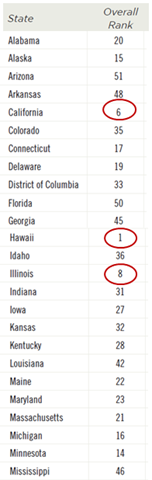
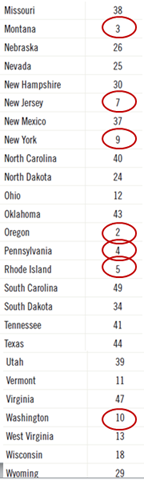
Answer: Hawaii and Oregon have the strongest teacher unions … Florida has the weakest.
See the report for details by state.

>> Latest Posts
SHARE THIS POST WITH FRIENDS & FAMILY
Posted in Education - Academics, Unions - UAW | 1 Comment »
October 24, 2012
During the last debate, Obama declared:
- ”You know, under my leadership, what we’ve done is reformed education, working with governors, 46 states. We’ve seen progress and gains in schools that were having a terrible time. And they’re starting to finally make progress.”
Ezra Klein – overexposed (and over-rated) liberal WashPost writer tried to prove the point for his favorite President … presenting reading and math scores for the past 20 years.
For reading, Klein concludes:
- “For eighth grade reading, students did better on NAEP, the gold standard for the quantitative measurement of student learning, in 2011 than in 2009, but fourth-grade scores were unchanged.”
Ken concludes:
- For 4th graders, reading scores improved by 4% under Bush’s much maligned “No Student Left Behind” program (NSLB) … from 213 to 221 … and haven’t budged under Obama’s “Race to the Top” (RTTT)
- For 8th graders. reading scores have been essentially flat-lined for the past 15 years, with neither NSLB or RTTT having moved the needle.

* * * * * *
For math, Klein concludes:
- “Math scores significantly improved across the board (under Obama).
Ken concludes:
- For 4th graders, math scores improved by 7% under Bush’s much maligned “No Student Left Behind” program (NSLB) … from 226 to 240 … and increased by 1 measly point under Obama’s “Race to the Top” (RTTT)
- For 8th graders. math scores improved by 4% under Bush’s much maligned “No Student Left Behind” program (NSLB) … from 273 to 283 … and increased by 1 measly point under Obama’s “Race to the Top” (RTTT)

* * * * *
Bottom line:
1) Tell me again why No Child Left Behind was so bad?
2) Maybe Klein should take the math test.
>> Latest Posts
SHARE THIS POST WITH FRIENDS & FAMILY
Tags:No Child Left Behind, Race to the Top
Posted in 2012 Campaign, Education - Academics | Leave a Comment »
October 5, 2012
Punch line: Here’s an angle … An online lesson-plan marketplace allows teachers to make thousands (or millions!) selling lesson plans to other teachers.
Anybody want to buy a PVP syllabus?
* * * * *
Excerpted from businessweek.com’s “How a Teacher Made $1 Million Selling Lesson Plans”

Deanna Jump is not a trust fund baby. She never married into money and she has never won the lottery. But in the past year-and-a-half, the 43-year-old kindergarten teacher has earned more than $1 million. Her unlikely strategy: selling catchy kindergarten lesson plans to other teachers.
Jump is just one of 15,000 teachers currently marketing their original classroom materials through the online marketplace, TeachersPayTeachers (TPT). Since signing on to the site, she has created 93 separate teaching units and sold 161,000 copies for about $8 a pop.
To be fair, no one else on TPT has been as wildly successful as Jump, but at least two other teachers have earned $300,000, and 23 others have earned over $100,000, according to site founder Paul Edelman.
Edelman launched TPT in 2006 after sinking grueling hours into planning his own classes. “To get ahead, Edelman and his colleagues swapped ideas and lesson plans. They also perused online sites for helpful resources, but found only sub-par, outdated materials.
After four years in the classroom, Edelman hit upon the idea for an online lesson-plan marketplace. Soon after the launch, New York-based publisher Scholastic bought the site for a low six-figure sum. Over the next few years, TPT continued growing, though not fast enough to hold Scholastic’s interest. Edelman bought the site back in 2009.
Little by little, TPT began gaining steam. Today the site has 1.1 million active members and over the past year has seen enormous growth. Last month alone, TPT grossed $2.5 million in sales, up from $305,000 in August 2011. It has 10 employees working in customer service. Teachers pay an annual premium membership fee of $59.95 to sell materials on the site, and TPT takes a 15 percent cut of most sales.
Jump admits that her own success is partly due to keeping a popular blog that helps direct readers to her TPT materials. TPT’s “Follow Me” button has also been a boon. “I have over 16,000 followers,” she says. “So every time I post a new product, an e-mail goes out to those people and—literally within an hour—I’m selling, selling, selling.”
In the past three months, Jump, who earns $55,000 per year teaching, has collected $213,000 in TPT sales. The money has not changed how she lives day-to-day. If anything, she’s working harder than ever, putting about 40 hours a week into TPT projects, apart from her regular teaching schedule. So far, she’s used the money to pay off bills, send her daughter to college, and buy a handicapped-accessible van for her quadriplegic brother.
Edit by BJP
>> Latest Posts
SHARE THIS POST WITH FRIENDS & FAMILY
Tags:selling lesson plans
Posted in Academics - Research, Education - Academics, Entrepreneurship | Leave a Comment »
September 24, 2012
Answer: the Department of Education
As Nick Cannon would say on AGT, “America has voted … via a Pew Research poll.
Despite spending hundreds of billions of dollars over the past couple of decades*, the Department of Education gets the fewest favorability nods for Americans … only 40% give it a favorable rating … and its favorability rating is falling faster than any other agency.
The Education Dept’s low ratings aren’t that surprising since the U.S. is constantly reported to be trailing other developed nations in math, science and other basic skills … and since every politician lasers in on our need to fix public education (while protecting the sanctity of the teachers’ unions).
Second lowest is the IRS … also not surprising given its adversarial role versus citizens … imagine the IRS rating once the 15,000 new agents start enforcing the ObamaCare mandates on companies and individuals.
I was surprised to see the low rating for the Social Security Administration … especially since its primary mission is handing out money. Best hypothesis I can conjure is that the SSA is generally regarded as a hassle to deal with, and probably gets the brunt of ill-feelings when folks can’t make ends meet when on Social Security.
Initially, I was most surprised to see the comparatively high score for the oft-maligned Post Office … with an 89% favorability score, it’s 10 points higher than #3 – the Center for Disease Control.
Come to think of it, the Post Office hasn’t disappointed me often – especially given the number of transactions it handles. In fact, our local Post Office and our neighborhood mail carrier provide really good service. I guess that happens when people are customers not captives, and when there is some private enterprise competitors keeping the system somewhat on its toes.
* Source re: Dept. of Education Spending
>> Latest Posts
SHARE THIS POST WITH FRIENDS & FAMILY
Tags:Dept. of Education, favorability ratings, Government agencies
Posted in Dept. of Education, Education - Academics, Gov't Waste & Inefficiency, Gov't Spending, Government Angst | Leave a Comment »
September 14, 2012
Punch line: Top US business schools are reporting single and double digit applicant decline, making admission easier for candidates. After years of applicant increases, admissions offices explain the trend by tough competition – with cheaper and more convenient programs, and ramped up efforts from 2nd tier schools.

* * * * *
Excerpted from businessweek.com’s, “At Top Business Schools, an MBA Application Drought.”
In the last few weeks, a handful of top business schools have reported single-digit, and in some cases double-digit, declines in applications for their full-time MBA classes, including most recently Columbia Business School and New York University’s Stern School of Business.
Full-time MBA applications have sunk at at least a dozen of the top 30 B-schools.
Among the schools that have reported declines are the University of Chicago’s Booth School of Business, the Yale School of Management and Duke University’s Fuqua School of Business (down 3.5 percent, 9.5 percent, and 7 percent, respectively).
A handful of schools reported even steeper drops, including Michigan State University’s Broad College of Business, where applications fell 18 percent, and Indiana University’s Kelley School of Business, with a significant dip of nearly 21 percent.
The decline in applications is attributed to increased competition from rival business schools and a plethora of available choices, including part-time and online programs.
Second-tier schools are working more aggressively to recruit top MBA candidates and entice them with hefty financial aid packages. “…employer sponsorship for full-time MBA programs is almost nonexistent, and doing an MBA part-time or online can be an attractive offer for some students, especially when there is funding available.
With a smaller pool of MBA applicants, getting an offer to a top business school has become slightly easier … To meet their target enrollment for this year’s incoming MBA class, schools had to work harder to ensure admitted students accepted their offers. For many of those schools, that extra push paid off. Yield was up at nine of the 13 schools on which information was available.
This year, competition was especially stiff for women, underrepresented minorities, and students from nontraditional work backgrounds, says Liz Riley Hargrove at Fuqua. “It was just a really competitive environment, and I think it impacted everybody’s yield this year,” she says.
Edit by BJP
>> Latest Posts
SHARE THIS POST WITH FRIENDS & FAMILY
Posted in Careers & Interviewing, Education - Academics, MBA Degree, MBAs | Leave a Comment »
September 4, 2012
Interesting op-ed by a Williams College prof in the WSJ last week touted the perils of online education and benefits of faculty-student interaction …
Most of us in higher education take the long view about the value of what we do.
Sure, students graduate with plenty of facts in their heads. But the transmission of information is merely the starting point, a critical tool through which we engage the higher faculties of the mind.
What really matters is the set of deeper abilities — to write effectively, argue persuasively, solve problems creatively, adapt and learn independently — that students develop while in college and use for the rest of their lives.
Which educational inputs best predict progress in these deeper aspects of student learning?
By far, the factor that correlates most highly with gains in these skills is the amount of personal contact a student has with professors.
Not virtual contact, but interaction with real, live human beings, whether in the classroom, or in faculty offices, or in the dining halls.
Nothing else — not the details of the curriculum, not the choice of major, not the student’s GPA — predicts self-reported gains in these critical capacities nearly as well as how much time a student spent with professors.
These rich, human interactions can’t be replaced by any magical application of technology.
Technology has and will continue to improve how we teach.
But what it cannot do is remove human beings from the equation.
Now, there are new purveyors of massive, open online courses.

One even proposes to crowd-source the grading of essays, as if averaging letter grades assigned by five random peers were the educational equivalent of a highly trained professor providing thoughtful evaluation and detailed response.
To pretend that this is so is to deny the most significant purposes of education, and to forfeit its true value.
Yet the only way to achieve higher productivity, as the National Academy would define it, is to reduce each student’s time with the faculty. [To have faculty teach more students and more classes, and to put more material online.]
We know that while such approaches may allow us to deliver some facts to some students more efficiently in the short run, the approaches will undermine the fundamental purpose of education in the long run.
Ken’s Take: Technology doesn’t replace classroom interaction, it liberates and enhances it.
How?
One way is to change the nature of the classroom from “seat time” to “quality time”.
My rule: If I catch myself talking for, say, 10 minutes without a student comment or question, I try to outboard the material to an online tutorial.
That way, I’m able to free up class time for more rigorous interaction that can deepen learning … rather than just running out the clock.
* * * * *
Sidenote: I bet some of the profs who demean online crowd sourced grading use the off-line equivalent: having classmates rate peers’ class participation or having group members rated by their teammates. Hmmm. What’s the difference?
>> Latest Posts
SHARE THIS POST WITH FRIENDS & FAMILY
Tags:online education
Posted in Education - Academics, Online Education, Technology | Leave a Comment »
August 31, 2012
… you can control the way you respond to everything that happens to you.
Thanks one of the admonitions from my adios lecture to my MBA students.
I was amped when Condi Rice used a version of the line in her speech last night.
Other snippets from her speech that caught my eye are below …

The world is a chaotic and dangerous place.
The U.S. has since the end of World War II had an answer – we stand for free peoples and free markets, we are willing to support and defend them – we will sustain a balance of power that favors freedom.
Our friends and allies must be able to trust us. From Israel to Poland to the Philippines to Colombia and across the world — they must know that we are reliable and consistent and determined. And our adversaries must have no reason to doubt our resolve — because peace really does come through strength.
When the world looks at us today they see an American government that cannot live within its means. They see a government that continues to borrow money, mortgaging the future of generations to come. The world knows that when a nation loses control of its finances, it eventually loses control of its destiny. That is not the America that has inspired others to follow our lead.
The essence of America – that which really unites us — is not ethnicity, or nationality or religion – it is an idea — and what an idea it is: That you can come from humble circumstances and do great things. That it doesn’t matter where you came from but where you are going.
Ours has never been a narrative of grievance and entitlement. We have not believed that I am doing poorly because you are doing well.
We have been successful too because Americans have known that one’s status at birth was not a permanent station in life. You might not be able to control your circumstances but you could control your response to your circumstances
Today, when I can look at your zip code and can tell whether you are going to get a good education – can I really say that it doesn’t matter where you came from – it matters where you are going. The crisis in K-12 education is a grave threat to who we are.
We need to have high standards for our students – self-esteem comes from achievement not from lax standards and false praise. And we need to give parents greater choice – particularly poor parents whose kids – most often minorities — are trapped in failing neighborhood schools.
And on a personal note– a little girl grows up in Jim Crow Birmingham – the most segregated big city in America – her parents can’t take her to a movie theater or a restaurant – but they make her believe that even though she can’t have a hamburger at the Woolworth’s lunch counter – she can be President of the United States and she becomes the Secretary of State.
Click to see the video or read the full transcript
>> Latest Posts
SHARE THIS POST WITH FRIENDS & FAMILY
Tags:Condi Rice, control your response, failing education
Posted in 2012 Campaign, Education - Academics, Words of Wisdom | Leave a Comment »
July 3, 2012
Interesting video making the rounds …
Author Glenn Harlan Reynolds says:
“Bubbles form when too many people expect values to go up forever. Simply put, the cost of higher education has far outpaced its actual value. The bubble is going to burst.”
His punch line: The Higher Education Bubble Is Going To Burst.
Frightening, but worth watching …
click to view video

>> Latest Posts
SHARE THIS POST WITH FRIENDS & FAMILY
Tags:higher education bubble
Posted in Education - Academics | 1 Comment »
July 2, 2012
Punch line: If corporations really want to make a difference in the American education system they need to rethink their philanthropic giving. By reallocating monies to initiatives such as gamification they can facilitate the foundational transformation that the education system truly needs.
* * * * *
Excerpted from Fast Company Co.Exist: Big Corporations Can Disrupt Our Antiquated Education Model
AT&T recently announced that it had made one of its single largest grants ever to the small nonprofit GameDesk, a pioneer in game-based digital learning for at-risk kids.
The signal to educators, consumers, and legislators alike is that the company has a transformative role in the education arena.
Without question, this is a departure from the “tried and true,” philanthropic grant which … is not the disruptive or innovative approach that the education system needs. Unfortunately, most private investors–and educators–tend to be risk averse when it comes to investing significant dollars or time in disruptive approaches to teaching.
The kind of partner strategy we see from the AT&T/GameDesk partnership is exactly how senior leaders from Fortune 500 companies and their foundations need to be thinking …
Why? Because when it comes to the future of our children and country, taking a risk and investing in “game changing” technologies … sends a clear message to parents, consumers, students, and educators that the status quo must change.
Edited by JDC
>> Latest Posts
SHARE THIS POST WITH FRIENDS & FAMILY
Tags:digital learning, Education, gamification, gaming
Posted in Digital Media, Disruptive Innovation, Education - Academics | Leave a Comment »
June 27, 2012
Last week, the Fed releases its triennial report on consumer finances.
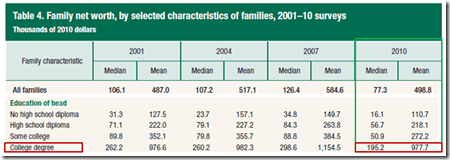
The headline was “Family net worth drops 40% to $77,000”
My first reaction: is the median net worth of American families that high? I would have expected the median to have been way, way lower.
Reading through the FRB report I stumbled on an interesting factoid:
The median net worth of college graduates is just short of $200,000.
The median net worth of non-college graduates with HS diplomas is about $60,000.
If you attribute the difference — $140,000 — to earning a college degree …. then, it looks like college at least pays for itself over time … and arguably, provides a positive return.
Hmmm.
>> Latest Posts
SHARE THIS POST WITH FRIENDS & FAMILY
Tags:college economics, FRB Survey of Consumer Finances, net wort
Posted in Education - Academics | Leave a Comment »
June 14, 2012
Couple of charts posted by Prof. Mark Perry caught my eye …
In one post, Prof. Perry charted college enrollment rates and tuitions.
Both slope upward,
Supply and demand ?
Maybe.

* * * * *
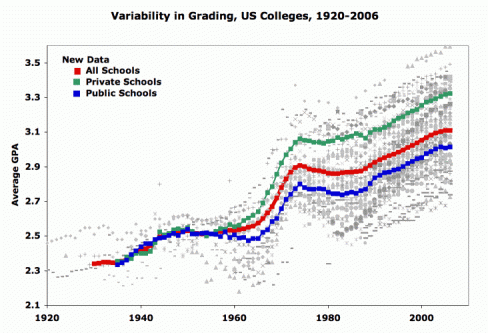
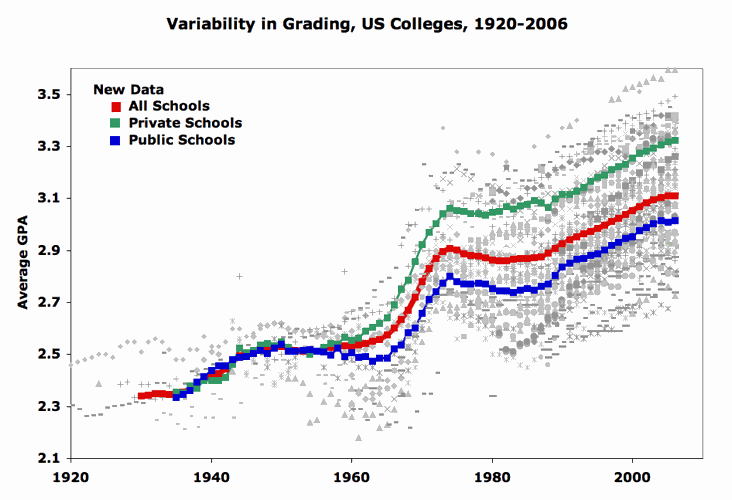
Keep the above red line (tuitions) in mind as you glance at the chart below: grade inflation.
The grades’ line also slopes up.
Sure looks like — as tuitions are rising — colleges are dishing out more high grades.
Cause & effect or just a coincidence?
Hmmm
>> Latest Posts
SHARE THIS POST WITH FRIENDS & FAMILY
Tags:College, grade inflation, grades, tuition
Posted in Education - Academics | Leave a Comment »
June 8, 2012
According to Prof. Mark Perry …
Last year, Professor Rojstaczer and co-author Christopher Healy published a research article in the Teachers College Record titled “Where A Is Ordinary: The Evolution of American College and University Grading, 1940–2009.”
The main conclusion of the paper is illustrated by the chart below showing the rising share of A letter grades over time at American colleges, from 15% in 1940 to 43% by 2008.
Starting in about 1998, the letter grade A became the most common college grade.
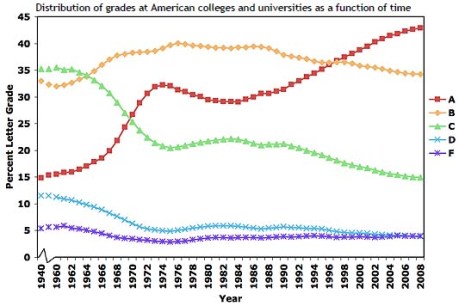
Ken’s Take: Note the Bs, Ds and Fs have stayed relatively constant, but Cs have declined … mirroring the increase in As,
Back when I was in college, a grade of C was referred to as a “Gentleman’s C” …. not too good, not too bad … not a source of pride, nor a disgrace … just right for a gentleman who didn’t want to work too hard.
Think George Bush … and John Kerry.
Now, I guess even gentlemen are getting As.
>> Latest Posts
SHARE THIS POST WITH FRIENDS & FAMILY
Tags:gentleman Cs, grade inflation
Posted in Education - Academics | 3 Comments »
May 22, 2012
Thanks to the spread of high-speed wireless technology, high-speed Internet, smartphones, Facebook, the cloud and tablet computers, the world has gone from connected to hyperconnected.
Finally, a generation that has grown up on these technologies is increasingly comfortable learning and interacting with professors through online platforms.
Coursera, a new interactive online education company.hopes to revolutionize higher education by allowing students from all over the world to not only hear his lectures, but to do homework assignments, be graded, receive a certificate for completing the course and use that to get a better job or gain admission to a better school.
Coursera just broke the million enrollments level.
Andrew Ng an associate professor of computer science at Stanford says: “I normally teach 400 students. Last semester I taught 100,000 in an online course on machine learning. To reach that many students I would have had to teach my normal Stanford class for 250 years.”
Source: N.Y. Times
>> Latest Posts
SHARE THIS POST WITH FRIENDS & FAMILY
Tags:cost of college, Higher education, online education
Posted in Academics - Research, Education - Academics, Online Education | Leave a Comment »
April 30, 2012
Punch line: TED-Ed YouTube channel aims to woo teachers with its subject-specific short-video content and customizable tools.
* * * * *
Excerpted from brandchannel.com “TED-Ed Aims to be a Teacher’s Pet”
The TED-Ed YouTube channel’s short videos have garnered over 2.5 million views since it was launched in March.
Now, a newly-launched TED-ED website is TED’s latest delivery on its brand promise of “Ideas Worth Spreading;” a dynamic site with customizable tools for educators.
click for a video overview of TED-Ed

Each short video (three to eight minutes) includes multiple choice quizzes, open-ended questions and a ‘Dig Deeper’ section. When a student answers incorrectly, a ‘Video Hint’ directs them to the point in the video with the correct answer. Teachers can browse content by subject with videos mapped via tagging to curricula taught in schools and access correlative materials that augment with the learning level.
“The new website is all about what teachers and students can do with those videos,” said TED-Ed’s Logan Smalley. “The goal of TED-Ed is for each great lesson to reach and motivate as many learners as possible. By putting this new technology to use, we hope to maximize time in class and give teachers an exciting tool for customizing – and encouraging – learning.”
“But the most innovative feature of the site is that educators can customize these elements using a new functionality called “flipping,”” notes the official press release. “When a video is flipped, the supplementary materials can be edited and the resulting lesson is rendered on a new and private web page. The creator of the lesson can then distribute it and track an individual student’s progress as they complete the assignment.”
Custom lesson plans receive a unique URL where teachers can track student’s viewing and responses and their plans can draw from any video on YouTube.
“Educators who have tested the site applaud it for its ease and intuitiveness, which, they say, will be especially useful for technology-shy teachers. “Some teachers are kind of afraid of videos,” says Jonathan Bergmann, a K-8 technology facilitator outside of Chicago. “They feel like technology is such a huge hurdle. I think this website will make it easier.” Bergmann, who is a pioneer of the flipped class movement, sees the TED-Ed site becoming an essential tool for outside-the-classroom learning.”
… “Our goal here is to offer teachers free tools in a way they will find empowering,” said TED Curator Chris Anderson of the TEDucation push. “Great teaching skills are never displaced by technology. On the contrary, they’re amplified by it.” …
Edit by KJM
>> Latest Posts
SHARE THIS POST WITH FRIENDS & FAMILY
Tags:online education, TED
Posted in Education - Academics, Online Education | Leave a Comment »
February 1, 2012
That’s something an older colleague once remarked to me.
So, true.
I often quip that if a student shows up at the Verizon Center and Lady Gaga’s concert is cancelled, they’re bummed.
If they show up for my class and see a sign that class is cancelled, they whoop and holler with glee.
And, on balance, most of them think my courses are better than the average academic offerings.
On a grander scale, many are predicting that high-priced colleges will be the next bubble to burst. Folks have been paying an increasing amount of money to get a decreasing amount of relevant learning. That’s not a good formula.
Government subsidies and “full fare” foreign students keep pushing tuitions up to levels required to support lavish facilities, expansive athletic programs, outdated delivery methods (think classrooms vs. online), and light teaching loads for faculty journalists.
For example, reported in the NY Post: The journal Academic Questions recently concluded that … many new graduates are finding that the degree they’ve earned is not worth the investment.
- Now, most college grads leave school with large debts — more than $27,000 on average.
- A college degree also no longer signifies that the recipient is either well-educated in the traditional sense or that he has acquired specific skills suited to the labor market.
That’s despite the fact that “most colleges have become trade schools — far more expensive ones than their for-profit counterparts.”
- By 2008, the number of bachelor’s degrees had risen to 1.5 million Americans, but few of these degrees were in the traditional liberal arts. Barely 2 percent of BAs were awarded in history and only 3.5 percent in English literature.
- More than a third of undergraduate degrees are now earned in business, health professions and education.
The former president of St. John’s College in Santa Fe argues that it’s no wonder that students have fled the liberal arts:
- For centuries, the liberal arts passed on what was best in Western civilization … despite our practical bent, youth were encouraged “to pursue inquiry into serious and perennial questions.”
- The humanities in particular were considered the “Keepers of the Culture” at a time when we believed we had a culture worth keeping and passing on.
- Since the 1960s, however, our culture has been under attack, our history rewritten as one of unmitigated oppression and the values our Founders and subsequent generations held dear reviled.
- Humanities courses in liberal arts colleges have replaced the canon of Western civilization with course offerings … aimed to show our benighted past and to condition us to a more tolerant future.
- Students have fled such courses in droves to pursue technical or professional skills.
The Post concludes: Their parents — and increasingly the students themselves, through loans — are left footing the bill for degrees that neither pay off in the marketplace nor enrich the intellectual lives of those on whom they are conferred.
Good point !
>> Latest Posts
SHARE THIS POST WITH FRIENDS & FAMILY
Tags:bubble, College, college loans, Education, tuition
Posted in Education - Academics | 2 Comments »
January 27, 2012
During the SOTU address Pres. Obama warned colleges and universities that they risk losing federal funding if they do not keep tuition costs down.
Hmmm.
Loyal HomeFilers know that we rail often on the indefensibly high tuitions colleges are charging.
For example, see one of our all time favorite posts:
What do b-school profs and Lady Gaga have in common?
Many pundits are predicting that high-priced colleges will be the next bubble to burst. Students (or their parents, or their companies) have been paying an increasing amount of money to get a decreasing amount of relevant learning. That’s not a good formula.
Government subsidies, student loans and “full fare” foreign students keep pushing tuitions up to levels required to support lavish facilities, expansive athletic programs, outdated delivery methods (think classrooms vs. online), and light teaching loads for faculty journalists.
Let’s see if Obama follows through on his threat … and see if it has an impact.
I’m betting under on both counts.
Universities are hot beds of liberal thinking.
No way Obama puts them in his cross hairs.
>> Latest Posts
SHARE THIS POST WITH FRIENDS & FAMILY
Tags:College, government subsidies, Obama, student loans, tuition, universities
Posted in College, Education - Academics | Leave a Comment »
January 20, 2012
Interesting op-ed by an econ prof …
Excerpted from Forbes: Dear Student: I Don’t Lie Awake At Night Thinking of Ways to Ruin Your Life by Prof. Art Carden
One of the popular myths of higher education is that professors are sadists who live to inflict psychological trauma on students.
So, let me clarify a few things.
First, I do not “take off” points. You earn them.
The difference is not merely rhetorical, nor is it trivial. In other words, you start with zero points and earn your way to a grade. You earn a grade for demonstrating that you have gained a degree of competence ranging from being able to articulate the basic principles (enough to earn a C) to mastery and the ability to apply these principles to day-to-day affairs (which will earn an A).
Second, the burden of proof is on you to demonstrate that you have mastered the material. It is not on me to demonstrate that you have not.
My assumption at the beginning of each class is that you know somewhere between nothing and very little about the subject. Otherwise, why are you here?
In this light, consider this: the fact that you “don’t understand” why you didn’t earn full points for a particular question might itself help explain why you didn’t earn full points.
If you understood the material – and do note that there is a large difference between really understanding the material and being able to reproduce a graph or definition you might remember from class – you would have answered the question flawlessly.
Finally, I’m here to be a mentor and instructor.
This means that our relationship differs from the relationships that you have with your friends and family. Please don’t infer from this that I don’t care about you, because I do.
You should never take grades personally. I don’t think you’re stupid because you tank an exam, an assignment, or even an entire course.
It probably doesn’t mean you’re dumb, it likely means you need to work smarter.
>> Latest Posts
SHARE THIS POST WITH FRIENDS & FAMILY
Tags:Education, exams, students
Posted in Education - Academics | 1 Comment »
December 12, 2011
College degrees are costing more and no longer insure a rich & prosperous life.
The cost is going up largely due to the availability of of student loan money.
A recommendation from the Washington Examiner …
Student loans, if they are to continue, should be made dischargeable in bankruptcy after five years — but with the school that received the money on the hook for all or part of the unpaid balance.
Up until now, the loan guarantees have meant that colleges, like the writers of subprime mortgages a few years ago, got their money up front, with any problems in payment falling on someone else.
Make defaults expensive to colleges, and they’ll become much more careful about how much they lend and what kinds of programs they offer.
The article also reps for non-college education.
As the Wall Street Journal has noted, skilled trades are doing quite well. For the past several decades,
America’s enthusiasm for college has led to a lack of enthusiasm for vocational education.
We need people who can make things, and it’s harder to outsource a plumbing or welding job to somebody in Bangalore.
Of course, the thing about skilled trades is that they require skill.
Even with training, not everyone makes a good welder or machinist.
Hmmm.
>> Latest Posts
SHARE THIS POST WITH FRIENDS & FAMILY
Tags:Higher education, student loans
Posted in Education - Academics | 1 Comment »
November 15, 2011
Interesting piece in Business Week …
Punch line: Sure, it costs more, and technology is threatening high-paying jobs. But the Great Recession shows postsecondary education is more valuable than ever
Supporting factoids:
The share of jobs in the U.S. economy requiring postsecondary education went up from 28 percent in 1973 to 59 percent in 2008… … and is projected to increase to 63 percent over the next decade.
* * * * *
Median earnings in 2008 …
- College graduate with a BA working full-time … $55,700
- Associates Degree (typically awarded by community and technical colleges) … $42,000.
- High school-only grads … $33,800
- Without a high school diploma ….$24,300
* * * * *
Earnings Power
About 25 percent of those in the top 40% of wage earners have only a high school diploma.
About 20 percent of workers with a college degree are in the lowest 40% of wage earners.
* * * * *
Unemployment rates:
- 4.3% for college graduates and above who are 25 years and older.
- 9.5% for high school graduates
- 13.9% for those with less than a high school education
>> Latest Posts
SHARE THIS POST WITH FRIENDS & FAMILY
Tags:College, employment, wages
Posted in Education - Academics, Employment - Jobs | Leave a Comment »
November 14, 2011
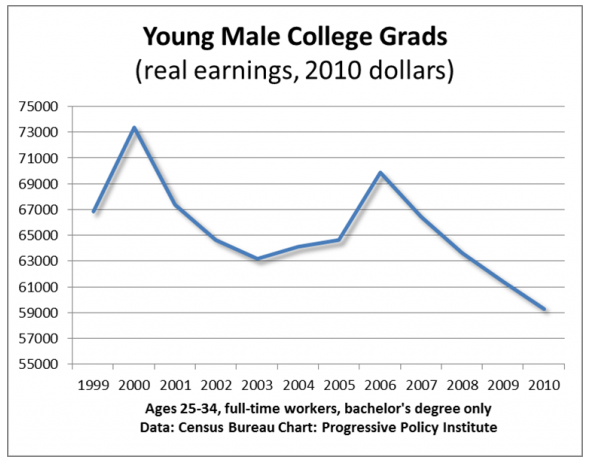
College grads’ average real earnings have declined almost 20% in the past decade.
But, there are some college grads still ringing the cash register.
According to PayScale.com:
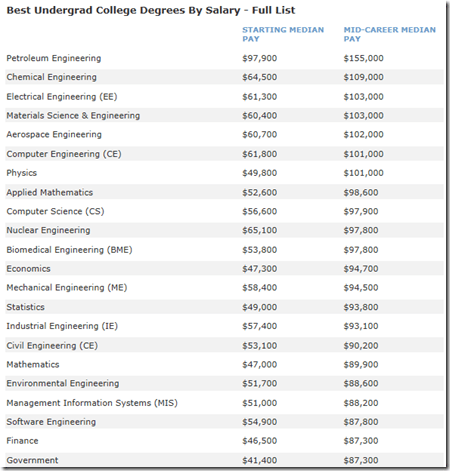
If you’re determined to find a job that pays top dollar, you’d be wise to study math and science.
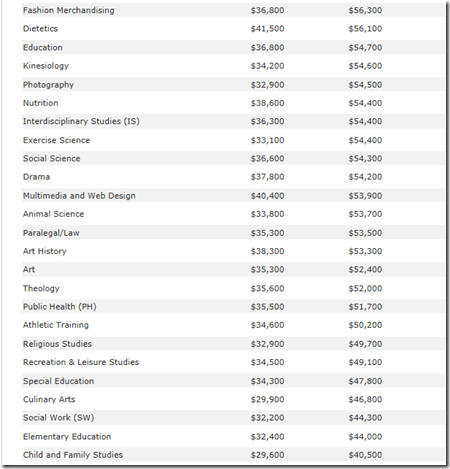
Lucrative careers exist for the history, English and foreign language majors out there, too, but they’re harder to find.
But, all’s not rosy … browse the bottom rungs, too.

The top of the list
The bottom of the list
>> Latest Posts
SHARE THIS POST WITH FRIENDS & FAMILY
Tags:Best Paying Degrees, College, College Grads, Mean Real Earnings
Posted in College, Education - Academics, Income - Earnings | Leave a Comment »
November 11, 2011
Earlier this week, we posted that only 4.5% of college grads are unemployed … a lot lower percentage than you’d think given the coverage of the Wall Street Occupiers.
There is a flipside, though.
Mean real earnings for college grads have fallen by almost 20% over the past decade … reflecting salary caps at many companies and a re-mixing towards lower paying jobs.
Suggests that the ROI on college is going down, down, down


Source
>> Latest Posts
SHARE THIS POST WITH FRIENDS & FAMILY
Tags:College, College ROI, Meana Earnings
Posted in College, Economy, Education - Academics, Income - Earnings | Leave a Comment »
November 10, 2011
In their book Academically Adrift, authors Arum and Roksa … name all the key actors involved in higher education – parents, students, professors, administrators, and government funding agencies – and explain why, given the behavior of all the other actors, no one wants to do anything about high cost and “limited learning” at most universities.
They argue that limited learning on college campuses is not a crisis because the institutional actors implicated in the system are receiving the organizational outcomes they seek,
- Parents – although somewhat disgruntled about increasing costs – want colleges to provide a safe environment where their children can mature, gain independence, and attain credentials that will help them be successful as adults.
- Students – in general seek to enjoy the benefits of a full collegiate experience that is focused as much on social life as on academic pursuits, while earning high marks in their courses with relatively little investment of effort.
- Professors – are eager to find time to concentrate on their scholarship and professional interests.
- Administrators – have been asked to focus largely on external institutional rankings and the financial bottom line.
- Government funding agencies – are primarily interested in the development of new scientific knowledge.
In other words, the system satisfies the needs of all the players … which explains why everybody seems satisfied with the status quo.
And, explains why there will be a loud cheer when the President issues an Executive order to dismiss all student loans.
Source EconoLib
Thanks to Tags for feeding the lead.
>> Latest Posts
SHARE THIS POST WITH FRIENDS & FAMILY
Tags:Academically Adrift, College, tuition
Posted in Education - Academics | Leave a Comment »
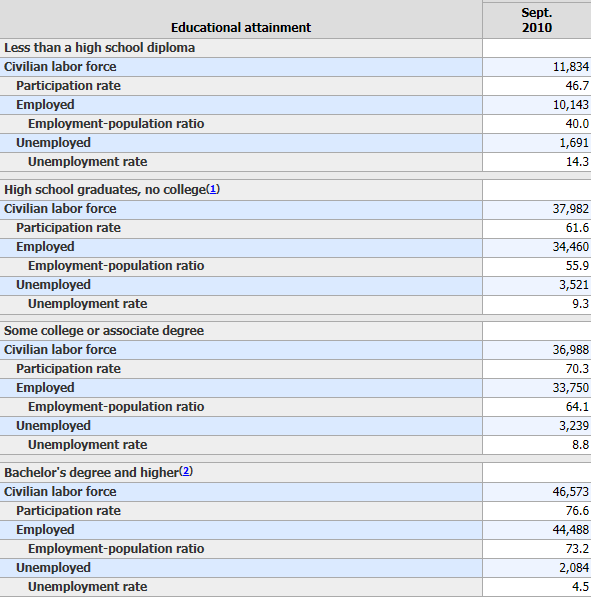
November 9, 2011
Based on the Wall Street Occupiers and the mainstream media reports, you’d think it’s sky high, right?
Well, according according to the BLS it’s 4.5%. … that’s versus 9.1% for all categories, 14.3% for drop-outs, 9.3% for high school grads, and 8.9% for those with some college.
Hmmm.


>> Latest Posts
SHARE THIS POST WITH FRIENDS & FAMILY
Tags:College, unemployment
Posted in College, Education - Academics, Employment - Jobs | Leave a Comment »
November 7, 2011
A loyal HomaFiles reader linked me to a site that has an expansive list of dumb & dumber college courses.
Here are my dozen favorites … I saved the best for last.
- Campus Culture and Drinking: As many students may have been sad to learn, this course doesn’t encourage students to go get trashed, instead asking them to more carefully consider the social and cultural aspects of drinking on campus. [Duke]
- American Degenerates: Learn more about the relationship between writers and early Americans and their sense of personal identity in this course. [Brown]
- Age of Piracy: Johnny Depp’s kooky but sexy Jack Sparrow has gotten many students interested in learning more about the pirating arts, and this course offers them the chance to take a look at the much less appealing, real-life lives of pirates. [Arizona State]
- Alien Sex: Explore the weird, wild and depraved aspects of sex between humans and monsters alike. [University of Rochester]
- Mail Order Brides? Understanding the Philippines in Southeast Asian Context: As off-putting as it sounds to most people, mail order brides are a real thing, and students at this prestigious university can learn why the phenomenon exists and is so prevalent in the Philippines through this course. [Johns Hopkins]
- The Simpsons and Philosophy: While the Simpsons may appear to be just good entertainment, this course shows the deeper philosophical issues under all those “d’ohs.” [UC Berkeley]
- Arguing with Judge Judy: Popular ‘Logic’ on TV Judge Shows: Ever felt like the plaintiffs on TV judge shows have some pretty questionable logic? This class addresses that subject directly, allowing students to pull apart courtroom excuses just like Judge Judy. [UC Berkeley]
- How to Watch Television: Though most of us are pretty adept at turning on the TV and vegging out, this course aims to teach students how to watch TV actively. [Montclair]
- Tightwaddery, or The Good Life on a Dollar a Day: While the title might elicit some laughs, this course offers some sage advice on breaking the bonds of consumerism and fighting back against the status quo. And if that isn’t part of a well-rounded college education then what is? [Alfred]
- Getting Dressed: While many students wouldn’t have made it to college without some idea of how to get dressed in the morning, this class takes it one step further and takes a look at what it really means to wear those Uggs or backwards baseball cap. [Princeton]
- Stupidity: What better topic to rail against at college than stupidity? This course examines it at depth from literary, social and philosophical perspectives. [Occidental]
- American Pro Wrestling: While the words “MIT” and “pro wrestling” may not be two you’d bring together, this course asks students at the tech-savvy school to think about the cultural implications of the often-theatrical wrestling world. [MIT]
Is college worth it? You bet it is.
Thanks to AY for feeding the lead.
>> Latest Posts
SHARE THIS POST WITH FRIENDS & FAMILY
Tags:College, curriculum, dumb courses
Posted in Education - Academics | Leave a Comment »
November 4, 2011
You just can’t make this stuff up.
Parents are shelling out about $5,000 in tuition money so their kids can probe the deep thoughts of rapper Jay-Z.
* * * * *
Excerpted from Wash Post : Jay-Z 101
Rapper Jay-Z is now being examined in the ivory towers of academia.
One of the most popular courses at Georgetown is — SOCI-124-01 “Sociology of Hip-Hop — Urban Theodicy of Jay-Z.”
Prof. Michael Eric Dyson asks: “What’s the intellectual, theological, philosophical predicate for Jay-Z’s argument?”
He says that Jay-Z’s work has proved to be powerful, effective and influential. And it’s time to wrestle with it.”
When the class reached its 80-student enrollment cap the first week of the semester, Dyson relocated to a bigger room that could seat 140 students. That’s the official head count, anyway.
* * * * *
Tell me again why we’re behind in math & science …
Thanks to JMH for feeding the lead.
>> Latest Posts
SHARE THIS POST WITH FRIENDS & FAMILY
Tags:College, Education, Jay-Z, Sociology
Posted in Academics - Research, Education - Academics | 1 Comment »
November 3, 2011
Earlier this week we posted about the high – and increasing — cost of college.
As a throwaway point, we mentioned that the annual tuition in Georgetown’s MBA program is about $50,000 … $49,638 to be precise.
That caught some attention, so let’s put the number in perspective.
A Gtown MBA student takes 18 module-courses per year … so. the tuition works out to about $2,750 per module-course.
Each module-course is two classes per week for 7 weeks … so, the tuition works out to about $200 for each of the 14 class sessions.
Let’s put that number in perspective.
According to SeatGeek.com, Lady Gaga ticket prices averaged $182.43 on last year’s Monster Ball Tour … about the same as an MBA class session.

Hmmm.
A couple of hours of Lady Gaga or 75 minutes soaking in some b-school wisdom … bring your wallet and take your pick.
Yipes.
P.S. For the record, I think of that $200 number every time I walk into a classroom. Move over Gaga.
>> Latest Posts
SHARE THIS POST WITH FRIENDS & FAMILY
Tags:Lady Gaga, MBA, ticket prices, tuition
Posted in Education - Academics, Entertainment | 3 Comments »
November 2, 2011
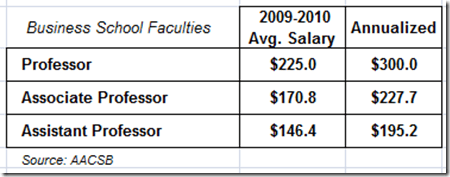
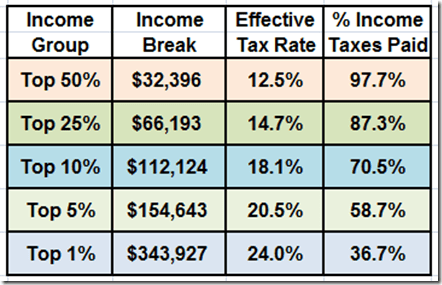
The IRS recently released 2009 tax data, it takes $343,927 in household income to make it into the top 1%; $154,643 to make the top 5%.
So, annualizing the 9-month salaries reported by the AACSB , a business school prof of any rank is top 5% … and full profs with working spouses are likely top 1%.
Hmmm
Don’t tell the Wall Street Occupiers…
P.S. Teaching profs rake in about $8.75 per hour … safely in the “99%”.
* * * * *
>> Latest Posts
SHARE THIS POST WITH FRIENDS & FAMILY
Tags:Business schools, Faculty Salaries
Posted in Education - Academics | 1 Comment »
 .
.












![Americans_College_Attainment_1975_2011-thumb-615x470-88514[1]](https://homafiles.info/wp-content/uploads/2012/05/americans_college_attainment_1975_2011-thumb-615x470-885141.png "Americans_College_Attainment_1975_2011-thumb-615x470-88514[1]")






 The Homa Files