Archive for the ‘MARKETING’ Category

Hit the potty, kid … diapers cost money!

October 7, 2011

Punch line: In tough economic times you gotta cut back, right?

Some parents are simply lengthening the time between their kids’ diaper changes.

Gross.

And, it’s penny wise – pound foolish … just raises the home’s decibel level and the ointment bill.

Excerpted from WSJ : Cut Back Diapers

As the economy continues to sputter, recent data show diaper sales are slowing and sales of diaper-rash ointment are rising.

Diapering a child six times a day costs about $1,500 a year, so it isn’t hard to see how it could become a burden on families dealing with chronic unemployment or struggling to cover rising costs.

Meantime, sales of diaper-rash ointment have increased 8% over the past year and pediatricians say the higher sales likely reflect either less frequent changes or a shift to lower quality diapers.

A pediatrician at Northwestern Memorial Physicians Group in Chicago, says she has seen a 5% to 10% spike in diaper-rash cases this year.

“We’re definitely seeing major effects of the economy: Diapers are very expensive, and the longer you sit in a dirty diaper, the more likely the chances of an infection.”

P&G says the new “wetness indicator” on Pampers Swaddlers has saved his family unnecessary diaper changes because “you don’t have to take the diaper off. You can just see the indicator, and you know if the baby is wet.”

P&G says its research shows parents are also potty training children earlier to save cash as economic uncertainty deepens.

Wonder if the wetness indicator was inspired by the pop-up that tells you when the T-Day turkey is ready?

Thanks to DM for feeding the lead.

>> Latest Posts

The perils of ‘free’ … Netflix tries to divide and reconquer … bet the under.

September 28, 2011

Punch line: Netflix tried to ‘seed’ their steaming video business with an irresistible offer: free.  But, customers revolted when asked to pay.Now, trying to be clever, Netflix is trying corporate fission: breaking into 2 parts.

I’m betting the under …

* * * * *
Excerpted from the Atlantic, by Megan McArdle:
The Qwikster and the Dead

Netflix admits that they’d really messed up the transition when they announced the end of free streaming, and that in order to fix it, they  decided to more decisively split their DVD and streaming services.

The DVD part will now be called “Qwikster” and have its own website; the streaming service will retain the Netflix brand.

The internet’s collective reaction sits somewhere between foaming rage, and an enormous collective “What the hey, Netflix?”

It’s so bizarre.. What problem does this solve?

Netflix does have a huge problem.

The company never wanted to be in the mail-order DVD service long-term; it’s not a good business.

Redbox was threatening to carve off the casual users, leaving them with the high-traffic movie buffs who don’t make them money.

Plus any idiot can see that the future is likely to be in painlessly streaming movies over the internet, not putting physical discs in little envelopes and mailing them.

The fact that the Postal Service is near bankruptcy tells you a lot about the viability of business models based on mailing things.

The problem is that they tried to build their streaming service by giving it away for free, as an add-on to their snail-mail service.

This was a good way to add customers.

But the history of the internet indicates that once you convince people something is supposed to be free, or close to it, you will have a devilishly hard time getting them to pay for it.

Unfortunately, users had been conditioned to expect unlimited free ice cream; they didn’t like having to pay for it.

Subscriptions dropped instead of rising.

Netflix stock went into a  rapid decline.

image

So I understand that Netflix was in a bad place.

But I don’t understand how Qwikster solves any of these problems.

It doesn’t improve their bargaining position with the content providers.

It doesn’t soothe angry customers who don’t like having to pay for stuff they used to get for free.

Thanks to Tags for feeding the lead.

>> Latest Posts

Ketchup? That’ll be extra, monsieur.

September 27, 2011

In marketing jargon, it’s called “unbundled pricing” … charging a price for a base product and then charging separately for add-ons.

In concept, price unbundling allows suppliers to flash lower base prices to potential buyers … and enables buyers to only pay for the specific product features that they want.

The downside: unbundling highlights the price of the add-on … which folks may have previously perceived to be free.  Think airlines charging for bags

Another case in point: a family member just got back from Europe …. where he was dismayed that McDonald’s was charging extra for ketchup.

For McDonald’s, it’s a way to to list a lower burger price.

For non-ketchup eater, it’s a way to save money … not paying the ‘hidden price’ for something that they don’t use.

For ketchup users?

Well, it certainly feels like Mickey D is screwing them.

Thanks to SMH for feeding the lead.

>> Latest Posts

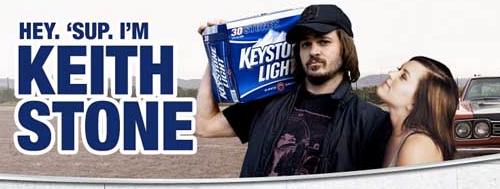
Hot for Halloween, Keystone’s Keith Stone is da man … hmmm.

September 23, 2011

Takeaway: While irreverent, Keystone Light’s spokesidiot Keith Stone has won over a cult following… but, the campaign’s success begs the question about where the brand will go from here.

* * * * *
Excerpted from brandchannel.com, “Keystone Light Mull(et)s Next Steps for Pervy Pitchman Keith Stone

“In developing the Keith Stone campaign, we wanted to literally bring the brand’s ‘Always Smooth’ essence to life in a way that is impactful and relatable to our Keystone Light drinker. We did this through the creation of an ownable brand hero, Keith Stone is the MC of Smoothness.”

Like the Old Spice Guy, the success of Keith Stone relies on a number of unpredictables.

First, there’s the “guy” himself …

The Keith Stone character aims to “elevate the key traits and values of Keystone Light at the core,” taking as its motto “Always Smooth” …

And yet, Keith Stone is extremely popular … When large numbers of Americans are dressing as your spokesperson for Halloween, it’s a pretty good sign you’re forming strong connections with your consumers …

image

Consumers identify with Keith “because, in many ways, [he] emulates characteristics of themselves. He’s easygoing and confident. He’s clever, resourceful and creative in unexpected ways. He’s lovably imperfect … He’s your laidback buddy who always has a 30-stone in tow.”

Keystone has extended the reach of its popular pitch man with additional virals and various tie-in partnerships.…

The brand uses the web to promote brand interaction through engagement with Keith’s fans, “his 21-34 year-old buddies who are looking for laughs across various content platforms” …

It’s impossible to assume Keith Stone would ever mature beyond his current self, which could pose a challenge for Keystone when it comes to growing its brand beyond the name recognition and “always smooth” positioning its locked down with the current campaign.

As for their pitchman’s future …  “It’s been a fun ride and we are currently discussing the possibilities for the brand in the coming years.”

Edit by KJM

>> Latest Posts

Wendy’s: new burger or New Coke? … at least they kept the iceberg lettuce.

September 22, 2011

TakeAway: Wendy’s remakes its hamburger, after 42 years, to boost sales and grow share in the fast food wars … New burger or New Coke? … The market will ultimately decide.

* * * * *
Excerpted from USAToday.com, “Wendy’s remakes its burgers; here’s how it did that

Dave’s Hot ‘N Juicy, named after late Wendy’s founder Dave Thomas, is Wendy’s new burger — with extra cheese, a thicker beef patty, a buttered bun, and no mustard, among other changes …

“Our food was already good. We wanted it to be better. Isn’t that what long-term brands do? They reinvent themselves.”

Wendy’s started Project Gold Hamburger two and a half years ago to boost lackluster sales and fight growing competition from McDonald’s and expanding fast-casual chains, such as Five Guys …

But the biggest issue was that Wendy’s, which hadn’t changed its burger since the chain began in 1969, let its food offerings get stale over the years while its competitors continued to update their menus …

We have a lot of catching up to do in some areas. But after we launch this hamburger there will be folks who need to catch up to us.”

Wendy’s polled more than 10,000 people about their likes and dislikes in hamburgers. It found that people like the food at Wendy’s but thought the brand hadn’t kept up with the times.

So, executives were shipped off to eat at burger joints around the country and measured each sandwich on characteristics like fatty flavor, salty flavor and whether the bun fell apart.

Then, it was time for Wendy’s researchers to consider the chain’s own burger, ingredient by ingredient. Each time they made a change, they asked for feedback, visiting research firms around the country to watch through two-way mirrors as people tried each variation.

Many suggestions sounded good but didn’t ring true with tasters.

  • They tried green-leaf lettuce, but people preferred to keep iceberg for its crunchiness.
  • They thought about making the tomato slices thicker but decided they didn’t want to ask franchisees to buy new slicing equipment.
  • They even tested a round burger, a trial that was practically anathema to a company that’s made its name on square burgers.

Wendy’s ultimately did not go with the round shape, but changed the patty to a “natural square,” with wavy edges, because tasters said the straight edges looked processed.

Tasters said they wanted a thicker burger, so Wendy’s started packing the meat more loosely, trained grill cooks to press down on the patties two times instead of eight, and printed “Handle Like Eggs” on the boxes that the hamburger patties were shipped in so they wouldn’t get smashed.

Wendy’s researchers knew that customers wanted warmer and crunchier buns, so they decided that buttering them and then putting them through a toaster was the way to go.

In the end, Wendy’s researchers changed everything but the ketchup. They switched to whole-fat mayonnaise, nixed the mustard, and cut down on the pickles and onions, all to emphasize the flavor of the beef.

They also started storing the cheese at higher temperatures so it would melt better, … a change that required federal approval.

Wendy’s faces the reality that some customers may not like the new burger  — or its likely price increase of 10 or 20 cents, because of the higher-quality ingredients.

Edit by KJM

Ford ads a new benefit: buying from a company that stands on its own.

September 19, 2011

Punch lineFord hit the airwaves with a potentially controversial ad touting the fact that it’s an American company that stands on its own … unlike its bailed out competitors.

I like it …

Excerpted from US News: Ford TV Ad Slams Obama Auto Bailouts article & video

America is still fighting over President Obama’s costly bailout of Chrysler and General Motors. Especially the owners of Ford, the only member of Detroit’s “Big Three” who rejected the government dole and emerged perfectly healthy.

In its most political ad in the so-called “Drive One” ads where real drivers are thrust before cameras to explain why they picked Ford, a real Ford F-150 pick-up driver is featured.

His name is Chris. After he sits down the “reporters” bark “Chris, Chris.” One asks him to explain why “was buying American important to you.”

Sitting and looking sincere and serious, Chris says:

I wasn’t going to buy another car that was bailed out by our government.

I was going to buy from a manufacturer that’s standing on their own: win, lose, or draw.

That’s what America is about is taking the chance to succeed and understanding when you fail that you gotta’ pick yourself up and go back to work.

Ford is that company for me.”

Now, let’s see if Chris the Ford buyer gets tax audited like Joe the Plumber …

>> Latest Posts

Super size it …. but, hold the calories, please.

September 16, 2011

TakeAway: New ultra-low calorie products celebrate America’s love of over-indulgence …  They give folks ‘normal’ portions with fewer calories.

About the taste? You decide …

* * * * *
E
xcerpted from courier-journal.com, “Marketing to your inner glutton: Ultra-low-calorie foods allow bingeing without guilt

There is a recent wave of ultra-low calorie products — such as, Artic Zero’s 150-calorie per pint dessert Artic Zero, 20 calorie per serving Tofu Noodles, and MGD 64, a 64 calorie beer — are aimed to direct appeal to our national sense of gluttony …

“What we’re seeing here is a strategy that says Americans like to stuff their faces … And these mean we don’t have to sacrifice.”

“It’s fine to eat one serving of ice cream, but I can’t remember the last time I sat down with a pint and ate half a cup,” said the CEO of Arctic Zero., whose pints of “ice cream replacement” prominently feature the 150-calorie message. “We feel like a serving is an entire pint.”

Tofu Shirataki noodles from House Foods America., offers two 20-calorie servings per 8-ounce package, but “most people eat the whole bag for a meal,” said Yoko Difrancia, the company’s marketing supervisor. “The whole bag is more realistic.”

Consumers seem to be buying it. Sales of Arctic Zero, introduced in 2009, have grown 15 to 20 percent per month for the past 18 months … ‘

“The idea is not that you can or should eat a much bigger volume than you typically
do,” Penn State Professor Barbara Rolls said. “It’s that if you eat your usual amount, you’re going to feel full but with fewer calories.”

… Health advocates and dietitians remain committed to the idea that portion sizes must come down. But they say these products could offer baby steps to people struggling to control their weight. They might also be useful when you feel that binge coming on …

Edit by KJM.

>> Latest Posts

Marketing to the rescue … how to save the USPS

September 14, 2011

Punch line: Many execs say “you can’t cost reduce yourself to success”.

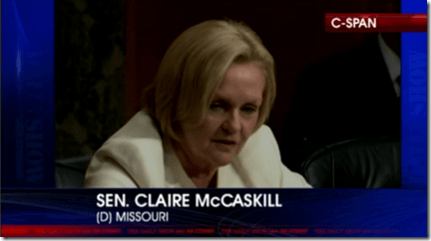
Apparently, Sen. Claire McCaskill agrees and looks to marketing to save the USPS from its financial woes.

* * * * *

U.S. Senator Claire McCaskill is a big supporter of the United States Post office.

McCaskill is against closing costly, non-essential post offices.

She thinks the USPS can market its way to success.

“I had an opportunity to go through a box of letters that my mother had from my grandmother’s house that were my letters I sent to her in college … My kids are in college now — I don’t have a box like that.”

Rather than cost-cutting, McCaskill is has suggested a marketing campaign stressing the “value of the written letter.”

Might work …

You just can’t make this stuff up.

* * * * *
Click  to see the video

image

Thanks to Tags for feeding the lead.

>> Latest Posts

Like us and we’ll donate will donate, love us and we’ll …

September 8, 2011

TakeAway: Brands are searching for  more ways to connect causes with marketing, and evolve consumer’s “slacktivism” to more significant social good.

Now, just “like” them on Facebook or tweet a specified phrase and some brands will donate to a cause.

You know what?

It works …

* * * * *

Excerpted from Brandchannel.com, “Cause Marketing Does Affect Brand Purchase

The Integer Group queried 1,200 Americans about factors influencing brand preference when choosing between two companies with both benefiting a cause, and selling a product similar in price and quality.

Survey results reveal that the brand’s philanthropic activities can influence shopper behavior and ultimately purchase decisions, and that gender is a factor:

  • Both men and women are influenced by “personal relevance of cause
  • Women choose brands that promise instant gratification with each purchase, while for men, it’s less important
  • Brands need to appeal to men’s rationale side, delivering a more rational benefit for their participation in a cause program, which can lead to higher engagement”
  • Men are more likely to support organizations, such as The Salvation Army or Goodwill, while women support disease prevention causes, such as breast cancer awareness

So, which brands do this well?

Top brands purchased based on their affiliation with a cause:

1. Yoplait
2. Anything Affiliated With Breast Cancer
3. and 4. (tied) Susan G. Komen for the Cure & Newman’s Own
5. General Mills
6. Yogurt in general
7. and 8. (tied) P&G and RED
9. Boxtops for Education
10. and 11. (tied) Kellogg’s, Campbell’s & Girl Scouts
12. Dawn
13. Avon

Edit by KJM

>> Latest Posts

Emotional profiling: I like you, but I don’t love you …

September 7, 2011

Punch line: Why do two identical-looking products that get the same score in acceptability tests, perform wildly differently in the marketplace?

“Emotional research ” tries to find out why, and create profiles of prime prospects.

Excerpted from CPGmatters “Kraft Foods Develops ‘Emotional Profiling’

Kraft Foods has been developing a sophisticated new science of “emotional profiling”.

Kraft has been working on emotional profiling for three years as part of its sensory and consumer-testing work.

“The theory behind emotional profiling is uncovering the difference between ‘liking’ something and ‘preferring’ it.”

“The idea is fairly basic.

Even if an individual likes two different products, they may still prefer one over the other.

We’re trying to figure out that difference or gap so that we can make the best possible products that consumers will truly prefer.”

Traditional research tools may not be enough to capture the implications of emotion on food shopping.

“We use emotional research to define unique points of difference and create a new hierarchy of attributes that go beyond ‘liking.’

Qualitative research usually includes in-depth interviews exploring sensory reactions with target customers who represent a variety of positions along the brand-loyalty scale.

So, tell me again why kids love artificial-looking, artificial-tasting Kraft mac & cheese …

>> Latest Posts

The death of the PC industry … as we know it.

September 6, 2011

Punch line: Like everything in tech, personal computers were always fated to become commodity appliances.

Excerpted from WSJ:”Steve Jobs and the Death of the Personal Computer

Great technology industries usually die with a whimper.

But last week the curtain came down with a bang on the most famous tech industry of all — personal computers — thanks to Steve Jobs’s retirement from Apple and the less high-profile announcement that Hewlett-Packard was leaving the PC market.

Hewlett-Packard’s announcement was more surprising. H-P was until recently the world’s largest maker of personal computers.

In recent years, though, cost-cutting competitors, market saturation and alternative hardware platforms have sucked most of the profits out of PCs.

Like everything in tech, personal computers were always fated to become commodity appliances.

>> Latest Posts

Grab your wallet … here comes Starbuck’s in a K-cup.

September 2, 2011

Punch line: First VIA. Now the K cup. Starbucks deepens its entry into the near $2 billion single-cup coffee market through a partnership with Green Mountain Coffee.

Excerpted from WSJ, “Starbucks coffee to be offered in Keurig K-Cup Packs in November”

Last year, Starbucks entered the single cup coffee market with the launch of VIA Ready Brew.

In November 2011, Starbucks coffee will be sold in Green Mountain Coffee’s Keurig K-Cup single-serve packs in grocery stores and specialty retailers in the U.S. …

The agreement provides for the manufacturing, marketing and selling of Starbucks and Tazo-branded K-Cup portion packs throughout the U.S. and Canada …

Also, Starbucks ended speculation that it will debut its own single-cup brewer, though it hasn’t ruled out such plans in the future.

Edit by KJM

>> Latest Posts

Don’t call them spinsters … women DJs are hot!

September 1, 2011

TakeAway: Women disc jockeys are the newest trendsetters for music, fashion and popular culture. So, Unilever hired 3 of them for its new “Fresh Spin” campaign, aimed at young female consumers for its Rebalance branded deodorant products.

* * * * *

Excerpted from NY Times, “She hopes to help a Dove campaign become a hit

Dove is working with MTV for its new “Fresh Spin” campaign, whose first big event occurs at the Video Music Awards … targeting females ages 12 to 34

The brand is showcasing three young women D.J.’s in a new video series, social media and a new Web site. The D.J.’s also are engaging fans in an interactive music game on the Internet site …

Women disc jockeys are the newest trendsetters for music, fashion and popular culture,”…

This month, Dove introduced its “Fresh Spin” campaign, which focuses on social engagement and not a strong product sell, reaching out to targets with a Web site, commercials on MTV and social media, including Facebook and Twitter.

The Web videos are behind-the-scenes looks into the lives of three D.J.’s — Jessica Who, Chelsea Leyland and Diamond Kuts — showing them in some sweaty situations, suggesting the need for deodorant …

This week, Dove began running commercials on MTV to introduce the trio. Ms. Who will report live from the video music awards, interviewing musicians on the red carpet and sharing her take on the music scene. The video will be available on dove.mtv.com after the awards …

As a brand, Dove does not want to focus on celebrities … The D.J.’s are real girls who are culturally relevant. They aggregate ideas about movements, fashion and, of course, music.”

Edit by KJM

>> Latest Posts

Somebody tell GM: ”Marketing is more than advertising!”

August 31, 2011

Punch line: What are GM’s adverting tag lines for Caddies & Chevies?

If you don’t know, you’re not alone.

So, GM is hassling its ad agencies.

Excerpted from BrandChannel: “GM Calling Agencies To Task”

Joel Ewanick was recruited as General Motors from Hyundai with expectations he would become a game-changer last year, positioning his new employer for long-term global success for its remaining brands.

But the GM CMO doesn’t think some of the advertising agencies that are supposed to help him are up to game speed yet. And he’s getting impatient.

No wonder Ewanick is a little edgy these days about the two brands.

Chevrolet has gotten stronger since his arrival, but a huge reason for that is one single new product: the Chevrolet Cruze small car, whose appeal seems based on fuel efficiency and strong vehicle features rather than buzz-worthy advertising.

Outsiders expressed concern last year with the brand’s new “Chevy Runs Deep” positioning. It wasn’t clear exactly what that message would do for the brand.

Meanwhile, Cadillac has been losing shine in the luxury-car war … and Caddy’s current “Red Blooded Luxury” campaign has been questioned.

Ken’s Take: My constant refrain to students is that marketing is more than advertising and promotion.

So, I cringed when I read the line “but … success is due to fuel efficiency and strong product features rather than buzz-worthy advertising”.  Emphasis on the “but”.

Horrors.

Success from delivering a good product rather than smoke & mirrowing a bad one.

Somebody, please tell GM that marketing is more than advertising & promotion,

>> Latest Posts

“It’s not the consumers’ job to know what they want.”

August 26, 2011

That was what Steve Jobs has has been saying for years.

The statement seems to be rippling through the marketing community now that Jobs has resigned.

NY Times, Without Its Master of Design, Apple Will Face Many Challenges

Mr. Jobs explained that his design decisions were shaped by his understanding of both technology and popular culture.

His own study and intuition, not focus groups, were his guide.

When a reporter asked what market research went into the iPad, Mr. Jobs replied: “None. It’s not the consumers’ job to know what they want.”

What’s the rub?

Jobs’ success flies in the face of marketers who spend  time and energy arguing for and doing extensive consumer research (surveys. focus groups, etc.).

And, it’s hard to argue with his success,

Hmmm.

>> Latest Posts

Proud to be a Marketer …

August 12, 2011

From Prof. Mark Perry’s blog

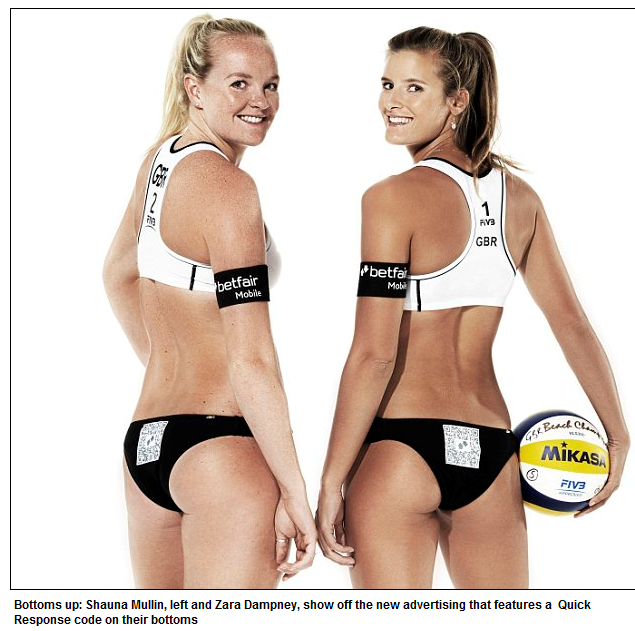
“Britain’s female beach volleyball champions are renting out their rears in an advertising deal that encourages spectators to photograph their behinds.

Zara Dampney, 24, and Shauna Mullin, 26, have turned their bottoms into their bottom line by wearing bikini briefs with a Quick Response (QR) code printed on the back where it will catch the eye of spectators.

When photographed on a smartphone, the code takes the user to a specific website – in this case, for bookmakers Betfair.”

image

>> Latest Posts

Four Ways CMOs Can Gain Power

August 11, 2011

A spreading sentiment these days is that marketing (and CMOs) are being marginalized ….  confined to tactical roles in communications and sales.

Here’s a take from MarketingProfs.com that suggests ways CMOs can elevate their (and their organization’s) clout.

 Marketing executives have an image problem, and it begins with the very definition of “CMO.”

CMO power is the ability to influence allocation of resources and other major strategic decisions within the top management team.

“We see CMOs get stuck in a pure communications role versus one that is at the heart of the business.”

Indeed, failure seems to infect the CMO suite, with the average tenure of chief marketing officers being less than two years.   

So, how does a CMO amass power”?

In his most recent study, Professor Mahajan (UT-Austin) identified four other ways CMOs can gain power:

1. Articulate a company vision in the face of industry instability.

When business is a roller-coaster ride, top management teams better appreciate the market and consumer perspectives of the CMO.

“Vision needs to be articulated.”

2. Lead innovation.

“The key to success, in many cases, is being able to position yourself as an agent of transformation.”

3. Personify the voice of marketing experience in the C-suite.

It’s hard for CMOs to feel the love when others on the executive team think they could do it better.

4. Take bottom-line responsibility for sales.

Marketing has generally been granted long-term accountability rather than responsibility for quarterly results.  Mahajan found that CMOs with bottom-line responsibility wielded more power than pure marketing or communications executives

Ken’s Take: Points 1 to 3 are blah, blah, blah. Focus on point number 4.  Without conspicuos bottom line attentiveness, marketing execs will invariability lack credibility and clout.  You have to be taking the heat if you want a seat at the kitchen table,

>> Latest Posts

Marketers reshape how college teams price & sell tickets …

August 10, 2011

Punch line: Colleges that are able to fill their football stadiums and basketball arenas are starting to price differentially – charging more for “hot” games.

But, the bulk of colleges are having trouble filling seats and are outsourcing ticket sales to aggressive outside organizations (think, “Boiler Room”)

* * * * *
Excerpted from USA Today

The “Haves” – Differentiated Pricing

Schools with overwhelming ticket demand are leveraging it as never before in an effort to boost revenue.

Notre Dame, for example, is varying football ticket prices by opponent for the first time this season. Games against Michigan State, Southern California and Boston College are $80; that’s $10 more than tickets for games against South Florida, Air Force and Navy.

The “Have Nots” – Outsourced Selling

“For years and years, if you put up enough billboards and sent out enough brochures, people would show up” at college games.

There not only was no need to be pushy in order to sell tickets to college games, there also was a fear of offending donors and deep-rooted fan bases by allowing non-profit colleges to have even the appearance of a chase-every-possible-dollar, professional sports business.

But, “colleges, for many years, were almost in an arms race for who could have the most seats — and they were able to fill those seats, for the most part. That has changed. … Most schools across the country have an issue with their football and/or their basketball seating demand vs. their seating capacity.”

Observers attribute this supply-demand imbalance to a combination of the tough economy, high gas prices and advances in high-definition television that have improved home viewing.

An empty seat leaves money on the table and  is a cancer to your brand.”

Hence, the rise in outsourcing

The number of schools outsourcing proactive, full-time ticket-selling operations to companies like Aspire, IMG, and Monumental S&E has recently skyrocketed.

The typical setup: 12 to 14 full-time staffers working on commission, each making 80 to 100 phone calls a day from a database of school-connected names.

“Get potential customers to talk about their love of the school. Seek referrals and new leads. Above all, make sales — and get psyched about making sales. Every time a staffer makes a sale, they ring a bell. Staffers who don’t ring the bell enough get fired.

  • Note: Georgetown uses Monumental Sports and Entertainment

>> Latest Posts

JetBlue’s all-you-can-fly promotion …

August 3, 2011

Punch line: To “hook” business folks traveling in & out of Boston. JetBlue is offering BluePass – a 3 month  all-you-can-fly promotional price.

From The Economist …

JetBlue selling “BluePass” allowing unlimited travel

JetBlue announced a promotion called “BluePass” that will allow travellers unlimited flights in a three-month span for one fixed price.

The three-month promotional period runs from August 22nd to November 22nd.

Travellers have three plans to choose from:

  1. Three months of unlimited travel between JetBlue’s Boston hub and any JetBlue city, all for $1,999.
  2. Three months of unlimited travel between JetBlue’s Boston hub and any of 13 selected JetBlue cities (non west of Chicago), this time for $1,499.
  3. Three months of unlimited travel between JetBlue’s Long Beach, California hub and any of nine selected JetBlue cities (non east of Chicago) for $1,299.

BluePass is targeted squarely at frequent business travellers, which seems likely given the pricing and the “Get Down to Business” promotional tagline

* * * * *

Right now, most airline pricing schemes are the kind that annoy travelers, not the kind that offer greater flexibility and customization.

It would be great if JetBlue’s offer starts to alter that dynamic. ZipCar, the popular American car-sharing firm, does a much better job than the airlines do of offering pricing plans to fit every need.

Ken’s Take: “All-you-can eat-plans” often push suppliers up against their capacity constraints and end up disappointing customers – think AOL’s unlimited monthly dial-up program.

At least JetBlue is time-limiting, and location-restricting the offer so they’re not stuck with it if it blows up on them.

Thanks to Tags for feeding the lead

>> Latest Posts

Have you noticed ?

July 15, 2011

Have you noticed the Homa Files fresh, new design?

After 3 years of using the stock WordPress design, I was nudged by family and friends to turn it up a notch.

Thanks to daughter-in-law Jess for the awesome new header … with clean lines, contempo colors and  a great image of the Key Bridge leading to Georgetown.

Be sure to notice that there are more information links on the home page … including click thru access to the Homa Notes on the 6 Ps of Marketing.

Onward and upward  …

>> Latest Posts

Shining sunlight on “vampire brands” …

July 13, 2011

Punch line: Vampire brands live off the blood of their customers … they can be (and should be) defanged by vigilant and vocal consumers.

Extracted from a published letter in the Financial Times by MSB Prof Charles Skuba.

Examples of minor customer exploitation have become too common business practices today and deserve more customer challenge.

It is lamentable that “business practices whose rationale derives from consumer ignorance and producer knowledge” are accepted today by too many executives, particularly in service industries, as convenient opportunities for fattening margins after the primary customer decision has been made.

The best brands and marketing practitioners have greater respect for their customers and work to win their loyalty at what Procter & Gamble calls the first and second “moments of truth”.

  • The first moment of truth is when the customer chooses one brand over another at the point of purchase.
  • The second moment of truth is when the customer chooses whether to repurchase after consideration of the value equation.

We will all benefit when consumers share their frustrating experiences with brands that fail this test.

Vampire brands that live off the blood of their customers are best controlled by exposure to the sunlight of customer criticism.

Ken’s Take: Social media provides a powerful way for dis-satisfied customers to spread their messages broadly and quickly.  Vampire brands beware.

>> Latest Posts

Stores creating “a sense of privacy, even sanctum” … for men!

July 8, 2011

According to research coming out of Australia, and reported in RetailWire:

Male-only supermarket shopping aisles that focus on gender-specific products rather than merchandise by category could encourage men to browse longer, trial new items and spend more.

“Research has shown that there is a group of male shoppers who have a ‘fear of the feminine’ or fear shopping among women’s health products such as tampons, waxing strips, pink razors and body scrubs,”

“Further, research found that men made more purchases … of health products that were not placed in high traffic areas or next to feminine-inspired products.

Apparently, some men are apprehensive of women’s products and are therefore less likely to spend time perusing their own personal needs.”

The answer: Creating retail ‘man caves’… “Gender specific aisles providie a relief to men, inspiring them to explore and discover new products … and create a sense of privacy, even sanctum.”

I can’t wait to go shopping tomorrow … I need some “privacy, even sanctum.”

* * * * *

Random Finding: Men also shop differently, valuing efficiency and independence over customer service and tend not ask for help.

Or, as Grandma Homa used to say: “Women shop, men buy.”

>> Current Posts

“Your rebate check may look like junk mail”

June 24, 2011

Interesting experience, indication of a trend.

Bought a set of new tires … tire guy pointed out that there was an applicable rebate of $20 per tire … even auto-filled out the mail-in form for me.

His parting words:“Your rebate check may look like junk mail … make sure that you don’t accidentally throw it away.”

Nice of the guy.

Have you noticed how more and more rebate and claims checks are, in fact,  looking like junk mail?

Historically, few people go through the hassle of submitting all of the docs for rebates. Historically, less than 15% of earned  rebates are claimed.

It’s just not worth the time and aggravation.

I guess that some companies think the 15% redemption rate is too high.

So, they try to aggravate “breakage” … doing things to keep folks from cashing the checks they receive.

One way to do it —  make the checks look like junk mail.

No way to run a business …

* * * * *

Whew! Ronald dodges the bullet …

May 20, 2011

Punch line:  McDonald’s is standing by its clown … still another job ‘saved’ or created. But now, image consultants are dissing him.

* * * * *

Excerpted from WSJ: No Pink Slip for Ronald McDonald, May 20, 2011

The 48-year-old, red-haired mascot has come under fire from health-care professionals and consumer groups who, in recent days, have asked the fast-food chain to retire Ronald McDonald.

But McDonald’s CEO says, “Ronald McDonald is going nowhere.”

“Ronald McDonald is an ambassador for McDonald’s, and he is an ambassador for good.”

There’s no doubt that Ronald McDonald is well known. He ranks fourth in consumer awareness out of 2,800 celebrities.

“Ronald is recognized by more than 99% of U.S. consumers. Of course, just because consumers know someone doesn’t mean they like them or trust them.”

* * * * *

Some image consultants are beginning to question how relevant Ronald McDonald even is to kids anymore — and whether he has kept pace with McDonald’s own reinvention.

McDonald’s has modernized its image in recent years by remodeling restaurants … by selling frappes and fruit smoothies and by offering free wi-fi to customers.

Mascots were heavily used in the mid part of the last century, but not so much anymore unless you’re an insurance company and you have a duck or a gecko or a caveman,”

“I’m not so sure Ronald is keeping up with where the brand is going. I question whether he’s still meaningful or a throwback to the last century.”

In-Store Marketing Reaches In…To Your Home

May 6, 2011

TakeAway: As shoppers research their grocery lists online before going to the store, shopper marketing begins at home.   In-store marketing traditionally consisted of flashy product displays, special promotions at the end of the aisle and attention-grabbing packaging on the shelf. 

No longer. 

Given how inundated consumers are with information via multiple media, the right marketing mix is even more challenging.

* * * * *

Excerpted from WSJ, “In-Store Sales Begin at Home By Ellen Byron, April 25, 2011

Determined to find the best deals, more shoppers are researching their grocery lists online before going to the store. For marketers, that means big changes in how and when they tempt consumers to buy.

It’s well known that consumers research expensive products like electronics online, but coming out of the recession, consumers are more scrupulous about researching their everyday products such as diapers and detergent, too. More than a fifth of them also research food and beverages, nearly a third research pet products and 39% research baby products, even though they ultimately tend to buy those products in stores, according to WSL Strategic Retail, a consulting firm.   That has led retailers and brands to target customers via blogs, social-media sites such as Facebook and Twitter and campaigns on retail sites, in addition to in-store campaigns.

A 2010 campaign for Procter & Gamble Co.’s new CoverGirl "Smoky Eye Look" makeup kit illustrates the more complex route marketers are taking.  To drum up hype for the product launch online, P&G, with Saatchi X, shipped the packs of mascara, eyeliner and eye shadow to makeup bloggers before they were available in stores. The "Makeup Master" kit also included application instructions, blogging tips, product photographs and a CoverGirl-emblazoned director’s chair.  Inside stores, CoverGirl drew attention to its kits with live product demonstrations, its co-branded print ads with Wal-Mart Stores and cardboard trays that carried the kits on the shelf while highlighting the product’s features.  After a purchase, shoppers were encouraged via Facebook and other online campaigns to write a review of the product, thus spreading the word to more customers researching makeup online.

The digital shift is a particular challenge for food and household-product companies, which typically aren’t as advanced online as their electronics and apparel counterparts. They have been deterred by the cost of shipping bulky but low-value items like paper towels, detergent and canned soup, especially given the ubiquity of brick-and-mortar stores selling the products for about the same price.

Wal-Mart is banking on the trend to accelerate. Lately, it has made its online circulars more user-friendly. It is also developing ways to offer more customizable circulars online, based on a shopper’s interests or needs.

To be sure, the shift hasn’t eliminated the need for effective campaigns inside stores. In-store marketing gained appeal and sophistication amid the fragmentation of television and print audiences, and accelerated during the recession, when marketers believed cash-strapped shoppers made even more purchasing decisions when looking at the store shelf.

Edit by AMW 

* * * * *

#1 Mom? Moms not feeling the love on Mother’s Day…

May 4, 2011

TakeAway: As brands aim to offer new ways to please moms on Mother’s Day, many moms feel neglected, and even hate their presents. 

While Americans expect to spend more this year on Mother’s day, nearly $140,  some Moms would just prefer time off from housework and a homemade card … 

* * * * *

Excerpted from MediaPost.com, “Brands reach out to moms, yet they feel dissed,” April 28, 2011

With Mother’s Day a few weeks off, marketers are doing their best to offer novel ways to remember her.

Lowe’s is targeting outdoor DIY projects as the ideal way to please her, offering plenty of mom-friendly ambience and lots of bright flowers. The retailer is even connecting it to a mom-friendly cause, selling Susan G. Komen Plant for the Cure plants.

Hallmark is getting some buzz for an extensive line of postage-paid greeting cards.

But … moms aren’t exactly feeling the love. A new survey from the Mom Complex reports that 30% of moms say they typically get honored for no more than 5 to 10 minutes on Mother’s Day. In fact, 40% feel their husband and children come first on Mother’s Day, and 12% feel they don’t even make the list.

Oh, and they hate their presents. What moms really want is time off from housework (57%) and a homemade gift or card. While 42% want that, only 28% got it last year …

… Americans will be spending more on mom this year — even if it’s not on the things she wants. The National Retail Federation reports that Americans are planning to spend $140.73 on gifts, up from $126.90 last year … Total spending is expected to reach $16.3 billion …

… The biggest change is in electronics with 13.3% planning to get mom an electronic gift, a 48% jump from last year. Jewelry is expected to be popular, with 31.2% percent of celebrants planning to buy mom silver, gold or diamonds — a 19% increase. …. it will likely be one of the biggest holidays of the year for restaurants, with 54.7% treating mom to dinner or brunch. About 65% will buy flowers.

Edit by KJM

* * * * *

Brands: Making ghosts powerful (again)

May 2, 2011

TakeAway: Kraft is on a mission to keep its myriad products from becoming ghost brands — once-prominent pantry staples that fade into obscurity through a lack of consumer interest brought on by a lack of advertising support. 

It is common during economic downturns for marketers to see if any brands they own can be renewed or revived because it can cost less to bring ghost brands back to life than develop new ones.

To forestall that fate for other brands, Kraft executives are initiating a project called Operation Spark, meant to help consumers reconnect with products that are not part of what Kraft calls its roster of “power brands,” which includes behemoths like Planters, Oreo, Ritz and Trident.

* * * * *

Excerpted from the NYTimes, “Rescuing ‘Ghost’ Brands From Grocery Limbo By Stuart Elliott, April 12, 2011

This is also a propitious time for Kraft to assess its product lineup because consumers who are still watching their spending are eating at home more often, making them more receptive to pitches for packaged foods.

If ghost brands cannot be reclaimed, marketers usually have to give up the ghost, selling or discontinuing them to concentrate on larger, livelier holdings. For instance, Kraft stopped making its Postum grain beverage, which dated to 1895, and sold off products like Log Cabin syrups.

The brands the executives hope to keep from the ghostly ranks include the Athenos line of Greek-style dips, spreads and yogurt; dairy products that are sold in the East under the Breakstone’s name and in the West as Knudsen; and Stove Top stuffing. 

Those brands are getting new campaigns and other promotional support, including television commercials for Breakstone’s and Knudsen that began on Monday. The brands also all have new agencies. 

A central element of Operation Spark is to pair the smaller brands with creative agencies that have outstanding reputations for effective, rule-breaking advertising — and have not previously worked for Kraft.

Edit by AMW 

* * * * *

For max effectiveness, place your commercials in a program’s “sweet spot” …

April 29, 2011

TakeAway:  New research done from viewership of shows on DVRs have found that — depending on the type of show — certain placement of the ad leads to better returns for recall and remembering of the ad.  

* * * * *

Excerpted from AdAge, “Finding the ‘Sweet Spot’ for ads in your favorite TV shows” by Brian Steinberg , April 11, 2011

Analysis of second-by-second viewing data from Tivos/DVRs suggests that shows have a  “sweet spot” for advertisers — a particular moment where commercials running in the program were more effective and received better by the audiences watching them?

Among the findings…:

  • Attention paid to the ads accompanying initial segments of many CBS procedurals — including “CSI: Miami,” “NCIS” and “Criminal Minds” — is more substantial than that accorded ad breaks during other parts of the programs. …CBS’s programming is consumed …by viewers wanting to sample the opening segment of the show. …where a crime is committed (and, oftentimes, comes with gore or violence) and viewers are likely trying to see if they like the set-up or if they’ve seen the episode in the past, ….
  • Viewers of NBC’s “Law & Order: SVU” paid the most attention during the last ad break in the show.
  • Heavy attention is paid to different moments in different sitcoms. Viewers of ABC’s “Modern Family” and NBC’s “30 Rock” paid the most attention during the last ad breaks in the programs (which often come before quick, funny segments that run alongside credits), while viewers of CBS’s “Big Bang Theory” paid the most attention to the first ad break in the half-hour comedy.
  • Viewers pay the most attention to the last ad break of many serial dramas … the ad breaks that precede segments in which networks tantalize viewers by offering scenes from the next episode.

Studies also indicate that DVR users tend to focus more intently on the show they’ve recorded and may not multitask.

Edit by HH

* * * * *

Grab your wallet … Ticketmaster going to “dynamic pricing”.

April 26, 2011

Punch line: Ticketmaster  plans to develop “dynamic pricing” systems that would adjust the cost of sports and concert tickets in response to demand, a strategy airlines and hotels have long used to maximize profits …  TM expects sports teams  to adopt the new system before concert promoters or Broadway producers.

* * * * *

Excerpted from WSJ, Ticketmaster to Tie Prices to Demand 

Dynamic pricing a key element in Ticketmaster’s strategy to revive sales of concert tickets, which have been stagnant or declining for years.

Last year was brutal for the concert industry, with ticket sales plunging 12% despite a modest decline in average prices. Recent price drops follow more than a decade of steady increases, a trend that helped mask fundamental problems.

“2010 taught us we have real challenges as an industry,” Mr. Hubbard said. “One of them is pricing.”

A frustration throughout the concert industry: the best seats appear to be consistently priced below what fans are willing to pay, leading to a multibillion-dollar “secondary market” in which scalpers can reap profits by reselling tickets above face value.

At the same time, he said, 40% of concert tickets sit unsold industry-wide, meaning that the ostensibly cheap seats for many shows are simply not cheap enough.

Thanks to JD for feeding the lead

P&G Sheds Pringles, its Last Food Brand

April 15, 2011

TakeAway:  In announcing the sale of Pringles to Diamond Foods for $2.35B, P&G concluded what had been a tumultuous, sometimes zany, 50-year experiment in engineered food.  P&G also refocused on its core product lines.

* * * * *

Excerpted from the NYTimes, “Once a Great Flop, Now Sold for Billions By Andrew Martin, April 5, 2011

The company’s expertise in edible oils was used widely by the potato chip industry in the 1950s and 1960s, and shaped the invention of Pringles. Company officials still aren’t sure how the chips got their name.  Pringles are basically dehydrated potato flakes that are rolled and then fried, but they were not universally loved initially.  The product was such a dud in its early years that some called for P&G to dump the brand. The brand did not take off until the company tweaked the flavor in 1980 and introduced the “Fever for the Flavor of Pringles” advertising campaign.  By the late 1990s, Pringles had become a $1 billion a year brand.

The sale of Pringles was not unexpected, as Procter has refocused its attention on the core businesses of beauty, grooming and household care.

In the 1950s, roughly 25% of the company’s sales were in food, particularly in shortening and other cooking oils.  But P&G lacked a distribution network to ship perishable bags of chips to grocery stores, so it directed its researchers to come up with a longer-lasting chip that could be distributed with P&G’s existing distribution network.  P&G wanted to create a perfect chip to address consumer complaints about broken and stale chips and air in the bags.

Officially, Pringles are called crisps rather than chips, the result of a long-ago fracas between competitors and regulators over what could be called a potato chip.

Edit by AMW 

* * * * *

Not sure what to get? How about an experiential gift card?

April 13, 2011

TakeAway: People are starting to turn away from stuff and turn to experiences and memories.

The rise of “experiential gift cards” has shown that you can do more with just an old gift card. Gone are the days of unwanted toasters or even gift cards to stores you don’t frequent. 

Gift cards loaded with a value that covers a variety of different activities are becoming the new rage.

* * * * *

Excerpted from AdAge, “New Gift-Card Trend Swaps Stuff for ‘Social Capital'” , March 28, 2011

“Experiential gift cards” …are becoming more popular, because they allow creativity for the giver and flexibility for the recipient.

“People aren’t looking for ‘stuff’ anymore, they’re looking for experiences,” … You can post pictures of your African-safari experience, but you can’t put up a picture of your Mercedes. That’s tacky.”

Smartbox offers gift-card boxes that retail from $49 to $369 … Inside the box is the card, of course, but also a book of the possible choices for such experiences as dinner for two in New York City (50 choices for $99); adventures like white-water rafting and surfing in California (100 choices for $69); and upscale getaways in the Great Lakes (35 choices for $369).

Experiential gifts, … are relatively nascent in the U.S. compared to the other places in the world such as the U.K. and Australia.

“In the U.S., this is really new, especially at retail, …The growth is really happening now”

Smartbox …has pushed out an aggressive public-relations campaign and more recently begun spreading its message via social media. …partnership with Zagat Smartbox Table for Two, and was marketed at Valentine’s Day with PR and a social-media promotion. …

“All happiness research points to the fact that it’s not the things you have that make you happy, it’s the experiences you have,” …”The lag in experience gifts and the lag in consumers recognizing it was an option surprised me, but marketers are catching on now.”

Gift experiences have the added bonus of making the giver more memorable. You won’t remember who gave you socks or a sweater, but you’ll probably recall who gave you an experience where a memory was created,…”A gift is a connection between me and you, and things have far less meaning than experiences.”

Edit by HH


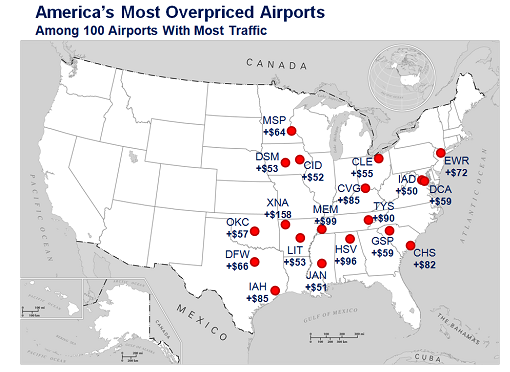
What do Houston, Newark, and Dallas have in common?

April 12, 2011

Answer: high air fares.

Great analysis in one of the New York Times blogs

The writer wanted to figure out why, say, an average passenger flying out of Newark Liberty Airport pays about 25 percent more than someone flying out of John F. Kennedy International for an equivalent seat on an equivalent flight.

So, he cranked some nums re: airline pricing, and sorted airports as ‘relatively overpriced’ or ‘competitively priced’.

He modeled airport prices based on distance to destinations,  size of market (how much ‘traffic’),  and competitive structure – i.e. the market share at the origin and destination airports held collectively by the five “legacy carriers” (United, American, Delta, Continental and US Air); the market share held by Southwest Airlines; and the market share held by the largest single carrier at that airport (for instance, Delta and its affiliates are responsible for about 66 percent of all traffic at Atlanta).

He concluded that prices are higher where:

  • Legacy airlines dominate an airport
  • Southwest has a large share as opposed to other low-cost carriers like AirTran and JetBlue.
  • One airline dominates an airport, regardless of whether it is a legacy carrier or a low-cost one.

Here are overpriced airports:

image

image

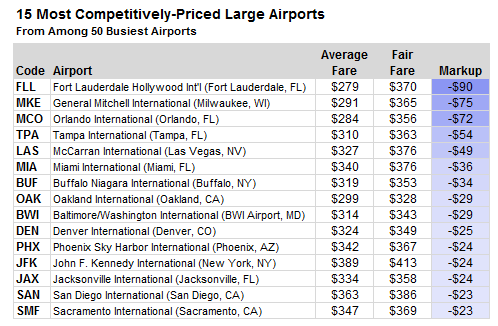
For ‘competitively priced’ airports, the “unifying theme”  is that many are warm-weather vacation destinations, like Las Vegas and pretty much anywhere in Florida.

Why?

Leisure travelers are more price-sensitive than business travelers since they, not their company, are paying for the ticket. To keep them flying, prices have to be relatively low,

Here are the bargains:

image

A very clever analysis … Worth reading the details:
http://fivethirtyeight.blogs.nytimes.com/2011/04/06/which-airports-have-the-most-unfair-fares/

Thanks to BM for feeding the lead.

Want to sell more to men? Just follow these 5 steps

April 8, 2011

TakeAway: As men shop more and more,retailers need to make them feel comfortable in their stores,  Here’s how …

* * * * *

Excerpted from AdAge, “How to Connect With the Heart and Mind of the Male Shopper” by Simon Goodall, March 29, 2011

Men are shopping more than ever. In 2002, 64% bought their own clothes; four years later that number was 84%, according to GQ. Around one-third of primary shoppers for groceries reportedly are now men. Yet 40% of men feel unwelcome in retail stores, we have found.

… all of the suggestions below should be seen as statements of how men are, on average, more likely to behave than their female counterparts. It’s important to understand why they shop…

1. Men need to demonstrate their mastery of shopping.

Men like doing things they can do well. And hate doing things they aren’t good at. …they have never had the opportunity to learn how to be a good shopper. …empower him to demonstrate his mastery …and he will come away feeling he has done a good job.

Amazon has enabled millions of men to master buying music. Consumer reviews and lists provide what he needs to feel confident about his choices…

2. Performance is emotional.

Men want to know how products perform. Reasons to believe are truly reasons to buy. Performance provides a kind of “emotional functionality.” It helps men feel that their choice is more efficient, powerful or technologically advanced. Performance is the way to a man’s heart.

3. Men don’t browse, they carry out reconnaissance.

…when men find themselves popping into a computer store or surfing through 3-D-TV reviews online, they are not browsing — they are carrying out important reconnaissance. Perhaps that explains the drift from generalist to specialist stores. They need someone available to assist with their purchases… they seek out expert advisers and technological proof during their research.

…personalization also plays to the fact that men are more willing to pay for products and brands that are customized to their needs….

4. Men want products that reflect their progress in the world.

Sixty-eight percent of millennial men and more than 50% of Gen X men state a preference for brands that “show I have good taste,” … men are more likely to seek out brands that offer exclusivity; have market-leading position; suggest to others that they are successful; and have a “members-only feel,” … proof of quality and their good taste in the details….

5. Men want sanctuaries where they can be men again.

… the majority of men still do not view shopping as a leisure activity, perhaps because it still carries connotations of femininity. Yet the resurgence of traditional barbershops and emergence of male beauty zones suggests a boom in retail experiences that create a sanctuary for maleness…

So what’s key to winning his heart, mind and wallet? Understand the underlying emotional motivations for why men shop.

Edit by HH


Unilever: “We can make your arm pits sexy …”

April 7, 2011

TakeAway:  Since practically everybody uses deodorant, marketers need to devise new features or grab sales from rivals. 

Winning over new customers is particularly difficult, however. Some 50% of deodorant buyers reported using the same brand in the last 12 months.

* * * * *

Excerpted from the WSJ, “Unilever Tackles the Ugly Underarm By Ellen Byron, March 30, 2011

Unilever’s new angle on selling deodorant to women is a product that claims to make underarms not only odor-free but prettier. 

Dove Ultimate Go Sleeveless, which hits U.S. stores this week, claims its formula of specialized moisturizers will give women better-looking underarms in five days.

UGS was inspired by Unilever research that found 93% of women consider their armpits unattractive. 

Magazines and talk shows pour out the tips on how women can improve plenty of body parts, from legs to midriffs to fingernails. But little attention — or advice — has been brought to armpits.

Some 62% of the women surveyed said they suffer underarm skin problems like breakouts, discoloration or itchiness, according to research at Unilever. Nearly half said they have been embarrassed enough by the condition of their underarms that they have changed clothes.

Promoting a problem that consumers don’t necessarily realize they have is a frequently used but risky approach.

“Any marketer has to be careful of appearing to create a problem that doesn’t really exist  … You can suffer a backlash if you do that.”

Edit by AMW

* * * * *

Pepsi (and everybody else) goes retro …

April 4, 2011

TakeAway: Many brands are finding that the best way to come up with a new product is to make a retro version of the old product.

Pepsi, Heinz, Hostess have all incorporated “throwback, retro” design and products into the line up. 

Studies shown that Millennials relate particularly well to retro items as it gives them a feeling of authenticity.

* * * * *

Excerpted from MediaPost, “More Retro Action: Heinz, Hostess Follow Pepsi” by Karlene Lukovitz, March 22, 2011

Everything old is new again in the world of marketing — although these days, “old” can sometimes mean the 1990s.

One week after PepsiCo made retro versions of Pepsi, Mountain Dew and Doritos a permanent part of the brands’ lineups, Heinz Ketchup is readying a collector’s edition glass bottle with a retro label, and Hostess is featuring ’70s brand characters and bringing back Twinkies’ original banana filling recipe.

These developments come a week after PepsiCo announced that it is making sugar-formulated (no high-fructose corn syrup), retro-packaged Throwback versions of Pepsi and Mountain Dew … permanent, year-round parts of the brands’ portfolios.

The retro phenomenon — also being seen in a wide variety of nonfoods categories (think Nike’s Playoff Air Jordan 13 Retro athletic shoe and Disney’s revival of the “Tron” franchise) — is being driven primarily by marketers’ realization of the power of “authenticity” among Millennials, in particular.

Retro is very cool with 20-somethings, because it ties in with their desire for simpler, cleaner, more authentic lives. … they see nostalgia as a way to differentiate themselves.”

“Millennials thrive on interconnectedness, but highly value authenticity, particularly ‘real’ ingredients as opposed to ‘chemical stews.’

At the same time, boomers feel a rose-colored yearning for the days when life was less complex.”

Edit by HH

Just me, or is that package smaller than it used to be.

April 1, 2011

TakeAway: As businesses anticipate rising raw materials costs, consumers are beginning to encounter shrinking food packages. 

With unemployment still high, companies have tried to camouflage price increases by selling their products in smaller packages. 

Most companies reduce products quietly, hoping consumers are not reading labels too closely.  However, there could be some backlash as consumers wise up.

* * * * *

Excerpted from the NYTimes, “Food Inflation Kept Hidden in Tinier Bags By Stephanie Clifford and Catherine Rampell, March 28, 2011

In every economic downturn in the last few decades, companies have reduced the size of some products, disguising price increases and avoiding comparisons on same-size packages, before and after an increase. Each time, the marketing campaigns are coy; this time, the smaller versions are “greener” (packages good for the environment) or more “portable” (little carry bags for the takeout lifestyle) or “healthier” (fewer calories).  Trying to keep customers from feeling cheated, some companies are introducing new containers that, they say, have terrific advantages — and just happen to contain less product.

“Consumers are generally more sensitive to changes in prices than to changes in quantity,” John Gourville, a marketing professor at Harvard Business School, said. “And companies try to do it in such a way that you don’t notice, maybe keeping the height and width the same, but changing the depth so the silhouette of the package on the shelf looks the same. Or sometimes they add more air to the chips bag or a scoop in the bottom of the peanut butter jar so it looks the same size.”

Kraft is introducing “Fresh Stacks” packages for its Nabisco Premium saltines and Honey Maid graham crackers. Each has about 15 percent fewer crackers than the standard boxes, but the price has not changed. Kraft says that because the Fresh Stacks include more sleeves of crackers, they are more portable and “the packaging format offers the benefit of added freshness,” said a Kraft spokesman.  Similarly, P&G is expanding its “Future Friendly” products, which it promotes as using at least 15 percent less energy, water or packaging than the standard ones.  “They are more environmentally friendly, that’s true — but they’re also smaller,” said Paula Rosenblum, managing partner for retail systems research at Focus.com, an online specialist network. “They announce it as great new packaging, and in fact what it is is smaller packaging, smaller amounts of the product,” she said.

Or marketers design a new shape and size altogether, complicating any effort to comparison shop. The unwrapped Reese’s Minis, which were introduced in February, are smaller than the foil-wrapped Miniatures. They are also more expensive — $0.57 an ounce at FreshDirect, versus $0.37 an ounce for the individually wrapped.

In the culture of thinness, smaller may be a selling point. It lets retailers honestly claim, for example, that a snack package contains fewer calories — without having to change the ingredients a smidge.  “For indulgences like ice cream, chocolate and potato chips, consumers may say ‘I don’t mind getting a little bit less because I shouldn’t be consuming so much anyway,’ ” said Professor Gourville. “That’s a harder argument to make with something like diapers or orange juice.”  But even while companies blame the recession for smaller packages, they rarely increase sizes in good times, he said.  Once the economy rebounds, he said, a new “jumbo” size product typically emerges, at an even higher cost per ounce. Then the gradual shrinking process of all package sizes begins anew, he said.

Edit by AMW

Ken gets a makeover … now, a“babe-magnet”

March 30, 2011

 Not me, silly …. Barbie’s “arm candy” in toyland.

I missed that Barbie dumped toy Ken in 2004, ending a 43 year relationship.  For the past 10 years, the jilted Ken toiled in obscurity.

Well, he’s back.

Mattel brokered a reconciliation between Ken and Barbie as part of its brand-marketing, sales-recovery strategy.

Ken’s remake has boosted the brand’s sales to $1.25 billion in 2010

* * * * *

Excerpted from: BW Magazine, “Why Ken Is the New Babe-Magnet in Toyland”  February 10, 2011 BW Magazine

The world’s most famous plastic couple – Ken & Barbie — is getting back together.

Ken’shandlers revamped his image, giving him a Justin Bieberesque makeover complete with floppy locks, skinny jeans, and graphic T-shirt.

That landed Ken a scene-stealing part in Toy Story 3, restoring him to his previous status of pop culture icon.  The filmmakers cast Ken as a vain, leopard-print-wearing metrosexual. In one scene, Ken cries: “I’m not a girl’s toy.”

Ken now has his own Facebook page and Twitter feed (sample tweet: “Weekend Ken-fession: I may have knocked somebody over while walking and playing Madden on my iPhone this morning. My bad.”).

Beaming with confidence after his big-screen debut, Ken won his ex back with professions of love on big-city billboards and ads in Us Weekly. One message: “We may be plastic, but our love is real.”

Despite Ken’s breakout movie role and his growing ranks of Twitter followers, his future depends, as always, on the woman he loves.

He’ll stay in the spotlight “unless he does something to really upset Barbie.”

In store service goes virtual … and, oh yeah, help yourself.

March 28, 2011

TakeAway: Digital bar code scanning is being utilized in stores to help customers learn more about the product, watch videos, price shop, and even help make an online purchase. 

Home Depot has taken to this strategy to provide another way for customers to get tips and help especially for those in the digital world often unwilling to ask for help but would rather just look it up or do it themselves.  

* * * * *

Excerpted from Internet Retailer, “The Home Depot customers get a Quick Response from mobile bar codes” by Katie Deatsch, March 22, 2011

… Home Depot long emphasized its jovial sales staff that is eager to offer product information and tips in stores. Now the retailer is taking that help to the mobile realm.

… a series of ads incorporating QR, or Quick Response, two-dimensional bar codes that smartphone owners can scan using an app tied to a smartphone’s camera to access product ratings and reviews, how-to guides, product videos and a web page on which they can make a purchase.

… Shoppers …will be able to access information like product demos and instruction videos, relevant accessories, buying guides, project guides, and an option to purchase online. …

… Home Depot … will be able to track the scans via Scanbuy bar code system analytics to better gauge customers’ interests, view locations of scans and more…

“… customers already using mobile devices to assist in the purchasing process, and now Home Depot is embracing this technology to more closely connect our stores and customers to our digital content…”

Bar code scanning may lend itself to products such as home furnishings that can have many complex features and are often installed by do-it-yourselfers.

… enables shoppers to scan…codes on Ralph Morris products for more information about the line as well as to gain access to post-sale help such as information on how to install the Randolph Morris products.

Other retailers using bar code scanning to promote their brands. …Macy’s Inc. last month launched a QR bar code scanning marketing program …that lets in-store shoppers use a mobile device …to access videos about the designers and brands. …provide consumers with tips and information on the latest trends, and advice and inspiration from celebrity style icons via 30-second films delivered to a phone.


Edit by HH


* * * * *

How much does a ‘for sale’ home’s list price matter?

March 25, 2011

Answer: a lot … it’s the psychological effect called anchoring.

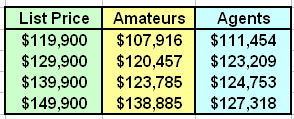
For example, researchers asked both professional real estate agents and man-off-the-street amateurs to predict the final selling price of a house.

They were all told that the current tax appraisal value of the house was $135,000.

Then, each respondent was told that the house was listed in one of four prices — ranging from $119,900 to $149,900.

The researchers found a clear positive correlation between list prices and predicted sale prices.

The amateur is responded more to the differences in list prices and the professionals — but even the pros and a $15,000 spread that can only be attributed to the differences in the list prices.

Bottom line: if you’re selling a home beach for the sky with your list price; if you’re buying a home try to ignore the list price and focus on more fundamental values like tax assessments and comparable sales

image

Source: Priceless, William Poundstone, Hill and Wang Books, 2010

Walk clockwise around grocery stores !

March 24, 2011

Why?

Because you’ll save money.

Researchers have discovered that “shoppers open their wallets wider when moving through a store in a counter-clockwise direction.”

On average, they spend $2 more per visit.

Why??

One theory is that most shoppers are right handed … and like most basketball players, they go to their right better…. so, impulse items stocked to their right along “walls of value” are easier to grab and throw in the cart.

If you are right handed, walk clockwise and the “wall of values” will on your left,  and will be less tempting.

Source: Priceless, William Poundstone, Hill & Wang, 2010, p.149

I spent $1 million on digital advertising … did it work?

March 23, 2011

TakeAway: With the move to digital, companies are unsure how to ensure their digital marketing dollars are being spent effectively.

Companies are spending more and more on copy testing for digital ads even with the criticism that copy testing kills creativity.  

* * * * *

Excerpted from AdAge, Copy Testing Coming to Digital Marketing” by Jack Neff, February 27, 2011

As … marketers are investing more in digital, they’re bringing with them one of their time-honored processes from TV advertising: copy testing.

… despite criticism that copy testing leads to bland ads that avoid risks, and that the storyboards or animatics used in copy tests don’t capture the magic production can create. …

…copy-testing houses have years of research showing copy-test results predict sales impact from ads. But expansion of copy testing to digital adds a new layer of controversy: Some critics believe tests developed for TV won’t work on digital ads.

… people close to P&G say it’s “TV testing” most of its digital ads now — video and other formats alike.

…”A home-page takeover on Yahoo can cost a million dollars a day,… The traditional thing with digital was if it’s not working, we’ll take it down. When you drop a million dollars in a day, you’d better be sure it’s working.” … “even if copy-testing squelches creativity …the world’s largest advertisers see value in doing this.”

…”All of our communications testing is designed to increase the odds of success in market, … We often conduct early learning with prototype production, increasing our ability to produce communication that really resonates with consumers.”…

… believes creative inconsistency has hurt digital ad effectiveness and applauds marketers for seeing they need to test copy. …But…”to try to force fit the old TV pretesting model into digital is kind of idiotic.”

… the context and content of where digital ads run affects how they work, …

Making small digital buys to test creative is no longer tenable for brand marketers because online survey response rates have plunged in recent years. Clicks and conversions in small tests are meaningful for direct-response advertisers, …but not brand marketers, … no links between clicks and offline sales, brand awareness or purchase intent.

…more packaged-goods clients are spending on digital copy testing, though most don’t have specific budgets for it and many are hesitating because of a lack of adequate research options. “Digital is not a single advertising medium, but rather an accumulation of media and should be addressed as such.”

“Once brands and researchers fully understand the digital space digital advertising research will become more actionable.”


Edit by HH

That menu — it’s playing with your mind … is it a profit scheme?

March 22, 2011

You bet it is …

In his book, Priceless: The Myth of Fair Value (and How to Take Advantage of It), author William Poundstone dissects the marketing tricks built into menus—for example, how something as simple as typography can drive you toward or away from that $39 steak.

1. The Upper Right-Hand Corner
That’s the prime spot where diners’ eyes automatically go first.

Restaurants often use it to highlight a tasteful, expensive pile of food.

2. Pictures

Generally, pictures of food are powerful motivators but also menu taboos — mostly because they’re used in downscale chains like Chili’s and Applebee’s.

Red Lobster ditched pics when it started trying to inch upscale

3. The “Anchor”
The highest priced item on the menu may not ever get ordered.  That’s ok.  It’s purpose is to make everything else near it look like a relative bargain.

4. In The Vicinity
The restaurant’s high-profit dishes tend to cluster near the anchor.  They’re items at prices that seem comparatively modest (when compared to the anchor).. They’re the items the restaurant really wants you to buy.

5. Columns Are Killers
It’s a big mistake for restaurants to list prices in a straight column. “Customers will go down and choose from the cheapest items.”

Consultants say to omit “leader dots” that connect the dish to the price; and to drop dollar signs, decimal points, and cents

6. The Benefit Of Boxes
“A box draws attention and, usually, orders.

When you see an item in a box, think “high margin”

7. Menu Siberia
That’s where low-margin dishes that the regulars like end up. They’re there, but relatively easy-to-miss  … or so the restaurant hopes..

8. Bracketing
A regular trick …  it’s when the same dish comes in different sizes.

Because youre never sure of the portion size, you’re tempted to to trade up … especially from small to “regular” size.

* * * * *

Excerpted from Priceless: The Myth of Fair Value (and How to Take Advantage of It), to be published in January by Hill & Wang, an imprint of Farrar, Straus & Giroux. © 2010 by William Poundstone.
http://nymag.com/restaurants/features/62498/

Panera builds loyalty .. and, oh yeah, keeps prices high.

March 21, 2011

TakeAway: Panera Bread investors are hoping the company’s new loyalty program and additional menu items will lead the way for continued sales and traffic growth.  The loyalty program, MyPanera cards, is a way for the company to build deeper relationships with people who are already engaged with the brand.

* * * * *

Excerpted from WSJ, “Panera Bread Sees Loyalty, Innovation Bringing in the Dough” By Annie Gasparro, February 11, 2011

On the heels of launching its customer-loyalty program, Panera is bringing in steak as new protein for its sandwiches, which, bolstered by extra marketing, are expected to help continue the trend of increasing sales, especially in the dinner and catering businesses.

The move to add steak to the menu comes at a time when beef prices are at all-time highs and rising, putting additional commodity pressure on Panera. But the company remains confident.

Panera’s loyalty program, MyPanera cards, is expected to be a key driver in future traffic growth, as it allows the company to track what its customers are buying, when they buy it and how much they spend. The free program was launched in the fourth quarter and presents members with “soft rewards,” like complimentary items, that match their buying habits.

This kind of insight can be used to make marketing substantially more effective, analysts point out. By giving a free bakery item to a customer who normally buys just coffee, Panera could create a higher-check customer long-term. In the same way, it could bring breakfast frequenters, for instance, in more regularly for lunch or dinner as well.

Panera isn’t afraid of raising prices coming out of the recession. The bakery chain says its overall commodity costs, about 80% of which are locked in for the year, will be up about 3% this year, causing the company to raise prices 2%.  Panera’s bottom line improved through much of the recession, having increased every quarter in nearly three years largely due to customer loyalty. While competitors discounted to lure customers during a slump in dining demand, Panera’s aversion to price cuts succeeded among its base of mostly upper-middle-class customers and revenue growth never reversed.

Edit by AMW

* * * * *

Marketers Return to “Good Ole Days” Strategy

March 18, 2011

TakeAway: With the economy still a long way from recovering, marketers are turning to an old strategy to reconnect with consumers.

Recent ads from automobile and even bourbon companies aim to reach the average Joe via the theme of shared values 

Advertising that makes an emotional appeal to consumers is by no means a new trick to advertisers or their agency partners, but it’s easier said than done. 

One of the classic, textbook examples of marketers who excel at this is Coca-Cola, which isn’t selling bottles of Coke, per se, but “8- and 12-oz. bottles of happiness.” 

In tough times, the strategy may be even more critical as cash-strapped consumers are more likely to spend money on brands that closely align with their personal values.

* * * * *

Excerpted from WSJ, “Marketers Embrace ‘Values’ Pitch in Tough Times” By Elaine Wong, February 17, 2011

The two-minute Chrysler “Imported from Detroit” commercial is full of values-laden phrases. There are the obvious descriptors like “hard work” and “conviction” as well as adages that inspire awe and determination, such as: “It’s the hottest fires that make the hardest steel.” Or, thought-provoking questions like, “What does a town that’s been to hell and back know about the finer things in life?” All statements that are meant to encourage consumers to take a second look at Chrysler by prompting them to reconsider their values.

Another one of Detroit’s Big Three, General Motors, which also advertised in the Super Bowl, has been running a campaign for the last four months to promote its new lineup of Chevrolet vehicles, including its Volt electric and Cruze compact cars. A 60-second “anthem” or anchor television spot takes viewers through Chevrolet’s historical past, as well as a brief look into its future. “One hundred years ago, Chevrolet sprang bolt by bolt, car by car, out of the very best America had to offer: ingenuity, integrity, optimism,” the voiceover says.  There is also a subtle plug at Chevy’s “deep” history: “This isn’t just any car company. This is Chevrolet. And the strength of our nation can be found in every car and truck we make. That’s why today, tomorrow and on into a bright future, we can proudly say, ‘Chevy runs deep.’”  The strategy is a bit different from the past, when Chevrolet marketed its vehicles via a “hard sell” kind of approach–i.e., “We’re an American brand, you’re an American consumer, therefore, you should buy our products.”

The shift stemmed from this insight: “While consumers want us to succeed, they don’t want to spend their hard earned money on us just because we’re made in the U.S. and are a U.S. company.” A better approach was to focus on the emotional reasons behind why Americans buy Chevrolets.

Edit by AMW

But, I just want plain old toothpaste …

March 15, 2011

TakeAway:  An explosion of specialized pastes and gels brag about their powers to whiten teeth, reduce plaque, curb sensitivity and fight gingivitis, sometimes all at the same time.

Add in all the flavors and sizes, plus ever-rising prices, and the simple errand turns into sensory overload. 

Manufacturers acknowledge the problem and are putting the brakes on new-product introductions.  In this case, more product variety isn’t always better.

* * * * *

Excerpted from the WSJ, “Whitens, Brightens, and Confuses By Ellen Byron,February 23, 2010


P&G, maker of Crest, says it has “significantly” reduced the number of oral-care products it makes world-wide in the past two years.  Crest hit the market in 1955 and in 1960 became the first fluoride toothpaste to gain the American Dental Association’s “seal of acceptance.” Toothpaste was elevated from cosmetic to therapeutic status, and sales of Crest nearly tripled within the next two years. The 1980s brought tartar-control formulas, raising consumer expectations of what toothpaste could do. Ever since, companies have brought out benefits and ingredients, in search of the next game-changing upgrade.

Each new benefit is a chance for toothpaste makers to push prices upward and drive sales. With some 93% of U.S. adults using toothpaste, according to Mintel, there’s little room to recruit new users.

Packaging plays its part in toothpaste-aisle clutter. “The toothpaste carton is a certain size and shape and sits on the shelf in a certain way. That makes it hard to communicate effectively when there’s a meaningful difference in a new product,” says Jonathan Asher, senior vice president at Perception Research Services, which specializes in packaging and shopper marketing.

This year, Colgate-Palmolive introduced packages meant to be more easily deciphered. It standardized sizes of the Colgate logo, the “sub-brand” and the flavor or benefit, so shoppers will notice them in that order. It did what it calls “shelf tests,” timing how long it took shoppers to find new packages of Colgate Total Advanced Whitening and other variations, versus older packages. “The new packaging was not only preferred but it was easier to find,” says Nigel Burton, president of Colgate’s global oral care, consumer insight and advertising.

Many dentists think differences between brands aren’t very meaningful. “Just make sure it has fluoride and has the American Dental Association seal,” says Ada Cooper, a New York dentist and consumer adviser for the ADA, which evaluates toothpaste claims. The ADA’s seal “tells you that the product has been tested, that it’s effective in doing what it says it’s going to do, and has the right mix of ingredients.”

Edit by AMW


Mr. Retailer wants to get chummy with you … what’s your 12-digit customer ID?

March 14, 2011

TakeAway: Retailers are trying to recreate images as companies that know its customers and gives them what they want.

Stores are leveraging loyalty programs as a way to use the customer information and customize marketing for each person. 

* * * * *

Excerpted from AdAge, “Retailers on a quest to Rekindle the Personal Touch of a Bygone Era”  by Natalie Zmuda, February 14, 2011

… retailers knew their customers. Sales clerks sent invitations to store events, called when items of interest arrived… Rolodexes crammed with notes about shoppers’ favorite brands and styles. That style of shopping — an intimate experience, not an anonymous one — has long been thought dead… now retailers are hoping to recapture some of the old magic.

… by updating and expanding loyalty programs, …customers are highly educated …more demanding than she’s been in the past, … and wants to go to a retailer that understands her, is really relevant to the lifestyle she’s living, and really does pay attention.

My Macy’s, now in its third year, seeks to be more relevant to consumers by stocking shelves with items popular in local markets — … also extends to marketing. Events celebrating the Kentucky Derby …And big wins for local sports teams are recognized… This month, Macy’s Star Beach Party program will launch in Chicago, targeting college students from 10 area campuses … pairing texting and pop-up events to lure students shopping for spring break fashions and, eventually, interview suits, the retailer hopes.

Food Lion has launched My Food Lion, inspired, in part, by My Macy’s … allows customers to create a profile personalized with relevant specials and recipes.

Worth noting: My Macy’s and My Food Lion are separate from those retailers’ loyalty programs, Macy’s Star Rewards and Food Lion’s MVP Card. The former focuses on understanding the customer and delivering desirable products and information, Ms. Reardon said. The latter is meant to reward customers for frequent shopping.

… savvier use customer information. PetSmart uses its database of email addresses to send out targeted emails with editorial content, as well as coupons. …Likewise, Sears Holdings has overhauled its loyalty program in the past two years, morphing it into Shop Your Way. …The program is cost-effective and gives Kmart and Sears the opportunity to build a robust database of consumers.… ongoing power of a very simple, classic idea: rewarding loyalty based on customer behavior,”…

More robust databases and better targeted communications will go a long way toward helping retailers recapture the magic of retailing days past. But it’s not easy or simple. … “What we tried to do was really customize [catalogs] to what the customer is really looking for and her past behavior shows she might want,” … “It was pretty resource intensive. But we learned a lot, and we are going to do similar things in the future.”

Edit by HH

New “super cold” Coors cans

March 11, 2011

TakeAway:  Package design is a critical part of a brand’s success.

At the point of sale a catchy package can make the difference between making the sale or not.

MillerCoors continues to evolve its gimmicky “cold cans” to try to boost sales in the ultra-competitive beer market.

* * * * *

Excerpted from brandchannel, “MillerCoors Looks to Boost Marketing in Face of Beer Sales Slump,” by Jennnifer Sokolowsky, February 21, 2011

MillerCoors is hoping that cold cans will warm up beer sales this year.

The veteran brewmeister plans to increase spending on marketing and introduce new packaging for Coors Light.

The new Coors Light packaging will include an indicator to show when the beer has reached a “super cold” temperature …

Introducing new packaging is a strategy that has worked in the past to boost sales for Coors Light, which is expected to overtake Budweiser as the No. 2 selling beer the U.S. this year, behind Bud Light.

However, MillerCoors and other beer makers are also going to need an improved economy and more jobs for 21- to 32-year-old men to get them drinking more mass-market beer. …

Edit by DMG


* * * * *

A Subway stop on every corner …

March 10, 2011

The marketing principle: Ubiquitous distribution.  Coke wants to always be within arm’s reach of every person. That’s ubiquity.

Now, Subway wants to be in every nook & cranny – anywhere somebody might yearn for a sandwich.

Punch line:  It’s official: the Subway sandwich chain has surpassed McDonald’s Corp. as the world’s largest restaurant chain, in terms of units.

At the end of last year, Subway had 33,749 restaurants worldwide, compared to McDonald’s 32,737.

Subway just opened its 1,000th location in Asia, including its first in Vietnam.

There are almost 8,000 Subways in unusual locations. “The non-traditional is becoming traditional.”

Subway has achieved its rapid growth, in part, by opening outlets in non-traditional locations such as an automobile showroom in California, an appliance store in Brazil, a ferry terminal in Seattle, a riverboat in Germany, a zoo in Taiwan, a Goodwill store in South Carolina, a high school in Detroit and a church in Buffalo, New York.

“We’re continually looking at just about any opportunity for someone to buy a sandwich, wherever that might be. The closer we can get to the customer, the better.”

McDonald’s is still the leader when it comes to sales. The burger chain reported $24 billion in revenue last year.

Excerpted from WSJ,  Subway Runs Past McDonald’s Chain , March 8, 2011

Battle of the titans: Miracle Whip calls out mayo…

March 10, 2011

TakeAway: Kraft kicked off a new, potentially risky campaign for its sandwich spread brand that embraces both Miracle Whip “lovers” and “haters.” 

The campaign comes at an interesting time for Miracle Whip.

Consumers are still packing lunches after last year’s recession, and sales of sandwich spreads and other “brown bag” ingredients are still holding up in a relatively weak economy.

At the same time, mayo and sandwich dressings have also gotten competition from healthier alternatives such as avocados and hummus, which can also be used as substitutes.

* * * * *

Excerpted from Forbes, “Kraft Shows “Polarizing” Side of Miracle Whip In New Campaign” By Elaine Wong, February 22, 2011

Miracle Whip, which comes in varieties like Light and Free, is targeted towards low-fat consumers and doesn’t think of itself as a mayonnaise. New ads ask bluntly, “We’re not for everyone. Are you Miracle Whip?”  And the lineup of celebrity spokespeople is just as polarizing.

Miracle Whip’s latest campaign is indeed provocative (after all, reaching out to the “haters” of a brand does carry risks), but Kraft sees it as a logical progression from two previous efforts the brand previously ran. One was a campaign that spun mayo, er, sandwich spread advertising on its head with spots that showed punk/rock consumers championing the brand. That effort, which carried the slogan, “We are Miracle Whip and we will not tone it down,” was meant to get younger consumers to take a second look at the brand.

The insight stemmed from the observation that “Miracle Whip has a unique flavor that tends to inspire a polarizing reaction in consumers. So, rather than deny this truth, we’re embracing it and owning up to the fact that we’re not for everyone,” said Miracle Whip’s senior brand manager.

In some households, the debate even went as far as the point where parents had to decide whether to raise the kids as Miracle Whip or mayo consumers, a phenomenon Kraft referred to as the “dual condiment household.”


Brand lovers may certainly help reinforce Miracle Whip’s positive attributes, but “negative” comments affirming the brand’s “poor” side can also easily get out of hand

Edit by AMW

* * * * *

Keds Steps It Up … to Kick It into Gear

March 9, 2011

TakeAway: Keds is repositioning itself and wants to remind people that it is an iconic brand. 

The buildup of artist collaboration and partnerships over 2010 culminates in the 2011 “How Do You Do?” campaign, which will encourage the target audience to create and collaborate, and emphasizes the idea of Keds sneakers being a canvas used to express that creativity.

* * * * *

Excerpted from WSJ, “A Campaign to Introduce Keds to a New Generation” By Tanzina Vega, February 22, 2011

Drivers who see a 32-foot shoebox rolling down the highway over the next few weeks should not be alarmed. The large white box is part of a new national marketing campaign for the sneaker company Keds.  The campaign, called “How Do You Do?,” is intended to reach millennials by taking the shoebox on wheels on a cross-country tour of college campuses. The campaign is also part of an effort to reposition the Keds brand, which has existed since 1916.

Since 2009, the company has been laying the foundation for that awakening by revamping the Keds Web site and participating in partnerships with designers and outlets like Alice and Olivia, Jeffrey New York and Richard Chai. Keds has also joined with the Whitney Museum of American Art on the Keds Whitney Collection, where artists like Jenny Holzer, Laura Owens and Sarah Crowner created limited-edition designs of the canvas sneakers, which were sold in Bloomingdale’s in New York City.

The company also created the online Keds Collective, where artists and designers could create their own versions of Keds to be sold on the company Web site. Users can also design their own Keds sneakers by customizing each of the 15 parts of the shoe, including details like the tongue binding, eyelets and laces.

A print campaign that began in 2010 was the next step in reintroducing the brand to the millennial demographic, defined as optimistic, collaborative, open and diverse. The ads featured groups of people doing things like building a sustainable garden on a rooftop.

Inside the shoebox, visitors will find two touch-screen maps of the tour where they can watch videos about the local artists, retail outlets and charity organizations that Keds is working with in each city. On another wall, users can see a gallery of Keds shoes inspired by each city on the tour schedule.  Outside the shoebox, visitors will see activities that expand on the “How Do You Do?” campaign slogan. For a section called “How Do You Do Keds?” students will be able to customize their own sneakers using a touch-screen kiosk, and can purchase the sneakers from the shoebox. The kiosks will also promote a shoe-design competition called “How Do You Do Your City?” which will run through the month of March.  The winner of the competition will get a $1,000 prize and a $5,000 donation to an arts-based charity. Keds is also sponsoring a segment called “How Do You Do Charity?,” where users will be asked to post messages on Twitter, using the symbol #HDYD, describing what inspires them about their city. The company will donate $1 per post to a local arts-based charity in each city, up to a predetermined maximum.

For each city in the tour, Keds has teamed up with local artists who will use the sneakers as a canvas. The slogans for each of the city stops will reflect the city name, as in “How Do You Do Austin?” and “How Do You Do New York?” For a concurrent promotion — “How Do You Do Art?” — local artists will create a mural on an eight-foot canvas inspired by the postings on Twitter using the tag #HDYD.

Edit by AMW

* * * * *