Biases: The “halo effect” … rock on, sister!

September 24, 2015

Two coinciding events this week: I’m prepping my fall course in business analytics — with some emphasis on decision biases — and, AGT is over (finally) and The Voice’s new season started.

So, it’s time to dust off one of my favorite posts …

======

I’ll explain the picture later, but first, the back story.

A couple of interesting dots got connected last week.


image

First, I started watching The Voice.

I liked the talent and the bantering among the coaches, but wondered why they used the turning chairs gimmick.  You know, judges can’t see the the performers, they can just hear them.

Became apparent when Usher turned his chair and was surprised to see that the high-pitched soul singer was a big white guy.

Hmmm.

=====

Second, for the course I’m currently teaching, I’ve been reading a book called The Art of Thinking Clearly — a series of short essays on cognitive biases – those sneaky psychological effects that impair our decision-making.

Read the rest of this entry »

Trumpspeak: It’s all about the way he talks …

September 23, 2015

Great piece in the Washington Post by Barton Swaim author of “The Speechwriter: A Brief Education in Politics.”

His basic conclusion: “The most distinctive about Trump … is the structure of his language.”

clip_image002

======

Swain says that Trump — nnlike most politicians –doesn’t speak in political rhetoric; he speaks in punchlines – short jabs, not convoluted passages.

Read the rest of this entry »

OECD : Over-use of computers is detrimental to education.

September 23, 2015

The Organization for Economic Co-operation Development (OECD) recently issued a report on the impact of technology – think, of computers in the classroom -– on fundamental learning.

image

=====

The bottom line:

“Students who use computers very frequently at school do much worse [in reading, science and math], even after accounting for social background and student demographics.”

More specifically …

Read the rest of this entry »

Fed Watch: What’s the impact of 1/4 of 1% interest rate increase on you (and me)?

September 22, 2015

Last week’s Federal Reserve action (err, make that inaction) caused a stir in the financial markets.

Common view was: ” geez, is the economy so bad that it can’t absorb a measly 25 bps increase in interest rates?”

image
Source

In yesterday’s post, I put the number in context, illustrating that the economic cost of a measly .25%  just on servicing the national debt is about $45 billion ( .25% times $18 trillion) ….  equivalent to roughly half of the Federal government’s annual cost for ObamaCare.

======

Today, let’s take a couple of more views of the 1/4 of 1 % …. the impact on household incomes.

Read the rest of this entry »

Fed Watch: Is 1/4 of 1 percent a big number or a little number ?

September 21, 2015

Last week’s Federal Reserve action (err, make that inaction) caused a stir in the financial markets.

Common view was: ” geez, is the economy so bad that it can’t absorb a measly 25 bps increase in interest rates?”

Obviously, .25% isn’t enough to sway many corporate investment decisions … most corporate investments are projected to return mucho above the firm’s cost of capital …  not mere quarters of a point.  Reality is that firms have hurdle rates way above their cost of capital, reflecting implicit risk and organizations’ limited implementation capacity.

So, what’s going on with the Fed’s decision?

Some pundits are arguing that the Fed is just trying to prop up the stock market with low rates that force investment into higher risk intruments (i.e. stocks)..

That may be true, but it doesn’t seem to have done the trick last week.

image

======

I think that there’s something else going on … something that I haven’t heard from any on-air pundits …

Read the rest of this entry »

Are you your worst enemy?

September 18, 2015

Interesting recap article in Business Insider

Basic premise: People fall for predictable psychological traps that can  sabotage their own career success.

image


Here are 7 of these potentially limiting psychological traps …

Read the rest of this entry »

Literacy, learning and Common Core standards …

September 17, 2015

I’m really conflicted in the debate re: the Common Core and its higher standards of learning.

As I argued in a prior post, I’m all for giving students a more rigorous education, but wonder if the emphasis on standards is just a diversion from fixing fundamental problems.

See Common Core: Is the problem really standards?

Said differently, it’s really easy to print & mail higher standards, but … what good are they if students aren’t achieving lower standards because of their capabilities, their environment or the educational delivery system. 

Case in point: U.S. literacy rates.

My hunch: all states have standards that say, at a minimum, “students should be able to read”.

Still, Google “U.S. Literacy Rates” and you get linked to articles with titles like:

The U.S. Illiteracy Rate Hasn’t Changed In 10 Years

Broad-scale studies indicate that less than 15% of the U.S. population reads proficiently.

Ouch.

image

======

Think about those findings for a moment …

Read the rest of this entry »

Trump: Inspired by the 1972 Cuban Olympic boxing team?

September 16, 2015

Since the 2nd GOP presidential debate is tonite, I thought it would be timely to reprise a post from a couple of weeks ago.

Read it, … and keep it in mind when the contenders spar tonite.

=====

Many of you may be too young to have witnessed and remember, but…

In the 1972 Olympics, the polished U.S. boxing team was predicted to sweep the competition.

But, something happened on the way to the medals’ platform that shocked the sporting world.

image

======

Here’s the story and why Trump jogged my memory of the 1972 Olympics …

Read the rest of this entry »

Eureka: Common Core’s new math … take the minute quiz.

September 15, 2015

Heard a story recently about a 3rd grader who was failing math.

Her state had signed up to the Common Core Standards (and testing) … and her school district had embraced the the Common Core curriculum.

Her math grades in 1st and 2nd grade were just fine.

When the Fs started coming home, her father – a college-educated engineer – jumped into the fray to tutor her.

The Fs kept coming.

The Fs kept coming  even though her answers were right … her process of arriving at the right answer was wrong.

Before you say, “well, certainly she needs to do the problem the right way”, take this simple test.

Question: Little Joey has a jar with 35 jelly beans.  He gives away 17 of the jelly beans to his friends. How many jelly beans does Joey have left in the jar.  Show each step of your calculation and label all numbers.

Do it !  Should only take a few seconds ….

Read the rest of this entry »

It’s not the quantity of family time, it’s the quality of it … dream on, mon amie.

September 14, 2015

Back in my consulting days, I logged a lot of work hours.  Par for the course.

And, the prevailing wisdom was: “Not to worry about spouses and kids … it’s the quality of time spent, not the quantity”.

I never bought in to the notion.

There were too many 2nd and 3rd marriages … and too many phoned-in happy birthday wishes to sons & daughters.

image

======

I even remember the story of a son who was was asked to eulogize his father who was struck down early with a fatal  heart attack.

The kids reply: “why don’t you do it, I barely knew the guy”

True story, except for the cause of death …

Eventually, I concluded that you have to throw a lot of quantity against the wall and hope that some of it sticks as quality time.

You can’t just pick your shots and expect nothing-but-net every time.

=====

All of the above was brought to mind by a NY Times op-ed that struck a confirmatory chord ….

Read the rest of this entry »

An Aussie, a Brit, a Scot and a Russian …

September 11, 2015

What’s up with America’s Got Talent?

======

For years, I’ve been ridiculed by my family for loyally watching America’s Got Talent.

This is the 10th anniversary of the show – and though Howard Stern repeatedly hypes the talent as “the best ever, the best in America … acts you won’t see anywhere else”, even I am starting to have my doubts.

Maybe my family has been right all along.

image

======

The AGT  “finals” are next week.

To make my point, let’s look at some of the 10 finalists ….

Read the rest of this entry »

Homework is discriminatory … say, what?

September 10, 2015

A recent study, published in The American Journal of Family Therapy concludes:

“Students in the early elementary school years are getting nearly three times as much homework than is recommended by education leaders”

According to CNN, parents reported first-graders were spending 28 minutes on homework each night versus the recommended 10 minutes.

Student doing homewrok


What are the potential consequences of this gross overload? 

Read the rest of this entry »

Lotto: The $6 million dollar man …

September 9, 2015

Just in case you missed it …

The City of Baltimore has negotiated a $6.4 “wrongful death” settlement with Freddie Gray’s family.

You remember Freddie, right?

He was the 25 year old drug dealer with a long rap sheet who died of a broken neck in police custody.  He was arrested for fleeing police and died while being transported from his place of business (a drug distribution corner in rough-and-tumble Baltimore City) to the police lock-up.

Six Baltimore cops (black & white, male & female, young & old) are charged in connection with the death but haven’t been tried yet.

According to Mayor Stephanie Rawlings-Blake:”This settlement is being made solely because it is in the best interest of the city, and avoids costly and protracted litigation that would only make it more difficult for our city to heal and potentially cost taxpayers many millions more in damages.”


image

=====

This settlement is preposterous on several levels …

Read the rest of this entry »

College life: Off-campus housing goes resort-style …

September 8, 2015

Will the aged 3-to-a-room dormitory go the way of of the dinosaur?

A growing trend is local privatization of student housing.

And, I’m not talking about the pest-infested, party-trashed places that populate most college towns.

image


Nope, we’re talking serious upscale residences …

Read the rest of this entry »

Uh oh: More evidence that “scientific” research is flawed …

September 4, 2015

In a prior post, we reported that Dr. John Ioannidis, a director of Stanford University’s Meta-Research Innovation Center, estimated that about half of published results across medicine were inflated or wrong

For details, see Uh-oh: Most published research findings are false…

Now, the NY Times is reporting findings published in the Journal of Science which concludes that more than half of all studies published in the 3 most prominent psychology journals are seriously flawed and that their results can’t be replicated.

The Times says:

The report appears at a time when the number of retractions of published papers is rising sharply in a wide variety of disciplines.

Scientists have pointed to a hypercompetitive culture across science that favors novel, sexy results and provides little incentive for researchers to replicate the findings of others, or for journals to publish studies that fail to find a splashy result.

======

Here’s the basis for the conclusion that the majority of the studies reported flawed conclusions …

Read the rest of this entry »

ACA: More Americans insured, but vast majority are less insured …

September 3, 2015

I’ve  been wrestling with a conundrum ..…

Mainstream media continues to tout the success of ObamaCare … always focusing on the number of previously uninsured folks who now have insurance.

Most recent CBO numbers say that about 19 million previously uninsureds now have insurance – mostly from Medicaid and subsidized ACA Exchange policies.

Now, about 80% of the non-elderly population is covered … but, about 36 million are still uninsured.

Said differently, over half of the previously uninsureds are still uninsured.

Huh?image

=====

Let’s look at the cost …

ObamaCare added about $100 billion in annual government spending .

So, the cost per newly insured person is roughly $5,000 per newly insured person per year.

That sounds about right since an average individual health insurance policy is about $5,000 per year.

======

OK, so what’s the rub?

Some simple arithmetic suggests that the aggregate monetary amount of insurance provided to the full population of non-elderly citizens has actually declined.

Here’s my logic …

Read the rest of this entry »

Stiffing Docs: High deductible plans pushing up bad debts … thanks, ACA

September 2, 2015

Chatting with a doctor-friend recently.

His is a very specialized 1-doctor practice (supported by a handful of well-trained techs).

Patients who are referred to him usually have a very serious condition needing sophisticated diagnostics.

My friend casually mentioned to me that – in the past couple of years — he has had to write-off more than $2 million in bad debts.

Way more than in prior years.

image

======

Here’s what’s going on …

Read the rest of this entry »

Hispanics are down on Donald, but he may be holding 93 million Trump cards …

September 1, 2015

Everybody knows that Trump can’t win because he alienated Hispanics by saying that he’d build the wall and send illegals back to their home countries … where they can queue up to enter the U.S. legally.

For a typical pindit argument, see Business Insider  “Donald Trump may be dooming the GOP with a 10% chunk of the electorate”

Need data?

A recent Gallup poll has Trump’s favorability with Hispanics “underwater” by a whooping 51 points … that is, the spread between Hispanics viewing him favorably and those viewing him unfavorably is 51 points.

image

=====

Pundits assert confidently that Trump can’t win because a candidate unless he is competitive with Hispanics … and Trump isn’t close to being competitive.

Not so fast, pundits …

Read the rest of this entry »

Market: Mr. Toad’s Wild Ride … butterflies, head fakes & accelerants.

August 31, 2015

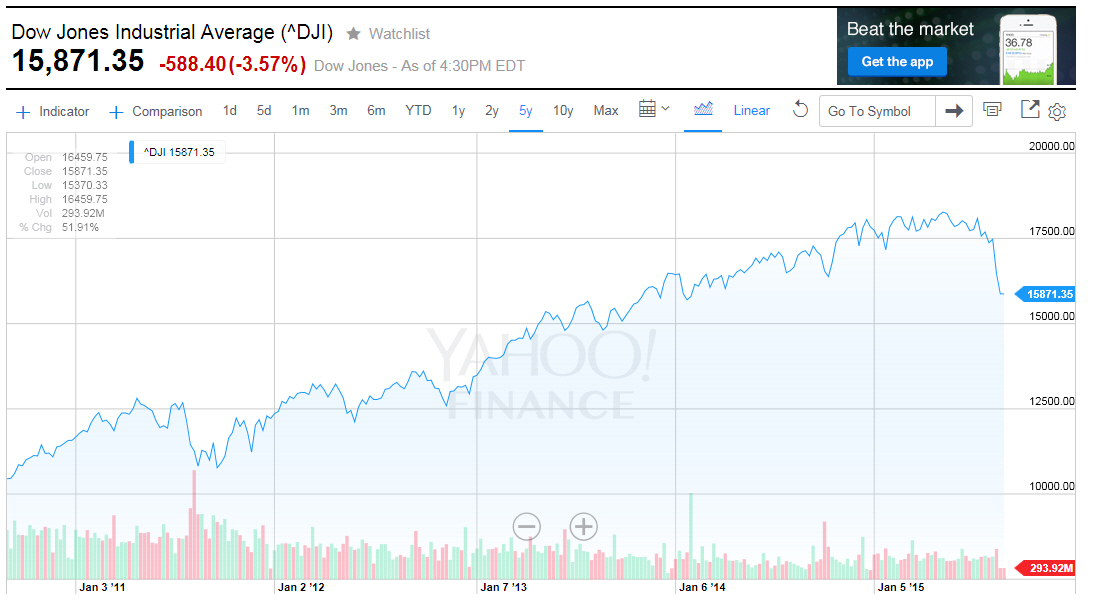
It was an interesting week on Wall Street … a huge drop on Monday …  followed by 3 days of high intra-day volatility … and ending right about where things started.

Whew.

So, what happened?

image

For what it’s worth, here’s my take …

Read the rest of this entry »

Why did the stock market get over valued?

August 28, 2015

This was a week that market analysts retroactively tag “a long anticipated correction”.

Yeah, right.  That’s what you guys have been saying.

DJIA 08-24-15 5 years
====
This week’s market dynamics beg a bigger question:

Why, given a sluggish economy and DC disarray, did the stock market keep marching forward to record highs … that met their come-uppance this week?

Easy.

Let’s start by taking a stroll down memory lane ….

Read the rest of this entry »

High frequency trading: A world of battling algorithms…

August 27, 2015

The extreme market volatility this week,  at least partially fueled by the algorithm-based high frequency traders, reminded me to reprise a very cool 15 minute TED Talk that is stashed in the HomaFiles archives.

Tech entrepreneur Kevin Slavin tells how algorithms have reached across industries and into every day life.

A couple of lines caught my attention:

  • There are more than 2,000 physicists working on Wall Street developing operational algorithms
  • Massive scale speed trading is dependent on millisecond read & respond rates …
  • So, firms are physically literally locating right next to internet routing hubs to cut transmission times
  • And, of course, there isn’t time for human intervention and control
  • “We may be building whole worlds we don’t really understand, and can’t control.”

Obviously, Slavin comes down on the side of the quants.

Worth listening to this pitch … a very engaging geek who may be onto something big.

* * * * *
Follow on Twitter @KenHoma >> Latest Posts

TechView: The 2 market charts that I’m watching …

August 26, 2015

I don’t give investment advice.  Period.

That said, there are the 2 technical charts that I have on my radar.

The first is a simple “channeled” trend view of the S&P 500

image

The takeaway:

For the past 3-1/2 years, the S&P has been trending upward (no news there) … within a fairly constant band delimited by the highs and lows.

Besides being a psychological trigger, the 2000 level appears to have been a significant technical breakpoint.

Hindsight is 20/20 … I should have bailed on my S&P Index holdings when the 200 level was broken.

But, of course, I didn’t.

Ouch.

The 2nd chart zooms in on the last 5 days of trading.


Read the rest of this entry »

Bernie Sanders missed a big opportunity on Monday …

August 26, 2015

Yesterday, we posted about high frequency traders crowing about their high profits from Monday’s unprecedented stock market volatility.

Arguably, their methodology — hinging on fast data and low transactions’ costs — fanned the volatility flames.

I was surprised that Bernie Sanders didn’t seize the moment to say “I told you so” … and to pitch his Financial Transactions Tax.

Given the stock market bounces this week, I though it would be timely to reprise a post from a couple of weeks ago which has heightened relevance and timeliness …

=====

Shocker: I agree with Bernie Sanders’ Financial Transactions Tax … err. make that “half-agree”

Dem-Socialist candidate Bernie Sanders doesn’t serve up much that I agree with … but, there is one reheated idea that I half-support.

Sanders proposes that financial transactions be taxed … roughly 1/2% for most trades … slightly lower for for some categories of investments … say, Municipal Bonds.

Sanders would use the new tax proceeds to fund public college for low-income students.

image

=====

Let’s dissect the proposal … then, for what it’s worth, I’ll tell you where I agree and where I disagree …

Read the rest of this entry »

High frequency traders crow: “Best day since the 2010 Flash Crash” … say what?

August 25, 2015

Yesterday was a historically spectacular day on Wall Street … DJIA down 1,000 on the open, rebound by about 750 points, back down by 750.

Unprecedented volatility.

DJIA 08-24-15

Geez, was the world’s economic structure changing that much hour-to-hour?

Was new economic  information flowing in at warp speed?

Nope.

Sure, there was a deepening understanding that the market is over-valued and that China’s economy is in trouble.

That explains a big correction, but what about the hour to hour volatility?

Read the rest of this entry »

Gov’t @ Work: Making $500k? Living in HUD housing? … No problem!

August 24, 2015

From the you can’t make this stuff up file …

A recent HUD IG report identified “families earning more than the maximum income for government-subsidized housing as an egregious abuse of the system. “

Some examples in the Washington Post:

  • A New York City family making $497,911 a year pays $1,574 a month to live in public housing in a three-bedroom apartment subsidized by taxpayers.
  • A tenant with assets worth $1.6 million — including stocks, real estate and retirement accounts — pays $300 for a one-bedroom apartment in public housing in Oxford, Neb.

These are extreme cases, but they’re not alone: about 2.5% of the 1.1 million families in the country who live in public housing have incomes over the HUD maximums.


image

So, why is this happening and what is HUD doing about it?

Read the rest of this entry »

Daily Mail: “Chelsea takes the plunge” >>>

August 21, 2015

WARNING: Disturbing Content

We’re temporarily suspending the HomaFiles usually high editorial standards … this is a story that must be told.

=====

Earlier this week, the UK’s Daily Mail led it’s coverage with the following story:

image

======

The article has so many angles that it’s a ‘must view to believe ” …

Read the rest of this entry »

Dems: An unstoppable 2016 ticket …

August 20, 2015

I hate to help the Dems, but I can tell them how to win when Hillary finishes her implosion.

Cutting to the chase, it’s  by running Biden for President with Obama for VP.

image

Before you dismiss the idea out-of-hand, let me explain …

Read the rest of this entry »

Trump: Inspired by the 1972 Cuban Olympic boxing team?

August 19, 2015

Say, what?

Many of you may be too young to have witnessed and remember, but…

In the 1972 Olympics, the polished U.S. boxing team was predicted to sweep the competition.

But, something happened on the way to the medals’ platform that shocked the sporting world.

image

======

Here’s the story and why Trump jogged my memory of the 1972 Olympics …

Read the rest of this entry »

Remember how your healthcare costs were going to go down by $2,500 per family?

August 18, 2015

Recently, a friend casually mentioned to me that his family finances were being strained by healthcare costs.

Why?

His family’s annual deductible had gone up from $2,500 to $12,500.

What?

Think about that for a moment … a 10-grand bump in out-of-pocket healthcare costs before the insurance even kicked in (with co-pays, of course).

image

======

The discussion piqued my curiosity, and I did some digging to put my friend’s predicament in perspective … what I found was surprising (and certainly under-reported in the main stream media)

Read the rest of this entry »

Tipping the scales: Airline starts weighing all passengers …

August 17, 2015

You read that right …

Uzbekistan Airways is going to start weighing passengers before flight

image

======

Here’s what’s going on …

Read the rest of this entry »

Want to be rich?

August 14, 2015

The most recent Census Bureau data … sorts households by income quintile … the highest quintile are “rich” households and the lowest quintile are “poor” households.

A fundamental conclusion drawn from the data: if you want to be rich, it helps to have a job and be married to someone who has one, too.

image .

Let’s dive into some of the details …

Read the rest of this entry »

How to think like a rich guy …

August 13, 2015

Steve Siebold, author of “How Rich People Think,” spent nearly three decades interviewing millionaires around the world to find out what separates them from everyone else.

“It had little to do with money itself, he told Business Insider. It was about their mentality.”

image

Here are my favorites from his 21 Ways that Rich People Think Differently:

3. Average people have a lottery mentality. Rich people have an action mentality.

“While the masses are waiting to pick the right numbers and praying for prosperity, the great ones are solving problems”

4. Average people think the road to riches is paved with formal education. Rich people believe in acquiring specific knowledge.

“Many world-class performers have little formal education, and have amassed their wealth through the acquisition and subsequent sale of specific knowledge.”

5. Average people long for the good old days. Rich people dream of the future.

“People who believe their best days are behind them rarely get rich, and often struggle with unhappiness and depression.”

7. Average people earn money doing things they don’t love. Rich people follow their passion.

“To the average person, it looks like the rich are working all the time … But one of the smartest strategies of the world class is doing what you love and finding a way to get paid for it.”

8. Average people set low expectations so they’re never disappointed. Rich people are up for the challenge.

“No one would ever strike it rich and live their dreams without huge expectations.”

12. Average people live beyond their means. Rich people live below theirs.

“The rich live below their means, not because they’re so savvy” … but because they can … and they do!

15. Average people would rather be entertained than educated. Rich people would rather be educated than entertained.

“The rich appreciate the power of learning long after college is over … Walk into a wealthy person’s home and one of the first things you’ll see is an extensive library of books they’ve used to educate themselves on how to become more successful … The middle class reads novels, tabloids and entertainment magazines.”

click for the full list

Thanks to CH for feeding the lead

>> Latest Posts

Rich man: “What inequality?”

August 12, 2015

According to a CNBC summary  of a study published in the Journal Psychological Science …

The richer you are, the more likely you are to think that others are wealthy, too. 

clip_image002

According to the study’s authors, the reason for the misconception is simple …

Read the rest of this entry »

Common Core: Is the problem really standards?

August 11, 2015

When questioned in the debate re: his support for Common Core, Jeb Bush gave a mushy (and self-contradictory) answer .

When he was done, I wasn’t sure if he was for it or against it.

For his punch line, he reverted to the universal “we need to set higher standards” argument.

A couple of other candidates jumped in to praise higher standards.

Sounds like motherhood, right?

image

======

I’m not so sure ….

Read the rest of this entry »

Reprise: How Beef-Loving Voters Can Get Tofu for President

August 10, 2015

This is from the HomaFiles archives – one of my favs.

The original article was inspired by Clinton’s win over elder Bush (the Perot factor), younger Bush’s win over Gore (the Nader factor), and Jesse Ventura’s gov win in Minnesota.

The analysis has relevancy these days, given the way that the not-Trump vote is being carved thin among many GOP presidential contenders.

* * * * *
Excerpted from WSJ: How Beef-Hungry Voters Can Get Tofu for President, March 14, 2003

Those odd ducks who scrutinize returns, calculate how each additional candidate affects the others’ chances and analyze strategic voting are hard at work. I refer, of course, to mathematicians.

Yes, there is a mathematics of elections.

Research has identified various voting systems world-wide in which, paradoxically, becoming more popular can make a candidate lose, abstaining gives your preferred candidate a better chance, and picking a winner means accepting someone a majority of voters don’t want.

This last paradox characterizes the U.S. system of plurality voting (vote for one; the top vote-getter wins). It works fine when there are two candidates, but with three or more, plurality voting can come up short.

For a democracy, the mathematicians’ most robust result is chilling. “It’s surprisingly difficult to identify a voting system that accurately captures the will of the people”.

* * * * *

The Election

So as not to inflame passions with current political examples I’ll illustrate his point with food.

You and two colleagues are planning an office party, and the caterer offers chicken, steak or tofu. You poll 17 invitees:

5 people prefer chicken to steak to tofu.

2 people prefer chicken to tofu to steak.

4 people prefer steak to tofu to chicken.

4 people prefer tofu to steak to chicken.

2 people prefer tofu to chicken to steak.

One organizer tallies the ballots by the plurality method, counting only first-place votes. Chicken wins (7 votes), while steak is last (4 votes).

A second organizer uses “approval voting,” in which voters mark all acceptable choices (everyone’s top two choices are acceptable). Now steak wins with 13, tofu gets 12 and chicken is last with 9.

The third organizer uses a point system that gives their first choices 2 points, second choices 1 and last picks 0. Now tofu wins with 18, steak gets 17, chicken 16.

The ‘winner’ changes with the choice of election procedureAn ‘election winner’ could reflect the choice of an election procedure” rather than the will of the people.

* * * * *

It gets better. Thanks to a mathematical property called non-monotonicity, in some voting systems, ranking a choice higher can defeat it.

In a plurality-with-runoff system, the two candidates with the most first-place votes face one another in round two.

This time, we invite other departments to our office party, and get this first-round result:

27 prefer chicken to steak to tofu.

42 prefer tofu to chicken to steak.

24 prefer steak to tofu to chicken.

Chicken (27 votes) and tofu (42) reach the runoff. Assuming steak fans maintain their preference and give their second-round votes to tofu, tofu wins the runoff.

That seems fair.

But what if four people in the group of 27 chicken lovers are last-minute converts to vegetarianism and, in round one, prefer tofu to chicken to steak, like the group of 42?

Now steak (24 first-place votes) and tofu (46) make the runoff, in which steak beats tofu 47 to 46. Tofu’s late surge turned its win into a loss.

* * * * *

Such paradoxes tend to occur under specific but far from unusual circumstances.

With plurality voting, the most common is when two centrists face an extremist. The majority splits its vote between the centrists, allowing the fringe candidate to squeak in. In Minnesota’s 1998 governor’s race, Hubert Humphrey got 28% of the vote, Norm Coleman 34% and Jesse Ventura won with 37%, even though most voters ranked him last.

* * * * *

Thanks to such outcomes, scientists say what’s most needed is “a way for voters to register their second and third choices … especially in primaries, where there tends to be a large field.” Both a ranking system (give candidates 4, 3, 2 or 1 point) and approval voting accomplish that.

The U.N. chooses a secretary-general by approval voting. “It is particularly appealing in elections with many candidates … If your favorite candidate is a long shot, you can vote for both him and a candidate with a better chance without wasting your vote on the long shot. Approval voting would do a lot to address the problem of presidential-primary victors not being the choice of most voters.” Approval voting could well make more people (especially supporters of long shots) feel their ballot matters.

Still, no system is perfect. As Nobel-winning economist Kenneth Arrow proved mathematically in 1951, no voting system is guaranteed to be free of paradoxes in a race with three or more candidates, except one — a dictatorship.

Here’s a wild election scenario that you won’t see anywhere else …

August 7, 2015

First, a couple of disclaimers:

This is neither my prediction of what’s to come, nor my preference..

It’s just an oddball scenario that could conceivably happen.


image

Bottom line:

All the pundits say that if Trump runs as a 3rd party candidate, then the GOP is toast..

I say: Not so fast …

Read the rest of this entry »

What happens if no presidential candidate gets 270 electoral votes?

August 6, 2015

Let’s put another puzzle piece in place re: a wild scenario of how the GOP could prevail even if Trump runs as a 3rd party candidate …

Electoral College

=====

What happens if no presidential candidate gets 270 electoral votes?

Read the rest of this entry »

Quick: Has any 3rd party presidential candidate ever won any electoral votes?

August 5, 2015

Lots of chatter around whether Trump (or Sanders) will run as 3rd party candidates.

Pundits are unanimous that a Trump 3rd party run would doom the GOP and hand the election to Hillary (presuming that she’s not in jail).

I’m not so sure.

In the next couple of posts, I’ll build to a scenario that has Trump running as a 3rd party candidate, but the GOP nominee getting the keys to the White House (<= note how I strained to avoid using the word “winning”).

image

======

Let’s put the first puzzle piece in place and answer the question:

Has any 3rd party presidential candidate ever won any electoral votes?

Read the rest of this entry »

Hacked: LifeLock CEO spanked by identity thieves … 13 times.

August 4, 2015

Since LifeLock is in the news again, I thought I should reprise the HomaFiles all-time most viewed post …

=====

Here’s one from the “you can’t make this stuff” file.

LifeLock is one of the companies that monitors the credit applications and credit worthiness inquires.

Todd Davis became LifeLock’s CEO when the company’s founder was ousted for making repeated misleading statements about his shady past and the company’s origins.

For a couple of years, Mr. Davis was prominent in LifeLock’s ads … revealing his social security number and daring identity thieves to crack his code.

Bad idea.


image


Reportedly, Mr. Davis has had his identity stolen at least 13 times since his taunt-the-thieves commercials.

Read the rest of this entry »

Smacked: FTC charges LifeLock (again) …

August 3, 2015

Loyal readers know that I’m attentive to identity theft issues ever since I got nailed.

I tend to be a proponent of the identity theft services.

I buy mine through Costco (good place to save a few pennies, right?) …  in part, because I’ve been suspicious of all the advertising done by industry leader LifeLock.


image

Turns out that the FTC was – and continues to be suspicious of LifeLock and its hyped up claims …

Read the rest of this entry »

How do self-made billionaires self-make their billions?

July 31, 2015

Previously, we posted that there are about 1,800 billionaires in the world and that about 2/3s of them are self-made … not just born lucky.

According to a PwC study, the self-made billionaires usually started at a big company, some were fired from the big companies, and most became serial entrepreneurs.

Usually they got on the map with their first or second venture, but built their wealth through a series of successive (and highly successful) ventures.

image

=====

The PwC study also identified 5 traits that were relatively common across the self-made billionaires.


======

Broadly speaking, PwC says concludes that most business managers are “performers” – linear logicians who are good at execution .

The self-made billionaires are “producers” who  look at the world from different angles — allowing them to spot opportunities and to turn good ideas into great businesses.

More specifically, the PxC team concluded that “most self-made billionaires – the “producers” –practice five habits of mind — ways of thinking and acting that generate uncommonly effective ideas and approaches to leadership.”

The 5 traits:

1. Ideas: Empathetic Imagination

The producers typically worked in their field long enough to have an awareness of critical trends, empathy for customers, and knowledge of existing practices.  Then, they added a healthy dose of imagination to change the game.

2. Time: Patient Urgency

“The creation of massive value in an industry does not happen overnight. The billion-dollar idea often comes after years, even decades, of commitment to a market space. Skilled producers learn to be patient. They know how to wait for the right idea at the right time. But once they hit on a compelling idea, they have a bias toward action that compels them to take urgent steps.

3. Action: Inventive Execution

Many executives take product design and go-to-market strategies as givens. “The business model, pricing, functions, sales pitch, and deal structure are treated as inherited, predefined by the models, costs, and pricing that already exist in the company and industry.“

Producers redesign opportunities everywhere – both in the product – broadly defined – and the implementation.

4. Risk: Relative, Not Absolute

“Producers, in general, are distinguished not by the level of risk they take, but by their attitude about risk. Most people measure risk in absolute terms: Will this business succeed or fail? Producers view risk in relative terms: Which option presents the greatest opportunity? If the opportunity is right in a risky venture, they’ll look for ways to mitigate risk”

5. Leadership: Teaming with Performers

“The idea of the solo genius is so pervasive in the way people talk about and think about extraordinary success that it obscures the real story of how good ideas become great businesses. Self-made billionaires are not alone. Producers have the ability to see beyond the parameters of what exists today to imagine new opportunities. Performers, in turn, have the ability to optimize and achieve within known parameters. Value creation requires both.”

Producers surround themselves with producers …

=====

Bottom line:

Yeah, wealth distribution is skewed. No argument there.

But, it’s wildly misleading to characterize the richest of the rich as folks who were just born lucky.

The majority of the made their own luck … and earned their wealth.

Sorry, if the facts don’t match the popular narrative …

=====

#HomaFiles

Follow on Twitter @KenHoma            >> Latest Posts

=====

How many billionaires are there? How many are self-made?

July 30, 2015

With all of the vitriol now being cast at rich people, and with all of the broad-brush policy proposals to redistribute their wealth … you’re probably guessing a pretty big number, right?

image

Well, Forbes reports about 1,800 billionaires worldwide  … holding $7 trillion…   or roughly 7% of the total global gross domestic product.

1.800 isn’t a particularly big number, right?

But, even I concede, they skew the distribution of wealth.

The billionaires always seem to get caricatured as Saudi princes, one of Sam Walton’s descendants  or Paris Hilton – all just lucky by birth and clearly undeserving.

Well, PwC’s think tank dug deeper into the numbers and uncovered some facts that tend to disrupt the popular narrative …

Read the rest of this entry »

Jet: Start-up targets Amazon and Walmart … say, what?

July 29, 2015

After months of testing and and network-building, the e-commerce start-up Jet.com opened its digital storefront last week, marking the official kickoff of the company’s ambitious effort to battle Amazon and Walmart for price-conscious customers.

According to the Washington Post, Jet is taking a new approach to pricing. Its algorithm doesn’t simply look at the price of each individual item in your online shopping cart.

It looks at all the items you want to buy, as well as your Zip code, to determine which retailer or warehouse can ship that unique combination of items to you the cheapest.

Shoppers can only buy things on Jet if they’ve signed up for a $49-per-year membership.

image
=====

Let’s dig a little deeper and assess the odds …

Read the rest of this entry »

Where does Amazon collect sales tax? Why?

July 28, 2015

One of the things that I about Amazon was that my orders didn’t get dinged with sales taxes.

That was then, this is now.

In 2013, I was disappointed to see Amazon start collecting sales taxes in Virginia (my home state).

But, no collected sales tax in Maryland – next state over – where we have a summer vacation shack. shack and a branch of the family tree.

Hmmm …

The arbitrage opportunity evaporated in 2014 when Amazon started collecting sales tax in Maryland.

Nuts.

image
Source

=====

Some recent purchases sparked my curiosity .  What’s going on?  Are there still arbitrage opportunities?

Read the rest of this entry »

States: Where does $100 buy the most? The least?

July 27, 2015

The Bureau of Economic Analysis (BEA) does a periodic market basket study – estimating how much a standard basket of goods costs in different parts of the country.

The national average is indexed to $100 … and called the Relative Price Parity index.

image

=====

Based on the most recent study, prices are the lowest in Mississippi where the $100 shopping basket can be purchased for $86.80.

Said differently, a dollar is worth 15% than the national average in Mississippi.

What’s the most costly state?  Where does your state rank?

Read the rest of this entry »

Big Question: Will an iPhone blend?

July 24, 2015

All the hoopla surrounding  Trump’s announcing Sen. Graham’s cell phone number …. and Graham’s humorous video of ways he tried to remediate the situation by destroying his cell phone … reminded me of an ad campaign run by a company called  Blendtec.

According to George Parker of  AdScam ….

At a conference a couple of years ago. GE and their agency, BBDO, made a presentation of their new “Imagination” campaign.

After showing some nice TV spots and explaining that they’d spent $300 million on media over the last year, they proudly declared that brand awareness had increased substantially.

This generated polite applause.

image

Next up was the Marketing Director of blender manufacturer Blendtec who proceeded to blend:

  • a brick
  • some ball bearings
  • an 8 ft garden rake
  • an iPhone

He then put up a single slide showing that every time they posted a self-produced, ten dollar video on YouTube in their long-running “Will It Blend” campaign (which to-date has had more than 220 million views,) sales went up by an accurately measurable percentage.

Understandably, the crowd went nuts.  

The point being, GE spent hundreds of millions and couldn’t quantify with any certainty what they had achieved for all that money.

Blendtec spent pennies and achieved consistently significant and measurable results.

Below are the links to the Blendtec iPhone videos…  worth watching.

Read the rest of this entry »

Flaw of Averages: 3 views on inflation …

July 23, 2015

Oftentimes, important trends are buried  in statistical averages.

You know, the thing drowning in a river with an average depth of 3 feet.

In my Strategic Business Analytics course, I harp on “decomposing” problems and statistics down to their component parts …. to simplify the problems and reveal insights.

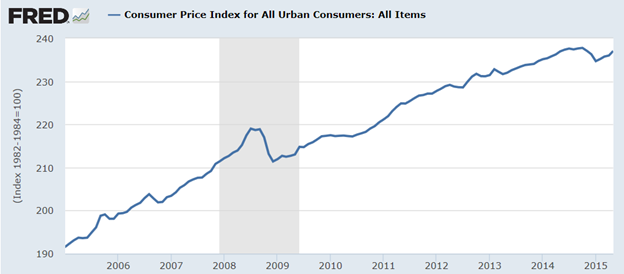
Here’s a case in point: the Consumer Price Index (CPI).

image

For the past 10 years (really, longer), the CPI has pretty much straight-lined upward.

Case closed, steady inflation … right?

Not so fast.

Let’s look at the CPI from a couple of other angles …

Read the rest of this entry »

Shocker: I agree with Bernie Sanders’ Financial Transactions Tax … err. make that “half-agree”

July 22, 2015

Dem-Socialist candidate Bernie Sanders doesn’t serve up much that I agree with … but, there is one reheated idea that I half-support.

Sanders proposes that financial transactions be taxed … roughly 1/2% for most trades … slightly lower for for some categories of investments … say, Municipal Bonds.

Sanders would use the new tax proceeds to fund public college for low-income students.

image

=====

Let’s dissect the proposal … then, for what it’s worth, I’ll tell you where I agree and where I disagree …

Read the rest of this entry »

Uh-oh: Hacker hits on Ashley Madison …

July 21, 2015

This may be bigger than the Feds having 20 or 30 million digital personnel files tapped by hackers.

Ashley Madison got hacked and over 37 million customer files have been taken hostage,

Just in case you’ve been living under a rock, Ashley Madison is a sleazy, Canadian based “online dating and social networking service” that “discretely” hooks up folks who are already in a relationship, i.e. married.

Some background:

The name of the site was created from two popular female names, “Ashley” and “Madison” … the site’s slogan “Life is short. Have an affair.”

The site has been around for about 15 years and gets about 125 million hits each month (pun intended).

Reportedly, 70% of the site’s members are guys … no surprise there.

clip_image002

That’s the back-story … now for the “so what?” …

Read the rest of this entry »

How many freelancers are there in the U.S. workforce?

July 20, 2015

Note that I said  “freelancers”, not “freeloaders” ….

So, how many?

image

Place to start is with a definition ….

According to a trade group called the Freelancers Union, there are 5  basic types of freelancers:

  1. Independent Contractors: These are the “traditional” freelancers who don’t have an employer and instead do freelance, temporary, or supplemental work on a project-to-project basis.
  2. Moonlighters: Professionals with a primary, traditional job who also moonlight doing freelance work. For example, a corporate employed web developer who also does projects for non-profits in the evening.
  3. Diversified workers People with multiple sources of income from a mix of traditional employers and freelance work. For example, someone who works the front desk at a dentist’s office 20 hours a week and fills out the rest of his income driving for Uber and doing freelance writing.
  4. emporary Workers:  Individuals with a single employer, client, job, or contract project where their employment status is temporary. For example, a business strategy consultant working for one startup client on a contract basis for a months-long project.
  5. Freelance Business Owners: Business owners with  between one and five employees who consider themselves both a freelancer and a business owner. For example, a social marketing guru who hires a team of other social marketers to build a small agency, but still  identifies as a freelancer.

OK, so what’s the answer?  How many?

Read the rest of this entry »