Here’s a classic test of intuitive skills excepted from Daniel Kahneman’s Thinking Fast, Thinking Slow…
As you consider this question, please assume that Steve – the subject — was selected at random from a representative sample.
Steve has been described by a neighbor as follows: “Steve is very shy and withdrawn, invariably helpful but with little interest in people or in the world of reality. A meek and tidy soul, he has a need for order and structure, and a passion for detail .”
Interesting study on cognitive biases from Daniel Kahneman’s Thinking, Fast and Slow …
Patients undergoing a painful medical procedure – think, colonoscopy without anesthesia – recorded their pain levels during the procedure on a range from no pain (zero) to excruciating (10).
Some of the procedures were short in duration … others were longer.
Below is the pain chart for 2 representative patients.
The patients were asked – after the fact—how painful the procedure was.
What’s your bet? Which patient claimed to have undergone the more painful procedure?
According to Chip & Dan Heath in Rotman Management article “The 4 Villains of Decision Making” …
“Research in Psychology over the last 40 years has identified a broad set of biases in our thinking that doom our decision making. If we aspire to make better choices, we must learn how these biases work and how to fight them.”
According to the Heath Brothers – academics & popular authors – there are 4 decision making villains that have to be confronted
Yesterday, the Washington Post reported that an academic journal — had to retract 60 research articles had to be retracted because its peer review process had been compromised.
Apparently, the Journal of Vibration and Control (JVC) — no, I didn’t make that title up — fell victim to a “peer review ring”. A close knit group started cloning their electronic identities as experts.
So, while the journal thought that it was sending candidate articles to a broad sample of experts — they were really sending them to a small handful of cronies.
In fact, because of the law of averages, on at least one occasion, an author got to peer review his own paper.
Oops
When the fraud was discovered, the journal ‘fessed up , retracted the compromised articles and allowed the senior editor to resign.
But, will the Journal of Vibration and Control (JVC) ever be able to restore its good name?
The incident reminded me of my absolute favorite academic journal scandal…
Awhile ago, I got an email from the Executive Director of the Academic and Business Research Institute:
There, bossman would be ordering pizza for the victory celebration.
Let’s look at the facts …
Flashback to March 2010, when Obamacare was being steam-rolled though Congress.
At that time, the Congressional Budget Office (CBO) projected that Obamacare would cost $938 billionover a decade, that the Federal deficit would shrink and 19 million uninsuredpeople would be insured as of 2014.
As a frame of reference, those estimates work out to be about $5,000 in annual cost per newly insured person … about par for private market medical insurance.
* * * * *
Unfortunately, but predictably, those estimates were wildly off the mark …
There was a growth spurt in bowling alleys after World War II. The U.S. added 2,000 bowling alleys between the end of World War II and 1958.
In 1958, the American Society of Planning Officials reported that “the bowling alley is fast becoming one of the most important—if not the most important—local center of participant sport and recreation.”
But, the bowling craze peaked and started to fade as folks found other ways to spend their spare time.
The U.S. had 4,061 bowling centers in 2012, down 25 percent from a high water mark in 1998.
* * * * *
To counter the downward trend, bowling alleys are rebranding themselves as “bowling centers”, spiffing up the facilities, and adding ancillary entertainment (e.g. rock music, gaming arcades).
Following the industry lead, “the exclusive bowling lanes reserved for White House employees and their guests are getting an upgrade.”Read the rest of this entry »
Interesting article on Quartz.com tracking how “the internet’s power to unbundle content sparked a rapid transformation of the music industry’ and arguing that”and it’s doing the same thing to higher education today.
Let’s start with the recorded music industry.
It’s no surprise that
The unbundling of albums in favor of individual songs was one of the biggest causes of the music industry’s decline.
It cannibalized the revenue of record labels as 99-cent songs gained popularity over $20 albums.
What did surprise me us that recording industry revenues have dropped by half from the $14 billion in 2000.
The eroding revenues and and internet dynamics have “changed the way music labels had to operate in order to maintain profitability.
The traditional services of labels: identifying artists; investing in them; recording, publishing, and distributing their work; and marketing them—are now increasingly offered a la carte.”
And, talk about the top 1% and distribution of riches …
Being a recording artist these days is a hard gig …
Pressure from labels then had downstream effects on content creators, specifically artists.
The top one 1% of artists now take home 77% of revenue, and the rest is spread across an increasing number of artists.
The pain of the record labels is forced on artists through smaller royalty payments.
Last week, we pointed out that the 288,000 jobs gain in June wasn’t all that it was cracked up to be since full-time employment declined by over 500,000 and part-time employment increased by almost 800,000.
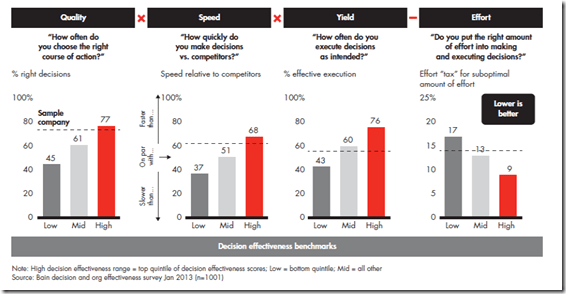
Interesting cut at measuring decision making effectiveness fromBain.
Bain says that:
One thing that sets great companies apart is the ability to make high-quality decisions.
But it isn’t just decision quality—the top performers also make those decisions quickly and execute them effectively. And they don’t spend too much or too little effort in the process.
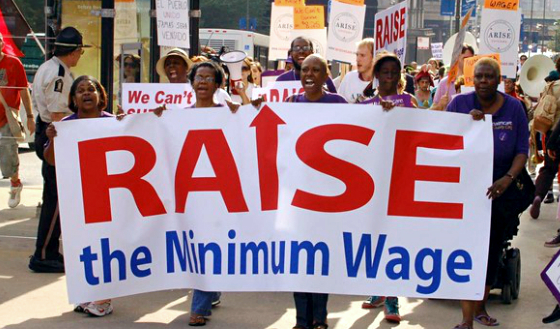
An article in the WSJ this week is causing a bit of a stir.
Titled “Who Really Gets the Minimum Wage”, the report concluded that Minimum wages are ineffective at helping poor families because such a small share of the benefits flow to them.
Specifically, “Obama’s $10.10 target would steer only 18% of the benefits to poor families; 29% would go to families with incomes three times the poverty level.”
Hmmm.
How does that happen?
The essence of the dynamic: counter-intuitively, low-wage workers and low-income (i.e. “poor”) families are not the same folks.
According to the article, data from the U.S. Census Bureau show that there is only a weak relationship between being a low-wage worker and being poor.
Three reasons for that:.
Many low-wage workers are in higher-income families—workers who are not the primary breadwinners and often contribute a small share of their family’s income.
Some workers in poor families earn higher wages but don’t work enough hours (and have hours cut when the minimum wage goes up)
About half of poor families have no workers, in which case a higher minimum wage does no good. This is simple descriptive evidence and is not disputed by economists.
Bottom line: Not much help to the well-intended anti-poverty movement.
There’s another “non-poor” group that benefits when the minimum wage is raised..
Glance at the picture above and see if you can guess who that is.
Think about it: 1 in about 200 get culled each year.
Hardly Jack Welch’s “bottom 10%” program.
More generally, data from the Office of Personnel Management indicate that it is five times as hard to get fired from a federal job as from a private-sector one.
It’s commonly claimed that federal workers settle for lower pay in exchange for job security.
Lots of hoopla last week that the unemployment employment rate dropped to 6.1% as employers added 288,000 jobs
Yep, 288k jobs added … which continues a year-over-year running rate growth in employment of slightly less than 2% … a little less than real GDP year-over-year growth.
I often confess to my students that I thought about 51% of the business decisions were correct … and that was despite my analytical pre-disposition and the benefit of a highly proficient team of managers and analysts.
Apparently, my record was about on par.
According to decision scientists Chip & Dan Heath in Decisive: How to Make Better Choices …
Last year around this time, I told the said story about how some bad guys tried to steal my identity and open up credit cards and car loans in my name.
Bottom line: An ordeal that burned up a bunch of my time and caused plenty of angst … but, no serious damage (that I know of).
A friend just got had his identity hacked. Somebody filed an IRS 1040 under his name and social security number, hoping to bag a refund check. Fortunately, the IRS flagged the return as suspicious and didn’t pay-off against the fraudulent return.
Now, as a public service, here’s what I learned that may help you …
First, some background on a group called Judicial Watch …Judicial Watch is a non-partisan conservative organization whose motto is “Because no one is above the law”.
To achieve this goal,” Judicial Watch uses the open records or freedom of information laws and other tools to investigate and uncover misconduct by government officials and litigation to hold to account politicians and public officials who engage in corrupt activities.” Source
For example, when the White House was claiming (a) that it had no involvement in the development of Susan Rice’s infamous “it was the video’s fault, not terrorists” talking points, and (b) that all emails had been turned over to Congressional committees … it was Judicial Watch that worked the courts using the Freedom of Information Act to get a copy of the smoking gun emails that put tied the talking to Ben Rhodes – the White House Deputy Strategic Communications Adviser at the time. Source
Somehow, Judicial Watch’s courts actions seem to get better access to sensitive government info than the Congressional Committees.
Go figure.
Well, now Judicial Watch is targeting Lois Lerner’s missing emails … (pun intended)
According to an HBR article “In Hiring, Algorithms Beat Instinct” …
Studies of applicant evaluations shows that a simple equation outperforms human decisions by at least 25%.
And, the effect holds in any situation with a large number of candidates, regardless of whether the job is on the front line, in middle management, or (yes) inthe C~suite.
Here’s why I think there’s a cover-up happening in the IRS targeting scandal …
Lois Lerner is at the heart of the investigation. She exercised her 5th amendment right to not self-incriminate and didn’t testify to Congress.
Then, it’s “discovered” that 10 days after the scandal inquiry kicked off, her PC hard drive – which contained the only permanent copies of emails she sent to folks outside the IRS – crashed … and all data – including the subpoenaed emails – was lost forever.
Hmmm.
Then it was revealed that the hard drives of 6 other IRS “persons of interest” had also crashed (after the investigation was kicked off.
Double hmmm.
Got me to wondering: What are the odds of that happening?
First, I don’t think any reasonable person can deny that persons within the IRS targeted conservative groups for harassment during the run-up to the 2012 Presidential election.
One interesting aspect is that the IRS actions had nothing to do with REVENUE since the organizations don’t operate for a profit. The organizations spend everything that they take in – i.e. expenses consume revenues, so profits are zero and there are no taxes to collect.
So, it’s reasonable to conclude that the harassment was done simply for political reasons, right?
Answer: A compelling, bi-partisan majority of U.S. politicians and citizens.
The question aroused my interest since it’s commonly implied that only Bush, Cheney and a handful of Neocons were on board with the invasion decision.
First, let’s look at the blowhard politicians.
The 2002 Iraq War Resolution passed the House 296 (68%) to 133 (31%) … with 81 Democrats voting for it.
In the Senate, the vote was 77 to 23 … with 29 of 50 Democrats voting for it …. Among the notable Dems voting yes: Biden, Clinton, Kerry, Hagel … Side note: Obama wasn’t in the Senate yet.
One of ObamaCare’s goals was to reduce pressure on emergency rooms by expanding Medicaid and giving poor people better access to primary care.
Instead, many hospitals across the nation are seeing a surge of those newly insured Medicaid patients walking into emergency rooms.
Nationally, nearly half of ER doctors responding to a recent poll by the American College of Emergency Physicians said they’ve seen more visits since Jan. 1.
That’s a problem since an average ER visit costs $580 more than a trip to the doctor’s office.
Interesting infographic from Pew calibrating something that everybody knows …
Democrats are becoming more liberal Republicans are getting more conservative … and the moderate middle-ground between the parties is getting smaller, and smaller and smaller …
About 40% of Democrats think that Republicans are destroying the country … and, about 40% of Republicans think that Democrats are destroying the country.
Here’s the finding that I found most interesting …
During the finals broadcast , the nun — dressed in her traditional habit, crucifix and plain black shoes — appeared surprised when she advanced to the final two, along with Giacomo Voli.
Sister Cristina — who was coached by Italian rapper J-Ax was overjoyed when the show’s host announced that she was the winner, taking 62.3 percent of the vote.
In the audience, her fellow nuns applauded, and cheering supporters waved T-shirts bearing her image and the hashtag #SisterAx.
The clincher: Sister Cristina performed a high-energy version “What a Feeling” from of Flashdance, complete with Madonna-like back-up dancers on stage … and her fellow nuns dancing in the aisles.
Last week, one the Administration’s talking points was “not to worry, the 5 Taliban leaders being released won’t be allowed back in Afghanistan for a year … and by then practically all troops will be out of the country … so the odds of Americans being killed are relatively low.”
Are you kidding me?
In a prior post, I posed a simple over-under bet: Do you think that the number of Americans who will be killed — either directly or indirectly – by the Taliban-5 will be under 1 or over 1?
I’m taking the over and haven’t gotten many takers for the under.
Today, let’s connect a couple of dots and personalize the situation…
Don’t worry, I’m not going deeply philosophical on you … I’m just going to pose a simple wager.
Last week, one the Administration’s talking points was “not to worry, the 5 Taliban leaders being released won’t be allowed back in Afghanistan for a year … and by then practically all troops will be out of the country … so the odds of Americans being killed are relatively low.”
A couple of interesting charts from the Fed’s Triennial Payments Study…
If you’re like most Americans, there both debit and credit cards in your wallet …. both debit and credit card usage is increasing … with debit card usage increasing by leaps and bounds..
When Obama finally commented on the VA scandal, he gave the usual “outraged, will investigate and hold accountable” … then asserted that “when veterans do get into the system, they get great healthcare”.
No questions from the media. Not much follow-up.
Must be true since the President said it, right?
Of course, my BS detector started screeching.
Fortunately, the WSJ started to dig and found “significantly higher rates of mortality and dangerous infections at some VA hospitals compared with others” … and compared to private hospitals.
For example, the Boston area VA hospital is rated 5-stars … the embattled Phoenix VA draws a single star.
Lots has been written recently re: the economic value of a college degree.
Let’s boil it down to 3 key charts …
======
First, the cost side of the equation …
Sky-rocketing tuitions are loading students with an enormous amount of post-graduation debt.
While other forms of consumer debt have held relatively constant for the past 10 years, student loans have soared from “only” $200 million in 2004 to over $1 trillion today.
Last week, the WSJ ran an opinion piece How to Fix the Veterans Affairs Mess by Anthony Principi who served as secretary of Veterans Affairs from 2001-05.
I expected a practical roadmap for attacking the current problems.
Instead, the author delivered a potpourri of declarations … some of which surprised me, and many of which made me sigh “oh my”.
Here are some of the points that caught my attention.
More specifically, privacy pundits say that it just takes your name, zip code and birth date to ID you and start linking your online and offline personal data … forever.
Now, Pew has published a research study re: teen’s online habits .
I was really excited when the TV show “Numbers” launched. Being a quant guy, I thought the concept of solving crimes by using math analysis had a ring to it. Disappointment set in (for me) when they started focusing on the characters and their relationships instead of the numbers. Oh well.
I was equally as excited about the prospects for The Numerati … and about equally as disappointed. Nice topic, but way too superficial.
The central premise of the book is good: prolific data accumulation (including mucho private data), integration of massive data sets, high speed data access and processing, sophisticated statistical models and data mining algorithms, and an increasing number of uses and users … is making all facets of life more and more numbers based.
* * * * *
Specifically, Baker provides some anecdotal examples of numbers-in-use:
In the financial markets: credit scoring by bankers and credit card companies started the snowball rolling …
In the workplace: some companies are already trying to derive behavioral profiles of employees that can provide insight re: how to motivate them, which teams to assign them to, and how to build a leveragable database of employee skills and interests.
In the store: some retailers are combining market research behavioral, and financial information to more closely target products and promotions .. think of it as loyalty carding on steroids with a dose of customer profitability management.
In politics: the Chicago machine controlled precincts, the Bushies went after “values” segments and swing voters, and the Obama folks micro-targeted and “rolled up” using social marketing methods (e.g. Facebook, Tweeter).
On the blogs: some companies routinely scour the population of blogs to find references to their products that can be consolidated into a real time view of how the products are being perceived.
In the war on terror: neural data networks are processing a constant stream of information and electronic communications, hoping to spot behavior patterns that might provide an early warning of potential terrorist activity … think “Patriot Act”
In the doctor’s office: electronic medical records appear to be gaining traction, providing docs with real time access, distributive capability (i.e. sending the info to other docs), and “evidence-based” analysis of best practices. The looming questions: scalability and privacy.
In the heart: mate-finding sites (e.g. E-Harmony) are getting increasingly sophisticated – using behavioral and deep-psyche info and concepts to make the perfect matches.
Bottom line: For businesses, quant analytics used to provide a competitive edge. Now, they are required just to compete.
For individuals, kiss privacy good-by and expect to be increasingly targeted with customized products and promotions.
“These statistical tools are going to be quietly assuming more and more power in our lives. We might as well grab the controls and use them for our own interests.”
Big grocery chains are increasingly turning to big data and mathematical models to take the guessing out of the process of pricing thousands of items on their shelves,
The models can detect your yogurt flavor preferences and your “internal hierarchy of brands” … i.e. which brands your think are better than others.
The models can identify the precise price point at which you would switch between brands or how much incentive you’d need to buy the bigger pack.
It’s not enough to simply know that a 12-pack should cost less per item than a six-pack, nor that branded yogurts should command a price premium … the models try to calculate exactly how much each of those prices should vary.
The models recognize that people are really price-sensitive when buying cold desserts and that a “buy one, get one free” offer is more cost efficient than a straight 50 percent price cut (that’s because some people will still take just one).
And, the models can also detect more nuanced dynamics such as “asymmetric cross-price elasticity” … e.g. an eight-pack’s price affects sales of four-packs more strongly than vice versa.
Think about it next time you swipe your store’s loyalty card.
Being a “morning person” may be more than virtuous. It may literally be a criteria for career success.
Managers rate workers who get an early start higher than those who get in and stay late, no matter how many hours they work in total or how well they do their jobs.
Apparently, managers have a “morning bias” … that confuses starting time with conscientiousness and productivity.
Managers perceive employees who start later as less conscientious, and consequently less hard-working and disciplined, and that carries through to performance ratings.
At our house, we play a game that I affectionately call “Guess the Food”.
Here’s the way it works …
My wife Kathy asks want I want for dinner tonite. I answer. She then explains why that’s not a good answer and asks the question again. I answer again, she explains again and repeats the question … until I guess the right food.
After decades of playing the game, I’ve gotten pretty good and can usually guess what I want for dinner by the 3rd or 4th guess.
OK, let’s tie that in to ObamaCare …
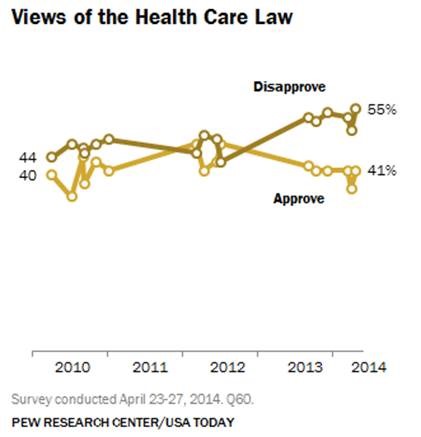
Pew recently released poll results that indicate an approval / disapproval gap of 14 percentage points (55% disapprove to 41% approve)
And, as in earlier surveys, Pew reports opposition to the law is more intense than support: 43% of the public disapproves of the law very strongly – about 80% of the disapprovers — and only 26% approve of the law very strongly – a gap of 17 percentage points.
First, Business Insider reported that “spending on healthcare grew an astounding 9.9% in Q1 … the biggest percent change in healthcare spending since 1980”
The article goes on to say: “Analysts said it’s primarily due to a consumption boost from the implementation of the Affordable Care Act.”
That makes sense.
Some folks rushed to their docs in the last quarter of 2013 to beat the jump in their deductibles and to jump the line ahead those becoming newly insured.
Nonetheless, the fact remains that, adjusted for inflation, America is spending more on healthcare than ever before..



































 The Homa Files