Stores are yesterday … get your ketchup online.

November 8, 2011

TakeAway: Heinz is launching its new premium ketchup with limited distribution through Facebook … and higher prices that includes shipping.

* * * * *
Excerpt from NY Times: “Ketchup Moves Upmarket, With a Balsamic Tinge”

In the era of squeeze bottles, patience is no longer required, but to create anticipatory buzz for a new ketchup variety, Heinz initially will limit its availability.

Heinz Tomato Ketchup Blended with Balsamic Vinegar, which substitutes balsamic for the traditional white vinegar, won’t initially be available  in stores.

Rather, consumers will be able to buy the ketchup only through the brand’s Facebook page until the product begins to appear in supermarkets later this year.

The balsamic ketchup will only be sold in 14-ounce glass (non-squeezable) bottles. The ketchup will carry a suggested retail price of $2.49 (plus a $2 shipping charge on Facebook), compared with $1.89 for the original in a plastic bottle of the same size at your local grocer.

Edit by ARK

>> Latest Posts

C’mon man: “Jay-Z 101” is just the tip of the iceberg …

November 7, 2011

A loyal HomaFiles reader linked me to a site that has an expansive list of dumb & dumber college courses.

Here are my dozen favorites …  I saved the best for last.

  1. Campus Culture and Drinking: As many students may have been sad to learn, this course doesn’t encourage students to go get trashed, instead asking them to more carefully consider the social and cultural aspects of drinking on campus. [Duke]
  2. American Degenerates: Learn more about the relationship between writers and early Americans and their sense of personal identity in this course. [Brown]
  3. Age of Piracy: Johnny Depp’s kooky but sexy Jack Sparrow has gotten many students interested in learning more about the pirating arts, and this course offers them the chance to take a look at the much less appealing, real-life lives of pirates. [Arizona State]
  4. Alien Sex: Explore the weird, wild and depraved aspects of sex between humans and monsters alike. [University of Rochester]
  5. Mail Order Brides? Understanding the Philippines in Southeast Asian Context: As off-putting as it sounds to most people, mail order brides are a real thing, and students at this prestigious university can learn why the phenomenon exists and is so prevalent in the Philippines through this course. [Johns Hopkins]
  6. The Simpsons and Philosophy: While the Simpsons may appear to be just good entertainment, this course shows the deeper philosophical issues under all those “d’ohs.” [UC Berkeley]
  7. Arguing with Judge Judy: Popular ‘Logic’ on TV Judge Shows: Ever felt like the plaintiffs on TV judge shows have some pretty questionable logic? This class addresses that subject directly, allowing students to pull apart courtroom excuses just like Judge Judy. [UC Berkeley]
  8. How to Watch Television: Though most of us are pretty adept at turning on the TV and vegging out, this course aims to teach students how to watch TV actively. [Montclair]
  9. Tightwaddery, or The Good Life on a Dollar a Day: While the title might elicit some laughs, this course offers some sage advice on breaking the bonds of consumerism and fighting back against the status quo. And if that isn’t part of a well-rounded college education then what is? [Alfred]
  10. Getting Dressed: While many students wouldn’t have made it to college without some idea of how to get dressed in the morning, this class takes it one step further and takes a look at what it really means to wear those Uggs or backwards baseball cap. [Princeton]
  11. Stupidity: What better topic to rail against at college than stupidity? This course examines it at depth from literary, social and philosophical perspectives. [Occidental]
  12. American Pro Wrestling: While the words “MIT” and “pro wrestling” may not be two you’d bring together, this course asks students at the tech-savvy school to think about the cultural implications of the often-theatrical wrestling world. [MIT]

Is college worth it? You bet it is.

Thanks to AY for feeding the lead.

>> Latest Posts

Big banks face flight of unprofitable customers … good news for credit unions ???

November 7, 2011

Last Saturday was “Bank Transfer Day”.

First the details, then the analysis …

According to the AP:

A grassroots movement that sprang to life last month is urging bank customers to close their accounts in favor of credit unions.

The spirit behind “Bank Transfer Day” caught fire and had more than 79,000 supporters on its Facebook page.

“Consumers are waking up and seeing that they have options.”

Even with its public support, however, it’s not likely that any account closings that take place will make a big dent with industry titans such as Chase, which is the largest bank in the country with some 26.5 million checking accounts.

Credit unions and small community banks have been basking in the spotlight and issuing press releases highlighting what they say are superior interest rates and more intimate service.

Big banks have also learned that customer grumblings don’t always translate into action. That’s particularly true for those who have multiple accounts, direct deposit and automatic bill pay; many decide that switching just isn’t worth the hassle.

Here’s what I find bemusing …

Banks only make money on about 40% of their customers.  Think multiple accounts, big balances..

image

My bet: the bulk of the  Bank Transferers are in the bottom 60% … especially since the debit card fee structures (from merchants) were cut by legislation and B of A’s evil $5 monthly fee was rescinded.

The WSJ says that people who gravitate to credit unions will likely  tend to be ones who were unprofitable for giant banks because of the small balances they keep on deposit, low number of products they buy and the relatively high account-maintenance expenses at big financial firms. —  it costs the giant banks about $350 to $450 per year to maintain a checking account

So, the credit unions and small banks are probably getting a bunch of accounts that will hurt their profitability.

Anybody remember the 1980 Mariel Boatlift?

Bank Transfer Day may be the big banks’ equivalent …

image

>> Latest Posts

Wagging the “Long Tail” by self-publishing …

November 7, 2011

TakeAway: Established writers and new writers take advantage of self publishing with the evolution of digital books.

Good example of the Long Tail Strategy. 

* * * * *
Excerpt from WSJ: “Secret of Self-Publishing: Success”

Self-publishing has been available for decades.

But thanks to digital technology and particularly the emergence of e-books, the number of self-published titles exploded 160% in 2010 from 2006. 

Amazon.com fueled the growth by offering self-published writers as much as 70% of revenue on digital books.

By comparison, traditional publishers typically pay their authors 25% of net digital sales and even less on print books.

A veteran romance author self-published her first e-book in April 2010. She has since cumulatively sold 265,000 units of 10 self-published titles.

Her total take from those 10 titles since last April: in excess of $500,000 after expenses. Previously, the most she ever made from a book was $33,000.

“One of the big differences between e-books and print is the sales cycle … It’s almost inverted.”

A chain store buyer makes a decision as much as six months before a book is published, and then it has no more than six months on the shelf. At that point, the sales cycle is essentially over.

But with e-books, it’s completely the opposite.

“It’s often six to nine months before your book takes off, and you never take it down.”

Edit by ARK

>> Latest Posts

C’mon man: A college course on Jay-Z ???

November 4, 2011

You just can’t make this stuff up.

Parents are shelling out about $5,000 in tuition money so their kids can probe the deep thoughts of rapper Jay-Z.

* * * * *
Excerpted from Wash Post : Jay-Z 101

Rapper Jay-Z is now being examined in the ivory towers of academia.

One of the most popular courses at Georgetown is — SOCI-124-01 “Sociology of Hip-Hop — Urban Theodicy of Jay-Z.”

Prof. Michael Eric Dyson asks:  “What’s the intellectual, theological, philosophical predicate for Jay-Z’s argument?”

He says that Jay-Z’s work has proved to be powerful, effective and influential. And it’s time to wrestle with it.”

When the class reached its 80-student enrollment cap the first week of the semester, Dyson relocated to a bigger room that could seat 140 students. That’s the official head count, anyway.

* * * * *

Tell me again why we’re behind in math & science …

Thanks to JMH for feeding the lead.

>> Latest Posts

Forget demographics … segment markets based on buying behavior.

November 4, 2011

TakeAway: MasterCard and Visa are entering the business of market research by tracking online purchases and using the info to identify market segments and target them.

* * * * *
Excerpt From WSJ: “Using Credit Cards to Target Web Ads”

Visa  and MasterCard are using what they know about people’s credit-card purchases for targeting them with ads online.

This strategy is a technological feat: tying people’s Internet lives with shopping activities.

Some of the ideas, for instance, a weight-loss ad to a person who just swiped their card at a fast-food chain — then track whether that person bought the advertised products.

Currently, Web ads generally are based on a person’s online behavior but not information tied to his or her identity or activities in the brick-and-mortar world.

“There is a lot of data out there, but there is not a lot of data based on actual purchase transactions. We are taking it a level deeper…it is a much more precise targeting mechanism.”

MasterCard is pursuing a plan to sell marketers an analysis of anonymous, aggregated data sorted into marketing “segments,” such as people with a high propensity to be interested in international travel.

Visa is also currently pitching the ability to use cardholders’ anonymous buying histories, in aggregate, to tailor the ads people see online.

That would let advertisers, for instance, show cat-grooming offers to people in one area, and dog-grooming ads to people somewhere else, based on the group buying behavior in the areas as a whole.

Edit by ARK

>> Latest Posts

What do b-school profs and Lady Gaga have in common?

November 3, 2011

Earlier this week we posted about the high – and increasing — cost of college.

As a throwaway point, we mentioned that the annual tuition in Georgetown’s MBA program is about $50,000 … $49,638 to be precise.

That caught some attention, so let’s put the number in perspective.

A Gtown MBA student takes 18 module-courses per year … so. the tuition works out to about $2,750 per module-course.

Each module-course is two classes per week for 7 weeks … so, the tuition works out to about $200 for each of the 14 class sessions.

Let’s put that number in perspective.

According to SeatGeek.com, Lady Gaga ticket prices averaged $182.43 on last year’s Monster Ball Tour … about the same as an MBA class session.

image

Hmmm.

A couple of hours of Lady Gaga or 75 minutes soaking in some b-school wisdom … bring your wallet and take your pick.

Yipes.

P.S. For the record, I think of that $200 number every time I walk into a classroom. Move over Gaga.

>> Latest Posts

Sticking it where the sun don’t shine …

November 3, 2011

TakeAway: UK children get too little sunshine and, thus, have a vitamin D deficiency.  Kellogg sees  a market opportunity to boost sales by lacing their cereals with sunshine vitamin D

* * * * *
Excerpt from AdAge: “Kellogg Sticks Vitamin D Where the Sun Don’t Shine”

In the cloud-filled U.K., children are apparently getting less sunshine than ever before as they spend more time inside.

Kellogg  with plans to fortify Rice Krispies, Coco Pops and other cereals in the U.K. with vitamin D, touting the addition of the “sunshine nutrient” as a way to combat rising incidents of rickets.

The company will boost its entire kids cereal line-up with vitamin D by the end of the year. Kellogg already put vitamin D in Corn Flakes, marking it with a brightly colored label on the top of each box, including a message that vitamin D “Helps to Build Strong Bones.”

“Parents who are worried about the risks of sun exposure are failing to encourage their children to spend time outdoors in the sunlight with a third not getting enough sun exposure to give them sufficient vitamin D.”

UK health experts are calling attention to the nation’s rising vitamin D deficiency problem. “Children are also spending more time inside on the computer, with 29% playing outside less than twice a week.”

Edit by ARK

>> Latest Posts

Guess who’s in the top 1% … may surprise you.

November 2, 2011

The IRS recently released 2009 tax data, it takes $343,927 in household income to make it into the top 1%; $154,643 to make the top 5%.

So, annualizing the 9-month salaries reported by the AACSB , a business school prof of any rank is top 5%   … and full profs with working spouses are likely top 1%.

Hmmm

Don’t tell the Wall Street Occupiers…

P.S. Teaching profs rake in about $8.75 per hour … safely in the “99%”.

image

* * * * *

image

>> Latest Posts

Malls Replace Closed Circuit City Stores with……… Gun Shops?

November 2, 2011

TakeAway: Malls and shopping centers are countering lower traffic and closings of traditional brick and mortar stores by turning to unique shops and services to draw revenues.

* * * * *
Excerpt from WSJ: “New Tricks for Old Malls”

Mall giant Simon Property Group opened an aquarium at its Grapevine Mills mall. Real-estate brokerage Jones Lang LaSalle  put a fencing academy in a former Old Navy store, and a community theater on the lower level of a former Boscov’s store.

Perhaps the most unusual use of a former big-box store is William James’s Arms Room gun shop and shooting range, which opened last year in a former Circuit City store.

Rising retail vacancies, and loosening rent demands from landlords at struggling shopping centers, are creating opportunity for tenants previously housed in community centers, industrial parks and home basements.

“In the past, we’ve typically been in industrial parks because of the [low] cost per square foot,” said Howard Picker, founder of Speed Raceway. But retail landlords “are coming down on price and more willing to work with tenants like us,” he said.

The proliferation of “nonretail” tenants comes as traditional stores cede ground in U.S. shopping centers because of constrained consumer spending and decades of retail overbuilding in the U.S.

Landlords are embracing unusual tenants as a way to continue drawing visitors to their shopping centers, even if those patrons aren’t necessarily coming to shop.

A little extra traffic generated by a gym or a trampoline center is better than an empty storefront that draws no one, they say.

Edit by ARK

>> Latest Posts

The cost of college …

November 1, 2011

Given the uproar from the Occupiers and Campaigner-in-Chief, I got curious about the facts re: college tuitions.

According to the College Board. here’s what it really costs to attend college:

  • Public two-year colleges charge, on average, $2,713 per year in tuition and fees.
  • Public four-year colleges charge, on average, $7,605 per year in tuition and fees for in-state students.
  • Public four-year colleges charge, on average, $19,595 per year in tuition and fees for out-of-state students.
  • Private nonprofit four-year colleges charge, on average, $27,293 per year in tuition and fees.

The College Board adds: “Keep in mind that — due to grants and other forms of financial aid — the actual price the average undergraduate pays for a college education is considerably lower than the published tuition and fees.”

* * * * *
For the record, Georgetown University charges undergrads $40,920 per year in tuition … and about $10,000 in room, board and miscellaneous charges … MBAs pay a couple of bucks short of $50,000 — just for tuition.

Ouch !

>> Latest Posts

Innovate by Spending Less on R&D … huh?

November 1, 2011

TakeAway: Companies that spend more on R&D are rated less innovative than other companies that spread spending across divisions to grow innovation.

* * * * *
Excerpt from WSJ: “Top ‘Innovators’ Rank Low in R&D Spending”

A report by consulting firm Booz & Co., says that few of the biggest R&D spenders crack the top 10 in terms of being considered “innovative” by their peers.

The most frequent pick for innovative was Apple — the 70th biggest research-and-development spender— followed by Google and 3M, also not among the top-20 spenders.

Health-care companies held four of the five top-spender spots, but none made the top 10 in terms of being deemed innovative.

Pfizer, which ranked second for R&D spending in the study and 16th for innovation, has for the past few years tried to spur creativity by inviting researchers to attend commercial meetings and encouraging employees on the commercial side to attend scientific reviews. The company also plans to cut its R&D budget, currently over $8 billion, to as low as $6.5 billion as it focuses on fewer, targeted disease areas.

3M, which spends relatively little money on its research and development, landing at number 86 on Booz’s spending list, allows employees to spend 15% of their time exploring side projects. It also offers seed “grants” to encourage innovation.

Edit by ARK

>> Latest Posts

What keeps marketing VPs up at night?

October 31, 2011

IBM, interviewed 1,734 CMOs from 19 industries and 64 countries.

Here’s their worry list:

image

IBM Study Shows CMOs Fail To Monitor Digital Channels

>> Latest Posts

You may be closer to the top 1% club than you think … or, at least the top quartile.

October 31, 2011

The IRS recently released 2009 tax data.

Here are some highlights:

  • It takes $343,927 in household income to make it into the top 1%; $112,124 to make the top 10%; and $66,193 to make the top quartile … sounds to me like a reasonable reach.
  • Excluding Warren Buffett, the top 1% pays a 24% effective rate … higher than Buffett’s secretary … whew!
  • The top 10% pays 70% of Federal income taxes; the bottom half pays essentially nothing … hmmm.

Virtually all of the people in the bottom half think that people at the top should pay more … it’s called “fairness”

image

>> Latest Posts

The good news: housing is more affordable now … if you have a job, that is.

October 28, 2011

According to the WSJ ;

“While the fall in home prices has been painful for current owners, it has also made housing far more affordable for new buyers.”

In fact, the ratio of homes prices to annual income is at its lowest point in 30 years.

image

Tidbits

Five years into the housing bust, the U.S. still has 10.9 million “underwater” borrowers, whose homes are worth less than the original purchase price.

* * * * *

If Pres. Obama’s  homeowners refinance gets traction, investors who hold mortgage-backed securities will take a hit when those securities fall in value as borrowers prepay their old loans.  In fact, the MBS market fell out of bed after the White House announcement on Monday.

* * * * *

The Congressional Budget Office tested an economic model of the President’s refinancing plan and estimated that:

  • Government enterprises like Fannie and Freddie would save $3.9 billion from refinancing, but they’d also lose $4.5 billion from the reduced value of their mortgage-backed securities.
  • Pension funds, banks and others would lose as much as $15 billion.

>> Latest Posts

Maybe marketing is too important to be left to the marketing department …

October 28, 2011

History has it that David Packard (of Hewlett-Packard fame) was the first to say that “marketing is too important to be left to the marketing department”.

Hmmm.

Seth Godin – of “All Marketers are Liars” notoriety — has been echoing the Packard theme for years.

Recently, the McKinsey Quarterly published an article “We’re All Marketers Now”.  The thinly veiled message: “marketing is too important to be left to the marketing department.”

Ouch.

Since marketing was the central hub of business activities at the companies where I worked, I just shrugged off the critiques.

But, some data has come to light that supports the Packard theme.

IBM’s interviewed 1,734 CMOs in 19 industries and 64 countries to better understand their goals and the challenges they confront.

According to the report, the respondents came from a wide variety of organizations, including 48 of the top 100 brands listed in the latest Interbrand rankings.

Here’s the finding that hit me hard:

If CMOs are to be held responsible for the marketing returns they deliver, they must also have significant influence over all four Ps: promotion, products, place and price.

Surprisingly, this is often not the case.

CMOs told us they exert a strong influence over promotional activities such as advertising, external communications and social media initiatives.

But, in general, they play a smaller role in shaping the other three Ps.

Less than half of all respondents have much sway over key parts of the pricing process, for example.

Similarly, less than half have much impact on product development cycles or channel selection.

Apparently many companies have, in fact, concluded that marketing is too important to be left to the marketing department.

Bummer.image

>> Latest Posts

I hate it when that happens …

October 28, 2011

Punch line: Hate when your chips get stuck in the vending machine? You are not alone … Kettle brand launches its first, dialogue-free, national tv campaign, inspired by consumers’ passion for Kettle’s all-natural potato chips.

* * * * *
Excerpted from mediapost.com, “Kettle Brand In First National TV Campaign

After 30 years of heavy reliance on word-of-mouth advocacy, Diamond Foods, Kettle Brand Potato Chips are getting star treatment with a major new campaign that includes the brand’s first national television advertising.

The campaign, themed “Nobody Likes Kettle Chips. They Love Them,” kicked off this week with national TV spots, print ads, public relations, in-store marketing, digital display ads, online video and social media ….

The humorous, dialogue-free TV spots portray fans of the batch-cooked, all natural potato chips in everyday moments in which they are eagerly anticipating satisfying their craving for the chips, only to have their hopes dashed by various glitches.

One spot shows a boy’s crushed expression as his teacher confiscates his secret bag of Kettle Chips (and proceeds to eat them herself). In another, a man at work desperately scrounges up enough change to buy a bag of the chips; his facial expression shifts from excited to gravely disappointed as the bag gets stuck in the vending machine …

The campaign’s creative was inspired by real consumers describing their passion for the chips and “the extraordinary lengths they go to during ordinary moments to get, save and enjoy their favorite Kettle Brand chips.”

Diamond Foods reports that Kettle Brand’s U.S. sales in mass retail channels increased by 6.9% during the 12-week period ending Oct. 1, per Nielsen FDMx data …

Edit by KJM

>> Latest Posts

Prediction: Obama’s midnight pardons will rock the world.

October 27, 2011

On his current campaign swing, President Obama is throwing around tax payer money to rebuild his base.

Earlier this week it was the Federal refinancing of underwater home loans.  Taxpayers will own any defaults.

Yesterday it was the announcement of an executive order to restructure, cap, and eventually forgive student loans after 20 years of payments.

That one troubles me.

Even CNN acknowledges:

The president’s focus on college loan assistance could also help him with younger voters — generally a core Democratic constituency. In 2008, Obama carried two-thirds of all voters ages 18 to 24, according to national exit polls.

Did you know that a provision of the ObamaCare law was to nationalize student loan programs?  Amazing what you can sneak into a 2,000 page unread law.

Now, the Executive branch (i.e. the Obama administration) has wide, unprecedented latitude to grant, structure and forgive student loans.

Presidents have often issued pardons and waivers during their last hours in office.  Think Bill Clinton pardoning uber-tax evader Marc Rich.

I predict that if Obama gets beat in 2012 – a 50 / 50 bet as things now stand – he will issue the mother of all pardons: forgiveness of all Federally held student loans and maybe, while he’s at it, the forgiveness of all Federally held home loans.

Far-fetched?

I don’t think so, and now, I’m on the record.

>> Latest Posts

Mr. Sculley, what makes a good manager?

October 27, 2011

An interviewer asked John Sculley, former Pepsi exec and Apple CEO;

Mr. Sculley, you’ve said you aren’t a great manager. What makes a great manager?

Sculley’s answer:

Really good managers want to turn one-off projects into as much of a routine process as they can.

I am a project-centric leader.

I like to work on projects and solve tough problems.

Whereas a really good manager will say, “How do we replicate the processes so that when a problem comes up like this again we can routinely solve it?”

That is a very different skill set.

It takes both to run a successful company.

I always tried to complement my creative problem-solving skills with people on my team who had more process and management skills, so as a team we were very successful.

It’s important to understand what you are really good at and weak at so you can fill out the leadership team with all the needed talent to be successful.

So, are you project-centric or process-oriented?

>> Latest Posts

Taking a pulse … How’s your “Facebook health”?

October 27, 2011

Punch line: While there is no magic way to gain strong consumer engagement on Facebook, a Covario study highlights the “Facebook health” of 100 leading advertisers across industry verticals. This study reveals less is more and quality counts …

* * * * *
Excerpted from mediapost.com, “Facebook Fans Say ‘Coke Is It’

Coca-Cola ranks as the world’s No. 1 brand in a Covario study focusing on the Facebook health of 100 leading advertisers.

Hyundai, MTV, Disney and Bayer round out the top most liked and Wal-Mart rates best for engagement.

With the number of global Facebook users exceeding 750 million, its importance as an advertising medium is undeniable and growing fast … Coke has more than 34 million fans on Facebook, which is growing at a monthly rate of nearly 3%. The brand has strong fan engagement, typically posting seven items a month on its page with each garnering more than 235 comments and nearly 1,750 “likes.”

… “Several advertisers — Bayer and SC Johnson — have built followers, but their engagement statistics are relatively low … This is a huge branding opportunity for the firms.” AT&T, Wal-Mart, Dr. Pepper and Fox have excellent engagement, but lower than expected “reach” statistics …

Wal-Mart ranks on top for overall engagement, receiving an average of 7,390 comments and 726 “likes” on every post, which far exceeds all of the other advertisers in the study.

Apple is the only company among the nation’s top 100 advertisers that does not have an official Facebook page. The top Apple listing is a user page with 188,000 followers.

The study broke out Facebook leaders by vertical industry segments, including automotive, consumer packaged goods — sundries (Johnson & Johnson), consumer packaged goods — food and beverage (Coca-Cola), entertainment and media (MTV/Viacom), financial services/insurance (American Express), pharmaceuticals (Bayer), restaurants (Wendy’s), retailers (Victoria’s Secret), technology (Hewlett Packard) and telecommunications (DirecTV) …

Having many outbound posts is not an optimization factor … less is more with Facebook and quality is what counts … The best brands at engagement obtain upwards of 750 comments and 1,500 “likes” per post.

There is no magic to the type of posts being run by successful brand advertisers. While promotions are rampant in advertiser posts, often posting generalized questions is more successful than hard promotions …

Edit by KJM

 >> Latest Posts

Strategy: The GE–McKinsey nine-box matrix

October 26, 2011

Excerpted from McKinsey Online: “Enduring ideas: The GE–McKinsey nine-box matrix”, September 2008

* * * * *

The GE–McKinsey nine-box matrix, a framework that offers a systematic approach for the multibusiness corporation to prioritize its investments among its business units.

Below is a summary of the article, a link to the full article, and a link to an online presentation on the topic.

* * * * *

With the rise of multibusiness enterprises in the 20th century, companies began to struggle with managing a number of business units profitably. In response, management thinkers developed frameworks to address this new complexity. One that arose in the early 1970s was the GE–McKinsey nine-box framework, following on the heels of the Boston Consulting Group’s well-known growth share matrix.

The nine-box matrix offers a systematic approach for the decentralized corporation to determine where best to invest its cash. Rather than rely on each business unit’s projections of its future prospects, the company can judge a unit by two factors that will determine whether it’s going to do well in the future: the attractiveness of the relevant industry and the unit’s competitive strength within that industry.

image

Placement of business units within the matrix provides an analytic map for managing them.

With units above the diagonal, a company may pursue strategies of investment and growth; those along the diagonal may be candidates for selective investment; those below the diagonal might be best sold, liquidated, or run purely for cash.

Sorting units into these three categories is an essential starting point for the analysis, but judgment is required to weigh the trade-offs involved. For example, a strong unit in a weak industry is in a very different situation than a weak unit in a highly attractive industry.

The criteria for assessing industry attractiveness and competitive strength have grown more sophisticated over the years.

* * * * *

Full article
Online presentation with interactive matrix
>> Latest Posts

Aiming for the 1%, MBAs still flock to Wall Street…

October 26, 2011

So what if Wall Street firms almost caused the world economy to implode.

So what if a couple of the biggest firms cratered and bonuses have been slashed.

So, what is the Feds and protesters have the evil bankers in their sites.

Sill, according to the WSJ, MBA grads are heading to Wall Street – if they can land offers.

Financial-services industry hiring at the big Master of Business Administration programs hit a post financial-crisis high this year.

Employers such as banks, hedge funds, investment managers, private equity and venture capital firms hired 39% of job-seeking 2011 graduates at Harvard Business School and the Yale School of Management, 36% at the Stanford Graduate School of Business and 51% at Columbia Business School.

Even in an age of heavy layoffs, shrinking bonus pools and noisy antibank protests, it is no mystery why M.B.A. students keep entering the revolving door that is Wall Street. It pays well and carries considerable prestige.

But those getting jobs in finance will be entering an industry undergoing a massive belt-tightening, as investors flee banks hammered by a weak economy, tumultuous markets and tightening regulation.

“You’re vulnerable if you’re in that five-, seven- or nine-year range. You’re expensive and you don’t have clients.”

Investment bankers with about five years of experience can command compensation of close to $400,000.

New hires from business schools can expect about one-third as much.

Have to admit that I’m surprised that interest in finance careers hasn’t slowed a bit.

I guess there’s nothing like the smell of money.

>> Latest Posts

Tanning salons say “go get ‘em B of A”

October 25, 2011

As if Bank of America didn’t cause enough of a stir with its $5 monthly debit card charge …

A B of analyst issued a report predicting that U.S. debt will be downgraded again in November or early December.

His rationale: the so-called “super committee” designated to craft a plan to reduce the nation deficit and debt will fail to reach a compromise and the draconian default cuts will kick in.

Specifically,B of A  analyst Ethan S. Harris wrote:

We expect a moderate slowdown in the beginning of next year, as two small policy shocks — another debt downgrade and fiscal tightening — hit the economy.

The “not-so-super” Deficit Commission is very unlikely to come up with a credible deficit-reduction plan.

The committee is more divided than the overall Congress

It is hard to imagine the liberal Democrats on the Committee agreeing to significant entitlement cuts.

And,  all the Republican members have signed the “no taxes” pledge.

The credit rating agencies have strongly suggested that further rating cuts are likely if Congress does not come up with a credible long-run plan.

Hence, we expect at least one credit downgrade in late November or early December when the super Committee crashes.

Didn’t these jabrones see what happened to S&P, Gibson Guitars and the tanning salons?

>> Latest Posts

Halloween: Battle of the bite-sized candies …

October 25, 2011

Punch line: Despite a tough economic situation, Americans are likely to spend more this Halloween season.  And, what candy should you buy for the trick-o-treaters? Well, this year consider bite-size M&Ms and Skittles – they scored the highest across all key metrics according to Insight Workbench … 

* * * * *
Excerpted from brandchannel.com, “M&Ms and Skittles Best Bite-Size Halloween Brands

According to the National Retail Federation’s 2011 Halloween Consumer Intentions and Actions Survey, Americans will spend $72.31 on costumes, candy, and decorations, up from last year’s $66.28 and 2009’s $56.31 …

Overall, this Halloween is all about bite-size …

According to Insight Workbench, Candy Corn, the most iconic Halloween candy had the weakest metrics across all categories: lowest share of buzz, a Net Sentiment score of 52 and a Passion Intensity score of 48. Most people eat it solely at Halloween for tradition’s sake …

According to the NPD Group, about 5% of all candy consumed annually is eaten between Halloween and the week after with the most popular choices being chocolate, chewy candies and hard candy.

“It really came down to a battle of the bite-sized candy bits: the good ole reliable, melts-in-your-mouth-not-in-your-hand chocolaty M&Ms vs. the chewy, fruit-impersonating Skittles that let you “taste the rainbow.”

“Halloween was once an inexpensive holiday. Families made treats like candy apples, constructed costumes out of old bed sheets, and made their own spooky decorations. As stores stockpile all of the typical Halloween fare … plan a budget for this trick or treat season,” says Howard Dvorkin, CPA and founder of Consolidated Credit Counseling Services, Inc. …

Edit by KJM.

>> Latest Posts

Tech point re: charitable contributions …

October 24, 2011

I know that I said that Part 5 of my Buffett tax analysis would be my last. but …

First, I got input from a loyal reader that my analysis was wrong because “only 5% of charitable contributions can be deducted in 1040s”

That sent me back to the tax code.  Specifically to Publication 526 : Charitable Donations.

Keeping in mind that HomaFiles doesn’t offer tax or investing advice, here’s the law:

The amount of your deduction for charitable contributions is limited to 50% of your adjusted gross income, and may be limited to 30% or 20% of your adjusted gross income depending on the type of property you give and the type of organization you give it to.

Here’s the English translation.

In general, for all typical charities,e.g. churches, schools, hospitals, disease-causes, a taxpayer can deduct 100% of his charitable … but there’s a ceiling …. the total amount of charitable deductions is limited to 50% of the taxpayer’s AGI.

So, if a taxpayer had $100,000 AGI, he can write $50,000 in  checks to qualified charities and deduct all $50,000.  If he writes checks for $60,000 … he can deduct only $50,000.

The major exception: donating appreciated assets (think “stocks).  A taxpayer can claim a charitable deduction for the fair market value of the asset, pay no capital gains, and deduct up to 30% of his AGI.

Things get a bit trickier if there are both cash donations and appreciated assets in the mix.

The general  takeaway: up to a total of 50% AGI, all charitable contributions can be deducted ,,, slightly less if the donations are stock not cash.

That said, the Buffett analysis survives intact.

We estimated charitable contributions at $20 million …about 1/3 of Buffett’s $63 million AGI … so, based on our anlysis, he can deduct all of his charitable deductions, sheltering all or most of his ordinary income.

Whew.

* * * * *

Separately, I got a few emails and replies commenting on the HomaFiles-coined GBSR™ – “Give Back to Society Rate” … the sum of fed & state taxes, and charitable contributions divided by AGI.

Some of the emails said “you’re on to something”, so I’ve trademarked the metric by adding the legal “TM” super-script.

Gotta protect your intellectual property, right?

>> Latest Posts

Sculley on Jobs … notable quotes

October 24, 2011

In one of the many tribute pieces to Steve Jobs, Business Week published a note from John Sculley.

A couple of lines caught my eye …

On PLC management:

When I first joined Apple, my priority was to squeeze three more years of cash flow out of the near-end-of-life Apple II so Steve would have enough cash runway to create and launch the Mac.

Simplify, simplify, simplify

Steve would say the hardest decisions are what to leave out, not what to put in.

He was the ultimate systems designer.

Always simplifying.

Everything began and ended with the user experience.

Simplify the steps. “Look, we can do it in three steps. … Not good enough, do it in one step.”

The master impresario:

The advances in technology over these years are extraordinary, but Steve wasn’t an engineer.

As an artist he barely drew anything recognizable on his white board.

But as a master impresario, the clarity and brilliance of his creations was genius.

Great companies, noble causes

Great companies must have a noble cause.

Then it’s the leader’s job to transform that noble cause into such an inspiring vision that it will attract the most talented people in the world to want to join it.

>> Latest Posts

Squeezing Buffett’s numbers … Part 5 (and done !)

October 21, 2011

OK, today should about do it.

After a recap, I’ll drop my conclusion on you … my very surprising conclusion

First. a recap to get everybody on the same page.

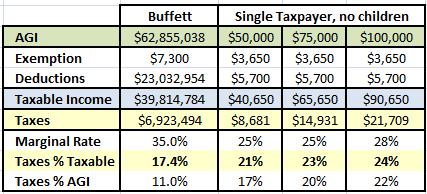
In Part 1, we looked hard at Buffett’s effective income tax rate (17.4%), and showed how he could get to that low rate by offsetting practically all of his ordinary income with $23 million in deductions.

This conclusion debunks the popular pundit point that he gets to the rate by having practically all of his income in capital gains and dividends.

In Part 2, we showed that about $20 million of the deductions are probably charitable contributions – a device that rich folks use to (1) do good things and (2) to manage down their tax liabilities.

Better to give to a cause that you believe in, right? Why give it to the government and have it waste the money?

In Part 3, we agreed that Buffett’s tax rate as a percentage of his taxable income is probably less than his secretary’s – partially due to his capital gains being taxed at a comparatively low rate, but mostly because he shelters his ordinary income with charitable deductions.

And, we showed how ordinary earners can get to a rate lower than Warren’s … just by donating a huge chunk of their income to charity. Not realistic, but mathematically possible.

In Part 4, we showed that Buffett’s tax rate as a percentage of AGI is only 11% …. about half of the estimated rate for our hypothetical secretary surrogates.

image

Now, my first reaction when I stared at the taxes to AGI rate was “Wow, Buffett’s right – he’s nothing but a coddled piker.”

But now, I’m not so sure.

On one hand, his paying a rate (to taxable income) that’s 5 points less than his secretary doesn’t seem fair.  Especially since he gets to the rate by exploiting some dreaded tax loopholes, aka. “deductions”.

The situation seems even worse when you consider his taxes to AGI rate – a mere 11% – less than half of his secretary’s rate (I suspect).

Gotta jack up taxes, right?

Not so fast.

Let’s construct another measure: the GBSR™ — “Give Back to Society Rate

Since I’m coining the measure, I’ll define the GBSR™ as the sum of taxes paid plus charitable contributions – since those are all money that’s supposed to be going to the common good, albeit administered by different organizations – divided by AGI.

OK, so what’s Buffett’s GBSR?

Well, based on my estimates, Buffett pays about $7 million in Federal taxes, about $3 million in state taxes, and about $20 million to charities.  ,,, for a total of $30 million … which dived by his $63 million AGI … gives a GBSR™ rate of almost 50% (47.6% to be precise).

Now, let’s pretend that Buffett’s secretary profiles like our $100,000 ordinary earner above.  Her charitable deductions would be at most $5,700.  Otherwise she wouldn’t be taking the standard deduction, she’d itemize.

So, her GBSR™ @ $100,000 AGI is 27.5%   ($5,700 + $21,709 = 27,409 / $100,0000 = 27.5%).

That means that Buffett’s GBSR™ is almost twice his secretary’s.

Hmmm.

Maybe he’s not such a bad guy and I should stop ranting about him.

And, maybe he should stop causing trouble for other folks by constantly whining about the tax code.

It just may be that the tax code is leading to the right answer.

Just have to look around the trees to see the forest.

AMEN

>> Latest Posts

If you aren’t being paid enough, taxpayers will make up the difference … huh?

October 21, 2011

Gene Sperling – one of the Obama’s economic hacks – has an editorial in today’s WSJ trying to defend the “pass it now” Jobs Bill.

First, he argues that

“It provides a strong and immediate boost to demand that could create up to 1.9 million jobs, increase growth by up to 2%, and lower unemployment, according to independent economists such as Moody’s Analytics.

First, note that the administration has at least learned a lesson re: setting benchmarks.  The squirrely “up to” is a maximum, not a minimum.  So, the result can be anything less than those benchmarks and they can declare success. Huh?  I wish my pay-for-performance targets had been “up to a 2 point share gain”.  I would have gotten rich.

Second, I like the phrase “such as Moody’s Analytics”.  Obama has been saying “all economists agree”.  Based on SAT training, we all know that “all” is usually not the answer.  The only economist I’ve seen on record is Mark Zandi at Moody’s.  He’s the guy who said the first stimulus would keep unemployment under 8%.  And, oh yeah, one of Moody’s biggest shareholder’s is Warren Buffett.  Coincidence?

Sperling also argues that the provisions of the Jobs Bill are “specifically designed to take on the problem of long-term unemployment.” It includes:

  • A tax credit for hiring the long-term unemployed and veterans
  • A ban on hiring discrimination against the unemployed
  • Major reforms to our unemployment-insurance system, including wage insurance to assist workers whose new job pays less than their old
  • A “Bridge to Work” program to help the unemployed reconnect with the labor force through temporary work
  • Job-search assistance for all long-term unemployed
  • Support for unemployed workers looking to become entrepreneurs.

Some on these provisions are laudable – at least on the surface.  I don’t think anybody is against helping veterans, or providing job search assistance.

Bot others are questionable.  For example, take the provision that would give those claiming discrimination a right to sue, and violators would face fines of up to $1,000 per day, plus attorney fees and costs.

Why do we need that?

Sperling says “the National Employment Legal Program recently found, in a span of four weeks, over 150 Internet job postings that include “do not apply” notices discriminating against those who are currently unemployed.”

Oh my God — 150 evil posting in a month … out of the gazillion web postings each month  Statistically insignificant – and certainly not worth another slew of frivolous law suits.  Cue the trial lawyers.

And, if your new job pays less, taxpayers will make up the difference?

Who thinks this stuff up?

>> Latest Posts

Unfit to serve … under 6% qualify for military

October 21, 2011

The  ABC News headline reads

“Nearly one-fourth of the students who try to join the U.S. Army fail its entrance exam”.

That’s true, but it’s only part of the story.

A study by The Education Trust found that 23 percent of recent high school graduates don’t get the minimum score needed on the enlistment test to join any branch of the military.

Here’s the line that caught my eye.

The military exam results are also worrisome because the test is given to a limited pool of people:

Pentagon data shows that 75 percent of those aged 17 to 24 don’t even qualify to take the test because they are physically unfit, have a criminal record or didn’t graduate high school.

Doing the arithmetic, the military is drawing from a pool that only contains 5.75% of those aged 17 to 24.

Holy smokes …

>> Latest Posts

Making science cool (again) … dy-no-mite!

October 20, 2011

My daughter-in-law has a group of PhD scientist-friends.

Last summer I was chatting with them about why the U.S. is reportedly falling behind in math and science.

They offered  that the PhD grind is, in fact, a grind … and that comp levels in science are paltry.

My hypothesis: there aren’t enough aspirational heroes for kids these days.

In my day, Salk was a hero vaccinating polio and every kid wanted to be an astronaut.

My prescription: we need more heroes and we need to make school (and science) cool again.

Well, maybe science is getting cool again.

Check out this video from the McGill Cancer Research Center … a fun view of lab science.

See, science doesn’t have to be boring!

                                    click to view

image

image

Thanks to Barbara Gordon & Jess Homa @ American Society for Biochemistry and Molecular Biology for feeding the lead

>> Latest Posts

Squeezing Buffett’s numbers … Part 4

October 20, 2011

In Part 1, we looked hard at Buffett’s effective income tax rate (17.4%), and showed how he could get to that low rate by offsetting practically all of his ordinary income with $23 million in deductions.

This conclusion debunks the popular pundit point that he gets to the rate by having practically all of his income in capital gains and dividends.

In Part 2, we showed that about $20 million of the deductions are probably charitable contributions – a device that rich folks use to (1) do good things and (2) to manage down their tax liabilities.

Better to give to a cause that you believe in, right? Why give it to the government and have it waste the money?

In Part 3, we agreed that Buffett’s tax rate as a percentage of his taxable income is probably less than his secretary’s – partially due to his capital gains being taxed at a comparatively low rate, but mostly because he shelters his ordinary income with charitable deductions.

And, we showed how ordinary earners can get to a rate lower than Warren’s … just by donating a huge chunk of their income to charity.  Not realistic, but mathematically possible.

Whew.

Now let’s start pulling things together.

The chart below makes the obvious clear … at least to me to me.

image

Note that Buffett’s tax rate as a percentage of AGI is only 11% …. about half of the estimated rate for our secretary surrogates.

Now that’s a gap!

But, I haven’t seen anybody in the mainstream media even notice.  They, and Chuckie Shumer, just focus on the rate to taxable income.

What’s going on?

Same story as before: Buffett shelters over a third of his AGI – and practically all of his ordinary income with charitable deductions.

Simply stated, because he gives money away to charities (e.g. the Bill Gates Foundation) he only has to give a pittance to the Feds.

Is that a good thing or a bad thing?

We’ll save that for a subsequent post.

>> Latest Posts

Today’s Deal: Groupon at 1/3 off … buy now?

October 20, 2011

Punch line: Groupon’s IPO was originally expected to value the three-year-old company at between $15 billion and $20 billion … now, the company is talking $12 billion … still a huge deal, but heading south

According to the WSJ …

In a stark comedown for what was expected to be one of the hottest stock offerings of the year, Groupon is scaling back plans for its public debut.

The Chicago company and its bankers will begin meeting with investors in the next few days to sell them on a deal that values the daily deals pioneer at less than $12 billion.

Groupon’s IPO was originally expected to value the three-year-old company at between $15 billion and $20 billion, according to people familiar with the matter.

The change comes in the wake of recent market volatility as well as several missteps by the company, the people said. Regulators have been scrutinizing Groupon’s accounting and the company was forced last month to change the way it books revenue.

Groupon plans to conduct its road show for investors next week.
.
The size of the stock sale, expected to be completed in the next two weeks, could be $500 million to $700 million.

The small offering, which would represent well under 10% of the company’s outstanding shares, is meant to cut the amount of stock being sold, in hopes that more shares can be sold later at higher prices

As we’ve said before, these guys will rue the day they turned down Google’s $5.5 billion offer …

>> Latest Posts

IBM study indicates CMOs are old school … but trying to catch-up

October 20, 2011

Punch line: This IBM study outlines top concerns from global CMOs and highlights how CMOs fail to analyze and capitalize on digital channels …

* * * * *
Excerpted from “IBM Study Shows CMOs Fail To Monitor Digital Channels

“From Stretched to Strengthened,” IBM’s latest Global Chief Marketing Officer Study, interviewed 1,734 CMOs from 19 industries and 64 countries. Topline findings converge on three points:

  • The empowered customer is now in control of the business relationship
  • Delivering customer value is paramount — and an organization’s behavior is as important as the products and services it provides
  • The pressure to be accountable to the business is not just a symptom of hard times, but a permanent shift that requires new approaches, tools and skills.

While 82% of marketing chiefs rely on traditional market research — which delivers information about consumers in the aggregate — comparatively few “are exploiting the full power of the digital grapevine,” with only 26% regularly tracking blogs, 42% tracking third-party reviews and only 48% tracking consumer reviews.

Four major priorities concern CMOs:

  1. Data explosion
  2. Social media
  3. Proliferation of channels and devices
  4. Shifting consumer demographics.

… IBM warns that a majority of CMOs are missing the personal touch, by paying more attention to markets than individuals and “peddling, not partnering,” and favoring data over relationships.

The researchers offer three key areas for improvement:

  1. understand and deliver value to empowered customers;
  2. create lasting relationships with those customers;
  3. measure marketing’s contribution to the business in relevant, quantifiable terms.

While more than half of the interviewees are confident their organization’s corporate character is understood in the marketplace, just 20% believe their employees are fully on board, and 75% believe marketing should oversee brand reputation inside and outside the enterprise.

Conclusions on how to “Get fit for the future” include:

  1. Create value for customers as individuals
  2. Reprioritize investments to analyze digital channels to access customers’ views and use advanced analytics to recognize preferences and trends across every touch point
  3. Work with IT to assess potential data and infrastructure exposures, employ tools to secure customer data and update privacy policies to address customers’ concerns
  4. Capitalize on new digital channels to stimulate customer conversations and new relationships; use tangible incentives to attract followers.

“Marketing people will need unique skills in the near future. They’ll need to be capable of integrating marketing and IT – like footballers who can kick with both feet,” concludes Jeroen de Punder, CMO of Ricoh Netherlands.

Edit by KJM.

>> Latest Posts

Squeezing Buffett’s numbers … Part 3

October 19, 2011

In Part 1, we looked hard at Buffett’s effective income tax rate (17.4%), and showed how he could get to that low rate by offsetting practically all of his ordinary income with $23 million in deductions.

This conclusion debunks the popular pundit point that he gets to the rate by having practically all of his income in capital gains and dividends.

In Part 2, we showed that about $20 million of the deductions are probably charitable contributions – a device that rich folks use to (1) do good things and (2) to manage down their tax liabilities.

Better to give to a cause that you believe in, right?  Why give it to the government and have it waste the money?

Today, let’s look at the popular headline: “Buffett’s Tax Rate Lower than His Secretary’s”

Since we don’t know his secretary’s specifics, we looked at 3 hypotheticals: a single taxpayer (i.e. not married), all ordinary income,  no dependents, standard deduction (i.e. doesn’t itemize).

The bottom line: The headline seems reasonable.  In each of 3 income scenarios ($50k, $75k and $100k) the rate to taxable income is in the lower 20s – about 5 points higher than Buffett’s rate.

But, keep reading …

image

First, these are scenarios the get to the highest possible tax rates – a joint-married filer with dependents and itemized deductions would pay less.

Nonetheless, it’s hard to imagine an ordinary person closing the gap to Warren’s rate unless they had a big mortgage deduction and played the charity angle: giving a lot to charity to shelter income down to the 15% rate.

For example, if our 50K single taxpayer had no mortgage interest and paid about 5% in state & local taxes, he could make a charitable contribution of about $10,000 and land in the 15% tax bracket (which is capped at $34,000)

Here’s the arithmetic: $50,000 less $3,650 in exemptions, less about $2,500 in state and local taxes, less $10,000 in charitable deductions is less than$34,000 – which is the top of the 15% bracket.

The charitable deduction would be 20% of AGI … which is lower than Buffett’s apparent 30% donations’ rate ($20 million / $63 million = 31.4%) … but probably not practical at that income level.

And, using the same logic, getting our $75k and $100k ordinary income earners into the 15% bracket would require a  charitable giving rate approaching 50% of AGI.

That certainly doesn’t seem practical.

What’s the point?

Buffett’s case illustrates how a completely discretionary itemized deduction – charitable contributions – can be used by folks – especially rich folks – to shelter ordinary income from taxes … and get them to a low effective tax rate.

That’s not a shot at charitable deductions – more on that in subsequent posts – just raises the point that closing the gap between Buffett and his secretary may be less a matter of raising tax rates (on capital gains) and more a matter of how deductions are allowed and applied.

More to come ..

>> Latest Posts

Occupy Wall Street … by the numbers.

October 19, 2011

According to Democratic pollster Doug Schoen:

Research shows clearly that the movement doesn’t represent unemployed America and is not ideologically diverse.

Rather, it comprises an unrepresentative segment of the electorate that believes in radical redistribution of wealth, civil disobedience and, in some instances, violence.

Specifically …

  • Half (52%) have participated in a political movement before
  • Virtually all (98%) say they would support civil disobedience to achieve their goals
  • Nearly one-third (31%) would support violence to advance their agenda.
  • The vast majority of demonstrators are actually employed
  • An overwhelming majority of demonstrators supported Barack Obama in 2008.
  • Now 48% say they will vote to re-elect him in 2012, while at least a quarter won’t vote.
  • 65% say that government has a moral responsibility to guarantee all citizens access to affordable health care, a college education, and a secure retirement—no matter the cost.
  • By a large margin (77%-22%), they support raising taxes on the wealthiest Americans, but 58% oppose raising taxes for everybody,

Schoen’s bottom line: Occupy Wall Street is a group of engaged progressives who are disillusioned with the capitalist system and have a distinct activist orientation.

>> Latest Posts

For Groupon, suddenly, $5.6 billion is looking better …

October 19, 2011

Punch line: Groupon’s luster – and valuation – are starting to fade.  These guys will rue the day they sent Google packing.

According to the WSJ:

Last year, four mutual fund companies – including Growth Fund of America, T. Rowe Price and Fidelity Investments — invested in Groupon at a price that valued the entire company at $4.7 billion,

Then,  Groupon turned down an offer from Google reported to be just south of $6 billion?

At the time, Groupon was said to have potential IPO valuations ranging from $15 billion to as high as $30 billion.

But the U.S. IPO market has been largely dormant, the Securities and Exchange Commission has required more-conservative accounting from Groupon, and a top company executive has departed.

Some IPO analysts now predict a Groupon IPO, if completed, might value the company at $5 billion to $10 billion.

If the valuation keeps falling, some early-in funds may find themselves marking down the value of their holdings on their books.

Of course, I’m betting the under …

>> Latest Posts

Squeezing Buffett’s numbers … Part 2

October 18, 2011

In Part 1, we looked hard at Buffett’s effective income tax rate (17.4%).

We tested the conventional wisdom that the rate is low because Buffett gets practically all of his income from capital gains and dividends.

Maybe and maybe not.

We showed that, in fact, almost half of Buffett’s income could be from ordinary income and he’d still pay the low rate.

Why?

Because deductions are first applied to higher taxed income (think ordinary income @ 35%) and then to lower taxed capital gains.

Buffett could, in effect, be getting his ordinary income tax-free.

Let’s dig a little deeper on Warren’s tax data.

image

The key numbers: AGI = $53 million, Deductions (aka. “loopholes”= $23, Taxable Income =$40 million, and taxes = $7 million … 17.4%

Let’s think about the deductions for a moment

Some pundits have theorized that many of the deductions are “interest on investment borrowing”, suggesting that Buffett buys a lot of his holdings on margin.

I don’t think so.

First, he’s a frugal guy who doesn’t strike me as margin kind of guy.

Second, interest rates are essentially zero … especially for a big hitter like Buffett … and zero times any balance is, well, zero.

Third, Buffett himself says it ain’t so.

He says the roughly $23 million difference between his AGI and taxable income is due largely to deductions he took for charitable giving and local taxes.

Let’s do taxes first.

Nebraska state income taxes have a max marginal rate of just under 7%.  So, Buffett probably pays about $3 million in state & local taxes.

That leaves about $20 million in charitable deductions.  It’s oft reported that many of those donations go to the Gates Foundation.

We’ll come back to the charitable deductions in a subsequent post.

We’re not saying they’re necessarily good or bad … just remember the $20 million number.

* * * * *
Next up: How does the 17.4% compare to ordinary folks?  And, is it the right  number to focus on?

>> Latest Posts

How to keep the flab off …

October 18, 2011

Most folks have dieted at one time or another to shed a few pounds.

Inevitably, the pounds creep back.

But, according to a place called the National Weight Control Registry, regaining lost weight isn’t inevitable:

Some people are able to lose a substantial amount of weight and keep it off at least a decade.

Here’s how they do it:

  • Track their food intake.
  • Count calorie or fat grams or use a commercial weight-loss program to track food intake.
  • Follow a low-calorie, low-fat diet … about 1,800 calories a day with less than 30% of calories from fat.
  • Eat breakfast regularly.
  • Limit the amount they eat out … dining out an average of three times a week and eating fast food less than once a week.
  • Eat similar foods regularly with no binging on holidays and special occasions.
  • Walk about an hour a day or burn the same calories with other activities.
  • Watch fewer than 10 hours of TV a week.
  • Weigh themselves at least once a week.

OK,  I’ll start by having breakfast … the rest can come later.

>> Latest Posts

Squeezing Buffett’s numbers … Part 1

October 17, 2011

Last week Warren “Don’t Coddle Me” Buffett released some of his tax info.

Just some highlights, but enough to give fodder to some analyses.

I think I have some interesting unreported angles on the nums that I’ll be dribbling out in this and subsequent posts.

First, the facts:

  • Buffett’s adjusted gross income (AGI) was $62,855,038  last year
  • His taxable income was $39,814,784
  • His federal income tax bill came to $6,923,494, or 17.4% of his taxable income.
  • He said The roughly $23 million difference between his AGI and taxable income was due largely to deductions he took for charitable giving and local taxes
  • He paid $15,300 in payroll taxes … but, so what?

You may remember, the buzz us about how Buffett’s 17.4% is lower than his secretary’s mid-20s tax rate.

Conventional wisdom is saying that the issue stems from so much of Buffett’s income comes from capital gains and dividend (taxed at 15%) rather than ordinary earned income (taxed at 35% at the margin).

A simple analysis suggests that for Buffett to have an overall 17.4% tax rate, his $40 million in taxable  income must be split roughly $35 million from capital gains & dividends (taxed at 15%) and $5 million in ordinary income (virtually all taxed at 35%).

image

But, not so fast …

I’m not a tax adviser but …here’s something that I think is right and that I bet you didn’t know:

Mechanics for applying the tax code work to the tax payer’s advantage in at least one very import way … deductions against income aren’t applied pro-rata across tax categories – ordinary income and capital gains … rather they get applied to the highest taxed category of income first.

Said differently, deductions are first applied to ordinary income, then to capital gains (if there are any left).

That’s a big deal … for Buffett and for us ordinary folks.

What it could mean for Buffett is that the could pay his 17.4% rate with an almost 50 / 50 mix or ordinary income and capital gains.

Here are the nums:

image

So what?

Well, if I’m right then maybe Buffett’s right … he is being coddled.

But, the problem isn’t the tax rate (sorry, Chuckie Shumer) it’s those devilish loopholes.

It’s that he can generate tax deductions by giving mucho  $$$ to his buddy Gates’ foundation … and, in effect, can shelter almost all of his ordinary income from any taxes.

Now, that’s a big deal!

More in subsequent posts.  Trust me, I’m not done with this one.

>> Latest Posts

At ripe age of 132, P&G’s first mass marketed brand gets a makeover …

October 17, 2011

Punch line: P&G launches Ivory soap in new colorful packages and with a redesigned logo, and a back-to-basics nostalgic marketing campaign.

* * * * *
Excerpted from philly.com, “P&G launches for Ivory soap

… The remake is part of an effort to breathe new life into Ivory. It comes at a time when Americans are scaling back on spending in the down economy, but are looking for little, cheap ways to pamper themselves … As P&G has focused on bigger, faster-growing brands, the white bar of soap has lagged behind its rival Dove and faced increasing competition from Dial and Irish Spring.

Ivory isn’t among the 24 brands with at least $1 billion in annual sales at P&G … but the soap that floats has a long history with the company.

Ivory was the first brand mass-marketed by P&G. It is the namesake of a P&G research and production center called “Ivorydale.” It’s deeply entrenched in American pop culture as a sponsor of early television soap operas and the first televised major league baseball game …

Ivory is where our origins are … It has a special place in a lot of people’s hearts around here. It’s incredibly important to keep it alive and growing.”

… P&G expects the new campaign to remind people why their families used Ivory in the past, and to attract new users with quality for low price …

“There is so much tail wind at our back: the economic environment, this trend of getting back to things that work, and reminding us of a time when things were a bit simpler.”

… Instead of Ivory’s usual nearly all-white packages, new ones will be more colorful. One is mostly bright blue. The new package emphasizes the 10 bars compared to 8- and 6-packs sold by most competitors with a big “10.” A simpler logo plays off the previous of the 1950s and carries the slogan, “pure, clean & simple.”

… The ads have some understated humor, calling Ivory “meticulously scented to smell exactly like soap” and pledging that “when dirt changes its formula, so will we.” …

Edit by KJM.
Thanks to DM for feeding the lead

>> Latest Posts

Tanning salon update: tax collections 64% below ObamaCare projections

October 14, 2011

Well, well, well.

It appears that tanning salons either don’t know about their targeted ObamaCare tax or they aren’t complying with it or the added tax has dampened demand … and the IRS is having trouble tracking the  salons down to figure out what’s going on.

So, the new federal tax on indoor tanning services isn’t bringing in as much revenue as promised.

The Treasury Inspector General for Tax Administration says the new federal tax on indoor tanning services isn’t bringing in as much revenue as hoped.

Tanning tax receipts for that nine-month period ending March 31, 2011  totaled $54.4 million, the report found.

That was below projections by the Congressional Joint Committee on Taxation, which had estimated the tax would raise $50 million per quarter.

The IRS had difficulty determining the actual number of tanning salons and the contact info for businesses required to collect the new tax from customers.

Using an April 2010 Indoor Tanning Association estimate, the IRS initially projected the tax would be due quarterly from roughly 25,000 stand-alone tanning salons, plus spas, health clubs and beauty parlors.

But the inspector general report found that actual tax returns filed for the first three quarters through March 31 averaged just above 10,300.

Source: USA Today

It’s a shocker, isn’t it ?

>> Latest Posts

Rewarding failure to spur innovation … say, what?

October 14, 2011

TakeAway: Companies are looking for a new way to be innovative by rewarding individuals on their failures.

The rewards for failures vary by company from statues to monetary awards with the hope of generating innovation.

Excerpted from WSJ: “Better Ideas Through Failure

Amid worries that we are becoming less innovative, some companies are rewarding employees for their mistakes or questionable risks.

The tactic is rooted in research showing that innovations are often accompanied by a high rate of failure.

“Failure, and how companies deal with failure, is a very big part of innovation,” …. Failures caused by sloppiness or laziness are bad. But “if employees try something that was worth trying and fail, and if they are open about it, and if they learn from that failure, that is a good thing.”

A unit of WPP’s Grey Group started handing out the “Heroic Failure” award because he was worried that fast growth at the agency was making employees “a little more conservative, maybe a little slower,”

Extracting lessons from foul-ups is the focal point of Michael Alter’s “Best New Mistake” awards at SurePayroll.

Only people who are trying to do a good job, make a mistake and learn from it are eligible for the $400 annual cash award.

Edited by ARK

Ken’s Take: I always scratch my head when I hear people say that companies punish risk takers.

If  GE and Black & Decker had given trophies for ‘nice tries’ that didn’t pan out, I’d need another wing on the house to hold them. 

>> Latest Posts

With junk mail & gov’t checks being the pillars of their business, what’s the USPS to do ?

October 13, 2011

Talk about being at the end of the product-life-cycle … how would you like to be the dude running the US Postal Service?

The vast majority of the stuff still handled by USPS is made up of catalogues, junk mail ads, unwanted solicitations and, oh yeah, government checks.

In a few years, all that will be left will be government checks.

Hard to make a living off them.

Unless, of course, Team O gets re-upped for a 2nd term.

Excerpted from WSJ: Junking the Junk Mail Office

Email and Fedex already take care of serious delivery business. Why subsidize catalogue carriers?.

The United States Postal Service (USPS) lost $9 billion last year.

The rapid growth of email, online bill paying and the like has reduced the volume of first class mail by 22% since 2006, cutting into the government’s monopoly.

An inexorable decline is underway. The lesson here is that even monopolies can die if they provide inefficient services to shrinking markets.

Both Fedex and UPS do a much better job shipping packages than does the USPS.

The cost of a first-class stamp to 44 cents when it should be closer to 30 cents, if held to the rate of inflation.

Meanwhile, bulk-mail discounts have resulted in a glut of unwanted catalogues and credit-card offers in our mailboxes — and have led to billions of dollars in losses.

Our political leaders should end the USPS’s dysfunctional first-class mail monopoly, opening it up to private competition.

Postal Service employees are generally very well paid and (with some notable exceptions, usually in smaller towns) have rarely been characterized by high productivity.

Visits to the post office are not normally known to be user-friendly experiences. It is a good bet that the private sector will be considerably more productive — and user-friendly — than today’s government employees, no matter how loyal they may be.

And, post offices usually occupy prime real estate in cities and towns across America, potentially of great interest to retailers, restaurateurs, municipal governments and others.

And, don’t forget, the more than 200,000 USPS vehicles are also saleable.

I’d bid on one of those USPS carrier jeeps …

>> Latest Posts

SBUX’s Schultz: "We can’t wait for Washington.”

October 13, 2011

I guess I shouldn’t be poking fun at this one, but I can’t resist …

First, the facts:

Excerpted from WSJ : Starbucks Pushes to Create Jobs

Starbucks  CEO Howard Schultz, who has been on a mission to cut the national debt and boost job creation, has pledged to donate at least $100,000 of profits annually  to boost jobs in low-income areas

Profits from Starbucks stores in the Harlem section of Manhattan and the Crenshaw neighborhood of Los Angeles will go toward two community organizations that work to improve education and job training for young adults in those areas.

High-school students in those neighborhoods also will receive barista training at the Starbucks shops.

Ken’s Take:

1) $100,000 ???  Come on Howard, that’s the equivalent of about 50 lattes per day … if you’re going to step-up, then STEP-UP !

2) Can’t you just imagine the reaction of the neighborhood kids … “Hot damn, dreams come true, I can be a Barista”

>> Latest Posts

Why not Occupy Omaha ?

October 12, 2011

Well, Tuesday was the day that, according to CNN Money

Community groups and progressive organizations that have been working with the broader Occupy Wall Street movement marched on the homes of JP Morgan Chase CEO Jamie Dimon, billionaire David Koch, hedge fund honcho John Paulson, and News Corp  CEO Rupert Murdoch.

The millionaires and billionaires are being targeted for what event organizers called a “willingness to hoard wealth at the expense of the 99%.”

Why not stake out Warren’s place until he agrees to forego all of his tax loop holes (e.g. deductible contributions to his buddy Gates)?

Or, better yet, Washington … picket the millionaire who has been pushing hard for class warfare.

Hope Barry & Warren are proud … mission accomplished.

>> Latest Posts

Tracking the progress at GM …

October 12, 2011

The U.S. Treasury aimed to sell more of its 26.5% stake in GM by August or September.

Then, the stock started tanking.

GM stock would need to hit $53 a share for the U.S government to break even on its $50 billion bailout of the auto maker.

At $30 a share, the U.S. would lose more than $10 billion on its $50 billion bailout of GM.

So far this year, GM stock is down about 40%

It was trading just over $22  this week,

Than makes the loss about $15 billion … but, who’s counting?


image

>> Latest Posts

The top 100 brands … and the movers.

October 12, 2011

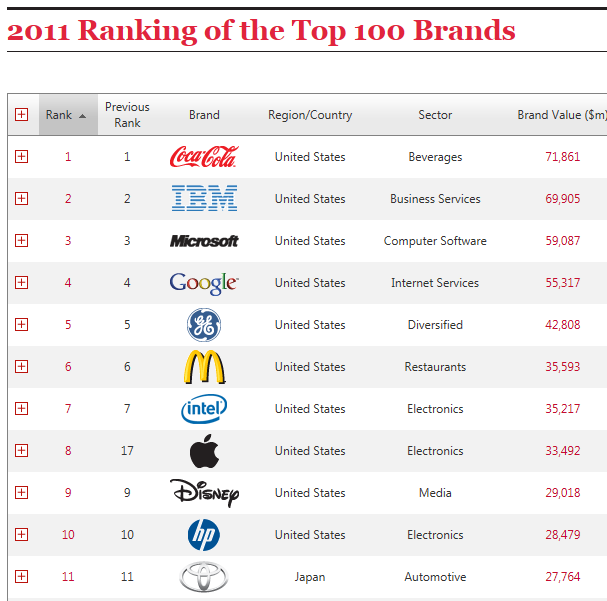
Interbrands’s has released its 2011 estimates of brand values.

First, the top 11.

I went 11 deep since  I think it’s noteworthy that Toyota gained in brand value despite the flap in the US over the alleged gas pedal problem.

Also, noteworthy is HP in 10th place …   obviously doesn’t reflect the recent turmoil there.

Rest of the list are the usual suspects.

image

* * * * *
Here are the biggest gainers in brand value from 2010 to 2011.

Note that VW and Audi earned nice gains.

image

* * * * *
And, here are the biggest losers in brand value from 2010 to 2011.

Only surprises  (to me) is IKEA and MTV.  It’s a bummer getting old …

image

For the article, methodology and interactive chart click here

>> Latest Posts

It’s 4 o’clock …. quittin’ time.

October 11, 2011

Couple of wars, economy is tanking … let’s call it a day.

Reported by the NY Post (so it has to be true):

The president’s workdays are said to end early, often as early as 4 p.m.

He usually has dinner in the family residence with his wife and daughters, then retreats to a private office.

One person said he takes a stack of briefing books.

Others aren’t sure what he does.

True or not, most CEO’s don’t relish this kind of buzz …

>> Latest Posts

Fair share revisited…

October 11, 2011

Obama’s tax plans don’t really impact , so this issue is strictly philosophical.

I’m still struggling with his “fair share” riff.

Out of 140 million tax filers, there 1,470 millionaires who pay no taxes of them.

Doesn’t sound like they’re paying their fair share, but there aren’t many of them … and, I bet each has an interesting story.

More generally, according to the IRS, folks making:
• More than $1 million pay 24% of income in taxes
•  $200,000 to $300,000 pay 17.5%
•  $100,000 to $125,000 pay 9.9%
•  $50,000 to $60,000 pay 6.3%
•  $20,000 to $30,000 pay 2.5%

And, the IRS reports that – as a % of income tax revenues:
• The top 1% pays 39%
• The top 5% pays 60%
• The top 10% pays 72%
• The bottom half pays 3%

So, what’s “fair share”?

Neither Obama nor his frontmen seem comfortable saying/

Wouldn’t you like to know?

Hmmm.

>> Latest Posts

Tanning salons are back in the hot seat …

October 11, 2011

Apparently, the ObamaCare tax surcharge wasn’t enough to kill the tanning business.

Now, California is banning use of tanning salons by minors.

According to Reuters:

Governor Jerry Brown signed a bill on Sunday prohibiting anyone under the age of 18 from using ultraviolet tanning devices.

The bill was part of a cluster of legislation designed to “improve the health and well-being of Calfornians.”

I guess you don’t want to own a tanning salon or Gibson Guitars …

>> Latest Posts