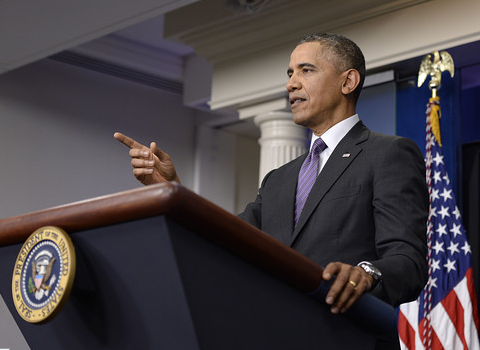
During last Friday’s press conference, President Obama criticized opponents to his policies as having “half-baked ideas” and speaking “mumbo jumbo” … and, he said that Congress should tighten gun control laws because “the polling says the majority of Americans understand we should be changing these laws “ and “Congress should act on behalf of the majority” Source
Today, we’ll just deal with the last part: acting on behalf of the majority.
First, I was pleased to hear the President come out in favor of majority rule.
A couple of notable examples suggest that it’s a change of heart.
Everybody must have their favorite moments from the Pope’s visit.
Here are my top 2 in reverse order:
#2 Obama was late getting to Andrew’s Air Force Base, so the Pope’s plane was put in a holding pattern over North Carolina to blow some time and arrive concurrently with the President. Source
I got a kick out of this one since the men — who were totally in sympatico re: climate change change — didn’t flinch at the notion of burning a couple of hundred gallons of jet fuel.
Mainstream media continues to tout the success of ObamaCare … always focusing on the number of previously uninsured folks who now have insurance.
Most recent CBO numbers say that about 19 million previously uninsureds now have insurance – mostly from Medicaid and subsidized ACA Exchange policies.
Now, about 80% of the non-elderly population is covered … but, about 36 million are still uninsured.
Said differently, over half of the previously uninsureds are still uninsured.
Huh?
=====
Let’s look at the cost …
ObamaCare added about $100 billion in annual government spending .
So, the cost per newly insured person is roughly $5,000 per newly insured person per year.
That sounds about right since an average individual health insurance policy is about $5,000 per year.
======
OK, so what’s the rub?
Some simple arithmetic suggests that the aggregate monetary amount of insurance provided to the full population of non-elderly citizens has actually declined.
Recently, a friend casually mentioned to me that his family finances were being strained by healthcare costs.
Why?
His family’s annual deductible had gone up from $2,500 to $12,500.
What?
Think about that for a moment … a 10-grand bump in out-of-pocket healthcare costs before the insurance even kicked in (with co-pays, of course).
======
The discussion piqued my curiosity, and I did some digging to put my friend’s predicament in perspective … what I found was surprising (and certainly under-reported in the main stream media)
Everybody knows that Amazon’s free shipping program has been a resounding success.
So much so. that the company has announced that it will be moving the minimum qualifying order up from $25 to $35 … inducing shoppers to fill their carts fuller or switch to the highly profitable Amazon Prime program.
Yesterday, the Supreme Court heard oral arguments in the latest — and perhaps, the most significant challenge to ObamaCare.
In a nutshell, the essence of the case is whether the ObamaCare law provides for insurance subsidies to folks buying health insurance through the Federal Insurance Exchange.
The argument centers on very specific – and very literal wording in the law.
To “motivate” individual states to set up their own insurance exchanges, the law law says that subsidies would only be provided to people who buy their health insurance thru state exchanges. No provision was made for subsidies thru the Federal exchange.
ObamaCare supporters are arguing that the wording was a “drafting error” and that the legislative intent was to provide subsidies regardless of whether the insurance was bought thru a state or Federal exchange. That’s somewhere between revisionist history and boldface lie.
Failing that argument, the fallback line of reasoning is that bad things will happen ObamaCare if it’s implemented the way it’s written.
That may be true, but this is a legal issue not a social issue.
Conservatives argue that the intent was clear (to bully states into creating exchanges) and that the law needs to be interpreted as written, not based on what might have been intended.
Of course, Chief Justice Roberts violated the latter point when he let the law fly when the individual mandate was challenged — coining the penalty to be a tax.
I expect the Justices to find for the plaintiffs and against ObamaCare.
According to the NY Times , the Harvard faculty is throwing a collective hizzy fit.
What’s their beef?
In a touch of irony, the same folks who cheer-led the passage of ObamaCare now feel aggrieved because they’re being forced to shoulder some of the costs.
To quote my grandson Ryne, “Oh me oh my.”
Here’s the scoop … with some priceless snippets from the Times’ article
Last week, Sen. Chuck Schumer caused a stir in Democrat ranks’ by observing that President Barack Obama’s insistence on revamping the healthcare system was, in Schumer’s words, “misguided” and was a major cause of the GOP’s mid-term election romp & stomp.
Schumer is still all for massive healthcare changes.
His observation is strictly political.
His reasoning:
“Democrats were targeting the uninsured, a population that makes up only about 5 percent of registered voters. Only about one-third of the uninsured are registered or eligible to vote.” Source
Schumer’s on the right track, but misses a bigger point: When people are forced to give up something they have, they overvalue the loss and try hard to recoup it.
Think, the higher premiums and changed doctors that millions of folks have had had to endure.
Behavioral theorists have long observed that most people are risk adverse and, due in part to an “endowment effect”, they “value” losses greater than gains.
Endowment Effect: People tend to ascribe a higher value to things that they already own than to comparable things that they don’t own. For example, a car-seller might think his sleek machine is “worth” $10,000 even though credible appraisers say it’s worth $7,500. Sometimes the difference is due to information asymmetry (e.g. the owner knows more about the car’s fine points), but usually it’s just a cognitive bias – the Endowment Effect.
The chart below illustrates the gains & losses concept.
Note that the “value line” is steeper on the losses side of the chart than on the gains side.
L & G are equivalently sized changes from a current position.
The gain (G) generates an increase in value equal to X.
The loss (L) generates a decrease in value that is generally found to be 2 to 3 times an equivalently sized gain
=====
For example, would you take any of these coin flip gambles?
Heads: win $100; Tails: lose $100
Heads: win $150; Tails: lose $100
Heads: win $200; Tails: lose $100
Heads: win $300; Tails: lose $100
Most people pass on #1 and #2, but would hop on #3 and #4.
OK, now let’s show how all of this relates to ObamaCare.
Everybody knows that Amazon’s free shipping program has been a resounding success.
So much so. that the company has announced that it will be moving the minimum qualifying order up from $25 to $35 … inducing shoppers to fill their carts fuller or switch to the highly profitable Amazon Prime program.
The Obama administration on Friday unveiled data showing that many Americans with health insurance bought under the Affordable Care Act could face substantial price increases next year — in some cases as much as 20 percent.
Now, those are exchange premiums so they don’t apply to me.
Still, the headline was shocking enough to make me take a serious look at the premiums that I pay.
Even if you believe that “the end justifies the means”, this has gotta make your skin crawl.
Some background: Prof. Jonathan Gruber is an MIT economist who helped on RomneyCare in Massachusetts and was one of the primary architects of ObamaCare.
He was caught on video speaking quite frankly about the crafting of ObamaCare.
His basic message:
“The bill was written in a tortured way … to be sure that the CBO didn’t score the mandate as a tax … otherwise the bill would die … so, it was written to do that … with regards to the subsides … if people figured out that healthy pay in to give sick people money, it wouldn’t have passed … lack of transparency is a huge political advantage … and basically, call it the stupidity of the American voter or what … that was critical to getting the bill to pass … yeah, it would be better to be transparent, but I’d rather have this law than not.”
Watch the video … it’s even more chilling to hear Prof. Gruber say the words: Obfuscate and bank on American stupidity.
How do these guys sleep at night?
P.S. Another Gruber video will get wide play in the next couple of months.
He’s on tape saying that the specific language in the bill that only provided subsidies for folks going through state exchanges was intentional to motivate states to build exchanges,
Now, ObamaCare supporters are claiming it was just a typo that didn’t represent intent.
Well, the Supreme Court has signed on to settle the matter … with life & death consequence for ObamaCare.
Flashback: Remember when the Administration declared war on the Little Sisters of the Poor?
Not ISIS (or ISIL or whatever), the Little Sisters.
You see, the nuns weren’t interested in ObamaCare’s contraception provisions … they were already controlling births very well, by abstaining from you-know-what … and the nuns didn’t want to provide birth control for their lay employees since it violated their fundamental religious beliefs.
So, the DOJ filed a lawsuit to force the nuns off their right-to-life platform and compel them to provide birth control in their insurance packages.
You know, the Georgetown law student who couldn’t afford $3,000 for birth control pills while going to law school.
Not to worry, we’re not taking sides on the ObamaCare contraceptives issue … this is all about money — freakonomics.
Still, since it’s critical background, here’s an excerpt of her infamous Congressional testimony:
My name is Sandra Fluke, and I’m a third-year student at Georgetown Law School.
I attend a Jesuit law school that does not provide contraceptive coverage in its student health plan.
We students have faced financial, emotional and medical burdens as a result.
When I look around my campus, I see the faces of the women affected by this lack of contraceptive coverage …
On a daily basis, I hear from yet another woman from Georgetown or from another school … and they tell me that they have suffered financially, emotionally and medically, because of this lack of coverage.
Without insurance coverage, contraception, as you know, can cost a woman over $3,000 during law school.
For a lot of students who, like me, are on public interest scholarships, that’s practically an entire summer’s salary.
Forty percent of the female students at Georgetown Law reported to us that they’ve struggled financially as a result of this policy.
Behavioral theorists have long observed that most people are risk adverse and, due in part to an “endowment effect”, they “value” losses greater than gains.
Endowment Effect: People tend to ascribe a higher value to things that they already own than to comparable things that they don’t own. For example, a car-seller might think his sleek machine is “worth” $10,000 even though credible appraisers say it’s worth $7,500. Sometimes the difference is due to information asymmetry (e.g. the owner knows more about the car’s fine points), but usually it’s just a cognitive bias – the Endowment Effect.
The chart below illustrates the gains & losses concept.
Note that the “value line” is steeper on the losses side of the chart than on the gains side.
L & G are equivalently sized changes from a current position.
The gain (G) generates an increase in value equal to X.
The loss (L) generates a decrease in value that is generally found to be 2 to 3 times an equivalently sized gain
=====
For example, would you take any of these coin flip gambles?
Heads: win $100; Tails: lose $100
Heads: win $150; Tails: lose $100
Heads: win $200; Tails: lose $100
Heads: win $300; Tails: lose $100
Most people pass on #1 and #2, but would hop on #3 and #4.
OK, now let’s show how all of this relates to ObamaCare.
There, bossman would be ordering pizza for the victory celebration.
Let’s look at the facts …
Flashback to March 2010, when Obamacare was being steam-rolled though Congress.
At that time, the Congressional Budget Office (CBO) projected that Obamacare would cost $938 billionover a decade, that the Federal deficit would shrink and 19 million uninsuredpeople would be insured as of 2014.
As a frame of reference, those estimates work out to be about $5,000 in annual cost per newly insured person … about par for private market medical insurance.
* * * * *
Unfortunately, but predictably, those estimates were wildly off the mark …
Last week, we pointed out that the 288,000 jobs gain in June wasn’t all that it was cracked up to be since full-time employment declined by over 500,000 and part-time employment increased by almost 800,000.
One of ObamaCare’s goals was to reduce pressure on emergency rooms by expanding Medicaid and giving poor people better access to primary care.
Instead, many hospitals across the nation are seeing a surge of those newly insured Medicaid patients walking into emergency rooms.
Nationally, nearly half of ER doctors responding to a recent poll by the American College of Emergency Physicians said they’ve seen more visits since Jan. 1.
That’s a problem since an average ER visit costs $580 more than a trip to the doctor’s office.
When Obama finally commented on the VA scandal, he gave the usual “outraged, will investigate and hold accountable” … then asserted that “when veterans do get into the system, they get great healthcare”.
No questions from the media. Not much follow-up.
Must be true since the President said it, right?
Of course, my BS detector started screeching.
Fortunately, the WSJ started to dig and found “significantly higher rates of mortality and dangerous infections at some VA hospitals compared with others” … and compared to private hospitals.
For example, the Boston area VA hospital is rated 5-stars … the embattled Phoenix VA draws a single star.
Last week, the WSJ ran an opinion piece How to Fix the Veterans Affairs Mess by Anthony Principi who served as secretary of Veterans Affairs from 2001-05.
I expected a practical roadmap for attacking the current problems.
Instead, the author delivered a potpourri of declarations … some of which surprised me, and many of which made me sigh “oh my”.
Here are some of the points that caught my attention.
At our house, we play a game that I affectionately call “Guess the Food”.
Here’s the way it works …
My wife Kathy asks want I want for dinner tonite. I answer. She then explains why that’s not a good answer and asks the question again. I answer again, she explains again and repeats the question … until I guess the right food.
After decades of playing the game, I’ve gotten pretty good and can usually guess what I want for dinner by the 3rd or 4th guess.
OK, let’s tie that in to ObamaCare …
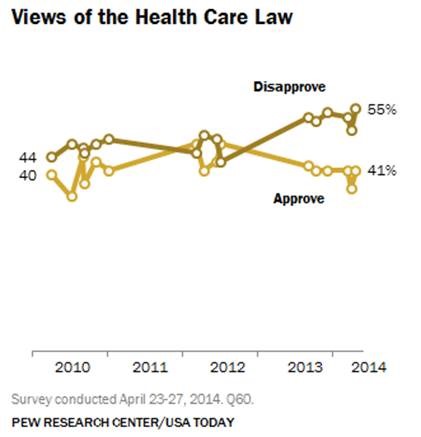
Pew recently released poll results that indicate an approval / disapproval gap of 14 percentage points (55% disapprove to 41% approve)
And, as in earlier surveys, Pew reports opposition to the law is more intense than support: 43% of the public disapproves of the law very strongly – about 80% of the disapprovers — and only 26% approve of the law very strongly – a gap of 17 percentage points.
First, Business Insider reported that “spending on healthcare grew an astounding 9.9% in Q1 … the biggest percent change in healthcare spending since 1980”
The article goes on to say: “Analysts said it’s primarily due to a consumption boost from the implementation of the Affordable Care Act.”
That makes sense.
Some folks rushed to their docs in the last quarter of 2013 to beat the jump in their deductibles and to jump the line ahead those becoming newly insured.
Nonetheless, the fact remains that, adjusted for inflation, America is spending more on healthcare than ever before..
First, Business Insider reported that “spending on healthcare grew an astounding 9.9% in Q1 … the biggest percent change in healthcare spending since 1980”
The article goes on to say: “Analysts said it’s primarily due to a consumption boost from the implementation of the Affordable Care Act.”
That makes sense.
Some folks rushed to their docs in the last quarter of 2013 to beat the jump in their deductibles and to jump the line ahead those becoming newly insured.
Nonetheless, the fact remains that, adjusted for inflation, America is spending more on healthcare than ever before..
For 2013, the Medscape survey said that the average doctor was face-to-face with patients about 41 hours …. with about 2/3s of them in the 40 to 50 hours cluster.
How does the 41 hours compare to historical rates?
According to Medscape:
A 2010 study in JAMA found that after no significant change between 1977 and 1997 in the hours per week that physicians spend with patients’
Patient hours decreased steadily from 54.6 to 51.0 between 1997 and 2007.
The study authors attributed the decrease to a parallel 25% inflation-adjusted decline in fees between 1996 and 2006.
Shocker, right? 54.6 to 51 to 41 …
Pay somebody less and they’re less incentivized to bust their humps.
Think about that each time you hear about the Feds and insurance companies ratchet down the reimbursement rates to “fix” the healthcare system,
For that matter, I like practically all illusionists.
One trick that illusionists use is to get the audience focused on a decoy … to redirect the audience away from where the “trick” is really happening.
On Wall Street, the decoy is sometimes called a “red herring” … “something that misleads or distracts from the relevant or important issue.”
Like a deft illusionist, President Obama now has the country focused on the 8 million folks who have signed-up on the ObamaCare Exchanges.
This decoy fell into Obama’s hands when the web site crashed and Republicans, started spotlighting the number – assuming that it would be a clear indicator to the country that ObamaCare failed.
Bingo: GOP gets everybody focused on the 7 million number ,,,, Obama hits the Ferns … sign-ups blow past 8 million … GOP loses its talking point … Obama takes a victory lap.
Not so fast.
Guess what?
The 8 million number is a red herring – plain & simple.
During last Thursday’s impromptu press conference, President Obama ballyhooed that the OC Exchanges had passed 8 million sign-ups (whatever the heck a “sign-up” is) … and that the CBO’s “latest estimate” says the ObamaCare “costs are down 15% from the prior estimate”.
Oh, really?
My BS detector auto-starts when I hear well-parsed, weasely words like those.
Wonder when the latest estimate was made? What were the assumptions? How does it tie to the miracle of 8 million?
So, I took a moment to dissect that statement … the digging didn’t disappoint
Now that the ObamaCare site has logged over 7 million sign-ups (yeah, right) I expect the focus to shift to the mix of the Exchange’s mix of old, unhealthy folks who consume lots of healthcare (i.e. more than they pay for their insurance) and young invincibles who pay in but don’t consume much.
The common wisdom is that the ObamaCare insurance exchange needs healthy young people to subsidize the older, less healthy enrollees … otherwise, policies offered on the exchanges will go into a premiums’ death spiral.
Yesterday, President Obama took a victory lap for getting over 7 million folks to put a free or heavily discounted ObamaCare policy in their shopping basket or to click the “I tried, don’t fine me” button.
Still no word on how many folks “bought” policies … i.e. paid the 1st months premium … insurance companies say that 20% haven’t.
And, McKinsey says 73% of the 7.1 million are from the pool of over 6 million folks who had their insurance policies cancelled because of ObamaCare.
Focus for a second on that 6 million number.
At the time the cancellations were announced, Jay Carney – Obama’s front man — said the 6 million is “just a sliver or cut of the 5% of the people on the individual market who are affected.”
Here’s the video clip. The killer quote comes at about the 2:20 mark
For the record, I think that ObamaCare is an expensive, amateurish travesty that should be repealed and rebuilt from the ground up by professionals. Keep the high risk pools for pre-exiting conditions, keep the subsidies for the poor … but lose the micro-narrow provider networks and the junk mandated into policies (e.g. my favorite: universally free birth control for law schoolers).
And, I think that Dr. Dr. Ezekiel Emanuel – Rahm’s brother and one of the ObamaCare architects – is a complete butt.
That said, I was on Zeke’s side when he sparred with O’Reilly this week …
Hopefully everybody has heard about the CBO report that estimates 2.5 million current workers will either intentionally cut the number of hours they work, or quit work altogether in order to qualify for ObamaCare subsidies.
That estimate is up threefold from the CBO study that was used to justify ObamaCare economics.
Today I’ll try to stick to the technical aspects of the CBO Report…
First, the literal CBO finding:
The reduction in CBO’s projections of hours worked represents a decline in the number of full-time-equivalent workers of about 2.0 million in 2017, rising to about 2.5 million in 2024.
The decline in fulltime-equivalent employment stemming from the ACA will consist of some people not being employed at all and other people working fewer hours.
The estimated reduction stems almost entirely from a net decline in the amount of labor that workers choose to supply, rather than from a net drop in businesses’ demand for labor, so it will appear almost entirely as a reduction in labor force participation and in hours worked.
English translation: the unemployment rate will decline because there will be fewer workers in the labor force.
That’s one way to fix an unemployment problem.
=====
Why the original CBO miss?
The CBO notes that their earlier projection – supportive of ObamaCare – recognized these labor force dynamics, but underestimated them (by a factor of 3).
Why the new upward revisions?
There are several reasons for the difference in the former and current estimates:
CBO has now incorporated into its analysis additional channels through which the ACA will affect labor supply, reviewed new research about those effects, and revised upward its estimates of the responsiveness of labor supply to changes in tax rates.
English translation: Oops, dropped the ball … nothing changed in the world, just our view of the world.
=====
What new research?
What the CBO is referring to is work done by University of Chicago economist Casey Mulligan. Prof. Mulligan’s work isn’t “new”, though. He was touting it before ObamaCare was enacted.
Putting that technical point aside, the WSJ says that the CBO’s intellectual conversion is directly attributable to Mulligan’s ideas.
Mr. Mulligan’s premise is what economists call “implicit marginal tax rates“.
ObamaCare make work less financially valuable for lower-income Americans.
Because the insurance subsidies are tied to income and phase out as cash wages rise, some people will have the incentive to remain poorer in order to continue capturing higher benefits.
Another way of putting it is that taking away benefits has the same effect as a direct tax, so lower-income workers are discouraged from climbing the income ladder by working harder, logging extra hours, taking a promotion or investing in their future earnings through job training or education.
Specifically, as the CBO put it in their report:
For some people, the availability of exchange subsidies under the ACA will reduce incentives to work both through a substitution effect and through an income effect.
The income effect arises because subsidies increase available resources — similar to giving people greater income — thereby allowing some people to maintain the same standard of living while working less.
The substitution effect arises because subsidies decline with rising income (and increase as income falls), thus making work less attractive.
As a result, some people will choose not to work or will work less — thus substituting other activities for work.
English translation: Workers will be liberated from their personal responsibilities to earn a living and support themselves.
When 5 or 6 million folks who like their health insurance, lost their health insurance … the Administration pooh-poohed the number as a “small sliver”.
Hmmm.
Let’s try another angle …
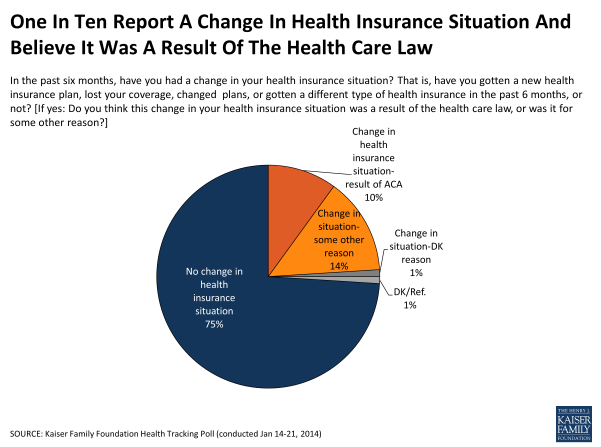
The Kaiser Family Foundation reports that 1 in 10 Americans think that ObamaCare has impacted them directly.
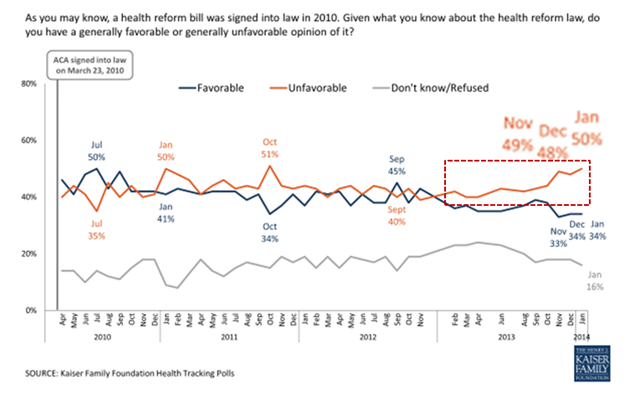
I always roll my eyes when the President declares that ObamaCare is the law of the land and nobody wants to re-litigate it..
I hate to resort to facts, but, according to the Kaiser Family Foundation, a majority of the country now views the law unfavorably .. only 34% view it favorably.
The trend isn’t good for the President’s claim.
And, remember the uninsureds – the folks that ObamaCare was designed to help?
First, let’s lay down a marker by flashing back to the late Steve Jobs.
One of the things that bothered Steve Jobs was the time that it took to boot when the Mac was first powered on.
To motivate the designers, Jobs reportedly exhorted them:
“If it could save a person’s life, would you find a way to shave ten seconds off the boot time?”.
The engineer allowed that he probably could.
Jobs went to a whiteboard and showed that if there were five million people using the Mac, and it took ten seconds extra to turn it on every day, that added up to three hundred million or so hours per year that people would save, which was the equivalent of at least one hundred lifetimes saved per year.
A few weeks later the engineer had the Mac booting up twenty-eight seconds faster.
Keep that story in mind the next time that a digitized phone answerer asks you to “press or say 1 for English; press or say 2 for Spanish”.
Not a big deal, right?
It only takes about 5 seconds to work thru the prompts.
But take Jobs rules and multiply the 5 seconds times a few million calls per day getting the prompt and you’ve got a statistically significant number of “lost lives” … or at least, lost productivity.
When I heard the news report, I thought it was a joke.
The full force of the DOJ is being thrown at, believe it or not …
THE LITTLE SISTERS OF THE POOR.
Not just nuns, “little” nuns.
Not just little nuns, little nuns who dedicate their lives to God and spend every waking hour praying or caring for the poor.
Not just little nuns who care for the poor, little poor-caring nuns who are, on average, probably about a hundred years old.
These are the nuns who are literally icons for the helpless.
So much so that weak sports teams – like those on Georgetown’s early season basketball schedule — have forever been referred to as representing The Little Sisters of the Poor.
According to the head of California’s largest medical association “seven out of every 10 physicians in California are rebelling against the state’s ObamaCare health insurance exchange and won’t participate”. Source
Why?
Simple economics: the reimbursement rates are too low.
And, for example, Medicaid only reimburses doctors 72 cents out of each dollar of costs.
You can’t make it up in volume.
======
Similarly, some high profile hospitals – e.g. Sloan-Kettering, Cedars Sinai – are opting out of the Exchange programs.
Why?
Reimbursements rates are too low.
Most conservative pundits are saying that the shrinking doctor & hospital networks will force ObamaCare to its knees … since people will revolt when they can’t use “their” doctors or the best hospitals.
Further, O’Reilly, et. al., have been saying “… and there’s nothing Obama can do about it.”
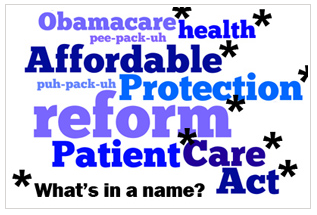
A couple of weeks ago, the Administration decided that ObamaCare need to be rebranded and remarketed since, in the words of CNN: “The name Obamacare – and the much maligned URL HealthCare.gov – have become associated with digital failure and government disorganization.”
Ouch.
In my post Rebranding ObamaCare … I suggested a new name: ObamACA™ … hoping that the name would catch traction and I could bag some royalties.
No such luck (so far).
Still, as a recovering marketer, I’m interested in the question: Would it help the administration sell the law if they ditched the ObamaCare name.
Sunday morning I linked to HealthCare.gov …. mostly, I just wanted to see if the site was up & alive.
The landing page populated quickly.
So, I decided to play the “find a glitch” game … the kinda thing I’d do when IT teams would come to demo a new system for me.
It took less than 5 seconds … and I didn’t have to leave the home page
=====
Here’s what I did.
I certainly didn’t want to apply for anything, so I just ran the cursor over the “See plans in your area” section of the landing page.
Note that the cursor turned into a hand, indicating a live hyperlink.
I clicked and nothing happened,
Clicked again, nothing happened.
Then I clicked the “See plans now” and got linked to a process for taking a peek at plans.
=====
In tech terms, the hyperlink “hotspot” is wrong … either the apparent link where I originally clicked should be removed … or a single hotspot should extend over the entire “See plans” wording.
OK, I concede that this is a minor glitch.
But, it’s like the drill sergeant checking the back of shoes during inspections – figuring that if the backs are polished, so are the fronts.
Makes me wonder: Is anybody really testing this stuff?
I warn students: Make sure that the first slide in your pitch is error free – no typos, no arithmetic errors, etc. – otherwise, your credibility gets tarnished right out of the blocks.
That applies to web site landing pages, too.
I wonder how many folks will click like I did and conclude that they still can’t shop plans without registering?
=====
Update
Apparently the glitch was fixed overnite … there is a revised landing page this morning.
Which raises another question: how will site returnees react when the sit looks different each time they visit?
Gotta cause some folks some angst re: security issues.
I assumed that it would be a typical NYT pro-Obama pitch about how ObamaCare wasn’t a redistribution of wealth … that it was simply a well-intended effort to improve the wasn’t a redistribution of wealth … that it was simply a well-intended effort to improve the health care system by providing universal insurance coverage.
To the contrary.
The article put in black & white the “truth” that, at it’s core, ObamaCare is a wealth distribution scheme with both winners and losers.
OMG, they said it.
Not “like it, keep it with lower premiums” but “winners & losers”
After a couple of years of his saying that he liked the name ObamaCare … since he’s Obama and he cares … the President has indicated that he thinks that ObamaCare –– which is now being lumped with brands like Edsel and New Coke – needs to be rebranded and remarketed.
As a recovering marketer who is always willing to lend a hand, here’s my re-branding nomination:
Pronounced “Obama – ka.”
A clever twist, right?
=====
P.S. Note the trademark TM above my nominated brand name … I’m hereby establishing what the IP attorneys call a “first use” to claim the rights to the name.
Maybe I can make some dough off this mess … to help defray my new, higher health insurance premiums.






















 The Homa Files