Great moments in innovation: “Ice cold beer” … literally!

April 12, 2012

Punch line: Japanese beer company Kirin offers 30 minutes of ice-cold beer, with its new frozen foam.


image_thumb[1]

Excerpted from “Kirin Launches Beer With Frozen Foam To Keep Your Drink Cool

Japanese beer company Kirin has unveiled a new beer with frozen foam in the restaurants of Tokyo this month.

The variant, called “Ichiban Shibori Frozen Draft,” features cold Kirin beer topped with frozen beer foam created using a process called Frozen Agitation, wherein air is blown into the beer as it is stirred and chilled.

The foam is very cold at -5 degrees Celsius, which, according to Kirin, can help keep the beer below it ice-cold for roughly thirty minutes …

Ichiban Shibori Frozen Draft is available in Tokyo for a trial run and will be launched throughout Japan by May.

Edit by KJM

>> Latest Posts

Told you so: Companies emerge from recession more productive.

April 12, 2012

Way back in July 2009, we posted “Private sector jobs won’t be coming back any time soon”

Our logic was basic business:

First, you can’t let a good crisis go to waste, right?

Businesses always use tough economic times to clean house.

Fat builds in all organizations over time. In “normal” times, it’s difficult to get rid of dead wood. Employment laws – perhaps well-intended originally –- serve to protect slackers by making it cumbersome and difficult to fire anybody.

When the economic tide rolls out, companies have the air cover they need to resize and purge under-performers en masse.

The tendency is to cut deep. If some muscle gets pared too, so be it. It can be rehabilitated later.

In typical business cycles, employment is a so-called lagging indicator of an economic rebound. That is, when the economy starts to recover, jobs are usually added back very slowly.

Why?

Because businesses have a renewed zeal for productivity, they recommit to keeping the fat from building up again, and they want to be sure that the signs of better economic times aren’t false positives.

Fewer jobs will get added back than history would suggest, and those that get added back will materialize later than past patterns.

Businesses will add jobs as a last resort rather than trying to build capacity ahead of the economic growth curve.

Well, the WSJ has confirmed our prognosis in an article titled: Large Corporations Emerge from Recession Leaner, Stronger—and Hiring Overseas

Overall, the Journal found that S&P 500 companies have become more efficient — and more productive.

In 2007, the companies generated an average of $378,000 in revenue for every employee on their payrolls. Last year, that figure rose to $420,000

Such efficiency moves are essential for companies to be competitive.

But economists warn that improved efficiency and continued executive caution are slowing the recovery.

“What’s best for an individual firm may not be best for the overall economy,”

Yeah, but, you just can’t let a good crisis go to waste …

>> Latest Posts

Remember the funky ABA basketball? … Well, Team Obama tops it.

April 11, 2012

The American Basketball Association (ABA) was a professional basketball league founded in 1967.
To compete with the NBA, the league copped some top players (think Pistol Pete and Dr. J.) and introduced some game innovations, including the 3-point line and and a red, white and blue basketball.

Note: The ABA became defunct when it  merged with the NBA in 1976.


image

Well, Team Obama has gone retro and “personalized: the ball.

When you play some hoops at the White House you get to play with an Obama ball.

And, I bet that for a statistically significant donation, you can bring one home for the kids.

image

>> Latest Posts

Re: the high cost of college … what if teachers taught more?

April 11, 2012

Chatted recently with a collegial friend on the high cost of colleges.

We honed in on the questions of whether faculty salaries were a large or small portion of a typical university’s cost structure and whether faculty teaching productivity (i.e. how many courses and students taught) had much of an effect on total educational costs.

Turns out that the issue was recently studied by the Center for College Affordability and Productivity  … with some blockbuster results:

“Recently released preliminary data from the University of Texas strongly suggest that the state of Texas could move towards making college more affordable by moderately increasing faculty emphasis on teaching.

Looking only at the UT Austin campus, if the 80 percent of the faculty with the lowest teaching loads were to teach just half as much as the 20 percent with the highest loads, and if the savings were dedicated to tuition reduction, tuition could be cut by more than half.

Moreover, other data suggest a strategy of reemphasizing the importance of the teaching function can be done without importantly reducing outside research funding or productivity.”                   

Hmmm … if teachers taught more, college costs would go down.

That’s a shocker …

>> Latest Posts

Uno’s intros 9-grain pizza crust … bet you can’t name the 9 grains!

April 10, 2012

Having spent 3 tours of duty in Chicago, I’m a deep dish pizza aficionado … and loyal to Uno’s — the best!

Well, last trip in, the server directed our attention to a new twist on the menu:

Nearly 70 years after inventing deep dish pizza, Uno’s introduced a new deep dish crust in honor of National Pizza Month.

Uno’s invented deep dish pizza in 1943 and this is another industry first: the nine-grain deep dish crust – which likely cannot be found anywhere else in the world..

Being a curious kinda guy, I asked the server to name the 9-grains.

She named 2 and took off to get the manager.

He named 2 more, but we were still 5 short.

We were talking about the incident at a fam get together this weekend.

The real-time iPhone-Google searches came up short.

But, a friend (and loyal Homa Files reader) dogged for the facts.

Best she could find: Some dude named Bob throws 10 grains in his whole grain hot cereal.

image

Now, all we have to figure out is which grain didn’t make Uno’s cut.

Anybody know?

Thanks to MET for feeding the lead.

>> Latest Posts

Why the top 1%’s “individual” income has increased so sharply …

April 10, 2012

Interesting op-ed in the WSJ last Friday: “The Real Causes of Income Inequality”

Article’s conclusion: Yeah, the Top 1% have accrued a greater portion of income in the U.S., but not to worry, they still pay proportionately more taxes that in places like, say, France or Sweden.

And, from a strictly taxes-economics perspective, the disproportionate gain is traceable to 3 tax changes which boost economic efficiency:

1) Marginal tax rates for individuals were lowered below corporate tax rates, so new businesses formed as limited partnerships and S-Corps instead of C-Corps.

In 1986, before the top marginal tax rate was reduced to 28% from 50%, half of all businesses in America were organized as C-Corps and taxed as corporations.

By 2007, only 21% of businesses in America were taxed as corporations and 79% were organized as pass-through entities, with four million S-Corps and three million partnerships filing taxes as individuals.

Now,  a significant amount of what is now declared as personal income is actually income from businesses that are now taxed as individuals.

In 1986, just 5.6% of the income of top 1% filers came from business organizations filing as Sub-chapter S-Corps and partnerships.

By 2007, almost 19% of income declared on tax returns filed by the top 1% came from business income.

A significant amount of income that critics claim is going to John Q. Astor actually is being earned by Joe E. Brown & Sons hardware store.

2) Capital gains taxes were lowered, first under President Bill Clinton and then under President George W. Bush.

At a top tax rate of 28%, realized capital gains were 2.5% of GDP and made up 17.7% of the income of top 1% filers.

The percentage of the income of top 1% filers coming from capital gains grew to 26% in the 1997-2002 period and 28.1% during 2003-07.

By reducing the penalty for transferring capital from one investment to another, these lower tax rates increased the mobility of capital.

High-income taxpayers sold more assets, declared more income, and paid more taxes.

3) The tax rate on dividends was lowered,

Similarly, when the tax rate on dividends fell to 15% in 2003, dividend income for the top 1% grew 178% by 2007 to make up 5.6% of the income of these filers.

In 2007, immediately prior to the recession, capital gains and dividend income combined was equal to the amount of salary, bonus and exercised stock options earned by the average top 1% filer.

Lower tax rates made dividend-paying stocks more attractive to high-income investors and made dividend payouts more attractive for companies that would have previously retained those earnings or bought back their stock.

Capital trapped in companies with below-market rates of return was redeployed and the entire economy benefited.

* * * * *

So, if corporate tax rates are pushed own – as they should be to make the U.S. competitive in the global economy – then more businesses will incorporate as C-Corps and income will shift from the top 1% to corporations.

Hmmm.

And, if capital gains and dividend taxes are raised, then capital will become less mobile, and often locked in low return businesses.

Double hmmm.

Hope Team O read the op-ed.

>> Latest Posts

For Sale: Best-seller books … Price: $8 per kilo, hardcovers extra.

April 9, 2012

In one of my classes we study how books are priced.

Last fall, a team suggested that page count was a relevant criteria … that books with more pages should be priced higher than shorter books.

I summarily rejected the idea and joked at the team’s expense.

Well, the page has turned.

The team just returned from China and sent me me this picture.

image

 Lo and behold, in China, they encountered book stores that sold books based on their weight.

A counterfeit version of the Steve Jobs biography (above) weighed in at 360 grams, and was priced by weight at 18 RMB ($2.85). Roughly 50 RMB ($8) per kilo.

The team tells me that all paperback books in that particular shop (located on Nanjing road, main street Shanghai) are sold at this rate; hardcovers are also priced  by the kilo but at a higher rate.

OK guys, you get the last laugh.

Thanks to Ash Kaluarachchi & Greg Berguig for feeding the lead

>> Latest Posts

‘Tis the season …

April 9, 2012

… or more precisely:  ‘tis the seasonality.

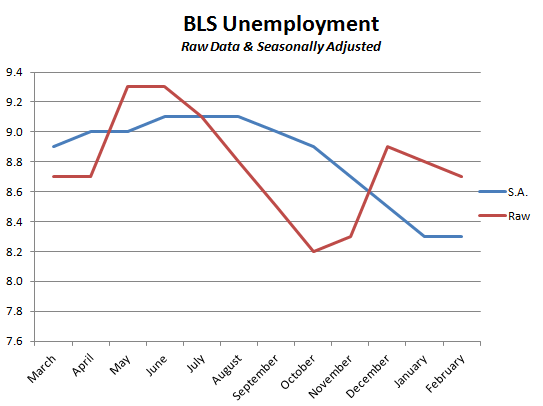
For a couple of months, we’ve been pointing out that something smelled fishy about the Fed’s employment reports.

Too much of the good news seemed to be directly tied to statistical tweaks of the the raw data called “seasonal adjustments”.

In fact, the Feds have been goosing the numbers up by more then they used to.

Well, now the Wash Post is even on the case.

The Post article — “Mild winter may have artificially inflated jobs data, economists fear“ —  suggests that we may have been underestimating the effect.

Economists are now saying that the mild winter has artificially inflated job growth.

Translation: The surge in hiring early in the year may not be as strong as it appeared.

The warm weather meant more jobs for construction workers and retail employees.

For economists, it means a statistical nightmare.

Typically, these bumps in demand are evened out through a process called seasonal adjustment.

That allows researchers to compare one month’s economic activity with the next for a more accurate picture of the nation’s health.

But this year’s weather was so abnormal that those models fell short, and economists are now scrambling to figure out how much of the growth over the past three months was simply due to a glitch in their systems.

“When the weather does not follow a normal seasonal pattern, then the seasonal adjustment cannot adjust for it.”

And that may help explain why recent data on jobs have looked rosier than actual economic growth would suggest.

Forecasts for the nation’s gross domestic product during the first quarter hover around 2 percent, a middling number at best.

Somewhere there is a disconnect, and Mother Nature is a valid scapegoat.

The labor market boost from the mild winter will eventually even itself out, though it may mean dips in job growth in coming months

Glad to see the mainstream media catching up with the Homa Files and its loyal readers …

>> Latest Posts

The unemployment rate went down … hmmm.

April 6, 2012

BLS Report says that 120,000 seasonally adjusted jobs were added in March … below February when 240,000 were added.

In February, the unemployment rate remained constant at 8.3% … it dropped in March to 8.2%.

How can that be?

Remember that the jobs growth comes from the “Institutions Survey” and the unemployment rate comes from the “Population Survey”.

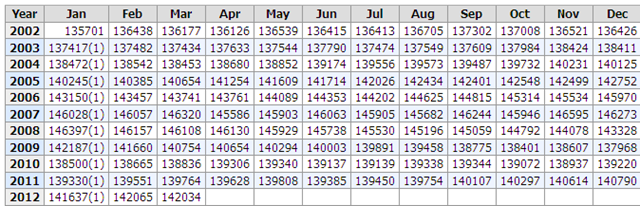
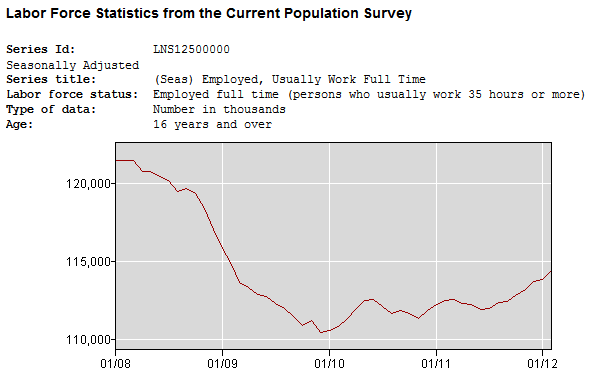
From the “Population Survey”, seasonally adjusted employment actually declined by 31,000 – from 142.065 million to 142.034 million. (chart below)

So, how did the unemployment rate go down?

Simple.

The labor force participation rate continued to decline.

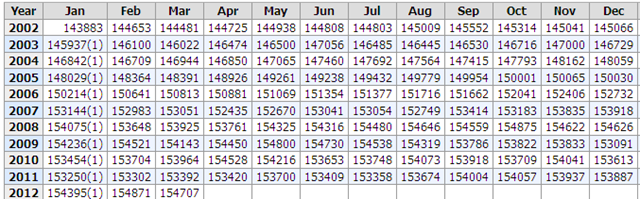
In February, 154.871 million were in the labor pool; in March there were 154.707 million … a drop of 164,000. (chart below)

Presto … the unemployment rate goes down.

If only more people were to get sufficiently discouraged that they’d stop looking for work, we’d have this unemployment problem nailed.

* * * * *

Labor Force Statistics from the Current Population Survey

Civilian Employment Level

image


Civilian Labor Force Level

image

>> Latest Posts

In the UK, it’s better to be fat than to be old.

April 6, 2012

Recent editorial in the UK’s  Telegraph pointed out that the National Health Service (NHS) discriminates against elderly folks … rationing their care by dealying or denying medical services.

According to the Telegraph, the elderly are displaced in the medical queue by overweight folks whose “conditions, though, are the direct result of bad habits, poor diet, and the wrong choices. These conditions range from obesity and diabetes to smoking-related diseases like emphesema.”

If a 20-stone, 30-something woman comes into hospital with a bad diabetic attack, does she deserve to be at the front of the queue or the back?

She has chosen to stuff her face with Mars bars and Coke, and is now suffering the consequences of her choice.

She cannot claim ignorance of the dangers of her diet: the Government has carpet-bombed us with health advice, from schools to GP practices.

Class no longer regulates access to healthy living: everyone who can watch the telly, let alone read the magazines, knows that a high-fat diet will make you look bad and feel worse.

So what?

The Telegraph’s view:

The septuagenarian who develops breast cancer has done nothing wrong – except grow old.

The NHS has to consider that there are deserving cases and undeserving ones.

Age should not be a barrier to optimum care; but bad habits should be.

As my personal odometer races forward, I gotta agree with the Telegraph.

>> Latest Posts

Mindreader: “I’m not picking up a signal”

April 6, 2012

According to the Journal of Commerce, the head of the General Services Administration (GSA) and top staff got pink slips for spending $800,000 on a Las Vegas conference.

U.S. Rep. John L. Mica (R-FL) sniffed out that “the tab even included a clown for entertainment” and huffed that “this is just the tip of the iceberg.”

Boy, that’s for sure.

Riding lower on the conference iceberg was a mindreader, leading Rep. Mica to wonder “if the $3,200 mind reader told GSA officials that blowing more than $800,000 on a Vegas conference for a few hundred bureaucrats would get them fired?”

Silly question. 

Mindreaders read minds, they don’t tell fortunes.

Fortune tellers tell fortunes.

Maybe they should have hired a fortune teller …

* * * * *

P.S Yeah, the expenses sound a little high, but c’mon, man  … every conference I’ve ever been to has had some entertainment … and a mindreading act isn’t exactly el primo education.

Also, while I love to pick on gov’t waste, I’m told that the GSA does a pretty solid job.

>> Latest Posts

Cookin’ the books? … 2 numbers to watch when the BLS reports tomorrow.

April 5, 2012

Loyal readers know that I’m a bit skeptical re: the employment numbers that the BLS has been spitting out in recent months.

Two reasons: (1) Unemployment rates are diverging from the Gallup daily surveys, and (2) Seasonal adjustment factors are boosting the employment numbers.

First, the Gallup relationship …

Historically, Gallup’s mid-month unemployment rate has tracked closely to the BLS end-of-month rate.

Not so in February … Gallup reported 8% … BLS reported 8.2%.

Hmmm.

Gallup’s mid-month rate for March was 8.9%.

Let’s see what the BLS says tomorrow.

image

* * * * *

The 2nd number to watch is the the seasonal adjustment adder.

For the prior10 years, the BLS has seasonally adjusted February employment numbers upward by 1.1423%.

Last month, they upped the raw numbers by 1.1688%.

That’s a big difference when floated into the unemployment rate calculation.

The prior 10 year adjustment factor for March has been .6209 %.

If the seasonal adder is higher than that tomorrow … be suspicious.

image

* * * * *

My bet: the unemployment rate will magically hang at 8.3% … .6% below the Gallup number.

>> Latest Posts

3 pages, single-spaced … due Thursday noon.

April 5, 2012

On Monday, former Constitutional law prof and now President Obama, laid into the Supreme Court for even thinking about declaring ObamaCare unconstitutional — either in part or in total — saying he was “confident” the Court would not “take what would be an unprecedented, extraordinary step of overturning a law that was passed by a strong majority of a democratically elected Congress.”

CBS News reports:

Overturning a law of course would not be unprecedented — since the Supreme Court since 1803 has asserted the power to strike down laws it interprets as unconstitutional.

And, in the escalating battle between the administration and the judiciary, a federal appeals court apparently is calling the president’s bluff — ordering the Justice Department to answer by Thursday whether the Obama Administration believes that the courts have the right to strike down a federal law, according to a lawyer who was in the courtroom.

An Appeals Court Judge asked a DOJ lawyer if she agreed that the judiciary could strike down an unconstitutional law.

The DOJ lawyer answered yes — and mentioned Marbury v. Madison, the landmark case that firmly established the principle of judicial review more than 200 years ago.

Now the part that I like.

The panel ordered the Justice Department to submit a three-page, single-spaced letter by noon Thursday addressing whether the Executive Branch believes courts have such power.

That’s a big difference between academia and the courts …  I always ask my students to double-space their homework.

>> Latest Posts

USA Today: “More CEOs plan to hire” … more than what?

April 4, 2012

Specifically, the headline said “More CEOs plan to hire as outlook brightens, survey says

The article said:

A growing number of chief executives at large U.S. companies say they are more optimistic about the economy and plan to step up hiring. The brighter view from the boardroom comes after the best three months of job growth in two years.

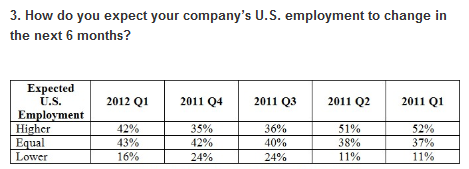
The Business Roundtable said Wednesday that a survey of its CEO members found that 42% expect to hire over the next six months. That’s up from 35% three months ago.

Wow.  Pretty good, right?

Being a trust & verify guy, I went to the Business Roundtable site to check the nums.

image

Sure enough, 42% of the 128 surveyed CEOs said they expect that employment will go up.

And, that is up from the 35% who thought so last quarter.

But, apparently the reporter didn’t notice that 52% of CEOs expected employment to go up last year at this time.

In other words, less than half of CEOs now  think that employment will go up in the next 6 months.

Over half thought it would last year.

Hmmm.

>> Latest Posts

I spy a billboard … hint: look down.

April 4, 2012

Punch line:  Billboards are no longer larger than life.  Legoland goes against the grain and advertises its ‘Minibreaks’ using the nation’s smallest billboards – incorporating the iconic Lego blocks in its designs.

Excerpted from psfk.com “Tiny Billboards Made Of Blocks Advertise Legoland Vacation

* * * * *

image

image

Advertising agency DLKW Lowe created this great poster campaign for Legoland Windsor, installing tiny Lego billboards around London and inviting passers-by to tweet #legolandminibreaks with a photo if they spotted one of them.

The agency shared a Google Map of their locations to help people find the miniature advertisements.

The nation’s smallest ever billboards promote different aspects of Legoland Minibreaks, including its resort packages, its new hotel, and the fact that kids go free.

Edit by KJM

>> Latest Posts

Noonan: The case for (and against) Barack Obama … then and now.

April 3, 2012

Flashback to October 31, 2008.

At the time, political observer Peggy Noonan gushed in the WSJ  about presidential candidate Barack Obama:

Obama and the Runaway Train The race, the case, a hope for grace.

Here’s the case for Barack Obama, in broad strokes:

He has within him the possibility to change the direction and tone of American foreign policy, which need changing;

His rise will serve as a practical rebuke to the past five years, which need rebuking;

His victory would provide a fresh start in a nation in which a fresh start would come as a national relief.

He climbed steep stairs, born off the continent with no father to guide, a dreamy, abandoning mother, mixed race, no connections.

He rose with guts and gifts.

He is steady, calm, and … shows good judgment in terms of whom to hire and consult, what steps to take and moves to make.

Now, fast-forward to 2012 … last Friday in the WSJ:

Not-So-Smooth Operator

Obama increasingly comes across as devious and dishonest.

The level of dislike for the president has ratcheted up sharply the past few months.

What is happening is that the president is coming across more and more as a trimmer, as an operator who’s not operating in good faith.

And it’s his fault, too. As an increase in polarization is a bad thing, it’s a big fault.

The shift started on Jan. 20, with the mandate that agencies of the Catholic Church would have to provide birth-control services the church finds morally repugnant.

Faced with the blowback, the president offered a so-called accommodation that even its supporters recognized as devious.

Not ill-advised, devious. Then his operatives flooded the airwaves with dishonest — not wrongheaded, dishonest — charges that those who defend the church’s religious liberties are trying to take away your contraceptives.

Events of just the past 10 days have contributed to the shift.

There was the open-mic conversation with Russian President Dmitry Medvedev in which Mr. Obama pleaded for “space” and said he will have “more flexibility” in his negotiations once the election is over and those pesky voters have done their thing.

On tape it looked so bush-league, so faux-sophisticated.

It was all so . . . creepy.

Next, a boy of 17 is shot and killed under disputed and unclear circumstances. The whole issue is racially charged, emotions are high, and the only memorable words from the president’s response were,

“If I had a son he’d look like Trayvon.”

Suddenly there were death threats and tweeted addresses and congressmen in hoodies.

At the end of the day, the public reaction seemed to be: “Hey buddy, we don’t need you to personalize what is already too dramatic, it’s not about you.”

Now this week the Supreme Court arguments on ObamaCare, which have made that law look so hollow, so careless, that it amounts to a characterological indictment of the administration.

The constitutional law professor from the University of Chicago didn’t notice the centerpiece of his agenda was not constitutional? How did that happen?

The high court’s hearings gave off an overall air not of political misfeasance but malfeasance.

From the day Mr. Obama was sworn in, what was on the mind of the American people was financial calamity — unemployment, declining home values, foreclosures.

But the new president wasn’t thinking about that. All the books written about the creation of economic policy within his administration make clear the president and his aides didn’t know it was so bad, didn’t understand the depth of the crisis, didn’t have a sense of how long it would last.

He presided from his hermetically sealed inner circle, which operates with what seems an almost entirely abstract sense of America.

They know Chicago, the machine, the ethnic realities. They know Democratic Party politics. They know the books they’ve read, largely written by people like them — bright, credentialed, intellectually cloistered.

As a former president he’ll be quiet, detached, aloof.

He’d make speeches and write a memoir laced with a certain high-toned bitterness.

It was the Republicans’ fault. They didn’t want to work with him.

My, how times change …

>> Latest Posts

I’m not gaming, I’m helping fight HIV / AIDS …

April 3, 2012

TakeAway: South By South West Trend Alert: The use of gaming to leverage collective manpower to improve health, fundraise for charities, solve once unsolvable problems – such as, a retrovirus enzyme related to HIV / AIDS.

* * * * *
Excerpted from psfk.com, “The Gaming-For-Good Trend [Need To Know: SXSWi]

…. Fueled by the ability to connect and gather players from across the world and motivate them to participate by injecting competitive aspects and rewards into structured play, games are growing up and being seen as agents of change.

The ability to scale enables these platforms to prompt positive action and overcome challenges on both an individual and societal level with implications for a growing number of areas from science and medicine to education and the environment.

Whether improving health, fundraising for charity or solving previously unsolvable problems, games are encouraging personal and social good …

Gamers Assist In Cracking The Aids Puzzle

image_thumb1

Fold.it is a web-based platform for collaborating on scientific research that allows gamers to compete against one another to design new proteins which could be used to help prevent or treat diseases like HIV/AIDS, Alzheimer’s and Cancer.

Developed by researchers at the US based University Of Washington, the platform asks online players to build 3D models of protein molecules online to earn points and status based off their problem solving abilities.

Researchers recently took advantage of the platform by inviting gamers to compete in configuring the structure of a retrovirus enzyme related to HIV/AIDS.

The resulting breakthrough in configuring the 3D structure of the protein in question took players just weeks though the puzzle had stumped scientists for years …

Edit by KJM

>> Latest Posts

Uh oh: Groupon forced to revise its financial results again.

April 2, 2012

To refresh you memory …

Prepping for its IPO, Groupon had to cut its reported revenue in half to satisfy questions from the Securities and Exchange Commission.

Then, the company  IPO’d in November for $20 per share.   Last Friday the shares closed at $17.20.

What happened ?

Well first, according to the WSJ:

Groupon reported an unexpected loss of $37 million on revenue $506.5 million for its fourth quarter —  its first period as a public company.

The news triggered a selloff in the stock as investors had expected the company to post a profit.

To make matters worse, the loss was understated by $22.6 million … because auditors discovered that the company “ failed to set aside enough money for customer refunds.”

Oops.

Here’s the story:

Groupon offers discounted deals to its subscriber base, and then splits the value of the deal with the merchant that offered it.

For a $10 purchase at a sandwich shop, for example, Groupon might take $5 and give the rest to the merchant.

The company makes a point of telling users that refunds won’t be a hassle.

Groupon emphasizes something it calls “the Groupon Promise,” which means “if the experience using your Groupon ever lets you down, we’ll make it right or return your purchase.”

Groupon had more customers seeking refunds than it expected.

The company also said the higher rate of refunds has persisted in the first quarter ending March 31.

Also according to the WSJ: “The surprise announcement raised questions about the reliability of Groupon’s numbers.”

You think ?

>> Latest Posts

Anybody want to co-parent this kid with me?

April 2, 2012

TakeAway: According to South-By-South-West, the idea of bringing people together with similar interests and needs- ‘social pairing’ – is gaining in popularity. Applying this concept, Modamily is a private social network for people looking to co-parent a child in the US.

* * * * *
Excerpted from psfk.com “The Social-Pairing Trend [Need To Know: SXSWi]”…

… People with similar interests, hobbies and needs have the opportunity to meet today through smart services that use a mix of social, location and demographic data to match profiles. Networks are looking at their member’s profiles on their site and across the social grid and linking people up based on interests, needs and location.

These systems facilitate tremendous efficiencies. People can connect in a way (and at a speed) that would previously have taken a great deal of time and effort.

Social Pairing is about getting people together. It fosters a feeling of community (geographic or activity based) and further collaboration could follow as a result.

Some examples:

Nextdoor Social Network Helps You Meet your Neighbors

  • KLM To Allow Passengers To Pick Plane Neighbors Based On Facebook, LinkedIn Data
  • Farmers’ Cooperative Pairs Up Singles To Share Leftover Food
  • Ticketmaster Lets You Choose Who To Sit Next To Using Facebook
  • Gobble Is A Marketplace For Home-Cooked Meals From Neighborhood Chefs
  • A Social Network To Build Coffee Shops To Foster Face-To-Face Conversation
  • An app Helps You Discover New Connections In Real-Time Based On Location

And, of course there’s Modamily which  bills itself as the “first community to facilitate introductions between responsible, like-minded adults committed to co-parenting a child.”

image_thumb1

Gotta think those kids will turn out just fine, right?

Edit by KJM

>> Latest Posts

A pouch of soup … hmmm, hmmm good!

March 30, 2012

Punch line: Campbell Soup Co. tests another packaging innovation – this time in a pouch geared at younger consumers – to support its turnaround.

* * * * *
Excerpted from adage.com, “Campbell Counts on Soups in a Pouch to Spur Turnaround

Campbell Soup Co. — which has put soup in see-through tubs and sipping cups — is now shoving it in a pouch as the marketer embraces innovations and new packaging in search of a turnaround.

The new microwavable pouches will be sold under the name, Campbell’s Go! Soup, and will launch in up to six flavors ranging from Coconut Curry with Chicken and Shitake Mushrooms to Moroccan Style Chicken with Chickpeas. The flavors, which are a mouthful even to say, are aimed at younger consumers.

image_thumb1

… Campbell reported domestic soup sales down 2% last quarter. The new strategy,first announced in July, seeks to reverse Campbell’s overemphasis on sodium reduction and its failure to reach out to young shoppers, who increasingly skip the soup aisle for other simple meals, such as frozen foods.

… CEO Denise Morrison framed the new approach as one that “requires moving from a high dependence on line extensions to more disruptive innovation, new and differentiated products, packaging and category segments that create new pathways for growth.” At the same time, Campbell is sticking by its plan to pour an additional $100 million this year into brand-building, research and development, and product launches.

Pouches and boxes aside, the can will remain at the company’s core. “When we talk about our U.S. soup strategy, we talk about first celebrate the can, then expand soup beyond the can, and then expand them to the greater simple-meals arena,” Ms. Morrison said.

Edit by KJM

>> Latest Posts

According to investment guru Burton Malkiel …

March 29, 2012

In a recent WSJ op-ed,  Burt Malkiel stopped random walking and cut to the chase re: the near-term economic climate and  investment options. 

Malkiel says:

The economic data, as a whole, suggest the economy is growing at a rate nearer to 2% rather than its previous trend rate of 3%-4%.

  • The strong employment gains may well have been aided by our unusually warm winter.
  • Rising gasoline prices will put increased pressure on consumers. And a number of strong economic headwinds still exist.
  • The economies of the euro zone are getting worse, not better.
  • The housing sector has yet to make a convincing turn for the better.

Given the present economic outlook, let’s look at three asset classes ranked them from worst to best – bonds, equities, and real estate.

Bonds are the worst asset class for investors.

Usually thought of as the safest of investments, they are anything but safe today.

At a yield of 2.25%, the 10-year U.S. Treasury note is a sure loser.

Even if the overall inflation rate is only 2.25% over the next decade, an investor who holds a 10-year Treasury until maturity will realize a zero real (after-inflation) return.

Even if the inflation rate remains moderate, interest rates are likely to rise to more normal levels as the economy continues to recover.

Given the likely trends, U.S. Treasurys and high quality bonds are likely to be extremely poor investments and are very risky.

Equities on the other hand are still attractively priced.

Despite their substantial rise from the October 2011 lows.

A good way to estimate the likely long-run rate of return from common stocks is to add today’s dividend yield (around 2%) to the long-run growth of nominal corporate earnings (around 5%).

Equity returns should be about 7% — five percentage points more than the safest bonds.

This five-percentage point equity risk premium is close to the historical average.

In other words, while equities appear to be favorably priced relative to Treasury bonds, returns are unlikely to be at the double-digit level enjoyed from 1982 through 1999.

Real estate is a particularly attractive asset class

Real-estate prices have fallen sharply, if not to their absolute lows, then certainly very near to them.

Long-term mortgages are below 4% for those who can qualify.

Housing affordability (a measure based on house prices and mortgage rates) has never been more attractive.

Housing has been a dreadful investment since the housing bubble burst in 2007.

I believe it will be one of the best investments over the next decade.

In today’s environment, the minimization of investment fees is more important than ever.

A 1% investment management fee may appear to be very low when measured against assets.

But when measured against a 7% equity return, that fee represents more than 14% of the return.

Against a 2% dividend yield, the fee absorbs one half of the dividend income.

The only way to ensure that you can enjoy top quartile investment returns is to choose investment funds that have bottom quartile expense ratios.

During 2011, over 80% of actively-managed equity funds were outperformed by the broad-based S&P 1500 Stock Index.

Investors can’t control returns generated by world financial markets.

But, they can control is fees paid to investment managers.

And, the quintessential low-expense instruments are broad-based, indexed mutual funds and ETFs.

* * * * *

Personal note: My very first class at Princeton was Econ 101 taught by Burton Malkiel. He was one of the “inspirers” for my majoring in economics. 

As a senior, he was one of my thesis graders … gave me an A, then wrote a Journal of Finance article debunking my findings.  Ouch.

Still think he’s a great economist and a great guy.

>> Latest Posts

Flashback: Obama disses the Supreme Court justices …

March 29, 2012

Remember the 2010 State of the Union address when Pres. Obama took the unprecedented step of criticizing the Supreme Court while they were sitting in the audience as distinguished guests?

click to view
image

Do you think Obama would like  to have that shot back now that the fate of ObamaCare is in the Justices’ hands?

>> Latest Posts

MBA Rankings: A loser’s uh-oh upsets conventional wisdom …

March 28, 2012

In a prior post, we looked at changes in Business Week’s rankings of MBA program in the 10-year period from from 2000 to 2010.

The key observations:

  • 13 MBA programs (e.g. HBS, Wharton, Kellogg) held their top 30 positions – plus or minus a spot or two – between 2000 and 2010
  • 6 MBA programs were in the 2000 Top 30 and improved their position by 6 or more spots between 2000 and 2010
  • University of Chicago  jumped 9 spots to take over the #1 ranking
  • 6 MBA programs that weren’t in the Top 30 in 2000 broke into the 2010 Top 10
  • 5 MBA programs dropped a whopping 15 places or more from 2000 to 2010 (more on that later, too)
  • Another 6 MBA programs dropped 5 spots or between 2000 to 2010

Also in a prior post, we observed that among the 6 MBA programs that weren’t in the Top 30 in 2000 and broke into the 2010 Top 10, SMU is the shining star.

SMU came out of nowhere – unranked as late as 2006 – and soared to #12 in 2010.

They did it with A+ Teaching and A+ Career Services … that earned them a #6 ranking with Corporate Recruiters and a #12 ranking overall.overall.

While SMU’s formula reflects mucho common sense, it’s not exactly conventional approach.

More often, MBA programs try to boost their rankings through intensified faculty research.

The logic: publish in academic journals, get recognized as thought-leaders, attract better students and recruiting companies … and a virtuous cycle becomes unstoppable.  Makes dense.

Our neighbor, the University of Maryland’s Smith School of Business tried that approach … with some disappointing results.

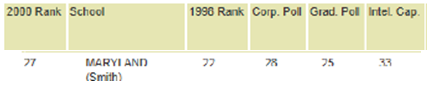
In 2000, Maryland was  at #27.

image

Given its relatively low #33 rating in Intellectual Capital, Maryland turned up the research jets.

Successful?

Well, Maryland’s ranking in Intellectual Capital skyrocketed to #2 … trailing only Duke – a perennial research giant.

What happened to it’s overall ranking?

Maryland dropped 15 spots … out of the Top 30 … to #42.

Ouch.

image
Source: Business Week – 2000 & 2010 MBA Rankings

* * * * *

BTW: The #3 program in Intellectual Capital is Wake Forest.

Its overall rank?

According to Business Week … #47.

>> Latest Posts

Hey, can I have your job (for awhile)?

March 28, 2012

Punch Line: Businesses are giving employees the opportunity to work in a different department or temporarily swap places with a coworkers overseas in order to improve collaboration and retention.

* * * * *
Excerpt from WSJ: “Co-Workers Change Places”

Companies are discovering that short- to medium-term moves for rank-and-file employees help workers sharpen their skills, stay motivated and identify new roles. Moreover, they help address a challenge: how to better foster collaboration across different specialties and regions.

At Intel employees search an internal database with hundreds of job listings. These assignments allow workers “to test-drive a job or make connections in different departments.”

At Virgin America, a handful of flight attendants recently traded places with colleagues at Virgin Australia.

Skills-based rotations are more valuable than swaps that are purely geographic. While a program like Virgin’s offers employees some short-term benefits, it may have less impact on a company’s overall effectiveness.

Global exchanges can be a valuable retention tool for multinational companies.

Edited by ARK

>> Latest Posts

MBA Rankings: A big winner’s keys to success …

March 27, 2012

In a prior post, we looked at changes in Business Week’s rankings of MBA program in the 10-year period from from 2000 to 2010.

The key observations:

  • 13 MBA programs (e.g. HBS, Wharton, Kellogg) held their top 30 positions – plus or minus a spot or two – between 2000 and 2010
  • 6 MBA programs were in the 2000 Top 30 and improved their position by 6 or more spots between 2000 and 2010
  • University of Chicago  jumped 9 spots to take over the #1 ranking
  • 6 MBA programs that weren’t in the Top 30 in 2000 broke into the 2010 Top 10 (more on that later)
  • 5 MBA programs dropped a whopping 15 places or more from 2000 to 2010 (more on that later, too)
  • Another 6 MBA programs dropped 5 spots or more between 2000 to 2010

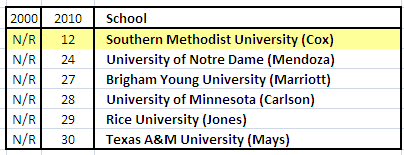
Among the 6 MBA programs that weren’t in the Top 30 in 2000 and broke into the 2010 Top 10, SMU is the shining star.

SMU came out of nowhere – unranked as late as 2006 – and soared to #12 in 2010.

How did they do it?

Here are the details that support the SMU ranking in 2008 – SMU’s first time in the Top 30:

image

Answer: heavy emphasis on Teaching (A+) and Career Services (A) yielded a #17 ranking among Corporate Recruiters … and a number #18 overall ranking.

Not bad! But, apparently, not good enough for SMU.

Things got even better in 2010.

SMU kept Teaching at an A+ level and boosted Career Services from a plain old A to an A+ … the result: up to #6 with Corporate Recruiters and #12 overall.

image  
Source: Business Week – 2000 & 2010 MBA Rankings

* * * * *

Bottom line: Get good students, teach them a lot, help them find jobs …. and, BINGO, MBA program success.

You’d think that’s common sense, right?  No surprise.

Well, tomorrow we’ll look at one of the biggest losers … with a twist that may surprise some of you.

>> Latest Posts

iPad loses its grip in the tablet market

March 27, 2012

Punch line: While iPad sales volume is up and expected to increase, but  its share of the tablet market is expected to drop to 62% this year, down from 66% last year, and 87% the previous year.

* * * * *
Excerpted from cnet.com, “iPad’s share of tablet market to dip to 62 percent this year

image_thumb3

The iPad will maintain its lead, though its share will drop because of competition from Android devices, estimates research firm TrendForce …

Though the iPad’s market share may be on the downswing, its sales are still headed higher.

Estimates from TrendForce call for global sales of about 59 million units in 2012, up from nearly 41 million last year and 14 million in 2010.

image_thumb1
(Credit: TrendForce)

Certain Android vendors have captured some of Apple’s former market share, but they’ve failed to catch up with the iPad’s advancements.

Amazon’s low-priced Kindle Fire ignited strong sales during the holiday quarter. But the Fire “still does not quite match consumers’ expectations for a tablet PC,”

Further, Amazon’s orders for display panels have fallen for the first half of 2012, indicating that the Fire won’t be a threat to the iPad’s dominant lead.

Some tablet vendors have been slowly cutting back on Android to focus on Windows 8 as Microsoft prepares its new tablet-friendly OS. But even here, success is far from assured.

“The makers are counting on Windows users’ high commitment to Microsoft Office to spur the sales of Windows 8 tablets,”

“But several issues persist, such as whether or not the ARM Windows 8 tablet is able to release as scheduled, the weight and battery life, and whether the software compatibility and interface design cater to the users’ preferences.”

With a new high-resolution display expected, the iPad 3 will help Apple hang onto its leading market share …

Overall, tablet makers are forecast to sell 94 million units this year, a 53 percent jump from the 62 million sold in 2011.

Edit by KJM

>> Latest Posts

MBA Rankings: A 10 year perspective … and, some surprises.

March 26, 2012

There has been a lot of talk around here about the MBA school rankings.

Typically, the conversation revolves around the changes – up or down – from the last rankings.

I got curious … wanted to see the landscape change over a longer-term … and picked a 10-year time horizon of the Business Week rankings – 2000 to 2010.

My going-in hypothesis was that there would be heavy inertia … that the top slots would be occupied by the usual suspects.

And, I expected schools to show relatively little movement up or down.

Here’s what I found …

* * * * *

13 MBA programs held their top 30 positions – plus or minus a spot or two – in 2000 and 2010:

image

* * * * *

6 MBA programs that were in the 2000 Top 30  improved their position by 6 or more spots between 2000 and 2010:

  • UC Berkeley had the sharpest rise … 10 spots to #8
  • Univ. of Chicago (my alma mater) had the most impressive gain … “only” 9 spots since they couldn’t do better than taking over the #1 ranking
  • Stanford cracked the Top 10 by moving up 6 spots.

image

* * * * *

Surprising (to me), there are 6 MBA programs that weren’t in the Top 30 in 2000 and that broke into the 2010 Top 10 … 5 just made it into the Top 30 … a proud accomplishment, but one that pales in comparison with SMU … SMU came out of nowhere – unranked as late as 2004 – and soared to #12 in 2010.

image

* * * * *

Of course, if there are winners, there must be losers.

5 MBA programs dropped a whopping 15 places or more from 2000 to 2010.

image

* * * * * *

Another 6 MBA programs dropped 5 spots between 2000 to 2010.

  • 5 of the programs stayed in the Top 30 despite their skids
  • Cornell and MIT-Sloan dropped out of the Top 10
  • Unfortunately, my beloved Georgetown’s slip was enough to lose Top 30 status.  (Don’t worry, we’ll be back …)

image

Source: Business Week – 2000 & 2010 MBA Rankings

* * * * *

In subsequent posts we’ll drill down to “why?” and “so what?”

Stay tuned.

>> Latest Posts


Once mighty AOL now selling off its patents … ouch!

March 26, 2012

Punch line: AOL has hired Evercore Partners to help it shop around its patent portfolio in hopes of offsetting lost dial-up business and  “accelerating shareholder value creation.”

Meanwhile, Facebook has acquired around 750 patents from IBM in order to “bolster the social network’s defenses against litigious rivals”.

Excerpted from: CNET: AOL, lacking better options, hires firm to sell its patents

Citing three people with knowledge of the hire, Bloomberg says AOL tapped Evercore to find a buyer for more than 800 patents and to “explore other strategic options” — code for a possible sale or private buyout of the entire company.

Last December, AOL announced plans to reorganize the company, combining its declining dial-up Internet service business and its Web services arm, the latter of which was recently scaled back with layoffs in the Instant Messenger group.

AOL has previously said it’s looking for ways to raise cash from its patent portfolio and is making efforts to “accelerate shareholder value creation.”

AOL’s move follows Facebook’s acquisition of some 750 patents from IBM, a deal made to bolster the social network’s defenses against litigious rivals.  Facebook has been targeted by Yahoo for allegedly infringing on a number of its patents that cover customization and advertising.

Easy to pile on AOL for its strategic mis-steps over the years (e.g. hanging with the “walled garden” too long, failing to find a way to migrate to high-speed internet service), but gotta give the company credit for its role in the Internet explosion.

And, in a timely fashion, the original owners dumped the bag on Time-Warner … walking away with a fortune …

>> Latest Posts

From the faculty lounge: False Positives

March 23, 2012

Punch line: Sometimes, published academic research results are flat out wrong.  Hmmm.

Excerpted from HBR’s Daily Stat: Researchers Can Easily “Prove” False Findings
 
Using legitimate statistical analyses, researchers were able to show in an experiment that participants were nearly 1.5 years younger after listening to the Beatles’ “When I’m Sixty-Four” than after listening to a song that comes with the Windows 7 operating system …

… an obviously ridiculous finding that demonstrates how easy it is for research to yield “false positives,” say Joseph P. Simmons and Uri Simonsohn of The Wharton School and Leif D. Nelson of UC Berkeley.

Too often, researchers aren’t aware of the high likelihood of finding false evidence, and the pressure to publish leads scientists to convince themselves of the validity of their findings, the authors say.
 
Source: False-Positive Psychology : Undisclosed Flexibility in Data Collection and Analysis Allows Presenting Anything as Significant

Surprise, surprise, surprise.

>> Latest Posts

Watch out for the boomerang effect …

March 23, 2012

“Boomerang kids” are young adults who move out of the family home for school or work and then return home.

According to the Cristian Science Monitor, a Pew Report indicates that the recession has exacerbated a trend that was already under way since the 1980s.

  • In 1980, some 11 percent of young adults lived in multigenerational households.
  • Today, some 29 percent of 25- to 34-year olds either never moved out of their parents’ home or say they returned home in recent years.
  • Among 18- to 24-year olds, that figure is even higher – 53 percent of young adults in that age group live at home.

Of those living at home, some 78 percent say they’re upbeat about their living arrangements … 24 percent say it’s been good for their relationships with their parents.

>> Latest Posts

Uh-oh: Law school deans and U.S. News “may have committed felonies” in “publishing false info”

March 22, 2012

According to Prof. Mark Perry

A paper by two professors at Emory University School of Law, provocatively titled “Law Deans in Jail” reports:

“A most unlikely collection of suspects – law schools, their deans, U.S. News & World Report and its employees – may have committed felonies by publishing false information as part of U.S. News’ ranking of law schools.

The possible federal felonies include mail and wire fraud, conspiracy, racketeering, and making false statements.

Some law schools and their deans submitted false information about the schools’ expenditures and their students’ undergraduate grades and LSAT scores.

Others submitted information that may have been literally true but was misleading. Examples include misleading statistics about recent graduates’ employment rates and students’ undergraduate grades and LSAT scores.

U.S. News itself may have committed mail and wire fraud.

It has republished, and sold for profit, data submitted by law schools without verifying the data’s accuracy, despite being aware that at least some schools were submitting false and misleading data.

U.S. News refused to correct incorrect data and rankings errors and continued to sell that information even after individual schools confessed that they had submitted false information.

In addition, U.S. News marketed its surveys and rankings as valid although they were riddled with fundamental methodological errors.”

Geez, if you can’t even trust law school deans

>> Latest Posts

A celeb that walks the energy talk … no Gulfstream for this dude.

March 22, 2012

Apparently, President Obama’s recent energy speech gained at least one influential endorsement.

I usually don’t put much stock in celebrity endorsements.

But in marketing parlance — this one, from a star who was way ahead oh his time — might have “legs” …

* * * * *
Questions:

1. Wouldn’t it be faster for Fred to leave the car at home and just walk to work ?

2. Are rock hard wheels more energy efficient than fully inflated tires ?

>> Latest Posts

So, is employment up or down since Obama took over?

March 21, 2012

Team Obama keeps crowing about the millions of jobs they’ve added with their trillions of dollars of fiscal and monetary stimulators.

Hmmm.

Here are the facts, direct from the BLS

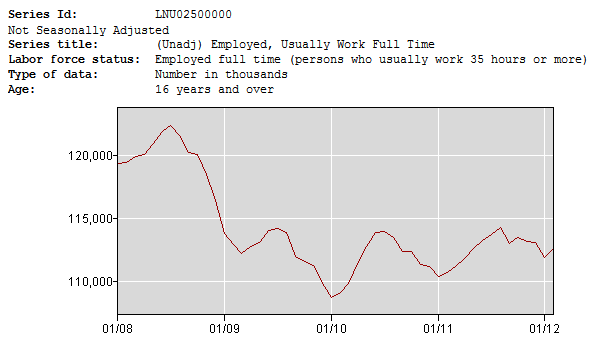
In February 2008 — right as the financial crisis was becoming evident — employment was 136.356 million.

Employment dropped by about 5 million between February 2008 and February 2009.

In February 2009 — when Obama took office — there were 131.314 million workers employed.   Real jobs, no seasonal adjustment.

Note: Obama’s Stimulus was passed January 28, 2009

The comparable number in February 2012 was 131,164 million.

By simple subtraction,  there are 150,000 fewer jobs now then there were in February 2009.

Note: During the same period, the labor force (i.e. those folks who are employed or looking for work) grew by about 300,000 … from 153.804 million in Feb 2009  to 154,114 million in Feb. 2012. 

image

* * * * *

Let’s dig a little deeper with another view of the data:

image

Cutting to the chase, “real” employment is back to where it was when Obama was inaugurated … but up substantially from the low point in Obama’s term.

The “issue” is who owns 2009 — Bush or Obama?

Obamites argue that the drop in 2009 is simply a reflection of the momentum coming out of the Bush years … slowed by effects of the Stimulus.

GOPers argue that — since Obama’s Trillion-dollar Stimulus was passed in January 2009 and since the administration made promises re: keeping unemployment in check — that Obama owns 2009.

The answer is probably somewherw in between.

You decide … 

>> Latest Posts

Wasn’t it cheaper to park here yesterday?

March 21, 2012

Punch line: Airlines have priced dynamically for years — raising or lowering prices depending on how fast a flight’s seats are selling.

Some sports teams have started charging different prices depending on the  day-of-week and and drawing power of the opposing team.

Coke was busted in some locales for electronically jacking up prices when dispensing machines were running low on inventory.

Now, some cities are using high tech meters to dynamically change parking prices.

* * * * *
Excerpted from NYT: A Meter So Expensive, It Creates Parking Spots

As much as a third of the traffic in some areas has been attributed to drivers circling as they hunt for spaces … causing  lost time, polluted air and illegal parking.

In his 2005 book, “The High Cost of Free Parking”, Donald Shoup, a professor of urban planning at UCLA advocated dynamic pricing of metered parking spots — finding the lowest price a city can charge and still have one or two vacant spaces available on every block.

San Francisco is putting the theory to test.

San Fran is using new technology and the law of supply and demand, raising the price of parking on the city’s most crowded blocks and lowering it on its emptiest blocks.

San Francisco installed high tech parking sensors and new meters at roughly a quarter of its 26,800 metered spots to track when and where cars are parked.

And beginning last summer, the city began tweaking its prices up and down and shortening (or lengthening) time limits — trying to to leave each block with at least one available spot all the time.

Eventually, the metes may charge different prices at different times of the day.

“We only need a few people to see there is a price difference and choose to park in a different location to open up just a few spaces here and there.”

But raising prices is rarely popular … and the program was “complicated on the social equity level” since high parking prices can shut out poorer parkers. 

Thanks to JF for feeding the lead.

>> Latest Posts

Head-scratching polling results …

March 20, 2012

We haven’t been posting re: presidential approval numbers for awhile … the numbers have been bouncing around so much based on the news cycle that I largely dismiss them.

But, something in last week’s poll numbers caught my eye …

Note that right-leaning FOX News has Obama +2 in approval, Rasmussen and Bloomberg — also usually a bit to the right — have him +1.

But, left-leaning Gallup has Obama down 7 points.

Far left-leaning CBS/NYT and ABC/Wash Post have him down 6 points and 4 points, respectively.

I think the latter two are what caused last week’s hand-wringing among Obamites, since NYT & Wash Post have a reputation for over-sampling Dems in their surveys.  So, it’s harder for Dems to dismiss them than, say, Fox News.I still don’t make much of the results, but think they’re interesting …

image
Source:
RCP

>> Latest Posts

The business of business cases …

March 20, 2012

Punch line: Publishing business case studies is big business, and more schools are looking to cash in.

* * * * *
Excerpted from WSJ: “The Business of Case Studies”

The three largest case-study publishers and distributors jointly sell more than 10 million cases and see tens of millions of dollars in revenue each year.

Harvard Business School Publishing Corp. dominates the market, recording sales of 8.5 million case studies in fiscal 2011 and estimating that 80% of the cases used world-wide come from there.

To maintain its edge, about five years ago Harvard started offering “simulations,” or online role-playing exercises.

Though simulations still represent a minor share of sales, they are growing fast. Sales in 2011 rose 37% from the prior year, which was double the 2009 figure.

There also has been growing interest in short cases as publishers market to part-time M.B.A. programs for time-crunched working adults, which have seen a surge in enrollment in recent years.

Harvard’s “Brief Cases” and concise offerings from other publishers can run just three or four pages, about one-quarter the length of a traditional case.

Case publishers and distributors are pushing hard into emerging markets, too, accepting cases written by faculty at up-and-coming schools in India, China and Latin America and selling products to those same institutions.

* * * * *
Top five cases from Harvard Business Publishing, fiscal 2011

  • Cola Wars Continue: Coke and Pepsi, 2006 — Competitive strategies of the soft-drink giants
  • Starbucks—Delivering Customer Service — Efforts to improve customer-service satisfaction
  • Apple Inc., 2010 — Can the iPad take the company to new heights
  • Walt Disney Co. — The Entertainment King—Disney’s 1980s turnaround and strategic challenges in the early 2000s
  • Toyota Motor Manufacturing, USA, Inc.—Solving assembly problems with the Toyota Production System

>> Latest Posts

What qualities are coveted by employers?

March 20, 2012

According to Jenn Folsom of Momentum Resources (MSB MBA ‘02):

Nothing beats A+ communication skills, both verbal and written.

Our clients also love to see creative problem solvers and “get it done” types of people.

They need those who can strike the balance of being able to work successfully in a team and without direction.

It’s all about results

Jenn’s full interview in ForbesWoman is worth reading

>> Latest Posts

Flat-earthers vs. Obama’s pipe dreams …

March 19, 2012

OK, so anybody who wants to keep using fossil fuels, to drill for oil and gas in the U.S., and to buy gas for a couple of bucks per gallon is a member of the flat earth society, lacking the the President’s vision.

Why Obama wants to insult the vast majority of Americans is beyond me, but that’s his tactical choice.

So far, the GOP has simply thrown back softballs: Solyndra, the Volt and the many other alternative energy busts.

Given my lack of tact, if I were a Romney adviser, here’s the line I’d offer up to Mitt:

“President Obama and I both have pipe dreams … mine in the Keystone Pipeline bringing oil from Canada … his goes back to his college days, I guess.”

Two for the price of one.

Keeps focus on the money wasted and lack of results from the President’s alternative energy gambles … and dregs up some old stuff re: Obama’s drug use that got wiped under the carpet in 2008.

Not rumors… straight from the horse’s mouth.

Obama first told of his early drug use in his 1995 memoir, “Dreams from My Father: A Story of Race and Inheritance” … published audaciously just after he became president of the Harvard Law Review.

He wrote re: his personal experience:

“Pot had helped, and booze; maybe a little blow when you could afford it.”

image

Picture source:  Coed Magazine,
“10 Most Influential Pot Smokers”

Hmmm.

I guess that I hadn’t thought of the full range of hardships inflicted by the bad economy …

>> Latest Posts

Wanted: trend-setting young professionals who spend at least 14 hours online every week.

March 19, 2012

Punch line: The young, trend-setting, urban professional, who loves entertainment and places a premium on technology is the main target for Verizon’s new hyper local FiOS 50 campaign.

* * * * *
Excerpted from mediapost.com “Verizon Targets Young Professionals

image_thumb1

Verizon is targeting what it calls “trend-setting young professionals” who live in apartments and condominiums in four major markets via a hyperlocal FiOS campaign …

The multimedia effort was tested in a metro-Washington D.C. pilot last fall and is now being rolled out in the New York, Philadelphia, Dallas/Fort Worth and Los Angeles metropolitan areas.

Many of the hyperlocal campaign elements used during the pilot — including immersive digital advertising combined with social media engagement, plus a concentrated presence of out-of-home advertising and local events with prospective customers — will be repeated in the broader campaign. Gyms, restaurants, bars, movie theatres, malls and transit centers are target venues …

Most 25- to 39-year-olds who make up a significant portion of multidwelling unit tenants are major users of social media and the Internet and spend as much as 14 hours online per week, said Pedro Correa, vice president of Verizon Enhanced Communities …

“Some people think they have to live in a single family home to get the very best broadband and video entertainment services, but that’s not true,” he said in a release.

To assist young professionals in finding MDUs with FiOS, Verizon has created a region-specific microsite at http://www.musthavefios.com that shows the MDUs where FiOS is available in metro New York, Philadelphia, Dallas/Fort Worth, Los Angeles and Washington, D.C. …

Verizon FiOS are available to more than 2 million multifamily units, and growing in parts of 12 states, and the District of Columbia. About half of all Verizon’s FiOS lines opened for sale this year will be in apartments and condos …

Edit by KJM

>> Latest Posts

Devalued Currency: According to Goldman Sachs, 40% of its employees are VPs … really?

March 16, 2012

By now, everybody has heard that a GS VP has turned states-evidence on the company, decrying in a NYT op-ed that company executives “callously” talk about “ripping their clients off” in order to make more money for the securities firm and that the firm’s culture is “toxic and destructive.”.

That’s a shocker, isn’t it?  Right up there with accusations that baseball sluggers juice-up.

Also unsurprising is that Goldman is wasting no time in fighting back against a disgruntled ex-employee.

According to the WSJ, GS immediately tried to marginalize   the dude by minimizing his role at the firm.

In a memo to employees, Goldman Chairman and Chief Executive Lloyd Blankfein and President Gary Cohn wrote that Mr. Smith was one “of nearly 12,000 vice presidents” among more than 30,000 employees at the company.

Now, that caught my eye …. 40% of employees are VPs.

Either it’s “all chiefs, no warriors” or within GS, the title is more honorary than substantive … providing clients with the peace of mind that only comes when dealing with “callous” VPs who are “ripping them off”.

Go figure …

>> Latest Posts

Remember when Southwest was the ‘no frills’ airline?

March 16, 2012

Just back from vacation … nice trip if you ignore the travel to and from Punta Cana.

Friends know that I’ve been a SWA loyalist for years.  I liked their cut-rate prices, was willing to forego some frills, and perversely enjoyed the fight to get a pass to board in the prized “Group A” and rush to get a prime seat.

My vacation flights were on United.  Ouch.

Base ticket price was ok … but, then the add-ons.

$25 for the 1st bag … $35 for the 2nd … 50 pound limit — strictly enforced.  C’mon, man.

Good news: United and Continental were converting to their new combined computer systems the morning I was flying … the agents weren’t able to collect the baggage fee because of a systems glitch.  Bank error, my favor

Then, the seat pricing scam.

Of course, I booked at the lowest available fare … with seats in the back.

Going — no problem. Got 2 pre-assigned seats close to the lavs in the back.

Got a couple of emails inviting me to shell out $59.99 each for seats closer to the pilot.  No thanks.

Returning — not so easy.

Initially told: no seats available at this time.  See agent when checking in for the return flight.  Huh?

Kept checking for seat availability.  Kept getting told: None, except for the $59.99 upgrades.  Hmmm.

During online check-in, a miracle.  UAL found 2 seats for us and took the liberty of pre-assigning them.

You guessed it … a couple of $59.99 special upgrades.

May we have you credit card number?  NO !!!

OK, Mr. Cheapskate … here are 2 seats back by the lavs.  Enjoy your trip.

Reminded me of an old restaurant tactic.  Servers were getting spiffed for wine sales.  So, they’d ask “would you like wine with your meal?”.  If the answer was “no”, they’d come back in a few minutes and query: “Excuse me, did you say red or white wine?”.  If the answer was “none”, they’d bring a glass of wine anyway to see if the customer had the nads to send it back.  Folklore had it that wine sales soared.

Hoped my bag would fly free again, but no luck. Got charged $29 (note- not $25) and had to carry on stuff to stay under the weight limit.  Bummer.

In flight, noticed there weren’t many takers for the relatively high priced (and presumed low quality) airplane food.

But, did see a dude walk-in with an extra large pizza.  Not the mini Papa John’s you get at the Verizon Center …. a full 16 inchers.  Thought the guy was going to get mugged.

What an experience.

As a friend observed: Southwest is suddenly the frills airline …

Go figure.

>> Latest Posts

Whew! A Presidential task force to ponder high gas prices …

March 15, 2012

In a TV interview, President Obama responded boldly re: rising gas prices:

“The only way to stabilize gas prices is to reduce our dependency on foreign oil …  In the meantime, because I know people are hurting right now and it feels like a tax out of their paychecks, what we’re doing is looking at every single area that can affect gas prices …  we’ve set up a task force.”

image

I assume it’ll be modeled after the Jeffrey Immelt-led Jobs Task Force.

That’ll let us all sleep a little easier, right?

>> Latest Posts

Inflation is in check … oh, really.

March 15, 2012

Punch line: The Feds are reporting that inflation is in check at just over 3%.  An independent assessment puts the number over 8% … more credible given what’s been happening on supermarket shelves.

Excerpted from the NY Post

On the face of it, the government measure of consumer prices, the CPI, is just mildly alarming — with the government estimating prices to be rising at a 3.1 percent annual rate.

But as anyone who pays the bills or does the household grocery shopping knows, a government-reported 3.1 percent inflation rate is laughably low.

Bought cereal or mac and cheese for the kids lately? If so, you’re aware of the near double-digit increase in prices in the supermarket aisles.

So what is the true inflation rate?

The folks at the American Institute of Economic Research have resurrected the idea.

Their Everyday Price Index (EPI) strips away the cost of big-ticket items, like homes and cars, and looks at the cost of things that consumers encounter on a daily or monthly basis, such as groceries, prescription medicine, and telephone and cable bills.

By that measure, the Everyday Price Index shows inflation galloping ahead at an 8.1 percent annual rate.

Reference:  AIER Report

>> Latest Posts

Think global: Are you in the 1% ?

March 15, 2012

If you’re a loyal HomaFiles reader, you bet you are.

Even the Wall Street Occupiers are the 1% by Global Standards 
 
According to HBR’s Daily Stat:

Many of the occupiers who have been decrying the wealth of the “1%” probably are the 1% if you look at it in a global context.

Because the developing world is so poor in comparison with the U.S., the cutoff for the global 1% is an income of about $34,000.

Reference: Foreign Policy

Thanks to Tags for feeding the lead

>> Latest Posts

Get out your wallet: CBO says ObamaCare to cost twice the original estimates.

March 14, 2012

According to a new projection released by the Congressional Budget Office, ObamaCare will cost $1.76 trillion over a decade,  rather than the $940 billion forecast when it was signed into law.

image

The CBO now projects  that more people will be obtaining insurance through Medicaid than it estimated a year ago at a greater cost to the government, but fewer people will be getting insurance through their employers or the health care law’s new subsidized insurance exchanges.

According to the Washington Examiner:

Democrats employed many accounting tricks when they were pushing through the national health care legislation.

The most egregious of the accounting tactics was to delay full implementation of the law until 2014, so it would appear cheaper under the CBO’s standard ten-year budget window and, at least on paper, meet Obama’s pledge that the legislation would cost “around $900 billion over 10 years.”

When the final CBO score came out before passage, critics noted that the true 10 year cost would be far higher than advertised once projections accounted for full implementation.

The projection for 2022, the last year available, indicate that the cost is likely to exceed $2 trillion over the first decade, or more than double what Team Obama advertised.

Surprise, surprise, surprise.

>> Latest Posts

Limiting “unlimited” cell phone plans … it’s called “throttling”

March 14, 2012

Late last year, AT&T started slowing down data service for the top 5 percent of its smartphone subscribers with “unlimited” plans — often to speeds slower than AT&T provides to subscribers on limited or “tiered” plans.

When slowed down, the phone can still be used for calls and text messaging, but Web browsing is painfully slow, and video streaming doesn’t work at all.

AT&T’s throttling of “unlimited” data comes as it tries to deal with limited capacity on its wireless network.

When the iPhone was new, AT&T had ample capacity on its network, and wanted to lure customers with the peace of mind offered by unlimited plans.

One ‘throttled’ subscriber took AT&T to court … and won !

Judge Awards IPhone User $850 In Throttling Case

When AT&T started slowing down the data service for his iPhone, Matt Spaccarelli took the country’s largest telecommunications company to small claims court. And won.

His award: $850.

The judge said it wasn’t fair for the company to purposely slow down his iPhone, when it had sold him an “unlimited data” plan.

Verizon Wireless and T-Mobile USA also throttle users, but their policies are gentler.

Verizon only throttles if the specific cell tower a “heavy user” subscriber’s phone is communicating with is congested at that moment.

Thanks to TH for feeding the lead.

>> Latest Posts

Flashback: Why do gas prices move up and down ?

March 13, 2012

Another piece from my oil & energy archives.  Chris Hairel — an MSB alum — recaps the the oil-to-gas value chain.

Good background reading as gas prices soar.

* * * * *
Originally posted Aug. 27, 2008

In an earlier post “Thinking about $4 per gallon gas”, I wondered why oil companies waited so long to push prices up to $4 — the apparent price that the market will bear — and why they don’t just let the price stick at $4 now that it has been tested.

Chris Hairel , MSB MBA alum, sent me a nice recap of the oil to gas value chain.

Bottom line: cost-plus pricing in a very competitive market.

Worth reading …

* * * * *

The downstream refined products value chain — from crude oil to retail gasoline and other oil-based products — has six segments, each with its own unique industry structure, pricing levers and regulation:

* * * * *

Refineries – the key asset in the business where the object is to maximize the economic value added of the refined products.

Refineries are basically price takers since their company trading group supplies them with crude oil and the projected prices for refined products.

Working with the trading group, the refinery is charged with turning that crude oil into the most profitable collection of products given the quality of the crude and the capabilities of the refinery.

* * * * *

Bulk Markets – The trading group assumes title of the product as it leaves the refinery and arranges transportation to the terminals based on projected demand in the rack (or wholesale market).

Along the way the traders seek to increase the realized price for their products, react to supply disruptions or unexpected demand.

Bulk is a relatively efficient market with good price transparency based on key trading hubs like New York Harbor, Houston and Chicago.

The NYMEX futures market provides a facility for hedging and for paper speculation. Trading parties include oil companies, major users of petroleum products, independent pipeline companies and speculators.

Pricing is market-based and profit-optimized by the traders.

* * * * *

Pipelines – Interstate pipelines with multiple customers are regulated by the Federal Energy Regulatory Commission .

Their tariffs (i.e. prices) are set based on a government sanctioned rate of return. So. pricing is essentially a cost-plus process.

Pipeline owners are not permitted to share information about who else is using the pipeline with their affiliated companies, nor can they give (or take) preferential treatment with respect to supply allocation or delivery scheduling.

* * * * *

Rack Markets and Terminals – Rack markets cover the wholesale market for a city.

Prices in rack markets are set daily for the next day. The marketing group for an oil company looks at demand by channel of trade (i.e. branded, unbranded, spot), recent price history in the area and the supply situation.

The pricing mechanism itself may be based on an index, a cost plus or other model, but there’s some leeway on the decision under certain circumstances. For example, pricing is actually used as a key demand management lever since companies can purposefully price themselves out of the spot or unbranded channel in order to save product for branded customers.

Despite what the pricers do, most transaction pricing is determined by long term contracts. These contracts usually allow customers to “swing” their volumes. A customer may commit to buying an average of 5,000 gal a day, but the contract management process will look at the monthly volume and divide by 30 – the customer can usually manage their buying pattern to buy more on days when gas is cheap and less when it’s more expensive. .

* * * * *

Secondary Transportation – These are the tanker trucks that move product from the terminal to the retail station. The logistics are typically handled by jobbers or independent marketers that almost always price on a cost-plus basis.

* * * * *

Retail – Retail gas stations typically price on a cost-plus basis with a slim retail margin added on.

The bulk oil stations’ profits isn’t from the gasoline ! Gas is simply the “leader” product that attracts traffic (literally) which often loads up with high margin coffee, soda, cigarettes, etc.

* * * * *

Retail gasoline prices

Retail gasoline prices tend to respond quickly to market forces for 3 reasons: (1) cost-plus pricing, (2) retail competition, and (3) fear of government intervention.

* * * * *

(1) Cost-plus pricing

Since cost-plus pricing is prevalent at all stages of the value chain, refined products’ prices and crude oil prices tend to move together.

Refiners’ margins are often forecasted using what’s called the 3-2-1 spread. Take the price difference between three WTI NYMEX contracts and the sum of two NYMEX gasoline contracts plus one heating oil contract – then trade accordingly.

When crude falls. the entire complex floats down with it since the bulk market is fairly efficient and the downstream segments all use a cost-plus pricing model.

If domestic bulk markets fail to react to lower crude prices, several large players can bring product in from Europe to capture the arbitrage.

Since the vast majority of transactions are priced on a cost-plus basis, companies compete on their ability to “buy right”, on the efficiency of their operations, and their opportunity for more profitable ancillary sales. .

* * * * *

(2) Retail CompetitionFew prices are signaled to potential customers more visibly than gasoline prices.

There are often 2 or 3 gas stations on a corner, so consumers are tempted to chose the cheapest one even if it’s only a cent or two cheaper per gallon. The conventional wisdom is that brand loyalty is low.

The same price pressures evident in the wholesale rack markets since unbranded retailers have the option of buying from multiple terminals. If Shell is less expensive than Exxon on a particular day, Shell gets the sale in the unbranded and spot channels of trade.

* * * * *

(3) Threat of Regulation

A third force is the threat of government action.Pricing through the entire oil value chain is very transparent. Timely price data available from multiple sources for every segment of the market (DOE data, NYMEX, bulletin board exchanges, broker quotes, daily PLATT and OPUS surveys, AAA retail surveys, etc.).Oil companies generate two-thirds of their profits from crude oil production and refining. The wholesale and retail marketing and distribution parts of the business is generally considered mote of a cost of going business (i.e. overhead) than a profits source. So, oil companies would rather play it safe (from government regulators) than try to eek out an extra half percentage point of profit at the wholesale or retail level.

>> Latest Posts

Obama better buy his Volt now …

March 13, 2012

On a campaign stop a couple of weeks ago, after a photo op sitting in a Volt, President Obama told a crowd of United Auto Workers:

“It was nice. I bet it drives real good,” he said. “And five years from now, when I’m not president anymore, I’ll buy one and drive it myself.”

image

Well, he might want to place his order now …

WSJ reports that despite advertising galore, Chevy has sold under 10,000 of the green machines so far — less than 1,000 per month — and GM has decided to idle production of the battery-powered car for five weeks.

The plant had just resumed production on Feb. 6 after a prolonged holiday shutdown.

Former GM Vice Chairman Bob Lutz the main force behind the Volt, said recently that GM’s lofty targets for the Volt are its main problem.

“The Volt is a bases-loaded home run,” Mr. Lutz said. “It will overcome.”

Another GM spokesperson says:

“This technology is here to stay, we have all kinds of people who want to copy it and go after it. We are not re-evaluating anything … The only question here is what the rate of sales will be.”

In other words, great dog food …. it’s just that the dogs aren’t eating it.

Thanks to SMH for feeding the lead

>> Latest Posts

The unemployment numbers … digging deeper.

March 12, 2012

The Feds said last Friday that the economy added over 200,000 jobs and the unemployment rate stayed at 8.3%

I’d predicted 8.5% or higher … hmmm.

First, unemployment claims increased in each of the 4 weeks in February

image

That would make you think that the unemployment rate would go up, right?

Not so, using Fed math … the BLS reported that the  seasonally adjusted unemployment rate stayed at 8.3% …

image

But, take a peek at the raw unemployment rate … the one before the Feds adjust for seasonality.

Hmmm.  Looks like the rate has ticked up in the past couple of months … and is now around 8.7%

image

The secret sauce: the seasonal adjustment factors.

I guess a guy doesn’t feel unemployed if he’s unemployed in February  … seasonal unemployment is different.

Really?

Let’s look at the main data series that goes into the unemployment rate: the number of employed people.

Again, the Feds report steady improvement on a seasonally adjusted basis.

image

But,  when the seasonality factors are backed out, actual employment levels have been going down … consistent with the unemployment claims data.

image

Finally,  for fun, let’s match the seasonally adjusted unemployment rates data (which is reported by the Feds) against the raw numbers (which the Fed calculate but don’t shout out).

image

Pretty interesting … says we’re in a period when seasonally adjusting helps the unemployment rate appear more favorable … but when we head into Aug, Sept, Oct, Nov … seasonally adjusting makes the unemployment rate look less favorable.

My next prediction: about mid-summer, the Feds will come out with some cock-and-bull story explaining why they’re going to start report unemployment data that isn’t seasonally adjusted.

And, they’ll say with a straight face that the change in reporting methods has nothing to do with the election.

Yeah, right.

>> Latest Posts

Wanna pop a Duff’s brewski … just like Homer Simpson?

March 12, 2012

Punch line: Ever wish you could be Homer Simpson, drinking a Duff beer on the couch? Well, you’re in luck! UK consumers can now purchase a 6 pack of Legendary Duff Beer for £12.50.

* * * * *
Excerpted from psfk.com “Homer Simpson’s Duff Beer Goes On Sale In The UK

The fictional beer enjoyed by Homer on The Simpsons television show is now a reality for consumers in the UK. The Legendary Duff Beer, a premium German pilsner with “a crisp, light refreshing taste,” can be bought online and delivered to locations in England, Scotland, Wales and Northern Ireland.

                    image_thumb

The lager, brewed by Eschweger Klosterbrauerei, is available in cans and bottles featuring the iconic red, white and black packaging design. 1 can or bottle costs £2.99 ($4.72) and a 6 pack is £12.50 ($19.74). The UK partner and distributor for The Legendary Duff Beer, Duff Beer Distribution, writes:

Having seen the great success the beer enjoyed in Europe and the rest of the world we have made it our goal to ensure everyone in the UK market cannot be without a Duff!

Edit by KJM

>> Latest Posts