Historically in economic downturns heels have tended to go up and stay up, according, a consumer-products expert with IBM.
Why? Consumers look to compensate for dismal times with more flamboyant fashions.
Certainly that’s been true during the recent downturn.
Flats and relatively subdued heels of the 1920s gave way to the high heels of the 1930s recession.
Platform heels also soared during the recession fueled by the 1973 oil crisis.
Ominously, the average height of heels mentioned in social media soared from 3 inches in the first half of 2008 to 6 inches in the second half, just as the U.S. financial bubble burst.
Heel buzz most recently peaked in the first half of 2009 at 7 inches, bounced around at 4 to 5 inches through early 2010 and plunged to 2 inches in the most recent IBM analysis from early this year.
IBM’s cross analysis of heel-height buzz and macroeconomic data suggest a strong inverse correlation between heel-height buzz and economic growth.
Last week, I was invited to do a radio interview on NPR.
When I told my daughter-in-law, she suggested that I request sparkling water and green M&Ms.
I thought that was pretty funny, but didn’t know the story behind it
Now, I realize that all cool people know that rockstars Van Halen always included a contract provision that there be M&Ms in their dressing room and backstage … with the brown M&Ms sorted out.
Publically, that demand morphed to “only green M&Ms” … and was used to tag Van Halen as uber-spoiled rocksters.
They might have been, but this isn’t the evidence to convict.
According to the Smoking Gun it turns out that there’s more to the story … that the contract provision was not an example of rock ‘n’ roll hedonism, but a savvy business move:
The rider’s “Munchies” section was where the group made its candy-with-a-caveat request: “M&M’s (WARNING: ABSOLUTELY NO BROWN ONES).”
The group has said the M&M provision was included to make sure that promoters had actually read its lengthy rider.
If brown M&M’s were in the backstage candy bowl, Van Halen surmised that more important aspects of a performance – lighting, staging, security, ticketing — may have been botched by an inattentive promoter.
And, one of my students told me that the provision was added only after a promoter failed to put a restraint in the right place – as spelled out in the contract – and a stage hand had a fatal fall.
I can’t verify that part of the story … that’s the way urban legends are, I guess …
P.S. No I didn’t get green M&Ms, but I was able to sneak some candy into the studio.
Thanks to JNH for the idea and JV for feeding the legend.
The unemployment rate dropped a lot in November from 9.0% to 8.6%.
That’s good news for us and for President Obama. right?
I’m not so sure.
First, let’s dive into the numbers.
Job growth has been around 100,000 per month for the past couple of months.
But, until November, the unemployment rate has been stuck at 9%.
Hmmm.
Most folks argue that 100,000 to 200,000 is what’s required to handle population growth — the new workers entering the market.
But, in November, 125,000 new jobs pushed the unemployment rate down by .4% – which is huge.
Couple of reasons.
There are different surveys used to calculate job growth and unemployment rates. It could be that one of the surveys is whacky … either there were more jobs added than reported, or unemployment is under-reported.
The jobs numbers for the immediately prior months were revised upward. That means that unemployment may have been over-estimated … that the rate really is 8.6% now, but it’s a drop from, say, 8.8% … not 9%
Most important, about half of the apparent drop in the unemployment is attributable to folks dropping out of the workforce … people who are unemployed but have stopped even looking for new employment.
My bet is that the jobs number is right and that the unemployment rate didn’t really fall by .4% … maybe it fell by one or two tenths of a percent … but not close to 1/2 percent. My eye is on the jobs number.
OK, let’s not quibble over the numbers.
The question is: will November’s 8.6% help or hurt President Obama’s re-election campaign.
Short-run, the President should get an approval bump from the unemployment rate headlines. That’s fair.
But, the new lower number may be an albatross in 2012.
Here’s why.
The unemployment rate is likely to move back up because, historically, as the economy appears to be bouncing back, unemployed folks who aren’t looking for work re-enter the job market and start looking again. In other words, the unemployment rate may creep up because the denominator is getting bigger.
So, even if a modest recovery is taking place – something I don’t believe to be true – the labor market dynamics work against the President.
Pundits have been saying that Obama will be ok with a high unemployment rate in 2012 as long as the trajectory is in the right direction. That is, that unemployment is coming down.
Here’s my scenario, unemployment will creep back up and Obama will be facing a high unemployment rate that is rising. That’s not good.
Further, if Obama chest-pounds the 8.6% now, Congress has less pressure to “pass it now.” So, he may get less of his jobs bill through.
Politically, Obama might have been better off if the rate had stayed closer to 9% … he may be in the awkward position of having a high unemployment rate that’s going in the wrong direction.
When 1985’s Back to the Future blew the doors off of the box office – eventually generating $303.87 billion – two sequels were automatically set into motion and released in 1989 and 1990. And somewhere in there, someone got fully turned onto the joy of product placement.
Back to the Future II was particularly chockfull of brand names, including Black and Decker, Pepsi, Texaco, Mattel, Pizza Hut, The Weather Channel, 7-Eleven, and AT&T, among others. But fans salivated most over the special shoe that Nike designer Tinker Hatfield created for the film, the Nike MAG shoe, with its glowing LED panel and an electroluminescent “Nike” for Michael J. Fox to wear as the film’s hero, Marty McFly.
Sneaker aficionados had been begging the company for years to release the same shoe to the mainstream. So in a highly-publicized eBay auction in September, Nike made only 1,500 to auction off on eBay to raise cash for Michael J. Fox’s Foundation for Parkinson’s Research. The result was $4.7 million from consumers, which a matching initiative doubled to $9.4 million.
“The enthusiasm this project ignited, and the funds and awareness the shoes generated for Parkinson’s research, are both humbling and inspiring,” Fox. “Our Foundation is truly grateful to Nike for this unique partnership that brought Back to the Future fans, sneakerheads and the PD community together in the quest to eradicate Parkinson’s from the space-time continuum.”
The first pair went to British rapper and “avid sneaker collector” Tinie Tempah, who shelled out $37,500 for the honor at a celeb auction in Los Angeles.
If you missed out and are looking to pick up some Back to the Future memorabilia while helping out Fox’s Foundation, you’re in luck. Technabob reports that auction house Profiles in History will sell off more than 100 items from the films in L.A. between Dec. 15 and Dec. 18. Part of the proceeds will go to the Foundation.
Some of the gear set to be auctioned off includes some futuristic Pepsi and Slice cans, Marty’s Mattel Hoverboard, the case from the Nike self-lacing shoes, and, yes, one of the seven awesome DeLoreans used during the filming. It would make an unforgettable holiday gift, don’t you think?
TakeAway: Norte, a South American beer, is taking a new approach to protect its brand by protecting its customers from being in unbecoming pictures that could end up on the web.
To protect its consumers from being branded as “dirty old men” or “floozies,” Norte Beer and agency Del Campo Nazca Saatchi & Saatchi recently handed out “intelligent beer coolers” throughout bars in Argentina.
The beer cooler is equipped with Photoblocker, a camera-flash sensor that triggers its own flash in response when a picture is being taken. The larger flash, in effect, destroys the picture. And the evidence.
Punch line: Sometimes people do perceive that higher priced products are better – even when they’re not. They’re subconsciously using price as a “quality cue”.
* * * * * Excerpted from Free Market Madness by Peter Ubel
Standard economic theory holds that consumers independently evaluate the quality of a product and its price in order to make trade-offs between quality and price. According to this theory, people will be willing to pay more for product A than B if they perceive that A is better than B.
But consider the following experiment, in which
Researchers gave 125 people a beverage that claims to increase mental acuity, and then asked them to solve a series of word-jumble puzzles.
They informed people that the regular price of the beverage was $1.89.
However, they sold the drink at a discounted price of $0.89 to half the participants, selected randomly.
The researchers found that people in the discounted-price group not only reported lower expectations of the drink than those in the full-price group, but also performed significantly worse on the puzzle task, correctly solving 20% fewer puzzles.
TakeAway: Retailers, in an effort to compete online, offer free shipping. It may hurt their margins, but they hope to make it up in volume.
A few years ago Amazon tested free shipping in the US and cut-rate shipping in the UK. UK sales increased, but by a far lower percentage than US sales. Amazon fully implemented free shipping in both the US and UK.
Traditional retailers are taking the expensive step of offering more free-shipping deals this holiday season, as they seek to lure the growing number of Internet shoppers to their websites and away from online-only rivals, particularly Amazon.com .
Toys “R” Us has made its entire on-line inventory eligible as long as customers spend $49. Similarly, Wal-Mart Stores Inc. has made every consumer-electronics item on its website available for free shipping through Dec. 19 with a minimum $45 purchase. And Best Buy Co. is offering free shipping for every product it offers online, including giant TV sets.
“Free shipping used to be a way to entice customers to your store over another site, but now it’s just the price of entry.”
High shipping costs can turn off customers altogether. Amanda Lordy recently canceled an order for $30 of gourmet cheese because the site was charging $14 for shipping.
Nordstrom., which in August, began offering free shipping and returns on all online orders, estimates that the free shipping cut its gross margin by about 0.15 percentage point.
Amazon, however, is expecting its fourth-quarter sales to jump between 27% and 44%. The company loses more than $1 billion a year in shipping costs. Its operating margin shrank to 0.7% in the third quarter from 3.5% a year earlier as expenses rose 48%.
Two ancient legends of the Canadian Football League (no, not Warren Moon) got into a fistfight at an alumni luncheon Friday in Vancouver.
Joe Kapp, a 73-year-old former quarterback (and coach of the Cal Bears from 1982-86), punched his longtime rival Angelo Mosca, a 74-year-old defensive linemen and longtime professional wrestler.
The two have disliked other since the 1963 Grey Cup (the CFL championship game). Apparently in that game, Mosca delivered a controversial hit on Kapp’s teammate Willie Fleming, knocking him out of the game.
When Mosca and Kapp were introduced, the luncheon’s host, comedian Ron James, told Kapp to give Mosca an olive branch from a table setting as a peace offering.
Mosca, however, had an alternate suggestion as to what Kapp could do with the olive branch. Kapp didn’t care for that idea and slugged Mosca, who hit Kapp with his cane, then stumbled off the stage.
Punch line: Few things are more attractive than those that are unavailable or in scarce supply. Tell someone that they can’t have something, and they will be much more likely to desire it.
In his book Influence, Robert Cialdini describes a trick his brother employed to sell used cars that relied on the psychological power of scarcity.
He would place an ad in the paper, inviting people to set up a time to look at the car.
When the first person would call, he would set up a time to meet, say, one o’clock on the following Saturday.
When the second person would call, he would set up another meeting at exactly the same time. The first customer would arrive and start looking at the car, skeptically kicking its tires, pointing out its flaws, working hard to ratchet down the price.
Then, inevitably, the second customer would arrive and Cialdini’s brother would tell him to “wait just a few minutes,” the other customer had first dibs on the car.
Cialdini’s brother had brilliantly manipulated the situation to make the car look popular and to ramp up people’s competitive juices.
That’s why response rates go up when “only the first five hundred respondents …” .
Last week I posted my talking points to a Wash Post reporter asking about retailers moving to Thanksgiving evening openings in advance of Black Friday.
I served up some ivory tower stuff about budget effects, shopping days’ effects, etc.
Last year, Toys R Us became one of the first big-box chains to launch its Black Friday specials at 10 p.m. Thursday. This year, Wal-Mart matched the move.
So Toys R Us opened its doors even earlier, at 9 p.m.
“This is just the beginning,” said Ken Homa, professor of marketing at Georgetown University’s McDonough School of Business. “Next year, we’re likely to see everybody doing this. . . . The guys with the first opportunity to get to somebody’s pocketbook are likely to take share away from their competitors.”
Accurately quoted and, if I must say so myself, captures the essence of my message … and my style.
TakeAway: The NGO, Corporation for Travel and Promotion, is going to give USA a new global positioning that welcomes world travelers to ultimately drive economic growth.
The country’s new positioning comes courtesy of the Corporation for Travel Promotion (CTP), which hired JWT to handle a global marketing campaign and to create a logo for Brand U.S.A.
The goal is to promote leisure and business travel in order to drive economic growth and job creation.
Based on the first glimpses of the CTP’s strategy, they are leaning heavily on creating content, such as this website that houses travel itineraries for different U.S. cities.
The site also links to several partners in the effort, among them: federal agencies related to tourism, transportation companies, travel agencies, and tour operators. Another major part of its push appears to be social media, with fan pages on Facebook for different cities.
It’s going to take a lot more than a few day-trip suggestions and “likes” on Facebook to get tourists.
Pew Studies in recent years have shown America’s image declining not just in parts of the world where anti-Americanism runs rampant.
The CTP is planning to launch a worldwide push in March, which it calls “the first-ever coordinated global marketing effort dedicated to welcoming international travelers to the United States.”
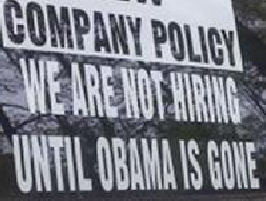
“The way the economy’s running, and the way my business has been hampered by the economy, and the policies of the people in power, I felt that it was necessary to voice my opinion, and warn that I wouldn’t be able to do any hiring.”
So said a Georgia small business owner who posted a sign that has gone viral.
Well, we told so … going back to a July 2009 post titled: “Why private sector jobs won’t be coming back any time soon … hint: it’s called passive aggressive resistance.”
Back then, we were saying:
The bottom line: businesses will resist government policies passive aggressively.
Fewer jobs will get added back than history would suggest, and those that get added back will materialize later than past patterns. Businesses will add jobs as a last resort rather than trying to build capacity ahead of the economic growth curve.
Why should companies increase their costs and risks any more than is absolutely necessary ?
Companies will continue to off-shore jobs, but will be more clever and clandestine about it, e.g. by vertically disintegrating and simply buying goods and services from 3rd parties.
Given the Administration’s anti-corporate rhetoric, actions, and proposed game-changing rules, I doubt that many CEOs will be taking on added costs and risks to boost the administration.
More likely, they will let unemployment continue to creep up, and will slow roll the process of rehiring.
Corporate chieftains will sit back and watch the President squirm and spin his “saved you from a catastrophe” riff .
As Rev. Wright would say “the chickens will have come home to roost”.
Punch line: According to the Washington Post, “far from being mass synchronized temporary insanity, the Black Friday ritual has distinct psychological underpinnings.”
1) The crowds (and scarcity) make us happy
When crowds create a sense of competition — such as when hundreds of shoppers are rushing to collect marked-down goods — they generate a different feeling … called hedonic shopping value, or a sense of enjoyment from the mere process of buying goods.
Consumers enjoy something that’s harder to get, and it makes them feel playful and excited.”
create a promotional strategy that has a high value for a limited time.”
2) We love the hunt
Black Friday is “hunting for women” … it hinge on long-standing traditions and involve pursuing a goal as a group. Whether the group actually hits its target is secondary to the fun of the chase.
The process is akin to a marathon, in that a long-distance runner is energized by the grueling trek in much the same way a Black Friday shopper thrives on long lines and frenzied grabs at cashmere sweaters.
Shoppers love to swap stories and show off their prizes at the end of the day.
“It’s ‘mission accomplished … You brag about your great deal, or about how you got the last one.”
3) It’s about togetherness
Black Friday shopping combines elements of both traditional shopping and holiday rituals.
Shoppers planned extensively for Black Friday — as they would for a holiday meal — and relish the day in part because it allows them to spend time with close friends and family.
“Sharing the shopping ritual with family members and indoctrinating children helps to ensure that the ritual is continued in the next generation.”
TakeAway: RadioShack’s emphasis on mobility products (aka. cell phones) turned away their core customers – parts & gadget buyers. Now, RadioShack is trying to get these customers back.
In a candid presentation, RadioShack’s CMO Lee Applbaum described how the marketer abandoned its core do-it-yourself customer, in a bid to embrace mobility.
As the mobility business grew, the “signature” business, which includes things like accessories and power products suffered, falling from 38% of the business in 2009 to 32% in 2010.
Shareholders and analysts took note of decline, considering the category has very high margins, drives frequency and encourages loyalty.
Initially, RadioShack told itself that people just weren’t buying those products anymore.
But, as evidenced by the Wired article and a slew of blog posts, it quickly became clear that wasn’t the case.
“For all the work around the rebranding, we didn’t spend ample time understanding our customers.”
Once RadioShack acknowledged the problem, it moved quickly to re-establish connections with the DIY shopper.
RadioShack began asking those consumers what they wanted, reaching out via its blog and social media. The response was swift.
A program called “The Great Create” leveraged RadioShack’s roots and attracted 110 million impressions in the first 30 to 45 days.
That’s the question I was asked by a reporter from the Washington Post yesterday
Here’s what I told her:
In general, Christmas shoppers operate against some sort of Xmas spending budget. That’s called a budget effect.
The budget may be conscious or subconscious — it can be explicit (written down in detail) or vague (e.g. spend no more than some amount).
A shopper’s budget typically has some stretch to it, especially if times are good. But, there is likely to be little or no budget stretch in tough times (like now).
One impact of early openings on retailers is a shopping days effect.
You might expect shoppers to expend their full budgets regardless of the number of shopping days available to them. That is, they’ll spend their budgeted amount whether there are 30 shopping days or 32 shopping days until Christmas. It doesn’t always work that way. There is some evidence that some money may end up left in shoppers pockets if they don’t have enough convenient opportunities to spend it.
So, added shopping days — or a part of a shopping day — tends to insure that consumers spend more (or all) of their budget.
The biggest impact on retailers is the market share effect.
Given the budget effect, retailers are fighting for a share of holiday spending budgets that are essentially fixed.
So, it’s to retailers’ individual advantage to get a first mover effect. That is, to have people spend money with them first, perhaps leaving less budget available for competitors.
The bottom line is that overall, sales may increase very slightly since shoppers have an extra opportunity to spend (the shopping days effect).
More important, this year, retailers that open on Thanksgiving night are likely gain share by getting into shoppers wallets sooner than their competitors, making sure that they get their fair share and maybe a little more.
Next year, market shares will likely reset as competitors follow suit and open earlier.
* * * * *
Side note: Many of the retailers opening on Thanksgiving are considered low-end merchants. Think Walmart. Higher-end retailers might tarnish their images by participating in T-day openings.
TakeAway: PepsiCo is learning how consumer psychology influences in-store shopping behavior. With these insights, PepsiCo has adjusted the shopping experience – the shape of end caps, design of advertising circulars – to appeal to the differences between male and female shoppers …
So far, PepsiCo’s research has unveiled three key learnings:
The importance of the shopper’s unconscious
Men and women respond differently
Psychology influences behavior across the shopping cycle
PepsiCo’s goal is to understand the unconscious, engage both genders effectively, and develop best practices to ensure that its brands apply what they learn throughout the shopping process …
Take the importance of curvilinear merchandising … PepsiCo’s Frito-Lay brand is using more rounded fixturing in the store, including the configuration aisles and end caps.
“What we’ve found is a neurological preference toward rounded edges,” Michelle Adams, PepsiCo’s VP of customer strategy and shopper insights said. “Innately, humans avoid sharp edges and objects, and hot stoves. It’s a piece of who we are that we never really realized was going on, but is going on subconsciously.”
A design principle that appeals more to the female mind than male is scattering elements in, say a printed circular. “The more you break things up, the more females like it,” Adams said. “Whereas the male brain will gravitate toward the linear, toward block designs, the female brain will go toward angles and curves and different fonts.”
Another key point of differentiation between male and female shoppers is their reaction to “causes” in marketing, merchandising and packaging. Breast cancer and “sustainability” are particularly attractive causes to women.
“It’s not that appealing to sustainability will shut men down,” Adams said. “It just doesn’t get their attention. Men are about assuring that they’ve got the right brands and flavors, that this brand is for him and his family. The other thing is they want assurances around taste.”
Another area where men and women diverge is in the importance of all-natural products to them. However, overall shopper preference for better-for-you snacks has become important enough to Frito-Lay that it has influenced how the brand arranges its shelf space in supermarkets – typically in the front of the aisle and its more conventional products toward the back.
PepsiCo also rallies especially to the concerns of women with back-to-school “solutions” merchandising. “Our angle around back-to-school is to provide easy solutions to the problems that mom has,” Adams said. For instance, Frito-Lay promotes multi-packs of single-serve packages of chips that are handy for school lunches.
“We try to create sections in the store saying to moms: ‘Here’s your lunch solution, your dinner solution and your big-game event solution,’” Adams explained. “And with the brands we have, we can do that. It’s the advantage that PepsiCo has.”
Adams said that PepsiCo brands already have incorporated design changes in circulars based on psychological insights and already have been able to log greater engagement with consumers because of them …
Obama’s jobs plan has a smorgasbord of hiring incentives … all of which are 1-time credits (e.g. for hiring veterans) or 1-year tax incentives (e.g. eliminating half of employers’ FICA match).
Corp execs’ statements that they don’t hire based on 1-year incentives keep falling on deaf ears, and the Administration keeps serving them up.
Let’s look at a specific and do some simple arithmetic.
According to the Administration’s fact sheet on the Jobs Bill, the lead provision of the bill (about 15% of the $450 billion cost) is a payroll tax cut for businesses.
The President’s plan will extend the payroll tax cut to firms by cutting in half their payroll tax on the first $5 million in payroll. Next year, instead of paying 6.2 percent on their payroll expenses, firms would pay only 3.1 percent.
For example, a firm with 50 workers earning an average of $50,000 a year – for a total payroll of $2.5 million – would receive a payroll tax cut of 3.1% of its total payroll, or about $80,000 – $1,500 per average employee.
By intent, the cut doesn’t do much for big businesses. The maximum benefit that could go to a big company is only $155,000 ($5 million times 3.1%). That’s rounding rounding error – equivalent to maybe 2 “free” hires for 1 year.
Hardly a game changer.
So let’s look at a small business.
At the margin, continuing the fact sheet’s example, a new average employee’s base salary cost is $50,000. Fringes (e.g. health insurance) add on another $10,000. Payroll taxes (pre-credits) adds on another $3,000 … bringing the total to $63,000.
But, companies don’t hire people for 1-year. Once they’re added to the payroll, they stay there for awhile.
How long?
Well, the BLS says that the median tenure of employees is about 4.5 years … with almost 1/3 employees having been on payrolls for more than 10 years.
Let’s take the low number, 4.5 years.
When a company hires an employee, it is implicitly making a commitment of at least $285,000 ($63,000 times 4.5 years).
The Obama plan offsets the cost with $1,500 … a whopping 1/2 of 1%.
Does anybody really believe that will stimulate companies to hire in uncertain times?
TakeAway: Retailer optimism is lower this year. Yet, Target hopes to spur sales with a two-day Black Friday sales event and the return of Christmas Champ ad campaign.
With Black Friday just a week away, a new survey shows that retailer optimism about sales growth is lower this year than in 2010. Heavy discounts are expected to rule the day as many retailers move their Black Friday operations to Thursday in a dismal zero sum game sales spiral …
To pitch its 2011 two-day Black Friday sales event, Target has rolled out a collection of “tips” from its effervescent, slightly off-kilter shopping maven.
Promoted as their @ChristmasChamp on Twitter, the manic Black Friday sales lover (brilliantly portrayed by comedian Maria Bamford) was Target’s secret weapon that drove the store’s 2009 Black Friday sales to its biggest ever levels despite a grim holiday shopping environment. Bamford was so popular that Target brought her back in 2010.
And so here we are again in 2011 and Target is again turning to Bamford. But the ads the retailer is running are the same as last year …
We kid, but Target’s regifting of its popular, two-year-old campaign is nothing to laugh at if it’s working. Indeed, if a brand runs a holiday ad enough years in a row, it can become iconic.
Interesting read in Biz Week re: how companies are using creative methods recruiting to land talent.
Think next generation “Moneyball”.
A new era of talent hunting has begun.
It’s happening not only at high-tech companies such as Facebook, but also at Army bases, ad agencies, investment banks, Hollywood studies, corporate boardrooms, college admissions offices, and even at nanny agencies.
In all these fields, experts don’t just sort résumés. They pick people and build teams in a profoundly different way.
Traditional measures of past achievement, such as test scores and academic degrees, are losing power, and companies are getting better at looking for those future superstars who deliver many times the value of someone who is merely good.
Facebook publishes gnarly programming challenges and invites engineers anywhere to solve them.
Not the superficial brainteasers that some companies used, like estimating the number of piano tuners in Chicago.
Instead, Facebook’s website issues multi-hour tests of coding prowess.
Google concluded that it had been looking at résumés far too narrowly.
The company had started out by focusing inordinately on candidates’ education, grade-point averages, and even SAT scores.
They were missing candidates:
Whose grades had faltered because they were working 30 hours a week to pay for college
Highly competitive people who had chased an athletic dream when they were younger — and now were applying that same relentless energy to professional goals
People who weren’t great students but had been running businesses, tutoring, volunteering, and otherwise being civic leaders from their teenage days onward.
Now at Google, several dozen factors — including tidbits like the age when a recruit got into computers — are used to help predict candidates’ chances.
And, they spend time looking at resumes “upside down.” … Now, they start with “interest” to if some special, rare attribute could point the way to greatness.
Corporate directors are also taking fresh looks at the process of picking chief executive officers.
Recent academic studies show that charisma and affability may be overrated as traits that lead to CEO success.
Efficiency, problem-solving, and hard-nosed accountability appear to be more valuable.
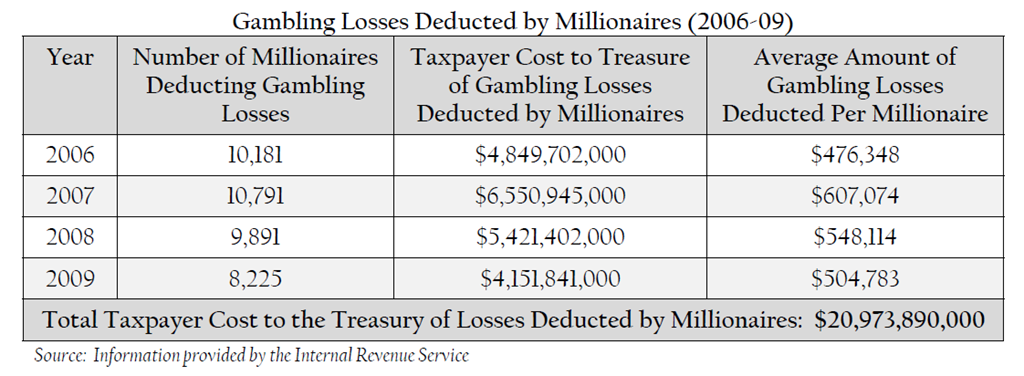
I thought I’d get a couple of posts out it, but it turned out to be old news (Bon Jovi calling his estate a bee farm and paying practically no taxes) … and the result of not means testing Social Security and Medicare.
Two of the subsidies did catch my eye:
1) Millionaires deducted more than $20 billion in gambling losses … though, even that’s not such a big deal since they simply offset gambling winning … they don’t deduct from ordinary income.
2) Millionaires copped almost $21 million in Unemployment Insurance … not a big amount, but c’mon man.
He likes restaurants and insurers, runs a company called “BH” and writes long, self-effacing annual letters to shareholders.
Sardar Biglari,— the self-described Warren Buffett wannabe – runs the Steak ‘n Shake restaurant chain alongside stock investments and other holdings.
Today, entryways to Steak ‘n Shake restaurants, which he turned around in part by slashing costs and closing unprofitable locations, display large photos of a grinning Mr. Biglari.
Now, he has set his sights on Cracker Barrel Old Country Store.
“We blame the board for mediocrity,” he said in a Sept. 12 letter to Cracker Barrel shareholders. “I intend to raise expectations.”
Cracker Barrel, a down-home restaurant and gift store whose results have turned south with the slow economy, initially tried to accommodate Mr. Biglari’s requests.
But as his demands grew more intrusive, relations soured. The company recently adopted a poison-pill antitakeover provision, and Mr. Biglari launched a proxy fight to get himself elected to the board.
The remark has caused a massive wringing of hands … e.g. “but what about Israel?”
Settle down folks.
Zero-based doesn’t necessarily mean zero.
It simply means stating each year with a clean sheet … starting each year’s budget at zero, and then justifying spending an item at time … rather than simply taking last year’s budget as a starting point and adjusting that total up or down (usually up).
Any funding that gets justified gets added; unjustified spending gets axed.
Sounds reasonable doesn’t it?
It’s the way well run businesses do it.
If your still uncomfortable, think of it as going through the budget line-by-line.
Remember, when Candidate Obama said he’d go through the budget line-by-lined, people cheered the new way of doing business
When Candidate Perry said essentially the same thing, people squirmed.
The difference?
Easy.
President Obama didn’t do it. Doubt if he ever intended to …. but, it did resonate on the stump.
If Perry gets elected president, he just might do it.
Oh my, fiscal responsibility … time to squirm.
* * * * *
For the record, I’m not a big Rick Perry fan, but I do think he landed a nice punch with this one.
TakeAway: With projected holiday spending down, big retailers hope to boost sales on Black Friday by opening up even earlier.
New plan for T-Day: schedule dinner for 4 p.m., eat way too much, take a really long nap … then at midnight, head for the stores to buy some plus-sized clothes (for me) and heavily discounted gifts (for loved ones).
More retailers are concluding that 4 a.m. on the Friday after Thanksgiving just isn’t early enough. Macy’s said most of it will open at midnight. That’s four hours earlier than in recent years.
Last week, Target said it will break with its usual around-dawn opening practices and begin business at midnight on Thanksgiving night.
“In dollars and cents, it probably gives the retailers that are opening extra early another fraction of a day’s sales … and, it does engender publicity, which, in this environment, is very valuable.”
This year is expected to be especially competitive because spending is projected to be a bit lackluster.
The National Retail Federation expects total retail spending during the holiday period to rise 2.8%, down from a 5.2% increase last year.
Shoppers are expected to spend 4.6% less this year on gifts, or about $516.
Most are saying that Obama wins if the court rules the individual mandate (and assorted ObamaCare junk) is constitutional …. and, he loses if the court rules that it’s unconstitutional.
I don’t see it that way.
Sure, it’s a win if the law gets a pass. Obama can crow about how it’s time to move on.
Here’s the twist.
If it’s ruled unconstitutional, the GOP loses one of its major campaign issues. They can’t go around beating a dead horse, right?
But, Obama can rail about the conservative justices legislating from the bench … and, he can argue that he needs to be re-elected – with a large majority – in order to craft a cleaner replacement for ObamaCare and, more important, to control appointments to the SCOTUS to make it more reasonable and objective.
Obama can also reap the economic benefits the laws demise. For sure, hiring will pick up a bit when the bill is buried.
TakeAway: Companies are using online job fairs to save costs and time while providing job searchers with information about the companies and positions available.
Companies are turning to virtual career fairs. Employers say these online forums — accessed by companies and job seekers from anywhere in the world — can save them time and money, as well as broaden the candidate pool.
Candidates learn about fairs through the company’s website, social-networking services such as Facebook and Twitter, or word of mouth.
Procter & Gamble and Citigroup customize their own company-specific virtual career fairs. Other firms join broad-based virtual career fairs hosted by companies like jobs sites Monster.com. The group fairs host anywhere from a handful to hundreds of companies.
The fairs are less about landing a job offer, say HR experts, and more about generating interest among candidates.
Lourdes Fuentes, a marketing executive with P&G, says the virtual fair is cost- and time-efficient because she can access it from her office and doesn’t have to spend a full day traveling.
Punch line: Sure, it costs more, and technology is threatening high-paying jobs. But the Great Recession shows postsecondary education is more valuable than ever
Supporting factoids:
The share of jobs in the U.S. economy requiring postsecondary education went up from 28 percent in 1973 to 59 percent in 2008… … and is projected to increase to 63 percent over the next decade.
* * * * * Median earnings in 2008 …
College graduate with a BA working full-time … $55,700
Associates Degree (typically awarded by community and technical colleges) … $42,000.
High school-only grads … $33,800
Without a high school diploma ….$24,300
* * * * *
Earnings Power
About 25 percent of those in the top 40% of wage earners have only a high school diploma.
About 20 percent of workers with a college degree are in the lowest 40% of wage earners.
* * * * *
Unemployment rates:
4.3% for college graduates and above who are 25 years and older.
9.5% for high school graduates
13.9% for those with less than a high school education
The Detroit Free Press reports that a Chevrolet Volt caught fire several weeks after a crash test.
The electric vehicle had been subjected to a low speed (20 mile-per-hour), side-impact test for its crash safety rating.
Apparently, the crash punctured the Volt’s lithium-ion battery, and though it took a couple of weeks, the vehicle eventually self-combusted – i.e. it went up in flames.
General Motors believes the fire occurred because the testers didn’t drain the energy from the Volt’s battery following the crash, which is a safety step the automaker recommends.
Government officials are weighing the need for new safety rules that could require first responders to drain electric vehicles’ batteries after a crash.
Note, they’re not investigating how to make the Volt safer, they’re determining whether fire-fighters have to drain the batteries when they arrive at an accident scene.
TakeAway: A promotions company is trying to use prepaid cards to push product samples, but CPG firms are hesitant to get on board.
Ken’s Take: Geez, just what consumers need … another credit or gift card in their already too fat wallets. This one will get leapfrogged pretty quickly – with a mobile app that’ll do the same thing – without another card to carry.
Young America, promotion-services company is joining with Citi Prepaid Services to create prepaid cards redeemable for full-size product samples at stores.
The idea is to open up sampling alternatives for product categories such as frozen foods, over-the-counter drugs and laundry detergent, where it’s either impossible or impractical to send samples through the mail or insert them into newspapers.
The prepaid cards are programmed to be redeemable only for specific SKUs and only up to the price of the item.
One advantage of using cards over using paper coupons for the same purpose is reducing the risk of redemption fraud.
Other advantages include not having to pay to ship full items to homes, not having to manufacture a special sample size and the potential for tying sampling programs to shopper-marketing programs that can induce retailers to stock and prominently display the featured products.
Young America is in talks with several marketers on the tactic but hasn’t signed any up yet.
“The con is that the brand ends up paying the retailer price vs. the manufacturer price” said a former P&G sampling-promotion executive.
Legend now has it that when a reporter asked Steve Jobs what market research went into the iPad, Jobs replied:
None. It’s not the consumers’ job to know what they want.
Design decisions should be shaped by managers’ intuitive understanding of technology and popular culture
Jobs’ stated philosophy created quite a stir among marketers.
The accepted paradigm is that companies should be “customer-driven” since the “customer is king”.
But, Steve Jobs – one of the greatest innovators ever — said emphatically that he wasn’t customer-driven.
What gives?
I surmise that Steve Jobs was sensitive to customer needs and wants, even though he claimed that he wasn’t customer-driven.
Let’s dive deeper.
I don’t think Jobs had a problem with the “customer” part of customer-driven. He seemed to like it when people would uh & ah over his designs. And, he sure seemed happy to be selling lots of stuff.
Note: Some folks may quibble over use of the word “customer” versus the word “consumer”, but I think that’s a distinction without much difference.
My experience suggests that most companies think “customers”. For example I often hear about the “voice of the customer”, the “customer experience”, and “customer loyalty”.
Usually when I hear the word “consumer”, it is being used to distinguish a line of business from another one that is oriented to industrial or commercial markets, e.g. Black & Decker has a Commercial & Industrial business that serves tradesmen and a Consumer business that serves folks like me and you.
Bottom line: “customer” is ok.
I think the issue that Jobs had, and some other people have with “customer-driven” is the “driven” part.
Should companies react in a Pavlovian way to everything customers indicate that they want?
Doubtful.
Should companies be sensitive to what customers say (or think) they want?
You bet.
Should managers have the leeway to judgmentally screen and augment customers’ wish lists to reflect technology constraints (or advances) and economic realities?
For sure..
Accordingly, I propose that companies move on from “customer-driven marketing” to a more nuanced mindset and methodology: Customer-Valued Marketing TM or, in short, CVM TM.
Whereas “customer-driven” evokes a sense of mechanical compliance to customers demands, Customer-Valued Marketing TM connotes an authentic, balanced, proactive approach that:
Recognizes (and calibrates) customers’ value to the company strategically and financially. Think customer lifetime value. loyalty economics and ‘customers as assets’.
Respectfully values customers needs and wants – considering needs and wants that are both salient (known) and latent (sub-conscious or unknown) — immediate or future-projected. Again, think voice-of-the-customer and Quality Function Deployment.
Allows managers leeway to “re-value” customer desires by filtering and massaging them based on technological feasibility (can we do it?) and economic desirability (do we want to do it?).
Delivers benefits that customers value and are willing to pay for. Think value creation and value capture Economic Value to Customers, value mapping.
Provides integrated measures of success centered on value and values: value to society, value to shareholders, value to customers, value to employees,
My take: While Steve Jobs may not have been customer driven, he seems to have practiced Customer-Valued Marketing TM
Stay tuned, I’ll have plenty more to say on Customer-Valued Marketing TM …
* * * * * CVM TM, Customer-Valued TM, and Customer-Valued Marketing TM are declared trade/service marks of Kenneth E. Homa
MillerCoors is banking on new packaging and advertising to help beat back what the brewer characterized as the “toughest headwinds we’ve seen as a company.”
Changes include new “taste flow” cans for Miller Lite that feature a second opening on the can top designed to increase airflow and reduce “glug.” The optional new hole can be opened with a key or other object.
The growth of spirits brands is a new threat to beer, especially among younger drinkers.
“All of our various agencies have been looking at the mindset of millennial drinkers and what’s driving their switching [to spirits],”
Besides taste-flow cans, M-C is rebranding the low-calorie MGD 64 brand as “Miller 64” with new black-and-red color scheme, replacing the white-labeled cans and bottles now on shelves.
The brewer is also giving a different look to Miller Genuine Draft with new, all-black labels.
Chris Rock — comedian and actor – says that he’s “fine with the president,” because he understands that the president has to keep his most aggressive policies on the back burner until he earns a second term.
More specifically …
“There’s a f——— art to the first term because you’re always running for a second term the whole time. You can’t really do your gangsta sh— until your second term.”.
“ I want more action. But I understand that he’s trying not to piss off a lot of people. But I believe wholeheartedly if he’s back in, he’s going to do some gangsta sh—.”
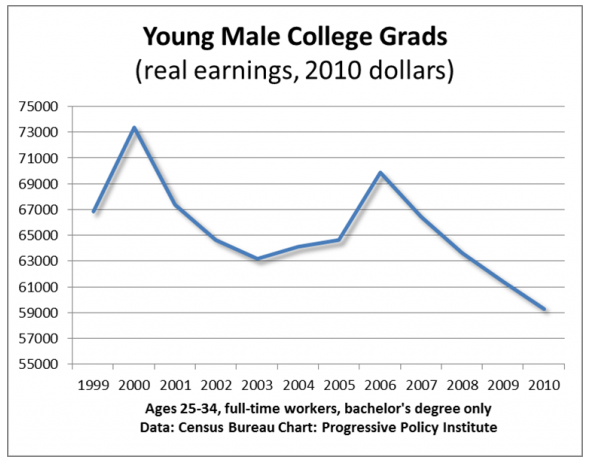
Earlier this week, we posted that only 4.5% of college grads are unemployed … a lot lower percentage than you’d think given the coverage of the Wall Street Occupiers.
There is a flipside, though.
Mean real earnings for college grads have fallen by almost 20% over the past decade … reflecting salary caps at many companies and a re-mixing towards lower paying jobs.
Suggests that the ROI on college is going down, down, down
TakeAway: To combat DVR and channel surfing, marketers have started placing messages in the corner of the TV screen during shows … sometimes even animating the messages.
Interesting approach: build goodwill by being annoying …
Marketers have long since realized they need to develop a few new weapons for their arsenal. Product placement is fast becoming passe.
One solution? Playing with bugs.
Yes, “bugs,” those TV-network logos that rest quietly in one of the bottom corners of the boob tube, are becoming ripe for promoting more than just the CW logo or the CBS “eye.”
This season, both the CW and Fox have allowed sponsors to post messages around and even in their logos.
On Fox, DirecTV has informed viewers during the first few seconds of “Terra Nova” through a display in the bottom right corner of the screen that the company helps to bring the program to viewers in “Fox High Def.”
Rising interest in the smallest corners of TV-screen real estate suggests advertisers believe viewers are growing even more resistant to their normal commercials.
“There are advertisers who are concerned about losing ratings to growing DVR playback and who want the networks to provide reach that cannot by skipped.,” ….
TV networks aren’t likely to make their bugs available without a substantial ad buy already in place.
Bing had signed up for an extensive package that included the CW producing individual videos featuring actors and behind-the-scenes talent from its prime-time lineup to air during commercial breaks.
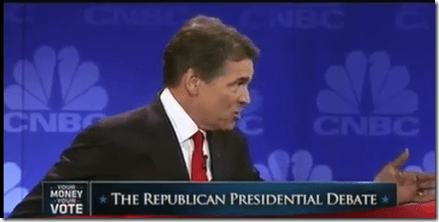
A gaffe or mistake that was so consequential that it was virtually certain to bring a manager’s career progress to a screeching halt, never to be restarted.
In last night’s debate, Gov. Rick Perry became the poster child for CLTs.
Warning: Whether you like the guy or not, this vid is painful to watch.
Rivals of Groupon are threatening the daily deal site leader by offering quicker payment to merchants, potentially jeopardizing a key part of the company’s business model.
Groupon, which offers online deals for local merchants, keeps itself in cash by collecting money immediately when it sells its daily coupons to consumers while dragging out payments to the merchants over 60 days.
For instance, a hair salon might run a deal offering $100 of services for just $50 on Groupon’s website, which then keeps as much as half of the total collected and sends the remainder to the salon in three installments about 25 to 30 days apart.
“You want to get paid in full as quickly as possible. We’re the ones that have to cover the cost of goods for giving away everything at half price,”
* * * * *
Groupon pays merchants in installments of 33% over a period of 60 days
LivingSocial pays merchants their full share in 15 days.
Amazon Local, pays immediately.
Google Offers promises 80% of the merchant’s cut within four days, and the remainder over 90 days.
In their book Academically Adrift, authors Arum and Roksa … name all the key actors involved in higher education – parents, students, professors, administrators, and government funding agencies – and explain why, given the behavior of all the other actors, no one wants to do anything about high cost and “limited learning” at most universities.
They argue that limited learning on college campuses is not a crisis because the institutional actors implicated in the system are receiving the organizational outcomes they seek,
Parents – although somewhat disgruntled about increasing costs – want colleges to provide a safe environment where their children can mature, gain independence, and attain credentials that will help them be successful as adults.
Students – in general seek to enjoy the benefits of a full collegiate experience that is focused as much on social life as on academic pursuits, while earning high marks in their courses with relatively little investment of effort.
Professors – are eager to find time to concentrate on their scholarship and professional interests.
Administrators – have been asked to focus largely on external institutional rankings and the financial bottom line.
Government funding agencies – are primarily interested in the development of new scientific knowledge.
In other words, the system satisfies the needs of all the players … which explains why everybody seems satisfied with the status quo.
And, explains why there will be a loud cheer when the President issues an Executive order to dismiss all student loans.
Source EconoLib Thanks to Tags for feeding the lead.
Take Away: Jim Beam looks to boost its market share by diversifying its product portfolio with lighter, fruiters drinks aimed at women. Jimmy hopes to drive new in-home occasions with females, tapping into the ‘ladies night-in’ concept.
… After 216 years of catering to guys’ guy, with tattooed singer Kid Rock as a pitchman — Jim Beam whiskey is now chasing women.
“Two years ago, 100 percent of our marketing was geared to men,”
Beam is now touting women-friendly Courvoisier cognac infused with red wine, tart Pucker vodka, and low-calorie Skinnygirl-brand cocktails … trying to reach female consumers with lighter or fruitier quaffs they can consume outside of bars and restaurants.…
* * * * *
The gender-bending marketing shift happened almost by accident.
In 2009 the distiller introduced a black cherry-infused version of Jim Beam called Red Stag and signed Kid Rock to pitch the product.
As sales took off, Beam discovered that women were buying the sweeter concoction at almost three times the rate at which they typically bought bourbon.
Further research revealed what the company marketing executives came to call the “girlfriend connection … Womentend to drink with other women or in a very social setting.”
“We wanted to understand the emotional reasons why women drink wine or spirits.”
While women make up almost half of spirits drinkers, they consume just 25% of the spirits sold — far less than their 58% of wine consumption,
“We started to understand how to move that wine occasion to a spirits occasion”
* * * * *
Sales of Beam’s Sauza tequila also benefited from the women’s focus.
About 57 percent of the tequila sold in the U.S. is mixed in margaritas,
Two-thirds of those margaritas are consumed by women. Yet tequila marketers always targeted men.
Sauza began marketing itself around the notion of a “ladies’ night in,” hosting 1,000 in-home margarita parties and advertising on Food Network (SNI). … the company teamed up with restaurants to brand so-called “Sauza-Ritas.”
* * * * * The bottom line: Beam is rolling out drinks targeted at women to fuel sales in the $19.2 billion spirits business, which grew 2.3 percent last year.
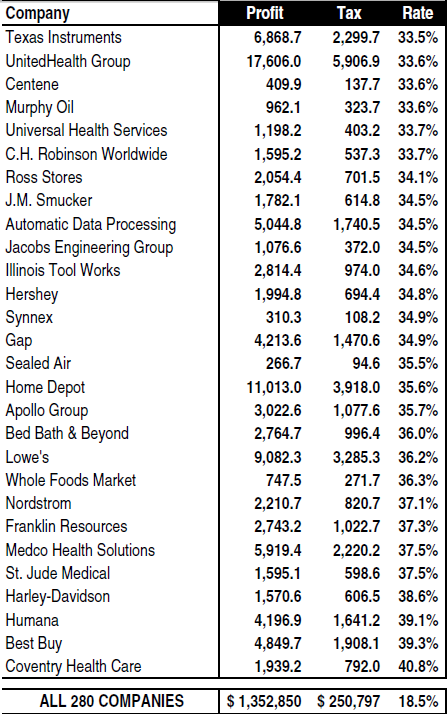
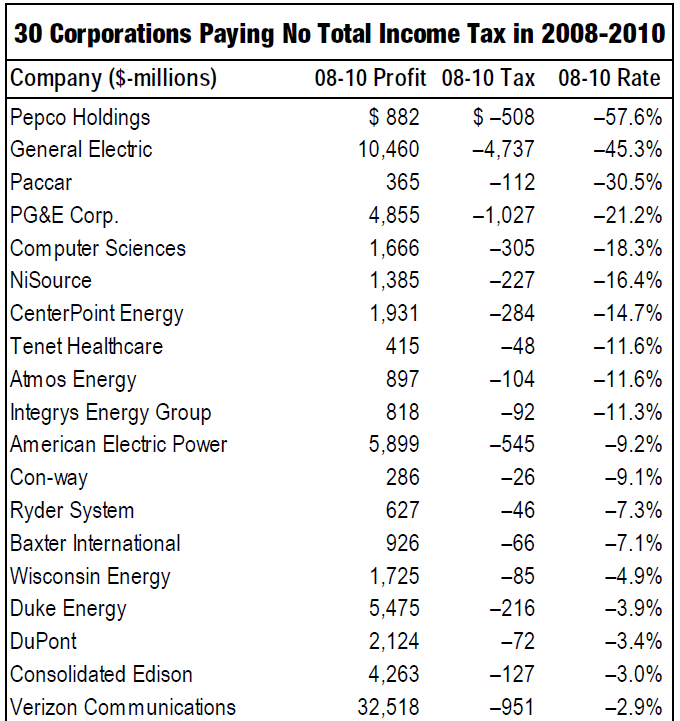
Here’s their list of the Top 30 “Tax Dodgers” … below the table is CTJ’s decoding of how they do it
Accelerated Depreciation
In early 2008, in an attempt at economic stimulus for the flagging economy, Congress and President George W. Bush dramatically expanded depreciation tax breaks by creating a supposedly temporary “50% bonus depreciation” provision that allowed companies to immediately write off as much as 75 percent of the cost of their investments in new equipment right away.
This provision was extended and expanded through 2012 under President Barack Obama.
Stock options
Most big corporations give their executives (and sometimes other employees) options to buy the company’s stock at a favorable price in the future.
When those options are exercised, companies can take a tax deduction for the difference between what the employees pay for the stock and what it’s worth (while employees report this difference as taxable wages).
Paying executives with options took off in the mid-1990s, in part because this kind of compensation was exempt from a law enacted in 1993 that tried to reduce income inequality by limiting corporate deductions for executive pay to $1 million per executive.
Tax options were also attractive because companies didn’t have to reduce the profits they report to their shareholders by the amount that they deducted on their tax returns as the “cost” of the stock options.
Industry-specific tax breaks.
The federal tax code also provides tax subsidies to companies that engage in certain activities. For example:
research (very broadly defined);
drilling for oil and gas; providing alternatives to oil and gas;
making video games;
ethanol production;
not moving operations offshore;
maintaining railroad tracks;
building NASCAR race tracks;
making movies;
… and a wide variety of activities that special interests have persuaded Congress need to be subsidized through the tax code.
Offshore tax sheltering.
Over the past decade or so, corporations and their accounting firms have become increasingly aggressive in seeking ways to shift their U.S. profits, on paper, into offshore tax havens, in order to avoid their U.S. tax obligations.
These typically involve various artificial transactions between U.S. corporations and their foreign subsidiaries, in which revenues are shifted to low- or no-tax jurisdictions, while deductions are created in the United States.
Some companies have gone so far as to renounce their U.S. “citizenship” and reincorporate in Bermuda or other tax-haven countries to facilitate taxsheltering.
“America must cut taxes and reduce government spending in order to kick-start an economic recovery, Jim Skinner, the chief executive of McDonald’s, has warned.”
“In order to create jobs in America, you’re going to have to cut taxes… particularly in the business community.
“We pay some of the highest [corporate] taxes around the world. There needs to be some levelling.”
For the record, in 2010, McDonald’s paid the Feds $1 billion on $2.624 billion in profits … pardon the pun, but that’s a whopper: 38.9%
Based on the Wall Street Occupiers and the mainstream media reports, you’d think it’s sky high, right?
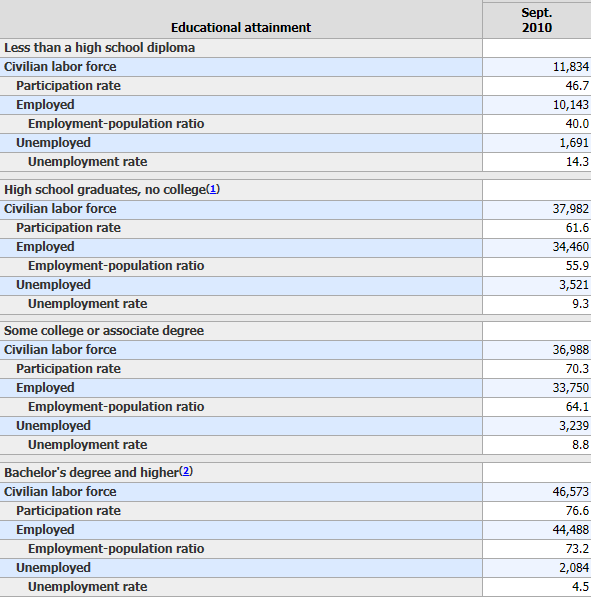
Well, according according to the BLS it’s 4.5%. … that’s versus 9.1% for all categories, 14.3% for drop-outs, 9.3% for high school grads, and 8.9% for those with some college.
There is no statistically significant relationship between financial performance and innovation spending, in terms of either total R&D dollars or R&D as a percentage of revenues.
Many companies — notably, Apple — consistently underspend their peers on R&D investments while outperforming them on a broad range of measures of corporate success, such as revenue growth, profit growth, margins, and total shareholder return.
Meanwhile, entire industries, such as pharmaceuticals, continue to devote relatively large shares of their resources to innovation, yet end up with much less to show for it than they — and their shareholders — might hope for.











 The Homa Files