Archive for December, 2011

Merry Christmas … 45 Lessons in Life

December 25, 2011

Merry Christmas, Happy Hanukkah and HAPPY NEW YEAR  to all !

This short video was sent to me by a friend a couple of years ago

It really resonated with me, so I like to share it at Christmas time.

 … back with you after the New Year

* * * * *

       click picture  to launch ( best with audio on)
image

>> Latest Posts

Ditched by NPR … for the record, here’s what I said.

December 23, 2011

A couple of weeks ago I was invited to do a radio interview with NPR for its MarketPlace business segment.

The topic was retailer’s pricing practices.

Right down my power alley, so I was amped.

I took the interview seriously – even did some research.

Went to the studios for the interview … which was recorded.

After the allotted 30 minutes, the reporter asked me if I could continue for another 3o minutes.

Sure.

I expected she’d pull a couple of 15 second sound bites out of the 60 minutes.

To my dismay, all 60 minutes of my “filet”  hit the edit room floor.  Ouch.

Below, I’ll give my hypothesis for what happened … here (based on my notes) is what I said … some pretty good stuff – if I must say so myself.

Studies consistently show that consumers’ have very imprecise knowledge of prices.

Very few consumers are even able to recall — within 5 or 10% the price they paid … even for recently bought or frequently bought items.

The exceptions are so-called “signpost items” — such as a gallon of milk or a 12-pack of Coke. Consumers often use those items as “sample precincts” used to implicitly judge other prices in a store.

“If they’re priced right on milk, they must be priced right on other products”

* * * * *

People look for “cues” when evaluating a product’s price.

The words “free”. “new” and “sale” are probably the most impactful in a marketer’s vocabulary.

“Sale” takes on a particularly strong meaning when it’s supported by a comparative price claim  … versus competitors’ prices  … or versus a self-proclaimed “regular price”.

Since people tend to have imprecise knowledge of prices, they often  anchor their price perceptions on stated regular prices and react — or over-react – to the implied discounts.

Shoppers conclude – sometimes erroneously: The bigger the discount, the better the deal.

* * * * *

Legally speaking, a “regular price” is defined as a price that was offered for a meaningful length of time and at which a substantial amount of sales were made.

Of course, the terms “meaningful length of time” and “substantial sales” are subject to interpretation and often tough to pin down in practice.

It boils down to whether a good faith effort was made to sell the product at its “regular price”.

* * * * *

While the FTC has legal jurisdiction over unfair marketing practices – including “fictitious price claims” –  it hasn’t brought any cases in the past 30 years.

The FTC has largely delegated enforcement to the states and localities … which have a crazy-quilt of statutes that are selectively enforced, typically when there is a veritable groundswell of consumer complaints.

Even then, cases are hard to prove and any penalties are relatively light slaps-on-hands.

* * * * *

Some retailers make heavy use of what’s called “high-low” or “was/is” pricing tactics.

That is, they run frequent sales that emphasize the discount from so-called regular prices.

Kohl’s is famous for using the “was/is” tactic; so is the men’s clothing chain Jos A Banks – which routinely run sales touting “buy 1 suit at regular price and get 2 for free”.

If anybody buys anything at those stores at “regular” prices, they should look over their shoulders to make sure that Darwin isn’t chasing them”

* * * * * *

These high-low tactics are a relatively benign form of marketing hype.

Savvy buyers ignore everything but the bottom line price that they’ll be paying.

They ask themselves do I want to buy this product at this price?

Sure, they might want to shop around to see if they can find a lower price someplace else, but …

What somebody else may or may not have paid for the product at another point in time is largely irrelevant … except for bargain hunter’s bragging rights.

The real question is whether you want to buy that shirt for $19,99 or not.

* * * * *

Further, strict enforcement of the statutes may actually have a harmful effect on consumers.

Think about it … why force a retailer to sell more stuff at a high price to satisfy a statute?

That would result in consumers – on average – to pay more for products

* * * * *

I get more concerned with hidden charges that aren’t reflected in the prices that customers think they’re paying.

For example, shipping & handling charges that far exceed the cost to ship or handle …

Or, stripped down products that don’t include all the necessary components … like computer peripherals that don’t include the connecting cables … or printers that come with toner cartridges that print a minimal number of copies.

Often times, buyers don’t know what hit them until after-the-fact

Basically, the piece that aired was dumbed down to “lots of stuff is on sale … really, LOTS of stuff”   A surprisingly light piece.

My hypothesis: the reporter went into the story expecting to nail retailers (like Kohl’s) for deceptive practices.  My view was that the “was-is” pricing tactic is pretty benign and that shoppers should just focus on the current price.  That didn’t support the story line.

And, I doubt the reporter could find anybody who got very excited about whether retailers’ “regular” prices really were regular prices.

So the storyline fell apart and “lots of stuff on sale” became the emphasis.

Woulda thought the Darwin line would make the cut. 

Oh well … it made the Homa Files !

>> Latest Posts

$1,000 annually, $40 per week … huh?

December 22, 2011

Someone just said in a press conference that the proposed 2-month  2% payroll tax holiday would save an average family earning $50,000 per year about $1,000.

Hmmm.  Annualizing a 2 month program. Clever arithmetic.

Perhaps, sensing that’s misleading, he went on to clarify: that works out to about $40 per week.

Hmmm.

Let’s do the math: $40 times 52 weeks = #2,080 … that can’t be right.

$1,000 divided by 52 weeks is less than $20.

Huh?

I hate to get petty, but if the “someone” had been Rick Perry, the gaffe woulda made headlines.

If it had been Joe Biden, everybody would have just shook their heads and said “again?”.

But, it was Barack Obama, so it’ll get ignored by the press … but not by the Homa Files.

>> Latest Posts

The payroll tax holiday … and Homa’s Rule of 3

December 22, 2011

I often remind my students of “Homa’s Rule of 3”.

Simply stated, if you can get somebody to do something – practically any thing – 3 times … then, you got ‘em.  Their behavior becomes – more or less – habitual.

Get hen to eat at your restaurant 3 times.

Get them to use your credit card 3 times.

Bam.  You got ‘em. You’ve got a (loyal) customer with a habitual behavior.

How does that apply to the payroll tax holiday that causing such a fuss in Washington these days?

Easy.

2011 was the first time.

2012 will be the 2nd time … mark my words.

Then what will the 2012 electees do – “raise taxes on 150 Americans”?

I’ll take the under on that bet.

So, the payroll tax holiday will be continued for a 3rd year  … Homa’s Rule of 3 kicks in and it’ll be extended to a 4th … and so on.

So what?

Zero evidence that a payroll tax holiday stimulates the economy.

But, for sure it makes Social Security’s “unfunded obligations” go up and up … year after year.

That’s a problem.

>> Latest Posts

Romney-Rice in 2012 ?

December 22, 2011

My bet is that it’ll be Romney-Rubio, but, there’s an interesting piece in the Washington Times that positions Condi Rice for the VP slot.

The essence of the logic:

  1. Hillary will replace Biden as Obama’s running mate to give Obama an uplift and position her for 2016.The Times says insiders claim “the swap” is what induced her to join the Obama team as Secretary of State.
  2. Having Rice on the GOP ticket would change the dynamics of the race since she’s smart, a good debater and, oh yes, an African-American woman.
  3. Rice is reportedly antsy in her current professorial position and wants to get back in the action.

Interesting … but my money is still on Romnet-Rubio … GOP needs some charisma, and Rubio has it.

>> Latest Posts

Taking the mystery out of “mystery meat” …

December 22, 2011

TakeAway: McDonald’s is giving consumers transparency into their agricultural suppliers to boost the image and quality of their food.

* * * * *

Excerpt from AdAge: “McDonald’s to Launch Campaign Focused on Growers”

On Jan. 2, McDonald’s will launch a campaign featuring four of its U.S. beef and produce suppliers.

“We thought putting a face on the quality of the food story would be a unique way to approach this,” said U.S. CMO.

“We acknowledge that there are questions about where our food comes from. I believe we’ve got an opportunity to accentuate that part of our story.”

The campaign will include TV, print and digital, as well as additional paid and earned media.

“Consumers want transparency — disclosures of everything from menus to labor and local-sourcing practices,” Technomic said.

“A small but growing number are serious about nutrition, labeling, sustainability and community involvement, and they are using such knowledge to make purchasing decisions.”

Edited by ARK

>> Latest Posts

Xmas tip: Wrap it up, dummy.

December 21, 2011

For Christmas, Behavioral Economists (you know, the guys who say we’re predictably irrational), say that gifts should be carefully wrapped.

Why?

First, wrapping adds a personal touch … showing that you care enough to select the right wrapping and put some sweat equity into the present.

Second, wrapping adds to the romance (broadly defined), suspense and ritualization … you know: the shaking of the present, the slow reveal, the shouts of joy.

So, (1) do it yourself (2) don’t use newspaper or birthday wrapping (3) don’t say “I wrapped it myself” … that’ll be obvious.

Inspired by: The Behavioral Economist’s Guide to Buying Presents

>> Latest Posts

Xmas tip: for guys: gadgets … for gals: something expensive (and useless)

December 21, 2011

For Christmas,  Behavioral Economists (you know, the guys who say we’re predictably irrational), advise getting “him” a gadget and getting “her” something expensive and useless.

Excerpted from: The Behavioral Economist’s Guide to Buying Presents

Buying for a guy? Get him a gadget. Buying for a girl? Get her something expensive and useless.

University of Utah Professors Russell Belk and Laurence Coon  found three main purposes for presents: social exchange, economic exchange, or a sign of “agapic” — that would be Greek for “selfless” — love.

In the social sense, gifts were seen as a symbol of commitment.

In the economic context, men saw gifts as a way to get sex.

Women, meanwhile, tended to be more agapic, giving out of the goodness of their hearts.

But what did men and women actually want?

Belk and Coon found women care about the symbolic value, whereas men are more interested in the utility.

So women are best off getting their guy a gadget.

Men are better off going sentimental. Or extravagant.

In his book The Mating Mind, University of New Mexico Professor Geoffrey Miller explained that  the best gifts are “the most useless to women and the most expensive to men.” Flowers. Pricey dinners. Jewelery.

The less useful, the better.

Waste is the most efficient way to a woman’s heart.

Hey, I’m just reporting …

>> Latest Posts

Smile …. that security cameras is tracking your shopping behavior.

December 21, 2011

Punch line: Retailers are linking security cameras with software to track consumer behavior …

According to Business Week:

On the Web, every click and jiggle of the mouse helps e-tailers customize sites and maximize the likelihood of a purchase.

Brick-and-mortar stores have long wanted to track consumers in a similar fashion, but following atoms is a lot harder than following bits.

For the most part, they’ve been forced to rely on consumer surveys.

“The problem with survey research is the consumer can say one thing and do another.”

To get a better understanding of their customers in real time, mall operators are monitoring shoppers’ behavior with devices that track mobile-phone signals … are finding new uses for old tools such as in-store security cameras.

The goal is to divine which variables affect a purchase, then act with Web-like nimbleness to deploy more salespeople, alter displays, or put out red blouses instead of blue.

>> Latest Posts

How much healthcare do free-riders “take”?

December 21, 2011

Interesting tidbit from the WSJ

On average, people without health insurance consume only about half as much health care as everyone else.

Of the amount of care they consume, they pay for about half.

Thus the “free ride” for the average uninsured person is about one-fourth of what everyone else spends on health care.

Raises an interesting question: do free-riders consume too little health care, or do riders consume too much?

Hmm …

>> Latest Posts

Maybe Amazon (not Google) will control internet…

December 20, 2011

A real “hmmm” graphic from   CPC Strategy

Their take:Amazon has come a long way from *just* being the world’s largest bookseller.

This year alone the company has launched three new products or service offerings that challenge the market dominance of an established player.

CPGS may be onto something …

Amazon v. The World - An Infographic

Thanks to Tags feeding the lead

>> Latest Posts

What’s the best Xmas gift?

December 20, 2011

According to Behavioral Economists (you know, the guys who say we’re predictably irrational), the answer is cash money.

Not just generic money … cash money.

Excerpted from: The Behavioral Economist’s Guide to Buying Presents

What is the single best possible gift? Cash money.

Money is the soundest gift for one simple reason: It guarantees that the recipient gets exactly what they want.

In 1993, economist Joel Waldfogel published a study with a title that only the Grinch could love: “The Deadweight Loss of Christmas.”

Deadweight loss is the term economists use to describe the gap between what we spend on something and what it’s actually worth.

Because people rarely know exactly what their friends and loved ones want, Waldfogel decided to ask a simple, slightly uncomfortable question: How much value do we waste every year by picking the wrong holiday gifts?

He concluded that gift giving “destroys” between a tenth and a third of the value in what we buy.

In other words, if you spend $100 on that Santa-red cardigan at Macy’s, chances are whoever gets it will only value your gift between $70 and $90.

Some groups had a better gift radar than others.

Grandparents, aunts and uncles had the worst sense of what to buy.

Friends and significant others had the best.

But ultimately, cash was just more efficient.

So if you’re feeling uncertainty, don’t guess.

Do everyone a favor and go with greenbacks.

If you want to seem a tad more thoughtful, make it a gift card.

>> Latest Posts

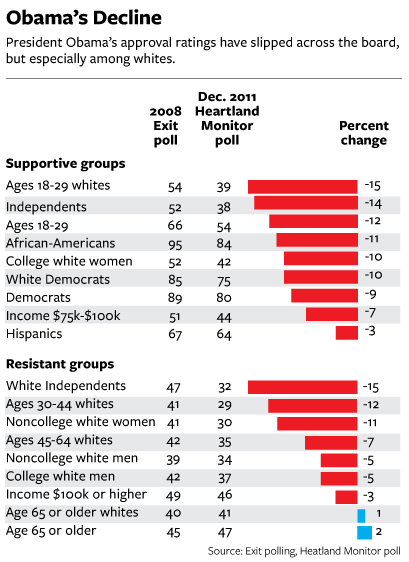
Uh-oh: Obama slips among youth and independents …

December 19, 2011

I’ve said before: I have run into folks who voted for Obama in 2008 who say they won’t vote for him in 2012, but haven’t run into anybody who didn’t vote for him in 2008 who say they will in 2012.

Data seems to confirm my random anecdotal evidence …

From the latest Allstate/National Journal Heartland Monitor poll:

Not only is Pres. Obama’s overall approval rating lagging, but he’s lost as much (or even more) ground among groups that favored him in 2008 as among those who resisted him last time.

Overall, Obama has slipped from 52.8 percent of the vote in 2008 to 44 percent approval in the new survey with 49 percent disapproving.

As the chart below shows, Obama has declined not only in the groups that were always dubious of him, but also with several that enthusiastically joined his winning 2008 majority.

The groups that have proven most resistant to this trend are Hispanics (where Obama’s latest approval rating has slipped just three percentage points from his 2008 vote share); seniors (where he’s actually running slightly ahead) and families earning at least $100,000 annually (where he’s also fallen just three percentage points.)

image

>> Latest Posts

“Little” brands, few ad dollars … lots of awareness.

December 19, 2011

TakeAway: Small brands overcome limited marketing budgets by growing brand awareness through support of social movements, in-store experiences and work culture.

* * * * *
Excerpt from AdAge: “How Little Brands Land Big Bang for Their Buck”

Brands built with little or no media support were once relatively rare, but they’ve begun to proliferate in recent years.

From Ben & Jerry’s, Honest Tea and Lululemon, they fascinate the many marketers who must shell out millions to get noticed.

One reason is that these success stories are often built on factors that don’t usually fit with big, established brands.

For example, some are built on substantial investments in branded retail stores and the store experience, rather than media.

Others are built on the brand’s affinity with political and social movements that can be tough for big brands to embrace.

And some have been based on big investments in wages, benefits and fun cultures that keep employees happy — not the usual storyline for huge corporations.

The common thread through all these no-cost, low-cost marketing success stories is a good story, one that bears repeating and fares well both in social and PR-fueled traditional media.

Almost by definition, such stories are easier for bootstrap entrepreneurs to come by than, say, 65-year-old detergent brands.

All things considered, It’s still nice to have money ..

Edit by ARK

>> Latest Posts

Breaking news: Congress sees the light …

December 16, 2011

From the Washington Times

Congress overturns incandescent light bulb ban

Congressional negotiators struck a deal Thursday that overturns the new rules that were to have banned sales of traditional incandescent light bulbs beginning next year.

That agreement is tucked inside the massive 1,200-page spending bill that funds the government through the rest of this fiscal year,.

Now, back to dishwashers and clothes washers that wash?

Call me a dreamer …

>> Latest Posts

HOT: The 4 Stages Strategic Thinking

December 16, 2011

I’ve gotten a couple of requests from alums to post some of the material that I’m now pitching to current classes.

So today, I’m posting the first HOT – Homa Online Tutorial – something right out of the classroom to you via the HomaFiles.

Some stuff will be classic, some will be edgy; some will be original, some will be “borrowed” from other sources (with proper attribution of course).

Here’s the first HOT topic …

* * * * *

Great Strategy

In my Advanced Marketing Strategy introduction, I tell students that the course goal is to get them to “internalize a mindset geared to creating great marketing strategies.”

That raises a logical question: what’s a “great” strategy … as opposed to a “good” strategy.

I try to put “great” in the context of the 4 stages strategic thinking.

click for the online tutorial “The 4 Stages of Strategic Thinking” (4:30 min)

image

* * * * *

Synopsis: The 4 Stages of Strategic Thinking

Companies can be at one of 4 levels of strategic thinking.

Level 1 is “reactionary” … responding to market and forces as they happen … hoping to make it through this day and see the sun come up tomorrow … and rejoicing when it does (think, my dog Captain)

Level 2 is “remedial” … proactively stop doing dumb stuff … and try doing mostly the same things, just a bit better … often by benchmarking companies with best practices and trying to emulate them. Consultants make mucho $$$ on these folks … taking the #3 company in an industry and telling them to be like #1 … in hopes of overtaking #2.

Level 3 is “resourceful” … think typical MBA training … analyze SWOTs, assess competitive advantages, find “white spaces” or “blue oceans” … basically fit the existing world and play by the rules.

Level 4 is “revolutionary” … try to change the way the game is played … alter the rules of the business to your company’s unique advantage … think, FedEx, early Netflix or Apple iPad … don’t just report the weather, create it.

>> Latest Posts

Uh-oh: Bootleg liquor kills 102 …

December 16, 2011

You can relax … it was in India, not on M Street.

Reported in USA Today: Bootleg liquor kills 102 people in India :

Day laborers and other poor workers began falling ill late Tuesday after drinking the brew that was laced with the toxic methanol around the village of Sangrampur,India.

The tragedy began  when groups of poor laborers finished work and bought some cheap homemade booze for about 10 rupees (20 cents) a half liter, less than one-third the price of legal alcohol.

The men were drinking along the roadside near the railway station, when they began vomiting, suffering piercing headaches and frothing at the mouth, Nigam said.

The death toll skyrocketed to 102, and dozens more remained hospitalized.

Police arrested four people in connection with making and distributing the methanol-spiked booze.

Highly toxic methanol can be used as a fuel, solvent and anti-freeze. (Ouch !)

Two-thirds of the alcohol consumed in the country is illegal hooch made in remote villages or undocumented liquor smuggled in.

* * * * *

Despite religious and cultural taboos against drinking among Indians, 5 percent — roughly 60 million people, the population of France — are alcoholics.

Teaching point: “This Bud’s for you” … ok to go goofy, but stay safe

>> Latest Posts

Give me a grande OJ, please.

December 16, 2011

TakeAway: Starbucks is betting on their multiple locations and recent acquisition of a juice making company to become player in the CPG industry.

* * * * *
Excerpt from WSJ: “Latest Starbucks Concoction: Juice”

Starbucks Corp. is buying a small, upscale juice maker Evolution Fresh — a deal that shows how serious the company is about transforming itself into a consumer products player.

Many packaged-food and beverage manufacturers have struggled to boost profit margins amid high marketing and commodities costs, and some brands have been pushed off store shelves entirely.

Starbucks’s business model will help it succeed where others have failed, because it can test new products in its stores before introducing them to supermarkets.

Starbucks also may not have to spend as much money on traditional marketing and customer acquisition as other food manufacturers, since it can use its stores as advertisements.

Getting a product in front of the 60 million customers who frequent Starbucks stores around the world each week is equivalent to airing a commercial on the top three television shows weekly.

Edit by ARK

>> Latest Posts

GOP set to hand O an early Xmas present …

December 15, 2011

Let’s set the stage: The President is caught between a rock (his unions) and a hard place (his enviromentalist supporters).

So, he punts the XL pipeline decision until after the 2012 election … telling both sides not to worry that he’ll take their side when nut-cutting time comes.

Everybody with an IQ over 50 sees the move as pure politics, but Obama’s boxed.

To the rescue: the GOP … by demanding that XL be part of the payroll tax cut extension legislation.

Of course, Obama plays the Brer Rabbit card and threatens a veto.

So, the GOP hardens its position … XL has got to be part of the package.

It will be.

Why?

Because O gets off the hook.

Even he knows the pipeline is a good idea – jobs, energy independence, etc.

He’d like to sign it, but can’t because of the pressure from the environmentalists.

He can’t, unless he’s painted into a corner, say, by the GOP demanding it to pass the payroll tax cut.

So, the bill will pass with XL in it, the President will sign it, and he’ll tell the environmentalists that he had no choice.

You heard it here in the HomaFiles …

>> Latest Posts

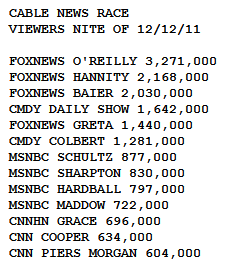
MSNBC edging out CNN … FOX on top (of course)

December 15, 2011

Recent ratings reported by Drudge …

I hadn’t realized how far CNN had fallen in the ratings … now being edged by MSNBC and getting whomped by the news spoofs on Comedy Central.

FOX rocks on.  But, for perspective, only about 2% of the U.S. adult population watches O’Reilly ….

image

>> Latest Posts

YouTube says it’s where the action is …

December 15, 2011

Punch line: YouTube hopes to gain a greater share of online advertising spend. Yet, only 1% of ad spend is on online video vs. 38% for TV ads. YouTube bets that its global and local reach is an targeted advantage for this media outlet. So will large CPG firms (e.g., P&G) pump more dollars into YouTube?

* * * * *
Excerpted from http://www.business-standard.com, “YouTube makes the case that it helps build brands

Despite online video and commercial-skipping DVRs, companies still spend 38% of their advertising budgets on television ads and just 1% on online video. YouTube is trying to change that.

In a bid to lure TV ad dollars, YouTube is making the case to brands that online video is the best way to reach customers …

“We would love YouTube to be a much larger part of brands’ advertising budget and mix in the next year and the future than it is today,” said Lucas Watson, YouTube’s vice president of online video global sales.

… It now says it has 800 million unique viewers worldwide a month. Analysts estimate that YouTube contributes more than $1 billion to Google’s annual ad revenue and is most likely profitable.

But YouTube, now six years old, is still in the early stages of making money. Advertisers spend just $2.2 billion on all online video ads, compared with $60.5 billion on television ads …. ad agencies are only now hiring people with expertise in online video …

YouTube has to recruit new kinds of advertisers, beyond the music, entertainment and technology companies that have flocked to the site, and convince them that YouTube is a fruitful place for brand building …

Unlike television, YouTube incorporates social elements by inviting viewers to choose whether they watch, share or create their own videos about advertisers’ products.

YouTube has both global reach and the ability to target an ad to 20-something men who live near a pizza shop …

Even though YouTube is showing more professional videos so brands can avoid appearing next to unsavory homemade videos, advertisers still hesitate to spend as much on YouTube as they do on TV …

Edit by KJM.

>> Latest Posts

Want to own a pro sports team? … Hint: get a Georgetown degree.

December 14, 2011

According to the WSJ

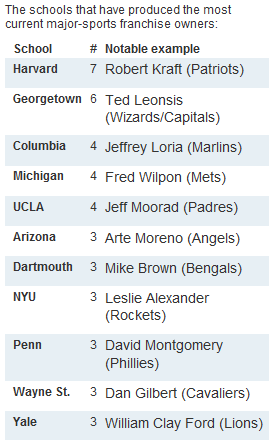
If you want to own a pro-sports franchise, an advanced degree from Harvard or an undergrad degree from Georgetown (plus a few hundred million dollars) is the place to start.

Among the 122 franchises in the four major North American pro leagues, more owners graduated from Harvard’s business or law school (seven) than any other institution.

But, when it comes to undergraduate degrees, Georgetown is No. 1.

Five owners earned their undergraduate degrees there, including embattled Los Angeles Dodgers owner Frank McCourt and Washington’s Ted Leonsis, who owns the Wizards and Capitals.

image

Thanks to CS for feeding the lead …

>> Latest Posts

Knock, knock … here’s your Big Mac.

December 14, 2011

TakeAway: Fast food franchises are replacing drive-thru with delivery in Asia, Middle East, & African markets. Comin’ to America?

* * * * *
Excerpt from WSJ: “Asia Delivers for McDonald’s”

Delivery is becoming an important part of McDonalds and KFC where cities are too crowded and real estate costs too high to build drive-throughs.

KFC offers delivery in more than half its 3,500 restaurants in China, and estimates delivery in more than 2,000 new KFC restaurants in China over the next decade.

McDonalds says delivery sales have been posting double-digit growth every year in every country where it’s offered. In Egypt, where McDonald’s first started offering delivery in 1994, more than 30% of total sales come from delivery.

Still, it’s not a model either company plans to export to Western markets. McDonald’s derives about two-thirds of its sales in the U.S. from drive -through customers.

In some countries, such as China, customers pay a flat fee for delivery. In others, people pay a fee equal to 15% to 20% of their order price.

Edited by ARK

>> Latest Posts

DIY ultrasounds … all you need is a smartphone

December 14, 2011

In a recent Advanced Marketing Strategy class, we were talking about “disruptive innovation” … stripped down technologies that attack the low-end of markets (i.e. “low-end encroachment”).

One of the examples in healthcare are ultrasound machines.  It used to be that all ultrasound machines were big, sophisticated and costly.

The full-featured ultrasounds got scaled down in functionality and price.  Many of the low-cost machines have found their way into ob-gyn offices where non-radiologist docs scan pregnant women for views of their babies.

Now, those machines have been scaled down … to a smartphone app.

Be a hit at the next party … bring your smartphone ultrasound and start scanning.

Here’s a demo …

click to view
image

>> Latest Posts

Frito-Lay says: “Gentlemen, start your (electric) engines.”

December 13, 2011

Punch line:  Frito-Lay is building the largest fleet of electric cars in North America

According to Today’s Trucking

PepsoCo’s Frito-Lay North America has turned the ignition on ten new electric trucks in Orlando.

The electric delivery trucks are set to be part of the largest planned fleet of commercial all-electric trucks in North America.

Frito-Lay plans to deploy 176 electric trucks this year, making them the largest commercial fleet of all-electric trucks in North America.

The trucks are by Smith Electric Vehicles, and designed to operate at peak effectiveness in urban environments.

The trucks generate zero tailpipe emissions and each truck emits 75 percent less greenhouse gases than a conventional diesel truck.

The trucks operate for up to 100 miles on a single charge.

>> Latest Posts

I wish me a Merry Christmas … I wish me a Merry Christmas …

December 13, 2011

TakeAway: Consumers are spending more on themselves this holiday season. This is boosting retailer’s sales for now but raising concern of consumer spending after the holidays.

* * * * *
Excerpt from AdAge: “On Your Holiday Shopping List This Year: You”

Consumers are taking advantage of deals to snap up items for themselves and non-gift items for their families.

According to the National Retail Federation, six in 10 planned to buy non-gift items this holiday season, spending an average of $130, up from $112 a year ago.

Research from Shopper Sciences found that a majority of shoppers spent more on themselves than on friends and family during the post-Thanksgiving shopping period. And 80% of shoppers surveyed spent more than they planned to.

Some retailers are even marketing the concept of self-gifting. NRF recently highlighted J.Crew, which featured a “Gift Yourself” section on its website, along with the text “To: You, From: You.”

While self-gifting is good news in the near term, in the long term it could prove problematic.

“Many went into the holidays thinking, ‘I need a new laptop, but I’ll wait until the prices are good.’ If consumers are waiting for the holidays, that creates a challenge for retailers [trying to] pull shoppers in the other 10 months of the year. It’s a blessing during the holidays and a curse the rest of the year.”

Edit by ARK

 >> Latest Posts

This Google pop-up is different …

December 13, 2011

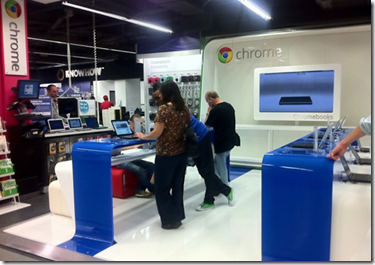
Takeaway: Google launched its first retail pop-up store in London, called the Chrome Zone. Google hopes to appeal to consumers’ desire to physically touch and experience a laptop computer before purchasing it. Let’s see if it helps boost the company’s holiday sales …

* * * * *
Excerpted from brandchannel.com, “Google launches first branded store in London

image_thumb1

… Well, the wait is over and the company has opened its first store… as a “store within a store” in central London — a pop-up boutique.

The 285 sq. ft. pop-up store within the Currys and PC World superstore on Tottenham Court Road “only sells Google’s (Samsung) Chromebook laptop and a few accessories such as headphones” and “will run for three months up to Christmas” …

A second Chrome Zone location will open this week (Oct. 6th) at a PC World superstore in Essex. “We’ve put a lot of effort into making it feel welcoming, homely and, dare I say it, Googley,” said a company spokesperson.

“It is our first foray into physical retail,” said Arvind Desikan, head of consumer marketing at Google UK. “This is a new channel for us and it’s still very, very early days. It’s something Google is going to play with and see where it leads

Edit by KJM.

>> Latest Posts

Xavier, Cincinnati … as ugly as it gets

December 12, 2011

From SI reports …

There has always been bad blood between Xavier and Cincinnati.   The schools are only 4 miles apart and jockey for position in the city.

Saturday night, an ugly brawl erupted with 9.4 seconds left in their basketball game.

Benches cleared, fists flew.

Lots of mayhem.  Lots of blood.

Not your garden variety pushing and shoving.

The post-game explanations were equally as chilling.

Xavier’s senior All-America guard Tu Holloway readily admitted starting the fight by taunting Cincinnati players and coaches … and he defended his actions, and those of his Xavier teammates, for their parts in the fight:

“You gotta understand, we got a whole bunch of gangsters in the locker room …  tough guys.”

When asked why he taunted the Cincinnati bench and incited the fracas, Holloway said that he was disrespected when a Cincinnati player said that he was a better player.

“This is my city … I’m cut from a different cloth.

None of them guys on their team is like me.

We got disrespected.

Maybe it looked bad to you (media), but this is what I’m used to.

This is where I’m from..”

Georgetown connection?

Cincinnati is in the big East … Xavier is “A Jesuit, Catholic University in Cincinnati, Ohio since 1831”.

Yipes.

>> Latest Posts

What if colleges owned college loans?

December 12, 2011

College degrees are costing more and no longer insure a rich & prosperous life. 

The cost is going up largely due to the availability of of student loan money.

A recommendation from the Washington Examiner

Student loans, if they are to continue, should be made dischargeable in bankruptcy after five years — but with the school that received the money on the hook for all or part of the unpaid balance.
 
Up until now, the loan guarantees have meant that colleges, like the writers of subprime mortgages a few years ago, got their money up front, with any problems in payment falling on someone else.
 
Make defaults expensive to colleges, and they’ll become much more careful about how much they lend and what kinds of programs they offer.

The article also reps for non-college education.

As the Wall Street Journal has noted, skilled trades are doing quite well. For the past several decades,

America’s enthusiasm for college has led to a lack of enthusiasm for vocational education.

We need people who can make things, and it’s harder to outsource a plumbing or welding job to somebody in Bangalore.
 
Of course, the thing about skilled trades is that they require skill.

Even with training, not everyone makes a good welder or machinist.

Hmmm.

>> Latest Posts

Forget Millennial .. it’s the Quadrennial Effect that matters.

December 12, 2011

TakeAway: Is spending cyclical? Some forecasters believe so and are predicting higher ad spending in 2012 because of the key events that happen every 4 years. The impact of these events on the economy is known as the Quadrennial Effect.

* * * * *
Excerpt from NYT: “Quadrennial Effect Could Make ’12 a Very Good Year”

The fact that several events that happen every four years will take place next year will stimulate the media and ad industries, leading forecasters said, offsetting the detrimental effects of the European debt crisis.

Events on the 2012 calendar likely to encourage more ad spending than this year include the United States presidential and Congressional elections, the Summer Olympic Games and the European Football (soccer) Championship.

Some analysts are expecting “The strongest-ever quadrennial effect” … adding  $7 billion to global ad spending in 2012.

For all its power, the quadrennial effect can do only so much in a bad economy.

Edit by ARK

>> Latest Posts

US Healthcare: Ripe for Disruption

December 9, 2011

Punch line: Clayton Christensen – the guru of disruptive innovation – says that the US healthcare system needs some seriously disruption … to improve quality and cut costs.

Here’s a summary of his prescription.

Excerpted from MIT Sloan Review: Good Days for Disruptors – An Interview with Clayton Christensen Spring 2009

Every disruption has three components to it: a technological enabler, a business model innovation and a new commercial ecosystem.

In health care, the enabling technology is the ability to diagnose diseases precisely.

Now, through molecular diagnostics, enabled by our understanding of the genome, and through imaging technology that allows people to look inside the body with remarkable clarity, we are acquiring the ability to precisely diagnose more diseases by their cause, not by their symptoms.

That ability then enables us to develop rules-based treatment and a predictably effective therapy.

Our hospitals are, like mainframe computer companies, hopelessly complicated and very expensive.

To ever expect today’s hospitals to become cheap is a pipe dream.

Instead, we need to bring technology, in the form of precise diagnostics and predictably effective therapy, to outpatient clinics so you can do more and more and more of the things there that in the past required a hospital.

And then we need to bring better diagnostic technology to doctors’ offices, so you can do more and more things there that previously required a clinic.

And to nurse practitioners, so they can take on more and more of the things that in the past required a doctor.

Yes, I’m a big fan of MinuteClinics — walk-in clinics that inexpensively treat common disorders such as strep throat and bladder infections.

The hospital is really not a viable business model because, in general, its costs are driven by overhead, which is driven by complexity.

In a large general hospital, much of the cost is overhead cost that’s not expended in the direct care of a patient.

While cost is driven by complexity, quality is driven by integration. It’s when we don’t integrate things correctly that problems fall through the cracks.

Specialized health care institutions, whether they are focused hospitals or focused diagnostics clinics, can integrate correctly, and because of their focus, they have much lower overhead costs.

You get better quality and lower cost.

>> Latest Posts

Judge Judy for President …

December 9, 2011

Warning: This post isn’t politically correct and may offend HomaFiles left-leaning readers.

* * * * *

In a recent segment that has gone viral, Judge Judy is trying to settle a rent dispute.  A 3rd year college student is getting government aid that is specifically intended as rent money. But, he isn’t paying his rent.  JJ wants to know why and lands on a broader message that she “wants to send to Congress”.

click to view video
image

My favorite lines: “Just having me around is like me paying rent” and “I’m getting the money just for being me”.

Geez … and some people  don’t want to pay higher taxes … wonder why?

I wish that the President & Michelle would be preaching these lessons instead of Judge Judy.

>> Latest Posts

Subsidizing Chinese solar panels … ouch!

December 8, 2011

Must read piece in the WSJ today by TJ Rodgers, outspoken CEO of Cypress Semiconductor.

His Law of Misguided Subsidies:

Whenever Washington disrupts a market by dumping subsidies into it, Wall Street will find a way to pocket a majority of the money while the intended subsidy beneficiaries are harmed by the resulting market turmoil.

When President Obama says that we must subsidize our solar industry to remain competitive with the Chinese, it would be more accurate to say that we subsidize Wall Street to create employee-less corporations that buy and install Chinese solar panels in the U.S.

Illustrative economics:

Consider the current 30% federal solar energy subsidy.

A home solar system with 60 solar panels produces about 15,000 watts of power, enough to completely offset the $6,000 annual electricity bill of a typical upscale California home.

The system costs about $90,000 prior to the 30% federal income-tax credit, which reduces its cost to $63,000.

After a simple payback period of about 10 years, the homeowner literally enjoys free electricity for the remainder of the guaranteed 20-year system life, a very profitable 10 years.

The “gotcha”:

But … that $27,000 tax credit, the associated accelerated-depreciation tax savings, and most of the hefty post-payback profits [go] to Wall Street firms with a “tax appetite,” not the homeowner.

That’s just what happens with the majority of new home solar-system installations today.

Again, it’s worth reading the whole article Subsidizing Wall Street to Buy Chinese Solar Panels

>> Latest Posts

Go get me a ream of Dunder Mifflin paper … really!

December 8, 2011

TakeAway: Staples uses a fictional brand name from the popular TV show “The Office” to differentiate and boost sales in a declining commodity-like industry.

* * * * *
Excerpt from WSJ: “Great Scott! Dunder Mifflin Morphs Into Real-Life Brand of Copy Paper”

Staples’ Quill.com has struck a licensing deal with NBC’s parent company to launch a Dunder Mifflin brand.

Priced above private-label copy paper, the Dunder Mifflin packages will be emblazoned with slogans such as “Our motto is, ‘Quabity First’ ” and “Get Your Scrant on,” well-known phrases from the comedy series.

The marketing deal is an effort to combat what Quill’s chief marketing officer calls a “race to the bottom in the paper business.”

The Dunder Mifflin deal is an example of “reverse product placement.”

For decades, marketers have worked to embed their brands in the plots of TV shows and movies as a way to stand out in a crowded ad market. Nowadays, they are seeing value in bringing to life fictional brands that are already part of pop culture.

Examples include Bertie Bott’s Every Flavor Beans, a candy from the Harry Potter books, and Bubba Gump Shrimp Co. restaurants, inspired by the 1994 film “Forrest Gump.”

For Quill, which has a roughly $3 million annual ad budget, using the well-known Dunder Mifflin name is a way to draw attention to its brand without spending heavily on marketing.

Edit by ARK

>> Latest Posts

How close are you to the evil 1%?

December 8, 2011

Note: Based on 2009 tax year filing data, the Internal Revenue Service says an adjusted gross income, or AGI, of $343,927 or more will put you in the top 1 percent of taxpayers.

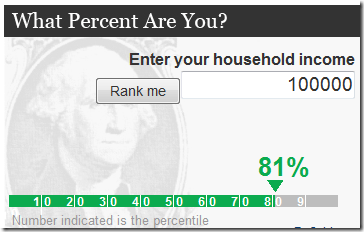
The WSJ has a cool interactive … plug in your household income (which is a higher number than AGI) and it pegs your percentile.

For example, the WSJ says …

  • $100,000 puts you in the 81st percentile
  • $150,000 puts you in the 89th percentile
  • $200,000 puts you in the 94th percentile
  • $250,000 puts you in the 96th percentile
  • $507,000 puts you in the 99th percentile

 click to plug in your number
image

>> Latest Posts

Reich: “Pay workers more than they’re worth” … say, what?

December 7, 2011

Former Secretary of Labor Robert Reich thinks so …

Reich is a smart economist, so I can’t imagine he really believes his own mumbo jumbo:

Excerpted from Instead of New Deal, workers get raw deal

For most of the last century, the basic bargain at the heart of the American economy was that employers paid their workers enough to buy what American employers were selling.

That basic bargain created a virtuous cycle of higher living standards, more jobs and better wages.

Back in 1914, Henry Ford announced he was paying workers on his Model T assembly line $5 a day – three times what the typical factory employee earned at the time.

Ford knew it was a cunning business move.

The higher wage turned Ford’s autoworkers into customers who could afford to buy Model Ts. In two years, Ford’s profits more than doubled. 

That was then.

Now, Ford  is paying its new hires half what it paid new employees a few years ago.

The basic bargain is over – not only at Ford but all over the American economy.

In the years leading up to the Great Crash, most employers forgot Henry Ford’s example.

The wages of most American workers remained stagnant. The gains of economic growth went mainly into corporate profits and into the pockets of the very rich.

* * * * *
Corporations don’t need more money.

They have so much money right now they don’t even know what to do with all of it.

They’re even buying back their own shares of stock.

This doesn’t create a single new job, and it doesn’t raise the wages of a single employee.

Get it? Corporate profits are up right now largely because pay is down and companies aren’t hiring. But this is a losing game even for corporations over the long term. Without enough American consumers, their profitable days are numbered.

After all, there’s a limit to how much profit they can get out of cutting American payrolls or even selling abroad. European consumers are in no mood to buy. And most Asian economies, including China, are slowing.

We’re in a vicious cycle. The only way out of it is to put more money into the pockets of average Americans.

A basic economic principle is pay “market prices” for inputs and to add inputs – like labor – whenever its “marginal profitability” is greater than zero.

That means, if an added (“incremental”) employee doesn’t contribute enough to cover his / her costs, the company is worse off than if it hadn’t added the employee.

That’s economics 101.

Reich says to discard that principle and just pay employees a lot – whether or not they cover their associated costs.  Just pay them because they might be stimulative to the overall economy.

Really?

More of this in subsequent posts

>> Latest Posts

Bold move: Domino’s keeps the cheese in cheesy bread … Whew !

December 7, 2011

TakeAway: Despite the down economy, Domino’s resisted the temptation to take the cheese out of its cheesy bread.

Otherwise, I guess they would have had to change the name to just plain “bread”.

Not much sizzle to to that, huh?

* * * * *

Excerpt form AdAge: “Domino’s Introduces ‘Gourmet’ Cheesy Bread”

Domino’s is revamping yet another product: its cheesy bread.

The chain today begins selling three “gourmet” varieties — spinach and feta, bacon and jalapeno and cheese only — to replace its existing cheesy bread.

“In this economy, things are bad, people are cutting budgets,” said Domino’s CMO.

“The normal thing to do is raise prices and reduce quality. We’re making a purposeful effort to be on the side of consumers. We could take cheese out, but we put more cheese in and added more gourmet-type flavors.”

In this economy, “restaurant-goers are more demanding than ever, closely watching their food-service dollars and actively seeking the best overall value,” according to a recent Flavor Consumer Trend Report.

“In this way, flavor is more important than ever before.”

The report found that “more than two out of five consumers say they are more likely to try new flavors than they were a year ago, while 52% express a preference for restaurants that offer unique or original flavors, up from 42% of those polled two years ago.”

Edit by ARK

>> Latest Posts

Apparently the “thrill up the leg” is gone … too bad.

December 6, 2011

During the 2008 presidential campaign, MSNBC’s Chris Matthews made headlines with his creepy comment “Obama sends a thrill up my leg”.

I have to tell you, you know, it’s part of reporting this case, this election, the feeling most people get when they hear Barack Obama’s speech.

My, I felt this thrill going up my leg. I mean, I don’t have that too often.

click to view video
image

Well, it seems that the thrill is gone from Matthews leg.

Now, he’s criticizing Obama for being out-of-touch, ineffective, and shirking leadership.

click to view video
image.

Oh my.  How things have changed in 3 years.

As a friend of mine observed:

I’ve talked to plenty of people who voted for Obama in 2008 who say they will not vote for him again.

I haven’t run into a single person who did not vote for Obama who say that they will vote for him in 2012

That says a lot, doesn’t it.

>> Latest Posts

Bad economy? … Jack up your heels.

December 6, 2011

TakeAway: IBM research shows a relationship between the height of women’s heals and the economy … the weaker the economy, the higher the heels..

* * * * *
Excerpt from AdAge: “At Last a Good Economic Indicator: Heel Heights Poised for Fall”

Historically in economic downturns heels have tended to go up and stay up, according, a consumer-products expert with IBM.

Why? Consumers look to compensate for dismal times with more flamboyant fashions.

Certainly that’s been true during the recent downturn.

Flats and relatively subdued heels of the 1920s gave way to the high heels of the 1930s recession.

Platform heels also soared during the recession fueled by the 1973 oil crisis.

Ominously, the average height of heels mentioned in social media soared from 3 inches in the first half of 2008 to 6 inches in the second half, just as the U.S. financial bubble burst.

Heel buzz most recently peaked in the first half of 2009 at 7 inches, bounced around at 4 to 5 inches through early 2010 and plunged to 2 inches in the most recent IBM analysis from early this year.

IBM’s cross analysis of heel-height buzz and macroeconomic data suggest a strong inverse correlation between heel-height buzz and economic growth.

Edit by ARK

>> Latest Posts

Sparkling water and green M&M’s …

December 5, 2011

Last week, I was invited to do a radio interview on NPR.

When I told my daughter-in-law, she suggested that I request sparkling water and green M&Ms.

I thought that was pretty funny, but didn’t know the story behind it

Now, I realize that all cool people know that rockstars Van Halen always included a contract provision that there be M&Ms in their dressing room and backstage … with the brown M&Ms sorted out.

Publically, that demand morphed to “only green M&Ms” … and was used to tag Van Halen  as uber-spoiled rocksters.

They might have been, but this isn’t the evidence to convict.

According to the Smoking Gun it turns out that there’s more to the story … that the contract provision  was not an example of rock ‘n’ roll hedonism, but a savvy business move:

The rider’s “Munchies” section was where the group made its candy-with-a-caveat request: “M&M’s (WARNING: ABSOLUTELY NO BROWN ONES).”

The group has said the M&M provision was included to make sure that promoters had actually read its lengthy rider.

If brown M&M’s were in the backstage candy bowl, Van Halen surmised that more important aspects of a performance – lighting, staging, security, ticketing — may have been botched by an inattentive promoter.

And, one of my students told me that the provision was added only after a promoter failed to put a restraint in the right place – as spelled out in the contract – and a stage hand had a fatal fall.

I can’t verify that part of the story … that’s the way urban legends are, I guess …

P.S.  No I didn’t get green M&Ms, but I was able to sneak some candy into the studio.

Thanks to JNH for  the idea and JV for feeding the legend.

>> Latest Posts

Is 8.6% good or bad for Obama?

December 5, 2011

The unemployment rate dropped a lot in November from  9.0% to 8.6%.

That’s good news for us and for President Obama. right?

I’m not so sure.

First, let’s dive into the numbers.

Job growth has been around 100,000 per month for the past couple of months.

But, until November, the unemployment rate has been stuck at 9%.

Hmmm.

Most folks argue that 100,000 to 200,000 is what’s required to handle population growth —  the new workers entering the market.

But, in November, 125,000 new jobs pushed the unemployment rate down by .4% – which is huge.

Couple of reasons.

  • There are different surveys used to calculate job growth and unemployment rates.  It could be that one of the surveys is whacky … either there were more jobs added than reported, or unemployment is under-reported.
  • The jobs numbers for the immediately prior months were revised upward.  That means that unemployment may have been over-estimated … that the rate really is 8.6% now, but it’s a drop from, say, 8.8% … not 9%
  • Most important, about half of the apparent drop in the unemployment is attributable to folks dropping out of the workforce … people who are unemployed but have stopped even looking for new employment.

My bet is that the jobs number is right and that the unemployment rate didn’t really fall by .4% … maybe it fell by one or two tenths of a percent … but not close to 1/2 percent.  My eye is on the jobs number.

OK, let’s not quibble over the numbers.

The question is: will November’s 8.6% help or hurt President Obama’s re-election campaign.

Short-run, the President should get an approval bump from the unemployment rate headlines.  That’s fair.

But, the new lower number may be an albatross in 2012.

Here’s why.

The unemployment rate is likely to move back up because, historically, as the economy appears to be bouncing back, unemployed folks who aren’t looking for work re-enter the job market and start looking again.  In other words, the unemployment rate may creep up because the denominator is getting bigger.

So, even if a modest recovery is taking place – something I don’t believe to be true – the labor market dynamics work against the President.

Pundits have been saying that Obama will be ok with a high unemployment rate in 2012 as long as the trajectory is in the right direction.  That is, that unemployment is coming down.

Here’s my scenario, unemployment will creep back up and Obama will be facing a high unemployment rate that is rising.  That’s not good.

Further, if Obama chest-pounds the 8.6% now, Congress has less pressure to “pass it now.” So, he may get less of his jobs bill through.

Politically, Obama might have been better off if the rate had stayed closer to 9% … he may be in the awkward position of having a high unemployment rate that’s going in the wrong direction.

It’ll be interesting …

>> Latest Posts

Nike tells Marty McFly: “Just do it !”

December 5, 2011

TakeAway: With a special-edition “Back to the Future” shoe, Nike helps to fundraise $9.4M for Michael J. Fox’s Parkinson Foundation.

* * * * *
Excerpted from brandchannel.com, “Nike ‘Back to the Future’ Shoes Raise $9.4 Million for Michael J. Fox Foundation

image_thumb

When 1985’s Back to the Future blew the doors off of the box office – eventually generating $303.87 billion – two sequels were automatically set into motion and released in 1989 and 1990. And somewhere in there, someone got fully turned onto the joy of product placement.

Back to the Future II was particularly chockfull of brand names, including Black and Decker, Pepsi, Texaco, Mattel, Pizza Hut,  The Weather Channel, 7-Eleven, and AT&T, among others. But fans salivated most over the special shoe that Nike designer Tinker Hatfield created for the film, the Nike MAG shoe, with its glowing LED panel and an electroluminescent “Nike” for Michael J. Fox to wear as the film’s hero, Marty McFly.

Sneaker aficionados had been begging the company for years to release the same shoe to the mainstream. So in a highly-publicized eBay auction in September, Nike made only 1,500 to auction off on eBay to raise cash for Michael J. Fox’s Foundation for Parkinson’s Research. The result was $4.7 million from consumers, which a matching initiative doubled to $9.4 million.

“The enthusiasm this project ignited, and the funds and awareness the shoes generated for Parkinson’s research, are both humbling and inspiring,” Fox. “Our Foundation is truly grateful to Nike for this unique partnership that brought Back to the Future fans, sneakerheads and the PD community together in the quest to eradicate Parkinson’s from the space-time continuum.”

The first pair went to British rapper and “avid sneaker collector” Tinie Tempah, who shelled out $37,500 for the honor at a celeb auction in Los Angeles.

If you missed out and are looking to pick up some Back to the Future memorabilia while helping out Fox’s Foundation, you’re in luck. Technabob reports that auction house Profiles in History will sell off more than 100 items from the films in L.A. between Dec. 15 and Dec. 18. Part of the proceeds will go to the Foundation.

Some of the gear set to be auctioned off includes some futuristic Pepsi and Slice cans, Marty’s Mattel Hoverboard, the case from the Nike self-lacing shoes, and, yes, one of the seven awesome DeLoreans used during the filming. It would make an unforgettable holiday gift, don’t you think?

Edit by KJM.

>> Latest Posts

GM: The Volt isn’t about how many you sell … say, what?

December 2, 2011

According to the WSJ:

  • The company sold 1,139 Volts in November, bringing sales to 6,142 this year.
  • GM will miss a target to sell 10,000 Volts in 2011.
  • GM has 134 day’s supply of the Volt, while the Nissan has a 21 day supply of the Leaf, the only other electric car on sale in the U.S. mass market.

GM’s reaction: “The Volt isn’t just about how many cars we sell …. This car is revolutionary.”

Speaking of revolutionary …

GM offered to buy back Volts from any owner who fears the car is a fire risk amid a U.S. safety investigation of its lithium-ion battery.

Not exactly a textbook example of Crossing the Chasm …

>> Latest Posts

Creative marketing: Mickey D goes from “free” to “almost free” …

December 2, 2011

San Fran parents said kids were pressuring them to buy non-nutritious happy meals to get the free toys.

So, the San Fran city council passed a  law making it illegal for fast food chains to include free toys in happy meals.

According to the Wash Post, McDonald’s crafted a creative workaround: for 10 cents, patrons can buy a toy to go along with a happy meal.

10 cents isn’t “free” it’s “almost free”.

The kicker: all the dimes all go to charity – the Ronald McDonald Houses.

The downside: consumer behavior is such that there’s a big fall off in demand when a price is raised from free to almost free.

So, Ronald McDonald Houses probably won’t get much money from the program

>> Latest Posts

Now what happens at the club … really stays at the club.

December 2, 2011

TakeAway: Norte, a South American beer, is taking a new approach to protect its brand by protecting its customers from being in unbecoming pictures that could end up on the web.

* * * * *

Excerpt From AdAge: “An ‘Intelligent Beer Cooler’ Will Destroy Dangerous Photos of You”

To protect its consumers from being branded as “dirty old men” or “floozies,” Norte Beer and agency Del Campo Nazca Saatchi & Saatchi recently handed out “intelligent beer coolers” throughout bars in Argentina.

The beer cooler is equipped with Photoblocker, a camera-flash sensor that triggers its own flash in response when a picture is being taken. The larger flash, in effect, destroys the picture. And the evidence.

Edit by ARK

>> Latest Posts

I paid more, so it must be better …

December 1, 2011

Punch line: Sometimes people do perceive that higher priced products are better – even when they’re not.  They’re subconsciously using price as a “quality cue”.

* * * * *
Excerpted from Free Market Madness by Peter Ubel

Standard economic theory holds that consumers independently evaluate the quality of a product and its price in order to make trade-offs between quality and price. According to this theory, people will be willing to pay more for product A than B if they perceive that A is better than B.

But consider the following experiment, in which

Researchers gave 125 people a beverage that claims to increase mental acuity, and then asked them to solve a series of word-jumble puzzles.

They informed people that the regular price of the beverage was $1.89.

However, they sold the drink at a discounted price of $0.89 to half the participants, selected randomly.

The researchers found that people in the discounted-price group not only reported lower expectations of the drink than those in the full-price group, but also performed significantly worse on the puzzle task, correctly solving 20% fewer puzzles.

>> Latest Posts

Buffett says: “The airline business is unusually treacherous” … no bleep, Warren.

December 1, 2011

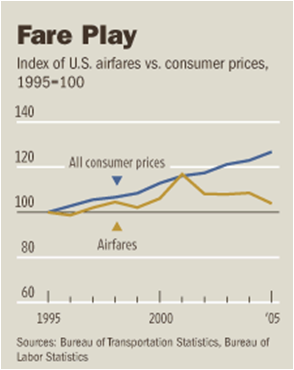
With American Airlines filing for bankruptcy, seem like a good time to dust off a slide I use in my class re: airlines revenue management practices.

My students hear often that I think airlines are pricing masters.

Which begs a question: why is their profitability so low?

Warren Buffett’s answer:

“A great management in that business will not necessarily get a great result …

In the airlines, you have a huge amount of capacity … something close to a commodity product with high fixed costs and no marginal costs

Since that extra seat doesn’t cost you anything, the temptation to sell it at a terrible price is overwhelming.”

As a result, inflation-adjusted air fares have been essentially flat for decades.

image

Even extra baggage fees can’t save the day …

>> Latest Posts

Pay for shipping? I don’t think so …

December 1, 2011

TakeAway: Retailers, in an effort to compete online, offer free shipping.  It may hurt their margins, but they hope to make it up in volume.

A few years ago Amazon tested free shipping in the US and cut-rate shipping in the UK.  UK sales increased, but by a far lower percentage than US sales.  Amazon fully implemented free shipping in both the US and UK.

Draw your own conclusion.

* * * * *
Excerpt from WSJ:
“Ship Free or Lose Out”

Traditional retailers are taking the expensive step of offering more free-shipping deals this holiday season, as they seek to lure the growing number of Internet shoppers to their websites and away from online-only rivals, particularly Amazon.com .

Toys “R” Us has made its entire on-line inventory eligible as long as customers spend $49. Similarly, Wal-Mart Stores Inc. has made every consumer-electronics item on its website available for free shipping through Dec. 19 with a minimum $45 purchase. And Best Buy Co. is offering free shipping for every product it offers online, including giant TV sets.

“Free shipping used to be a way to entice customers to your store over another site, but now it’s just the price of entry.”

High shipping costs can turn off customers altogether. Amanda Lordy recently canceled an order for $30 of gourmet cheese because the site was charging $14 for shipping.

Nordstrom., which in August, began offering free shipping and returns on all online orders, estimates that the free shipping cut its gross margin by about 0.15 percentage point.

Amazon, however, is expecting its fourth-quarter sales to jump between 27% and 44%. The company loses more than $1 billion a year in shipping costs. Its operating margin shrank to 0.7% in the third quarter from 3.5% a year earlier as expenses rose 48%.

Edit by ARK

>> Latest Posts