The fiscal pin prick (aka, the “Catastrophic Sequester”) puts this fall’s college football season at risk … at least for the National Champions — the University of Alabama.
Apparently, the only thing that can possibly be cut from the FAA budget are the air traffic controllers at the Tuscaloosa, Alabama airport on Crimson Tide football weekends.
According to Channel 42 WIAT News:
Looming budget cuts from the Federal Aviation Administration could have an impact on the next college football season.
Budget cuts could include eliminating local air traffic controllers at the Tuscaloosa Regional Airport.
We’re told that the airport wouldn’t shut down, but pilots would fly in and out using “visual flight rules” and Birmingham’s air traffic system.
Hundreds of flights come in and out of the Tuscaloosa Airport during the football season.
This development is mind-blowing for a couple of reasons …
An aide to Duncan described it as a “rough back-of-the-envelope calculation,” derived by dividing the average pay and benefits of a teacher — $70,000 — by the amount — $2.8 billion — that needed to be cut in education programs.
But, school districts and states may find many ways to juggle funds or reduce expenses to avoid losing many teachers, which is what has happened during previous periods of financial stress.
Keep in mind that local taxes (i.e. real estate taxes) fund about 90% of teachers. … and, remember that most districts are now bloated with administrators feeding the Federal bear with paper.
Regarding the layoffs already occurring:
The Education Department for days was unable to cough up the name of a single school district where these notices had been delivered.
Then, Duncan appeared before the White House press corps and produced a name — Kanawha County in West Virginia.
But, no one in the county seemed to know what Duncan was talking about, including the education reporters who cover the school district for the Charleston, W.V., newspapers.
“There’s very little sequestration-related panic, at least on the education side of things,” one reporter said.
Our colleague Lyndsey Layton helped unravel the mystery.
She discovered that these were not layoffs, but rather “transfer notices” sent to 104 Title I teachers for reasons unrelated to the sequestration cuts.
In other words, Duncan was peddling a made-up story.
Today, a couple of big Wall Street firms announced another round of cuts:
Citigroup plans to slash 11,000 jobs and close branches worldwide as part of a broad restructuring effort it hopes will save about $1.1 billion in expenses,
JPMorgan Chase became the latest Wall Street firm to scale back in an uncertain economy, announcing plans Tuesday to save $1 billion through various costs cuts and about 4,000 job reductions.
Goldman – which has already let 3,300 employees go worldwide in the past two years – announced another round of layoffs to cut costs by a cool billion dollars
OK, so 3 companies are cutting over $3 billion in expense.
No gnashing of teeth ,,, no “the sky is falling”
Just “times are tough … we’ve gotta do it.”
No so on the Sequester front … apparently the torch has officially been passed from the 12-21-12 Doomsday crowd to Team Obama …
Today was another day of .hysteria … and silly rhetoric.
Allegedly, Obama said that – because of the Sequester – an already closed agency would have to be shuttered.
It started when old Benedict become the first pope in over 600 years to resign.
Before the College of Cardinals could puff out some white smoke, the Italians flocked to the ballot boxes to do some damage.
Headline in the Washington Post: “Berlusconi revives political career in chaotic Italian election”
More from the Post …
“Silvio Berlusconi, the three-time Italian prime minister, onetime cruise ship singer,billionaire playboy and perpetual criminal defendant who was all but counted out of Italian political life when a debt crisis forced his resignation in 2011, shocked the country Monday by shooting back into a position of influence. Even by the chaotic standards of Italian politics, the resurgence of Berlusconi’s People of Liberty party has cast the Italian government into confusion.
It referenced rants on “Steven Brill’s epic cover story for Time on why healthcare costs so much.”
The paragraph that set them off from the Brill article should – according to Business Insider — “legitimately get anyone’s blood boiling.”
By the time Steven D. died at his home in Northern California the following November, he had lived for an additional 11 months. And Alice had collected bills totaling $902,452. The family’s first bill — for $348,000 — which arrived when Steven got home from the Seton Medical Center in Daly City, Calif., was full of all the usual chargemaster profit grabs: $18 each for 88 diabetes-test strips that Amazon sells in boxes of 50 for $27.85; $24 each for 19 niacin pills that are sold in drugstores for about a nickel apiece.
There were also four boxes of sterile gauze pads for $77 each. None of that was considered part of what was provided in return for Seton’s facility charge for the intensive-care unit for two days at $13,225 a day, 12 days in the critical unit at $7,315 a day and one day in a standard room (all of which totaled $120,116 over 15 days). There was also $20,886 for CT scans and $24,251 for lab work.
As for why we can have a system where diabetes-test strips are sold for $18/each in one place, while Amazon sells a box of 50 for $27.85, see this, great piece by Sarah Kliff on the lack of price controls in the US.
My opinion: Apparently these guys have never heard of “absorption costing” or bothered to really ask “why is healthcare so costly?”
A simple analysis … and interesting historical perspective.
========
These days — with conventional mortgage rates running about 4% — a $1,000 monthly Principle & Interest (P&I) payment gets you a 30-year loan of about $210,000.
Assuming a 10% downpayment, that’s a $235,000 home.
IMPORTANT: That doesn’t take into account real estate taxes (usually between 1% and 1.5% of a homes value) … or insurance (a grand or two annually) … that are usually added to your monthly payment and held by the lender in an escrow account.
Here’s a chart that gives you a quick way to estimate the mortgage amount over a range of interest rates … assuming a $1,000 per month P&I payment.
Just take the interest rate that you can get (on the horizontal axis), draw a vertical line, and ricochet it off the blue line to estimate the corresponding mortgage amount.
Of course, as interest rates go up, the corresponding mortgage amount goes down.
If you’ve got a budget bigger than $1,000 per month, just divide your budget by 1,000 and multiply times the mortgage amount corresponding to the $1,000 payment charted above.
For example, if your monthly P&I budget is $2,000, just double the mortgage amount on the chart …. $210,000 (@4%) times 2 gets a $420,000 mortgage … which gets a $465,000 house, assuming a 10% down payment.
=========
The 30-year trend in “how much house?” is pretty interesting …
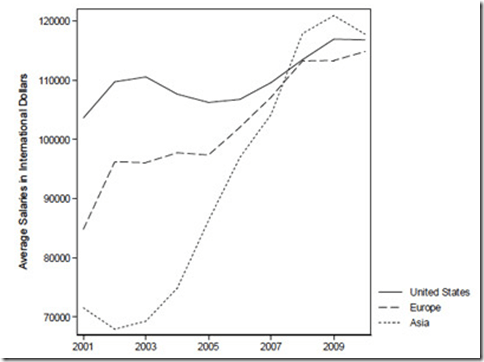
MBA grads pay at business schools in Europe and Asia increased dramatically in the past couple of years.
Adjusted for local purchasing power, European and Asian MBAs have essentially caught up to U.S. MBAs.
To avoid distortions between countries, the pay levels are stated in “international dollars” that have been adjusted for purchasing power parity.
The researchers attributed the pay growth in Europe to the growing demand for MBAs in Europe and the geographic proximity of highly ranked European programs to the key labor markets they serve.
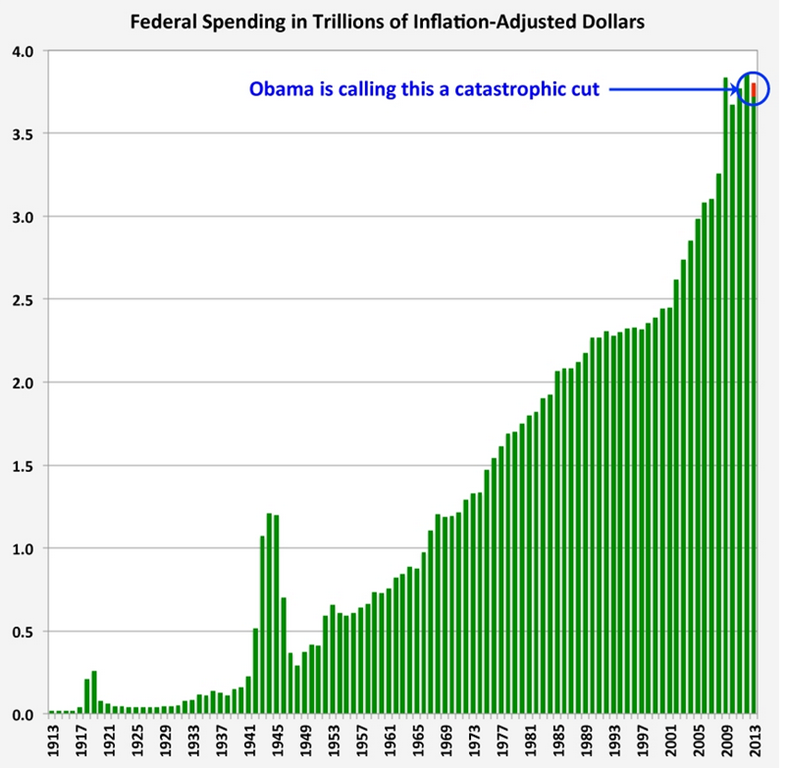
Sequestration will cut less than 3% of Federal spending … about the amount that was granted to Hurricane Sandy states in the whisk of a pen.
Still, President Obama had to broadcast dire consequences in front of a group of firemen … who will have to be laid off, probably causing small children to die in fires.
The chart plots the level of the Federal minimum wage against the number of percentage points that the teenage unemployment rate is over the all-inclusive unemployment rate.
Implicitly, the analysis assumes that the bulk of minimum wage jobs go to teens … and, measuring the differential (instead of the gross rate) normalizes to the overall state of the economy.
The conclusion is stark: when you raise the minimum wage you lose jobs.
Period.
But, some folks argue that economic life is better for the minimum wagers who retain their jobs.
Marker’s Mark Bourbon may have made the single dumbest marketing decision ever.
They decided to stretch short supplies of Maker’s Mark by diluting it … by literally adding water.
The company must have been inspired by either:
(a) millions of teenage boys who replenished their dad’s whiskey bottle by adding water after taking a swig, or
(b) Chris Rock’s hilarious minute-long bit on ‘Tussin … which is guaranteed to make you chuckle.
.
If you run out of ‘Tussin, no problem.
Just put some water in the bottle and shake it up.
Just like that … mo’ ‘Tussin … mo’ ‘Tussin
* * * * * OK, back to the Maker’s Mark story …
By now everybody has probably heard that Maker’s Mark bourbon got themselves into a bit of a mess.
The primary cause: runaway sales.
Why’s that a problem?
Well, bourbon whiskey takes a few years to age … and a couple of years ago, Maker’s Mark management bet the under on future demand and didn’t start enough MM flowing through the distilling process.
So, Maker’s Mark can’t meet the market demand.
They can ramp up production, but the new brew won’t be ready for 6 years.
So, what did the jabrones decide to do … and why is it a problem?
When I was a kid, the local school board would biennially warn that football, the band, the honors program and hot lunches would be cut unless a levy was passed to boost real estate taxes.
I remember that – even as a kid – it sounded like a bunch of bull.
Sometimes the levies passed. Sometimes they didn’t.
Regardless of the vote, the stadium lights still glowed bright on Friday nights, the smart kids still got their honors courses, and the cafeteria kept serving up hot slop.
Today’s equivalent of football, band, honors and lunches is Obama’s dire warning that there will be dire consequences if sequestration happens.
Just for openers, the White House says it has no choice but to put the following on the chopping block:
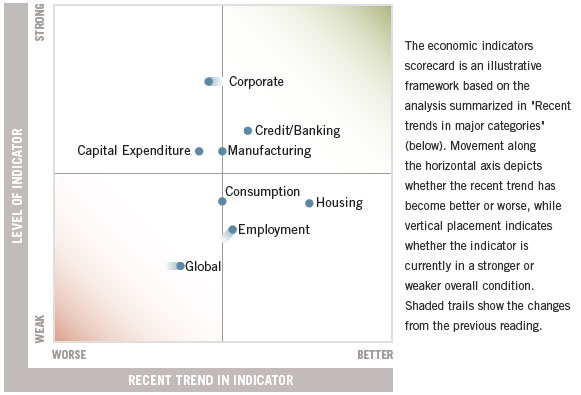
On the horizontal axis is the trend of the variable – getting better or getting worse.
For example, housing is low, but the trajectory is good..
Capital expenditures are fair to midling … with a weak trend.
Overall, Fidelity’s view is fairly good.
Draw your own conclusions … for the individual variables and the gestalt.
* * * * * Position in the Business Cycle
Another Fidelity chart depicts a typical business cycle in stages – recovery, expansion, and contraction … and plots their view of where the U.S. economy is now.
First, I have to admit that I was part of the vast majority of Americans who didn’t watch Obama’s State of the Union address this week.
About 37.75 million viewers watched President Obama’s 2012 State of the Union address, which was aired live across 14 broadcast and cable networks.
That was down 12% from last year’s speech, and down 21% from Obama’s first State of the Union in 2010.
No, I wasn’t watching the LA police torch Christopher Dorner.
I was watching a Castle re-run … and, proud of it.
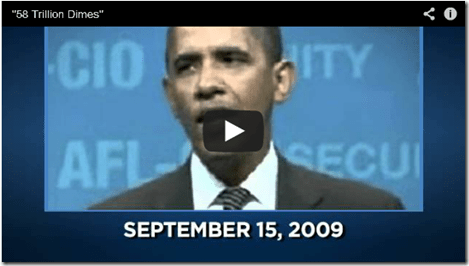
I am a bit disappointed that I missed Obama refrain his signature line that his free-spending on a smorgasbord of whacky programs “won’t add one dime to the deficit”
Yeah, right.
The GOP was quick to pounce with a commercial showing Obama spin that whopper several time over the years.
In the old days, I didn’t know that the Girl Scouts mission was building “courage, confidence, and character”.
I thought that they were just a highly efficient cookie distribution outfit … good marketing, highly effective sales force, and low cost delivery system.
Well, the Girl Scouts aren’t resting on the laurels.
Girl Scouts of the USA has revamped its business approach, taking innovative measures to broaden customer access and overall appeal.
These girls will stop at nothing to make their sale.…
A couple of years ago, behavioral economists Xavier Gabaix and David Laibson wrote a seminal paper on the concept of “price shrouding,” and “information suppression”.
In other words, techniques that make it practically impossible fo a buyer to ascertain the real economic cost of a product.
Here are some of the ways that sellers shroud their prices to flatten your wallet …
Working with celebrities used to be a simple matter.
Marketers would write a big check for a star to perform a specific purpose — for Olympian Mary Lou Retton to grace boxes of Wheaties, or for model Cindy Crawford to don short-shorts and sip Pepsi.
Now, according to AdAge, brands aren’t just featuring celebs in marketing campaigns — they’re giving stars a place in the marketing suite.
Big brand names are going beyond celebrity endorsements and hiring celebs for actual marketing jobs, giving them titles like Brand Manager, Creative Director, and even CMO.
Back about 25 years ago, I was at Black & Decker and my marketing team was on the leading edge of product placements – paying to get our stuff into TV shows and movies.
Our big score was getting Marty to ogle over a Dustbuster in Back to the Future – Part 2.
Now, is iit just me, or is product placement out of control?
ABC, NBC and IFC are taking product placements up a notch in their prime time network shows.
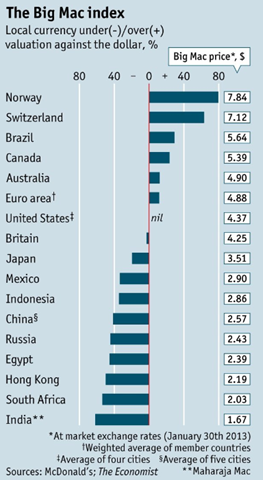
OK, so you have to go to India … it’s technically a Maharaja Mac, not a Big Mac … and, the cheap price is driven by relative currency values.
Still, one of my favorite price indices is the Big Mac Index … it compares the currency adjusted price of the burger across the globe.
According to Ryan Avent, chief economist at The Economist …
The Big Mac index is based on an economic theory called purchasing-power parity (PPP), which indicates that over a long enough time exchange rates should adjust so similar goods cost the same across countries.
The index reveals that, at market exchange rates, the price of the same McDonald’s burger can vary vastly from country to country.
Since psychological studies first began, people have given themselves top marks for most positive traits.
While most people do well at assessing others, they are wildly positive about their own abilities.
The phenomenon is known as illusory superiority.
Illusory superiority is everywhere
In studies, most people overestimate their IQ. For instance, in a classic 1977 study, 94 percent of professors rated themselves above their peer group average.
In another study, 32 percent of the employees of a software company said they performed in the top 5%.
Drivers consistently rate themselves as better than average — even when a test of their hazard perception reveals them to be below par.
Ironically, the most incompetent are also the most likely to overestimate their skills, while the ace performers are more likely to underrate themselves.
Psychologists say the illusory superiority happens for several reasons:
Despite urban legends to the contrary, drinking doesn’t lead to a better night’s sleep.
Having a few drinks may help you fall asleep, but that deep slumber continues for only part of the night.
After that point, getting shut-eye becomes more difficult … and there’s a serious downside.
Researchers analyzed … more than 500 people who drank low, moderate or high amounts of alcohol before going to bed, and underwent testing while they snoozed in a sleep lab.
Boys score as well as or better than girls on most standardized tests, yet they are far less likely to get good grades, take advanced classes or attend college.
Punch line: Studies have shown that executives with military experience are less likely to be involved in fraud.
Students and executives are trying to learn from these leaders through courses taught on a USMC base in Quantico, VA where they face intense ethical challenges.
* * * * * QUANTICO, Va. – Sunlight was filtering through the trees as the team trudged up yet another hill to the final objective of the morning.
The mission was simple. The team was to meet with a local village priest and establish a relationship.
The plan quickly fell apart when the group realized the solemn ceremony they had been invited to was a forced “wedding” in which a bride whose hands were bound by rope was carried screaming into a tent.
Based on BLS reporting, Business and Finance jobs are among the least deadliest professions … except for paper cuts and missed deadline coronaries, there’s not much risk of work-related deaths.
At the other end of the spectrum, “The Deadliest Catch” is on target … fishermen really do have the greatest risk of dying on-the-job.
Oreo’s quick thinking during the infamous Super Bowl blackout generated a spontaneous twitter ad that caught the attention of millions.
Anyone watching the Super Bowl this evening saw a great game — and one of the greatest embarrassments in pro sports history: a power outage that halted play for a full half-hour.
As both teams, tens of thousands inside New Orleans’ Superdome and millions watching on TV waited, Oreo came up with an idea so brilliant and bold that it out and out won the night.
In his book, Priceless: The Myth of Fair Value (and How to Take Advantage of It), author William Poundstone dissects the marketing tricks built into menus—for example, how something as simple as typography can drive you toward or away from that $39 steak.
Here are some on the profit-enhancing menu tricks to watch for …
Many folks are wondering: Why has the stock market continued to steam ahead despite a ho-hum (or humbug) economy?
Source: Council of Economic Advisers
Answer: It’s less a matter of optimism re: a recovery, and more a function of the Fed pouring money into the economy. You know, quantitative easing — QE-infinity.
US US News & World Report says to keep these 10 catch phrases off your cover letter:
1. “I meet the requirements for the position.”Explain why you’re an excellent candidate, not just an adequate one.
2. “I’m hard-working and a great communicator.” These are cliches that cause hiring managers’ eyes to glaze over …and don’t convey anything of substance.
3. “I’m a visionary leader.” Proclaiming this about yourself comes across as, well, weird. Show accomplishments.
4. “You won’t find a candidate better qualified than me.” This comes off as needlessly cocky hyperbole — and it’s generally inaccurate..
5. “Dear sir or madam.” In most industries, this will come across as an antiquated, stuffy salutation. If you know the hiring manager’s name, use it … if not, simply writing “dear hiring manager” is fine.
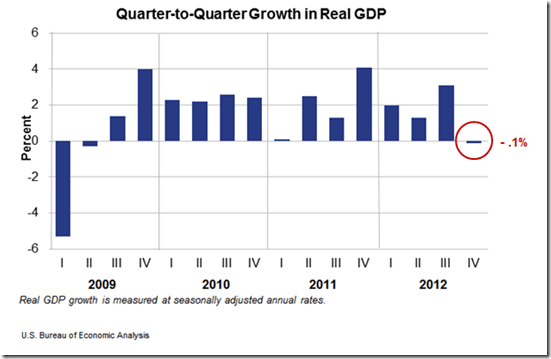
The government reported that the U.S. economy shrank for the first time in more than three years in the fourth quarter of 2012.
Gross domestic product — the broadest measure of goods and services churned out by the economy — fell at a 0.1% annual rate in the fourth quarter of 2012.
The drop, a surprise, was driven by a sharp fall in government spending and by businesses putting fewer goods on warehouse shelves, as well as by a decline in exports.
A one quarter contraction of economic output doesn’t mean the economy is formally in recession, but it is unusual for such contractions to happen in the middle of economic expansions.
In fact, a similar drop has only happened one time in the past fifty years.
Of course, the media bellowed that the number wasn’t as bad as it looked since much of the hit came from a drop in government spending which, incidentally, had surged in the pre-election 3rd quarter.






















 The Homa Files