Adverse selection: Will “adult children” destroy ObamaCare economics?

October 22, 2013

I’ve railed for awhile re: one of ObamaCare’s most popular benefits … forcing insurance companies to allow “adult-children” to be appended to their parents’ health insurance policies.

I wouldn’t mind if they – or more accurately, their parents – were paying for the coverage … but they typically aren’t

All other folks are being forced to pay higher premiums to cover the added costs.

image

Let me explain the economics and tie it to another likely ObamaCare “glitch” …

Read the rest of this entry »

OC eligibility verification: The canary in the coal mine?

October 21, 2013

Let’s see ….

The original ObamaCare law said that an insurance applicant’s eligibility should be verified before they’re granted a Federal premium subsidy.

Sounds easy enough.

But then, out of the blue, President Obama modifies the law on-the-fly with an Executive Order to fugetaboutit..

You know, just go by the honor system.

Hmmm.

Anybody remember the “liar loans” that played a central role in the financial crisis?

Then the budget brouhaha gets settled by reinstating the original law’s requirement that an applicant’s eligibility be verified before a subsidy is granted.

Essentially, eligibility is based on income.

Which led my wife to ask me a question that cuts to the core of the ObamaCare systems issue.

  • Important tech note: It is a “systems issue” and not a “web site issue” as the media likes to call it.  That’s significant, because it’s relatively easy to fix a web site issue with code tweaks … a systems issue is much more challenging … especially if the “system” consists of a bunch of decades-old “batch-based” legacy systems that are cobbled together and asked to operate in real-time.

My wife’s question: “Why is verifying income so hard?

If people have to submit their Social Security numbers when applying for ObamaCare, can’t they just ask the the IRS system how much income the people make ?”

Good question.

image

But, a question that opens up a veritable Pandora’s box. …

Read the rest of this entry »

Redskins: Here’s how to end the flap over your name …

October 18, 2013

Let’s think out-of-the-box and resolve the flap over the Washington Redskins name.

It seems that in every odd number year, there’s a controversy … and pressure is get the Redskins to change their name.

Apparently some folks think the name is offensive to native Americans.

No kidding.

image

Well, I have a creative idea for resolving this bruhaha …

Read the rest of this entry »

Here’s the skinny on ObamaCare premiums …

October 17, 2013

The recent Forbe’s article that we reported on yesterday said that the ObamaCare web site gets bogged down because folks need to enter their private info in order to get a premium quote.

Why?

Forbes (and other pundits) say that the “list price” of the premiums are much higher than people expect … so the Feds want to calculate the ObamaCare subsideis first and quote people a net price … after taking the subsidies into account.

That got me curious.

How much are ObamaCare premiums … and what are the policy terms & conditions re: deductibles, co-pays, etc.?

So, I did some hunting … and, in fact, it takes some hunting.

Best source that I found is a tool developed by the Kaiser Family Foundation (link below).

image

The Kaiser calculator requires just a couple of inputs … no private information.

Here’s what I input: Family of 4, non-smokers, $100K household income.

image

OK, place your bets.

What do think the annual premium would be?

Read the rest of this entry »

What’s the price? … and more tales from the ObamaCare web site.

October 16, 2013

The ObamaCare website and its underlying inter-connected legacy systems are going to be legendary for apparent IT ineptness.

A case study in how not to develop and launch new systems

image

Why isn’t the system able to do the basics?

You know: log people in, tell them the price, sign them up and, oh yeah, keep people’s private information secure.

Some of the problems are structural … what happens when you try to inter-connect old legacy systems … each with a humongous, uniquely-designed database.

Other problems are self-inflicted … either amateurish design or intentional strategic specifications built into the design.

As a recovering systems designer and CIO — and, oh yeah, a pricing prof — here’s my take  ..

Read the rest of this entry »

In praise of tough teachers …

October 15, 2013

My students are likely to cringe at this post which kinda legitimizes my teaching style.

Uh-oh …

=====

According to a recent WSJ article:

The latest findings in fields from music to math to medicine lead to a single, startling conclusion: It’s time to revive old-fashioned education.

Not just traditional but old-fashioned in the sense that so many of us knew as kids, with strict discipline and unyielding demands.

Why?

Because here’s the thing: It works.


image


Of course, that conclusion flies in the face of the kinder, gentler philosophy that has dominated American education over the past few decades.

The conventional wisdom holds that teachers are supposed to tease knowledge out of students, rather than pound it into their heads.

Projects and collaborative learning are applauded; traditional methods like lecturing and memorization — derided as “drill and kill” — are frowned upon, dismissed as a surefire way to suck young minds dry of creativity and motivation.

But the conventional wisdom is wrong.

And the following eight principles explain why …

Read the rest of this entry »

What do colleges have in common with Kohl’s?

October 14, 2013

I oft say that anybody who pays sticker price at Kohl’s should look over their shoulder to make sure that Darwin isn’t chasing them.

Maybe the same should be said of parents who pay list price tuition to fund their kiddies through college.

Lots of talk re: how college costs are soaring.

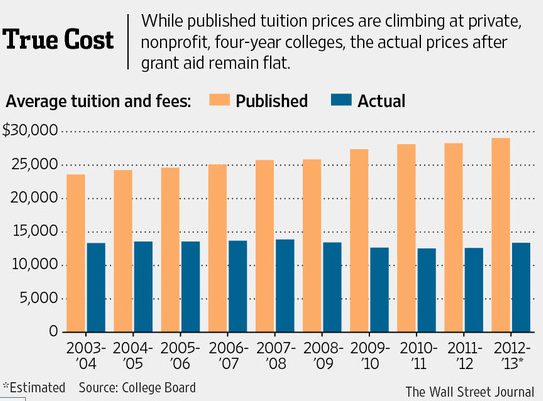
According to the WSJ

Published tuition rates have soared in the last decade, but only a small percentage of families actually pays full freight.

Between grants to needy students and merit scholarships to entice other desirable candidates, schools these days are giving back nearly 50% of gross tuition revenue in the form of aid and awards.

In other words, list prices are going up, but more stuff is being sold at sale prices.


image


Increasingly, colleges are using pricing methods previously the domain of airlines and discount retailers …

Read the rest of this entry »

Will the U.S. default if debt limit isn’t raised?

October 11, 2013

Lots of hysteria re: the debt limit.

Key question: will the U.S. really default on its debt obligations if the debt limit isn’t raised?

Answer: Only if that’s what the Treasury Department wants to do.

Basic facts:

The Treasury receives about $250 billion in tax receipts every month.

Interest on the debt is about $30 billion per month (@ an average interest rate of about 2%)

So, plenty of money to cover interest on the debt.

What’s the rub?

Some calamitists say: “No legal way to prioritize who gets paid.  Gotta pay all obligations.”

Easy answer: Cut the flow of obligations.

As the shutdown is showing, we can tell NASA, HUD, EPA, and Education to stay home for awhile and we won’t miss a beat.

Cut expenses, cut obligations. Easy as that.

But, Business Insider says that the government doesn’t have sophisticated enough computer systems to prioritize the cutting of checks.

If the ObamaCare exchanges are representative, they may be right on that one.

=====

Here’s a clip worth watching.

David Stockman – former OMB head – speaks to the issue … he says default won’t happen.


image

* * * * *
Follow on Twitter @KenHoma               >> Latest Posts

Nums: About the Federal debt limit …

October 10, 2013

Great infographic from CBC News … re: the U.S. Debt limit.

Takeaways below the chart …

image

As commonly known, the debt limit has surged under both Bush and Obama.

The debt to GDP ratio has soared under Obama … after being flat for about 20 years.

Of course, part of the ratio increase is tied to the denominator … the debt has increased faster than the slow economic recovery.

Biggest surprise (to me) is that The “inflection point” – when the debt really started to takeoff was during the Reagan presidency.

So what?

Upward trajectory has to end some day, right?

=====

click to play with the infographic … worth browsing.

 
* * * * *

Follow on Twitter @KenHoma                >> Latest Posts

Hacks: ObamaCare exchanges are “target rich environments” …

October 9, 2013

Couple data points converged for me …

First, loyal readers may remember that  I was an identity theft victim.

Started a couple of weeks after my first e-filing of a tax return to the IRS.

Coincidence?

=====

Being sensitized to the ID theft issue, I noticed a couple of recent articles about “ripe pickings” …

Read the rest of this entry »

Turnabout is fair play … remember “Reconciliation”?

October 8, 2013

I’ve been amused by the Dems squawking about the way that the GOP Congress has linked ObamaCare  to the Budget’s “continuing resolution”.

Foul.  Fight fair. Never done.  Blah-blah-blah.

Here’s the ironic twist …

Remember how Obama Care was passed?


image


To refresh your memory, and see the irony …

Read the rest of this entry »

Nums: How much of the government is actually shut down?

October 7, 2013

Question: in a partial government shutdown, like the one underway at the moment, how much of the government is actually shut down, and how much is not?

Answer: About 17%.shut down; 83% up and running

Details below …

image

Based on estimates drawn from CBO and OMB data, 83 percent of government operations will continue.

This figure assumes that the government pays amounts due on appropriations obligated before the shutdown ($512 billion), spends $225 billion on exempted military and civilian personnel, pays entitlement benefits for those found eligible before the shutdown (about $2 trillion), and pays interest costs when due ($237 billion).

This is about 83 percent of projected 2014 spending of $3.6 trillion.” Source

Hmmm.

And, let’s drill down on who actually got furloughed …

Read the rest of this entry »

Uh-oh: The White House is winning … oh, really?

October 5, 2013

All the pundits are saying that President Obama is winning big as the GOP’s ham-handles the government shut down.

Hmmm.

Apparently the pundits don’t look at the numbers.

On Friday, Obama’s sagging approval ratings dropped to 41% in Gallup’s daily tracking poll.

With a 52% disapproval rating, that puts him 11 points underwater in a poll that generally leans a bit to the left.

image

If you think that Gallup is an outlier, then keep reading …

Read the rest of this entry »

Flambé: Tesla hits phantom steel object and does a Dreamliner …

October 4, 2013

Guess what: Big batteries – when subjected to trauma – catch fire … whether in the air  (787) or on the ground (Tesla).

Earlier this week, a Youtube was posted showing a Tesla on fire.

Audio: “Dude, that’s a brand new car … wow”

click to view

Here are some details …

Read the rest of this entry »

Deja Vu: Anybody remember zero-based budgeting?

October 3, 2013

First, a quick refresher course courtesy of the Government Finance Officers Association (of Canada, that is).

image

When using zero-base budgeting (ZBB), a government builds a budget from the ground up, starting from zero.

There has been renewed interest in ZBB in today’s environment of fiscal constraint, not least because the “zero” in zero-base budgeting sends a powerful message that taxes and spending will be held in check.

Zero-base budgeting, also known simply as ZBB, has had a long …  history in the public sector.

Zero-base budgeting first rose to prominence in government in the 1970s when U.S. President Jimmy Carter promised to balance the federal budget in his first term and reform the federal budgeting system using zero-base budgeting, a system he had used while governor of Georgia.

ZBB, as Carter and budget theorists envisioned it, requires expenditure proposals to compete for funding on an equal basis – starting from zero. In theory, the organization’s entire budget needs to be justified and approved, rather than just the incremental change from the prior year.

Today, there is an apparent resurgent interest in ZBB.

GFOA’s survey shows that traditional budgeting methods, namely line-item and incremental budgeting, have declined in use in the last few years, while all forms of budgeting that are thought to be better adapted to cutting back the budget, not just ZBB, have increased Source

OK, they’re talking about Canada, not the U.S.

Still a couple of takeaways:

1. The process – in government, at least – traces back to Jimmy Carter.

2. Many Canadian governments are using ZBB

3. In Canada, the use of ZBB is increasing

Now. here’s what I think is interesting …


Although they stumbled into it, the GOP may have landed on a masterful plan.

In effect, the GOP’s piecemeal approach to unraveling the government shutdown is nothing more than real-time ZBB.

Think about it for a second.

A week ago the gambit was to fund everything except ObamaCare.

Non-starter, right?

Now, in concept at least, the piecemealing approach allows everything to be funded … except ObamaCare.

Everything that matters – either really or because of political optics – can be quickly restored with short, separate authorization bills.

Anything that’s questionable stays squashed.

Anything that’s essential gets an appropriation,

Eventually everything that’s essential gets funded.

Gee, that sounds like zero-based budgeting, doesn’t it?

* * * * *
Follow on Twitter @KenHoma            >> Latest Posts

Do you think I’m sexy? … My ratings hang in the balance!

October 2, 2013

According to BigThink.com

The website ratemyprofessors.com has students anonymously comment on their professors’ “helpfulness,” “clarity” and “easiness.”

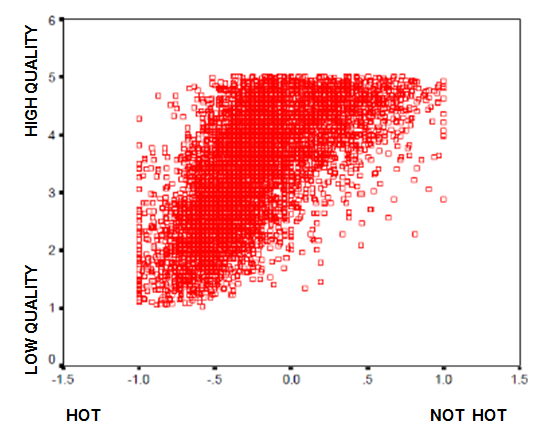
The punctuation point: Raters are asked where the prof is “hot” or “not.”

Four professors from Central Michigan University trolled through the data and wrote a paper examining “Attractiveness, Easiness, and Other Issues: Student Evaluations of Professors on rateMyProfessors.com.”

After conceding that the site is rife with “issues”, the authors dug in and researched the relationship between student perceptions of professor “hotness” and their evaluation of “quality of instruction.”.

Guess what?

A large percentage of American college students consider courses to be high-quality when the professor is attractive..


image


As Gomer Pyle would say: “Surprise, surprise, surprise.”

The only surprise is the magnitude and consistency of the relationship.

Profs that are “not hot” are toast.

The Central Michigan “scholars” also evaluated the relative hotness of profs by discipline …

Read the rest of this entry »

Wharton: Applications down, but ratings soon to increase … at least on the radio

October 1, 2013

Two related articles caught my eye …

First, the WSJ said that “something at Wharton doesn’t add up”.

Applications to the University of Pennsylvania’s business school have declined 12% in the past four years.


image

=====

Of course, Wharton claims that they’re going after quality, not quantity.

Wharton says the decline, combined with a stronger applicant pool and a higher percentage of accepted applicants who enroll, proves that the school is doing a better job targeting candidates.

But business-school experts and b-school applicants say Wharton has lost its luster as students’ interests shift from finance to technology and entrepreneurship.

One non-applicant observed: “Wharton is typecast as the finance school … going to business school isn’t about going into the financial sector any more.”

Some admissions advisers and Wharton professors agree, saying that the school didn’t react aggressively enough when the spigot of finance jobs was turned off.

Even though applications may be down, Wharton’s brand still has drawing power … here’s proof.

Read the rest of this entry »

Naked Bears: The value of a college education …

September 30, 2013

From the “you can’t make this stuff up” file …

There has been a lot of chatter recently re: the value of a college education …  tuitions are up, high paying job are scarce, “adult-children” hang on their parents’ health insurance policies until they’re 26, some move back in with mom and dad.

In these uncertain times, how are college students responding? 


image

Here’s one answer …

Dateline Providence. R.I.: Brown University Students To Host Nudity Week

Read the rest of this entry »

Life: E + R = O

September 27, 2013

OK, I.m a control freak.

There, I said it.

Along the way, somebody passed along a memorable observations:

“You can’t control everything that happens to you, but you can always control the the way you respond to it.”

Fast forward.

A couple of night’s ago, I was watching a replay of the Ohio State Cal game from the prior weekend.

The announcers said that Urban Meyer – OSU’s head coach —   preaches the E+R=O principle to his players … even has them wear wristbands.

image

Say, what?

I ran and googled E+R=O

Answer: Event + Response = Outcome

image

Hmmmm … sounds familiar.

And, there’s more …

Read the rest of this entry »

Big Question Will the iPhone 5 blend?

September 26, 2013

All the hoopla surrounding the iPhone 5 launch reminded me of an ad campaign run by a company called  Blendtec.

According to George Parker of  AdScam ….

At a conference a couple of years ago. GE and their agency, BBDO, made a presentation of their new “Imagination” campaign.

After showing some nice TV spots and explaining that they’d spent $300 million on media over the last year, they proudly declared that brand awareness had increased substantially.

This generated polite applause.

image

Next up was the Marketing Director of blender manufacturer Blendtec who proceeded to blend:

  • a brick
  • some ball bearings
  • an 8 ft garden rake
  • an iPhone

He then put up a single slide showing that every time they posted a self-produced, ten dollar video on YouTube in their long-running “Will It Blend” campaign (which to-date has had more than 220 million views,) sales went up by an accurately measurable percentage.

Understandably, the crowd went nuts.  

The point being, GE spent hundreds of millions and couldn’t quantify with any certainty what they had achieved for all that money.

Blendtec spent pennies and achieved consistently significant and measurable results.

Below is the links to the Blendtec iPhone videos…  worth watching.

Read the rest of this entry »

Decisive action against disability fraud … not by the Feds, by Disney

September 25, 2013

During the recent economic  “recovery”, unemployment rates have started to recede, in part because many folks are leaving the labor force.

Some of the “leavers” are retiring … some are going to college … some are signing up to collect SSDI – Social security Disability Insurance..

There has been a sharp increase in SSDI applications over the past couple of years.

image
Source

Most of the applications are probably legit, with some rise due to increasingly diagnosed bad backs and mental health issues..

But, any reasonable person knows that the rolls are also  increasing due to fraud – folks taking advantage of the program as a substitute for welfare.

What’s the government doing about that?

Nothing, as far as I can tell

But, there are other instances of disability fraud, and one victimized company  has had enough and is cracking down ….

Read the rest of this entry »

Congressional brain drain … say, what?

September 24, 2013

I’ve been meaning to write about this for awhile – and since it’s back in the news, I’ll take my shot.

image


You’ve probably heard that Congress and Congressional staffs – as part of the ObamaCare law – were required to get their health insurance on the newly forming ObamaCare exchanges and give up some of their generous government subsidies.

More specifically:

The ObamaCare Act applied to Congress the same civil-rights employment and labor laws that lawmakers had required everyday citizens to abide by.

With some lapses, it’s worked well to defuse public outrage about “one law for thee, one law for me” congressional behavior.

In 2009, Senator Chuck Grassley decided that the principle deserved to be embedded in Obamacare, and he was able to insert a provision requiring all members of Congress and their staffs to get insurance through the Obamacare health exchanges.

“The more that Congress experiences the laws it passes, the better,” said Grassley.

Most employment lawyers interpreted that to mean that the taxpayer-funded federal health-insurance subsidies dispensed to those on Congress’s payroll — which now range from $5,000 to $11,000 a year — would have to end.

Source

Makes sense to me – make them eat their own cooking.

But, there’s much more to this story …

Read the rest of this entry »

It’s not weird if it works…

September 23, 2013

You’ve seen some of Bud Light’s commercials showing the strange superstitious stuff that people do to “help” their sports teams.

You know, like sit in the same chair to watch games on TV … or eat the same food before every game … or turn their caps around for a rally.

The tagline for the commercials is “It’s only weird if it doesn’t work”.

If you don’t know what I’m talking about, watch this ad.

click to view
 image

======

Well, the Homa family has its own ritual when rooting for our favorites … the Monsters of the Midway … the Chicago Bears.

Read the rest of this entry »

America’s Got Talent … well, kinda.

September 20, 2013

Some loyal readers have asked why HomaFiles has been light on America’s Got Talent reviews this year.

image

Well, to be blunt, I thought it was an awful season. 

That’s bold revelation since I’ve been defending the show to family and friends for a couple of years.

The judges passed through a barrage of horrible acts … including one that consisted of a group of guys playing a fat man’s belly like a drum.

Gimme a break,

I boycotted the show for a couple of weeks, but got siren-called back for the last couple of rounds.

This week was the grand finale.

Here’s the good news: the best performer in the competition – by far – won the million bucks.

Here’s the rub …

Read the rest of this entry »

Why did the stock market hit record highs despite a sluggish economy?

September 19, 2013

Yesterday, the stock market soared when Bernanke announced the continuation of the Fed’s Quantitative Easing program … that is, the Fed plans to continue pumping $85 billion dollars per month into the economy.

stocks surge on Fed action

====

So, why did the market reach record highs?

Easy.

Let’s start by taking a stroll down memory lane ….

Read the rest of this entry »

Want a job? Then learn to crunch nums …

September 18, 2013

McKinsey recently published a report “Big Data – The Next Frontier” that concludes:

The United States faces a shortage of 140,000 to 190,000 people with deep analytical skills as well as 1.5 million managers and analysts to  make decisions based on their findings.

image

Crunch those nums …

>> Latest Posts

Why Right Brainers Will Rule the World …

September 17, 2013

Just finished a book called A whole New Mind: Why Right Brainers Will Rule the World.

As a hard core left-brainer, I figured I’d better pay attention to this one.

=====

Here’s the crux of the book …

The last few decades have belonged to a certain kind of person with a certain kind of mind — computer programmers who could crank code, lawyers who could craft contracts, MBAs who could crunch numbers.

But, the future belongs to a very different kind of person with a very different kind of mind — creators and empathizers, pattern recognizers, and meaning makers.

We are moving from an economy and a society built on the logical, linear, computerlike capabilities of the Information Age …

… to an economy and a society built on the inventive, empathic, big-picture capabilities of what’s rising in its place, the Conceptual Age.

Why the shift?

Because any kind of work that be reduced to repeatable rules and defined processes can be automated or shipped off-shore – even so-called knowledge work

Survival in the Conceptual Age requires thinking skills utilizing the right-side of the brain.

Specifically, “high concept” involves the capacity to:

  • detect patterns and opportunities
  • create artistic and emotional beauty
  • craft a satisfying narrative

…. and to combine seemingly unrelated ideas into something new and distinctive.


image
Amazon link


What’s required to to succeed in Conceptual Age?

Read the rest of this entry »

Nums: Trust in government falls … even lower.

September 16, 2013

Right when you think trust in government has bottomed out, Gallup releases a new poll.

Gallup is reporting  Less than half of Americans trust the government to handle any kind of problems, anall-time low..

According to Gallup. just 49% of Americans have a great deal or fair amount of confidence in the federal government to handle international problems

The previous low was 51 percent in 2007.

image
Source


And, that’s the good news.

Trust is even lower on domestic issues.

Read the rest of this entry »

HITS: Are you left-brained or right-brained?

September 13, 2013

HITS: HomaFiles’s Ideas To Share

For decades cognitive psychologists has characterized folks as being either left brain dominant  – logical – or right brain dominant – creative.

Browse the lists below and pick your dominant brain side – left or right.

image

= = = = = 
So what? What to do?
= = = = =

Read the rest of this entry »

Nums: The state of the housing market in 2 charts …

September 12, 2013

I was a bit surprised to hear on the news that Citi was laying off a couple of thousand folks in their mortgage division.

After all, there’s been lot of talk re: housing recovery …  with some markets el fuego.

Hmmm.

Turns out that mortgage applications bottomed out after the meltdown …and arguably showed some up-trend in the past couple of years (thanks to the Fed QE program),

But,  mortgage apps have declined recently (as interest rates started moving up a bit) and are hovering at very low levels

image

What about home prices?

Read the rest of this entry »

Nums: A world of battling algorithms

September 11, 2013

Yesterday I gave a pitch that touched on whether quants (left-brainers) or poets (right-brainers) were on the rise.

Reminded me of a cool 15 minute TED Talk.

Tech entrepreneur Kevin Slavin tells how algorithms have reached across industries and into every day life.

A couple of lines caught my attention:

  • There are more than 2,000 physicists working on Wall Street developing operational algorithms
  • Massive scale speed trading is dependent on millisecond read & respond rates …
  • So, firms are physically literally locating right next to internet routing hubs to cut transmission times
  • And, of course, there isn’t time for human intervention and control
  • “We may be building whole worlds we don’t really understand, and can’t control.”

Obviously, Slavin comes down on the side of the quants.

Worth listening to this pitch … a very engaging geek who may be onto something big.

* * * * *
Follow on Twitter @KenHoma >> Latest Posts

Ouch: New book smacks McKinsey …

September 10, 2013

McKinsey does a relatively good job of staying out of the press.

But, a book called “The Firm: The Story of McKinsey and Its Secret Influence on American Business,” is being released today that may stir the pot a bit.

Early reviews indicate that the book dishes some serious smack at my former employer.

image

Here are some of the lowlights …

Read the rest of this entry »

Jobs: The story in 3 charts …

September 9, 2013

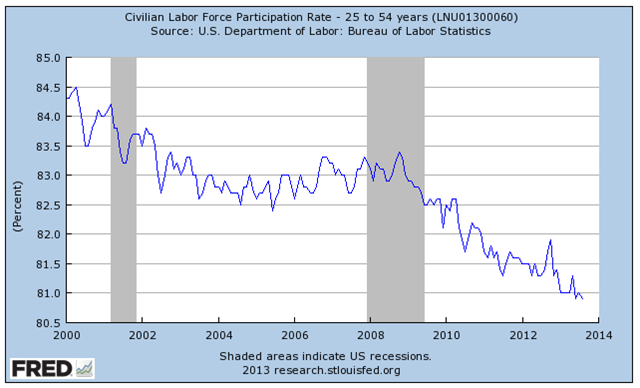
The Feds reported that the unemployment rate dropped to 7.3% … despite tepid job growth – fewer jobs added than expected, and those that were added were in retail & hospitality.

Most analysts quickly pointed out that the unemployment rate dropped because the number of people dropping out of the labor force was about twice the number of jobs added.

In technical jargon, the labor force participation rate dropped to a 35 year low.


image

=====

A complementary metric that combines the effect of the Unemployment Rate and the Labor Force Participation Rate is the Civilian Employment to Population Ratio – the percentage of the working age population that has a job.

That rate dropped about 4 percentage points during the recession … then has flatlined during the “recovery”.

That is, job growth has barely kept up with population growth.


image

=====

What about my favorite?  The downmixing to more part time positions?


Read the rest of this entry »

Nums: Before today’s employment report …

September 6, 2013

Here are some data points in advance of this morning’s BLS Employment Report.

Gallup’s daily tracking report indicated a surge in the unemployment rate … averaging 8.5% … getting as high as 8.8% during the month.


image

Source: Gallup

More data …

Read the rest of this entry »

$$$: Time to move to cash?

September 5, 2013

First, the disclaimers:

1) I don’t give investment advice.

2) I think Jim Cramer is a blowhard.

But …

image

Last week, a friend of mine who seems to have a touch reading the market alerted me that he was moving strongly towards cash … away from stocks … and far away from bonds.

Hmmm.

Cramer must have been listening in.

Here are Cramer’s 7 reasons to move to cash …

Read the rest of this entry »

Trax: Netflix tightens up its algorithms …

September 4, 2013

I bought a new “smart” TV … and it came with a 6-month free subscription to Netflix steaming service.

Sweet.

In concept, the streaming concept is a cool idea, except for:

  1. The “loading” message brings a movie to a halt when the “cache” gets full, needs to be emptied, and more content has to stream in.
  2. The limited streaming library … I thought I’d get access to practically every movie ever made … not so, by a long shot.
  3. The goofy recommendations for what I’d like to view next.

#3 surprised me since Netflix have invested heavily in systems to figure out what we want to to see.

image

Here’s what’s going on and what Netflix is doing about it …

Read the rest of this entry »

Nums: Gov’t Motors slips in consumer satisfaction …

September 3, 2013

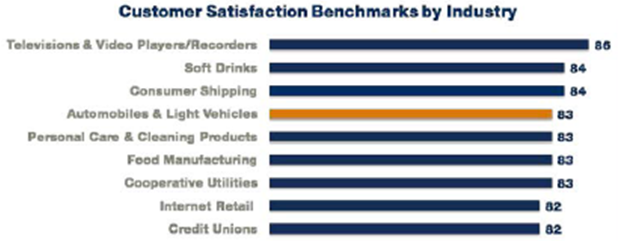
Yesterday, we posted some recent ASCI Customer Satisfaction survey results.

Headline was that overall customer satisfaction numbers have been steadily increasing.

Minor surprise was that autos sorted relatively high on the list.


image
Source

But, there’s more to the story.

Read the rest of this entry »

“The buck stops with the President” … oh, really?

August 30, 2013

Remember Harry Truman’s desk sign that read “The Buck Stops Here”?

Well, it sprang to mind when I read a Washington Post article title: “U.S. Facing Test on Data to Back Action on Syria.


image


What’s that got to do with Harry Truman?

Here’s what caught my eye …

Read the rest of this entry »

Nums: Customers are feeling more satisfied …

August 29, 2013

It has been a couple of years since I glanced at ASCI Customer Satisfaction numbers.

And, I was a bit surprised by the numbers …

During the 1990s, there was a pronounced drop in customer satisfaction … aggregated across all categories of products.

But since 1997, there has been a steady improvement … reaching new historic highs.


image
Source


Here are the details by product category …

Read the rest of this entry »

Nums: Low public support for military action in Syria … and a historical reference point.

August 28, 2013

Recent polls have indicated that there is very low public support for military action against Syria.

Gallup says that 68% of Americans say the United States should not use military action in Syria to attempt to end the civil war there.

image
Gallup

=====

Ditto a Reuters/Ipsos poll that says “Americans strongly oppose U.S. intervention in Syria’s civil war and believe Washington should stay out of the conflict even if reports that Syria’s government used deadly chemicals to attack civilians are confirmed,”

More specifically, “about 60 percent of Americans surveyed said the United States should not intervene in Syria’s civil war, while just 9 percent thought military action should be taken.”

A historical context puts an interesting paint job on these numbers …

Read the rest of this entry »

Even if you’re smart, you might not be logical …

August 26, 2013

Jacked from researchers at the Univ. of Toronto

“Although intelligence as measured by IQ tests is important, so is the ability to think rationally about problems.

The surprise is that less intelligent people usually perform just as well as highly intelligent people on problems that test rationality.”

Below is a question to test if you’re a rational (i.e. logical) thinker … or just smart


image


Question

The XYZ virus causes a disease in one in every 1,000 people.

A test always correctly indicates if a person is infected.

The test has a false-positive rate of five per cent.

In other words, the test wrongly indicates that the XYZ virus is present in five per cent of the cases in which the person does not have the virus.

What is the probability that an individual testing positive actually has the XYZ virus?

Answer  

Read the rest of this entry »

How much does IQ influence business success?

August 23, 2013

According to the latest research, IQ accounts for what portion of career success?

a. 50 to 60 percent

b. 35 to 45 percent

c. 23 to 29 percent

d. 15 to 20 percent


image


The answer …

Read the rest of this entry »

Nums: Gallup says unemployment surging …

August 22, 2013

You may remember that the BLS reported tha, for July,  the unemployment rate continued its decline … all the way down to 7.4%.

image

Good news. right.

Not so fast …

Read the rest of this entry »

Ouch: “Old Professors Never Quit, They Just Hang Around”

August 22, 2013

A real-world colleague of mine used to ask “Where do old marketing people go? I never see any around …”

Hmmm.

Now, Bloomberg has broken the code and I can answer my former colleague:

“They go into teaching … and stay there.”

Now, it’s getting real personal.


image


A survey commissioned by Fidelity (who the heck knows why) reported in the journal Inside Higher Ed found that “some 74 percent of professors aged 49-67 plan to delay retirement past age 65 or never retire at all.”  Never retire at all?

Here’s what’s going on …

Read the rest of this entry »

Bias: How valuable is an “easy A” ?

August 21, 2013

Answer: Real valuable.

Perennial question for Ivy-aimed  high-schoolers is “which is better an A in a regular course or B in an AP course?”

Admission officers always say “Take the AP course and get an A in it”.

Easier said than done sometimes.

Fast forward to college and b-school admissions.

If you want to get into a highly ranked b-school, Is it better to get average grades in hard courses at an academically challenging college …. or high grades in easier courses at an easier or grade-inflated school?


College admissions gameboard


Here’s the answer …

Read the rest of this entry »

Trax: Using casinos’ loyalty systems to ID gambling addicts …

August 20, 2013

Excerpted from the WSJ …

Casinos have developed detailed behavioral profiles of many of their customers, based in part on information gathered though loyalty-card programs that can track slot-machine play and other-gambling activity.

The casinos use this information to tailor marketing offerings, particularly to the small minority who make up the bulk of their revenue base.


image

It’s called predictive analytics, and casinos have been on the leading edge.

Here’s the rub …

Read the rest of this entry »

Ordering a pizza in 2015 …

August 16, 2013

If you’ve been shrugging off the  government spying and control stuff, watch this short video-simulation.

It’s getting personal …

click to view

image

Thanks to ST for feeding the lead …

* * * * *
Follow on Twitter @KenHoma              >> Latest Posts

Trax: How Netflix knows what to recommend …

August 15, 2013

Consider this …

In March, Netflix shipped its 4 billionth DVD.

In the first quarter of 2013 alone, it streamed more than 4 billion hours.

The company estimates that 75 percent of viewer activity is driven by the company’s algorithmic recommendation.


image


Here’s some skinny on how Netflix works the numbers  …

Read the rest of this entry »

Health: Get skinny by sleeping more …

August 14, 2013

The Daily Mail reports that scientists have discovered that sleep deprivation increases cravings for junk food:

  • Sleep deprivation impairs activity in the brain’s frontal lobe
  • This is the part of the brain responsible for complex decision making
  • Lack of sleep increases activity in the centers that respond to rewards
  • This means sleep deprived people are more likely to choose junk food


image

Here’s the skinny on the study…

Read the rest of this entry »

Trax: About your credit score(s) …

August 13, 2013

While most people tend to think that they have one credit score, there are actually many different types of scores.


image

Here are some specifics …

Read the rest of this entry »