The website ratemyprofessors.com has students anonymously comment on their professors’ “helpfulness,” “clarity” and “easiness.”
The punctuation point: Raters are asked where the prof is “hot” or “not.”
Four professors from Central Michigan University trolled through the data and wrote a paper examining “Attractiveness, Easiness, and Other Issues: Student Evaluations of Professors on rateMyProfessors.com.”
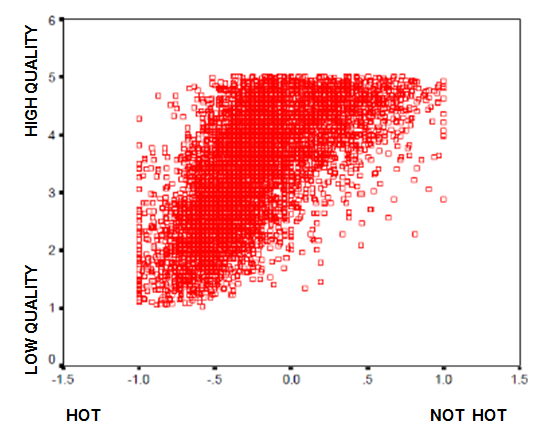
After conceding that the site is rife with “issues”, the authors dug in and researched the relationship between student perceptions of professor “hotness” and their evaluation of “quality of instruction.”.
Guess what?
A large percentage of American college students consider courses to be high-quality when the professor is attractive..
As Gomer Pyle would say: “Surprise, surprise, surprise.”
The only surprise is the magnitude and consistency of the relationship.
Profs that are “not hot” are toast.
The Central Michigan “scholars” also evaluated the relative hotness of profs by discipline …
The College Football Playoff was supposed to end the collegiate National Championship controversy, right?
For openers, let me disclose that I’m an Ohio State fan … raised in Ohio … big brother played for the legendary Woody Hayes … many relatives only wear scarlet & gray.
And, I’m a big Urban Meyer fan … loyal readers see my E + R = O post every couple of months since it’s one of my favs.
So, I was delighted to see the Buckeyes womp Wisconsin (59-0) behind a 3rd string quarterback in his first collegiate start … strip the nation’s leading running back of his Heisman trophy hopes … and, give the CFP selection committee a heavy dose of heartburn.
For years, college sports fans loved to hate the Bowl Championship Series … the system for designating a so-called “National Champion”.
Interesting study on cognitive biases from Daniel Kahneman’s Thinking, Fast and Slow …
Patients undergoing a painful medical procedure – think, colonoscopy without anesthesia – recorded their pain levels during the procedure on a range from no pain (zero) to excruciating (10).
Some of the procedures were short in duration … others were longer.
Below is the pain chart for 2 representative patients.
The patients were asked – after the fact—how painful the procedure was.
What’s your bet? Which patient claimed to have undergone the more painful procedure?
We’re working through predictive analytics in class these days.
So, my eyes are open for articles on the subject.
Predictive analytics.
You know, the stuff that Moneyball got rolling in baseball … and Target popularized by identifying pregnant women before the women knew they were expecting.
Let’s set the stage.
The Washington Redskins have been having (another) rough season.
Veteran sportswriter Tony Kornheiser saysadvanced analytics could save the Redskins…
The punch line to the post was that Chris Rock — a very funny guy — takes his craft very seriously and toils long and hard to test and fine-tune his material.
His routine on the many uses of Robitussin (‘tussin, for short) is a comedy classic.
If you haven’t seen the ‘tussin riff– or want a refresher — click to view it now.
======
Rock homes his skits standing up in comedy clubs … for example, he said he worked the Comedy Cellar for a week prior his recent guest spot on SNL.
In a recent interview, Rock talked about an emerging threat to his practiced work routine …
Last week, Sen. Chuck Schumer caused a stir in Democrat ranks’ by observing that President Barack Obama’s insistence on revamping the healthcare system was, in Schumer’s words, “misguided” and was a major cause of the GOP’s mid-term election romp & stomp.
Schumer is still all for massive healthcare changes.
His observation is strictly political.
His reasoning:
“Democrats were targeting the uninsured, a population that makes up only about 5 percent of registered voters. Only about one-third of the uninsured are registered or eligible to vote.” Source
Schumer’s on the right track, but misses a bigger point: When people are forced to give up something they have, they overvalue the loss and try hard to recoup it.
Think, the higher premiums and changed doctors that millions of folks have had had to endure.
Behavioral theorists have long observed that most people are risk adverse and, due in part to an “endowment effect”, they “value” losses greater than gains.
Endowment Effect: People tend to ascribe a higher value to things that they already own than to comparable things that they don’t own. For example, a car-seller might think his sleek machine is “worth” $10,000 even though credible appraisers say it’s worth $7,500. Sometimes the difference is due to information asymmetry (e.g. the owner knows more about the car’s fine points), but usually it’s just a cognitive bias – the Endowment Effect.
The chart below illustrates the gains & losses concept.
Note that the “value line” is steeper on the losses side of the chart than on the gains side.
L & G are equivalently sized changes from a current position.
The gain (G) generates an increase in value equal to X.
The loss (L) generates a decrease in value that is generally found to be 2 to 3 times an equivalently sized gain
=====
For example, would you take any of these coin flip gambles?
Heads: win $100; Tails: lose $100
Heads: win $150; Tails: lose $100
Heads: win $200; Tails: lose $100
Heads: win $300; Tails: lose $100
Most people pass on #1 and #2, but would hop on #3 and #4.
OK, now let’s show how all of this relates to ObamaCare.
In class, I inadvertently dropped a phrase that revealed either my Midwest roots or my “maturity”, or both.
I referred to something as a “Lucky Strike Extra”.
You know, something out of the normal routine … an added benefit.
Most of the class ignored the comment and some rolled their eyes.
But, one student emailed me:
“I have noticed you use the expression “lucky strike extra” in class — this is an old family favorite (we call extra “freebie” birthday/Christmas gifts lucky strike extras). It is not something that you hear all that often – it inspired some sentiment just in time for the holidays.”
That got me wondering where the phrase originated.
This came in this week in class … subject was “confirmation bias” … how people naturally lock onto beliefs and only seek or notice that aligns with their going-in position.
One of the antidotes is enlisting a so-called devil’s advocate” to keep things honest.
A what?
You know, we’ve all been there …
You’re in meetings pitching an idea when some jabrone pipes in:
“Let me play the role of devil’s advocate …”
He then blasts your idea with half-baked criticisms.
As you aggressively defend your cherished idea, he backs off:
“Hey man, I’m just playing devil’s advocate”.
“Say, what? You mean your just made up those cheap shots?”
I’ve been reading books on decision making this summer.
A couple have praised the use of so-called devil’s advocates to validate ideas and arguments.
I didn’t say it, the New Yorker magazine did, setting off a buzz in the halls of academia.
The theme of the New Yorker article –- titled “Truth Wears Off” –was that most (academic) research was flawed and not able to be replicated. This is, the results were at best true under some special circumstances at a specific point in time, but can’t be replicated. At worst, they’re just plain bull.
Hmmm.
Challenging the integrity of publication-driven academics?
Turns out that the New Yorker wasn’t the first mag on the beat.
Everybody knows that Amazon’s free shipping program has been a resounding success.
So much so. that the company has announced that it will be moving the minimum qualifying order up from $25 to $35 … inducing shoppers to fill their carts fuller or switch to the highly profitable Amazon Prime program.
Excerpted fro WSJ: Why So Many People Can’t Make Decisions
Some people meet, fall in love and get married right away. Others can spend hours in the sock aisle at the department store, weighing the pros and cons of buying a pair of wool argyles instead of cotton striped.
Seeing the world as black and white, in which choices seem clear, or shades of gray can affect people’s path in life, from jobs and relationships to which political candidate they vote for.
The Obama administration on Friday unveiled data showing that many Americans with health insurance bought under the Affordable Care Act could face substantial price increases next year — in some cases as much as 20 percent.
Now, those are exchange premiums so they don’t apply to me.
Still, the headline was shocking enough to make me take a serious look at the premiums that I pay.
Recently referenced in class a book called A whole New Mind: Why Right Brainers Will Rule the World.
As a hard core left-brainer, I figured I’d better pay attention to this one.
=====
Here’s the crux of the book …
The last few decades have belonged to a certain kind of person with a certain kind of mind — computer programmers who could crank code, lawyers who could craft contracts, MBAs who could crunch numbers.
But, the future belongs to a very different kind of person with a very different kind of mind — creators and empathizers, pattern recognizers, and meaning makers.
We are moving from an economy and a society built on the logical, linear, computerlike capabilities of the Information Age …
… to an economy and a society built on the inventive, empathic, big-picture capabilities of what’s rising in its place, the Conceptual Age.
Why the shift?
Because any kind of work that be reduced to repeatable rules and defined processes can be automated or shipped off-shore – even so-called knowledge work
Survival in the Conceptual Age requires thinking skills utilizing the right-side of the brain.
Specifically, “high concept” involves the capacity to:
detect patterns and opportunities
create artistic and emotional beauty
craft a satisfying narrative
…. and to combine seemingly unrelated ideas into something new and distinctive.
Even if you believe that “the end justifies the means”, this has gotta make your skin crawl.
Some background: Prof. Jonathan Gruber is an MIT economist who helped on RomneyCare in Massachusetts and was one of the primary architects of ObamaCare.
He was caught on video speaking quite frankly about the crafting of ObamaCare.
His basic message:
“The bill was written in a tortured way … to be sure that the CBO didn’t score the mandate as a tax … otherwise the bill would die … so, it was written to do that … with regards to the subsides … if people figured out that healthy pay in to give sick people money, it wouldn’t have passed … lack of transparency is a huge political advantage … and basically, call it the stupidity of the American voter or what … that was critical to getting the bill to pass … yeah, it would be better to be transparent, but I’d rather have this law than not.”
Watch the video … it’s even more chilling to hear Prof. Gruber say the words: Obfuscate and bank on American stupidity.
How do these guys sleep at night?
P.S. Another Gruber video will get wide play in the next couple of months.
He’s on tape saying that the specific language in the bill that only provided subsidies for folks going through state exchanges was intentional to motivate states to build exchanges,
Now, ObamaCare supporters are claiming it was just a typo that didn’t represent intent.
Well, the Supreme Court has signed on to settle the matter … with life & death consequence for ObamaCare.
That’s pretty ironic since the Dems were, before the election, boasting about their predictive analytics and their unstoppable get-out-the-vote organization.
I haven’t been hearing much on the news about the GOTV machine that failed to get-out-the-vote.
Lots has been written recently re: the economic value of a college degree.
Let’s boil it down to 3 key charts …
======
First, the cost side of the equation …
Sky-rocketing tuitions are loading students with an enormous amount of post-graduation debt.
While other forms of consumer debt have held relatively constant for the past 10 years, student loans have soared from “only” $200 million in 2004 to over $1 trillion today.
Former darling of the left for having predicted President Obama’s hefty win over Mitt Romney, stats-jock Nate Silver has given his final pre-election prediction:
76% chance that the Republicans take control of the Senate today … with odds trending their way.
Silver’s prediction slides between the high-end Washington Post (97%) and CNN (95%) … and the low-balling New York Times (70%).
That means that there’s a 100% chance that Silver gets neither savant accolades, nor hoot-calls … his prediction is stuck in the middle.
My students are likely to cringe at this post which kinda legitimizes my teaching style.
Uh-oh …
=====
According to a recent WSJ article:
The latest findings in fields from music to math to medicine lead to a single, startling conclusion: It’s time to revive old-fashioned education.
Not just traditional but old-fashioned in the sense that so many of us knew as kids, with strict discipline and unyielding demands.
Why?
Because here’s the thing: It works.
Of course, that conclusion flies in the face of the kinder, gentler philosophy that has dominated American education over the past few decades.
The conventional wisdom holds that teachers are supposed to tease knowledge out of students, rather than pound it into their heads.
Projects and collaborative learning are applauded; traditional methods like lecturing and memorization — derided as “drill and kill” — are frowned upon, dismissed as a surefire way to suck young minds dry of creativity and motivation.
Sometimes I scratch my head and wonder whether “one man, one vote” makes sense.
Polls routinely reveal that a majority of Americans have marginal knowledge of government, politics, and political issues.
Try this: ask folks to explain the difference between the Federal deficit and the Federal debt … ask them where the money money that funds, say unemployment benefits, comes from.
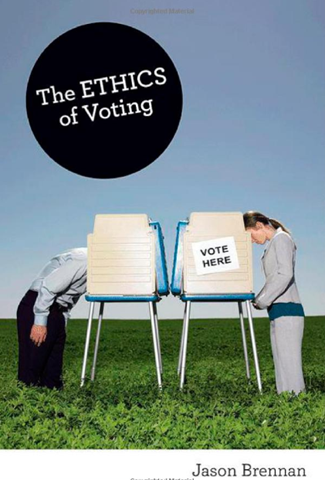
Jason Brennan is a young prof at MSB … his research is at the nexus of ethics and politics.
He has written an insightful book called The Ethics of Voting
I didn’t say it, the New Yorker magazine did, setting off a buzz in the halls of academia.
The theme of the New Yorker article –- titled “Truth Wears Off” –was that most (academic) research was flawed and not able to be replicated. This is, the results were at best true under some special circumstances at a specific point in time, but can’t be replicated. At worst, they’re just plain bull.
Hmmm.
Challenging the integrity of publication-driven academics?
Turns out that the New Yorker wasn’t the first mag on the beat.
Psychology researchers have studied how people make decisions and concluded there are two basic styles.
“Maximizers” like to take their time and weigh a wide range of options—sometimes every possible one—before choosing.
“Satisficers” would rather be fast than thorough; they prefer to quickly choose the option that fills the minimum criteria (the word “satisfice” blends “satisfy” and “suffice”).
“Maximizers are people who want the very best.
Satisficers are people who want good enough,”
Take the quick test below to see if you’re a maximizer or satisficer…. and see what the implications are..
Last week, the NY Times took aim at the Obama-deniers – the Dem Senatorial candidates who wont even admit that they voted for the guy (even though they voted with the guy over 90% of the time).
Specifically, the Times blasted:
But one of the reasons for his unpopularity is that nervous members of his own party have done a poor job of defending his policies over the nearly six years of his presidency, allowing a Republican narrative of failure to take hold.
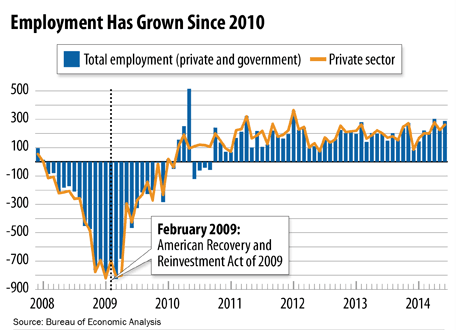
Few voters know that the 2009 stimulus bill contributed heavily to the nation’s economic recovery, saving and creating 2.5 million jobs.
I can nit pick that it should be “recovered” not created … and I could point out that full-time jobs are being replaced with part-time jobs … and I could pile on by mentioning that most of the jobs are in the low pay hospitality and retail industries.
But, I won’t do that, because I want to make another point.
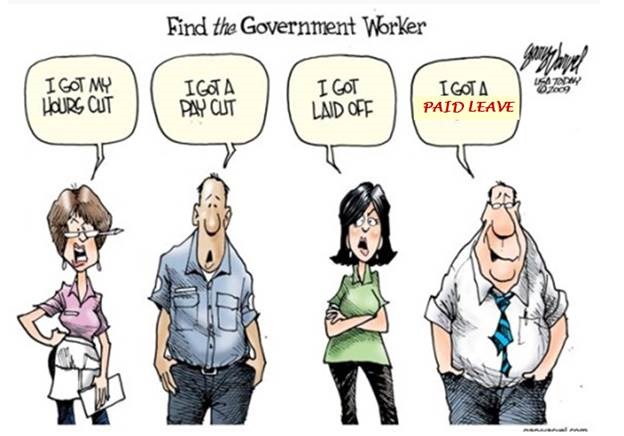
Government records show that tens of thousands of federal workers are being kept on paid leave for at least a month — and often for longer stretches that can reach a year or more — while they wait to be punished for (or cleared of ) misbehavior or are disputing a demotion.
Studies also have shown that voters don’t always remember accurately just who it was they backed before.
Why?
“Voters who defect from their party … are more likely to ‘forget’ this over time and to report a vote more consistent with their current party identification”
“Reports of past vote also correlate with current preferences.”
That’s to say, if the candidate gets elected and disappoints, some voters revise history and claim that they never voted for the bum.
A recent USA TODAY/Suffolk University poll in a half-dozen states with key Senate races underscore the point.
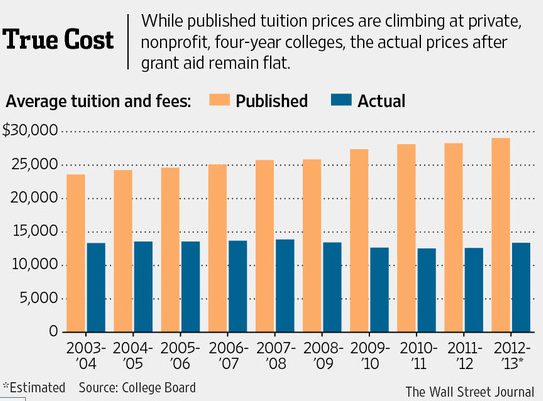
Published tuition rates have soared in the last decade, but only a small percentage of families actually pays full freight.
Between grants to needy students and merit scholarships to entice other desirable candidates, schools these days are giving back nearly 50% of gross tuition revenue in the form of aid and awards.
In other words, list prices are going up, but more stuff is being sold at sale prices.
Increasingly, colleges are using pricing methods previously the domain of airlines and discount retailers …
LinkedIn data mines its rolls, scores the career progress of members in several disciplines, and then ranks schools based on the members’ career progress scores.
In the current ranking, Georgetown’s undergraduate program was ranked #3 in Finance and #1 in Investment Banking.
Last week President Obama another shout-diss to FoxNews as the reason that roughly half of the country’s 300 million population think that he’s not doing such a great job.
Hmmm.
Let’s think about that.
Qualitatively speaking, , no disputing that Fox leans right and pounce’s on the Administration’s frequent miscues.
Quantitatively speaking, the President’s concern seems unfounded.
Fox boasts – with merit – that it outdraws left-leaning CNN and MSNBC combined.
That’s true.
And, top dog O’Reilly draws almost 3.5 million viewers … more than 4 times what best competitor Rachel Maddow draws.
Earlier this week, we looked at one of the no-BS economic measures: household income.
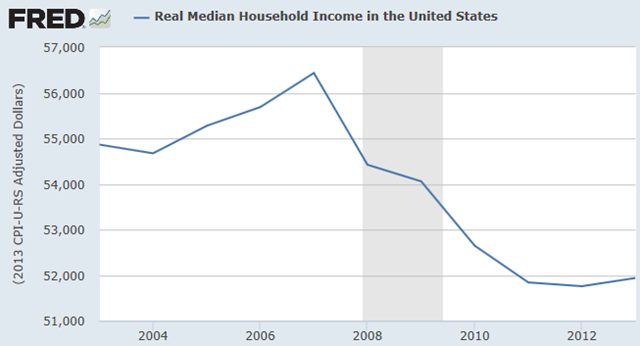
Adjusted for inflation, median household income dropped 8% during the recession … and has been flat after bottoming out a couple of years ago.
That means that the median real household income is still down 8% from the pre-recession peak.
======
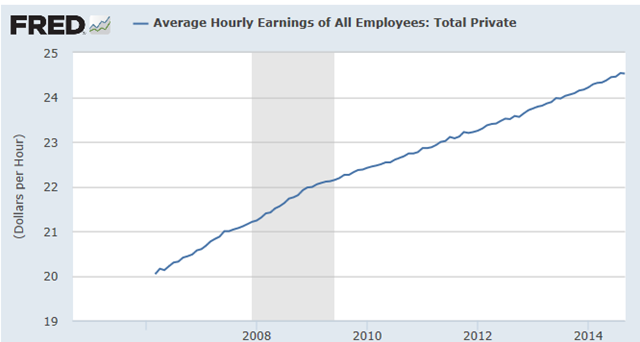
The drop in median household income has come despite a steady increase in average hourly wages … they’re up about 10% since the official end of the recession.
Wash Post had an interesting analysis titled “This graph shows how bad the Fed is at predicting the future
The crux of their argument: the Fed has a clear recent tendency to mis-forecast economic growth … not by a little, by a lot … forecasting almost twice as rapid growth as is ultimately realized.
For example, in 2009 the Fed was predicting 4.2 percent growth in 2011. But then in 2010 it revised that down to 3.85 percent growth. And in 2011 they revised it further to 2.8 percent growth. And when all was said and done, the economy only grew about 2.4 percent that year. The Fed projected growth almost twice as fast as what actually happened.
Lots of end-zone dancing last week re: the economy.
The President says that all indicators are good, and that folks who aren’t feelin’ it just “don’t get it” because they’re watching FoxNews too much.
Say, what?
Let’s look at the ultimate measure: household income.
Adjusted for inflation, median household income dropped 8% during the recession … and has been flat after bottoming out a couple of years ago.
That means that the median real household income is still down 8% from the pre-recession peak.
Hard to get excited about that, right?
======
The drop in median household income has come despite a steady increase in average hourly wages … they’re up about 10% since the official end of the recession.
That’s before inflation, but the Feds keep telling us that inflation is negligible, that shouldn’t matter, right?
======
Let’s see, average wages are going up, but median household income is stalled at a depressed level.
























 The Homa Files