Archive for May, 2012

Betcha he misses this free throw …

May 31, 2012

Punch line: I had a friend who would bet on anything … in a football game it would be who would win the toss, who would score first, whether the next play would gain more or less than 5 yards.

You get the picture.

Well, he must be salivating.

Cantor Fitzgerald — the NY brokerage outfit — is bringing technology and near real-time action to betting.

I guess derivatives weren’t risky enough for these wise guys …

* * * * *
Excerpted from the Washington Post

Cantor Fitzgerald, one of the world’s largest brokers of government bonds, is diversifying —  into sports-gambling.

Equipped with technology drawn from Wall Street and a trader’s appetite for risk, Cantor is charging into sports betting in Las Vegas .

With a $150 million investment, the New York-based bond brokerage has taken control of and retooled seven sports books.

Cantor has also produced wireless tablets so gamblers can bet anywhere in the casino or hotel. Eventually, it wants to start an online poker casino, too.

“The idea is that we can bring  technological innovation to the market.’’

Cantor’s bookmaking software, a modified version of what Wall Street traders use, has changed the way sports gamblers bet.

Cantor says its computer servers, driven by the kind of algorithm-rich software that fuels derivatives trading, spew out odds on events at the fastest rate ever.

Before Cantor ran the sports book, people could usually bet only once, before the game began, on the outcome.

Cantor’s technology allows gamblers to place bets during contests on dozens of situations just seconds before they unfold.

During a Los Angeles Lakers-Boston Celtics game, a betting opportunity pops up on the stations.

It offers a $100 payoff on a $220 wager that the Celtics’ Paul Pierce will sink the two foul shots he’s about to take.

Gamblers bet on Pierce by swiping a finger across the screen.

Pierce sinks both.

Cantor’s big bet is that Congress will allow sports wagering to spread across the country … online, of course..

Thanks to SMH for feeding the lead.

>> Latest Posts

Innovation is hot … especially in b-school mission statements.

May 31, 2012

The WSJ reports that:

An analysis by the Association to Advance Collegiate Schools of Business, an accrediting body, involving 733 member schools, found that 28% include the words “innovate,” “innovation” or “innovative” in their school mission statements.

Most use the terms to describe their own curricula.

Business schools have added research centers, classes and even full-fledged majors in innovation.

But some think the schools may be missing the mark, focusing too heavily on ideation and brainstorming while skimping on the practical aspects of turning ideas into concrete strategy and action.

“Innovation requires taking the great idea and doing something with it.”

So where does it all lead?

As schools race to add innovation to their offerings, they’re also trying to differentiate themselves from one another.

The goal at the Haas School of Business at Berkeley,  is to create managers who can foster innovation or oversee innovative organizations, not just come up with innovative ideas.

“It’s not about producing home-run hitters.”

>> Latest Posts

Perhaps, the sloppiest analysis ever …

May 30, 2012

Well, maybe that’s hyperbole, but it’s certainly a candidate.

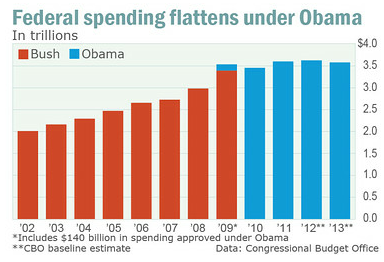
Last week, some jabrone named Rex Nutting blogged in MarketWatch that the “Obama spending binge never happened”.

Nutting cooks some CBO numbers to conclude that “under Obama, federal spending is rising at the slowest pace since Dwight Eisenhower brought the Korean War to an end in the 1950s.”

Oh really?

The crux of his argument is that all the surge in Fed spending occurred in FY2009 — the last year of the Bush presidency.

Barack the Austere has just been treading water.

image

Hmmm.

Apparently Nutting wasn’t aware that Fed fiscal years run from Oct to Sept, so FY2009 was 3/4s Obama … and included about $1 trillion of his Stimulus and bailouts.

So, the real story is that Obama uber-boosted spending to try to stimulate the economy and had has kept spending at that higher level.

Hardly belt tightening.

Nutting’s analysis was so bad that the pro-Obama Washington Post gave it 3 Pinnochios … for “significant factual error and obvious contradictions.”

That didn’t stop the President from repeating the bogus conclusion in his campaign speeches yesterday.

Shame, shame.

P.S. The entire Wash Post fact-checker article is worth reading … an example of a good analysis .. with links to a couple of other pretty good analyses.

>> Latest Posts

No coupons, no customers … the perils of being fair & square.

May 30, 2012

Punch line: JC Penney’s is trying to re-cast itself as the “fair & square” retailer.  So far, the dogs aren’t eating the dog food.  Why? It’s simple behavioral economics. People are predictably irrational.

Personal note: When I was at Black & Decker, we tried to lead the industry out of constant rebating.  You know, $5 back if you mail a receipt, UPC code, etc. to some PO Box in Texas.

When we stopped offering rebates, competitors doubled their’s and ate our lunch.

Penney’s should have asked me …

* * * * *
Excerpted from MSNBC.com

JC Penney’s “Fair & Square” campaign, which launched on Feb. 1, appears to be a disaster.

Revenue dropped 20 percent; customer traffic fell 10 percent; the company lost $163 million in the 1st quarter.

Could we have a moment of silence please for what might be the last heartbeat of honest price tags?

Not only did Penney’s plain pricing structure fail to attract fair-minded shoppers – it “repelled” them.

Apparently, if a firm tries to educate consumers on tricks and traps, and tries to offer an honest product, a funny thing happens: Consumers say, “Thank you for the tips,” and go back to the tricky companies, where they exploit the new knowledge to get cheaper prices, leaving the “honest” firm in the dust.

“Once you educate consumers on the right way to shop, they will seek out the lowest cost store.”

To oversimplify, here’s Penney’s problem.

JCP told the world that retailers only offer their best prices during crazy sales, and Penney stores would no longer host them.

Sensible consumers apparently took that information to heart and decided to simply wait for such sales at other stores.

As an added benefit, Penney lowered consumers’ search costs, because they now knew they didn’t need to bother driving to a Penney’s store anymore.

Penney’s is also leaving a lot of money on the table by rejecting a phenomenon known as “price discrimination.”

Some people have more money than time, and some have more time than money.

Some shoppers don’t mind spending hours to save $20; others would gladly give a store $20 to escape quickly. Smart retailers get money from both.

By killing couponing, Penney has eliminated its ability to satisfy price discriminators.

But the real problem is Penney’s ill-fated attempt to cast itself as the only fair poker player in a game of cheats.

Shoppers just aren’t buying it.

However unsophisticated consumers are, very few of them believe a pair of shoes bought at Penney’s everyday low price will be cheaper than a pair of shoes bought at Macy’s on clearance with a 25 percent off coupon.

>> Latest Posts

More cookin’ the books … giving bad news a positive headline.

May 29, 2012

I smelled this one a couple of weeks ago … and, surprisingly, haven’t heard any pundits nail it.

Each Thursday morning, the BLS reports new unemployment claims.

Here are the headline numbers from the past couple of weeks:

In the week ending April 28, the advance figure for seasonally adjusted initial claims was 365,000.

In the week ending May 5, the advance figure for seasonally adjusted initial claims was 367,000, a decrease of 1,000 from the previous week’s revised figure of 368,000.

In the week ending May 12, the advance figure for seasonally adjusted initial claims was 370,000, unchanged from the previous week’s revised figure of 370,000.

In the week ending May 19, the advance figure for seasonally adjusted initial claims was 370,000, a decrease of 2,000 from the previous week’s revised figure of 372,000.

OK, for 3 weeks running, unemployment claims were unchanged 1 week and declining 2 weeks.

Oh really?

Tabulating the reported data (chart below) reveals a very different trend.

Comparing the so-called advance numbers from month-to-month shows a decline in 2 weeks with 1 week unchanged.

Hmmm.

Comparing the revised numbers from month to month shows a decline in 2 weeks.

Double hmmm.

In other words, in each of the past 3 weeks, the advanced number was low-balled and compared to a number that was revised up.

Changes that coincidently provide positive headlines … for what amounts to be negative news.

Cookin’ the books?

Let’s see what happens in this Thursday’s  & Friday’s unemployment reports. …

image

>> Latest Posts

Tipping point: half of households getting gov’t checks … half paying income taxes.

May 29, 2012

Frequently reported is the stat that only about half of the adults in the U.S. pay any Federal income taxes.

That’s the “revenue” side”.

Now, the WSJ reports that according to recent Census Bureau data, nearly half of the people in the U.S. live in a household that receives at least one government benefit, and many likely received more than one.

The 49.1% of the population in a household that gets benefits is up from 30% in the early 1980s and 44.4% as recently as the third quarter of 2008.

image

First, there are the senior citizens who anted into the pot during their working years:

  • 16% of the population lives in a household where at least one member receives Social Security
  • 15% receive or live with someone who gets Medicare.

Then, there are the poor:

  • 26% had someone enrolled in Medicaid
  • 15% of people lived in a household that received food stamps,
  • 2% had a member receiving unemployment benefits.

Most interesting to me is the low percentage getting unemployment benefits … only about 25% of the unemployed.

>> Latest Posts

A couple of great quotes …

May 25, 2012

Free Stuff
Think Facebook, “free” email services …

“If you’re not paying for something, you’re not the customer; you’re the product being sold”.  Source

* * * * *
The Economic Recovery
Team Obama would like you to think we’ve turned the corner, but…

“Calling our current economic status a recovery is like calling the product of a Kim Kardashian wedding a marriage.”   Source

* * * * *
Obama on Taxes

“Over the past three years, Obama has pursued the goal of higher tax rates as relentlessly as Captain Ahab pursued the great white whale.”  Source

>> Latest Posts

Maybe, the next social media win will be healthcare.

May 25, 2012

Buried as the last of  7 Reasons Why Facebook IPO Was A Bust, Forbes’ writer Rich Karlgaard raised a point that caught my eye:

Mass social media is a crock. It is an inherent contradiction.

I like LinkedIn more than Facebook because it  has a special purpose and therefore doesn’t feel like a time waster.

FWIW, I predict the next huge win in social media will be in health care.

As a health care consumer, I want chat with people who are just like me.

With similar gene structures.

Who suffer from similar maladies as well as the genetic potential for similar maladies.

When linking up with my “health friends” I also want a 100% guarantee that my social network won’t betray my health confidences.

Would I trust Facebook to keep these confidences? Never.

Think about it.

How many times have you Googled for medical advice, e.g. what to do for poison ivy?

And, how many folks have built ad hoc digital support structures when a friend or relative  was facing a tough medical situation?

>> Latest Posts

The difference between average and high achievers …

May 24, 2012

Management guru Tom Peters used to oft say:

“The difference between average and high achievers” is often a factor of not 10, but 1,000”

In Outliers, Malcolm Gladwell asserted:

It takes 10,000 hours of work to become expert in anything.

Chad Syverson, an economist at the University of Chicago’s Booth School of Business, found:

What separates top firms from bottom firms is, typically, a large difference in productivity, with the top firms producing almost twice as much with the same measured input.

Bottom line: it’s easy to be average, hard to be great …

>> Latest Posts

Thanks, Oprah … but, no thanks.

May 24, 2012

Gotta admit that I have never paid much attention to Oprah Winfrey … admired her media success … but it just didn’t matter much to me.

That’s ok, because I’m definitely not in her target market.

But, a couple of articles caught my eye last week.

The first was one of many that broadcast an excerpt from the book “The Amateur” that claimed that Oprah — despite her impactful endorsement of Obama — has been largely shunned by the Obamas.

Why?

Gossipy reports say that Michelle feels threatened by powerful women around Barack, and — according to Oprah herself — “Michelle hates fat people and doesn’t want me waddling around the White House!’

Ouch.

Regardless of cause, nobody seems to dispute that Oprah hasn’t been in view around the White House … or on Obama’s campaign bus.

* * * * *
A second article in the NRO chronicled Oprah’s decline as a mega-media powerhouse.

She’s still a big deal … just not as big as she used to be.

One theory of the case is that lost the hearts of many of her followers when she dissed Hillary — the woman candidate — and endorsed Obama:

Oprah had chosen the less-qualified, less-experienced black man over the more-qualified, more-experienced white woman.

It didn’t take long for Oprah to feel the backlash.

Hell hath no fury like millions of women scorned.

Even the major media outlets couldn’t ignore the firestorm Oprah had ignited by choosing one part of her identity over another.

One ABC News headline said it most plainly: “Women Angry Over Oprah-Obama Campaign.”

Of course, there’s more to the story than that …. Oprah also blew off the mass media networks for her own cable network and Ellen Degeneres caught fire.

Still, an interesting connection, right?

>> Latest Posts

What do Mitt Romney and Steve Jobs have in common?

May 23, 2012

I love the irony when it’s revealed that a villain and a hero are found guilty (innocent?) of similar deeds.

Past couple of weeks, Team O has been pouncing on Mitt & Bain for the evil done by private equity firms.

And, for years, Steve Jobs has been revered for his magic at Apple.

Here’s an interesting snippet from an NRO article: Praise Private Equity

Just months before Romney’s career at Bain Capital became controversial, Americans mourned the death of Apple CEO Steve Jobs.

And yet when Jobs returned to Apple in 1997, Jobs returned as an angel of destruction. He fired over 3,000 employees, a move that helped swing Apple from a $1.05 billion annual loss to a $309 million profit.

He shut down Apple’s manufacturing facilities and outsourced almost every aspect of production.

He swung the axe pitilessly, since he was convinced that survival requires leanness.

And in the 14 years after Jobs returned, employment levels at Apple soared.

Apple’s manufacturing work force was eventually replaced by engineers, support staff, and — in a move that would have surprised many in 1997 — a vast army of retail employees.

The destruction was a prerequisite for the creation, and for the transformation of a wounded technology firm into one of the world’s most valuable public companies.

And, oh yeah, Apple is insanely profitable … and pays no Federal income taxes.

Jobs is good; Romney is bad.

Hmmm …

>> Latest Posts

So, what’s a brand worth?

May 23, 2012

Millward Brown — a brands’ consultancy — has just released its Brand Z 2012 brand rankings and valuations (see chart below and click through for the complete list).

Apple tops their list … followed by IBM, Google, McDonald’s, Microsoft and Coke.

Sounds reasonable … but, according to Ad Age — the list re-opens a can of worms re: brand valuations.

Ad Age cites IBM as a case in point:

According to Brand Z, IBM continues its rise up the brand-valuation hierarchy, leapfrogging Google and rising to No. 2 behind Apple, its value up 15% to nearly $116 billion last year.

Omnicom’s Interbrand also had IBM No. 2 in its brand-valuation ranking released last October, up 8%, but valued Big Blue at just under $70 billion, only about 60 cents on Brand Z’s dollar.

But, the CoreBrand Brand Power ranking released about three weeks earlier, said  the value of IBM’s brand plummeted last year as it fell 18 places to No. 66 on that firm’s list.

Hmmm.

Ad Age says it’s illustrative of a bigger problem:

The IBM case is but an extreme among many disparities the Marketing Accountability Standards Board has found in publicly available valuations of brands.

The MASB  has been trying to develop a common way of measuring what brands are worth and how those values change.

“Many of the valuators treat them as black boxes, so you don’t even know what’s in it.”

So, how much is a brand worth?

* * * * * *

image

>> Latest Posts

Gallup: “National Mood a Drag on Obama’s Re-Election Prospects” … say, what?

May 23, 2012

According to Gallup :

Some six months before voters head to the polls to choose the next president of the United States,

Gallup finds several indicators of the economic and political climate holding steady at levels that could be troublesome for President Barack Obama.

According to Gallup polling in early May, Obama’s approval rating is below 50%, Americans’ satisfaction with the direction of the country is barely above 20%, and the economy remains a dominant concern.

Talk about a juxtaposition of cause & effect …  perhaps, its President Obama who is responsible for the country’s lack of confidence … rather than the lack of confidence causing headwinds for the President.

* * * * *

Side Note

41% of the country was  “satisfied with direction of the U.S.” when Bush was vying for re-election.

image

>> Latest Posts

This prof taught 100,000 students last semester … wow.

May 22, 2012

Thanks to the spread of high-speed wireless technology, high-speed Internet, smartphones, Facebook, the cloud and tablet computers, the world has gone from connected to hyperconnected.

Finally, a generation that has grown up on these technologies is increasingly comfortable learning and interacting with professors through online platforms.

Coursera, a new interactive online education company.hopes to revolutionize higher education by allowing students from all over the world to not only hear his lectures, but to do homework assignments, be graded, receive a certificate for completing the course and use that to get a better job or gain admission to a better school.

Coursera just broke the million enrollments level.

Andrew Ng an associate professor of computer science at Stanford says: “I normally teach 400 students. Last semester I taught 100,000 in an online course on machine learning. To reach that many students I would have had to teach my normal Stanford class for 250 years.”

Source: N.Y. Times

>> Latest Posts

Cookin’ the books … more fishiness in BLS nums.

May 22, 2012

Punch line: The US economy added 130,000 jobs in April … pushing the unemployment rate down to 8.1% since over 350,000 left the labor force.

Hmmm.

* * * * *
First, let’s look at the 130,000:

According to US News & World Report

There is a little-known category of job creation called the birth/death model, a seasonal adjustment in which the Bureau of Labor Statistics (BLS) arbitrarily adds jobs for net new companies it thinks are starting up and creating positions.

Last month, the BLS made the assumption that 206,000 jobs were created in this category based on the companies that it thinks, but really can’t prove, have just started up and essentially are invisible to government labor surveys.

This is an imprecise, controversial guesstimate based on historical extrapolation.

One must be skeptical, since this figure of 206,000 rose from 172,000 in April 2011 despite the obvious decline in economic activity this spring and the general lack of financing for start-up companies.

In other words, 76,000 jobs were lost in “countable” businesses … and 206,000 jobs were added in the “your guess is as good as our/s” category … netting to the reported 130,000 jobs.

Hmmm …

* * * * *
Now, let’s look at the denominator … the 350.000 folks who stopped looking for jobs.

Prior posts have addressed the decline in the labor force participation rate.

One of the reasons offered up for the decline in the labor force participation rate is that that low paying jobs are “under water” compared to unemployment benefits.  Specifically, according to the WSJ, in some high-benefit states women need to earn $30,000 or more to compensate for the benefits they lose if they get a job. Since minimum wage is about $10 per hour and there are about 2,000 hours in a work-year, a minimum wage job pays about $20,000.  So, many folks are making the economically rationale decision to stay home.

Additionally, also according to US News & World Report, the number of people applying for disability benefits has been skyrocketing … apparently,  new stealth welfare program

Last month alone, 225,000 signed up for government=paid disability payments.

That’s up since last year when about 1 million Americans applied for disability.

Since President Obama took office more than three years ago, more than 5 million people have been added to the nation’s disability coverage, costing the government billions upon billions of dollars every year.

“Either the safety standards at work have eroded dramatically or many working people have found a creative way to game the system and turn it into a quasi-welfare state.”

>> Latest Posts

Algorithms are out … exponential technologies are in.

May 21, 2012

Punch line: Despite the hoo[la around Facebook’s IPO, social media is already passé in Silicon Valley.

America’s innovation engine is now focused on transportation, energy and manufacturing.

* * * * * *
A couple of snippets from an editorial in the WSJ : The Future Is More Than Facebook by Rich Karlgaard  of Forbes.

Only a certain kind of company is getting rich in the Obama economy.

These are outfits that make algorithms — bits of software code cleverly strung together to take the form of an iPhone operating system, a LinkedIn social network, or a proprietary trading scheme.

But America can do better than that, and it will. In fact, the seeds are being planted now.

In Silicon Valley, investing in social-media companies is already passé. America’s innovation engine, Silicon Valley, is again overheating.

There’s a growing interest among bright minds to apply “exponential technologies”  to solve problems much larger than whom to friend on Facebook: transportation (smart cars), manufacturing (3-printing), and energy (high-tech horizontal drilling).

Question: If America could have only one of the following — Facebook, Twitter or horizontal drilling — which would be the smarter choice?

Happily, we don’t have to make that choice. America remains the world’s innovator, a country without limits.

>> Latest Posts

Remember the last big IPO? … You know, the one before Facebook

May 21, 2012

Well, Facebook went out at $38 and closed at $38.

The pundits are whining that the IPO was a failure because there wasn’t a big first day pop.

My take: one of the rare times that the IB’s priced a deal at fair market value.

Oh my, “flippers” didn’t get a chance to earn millions by just showing up for work.

Sounds ok to me.

* * * * *
What I didn’t like about the Facebook IPO is that it got most analysts talking about the Government Motors IPO.

Given the chatter, I got curious and checked out the stock price

Oops, down almost 40% from the IPO price …. during a period when the overall market was up over 10%.

image

Geez, since Bin Laden is dead and GM is alive, why the stock dip?

The company claimed record profits of $7.6 billion in 2011, the “highest profits in the 100 year history of that company” according to President Obama.

And, the company paid no Federal income taxes on taxes those record earnings.

Why?

Because New GM came out of bankruptcy “owning” all of the tax loss carry forwards from old GM.

That’s not supposed to be allowed when a company goes through bankruptcy — a deterrent to companies trying to simply buy losses to offset some of their taxable earnings.

How did it happen?

According to several sources:

The Obama administration quietly snuck in a special tax break for GM, which allows the company to write off approximately $45 billion in post-bankruptcy losses against post-bankruptcy profits.

It’s good for twenty years.

The $45 million tax write-off is in addition to the more than $50 billion given to General Motors in the bailout,

>> Latest Posts

Dear Skechers’: “I wore your shoes and my butt’s still humongous. You lied.”

May 18, 2012

Skechers advertised its Shape-ups as a fitness tool designed to promote weight loss and tone muscles with the shoe’s curved “rocker” or rolling bottom — saying it provides natural instability and causes the consumer to “use more energy with every step.”

But, the Feds want you to know that simply sporting a pair of Skechers’ fitness shoes is not going to get you sexy curves or a toned tush.

For millions of consumers,”the only thing that got a workout was their wallet.”

Skechers will pay $40 million to settle charges by the Federal Trade Commission that the footwear company made unfounded claims that its Shape-ups shoes would help people lose weight and strengthen their butt, leg and stomach muscles.

Consumers who bought the shoes will be eligible for refunds, though it’s not clear how much money people will get.

“The FTC’s message, for Skechers and other national advertisers, is to shape up your substantiation or tone down your claims.”

Skechers says it disputes the charges and is pursuing additional studies.

Souce: Yahoo Finance

>> Latest Posts

Senate throws a shutout … Obama’s faux-budget still on the snide.

May 18, 2012

On the wire

For the 2nd year in a row, the Democratic-controlled Senate unanimously rejected President Obama’s budget submission.  This year’s vote: 99 to 0.

Coupled with the House’s rejection in March, 414-0, that means Mr. Obama’s budget has failed to win a single vote in support this year.

Team O had been saying – with a straight face, no less – that the President was offering up a “balanced approach” to begin reining in deficits., even though it It would add $6.4 trillion in new deficits over the next 10 years.

* * * * *

Ken’s Take: Amazing that the county’s CEO and top-lawmaking body are unwilling to develop an operating budget … for the 3rd year in a row. 

No company that I know of operates that way.

>> Latest Posts

Rude awakening: Selling “rags” isn’t as easy as selling iPhones.

May 17, 2012

Punch line: Ron Johnson earned fame by designing Apple Stores.  He was lured to JC Penney to inject some of his merchandising magic.  Johnson immediately set out to remake JCP into Apple Stores: no discounting, corner boutiques, hangout areas.  Based on initial results, it’s safe to conclude that JCP isn’t exactly Apple.  Hot, world class products can make a lot of store formats work … but, apparently, hot store formats can’t make “ordinary” products  explode.

* * * * *
Excerpted from WSJ: Penney’s Stock Plummets on a Big Loss

J.C. Penney CEO Ron Johnson is getting a taste of what it’s like to run a retail operation without world-beating products, and so far it is not pretty.

JCP is in the early stages of a transformation led by Mr. Johnson, the former senior vice president of Apple’s retail operations who took over the retailer last fall.

Mr. Johnson, who won plaudits for reinventing the retail experience with Apple stores’ clean lines and empty space, has laid out an ambitious yet risky plan that involves carving stores into a warren of specialty shops, turning the center selling space into an entertainment and hangout area, and eschewing constant “sales” in favor of lower prices every day.

So far, consumers don’t seem to like the strategy,

Company executives said that weaning of shoppers from their coupon addiction has hurt sales and store traffic more than anticipated.

65% of sales were at full price, but store traffic dropped 10% and average customer spend dropped 5% compared with a year earlier.  

JCP’s quarterly earnings report marked the first time that investors could gauge the impact of the new strategy.

The company missed nearly every financial target it had set for the latest quarter.

The retailer reported a $163 million loss, more than twice what analysts were expecting.

Same-store sales slid 19% … margins narrowed to 37.6% from 40.5%.

Investors whispered to each other about the “bloodbath.” 

Penney’s shares plummeted 13% to around $29 as the company suspended its quarterly dividend and announced that it will not meet its previous annual earnings target.

Fitch Ratings lowered its credit ratings on Penney to junk territory, citing risks of rolling out the new pricing strategy.

The earnings report is a blow to Mr. Johnson, who said  the turnaround has been a lot harder than management expected.

* * * * *
Ken’s Take:

(1) When economic times are tough and daily deals (think Groupon) are the rage, it’s a fool’s mission to try peddling “ordinary” merchandise at list price. You’re just a sitting duck for competitors who will discount off your benchmark price.

(2) Unless you have exclusive, hot products or a substantial competitive cost advantage (think Walmart), everyday low pricing won’t work … you have to provide a lot of shopping “experience” to justify higher prices.

(3) Stop by a JCP store and ask yourself: Are these folks clamoring for a shopping “experience’?  Or, flip the question: Are there a lot of folks who are looking for a shopping experience thinking “let’s rush over to Penney’s”?

>> Latest Posts

Obama: “I was for it before I was against it … but now, I’m for it … unless the polls go against me.”

May 17, 2012

Unless you were on Mars last week, you know that President Obama – inadvertently coaxed by bumbling Joe Biden – announced his support for gay marriage.

Not much surprise there, but the revelation sparked some interesting politics.

Quick out of the chutes, Newsweek – the reliably liberal news mag – hit the stands with a very controversial cover announcing Obama as the first gay president … apparently a play off of Bill Clinton’s old claims that he was the first black president.

My bet: it’ll be the highest selling issue of Newsweek ever … with most of its distribution in early November … used by both the far left left and the far right to rally their bases.

image

* * * * *
Interesting Twist

On the heels of the Newsweek feature article, a New York Times survey reported that 2 of 3 people saw through Obama’s “evolution” as being more politically expedient than morally driven.

image 
* * * * *
The political motives

Consistent with the NY Times survey, the Newsweek article outlined the political rationale:

There was, of course, cold politics behind it.

One in six of Obama’s fundraising bundlers is gay, and he needs gay’s money.

When Obama announced recently that he would not issue an executive order barring antigay discrimination for federal contractors, the gay donors all but threatened to leave him high and dry.

If money was one factor making the move necessary, the youth vote — essential to his demographic coalition and overwhelmingly pro–marriage equality — clinched the logic of it. The under-30s were looking worryingly apathetic, especially compared with 2008. This would fire them back up.

The latest Gallup poll, moreover, offered another incentive.

Marriage equality is now supported by half of Americans in polls.

Independents favor gay marriage by 57 percent.

So it’s been confirmed: gay rights is indeed a wedge issue.

* * * * * *
Another plot twist

Newsweek’s political logic makes sense, except…

The New York Times/CBS News poll indicates that most respondents said that the president’s position (on gay marriage) will not impact how they vote.

But among those who say it will influence their choice, 26 percent said they are less likely to vote for Obama as a result, while 16 percent say they are more likely to.

Hmmm.

Doing the arithmetic, that means a net loss of 5% (25% minus 16% = 10% times 50% = 5%) voting for Obama in what’s generally considered a 50/50 race.

* * * * *
Dissing the media

To close the loop, Obama campaign deputy manager Stephanie Cutter went on MSNBC to dismiss the CBS/New York Times poll as “flawed”.

Note that we cited Newsweek, the NY Times, CBS and MSNBC … not FoxNews or the WSJ …  wow.

Stay tuned, this political saga isn’t over.

>> Latest Posts

GM unfriends Facebook … ouch.

May 16, 2012

              image


According to the WSJ … GM is going to stop advertising on Facebook

General Motors plans to stop advertising on Facebook after the company’s marketing executives determined their paid ads had little impact on consumers’ car purchases.

GM will continue to expand its use of marketing through Facebook’s pages, in which marketers can display content at no cost

The news comes at a bad time for Facebook  which is expected to hold a historic initial public offering on Friday. Facebook executives have spent the last two weeks trying to convince investors that its advertising business makes it worthy of a $105 billion valuation.

GM, started to re-evaluate its Facebook strategy earlier this year after its marketing team began to question the effectiveness of the ads.

GM marketing executives met with Facebook managers to address concerns about the site’s effectiveness and left unconvinced advertising on the website made sense,.

GM spends about $40 million on its Facebook presence. About $10 million of that is paid to Facebook for advertising, the rest covers content created for the site,

Companies in industries from consumer electronics to financial services tell us they’re no longer sure Facebook is the best place to dedicate their social marketing budget — a shocking fact given the site’s dominance among users.”

Although GM’s $10 million worth of ad spend on Facebook won’t impact its $3.7 billion in revenue, the move is a disappointing development for the social network and could hurt if more big advertisers choose to follow suit.

“Disappointing and could hurt” … you think ?

>> Latest Posts

“You PE guys are a bunch of vampires … have any loose change?”

May 16, 2012

Monday was a great  day in the rough & tumble day in the world of presidential politics and candidates’ hypocrisy.

* * * * *
Monday morning

President Obama’s campaign launches an ad, “Steel,” attacking Mitt Romney’s record on job creation.

The two-minute ad focuses on GS Technologies, a steel mill in Kansas City that was bought by Romney’s private equity firm Bain Capital and went bankrupt soon after.

According to the Washington Post, the ad paints Romney as out of touch with the needs of the local workers and concerned only with Bain’s own profits.

“We view Mitt Romney as a job destroyer … a vampire. They came in and sucked the life out of us.”

          click to view
image

* * * * *
Monday afternoon

In rapid response mode, the Romney campaign also released its own web ad, “American Dream,” focused on a successful steel company invested in by Bain:

          click to view
image

* * * * *
Monday evening

According to the Weekly Standard, President Obama attended a fundraiser Monday evening in New York City  hosted by Hamilton E. James, the chief operating officer and president of Blackstone —  “one of the world’s largest private equity fund businesses”

This fundraiser-of-the day had a particular irony to it since earlier in the day Obama criticized private equity investors as vampires.

* * * * *

You just can’t make this stuff up …

>> Latest Posts

“If Martha Stewart was convicted, why no one from Goldman Sachs?”

May 15, 2012

Punch line: Liberals do an excellent job painting conservatives as heartless, greedy villains.  Frank Luntz — right leaning pollster —  fights back with some survey results that debunk some myths about conservatives

* * * * *
Excerpted from the Washington Post: Five myths about conservative voters

Myth #1. Conservatives care most about the size of government.

conservatives don’t want a reduced government so much as one that works better and wastes less.

In a poll we completed among self-identified conservatives just before the 2010 elections,“efficient” and “effective” government clearly beat “less” and “smaller” government.

For conservatives, this debate is less about size than about results, along with a demand that elected officials demonstrate accountability and respect for the taxpayer, regardless of whether they’re spending $1 million or $1 trillion.

Myth #2. Conservatives want to deport all illegal immigrants.

Yes, conservatives want effective border control right away. And more than 80 percent are dissatisfied with America’s immigration system. Conservatives don’t want to round up all the illegal immigrants and deport them.

But, conservatives embrace legal immigration. A solid majority believe that there should be an eventual path to earned legal status.

According to our polling in November, seven in 10 conservatives agree with the following statement: “America’s immigration policy should consist of tall fences and wide gates. We need to aggressively prevent illegal immigration, but let those stay that have worked hard and demonstrated a real, measurable commitment to this country through military or public service.”

Myth #3. They worship Wall Street.

Conservatives are highly critical of Wall Street and wholeheartedly celebrate Main Street.

The business leaders that conservatives respect most are entrepreneurs, not chief executives; conservatives value small-business owners above big bankers.

In a poll conducted early this year, I asked conservatives whom they most trusted to get our country on the right economic track. By nearly two to one, they chose small-business owners over corporate America (only “political leaders” did worse).

Most agree with moderates and liberals that things on Wall Street have gotten out of hand. They believe that those who abuse the system should be held accountable and that those who work hard and play by the rules should be free to advance.

Myth #4. Conservatives want to slash Social Security and Medicare.

Conservatives want the programs strengthened, not dismantled. They know Social Security & Medicare need reform, but they want changes to be effective and reasonable.

Conservatives believe in such simple principles as personal choice and greater competition, and they are more confident than liberals in people’s ability to make the right decisions.

For example, 78 percent agree with the statement: “Increasing patient choice in Medicare will help save Medicare from bankruptcy. When patients can shop for better care . . . it will force insurance companies to compete against each other, which lowers costs and increases care.”

Myth #5. Conservatives don’t care about inequality.

Fully 66 percent of conservatives consider the growing gap between the rich and the poor a “problem,”  while 21 percent call it a “crisis.”

The big difference between left and right is the difference between opportunity and outcome.

Conservatives want to increase opportunity, giving everyone the freedom and tools to prosper, so that the poor may someday become rich.

Liberals want to redistribute income, making the rich — quite simply — less rich.

* * * * *

Bonus Myth. Conservatives don’t want regulations enforced.

Conservatives also believe that we need better enforcement of the regulations we already have, not more rules.

Like all Americans, they are outraged that there hasn’t been a single prosecution by the Obama administration for the corporate abuses that led to the economic meltdown.

As a focus group participant once asked: “If Martha Stewart was convicted, why no one from Goldman Sachs?”

>> Latest Posts

Don’t “Like” Me, Own Me …

May 15, 2012

TakeAway: A new start up is taking “like” to the next level by letting consumers buy company shares via Facebook.

* * * * *

Excerpt from AdAge: “’Like’ the Brand? Loyal3 Wants You to Own the Company”

The idea behind startup Loyal3 is to provide a technology platform for brands to sell their own shares (actually $10 fractions of shares) to consumers on Facebook — a concept CEO Barry Schneider calls “the ultimate ‘like’ button.”

Loyal3 is slated to launch in May with a number of brands hoping to give their fans a chance to own the company.

Edited by ARK

What’s up with women leaving the labor force ?

May 14, 2012

Last week, we were fast out of the blocks posting about the drop in the labor force participation rate: How to make 11% unemployment look like 8.1% 

The essential points raised:

  • Since President Obama was inaugurated, the U.S. working age population has increased by roughly 8 million people.
  • During that same period the U.S. labor force – folks either holding or looking for jobs – stayed roughly constant at about 154 million.
  • So, it arithmetically follows that the labor force participation rate declined … from about 66% to 63.5%

Here’s the money chart from last week’s post:

 image

* * * * *
The long view

Some analysts have seized on the fact that  324,000 Women Dropped Out of Labor Force in Last Two Months.

Are women really leaving the labor force in droves? ?

Let’s start with the long view:

Back in 1960, women’s labor force participation rate was below 40%.

Over the next 40 years, it bumped up about a point a year, hitting 60% in 2000.

The demographics are well known.  More women chose to pursue careers and some families needed 2-wage earners in the family in order to make financial ends meet.

image

* * * * *
The Shorter View

But, the long view masks what’s been happening the past couple of years.

Let’s shorten the time frame back to only 1990, and increase the granularity of the charting scale.

During the Clinton Era, women’s labor force participation rates continued to climb at the historical rate and reached a historical peak a bit above 60%

The participation rate fell back slightly during the eight Bush years … from 60% to about 59.5%

During the 3+ years since Obama’s inauguration, the women’s labor force participation rate dropped 2 points from 59.5 to 57.5%

Hmmm.

image

* * * * *

So, what’s going on?

Pundits are serving up a few explanations:

1. The labor market has absorbed the historically pent up supply of women wanting to work and able to find jobs.

2. Some women have discovered what many me have know for centuries – work often isn’t as fulfilling and rewarding as it’s made out to be.

3. Some women have done the math and figured out that compensation levels are sometimes inadequate to fully cover the costs of work clothes, commuting, child care, etc.

4. As government benefits have increased, some women at the lower rungs of the economic ladder have concluded that they’re better off not employed than to take a low paying job. 

Regarding the last pint, according to the WSJ, in some high-benefit states women need to earn $30,000 or more to compensate for the benefits they lose if they get a job.

Considering that a full-time minimum wage job only pays about $20,000  [ 2,000 hours times $10} …  at least part of the explanation for declining labor force participation rates may be purely rational economics …

>> Latest Posts

Judge says 4 of the 10 Commandments should be tossed … hmmm, which 4 go?

May 11, 2012

A couple of weeks ago – during the clash between Team Obama and the Catholic bishops – some pundits thought that the Catholic Church should change its doctrine re: contraception because its position lacked popular support.

Hopping on that idea, HomaFiles asked: How about a referendum on the 10 Commandments ?

OK, the Catholic bishops are still pushing back on the ObamaCare mandate that church-affiliated organizations must “violate their consciences” and ante up for contraceptives.

Many pundits are counter-punching the bishops … arguing that they are woefully out-of-touch … that an overwhelming majority of Catholics support contraception.  So, the bishops should get off their soap boxes and ditch the rule.

Interesting angle: subject religious doctrine re: right and wrong  to a popular vote.  If it doesn’t get a majority, chuck it.

Hmmm.

I think the idea has merit.

In fact, I say: why not hold a referendum on the 10 commandments?

Maybe #10 and #7 would fail to get enough votes and it would become legit for me to jack my neighbors big screen TV.

The idea has potential, right?

Think about it.

Which of the 10 would you like to see voted out?

* * * * *
Well, seems a judge in Roanoke thinks we were onto something

Could the Ten Commandments be reduced to six, a federal judge asked Monday.

That unorthodox suggestion was made by Judge Michael Urbanski during oral arguments over whether the display amounts to a governmental endorsement of religion, as alleged in a lawsuit filed by a student at Narrows High School.

After raising many pointed questions about whether the commandments pass legal muster, the judge referred the case to mediation – with a suggestion:

Remove the first four commandments, which are clearly religious in nature, and leave the remaining six, which make more secular commands, such as do not kill or steal.

What remains unclear is whether the county would be willing to make such a move – likely to produce more political turmoil – during future discussions to come from mediation.

Source

Looks like we started something … though, those are the 4 commandments we would chuck.

>> Latest Posts

Disruptive innovation: Apple threatened by skinnied-down challenger.

May 11, 2012

TakeAway: A disruptive innovator in the French Telecom industry is growing market share and inadvertently challenging Apple’s IPhone business model.

* * * * *

Excerpt from Forbes: “Apple’s Business Model Vulnerability, Exposed by a French Upstart”

Free Mobile is up-ending Apple’s prospects in France. Analysts are blaming the firm for driving down iPhone sales by 10% in the past quarter alone.

Free is offering unlimited domestic calls and texts, free calls to many international countries, 3 GB of data, and no contract commitment — all for $25 a month. In exchange, subscribers give up benefits associated with traditional mobile carriers. Free barely advertises, does not invest in proprietary applications; and doesn’t subsidize handsets at all.

image

Free has won nearly 3 million subscribers in its first three months, and the incumbents are facing intense price pressure.

This is a major problem for Apple. People who have to pay the full price for a handset flock to the less expensive, and technically quite solid, Android and Windows offerings.

The iPhone has always been expensive, reliant upon big subsidies from carriers trying to stand out from their competitors.

Edited by ARK

>> Latest Posts

Wake up and smell the coffee … even without the coffee!

May 10, 2012

Takeaway: Dunkin Donuts launches out-of-store sensory experience linking radio ads with a light coffee aroma spray inside commuter busses.

* * * * *

Excerpted from PSFK.com “Dunkin’ Donuts Interactive Bus Ad Sprays The Aroma Of Coffee

image

A South Korean Dunkin’ Donuts campaign is reinventing the traditional radio advertisement using unique technology and the smell of coffee.

The campaign, named, Flavor Radio releases coffee aroma via sound recognition technology.

Each time the Dunkin’ Donuts radio ad was played a light coffee aroma was released using atomizers installed on commuter buses in Seoul.

The aroma has reinforced the sensory connection and experience of the Dunkin’ Donuts brand, and has boosted in-store traffic in South Korea.

In fact, over than 350,000 people experienced the ad during the campaign, leading to number of visitors to the Dunkin’ Donuts stores increasing by 16 percent and sales going up 29 percent.

In-store sensory experience is nothing new to retailers, but now this experience has been taken out of the store and into the streets.

Edit by KJM

>> Latest Posts

NY Times: “An aging rock star” … ouch!

May 10, 2012

The NY Times reported on President Obama’s campaign rallies over the weekend:

The atmosphere at both college  rallies was buoyant and the crowds were sizable, though in Columbus the turnout did not fill the Ohio State University’s 18,300 seat arena.

At times, the rallies had the feeling of a concert by an aging rock star.

A  few supporters were wearing faded “Hope” and Obama 2008 T-shirts, and cheers went up when the president told people to tell their friends that his campaign was “still about hope” and “still about change.”

image

OMG.

And, that’s from the NY Times …

>> Latest Posts

Constitutional Law 101 …

May 9, 2012

Mainstream media missed it, but last week Health and Human Services Secretary Kathleen Sebelius testified before a Congressional committee to rehash her directive that Catholic organization pony up for contraceptives.

Representative Trey Gowdy (R–SC) asked Sebelius to explain the legal basis for what the secretary called an “appropriate balance between respecting religious freedom and increasing access to important preventive services.”

In her responses to subsequent questions, the secretary admitted she was unaware of Supreme Court cases stretching back several decades, in which religious believers’ rights against government intrusion were upheld by the court.

So, Rep. Gowdy schooled her.

It’s worth watching the video of the trainwreck … portions of the transcript are below.

         click to view
image

Excerpted for the Catholic News Agency 

“So, before this rule was promulgated,” Gowdy continued, referring to the federal contraception mandate, “did you read any of the Supreme Court cases on religious liberty?”

“I did not,” Sebelius responded.

The representative proceeded to ask the Health and Human Services secretary whether she was familiar with the outcomes of several cases pitting state interests against religious believers’ claims under the First Amendment.

Sebelius agreed with Gowdy that the state had a “compelling interest in having an educated citizenry.”

“So when a state said, ‘You have to send your children to school until a certain age,’ and a religious group objected because they did not want to send their children to school until that certain age, do you know who won?” he asked. “It went to the Supreme Court.”

The 1970s case, Wisconsin v. Yoder, is considered a landmark in U.S. jurisprudence. Sebelius said she did not know its outcome. “The religious group won,” Gowdy informed her.

“I think the state has a compelling interest in banning animal sacrifice,” he continued. “When a state banned the practice of animal sacrifice and a religious group objected, it went to the Supreme Court. Do you know who won that?”

“I do not, sir,” Sebelius responded. She was again informed that the religious group prevailed, in the 1993 case of Church of Lukumi Babalu Aye v. Hialeah.

“When a religious group objected to having a certain license tag on their cars, it went to the Supreme Court,” Gowdy said, in an apparent reference to the 1976 case of Wooley v. Maynard. “Do you know who won?”

Sebelius said she was unaware of this outcome as well. “The religious group won,” Gowdy told her.

The congressman also noted the Equal Employment Opportunity Commission’s recent 9-0 loss in the Supreme Court. The commission accused a Lutheran church and school of retaliatory firing, but lost the case when all nine justices upheld the school’s right to choose employees on religious grounds.

“So when you say you ‘balanced’ things,” Gowdy said, “can you see why I might be seeking a constitutional balancing, instead of any other kind?”

Ouch …

“Disruptive innovation” … an incomplete idea ?

May 8, 2012

In AMS, we’ve being reading about Clayton Christensen’s theories on disruptive innovation.

For background, see last weeks post disruptive innovation.

This week, Business Week has a feature article on Christensen — focusing on his life values — but also summarizing his research work, including some criticism.

* * * * *
Criticism of Disruptive Innovation

If there has been one knock against Christensen’s theories, it’s that they are better as analysis than as a course of action.

It’s something Christensen and an impressive network of co-authors and collaborators have worked hard to dispel. 

“The theory is more descriptive than prescriptive,” says Larry Keeley, the co-founder of Doblin, a strategic consulting firm in Chicago, who considers Christensen a peer and a friend.

“There are very few robust intellectuals working on innovation, and I don’t mean to take anything away from Clay’s accomplishment when I say this, but …

[the disruption theory] strikes me as an incomplete idea.”

* *  * * *
Christensen on life values:

To understand a company’s strategy, look at what they actually do rather than what they say they do

The same logic applies to one’s life. For example, ambitious people will reliably tell you that family, or being a mother or father, is the most important thing in their lives.

Yet when pressed to choose between racing home to deal with a chaotic pre-bedtime scene and staying another hour at the office to solve a problem, they will usually keep working.

It’s these small, everyday decisions that reveal if you’re following a path to being the best possible spouse and parent.

“If your family matters most to you, when you think about all the choices you’ve made with your time in a week, does your family come out on top?”

Full article

>> Latest Posts

“Unintended consequences” … say, what?

May 8, 2012

There was a report released last week by the House Ways and Means Committee.

It didn’t get much mass media coverage, perhaps, because of its title: “Why ObamaCare Will Force Americans to Lose the Health Care Coverage They Have and Like

The essence of the report: many Fortune 100 companies expected to drop their health insurance plans and, instead, pay the $2,000 per employee ObamaCare “penalty”.

First, the facts:

The House Ways and Means Committee asked for and received, on a confidential basis, information on the cost and coverage of the health insurance plans for the Fortune 100 companies.

In total, the Committee received information from 71 Fortune 100 companies.

In total, the 71 Fortune 100 companies that responded to this inquiry could save an estimated $28.6 billion in 2014 alone by eliminating health insurance coverage for their more than 5.9 million U.S. employees (impacting more than 10.2 million employees and dependents covered by those plans) and instead paying the $2,000 per full-time employee fine created in the Democrats’ health care law.

From 2014 through 2023, these employers could save an astounding $422.4 billion if they took this action.

image

Most (all ?) of the cable and radio pundits were calling big company plans to be an unintended consequence of ObamaCare.

I beg to differ.  I think it’s completely intended.

Thank about it: Team Obama often said that they wanted a “single payer system”.

English translation: everybody gets covered by government administered  health insurance.  Everybody.

So, they put a lowball number on the penalty.

Companies usually pay more than $5,000 per employee … often more … sometimes way more.

It’s a no-brainer for companies to ditch their plans, pay the penalty, and force their employees onto the government program.

But, that’ll make ObamaCare more costly.

How will it get paid for?

Easy, just jack up the ‘per employee’ penalties.

The penalties are already programmed to go to $10,000 in 2024.

What’s to keep them from going even higher?

Answer; nothing.

Now ponder that for a moment

Many (most?) companies will be paying an escalating “headcount tax”.

The more employees they hire, the higher the tax bill.

How do you think that’ll impact the sluggish job growth?

I’m betting it won’t help …

>> Latest Posts

How to make 11% unemployment look like 8.1%

May 7, 2012

President Obama says “The unemployment rate clicked down again in April”.

Proof positive that his economic plan is working.

Not so fast.

Indeed the unemployment rate dropped to 8.1% despite relatively low job growth.

How can that be?

Easy.

The unemployment rate is a fraction: the numerator is the number of unemployed people who are actively looking for work … the denominator is the number of people employed plus the number of people actively looking for work.

Most people implicitly assume that the denominator is staying relatively constant … maybe edging up a bit.

So, they conclude that a drop in the unemployment rate is driven by unemployed people finding jobs.

Not in the Obama recovery.

These days, the unemployment rate is driven more by what’s called the labor force participation rate … the percentage of able bodied people in the population who are either employed or actively looking for work.

The labor force participation rate has tumbled in the past couple of years.

More specifically …

* * * * *

Labor Force

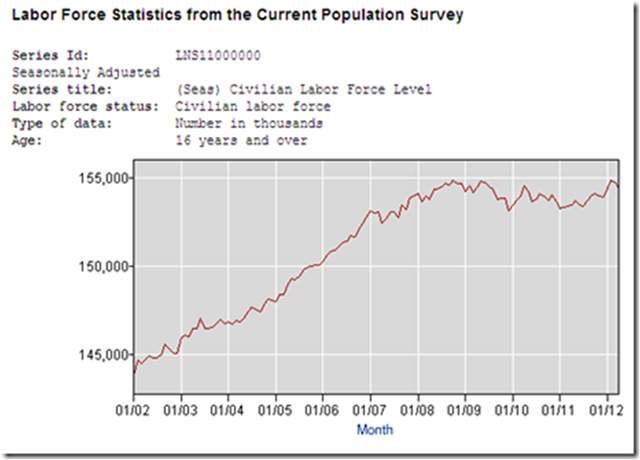
Since January 2009, the U.S. working age population has grown about 8 million, but the labor force has stayed pretty much flat.

image 

* * * * *

Labor Force Participation

While some of the 8 million increase in the working age population since January 2009 may have replaced folks who dropped out of the labor force, the net effect is that the 8 million increase in the working age population didn’t boost the size of the labor force.

Said differently, the labor force participation rate dropped precipitously … from about 66% to 63.5%.

While the labor force participation rate dropped a bit during the Bush years, the decline is – buy and large – a reflection of the “Obama Recovery”.

image

* * * * *

Impact on Unemployment Rate

Let’s put that drop in context:

In January 2009, the labor force participation rate was 65.71%

Since January 2009, the working age population grew by just over 8 million … from 234,738,000 to 242,784,000

If the labor force participation rate had stayed constant from January 2009 until now, there would be 159,522.672 folks in the labor force … not the currently reported 154,365,000

The BLS reported 12.5 million unemployed in April (<= note the “roundness” of the number)

The BLS reported the unemployment rate at 3.1% … 12.5 million divided  by 154.4 million.

If the labor force participation rate was still at the January 2009 level, then the current  unemployment rate would be a whopping 11%. 

Calculation:

159,522.672 minus 154,365,000 equals 5.2 million dropouts from the labor force

12.5 million unemployed plus 5.2 million dropouts = 17.7 million

17.7 million divided by 159,522.672 equals 11%

Those are the top line numbers … in subsequent posts I’ll dive deeper into the numbers and provide some “what’s going on” context

>> Latest Posts

AMS Concept: Disruptive Innovation

May 4, 2012

In every market, there are two trajectories—the pace at which products and services improve and the pace at which customers can utilize the improvements.

Customers’ needs tend to be relatively stable over time, while the offerings improve at a much faster rate.

Therefore, over time, products and services that once were not good enough for the typical customer ultimately pack in more features and functions than the customer can use. These are sustaining innovations. Whether they are simple or breakthrough improvements, they help industry leaders make better products that they can sell for higher profits to their best customers.

Industry leaders—or incumbents—almost always win battles of sustaining innovations, regardless of how technologically challenging they are.

Industry leaders stumble, however, when they face disruptive innovations.

A disruptive product or service is not a breakthrough improvement — in fact, it’s actually not as good as the item the industry leaders are selling. Because of this, existing customers won’t use it, and the leaders ignore it.

But these disruptive innovations are more threatening than industry leaders realize.

They transform complicated and expensive products into simpler and more affordable ones, so they appeal to consumers who previously lacked the money and skill to own and use the leaders’ products.

And little by little, the disruption predictably improves, until the disruptive products serve a much wider audience better and more affordably.

As a result, everyone is better off—except for the disrupted companies.   Consumers abandon more expensive and less accessible old-line products, and the incumbent companies that produced these go out of business.

The dynamics of disruption play out in virtually every industry, from electronics to transportation. The personal computer disrupted mainframes and minicomputers. Southwest disrupted the major airlines. Toyota disrupted the Detroit car companies.

Excerpted from BizEd, “On Innovation”, Clayton Christensen, May / June 2008

>> Latest Posts

Biden coins Obama 2012 campaign slogan, berates donors … and, the dumbest poll question ever.

May 4, 2012

Last week in a major policy address on foreign policy, VP Biden cited a reason to elect President Obama: because he has “a big stick”. 

Say what?

Maybe “Cool with a Big Stick” will  catch on as a replacement for Hope & Change …

     click to view
image

This jabrone  a gift that keeps on giving.

* * * * *
Biden Berates Donors

According to pool press reports:

Vice President Joe Biden berated campaign donors at a fundraiser in Washington D.C.

“I guess what I’m trying to say without boring you too long at breakfast – and you all look dull as hell.

I might add. The dullest audience I have ever spoken to.

Just sitting there, staring at me. Pretend you like me!”

* * * * *
Dumbest Poll Question

While we’re on the topic …

Also last week, the FoxNews poll asked one of the dumbest questions ever:

“Do you approve or disapprove of the job Joe Biden is doing as Vice President?”

The results: a toss-up

 image

My take:

1) Do people have any idea what the “job as Vice President” is?  Not sure that I do …

2) Hard for me to believe that 84% of the people even know who Joe Biden is.

3) Even if they did know what a VP does, and have an opinion re” how well Biden is doing the job … who cares?

Prepping for the jobs report this Friday …

May 3, 2012

A couple of data points …

The BLS weekly new unemployment claims averaged 363,000 in March … they’ve been just short of 390,000 the past couple of weeks.

* * * * *

Challenger  reported an increase in job cuts — vs. last month and vs. same month last year.

U.S.-based employers announced planned job cuts totaling 40,559 during the month of April.

That is a 7.1 percent increase from  job cuts announced in March.

April job cuts were up 11.2 percent from the same month a year ago.

So far this year, employers have announced 183,653 job cuts, 9.8 percent more than the job cuts by this point in 2011.

* * * * *

Gallup’s daily tracking of unemployment has been running between 8.3% and 8.4% for the past week or so.

* * * * *

Yesterday, ADP reported that the private sector added just 119,000 jobs in April

Private-sector employment increased by just 119,000 in April, according a report from ADP that puts a dent into the notion that the jobs market is on the path to a solid recovery.

The report was well below forecasts of 170,000 and comes after a string of stronger numbers.

ADP said service-sector jobs rose by 123,000, but construction fell by 5,000

* * * * *

Let’s see: unemployment claims are up, Gallup says 8.4%, ADP reports a slowing of job growth (below what’s need to keep pace with typical labor market growth).

So, what’ll be the BLS unemployment number?

My bet: the mysterious seasonal adjustments coupled with more discouraged workers no longer looking for work will keep the unemployment rate at 8.2%

We’ll see.

>> Latest Posts

Are you living up to your creative potential? … That’s OK, nobody is.

May 3, 2012

Excerpt from AdAge: “Global Study: 75% of People Think They’re Not Living Up to Creative Potential”

image

More than 75% of people feel that their countries are not living up to their collective potential to be creative.

In the U.S., 52% of respondents described themselves as creative, the highest of all the regions. It was 36% in France and 19% in Japan.

Japan rose to the top as the most creative country, but Japanese respondents themselves didn’t view Japan as the most creative.

Six in 10 people felt that being creative is valuable to their country’s economy, while in the U.S. it was 7 in 10. France was the country with the lowest number of people prizing creativity — 13%.

Indeed, increasing pressure to be productive rather than creative at work in the U.S. and U.K. was 80%, while 85% in France.

Edited by ARK

>> Latest Posts

About that GM success story ….

May 2, 2012

Team Obama is touting the rousing success of GM. 

You know, Bin Laden is dead; the UAW is alive.

Oops, Imeant GM is alive.

Hmmm.  Let’s see …

The original GM stockholders — you know, your grandma and the pension funds — got completely wiped out.

The secured creditors got about 65% of their principal wiped out.

And privileged folks got the opportunity to buy stock in the new GM.

Those share have declined by 30% from the $33 IPO price ,,, a 50 point spread vs, the S&P 500 which increased  20% over the same period.

That’s a loss of about $16 Billion in market cap in about 18 months.

Now, that’s what I call a roaring success … many more successes and we really will be bankrupt.

image

>> Latest Posts

IDEO: Increase your innovation leverage …

May 2, 2012

Punch line: Less scale, extend reach, and more collaboration. IDEO representative explains how companies and individuals can increase their own innovation leverage.

* * * * *
Excerpted from psfk.com, “How Can Companies Be More Innovative?

image

… Recently, psfk.com interviewed Ryan Jacoby  –  who helps clients incubate new businesses, design new offerings, and craft innovation strategies at IDEO.. We asked him to explain how a company or an individual can increase their ‘innovation leverage:’

    Instead of ‘scaling innovation,’ focus on increasing your innovation leverage.

    Scaling innovation often means enabling hundreds or even thousands of individuals within an organization to become more productive participants in the innovation process. While a lofty goal, most organizations aren’t going to transform an organization without years of work and significant investment.

    There are thriving communities and partners out there actively innovating right now. The trick is to tap into that activity. Rather than focusing efforts exclusively on scaling innovation, for some companies I recommend organizations find quick and concrete ways to increase their Innovation Leverage.

    Broadly speaking, you can increase your organization’s Innovation Leverage in two ways:

  •     Extending your organization’s innovation reach: Opening up to a variety of collaborators—internal groups, customers, suppliers, stakeholders, and partners—extending your ecosystem in the process.
  •     Leveraging your reach and newly formed relationships: Smartly utilizing that extended ecosystem, contributing to platforms, inviting collaboration, and doing more in the process with limited investment.

    As the tools and networks evolve, it should get easier and easier to increase innovation leverage. The trick, as always is the case, is for innovators to get their organizations comfortable with the act of opening up and getting feedback on less-than-perfect ideas. The organizations that do will find a wealth of options for them to innovate more, with less.

Edit by KJM
>> Latest Posts

From birth to 9 years old in 2 minutes … man, do kids grow up fast.

May 1, 2012

TakeAway: In such a fast paced life, Danish filmmaker captures his children’s growth through weekly filmings.  This video provides a new spin on the phrase, “kids grow up so fast.”

* * * * *
Excerpted from psfk.com, “Filmmaker Creates Time-Lapse Videos Of His Kids Growing Up

Danish filmmaker, Frans Hofmeester, has a two-minute video that shows his son growing up from birth to nine years old.

He also has a similar video of his daughter where the clip starts off with her as a baby and ends with her at 12 years old.

The two time-lapse videos show the remarkable changes as the children transform from crying babies, to kids with expressive characteristics.

Hofmeester commented that he filmed his children every week. He began with his daughter when he“felt the need to document the way she looked to keep my memories intact.”

His two videos were uploaded last week and have gone viral with more than 4.3 million views combined.

Watch the video below to see Hofmeester’s daughter Lotte grow up from birth to 12 years old in under three minutes.

     click to view
image

Edit by KJM

>> Latest Posts

Is way cool … too cool?

May 1, 2012

Last week, I had an interesting coincidence of events.

First …

I was chatting with an MSB alum who is very active in political circles about the marketing of candidates …. specifically, the impact of advertising.

To paraphrase, he said that relatively few political commercials really break through the clutter and move the needle.

He cited two as commonly regarded success models: Hillary’s “3 a.m. phone call” and McCain’s “Celebrity”.

click to view “3 a.m.”

image 

click to view “Celebrity”

image

* * * * *

Then …

President Obama slow jammed on the Jimmy Fallon Show.

Next day, American Crossroads (a GOP Super PAC) ran a “Celebrity” ad knock-off called “Too Cool”

click to view “Too Cool”

image

* * * * *

Raises an interesting question:

1) Cool move by the President to engage young folks who vote based on “cool”,?

2) Or, did Team Obama hand Team Romney a gift.

Hmmm.

>> Latest Posts