Though he’s been absent from this column for weeks, it’s time to put Donald Trump back in play.
He’s right: Boycott baseball — and the rest of the progressives’ new corporate cancel-culture all-star team, including Patagonia, H&M, Uber, Tripadvisor, Levi’s, Blue Apron, Nordstrom and SoFi.
Why boycott them?
Because their CEOs are treating their customers like compliant saps.
Most of commercial life today revolves around one idea—promoting a company’s “brand.”
The left sees that they can generate 500 hostile social-media posts against a corporate brand over some made-up woke offense.
No dopes, CEOs who have bet their careers on millions in marketing costs, fear that their brands are about to be destroyed by groupthink millennials who all at once will stop drinking Coke or refuse to stream baseball on MLB.TV.
Corporate cowardice is worse than ever.
I suspect the left’s professional activists are as taken aback as anyone at how the middle-aged liberals running big companies and cultural institutions swooned for wokeness. Why so easy?
The logical conclusion:
It’s time for conservatives to organize commercial boycotts …
… to keep pandering CEOs from cavalierly dismissing half of their brand base …
… and to save once-rational liberals from destroying themselves and pulling the rest of us down in the woke vortex.
=============
My take:
Baseball has been losing fans by the droves for a decade or more.
From a marketing perspective, politics aside, I don’t understand why MLB was so quick to give an eye-poke to its mostly white, mostly male, mostly working-class fan base.
I guess that MLB thinks that woke millennials will stem the attendance and TV-viewing slide and flock to America’s slow-paced pastime.
Recent research has indicated the obvious: highlight reels are “in” and couch-watching long, commercial-heavy games is “out”.
So, I’m betting the under on woke millennials saving baseball.
And, I’m betting the over on pissed off fans ditching the high-priced seats and and ungluing from their TV sets.
“Getting the results of a genetic test can be a bit like opening Pandora’s box … you might learn that you’re likely to develop an incurable disease later on in life.”
There’s a federal law that’s supposed to protect people from having their own genes used against them, the Genetic Information Nondiscrimination Act, or GINA.
Under GINA, it’s illegal for health insurers to raise rates or to deny coverage because of someone’s genetic code.
But the law has a loophole: It only applies to health insurance.
Some insurance can be denied or priced high because of a person’s DNA.
All the hoopla surrounding Trump’s announcing Sen. Graham’s cell phone number …. and Graham’s humorous video of ways he tried to remediate the situation by destroying his cell phone … reminded me of an ad campaign run by a company called Blendtec.
At a conference a couple of years ago. GE and their agency, BBDO, made a presentation of their new “Imagination” campaign.
After showing some nice TV spots and explaining that they’d spent $300 million on media over the last year, they proudly declared that brand awareness had increased substantially.
This generated polite applause.
Next up was the Marketing Director of blender manufacturer Blendtec who proceeded to blend:
a brick
some ball bearings
an 8 ft garden rake
an iPhone
He then put up a single slide showing that every time they posted a self-produced, ten dollar video on YouTube in their long-running “Will It Blend” campaign (which to-date has had more than 220 million views,) sales went up by an accurately measurable percentage.
Understandably, the crowd went nuts.
The point being, GE spent hundreds of millions and couldn’t quantify with any certainty what they had achieved for all that money.
Blendtec spent pennies and achieved consistently significant and measurable results.
Below are the links to the Blendtec iPhone videos… worth watching.
Over the weekend, a friend got squeezed on a flight from BWI to LAX.
Not “bumped” … “squeezed” … by a plump plus-sizer overflowing the adjacent seat.
My trim, yoga-inclined friend suggested that I reprise my posts about airlines’ pricing … hoping that the airlines would get the message this time around.
Specifically, I suggested that airlines charge passengers by weight: a base ticket price for the first 175 pounds and then $75 for each 50 pounds (or portion thereof) over the limit.
I thought I was on safe ground since a survey done for the travel website Skyscanner reported that 76% of travelers said airlines should charge overweight passengers more if they didn’t fit in a seat.
But, the idea went over like a lead-butted balloon.
Turns out that, as usual, we were just a bit ahead of the times.
Later, we reported that Samoa Air became the first airline to start charging by the pound.
Now, even politically correcct academicians are hopping on the scale. A Norwegian economist has suggested — in a prestigious academic journal — a “pay what you weigh” pricing plan that “would bring health, financial and environmental dividends.”
At a conference a couple of years ago. GE and their agency, BBDO, made a presentation of their new “Imagination” campaign.
After showing some nice TV spots and explaining that they’d spent $300 million on media over the last year, they proudly declared that brand awareness had increased substantially.
This generated polite applause.
Next up was the Marketing Director of blender manufacturer Blendtec who proceeded to blend:
a brick
some ball bearings
an 8 ft garden rake
an iPhone
He then put up a single slide showing that every time they posted a self-produced, ten dollar video on YouTube in their long-running “Will It Blend” campaign (which to-date has had more than 220 million views,) sales went up by an accurately measurable percentage.
Understandably, the crowd went nuts.
The point being, GE spent hundreds of millions and couldn’t quantify with any certainty what they had achieved for all that money.
Blendtec spent pennies and achieved consistently significant and measurable results.
Below is the links to the Blendtec iPhone videos… worth watching.
“Getting the results of a genetic test can be a bit like opening Pandora’s box … you might learn that you’re likely to develop an incurable disease later on in life.”
There’s a federal law that’s supposed to protect people from having their own genes used against them, the Genetic Information Nondiscrimination Act, or GINA.
Under GINA, it’s illegal for health insurers to raise rates or to deny coverage because of someone’s genetic code.
But the law has a loophole: It only applies to health insurance.
Some insurance can be denied or priced high because of a person’s DNA.
Punch line: Major retailers are customizing online prices for each user, using users’ information (such as location) to determine different prices for identical items. The goal: higher price realization and higher profits.
“Getting the results of a genetic test can be a bit like opening Pandora’s box … you might learn that you’re likely to develop an incurable disease later on in life.”
There’s a federal law that’s supposed to protect people from having their own genes used against them, the Genetic Information Nondiscrimination Act, or GINA.
Under GINA, it’s illegal for health insurers to raise rates or to deny coverage because of someone’s genetic code.
But the law has a loophole: It only applies to health insurance.
Some insurance can be denied or priced high because of a person’s DNA.
At a conference a couple of years ago. GE and their agency, BBDO, made a presentation of their new “Imagination” campaign.
After showing some nice TV spots and explaining that they’d spent $300 million on media over the last year, they proudly declared that brand awareness had increased substantially.
This generated polite applause.
Next up was the Marketing Director of blender manufacturer Blendtec who proceeded to blend:
a brick
some ball bearings
an 8 ft garden rake
a Blackberry donated by a member of the audience
He then put up a single slide showing that every time they posted a self-produced, ten dollar video on YouTube in their long-running “Will It Blend” campaign (which to-date has had more than 220 million views,) sales went up by an accurately measurable percentage.
Harrah’s is a poster child for “predictive analytics” … using hard numbers to make good decisions.
Why then – asks the IO Creative Group of tiny York, PA – did the Las Vegas big boy casinos lose over one billion dollars.
According to IOCG, casinos attendance is up, their hotel stays are up, their night club business is up, restaurant and bar sales are up.
How could their profits be down by one billion dollars???
It is because of their belief that new customers were in order – which attracted a lot more customers who are completely NOT PROFITABLE.
These new Vegas fans sleep all day, party all night and do not gamble. They don’t shop nor do they utilize the services and amenities of the buildings.
Vegas became married to the idea that their money should be invested in attracting new younger, hipper, sexier customers and they achieved that.
What they failed to do was to invest in their current very profitable customers who were actually making them money.
Casinos got caught up in the “shiny object syndrome” — the need to go after something new when their most profitable market was already right in front of them.
When they were going after completely new markets, they should have been further investing in the one they already had.
* * * * * *
IOCG offers up a couple of ways to increase current customer “monetization”:
“Getting the results of a genetic test can be a bit like opening Pandora’s box … you might learn that you’re likely to develop an incurable disease later on in life.”
There’s a federal law that’s supposed to protect people from having their own genes used against them, the Genetic Information Nondiscrimination Act, or GINA.
Under GINA, it’s illegal for health insurers to raise rates or to deny coverage because of someone’s genetic code.
But the law has a loophole: It only applies to health insurance.
Some insurance can be denied or priced high because of a person’s DNA.
Punch line: Major retailers are customizing online prices for each user, using users’ information (such as location) to determine different prices for identical items. The goal”higher price realization and higher profits.
At a conference a couple of years ago. GE and their agency, BBDO, made a presentation of their new “Imagination” campaign.
After showing some nice TV spots and explaining that they’d spent $300 million on media over the last year, they proudly declared that brand awareness had increased substantially.
This generated polite applause.
Next up was the Marketing Director of blender manufacturer Blendtec who proceeded to blend:
a brick
some ball bearings
an 8 ft garden rake
an iPhone
He then put up a single slide showing that every time they posted a self-produced, ten dollar video on YouTube in their long-running “Will It Blend” campaign (which to-date has had more than 220 million views,) sales went up by an accurately measurable percentage.
Understandably, the crowd went nuts.
The point being, GE spent hundreds of millions and couldn’t quantify with any certainty what they had achieved for all that money.
Blendtec spent pennies and achieved consistently significant and measurable results.
Below is the links to the Blendtec iPhone videos… worth watching.
In one svelte move, JC Penney launched near-total, point-by-point repudiation of ex-CEO Ron Johnson’s attempt to turn the retailer into a chain of Apple stores.
Specifically, I suggested that airlines charge passengers by weight: a base ticket price for the first 175 pounds and then $75 for each 50 pounds (or portion thereof) over the limit.
I thought I was on safe ground since a survey done for the travel website Skyscanner reported that 76% of travelers said airlines should charge overweight passengers more if they didn’t fit in a seat.
But, the idea went over like a lead-butted balloon.
Turns out that, as usual, we were just a bit ahead of the times.
Yesterday, we reported that Samoa Air became the first airline to start charging by the pound.
Now, even politically correcct academicians are hopping on the scale. A Norwegian economist has suggested — in a prestigious academic journal — a “pay what you weigh” pricing plan that “would bring health, financial and environmental dividends.”
This week in class we’re doing a a case about a company trying to launch an innovative refrigerated pizza.
Guess this is innovative pizza week.
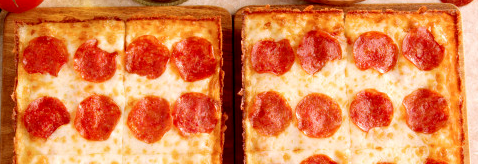
Leading the charge: Little Caesars
According to the Huffington Post, Little Caesars — “more known for value than taste” — is launching a big new “higher end” product called the DEEP! DEEP! Dish pizza.
The new pizza is “Detroit-style” — a thick, square-panned pie that’s crispy on the edges, but has a soft, chewy middle.
No kidding, the company is calling it “the biggest product introduction in the company’s 54-year history.”
Hmmm.
I can remember sucking down Uno’s deep dish in Chicago 40 years ago … and, I was a late-adopter.
I guess that some innovations diffuse through the market at a slower rate than others …
P.S. “Detroit-style pizza” … you gotta be kidding me.
In recent years, airlines nave become masters at “unbundled pricing” … offering a low base fare and then charging more for bags, heavy bags, priority boarding,window seats, bad sandwiches, soft drinks, blankets and, of course, reservation changes.
According to CNN: Baggage fees alone generate more than $3.3 billion each year, and fees for reservation changes add almost $2.5 billion.
Annoying, for sure … but also a good source of revenue.
According to watchdog group ProPublica, colleges are starting to adopt the airlines’ pricing playbook.
Specifically, ProPublica says that student fees have become a kind of “stealth, second tuition imposed on unsuspecting families.”
And though their names can border on the comical — i.e., the “student success fee” — there’s nothing funny about how they can add up.
In one of my classes we study how books are priced.
One team suggested that page count was a relevant criteria … that books with more pages should be priced higher than shorter books.
I summarily rejected the idea and joked at the team’s expense.
Well, the page has turned.
The team went to China and sent me me this picture.
Lo and behold, in China, they encountered book stores that sold books based on their weight.
A counterfeit version of the Steve Jobs biography (above) weighed in at 360 grams, and was priced by weight at 18 RMB ($2.85). Roughly 50 RMB ($8) per kilo.
The team tells me that all paperback books in that particular shop (located on Nanjing road, main street Shanghai) are sold at this rate; hardcovers are also priced by the kilo but at a higher rate.
OK guys, you get the last laugh.
Thanks to Ash Kaluarachchi & Greg Berguig for feeding the lead
Harrah’s is a poster child for “predictive analytics” … using hard numbers to make good decisions.
Why then – asks the IO Creative Group of tiny York, PA – did the Las Vegas big boy casinos lose over one billion dollars.
According to IOCG, casinos attendance is up, their hotel stays are up, their night club business is up, restaurant and bar sales are up.
How could their profits be down by one billion dollars???
It is because of their belief that new customers were in order – which attracted a lot more customers who are completely NOT PROFITABLE.
These new Vegas fans sleep all day, party all night and do not gamble. They don’t shop nor do they utilize the services and amenities of the buildings.
Vegas became married to the idea that their money should be invested in attracting new younger, hipper, sexier customers and they achieved that.
What they failed to do was to invest in their current very profitable customers who were actually making them money.
Casinos got caught up in the “shiny object syndrome” — the need to go after something new when their most profitable market was already right in front of them.
When they were going after completely new markets, they should have been further investing in the one they already had.
* * * * * *
IOCG offers up a couple of ways to increase current customer “monetization”:
Punch line: There’s added pressure for the Hoyas in the Tourney this year.
They have to avoid the unfortunate early losses of past years and go deep into Tournament in order to protect the image of the New Big East (aka. Catholic 7)
Now, Prof. Jonah Berger from Wharton hopes to catch a wave with a new book: Contagious: Why Things Catch On.
Berger says you need 6-elements – or STEPPS – to boost your odds of going viral:
Social currency:, It’s all about people talking about things to make themselves look good, rather than bad
Triggers, which is all about the idea of “top of mind, tip of tongue.” We talk about things that are on the top of our heads.
Ease for emotion: When we care, we share. The more we care about a piece of information or the more we’re feeling physiologically aroused, the more likely we pass something on.
Public: When we can see other people doing something, we’re more likely to imitate it.
Practical value: Basically, it’s the idea of news you can use. We share information to help others, to make them better off.
Stories, or how we share things that are often wrapped up in stories or narratives
On the road this week … savoring the joys of air travel.
Stop #1: Southwest’s curbside check-in.
Guy in front of us had one of those “c’mon man” moments.
His bag weighed in at a couple of pounds over the 50# limit.
The skycap – a very nice guy – explained that he’d have to take a few things out of his bag to sneak under the weight limit or shell out 75 bucks – roughly $25 per pound – for the excess.
The guy started rifling through his bag and made weight.
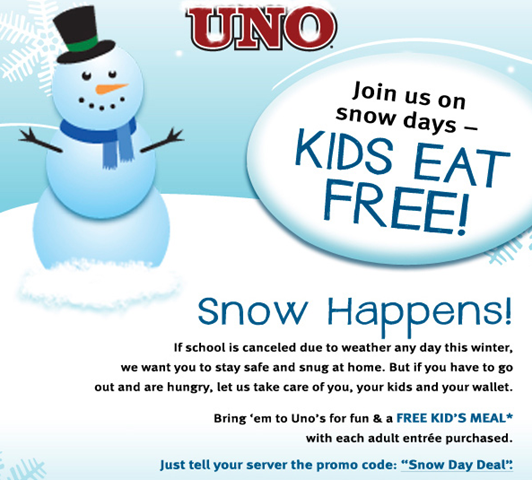
Northern Virginia schools are closed today because of the threat of a snow storm.
So, Pizzeria Uno sent an email announcing a special “Snow Day Deal” … free meals for the school-cancelled kids … (with a matching adult paying full fare, of course).
Question: Wonder if Uno’s will get sued if some jabrone drives off a slippery road coming to score some free chow for his kid?
It referenced rants on “Steven Brill’s epic cover story for Time on why healthcare costs so much.”
The paragraph that set them off from the Brill article should – according to Business Insider — “legitimately get anyone’s blood boiling.”
By the time Steven D. died at his home in Northern California the following November, he had lived for an additional 11 months. And Alice had collected bills totaling $902,452. The family’s first bill — for $348,000 — which arrived when Steven got home from the Seton Medical Center in Daly City, Calif., was full of all the usual chargemaster profit grabs: $18 each for 88 diabetes-test strips that Amazon sells in boxes of 50 for $27.85; $24 each for 19 niacin pills that are sold in drugstores for about a nickel apiece.
There were also four boxes of sterile gauze pads for $77 each. None of that was considered part of what was provided in return for Seton’s facility charge for the intensive-care unit for two days at $13,225 a day, 12 days in the critical unit at $7,315 a day and one day in a standard room (all of which totaled $120,116 over 15 days). There was also $20,886 for CT scans and $24,251 for lab work.
As for why we can have a system where diabetes-test strips are sold for $18/each in one place, while Amazon sells a box of 50 for $27.85, see this, great piece by Sarah Kliff on the lack of price controls in the US.
My opinion: Apparently these guys have never heard of “absorption costing” or bothered to really ask “why is healthcare so costly?”
Marker’s Mark Bourbon may have made the single dumbest marketing decision ever.
They decided to stretch short supplies of Maker’s Mark by diluting it … by literally adding water.
The company must have been inspired by either:
(a) millions of teenage boys who replenished their dad’s whiskey bottle by adding water after taking a swig, or
(b) Chris Rock’s hilarious minute-long bit on ‘Tussin … which is guaranteed to make you chuckle.
.
If you run out of ‘Tussin, no problem.
Just put some water in the bottle and shake it up.
Just like that … mo’ ‘Tussin … mo’ ‘Tussin
* * * * * OK, back to the Maker’s Mark story …
By now everybody has probably heard that Maker’s Mark bourbon got themselves into a bit of a mess.
The primary cause: runaway sales.
Why’s that a problem?
Well, bourbon whiskey takes a few years to age … and a couple of years ago, Maker’s Mark management bet the under on future demand and didn’t start enough MM flowing through the distilling process.
So, Maker’s Mark can’t meet the market demand.
They can ramp up production, but the new brew won’t be ready for 6 years.
So, what did the jabrones decide to do … and why is it a problem?
In the old days, I didn’t know that the Girl Scouts mission was building “courage, confidence, and character”.
I thought that they were just a highly efficient cookie distribution outfit … good marketing, highly effective sales force, and low cost delivery system.
Well, the Girl Scouts aren’t resting on the laurels.
Girl Scouts of the USA has revamped its business approach, taking innovative measures to broaden customer access and overall appeal.
These girls will stop at nothing to make their sale.…
A couple of years ago, behavioral economists Xavier Gabaix and David Laibson wrote a seminal paper on the concept of “price shrouding,” and “information suppression”.
In other words, techniques that make it practically impossible fo a buyer to ascertain the real economic cost of a product.
Here are some of the ways that sellers shroud their prices to flatten your wallet …
Working with celebrities used to be a simple matter.
Marketers would write a big check for a star to perform a specific purpose — for Olympian Mary Lou Retton to grace boxes of Wheaties, or for model Cindy Crawford to don short-shorts and sip Pepsi.
Now, according to AdAge, brands aren’t just featuring celebs in marketing campaigns — they’re giving stars a place in the marketing suite.
Big brand names are going beyond celebrity endorsements and hiring celebs for actual marketing jobs, giving them titles like Brand Manager, Creative Director, and even CMO.
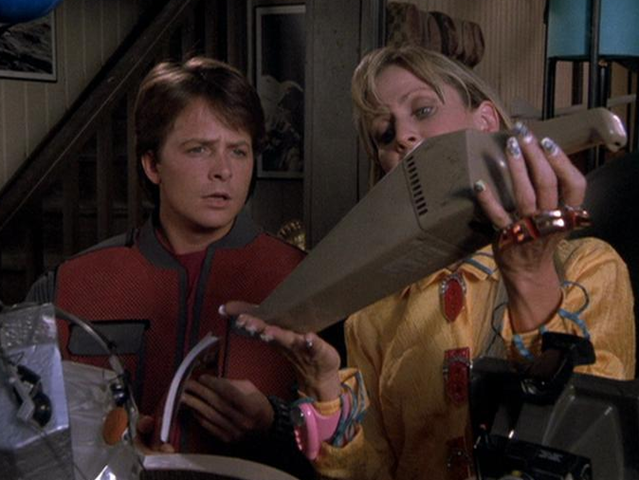
Back about 25 years ago, I was at Black & Decker and my marketing team was on the leading edge of product placements – paying to get our stuff into TV shows and movies.
Our big score was getting Marty to ogle over a Dustbuster in Back to the Future – Part 2.
Now, is iit just me, or is product placement out of control?
ABC, NBC and IFC are taking product placements up a notch in their prime time network shows.
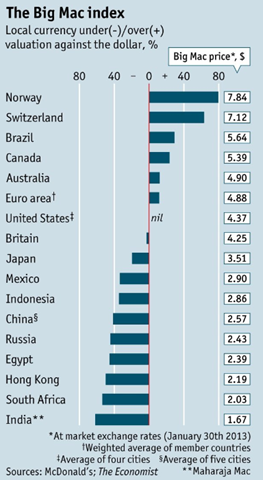
OK, so you have to go to India … it’s technically a Maharaja Mac, not a Big Mac … and, the cheap price is driven by relative currency values.
Still, one of my favorite price indices is the Big Mac Index … it compares the currency adjusted price of the burger across the globe.
According to Ryan Avent, chief economist at The Economist …
The Big Mac index is based on an economic theory called purchasing-power parity (PPP), which indicates that over a long enough time exchange rates should adjust so similar goods cost the same across countries.
The index reveals that, at market exchange rates, the price of the same McDonald’s burger can vary vastly from country to country.



















 The Homa Files

