The new liberal bible is by a French economist (Thomas Pinetty) “proving” that capitalism causes income & wealth inequality.
So that you don’t inadvertently land in the evil 1%, MarketPlace.com recapped some research on what it takes to make it to the top 1%
The conclusion: The top-earners club isn’t quite the bastioned, unreachable world it’s been painted out to be … a household income just north of $300K gains entry … and there is a “strong sense of fluidity in terms of folks entering the top income percentiles,”
Note the big spike during the dot-com bubble …. garage-tech entrepreneurs flooded the top 1%, pushing the entry level to almost $450,000 … showing that all it takes is an idea and an IPO to make the top 1%.
And, these entrepreneurs also demonstrated the fluidity of the top 1% …. most of them aren’t there now.
Also, note that the 1% entry level in 1993 – in nominal terms (i.e. not adjusted for inflation) — was higher than it was in 2010 – also in nominal terms.
I rarely watched the Simpsons and the only episode I remember involved the Springfield Power Plant – where Homer worked – being taken over by a German company who did a productivity analysis.
Uh-oh.
Sure enough when judgment day came …
Horst – the plant’s new general manager – gathered all employees in the courtyard to announce the cut-backs that where being implemented:
Horst: Attention workers, we have completed our evaluation of the plant.
We regret to announce the following lay-offs, which I will read in alphabetical order:
[pause]
Horst: Simpson, Homer.
[pause]
Horst: That is all.
Ouch.
Now what has that got to do with the U.S. Parole Commission?
First, Business Insider reported that “spending on healthcare grew an astounding 9.9% in Q1 … the biggest percent change in healthcare spending since 1980”
The article goes on to say: “Analysts said it’s primarily due to a consumption boost from the implementation of the Affordable Care Act.”
That makes sense.
Some folks rushed to their docs in the last quarter of 2013 to beat the jump in their deductibles and to jump the line ahead those becoming newly insured.
Nonetheless, the fact remains that, adjusted for inflation, America is spending more on healthcare than ever before..
There are two BLS surveys: the Establishment Survey which queries businesses and the Household Survey which queries individuals, i.e. people.
The Establishment Survey is a larger sample, but has a huge data whole – new and small businesses — that gets plugged with a SWAG.
The Household Survey is smaller (about 10,000 respondents) … but big enough that it’s treated as the gold standard for calculating the unemployment rate.
It was the Establishment Survey that reported 288K jobs were added.
Guess what?
The Household Survey said the opposite … that 73K jobs were lost.
Let’s take this a step further …
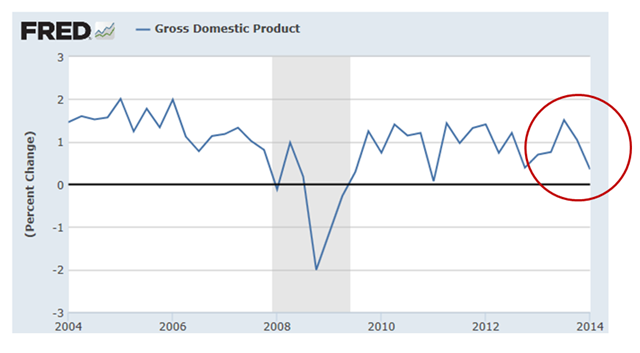
Earlier last weeks, the Feds reported that GDP was essentially flat in the first quarter … only increasing by 1/10th of a percentage point.
Despite a flat economy, the BLS says that employers were adding jobs like drunken sailors.
Does that make sense to you?
My view: one of the two numbers has to be wrong … either the GDP or the employment numbers … and, given the job losses reported on the Household Survey … I’m betting the 288K job gain is more illusion than reality.
A couple of weeks ago we posted a Business Week report titled “Keeping the Mystery Out of China’s Meat”
The essence of the article was thatsome Chinese retailers were selling donkey meat that was diluted with fox meat. If you don’t understand why that’s a show-stopper, see Tainted donkey meat … say, what?
Fearing that I might inadvertently get stuck with some bad donkey meat, I’ve been alert to mystery meat stories.
Right on cue, here comes Taco Bell.
C’mon, admit it … when you bite into a TB taco don’t you wonder if you’re really eating beef?
During 2013, the left-leaning Washington Post slapped President Obama with a slew of Pinnochios.
The year ended with PolitiFact.com – a branch of the left-leaning Tampa Bay Times — giving President Obama their “Lie of the Year” award for his infamous oft-repeated “Like your plan, keep you plan …Like your doctor, keep you doctor”. Source
So, it shouldn’t surprise anybody that, in a recent poll, 61% of the people polled said that President Obama lied on important issues some or most of the time
For 2013, the Medscape survey said that the average doctor was face-to-face with patients about 41 hours …. with about 2/3s of them in the 40 to 50 hours cluster.
How does the 41 hours compare to historical rates?
According to Medscape:
A 2010 study in JAMA found that after no significant change between 1977 and 1997 in the hours per week that physicians spend with patients’
Patient hours decreased steadily from 54.6 to 51.0 between 1997 and 2007.
The study authors attributed the decrease to a parallel 25% inflation-adjusted decline in fees between 1996 and 2006.
Shocker, right? 54.6 to 51 to 41 …
Pay somebody less and they’re less incentivized to bust their humps.
Think about that each time you hear about the Feds and insurance companies ratchet down the reimbursement rates to “fix” the healthcare system,
For that matter, I like practically all illusionists.
One trick that illusionists use is to get the audience focused on a decoy … to redirect the audience away from where the “trick” is really happening.
On Wall Street, the decoy is sometimes called a “red herring” … “something that misleads or distracts from the relevant or important issue.”
Like a deft illusionist, President Obama now has the country focused on the 8 million folks who have signed-up on the ObamaCare Exchanges.
This decoy fell into Obama’s hands when the web site crashed and Republicans, started spotlighting the number – assuming that it would be a clear indicator to the country that ObamaCare failed.
Bingo: GOP gets everybody focused on the 7 million number ,,,, Obama hits the Ferns … sign-ups blow past 8 million … GOP loses its talking point … Obama takes a victory lap.
Not so fast.
Guess what?
The 8 million number is a red herring – plain & simple.
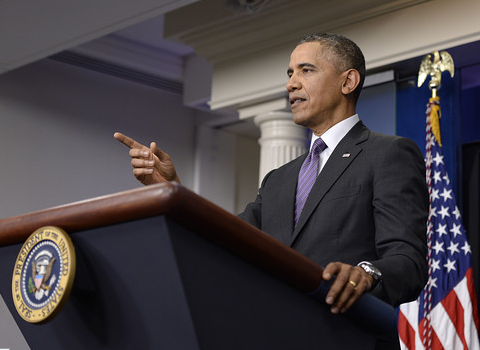
During last Thursday’s impromptu press conference, President Obama ballyhooed that the OC Exchanges had passed 8 million sign-ups (whatever the heck a “sign-up” is) … and that the CBO’s “latest estimate” says the ObamaCare “costs are down 15% from the prior estimate”.
Oh, really?
My BS detector auto-starts when I hear well-parsed, weasely words like those.
Wonder when the latest estimate was made? What were the assumptions? How does it tie to the miracle of 8 million?
So, I took a moment to dissect that statement … the digging didn’t disappoint
Wash Post had an interesting analysis titled “This graph shows how bad the Fed is at predicting the future
The crux of their argument: the Fed has a clear recent tendency to mis-forecast economic growth … not by a little, by a lot … forecasting almost twice as rapid growth as is ultimately realized.
For example, in 2009 the Fed was predicting 4.2 percent growth in 2011. But then in 2010 it revised that down to 3.85 percent growth. And in 2011 they revised it further to 2.8 percent growth. And when all was said and done, the economy only grew about 2.4 percent that year. The Fed projected growth almost twice as fast as what actually happened.
Since it’s tax week, I thought I’d flashback to a drill down I did on the tax system — who pays in, where does it go and who benefits …
In a prior post, we drilled down on taxes … or, as my Dem friends would say government “revenues”.
We posted that in 2012 Americans paid a tad over $5 trillion in taxes to the Feds, States and Local Governments.
Drilling down, the $5 trillion is split roughly 50%-30%-20% to the Feds, States and Locals, respectively. Note that the Federal portion is just under $2.5 trillion.
* * * * *
If these are “revenues” there must be matching services provided, right?
I found a study by the non-partisan Tax Foundation that analyzes taxes paid and benefits received.
The study is old – using 2004 data – but, in my opinion is a good starting point to calibrate the answer.
“Disney has launched a $1 billion experiment in crowd control, data collection, and wearable technology that could change the way people play—and spend—at the Most Magical Place on Earth. “
The innovation – called MyMagic – let’s Mickey track every move you make around the old Magic Kingdom.
The United States faces a shortage of 140,000 to 190,000 people with deep analytical skills as well as 1.5 million managers and analysts to make decisions based on their findings.
These days the business and management science worlds are focused on how large datasets can decode consumers’ behavior patterns … enabling marketers to laser-target high potential prospects with finely-honed messages, offers, and “attention”.
“Big data” … becomes problematic when it adheres to “data fundamentalism” … the notion that correlation always indicates causation, and that massive data sets and predictive analytics always reflect objective truth … that “with enough data, the numbers speak for themselves.”
Big data has hidden biases in both collection methods and analysis …
In class this week, I was noting that for many (most ?) retailers, the difference between low (on no) profits and extraordinary profits is getting people to throw just one more item into the shopping cart.
Well, Business Insider must have been listening in …
=====
Specifically, BI offered up 18 ways that retail stores get us to buy more stuff.
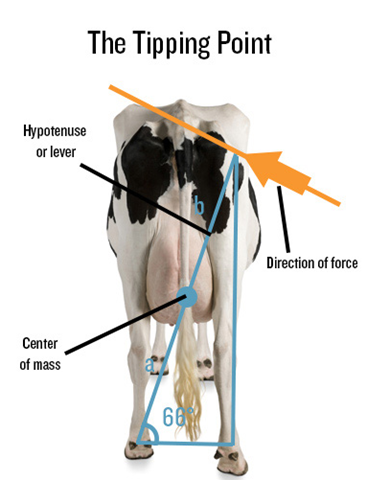
It’s a ritual where drunk farm boys sneak up on cows and tip them over.
Technical note: I have no idea why they have to be drunk, but it’s always stated that way.
Last year , Modern Farmer magazine published a scientific study on cow tipping.
Basically, Modern Farmer debunked the rural legend:
Cow tipping, at least as popularly imagined, does not exist.
Drunk young men do not, on any regular basis, sneak into cow pastures and put a hard shoulder into a cow taking a standing snooze, thus tipping the poor animal over.
While in the history of the world there have surely been a few unlucky cows shoved to their side by gang of boozed-up morons, we feel confident in saying this happens at a rate roughly equivalent to the Chicago Cubs winning the World Series.
The evidence against cow tipping is immense, and backed up by both farmers and the laws of physics
Ignore the cheap shot at my favorite Cubbies … focus on the “boozed up morons” and the “laws of physics”.
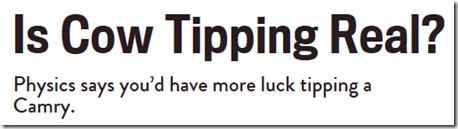
The Modern Farmer study was provocative enough that it was picked up by Slate.com with the following headline:
Uh-oh, this is where things get really interesting …
Now that the ObamaCare site has logged over 7 million sign-ups (yeah, right) I expect the focus to shift to the mix of the Exchange’s mix of old, unhealthy folks who consume lots of healthcare (i.e. more than they pay for their insurance) and young invincibles who pay in but don’t consume much.
The common wisdom is that the ObamaCare insurance exchange needs healthy young people to subsidize the older, less healthy enrollees … otherwise, policies offered on the exchanges will go into a premiums’ death spiral.
Yesterday, President Obama took a victory lap for getting over 7 million folks to put a free or heavily discounted ObamaCare policy in their shopping basket or to click the “I tried, don’t fine me” button.
Still no word on how many folks “bought” policies … i.e. paid the 1st months premium … insurance companies say that 20% haven’t.
And, McKinsey says 73% of the 7.1 million are from the pool of over 6 million folks who had their insurance policies cancelled because of ObamaCare.
Focus for a second on that 6 million number.
At the time the cancellations were announced, Jay Carney – Obama’s front man — said the 6 million is “just a sliver or cut of the 5% of the people on the individual market who are affected.”
Here’s the video clip. The killer quote comes at about the 2:20 mark
They take up more seats, require more server time, and eat more food.
Why do I ask?
Virtually all articles re: ObamaCare are saying “at least save the popular parts like allowing adult children on their parents’ policies until they are 26”.
First, the term “adult-children” gives me the creeps. But, that’s beside the point.
I don’t care if insurance companies have to carry 26 year olds on their parents’ policies, but I don’t understand why you & I have to pay for it … not the adult-children’s parents.
Now, practically all employer-sponsored health insurance plans charge premiums in tiers: employee only, employee plus spouse, employee plus children, and employee plus spouse and children. Note: it doesn’t matter if the employee has 1 child or a dozen children … same premium.
Say what?
For example, the United Healthcare plan through Georgetown — which is probably pretty typical — charges:
Note that it costs $7,346 to tack a spouse (or equivalent) — presumably an adult — onto an employee’s policy.
Psychology professor Angela Lee Duckworth has researched successful students, athletes and business managers.
She concludes that talent and intelligence will get you only so far.
The characteristic that separates successful people from the also-rans is, in a word, “grit”.
Grit is tenacious spirit that keeps certain people dedicated to their goal (whether it involves their studies, their projects, their clients, or something else) for the long haul, determined to accomplish what they set out to do.
Grit is working with intensity and stamina over long periods of time to incrementally chip away at some goal.
Prof. Duckworth says schools & companies should recruit people who are not only smart, but also demonstrate “true grit”.
Maybe she’s onto something.
======
Here’s a TED talk in which Prof. Duckworth summarizes her findings.
If you want more here’s is a link to a longer talk Prof. Duckworth gave recently.
I’ll explain the picture later, but first, the back story.
A couple of interesting dots got connected last week.
First, I started watching The Voice.
I liked the talent and the bantering among the coaches, but wondered why they used the turning chairs gimmick. You know, judges can’t see the the performers, they can just hear them.
Became apparent when Usher turned his chair and was surprised to see that the high-pitched soul singer was a big white guy.
Hmmm.
=====
Second, for the course I’m currently teaching, I’ve been reading a book called The Art of Thinking Clearly — a series of short essays on cognitive biases – those sneaky psychological effects that impair our decision-making.
Since psychological studies first began, people have given themselves top marks for most positive traits.
While most people do well at assessing others, they are wildly positive about their own abilities.
The phenomenon is known as illusory superiority.
Illusory superiority is everywhere
In studies, most people overestimate their IQ. For instance, in a classic 1977 study, 94 percent of professors rated themselves above their peer group average.
In another study, 32 percent of the employees of a software company said they performed in the top 5%.
Drivers consistently rate themselves as better than average — even when a test of their hazard perception reveals them to be below par.
Ironically, the most incompetent are also the most likely to overestimate their skills, while the ace performers are more likely to underrate themselves.
Psychologists say the illusory superiority happens for several reasons:
people don’t usually get honest feedback from others others (who are too polite to say what they really think)
incompetent people lack the skills to assess their abilities accurately
most positive traits — like being a good driver — are so vaguely defined that there’s plenty of wiggle room
self-delusions can actually protect people’s mental health serving as a protective mechanism that shields self-esteem
The remedy for illusory superiority ?
Since people are generally more accurate in assessing other people (than assessing themselves), get — and take to heart — constructive criticism from others.
OK, I was asleep at the switch on this one … completely missed that Monitor – the consulting outfit started by strategy guru Michael Porter – went bankrupt last year and got acquired by Deloitte.
How ironic … an uber-strategist’s own company goes belly up.
This morning, the WSJ published an editorial titled “The Hidden Rot in the Jobs Numbers ” by Prof. Edward Lazear, who was chairman of the president’s Council of Economic Advisers from 2006-09, is a professor at Stanford University’s Graduate School of Business and a fellow at the Hoover Institution.
Strong credentials, right?
The punch line: “Hours worked are declining, resulting in the equivalent of a net loss of 100,000 jobs since September.”
My students are likely to cringe at this post which kinda legitimizes my teaching style.
Uh-oh …
=====
According to a recent WSJ article:
The latest findings in fields from music to math to medicine lead to a single, startling conclusion: It’s time to revive old-fashioned education.
Not just traditional but old-fashioned in the sense that so many of us knew as kids, with strict discipline and unyielding demands.
Why?
Because here’s the thing: It works.
Of course, that conclusion flies in the face of the kinder, gentler philosophy that has dominated American education over the past few decades.
The conventional wisdom holds that teachers are supposed to tease knowledge out of students, rather than pound it into their heads.
Projects and collaborative learning are applauded; traditional methods like lecturing and memorization — derided as “drill and kill” — are frowned upon, dismissed as a surefire way to suck young minds dry of creativity and motivation.
Fans on the political right see . . . an unapologetic ode to American values.
Critics on the political left see it as Ugly American chest thumping at its worst.
What’s got folks so stirred up?
Here’s the ad’s punch line:
“We’re crazy, driven, hard-working believers. . . . . You work hard. You create your own luck.
And you’ve gotta believe anything is possible.
As for all the stuff?
That’s the upside of only taking two weeks off in August, n’est ce pas?”
Crass ugly American materialism … or the American Dream?
Watch the commercial and draw your own conclusion.
One of my favorite reactions was from a “Manhattan brand consultant” who quipped:
The spot is well-done but philosophically odious.
The surprising thing strategically is that they would choose to play to their base instead of trying to expand it.
Say, what?
First, what’s odious about reaping some benefits from hard work ?
Sure, it’s ironic that the commercial is coming from Government Motors … but should the company be touting the progressive mantra “liberation from work” ?
I don’t think so.
Re: “playing to the base” …
I thought Cadillac’s base was NFL-NBA players and urban-based chemical distributors.
Note: I probably shouldn’t generalize from personal experience, but an NFL player lives a mile or two from our house. During the season, there are always 12 or more black Escalades parked in his circular drive. Place looks like a Caddy showroom.
They are trying to “expand the base”.
The Caddy ad caught my attention ….
…. just like C.C. Catch did in the 80s with her hit “In the Backside of Your Cadillac”





























 The Homa Files