Ever wonder why the gun-chewing cashier asks you for your zip code?
I naively assumed the store was just doing some kind of geo-survey … trying to figure out where their customers were coming from … how far they were driving to shop their store.
Silly boy.
CNN reports that ”Every time you mindlessly give a sales clerk your zip code at checkout, you’re giving data companies and retailers the ability to track everything from your body type to your bad habits.”
Interesting study on cognitive biases from Daniel Kahneman’s Thinking, Fast and Slow …
Patients undergoing a painful medical procedure – think, colonoscopy without anesthesia – recorded their pain levels during the procedure on a range from no pain (zero) to excruciating (10).
Some of the procedures were short in duration … others were longer.
Below is the pain chart for 2 representative patients.
The patients were asked – after the fact—how painful the procedure was.
What’s your bet? Which patient claimed to have undergone the more painful procedure?
“Disney has launched a $1 billion experiment in crowd control, data collection, and wearable technology that could change the way people play—and spend—at the Most Magical Place on Earth. “
The innovation – called MyMagic – let’s Mickey track every move you make around the old Magic Kingdom.
A couple of years ago I switched off TurboTax when they tried to start charging separately for each computer – meaning that I had to buy 2 licenses to have TurboTax on both my desktop and laptop.
I got back on the program when they backed off that silly pricing hack.
Having learned nothing from that pricing backfire, TurboTax recently got itself in another brouhaha with customers when it tried another pricing sleight of hand.
Lots of hacking going on: Sony, Anthem Healthcare …
Here’s one from the “you can’t make this stuff” file.
LifeLock is one of the companies that monitors the credit applications and credit worthiness inquires.
Todd Davis became LifeLock’s CEO when the company’s founder was ousted for making repeated misleading statements about his shady past and the company’s origins.
For a couple of years, Mr. Davis was prominent in LifeLock’s ads … revealing his social security number and daring identity thieves to crack his code.
Bad idea.
Reportedly, Mr. Davis has had his identity stolen at least 13 times since his taunt-the-thieves commercials.
US News & World Report says to keep these 10 catch phrases off your cover letter:
1. “I meet the requirements for the position.”Explain why you’re an excellent candidate, not just an adequate one.
2. “I’m hard-working and a great communicator.” These are cliches that cause hiring managers’ eyes to glaze over …and don’t convey anything of substance.
3. “I’m a visionary leader.” Proclaiming this about yourself comes across as, well, weird. Show accomplishments.
4. “You won’t find a candidate better qualified than me.” This comes off as needlessly cocky hyperbole — and it’s generally inaccurate..
5. “Dear sir or madam.” In most industries, this will come across as an antiquated, stuffy salutation. If you know the hiring manager’s name, use it … if not, simply writing “dear hiring manager” is fine.
Wash Post had an interesting analysis titled “This graph shows how bad the Fed is at predicting the future
The crux of their argument: the Fed has a clear recent tendency to mis-forecast economic growth … not by a little, by a lot … forecasting almost twice as rapid growth as is ultimately realized.
For example, in 2009 the Fed was predicting 4.2 percent growth in 2011. But then in 2010 it revised that down to 3.85 percent growth. And in 2011 they revised it further to 2.8 percent growth. And when all was said and done, the economy only grew about 2.4 percent that year. The Fed projected growth almost twice as fast as what actually happened.
A lot of chatter over the weekend about how President Obama’s economic policies are – after 6 years — humming.
More than 250,000 more people were employed … but interestingly, the unemployment rate inched up as the labor force participation rate increased a bit.
What’s going on?
A couple of economists at the NBER – the think tank that officially declares when recessions begin and end – just issued a study with an evidenced-based hypothesis …
Specifically, he says that he hears all the time that “unemployment is greatly reduced, but the people aren’t feeling it.”
The reason: “The official unemployment rate, as reported by the U.S. Department of Labor, is extremely misleading.” It doesn’t capture the true angst in the job market.
The crux of his argument centers on a “good jobs” metric: the ratio of full-time workers to the total adult population.
That ratio dropped about 5 percentage points during the recession and has recouped only about one of those 5 percentage points.
That’s not good.
Clifton brings those numbers to life in his opinion piece …
A rising tide of prosperity in developing economies is reshaping the nature of competition. Recognizing the challenges of the new environment, a few product makers … are taking a different approach.
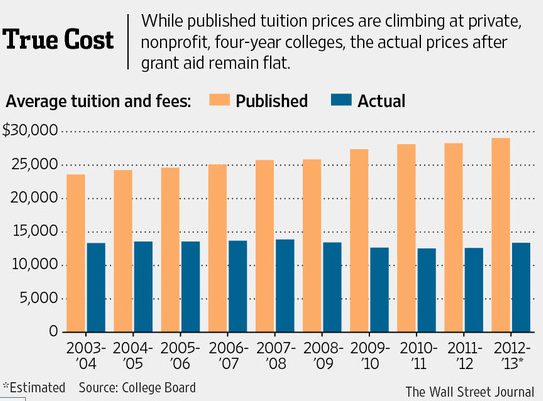
Published tuition rates have soared in the last decade, but only a small percentage of families actually pays full freight.
Between grants to needy students and merit scholarships to entice other desirable candidates, schools these days are giving back nearly 50% of gross tuition revenue in the form of aid and awards.
In other words, list prices are going up, but more stuff is being sold at sale prices.
Increasingly, colleges are using pricing methods previously the domain of airlines and discount retailers …
Big grocery chains are increasingly turning to big data and mathematical models to take the guessing out of the process of pricing thousands of items on their shelves,
The models can detect your yogurt flavor preferences and your “internal hierarchy of brands” … i.e. which brands your think are better than others.
I often ask: ”Do weather forecasters feel guilty accepting their pay?”
Most people would say: “They certainly should”.
After clearing the streets of NYC for “an unprecedented blizzard of epic proportions”, weather forecasters had to eat crow when the snow-that-would-end-the world turned out to be, well, a garden-variety winter snow storm.
At least one weather-dude had the decency to apologize.
According to CNBC:
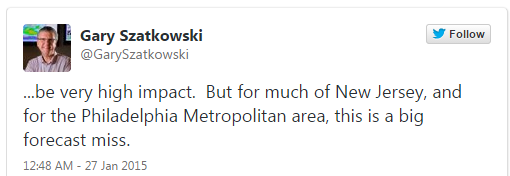
“Gary Szatkowski, the meteorologist in charge of the National Weather Service’s office in New Jersey, stunned people in the wee hours Tuesday with a heartfelt apology for the blown forecast.”
Both the New York Times and Washington Post editorial boards enthusiastically supported drilling in ANWR in the late 1980s.
The Post noted that the area “is one of the bleakest, most remote places on this continent, and there is hardly any other where drilling would have less impact on surrounding life. . . . ”
ANWR is roughly the size of South Carolina …
However, the area where, according to Department of Interior estimates, some 5.7 billion to 16 billion barrels of recoverable oil reside is much smaller and … would amount to the size of Dulles airport.
Being a “morning person” may be more than virtuous. It may literally be a criteria for career success.
Managers rate workers who get an early start higher than those who get in and stay late, no matter how many hours they work in total or how well they do their jobs.
Apparently, managers have a “morning bias” … that confuses starting time with conscientiousness and productivity.
Managers perceive employees who start later as less conscientious, and consequently less hard-working and disciplined, and that carries through to performance ratings.
Since yesterday Obama was pitching tax increases in the SOTU, I thought you might like to see a recap of how much dough (some) Americans fork over to the government …
Americans pay a tad over $5 trillion in taxes to the Feds, States and Local Governments.
Technical note: In government parlance, the taxes are called “revenue”.
By taxing authority
Drilling down, the $5 trillion is split roughly 50%-30%-20% to the Feds, States and Locals, respectively
They take up more seats, require more server time, and eat more food.
Why do I ask?
Since ObamaCare premiums have been back in the news, we have to ask the question.
Virtually all articles re: ObamaCare are saying “at least save the popular parts like allowing adult children on their parents’ policies until they are 26”.
First, the term “adult-children” gives me the creeps. But, that’s beside the point.
I don’t care if insurance companies have to carry 26 year olds on their parents’ policies, but I don’t understand why you & I have to pay for it … not the adult-children’s parents.
Now, practically all employer-sponsored health insurance plans charge premiums in tiers: employee only, employee plus spouse, employee plus children, and employee plus spouse and children. Note: it doesn’t matter if the employee has 1 child or a dozen children … same premium.
In class this week, I was noting that for many (most ?) retailers, the difference between low (on no) profits and extraordinary profits is getting people to throw just one more item into the shopping cart.
Well, Business Insider must have been listening in …
=====
Specifically, BI offered up 18 ways that retail stores get us to buy more stuff.
You gotta start scratching your head a bit when the Dept. of Defense gets its Twitter account hacked and issues an internal directive to change social networking passwords.
Not obvious to me why the DOD even has a Twitter account, and laughably frightening that they didn’t already have a policy for frequent password changes.
The fiasco reminded me of a competition to see how long it would take uber-hackers to crack 15,000 15-character passwords
Let’s pretend that that your passwords are 16-characters long – a mix of capital and lower case letters, numbers and special characters.
The College Football Playoff Selection Committee took a lot of heat when they seeded OSU in the tourney.
Well, last nite’s game vindicated the committee.
Also vindicated was Rev. Thomas Bayes.
You know, the guy who developed Bayes’ Theorem.
Here’s what I mean …
In my Strategic Business Analytics course we cover Bayesian Inference … applications of Bayes’ Theorem … how to statistically adjust your so-called “prior beliefs” when you get new evidence.
Even I admit that sometimes the subject can get a bit dry …
An easy question for loyal readers … (who had to know that today’s post was coming).
First, for casual sports fans … who the heck is Cardale Jones/
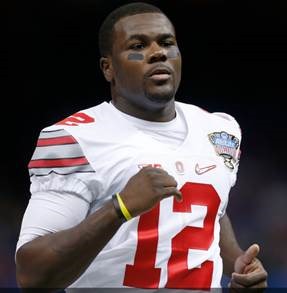
Answer: the 3rd string quarterback who is leading injury-plagued Ohio State into tonite’s college championship game.
Now, about the wristband.
Last Friday, even the WSJ has finally noticed that …
“Jones, like every other Ohio State player, went through extensive emotional training over the past two years, studying a formula that he wears on a wristband on his throwing arm. ”
It’s simple formula for life.
For an explanation, let’s flashback to a HomaFiles post from September 27, 2013 … more than a year ago!
Psychology professor Angela Lee Duckworth has researched successful students, athletes and business managers.
She concludes that talent and intelligence will get you only so far.
The characteristic that separates successful people from the also-rans is, in a word, “grit”.
Grit is tenacious spirit that keeps certain people dedicated to their goal (whether it involves their studies, their projects, their clients, or something else) for the long haul, determined to accomplish what they set out to do.
Grit is working with intensity and stamina over long periods of time to incrementally chip away at some goal.
Prof. Duckworth says schools & companies should recruit people who are not only smart, but also demonstrate “true grit”.
Maybe she’s onto something.
======
Here’s a TED talk in which Prof. Duckworth summarizes her findings.
If you want more here’s is a link to a longer talk Prof. Duckworth gave recently.
First day of strategy consulting , so appropriate to reprise the Michael Porter question …
=====
OK, I was asleep at the switch on this one … completely missed that Monitor – the consulting outfit started by strategy guru Michael Porter – went bankrupt last year and got acquired by Deloitte.
How ironic … an uber-strategist’s own company goes belly up.
According to the NY Times , the Harvard faculty is throwing a collective hizzy fit.
What’s their beef?
In a touch of irony, the same folks who cheer-led the passage of ObamaCare now feel aggrieved because they’re being forced to shoulder some of the costs.
To quote my grandson Ryne, “Oh me oh my.”
Here’s the scoop … with some priceless snippets from the Times’ article
No, we’re not talking about the defensive pass interference penalty flag that was picked up without explanation in the Cowboys-Lions game.
Everybody is all over that one. So, we’ll pass.
What caught my eye was a piece in SBNation headlined: “Lions fans should be a bit mad at the referees for what happened as they tried to seal a win. They should be just as mad at their coach, though.”
The situation:
Late in the game, the Lions had a fourth-and-1 on the Dallas 46.
At first, they lined up to go for it. But they didn’t.
Instead, the Lion’s punter shanked a 10-yarder …
Retrospectively, a bad call, for sure.
But, coach Caldwell was just going with coaches’ conventional wisdom.
Leading to a broader question: how often is NFL coaches’ conventional wisdom right (or wrong)?
Consumers are spending more on themselves this holiday season. This trend is boosting retailer’s sales for now but raising concern of consumer spending after the holidays.
Consumers are taking advantage of deals to snap up items for themselves and non-gift items for their families.
“Without provocation, an attacker ambushed and killed officers Wenjian Liu and Rafael Ramos while they sat in their marked patrol car in the Bedford-Stuyvesant Area of Brooklyn … ‘They were quite simply assassinated, targeted for their uniform,’ Police Commissioner William Bratton said at a news conference.”
Earlier in the day, the killer posted a photo of a silver handgun and a message on Instagram in which he talked about killing police officers “in retaliation for the deaths of Garner and Brown.”
In the old days, folks fretted (or dreamed) about the effect of computerized automation in factories and ATMs replacing bank tellers.
According to a recent McKinsey report:
Physical labor and transactional tasks have been widely automated …
Now, advances in data analytics, low-cost computer power, machine learning, and interfaces that “understand” humans are moving the automation frontier rapidly towards “knowledge work”..
Developments in how machines process language and understand context are allowing computers to search for information and find patterns of meaning at superhuman speed.
Punch line: Major retailers are customizing online prices for each user, using users’ information (such as location) to determine different prices for identical items. The goal: higher price realization and higher profits.
The accompanying narrative was something like “adding jobs – full-time, not part-time — looking good”.
Earlier this week, we showed that the WSJ data is accurate, but it’s analysis is misleading because it starts analyzing from the depth of the recession (versus before the start of the recession) … and looks at raw numbers of jobs added (without normalizing for population growth).
AdAge ran an article asking “Is the College Football Playoff the Next Super Bowl?”
Answer: Maybe … and maybe not.
The article had a couple of interesting tidbit’s about the CFP’s economics.
ESPN bought exclusive broadcast rights for 12 years of the semi-final games and national championship game as part of a 12-year media rights deal announced in 2012 that reportedly cost $7.3 billion.
Now, that’s big business!
Buried deep in the article was an incidental piece of info that caught my eye … a sure-fire winner.
It has been a while since we looked into the employment numbers … long overdue.
I was awakened by a WSJ article that put a positive spin on the November jobs report – jobs continue to be added …. and, they’re full-time jobs:
“The economy has seen a net gain of more than 6 million full-time jobs since the official end date of the 2007-09 recession, which was in June 2009. The economy has witnessed a net increase of just 311,000 part-time jobs over the same period,”
Hmmm.
Let’s dig a little deeper.
What the Journal says is true, but not complete … and picking to start the chart at the trough of the recession obscures some of the context.






















 The Homa Files