June 21, 2012
Punch line: A UK online service matches budget conscience companies with eager-to-work MBA’s, creating an innovative solution to the economic challenges that companies and MBA’s are facing.
* * * * *
Excerpted from WSJ, “Short on Staff? Rent and MBA”
For just a few hundred dollars a day, you can rent an M.B.A.

Appealing to companies keeping a close eye on staff costs, online service MBAandCo.com allows firms to retain business-school graduates … to work on consulting gigs with minimal outlay and no long-term commitment.
Given the tight job market in Europe (and much of the rest of the world), the three-year-old website now boasts more than 10,000 members, all of whom have at least five years of professional experience and an advanced degree. The freelancers themselves must have graduated from a top-100 business school, as ranked by the Financial Times. Past clients have included Virgin Media, Stolichnaya Vodka and Ogilvy & Mather, as well as small venture capital-backed firms, the company says.
Workers are attracted by the promise of a flexible schedule and the opportunity to trade in days filled with meetings in favor of hands-on work. When the alternative may be no employment at all, it looks like a particularly good deal.
The company uses preferences and an algorithm to determine who might be most compatible, offering clients a shortlist of potential freelancers. Costs vary by experience and academic pedigree.
Would you consider “renting” an M.B.A. to work on projects? If you are an M.B.A. is this something you’d consider?
Edit by BJP
>> Latest Posts
SHARE THIS POST WITH FRIENDS & FAMILY
Tags: MBA, rent-an-MBA
Posted in MBAs | Leave a Comment »
June 20, 2012
Now you’re talking ….
According to the LA Times, Let’s Pizza is a pizza vending machine that promises to deliver a piping hot pizza pie made from scratch in less than three minutes.
The machine makes pizzas to order, including kneading and rolling out the dough.
There are more than 200 toppings from which to choose.
The pizza is “delivered” in an insulated take-away box.
The machine takes cash and credit cards.
A 10-inch pizza will sell for about $5.95.
“Let’s Pizza is a huge success in Europe, especially in Italy.
You have to see it to believe it
click to watch the pizza machine work

>> Latest Posts
SHARE THIS POST WITH FRIENDS & FAMILY
Tags: Let's Pizza, pizza, vending machines
Posted in Food & Drink | 1 Comment »
June 20, 2012
I’m ambivalent about Obama’s decision to, in effect, implement the Dream Act despite it’s rejection by Congress.
I’m ok with parts of it — like legalizing those who serve in the military — but I’m not that keen on presidents completely ignoring the Constitution.
Immigration politics aside, I’m interested in the statistics … specifically, the impact of Obama’s move on the BLS’ reported unemployment rates.
Most sources are estimating that just short of 1 million illegals fall into Obama’s stick-around policy — over 16 years old, younger than 30.
Those people now — by the stroke of Obama’s pen — qualify as “in the American labor force” … the denominator of the unemployment rate calculation.
Let’s do some simple math …
The BLS says that there are currently 155 million people in the labor force … according to the last BLS report, 142.3 million were employed … 12.7 million unemployed … for an 8.2% unemployment rate.
What happens when the 1 million newly minted legals get thrown into the statistical mix?
Worst case: if all are currently unemployed … then the unemployment rate jumps to 8.8% … 13.7 unemployed divided by 156 million in the labor force.
Best case: if only 11% are unemployed — the current UE rate for Hispanics … then the unemployment rate increases slightly to about 8.25% … 12.81 unemployed divided by 156 million in the labor force.
Most like (statistically): somewhere between the best and worst cases … probably a 25% unemployment rate for the new legals … bumping the UE rate by about .1/10th of a percentage point.
Most likely (politically): the BLS will “forget” to add the new legals to the labor force until, say, January 2013.
That’s the case that I’m betting on … watch the labor force numbers to see if I’m right … they should bump up a million when June numbers get reported … but they won’t!
>> Latest Posts
SHARE THIS POST WITH FRIENDS & FAMILY
Tags: Dream Act, Illegals, Obama, unemployment rate
Posted in BLS, Employment - Jobs, Unemployment | Leave a Comment »
June 19, 2012
Michael Francis helped make Target a roaring success. So, JC Penney CEO Ron Johnson offered him a $12 million signing bonus to jump ships. Francis took the bait.
Bad decision …except for the $12 million … which Francis gets before the tax rates jump on Jan. 1.
Now, Francis taking the fall for Johnson’s “no sales” strategy’s failure to ignite consumer interest.
Johnson’s still claiming that his idea is fine but it wasn’t marketed right. That there was a failure to communicate.
After all, a sleek logo and aggressive “retail list price maintenance” worked at Apple … so why shouldn’t it work at a commodity rag place like JCP?

Excerpted from BrandChannel:
J. C. Penney ousted its JC Penney brand president, Michael Francis.
Francis was hired last October “at great expense” — a whopping $12 million signing bonus — from Target.
He is seen as taking the fall for his boss, company CEO Ron Johnson, the former Apple top retailer who oversaw JCP’s new brand strategy in January.
Johnson who championed the idea of killing coupons and sales in favor of “fair and square pricing” (a reference to its logo), so-called “month long value” and “everyday low” pricing.
JCP recently scrapped that strategy and is re-embracing the dreaded s-word — “sale.”
CEO Johnson “will assume direct responsibility and oversight of the company’s marketing and merchandising functions.”
Ken’s Take: If I were JCP, I would have fired the Apple guy and kept the target guy … eventually, they’ll fire the CEO, too … and probably promote their VP Finance to interim CEO … as soon as it becomes evident that the critical Christmas season is a bust
* * * * *
In case you missed it, I was on NPR a couple of weeks ago commenting on the JCP strategy.
>> Latest Posts
SHARE THIS POST WITH FRIENDS & FAMILY
Tags: Apple, JC Penney, Target
Posted in Mktg - Brands, Retailing | 7 Comments »
June 19, 2012
The airlines industry — in aggregate — hasn’t made money.
Think about that for a second.
There have been some brief periods of prosperity, but longer stretches of losses … some pretty deep.

Makes sense when you think about the number of airlines that that have consolidated, gone through bankruptcy or fallen off the radar screen (think, Pan Am, Eastern, TWA)
The irony is that we feel gouged by airlines … especially when they start charging us for bags and peanuts.
Side note: “ancillary revenue” supplements the flight by another $18 per person on a 100-passenger flight.
That includes fees for checked baggage, seat assignments, ticket penalties and revenue from cargo.
According to the Bureau of Labor Statistics, baggage fees for the U.S. airline industry last year totaled a hefty $3.4 billion, or roughly $5 for every passenger boarded.
Cancellation and change fees totaled $2.4 billion, or more than $3 for every passenger.
Source: WSJ
What’s the problem?
First, there are pricing pressures.
In the past 15 years, fares haven’t come close to matching inflation.
In other words, “real” prices in the industry have stayed flat or declined.

That makes sense …
In the airlines, there’s a huge amount of capacity … something close to a commodity product … with high fixed costs and virtually no marginal costs.
Since one more passenger.doesn’t cost you anything except, maybe a cup of coffee, there’s great temptation to sell seats at rock bottom prices — just to fill them.
Further, there’s the Southwest factor. Legacy airlines (think United or American) have big infrastructures, huge hub-and-spoke networks, old fuel – inefficient planes, and high cost, unionized employees. Southwest’s cost-effective operations — point-to-point network, fuel-efficient 737s, happy employees — changed the pricing game.
Then, think about fuel costs — generally high, and subject to wide, unpredictable swings.
According to the WSJ, “fuel now is by far the biggest cost for airlines. , the tickets and fees of 29% of passengers pay just for the fuel to make the trip.
Airline gas mileage has improved over the years, the result of filling more seats on each flight, replacing multiple trips on small planes with fewer trips on larger aircraft and replacing older planes with newer, more fuel-efficient jets.
In 2000, U.S. airlines burned 28.6 gallons of jet fuel per passenger. Last year, that improved to 22.5 gallons per passenger. “
Add on maintenance that keeps the planes safe and government fees and taxes (think TSA) and the bottom line is that there is very little wiggle room on the plane for profit.
Put it all together, and airlines — the well run ones — are only able to convert less than 1% of revenues into profits.

Source: WSJ
Probably not what Wilbur & Orville had in mind …
>> Latest Posts
SHARE THIS POST WITH FRIENDS & FAMILY
Tags: airline economics, airlines, fuel costs, pricing
Posted in Airlines, PVP - Concepts, frameworks, examples | 2 Comments »
June 18, 2012
Team Obama says you shouldn’t give a bride & groom a toaster or impersonal cash … rather, you should make a donation – in their namse – to O’s re-election campaign.
Yeah, right …

>> Latest Posts
SHARE THIS POST WITH FRIENDS & FAMILY
Tags: Obama 2012, wedding presents
Posted in Laughs | 1 Comment »
June 18, 2012
Punch line: Democrats and Republicans have wildly different taste when it comes to certain brands. Politicians are starting to see the value in understanding these differences, and the link to voters’ decision making process.
* * * * *
Excerpted from brandchannel.com’s, “Brand Decision 2012: Dems are from Starbucks, Republicans are from Dunkin’”

America is settling in for a long summer of campaigning between the Democratic candidate President Obama and the Grand Old Party’s Mitt Romney.
News of minor flubs by candidates and those who work for them will come up at bars, barbecues, and ice-cream joints across the land (or be completely avoided, for everyone’s safety).
… Members of the two political parties don’t just disagree on their candidates. They also mostly disagree on the brands they love, though there are three that help bring them together. Next time a president wants to have a bipartisan summit of some sort, he or she might want to involve Coke, Apple, and Visa.

Both candidates and brands have never fought harder for our affection and our votes, … It’s never been more important to understand why people make the choices that they do. Brands can learn a lot by having a deeper understanding of the deep-seated connections that drive our decision-making.
Edit by BJP
>> Latest Posts
SHARE THIS POST WITH FRIENDS & FAMILY
Tags: Brands, Dunkin' Donuts, political parties, Starbucks
Posted in Mktg - Brands, Politics - General | Leave a Comment »
June 18, 2012
You read that right.
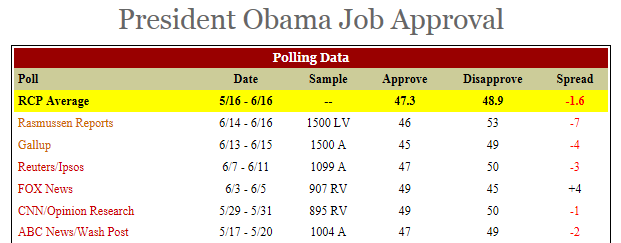
Yesterday’s RCP’s poll-of-polls had Obama’s approval underwater by 1.9 points.
That’s not big news, but …
In an ironic twist, the only poll that had more folks approving than disapproving was the poll conducted by FOX News.
You know, the FOX News that’s biased against Obama
Go figure ….

>> Latest Posts
SHARE THIS POST WITH FRIENDS & FAMILY
Tags: FOX News, Obama Approval, polls
Posted in 2012 Campaign, Obama, Polls & Surveys | Leave a Comment »
June 15, 2012
Yesterday, the BLS reported that it’s revising last week’s estimate of new unemployment claims up by 3,000 … or about 1%

We’ve been pointing out this glaring statistical bias for weeks.
Finally, some other media sources have finally jumped on the bandwagon and researched the issue historically.
Turns out that the weekly jobless claims number has now been revised up 20 weeks in a row and 65 out of the last 66 weeks.
Hmmm.
Why is it important?
Because it means the Feds are consistently under-reporting weekly unemployment claims’ changes … making things look rosier than they really are.

May be an innocent error but, geez, wouldn’t you think the statisticians would have caught on to the bias by now?
>> Latest Posts
SHARE THIS POST WITH FRIENDS & FAMILY
Tags: BLS, cookin' the books, unemployment claims
Posted in BLS, Employment - Jobs, Unemployment | Leave a Comment »
June 15, 2012
Excerpted from Jones Lang LaSalle Retail Research: Digital Dynamics
With rising gas prices – many consumers are buying more products online, as a way to get low prices and save gas – especially when shipping costs are low.
But, the trend toward consumers researching products online, reading reviews and searching for the best deals locally, is growing.
The attractiveness of this practice lies in consumers’ desire for immediate gratification as well as the ability to save on shipping costs by buying local.
Researchers estimate that this trend – aptly called “web-influenced sales” – will generate almost $1.1 trillion in U.S. sales this year and by 2015 will represent approximately 44 percent of total retail sales, or $1.6 trillion.
The most important actions for local retailers are to ensure their products show up online, that the site reflects accurate availability, and that the online and in-store experiences are as seamless as possible.
The rewards are direct – not only do shoppers come in for the researched product, they also stick around to buy other items once in-store.
Forrester Research reported that 45 percent of shoppers interviewed said they bought extra items once in a store, spending, on average, $154 on additional purchases.
Side note: By coincidence, I just had a so-called “cross channel” experience.
My cable modem died and I didn’t want to wait a couple of days for an online purchase … so, I reluctantly trekked to Best Buy.
As expected, BB’s prices were a tad high … but, the salesperson was quickly authorized to meet Amazon’s online price … so, my cost adders above Amazon were gas to the store and Maryland’s 6% sales tax (ouch).
>> Latest Posts
SHARE THIS POST WITH FRIENDS & FAMILY
Tags: Commerce 3.0, cross-channel commerce, JLL
Posted in Internet Marketing - eCommerce - | 1 Comment »
June 14, 2012
According to Michael Barone, writing in RCP:
President Obama recently attended his 150th fundraiser.
That’s more than the number attended by the last four presidents put together.
Imagine the upside if the guy focused on doing good, on attacking the country’s real problems …
You know, on being president instead of just running for president.
If he wants the job so badly, why doesn’t he try doing it?
>> Latest Posts
SHARE THIS POST WITH FRIENDS & FAMILY
Tags: campaigning, fundraisers, Obama
Posted in 2012 Campaign, Obama | Leave a Comment »
June 14, 2012
Couple of charts posted by Prof. Mark Perry caught my eye …
In one post, Prof. Perry charted college enrollment rates and tuitions.
Both slope upward,
Supply and demand ?
Maybe.

* * * * *
Keep the above red line (tuitions) in mind as you glance at the chart below: grade inflation.
The grades’ line also slopes up.
Sure looks like — as tuitions are rising — colleges are dishing out more high grades.
Cause & effect or just a coincidence?
Hmmm

>> Latest Posts
SHARE THIS POST WITH FRIENDS & FAMILY
Tags: College, grade inflation, grades, tuition
Posted in Education - Academics | Leave a Comment »
June 14, 2012
These days, it’s popular to pile on Facebook because of its noteworthy IPO.
Amazing the number of people who knew that FB was overvalued.
Yeah, right.
An article last week in the WSJ harped that the Days of Wild User Growth Appear Over at Facebook … that Facebook’s user growth rate in the U.S. is slowing sharply.
May be true … but, it’s also true that “Facebook is already a dominant Web platform and they’ve got significant Internet penetration today. ”
Consider:
- Approximately 56% of Facebook’s 2011 ad revenue of $3.1 billion came from the U.S. … that’s about half of Facebook’s revenue.
- Facebook has already has 71% of all 221 million U.S. Internet users,
- In April, U.S. unique visitors to the Facebook website increased to 158 million, up 5% from a year earlier.
- Facebook users spend more than six hours a month on the site …. Google users spend about 4 hours per month on Google-related sites including YouTube.
- not all activity on Facebook takes place directly on Facebook.com … there are other websites and apps linked to FB accounts.
- Facebook is experiencing substantial growth in countries such as India and Brazil
I’m not a big Facebook fan, but you gotta be impressed by the numbers that they’ve put on the board.
>> Latest Posts
SHARE THIS POST WITH FRIENDS & FAMILY
Tags: engagement, Facebook, users
Posted in Internet - Soc Networking | Leave a Comment »
June 13, 2012
Easy question, right?
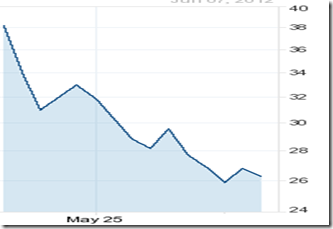
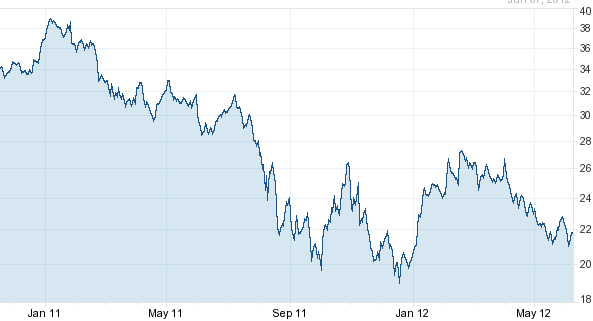
Two high profile IPOs that have lost about of their value since their IPOs.
C’est la vie …
* * * * *
GM

* * * * *
Facebook
>> Latest Posts
SHARE THIS POST WITH FRIENDS & FAMILY
Tags: Facebook, FB, GM, IPOs
Posted in Autos - Travel, IPOs | Leave a Comment »
June 13, 2012
Punch line: Claiming the title of the first user to hit 25 Million followers on twitter, Lady Gaga has an army of fans who rely on social media.
Gaga is now launching her own social media site, LittleMonsters.com.
The site will be similar to Pinterest and Tumblr, and will eventually be monetized.
Advertisers will be able to use LittleMonsters.com to reach Gaga’s 25 Million global followers with products and services specifically targeted at these consumers.
In the never-ending world of social media trends, this innovation opens up new opportunities for marketers around the world.
*****
Excerpted from brandchannel, “Lady Gaga Gets Ready to Unveil Little Monsters Social Network.”
Lady Gaga is launching her social network, LittleMonsters.com this summer, as her fame catapults to 25 million followers on Twitter — the first user to hit that milestone.
Still invite-only platform in beta with fewer than 100,000 users, sneak peeks at the site’s design show a highly visual interface that’s similar to Pinterest, with a collage of tiled photos that when scrolled over, link to each Little Monster’s user profile. Each profile page … includes a Calendar, Monsters (other members in their network), Messages, Events, What’s Hot and New on the site plus Gaga News, other exclusive content, and a link to the Monster Code (of behavior). Members can “like” someone else’s post, share it on other social networks, comment and help each other’s content go viral across the network.
The secret of Little Monsters … is how it’s aggregating a global network of digital identities, platforms and passions into one community, united by their passion for Brand Gaga — it’s as much about them and inspiring and connecting with each other, so not a platform for idolatry.
Naturally, it will also appeal to advertisers, and the community will be monetized. Founders believe there is strong advertising potential by using top influencers, instead of Lady Gaga herself. “The provocative and eccentric pop icon with her 50 million Facebook fans and 25 million Twitter followers, is the ultimate mediator and moderator for a generation that has never known a Web-free world.” After all, they were all born this way — digital natives to the core.
Edit by BJP
>> Latest Posts
SHARE THIS POST WITH FRIENDS & FAMILY
Tags: Lady Gaga, LittleMonsters, social networking
Posted in Internet - Soc Networking | Leave a Comment »
June 12, 2012
Article in the NY Times concluded that Obama has a tailwind because shifting demographics work to his advantage …
This fall’s election will be a contest pitting “demographics versus economics.”
White working-class voters have gotten seriously squeezed by high unemployment and stagnant or declining incomes.
But, the number of working-class whites is shrinking and minority voters have edged up as a share of the population … the combined effects of immigration and disparate birthrates.
Comprising 89 percent of the electorate in 1976, whites had fallen to 74 percent four years ago. During the same period, Hispanics grew from 1 percent of the electorate to 9 percent.
In 12 battleground states, the proportion of votes cast by working-class whites, a group Mr. Obama lost lopsidedly in 2008, will drop by three percentage points this fall.
A number of states are urbanizing and losing their historically large rural conservative vote.
Somehow, it doesn’t seem like a good trend when “working class” people — regardless of their race — simultaneously get squeezed economically and lose their voting clout …
>> Latest Posts
SHARE THIS POST WITH FRIENDS & FAMILY
Tags: demographics, Economics, Obama's tailwind
Posted in 2012 Campaign, Demograhics, Economics | Leave a Comment »
June 12, 2012
Interesting analysis from The Atlantic: Why Women Will Rule the Economy of the Future
Way back in 1975, more than 1 in 4 guys had a degree; less then 1 in 5 gals did.
Curves crossed in 1995 when the percentage of young women with degrees hit 1 in 4 and the guys’ rate slipped back a bit.
Since then, women have been opening a lead … approaching the 40% mark.
Hmmm.
![Americans_College_Attainment_1975_2011-thumb-615x470-88514[1]](https://homafiles.info/wp-content/uploads/2012/05/americans_college_attainment_1975_2011-thumb-615x470-885141_thumb.png?w=450&h=344 "Americans_College_Attainment_1975_2011-thumb-615x470-88514[1]")
>> Latest Posts
SHARE THIS POST WITH FRIENDS & FAMILY
Tags: Education, gender gap, What percentage of women have college degrees?
Posted in Demograhics, Education - Academics | 2 Comments »
June 11, 2012
Yeah, I’ve been harping on this but it has my attention and I’m dismayed that the mass media hasn’t picked up on it …
Last Thursday’s BLS release on Unemployment Claims did it again … revised upward the prior week’s estimate.
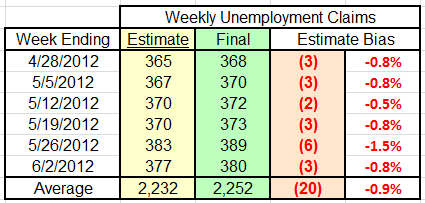
Let’s look at the numbers for the past couple of weeks:

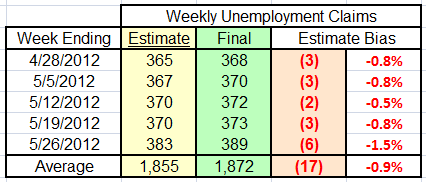
In each of the past 5 weeks — maybe longer, I just started tracking then — the so-called “Advance” estimate of weekly unemployment claims eventually got revised upward … by a fairly consistent 1%.
There’s a name for a consistent unidirectional error in forecasts.
It’s called SYSTEMATIC STATISTICAL BIAS.
So, you gotta wonder: why haven’t the crack statisticians at the BLS noticed the bias and started correcting for it?
Either they’re incompetent, or they’re as biased as they’re data.
Why does it matter?
Because the “headline numbers” each week are calculated by subtracting the advance number — which is consistently understated — from the prior week’s final number — which is consistently raised up.
In other words, there is a consistent bias to report bigger drops in unemployment claims than are real … and in 2 of the past 4 weeks, to report drops in weekly unemployment gains when there were actually increases.
Hmmm.
No wonder the President thinks the private economy is doing fine.

>> Latest Posts
SHARE THIS POST WITH FRIENDS & FAMILY
Tags: BLS, cookin' the books, private economy is doing fine, weekly unemployment claims
Posted in BLS, Employment - Jobs, Unemployment | Leave a Comment »
June 8, 2012
According to Prof. Mark Perry …
Last year, Professor Rojstaczer and co-author Christopher Healy published a research article in the Teachers College Record titled “Where A Is Ordinary: The Evolution of American College and University Grading, 1940–2009.”
The main conclusion of the paper is illustrated by the chart below showing the rising share of A letter grades over time at American colleges, from 15% in 1940 to 43% by 2008.
Starting in about 1998, the letter grade A became the most common college grade.

Ken’s Take: Note the Bs, Ds and Fs have stayed relatively constant, but Cs have declined … mirroring the increase in As,
Back when I was in college, a grade of C was referred to as a “Gentleman’s C” …. not too good, not too bad … not a source of pride, nor a disgrace … just right for a gentleman who didn’t want to work too hard.
Think George Bush … and John Kerry.
Now, I guess even gentlemen are getting As.
>> Latest Posts
SHARE THIS POST WITH FRIENDS & FAMILY
Tags: gentleman Cs, grade inflation
Posted in Education - Academics | 3 Comments »
June 8, 2012
According to Fidelity, a 65-year-old couple retiring this year on a $75,000 annual household income, will be getting about $29,970 in annual Social Security payments.
With an average life expectancy of about 80 years, that grosses up to about $450,000 in lifetime Social Security benefits.
Not bad,
Except …
Many retirees rely on Social Security benefits as their primary source of income, and …
Fidelity estimates that a 65-year-old couple retiring this year is will need $240,000 to cover medical expenses throughout retirement.
So, for most retiring couples, the majority of Social Security payments could go toward health care costs.
Bottom line: Start saving …
>> Latest Posts
SHARE THIS POST WITH FRIENDS & FAMILY
Tags: healtcare costs, social security
Posted in Social Security | Leave a Comment »
June 7, 2012
First, the bad news … you may have missed it, but Ginger the Taco Bell Chihuahua died a couple of years ago … 2009 to be precise … here’s the obit.
The bug-eyed dog who pitched 2 tacos for 99 cents must be turning over in her grave.
click to view Ginger pitching

Why?
Well, according to the AP …Taco Bell, is going upscale.
The chain plans to rollout “gourmet Mexican” menu additions created by celebrity chef Lorena Garcia … venturing onto the turf of Chipotle and Qdoba which are known for higher-quality ingredients.
It’s a departure from such standards as tacos, burritos and chalupas that Taco Bell’s core young-adult customers crave.
But, the Cantina Bell line could find a niche between Taco Bell’s less-expensive core items and the more-expensive fare at Mexican restaurants such as Chipotle and Qdoba.
The menu additions are bigger than the chain’s regular burritos … and will take a bigger bite out of the wallet: The Cantina Burrito Bowl and Cantina Burrito, offered with chicken or steak, will sell for nearly $5 apiece.
Taco Bell executives acknowledged that the push for quality will draw some skepticism. … especially following a yearlong sales slump stemming from a lawsuit that raised questions about its meat filling.
Ken’s Take:
(1) C’mon man, you’re Taco Bell!
(2) Next, they’ll start using real meat.
(3) No quiero, Taco Bell … if it’s going upscale.
I’m taking the under on this repositioning.
>> Latest Posts
SHARE THIS POST WITH FRIENDS & FAMILY
Tags: Chihuahua, Chipotle, repositioning, Taco Bell
Posted in Mktg - Positioning, Restaurants | Leave a Comment »
June 7, 2012
Punch line: Companies flock to social media, hoping that people will ‘like’ them and provide them with close-bud references.
Well, it didn’t take long for social network pool to start getting polluted.
Now, when you click that like icon, you may be signing up for spam or triggering a virus.
That might dampen some social media enthusiasm …
* * * * *
Excerpted from Business Week …
Two years ago, e-mail was the format of choice for spam peddling diets, sexual enhancement, and get-rich scams.
Better filters have since banished many of the unwanted missives from in-boxes.
Instead, scammers are turning to social media sites that are often poorly equipped to deal with the influx.
“Social spam can be a lot more effective than e-mail spam”
Spammers create as many as 40 percent of the accounts on social-media sites.
About 8 percent of messages sent via social pages are spam, approximately twice the volume of six months ago.
Spammers use the sharing features on social sites to spread their messages.
Click on a spammer’s link on Facebook (FB), and it may ask you to “like” or “share” a page, or to allow an app to gain access to your profile.
By clicking on a link, some users may unwittingly “like” the spam, a practice security experts call “likejacking.”
On Pinterest, spam often lurks in the embedded links attached to photos, making it tricky for users to spot.
Be careful who or what you ‘like’ …!
>> Latest Posts
SHARE THIS POST WITH FRIENDS & FAMILY
Tags: Like, social media, social networking, spam, viruses
Posted in Internet - General, Internet - Soc Networking, Internet Marketing - eCommerce - | Leave a Comment »
June 6, 2012
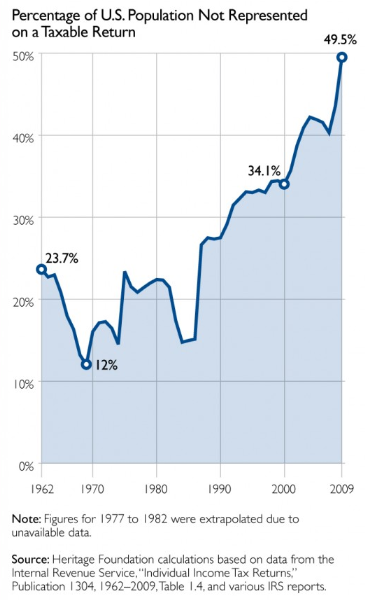
OK, you gotta go way back to 1969, but then, 88% of the U.S. population was represented on a taxable return — either as a taxpayer or a dependent.
Now, according to the Heritage Foundation, that number is down to about 50%.

While Obama’s policies (and the recession) have ticked us to a non-taxpaying majority, the blame (or credit, depending on your perspective) belongs to Bush … when he took office in 2001, about 2/3s of the population were represented on taxpaying returns … when he left office in 2009, we were close to the 50 / 50 split.
While the Dems like to harp on the tax breaks to millionaires and billionaires, a whopping 15% of the population benefited by being taken off the tax rolls.
Maybe the economics are sensible, but the political dynamics aren’t …
>> Latest Posts
SHARE THIS POST WITH FRIENDS & FAMILY
Tags: non-tax payers, What percentage of Americans don't pay Federal income taxes?
Posted in Tax Loopholes, Taxes | 2 Comments »
June 6, 2012
Certainly you’ve heard about Mayor Bloomberg’s action to ban take-out soft drinks bigger than 16 ounces.
Many folks have pointed out the obvious idiocies, e.g. will folks be allowed to buy more than one 16 ounce soft drink … or will their be a limit of one?
Hmmm.
I’m worried about a bigger issue: what happens to free refills?
Surely “infinite” is bigger than 16 ounces.
Will restaurants be required to stop giving free refills?
I’ve always put the free refill on the list with electricity and the 3-points line as the greatest innovations ever.
Banning free refills would get me to take to the streets, for sure.
* * * * *
Industry profitability?
While on the subject. I wonder what will happen to industry profitability.
The biggest sizes are the biggest profit generators … cups are a big part of the cost structure and cup costs are fairly constant across sizes … the soda itself costs only pennies … and the ice is essentially free.
So, making folks downsize will certainly hurt margins … unless, of course, prices are jacked up … which they will be.
* * * * *
Cola – not OK, weed – OK
Only in NYC
According to the NYTimes …
The New York Police Department, the mayor and the city’s top prosecutors endorsed a proposal to decriminalize the open possession of small amounts of marijuana, giving an unexpected lift to an effort by Gov. Andrew M. Cuomo to cut down on the number of people arrested.
You just can’t make this stuff up.
>> Latest Posts
SHARE THIS POST WITH FRIENDS & FAMILY
Tags: Bloomberg, free refills, super-size ban
Posted in Beverages - Soft Drinks, Laws - Very Strange | Leave a Comment »
June 5, 2012
The chickens came home to roost last Friday when the BLS had to gulp and (1) revise downward March and April jobs data, and (2) boost their count participants to the job market — the statistical aberration that was making the unemployment rate look like it was going down
Last Friday’s dismal jobs report shouldn’t have been much of a surprise to loyal readers. As we’ve said often, CEOs are dismayed by Team Obama’s economic, regulatory and pro-union policies and won’t do any serious hiring while Obama is in power. Period.
For the record, the Homa Files pitched this case over 2 years ago in a post titled: “Why private sector jobs won’t be coming back any time soon … Hint: it’s called passive aggressive resistance” … the punch lines:
Given the Administration’s anti-corporate rhetoric, actions, and proposed game-changing rules, I doubt that many CEOs will be taking on added costs and risks to boost the administration.
More likely, they will let unemployment continue to creep along, and will slow roll the process of rehiring.
Corporate chieftains will sit back and watch the President squirm and spin his “4 million jobs – saved or created”. As Rev. Wright would say “the chickens will have come home to roost”. Passively aggressive resistance at its very best.
Unfortunately, that means we’ll be seeing high unemployment for some time – at least through the 2012 Presidential elections.
The full original post is worth another read !
* * * * *
Ken’s current take:
Certainly there won’t be any meaningful hiring until the 2012. elections are in the book.
CEO heels are dug in. I’ve heard cocktail party chatter like “Each job added is a vote for Obama … Fool me once, shame on you … fool me twice, shame on me”
CEOs started to relent a bit when the Congress tilted GOP and Obama extended the Bush tax cuts. (Whatever happened to Immelt’s job creation task force?)
But, recent moves – e.g. stopping Boeing’s move to South Carolina, stumping again for higher taxes, especially on off-shore profits – have more than offset any momentum.
We’ll be stuck with unemployment in the 8s until 2013 … or until there’s a substantial policy roll-back .
And, the latter just ain’t gonna happen …
>> Latest Posts
SHARE THIS POST WITH FRIENDS & FAMILY
Tags: BLS, Obama, unemployment
Posted in 2012 Campaign, Employment - Jobs, Obama | Leave a Comment »
June 5, 2012
Earlier this week, President Obama honored Bob Dylan with a Presidential Medal of Freedom award.

Brought back memories of my Princeton graduation.
It was during the Viet Nam War days … no academic robes, — just “together for peace” armbands … honorary degree recipient: Bob Dylan.
It was was a year of locusts in New Jersey .. and, they were chirping loudly.
That provided inspiration for Dylan’s commemorative song : Day of the Locusts:
As I stepped to the stage to pick up my degree
And the locusts sang off in the distance
Yeah the locusts sang such a sweet melody
Oh, the locusts sang off in the distance
Yeah, the locusts sang and they were singing for me.
I put down my robe, picked up my diploma
Took hold of my sweetheart and away we did drive
Straight for the hills, the black hills of Dakota
Sure was glad to get out of there alive
Man, that was a long time ago.
>> Latest Posts
SHARE THIS POST WITH FRIENDS & FAMILY
Tags: Day of the Locusts, Dylan, Freedom Award, Princeton University
Posted in Ken - Misc., Personalities | Leave a Comment »
June 4, 2012
Not to worry about the economy … President Obama has a Plan B.
His response to the bump in the unemployment rate: everybody should “buy a thingamajig for their furnace” … in June, no less.
click to view

You can’t make this stuff up.
I love it when the economist-in-chief talks off-the-cuff without his teleprompter.
Now, about those transcripts …
>> Latest Posts
SHARE THIS POST WITH FRIENDS & FAMILY
Tags: economy. teleprompter, Obama
Posted in 2012 Campaign, Employment - Jobs, Obama | Leave a Comment »
June 4, 2012
Don’t faint, I wasn’t talking politics.
The topic on Marketplace was JC Penney’s decision to supplement their “fair & square – no sales” strategy with Friday sales.
My predictable reaction:
Kenneth Homa: Well now their basic proposition is they’re not going to have sales, except for when they have sales.
Reporter: Ken Homa teaches marketing at Georgetown’s McDonough School of Business.
Homa: I don’t know how they can possibly communicate that clearly to any consumers
click to hear the 2-minute podcast or read the full transcript

>> Latest Posts
SHARE THIS POST WITH FRIENDS & FAMILY
Tags: EDLP, JC Penney, NPR
Posted in Mktg - Promotion, NPR, Retailing | 1 Comment »
June 1, 2012
The BLS reports May’s unemployment number at 8:30 this morning.
If the headline is “Unemployment rate clicks down to 8%” … I’ll scream.
You may remember that job growth was anemic last month (under 125,000), but the unemployment rate dipped to 8.1% as more than 350,000 quit looking for jobs.
In advance of today’s BLS report …
The Commerce Dept revised down its Q1 GDP estimate to 1.9% … … its original report a month ago was an increase of 2.2%.
ADP reported 133,000 new jobs … after revising its prior month estimate down by 6,000.
Gallup’s mid-May unemployment rate rate hovered around 8.2%.
And, unemployment claims for last week increased by 10,000 … after revising the prior week’s claims up (of course).

My bet: miraculously, the unemployment rate will stay constant at 8.1% … though every other piece of data says it it should bump up.
We’ll see.
>> Latest Posts
SHARE THIS POST WITH FRIENDS & FAMILY
Tags: BLS cookin' the books, employment, unemployment
Posted in BLS, Employment - Jobs, Unemployment | Leave a Comment »
June 1, 2012
According to AdAge …
JC Penney is ramping up its promotional messaging in the wake of a dismal first quarter.
The retailer has added "Best Price Fridays" to its calendar
Certain products are marked down on those days, and the lower prices are in effect until the product sells out.
"The additional Best Price Fridays equates to adding promotions and is a step away from the company’s pricing strategy, suggesting that the company is willing to forgo its original thinking."
Store associates also have been instructed to place stickers with new prices for best price and month-long value items next to, rather than on top of, original prices.
The new approach will better highlight savings for customers so that they can … "Do the Math" .
"The change in strategy is an admission that the company’s existing pricing strategy has flaws — less than 120 days since Ron Johnson’s new model took course on Feb. 1."
In discussing first-quarter results, executives admitted there has been confusion surrounding its pricing strategy and lack of coupons.
Shocker: Shoppers like deals and find it incredible (i.e. not credible) when a promotions-intensive retailer claims to have “seen the light”.
>> Latest Posts
SHARE THIS POST WITH FRIENDS & FAMILY
Tags: coupons, deals, fair & square, JC Penney, promotions
Posted in Retailing | 1 Comment »
May 31, 2012
Punch line: I had a friend who would bet on anything … in a football game it would be who would win the toss, who would score first, whether the next play would gain more or less than 5 yards.
You get the picture.
Well, he must be salivating.
Cantor Fitzgerald — the NY brokerage outfit — is bringing technology and near real-time action to betting.
I guess derivatives weren’t risky enough for these wise guys …
* * * * *
Excerpted from the Washington Post …
Cantor Fitzgerald, one of the world’s largest brokers of government bonds, is diversifying — into sports-gambling.
Equipped with technology drawn from Wall Street and a trader’s appetite for risk, Cantor is charging into sports betting in Las Vegas .
With a $150 million investment, the New York-based bond brokerage has taken control of and retooled seven sports books.
Cantor has also produced wireless tablets so gamblers can bet anywhere in the casino or hotel. Eventually, it wants to start an online poker casino, too.
“The idea is that we can bring technological innovation to the market.’’
Cantor’s bookmaking software, a modified version of what Wall Street traders use, has changed the way sports gamblers bet.
Cantor says its computer servers, driven by the kind of algorithm-rich software that fuels derivatives trading, spew out odds on events at the fastest rate ever.
Before Cantor ran the sports book, people could usually bet only once, before the game began, on the outcome.
Cantor’s technology allows gamblers to place bets during contests on dozens of situations just seconds before they unfold.
During a Los Angeles Lakers-Boston Celtics game, a betting opportunity pops up on the stations.
It offers a $100 payoff on a $220 wager that the Celtics’ Paul Pierce will sink the two foul shots he’s about to take.
Gamblers bet on Pierce by swiping a finger across the screen.
Pierce sinks both.
Cantor’s big bet is that Congress will allow sports wagering to spread across the country … online, of course..
Thanks to SMH for feeding the lead.
>> Latest Posts
SHARE THIS POST WITH FRIENDS & FAMILY
Tags: Cantor Fitzgerald, online betting, sports betting, technology
Posted in Gambling, Wall Street | Leave a Comment »
May 31, 2012
The WSJ reports that:
An analysis by the Association to Advance Collegiate Schools of Business, an accrediting body, involving 733 member schools, found that 28% include the words “innovate,” “innovation” or “innovative” in their school mission statements.
Most use the terms to describe their own curricula.
Business schools have added research centers, classes and even full-fledged majors in innovation.
But some think the schools may be missing the mark, focusing too heavily on ideation and brainstorming while skimping on the practical aspects of turning ideas into concrete strategy and action.
“Innovation requires taking the great idea and doing something with it.”
So where does it all lead?
As schools race to add innovation to their offerings, they’re also trying to differentiate themselves from one another.
The goal at the Haas School of Business at Berkeley, is to create managers who can foster innovation or oversee innovative organizations, not just come up with innovative ideas.
“It’s not about producing home-run hitters.”
>> Latest Posts
SHARE THIS POST WITH FRIENDS & FAMILY
Tags: Innovation, MBA, mission statements
Posted in Innovation, Innovation - Creativity, MBAs | Leave a Comment »
May 30, 2012
Well, maybe that’s hyperbole, but it’s certainly a candidate.
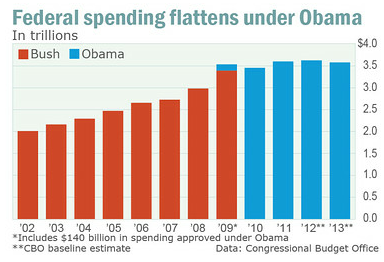
Last week, some jabrone named Rex Nutting blogged in MarketWatch that the “Obama spending binge never happened”.
Nutting cooks some CBO numbers to conclude that “under Obama, federal spending is rising at the slowest pace since Dwight Eisenhower brought the Korean War to an end in the 1950s.”
Oh really?
The crux of his argument is that all the surge in Fed spending occurred in FY2009 — the last year of the Bush presidency.
Barack the Austere has just been treading water.

Hmmm.
Apparently Nutting wasn’t aware that Fed fiscal years run from Oct to Sept, so FY2009 was 3/4s Obama … and included about $1 trillion of his Stimulus and bailouts.
So, the real story is that Obama uber-boosted spending to try to stimulate the economy and had has kept spending at that higher level.
Hardly belt tightening.
Nutting’s analysis was so bad that the pro-Obama Washington Post gave it 3 Pinnochios … for “significant factual error and obvious contradictions.”
That didn’t stop the President from repeating the bogus conclusion in his campaign speeches yesterday.
Shame, shame.
P.S. The entire Wash Post fact-checker article is worth reading … an example of a good analysis .. with links to a couple of other pretty good analyses.
>> Latest Posts
SHARE THIS POST WITH FRIENDS & FAMILY
Tags: 3 Pinnochios, Fed spending, Obama
Posted in Gov't Spending, Obama | 1 Comment »
May 30, 2012
Punch line: JC Penney’s is trying to re-cast itself as the “fair & square” retailer. So far, the dogs aren’t eating the dog food. Why? It’s simple behavioral economics. People are predictably irrational.
Personal note: When I was at Black & Decker, we tried to lead the industry out of constant rebating. You know, $5 back if you mail a receipt, UPC code, etc. to some PO Box in Texas.
When we stopped offering rebates, competitors doubled their’s and ate our lunch.
Penney’s should have asked me …
* * * * *
Excerpted from MSNBC.com …
JC Penney’s “Fair & Square” campaign, which launched on Feb. 1, appears to be a disaster.
Revenue dropped 20 percent; customer traffic fell 10 percent; the company lost $163 million in the 1st quarter.
Could we have a moment of silence please for what might be the last heartbeat of honest price tags?
Not only did Penney’s plain pricing structure fail to attract fair-minded shoppers – it “repelled” them.
Apparently, if a firm tries to educate consumers on tricks and traps, and tries to offer an honest product, a funny thing happens: Consumers say, “Thank you for the tips,” and go back to the tricky companies, where they exploit the new knowledge to get cheaper prices, leaving the “honest” firm in the dust.
“Once you educate consumers on the right way to shop, they will seek out the lowest cost store.”
To oversimplify, here’s Penney’s problem.
JCP told the world that retailers only offer their best prices during crazy sales, and Penney stores would no longer host them.
Sensible consumers apparently took that information to heart and decided to simply wait for such sales at other stores.
As an added benefit, Penney lowered consumers’ search costs, because they now knew they didn’t need to bother driving to a Penney’s store anymore.
Penney’s is also leaving a lot of money on the table by rejecting a phenomenon known as “price discrimination.”
Some people have more money than time, and some have more time than money.
Some shoppers don’t mind spending hours to save $20; others would gladly give a store $20 to escape quickly. Smart retailers get money from both.
By killing couponing, Penney has eliminated its ability to satisfy price discriminators.
But the real problem is Penney’s ill-fated attempt to cast itself as the only fair poker player in a game of cheats.
Shoppers just aren’t buying it.
However unsophisticated consumers are, very few of them believe a pair of shoes bought at Penney’s everyday low price will be cheaper than a pair of shoes bought at Macy’s on clearance with a 25 percent off coupon.
>> Latest Posts
SHARE THIS POST WITH FRIENDS & FAMILY
Tags: Apple, coupons, everyday low pricing, fair & square, JC Penney's, rebates
Posted in Retailing | 1 Comment »
May 29, 2012
I smelled this one a couple of weeks ago … and, surprisingly, haven’t heard any pundits nail it.
Each Thursday morning, the BLS reports new unemployment claims.
Here are the headline numbers from the past couple of weeks:
In the week ending April 28, the advance figure for seasonally adjusted initial claims was 365,000.
In the week ending May 5, the advance figure for seasonally adjusted initial claims was 367,000, a decrease of 1,000 from the previous week’s revised figure of 368,000.
In the week ending May 12, the advance figure for seasonally adjusted initial claims was 370,000, unchanged from the previous week’s revised figure of 370,000.
In the week ending May 19, the advance figure for seasonally adjusted initial claims was 370,000, a decrease of 2,000 from the previous week’s revised figure of 372,000.
OK, for 3 weeks running, unemployment claims were unchanged 1 week and declining 2 weeks.
Oh really?
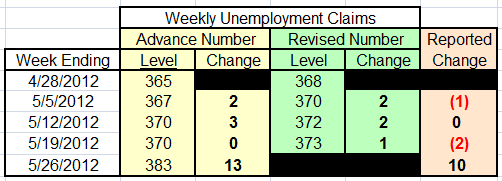
Tabulating the reported data (chart below) reveals a very different trend.
Comparing the so-called advance numbers from month-to-month shows a decline in 2 weeks with 1 week unchanged.
Hmmm.
Comparing the revised numbers from month to month shows a decline in 2 weeks.
Double hmmm.
In other words, in each of the past 3 weeks, the advanced number was low-balled and compared to a number that was revised up.
Changes that coincidently provide positive headlines … for what amounts to be negative news.
Cookin’ the books?
Let’s see what happens in this Thursday’s & Friday’s unemployment reports. …

>> Latest Posts
SHARE THIS POST WITH FRIENDS & FAMILY
Tags: BLS cooking the books, unemployment claims
Posted in Employment - Jobs, Unemployment | Leave a Comment »
May 29, 2012
Frequently reported is the stat that only about half of the adults in the U.S. pay any Federal income taxes.
That’s the “revenue” side”.
Now, the WSJ reports that according to recent Census Bureau data, nearly half of the people in the U.S. live in a household that receives at least one government benefit, and many likely received more than one.
The 49.1% of the population in a household that gets benefits is up from 30% in the early 1980s and 44.4% as recently as the third quarter of 2008.

First, there are the senior citizens who anted into the pot during their working years:
- 16% of the population lives in a household where at least one member receives Social Security
- 15% receive or live with someone who gets Medicare.
Then, there are the poor:
- 26% had someone enrolled in Medicaid
- 15% of people lived in a household that received food stamps,
- 2% had a member receiving unemployment benefits.
Most interesting to me is the low percentage getting unemployment benefits … only about 25% of the unemployed.
>> Latest Posts
SHARE THIS POST WITH FRIENDS & FAMILY
Tags: government benefits, medicaid, Medicare, social security, tipping point
Posted in Social Security, Unemployment | Leave a Comment »
May 25, 2012
Free Stuff
Think Facebook, “free” email services …
“If you’re not paying for something, you’re not the customer; you’re the product being sold”. Source
* * * * *
The Economic Recovery
Team Obama would like you to think we’ve turned the corner, but…
“Calling our current economic status a recovery is like calling the product of a Kim Kardashian wedding a marriage.” Source
* * * * *
Obama on Taxes
“Over the past three years, Obama has pursued the goal of higher tax rates as relentlessly as Captain Ahab pursued the great white whale.” Source
>> Latest Posts
SHARE THIS POST WITH FRIENDS & FAMILY
Tags: customers, free stuff, Obama, products, quotes, Taxes
Posted in Quotations | Leave a Comment »
May 25, 2012
Buried as the last of 7 Reasons Why Facebook IPO Was A Bust, Forbes’ writer Rich Karlgaard raised a point that caught my eye:
Mass social media is a crock. It is an inherent contradiction.
I like LinkedIn more than Facebook because it has a special purpose and therefore doesn’t feel like a time waster.
FWIW, I predict the next huge win in social media will be in health care.
As a health care consumer, I want chat with people who are just like me.
With similar gene structures.
Who suffer from similar maladies as well as the genetic potential for similar maladies.
When linking up with my “health friends” I also want a 100% guarantee that my social network won’t betray my health confidences.
Would I trust Facebook to keep these confidences? Never.
Think about it.
How many times have you Googled for medical advice, e.g. what to do for poison ivy?
And, how many folks have built ad hoc digital support structures when a friend or relative was facing a tough medical situation?
>> Latest Posts
SHARE THIS POST WITH FRIENDS & FAMILY
Tags: health care, medical, privacy, social networks
Posted in Internet - Soc Networking | 1 Comment »
May 24, 2012
Management guru Tom Peters used to oft say:
“The difference between average and high achievers” is often a factor of not 10, but 1,000”
In Outliers, Malcolm Gladwell asserted:
It takes 10,000 hours of work to become expert in anything.
Chad Syverson, an economist at the University of Chicago’s Booth School of Business, found:
What separates top firms from bottom firms is, typically, a large difference in productivity, with the top firms producing almost twice as much with the same measured input.
Bottom line: it’s easy to be average, hard to be great …
>> Latest Posts
SHARE THIS POST WITH FRIENDS & FAMILY
Tags: Gladwell, high achievers, Outliers, Tom Peters
Posted in Management - General | Leave a Comment »
May 24, 2012
Gotta admit that I have never paid much attention to Oprah Winfrey … admired her media success … but it just didn’t matter much to me.
That’s ok, because I’m definitely not in her target market.
But, a couple of articles caught my eye last week.
The first was one of many that broadcast an excerpt from the book “The Amateur” that claimed that Oprah — despite her impactful endorsement of Obama — has been largely shunned by the Obamas.
Why?
Gossipy reports say that Michelle feels threatened by powerful women around Barack, and — according to Oprah herself — “Michelle hates fat people and doesn’t want me waddling around the White House!’
Ouch.
Regardless of cause, nobody seems to dispute that Oprah hasn’t been in view around the White House … or on Obama’s campaign bus.
* * * * *
A second article in the NRO chronicled Oprah’s decline as a mega-media powerhouse.
She’s still a big deal … just not as big as she used to be.
One theory of the case is that lost the hearts of many of her followers when she dissed Hillary — the woman candidate — and endorsed Obama:
Oprah had chosen the less-qualified, less-experienced black man over the more-qualified, more-experienced white woman.
It didn’t take long for Oprah to feel the backlash.
Hell hath no fury like millions of women scorned.
Even the major media outlets couldn’t ignore the firestorm Oprah had ignited by choosing one part of her identity over another.
One ABC News headline said it most plainly: “Women Angry Over Oprah-Obama Campaign.”
Of course, there’s more to the story than that …. Oprah also blew off the mass media networks for her own cable network and Ellen Degeneres caught fire.
Still, an interesting connection, right?
>> Latest Posts
SHARE THIS POST WITH FRIENDS & FAMILY
Tags: Ellen Degeneres, Obama, Oprah
Posted in Obama | Leave a Comment »
May 23, 2012
I love the irony when it’s revealed that a villain and a hero are found guilty (innocent?) of similar deeds.
Past couple of weeks, Team O has been pouncing on Mitt & Bain for the evil done by private equity firms.
And, for years, Steve Jobs has been revered for his magic at Apple.
Here’s an interesting snippet from an NRO article: “Praise Private Equity“ …
Just months before Romney’s career at Bain Capital became controversial, Americans mourned the death of Apple CEO Steve Jobs.
And yet when Jobs returned to Apple in 1997, Jobs returned as an angel of destruction. He fired over 3,000 employees, a move that helped swing Apple from a $1.05 billion annual loss to a $309 million profit.
He shut down Apple’s manufacturing facilities and outsourced almost every aspect of production.
He swung the axe pitilessly, since he was convinced that survival requires leanness.
And in the 14 years after Jobs returned, employment levels at Apple soared.
Apple’s manufacturing work force was eventually replaced by engineers, support staff, and — in a move that would have surprised many in 1997 — a vast army of retail employees.
The destruction was a prerequisite for the creation, and for the transformation of a wounded technology firm into one of the world’s most valuable public companies. “
And, oh yeah, Apple is insanely profitable … and pays no Federal income taxes.
Jobs is good; Romney is bad.
Hmmm …
>> Latest Posts
SHARE THIS POST WITH FRIENDS & FAMILY
Tags: Apple, creative destruction, Mitt Romney, Obama, private equity, Steve Jobs
Posted in Private Equity | Leave a Comment »
May 23, 2012
Millward Brown — a brands’ consultancy — has just released its Brand Z 2012 brand rankings and valuations (see chart below and click through for the complete list).
Apple tops their list … followed by IBM, Google, McDonald’s, Microsoft and Coke.
Sounds reasonable … but, according to Ad Age — the list re-opens a can of worms re: brand valuations.
Ad Age cites IBM as a case in point:
According to Brand Z, IBM continues its rise up the brand-valuation hierarchy, leapfrogging Google and rising to No. 2 behind Apple, its value up 15% to nearly $116 billion last year.
Omnicom’s Interbrand also had IBM No. 2 in its brand-valuation ranking released last October, up 8%, but valued Big Blue at just under $70 billion, only about 60 cents on Brand Z’s dollar.
But, the CoreBrand Brand Power ranking released about three weeks earlier, said the value of IBM’s brand plummeted last year as it fell 18 places to No. 66 on that firm’s list.
Hmmm.
Ad Age says it’s illustrative of a bigger problem:
The IBM case is but an extreme among many disparities the Marketing Accountability Standards Board has found in publicly available valuations of brands.
The MASB has been trying to develop a common way of measuring what brands are worth and how those values change.
“Many of the valuators treat them as black boxes, so you don’t even know what’s in it.”
So, how much is a brand worth?
* * * * * *

>> Latest Posts
SHARE THIS POST WITH FRIENDS & FAMILY
Tags: Brand Z, Crebtands, Interbrands
Posted in Mktg - Brands | Leave a Comment »
May 23, 2012
According to Gallup :
Some six months before voters head to the polls to choose the next president of the United States,
Gallup finds several indicators of the economic and political climate holding steady at levels that could be troublesome for President Barack Obama.
According to Gallup polling in early May, Obama’s approval rating is below 50%, Americans’ satisfaction with the direction of the country is barely above 20%, and the economy remains a dominant concern.
Talk about a juxtaposition of cause & effect … perhaps, its President Obama who is responsible for the country’s lack of confidence … rather than the lack of confidence causing headwinds for the President.
* * * * *
Side Note
41% of the country was “satisfied with direction of the U.S.” when Bush was vying for re-election.

>> Latest Posts
SHARE THIS POST WITH FRIENDS & FAMILY
Tags: Bush, Gallup, Obama, Satisfaction with Direction of Country
Posted in Campaign 2012, Obama, Polls & Surveys | Leave a Comment »
May 22, 2012
Thanks to the spread of high-speed wireless technology, high-speed Internet, smartphones, Facebook, the cloud and tablet computers, the world has gone from connected to hyperconnected.
Finally, a generation that has grown up on these technologies is increasingly comfortable learning and interacting with professors through online platforms.
Coursera, a new interactive online education company.hopes to revolutionize higher education by allowing students from all over the world to not only hear his lectures, but to do homework assignments, be graded, receive a certificate for completing the course and use that to get a better job or gain admission to a better school.
Coursera just broke the million enrollments level.
Andrew Ng an associate professor of computer science at Stanford says: “I normally teach 400 students. Last semester I taught 100,000 in an online course on machine learning. To reach that many students I would have had to teach my normal Stanford class for 250 years.”
Source: N.Y. Times
>> Latest Posts
SHARE THIS POST WITH FRIENDS & FAMILY
Tags: cost of college, Higher education, online education
Posted in Academics - Research, Education - Academics, Online Education | Leave a Comment »
May 22, 2012
Punch line: The US economy added 130,000 jobs in April … pushing the unemployment rate down to 8.1% since over 350,000 left the labor force.
Hmmm.
* * * * *
First, let’s look at the 130,000:
According to US News & World Report …
There is a little-known category of job creation called the birth/death model, a seasonal adjustment in which the Bureau of Labor Statistics (BLS) arbitrarily adds jobs for net new companies it thinks are starting up and creating positions.
Last month, the BLS made the assumption that 206,000 jobs were created in this category based on the companies that it thinks, but really can’t prove, have just started up and essentially are invisible to government labor surveys.
This is an imprecise, controversial guesstimate based on historical extrapolation.
One must be skeptical, since this figure of 206,000 rose from 172,000 in April 2011 despite the obvious decline in economic activity this spring and the general lack of financing for start-up companies.
In other words, 76,000 jobs were lost in “countable” businesses … and 206,000 jobs were added in the “your guess is as good as our/s” category … netting to the reported 130,000 jobs.
Hmmm …
* * * * *
Now, let’s look at the denominator … the 350.000 folks who stopped looking for jobs.
Prior posts have addressed the decline in the labor force participation rate.

One of the reasons offered up for the decline in the labor force participation rate is that that low paying jobs are “under water” compared to unemployment benefits. Specifically, according to the WSJ, in some high-benefit states women need to earn $30,000 or more to compensate for the benefits they lose if they get a job. Since minimum wage is about $10 per hour and there are about 2,000 hours in a work-year, a minimum wage job pays about $20,000. So, many folks are making the economically rationale decision to stay home.
Additionally, also according to US News & World Report, the number of people applying for disability benefits has been skyrocketing … apparently, new stealth welfare program
Last month alone, 225,000 signed up for government=paid disability payments.
That’s up since last year when about 1 million Americans applied for disability.
Since President Obama took office more than three years ago, more than 5 million people have been added to the nation’s disability coverage, costing the government billions upon billions of dollars every year.
“Either the safety standards at work have eroded dramatically or many working people have found a creative way to game the system and turn it into a quasi-welfare state.”
>> Latest Posts
SHARE THIS POST WITH FRIENDS & FAMILY
Tags: BLS guesstimates, disability payments, labor force participation
Posted in Employment - Jobs, Unemployment | Leave a Comment »
May 21, 2012
Punch line: Despite the hoo[la around Facebook’s IPO, social media is already passé in Silicon Valley.
America’s innovation engine is now focused on transportation, energy and manufacturing.
* * * * * *
A couple of snippets from an editorial in the WSJ : The Future Is More Than Facebook by Rich Karlgaard of Forbes.
Only a certain kind of company is getting rich in the Obama economy.
These are outfits that make algorithms — bits of software code cleverly strung together to take the form of an iPhone operating system, a LinkedIn social network, or a proprietary trading scheme.
But America can do better than that, and it will. In fact, the seeds are being planted now.
In Silicon Valley, investing in social-media companies is already passé. America’s innovation engine, Silicon Valley, is again overheating.
There’s a growing interest among bright minds to apply “exponential technologies” to solve problems much larger than whom to friend on Facebook: transportation (smart cars), manufacturing (3-printing), and energy (high-tech horizontal drilling).
Question: If America could have only one of the following — Facebook, Twitter or horizontal drilling — which would be the smarter choice?
Happily, we don’t have to make that choice. America remains the world’s innovator, a country without limits.
>> Latest Posts
SHARE THIS POST WITH FRIENDS & FAMILY
Tags: exponential technology, Innovation, social networking, Venture capital
Posted in Innovation, Venture Capital | Leave a Comment »
May 21, 2012
Well, Facebook went out at $38 and closed at $38.
The pundits are whining that the IPO was a failure because there wasn’t a big first day pop.
My take: one of the rare times that the IB’s priced a deal at fair market value.
Oh my, “flippers” didn’t get a chance to earn millions by just showing up for work.
Sounds ok to me.
* * * * *
What I didn’t like about the Facebook IPO is that it got most analysts talking about the Government Motors IPO.
Given the chatter, I got curious and checked out the stock price
Oops, down almost 40% from the IPO price …. during a period when the overall market was up over 10%.

Geez, since Bin Laden is dead and GM is alive, why the stock dip?
The company claimed record profits of $7.6 billion in 2011, the “highest profits in the 100 year history of that company” according to President Obama.
And, the company paid no Federal income taxes on taxes those record earnings.
Why?
Because New GM came out of bankruptcy “owning” all of the tax loss carry forwards from old GM.
That’s not supposed to be allowed when a company goes through bankruptcy — a deterrent to companies trying to simply buy losses to offset some of their taxable earnings.
How did it happen?
According to several sources:
The Obama administration quietly snuck in a special tax break for GM, which allows the company to write off approximately $45 billion in post-bankruptcy losses against post-bankruptcy profits.
It’s good for twenty years.
The $45 million tax write-off is in addition to the more than $50 billion given to General Motors in the bailout,
>> Latest Posts
SHARE THIS POST WITH FRIENDS & FAMILY
Tags: Facebook, GM, Tax loopholes
Posted in Autos - Travel | Leave a Comment »
May 18, 2012
Skechers advertised its Shape-ups as a fitness tool designed to promote weight loss and tone muscles with the shoe’s curved “rocker” or rolling bottom — saying it provides natural instability and causes the consumer to “use more energy with every step.”
But, the Feds want you to know that simply sporting a pair of Skechers’ fitness shoes is not going to get you sexy curves or a toned tush.
For millions of consumers,”the only thing that got a workout was their wallet.”
Skechers will pay $40 million to settle charges by the Federal Trade Commission that the footwear company made unfounded claims that its Shape-ups shoes would help people lose weight and strengthen their butt, leg and stomach muscles.
Consumers who bought the shoes will be eligible for refunds, though it’s not clear how much money people will get.
“The FTC’s message, for Skechers and other national advertisers, is to shape up your substantiation or tone down your claims.”
Skechers says it disputes the charges and is pursuing additional studies.
Souce: Yahoo Finance
>> Latest Posts
SHARE THIS POST WITH FRIENDS & FAMILY
Tags: false advertising, FTC, Skechers'
Posted in Mktg - Advertising | Leave a Comment »
May 18, 2012
On the wire …
For the 2nd year in a row, the Democratic-controlled Senate unanimously rejected President Obama’s budget submission. This year’s vote: 99 to 0.
Coupled with the House’s rejection in March, 414-0, that means Mr. Obama’s budget has failed to win a single vote in support this year.
Team O had been saying – with a straight face, no less – that the President was offering up a “balanced approach” to begin reining in deficits., even though it It would add $6.4 trillion in new deficits over the next 10 years.
* * * * *
Ken’s Take: Amazing that the county’s CEO and top-lawmaking body are unwilling to develop an operating budget … for the 3rd year in a row.
No company that I know of operates that way.
>> Latest Posts
SHARE THIS POST WITH FRIENDS & FAMILY
Tags: budget, Obama, Senate
Posted in Obama | Leave a Comment »
May 17, 2012
Punch line: Ron Johnson earned fame by designing Apple Stores. He was lured to JC Penney to inject some of his merchandising magic. Johnson immediately set out to remake JCP into Apple Stores: no discounting, corner boutiques, hangout areas. Based on initial results, it’s safe to conclude that JCP isn’t exactly Apple. Hot, world class products can make a lot of store formats work … but, apparently, hot store formats can’t make “ordinary” products explode.
* * * * *
Excerpted from WSJ: Penney’s Stock Plummets on a Big Loss
J.C. Penney CEO Ron Johnson is getting a taste of what it’s like to run a retail operation without world-beating products, and so far it is not pretty.
JCP is in the early stages of a transformation led by Mr. Johnson, the former senior vice president of Apple’s retail operations who took over the retailer last fall.
Mr. Johnson, who won plaudits for reinventing the retail experience with Apple stores’ clean lines and empty space, has laid out an ambitious yet risky plan that involves carving stores into a warren of specialty shops, turning the center selling space into an entertainment and hangout area, and eschewing constant “sales” in favor of lower prices every day.
So far, consumers don’t seem to like the strategy,
Company executives said that weaning of shoppers from their coupon addiction has hurt sales and store traffic more than anticipated.
65% of sales were at full price, but store traffic dropped 10% and average customer spend dropped 5% compared with a year earlier.
JCP’s quarterly earnings report marked the first time that investors could gauge the impact of the new strategy.
The company missed nearly every financial target it had set for the latest quarter.
The retailer reported a $163 million loss, more than twice what analysts were expecting.
Same-store sales slid 19% … margins narrowed to 37.6% from 40.5%.
Investors whispered to each other about the “bloodbath.”
Penney’s shares plummeted 13% to around $29 as the company suspended its quarterly dividend and announced that it will not meet its previous annual earnings target.
Fitch Ratings lowered its credit ratings on Penney to junk territory, citing risks of rolling out the new pricing strategy.
The earnings report is a blow to Mr. Johnson, who said the turnaround has been a lot harder than management expected.
* * * * *
Ken’s Take:
(1) When economic times are tough and daily deals (think Groupon) are the rage, it’s a fool’s mission to try peddling “ordinary” merchandise at list price. You’re just a sitting duck for competitors who will discount off your benchmark price.
(2) Unless you have exclusive, hot products or a substantial competitive cost advantage (think Walmart), everyday low pricing won’t work … you have to provide a lot of shopping “experience” to justify higher prices.
(3) Stop by a JCP store and ask yourself: Are these folks clamoring for a shopping “experience’? Or, flip the question: Are there a lot of folks who are looking for a shopping experience thinking “let’s rush over to Penney’s”?
>> Latest Posts
SHARE THIS POST WITH FRIENDS & FAMILY
Tags: Apple Stores. deals, discounts, everyday low prices, J.C. Penney
Posted in Retailing | Leave a Comment »






![Americans_College_Attainment_1975_2011-thumb-615x470-88514[1]](https://homafiles.info/wp-content/uploads/2012/05/americans_college_attainment_1975_2011-thumb-615x470-885141.png "Americans_College_Attainment_1975_2011-thumb-615x470-88514[1]")





 The Homa Files