Why isn’t toothpaste mandated on my health insurance?

February 9, 2012

That question and a few others that cut to the chase on the flap between ObamaCare and the Catholic Church are central to a WSJ op-ed by Univ. of Chicago prof John Cochrane.

Well worth reading in its entirety.

The answer:

Insurance is a bad idea for small, regular and predictable expenses.

There are good reasons that your car insurance company doesn’t add $100 per year to your premium and then cover oil changes, and that your health insurance doesn’t charge $50 more per year and cover toothpaste.

You’d have to fill out mountains of paperwork, the oil-change and toothpaste markets would become much less competitive, and you’d end up spending more.

Every increase in coverage means an increase in premiums.

Another question: What’s the difference between “access” and “cost.”

I have “access” to toothpaste because I have two bucks in my pocket and a competitive supplier.

Anyone who can afford a cell phone can afford toothpaste or pills or condoms.

Poor women who can’t afford birth control are a red herring in this debate.

The very poor typically don’t have employer-provided health insurance in the first place.

But, Americans, when paying even modest co-payments, choose to spend their money on other things.

They prefer a new iPod to a “wellness visit” to the doctor.

Cochrane’s overall conclusion:

It all leads back to the elephant in the room: the tax deductibility of employer-provided group insurance.

If your employer pays you $100 less in salary and buys $100 of group insurance for you, you don’t pay taxes on that amount.

Hence, the more insurance costs and covers, the less in taxes you seem to pay. (Even that savings is an illusion: The government still needs money and raises overall tax rates to make up the difference.)

To add insult to injury, this tax deduction does not apply to portable, guaranteed-renewable individual insurance.

You don’t get the tax break if your employer gives you the $100 and you buy a policy — a policy that will stay with you if you get sick, leave employment or get divorced.

The pre-existing conditions crisis is largely a creature of tax law.

You don’t lose your car insurance when you change jobs.

Again, well worth reading in its entirety ,,,

>> Latest Posts

Check the weather or stock quotes as you recycle … say, what?

February 9, 2012

Punch line: New smart recycling bins provide consumers with added benefits – LCD display, Wi-Fi connectivity, weather forecasts, and even stock prices. These smart bins are being rolled out in London, NY, Singapore, and Tokyo.

* * * * *
Excerpted from psfk.com, “London’s New Smart Recycling Bins Come With LCD Displays & Wi-Fi

image_thumb

In preparation for the 2012 Olympics, London will introduce 25 high-tech ‘smart bins’ placed around the city.

These recycling bins will be embedded with an LCD display on each side and come integrated with Wi-Fi connectivity.

The screens will constantly change to display different information, ranging from weather forecasts to stock prices.

In addition, these high-tech bins are also bomb-proof.

At $1,880 each, they aren’t cheap compared to traditional outdoor recycling bins that are usually between $200-500.

The smart bins won’t only be seen in London, but are also expected to be implemented in other metropolitan cities including New York, Singapore and Tokyo.

Edit by KJM

>> Latest Posts

Unleashing private capital to stabilize the housing market … it’s happening !

February 8, 2012

For a couple of years (literally – back as far as Nov. 2008), I’ve been blogging that the key to stabilizing the housing market is incentivizing private capital (i.e. investors) to buy up distressed properties and rent them.

To refresh your memory, here’s the plan I advocated.

  1. Eliminate future capital gains taxes on any residential property bought in the next 2 years, and held for at least 3 years.
  2. Allow investors (i.e. landlords) who rent the properties to depreciate the properties on an aggressively accelerated basis (i.e. say, 5 years),
  3. Allow any excess tax losses from renting to be applied to ordinary income.

I argued that the likely outcome: a massive inflow of private capital to buy residential properties, housing prices would be bid up, folks would have access to affordable rentals, and the economy would be stimulated … REALLY stimulated.

Well, BusinessWeek reports that “the dealmakers running America’s private equity firms see opportunity in one of the most distressed precincts of the U.S. economy: residential housing”

Buyout funds are raising billions to convert foreclosed homes into rentals, which Washington hopes will improve the housing market

For example:

  • GTIS Partners will spend $1 billion by 2016 acquiring single-family homes to manage as rentals
  • GI Partners, a Menlo Park (Calif.) private equity fund, expects to invest $1 billion
  • Los Angeles-based Oaktree Capital Management will spend $450 million on similar housing deals.
  • Cerberus Capital Management, (DB)Deutsche Bank, (FIG)Fortress Investment Group, and Starwood Capital Group sponded to an Administration request for proposals on how to dispose of the government’s inventory of foreclosed homes.

Some pundits say: “This will be a new institutional asset class in the next 24 months.”

Why the enthusiasm?

  • Obviously, low prices and high demand for rentals make the market intriguing.
  • About 7.5 million homes with a market value of $1 trillion will be liquidated through foreclosures or other distressed sales by 2016.
  • “The share of Americans who are willing and able to own their own home is still falling,”
  • 20 million single-family homes are already serving as rentals
  • Single-family home rentals — which have yielded annual returns averaging 8.1 percent since 1990 — can generate cash flows that are 3 percentage points higher than apartments.
  • The U.S. government is eager to clear out the foreclosed properties now on its books.

Hmmm.

Imagine if there was a tax incentive … and imagine if the program had been in place for a couple of years …

Oh, well.

>> Latest Posts

Reprise: Move over Charlie Brown, (former) Congressman Stupak wants to kick the football …

February 8, 2012

OK, I can’t resist.

Remember gullible old Joe Stupak — former Congressman from Michigan?

President Obama got old Joe to sell out his convictions and cast one of the votes that carried ObamaCare. 

How?

By giving Stupak $750k for airport construction in his district and by promising an executive order that would insure that Catholic facilities wouldn’t have to fund or provide abortions, contraceptives, etc.

Here’s our post on the subject from March 2010.

This was an easy one to predict.

Hope Stupak feels like a complete idiot.

* * * * *
Move over Charlie Brown, Congressman Stupak wants to kick the football …

Fool me once, shame on you.

Fool me twice, shame on me.

What about the 3rd, 4th, 5th times ?

Doesn’t Bart Stupak learn ?

To refresh your memory:

  • Back in November, pro-life Rep. Bart Stupak scored what he thought was a victory and the House passed an amendment to its ObamaCare bill limiting the use of tax-payer funds for abortions.
  • But, immediately after the vote, pro-choice Dems expressed confidence that “controversial language on abortion would be stripped from a final healthcare bill” via legislative maneuvering.
  • Then , House Dem leadership told Stupak and his pro-life buddies to take a hike … because liberal Dems want the government to fund abortions.  Details

Sunday, to get Stupak to vote yes on ObamaCare, the President promised to issue an Executive Order that, in effect, restores the Stupak Amendment to the final bill — after the fact.

Well, a couple of potential bumps in Bart’s road:

  1. The President has to do what he promised … hmmm.
  2. Some legal pundits are saying that the Executive Order has little or no force — the passed law will prevail in high courts
  3. A President can rescind an Executive Order at any time

This time when Lucy pulls the football away, Stupak will have no one but himself to blame.

He’ll deserve to feel more ‘stupid’ than ‘Stupak’.

>> Latest Posts

“Speed-roomating” … on your mark, get set, go !

February 8, 2012

TakeAway: Need a room? or Have a room to rent? Simply stop by a “Speedroomating” event at a bar. Throw on a nametag with your interest, price range, and preferred area … and speed your way through the crowd.

* * * * *
Excerpted from psfk.com, “Speed Date Your Way To A New Roommate

A New York City service is using the traditional speed dating format to connect people who are looking for rooms or roommates.

It’s called “Speedroommating” and it got its start in London.

The idea is simple: Speedroommating organizes an event at a bar in the city where interested parties can go to meet potential roommates.

At the bar, participants are given a name tag that either says “I have a room,” or “I need a room.” In addition, users list their price range and preferred area.

After that, they are encouraged to grab a cocktail and schmooze.

If all goes well, the lucky ones will walk out with a new roommate.

Edit by KJM

>> Latest Posts

An ironic twist to Team O’s plan for refinancing underwater mortgages …

February 7, 2012

Last week, the Campaigner-in-Chief stumped for a program to allow folks with underwater mortgages to refinance at current market interest rates.

According to Obama:

There are more than 10 million homeowners across the country who, because of an unprecedented decline in home prices, owe more on their mortgage than their homes are worth.

For those responsible homeowners, there are actions we can take now to provide some relief.

That’s why I’m sending Congress a plan that gives every responsible homeowner the chance to save about $3,000 a year on their mortgage by refinancing at today’s low rates.

No more red tape or runaround from the banks.

A small fee on the largest financial institutions will ensure that it won’t add to the deficit and will give those banks that were rescued by taxpayers a chance to repay a deficit of trust.

I’m basically ok with the idea, but there’s some irony: Remember when the payroll tax cut was extended (for 2 months)  last December?

Well, it was also pitched as deficit neutral.

How was it going to be paid for?

Well, the 2-month payroll tax holiday is being offset (over 10 years) by an increase in mortgage fees,

Every new or refinancing loan going through Fannie Mae or Freddie Mac – that’s over 90% of all mortgages – get tagged with an added fee (20 basis points, .2 %)

According to NPR, the added fee works out to about $17 per month for an average mortgage of about $200,000.

So, let me get this straight: Team O is going to force lenders to cut the rate on underwater mortgages — most of which will go thru Fannie and Freddie — and then hit the folks who are refinancing with a an added fee for cover the cost of payroll tax cuts.

This stuff gets wackier by the minute  …

>> Latest Posts

Facebook’s 99 percent … they don’t interact.

February 7, 2012

Punch line: Ehrenberg-Bass Institute reports that only 1% of a brand’s Facebook fans actually engage with it – including likes, posts, comments, tags, and shares.

Is the FB effect over-rated or do consumers simply need more time to change their behavior?

* * * * *
Excerpted from businessinsider.com, “Only 1% Of A Brand’s Facebook Fans Actually Engage With It Online

image_thumb1

… If 1 percent engagement sounds way too small to make Facebook brand pages worthwhile, Karen Nelson-Feld, a senior research associate for Ehrenberg-Bass, reminds us that brand pages are still relatively young.

“People need to understand what it can do for a brand and what it can’t do,” she said. “Facebook doesn’t really differ from mass media. It’s great to get decent reach, but to change the way people interact with a brand overnight is just unrealistic.”

Edit by KJM

>> Latest Posts

It’s the Super Bowl … you gotta play hurt !

February 7, 2012

No, I’m not talking about the Pats’ Rob Gronkowski.

I’m talking about Madonna !

According to the Daily Mail:

The Material Girl was suffering from a hamstring injury that  could have jeopardized her big moment.

The singer had a mishap while rehearsing and as well as hurting her leg, she also suffered a knock to her nose.

In our family, a nose knock is a big deal.

I guess for Madonna, the hamstring could have hampered her dancing and jumping.

But, she sucked it up and played through the pain … at age 53!

After all, it was the Super Bowl.

P.S. Here’s the link to the new song she did …

>> Latest Posts

Unemployment rate down to 8.3% … hmmm.

February 6, 2012

The Feds reported 243,000 new jobs in January … driving the unemployment rate down to 8.3%

Clear evidence that we’re on a roll, right?

Not so fast.

First, numerous sources have pointed out that another 1.2 million people got discouraged and stopped looking for work. They’re no longer counted as unemployed.

Second, as it does every year, the government revised its statistical methodology for the  January report.  The BLS footnotes say “As a result, household survey data for January 2012 will not be directly comparable with that for December 2011 or earlier periods.”

Hmmm.

Morw specifically, even the NY Times asks: Is the number real ?

How many jobs did the American economy add in January?

The Labor Department estimated on Friday that the economy gained 243,000 jobs.

The department also estimated that the economy lost 2,689,000 jobs in the month

The difference in the two numbers is in seasonal adjustment.

The actual survey showed the big loss in jobs.

The seasonal adjustments produced the reported gain of 243,000 jobs.

A reason to doubt the number is that there has been a tendency in this cycle for the seasonal factors to overstate moves, in both directions.

 If the seasonal adjustment was too large, then the gain should be smaller.

Double hmmm.

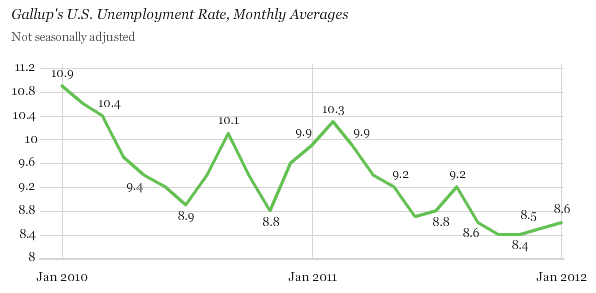
That’s why  I like to track Gallup’s unemployment estimates.  Over time, they’ve seemed reliable and — call me cynical — but, they’re less likely to be subject to political manipulation.

For openers, here’s what Gallup said prior to the government release:

The U.S. government’s January unemployment rate that it will report Friday morning will be based largely on mid-month conditions.

The mid-month reading normally provides a pretty good estimate of the government’s unadjusted unemployment rate for the month.

At mid-January, Gallup reported that its unemployment rate had declined to 8.3%, based on data collected through the 15th of the month.

OK, that squares with the Feds number.

But, importantly, Gallup also notes:

Gallup’s unemployment and underemployment measures show deterioration since mid-January.

While the unemployment rate of 8.6% for January is up only modestly from December, this overall increase subsumes the more negative trend of the most recent weeks.

In turn, this also seems consistent with Wednesday’s ADP report showing less job growth in January than in the prior month.

English translation: Expect February’s unemployment rate (reported first week of March)  to bounce back up … unless there’s a flurry of new hiring in early February.

Here’s the data …

image

Ken’s Take:

Here’s what I said before, and I stand by it !

Pundits have been saying that Obama will be ok with a high unemployment rate in 2012 as long as the trajectory is in the right direction. That is, that unemployment is coming down.

Here’s my scenario: unemployment will creep back up and Obama will be facing a high unemployment rate that is rising.

That’s not good for the O-team.

Politically, Obama might have been better off if the rate had stayed closer to 9% for a while … he may be in the awkward position of having a high unemployment rate that’s going in the wrong direction.

It’ll be interesting …

>> Latest Posts

Practice your downward dog at SFO airport …

February 6, 2012

Takeaway: Decompress before your next flight through SFO airport by using the yoga room built in Terminal 2. Based on a passenger suggestion, this yoga studio is considered the first of its kind globally. Namaste.

* * * * *
Excerpted from Reuters.com, “San Francisco airport unveils yoga room for travellers

Just cleared airport security and in need of a little deep breathing and stretching relaxation?

San Francisco Airport has opened what it calls a first of its kind yoga room, and while it’s not quite a mountaintop in Tibet, airport officials say the low lights, and soothing blue walls aim to afford travellers, stressed out or sanguine, an oasis of calm in which to flex, twist and decompress.

image
Doin’ a Downward Dog

“As far as we know it’s the first (yoga room) at an airport anywhere in the world,” said Michael C. McCarron, director of community affairs for the airport.

He said the idea for the room, in the newly refurbished Terminal 2, came from a passenger suggestion at an open house. It joins the Berman reflection room, a space intended for silence and meditation located before Terminal 2 security.

Airport Director John L. Martin called the room, which opened last week, “another leap forward in providing our travellers the opportunity and space to relax and decompress on their own terms.” …

Edit by KJM

>> Latest Posts

Amazon lifts LivingSocial’s kimono … and, it ain’t pretty.

February 3, 2012

Punch line: Lost $558 million  last year on $245 million revenue. Ouch.

* * * * *
Excerpted from the Washington Business Journal

Amazon,  which invested in LivingSocial in late 2010, disclosed limited details of the daily deal company’s 2011 performance in its annual report filed with regulators.

Accounting Note

Accounting rules required that Amazon release Living Social’s essential financial data.

As explained in Amazon’s annual report, LivingSocial is recorded using the “equity method of accounting” – a method used when an investment “gives us the ability to exercise significant influence, but not control, over an investee.”

The threshold for that designation typically runs between 20 percent and 50 percent ownership. Amazon owns 31 percent of LivingSocial.

Under that accounting method, Amazon must include some condensed financial information about LivingSocial in its own financial reports

Even though the data was buried far down in Amazon’s annual report, the numbers quickly found their way into the press and produced a flurry of unwanted headlines

Amazon, which owns a little less than a third of the DC-based daily deal company, laid out LivingSocial’s numbers, showing a $558 million loss last year on $245 million revenue, with operating expenses of $686 million.

Daily deals is a manpower-intensive field crowded with competitors. LivingSocial has about 5,000 employees.

LivingSocial’s informally claims that much of that operating loss was incurred earlier in 2011, and narrowed later in the year as the company scaled back marketing expenses.

Also, part of the loss can be attributed to LivingSocial’s acquisition spree, which was paid for through a mix of cash and stock.

Still, the $558 million loss is much more red ink than LivingSocial observers had expected, and much less revenue.

In April, CEO Tim O’Shaughnessy said his company was on track to book $1 billion in revenue in 2011.

Oops.

Now that’s a markdown for you

Thanks to SMH for feeding the lead

>> Latest Posts

Virtual pin boarding woos the ladies and attracts big brands

February 3, 2012

Punch line: With 4.5 million users – mostly under 45, socially and digitally savvy females – Pinterest is a unique virtual pin board for sharing and promoting consumer brands.

Even big brands are catching on and seeking to get on this website.

* * * * *
Excerpted from brandchannel.com “#Pinning: Brands Get Pinteractive and Engaging on Pinterest

image_thumb1

Pinterest, the virtual pin board at the crossroads of social and style, has burgeoned into a marketplace for consumer brands, offering a visual and demonstrable platform for engagement.

From small brands to other big brands, including Martha Stewart, Better Homes & Gardens, Real Simple, Bergdorf Goodman, Chobani and NBC’s The Today Show are also active on the site,

Pinterest is attracting brand marketers to allocate part of their interactive bandwidth to its 4.5 million users — primarily female, under the age of 45 and socially-, digitally-savvy.

Mashable breaks down the stats: “70% of pinners are female. Pinterest has a highly engaged audience — a reported 3.3 million users logging more than 421 million pageviews — so there’s plenty of opportunity for brands to flesh out pinboards and catch pinners’ eyes.”

Hitwise parsed the site’s popularity in a blog post that noted: “Pinterest content has something for everyone, but the site is dominated by images featuring home décor, crafts, fashion, and food…

‘Pin Etiquette’ is the term for the site’s golden rule: Pinterest is not a playground for self-promotion, challenging marketers to come up with content that engages, not just promotes (think “Pin unto others…”) It’s no surprise that one of Facebook’s new bevy of 60 Timeline-integrated apps is a Pinterest app.

Some pinned-and-true ways for brands to engage with users include:

  • Hold a Contest
  • Conduct Market Research
  • Feature Customers
  • Put a Face to Your Brand
  • Sell More Products
  • Present Concepts in a New Way
  • Promote Your Image Content

Edit by KJM

* * * * *
KJM editorial comment: my best friend sent me this link – and I was immediately hooked! Forget Facebook, this is my new method of procrastination and idle entertainment)

>> Latest Posts

Education: a product for which people are willing to pay more to get less … go figure.

February 1, 2012

That’s something an older colleague once remarked to me.

So, true.

I often quip that if a student shows up at the Verizon Center and Lady Gaga’s concert is cancelled, they’re bummed.

If they show up for my class and see a sign that class is cancelled, they whoop and holler with glee.

And, on balance, most of them think my courses are better than the average academic offerings.

On a grander scale, many are predicting that high-priced colleges will be the next bubble to burst.  Folks have been paying an increasing amount of money to get a decreasing amount of relevant learning.  That’s not a good formula.

Government subsidies and “full fare” foreign students keep pushing tuitions up to levels required to support lavish facilities, expansive athletic programs, outdated delivery methods (think classrooms vs. online), and light teaching loads for faculty journalists.

For example, reported in the NY Post: The journal Academic Questions recently concluded that … many new graduates are finding that the degree they’ve earned is not worth the investment.

  • Now, most college grads leave school with large debts — more than $27,000 on average.
  • A college degree also no longer signifies that the recipient is either well-educated in the traditional sense or that he has acquired specific skills suited to the labor market.

That’s despite the fact that “most colleges have become trade schools —  far more expensive ones than their for-profit counterparts.”

  • By 2008, the number of bachelor’s degrees had risen to 1.5 million Americans, but few of these degrees were in the traditional liberal arts. Barely 2 percent of BAs were awarded in history and only 3.5 percent in English literature.
  • More than a third of undergraduate degrees are now earned in business, health professions and education.

The former president of St. John’s College in Santa Fe argues that it’s no wonder that students have fled the liberal arts:

  • For centuries, the liberal arts passed on what was best in Western civilization …  despite our practical bent, youth were encouraged “to pursue inquiry into serious and perennial questions.”
  • The humanities in particular were considered the “Keepers of the Culture” at a time when we believed we had a culture worth keeping and passing on.
  • Since the 1960s, however, our culture has been under attack, our history rewritten as one of unmitigated oppression and the values our Founders and subsequent generations held dear reviled.
  • Humanities courses in liberal arts colleges have replaced the canon of Western civilization with course offerings … aimed to show our benighted past and to condition us to a more tolerant future.
  • Students have fled such courses in droves to pursue technical or professional skills.

The Post concludes: Their parents — and increasingly the students themselves, through loans — are left footing the bill for degrees that neither pay off in the marketplace nor enrich the intellectual lives of those on whom they are conferred.

Good point !

>> Latest Posts

Target flexes muscle to thwart “showrooming” … good luck!

February 1, 2012

TakeAway: Target is flexing its buying power over suppliers to ward off increasing competition from online retailers such as Amazon.

* * * * *
Excerpt from WSJ: “Showdown Over ‘Showrooming’”

Target is asking suppliers for help in thwarting “showrooming” — that is, when shoppers come into a store to see a product in person, only to buy it from a rival online, frequently at a lower price.

Target suggested that suppliers create special products that would set it apart from competitors and shield it from the price comparisons that have become so easy for shoppers to perform online. Target asked the suppliers to help it match rivals’ prices.

Vendors are likely to have little choice but to play ball with Target because of its clout as the second-largest discount chain.

Some analysts said Target’s new tactics are unlikely to reverse the showrooming trend.

Online-only retailers have significantly lower labor costs and, at least, for the time being don’t collect sales tax in most states.

Amazon can sell products so cheaply because it uses its other profitable units — such as cloud data storage and fees it charges others to sell on its website — to subsidize the rest of its business.

Edited by ARK

>> Latest Posts

The Buffett Rule … a few facts might help.

January 31, 2012

At the risk of stifling the tax rate hysteria with facts, the Congressional Research Service did a great study on the “Buffett Rule”.

One of the key charts – with a couple of Homa Files accentuators – says that

  • “Millionaires & billionaires” tax rate is – on average – 11 points higher than folks making under $100k.
  • About 1 in 4 millionaires & billionaires (less than 100,000 tax payers) – those with the lowest effect tax rates – pay a lower rate than about 10% of the more than 100 million folks making under $100,000
  • Applying the SOTU Buffett Rule – minimum 30% for folks making more than $1 million – would jack up taxes for about 1/2 of millionarires and billionaires.

Is jacking the rate on about 200,000 taxpayers really going to get us out of this fiscal mess we’re in?

I’m betting the under.

image

* * * * *

Supplementary data:

image

>> Latest Posts

Coke bails after taking the Nestea plunge …

January 31, 2012

TakeAway: American consumer preferences are shifting away from cola to healthier options.  So, Coca-Cola is  bailing from its partnership with Nestle.  Coca-Cola will no longer market Nestea-branded products.  Instead, it will focus on marketing its own RTD tea beverages …

* * * * *

Excerpted from brandchannel.com, “Tea Party Ends for Coca-Cola and Nestea

Coca-Cola and Nestle are no longer taking the Nestea Plunge together in America. The two multinationals are dissolving their Beverage Partners Worldwide group, which producesand markets Nestea-branded products, in the United States, so they can each market their own beverages.

Thanks to America’s sudden fascination with healthy living, cola sales are going down, so Coke is looking to diversify its offerings in the tea-and-juice department.

Forbes sees the two companies redirecting the partnership’s efforts on Canada and Europe, along with plans to “enter into a license agreement with Nestle in Taiwan and Hong Kong.”

This likely means that Coca-Cola will put more energy into its own ready-to-drink tea products such as Gold Peak iced teas, CSP notes. “The company recently also purchased organic tea maker Honest Tea and will soon launch Fuze teas, a fusion of tea and juice flavors, to replace Nestea,” CSP notes.

Vending Times points out that PepsiCo, Coca-Cola’s archrival, “dominates the category with its Lipton RTD teas under a joint venture with Unilever NV.”

Edit by KJM

>> Latest Posts

Buffett, Romney & the Give Back to Society Rate

January 30, 2012

The cameo by Buffett’s secretary at last night’s SOTU address, and Mitt’s released tax returns have re-elevated the issue “coddling the rich” with low tax rates (compared to their secretaries).

Last fall, when we dissected Buffett’s taxes, we coined a  measure: the GBSR™ – “Give Back to Society Rate

We defined the GBSR™ as the sum of taxes paid plus charitable contributions – since those are all money that’s supposed to be going to the common good, albeit administered by different organizations – divided by AGI.

We crunched the numbers and concluded that Buffett pays about $7 million in Federal taxes, about $3 million in state taxes, and about $20 million to charities … for a total of $30 million … which dived by his $63 million AGI … gives a GBSR™ of almost 50% (47.6% to be precise).

We concluded that Buffett may not be the piker that he claims to be.  And, maybe he should stop causing trouble for other folks by constantly whining about the tax code.

In Romney’s case, his release says that he made $21 million … paid $3 million in taxes … and donated $3.7 million to charities.  So, his tax rate may sound meager @ 14%, but his GBSR™ is almost 32% – and that’s not counting state & local income taxes.  My bet: add S&L taxes in and Mitt ‘s GBSR™ is way over 40%, too.

So, it just may be that the tax code is leading fat cats to do the right thing – it’s just that they’re giving much of their dough to private charities instead of the Feds.

Do you blame them?

* * * * *
Here’s the original HomaFIles post:

Squeezing Buffett’s numbers … Part 5 (and done !)
Homa Files 10/21/2011

OK, today should about do it.

After a recap, I’ll drop my conclusion on you … my very surprising conclusion

First. a recap to get everybody on the same page.

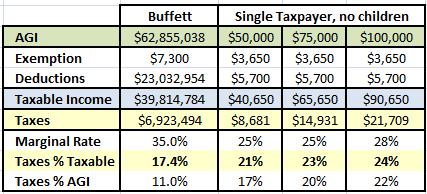
In Part 1, we looked hard at Buffett’s effective income tax rate (17.4%), and showed how he could get to that low rate by offsetting practically all of his ordinary income with $23 million in deductions.

This conclusion debunks the popular pundit point that he gets to the rate by having practically all of his income in capital gains and dividends.

In Part 2, we showed that about $20 million of the deductions are probably charitable contributions – a device that rich folks use to (1) do good things and (2) to manage down their tax liabilities.

Better to give to a cause that you believe in, right? Why give it to the government and have it waste the money?

In Part 3, we agreed that Buffett’s tax rate as a percentage of his taxable income is probably less than his secretary’s – partially due to his capital gains being taxed at a comparatively low rate, but mostly because he shelters his ordinary income with charitable deductions.

And, we showed how ordinary earners can get to a rate lower than Warren’s … just by donating a huge chunk of their income to charity. Not realistic, but mathematically possible.

In Part 4, we showed that Buffett’s tax rate as a percentage of AGI is only 11% …. about half of the estimated rate for our hypothetical secretary surrogates.

image

Now, my first reaction when I stared at the taxes to AGI rate was “Wow, Buffett’s right – he’s nothing but a coddled piker.”

But now, I’m not so sure.

On one hand, his paying a rate (to taxable income) that’s 5 points less than his secretary doesn’t seem fair. Especially since he gets to the rate by exploiting some dreaded tax loopholes, aka. “deductions”.

The situation seems even worse when you consider his taxes to AGI rate – a mere 11% – less than half of his secretary’s rate (I suspect).

Gotta jack up taxes, right?

Not so fast.

Let’s construct another measure: the GBSR™ – “Give Back to Society Rate

Since I’m coining the measure, I’ll define the GBSR™ as the sum of taxes paid plus charitable contributions – since those are all money that’s supposed to be going to the common good, albeit administered by different organizations – divided by AGI.

OK, so what’s Buffett’s GBSR?

Well, based on my estimates, Buffett pays about $7 million in Federal taxes, about $3 million in state taxes, and about $20 million to charities … for a total of $30 million … which dived by his $63 million AGI … gives a GBSR™ rate of almost 50% (47.6% to be precise).

Now, let’s pretend that Buffett’s secretary profiles like our $100,000 ordinary earner above. Her charitable deductions would be at most $5,700. Otherwise she wouldn’t be taking the standard deduction, she’d itemize.

So, her GBSR™ @ $100,000 AGI is 27.5% ($5,700 + $21,709 = 27,409 / $100,0000 = 27.5%).

That means that Buffett’s GBSR™ is almost twice his secretary’s.

Hmmm.

Maybe he’s not such a bad guy and I should stop ranting about him.

And, maybe he should stop causing trouble for other folks by constantly whining about the tax code.

It just may be that the tax code is leading to the right answer.

Just have to look around the trees to see the forest.

AMEN

>> Latest Posts

The bald, and the beautiful? Barbie could get a buzz cut …

January 30, 2012

Punch line: This is a classic story of the intersection of consumer driven insights, a strong cause, and the power of social media. 

Two mothers, whose daughters lost their hair due to cancer treatment, contacted Mattel to create a bald Barbie to serve as a role model for young children. 

After this initial request failed to gain traction with Mattel,  these mothers used the ultimate weapon – the F-bomb.  Facebook.  They created a fan page called ‘Beautiful and Bald Barbie’ and generated over 137,000 ‘likes.’ 

Now, Mattel is more actively addressing this idea.

* * * * *
Excerpted from brandchannel.com “Mattel Doesn’t Say No to Bald Barbie

image

Back in December, two moms whose daughters had lost their hair due to cancer treatment contacted Mattel, the makers of Barbie, to see if the company would be interested in producing a bald Barbie as a role model to their own and other young girls.

Mattel sent Jane Bingham and Beckie Sypin a stock letter saying that it “does not take unsolicited ideas from outside sources.”

Undeterred, the women put up a Facebook fan page entitled “Beautiful and Bald Barbie! Let’s see if we can get it made,” and it duly received more than 137,000 “likes.” As a result, Brand Republic reports that Mattel is now addressing the issue more directly.

“We are honored that Jane Bingham and Beckie Sypin believe that Barbie could be the face of such an important cause,” a spokesperson said, according to the site. “Mattel appreciates and respects the passion that has been built up for the request for a bald Barbie doll.”

Mattel isn’t committing to get a hairless Barbie onto production lines….

“The obvious thing to do would be to release a limited edition bald Barbie with a percentage of the proceeds going to charity,” said Robin Grant, managing director at the social-media agency We are Social. “Some companies have a fear of being seen to bow to consumer pressure – but corporate marketing teams must guard against being unchanging and monolithic.”

Edit by KJM

>> Latest Posts

Obama warns colleges … yeah, right.

January 27, 2012

During the SOTU address Pres. Obama warned colleges and universities that they risk losing federal funding if they do not keep tuition costs down.

Hmmm.

Loyal HomeFilers know that we rail often on the indefensibly high tuitions colleges are charging.

For example, see one of our all time favorite posts:
What do b-school profs and Lady Gaga have in common? 

Many pundits are predicting that high-priced colleges will be the next bubble to burst. Students (or their parents, or their companies) have been paying an increasing amount of money to get a decreasing amount of relevant learning. That’s not a good formula.

Government subsidies, student loans and “full fare” foreign students keep pushing tuitions up to levels required to support lavish facilities, expansive athletic programs, outdated delivery methods (think classrooms vs. online), and light teaching loads for faculty journalists.

Let’s see if Obama follows through on his threat … and see if it has an impact.

I’m betting under on both counts.

Universities are hot beds of liberal thinking.

No way Obama puts them in his cross hairs.

>> Latest Posts

Life is a sport’… and for $150, Nike wants to help ‘make it count’

January 27, 2012

TakeAway: For $150 – more than a year’s gym membership at Planet Fitness – you can purchase the Nike + Fuelband to track your every ‘move.’ This new rubber bracelet measures your activity level, and even syncs with an iPhone.

* * * * *
Excerpted from “Nike’s FuelBand: Game Changer or Slickly Marketed $150 Monitor?”

While the large majority of athletic gear is segmented for each specific sports market, Nike announced a product that sweeps across the entire sporting landscape and can be used by any athlete at any level.

The Nike+ FuelBand, is a foray into more technically-advanced digital monitoring 

It is a rubber bracelet worn on the wrist during exercise and sports activities to measure “steps, calories, time & Fuel metric (currency measured by oxygen kinetics).”

The NikeFuel Twitter account says:

“Not only is the FuelBand a fun way to keep you active, but you can compete, collaborate & compare your activity w/each other.”

The price is $150, “about 50% more expensive than the similar Fitbit device” .

According to Nike, “The @Nike+ FuelBand syncs with your iPhone via Bluetooth, provides on-device feedback, gives you @NikeFuel experience.” Integrating Path technology with a free iPhone app and dashboard at NikePlus.com, it’s being positioned as “the ultimate measure of activity.”

The marketing pitch: “NikeFuel is the ultimate measure of activity. It isn’t bought or sold. It’s earned.” 

Edit by KJM

>> Latest Posts

Translating President Obama’s SOTU into plain English…

January 26, 2012

The Americans for Tax Reform has provided a decoding ring for  translating from Obama-speak to plain English:

  • “Investment” – Spending taxpayer money on Obama re-election constituencies such as government employee unions, teachers’ guilds, and big-city political machines.
  • “Children and grandchildren” – The people picking up the tab.
  • “Energy” – Something that flows from good intentions, government programs, “stimulus” spending but not pipelines.
  • “Exports” – That trade – and only that trade – acceptable to union bosses.
  • “I” or “Me” – Center of the known universe.
  • “Compromise” – Tax hikes.
  • “Sacrifice” – Tax hikes.
  • “Bipartisan” – Tax hikes.
  • “Fair” OR “Fair Share” – Tax hikes.
  • “Balanced” – Tax hikes.
  • “Small business” – Those who will pay the most under my plan to tax “the rich.”
  • “Special interests” – Taxpayers who do not wish to give their money to my friends.
  • “There are those who…” OR “Some” – [INSERT STRAW MAN HERE]
  • “Middle class” – Those who are the target of seven tax hikes in Obamacare.
  • “Deficit” – What Democrats want you to focus on when what they really want to sell you is a tax hike.
  • “Regulations” – The governmental leash attached to the choke collar around the neck of the economy.
  • “Recovery” – This time it’s real, I swear, not like that “Recovery Summer” we had in 2010 after spending $1 trillion of borrowed money.
  • “Infrastructure” OR “Roads and Bridges” – Spending taxpayer money on those states voting Democrat in ’08.
  • “Affordable” – Reality for the taxpayer only after they’ve worked 224 days to pay for the total cost of government.
  • “Obstructionists” – House Republican lawmakers who have actually passed a budget – NOT the Senate Democrats who have refused to pass a budget for 1,000 days.
  • “Streamline” – The pretense of dieting after an all-out spending binge.
  • “Wall Street” – 1. Where your IRA and 401(k) live. 2. A bauble to distract you from noticing my bailout of Fannie and Freddie.
  • “Jobs” – “You want to find work on the Keystone XL pipeline? Tough luck – I’ve got a campaign to run.”
  • “Profit” – Money without which jobs would never be created.

Very useful, right?

* * * * *

P.S. Americans for Tax Reform also hit on the idea of Obama Bingo … great minds running in the same track … I didn’t jack the idea from them … I jacked it from students who told me that they sometimes play Prof Bingo in class.

>> Latest Posts

Let’s see HER tax returns !

January 26, 2012

Obama seems determined to structure the U.S. income tax code around Warren Buffett and his secretary.

There she was … in Michelle’s box for the SOUTU address.

Well, seems that cameo appearance is sparking some scrutiny.

Is she, in fact,  a tax-abused waif living from paycheck to paycheck?

According to Forbes: Warren Buffett’s Secretary Likely Makes Between $200,000 And $500,000/Year

Warren Buffet’s secretary, Debbie Bosanek, served as a stage prop for President Obama’s State of the Union speech. She was the President’s chief display of the alleged unfairness of our tax system – a little person paying a higher tax rate than her billionaire boss.

Bosanek’s prominent role in Obama’s “fairness” campaign has finally  piqued curiosity.

How much does her boss pay this downtrodden woman?

So far, no one has volunteered this information.

We can get an approximate answer by consulting IRS data on tax rates by adjusted gross income, which would approximate her salary, assuming she does not have significant dividend, interest or capital-gains income (like her boss).

I assume the tax rate Obama refers to is from her own earnings.

Insofar as Buffet (like Mitt Romney) earns income primarily from capital gains, which are taxed at 15 percent (and according to Obama need to be raised for reasons of fairness), we need to determine how much income a taxpayer like Bosanek must earn in order to pay an average tax rate above fifteen percent. This is easy to do.

The IRS publishes detailed tax tables by income level.

The latest results are for 2009. They show that taxpayers earning an adjusted gross income between $100,000 and $200,000 pay an average rate of twelve percent.

12% is below Buffet’s rate; so she must earn more than that.

Taxpayers earning adjusted gross incomes of $200,000 to $500,000, pay an average tax rate of nineteen percent.

Therefore Buffet must pay Debbie Bosanke a salary above two hundred thousand.

At that level of income, she is scarcely the symbol of injustice that Obama wishes her to project.

While we’re at it, how about a peek at Buffett’s returns?

After all, if we’re going to revamp the entire tax code off of 2 data points, let’s at least have all the data that the points have to offer.

Latest Posts

Does sex sell? Just ask GoDaddy … or, watch this year’s Super Bowl

January 26, 2012

USA Today reports …

Thirty-some advertisers will spend upwards of $230 million just for the airtime to fight for attention in the Feb. 5 game.

At stake: the eyeballs of more than 100 million Super Bowl viewers. And the urgent need to drive all of them online to find out more, socialize and tweet with friends and ultimately buy that beer, smartphone or luxury car.

Sexy ads are slinking back to the Super Bowl.

No company has used sexual imagery more shamelessly on the Super Bowl than GoDaddy.

“We set the standard of indecency,” jokes CEO Parsons, who takes special pride in being widely accused of single-handedly bringing down the tone of Super Bowl advertising.

Truth be told, the action in each GoDaddy ad is just a big tease to get folks to go online and find out more about the company that people use to register domain names and host websites.

The ploy, which GoDaddy has used for eight consecutive Super Bowls, works ridiculously well.

But. some researchers have found that spots with sexual imagery take a 10% hit in “likability” vs. ads without racy images.

They conclude that most viewers actually prefer to see ads with kids or animals.

Yeah, right.

Watch the vid .. then you decide.

        click to view video

image
>> Latest Posts

Flashback: The original “Built to Last”

January 25, 2012

One of  Obama’s SOTU themes last night was jacked from the book Built to Last by Jerry Porras and Jim Collins.

I wonder if any of O’s speech writers have either read the book  or, at least followed up on the companies cited in the book (list below).

I did, and guess what?

Built to Last has been roundly criticized because many of the companies it profiled have subsequently faltered.

According to FastCompany:

Within 10 years of the book’s publication, almost half of the visionary companies on the list have slipped dramatically in performance and reputation, and their vision currently seems more blurred than clairvoyant.

At least 7 of BTL’s original 18 companies have stumbled (8 if you’re cynical about HP)

Each has struggled, and all have faced serious questions about their leadership and strategy.

Odds are, none of them today would meet BTL’s criteria for visionary companies, which required that they be the premier player in their industry and be widely admired by people in the know.

Jim Collins – one of the authors – counters that “The book never promised that these companies would always be great, just that they were once great.”

That makes more sense.  Obama isn’t saying that his America is going to become great (again) and stay great …. just that it once was great.

Now, that’s something to rally around….

* * * * *
Here’s Collins and Porras’ BTL List
… draw your own conclusions.

3M
American Express <= TARP
Boeing  <= NLRB target <= a good thing (unless you’re Team O chasing them)
Citigroup <= TARP
Disney  <= struggling since Cap Cities acquisition
Ford <= least bad U.S. car company
General Electric  <= TARP
Hewlett Packard  <= CEO turnover
IBM
Johnson & Johnson
Marriott
Merck
Motorola  <= corporate break-up
Nordstrom
Philip Morris (now Altria)
Procter & Gamble
Sony  <= lost its mojo
Wal-Mart  <= evil empire

>> Latest Posts

Quick: Which company is “America’s Largest Brewer”?

January 25, 2012

TakeAway: Depends on your definition.  If you go with All American-owned and American-brewed … then Yuengling  — 8th in market share – can claim the tile/

* * * * *

Excerpt from AdAge: “D.G. Yuengling & Son Becomes America’s Largest Brewer”

Yuengling surged last year with shipments up 16.9% to 2.5 million barrels, placing it eighth in overall U.S. market share, at 1.2%. That was good enough to nose by Boston, which owns the Sam Adams brand.

Anheuser-Busch, owned by Belgium-based InBev, still has a firm hold on No. 1, but its market share fell from 47.7% to 47.0%.

No. 2 MillerCoors, part-owned by London-based SABMiller, saw its share drop from 28.8% to 28.4%.

Third place belongs to Corona importer Crown Imports and Heineken USA kept its hold on fourth.

Yuengling’s ranking comes with some caveats. Pabst Brewing Co., which ranks fifth overall, is U.S.-owned, but outsources its brewing.

Sixth-place North American Breweries is also U.S.-owned, but a chunk of its volume comes from the imported Labatt brand.

Edited by ARK

>> Latest Posts

Let’s play Obama Bingo during tonite’s State-of-the-Union Address …

January 24, 2012

Irish bookies are  laying odds on which clichés President Obama will drop first and say most often in tonite’s State of the Union address.

Why not turn it into a game …. like students do with boring profs.

Randomly post the most likely clichés to squares on 5 x 5 game cards.

First player to score a row, a column, a diagonal or the 4 corners with “he said it” marks wins the game.

Below are the official odds on what Obama will say first.

Note My “lock” prediction isn’t even on the list: “Let me be perfectly clear” … a couple of my other favorites are bolded.

Odds   Cliché

8/1     We have more work to do
10/1     Health care reform
10/1     As I stand here today
12/1     Fundamental belief
12/1     God bless America
12/1     Crossroads of history
12/1     Defining moment
12/1     Make Washington work
14/1     Common purpose
16/1     Pursuit of happiness
16/1     Building a better America
16/1     Reduce the deficit
18/1     War on terror
18/1     It won’t be easy
18/1     Hungry for change
18/1     My civil liberties
20/1     Honor for me
20/1     I have a dream
20/1     Willing to listen to each other
20/1     Yes, we can
20/1     Don’t get me wrong
25/1     Hard to believe
25/1     I’m fired up
25/1     Withdraw our troops
25/1     There are better days ahead
25/1     Do-nothing Congress
25/1    We’ll have to make hard choices
25/1     We can be one people
25/1     A new direction
33/1     For far too long
33/1     Safe from harm
33/1     Jobs to the jobless
33/1     Reshapes our economy
40/1     Deepest gratitude
40/1     Greatness of our nation
40/1     Possibilities of this nation
40/1     Florida primary
50/1     Believe in what this country can be
50/1     Unity is the great need of the hour
50/1     In the face of despair, you believe there can be hope
50/1     We can work together to keep our country safe
50/1     Abiding faith
66/1     Brighter day will come
66/1     Publish tax returns
66/1     Washington has a long way to go
80/1     Overcome the adversity
80/1     Bloated federal government
100/1     Diversity of my heritage
100/1     Yes, we might
250/1     Life is like a box of chocolates

Source: Washington Times

>> Latest Posts

Why is exec comp so far out of whack?

January 24, 2012

Most folks seem to agree that executive compensation – especially CEO’s pay – is wildly excessive.

How did it get that way?

As partial explanation, I think that two well-intended legislative actions started the ball rolling with unintended consequences.

The first is Item 402 of  SEC Regulation S-K:

Item 402 – Executive Compensation. The SEC regulations governing disclosure of information about executive compensation are contained in Item 402 of Regulation S-K. Pursuant to Item 402, a public company must disclose to its shareholders information concerning compensation paid to its CEO and its four most highly-compensated executive officers (its “named executive officers”) during the last fiscal year, as well as its directors, in certain registration statements, its annual proxy statement, and certain other filings under the Securities Exchange Act of 1934, as amended (“Exchange Act”).

The motivation for the regulation is clear: provide shareholders with transparency into the way that top execs were being paid.

Sounds like a right thing to do, right?

The unintended consequence: For the first time, top execs had factual benchmarks re: how they racked up relative to their peers.

Underpaid execs used the data to get pay boosts; highly paid execs used the data to maintain their spreads against their less deserving peers.

For many (most?) execs, compensation became a manhood issue … and of course, bigger is always better.

Executive comp wars broke out and escalated.

A second legislated driver was Section 162(m) of the Internal Revenue Code:

Section 162(m) of the Internal Revenue Code generally limits the corporate tax deduction for annual compensation paid to executive officers named in the Summary Compensation Table to $1,000,000, unless the compensation satisfies the requirements for performance-based compensation. Stock options, performance shares, and cash-equivalent performance shares granted under the Company’s stock incentive plans have generally been entitled to the full tax deductions available because the compensation has been considered performance-based and not applied against the $1,000,000 limit.

Again, well intended.

Why should taxpayers subsidize over-sized exec comp?  If companies want to pay execs more than $1 million, they can … they just can’t take a tax deduction for the amount over $1 million.

So, what’s the problem?

We,, it’s the qualifier: “unless the compensation satisfies the requirements for performance-based compensation

To circumvent the rules, companies shifted to performance-based compensation tools … think bonuses and stock options.

So, bonuses became a larger part of comp packages and stock options became the major mechanism for “rewarding” execs.

In 1970, stock based compensation was less than 1 percent of compensation.

By 2000, it was around half of compensation.

Source

The heavy emphasis on stock options certainly provided some motivation to execs to boost share prices (that’s good), sometimes by focusing too aggressively on short-term results (that’s bad).

More to come …

>> Latest Posts

From typos to tardiness … how ‘bout some attention to detail?

January 24, 2012

Excerpted from EVERYTHING COUNTS! 52 Remarkable Ways to Inspire Excellence and Drive Results by Gary Ryan Blair

From typos to tardiness, many people and organizations act as if details just don’t matter much

Nothing could be further from the truth.

We must do little things correctly …  When each detail is attended to, and each step in the process is given careful attention, the result will inevitably be of the highest quality.

Successful people in many walks of life understand the importance of detail.

  • Doctors and nurses understand that the slightest mistake or loss of focus can result in tragic consequences that carry massive liability.
  • Engineers and architects know that the stability of the most gigantic structure depends on the integrity of its smallest element; a failed bolt or a misplaced pin can have huge consequences.
  • Computer programmers spend their careers tightly focused on detail, as one incorrect digit in a code of millions can create an operational nightmare for the end user.

The magic behind every outstanding performance, exceptional meal, and fine piece of furniture or jewelry is found in the smallest of details.

No matter what business you are in, you will be continuously challenged by larger problems that could have been prevented if you had paid closer attention to the details at the beginning.

Think about it …

>> Latest Posts

Ditch the Red Bull … “We Drink Water”

January 23, 2012

Punch line: It’s cool to drink water again. Snowboarders get fed up with energy drinks over-branding of the snowboarder market, and now endorse water. Two pro snowboarders create “drink water” branded apparel line with 10% of proceeds going to water.org.

* * * * *
Excerpted from brandchannel.com, “Snowboarders Refusing Energy-Drink Money to Push Water”

image_thumb

… Industry leaders Red Bull, Monster Energy, and Rockstar have sunk some serious marketing dollars into the “international sports market, sponsoring athletes, events and video shoots in motorsports, surfing, snowboarding and skiing, mixed martial arts, and others,” according to the New York Times. Logos for the brands are appearing on athlete apparel and gear.

Two professional snowboarders had enough last year and started to make their own statement with a campaign, called “We Drink Water“, against the energy-drink companies, including creating their own non-logo logo, “Drink Water,” on their boards. The slogan has taken off and now the two snowboarders, Bryan Fox and Austin Smith, have a website selling T-shirts ($30), sweatshirts ($60), jackets ($65), and sets of stickers and pins ($10) …

And the two fellas are putting their money where their mouth is as well, by donating 10% of all revenue from the apparel to the nonprofit founded by Matt Damon, water.org, which works to get clean water and sanitation in Africa, southern Asia and Central America. Fox and Smith will head off to Asia this month to snowboard and raise awareness of the Drink Water campaign. Along the way, the Times points out, they’ll compete in an event sponsored by Red Bull.

What’s their beef with energy drinks? It “stemmed from the drinks’ ingredients,” the Times reports, “which in addition to sugar and caffeine include guarana (a plant that contains caffeine), taurine (an amino acid) and ginseng, as well as the size of doses found in servings.”

However, the Drink Water campaign has a long way to go before it washes away any bit of the energy-drink market…. as “energy drink sales increased by 12.5 percent during four weeks ended on Nov. 26, with Rockstar (up 30 percent) and Red Bull (15 percent) on top,” the Times reports …

Edit by KJM

>> Latest Posts

Newt’s brilliant plays … Mitt’s fumbles

January 22, 2012

First, the disclaimers ….

I had a Mitt ‘08 bumper sticker … he was my pick back then … he was my pick coming into 2012.

I think he’d make a good president … maybe even a very good president … not likely a great one.  Think Bush 41.

I think he’d get CEOs to start breaking ties in favor of hiring, I think he’d get domestic oil rolling, and I think that he’d bridge some of the divide between the left-right extremes (after all, he is a “Massachusetts moderate”).

Side note: When did “moderate” become a bad thing?

But, I gotta admit, I’m starting to have doubts.

First is the charisma deficit.

Even McCain could show some umph every now and then. Sure, be mature, be disciplined … act like the adult in the room … but, stop acting & looking  like a funeral director.  That blank stare during the debates is giving me the creeps.

Second are the bona fides.

I think Mitt’s smart, knows business and knows how to run organizations – public and private.

But, the storyline isn’t compelling to a vast majority who think that all business people are Gordon Gekkos … related to either “Chainsaw Al” Dunlop or Bernie Madoff … or both.

  • The Olympics turnaround was a clear success. 
  • But, the Mass governorship was equivocal – sold out some basic principles to get elected – signed some dreadful legislation – wasn’t likely to get re-elected – and shied away from the battle.
  • Solid exposure to business as a blue-chip consultant and investment firm honcho … but, didn’t run any businesses (except the capital firm) … and the job creation stats aren’t a “wow” … added 120,000 retail clerks at Staples and Sports Authority … big deal.

When was the last time you were in a Sports Authority? I thought they were out of business …

Third, are the elephants is the room.

  • RomneyCare … still hasn’t given a credible rationale for why he signed the bill and why he thinks the system is working … and, if it is, why he’d squash ObamaCare
  • Bain Capital … it should be easy to defend his Bain years and turn the experience into a positive … do it!
  • He’s in the evil 1% …  explain to people why that’s a good thing, not a bad thing … the debate point that he didn’t inherit his wealth was strong … but he didn’t go in for the kill
  • The tax returns … related to the 1% problem …  and compounded by Buffett’s “coddled” mantra and unseemly parking of dough in the Cayman Island … deal with it, man.  My advice: release your 2010 tax returns today … before the Tampa debates … and fight back like Newt would when pundits start picking lint off the returns.
  • The Mormon thing … it’s not a problem for me … I’ve worked with many Mormons and respect their basic value system – strong families, work ethic, community support, etc. … but, it’s an issue for many folks  … so deal with it head on … convince people that you only have one head and one wife … that chuch service is a good thing … that you don’t have to smoke & drink to be cool.

Fourth, is the overall strategy,

  • Raising money from the establishment, investing in a campaign structure, and then playing prevent defense just isn’t going to cut it. Gotta play some offense, man.
  • Going after Newt on historical nits is petty and won’t work … we know he was a philanderer; we know he was heavy-handed as speaker; we know that he took money from Freddie Mac.  Nobody cares, Mitt.
  • Show us that you really want to win this thing !

We’ll see in the next couple of days whether Mitt can regroup, turn it up an couple of notches and  play to win.

I’m still rooting for the guy, but my knees are getting wobbly.

* * * * *

Now, on to Newt.

I think he’d make the campaign against Obama very interesting … I think he’d lose (remember, half the country doesn’t pay income taxes and thinks gov’t dependency is a good thing, not a bad thing), and would make an awful president if elected … better than the incumbent, but too erratic for my tastes.

But, gotta tip the cap to the guy.

On balance, I think the Bain attacks were a mistake since they were largely unfounded and did present an anti-capitalist theme that Mitt should’ve pounced on stronger.

The debate ploy to attack the media on the open marriage question was a stroke of brilliance … took that issue off the table … elevated the media to bad guy status … and set a tone for the rest of the debate.

Well played.

Last night’s acceptance speech was also well done …  conciliatory to opponents … in Obama’s face … right tone and substance.

I was really struck by the new campaign themes that he rolled out: “Unleashing the power of the American people” and “Rebuilding the America we believe in”.

My opinion: Those are powerful battle cries.

And, by launching them last night, he pre-empted Obama’s state-of-the union which reportedly is going to be themed “Return to American values of fairness for all”

This could get interesting …

>> Latest Posts

A prof says: “You earn exam points … and, the burden of proof is on you”

January 20, 2012

Interesting op-ed by an econ prof …

Excerpted from Forbes: Dear Student: I Don’t Lie Awake At Night Thinking of Ways to Ruin Your Life by Prof. Art Carden

One of the popular myths of higher education is that professors are sadists who live to inflict psychological trauma on students.

So, let me clarify a few things.

First, I do not “take off” points. You earn them.

The difference is not merely rhetorical, nor is it trivial. In other words, you start with zero points and earn your way to a grade. You earn a grade for demonstrating that you have gained a degree of competence  ranging from being able to articulate the basic principles (enough to earn a C) to mastery and the ability to apply these principles to day-to-day affairs (which will earn an A).

Second,  the burden of proof is on you to demonstrate that you have mastered the material. It is not on me to demonstrate that you have not.

My assumption at the beginning of each class is that you know somewhere between nothing and very little about the subject. Otherwise, why are you here?

In this light, consider this: the fact that you “don’t understand” why you didn’t earn full points for a particular question might itself help explain why you didn’t earn full points.

If you understood the material – and do note that there is a large difference between really understanding the material and being able to reproduce a graph or definition you might remember from class – you would have answered the question flawlessly.

Finally, I’m here to be a mentor and instructor.

This means that our relationship differs from the relationships that you have with your friends and family. Please don’t infer from this that I don’t care about you, because I do.

You should never take grades personally. I don’t think you’re stupid because you tank an exam, an assignment, or even an entire course.

It probably doesn’t mean you’re dumb, it likely means you need to work smarter.

>> Latest Posts

Toyota targets new hybrid launches at young buyers …

January 20, 2012

Question: How many total hybrid cars or trucks sold in the US are Toyota Priuses?

Answer: Nearly 50%.

Toyota hopes to grow its share of the hybrid market with new product launches, such as the Prius C –  “c” for city, to attract young buyers.

* * * * *
Excerpted from brandchannel.com, “NAIAS Action: Toyota Woos Younger Buyers with Hybrids

Toyota and Honda …  have been gearing up new products they’re hoping will begin attracting Americans back to their brands this year …

Toyota  showed off its new Prius c — the “c” in the name is for city — a small entry in its growing “family” of Prius hybrids, and bowed its NS4 concept plug-in hybrid that should see the market around 2015.

… Toyota is  reaffirming its commitment to the long-term future of a type of propulsion that it pioneered with the Prius hybrid.

Toyota also plans to introduce a “plug-in” Prius, a la the Chevrolet Volt, sometime this year, as well as a Scion iQ EV and a second generation of its Toyota RAV4 EV, an SUV, in small volumes.

“Young buyers on a budget have seen hybrids as out of reach… The next three years … will be a critical period for gauging consumer interest in other advanced technologies.

Cost and convenience will remain the key challenges during this period. [Also], refueling infrastructure remains a distinct challenge”  …

Edit by KJM

>> Latest Posts

About those top secret transcripts …

January 19, 2012

I’m hoping that Romney simultaneously releases his birth certificate, college transcripts and tax returns. …

Frankly, I don’t really care about Mitt’s tax returns.

Pretty predictable: a gazillion dollars of investment income – dividends, cap gains and tax shelter LPs … 15% effective tax rate … maybe lower since charitable deductions will be at least 10% of income – his required tithing to the Mormon church.

P.S. Don’t remember Obama donating 10% to charities …

P.P.S. Mitt wouldn’t be hiding income from the church, would he?

I’m still more interested in grabbing a peek at the President’s college transcripts … glad that they got brought up again in Carney’s presser yesterday: Carney Dodges Question About Obama’s College Transcripts

OK, call me petty, but I’d like to know:

  • Was Obama’s undergrad GPA higher than George Bush’s?  After all, Obama is proclaimed to be the smartest president ever … the other was, well, dumb old George Bush.  Wouldn’t it be a hoot if Bush outscored Obama?  Remember when Bush’s GPA was revealed to be higher than Kerry’s?  Oops.
  • Did Obama have grades and LSATs comparable to other Harvard Law admits? I’m betting under on the grades and a push on the LSATs.
  • What courses did Obama take as an undergrad? Taught by whom? Would expect lots of poli-sci and philosophy from radicals (think Cornell West types) … little math & science (oops) … zero business or economics.

C’mon …. be honest … wouldn’t you like a peek, too?

>> Latest Posts

An apple a day is so yesterday … now, “go bananas” every day !

January 19, 2012

Takeaway: Forget the old adage, “An Apple a Day,” Dole wants you to make it a banana a day. As part of its “Go Bananas” campaign, Dole aims to drive more usage occasions with Americans, while making us all a bit healthier…

* * * * *
Excerpted from progressivegrocer.com, “Dole Dares Consumers to ‘Go Bananas’ in 2012

… Although nearly 90 percent of U.S. households already buy bananas on a regular basis, Dole wants all Americans to make bananas part of their daily routine in 2012. The year-long initiative aligns with Dole’s long-time goal of bettering the public’s nutritional health through greater consumption of fresh fruits and vegetables.

As the world’s largest provider of fresh produce and the top banana brand in North America, Dole is building upon the success of its “Go Bananas” campaigns in 2009 and 2010 to take America’s love for bananas to the next level. The “Go Bananas Every Day” initiative from Dole Fresh Fruit offers recipes, promotions and partnerships with 366 ways (2012 is a leap year, after all) to enjoy the ubiquitous fruit this year …

Among the ways consumers can show their banana love throughout 2012:

  • Day 78 (Mar 18): Treat your post – St. Patrick’s Day hangover with a banana, nature’s Vitamin B6-rich hangover cure.
  • Day 238 (Aug. 25): Observe National Banana Split Day. The famous dessert celebrates its 108th birthday in 2012.
  • Day 285 (Oct. 11): Trade in the nicotine gum or patch for a banana to help stop smoking

The initiative will be supported by a 12-month-long multimedia marketing effort encompassing a campaign-specific microsite, traditional and digital advertising, a sticker program, public relations, social media, a blogger and other third-party partnerships. Dole will visit select cities throughout the year to meet with food bloggers, registered dietitians, retailers, the media and other influencers to discuss the health, versatility, affordability and convenience benefits of bananas …

Edit by KJM

>> Latest Posts

Timing is everything …

January 18, 2012

Interesting op-ed in the WSJ over the weekend: The Truth About Bain and Jobs

The article’s punch line: Job creation and destruction are both relentless. The small difference between the two is what we call prosperity.

Painstaking research by economists Steven J. Davis and John Haltiwanger revealed a side of America’s dynamism that isn’t always pretty.

Between 1977 and 2005, years roughly overlapping Mr. Romney’s business career, some 15% of all jobs were destroyed every year, even as total jobs grew by an average of 2% a year.

Job creation and destruction are both relentless, the authors showed in paper after paper.

The small difference between the two is what we call prosperity.

Good point !

For me, a second point hit very close to home:

Nobody—not even those whose billions were earned in private equity  —envisioned the astounding rise in business values in the gilded ’80s and ’90s.

When Mr. Romney was asked by his boss to start Bain Capital in 1983, the Dow was at 1086.50.

When he left on Feb. 11, 1999 to run the Olympics, it was 9363.46.

His is not the only recent fortune owed partly to this accident of timing (Warren Buffett’s and many others come to mind).

Indeed, if we’re being honest, Mitt here is representative of a generation of professionals whose serendipity it was to have spent the 1970s on our education and then to be spit into the job market just as one of history’s great economic liftoffs was taking place.

But, when private-equity investors sniff a profit opportunity, they are probabusually one step ahead of everybody else.

Of course, I like the swipe at Warren Buffett who, in my opinion, is way over-rated.

But, the author reminds me that I owe a lot to timing, too.

As Grandma Homa used to say: “Sometimes it’s better to be lucky than to be smart.”

>> Latest Posts

Don’t you dare call me the “Egg McMuffin” of anything !

January 18, 2012

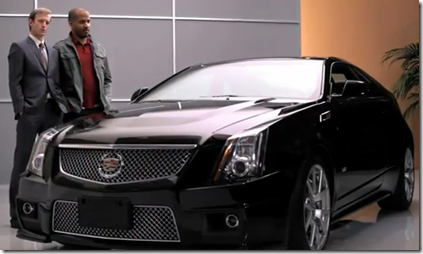
Punch line: In the old days, Cadillac was the badge of excellence.  Calling something the Cadillac of its category was high praise.

Well, Mickey D. wants to fill the void with the Egg McMuffin … suggesting that this breakfast sandwich is somehow synonymous with excellence.

Based on social networking indicators, the idea is getting some traction.

Gotta make you proud to be a marketer …

* * * * *
Excerpted from adweek.com, “Is This Egg McMuffin Ad the Egg McMuffin of Ads? Breakfast sandwich gets new catchphrase

http://www.youtube.com/watch?feature=player_embedded&v=nn1IGSCp2yI#t=0s

Casting the Egg McMuffin as shorthand for excellence is about as odd as grouping it with healthy foods and casting it as a wholesome dietary choice.

But McDonald’s latest commercial for the breakfast sandwich does just that, starting with a girl telling a guy that he’s “the Egg McMuffin of boyfriends” and proceeding from there.

That phrase has caught on quickly, with the Boston Globe reporting on the adoption of the phrase in social media — used ironically or not — with something like 11,000 tweets and 1,200 Facebook mentions.

Check Twitter for various clever uses. It even made Craigslist, where a New Jersey residence was described as “the Egg McMuffin of 2 BR apts in downtown Hoboken.”

Returning to the ad, my favorite part is the Egg McMuffin of cars bit.

That’s how a friend of mine used to describe his old vehicle because it leaked oil and smelled gross.

click to view the commercial
image

Edit by KJM

>> Latest Posts

What if PEs stop trying to turnaround failing companies?

January 17, 2012

The fanned hysteria against private equity firms is ripe with hypocrisy and unintended consequences.

The hypocrisy is almost comedic.

Gingrich was on the board of Forstman-Little.

Obama just promoted Jack Lew – formerly head of Citi’s PE group – to be his chief of staff.  And, don’t forget that Team Obama picked Dan Akerson to run Government Motors. What’s his background?

Prior to joining GM, Akerson was a managing director and head of global buyout for The Carlyle Group in Washington, D.C. In this position, Akerson managed more than $50 billion in assets and more than 200 portfolio companies with several hundred thousand employees around the world. He was instrumental in helping Carlyle achieve 30 percent gross internal rates of returns in the firm’s corporate private equity business.

Gee, sounds a bit like Romney doesn’t it?  I’d even be willing to bet that Akerson closed a few plants and laid off a few people in his time.

That’s not bad.  That’s how failing businesses are turned around.

Which leads me to my bigger point.

Connecting some dots, I see a disturbing trend.

  • A doctor friend of mine opined that if MDs start getting paid based on “success rates” then docs will simply start taking fewer difficult cases … why risk your pay check on on high risk patients? … treat the ones that are certainly curable … bingo, high success rate
  • Similar story with a dedicated teacher friend … asked about pay based on students success (e.g. test score improvement) … he parried: fine, then who’s going to teach the mainstreamed special needs students … or the incorrigible discipline students …  not the teachers striving for high success rates.

Easy to project those stories into the PE debate,

PEs go into turnaround situations knowing that tough actions will need to be taken, that companies will need to be restructured, and that some managers won’t make the cut.  That’s the way businesses are turned around

And, they know that – despite their best efforts – some turnarounds will fail.  That’s part of the game.

If the world lasers in on the unsuccessful attempts, who is going to step-in and start taking on the toughest turnarounds?

If the answer is nobody – or worse yet, the Feds – then those failing companies are certain for demise.

Is that what Gingrich and Obama want?

>> Latest Posts

Looks like a hybrid, runs like a hybrid … it’s eAssist.

January 17, 2012

Punch line: Buick is ducking some common perceptions by calling its new LaCrosse hybrid a “LaCrosse with eAssist”.

Excerpted from BrandChannel

American consumers remain decidedly lukewarm to hybrid vehicles.

Buick is hoping to get around this obstacle by positioning its latest hybrid, a version of the LaCrosse sedan, as a non-hybrid. Instead, GM is touting the “light electrification” system it uses for the car and has come up with a unique brand name for it: “eAssist.”

“When you say ‘hybrid,’ many times that comes with baggage.”

“So for us, the focus was to put an emphasis on the car itself and what this car delivers and how technology enhances the ownership experience.

We’re selling a LaCrosse that happens to have this great [eAssist] technology.”

For example, Buick and its dealers are emphasizing: the quiet ride… and the car’s  “start-stop” capability which halts operation of the engine at stoplights, saving fuel, and then starts it up again when the driver punches the accelerator.

The LaCrosse with eAssist retains a feature that has proven popular with most hybrid purchasers: a screen on the instrument panel that helps them track …  fuel economy.”

The eAssist gauge “is a way for people to show they’ve got something unique, and they can show their friends and families.”

That’ll fool a lot of folks, won’t it?

>> Latest Posts

But people still like him … oh, really?

January 16, 2012

According to the NY Times

A CNN poll released Friday found that 49 percent of Americans have a favorable view of President Obama and 49 percent an unfavorable view.

Hmmm.

For comparison, 43 percent of Americans have a favorable view of Mitt Romney and 42 percent an unfavorable view.

image

>> Latest Posts

Ditch your scissors … mobile couponing is is what’s happening.

January 16, 2012

TakeAway: Sorry coupon printers, people are going mobile with their couponing… Juniper research report reveals global mobile coupon redemption is growing an average 8% yearly … overtaking  the best paper coupon campaigns.

* * * * *
Excerpted from progressivegrocer.com, “Global Mobile Coupon Redemption to be 8 Times Paper by 2016

The global redemption rate of mobile couponing is   growing over 8 percent annually, according to Juniper Research.

According to the “Mobile Coupons Whitepaper,” by 2016 there will be over 600 million regular mobile coupon users worldwide.

The report found that mobile coupons have compelling advantages over their paper … as mobile coupons:

  • Bridge the divide between online and physical retailing
  • Can be individually targeted to drive traffic to stores

For the next few years users will be signing up to multiple coupon schemes and deciding on the ones they like best – so now is a crucial time for mobile marketing agencies to get it right on behalf of their clients and establish a loyal customer base. ”

Other findings from the report include:

  • The integration of mobile coupons and mobile payment data is rare and an untapped opportunity.
  • Redemption values will exceed $43bn globally by 2016, driven by better targeting and mobile apps.

Edit by KJM

>> Latest Posts

Re: PE firms … some academic findings.

January 13, 2012

Punch line: Private Equity has found itself under the media spotlight the past couple of days, thanks to Newt’s shots at Romney.

At the risk of burdening the hysteria with facts, here are the results of some academic studies reported by Business Week

PEs most common strategy is simple: buy an undervalued company, usually with borrowed money to juice returns. Whip it into shape. And after five years or so, sell it back to the public, paying off the debt and keeping the profits.

Private equity firms genuinely unlock value through “strong incentives to management, strong oversight, and operational consulting.” They force bad managers and deadwood employees to look elsewhere for work.

The PEs also benefit from special tax breaks, including the “carried interest” rule that allows them to treat their profits as lightly taxed capital gains.

More specifically …

  • According to Preqin, a London-based data provider, 25 percent of the dollars going to private equity funds from 2009 to 2011 came from public pension funds. That included teachers in Texas, California, and New Jersey. A second big chunk of investment comes from college endowment funds
  • Studies show that private equity firms are excellent at generating returns for their investors … An analysis of 598 buyout funds that existed between 1984 and 2008 found that even after fees, their weighted-average returns to outside investors were 1.27 times the returns on the Standard & Poor’s 500-stock index over the same periods …
  • A Harvard Business School working paper looked at the employment patterns of 3,200 firms targeted by private equity from 1980 to 2005 … the study concludes that in comparison to the control group, the PE firms’ employment shrank “less than 1 percent” in the two years after a deal.

Ken’s Take: The emerging backlash against private equity will likely have some  unintended consequences.

Question: What if the PEs stop investing in failing companies because they get skewed if they either do the necessary restructuring (i.e. shutter plants and jettison deadwood employees) or fail to turn the failing firms around.

Answer: The failing firms fail and all jobs are lost … or the Feds step in and make taxpayers subsidize inefficient, non-economic businesses.

I’d rather have PEs take the risk with private capital …

>> Latest Posts

New Orleans Hits the Jackpot with Football

January 13, 2012

TakeAway: New Orleans fortune of having three college bowl football games and a NFL playoff game expects to bring in almost a half of a billion dollars into the economy.

* * * * *
Excerpt from AdAge: “New Orleans Reaps $400M-Plus Football Bonanza”

The last time New Orleans hosted both a Sugar Bowl and college football’s national championship game the economic impact from that week was $400 million.

Throw in the New Orleans Bowl expected to bring in $25 million and the Saints’ playoff game  expected to reap another $20 million, and New Orleans will earn $445 million from four football games.

Some economists dismiss the theory that big-time sporting events bring economic benefits to cities, but the football numbers stack up pretty well against Mardi Gras, which brings in about $140 million.

And while it took three football games to see that $420 million economic impact. The Super Bowl alone was worth $292 million to New Orleans in 2002.

Edited by ARK

>> Latest Posts

What happens if no presidential candidate gets 270 electoral votes?

January 12, 2012

Below is our original post from January 2012 … way before it’s time.

The facts are still the same, but the context has changed with Obama going head-to-head with Romney … and folks asking “What if they tie?”

Click here for an updated post specific to Obama-Romney

* * * * *
What happens if no presidential candidate gets 270 electoral votes?
The Homa Files, January 2012

There are still rumbles that some candidate (think Ron Paul) might run as a 3rd party candidate.

The conventional pundit wisdom is that a 3rd party candidate who splits off from the GOP would simply siphon off GOP votes and seal Obama’s re-election.

I have another scenario to offer up.

What if Ron Paul ran on a 3rd party ticket and was able to win one or more swing states?

Sounds crazy, but think Wisconsin, Colorado and New Hampshire … ‘wildcard’ swing states with large college populations.

Keep in mind that Paul has enthusiastic support among college kids and young adults … partly driven by his staunch anti-war philosophies, his reverence for the Constitution  and his unshakable candor.

To that point, it’s being reported that — based on exit polls — Ron Paul won over  half of the votes of those under 30 in the New Hampshire contest.

Imagine that Paul wins enough electoral delegates to keep Obama or, say, Romney from reaching the magic number – 270 electoral votes.

What happens if no presidential candidate gets 270 electoral votes?

According to the Electoral College web site …

If no candidate receives a majority of electoral votes, the House of Representatives elects the President from the 3 Presidential candidates who received the most electoral votes. Each State delegation has one vote.

The Senate would elect the Vice President from the 2 Vice Presidential candidates with the most electoral votes, with each Senator casting one vote for Vice President.

So, the Congressional arm that Obama keeps ranting about could be the body that ultimately determines whether he’ll be living in DC or Chicago after the election.

Wouldn’t that ironic twist be fun to watch ?

Click here for an updated post specific to Obama-Romney

>> Latest Posts

Quick: How much tea do Americans drink?

January 12, 2012

No, it’s not a case interview question, but it could be. 

Answer: In 2010, 3 billion gallons of tea was consumed by 154 million folks in the U.S.  That’s about half of the U.S. population drinking a bit under a half-gallon per week per drinker..

Some other factoids from the Tea Association of the USA:

  • tIn 2010, the US imported more tea than the UK
  • Southerners and Northeasterners are the most likely tea drinkers.
  • The split is about 80-20 between black and green tea.
  • The split is about 85-15 between iced and hot.
  • So-called herbal teas aren’t really teas … they’re leaves, roots, bark and/or flowers.

Recent reports have touted tea’s health benefits, especially cardiac health:

“People who drink more tea do appear to have less risk of heart disease, and for those who have developed some cardiac event like a heart attack, those who are tea drinkers seem to have a lower incidence of a second event.”

Researchers suspect that natural components in tea, particularly a class of polyphenol antioxidants known as flavonoids, are responsible for tea’s health benefits

How much tea is needed for good health?

Researchers say 3 to 5  cups per day  is where you start to see benefits.

Tips for maximum health benefits:

  • Ready-to-drink and instant teas are diluted, so you’re not getting as strong a dose of flavonoids as you would from a cup of freshly brewed hot tea,.
  • For optimum flavonoids, drink tea soon after it’s brewed.
  • When you add sugar or buy it sweetened, you turn a zero-calorie beverage that’s great for hydrating the body and has half the caffeine of coffee into a drink loaded calories.

Excerpted from USAtoday.com, “Reading the tea leaves is easy: A brew can be beneficial

Edit by KJM

>> Latest Posts

Reprise: How Beef-Loving Voters Can Get Tofu for President

January 11, 2012

Ken’s Take: This is from the HomaFiles archives – one of my favs.

The original article was inspired by Clinton’s win over elder Bush (the Perot factor), younger Bush’s win over Gore (the Nader factor), and Jesse Ventura’s gov win in Minnesota.

The analysis has relevancy these days, given the way that the not-Romney vote is being carved thin among many conservative GOP presidential contenders.

* * * * *
Excerpted from WSJ: How Beef-Hungry Voters Can Get Tofu for President, March 14, 2003

Those odd ducks who scrutinize returns, calculate how each additional candidate affects the others’ chances and analyze strategic voting are hard at work. I refer, of course, to mathematicians.

Yes, there is a mathematics of elections.

Research has identified various voting systems world-wide in which, paradoxically, becoming more popular can make a candidate lose, abstaining gives your preferred candidate a better chance, and picking a winner means accepting someone a majority of voters don’t want.

This last paradox characterizes the U.S. system of plurality voting (vote for one; the top vote-getter wins). It works fine when there are two candidates, but with three or more, plurality voting can come up short.

For a democracy, the mathematicians’ most robust result is chilling. “It’s surprisingly difficult to identify a voting system that accurately captures the will of the people”.

* * * * *

The Election

So as not to inflame passions with current political examples I’ll illustrate his point with food.

You and two colleagues are planning an office party, and the caterer offers chicken, steak or tofu. You poll 17 invitees:

5 people prefer chicken to steak to tofu.

2 people prefer chicken to tofu to steak.

4 people prefer steak to tofu to chicken.

4 people prefer tofu to steak to chicken.

2 people prefer tofu to chicken to steak.

One organizer tallies the ballots by the plurality method, counting only first-place votes. Chicken wins (7 votes), while steak is last (4 votes).

A second organizer uses “approval voting,” in which voters mark all acceptable choices (everyone’s top two choices are acceptable). Now steak wins with 13, tofu gets 12 and chicken is last with 9.

The third organizer uses a point system that gives their first choices 2 points, second choices 1 and last picks 0. Now tofu wins with 18, steak gets 17, chicken 16.

The ‘winner’ changes with the choice of election procedureAn ‘election winner’ could reflect the choice of an election procedure” rather than the will of the people.

* * * * *

It gets better. Thanks to a mathematical property called non-monotonicity, in some voting systems, ranking a choice higher can defeat it.

In a plurality-with-runoff system, the two candidates with the most first-place votes face one another in round two.

This time, we invite other departments to our office party, and get this first-round result:

27 prefer chicken to steak to tofu.

42 prefer tofu to chicken to steak.

24 prefer steak to tofu to chicken.

Chicken (27 votes) and tofu (42) reach the runoff. Assuming steak fans maintain their preference and give their second-round votes to tofu, tofu wins the runoff.

That seems fair.

But what if four people in the group of 27 chicken lovers are last-minute converts to vegetarianism and, in round one, prefer tofu to chicken to steak, like the group of 42?

Now steak (24 first-place votes) and tofu (46) make the runoff, in which steak beats tofu 47 to 46. Tofu’s late surge turned its win into a loss.

* * * * *

Such paradoxes tend to occur under specific but far from unusual circumstances.

With plurality voting, the most common is when two centrists face an extremist. The majority splits its vote between the centrists, allowing the fringe candidate to squeak in. In Minnesota’s 1998 governor’s race, Hubert Humphrey got 28% of the vote, Norm Coleman 34% and Jesse Ventura won with 37%, even though most voters ranked him last.

* * * * *

Thanks to such outcomes, scientists say what’s most needed is “a way for voters to register their second and third choices … especially in primaries, where there tends to be a large field.” Both a ranking system (give candidates 4, 3, 2 or 1 point) and approval voting accomplish that.

The U.N. chooses a secretary-general by approval voting. “It is particularly appealing in elections with many candidates … If your favorite candidate is a long shot, you can vote for both him and a candidate with a better chance without wasting your vote on the long shot. Approval voting would do a lot to address the problem of presidential-primary victors not being the choice of most voters.” Approval voting could well make more people (especially supporters of long shots) feel their ballot matters.

Still, no system is perfect. As Nobel-winning economist Kenneth Arrow proved mathematically in 1951, no voting system is guaranteed to be free of paradoxes in a race with three or more candidates, except one — a dictatorship.

Looks like a K-cup, works like a K-cup … a patent-dodging imitator goes after Green Mountain

January 11, 2012

Punch line: Green Mountain Coffee Roaster’s  K-cups seem to be everywhere these days.  A nice little patent-protected moneymaker for GMCR.  That is, until a small company found a way around GMCR’s patents … or at least, thinks that it did.

* * * * *
Excerpted from Investorsplace. com: “The No-Name Private Company Sticking It to Green Mountain

Imagine you’re Green Mountain Coffee Roasters.

Your Keurig single-cup coffee brewer is wildly successful, and you recently struck deals with Starbucks to carry the Seattle coffee giant’s grounds as exclusive cups for the machine.

Shares of GMCR stock are up 700% since 2009 and have more than doubled since Jan. 1, 2011.

Green Mountain Coffee revenue has increased from about $340 million in fiscal 2007 to a forecast of $2.7 billion for fiscal 2011!

It’s good to be Green Mountain. Right?

Well, now imagine that after all this success at GMCR, a tiny family company in California is moving in on your turf.

Not only is it imitating your ideas — but it actually is using the fancy Keurig machines Green Mountain produces as a selling point!

It would be frustrating. It would be infuriating. But it appears to be completely legal.

Here’s the score:

Rogers Family Co., a coffee roaster and distributor based in Lincoln, Calif., has developed single-cup pods completely compatible with Keurig’s famous coffee brewer.

The closely-held company apparently sidesteps the patent protection of Keurig’s K-Cups because it uses a mesh screen on the bottom of the pots instead of plastic.

Not only does this allow the family-operated business to enter into the booming Keurig market, but it could give Rogers a chance at making a big splash with perhaps the cheapest brew out there.

A 12-pack of Rogers Family’s cups will have a recommended retail price of $6.99 and will be distributed to supermarkets including Costco, Safeway  and SuperValu.

By contrast, Dunkin’ Donuts branded K-Cups sell for $11.99 per 12-pack.

Not likely that Green Mountain will take this one sitting down.

Cue the patent attorneys … this one’s not over.

>> Latest Posts

Marketing Strategy Rule #1: Follow the money …

January 10, 2012

When diagnosing a current marketing strategy or developing a new one, most marketers jump right in to thinking about market segments, products, or ads.

Wrong.

I  encourage my students to always, always, always start with an analytical understanding of the business economics: how companies make money in the business.

It’s “Ken’s Rule #1” of strategy …

image

Historical note: During Nixon’s Watergate scandal, a source to Washington Post’s Woodward and Bernstein – nicknamed “Deepthroat” – kept telling the investigative journalists to “follow the money”.  That advice coined the now popular expression.

>> Latest Posts

HOT: Can problem-solving be learned?

January 10, 2012

Here’s another HOT – Homa Online Tutorial – straight from the classroom to you via the HomaFiles.

* * * * *

I sometimes get asked: Can problem-solving be learned or is hardwired into people’s DNA?

My view: DNA can help (e.g. raw brainpower can help) but “ordinary” folks can become adept problem-solvers.

How?

By internalizing models  i.e. simplifying frameworks) and protocols (i.e. analytical methods) … and applying them in a variety of contexts.

In doing so, the “devices” can be stored sub-consciously and retrieved consciously to solve problems.

That’s called intuition.

click to view

image

>> Latest Posts

Since O’s election, Democratic ranks shrinking …

January 10, 2012

According to Rasmussen:

  • 35.4% of Americans consider themselves Republicans
  • 32.7% of adults say they are Democrats,
  • 32.0% say they are independents — not affiliated with either of the major political parties

Versus 2009 (end of Obama’s first year in office):

  • Democrats’ affiliation is down, 2.8 percentage points (about 8%)
  • Republicans’ affiliation is up 1.4 percentage points (about 4%)
  • Independents are up 1.4 percentage points (about 4%)

All of which squares with my observation that I haven’t run into a single McCain voter who says they’ll vote for Obama in 2012 … but, I’ve run into many Obama ‘08 voters who say they won’t vote for him again.

image

Source: Rasmussen

>> Latest Posts

Ring it up yourself? Shoppers say “no thanks”

January 10, 2012

Punch line: Due to low usage rates and limited popularity among younger shoppers, self-service checkouts are becoming phased out at a few retailers. Yet, these self-checkouts can result in lower labor costs. A cost vs. benefit situation results…

* * * * *
Excerpted from pittsburghlive.com, “Self-service checkouts fall from favor

… Despite an almost universal dislike for standing in long or slow checkout lines, an overwhelming majority of shoppers opt for cashier-assisted lanes instead of self-service, according to the 2011 “Food Retailing Industry Speaks” report …

Self-service checkouts — introduced nationwide about a decade ago — have fallen in popularity. About 16 percent of supermarket customers used the self-service lanes in 2010, down from almost 20 percent in 2006 …

Almost 85 percent of customers choose a cashier to ring up their purchases when at least one self-service lane is available …

Perhaps as a result, supermarket chains such as Albertsons of Boise and Big Y Foods are removing self-service checkouts …

Self-checkout lines get clogged when  customers need to wait for store staff to assist with problems with bar codes, coupons, payment problems and other issues that invariably arise with many transactions.

Stores that remove self-service checkouts are creating more opportunities for customers to interact with the staff, thus increasing customer service …

Edit by KJM

>> Latest Posts